



The Ultimate Guide to Dual Citizenship Taxes and Accounting in Canada
Dual Citizenship Taxes Canada: A Clear Guide to Dual Citizen Tax Filing and Accounting with Gondaliya CPA
Dual citizenship taxes Canada can be complex, but Gondaliya CPA provides clear guidance on dual citizen tax filing Canada and dual citizen accounting Canada. Their expert approach helps clients meet dual citizenship tax obligations Canada while managing cross-border income and reporting requirements effectively.
Quick Summary
Two systems, two tests, one taxpayer. Canada taxes on residency — live here and worldwide income goes on a T1, with Form T1135 once specified foreign property passes CAD 100,000. The United States taxes on citizenship — hold the passport and a 1040 is due every year wherever you live, plus FBAR on FinCEN 114 once foreign accounts pass USD 10,000 and Form 8938 above its own FATCA threshold. Relief runs through the Foreign Earned Income Exclusion on Form 2555, which reaches earned income only, or the Foreign Tax Credit on Form 1116, which reaches everything and carries forward ten years. Where both countries claim you as resident, the tie-breakers in Article IV decide. And the Canadian accounts that work perfectly here — TFSA, RESP, RDSP, Canadian mutual funds as PFICs — are precisely the ones that cause trouble on the other return.
Reading time: 15 minutes.
Table of Contents
- Overview of Dual Citizenship Taxes
- U.S. Filing Requirements for Dual Citizens
- Canadian Filing and Reporting Responsibilities
- FBAR, FATCA, Departure Tax and Renunciation
- How Gondaliya CPA Supports Dual Citizens
- Real-World Scenarios and Resources
- Frequently Asked Questions
- Essential Topics for Foreign Income and Estates
- Businesses We Serve & Industry Spotlights
- Professional Guidance and Quick Reference
The Numbers That Matter
This article covers Canadian federal income tax with United States cross-border context, and Ontario and Toronto context, and reflects rules current to 16 October 2026. It is written for dual citizens resident in Canada, most often those also holding United States citizenship, and it covers worldwide income reporting, foreign property and account disclosure, treaty tie-breakers, registered plans, departure tax and renunciation. It is not advice on immigration or citizenship law, on the process of renouncing a citizenship, or on consular matters. Gondaliya CPA performs compilation engagements under CSRS 4200, which provide no assurance; audit and review engagements are referred out. This is educational information only and not tax or legal advice.
Overview of Dual Citizenship Taxes for Canadians
Overview of Dual Citizenship Taxes
Two Systems
Dual citizenship taxes Canada can get tricky. If you hold citizenship in two countries, like Canada and another, you still have to report all your income worldwide if you live in Canada. The Canada Revenue Agency (CRA) wants to see your full tax picture.
If you are a dual citizen tax filing Canada means telling the CRA about all your earnings, no matter where they come from. This includes money made in both countries.
You must follow CRA rules closely. They require Canadians—dual citizens included—to report foreign income and assets. Ignoring these rules could lead to penalties or fines.
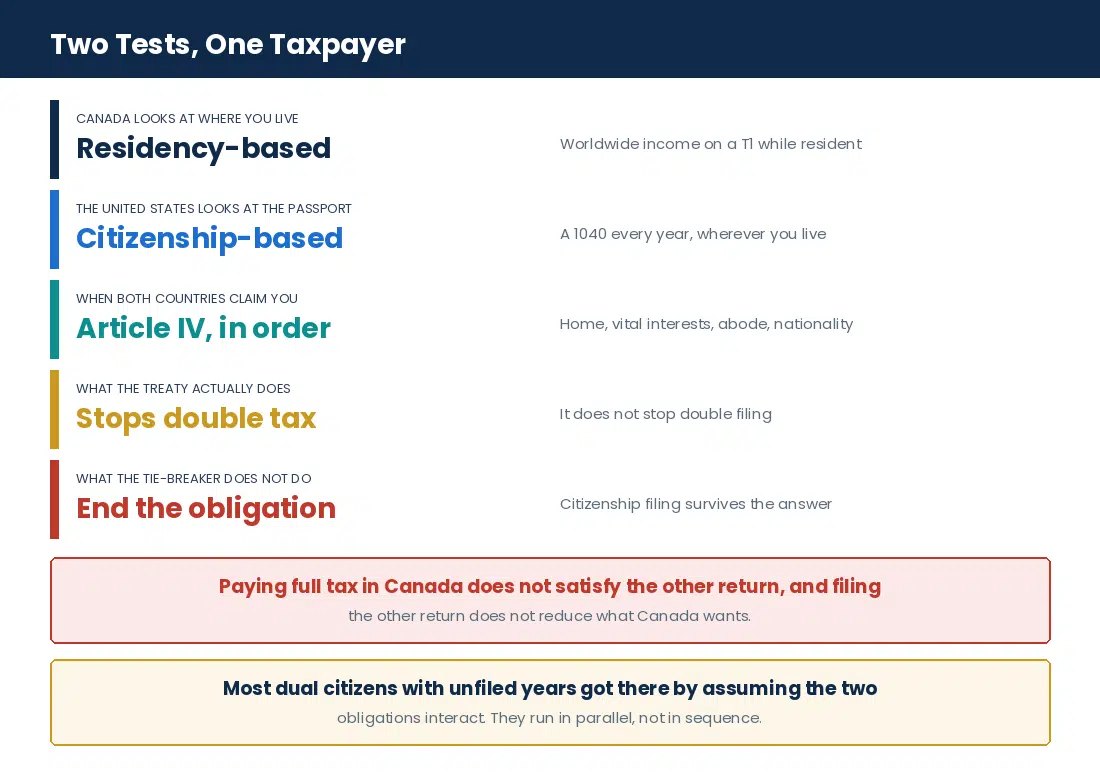
Key Differences Between U.S. Citizenship-Based Taxation and Canadian Residency-Based Taxation
Dual citizenship taxes Canada can differ a lot depending on where you pay taxes. The United States uses citizenship-based taxation. That means American citizens pay tax on all income, no matter where they live.
Canada works differently. It taxes people based on residency. If you live in Canada, you pay tax on worldwide income. If not, then you usually don’t.
Here’s a quick look:
- U.S. citizens abroad still file yearly with the IRS.
- Canadian residents with U.S. citizenship report foreign income only if it passes CRA thresholds.
Knowing these differences helps when planning your dual citizen accounting Canada needs.
The hardest idea to land in a first conversation is that the two obligations do not interact the way people expect.
Paying tax in Canada does not satisfy the US return, and filing the US return does not reduce what Canada wants. The treaty stops the same income being taxed twice; it does nothing at all about the same income being reported twice. Nearly every dual citizen who arrives with unfiled years arrived there by assuming otherwise. Figures changed for privacy.
Citizenship Acquisition and Its Impact on Tax Obligations
Getting a second citizenship changes your tax duties in many ways. Whether you get it by birth or naturalization, it can affect how and what you owe in taxes.
For dual citizenship tax obligations Canada expects full disclosure of foreign accounts and investments worth more than CAD 100,000.
The CRA’s foreign property rules mean missing this info might bring penalties—even if no extra tax is due.
Always check the limits and rules when gaining another nationality so that your dual citizen tax filing Canada stays clean.
Dual Citizenship Recognition Issues and Consular Access Limitations
Some countries don’t recognize dual citizenship well—or at all. That can cause trouble when trying to use consular services or when traveling.
In those cases, authorities may treat you as only their citizen, ignoring the other nationality. This mismatch can lead to confusing situations about which country’s laws apply.
For dual citizenship taxes Canada residents face, this recognition issue might complicate compliance or reporting obligations.
Being aware of these limits helps avoid accidental mistakes when dealing with tax authorities or consulates abroad.
Brazil/Canada Tax Treaty and Its Role in Preventing Double Taxation
The Brazil-Canada Tax Treaty helps people avoid paying tax twice on the same income if they earn money in both places.
This treaty allows:
- Tax credits for taxes paid overseas.
- Exemptions for certain passive investment incomes under specific conditions.
Following this treaty and working with good dual citizen accounting Canada experts means less hassle paying taxes twice or overpaying.
Understanding how such agreements work makes managing cross-border finances much smoother for those with ties to Brazil and Canada alike.
U.S. Tax Filing Requirements for Dual Citizens Living in Canada
U.S. Filing Requirements for Dual Citizens
The US Side
U.S. Tax Filing Obligations for Canadian Dual Citizens Regardless of Residency
If you’re a Canadian dual citizen, you need to file U.S. tax returns no matter where you live. The U.S. taxes its citizens on income earned anywhere, so even if you live only in Canada and pay Canadian taxes, the IRS still wants your annual return. You also have to report foreign bank accounts and financial assets because of FATCA rules.
Missing these filings can lead to fines or interest charges, whether or not you owe extra tax. So, dual citizens must know their filing duties alongside their Canadian tax responsibilities.
Important IRS Filing Thresholds and Deadlines Relevant for 2025 and 2026
For the 2025 tax year (to be filed in 2026), here are some key IRS numbers:
- Standard Deduction (Single): USD $14,000
- FBAR Reporting Threshold: USD 10,000 aggregate value in foreign accounts at any time during the year
- FBAR Filing Deadline: April 15 (automatic extension to October 15 available)
- Income Tax Return Due Date: April 15 (extension until October 15 available)
If you miss these deadlines, you could face penalties or get extra attention from both the CRA and IRS.
Foreign Earned Income Exclusion (FEIE) Qualification Criteria and Application
The FEIE lets U.S. citizens living abroad exclude up to USD 120,000* of foreign earned income from U.S. taxes (this amount changes yearly). To qualify, you must:
- Have your tax home outside the U.S.
- Pass either the bona fide residence test (live abroad a full calendar year) or physical presence test (be outside the U.S. for 330 full days in a 12-month period).
You must file Form 2555 with your tax return to claim this exclusion and show that your income came from work done while outside the U.S.
Note: FEIE is not automatic; you need to apply each year.
Using the Foreign Tax Credit (FTC) to Offset U.S. Tax Liability on Canadian Income
The FTC helps reduce double taxation for dual citizens who pay Canadian taxes on income also taxed by the U.S.. You can claim credits on your U.S. taxes for foreign taxes paid by filling out Form 1116.
Some points about FTC:
- Only foreign taxes actually paid or accrued qualify
- Credits cannot exceed the U.S. tax due on that foreign income
- Unused credits can roll back one year or forward ten years
- Keep official CRA notices as proof when claiming
Using FTC cuts down your overall tax bill but requires careful calculations based on both countries’ rules.
Comparison Between FEIE and FTC for Dual Citizens Residing in Canada
| Feature | Foreign Earned Income Exclusion | Foreign Tax Credit |
|---|---|---|
| Applies To | Earned wages or self-employment only | All types of taxable foreign income including investments |
| Maximum Benefit | Up to USD $120,000 excluded | Limited by US tax on that income |
| Required Forms | Form 2555 | Form 1116 + proof of foreign taxes paid |
| Effect on Other Deductions | May limit some deductions | No direct effect |
Many Canadians find FTC better since they often have mixed income sources beyond wages. But FEIE is still useful if you meet its criteria.
Offshore Streamlined Compliance Procedures for Late or Non-Filers
If you missed filing some past returns, the IRS has streamlined programs just for people like dual citizens who failed unintentionally:
- These programs reduce penalties if you come forward voluntarily before an audit starts
- You submit overdue returns plus reports like FBARs
- You must certify the omissions were accidental, not intentional
Getting professional help is smart here since these procedures have strict rules and paperwork to avoid big trouble later.
The word that matters in the streamlined programs is “non-willful”, and it has to be certified rather than assumed.
For most dual citizens it is the plain truth — nobody told them, so they did not file. But the certification is a signed statement, and it is far easier to make while coming forward voluntarily than after a letter has arrived. The timing is the whole advantage. Figures changed for privacy.
IRS Publication – Standard Deduction · FinCEN FBAR Instructions · Tax Policy Center – Expats & Taxes · IRS Streamlined Procedures
If you want help sorting out your dual citizenship taxes Canada obligations, contact Gondaliya CPA at info@gondaliyacpa.ca or call 647‑212‑9559 for a free chat about your situation anywhere in Ontario or across Canada including Toronto.
Canadian Tax Filing and Reporting Responsibilities for Dual Citizens
Canadian Filing and Reporting Responsibilities
The Canadian Side
Canadian tax rules for dual citizens depend on where you live, not just your citizenship. If you’re a Canadian resident, you must report all your income worldwide every year on your T1 tax return. This includes money earned from jobs, investments, rentals, or capital gains anywhere in the world. If you own foreign property that costs more than the CRA limit, you need to file Form T1135 to avoid penalties. Keeping clear records of all income helps meet dual citizenship taxes Canada requirements.
When it comes to dual citizen tax filing Canada demands that you report earnings from all countries no matter your other citizenship. Missing this can lead to reassessments and extra charges under the Income Tax Act. Firms like Gondaliya CPA specialize in handling these complex dual citizenship tax obligations Canada residents face.
Canadian Tax Obligations for Dual Citizens With U.S. Citizenship
Dual citizens who also have U.S. citizenship face special tax challenges because both countries have their own rules. Canada taxes based on where you live, but the U.S. taxes its citizens on all their income worldwide no matter where they live. This means you must file IRS Form 1040 along with your Canadian return.
Besides the usual T1 and foreign property forms (like T1135), you must be careful when claiming foreign tax credits to avoid paying tax twice. These situations make dual citizen tax filing Canada tricky without expert help.
Tie-Breaker Rules Under Article IV of the Canada/U.S. Tax Treaty to Determine Residency
| Test Order | Description | Evidence Needed |
|---|---|---|
| Permanent Home | Where you keep your main dwelling | Property deeds, lease agreements |
| Centre of Vital Interests | Where family & work ties are closest | Family location, business records |
| Habitual Abode | Country where most days are spent | Travel logs, entry stamps |
| Nationality | Your citizenship status | Passport copies |
Tax Treatment and Reporting of Canadian Registered Retirement Savings Plans (RRSP)
For dual citizen accounting Canada experts say RRSPs grow without tax inside Canada but get complicated across borders. On your Canadian tax return (Schedule 7), report any RRSP contributions and withdrawals.
If you’re a U.S.-resident or citizen too, you may need to disclose RRSPs using IRS forms like 8891 or FBAR because the IRS might treat them as PFICs if not reported right.
Reporting RRSPs carefully helps keep both countries’ tax rules happy and uses deductions properly on returns filed by firms like Gondaliya CPA in Ontario.
Impact of Canada/U.S. Totalization Agreement on CPP and OAS Benefits
The Totalization Agreement links Canada’s social benefits—CPP (Canada Pension Plan) and OAS (Old Age Security)—with U.S. programs.
Here’s how it works:
- Contributions made in one country count toward benefits in both.
- It stops double social security taxes.
- It affects how pensions show up on your returns when filed by dual citizen accountant Canada clients trust.
Knowing this deal prevents paying twice while respecting each country’s pension rules per CRA guidance.
Reporting Requirements for Tax-Free Accounts: TFSA, RESP, and RDSP Considerations
Tax-Free Savings Accounts (TFSA), Registered Education Savings Plans (RESP), and Registered Disability Savings Plans (RDSP) give big perks inside Canada but can cause reporting puzzles for dual citizens.
Though earnings inside these accounts aren’t taxed by Canada:
- Other countries may see TFSA growth as taxable.
- You still have to report these accounts per CRA rules.
- No income goes on your T1 return unless you withdraw funds.
Gondaliya CPA recommends tracking contributions and withdrawals well for yearly filings across provinces including Ontario.
Tax Implications of Canadian Mutual Funds and Potential PFIC Exposure in the U.S.
Canadian mutual funds owned by U.S.-citizen duals often trigger PFIC rules under U.S. law causing heavy taxes if missed.
From a dual citizen accounting viewpoint:
- These investments need special IRS elections like QEF or mark-to-market treatment.
- You must file these separately from RRSP or RRIF reports.
- Wrong classification leads to big penalties even if Canadian filings look fine.
Cross-border accountants familiar with both systems lower risks tied to mutual fund holdings among international clients served by firms such as Gondaliya CPA in Toronto.
$100K CAD — Current specified foreign property cost threshold triggering Form T1135 requirement. CRA source
All worldwide income must be reported yearly by residents no matter how many citizenships they hold. ITA s150
Forgetting to report foreign assets can cause fines up to $25/day capped at $2,500 plus interest. CRA Notice
Keep dated records showing all foreign assets’ values with consistent exchange rates. CRA Currency Conversion guide
Our Take: Good recordkeeping plus expert review avoids costly mistakes common among multi-country taxpayers helped regularly from Toronto offices.
The accounts that cause the most trouble are the ones nobody worries about — the TFSA opened on sound Canadian advice, the mutual funds held for a decade. Neither is a mistake here. Both are a problem there. Figures changed for privacy.
CRA – Specified Foreign Property Reporting Threshold · Income Tax Act RSC 1985 c 1 (5th Supp). Sections 150 & penalty provisions · IRS Worldwide Income Requirement · CRA Foreign Tax Credit Limits · Convention Between Canada and the United States of America With Respect to Taxes on Income and on Capital, Article IV Residence · CRA Guide RC4110 – Registered Retirement Savings Plan · IRS Publication 590-A/B re PFIC implications · Social Security Agreements Overview – Government of Canada & USA joint site · CPP/OAS totalization details – Service Canada official page · CRA Pensions Guide ITA Section references · TFSA / RESP / RDSP Official Guidance – Government sites · Disclosure requirements per form instructions · PFIC Rules Summary – Internal Revenue Service FAQs · Cross-border planning articles from professional bodies
Dual Citizen Filing Check
Five quick questions on where your filings stand. No fee shown.
Points to raise with us:
This is a general prompt, not tax or legal advice or a quote. Your position depends on your full facts. For a real review, please book a free consultation.
FBAR and FATCA Reporting Obligations: Thresholds, Forms, and Deadlines
FBAR, FATCA, Departure Tax and Renunciation
Disclosure
If you hold dual citizenship with Canada and the U.S., you must deal with some tricky rules. FBAR and FATCA are two U.S. laws that require you to report foreign financial accounts when their value goes over certain limits. This affects your dual citizenship taxes Canada responsibilities.
You must file an FBAR if your foreign accounts add up to more than USD 10,000 at any point in the year. The form is FinCEN 114, filed online by April 15. You get an automatic extension to October 15 if needed. FATCA requires Form 8938 along with your tax return if your foreign assets cross certain thresholds—usually starting at USD 50,000 for people living in the U.S., but more if you live abroad.
Canadian residents who are also U.S. citizens or green card holders face these extra requirements on top of their Canadian tax returns. While dual citizen tax filing Canada doesn’t include FBAR or FATCA forms, you still need to report properly to avoid penalties.
Deadlines to remember:
- FBAR: April 15 (auto-extension to October 15)
- FATCA Form 8938: Same deadline as your income tax return
Penalties for missing these can be steep. Non-willful mistakes can cost up to USD 12,921 per slip-up. Willful failures may cost over USD 100,000 or more.
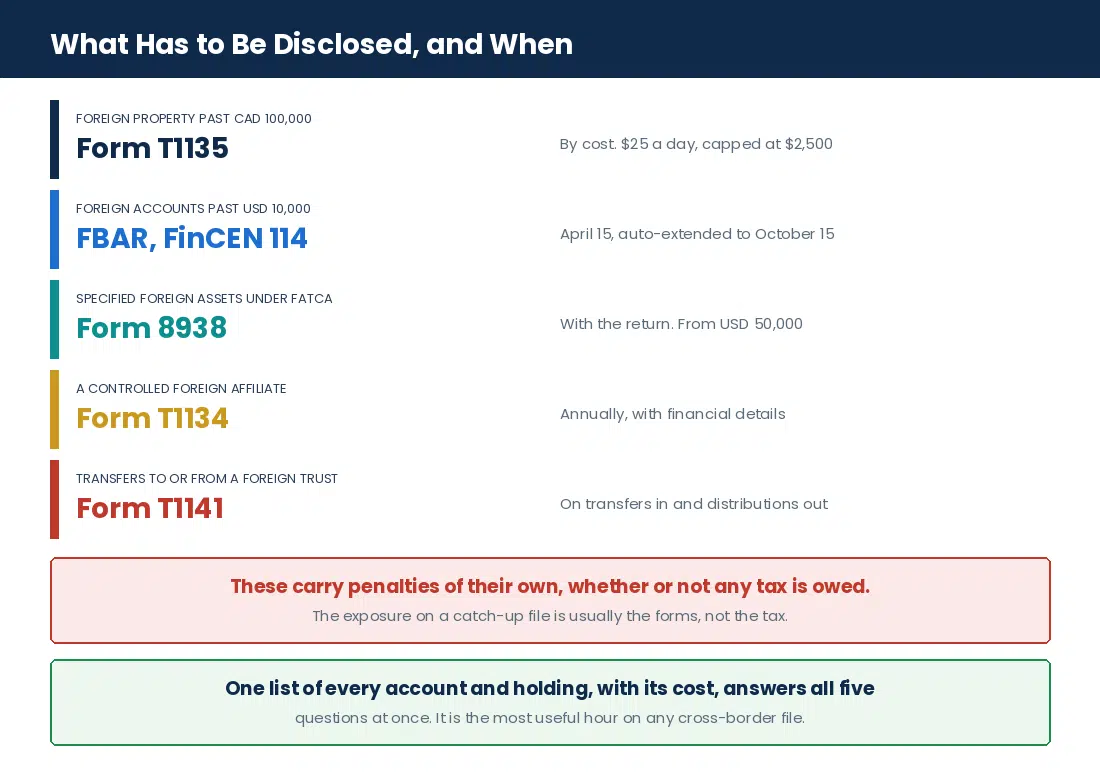
Penalties and Risks Associated with Non-Compliance in Cross-Border Reporting
Ignoring dual citizenship tax obligations Canada can lead to serious trouble. You may face heavy fines, interest on unpaid taxes, audits from CRA or IRS, and damage to your reputation.
Canadian residents must report all worldwide income on their T1 tax forms under section 150(1)(a) of the Income Tax Act. You also have to file form T1135 if your foreign property is worth over CAD 100,000. Missing this triggers penalties starting at CAD 25 per day up to CAD 2,500 max plus reassessments.
Cross-border reporting mistakes can cause CRA to work closely with other countries’ tax agencies. They share info that might trigger audits when what you report doesn’t match third-party data.
If you deliberately hide info or lie on your returns, penalties spike sharply—and criminal charges could follow under sections 239(1)(a), (b). These deal with knowingly giving false info.
To lower risks:
- Use CRA’s voluntary disclosure program
- Keep detailed records including currency conversions
- Work with accountants who know dual citizen accounting Canada issues
Managing Canadian Accounts to Avoid U.S. Tax Traps and Reporting Complexities
Dual citizen accounting Canada means you have to manage bank accounts carefully because both countries want reports about money there—especially if you’re a U.S. citizen too.
U.S. rules like FATCA make Canadian banks identify customers who owe taxes in the U.S., no matter where they live. That means Canadian accounts look like “foreign” accounts from a U.S. view.
To avoid messes:
- Keep clear records about who owns what account
- Use bookkeeping tools that work in both countries
- Watch currency changes when tracking transactions
Don’t mix funds carelessly—that can trigger taxable events or complicated departure tax calculations later (explained below).
A specialized accountant who handles dual citizen accounting Canada can help keep you compliant and organized without errors.
Canadian banks now ask the question at account opening, and that single change is what brings most people in.
FATCA means a bank here has to identify customers with US reporting obligations. Someone who has lived in Canada their whole life, holding citizenship only because a parent was American, finds out when the branch asks. The information goes where it goes, and the unfiled years are suddenly visible. Figures changed for privacy.
Departure Tax Implications When Exiting Canadian Tax Residency
When you stop being a resident of Canada for tax purposes—that’s different from giving up citizenship—you might owe “departure tax.” The Income Tax Act’s subsection 128.1(4) says most capital properties you own are treated as sold at fair market value right before you leave.
| Item | Who Reports | Records Needed | Return/Form | Risk If Wrong |
|---|---|---|---|---|
| Deemed disposition amount | Departing resident | Fair market value & cost base | Final T1 return | Capital gains reassessment + interest |
This deemed sale applies widely but some things like certain foreign real estate might be exempt (check treaty rules). The gain adds taxable income and may mean installment payments before departure deadlines set by CRA.
Getting the date wrong or misstating values can lead to reassessments plus penalties and interest. Keeping good records and working with a knowledgeable CPA is wise here.
Tax Consequences of Renouncing U.S. Citizenship for Canadian Dual Citizens
Renouncing U.S. citizenship has special effects on your taxes apart from changing residency status. Dual citizens who give up their US citizenship face unique dual citizenship tax obligations Canada residents should know about.
The IRS Section 877A imposes an exit tax based on unrealized gains exceeding certain limits near the renunciation date. You might owe this even if you live fully in Canada afterward.
Canada does not charge this exit tax directly but offers treaty relief so you don’t pay twice where treaties apply.
It’s crucial to document everything well during renunciation—valuation dates, asset details—since errors affect future claims against leftover US tax debts years later.
This guide does not cover immigration law around renunciation; only legal experts handle those parts.
Important Considerations When Returning to Canada from Abroad
Coming back to Canada while holding another citizenship brings filing challenges around previous international income and current local rules covering dual citizen tax filing Canada style.
Once you re-establish residency under section 250 ITA, global income becomes taxable again. You’ll need to reconcile past unreported earnings abroad with new returns here. Also watch out for T1135 filings if your foreign property hits threshold levels.
Keep good records of past overseas jobs — contracts, start/end dates — plus proof of how long you stayed away. This helps nail down proper filing periods and avoid mistakes common among returnees unfamiliar with current CRA rules.
Many Canadians use firms familiar with Ontario’s regulations offering catch-up filing services that fix gaps fast while avoiding costly delays caused by incomplete paperwork discovered during audits triggered by info-sharing worldwide since early 2020s reforms aimed at offshore evasion crackdowns.
Following these steps protects taxpayer rights while meeting all filing demands professionally from start through finish.
How Gondaliya CPA Supports Dual Citizens with Tax Filing and Accounting Services
How Gondaliya CPA Supports Dual Citizens
Support
Gondaliya CPA helps dual citizens with taxes in Canada. We know how tricky dual citizen tax filing Canada can be. Our firm offers full dual citizen accounting Canada services to keep things clear and correct. We understand the rules for Canadian residents who have a second citizenship. This includes reporting income from all over the world, foreign assets, pensions, and cross-border transactions.
We map income carefully between countries. We find foreign property that must be reported on Form T1135. Then, we prepare tax returns that include all credits and deductions clients qualify for. Many clients trust us, shown by 1300+ 5-star Google reviews. We offer flat-fee annual packages that cover everything from bookkeeping to complex tax filings. Plus, we respond within one business day and help with CRA representation if needed.
We use tools like QuickBooks and Hubdoc to keep records organized. This helps clients stay on top of dual citizen accounting Canada rules. Clear documentation lowers audit risks tied to foreign income or assets.
Best Practices for Maintaining Compliance With Both CRA and IRS Requirements
Dual citizenship tax obligations Canada mean you must follow rules from both the CRA and, if applicable, the IRS. Canadian law requires reporting worldwide income under sections 2(1) and 3 of the Income Tax Act. US citizens must also watch IRS rules carefully. Don’t assume you can skip filing just because you hold a second passport.
Here’s what you should do:
- Keep an updated list of foreign accounts if they total more than $100,000 CAD (this triggers T1135).
- Separate foreign employment income from investment or rental earnings.
- Track payments made abroad that count toward foreign tax credits (section 126(1) ITA).
- Check current treaties’ residence articles before claiming tie-breaker relief.
- Never assume treaty benefits apply without checking first.
Regular reviews prevent late filings or incomplete reports that bring penalties—even when no extra taxes are due.
Keep these records too:
- Currency conversion rates used (per CRA rules)
- Receipts for tax credit claims
- Pension statements linked to treaty articles
- Letters about catch-up filings from past years
Practical Steps for Claiming Tax Credits and Treaty Benefits Effectively
Claiming credits under dual citizenship taxes Canada needs careful proof. Follow Income Tax Act sections 126(1) and 20(11), plus bilateral treaty rules about pensions, dividends, interest, royalties, social security agreements, and more.
Here’s a simple checklist:
- Get Proof of Foreign Taxes Paid: Use official documents showing withholding amounts by country.
- Sort Income Types Right: Know if income is employment or passive investment since credit limits differ.
- Apply Credit Limits Per Country: Don’t mix up limits; extra amounts may be deductible but not credited.
- Use Treaty Rules Wisely: Look up specific articles about government pensions or exemptions to lower taxable amounts without breaking Canadian laws.
- Keep Detailed Records: Save copies of foreign tax returns plus payment proof matching Canada’s fiscal year.
This process helps you get all reliefs you deserve while avoiding mistakes during CRA audits.
Utilizing Professional Assistance Versus DIY Filing for Complex Cases
Dual citizen tax filing Canada gets complex fast. Worldwide income reporting, Form T1135 disclosures, pension treaty details, and estate issues often need expert help.
Professional accountants offer:
- Know-how with tricky laws like subsection 233(4) ITA about non-resident trusts
- Correct use of tie-breaker tests in treaties to avoid wrong residency claims
- Cross-border accounting including multi-currency bookkeeping systems
- Advice on legal ways to plan deductions versus credits without breaking rules like asset retitling
DIY filing might work if your situation is simple — small foreign holdings below reporting levels and straightforward jobs outside taxing countries needing no return there. But mistakes can lead to reassessments costing time and interest later.
Bottom line: Using a pro with cross-border experience cuts risks sharply and gives peace-of-mind through clear compliance processes at firms like Gondaliya CPA who serve Ontario residents across Canada.
The genuinely simple dual citizen file exists, and it is worth saying so rather than pretending otherwise.
One employer, one country of income, no foreign holdings near any threshold, nothing registered beyond an RRSP. That person can reasonably file themselves. The moment a TFSA, a mutual fund, an inherited asset or a missed year enters the picture, the arithmetic changes — not because the work is harder, but because the cost of getting it wrong stops being small. Figures changed for privacy.
Scheduling Consultations and Accessing Resources for Cross-Border Tax Management
Start managing your dual citizenship taxes Canada right by booking a consultation with experts who know CRA rules inside out—and understand international treaty obligations too. Early talks help gather what you need: past notices, passports or IDs, detailed asset lists—these matter during intake at firms focused on cross-border issues.
Common resources include:
- Checklists showing required documents
- Guides explaining “specified foreign property” definitions
- Info on how pensions get treated under treaties
- Tips on avoiding penalties for late Form T1135 or unreported years
Reach Gondaliya CPA anytime during business hours at 647‑212‑9559 or info@gondaliyacpa.ca for support backed by over 30 years handling tricky cases involving multiple countries—including Ontario taxpayers living anywhere in Canada needing clear advice tied to their second citizenship status.
Real-World Scenarios Illustrating Common Dual Citizenship Tax Situations
Real-World Scenarios and Resources
In Practice
When dealing with dual citizenship taxes Canada, things can get tricky fast. For example, a Canadian resident with dual citizenship who earns rental income from property abroad must report all that income on their Canadian tax return (T1).
They also need to keep good records—things like currency conversions and expenses matter here. If they don’t report it right, CRA can charge interest and penalties for not declaring specified foreign property. Figures changed for privacy.
Another case: a dual citizen living part of the year outside Canada earns Canadian employment income. They only declare the income earned in Canada on their T1 return. But they may still need to file taxes in their other country too.
Pensions paid abroad can cause trouble as well. A dual citizen living in Canada might get pension payments taxed by both countries. In such cases, they must apply tax treaty reliefs if available and report those pensions correctly using Schedule A or Form T1135. If they mess this up, double taxation can hit hard.
So, depending on where you live and what income you have, dual citizenship tax obligations Canada demand different filings. Keeping good records helps avoid audits or penalties.
Client Success Stories Demonstrating Efficient Tax Resolution Strategies
At Gondaliya CPA, we help many clients handle complex dual citizen tax filing Canada problems with smart accounting solutions.
One client inherited foreign assets but had no cost base documents for capital gains.
Our team tracked down old estate papers and gathered info from overseas to confirm accurate adjusted costs. This saved them from potential reassessment risks. Figures changed for privacy.
In another case, a household with mixed citizenship had various foreign incomes.
We set up bookkeeping systems using QuickBooks and Hubdoc to track everything clearly across countries. We made sure all forms like T1135 were filed on time and helped claim the highest foreign tax credits allowed by CRA. Figures changed for privacy.
We also assist clients who missed filing for years abroad. Through voluntary disclosure programs, we prepare amended returns to fix unreported earnings efficiently. These examples show how expert dual citizen accounting Canada services reduce risks while keeping compliance smooth.
Visual Comparisons of Filing Requirements and Treaty Benefits for Quick Reference
| Item | Resident Dual Citizen | Non-Resident Dual Citizen |
|---|---|---|
| Worldwide Income Reporting | Must report all global income annually | Report only Canadian-source taxable amounts |
| Specified Foreign Property | File Form T1135 if total cost > $100K CAD | Not required unless owning Canadian property |
| Foreign Pension Reporting | Include pensions; apply treaty articles | Generally exempt unless sourced in Canada |
| Foreign Tax Credit Eligibility | Limited per-country & per-income type | Credits limited to reported Canadian taxes |
| Treaty Tie-Breaker Application | Applies when both countries claim residence | Same as resident |
Here’s a quick look at how filing rules differ:
- Residents report worldwide income.
- Non-residents report only Canadian sources.
- Foreign property reporting depends on ownership thresholds.
- Pension treatment varies but usually follows treaty rules.
- Tax credits depend on limits and claimed amounts.
This table clears up what dual citizenship taxes Canada require at a glance.
Interactive Tools and Calculators for Estimating Dual Tax Liabilities
Estimating your taxes with dual citizenship taxes Canada needs careful math. You have to add up global income, deductions, treaty credits, and even currency changes. Gondaliya CPA offers calculators made just for this:
- Dual Citizen Income Tax Calculator: Shows combined federal and provincial taxes on worldwide earnings.
- Foreign Tax Credit Estimator: Finds your max credit based on country-specific limits from the Income Tax Act.
- Specified Foreign Property Threshold Checker: Checks if your assets go over CRA’s $100K CAD mark that triggers reporting.
These tools let you figure out your tax duties before filing or hiring help—helping you avoid surprises later.
Downloadable Resources Including Tax Calendars and Treaty Summaries
Managing deadlines for dual citizen tax filing Canada is easier with handy downloads:
- Annual Filing Calendar: Highlights important dates like April 30th returns and June instalments aligned with CRA rules.
- Treaty Summary Sheets: Break down key treaty articles about residence tests and pension rules from major agreements.
Having these resources helps you keep track of cross-border rules throughout the year. It reduces chances of missing a deadline or misunderstanding your obligations.
You can use them alongside expert advice to stay on top of everything when juggling multiple countries’ tax laws.
Encouraging Contact with Gondaliya CPA for Personalized Tax Advice and Support
Handling dual citizen accounting Canada matters takes solid knowledge of the law plus real experience in different cases—even within Ontario’s unique system. Gondaliya CPA offers personal consultations that look closely at how your second citizenship affects your Canadian taxes.
If you want help sorting out dual citizenship tax obligations Canada puts on you or need support with dual citizen tax filing, our licensed CPAs provide clear answers backed by proven methods trusted by hundreds—and shown in over 1300+ five-star Google reviews.
For personalized support that lowers risk and keeps filings correct, reach out at info@gondaliyacpa.ca or call 647‑212‑9559.
CRA – Specified Foreign Property Reporting · ITA Section 94(3); Pension Article – OECD Model Convention · Estate Cost Base Reconstruction Techniques – Internal Firm Case Files (Figures changed) · Integration Examples Using QuickBooks & Hubdoc – Client Accounting Systems Documentation · Voluntary Disclosures Program Guidelines · ITA Section 2(1) – Definition Resident; Worldwide Income Requirement · Form T1135 Instructions · OECD Model Convention Residence Article & Tie-Breaker Tests · Firm Developed Calculators Based On Current ITA Rules And Rates · Annual Filing Deadlines And Treaties Overview Documents Provided By Gondaliya CPA · Licensed Ontario CPA Firms Directory · Verified Customer Reviews As Of Last Update
Frequently Asked Questions on Dual Citizenship Taxes in Canada
Frequently Asked Questions
Answers
What is the voluntary disclosure program Canada and how does it help with dual citizenship tax compliance?+
How long must I keep documents for Canada Revenue Agency foreign reporting retention period?+
What are the CRA penalties for foreign asset reporting mistakes?+
When do instalment payments become necessary under Canadian tax rules?+
How does Canadian provincial personal tax in Ontario affect dual citizen tax filings?+
What is the foreign affiliate information return Canada requirement?+
What does foreign trust reporting Canada require for dual citizens?+
Can I file dual citizen tax returns myself or should I hire a CPA?+
What common dual citizenship tax mistakes Canada residents make?+
Are there penalties for late filing penalty foreign reporting Canada requires?+
How does cross-border accounting Canada assist with currency conversion of foreign income?+
What are Canadian non-resident dual citizen tax obligations?+
Essential Topics for Foreign Income and Estates
Key Points
Essential Tax Topics for Dual Citizens Managing Foreign Income and Estates
- Foreign inheritance taxes Canada vary by country; declare received assets properly to avoid surprise liabilities.
- Capital gains cost base on inherited foreign property requires detailed records to prevent overpayment of taxes.
- Foreign social security taxation Canada often involves treaty benefits; know when benefits are taxable or exempt.
- Foreign income never reported Canada risks audits and penalties; timely correction avoids harsher consequences.
- Cross-border tax planning Canada needs strategic allocation of deductions and credits for optimal outcomes.
Managing Complex Cross-Border Tax Filings Efficiently
- Use Gondaliya CPA expertise to navigate complex dual citizenship tax filing checklist Canada demands.
- Voluntary disclosure program Canada can mitigate penalties from past errors on foreign estate or trust reports.
- File all required forms including T1135 (specified foreign property) and T1134 (foreign affiliates) promptly.
- Ensure complete documentation retention for CRA review covering all cross-border income sources and assets.
- Monitor instalment payment threshold Canada rules yearly to stay ahead of possible tax liabilities.
Contact Gondaliya CPA at info@gondaliyacpa.ca or 647‑212‑9559 for expert help with your dual citizen accounting Canada needs today.
Businesses We Serve & Industry Spotlights
Industry Expertise
Dual citizens sit inside a wider group of people whose Canadian return is shaped by a second country, and the questions that decide a dual citizen’s filing — which country has the primary right to tax, what has to be disclosed on each side, and how the credits line up — recur across every one of these situations.
| Who | The Dual Citizen Angle |
|---|---|
| Dual citizens | Two filing obligations running on the same income |
| US citizens living in Canada | Citizenship-based filing layered on Canadian residency |
| Green card holders in Canada | US duties attached to the status, not the address |
| Canadians working in the US | Day counts and the substantial presence test |
| Emigrants leaving Canada | Departure returns and deemed disposition under 128.1(4) |
| Snowbirds | Residency tested against months spent away each year |
| Canadian snowbird landlords | Rental income reported on both sides of the border |
| Digital nomads | Residential ties weighed against time abroad |
| Foreign shareholders of Canadian corporations | Withholding on Canadian-source payments out |
| Angel investors | Canadian funds and ETFs that become PFICs |
| Portfolio managers | Client holdings that carry cross-border reporting |
- Dual citizens: The core of this work. Two filing obligations, treaty tie-breakers under Article IV, and the credit mechanics between them account for almost every adjustment we make.
- US citizens living in Canada: The most common version of this situation, where the US return follows the passport and survives every year with nothing owing.
- Green card holders in Canada: Obligations attached to the immigration status itself, which do not lapse simply because someone moved north.
- Canadians working in the US: Where the substantial presence test starts counting days the Canadian ties test ignores, and both countries reach for the same income.
- Emigrants leaving Canada: Departure returns and the deemed disposition under subsection 128.1(4), which arrive whether or not any citizenship changes.
- Snowbirds: Months away each winter that never quite settle the residency question, and a day count that has to be kept rather than remembered.
- Canadian snowbird landlords: Rental income that may be reportable in two countries at once, with foreign tax credits deciding the net outcome.
- Digital nomads: Residential ties weighed against long absences, which is the same tie-breaker analysis spread across a whole year.
- Foreign shareholders of Canadian corporations: Withholding on amounts leaving Canada, which interacts directly with the credit claimed on the other return.
- Angel investors: Canadian funds and ETFs held by anyone with US status fall under the PFIC rules, which is where an ordinary portfolio becomes a reporting problem.
- Portfolio managers: Holdings recommended on sound Canadian grounds can carry consequences for a client who also files elsewhere.
In every one of these, the Canadian return is usually in good order. It is the second obligation that goes unnoticed.
A duty that follows citizenship or status rather than residence does not announce itself. It survives the move, the new accountant and the years with no tax payable — which is exactly why it is so often discovered by a bank form rather than by a tax notice.
Professional Guidance and Quick Reference
Guidance
Essential Tax Points for Dual Citizens in Canada
Dual citizens get into difficulty in a predictable set of ways: assuming that paying tax in Canada satisfies the other country’s return; treating the treaty as removing the duty to file rather than the duty to pay twice; missing Form T1135 because foreign property crept past CAD 100,000 during the year; missing the FBAR because Canadian accounts never felt foreign; holding a TFSA, RESP or Canadian mutual funds without considering how they are treated on the US side; claiming the exclusion when the credit would have served better, or the reverse; and leaving a departure or renunciation undocumented so the valuations cannot be supported years later. Gondaliya CPA handles dual citizen filings on a flat annual fee.
Quick Answers
At a Glance
- Canada taxes: on residency, so residents report worldwide income on a T1
- The United States taxes: on citizenship, so a 1040 is due wherever you live
- Where both claim you: Article IV tie-breakers — permanent home, vital interests, habitual abode, nationality
- Specified foreign property: Form T1135 once cost passes CAD 100,000
- T1135 penalty: $25 per day, capped at $2,500, plus interest
- FBAR: FinCEN 114 once foreign accounts pass USD 10,000, due April 15, extended to October 15
- FATCA: Form 8938 with the US return, from USD 50,000 for US residents and higher abroad
- Exclusion: Form 2555, earned income only, up to USD 120,000, claimed each year
- Credit: Form 1116, all foreign income, back one year or forward ten
- Foreign affiliates: Form T1134 annually where control exists
- Foreign trusts: Form T1141 on transfers in or distributions out
- Instalments: required once net tax owing exceeds $3,000
- RRSP: deferred in Canada, with separate US disclosure to consider
- TFSA, RESP, RDSP: tax-free here, potentially reportable and taxable there
- Canadian mutual funds: usually PFICs for a US filer, with QEF or mark-to-market elections
- CPP and OAS: covered by the Totalization Agreement, preventing double social security tax
- Leaving Canada: deemed disposition under subsection 128.1(4) on the final T1
- Renouncing US citizenship: the Section 877A exit tax on unrealized gains above the limits
- Records: six years, with consistent exchange rates documented
Who This Is For / Not For
Fit Check
- For: dual citizens resident in Canada, most often those also holding US citizenship or a green card, including people who have only recently discovered the second obligation.
- For: dual citizens with foreign property, pensions, inherited assets or registered plans, those with unfiled years on either side, and those planning to leave Canada or renounce a citizenship.
- Not for: advice on immigration or citizenship law, on the process of renouncing a citizenship, or on consular matters, each of which is handled by legal advisers rather than accountants.
- Not for: Canadians with a single citizenship and no foreign holdings. A dual citizen who owes nothing in either country is still squarely in scope, because the returns are still due.
People Also Ask
Related Questions
I pay full tax in Canada. Why would I owe anything to another country?+
Usually you will not owe much, and often nothing — the Canadian tax already paid tends to cover it through the foreign tax credit. But owing nothing and having to file are separate questions. Citizenship-based taxation creates a filing duty that the treaty does not remove, and the information returns such as FBAR and Form 8938 carry penalties of their own regardless of tax.
Both countries say I am resident. Which one wins?+
The tie-breakers in Article IV of the Canada-US treaty, applied in order: where your permanent home is, then your centre of vital interests, then your habitual abode, then nationality. Each step needs evidence — deeds or leases, family and business records, travel logs. And the outcome settles tax residence, not the obligation to file a US return, which runs off citizenship regardless.
My TFSA is tax-free. Does the other country see it that way?+
Often not. A TFSA is genuinely tax-free in Canada, but another country may treat the growth inside it as taxable to you each year, and may require separate disclosure. The same applies to RESPs and to Canadian mutual funds, which for a US filer usually fall under the PFIC rules. None of these is a mistake in Canada; all of them are a problem on the other return.
Should I use the exclusion or the credit?+
They do different work. Form 2555 excludes earned income only, up to USD 120,000, and must be claimed each year. Form 1116 credits foreign tax actually paid, reaches investment income too, and carries unused amounts back one year or forward ten. Most people taxed at Canadian rates find the credit does more, but mixed income sources decide it case by case.
I have never filed on the other side. How bad is it?+
Usually better than expected, provided you come forward first. Streamlined compliance procedures exist for people whose omissions were non-willful, which for most dual citizens is simply the truth — nobody told them. You file the overdue returns and reports and certify the omissions were accidental. The advantage disappears once an audit has started, so the timing matters more than the amount.
Glossary of Key Terms
Definitions
- Residency-based taxation: the Canadian approach, taxing residents on worldwide income regardless of citizenship.
- Citizenship-based taxation: the US approach, taxing citizens on worldwide income wherever they live.
- Article IV tie-breakers: the treaty tests assigning a single residence where both countries would claim one.
- Specified foreign property: the category of foreign holdings that triggers Form T1135 above CAD 100,000 of cost.
- Form T1135: the CRA Foreign Income Verification Statement.
- Form T1134: the CRA information return for controlled foreign affiliates.
- Form T1141: the CRA return for transfers to, or distributions from, a foreign trust.
- FBAR: the Report of Foreign Bank and Financial Accounts, filed on FinCEN 114 above USD 10,000.
- FATCA: the US regime requiring Form 8938 and obliging foreign banks to identify US persons.
- FEIE: the Foreign Earned Income Exclusion, claimed on Form 2555 against earned income only.
- FTC: the Foreign Tax Credit, claimed on Form 1116 for foreign tax actually paid.
- PFIC: a passive foreign investment company, the category most Canadian mutual funds fall into for a US filer.
- Totalization Agreement: the Canada-US arrangement linking CPP and OAS with US social security to prevent double contributions.
- Deemed disposition: the rule under subsection 128.1(4) treating capital property as sold on ceasing Canadian residence.
- Section 877A exit tax: the US charge on unrealized gains above the limits when renouncing citizenship.
- Streamlined compliance procedures: the IRS route for non-willful late filers to catch up with reduced penalties.
- Voluntary Disclosures Program: the CRA equivalent for correcting unreported income or assets before detection.
Want a checklist to work from? You can download our free dual citizen tax checklist before your consultation.
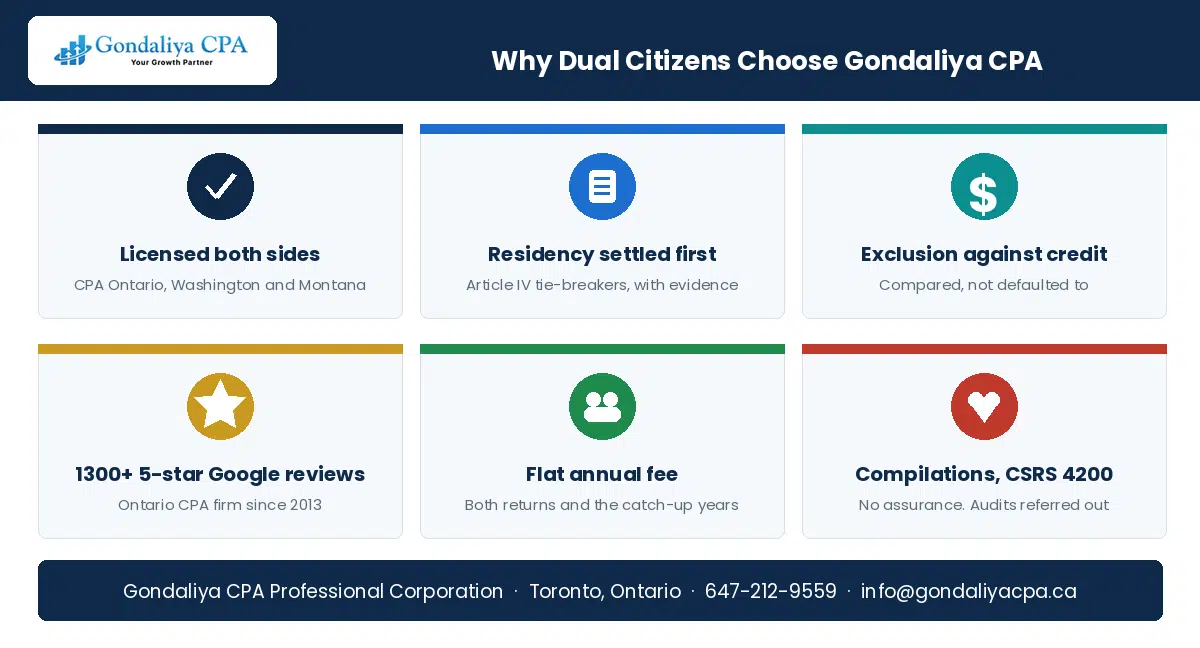
Four things decide a dual citizen’s year. Two tests, not one — Canada taxes on residency and the United States on citizenship, so both can apply to the same income, and where both claim you the Article IV tie-breakers settle residence without touching the duty to file. Disclosure on both sides — Form T1135 past CAD 100,000 at $25 a day to a $2,500 cap, FBAR on FinCEN 114 past USD 10,000, Form 8938 under FATCA, plus T1134 and T1141 where affiliates or trusts are involved. Relief, chosen deliberately — Form 2555 excludes earned income up to USD 120,000, Form 1116 credits tax actually paid on everything and carries forward ten years. And the accounts that look safest — the TFSA, the RESP, the Canadian mutual funds that are PFICs elsewhere — are the ones worth reviewing first.
Three questions tell you where you stand, and you can answer all of them today. First, have you filed in both countries for every year you have held both citizenships? Owing nothing does not remove the obligation, and the information returns carry penalties on their own. Second, can you list every account and holding in your name, with its cost? That list is what decides whether T1135, FBAR and Form 8938 are due, and it is the single most useful hour on any cross-border file. Third, do you hold a TFSA, an RESP, or Canadian mutual funds? All three are perfectly sound here and all three need looking at on the other side before the next return rather than after.
Dual Citizenship Taxes Canada: How Gondaliya CPA Can Help
Start with your last filed returns and a list of every account you hold
Gondaliya CPA maps income between the two countries, settles the residency position against the Article IV tie-breakers where both countries claim you, prepares the Canadian T1 with worldwide income and Form T1135 where the threshold is passed, compares the exclusion against the foreign tax credit rather than defaulting to one, works through the registered plans and holdings treated differently on each side including TFSAs, RESPs and Canadian mutual funds, prepares T1134 and T1141 where affiliates or trusts are involved, and handles unfiled years in sequence through the Voluntary Disclosures Program or the streamlined procedures as the facts require — on a flat annual fee including HST with a one-business-day response. Please book a free consultation.
Next Steps
Please book a free consultation with Gondaliya CPA and bring three things: your most recent return from each country, a list of every account and holding in your name with its cost, and any notices you have received from either authority. Those three settle the residency position, which disclosure forms are actually due and whether any years are outstanding — which between them account for nearly every adjustment we make on a dual citizen file. If you have only recently learned that a second filing obligation exists, or a bank has asked you about it, say so at the outset, because coming forward voluntarily is the whole advantage and it is lost once a review has begun. You will get a flat annual fee including HST before any work begins. We serve Toronto, Mississauga, Brampton, Vaughan, Etobicoke, Scarborough, Hamilton, Ottawa and the rest of Ontario, and work with dual citizens across Canada. We advise on tax, not on immigration or citizenship law. If our content helps, please add gondaliyacpa.ca as a preferred source on Google.
Published: · Last updated:
Editorial policy: We research against CRA, Department of Finance, Parliament of Canada, CPA Canada and CPA Ontario sources, fact-check the figures, and Sharad Gondaliya, CPA, reviews the content, which we update as the rules change.
Disclaimer: This article is educational information only and is not tax, legal, financial or immigration advice. It covers Canadian federal income tax with United States cross-border context for dual citizens resident in Canada, and it does not cover immigration or citizenship law, the process of renouncing a citizenship, or consular matters, each of which is handled separately. Filing thresholds, exclusion ceilings, penalty amounts, standard deductions and treaty positions change, and several figures in this article are stated for particular tax years; the figures and form references are those given in the source material, which cites the certification form for some filings in ways worth confirming, and every one should be checked against current CRA and IRS guidance before a return is filed. Residency, the availability of treaty relief and the treatment of registered plans all turn on individual facts. Gondaliya CPA performs compilation engagements under CSRS 4200 and does not perform audit or review engagements. Please consult a licensed CPA before acting.

Sharad Gondaliya is a CPA Canada & CPA USA with 15 Years+ experience of Accounting, Tax, Payroll of Corporate Small Businesses as Tax Accountant. He is a CPA Ontario member (61040184) and holds US CPA licences in Washington and Montana and is well known among corporate small businesses for tax planning, efficient tax solutions, and affordable CPA services. Sharad is the Principal (Director) of Gondaliya CPA – Affordable CPA Firm in Canada. Licenses: CPA Ontario: 61040184 | CPA USA (MT): PAC-CPAP-LIC-033176 | CPA USA (WA): 57629 | CPA Firm License: 61330051 View Full Author Bio