



Changing Your Corporate Tax Year-End in Canada: CRA Rules, Approval & Filing Requirements
Change Corporate Tax Year End Canada: How to Get CRA Approval to Change Fiscal Year End Corporation Canada
TLDR: Change corporate tax year end Canada by understanding the process for corporate year end change CRA requires. Gondaliya CPA guides you through obtaining CRA approval to change fiscal year end corporation Canada while ensuring compliance with tax rules and reporting standards.
Quick Summary
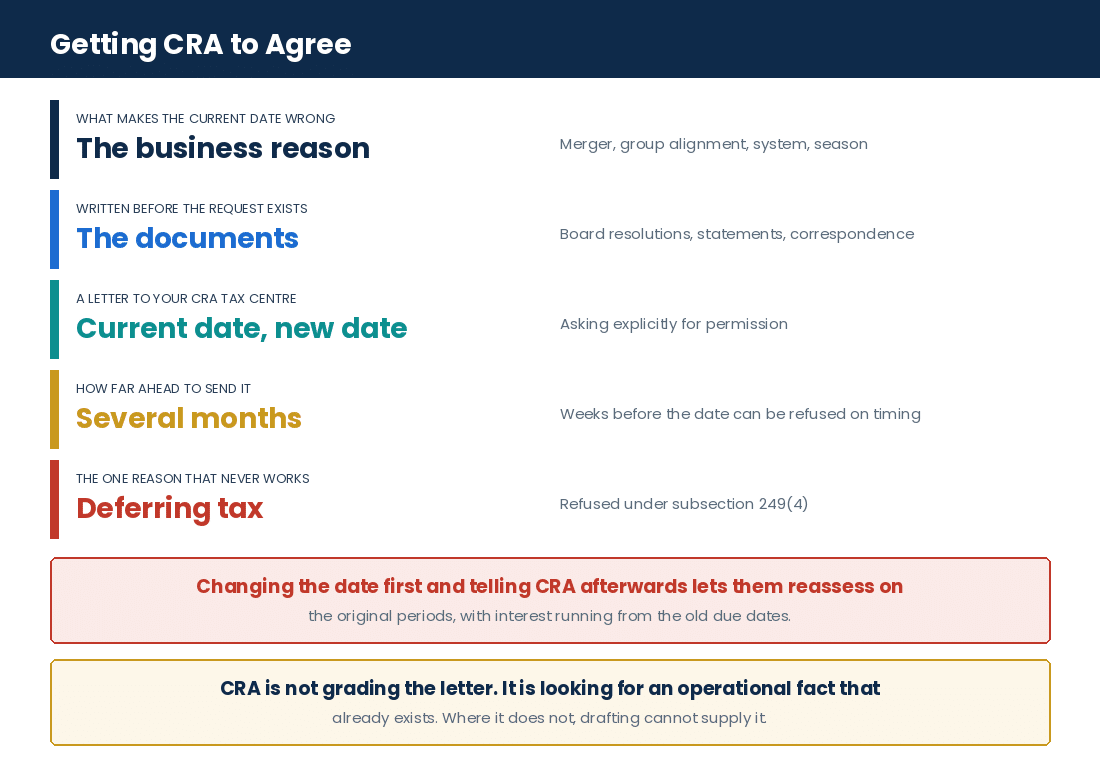
Three rules govern this and the rest follows from them. You need written concurrence first — under subsection 249(1) a corporation keeps its established year-end unless CRA agrees in advance, and changing without that agreement lets CRA reassess on the original dates. The reason has to be a real one — aligning after a merger or acquisition, matching subsidiaries in a group, or a new accounting system all qualify; deferring tax or securing an advantage is refused under 249(4). No period can exceed fifty-three weeks — so a mid-year change produces a short transitional year and a separate T2 for each, with filing deadlines, balance-due dates, instalments, capital cost allowance and the small business deduction all prorated to the days actually in each period. Some events skip the approval step entirely by creating a deemed year-end: winding-up, emigration, acquisition of control, amalgamation, a change in exempt status. And two things do not move with your fiscal year at all — GST/HST reporting and payroll remittance both stay on the calendar.
Reading time: 12 minutes.
Table of Contents
- Change of Fiscal Year-End for Corporations
- Determining Your Corporation’s Tax Year
- Process to Change Your Fiscal Period with CRA
- Exceptions and Special Circumstances
- Maintaining Business Information with CRA
- Key CRA Forms, Publications and Support
- Frequently Asked Questions
- Key Points on CRA Fiscal Period Guidelines
- Businesses We Serve & Industry Spotlights
- Professional Guidance and Quick Reference
The Numbers That Matter
This article covers Canadian federal corporate income tax, with Ontario and Toronto context, and reflects rules current to 16 October 2026. It is written for Canadian corporations considering a change of fiscal year-end, and it covers the concurrence requirement, acceptable business reasons, the fifty-three week limit, short transitional years, deemed year-ends and the knock-on effects on instalments, capital cost allowance and the small business deduction. It is not advice on corporate law or articles of amendment, on provincial registry filings beyond noting that some may be needed, or on accounting standards for financial statement presentation. Gondaliya CPA performs compilation engagements under CSRS 4200, which provide no assurance; audit and review engagements are referred out. This is educational information only and not tax or legal advice.
Change of Fiscal Year-End for Corporations in Canada
Change of Fiscal Year-End for Corporations
The Rules
Definition of Fiscal Year-End and Its Importance for Corporations
A fiscal year-end is the date when a corporation wraps up its financial records for the year. It sets the time for making financial statements, filing taxes, and meeting other rules. In Canada, companies sometimes want to change their corporate tax year end. They might do this to match others in their field or to better manage cash flow. But changing your corporate year-end means following certain CRA rules carefully.
Overview of Corporation Income Tax Fiscal Period Requirements
In Canada, a fiscal period can last up to fifty-three weeks — not longer. This limit stops companies from making their fiscal periods too long but still lets them pick a suitable date. When choosing a fiscal year-end, businesses must stick to legal rules. For example, they usually keep the same year-end as before unless the CRA has said it’s okay to change.
- Maximum fiscal period length: fifty-three weeks
- Legal obligations: keep consistency with previous years unless CRA approves change
Legal Framework Governing Corporate Fiscal Year-End Changes
If a corporation wants to change its fiscal year-end, it has to get permission from the CRA first. The CRA looks for good business reasons behind this request. They won’t accept just trying to delay taxes or gain some benefit as valid reasons.
- CRA approval: needed before you change your corporate tax year end
- Concurrence requirement: must show clear business reasons for the request
The word “concurrence” is doing a lot of work here, and it is worth taking literally.
CRA concurs, in writing, before the change takes effect. It is not a notification, not a filing position, and not something that can be argued after the fact on the first T2 filed under a new date. A return filed on a year-end CRA never agreed to is simply a return filed on the wrong period. Figures changed for privacy.
Implications of Fiscal Year-End on Corporate Tax Reporting
Changing your fiscal year-end affects how and when you report taxes:
- You might face a short tax period if you change mid-year, so filing deadlines will adjust accordingly.
- The balance-due date also changes based on your new fiscal year timeline.
- Instalments may need recalculating because income estimates now cover shorter periods.
Knowing these effects helps you avoid late filings or wrong payments linked to the new schedule.
If you follow these steps carefully and get professional advice when needed, changing your corporate tax year end in Canada becomes much easier—and keeps you aligned with CRA rules.
Determining Your Corporation’s Tax Year
Determining Your Corporation’s Tax Year
Setting the Date
Rules for Establishing the Initial Tax Year After Incorporation
When a corporation starts in Canada, its first tax year begins on the day it’s incorporated. It ends on a fiscal year-end date the company picks. This date must fall within fifty-three weeks of incorporation. Once chosen, this fiscal year-end sets the corporation’s official tax year unless the CRA agrees to change it later. The Income Tax Act limits how long this initial tax year can be.
If you want to change corporate tax year end Canada, you must ask the CRA in writing. Your request should explain why you need to change it and cannot be just to delay paying taxes or get an unfair advantage. The new fiscal period still has to follow rules like staying under fifty-three weeks.
For example, a company that incorporates on July 1 might choose March 31 as its first fiscal year-end. That makes the first tax year shorter than 12 months but legal under current rules Income Tax Act s.249(4).
Maximum Length and Timing of a Corporation’s Tax Year (53 Weeks)
Canadian corporations can have tax years up to fifty-three weeks long, but never longer. This rule helps keep reporting periods fair and stops companies from stretching out their tax years just to delay taxes.
If you’re planning a corporate year end change CRA, remember your new fiscal period can’t push any tax year beyond fifty-three weeks. If you try, you must file extra returns for shorter transitional years instead of one long one.
This applies to all businesses, big or small Income Tax Regulations 1100(3). The rule stops companies from gaming the system but allows changes when needed—like matching accounting systems or seasonal cycles.
For instance, if a company moves its December 31 year-end two months earlier, both resulting periods must be fifty-three weeks or less.
Otherwise, it needs separate returns for those shorter periods. This is the part that surprises owners: a change does not shift one year, it creates two, and both have to be filed. Figures changed for privacy.
Tax Year Start Date Considerations for New Corporations
New corporations in Canada start their first tax year right on their incorporation date—the day they legally exist—and that runs until their chosen fiscal year-end date within allowed limits.
When picking this date and wanting to change corporate tax year end Canada, think carefully because after this first choice, changing it again needs CRA approval with strong reasons.
CRA expects companies to stick with their dates unless something important happens that justifies a change. These changes should not be just for saving taxes CRA Guide T4012.
Say a company incorporates on June 15 and picks February 28 as its first fiscal year-end next calendar year. That sets clear start and end points following the law ITA s.248(1).
Exceptions for Professional Corporations and Partnerships Regarding Year-End Dates
Professional corporations (PCs) work under different rules in many provinces. They often cannot pick any fiscal year-end they want because their professional body sets accounting cycles. Partnerships also have special rules about their fiscal periods that differ from normal corporations.
Because of these exceptions, PCs might have fixed deadlines dictated by provincial rules rather than choosing freely under federal law CRA Interpretation Bulletin IT-490R.
Partnerships usually report income based on their agreements but might use special methods if allowed. However, if they turn into corporations or merge, normal restrictions kick back in and may force them to close a “deemed” tax year as per law ITA ss.149 & Excise Tax Act ss243–245.
For example, an Ontario law firm structured as a PC follows provincial rules for financial statements which differ from usual CCPC deadlines but still files federal returns properly after status changes involving deemed endings.
Consistency Requirement for Tax Years and When Changes Are Permitted
After setting a tax year, companies should keep using it every year unless they get permission from the CRA before changing it. This keeps things fair and clear for everyone Income Tax Act s.249(3).
To get CRA approval to change fiscal year end, you need strong reasons that show real business needs—not just trying to delay taxes or gain an edge over others. The CRA usually denies requests based only on tax savings.
Good reasons often include merging with another company or needing aligned accounting after buying another business—not simple preferences or convenience without solid support in documents explaining risks and results of changing dates.
For example, a manufacturer buying another firm might ask for approval because combining accounts requires matching fiscal years.
They’d include board resolutions proving they mean business and follow proper steps clearly described in CRA forms. The board resolution matters more than the covering letter — it is the document that shows the reason existed before the request did. Figures changed for privacy.
Process to Change Your Corporation’s Fiscal Period with CRA
Process to Change Your Fiscal Period with CRA
How To Apply
If you want to change your corporation’s tax year end in Canada, you must get the Canada Revenue Agency’s (CRA) written okay first. You can’t just switch it on your own. To do this, you send a formal request explaining why you want to change the fiscal period. This keeps things legal under the Income Tax Act and stops problems with filing dates, instalments, or tax calculations later.
Requirements for Obtaining CRA Approval to Change Fiscal Year-End
To get CRA approval for a new fiscal year-end, your corporation needs a good business reason. The reason can’t be about delaying taxes or scoring tax benefits. The rules come from section 249(1) of the Income Tax Act. Also, the new fiscal period can’t be longer than 53 weeks.
Here’s what you need:
- A clear reason based on business or admin needs.
- Proof the new fiscal period follows legal limits.
- All papers supporting your reason.
Remember: you must get CRA approval before changing your corporate year end Income Tax Act s.249(1); CRA guide T4012.
Steps to Submit a Request: Preparing Letter and Supporting Documentation
You have to write a letter to the right CRA tax centre that explains:
- Your current fiscal year-end date.
- The new fiscal year-end date you want.
- A solid business reason for the change.
- Any company events like mergers or acquisitions related to this.
You should attach documents like financial statements, board resolutions, or emails showing why this change is needed.
Send this letter well before your planned change date so there’s time for review and no rule-breaking.
Make sure the letter asks CRA explicitly for permission before making any changes CRA publication T4012; Income Tax Regulations 1100(3).
Timing and Advance Notice Recommendations for Change Requests
CRA suggests sending your request several months before your intended new year-end. This gives them enough time to process it and helps you avoid missing deadlines.
If you send it too late—like close to a filing deadline—they might say no because they don’t have enough time or info.
Giving early notice also helps adjust payment dates and instalment plans that might change with a shorter transitional fiscal period CRA technical interpretation TI2026–01.
Common Reasons Accepted by CRA for Fiscal Year-End Changes
The CRA accepts certain reasons as good business causes:
- Matching accounting periods after mergers or acquisitions when deemed year ends don’t apply.
- Aligning subsidiary reporting inside corporate groups.
- Switching accounting systems that need new reporting schedules.
Reasons just meant to delay income recognition or get tax breaks usually get rejected under section 249(4).
If you show real operational need with facts, you improve chances—but final say is always with CRA staff Income Tax Act s.249(4); CPA Canada guidance.
Potential Processing Times and Considerations for Delays
How long it takes varies but expect weeks to several months once they have everything they need.
Delays happen when requests lack info or aren’t clear enough, forcing extra back-and-forth.
Keep an eye on any messages from CRA during this time and don’t start changes until you get official okay from the right CRA office CRA service standards.
The single most useful thing you can do is send the request earlier than feels necessary.
A request that arrives months ahead gets assessed on its merits. One that arrives weeks before the proposed date is competing with its own deadline, and a refusal on timing grounds looks exactly like a refusal on substance from the outside. Early is not caution here, it is the difference between a decision and a non-decision. Figures changed for privacy.
Risks and Compliance Issues Associated with Changing Fiscal Year-End
Changing your corporation’s fiscal period without written CRA okay puts you at big risk. They can reassess old returns using original periods under subsection 150(1)(a). This might mean penalties and interest because of late payments calculated wrongly. You could lose carry-forward benefits or mess up capital cost allowance claims due to wrong proration. GST/HST filings stay on calendar years even if your corporate year changes, which complicates things more Income Tax Act ss.150 & 161; Excise Tax Act ss.243–245.
Payroll remittance schedules don’t change either, so missing payments can draw attention from authorities Canada.ca Payroll Guide.
Following all rules avoids these problems and keeps records straight in case of audits after any attempted changes without permission.
For help with corporate tax year end changes that follow Canadian law—including preparing proper requests meeting corporate year end change CRA rules—contact Gondaliya CPA at info@gondaliyacpa.ca or call 647‑212‑9559. We serve Ontario businesses including Toronto clients with trusted advice backed by over 1450 five-star Google reviews.
Year-End Change Readiness Check
Five quick questions on whether a request is worth making. No fee shown.
Points to raise with us:
This is a general prompt, not tax or legal advice or a quote. Your position depends on your full facts. For a real review, please book a free consultation.
Exceptions and Special Circumstances for Changing Fiscal Year-End
Exceptions and Special Circumstances
When Approval Is Not Needed
Situations Where CRA Approval Is Not Required (e.g., Winding-up, Emigration, Acquisition of Control)
Sometimes, a corporation can change its fiscal year-end without asking the CRA. Certain events cause a deemed year-end. This means the tax year ends automatically under the Income Tax Act.
These events include:
- Winding-up or closing the company
- Emigration, or leaving Canada
- When another person or entity takes control
- Amalgamation with another corporation
- Changes in exempt status
When this happens, the company does not need to request CRA approval. The law treats these as new tax years ending on a set date. The corporation must file separate T2 returns for each short fiscal period created by these events.
Remember, no fiscal period can be longer than fifty-three weeks. If an event causes a mid-year end, it leads to short transitional years instead of extending beyond that limit.
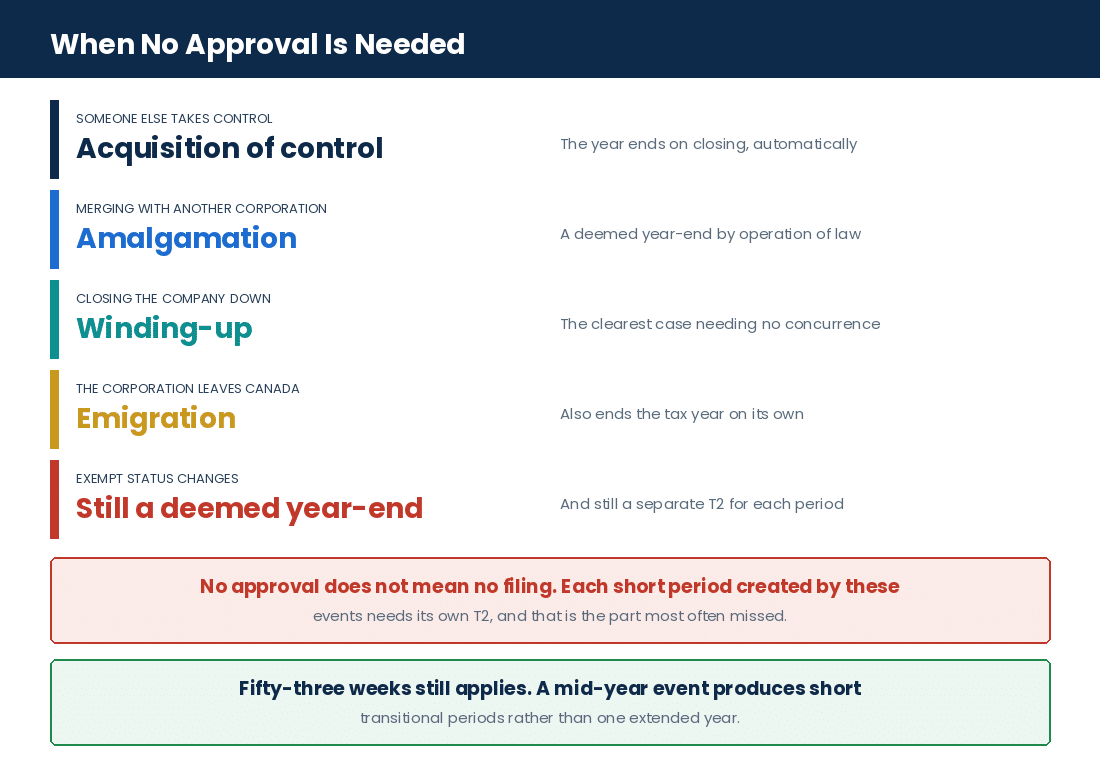
For example, if a company is taken over on March 31, it creates two tax years: one ending March 31 and one starting April 1.
The company files returns for both without CRA approval. Acquisition of control is the one that catches people, because nobody thinks of a share sale as a tax year-end event until the second T2 is already overdue. Figures changed for privacy.
CRA Reference: Income Tax Act sections 249(3), 249(4); Canada.ca – Corporation’s Fiscal Period
Fiscal Period Changes Related to Bankrupt Corporations and CRA Requirements
Bankrupt companies have special rules about their fiscal periods. Bankruptcy itself doesn’t always trigger a deemed year-end like other events do. But later steps in liquidation can affect filing dates and requirements.
If a bankrupt company wants to change its corporate tax year end Canada during insolvency, it usually must get CRA approval unless other exceptions apply.
The balance due date will match the new short fiscal period after approval. Instalment amounts will be recalculated based on this new period and income.
If you don’t follow these steps, CRA may reassess past filings and charge interest on late payments or wrongly calculated instalments.
For example, if a bankrupt firm wants to move its year-end from December 31 to June 30, it should wait for CRA’s written consent before filing under the new period.
CRA Reference: ITA section 161; Excise Tax Act sections relevant
Restrictions on Fiscal Year-End Changes for Self-Employed Individuals and Partnerships
Self-employed people don’t have corporate tax years. They report business income on personal T1 returns using the calendar year unless special elections apply.
Partnerships cannot just change their fiscal periods either. Partnership tax rules differ from corporations. Changes need strict steps laid out in federal and provincial laws.
Usually, self-employed folks must keep reporting aligned with calendar years unless they follow formal rules to do otherwise.
So, rules about changing corporate tax year end Canada don’t apply directly here. Still, knowing these limits helps understand why self-employed people stick mostly to fixed reporting cycles.
CRA Reference: Business income reporting guidelines; Partnership Reporting Rules
Alternative Reporting Methods for Business Income Fiscal Periods in Self-Employment
Some self-employed taxpayers can choose different methods for their business income fiscal periods. This lets them report outside of calendar years if they qualify under Income Tax Act rules.
Examples include professional corporations that follow special regimes. These might match client billing cycles or seasonal work patterns that CRA recognizes officially.
These alternatives are different from corporate requests to change fiscal years. They happen through elections made early—often when setting up the business—not later by asking for CRA approval like corporations do.
Taxpayers must keep good records showing their chosen accounting periods each year. They also have to handle GST/HST payments separately based on their specific business cycle lengths.
Specific Conditions Affecting Fiscal Period Changes Under the Income Tax Act
Canadian law sets clear limits on how long a corporation’s fiscal period can be after any change:
- No taxation period can last more than fifty-three weeks.
- This rule forces transitions into short periods rather than allowing long extensions.
- Corporate year end change CRA procedures require written approval before making changes—except where deemed year-ends apply automatically because of certain events.
Companies must provide valid reasons when asking to change their year end. They cannot just shift taxable income between years to delay taxes—that is not allowed by law.
Applications need solid business reasons supported by facts matching legislative intent about limiting too-long periods.
For example, if permission is given starting January 1, the company files two separate T2 returns—one for the old period and one for the new—each no longer than fifty-three weeks.
Capital cost allowance claims get adjusted over these shorter intervals too. The proration is where most of the post-approval work actually sits, and it reaches the small business deduction as well. Figures changed for privacy.
Maintaining and Updating Business Information with CRA
Maintaining Business Information with CRA
Housekeeping
Keeping your business info up-to-date with the Canada Revenue Agency (CRA) matters a lot. If you want to change corporate tax year end Canada or ask for a corporate year end change CRA, the details must be correct. This helps avoid delays and mistakes. Plus, you need CRA approval to change fiscal year end before you make any shifts officially.
Importance of Keeping Business Information Current for Tax Compliance
You should update your business info fast. It keeps your tax reporting smooth and helps when requesting a change fiscal year end corporation Canada. The CRA uses fresh info to check your application right. If info is old or wrong, you could face missed deadlines or wrong assessments. Corporations that want a corporate tax year end change cut risks by updating on time. This lowers chances of filing errors or wrong instalment numbers.
How to Access and Manage Your Business Information Online Using CRA Accounts
You can manage business info online via CRA’s My Business Account. Log in there to:
- See account balances
- File returns, including changes in T2 tax return fiscal years
- Update contact info
- Track messages about corporate year end change CRA
This online portal makes it easy to check details and submit requests like changing your fiscal period.
Procedures to Add Your SIN to Your CRA Business Account
Adding your Social Insurance Number (SIN) links your personal ID to the company account. It helps with permissions for things like getting CRA approval to change fiscal year end. To add SIN:
- Log into My Business Account
- Go to “Manage Representatives” or “Authorize New Users”
- Follow steps that verify who you are
This keeps your data safe but lets the CRA communicate with you about tax year changes.
Guidelines to Update Key Business Details Including Fiscal Year-End
Before you update stuff like change corporate tax year end Canada, get written ok from the CRA first. Then update:
- Legal name and address
- Contacts responsible for filings
- New fiscal dates within legal limits
Send accurate info to avoid problems during review. The Income Tax Act sections 249(1) and 248(1) set rules for taxation years, so follow those closely.
Security Measures and Best Practices for Protecting Business Information
Keep your business data safe when submitting things like corporate year end change CRA requests by:
- Using strong, unique passwords for My Business Account
- Turning on two-factor authentication if possible
- Limiting user access only to those who really need it
These steps cut risks of unauthorized access that could expose sensitive info tied to official approvals.
Stale contact details on the business account are a quiet cause of refused and delayed requests.
CRA writes to the address and the authorised representative it holds, not the ones you have moved on to. A concurrence decision sitting at a former accountant’s office is indistinguishable, from the corporation’s side, from no decision at all — until the proposed date passes. Figures changed for privacy.
Impact of Business Growth and Operational Changes on CRA Reporting Requirements
When your business grows or changes—like buying another company or changing operations—you might need to adjust how you report taxes [Income Tax Act s 249(3)]. Sometimes, this means changing accounting periods automatically due to rules about deemed-year-end. Other times, you must ask formally if the usual cycles don’t fit anymore.
Updating records after these changes keeps everything aligned with CRA’s filing rules. After the agency agrees, this helps keep your tax schedule correct.
If you find steps like change corporate tax year end Canada tricky or want smoother corporate year end change CRA approval, getting advice from pros familiar with Ontario rules can help.
Key CRA Forms and Publications Relevant to Fiscal Year-End Changes
Key CRA Forms, Publications and Support
Where To Look
If your company wants to change its corporate tax year end in Canada, you’ll need certain CRA forms and guides. The main form is T1139 – Reconciliation of Business Income for Tax Purposes with Accounting Income. You might use it when reporting income for a changed fiscal period. Also, check the instructions for Form T2 Corporation Income Tax Return, because your filing rules may shift after changing your year end.
The CRA’s “Corporation’s Fiscal Periods” publication shows the rules about changing fiscal periods. It says you must get written approval before making any change. Plus, the CRA won’t accept just wanting to defer tax or get a tax advantage as a good reason.
For how to ask for approval, see “Guide RC4400 – Corporations: Changing Your Fiscal Period”. It explains who can apply, what papers to include, and what happens after approval—like having short transitional years.
Here are key points to remember:
- Use form T1139 for income reconciliation after changes.
- Follow T2 instructions carefully post-change.
- Get written CRA consent before changing.
- Deferring tax isn’t a valid reason.
- Guide RC4400 has detailed steps and rules.
These materials help you stick with corporate year end change CRA rules and file properly under Canadian tax laws. CRA Publication RC4400
Official CRA Links for Corporation Income Tax and Business Reporting
If you want to change your corporation’s fiscal year end, use official CRA websites made for corporate income tax and business filings. The main spot is the Canada Revenue Agency’s Corporate Income Tax page. It covers tax years, new filing deadlines, recalculating instalments, and balance due dates after changes.
- Corporate income tax – general information
- Changing your corporation’s fiscal period (RC4400)
- T2 Corporation Income Tax Return forms & guides
These pages explain how to ask for CRA approval to change fiscal year end. They show what reasons count under law (Income Tax Act sections 249(1), 249(3)) and how to send in requests.
Stick with these official links so you follow all rules about corporate year end change CRA matters and keep up with updates through 2026.
Additional Government and Provincial Resources for Business Owners
Besides federal rules from the CRA about changing your company’s fiscal period in Canada, some provinces give extra info that might help business owners. These sources focus on provincial taxes or filings that could be affected by date changes but don’t replace federal steps.
For example:
- Ontario Ministry of Finance: Talks about provincial taxes affected by new accounting periods.
- ServiceOntario: Helps update registrations if incorporation info needs changes because of new fiscal dates.
- Provincial business registries: May require notifications depending on where you operate.
These help with stuff like payroll or GST/HST filings once you’ve switched your year-end. But they don’t replace federal demands about change fiscal year end corporation Canada issues.
Check out Ontario Ministry of Finance for more details on local requirements after changing your fiscal period.
Contact Information and Communication Channels for CRA Fiscal Year-End Requests
To start or ask about changing your corporation’s tax year-end in Canada, contact the CRA directly. You need their written okay before making changes, so quick contact helps avoid delays.
Here’s how you can reach them:
- Phone: Call 1-800-959-5525 for business questions.
- Mail: Send formal requests with explanation letters as Guide RC4400 says.
- Online: Use My Business Account for secure messages about your account but not for initial approval requests.
- Fax: Use numbers shown on official CRA letters or forms.
Make sure you include your corporation number (BN) when contacting them. Keep copies of all communications—they come in handy if there are questions later about timing or details related to your corporate year end change CRA request.
More info at CRA Contact Page.
Keep a copy of everything you send, with the date it went.
Questions about a year-end change almost always come down to timing — when the request was made, when concurrence arrived, which period a return belongs to. A dated file answers all three in a minute. Reconstructing it from memory two years later, with interest already running, takes considerably longer. Figures changed for privacy.
Gondaliya CPA Guidance and Support Options for Corporate Fiscal Year-End Changes
Gondaliya CPA helps companies handle tricky steps when changing their corporate tax year-end in places like Toronto or anywhere in Canada. Our team knows all about preparing strong applications that meet CRA rules valid through 2026.
We take care of everything—from showing good reasons why you want a new year-end to tracking approvals. We also manage next steps like adjusting capital cost allowances and recalculating instalments during short transitional years after approval.
Our services include:
- Preparing full application packages.
- Liaising with CRA on your behalf.
- Advising on compliance with Income Tax Act section 249.
- Offering flat fees with quick replies within one business day.
We have over “1450+ 5-star Google reviews” backing our work plus a Money Back Guarantee if you’re not satisfied during this sensitive process involving strict deadlines from both law (Income Tax Act section 249) and policy (CRA Guide RC4400).
Choosing Gondaliya CPA means getting reliable help that handles timelines clearly based on your situation. This lowers risks tied to missing deadlines or filing errors after getting written consent needed before changing your company’s tax cycle properly.
You can always reach us by email at info@gondaliyacpa.ca or phone at 647‑212‑9559 without any pressure. We’ll talk through whether you qualify under current rules requiring formal applications or if exceptions apply under Canada’s corporate tax laws today.
FAQs on Changing Corporate Tax Year End in Canada
Frequently Asked Questions
Answers
What is a deemed year-end and when does it apply?+
Can a corporation change its fiscal year without CRA’s written concurrence?+
How does a short transitional year affect filing deadlines?+
What are common reasons the CRA refuses fiscal year-end change requests?+
How does changing the fiscal year-end affect capital cost allowance claims?+
When should I submit a concurrence request to the CRA?+
Will changing my corporate year end affect GST/HST reporting periods?+
Does changing fiscal year-end impact payroll reporting and tax slips timing?+
Key Points on CRA Fiscal Period Guidelines
Key Points
Key Points on CRA Fiscal Period Guidelines and Compliance
- Income Tax Act s.249(1) requires CRA’s written approval before changing your fiscal period.
- Fiscal periods cannot exceed fifty-three weeks, per Income Tax Regulations 1100(3).
- Balance-due date interest and instalment base recalculation adjust after a fiscal year-end change.
- Small business deduction proration depends on actual days in each fiscal period.
- Reporting periods for GST/HST remain on calendar-based schedules despite corporate changes.
- Unequal comparatives may arise in financial statements disclosure following the change.
- Shareholders’ personal tax returns may need adjustments if their corporation’s year-end shifts.
- Reassessment can revert returns to original dates under ITA s.161(1)(a) if rules are breached.
- Filing own return during a short transitional year requires care to avoid missed deadline penalties.
- Relief and disclosure for incorrect returns can mitigate risks if mistakes occur post-change.
Gondaliya CPA’s Best Practices for Corporate Year-End Changes
- Conduct thorough business facts analysis before submitting requests to ensure sound business reason compliance.
- Prepare detailed application packages referencing relevant sections like Income Tax Act s.249(4).
- Communicate with CRA proactively to reduce processing time and avoid delays.
- Prorate capital cost allowance classes correctly over multiple short years after approval.
- Review instalment schedule impacts well ahead of new balance-due dates to prevent payment issues.
- Use professional guidance rather than DIY approaches to reduce top mistakes in the process.
Contact Gondaliya CPA for expert help with your corporate year end change CRA needs across Canada, including Ontario, ensuring full compliance with all Income Tax Act regulations and CRA Fiscal Period Guidelines.
Businesses We Serve & Industry Spotlights
Industry Expertise
A year-end change is almost always driven by something else happening in the business, and the question that decides it — is there a real operational reason, or is this about the timing of tax — recurs across every one of these sectors.
| Industry | The Year-End Change Angle |
|---|---|
| Business buyers | Acquisition of control creating a deemed year-end on closing |
| Businesses winding down | Winding-up ending the year by operation of law |
| Family-owned businesses | Aligning related companies onto one reporting cycle |
| Second-generation family businesses | Reorganisations that reset the group’s year-ends |
| Private equity firms | Portfolio companies matched to the fund’s reporting |
| Venture capital firms | Subsidiary alignment inside a group structure |
| Industrial manufacturers | Inventory counts moved to a quieter point in the cycle |
| Building supply companies | Seasonal trade where December is the worst time to count |
| Distributors | A new accounting system imposing a new reporting schedule |
| Fulfillment centres | Peak season sitting awkwardly across a December year-end |
| Construction project management firms | Project cycles that do not fit the calendar year |
- Business buyers: Acquisition of control is a deemed year-end, so a purchase creates two tax years and two T2 returns without anyone applying for anything.
- Businesses winding down: Winding-up ends the tax year by operation of law, which is the clearest case where no concurrence request is needed at all.
- Family-owned businesses: Where several related companies have drifted onto different dates, aligning them is exactly the operational reason CRA accepts.
- Second-generation family businesses: Succession reorganisations often reset the structure, and the year-ends have to be dealt with deliberately rather than left to drift.
- Private equity firms: Matching a portfolio company to the fund’s reporting cycle is a documented group requirement, which is what a strong application looks like.
- Venture capital firms: Subsidiary alignment inside a group is listed among the reasons CRA treats as genuine business need rather than preference.
- Industrial manufacturers: Moving a year-end so the inventory count falls at a low point is an operational argument, provided it is documented as one.
- Building supply companies: Strongly seasonal trades frequently inherit a December year-end that sits at the worst possible point in the cycle.
- Distributors: A new accounting or ERP system that imposes its own reporting schedule is among the reasons CRA accepts as administrative need.
- Fulfillment centres: Peak season straddling a December year-end makes both the count and the comparatives harder than they need to be.
- Construction project management firms: Project cycles that run across calendar years make the December cut-off an accounting problem rather than a tax one.
In every one of these, the reason either exists in the business already or it does not.
CRA is not weighing how well the letter is written. It is looking for an operational fact — an acquisition, a group structure, a system, a season — that makes the current date genuinely awkward. Where that fact exists, the application is largely a matter of documenting it. Where it does not, no amount of drafting supplies it.
Professional Guidance and Quick Reference
Guidance
Essential Points on Changing a Corporate Year-End
Corporations go wrong on this in a predictable set of ways: changing the date first and telling CRA afterwards; building the request around a tax reason, which is the one ground that guarantees refusal; sending it weeks rather than months before the proposed date; assuming one year simply shifts, when in fact two short periods are created and both need a T2; forgetting to prorate capital cost allowance and the small business deduction across those periods; leaving instalments and the balance-due date on the old schedule; and expecting GST/HST and payroll to follow the new year-end, which they do not. Gondaliya CPA prepares concurrence requests on a flat fee.
Quick Answers
At a Glance
- The core rule: written CRA concurrence before the change, under subsection 249(1)
- Maximum period: fifty-three weeks, with no exceptions
- Refused reason: deferring tax or securing an advantage, under 249(4)
- Accepted reasons: merger or acquisition alignment, group subsidiary reporting, a new accounting system
- What to send: a letter to your CRA tax centre with current date, proposed date, business reason and supporting documents
- Supporting documents: financial statements, board resolutions, correspondence evidencing the reason
- Timing: several months ahead; late requests can be refused on time alone
- Processing: weeks to several months once CRA has everything
- First tax year: runs from incorporation to the chosen date, within fifty-three weeks
- Consistency: the established year-end stands under 249(3) unless CRA agrees otherwise
- Deemed year-ends: winding-up, emigration, acquisition of control, amalgamation, change in exempt status
- Deemed year-ends need no approval, but still require a separate T2 for each period
- After approval: two T2 returns, each within the fifty-three week limit
- Prorated by days: capital cost allowance and the small business deduction
- Recalculated: instalment base and balance-due date
- Unchanged: GST/HST reporting periods and payroll remittance schedules
- Key forms: T1139 for income reconciliation, T2 for each period, Guide RC4400 for the process
- If you change without concurrence: CRA can reassess on the original periods, with interest
Who This Is For / Not For
Fit Check
- For: Canadian corporations with a genuine operational reason to move their fiscal year-end — an acquisition, a group alignment, a new system, a seasonal cycle that no longer fits.
- For: corporations that have just had a deemed year-end event and need to understand which returns are now due, and newly incorporated companies choosing a first year-end.
- Not for: advice on corporate law, articles of amendment, or provincial registry filings beyond noting that some may be needed alongside the tax change.
- Not for: self-employed individuals and partnerships, whose fiscal period rules are different. A corporation whose only motive is deferring tax is technically in scope but will not get approval.
People Also Ask
Related Questions
Can I just file my next T2 on the new date and let CRA catch up?+
No. Without written concurrence CRA can reassess on the original periods under 150(1)(a), with interest and penalties flowing from payment dates calculated on a year-end that was never agreed to. Carry-forward amounts and capital cost allowance claims prorated against the wrong periods come apart at the same time.
Our year-end falls in our busiest month. Is that a good enough reason?+
It can be, if it is framed and documented as an operational problem rather than a preference. CRA accepts reasons such as aligning after a merger or acquisition, matching subsidiaries within a group, and moving to an accounting system that imposes a different schedule. What it refuses, under 249(4), is a request whose real purpose is deferring income or securing a tax advantage.
We were just acquired. Do we need to apply?+
No. Acquisition of control creates a deemed year-end automatically, as do winding-up, emigration, amalgamation and a change in exempt status. No concurrence is needed — but a separate T2 is still required for each short period the event creates, and that is the part most often missed.
What actually changes once approval comes through?+
More than the date. You file two returns rather than one, each no longer than fifty-three weeks. Capital cost allowance and the small business deduction are prorated over the actual days in each period. The balance-due date moves and the instalment base is recalculated. Financial statements carry unequal comparatives, and shareholders’ personal returns may need adjusting.
Do GST/HST and payroll move with the new year-end?+
No, and assuming they do is a common and expensive error. GST/HST reporting stays on its calendar-based schedule and payroll remittance and slip timing stay tied to the calendar year, whatever your corporate fiscal period becomes. Missing a remittance because the internal calendar was rebuilt around the new year-end draws attention quickly.
Glossary of Key Terms
Definitions
- Fiscal year-end: the date a corporation closes its books for financial reporting and tax purposes.
- Fiscal period: the span covered by one tax year, which cannot exceed fifty-three weeks.
- Concurrence: CRA’s written agreement to a change of fiscal year-end, required in advance.
- Deemed year-end: a tax year ending automatically by operation of law on certain events, with no approval required.
- Acquisition of control: a change in who controls the corporation, which triggers a deemed year-end.
- Amalgamation: the merger of corporations, which also creates a deemed year-end.
- Short transitional year: the shortened period created when a year-end moves mid-year.
- Balance-due date: the date corporate tax owing must be paid, which shifts with the fiscal period.
- Instalment base: the figure instalment payments are calculated from, recalculated after a change.
- Capital cost allowance (CCA): the depreciation claim, prorated over the days in a short period.
- Small business deduction: the reduced rate for eligible income, prorated by days in each fiscal period.
- Form T2: the Corporation Income Tax Return, filed once for each fiscal period.
- Form T1139: the Reconciliation of Business Income for Tax Purposes with Accounting Income.
- Guide RC4400: the CRA guide on corporations changing their fiscal period.
- Reassessment: CRA revisiting filed returns, here on the original periods where a change lacked concurrence.
Want a checklist to work from? You can download our free corporate year-end change checklist before your consultation.
Four things decide whether a year-end change goes through cleanly. Concurrence first — subsection 249(1) requires CRA’s written agreement before the change, and acting without it lets CRA reassess on the original periods under 150(1)(a). A reason that exists in the business — merger or acquisition alignment, group subsidiary reporting, a new accounting system; a request built on deferring tax is refused under 249(4). Fifty-three weeks, always — so a mid-year change creates two short periods and two T2 returns, with capital cost allowance and the small business deduction prorated by actual days, and the balance-due date and instalment base both recalculated. And two things that never move — GST/HST reporting and payroll remittance stay on the calendar, whatever your fiscal period becomes. Some events skip all of it: winding-up, emigration, acquisition of control, amalgamation and a change in exempt status each create a deemed year-end on their own.
Three questions tell you where you stand, and you can answer all of them today. First, what happened in the business that makes the current date wrong? If you cannot point to an acquisition, a group structure, a system or a season, there is no application to make. Second, how many months until the date you want? Several is workable, a few weeks usually is not, and lateness alone can sink an otherwise sound request. Third, is the reason already written down somewhere — a board resolution, a purchase agreement, a system implementation plan? A reason documented before the request is worth considerably more than one explained in the covering letter.
Change Corporate Tax Year End Canada: How Gondaliya CPA Can Help
Start with what changed in the business and when you want the new date
Gondaliya CPA tests whether a genuine operational reason exists before anything is drafted, assembles the concurrence request with the board resolutions, statements and correspondence that evidence it, sends it to the right tax centre with the lead time CRA actually needs, tracks the file and handles the back-and-forth, then does the work that follows approval — two T2 returns within the fifty-three week limit, capital cost allowance and the small business deduction prorated by days, the instalment base and balance-due date recalculated, and GST/HST and payroll left on the calendar where they belong — on a flat fee with a one-business-day response. Please book a free consultation.
Next Steps
Please book a free consultation with Gondaliya CPA and bring three things: your current fiscal year-end and the date you would prefer, a short account of what changed in the business to prompt it, and whatever already exists in writing about that change. Those three settle whether a concurrence request is worth making, how strong it is, and how much lead time you still have — which between them account for nearly every refusal we see on year-end applications. If you have already changed the date, or filed a return on a year-end CRA never agreed to, say so at the outset, because that is a different and more urgent piece of work. You will get a flat fee before anything begins. We serve Toronto, Mississauga, Brampton, Vaughan, Etobicoke, Scarborough, Hamilton, Ottawa and the rest of Ontario, and work with corporations across Canada. If our content helps, please add gondaliyacpa.ca as a preferred source on Google.
Published: · Last updated:
Editorial policy: We research against CRA, Department of Finance, Parliament of Canada, CPA Canada and CPA Ontario sources, fact-check the figures, and Sharad Gondaliya, CPA, reviews the content, which we update as the rules change.
Disclaimer: This article is educational information only and is not tax, legal or financial advice. It covers Canadian federal corporate income tax rules on fiscal periods and year-end changes, and it does not cover corporate law, articles of amendment, provincial registry requirements, or accounting standards for financial statement presentation, each of which is administered separately. Statutory references, CRA guide numbers and administrative practice change, and the section references in this article are those cited in the source material, which attributes the fifty-three week limit to a regulation and cites a technical interpretation not independently verified here; every reference should be confirmed against current CRA guidance before a request is filed. Whether a particular reason will be accepted as a sound business reason is a matter for CRA on the full facts. Gondaliya CPA performs compilation engagements under CSRS 4200 and does not perform audit or review engagements. Please consult a licensed CPA before acting.

Sharad Gondaliya is a CPA Canada & CPA USA with 15 Years+ experience of Accounting, Tax, Payroll of Corporate Small Businesses as Tax Accountant. He is a CPA Ontario member (61040184) and holds US CPA licences in Washington and Montana and is well known among corporate small businesses for tax planning, efficient tax solutions, and affordable CPA services. Sharad is the Principal (Director) of Gondaliya CPA – Affordable CPA Firm in Canada. Licenses: CPA Ontario: 61040184 | CPA USA (MT): PAC-CPAP-LIC-033176 | CPA USA (WA): 57629 | CPA Firm License: 61330051 View Full Author Bio