



Emigrating From Canada: The Ultimate Guide to Departure Tax and Final Tax Filing
Emigrating from Canada Tax: Understanding Canadian Departure Tax, Leaving Canada Tax Filing, and Emigrant Tax Return Canada with Gondaliya CPA
Emigrating from Canada tax requires careful attention to Canadian departure tax, leaving Canada tax filing, and submitting an accurate emigrant tax return Canada. Gondaliya CPA guides you through departure reporting, deemed disposition rules, and managing your final Canadian tax return when leaving Canada to meet all CRA emigration date requirements and emigrant tax obligations.
Quick Summary
Leaving Canada is a tax event in its own right. Deemed disposition under 128.1(4) treats most property as sold at fair market value immediately before you go, so a gain accrued over years becomes taxable in the year you leave, with no sale and no proceeds. Some property is excepted — Canadian real estate, business assets tied to a permanent establishment, registered plans, certain stock options — and stays taxable here when actually sold. Report what you hold on Form T1161 where specified property passes $25,000, even if you defer. File a part-year return covering worldwide income to the departure date, then non-resident returns for Canadian-source income after it. You can defer the tax by electing and posting security with CRA, but only by the filing deadline, and never afterwards. And once you have gone, Canadian income still reaches you: Part XIII withholding up to 25%, with the section 216 election for rent and section 217 for certain other income.
Reading time: 15 minutes.
Table of Contents
- Understanding Emigration and Tax Residency
- Departure Tax and Deemed Disposition Rules
- Completing Your Emigrant Tax Return
- Elections, Registered Plans and Deferrals
- Managing Compliance After Departure
- Resources, Support and Next Steps
- Frequently Asked Questions
- Essential Insights for Emigrant Filing
- Businesses We Serve & Industry Spotlights
- Professional Guidance and Quick Reference
The Numbers That Matter
This article covers Canadian federal income tax on ceasing residence, with Ontario and Toronto context, and reflects rules current to 18 October 2026. It is written for individuals emigrating from Canada, and it covers residency determination, deemed disposition and excepted property, the final part-year return, Form T1161, deferral elections and security, registered plans, and the Canadian-source income that remains taxable afterwards. It is not advice on immigration law or on the rules of the country you are moving to, and it does not advise on when to leave or how to rearrange holdings before leaving. Gondaliya CPA performs compilation engagements under CSRS 4200, which provide no assurance; audit and review engagements are referred out. This is educational information only and not tax or legal advice.
Understanding Emigration and Tax Residency
Understanding Emigration and Tax Residency
Where It Starts
Leaving Canada: Who Qualifies as an Emigrant for Tax Purposes
When you think about emigrating from Canada tax issues come up fast. But who counts as an emigrant? Basically, if you stop being a Canadian resident for tax reasons, you’re an emigrant. This changes what taxes you pay and what forms you need to file.
To be an emigrant, you usually have to cut most ties with Canada. That means selling or renting out your home, closing bank accounts, and moving your stuff abroad. Whether you must file an emigrant tax return in Canada depends on your residency status when you leave.
Determining Your Canadian Tax Residency Status Before Departure
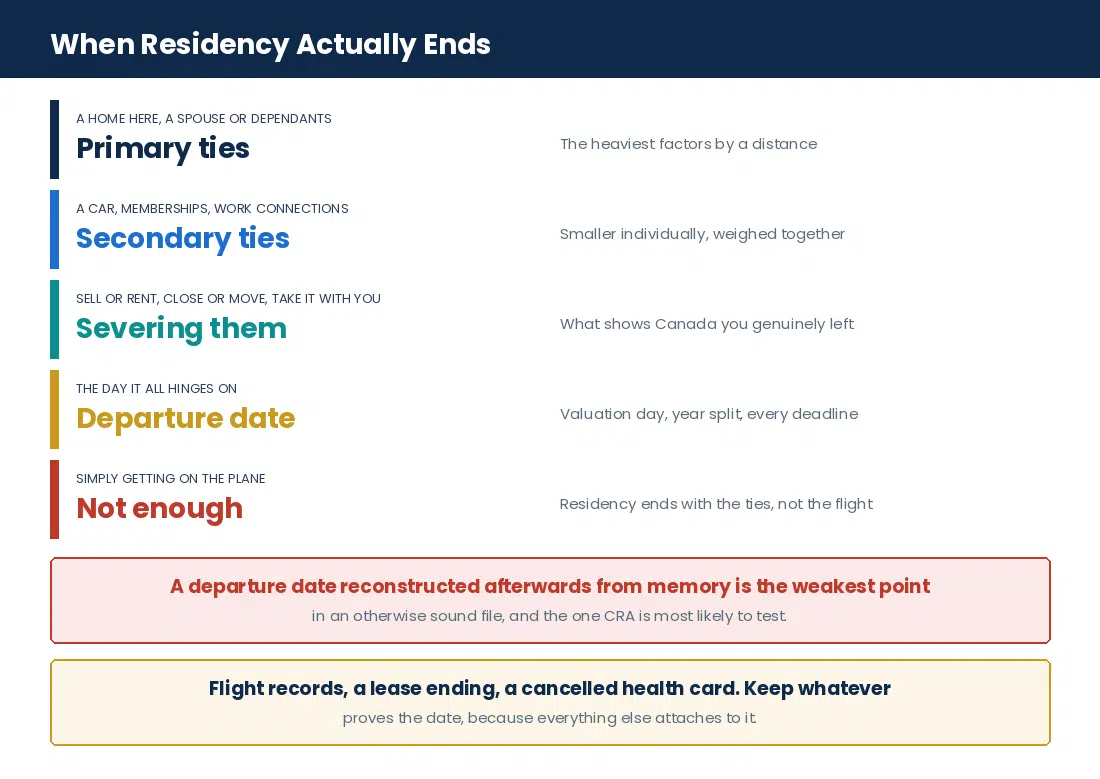
Before leaving, check your Canadian tax residency status carefully. This helps with leaving Canada tax filing and knowing if you owe any departure tax. The CRA looks at some key things:
- Primary residential ties: Do you have a home in Canada? Does your immediate family live here?
- Secondary residential ties: Things like your car, social groups, or work connections also matter.
Knowing these helps figure out if the Canadian departure tax applies when you move out.
Key Dates Affecting Non-Residency: Departure Date and CRA Emigration Date
Two dates really matter when deciding non-residency and taxes:
- Your Departure Date — the day you officially leave Canada. This usually stops your tax residency.
- The CRA Emigration Date — this might not be exactly the same but is close to when you leave.
These dates tell how long Canada can tax you as a resident after you move away.
Of everything on this page, the date is the item worth settling first and proving hardest.
It fixes the valuation day for every asset, the split between the resident and non-resident periods, and the deadline for the deferral election. A date reconstructed afterwards from memory is the weakest point in an otherwise sound file, and it is the one CRA is most likely to test. Flight records, a lease ending, a cancelled health card. Figures changed for privacy.
Residential Ties and Severing Connections with Canada
Leaving physically isn’t enough to stop Canadian taxes; breaking residential ties is key too. To handle leaving Canada tax filing properly, try this:
- Sell or rent out your Canadian home.
- Close bank accounts or move them overseas.
- Take all personal items out of the country.
These actions show Canada that you truly left and help avoid extra taxes later on from Canadian departure tax rules.
Implications of Factual Residency vs. Deemed Residency
It’s important to get the difference between factual and deemed residency before you leave:
- Factual residency means you still keep strong connections to Canada even if living elsewhere temporarily.
- Deemed residency applies once CRA says you’re a non-resident after you’ve cut those ties fully based on their rules.
This difference affects how much income tax you’ll owe after leaving—especially on capital gains from property or investments owned before moving away under section 128(7) of the Income Tax Act.
Impact of Tax Treaties on Residency Status and Tax Obligations
Tax treaties can change what happens to your taxes once you emigrate from Canada. They help sort out cases where two countries both want to tax the same income.
For example:
- If you keep some investments in Canada that make money, a treaty might reduce double taxation between here and your new country.
Knowing treaty details helps prevent paying twice on similar income streams after moving abroad.
Understanding both Canada’s laws and international agreements keeps surprises away about what taxes you’ll owe once you’ve left the country behind!
Overview of Canadian Departure Tax and Deemed Disposition Rules
Departure Tax and Deemed Disposition Rules
The Main Event
When you leave Canada, you might have to pay departure tax on most property you own that day. The law treats your assets as if you sold them at their current market value right before leaving. Even if you didn’t sell anything or get cash, you could owe taxes on the gains. This is called deemed disposition, and it’s covered by the Income Tax Act sections 128.1(1) and 128.1(4).
The idea is to tax the increase in value you earned while living in Canada before you become a non-resident. But some types of property don’t count here — more on that below. You need to report these deemed sales on your last Canadian tax return for the year you leave.
Example: Imagine you own shares worth $100,000 but originally bought for $60,000 on your departure day. The $40,000 gain is taxable even though you didn’t actually sell those shares.
That sentence is the whole of departure tax, and it is the one people do not believe the first time they hear it. No sale, no proceeds, and a real amount owing. Figures changed for privacy.
CRA: Ceasing to be a resident · Income Tax Act ss. 128.1(4), (6)
Property Subject to Departure Tax and Exceptions
Most things you own when leaving Canada fall under departure tax rules because of deemed disposition. But there are exceptions in the Income Tax Act s. 128.1(7). These include:
- Real estate located in Canada
- Resource properties used in a Canadian business
- Business assets linked to permanent establishments in Canada
- Registered plans like RRSPs and TFSAs (these are not taxed at departure)
- Stock options from Canadian employers
These exceptions stay taxable by Canada when they’re sold later instead of at the time you leave. It’s key to know which assets fall into each group to fill out your emigrant tax return correctly.
| Property Class | Subject to Departure Tax? | Notes |
|---|---|---|
| Shares & securities | Yes | Deemed disposed unless excepted |
| Real estate in Canada | No | Taxed when sold |
| RRSPs | No | Not disposed; taxed on withdrawal |
| Business assets tied to PE | No | Taxed upon sale |
Sources: CRA guide; ITA s. 128.1(7) · CRA: Deemed Disposition Exceptions
Reporting Requirements for Properties Over $25,000 Fair Market Value
If all your specified properties together are worth more than CAD $25,000 on your emigration date, you must file a report listing them—even if you defer taxes or don’t owe any now. This helps the CRA check compliance.
You’ll need to provide details like descriptions and fair market values backed by appraisals or bank statements. Keep these documents for six years after filing as proof.
Not filing this info can lead to fines and interest charges later if CRA audits your leaving Canada tax filing.
If your investments are worth CAD 30,500 plus exempt real estate, submit this list with your final emigrant tax return even if deferring tax.
Sources: ITA s.150(5); CRA Emigrant Info Return instructions
Income Reporting in the Year of Departure: Resident and Non-Resident Periods
You pay regular Canadian taxes on income earned up until the day you officially stop being a resident. That includes money from anywhere around the world. After that date, only income from Canadian sources counts for yearly non-resident filings.
This means filing two parts:
- A part-year resident return for January 1 through emigration date showing worldwide income.
- Later non-resident returns for Canadian income after leaving like rent or pensions.
Your deductions and credits get adjusted based on how many days you lived in Canada that year.
If you leave July 15 with $50K income Jan–July and get $2K dividends from Canadian stocks after July, report the first as resident income and handle the dividend as non-resident if needed.
Sources: ITA Part-Year Residency Guidance · CRA Non-Resident Filing Instructions · CRA: Non-residents and Canadian income
Filing Obligations for Emigrants: When and Who Must File
If you stop being a resident and meet basic thresholds, here’s what you need:
- A final T1 personal return showing worldwide income up to emigration day.
- An information return listing specified property over thresholds.
The usual deadlines apply—normally April 30 following year-end—but missing them can hurt deferral chances or cause penalties.
Not filing risks reassessments plus interest on unpaid amounts starting from due dates.
People with complicated portfolios often find professional help useful due to valuation challenges and elections involved.
| Category | Required Filings |
|---|---|
| Individual over filing thresholds | Final T1 + Info Return |
| Owner with low-value assets | Final T1 only |
Sources: ITA ss150 & Regulations · CRA Penalties Guide · Gondaliya CPA experience
Choosing the Correct Tax Package Based on Province or Territory
The province where you’re considered resident when leaving decides which provincial forms go with your federal final tax return. For example:
- Ontario uses Form ON428 along with federal forms; Quebec requires separate provincial filings directly with Revenu Québec.
Picking the right package prevents delays caused by sending forms to wrong places or triggering audits.
Tax professionals verify province codes early during intake, especially helpful if moving from one province to another before leaving Canada.
Sources: ITA Provincial Residence Rules · Provincial Revenue Agency Guidelines
Filing Deadlines and Where to Submit Your Final Canadian Tax Return
Final returns combining normal annual reporting plus extra schedules for emigrants follow standard deadlines:
- April 30 deadline applies unless self-employed; then June 15 applies but interest still starts April 30
- Deferral election papers share these deadlines
- Late filings risk penalties calculated daily but capped yearly
You can file electronically using certified EFILE providers like licensed Ontario CPAs serving clients nationwide—including Gondaliya CPA—or mail paper returns depending on what suits you best.
Keep delivery proof (tracking or receipts) just in case questions come up about when exactly CRA got your documents.
CRA General Filing Dates · Gondaliya CPA Service Details · CRA Compliance Notices
For clear help sorting out complex rules tied to emigrating from Canada’s taxes, contact Gondaliya CPA’s team offering free consultations tailored especially for Ontario residents moving abroad.
To talk about how we can help with your emigrant tax return call 647‑212‑9559, email info@gondaliyacpa.ca, or request a free consultation online—no strings attached.
Completing Your Emigrant Tax Return
Completing Your Emigrant Tax Return
The Final Return
Filing your emigrant tax return in Canada takes care. When you leave Canada, your last tax return must show the income you earned before you left. You also have to report any properties you’re treated as selling on departure day. Make sure you include all required forms and statements. This helps you avoid penalties or interest for missing details on your Canadian departure tax.
How to Accurately Complete Your Tax Return After Leaving Canada
Filing your final return means reporting all worldwide income up to the date you stopped living in Canada. You file as a part-year resident. That means including:
- Income from January 1 until the day before you leave.
- Capital gains or losses from the “deemed disposition” of most properties at fair market value on your departure date.
- Election forms if you want to delay paying departure tax.
- Foreign property owned when you stopped being a resident.
Keep documents like valuation reports and proof that you left Canada. The filing deadline is the same as usual. If you miss it, expect fines.
Example: Suppose you left Canada on June 15. You report your job income earned until that date plus capital gains on your investments valued at fair market price on June 15.
You also file Form T1161 listing property over certain amounts along with your return. The valuation at a single named date is what makes this return different from every other one you have filed. Figures changed for privacy.
Reporting Your Spouse’s or Common-Law Partner’s Income
When doing your leaving Canada tax filing, include your spouse’s or common-law partner’s income depending on their residency that year:
- If both of you stop living in Canada at the same time, each files a part-year resident return showing income until that day.
- If one stays longer, they file a full-year return while the other files part-year.
You might still claim income splitting for the months before leaving. Make sure spousal info is correct to get the right credits and deductions after departure.
Eligible Deductions for Emigrants, Including Moving Expenses
When emigrating from Canada, some moving expenses can reduce your taxable income. These are costs tied directly to moving your household stuff and travel costs from old home to new home outside Canada if CRA rules allow (see Income Tax Act section 62).
Other deductions may apply depending on when in the year you stopped being a resident but can’t go beyond limits set by law.
Keep detailed receipts and records for these deductions because CRA may ask for them later.
Claiming Federal and Provincial Non-Refundable Tax Credits as a Partial-Year Resident
As an emigrant filing your last Canadian return, you’re entitled to federal and provincial non-refundable credits. These get prorated based on how many days you lived in each place during the year.
You can claim things like:
- Basic personal amount
- Age amount (if it applies)
- Disability credit
- Pension income amount
These credits lower the taxes owed before any refundable credits or payroll instalments like CPP/QPP contributions are considered.
Your province’s credits depend on where you last lived when leaving; Ontario has its own forms calculating taxes owed for just those months [CRA source].
Handling Overpayments of CPP/QPP Contributions and Refund Procedures
Sometimes when leaving Canada, you’ve paid too much CPP or QPP because more than one employer sent payments or due to errors after moving.
- File your final T1 including Schedule 8 showing pension contributions made before leaving.
- Ask for refunds using specific lines in Schedule 8; excess is first used against any taxes owing then refunded if there’s none.
- Keep T4/T4A slips from employers ready in case CRA checks.
Submitting refund requests early stops losing money after your leaving Canada tax filing is done well by those who know emigrant cases.
Applying for Federal Refundable Tax Credits Post-Departure
Federal refundable credits like the GST/HST credit usually end once you’re not a resident anymore unless there are special cases around when exactly you left.
You can claim a pro-rated share covering months inside Canada if you qualify per CRA rules [CRA GST/HST Credit Guide].
Filing fast helps make sure you get what you’re due. Missing deadlines can cost these benefits even if you’re eligible after leaving officially recognized by CRA systems.
Relevant Forms and Publications for Departure Tax Filing
| Document/Form | Purpose | Source |
|---|---|---|
| T1 General – Final Return | Reports all income up to emigration date | CRA T1 Guide |
| Form NR73 (optional) | Asks CRA to decide exact date residency ended | CRA NR73 |
| Form T1161 – List Of Properties Owned At Departure Date | For reporting specified properties above thresholds under deemed disposition rules (ITA s128) | CRA Info Sheet |
| Election To Defer Payment Of Departure Tax (Section 220(4)) | Lets you postpone paying departure tax if security is provided | See Income Tax Act Part XIII |
| Schedule ON428 – Ontario Part-Year Resident Calculation | Figures provincial tax owed based on days lived in Ontario before leaving | N/A |
* Required depending on assets held & elections made according to current laws valid through 2026 and beyond.
Departure Tax Readiness Check
Five quick questions on where your departure file stands. No fee shown.
Points to raise with us:
This is a general prompt, not tax or legal advice or a quote. Your position depends on your full facts. For a real review, please book a free consultation.
Elections, Registered Plans and Deferral Options
Elections, Registered Plans and Deferrals
Your Choices
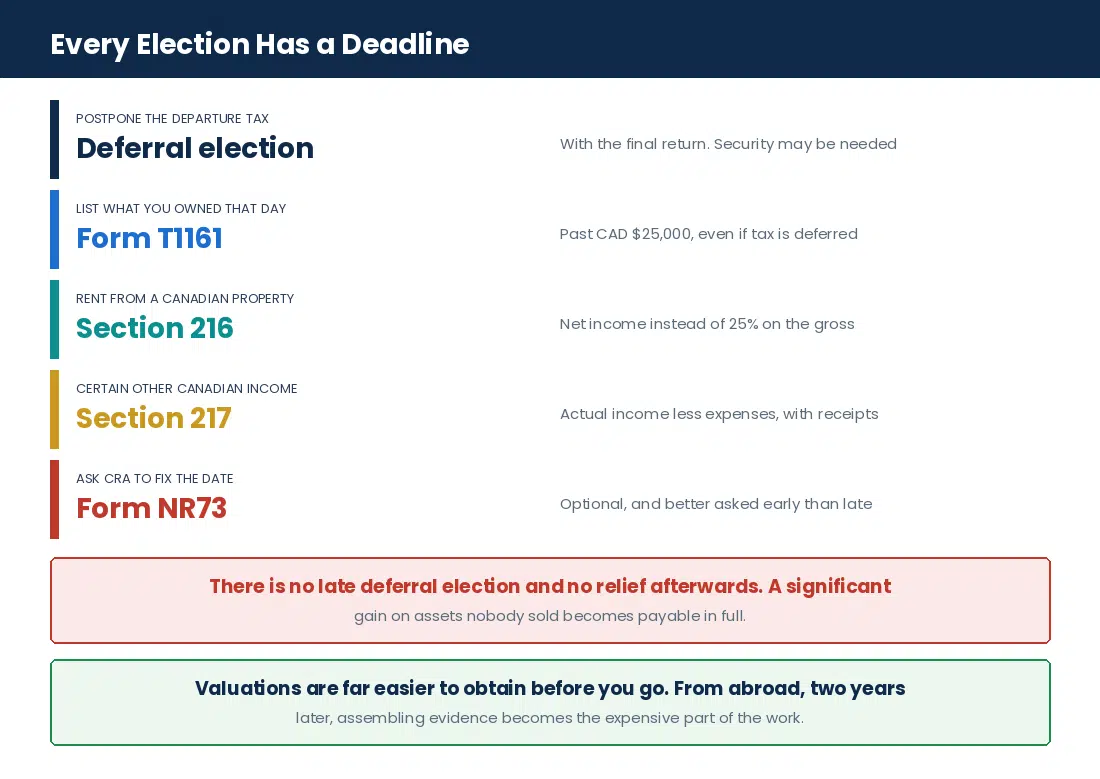
Electing Under Section 217 for Certain Canadian Income After Leaving
Section 217 of the Income Tax Act lets people who move away from Canada choose to pay tax on some Canadian income in a different way. Instead of paying taxes based on the full amount taken out, you can report the actual income minus expenses. This applies mostly to rental income, business earnings, and some other types you get after leaving.
To use this option, you have to file a special tax return under section 217. You must do this by the deadline for your last Canadian tax return. This election helps you pay tax on the real profit, not just on gross income. But if you miss the deadline, Canada Revenue Agency (CRA) will tax you using standard withholding rates.
CRA wants proof for all expenses you claim. This means receipts and contracts linked to your Canadian property or business after you leave. Without these, they might reassess your taxes or charge penalties.
This choice doesn’t change your departure tax duties but helps manage income from Canada after moving away. If you want help with leaving Canada tax filing or Section 217 election, talking to a tax expert familiar with emigrating from Canada tax rules is smart.
Treatment of Registered Plans Upon Emigration: TFSA, RRSP, HBP, LLP
When you leave Canada, registered plans like TFSAs, RRSPs, HBPs, and LLPs have special rules. These are different from most assets that face departure tax.
- TFSAs aren’t treated as sold when you leave. But if you add money while not living in Canada, CRA might fine you.
- RRSPs also avoid being treated as sold at departure. But if you take money out later as a non-resident, it’s taxable.
- HBPs and LLPs let you borrow for homes or education. You still have to pay them back on schedule even if living outside Canada.
These plans don’t trigger immediate capital gains at departure but need tracking when filing your emigrant tax return in Canada.
Missing details or not following rules can cause unexpected penalties or reassessments later.
The TFSA contribution trap catches people months after they have gone, because nothing stops the transfer.
The account still exists, the bank still accepts the deposit, and the automatic monthly contribution set up years ago keeps running. Nobody is notified that it should not. Cancelling standing contributions belongs on the departure checklist alongside the health card. Figures changed for privacy.
Managing Tax on Private Corporations and Trusts Controlled by Emigrants
If you control private companies or trusts before leaving Canada, taxes get tricky.
- Shares in private companies usually count as sold when you leave. But some shares in small businesses may get special treatment allowing delay of taxes.
- Trust interests can cause complex rules about who reports gains and when.
- Corporate profits and trust distributions must be reported carefully.
Failing to provide proper valuations or missing forms can lead to big penalties and interest charges on unpaid taxes from these deemed sales at departure.
It’s best to get advice from professionals who know how emigrants should handle closely held companies and trusts under current laws.
Sources: Income Tax Act s128(7) · CRA – Deemed Disposition Rules
Deferral Options for Departure Tax: Posting Security with the CRA
You can delay paying capital gains tax caused by deemed disposition when leaving Canada. You do this by filing an election by your final return deadline and giving security to CRA if needed.
Whether you need security depends on how much gain you’re deferring each year. Usually, banks issue letters of credit that CRA accepts as security.
This delay isn’t automatic or backward looking; miss deadlines means losing the option and owing full tax plus interest. Keep all paperwork safe — ownership proof, valuations used, and security documents — since CRA may ask later.
| Document Filed | Deadline |
|---|---|
| Deferral Election | Same day as final return |
| Security Documents | Accepted before assessment |
Doing this right helps avoid big cash payments but needs exact timing and good records during your leaving Canada tax filing.
Sources: Income Tax Act s220(4.54) · CRA – Departure Information Returns · CRA Record Retention Guidelines
Deferral is the provision that makes departure tax survivable, and it is the one most often lost to a date.
A taxable gain on assets nobody sold can be a serious amount of cash to find in one year. The election removes that problem entirely — but only if filed with the return, on time. There is no late election and no relief afterwards, so the deadline matters more than the arithmetic. Figures changed for privacy.
Election to Trigger Capital Gains or Losses on Deemed Disposition
You can choose to report capital gains or losses from deemed disposition immediately when you stop being a resident. This means recognizing any profit or loss right away instead of waiting until selling the asset abroad later.
This affects when taxes are paid but not how much overall is owed. You base this on fair market value set at your departure date with support like appraisals or brokerage statements.
To make this election:
- File forms with your last part-year Canadian return
- List all assets involved with values documented clearly
If done wrong or missed altogether:
- You risk penalties for late reporting
- Or lose chance to manage your cash flow by paying early
Someone selling investments may report $120K gain immediately instead of deferring it overseas sale recognition.
Sources: ITA s220(4) · Income Tax Act · CRA T4058 – Emigrants and Income Tax
Utilizing the Principal Residence Exemption and Lifetime Capital Gains Exemption
If you owned a home in Canada as your main place while living there, you might avoid some departure taxes on its gain by claiming the principal residence exemption.
The lifetime capital gains exemption (LCGE) also helps reduce taxes when disposing of certain small business shares because of leaving.
Both exemptions cut how much tax you owe but need proof:
- Show when and how long property was your main home
- Keep bills, address proofs, municipal records confirming occupancy well past moving date
Denials often happen because taxpayers lack solid proof about where they lived during relevant years.
| Exemption Type | When It Applies | What To Report |
|---|---|---|
| Principal Residence | Home lived in during residency | Mark it in final return |
| Lifetime Capital Gains | Qualified small business shares | Submit detailed schedules |
Using these exemptions properly cuts down departing taxes — if backed up with good records following strict rules.
Sources: ITA s40(2)(b) · CRA P113 – Gifts and Income Tax · Various ITA sections & CRA guides
Income Splitting Strategies and Tax Planning When Leaving Canada
Once you’re no longer a Canadian resident, income splitting options shrink a lot because many family-based credits don’t apply outside provinces anymore.
Still, some moves work if done before leaving:
- Setting inter-family loans early creates interest deductions
- Transferring investments carefully ahead avoids anti-avoidance problems
- Spousal loans timed right must show real economic reasons throughout exit process
Good planning also means matching instalment payments so partial year incomes line up with deadlines tied specifically to leaving canada tax filing.
Getting help from experts who understand cross-border issues protects against mistakes causing audits—common among new emigrants.
Managing Tax Compliance and Financial Matters After Departure
Managing Compliance After Departure
After You Go
Leaving Canada means you still have to handle some tax stuff. Even after you move away, Canadian departure tax rules apply. You need to know about your income from Canada, rental properties you keep, and taxes withheld on payments. Filing the right forms and meeting deadlines keeps penalties away.
Tax Reporting Requirements for Canadian Source Income as a Non-Resident
Once you’re no longer a resident, Part XIII withholding tax hits certain Canadian-source income like dividends, interest, rents, royalties, and pensions. Usually, the payer takes this tax before you get your money.
Non-residents usually don’t file returns for this income unless they make an election under section 216 of the Income Tax Act (ITA). This election lets you report net rental or business income yearly instead of paying withholding tax up front. If you skip this election, withholding still applies but no filing is needed.
Withholding rates go up to 25% but can be lower if your country has a treaty with Canada. CRA: Part XIII – Withholding Taxes
Filing and Reporting Canadian Rental Income and Real Estate Sales as a Non-Resident
What if you keep a Canadian property? Rental income after you leave is taxed in Canada. It faces a 25% Part XIII withholding unless you file an election under section 216 to report net income instead.
Selling property counted as taxable Canadian property (TCP) needs reporting too. Non-residents must send Form T2062 to CRA on time. Not doing this causes fines or delays in getting sale money because of clearance certificates.
Don’t miss deadlines; penalties and interest can add up fast. CRA: Selling Property When You Leave Canada
The clearance certificate is where a property sale stalls, and it stalls at closing with money held back.
A purchaser’s lawyer will withhold on a sale by a non-resident until the certificate is produced, and the request takes time CRA controls rather than you. Starting it when the property goes on the market rather than when the deal firms up is the difference between a clean closing and funds sitting in trust for months. Figures changed for privacy.
Withholding Tax Obligations on Dividends, Interest, and Royalties Paid to Non-Residents
Canadian companies pay dividends to non-residents with Part XIII withholding tax taken off first. The rates follow law or treaties that might reduce them. Interest paid without special deals faces full withholding except in some cases like loans between unrelated parties.
Royalties from Canadian sources also have mandatory withholding before the money goes overseas.
The payers must send these taxes directly to CRA. If they fail, both they and you risk penalties or reassessments.
Section 216 Election for Rental Income and Related Filing Procedures
Section 216 helps non-resident landlords who get rent from Canadian homes:
- They can file an annual return reporting net rent.
- They avoid the flat 25% withholding.
- Expenses can be deducted from gross rents.
You have until April 30 after the year’s end to file this election. It might mean a refund if expenses lower your net rental income below withheld amounts. You must file even if you don’t make money.
You get $20,000 rent; $5,000 withheld at 25%. If expenses are $7,000 causing a $13k loss reported with section 216 return filed on time—you could get some money back.
Sources: ITA s.216; CRA Guide RC4110 – Rental Income
Benefit payments that keep arriving after departure are not a windfall, and they are not CRA’s mistake to absorb.
The GST/HST credit and provincial equivalents stop at the end of residency, but the deposits often continue for a quarter or two because the account has not caught up. Every dollar is recovered later. Reporting the departure on the final return promptly is what stops the clawback growing. Figures changed for privacy.
Impacts of Becoming a Non-Resident on Benefits, Credits, and Tax Refunds
When you stop being a resident:
- Federal benefits like GST/HST credit end right away.
- Provincial credits stop based on your last province.
If you receive these benefits after leaving, you may have to pay them back once CRA adjusts your account.
Provincial taxes only apply till your official departure date that year. After that, they usually stop unless local laws say otherwise for part-year residents.
Make sure to report when you leave through your final part-year return so benefits are calculated right.
Practical Steps to Manage Tax Liability and Maintain Compliance Post-Departure
Here’s what to do after leaving Canada:
- File your final part-year T1 return including deemed disposition details under ITA s128(1).
- Send Form T1161 listing all specified property over threshold values at departure—even if deferring taxes.
- Stick to deadlines—usually April 30 next year for final returns.
- Pay security deposits quickly if using deferral options under ITA s220(4).
- Watch any ongoing Canadian-source income; keep filings and elections current.
- Keep records proving property values forever or at least as required by law.
- Talk to tax pros familiar with Ontario emigrants who know the tricky rules well.
| Filing Requirement | Deadline | Notes |
|---|---|---|
| Final part-year T1 Return | April 30 next calendar yr | Includes deemed disposition reporting |
| Form T1161 Information Return | Same deadline | Lists specified property over threshold |
| Section 216 Election | April 30 next calendar yr | Optional; reduces rental withholding |
Missing deadlines brings penalties plus interest that add up fast.
Resources, Support, and Next Steps with Gondaliya CPA
Resources, Support and Next Steps
Where To Look
Accessing Official CRA Forms and Publications Related to Emigration Tax Filing
When you leave Canada, your tax duties don’t just stop. The Canada Revenue Agency (CRA) has special forms for filing taxes when you move away. You’ll need the T1 General form with extra schedules for departure reporting. There’s also a guide called “Leaving Canada” that talks about departure tax rules and deemed dispositions under Income Tax Act sections 128.1(1) and 116.
If you own property above certain limits when you leave, you must file an emigrant tax return Canada to report it. Forms like T1243 (Deemed Disposition of Property by an Emigrant) might be needed depending on what you own. Check out CRA: Leaving Canada for official info. These documents help you get it right.
Additional Resources on Canadian Departure Tax and Non-Resident Tax Rules
Canadian departure tax can get complicated fast. You deal with deemed disposition, excepted property classes, deferrals, security deposits, and filing as a part-year resident. The CRA website breaks down these topics clearly. Note some rules will change in 2026, like deferral deadlines and security requirements [Income Tax Act Sections 128.1 & 150].
If you leave Canada tax filing covers more than just capital gains too. Some income after you leave could face non-resident withholding tax CRA: Non-Resident Taxes. Reading official guidance helps you keep track of what still applies.
How Gondaliya CPA Can Assist with Emigration Tax Return Preparation and Planning
Gondaliya CPA helps prepare emigrant tax returns across Canada from our Ontario offices. We charge a flat fee each year including HST. Our CPAs know personal taxation rules around Canadian departure tax well.
We gather detailed lists of all property deemed disposed when leaving Canada. We check valuations meet Income Tax Act rules. If allowed, we file deferral elections on time and manage required securities so no penalties catch you off guard.
Our team handles final returns too—calculating income for the part of the year you lived in Canada and looking at which province matters for your taxes that year. With over 1300 five-star Google reviews, many trust us on cross-border tax matters while moving out of Canada.
Contact Information and Consultation Services for Emigrant Tax Questions
If you want help with your emigrating from Canada tax questions, reach out to Gondaliya CPA by email at info@gondaliyacpa.ca or call 647-212-9559 Monday to Friday during business hours.
We offer free consultations to explain what you need to do before leaving. We review your possible obligations under the Canadian departure tax rules and plan next steps for filing without stress or surprises.
Getting in touch early helps us confirm your official CRA emigration date and guide paperwork based on federal law—not immigration rules—so your final return is accurate.
Encouraging Early Tax Planning to Optimize Tax Outcomes When Leaving Canada
Starting your tax planning early makes things easier when leaving Canada. Section 128.1(4) ITA says most assets are considered sold at departure, so values matter.
Early prep means gathering fair market value appraisals needed to support reported amounts on your final return and info forms filed on time with the CRA. It also helps decide if making a deferral election fits your asset types—and lets you set up any needed security deposits before deadlines hit, avoiding interest or enforcement later.
This post doesn’t tell you how to rearrange holdings or pick a departure day—that’s outside our scope—but early contact avoids late filings or missing valuations that can cause audits.
Valuations are far easier to obtain before you go than after, and that gap widens every month.
An appraiser who can inspect a property, a broker statement pulled while the account is still active, a business valuation while the records are at hand. From another country, two years later, assembling evidence for a date that has passed becomes the expensive part of the engagement rather than a preliminary to it. Figures changed for privacy.
Legal and Privacy Disclaimers Regarding Tax Advice and Compliance Support
This content is only educational about leaving Canada tax filing duties under current CRA rules; it isn’t legal advice or about immigration status laws that are separate [Income Tax Act].
Gondaliya CPA provides accounting services but does not audit or guarantee outcomes about residency decisions based on facts here consistent with laws mentioned throughout this guide [Editorial Policy].
You should talk to legal experts about immigration issues because foreign laws fall outside our advice—our focus stays only on making sure Canadian personal income reporting follows up-to-date federal rules connected to taxpayers leaving the country.
Got questions about emigrating from Canada taxes or need help with your final return? Contact Gondaliya CPA today for a free consult focused just on Canadian departure taxes handled professionally from Ontario locations like Toronto and Hamilton-area communities.
Frequently Asked Questions About Emigrating From Canada Tax
Frequently Asked Questions
Answers
What is the security deposit requirement when deferring departure tax?+
When must I file the deferral election for departure tax?+
What is the deadline for filing Form T1161 (Property List) when leaving Canada?+
How long should I keep valuation evidence after leaving Canada?+
Is tax withheld at source on Canadian-source income after I become a non-resident?+
What is a part-year return in emigrant tax filing?+
Should I choose a CPA Ontario firm like Gondaliya CPA for my emigrant tax filing?+
Can I file my emigrant tax return myself or should I hire a CPA?+
Essential Insights for Emigrant Filing
Key Points
Essential Insights: Best Practices & Key Points for Emigrant Tax Filing
- Thresholds matter: Report specified properties if their total exceeds CAD 25,000 at departure to avoid penalties.
- Security deposit: Required if deferring departure tax; arrange bank-issued security timely.
- Deferral election deadline: Must be filed with final T1 return by April 30 following emigration year.
- Form T1161 filing: Mandatory listing of properties over threshold accompanies final return.
- Retention period: Keep valuation proofs for six years; CRA can audit anytime in this window.
- Tax withheld at source: Applies on Canadian-source income post-emigration; know treaty benefits.
- Part-year return: Reflects worldwide income till departure date; files as resident during that period.
- Gondaliya CPA credentials: Registered with CPA Ontario; US CPA licenses enhance cross-border expertise.
- Emigrant filings complexity: Professional help reduces mistakes on elections and compliance certificates.
- Common errors to avoid: Missing deadlines, undervaluing property, not filing required forms triggers audits.
- Pre-filing checklist: Prepare asset lists, valuations, spousal income details, and moving expenses receipts.
- Handling late filings: Contact professionals immediately to catch up and reduce penalties and interest charges.
For professional support on your emigrant tax return or Canadian departure tax planning, contact Gondaliya CPA today at 647‑212‑9559 or info@gondaliyacpa.ca.
Businesses We Serve & Industry Spotlights
Industry Expertise
Emigrants sit inside a wider group of people whose Canadian return turns on where they are considered to live, and the questions that decide a departure file — when residency actually ended, what has to be valued on that date, and what Canada still reaches afterwards — recur across every one of these situations.
| Who | The Departure Angle |
|---|---|
| Emigrants leaving Canada | Deemed disposition, T1161 and the part-year return |
| Digital nomads | Residential ties tested against long absences |
| Snowbirds | Winters away that may or may not end residency |
| Canadian snowbird landlords | Rental property kept behind after leaving |
| Dual citizens | A second country’s rules waiting on the other side |
| US citizens living in Canada | A filing duty that survives the move either way |
| Canadians working in the US | Day counts deciding where residence actually sits |
| Businesses winding down | A corporation closed before the owner departs |
| Business buyers | Private company shares valued at the departure date |
| Angel investors | Portfolios deemed disposed with no sale and no cash |
| Portfolio managers | Client holdings needing valuation on a single named day |
- Emigrants leaving Canada: The core of this work. The departure date, the deemed disposition, Form T1161 and the deferral election account for almost every adjustment we make.
- Digital nomads: Long absences without a clean break, where the question is whether residency ended at all rather than when.
- Snowbirds: Months away each winter that rarely end residency, which is usually the better outcome once departure tax is in view.
- Canadian snowbird landlords: Where a rental property stays behind, section 216 and the clearance certificate both come into play later.
- Dual citizens: Departing Canada settles one side of the question and opens the other, with the destination country’s rules waiting.
- US citizens living in Canada: A filing obligation that follows citizenship, so leaving Canada changes the Canadian return and not the American one.
- Canadians working in the US: Often the step before a full departure, where day counts and ties decide whether this year is the year.
- Businesses winding down: A corporation closed before the owner leaves avoids valuing its shares on the departure date, which is worth sequencing deliberately.
- Business buyers: Private company shares are among the hardest assets to value at a named date, and among the most likely to be questioned.
- Angel investors: A portfolio of holdings deemed disposed on one day, with tax owing and nothing sold, is exactly what the deferral election exists for.
- Portfolio managers: Clients departing need statements pulled at a specific date, which is far simpler while the account is still open.
In every one of these, one date does the work, and everything else is evidence attached to it.
The departure date sets the valuation day, splits the year, and starts the clock on the election. Almost every difficulty on a departure file traces back to that date being decided late, recorded loosely, or reconstructed afterwards from memory.
Professional Guidance and Quick Reference
Guidance
Essential Tax Points for Canadians Leaving the Country
Departure files go wrong in a predictable set of ways: treating the physical move as the end of residency while the home, the family or the accounts stay behind; not fixing a departure date or not being able to prove it; discovering the deemed disposition after the year has closed; missing the deferral election, which has no late filing and no relief; omitting Form T1161 because tax was deferred and nothing seemed owing; valuing assets from abroad two years later instead of before leaving; continuing TFSA contributions as a non-resident; and selling Canadian property without starting the clearance certificate early enough. Gondaliya CPA prepares emigrant returns on a flat annual fee.
Quick Answers
At a Glance
- What ends residency: severing residential ties, not the flight itself
- Primary ties: a home in Canada, a spouse or dependants here
- Secondary ties: a car, social memberships, work connections
- Departure date: fixes the valuation day, the year split and the election deadline
- Deemed disposition: most property treated as sold at fair market value under 128.1(4)
- Excepted property: Canadian real estate, resource property, business assets tied to a PE, registered plans, certain stock options
- Excepted means later, not never: Canada taxes those on actual sale
- Form T1161: required once specified property exceeds CAD $25,000, even if tax is deferred
- Final return: part-year, worldwide income to the departure date
- Afterwards: non-resident returns for Canadian-source income only
- Deadline: April 30, or June 15 if self-employed with interest still from April 30
- Deferral: elected with the final return, with security such as a bank letter of credit
- Credits: non-refundable amounts prorated by days resident; GST/HST credit ends
- Registered plans: not deemed disposed, but TFSA contributions while non-resident attract penalties
- Part XIII: up to 25% withholding on dividends, interest, rent, royalties and pensions
- Section 216: election to report net rental income instead of gross withholding
- Section 217: election covering certain other Canadian income after leaving
- Selling Canadian property later: Form T2062 and a clearance certificate
- Records: valuations and appraisals kept at least six years
Who This Is For / Not For
Fit Check
- For: individuals leaving Canada permanently who need a final part-year return, a deemed disposition calculation and the forms that accompany them.
- For: emigrants holding investments, private company shares, trusts, registered plans or Canadian property they intend to keep, and those who left in a previous year without filing properly.
- Not for: advice on immigration law, on the tax rules of the country you are moving to, or on when to leave and how to rearrange holdings beforehand, which the source material places outside scope.
- Not for: people travelling or working abroad temporarily while keeping their ties here. Someone with modest assets is still squarely in scope, because the filings are required regardless of the amount owing.
People Also Ask
Related Questions
Why do I owe tax on things I haven’t sold?+
Because subsection 128.1(4) treats most of your property as sold at fair market value immediately before you cease residence. The purpose is to tax the gain that accrued while you lived here, before Canada loses the right to tax it. Nothing changes hands and no money arrives, but the gain is reported on your final return and the tax is real.
I’m deferring the tax. Do I still have to file the property list?+
Yes. Form T1161 is required once specified property exceeds CAD $25,000 at the departure date, regardless of whether you defer, and regardless of whether any tax is ultimately owing. It is an information return, and omitting it is its own compliance failure with its own consequences.
Can I make the deferral election later if I decide I need it?+
No. The election is filed with your final return by the deadline, usually April 30 of the following year. It is not available afterwards, and there is no late election. Where a significant gain has been triggered on assets nobody sold, that deadline is the single most expensive one on the file.
Does my RRSP get caught by departure tax?+
No. Registered plans are excepted property, so they are not deemed disposed on departure. They are taxed when you withdraw, and as a non-resident that withdrawal is subject to withholding. The TFSA is also excepted, but contributing to one after you cease residence attracts penalties, so standing contributions should be cancelled.
I kept my Canadian house. What happens when I sell it?+
Canadian real estate is excepted property, so it is not caught at departure — Canada taxes it on the actual sale instead. At that point you file Form T2062 and obtain a clearance certificate, and until it is produced the purchaser’s lawyer will hold back funds at closing. Start that process when the property is listed, not when the deal firms.
Glossary of Key Terms
Definitions
- Emigrant: someone who ceases to be a resident of Canada for tax purposes.
- Departure date: the day residency ends, which sets the valuation date and the year split.
- CRA emigration date: the date CRA records as the end of residency, close to but not always identical to the departure date.
- Residential ties: the home, family, belongings and connections CRA weighs in deciding residency.
- Deemed disposition: the rule treating property as sold at fair market value immediately before ceasing residence.
- Departure tax: the tax arising on the gains from that deemed disposition.
- Excepted property: assets outside the deemed disposition, taxed by Canada on actual sale instead.
- Specified property: holdings reportable on Form T1161 above the CAD $25,000 threshold.
- Form T1161: the list of properties owned at the departure date, filed with the final return.
- Form T1243: the deemed disposition of property by an emigrant form.
- Form NR73: the optional request asking CRA to determine the date residency ended.
- Part-year return: the final T1 reporting worldwide income to the departure date.
- Deferral election: the choice to postpone paying departure tax, with security posted to CRA.
- Part XIII tax: Canadian withholding on dividends, interest, rent, royalties and pensions paid to non-residents.
- Section 216 election: reporting net rental income rather than suffering gross withholding.
- Section 217 election: reporting certain other Canadian income on a net basis after leaving.
- Form T2062 and clearance certificate: the filing and certificate required when a non-resident sells taxable Canadian property.
Want a checklist to work from? You can download our free departure tax checklist before your consultation.
Four things decide a departure file. The date — residency ends when the ties are severed, not when the flight leaves, and that date fixes the valuation day, the split between resident and non-resident periods, and every deadline that follows. The deemed disposition — under 128.1(4) most property is treated as sold at fair market value immediately before you go, so a gain built over years becomes taxable with no sale and no cash, while excepted property such as Canadian real estate, registered plans and business assets tied to a permanent establishment stays taxable here on actual sale. The filings — a part-year T1 on worldwide income to the departure date, Form T1161 once specified property passes $25,000, and the deferral election filed with the return by April 30 or lost entirely. And what remains — Part XIII withholding to 25%, the section 216 and section 217 elections, and Form T2062 with a clearance certificate when Canadian property is eventually sold.
Three questions tell you where you stand, and the best time to answer them is before you go. First, what date will you say residency ended, and what proves it? Flight records, a lease ending, a cancelled health card. Everything else attaches to that date. Second, can you list everything you own with a value at that date? Shares, funds, private company shares, trust interests, property here and abroad — valuations are vastly easier to obtain while you are still here. Third, would paying the departure tax in one year be a problem? If so, the deferral election is the answer, and it has to be filed with the final return rather than requested later.
Emigrating From Canada Tax: How Gondaliya CPA Can Help
Start with your departure date and a list of what you own
Gondaliya CPA settles the residency position and the departure date against the ties before anything is calculated, builds the asset list and checks the valuations support what will be reported, prepares the final part-year T1 with the deemed disposition and prorated credits, files Form T1161 where specified property passes the threshold, handles the deferral election and the security arrangements within the deadline, applies the principal residence and lifetime capital gains exemptions where the records support them, and sets up what comes afterwards — section 216 for rental income, Form T2062 and the clearance certificate when Canadian property is sold — on a flat annual fee including HST with a one-business-day response. Please book a free consultation.
Next Steps
Please book a free consultation with Gondaliya CPA and bring three things: the date you left or expect to leave with whatever proves it, a list of everything you own with rough values, and a note of what you are keeping in Canada. Those three settle the residency position, the size of the deemed disposition and whether the deferral election is worth making — which between them account for nearly every difficulty we see on a departure file. If you left in an earlier year and did not file properly, say so at the outset, because catch-up work is routine and considerably cheaper raised than found. We advise on Canadian tax only, not on immigration or the rules of the country you are moving to, and we do not advise on when to leave or how to rearrange holdings beforehand. You will get a flat annual fee including HST before any work begins. We serve Toronto, Mississauga, Brampton, Vaughan, Etobicoke, Scarborough, Hamilton, Ottawa and the rest of Ontario, and work with departing clients across Canada. If our content helps, please add gondaliyacpa.ca as a preferred source on Google.
Published: · Last updated:
Editorial policy: We research against CRA, Department of Finance, Parliament of Canada, CPA Canada and CPA Ontario sources, fact-check the figures, and Sharad Gondaliya, CPA, reviews the content, which we update as the rules change.
Disclaimer: This article is educational information only and is not tax, legal, financial or immigration advice. It covers Canadian federal income tax on ceasing residence, and it does not cover immigration law, the tax rules of the destination country, or advice on when to leave or how to arrange holdings beforehand, each of which is handled separately. Thresholds, withholding rates, filing deadlines and statutory references change, and the section references in this article are those cited in the source material, which refers in places to section 128(7) and in others to 128.1(7), cites subsection 220(4) and 220(4.54) for the deferral election, and notes rule changes in 2026 without giving a source; every reference should be confirmed against current CRA guidance before a return is filed. Whether residency has ceased, and on what date, turns on the full facts. Gondaliya CPA performs compilation engagements under CSRS 4200 and does not perform audit or review engagements. Please consult a licensed CPA before acting.

Sharad Gondaliya is a CPA Canada & CPA USA with 15 Years+ experience of Accounting, Tax, Payroll of Corporate Small Businesses as Tax Accountant. He is a CPA Ontario member (61040184) and holds US CPA licences in Washington and Montana and is well known among corporate small businesses for tax planning, efficient tax solutions, and affordable CPA services. Sharad is the Principal (Director) of Gondaliya CPA – Affordable CPA Firm in Canada. Licenses: CPA Ontario: 61040184 | CPA USA (MT): PAC-CPAP-LIC-033176 | CPA USA (WA): 57629 | CPA Firm License: 61330051 View Full Author Bio