



Tax Accountant for Call Centres in Ontario and Across Canada
We put your switches, routers and VoIP gear in Class 46 rather than lumping them with the workstations, capitalize your call-floor build-out to Class 13 instead of expensing it, settle the employee-versus-contractor question on your at-home agents before CRA does, accrue vacation pay properly across a large hourly workforce, review whether your US client contracts genuinely qualify for export zero-rating rather than assuming either answer, and apply the place-of-supply rules so a client in another province is billed at their rate. Whether you run an inbound customer support centre, an outbound campaign operation, an answering service, or a collections centre, we handle the agent payroll, the HST and the CRTC-side compliance costs, and plan the salary, dividends and eventual sale of your company — with AFFORDABLE flat fees.
AFFORDABLE Call Centre Tax Accountant
A call centre is a payroll business wrapped around a telecom stack, and both halves are where the tax sits. Agent wages dominate your cost base, attrition means you are recruiting and training people who will not be productive for weeks, and vacation pay accrues on every hour worked whether or not anyone has booked time off. On the other side, the equipment that actually runs the floor is not one pool: your switches, routers and VoIP infrastructure belong in Class 46 at 30%, your servers and agent workstations in Class 50 at 55%, your software in Class 12, and the build-out of the floor itself in Class 13 over the lease term. Getting that split wrong is the most common error we see. Then there is the question every centre with American clients asks: whether the work is zero-rated as an exported service. Often it is, but not automatically, because the rules carve out services effectively rendered to another person in Canada. At Gondaliya CPA, we specialize in agent payroll, telecom-asset classification and export HST for contact centres, providing AFFORDABLE flat-fee support that keeps you CRA-compliant and stops you paying more tax than you owe.
As a contact centre accountant, we work with inbound customer support centres, outbound campaign operations, answering services, and collections centres across Ontario, with year-round support rather than a once-a-year scramble. We tell you plainly what you can deduct, what you cannot, and where the real margin sits on each client contract you run.
Let us handle the numbers so you can focus on the floor, the clients and the agents who actually deliver the work.
Our Official Partners









Accounting That Understands How a Call Centre Actually Works
Running a contact centre comes with financial pressures a desk-bound professional firm never faces. You carry a large hourly workforce with real attrition, you pay for weeks of training before an agent takes a live call, your floor runs on telecom infrastructure that sits in its own CCA class, and a single client contract can be a third of your revenue. At Gondaliya CPA, we understand the financial reality of a call centre and provide practical, trade-focused solutions across the GTA and all of Ontario.
Stay Compliant and Minimize Your Call Centre Tax
For a call centre, staying onside with CRA and WSIB and paying the least legal tax are the same job. We keep every filing on schedule while claiming every equipment, telecom and training dollar the T2 allows, so nothing is missed and nothing invites a reassessment.
Accounting & Tax Experts for Call Centres

- AFFORDABLE + Registered CPA Firm
- Business and Corporate Tax Expert
- Small & Medium Business Expert
- Accounting, bookkeeping, and tax filing
- CPA (Chartered Professional Accountant)
- 1300+ 5-star Google reviews
- 30-Day Money-Back Guarantee
- 60-Day Fees Matching Policy
Why Choose Our Accounting Services for Call Centres?
Tax Planning — Telecom & Equipment Expertise
We know the trade: network infrastructure in Class 46 at 30%, servers and agent workstations in Class 50 at 55%, software in Class 12, floor build-out in Class 13. We protect the $500,000 Small Business Deduction.
Consulting — Agent Payroll & Contract Costing
Our bookkeeping accrues vacation pay as hours are worked, costs each client contract against the seats it consumes, and tracks carrier minutes and seat licences so you see the real margin per contract.
CRA Representation — Contractor & Export Audit
When CRA challenges your at-home agents’ status or asks for the evidence behind a zero-rated US contract, we prepare the response and pursue relief on Form RC4288 where a prior error caused the penalties.
Bookkeeping — Ramp, Cash Flow & Sale
We fund the ramp properly, build a cash-flow plan that survives paying agents weekly against clients who pay in 60 days, and get you ready to sell. We model where incorporating pays off.
Google Reviews
Call Centre Clients
Call Centre Tax and Accounting Services in Ontario
Corporate Tax Filing (T2) for Call Centres
Professional T2 preparation with Schedule 8 CCA split across Class 46 network gear, Class 50 workstations and Class 13 floor build-out, and CRA compliance on every line.
Bookkeeping & Accounting for Call Centres
Agent payroll, contract costing and telecom bookkeeping with financial statements, clean records, and per-contract reporting built for a contact centre.
Payroll Services for Call Centres
Agent payroll with WSIB coverage, PD7A remittances, vacation pay accrual, T4s filed by the last day of February, and Employer Health Tax tracking.
GST/HST Filing for Call Centres
AFFORDABLE HST filing with the export position properly reviewed, place of supply applied to Canadian clients, and full input tax credits recovered.
Tax Planning for Call Centres
Smart tax planning to protect the Small Business Deduction, time your equipment and seat expansion, and plan salary, dividends and the sale of your centre.
Corporate Catch-Up Filing for Call Centres
File overdue T2 and HST years, rebuild missing payroll, client billing and equipment records, and get back into CRA compliance with accurate catch-up support.
CRA Audit Resolution for Call Centres
Expert support for contractor-classification, payroll and export-documentation audits, handled with confidence from the first letter.
CPA Financial Statements (Notice to Reader) for Call Centres
CPA-compiled financial statements that banks accept for a receivables line and that enterprise clients accept during vendor onboarding.
Incorporation Services for Call Centres
Full incorporation including NUANS, articles, share structure, and the section 85 rollover of your equipment and client contracts into the company.
Catch-Up Bookkeeping Services for Call Centres
Months or years of payroll runs, carrier invoices and client billing reconstructed and reconciled, so your vacation accrual and asset classes are finally accurate.
US Corporation & LLC Tax Filing for Call Centres
Cross-border filing for centres serving US clients or operating under a US parent, covering 1120/1120-F returns, treaty positions and FBAR reporting.
Voluntary Disclosure Program for Call Centres
Come forward on unremitted source deductions, unfiled T4A slips or mis-rated HST before CRA calls, cancelling penalties through a Voluntary Disclosures Program application.
Accounting & Tax Services Tailored for Call Centres
Real, practitioner-level CPA expertise for inbound customer support centres, outbound campaign operations, answering services, and collections centres across Ontario — built for how a contact centre actually runs.
- We prepare your T2 with GIFI on Schedule 100 and Schedule 125, separating inbound service revenue, outbound campaign revenue and per-seat contract income onto their correct lines, so CRA’s automated matching does not misread your file.
- We claim capital cost allowance on Schedule 8 with switches, routers and VoIP infrastructure in Class 46 at 30%, servers and agent workstations in Class 50 at 55% and application software in Class 12, rather than lumping the whole stack together.
- We capitalize your call-floor build-out, acoustic treatment and cabling to Class 13 over the lease term instead of expensing it, so a $90,000 fit-out is deducted across the years it actually serves rather than distorting one.
- We accrue vacation pay as your agents earn it rather than when leave is taken, because a floor of 120 hourly agents carries a real liability that an unaccrued set of statements simply does not show.
- We carry unbilled revenue where contracts bill in arrears on volumes already delivered, so the month the calls were handled and the month the invoice goes out do not pull your reported profit in opposite directions.
- We cost each client contract against the seats and agent hours it consumes inside QuickBooks Online or Xero, and on one centre this showed a flagship account running below cost once training and shrinkage were loaded against it.
- We reconcile carrier invoices, DID number charges and CCaaS seat licences monthly, because per-minute telecom billing drifts constantly and an unreviewed carrier account is one of the easiest places to find recoverable money.
- We track recruitment, onboarding and unproductive training hours as a distinct cost of attrition, so you can see what replacing an agent actually costs you rather than burying it in the wages line.
- We separate Genesys, Five9 or NICE CXone seat licences from the rest of your software spend so the per-seat cost is visible against the per-seat revenue on each contract you run.
- We capture every carrier, licence and recruitment invoice through Dext and reconcile monthly, keeping the six years of records section 230 requires and making sure no input tax credit is lost to a missing bill.
- We set up agent payroll in Wagepoint, withholding income tax, CPP and EI and remitting on the PD7A by the 15th of the following month, because CRA’s late-remittance penalty on source deductions climbs to 10% as the lateness grows.
- We settle the employee-versus-contractor question on your at-home agents using CRA guide RC4110, because an agent working your schedule on your systems looks like an employee to CRA no matter what the engagement letter calls them.
- We accrue vacation pay under the Ontario Employment Standards Act as hours are worked, so a centre running 120 agents does not discover an unrecorded six-figure liability the year someone finally takes their time.
- We register your WSIB coverage before the first hire and keep it current through every hiring wave, because coverage is mandatory from day one and an unregistered centre faces retroactive premiums on every wage dollar paid.
- We monitor total Ontario payroll against the $1,000,000 Employer Health Tax exemption, which a centre of any size crosses quickly, so you register and remit in the right year rather than being assessed later with interest.
- Where you serve a non-resident client who is not registered for GST/HST, the work is often zero-rated as an exported service, and we establish the position with the contract and residency evidence rather than defaulting to 13%.
- We review the carve-out that decides the question: a service supplied to a non-resident but effectively rendered to another person in Canada is treated differently, so a centre handling a US client’s Canadian customers is not automatically zero-rated.
- Zero-rated is not exempt, and that distinction is worth real money: because the supply stays taxable at 0%, your input tax credits on carrier minutes, seat licences, equipment and rent remain fully claimable.
- For Canadian clients we apply the place-of-supply rules so the rate follows the client’s address rather than your office, because billing every client 13% from an Ontario floor over-collects and invites an adjustment.
- We reconcile the HST on your returns to the revenue on your T2 every filing period, because CRA’s matching program compares the two and a company whose figures disagree by even $5,000 is among the fastest files pulled for audit.
- We set the salary-versus-dividend mix for the owners, paying enough T4 salary to build RRSP room while the balance flows as dividends, so combined tax stays near the 12.2% Ontario small-business rate instead of the 53.53% top personal rate.
- We keep your active income under the $500,000 Small Business Deduction limit using section 125, and watch the associated-corporation and passive-income rules that grind the limit toward the higher general corporate rate as surplus builds.
- We time your network, workstation and seat-expansion purchases against your fiscal year-end so the 30% Class 46 and 55% Class 50 rates give the largest first-year deduction against a strong contract year.
- We assess whether any of your IVR, routing or automation development meets the technological-uncertainty test for SR&ED, because some contact-centre engineering qualifies and a great deal of ordinary configuration does not.
- We plan at least two years ahead so your shares qualify for the $1.25M Lifetime Capital Gains Exemption under section 110.6, purifying the company of non-active assets so selling your centre defers tax CRA would otherwise collect.
- We reconstruct contract revenue from bank deposits, client billing records and platform reporting across your unfiled years, rebuilding the six years of records section 230 requires so CRA cannot arbitrarily assess your income.
- Late filing costs 5% of the balance owing plus 1% per month up to twelve months, so we file your oldest unfiled T2 first to stop the penalty compounding and limit the arrears interest CRA charges your corporation.
- We rebuild the payroll record across the unfiled years and reconcile T4 slips to the PD7A remittances actually made, because unremitted source deductions are the exposure CRA pursues hardest on a payroll-heavy file.
- We rebuild the undepreciated capital cost pools so missed CCA on Class 46 network gear, Class 50 workstations and the Class 13 floor build-out is recovered rather than lost along with the years themselves.
- We file a Voluntary Disclosures Program application on Form RC199 before CRA contacts you, because a disclosure accepted under the general program cancels penalties in full and gives roughly 50% interest relief on the older years.
- When CRA challenges the status of your at-home agents, we defend the position with the control, equipment, profit and risk analysis CRA guide RC4110 sets out, because a reclassification brings back CPP, EI and penalties across every year it ran.
- When CRA asks for the evidence behind a zero-rated client contract, we produce the residency documentation, the agreement and the analysis of who the service was actually rendered to, rather than a bare assertion that the client is American.
- We answer payroll reviews with PD7A reconciliations, T4 summaries and the vacation accrual working papers, because an unaccrued vacation liability surfacing mid-audit turns a routine review into a much longer conversation.
- When CRA opens a full audit, we manage the file and answer the revenue, payroll and CCA queries inside the deadlines, so a one-year review does not expand across the three prior years CRA is entitled to reopen.
- We file the Notice of Objection within 90 days of a reassessment and pursue taxpayer relief on Form RC4288, cancelling penalties and interest that can top $15,000 where a prior accountant’s error caused them, protecting your right to the Tax Court.
- We prepare the CSRS 4200 compilation engagement financial statements a bank requires across two fiscal years before approving the operating line that bridges paying agents weekly against clients who settle in 60 days.
- Your compiled statement of financial position presents accrued vacation pay, unbilled revenue, aged receivables and network and workstation assets at net book value by class, giving a lender the working-capital picture a bare T2 cannot.
- Enterprise clients screen financial capacity during vendor onboarding, and a centre bidding for a large contract without compiled statements can be set aside before anyone evaluates the operational response it spent weeks preparing.
- We build the statement of operations with inbound, outbound and per-seat revenue and agent wages classified consistently across two years and tied to the T2 filed with CRA, so both the bank and the client accept it.
- We deliver the compiled statements within 30 days of receiving your records and the year’s T2 figures, because a bid deadline or a conditional credit offer collapses when the file is not produced in time.
- We incorporate your business under the Ontario Business Corporations Act, giving you limited liability and roughly the 12.2% Ontario small-business rate, against the 53.53% top personal rate an unincorporated operator pays on every retained dollar.
- We complete the section 85 rollover on Form T2057, transferring your equipment, client contracts and goodwill into the corporation at elected amounts, deferring the capital gain a straight sale of those assets would trigger.
- We open the corporation’s CRA Business Number, HST and payroll accounts within the first 30 days and register WSIB before the first agent starts, so the floor is compliant from the day it takes its first live call.
- We set up the chart of accounts with the zero-rated and domestic split and per-contract costing built in from the first invoice, so the export evidence and the margin data accumulate as you trade rather than being reconstructed later.
- We structure the share classes and set the first fiscal year-end up to 53 weeks after incorporation, so dividends can be split among family shareholders and the first T2 balance-due date is deferred, keeping tax working longer.
- We rebuild months or years of neglected books from bank deposits, payroll runs, carrier invoices and client billing records, so a centre that let its records slide through two busy years gets a clean ledger.
- We reconstruct the vacation pay accrual across the caught-up months, because a large hourly workforce builds that liability continuously and statements without it overstate profit in every period they cover.
- We rebuild the asset schedules and put network gear back into Class 46, workstations into Class 50 and the floor build-out into Class 13, recovering capital cost allowance that was claimed at the wrong rate or not at all.
- We recover the input tax credits buried in unentered carrier, licence and recruitment invoices across the backlog, because a telecom-heavy cost base can hide five figures of credits over a couple of neglected years.
- We rebuild the subcontractor ledger for agents engaged outside payroll so the T4A slips that were never filed can be prepared, closing an exposure CRA finds by comparing your expense line to its own records.
- When most of your contracts are with American companies, we determine whether that US-source revenue creates a filing obligation and prepare Form 1120-F, applying the Canada-US treaty so the same income is not taxed twice.
- We claim treaty protection against a US permanent establishment where supervisors or account managers spend time on site with American clients, filing the treaty-based return positions that keep occasional travel from triggering US corporate tax.
- Where a US parent owns your Canadian centre, we handle the transfer-pricing documentation and Form T106 on intercompany service charges, so CRA cannot reassess the margin shifted across the border on a related-party balance.
- We manage the LLC hybrid-entity mismatch that traps many owners, coordinating the US and Canadian treatment so income taxed once in the US is not stranded, and we file the FBAR and Form T1134 your reporting requires.
- We reconcile the US and Canadian returns so foreign tax credits actually land, ensuring any US tax withheld on your service income offsets Canadian tax on the same income rather than being written off as a cost.
- We bring your company forward on source deductions that were withheld from agents but never remitted, because that is the exposure CRA treats most seriously and a disclosure accepted under the general program cancels the penalty.
- We file your VDP submission on Form RC199 with a full reconstruction of the payroll and the remittances, so a centre that fell behind across several quarters corrects the record on its own terms rather than facing an arbitrary assessment.
- We correct unfiled T4 and T4A slips through the same disclosure, sparing your company the per-slip penalties CRA would otherwise stack once it matches your wage and subcontractor expense against the slips on file.
- We disclose HST that was mis-rated, whether 13% was charged on work that qualified for zero-rating or nothing was charged on work that never did, cleaning up the account before CRA finds the pattern across several years.
- We confirm your disclosure is genuinely voluntary before CRA contacts you — the single condition that makes it valid — and secure the roughly 50% interest relief on the older years, turning a prosecution risk into a managed correction.
Call Centre Payroll & Asset Check
Six quick questions on your network-gear CCA class, your floor build-out, your vacation accrual, your at-home agents, your export HST position and whether it is time to incorporate. No fee shown.
1. Is your network gear in Class 46 rather than lumped with workstations?
2. Is your call-floor build-out capitalized to Class 13?
3. Do you accrue vacation pay as agent hours are worked?
4. Have your at-home agents been reviewed on CRA guide RC4110?
5. Do you hold documentation supporting your export HST position?
6. Is your call centre incorporated?
Free CPA Consultation for Call Centres
Case Studies: Call Centre Accounting & Tax
Mississauga Inbound Centre — Asset Classes and Build-Out
The problem: A Mississauga inbound support centre had put every piece of hardware it owned into one pool. The switches, routers and VoIP infrastructure that run the floor sat alongside the agent PCs in Class 50, and the entire call-floor fit-out, including cabling and acoustic treatment, had been expensed in the year it was done. The result was a depreciation claim at the wrong rate on the network side, a single distorted year on the build-out, and a balance sheet that told a lender nothing useful about what the company actually owned.
What we did: We rebuilt the capital asset schedule, moved network infrastructure into Class 46 at 30%, kept servers and workstations in Class 50 at 55%, and capitalized the floor build-out to Class 13 over the lease term, then refiled where the open years allowed.
The result:
- Network gear reclassified to Class 46, claimed at the right rate
- $90,000 floor build-out capitalized to Class 13
- Asset schedule now readable by a lender
Scarborough Outbound Operation — Agents and Vacation Pay
The problem: A Scarborough outbound centre had moved most of its floor to a work-from-home model and engaged the agents as contractors, issuing no T4s and withholding nothing, even though the agents worked assigned shifts on the company’s dialer and scripts. On top of that, no vacation pay had ever been accrued across a workforce of roughly 120 hourly people. The company was carrying two liabilities it could not see, and either one surfacing in an audit would have reached well into six figures.
What we did: We ran the CRA guide RC4110 analysis across the pool, moved the agents who were employees in substance onto payroll with WSIB coverage, rebuilt the vacation accrual from the timekeeping data, and brought the unremitted source deductions forward through a voluntary disclosure.
The result:
- Agent classification settled before CRA raised it
- Vacation liability quantified and recorded
- Source deductions disclosed, penalties cancelled
Ottawa Support Centre — The US Contract Question
The problem: An Ottawa centre handling customer support for an American software company had been charging 13% HST on the whole contract, on the previous accountant’s instruction that the client’s location was irrelevant because the agents sat in Ontario. That is not how the rules work, and the client had been querying the charge for two years. But the answer was not simply to zero-rate it either, because a meaningful share of the calls were from the client’s Canadian end users, which engages a carve-out that most centres never hear about.
What we did: We analysed the contract against the export rules, separated the portion of the work that qualified for zero-rating from the portion effectively rendered to persons in Canada, documented the residency evidence, and corrected the open reporting periods.
The result:
- Contract split correctly between zero-rated and taxable
- Two years of GST34 returns corrected
- Input tax credits preserved in full throughout
Our clear, efficient process ensures every step is transparent, building trust and long-term client relationships.
Kickoff (Document Request)
Collect prior T2 returns, client contracts with residency details, payroll and timekeeping data, agent engagement agreements, carrier and seat-licence invoices, equipment and build-out costs, and bank statements.
First 30 Days (Cleanup & Setup)
Set up QuickBooks Online or Xero, build per-contract costing, rebuild the capital asset schedule across Class 46, 50, 12 and 13, set the vacation accrual, and run the RC4110 review on remote agents.
Monthly Close
Payroll and PD7A reconciliation, carrier and licence review, per-contract margin reporting, GST34 with the export split, and receivables ageing against client terms.
Quarterly Planning Review
Salary and dividend mix, export and place-of-supply review, seat-expansion and equipment timing, and an attrition cost review against the wages line.
Year-End Close & T2 Filing
Trial balance, financial statements with accrued vacation pay, unbilled revenue and assets at net book value by class, T2 with GIFI, and CRA preparation.
Get Your Call Centre Taxes Done Right Today
Affordable Pricing for Call Centres
We believe in clear, upfront pricing so you know exactly what to expect. All fees include HST.
- Tax Preparation (Corporation) — From $400
- Tax Return Filing (Corporation) — From $400
- Tax Compliance Audit — FREE CRA audit support for our clients
- Tax Strategy — FREE for our clients
- Accounting Base Plan — From $100 per month
- Bookkeeping Management — Free for our Accounting clients
- Financial Reporting — Free for our Accounting clients
- Business Formation — Flat $35
- Incorporation Process — Flat $35
- Entity Setup Assistance — Flat $35
- Full-Service Payroll — From $125 per month
Payment is by Interac e-Transfer to info@gondaliyacpa.ca only. Security question: Not Applicable, as auto-deposit is enabled.
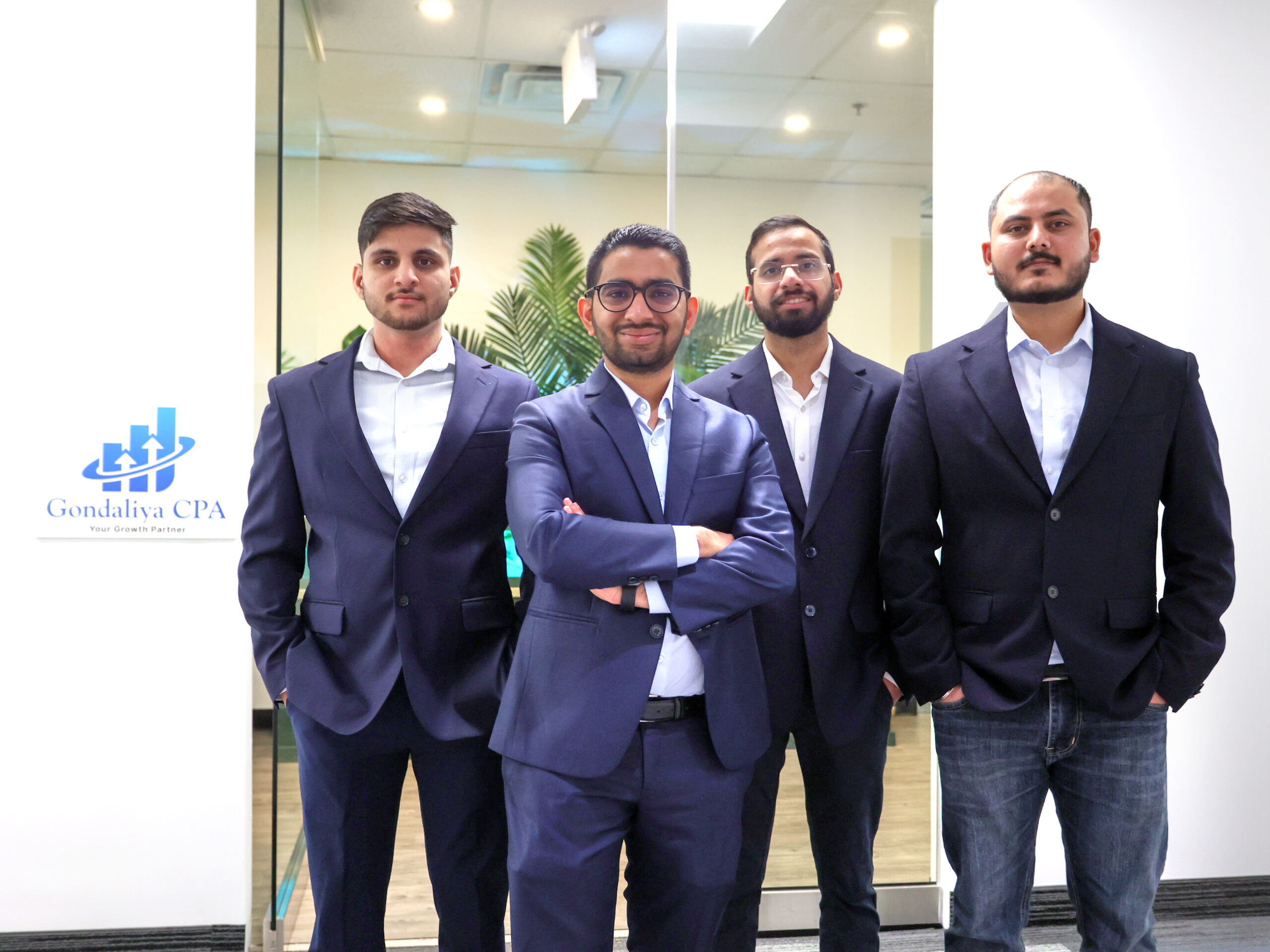
Meet Your Lead Call Centre Accountant
Meet your lead call centre accountant. As your service-business and corporate tax adviser, you deal with the same two people every year.


What Our Clients Say
1300+ five-star reviews from contact centre and business services owners across Ontario and Canada.
Serving Call Centres Across Ontario
Our CPA team provides specialized accounting and tax solutions for contact centres throughout Ontario. We understand how agent payroll, attrition, telecom infrastructure and export HST actually flow through a call centre, what CRA looks at on a payroll-heavy service file, and how to put every asset in the class it belongs in.
Toronto (ON)
55 Queen St E Ste 1205, Toronto, ON M5C 1R6, Canada
+1 (647) 212-9559
9:00 AM – 8:30 PM (Mon – Sun)
Mississauga (ON)
2100 Camilla Rd #716, Mississauga, ON L5A 2J8
+1 (647) 212-9559
9:00 AM – 8:30 PM (Mon – Sun)
Brampton (ON)
4 Starhill Crescent, Brampton, ON L6R 2P9, Canada
+1 (647) 212-9559
9:00 AM – 8:30 PM (Mon – Sun)
Scarborough (ON)
24 Clementine Square, Scarborough, ON M1G 2V7, Canada
+1 (647) 212-9559
9:00 AM – 8:30 PM (Mon – Sun)
Vaughan (ON)
19 Cabinet Crescent, Woodbridge, ON L4L 6H9, Canada
+1 (647) 212-9559
9:00 AM – 8:30 PM (Mon – Sun)
Oshawa (ON)
210 Durham St, Oshawa, ON L1J 5R3, Canada
+1 (647) 212-9559
9:00 AM – 8:30 PM (Mon – Sun)
Ottawa (ON)
2090 Neepawa Ave a314, Ottawa, ON K2A 3L6, Canada
+1 (647) 212-9559
9:00 AM – 8:30 PM (Mon – Sun)
Etobicoke (ON)
60 Stevenson Rd #1601, Etobicoke, ON M9V 2B4, Canada
+1 (647) 212-9559
9:00 AM – 8:30 PM (Mon – Sun)
Hamilton (ON)
70 Starling Dr, Hamilton, ON L9A 0C5, Canada
+1 (647) 212-9559
9:00 AM – 8:30 PM (Mon – Sun)
Guelph (ON)
1155 Gordon St, Guelph, ON N1L 1S8, Canada
+1 (647) 212-9559
9:00 AM – 8:30 PM (Mon – Sun)
Windsor (ON)
4387 Guppy Ct, Windsor, ON N9G 2N8, Canada
+1 (647) 212-9559
9:00 AM – 8:30 PM (Mon – Sun)
North York (ON)
150 Graydon Hall Dr #912, North York, ON M3A 3B2, Canada
+1 (647) 212-9559
9:00 AM – 8:30 PM (Mon – Sun)
Call Centre Accounting & Tax FAQs
Related Industries We Serve
Accountant for BPO Companies
- Offshore delivery and transfer pricing
- Export zero-rating and input tax credits
- Transition costs and multi-year contracts
Accountant for Market Research Firms
- Fieldwork subcontractors and interviewers
- Project work in progress and milestone billing
- Corporate tax planning and statements
Accounting for Small Businesses
- Corporate tax planning for small businesses
- Business tax filing and financial statements
- Payroll and bookkeeping services
Accountant for Incorporated Businesses
- T2 corporate returns and GIFI
- Salary, dividend and SBD planning
- Compilation statements and incorporation
Call Centre Accounting & Tax Done Right.
T2 filing, network infrastructure in Class 46 and the floor build-out in Class 13 rather than one undifferentiated pool, vacation pay accrued as agent hours are worked, at-home agents reviewed on CRA guide RC4110 before CRA raises it, the export HST position analysed and documented rather than assumed, place of supply applied to Canadian clients, and agent payroll with WSIB and T4s under one roof. AFFORDABLE flat fees, no hourly billing. Licensed CPA Ontario. 1300+ five-star reviews. 30-Day Money-Back Guarantee.