



The Ultimate Guide to Accounting and Tax Services for Mortgage Brokers in Canada
As a leading mortgage broker CPA Canada, Gondaliya CPA provides full mortgage broker accounting services including bookkeeping for mortgage brokers, tax services for mortgage brokers, and mortgage broker tax planning Canada. We assist with mortgage broker business accounting, expense deductions, and incorporated mortgage broker taxes to ensure smooth tax compliance and financial management.
Quick Summary
Three things separate a clean broker file from a messy one: commission statements reconciled monthly against the books, clawbacks recorded in the year they happen, and a clear decision on salary versus dividends. Please note that most commission income is exempt for GST/HST purposes, which means input tax credits on those earnings are generally not available.
| Aspect | Details |
|---|---|
| The income | Commissions, trailer fees, bonuses, referrals. |
| The slips | T4A on commissions, T4 on salary, T5 on dividends. |
| The deadline | T2 at six months, balance due at three. |
| The trap | Input tax credits claimed on exempt commissions. |
Reading time: 40 minutes.
Table of Contents
- Understanding the Need for a Mortgage Broker Accountant in Canada
- Core Accounting and Tax Services for Mortgage Brokers
- Financial Planning, Advisory, and Risk Management
- Simple Engagement Process and Transparent Pricing
- Industry Insight and Educational Resources
- Testimonials, Credentials and Professional Standards
- Frequently Asked Questions (FAQs)
- Essential Insights: Key Topics for Mortgage Broker Accounting
- Broker Segments We Serve
- Professional Guidance and Quick Reference
The Numbers That Matter
This article covers Canada, with Ontario and Toronto context, and reflects rules current to 2026. It assumes a licensed mortgage broker or brokerage, incorporated or considering it. Figures marked illustrative are examples, not quotes, and any masked engagement notes end with “Figures changed for privacy.” This is educational information only and not tax or legal advice. Licensing rules differ by province and regulator, so please confirm your own position with FSRA or the equivalent body before acting.
Understanding the Need for a Mortgage Broker Accountant in Canada
Understanding the Need for a Mortgage Broker Accountant in Canada
The Basics
Why Mortgage Brokers Require Specialized Accounting Services
Mortgage brokers face a financial world that’s pretty different from others. A mortgage broker accountant in Canada knows how commissions work, follows the rules, and handles taxes just right for this field. Regular accountants often miss these details.
When you work with a mortgage broker CPA in Canada, they help keep your records clean and reports on time. This makes following rules from places like the CRA and FSRA easier. Plus, it cuts down risks of making costly mistakes.
Specialized accounting services make managing money simpler and help mortgage brokers stay on track with all their obligations.
Challenges Unique to Mortgage Broker Financial Management
Mortgage brokers deal with money stuff that’s tricky, so they need a mortgage broker tax accountant who really gets it:
- Complicated commissions: Income comes from lots of spots — lender commissions, referral fees, bonuses — making it hard to keep track.
- Following rules: There are provincial licenses and federal tax laws to juggle.
- Finding deductions: Knowing which business costs count needs both tax smarts and industry knowledge.
- Managing cash flow: Income can jump up or down based on the market, making it tough to plan.
These points show why having someone with mortgage broker accounting services experience is a big help.
How Professional Accounting Supports Mortgage Broker Compliance and Growth
A mortgage broker accountant does more than just file taxes right. They help businesses grow:
- They handle taxes carefully so you don’t pay penalties.
- They plan taxes in ways that save money and fit your goals.
- They prepare financial reports so you can see how your business is doing; this helps if you want loans or partners.
Using these expert services means brokers spend less time on paperwork and more on working with clients.
The Role of a CPA in Mortgage Broker Tax Planning and Corporate Structuring
A CPA’s job includes guiding mortgage brokers on taxes and how to set up their companies:
- They create plans for paying yourself through salary or dividends—this affects taxes differently.
- They advise if it’s better to incorporate or not, balancing legal protection with business risks.
- They keep up with rule changes—like new commission reporting laws coming after 2026—and tell you what to do next.
Working with a skilled mortgage broker CPA Canada gives you smarter choices and keeps your business inside the rules needed for success in Canada’s lending scene.
Brokers rarely arrive with a tax problem. They arrive with twelve months of commission statements that were never matched to the bank, and the tax answer falls out once that is done. Figures changed for privacy.
Risk Warning: Claiming input tax credits against exempt commission income is one of the most common reassessments in this sector. Please check what portion of your revenue is actually taxable before filing a GST/HST return.
Core Accounting and Tax Services for Mortgage Brokers
Core Accounting and Tax Services for Mortgage Brokers
The Services
Mortgage brokers in Canada need accounting and tax services that fit their specific income types, rules, and business setups. A mortgage broker accountant Canada or mortgage broker CPA Canada helps with commission tracking, bookkeeping, tax compliance, and planning. They make sure incorporated brokers follow CRA rules and manage money well.
Commission and Trailer Fee Tracking with Detailed Deal Reporting
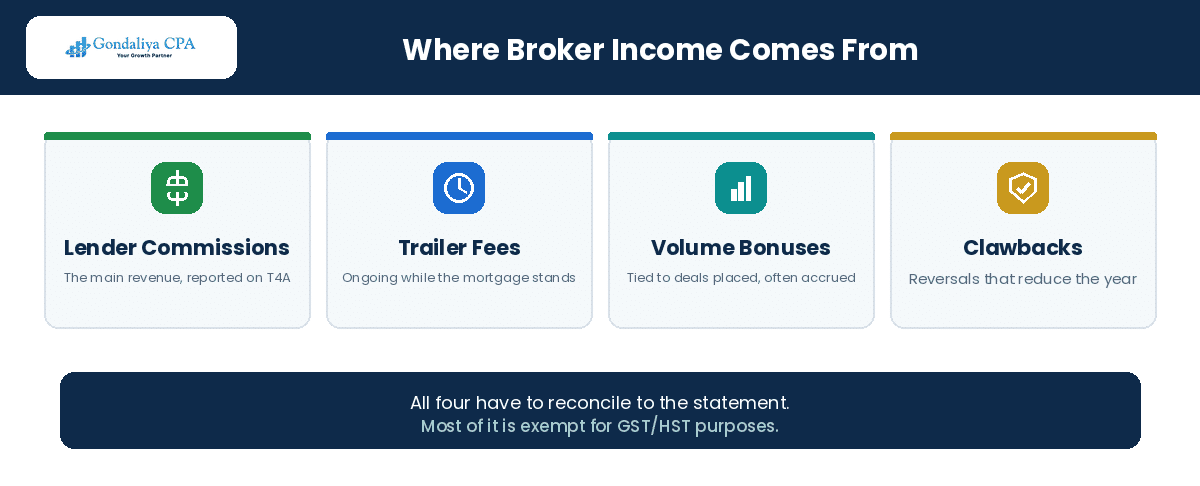
Commission income makes up most of a mortgage broker’s earnings. Tracking commissions—like finder’s fees, trailer fees, volume bonuses, and referral fees—is key. Brokers also report these amounts on T4A slips to follow CRA rules. Clawbacks (when commissions get reversed) and chargebacks affect when income counts for taxes.
Reconciliation means matching the brokerage’s commission statements to what’s in the books. This confirms that clawbacks are deducted before counting taxable income. Detailed reports for each deal help if the CRA audits you. These reports show dates, amounts, client info, and any changes.
- Example: Say an incorporated broker earns $120,000 in commissions during the year but has a $10,000 clawback because a deal got canceled. If this is noted in the books for that year, it lowers the income reported.
Bookkeeping Services Customized for Mortgage Broker Income Streams
Bookkeeping for mortgage brokers handles tricky commission flows with cloud tools like QuickBooks or Xero. These often link with receipt capture apps such as Hubdoc. The system organizes expenses like license fees, CRM subscriptions, and ads along with commission money.
Good bookkeeping means:
- Sorting transactions by deal type (residential vs commercial).
- Uploading receipts fast using mobile apps to claim expenses right.
- Matching monthly brokerage statements to bank deposits showing team splits or payout breakdowns.
This cuts down mistakes in records so financial statements meet ASPE standards.
HST, Payroll, and Regulatory Compliance Specific to Mortgage Brokerages
Mortgage brokerages must check if they need GST/HST registration based on their taxable activities beyond arranging mortgages. Most commission income is exempt under Excise Tax Act section 123(1), so brokers usually can’t claim input tax credits on those earnings.
Payroll remittances follow CRA deadlines: employers send CPP/QPP deductions monthly or quarterly depending on payroll size. T4/T4A slips must be filed by February 28 every year or penalties apply.
GST/HST filing depends on sales volume—big firms file monthly; smaller ones quarterly. Staying up to date avoids interest or late fines that hurt cash flow.
Integrated Personal and Corporate Tax Filing for Mortgage Brokers
Incorporated mortgage brokers file T2 corporate returns yearly showing business income minus allowed expenses under the Income Tax Act. Coordinating personal taxes with corporate filings helps balance dividends versus salary. This reduces double taxes and can boost RRSP room where possible.
Tax accountants who know this field get details like personal service business rules. These affect contracts between corporations owned by agents versus lenders. Getting this right stops costly CRA reassessments from slip mismatches or missing benefits.
Corporate Tax Planning and Filing for Incorporated Mortgage Brokers
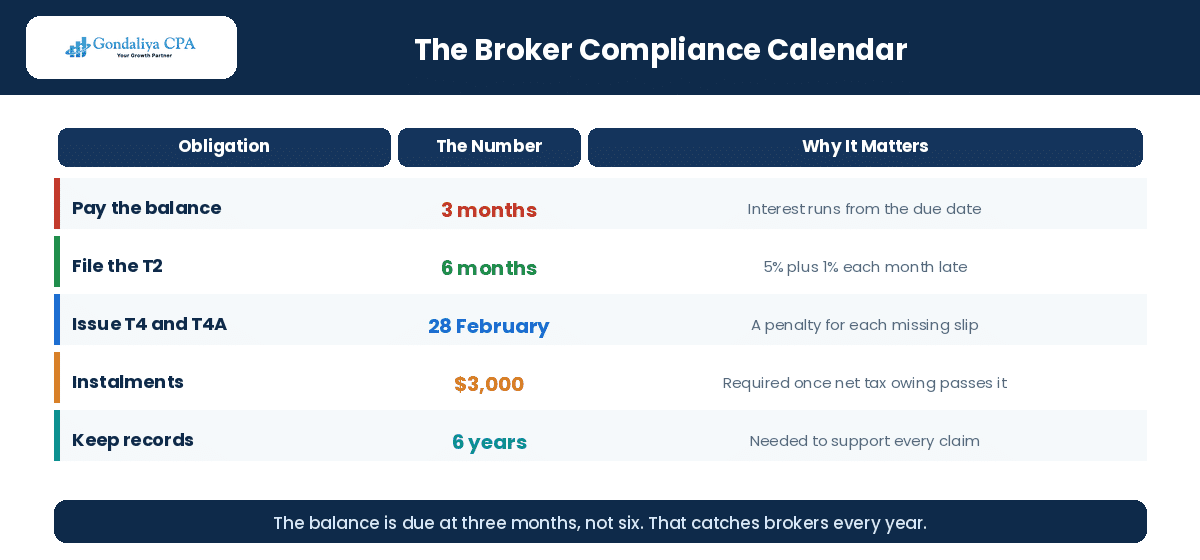
T2 returns are due six months after the fiscal year ends; but any tax owing is paid within three months after year-end per CRA rules. Late-filing penalties start at 5% of unpaid taxes plus 1% each month after, capped at 12 months unless relief applies.
Choosing salary or dividend payments matters. Salary needs CPP contributions but creates RRSP room; dividends skip pension but keep payroll simple.
| Factor | Salary | Dividend |
|---|---|---|
| CPP Contributions | Required | Not required |
| RRSP Contribution Room | Created | None |
| Payroll Setup | Needed | Optional |
| Payment Flexibility | Fixed pay periods | Flexible declaration |
Note: Salary fits those wanting retirement savings growth; dividends suit owners who want simpler cash flow without pensions.
Catch-Up Services: Corporate Tax Filing and Bookkeeping for New or Growing Brokerages
New brokers often miss filings or have messy books that block accurate reports. Catch-up services fix this step-by-step by rebuilding past books using bank data and brokerage statements then filing overdue T2 returns per CRA rules.
Flat-fee pricing offers clear costs covering bookkeeping cleanup using cloud tools (QuickBooks/Xero), GST/HST registration if needed, payroll help, corporate tax filing, plus representation if audited. This helps growing firms get back on track without surprise bills.
For advice about mortgage broker accounting across Toronto/Ontario/Canada-wide contact Gondaliya CPA at info@gondaliyacpa.ca or call 647-212-9559 today.
A ten thousand dollar clawback recorded in the wrong year turns into tax paid on money the broker never kept. It is the single correction we make most often. Figures changed for privacy.
Key Stat: The T2 is due at six months but the balance is due at three. Brokers who diarise only the filing date routinely pay interest on a return that was filed on time.
Financial Planning, Advisory, and Risk Management
Financial Planning, Advisory, and Risk Management
The Planning
Financial planning for mortgage brokers needs special care. They have unique income sources, tax rules, and must follow regulations closely. A mortgage broker accountant Canada trusts will build plans that help keep cash flow steady and stay within CRA rules and FSRA licenses. Adding risk management to financial advice helps protect incorporated mortgage brokers from surprise problems or audits.
Mortgage broker CPA Canada experts know how to handle commission reports, corporate tax returns (T2), GST/HST rules on mortgage arranging, and personal services business issues. These pros give advice that fits both federal tax laws under the Income Tax Act and local brokerage rules.
Cash Flow Forecasting and Strategic Tax Planning to Maximize Savings
Mortgage brokers deal with changing commissions, clawbacks, bonuses, and referral fees. Good cash flow forecasting means looking at commission statements carefully and tracking expenses. Mortgage broker accounting services use this info to guess net income over months or quarters.
Tax planning helps decide when to report income. For example, delaying dividends or paying some expenses early can lower taxable income legally. A mortgage broker tax accountant guides you on the best salary vs dividend mix. This takes into account CPP contributions and RRSP space. They also plan instalment payments to avoid fines.
Key parts include:
- Monthly money coming in based on deals done.
- Timing expenses like ads or home office costs that can be deducted.
- Planning GST/HST payments while following financial service exemptions.
- Reviewing options for keeping or distributing earnings at year-end.
This method helps keep money flowing while cutting corporate taxes for incorporated mortgage brokers in Ontario or across Canada.
Profit Maximization Strategies for Mortgage Brokerage Businesses
To make more profit, mortgage brokers should claim all valid expense deductions. Mortgage broker CPA Canada firms find deductions people often miss. Examples are CRM software fees, prepaid license dues, or prorated insurance premiums.
They also help set up team pay so it fits payroll or contractor rules properly with T4/T4A slips. Good bookkeeping captures clawback changes fast to avoid overstating revenue.
Other ideas include:
| Strategy | Benefit | Source/Reference |
|---|---|---|
| Claim capital cost allowance early (Class 10/10.1) | Lower taxable income faster | Income Tax Act s13(7) |
| Use holding companies | Grow passive investments | CRA ITA section 55 |
| Pay spouse wages | Split income if real work is done | CRA Bulletin IT-339R3 |
Making good profits means working closely with your accounting service and your team every day for quick decisions.
Business Structure Advice: Sole Proprietorship Versus Incorporation
Deciding between sole proprietorship and incorporation changes taxes, liability risks, finance choices—and FSRA license rules vary by province.
Sole proprietors report commissions on their personal T1 tax forms using Form T2125 but face unlimited personal risk if issues come up. Corporations file separate T2 returns that qualify for small business tax breaks but limit owner liability.
Here’s a quick look:
| Factor | Sole Proprietorship | Corporation |
|---|---|---|
| Liability | Owner fully liable | Company liable only |
| Tax Filing | Personal return + Schedule 2125 | Corporate return (T2) |
| Income Deferral | Not really possible | Can keep earnings in company |
| Cost & Complexity | Simple setup & costs | More costly & complex yearly |
If you want growth with smart tax moves, hiring a mortgage broker CPA Canada firm like Gondaliya CPA is worth thinking about. But if you prefer easy setup, sole proprietorship may work better.
CRA Audit Preparation and Resolution Tailored to Mortgage Broker Needs
CRA audits often focus on tricky spots for incorporated mortgage brokers. These include missing T4A slips for referral fees, vehicle claims without mileage logs, wrong input tax credits on exempt commissions, or mislabeling workers that affects deductions.
Mortgage broker CPAs get clients ready by keeping books clean with clear records such as:
- Monthly commission statement checks.
- Proof for every deduction claimed.
- On-time preparation of T4/T4A slips.
If audited:
- The CPA acts as your rep with CRA under AUT-01 authorization.
- Issues get fixed fast using solid evidence.
- Penalty relief requests go in if delays happened despite your efforts.
This keeps stress low during audits and protects your interests in Toronto/Ontario areas.
Risk Mitigation Through Accurate Record-Keeping and Compliance Monitoring
Avoiding risks starts with solid record keeping that follows CRA’s rule of keeping records at least six years after filing. Mortgage broker accounting services push regular checks like:
- Matching commission payments to brokerage deals before logging revenue.
- Confirming GST/HST registration matches what’s taxable so you don’t lose input credits later.
Built-in checklists in bookkeeping make sure deadlines for instalments, T2 filings, T4/T4A slips, and payroll are always met — avoiding late penalties.
Tip: Cloud tools like QuickBooks plus Hubdoc help capture receipts automatically so you spend less time chasing papers—something many Canadian CPAs recommend for this field.
If you want advice made just for your brokerage anywhere in Canada or Toronto area, reach out to Gondaliya CPA at info@gondaliyacpa.ca or call 647‑212‑9559 for a free talk focused on incorporated SMBs here.
Vehicle claims without a mileage log are the fastest way to lose an otherwise solid audit. The number itself is rarely the problem; the absence of the record is. Figures changed for privacy.
Pro Tip: Please reconcile the brokerage commission statement to the bank every month rather than at year-end. Clawbacks are far easier to place in the right period while the deal is still recent.
Simple Engagement Process: Consultation, Customized Planning, Execution, and Ongoing Partnership
Simple Engagement Process and Transparent Pricing
The Engagement
Working with a mortgage broker accountant Canada trusts starts with a clear talk. We listen to your brokerage’s specific needs. This helps us spot tax and accounting issues unique to mortgage brokers in Ontario and across Canada.
Next, we make a plan. This plan fits your corporate tax goals and meets the Income Tax Act and FSRA rules. We cover things like setting up bookkeeping, tracking commissions, GST/HST registration for exempt services, payroll for team leads or agents, and year-end deadlines.
Then comes execution. We set up bookkeeping with tools like QuickBooks or Xero. We regularly check commission statements. We prepare T4A slips for referral fees and bonuses. We keep records that follow CRA rules.
We keep working with you long-term. We send updates on new rules, like the 2026 changes in commission reporting. If you need help catching up on filings or face an audit, we support you. This process gives you clear steps each year, so you always know where your brokerage stands.
Transparent Pricing Models for Mortgage Broker Accounting and Tax Services
You pay one flat annual fee, including HST, confirmed in writing before any work starts. This price covers everything: corporate tax filing (T2), bookkeeping for your deals, GST/HST returns if needed, payroll management if asked, compilation work under CSRS 4200 standards, plus handling any CRA letters.
Here’s what affects cost:
- Deal Volume: More deals mean more bookkeeping time.
- Team Size: Payroll adds complexity.
- Years Outstanding: Catch-up filings take extra work.
- Bookkeeping Condition: Messy records slow things down.
- Holding Company Structure: May need extra returns.
To save money:
- Combine monthly deal statements.
- Use simple payroll software.
- Submit records on time.
- Use cloud apps to capture receipts.
- Plan when to incorporate holding companies.
Ask your CPA:
- How do you handle many transactions?
- Can you manage split payments?
- Do you clean up old files?
- Can you link with my current system?
- Do you advise on holding company benefits?
This clear pricing bundles key services so Canadian-incorporated mortgage brokers in Toronto and Ontario know what to expect every year.
Scalable Support for Solo Brokers and Established Brokerages
Mortgage broker accounting should fit all sizes—from solo brokers with few deals to big firms managing many agents and splits. Doing it yourself often misses key deductions or deadlines because the tax rules are tricky.
Non-CPA providers may do basic bookkeeping but lack deep knowledge about incorporated business taxes or provincial licensing rules.
CPA firms can scale services based on what each group needs—from home buyers needing detailed expense tracking to commercial lenders requiring advanced methods.
Here’s how we see different types of mortgage brokers:
- Residential Purchase Brokers: Focus on expense deductions; home office claims common
- Refinance & Renewal Specialists: Handle bonus accruals; GST/HST exemption matters
- Private Lending & MIC-Connected Brokers: Watch corporate structure effects on income
- Commercial Mortgage Brokers: Deal with bigger volumes; multi-region compliance
- Construction & Development Financing: Track capital assets carefully; contract rules
- Reverse Mortgage & Senior Lending: Avoid personal services business risks
- Brokerage Owners & Principal Brokers: Manage payroll and team splits
- Team Leads With Agent Splits: Need clear referral payment records
- Referral-Based & Part-Time Agents: Simplified record keeping works best
- Brokers Cross-Selling Insurance/Real Estate: Understand multi-industry taxes
We adapt our services by segment to keep costs reasonable but maintain strict compliance.
Accessibility: Regional Service Coverage Across Key Ontario Cities
Picking the right CPA means choosing one that knows your area but can serve broader markets too—like Toronto, Etobicoke, Vaughan, Mississauga, Brampton, Scarborough, Ottawa, Oshawa, Guelph, Hamilton, North York, Windsor—and beyond.
Knowing local rules helps with things like municipal licensing differences under provincial regulators like FSRA. It also means faster replies when busy times hit—like licence renewals tied to MBLAA rules starting in early 2026.[FSRA Regulatory Update].
We reply quickly—often same day or next business day—with some evening or weekend hours too. That speed is key when CRA deadlines loom.[CRA Filing Deadlines].
Our service promises clear policies—a money-back offer within thirty days plus a sixty-day price-match guarantee—and deep experience shown by over “1300+ five-star Google reviews.”
Dedicated Lead Mortgage Broker Accountants and Personalized Client Communication
You get one main mortgage broker accountant assigned from start to finish of your file. They handle everything—from reviewing incorporation details through quarterly bookkeeping checks to final year-end compilation reports following CSRS standards.[CPA Ontario Practice Standards]
We check in regularly about new laws like the January 2026 changes in commission reporting that affect T4A slips.[CRA Notice]. This helps avoid missed disclosures or wrong source deductions.
What we provide:
- Cloud-based bookkeeping files via QuickBooks or Xero
- Monthly summaries of commissions showing clawbacks or holdbacks
- Compilation financial statements using proper GIFI codes
- Full T2 tax return packages with all schedules needed by incorporated brokers
- T4/T4A slips issued on time covering salaries and referral fees
- Annual calendars highlighting important local filing dates (Toronto/Ontario)
- Tax planning memos identifying deferral chances
- Logs of all communication between you and CRA
This hands-on method builds trust and helps clients understand their financial situation better. You get info needed for choices about salary vs dividend pay or car expense claims—all fitting federal rules.[Income Tax Act Sections 8–20]
Need advice made just for your brokerage’s size? Contact us at info@gondaliyacpa.ca or call 647‑212‑9559 for a free chat focused on Canadian-incorporated mortgage professionals who want a steady advisory partner.
Solo brokers and twenty-agent brokerages need the same three things: monthly reconciliation, correct slips and a clear pay decision. Only the volume changes. Figures changed for privacy.
Key Stat: T4 and T4A slips are due 28 February. Referral fees paid without a slip are among the most common findings when a brokerage is reviewed.
Industry Insight and Educational Resources
Industry Insight and Educational Resources
The Detail
Mortgage Industry-Specific Accounting Expertise and Terminology
Mortgage broker accounting in Canada needs special know-how. A mortgage broker accountant Canada knows about how commissions, referral fees, clawbacks, and volume bonuses work. These terms matter a lot for tax reporting and keeping records straight. For example, commissions on T4A slips must match brokerage statements. That keeps everything right for CRA filings and business books.
Mortgage broker CPA Canada firms get the tricky parts of incorporation for brokers. They understand rules like personal services business under the Income Tax Act. They also know GST/HST exemptions tied to arranging mortgages. Using this specific language helps with exact bookkeeping and tax planning. It also follows rules set by groups like FSRA Ontario or other provinces.
Common Deductible Expenses and Tax Savings Opportunities for Mortgage Brokers
Mortgage brokers can write off many costs when filing taxes through their corporation. Here are common deductible expenses:
- Advertising fees
- CRM software subscriptions
- Licensing dues to regulators like FSRA
- Errors & omissions insurance premiums
- Home office expenses based on space used
- Meals up to 50% allowed by CRA
- Training related to licenses or skill upgrades
- Vehicle costs with detailed mileage logs
A mortgage broker tax accountant points out real deductions and avoids errors. One mistake is claiming input tax credits on exempt commissions, which can cause reassessments. Sorting expenses correctly helps keep financial statements right for lender applications or business decisions.
| Expense Type | When Deductible | What You Need | Source |
|---|---|---|---|
| Advertising & Lead Gen | Must be business-related | Invoices or receipts | Income Tax Act s.18(1)(a) |
| Licensing Dues | Required professional fees | Proof of payment | FSRA regulations |
| Home Office | Use proportional space | Floor plan and utility bills | CRA Guide T4044 |
| Meals | 50% limit applies | Receipts plus business reason | ITA s.67(1), CRA Bulletin |
Guidance on Software Integration and Automated Financial Workflows
Good mortgage broker accounting services use cloud tools like QuickBooks Online or Xero paired with apps like Hubdoc to capture receipts. Automation cuts manual mistakes when matching commissions with brokerage statements—important because clawbacks or holdbacks can be tricky.
Payroll tools such as Wagepoint make CPP contribution calculations easier whether paying salary or dividends. Payment processors like Stripe help handle client payments when needed. Automating these tasks supports fast GST/HST filings even if some income is exempt under financial service rules.
Using these systems improves monthly closing processes so T2 returns file on time with CRA deadlines. Plus, it gives brokers quick cash flow views needed to manage instalment payments as incorporated businesses.
Access to Educational Materials: Checklists, Guides, and Whitepapers for Mortgage Brokers
Keeping up with changes matters a lot for incorporated mortgage brokers across Canada. CPA firms focused on this field offer checklists covering yearly bookkeeping steps like:
- Preparing T4/T4A slips
- GST/HST registration rules based on sales (excluding exempt commissions)
- Year-end compilation following CSRS 4200 standards
- Catch-up filing if any years were missed
Whitepapers talk about new laws affecting commission reporting starting in 2026—for example, changes around how licensee pay gets incorporated—and suggest ways to lower risks during personal services business audits by CRA staff familiar with mortgage brokering.
These resources help principal brokers and team leads keep agents’ commission splits consistent without needing outside help all the time.
Understanding CRA Regulations and Compliance Updates Relevant to Mortgage Brokerages
CRA rules for incorporated mortgage brokers require clear reporting of all pay types: commissions (T4A), salaries (T4), dividends (T5), plus clawback reversals after year-end per ITA section 18(1)(a).
Starting in 2026, new rules ask for better disclosure of commission flows through corporations tied to licensing enforced by FSRA. Missing deadlines brings fines—$250 at first—and bigger penalties if returns stay unfiled past three months; missing T-slips issued late after February cause extra charges too.
Specialist tax accountants watch instalment schedules closely because many incorporated brokers owe quarterly payments if prior year’s net tax passes $3,000 per subsection 159(1). Staying ahead avoids daily interest adding up until balances clear.
Knowing these CRA requirements lets brokers plan ahead instead of fixing errors later during audits triggered by wrong slips or shaky vehicle claims without logs.
For specialized help made just for Canadian-incorporated mortgage pros looking for affordable accounting solutions backed by over “1300+ 5-star Google reviews,” contact Gondaliya CPA today at info@gondaliyacpa.ca or call 647-212-9559 for a free consultation focused exclusively on your needs within Toronto/Ontario jurisdictions.
The deductions brokers miss are rarely exotic. Prepaid licence dues, prorated insurance and the CRM subscription add up quietly across a year. Figures changed for privacy.
Pro Tip: Please keep the mileage log in the same app as the receipts. A vehicle claim supported by a contemporaneous log survives review; one reconstructed from a calendar usually does not.
Testimonials and Client Success Stories from Mortgage Professionals
Testimonials, Credentials and Professional Standards
The Firm
Mortgage brokers in Canada choose Gondaliya CPA for mortgage broker accounting services that fit their needs. One brokerage owner in Toronto said switching to a mortgage broker accountant Canada helped improve tax planning and cut down compliance risks. They also found bookkeeping became much easier.
Another client in Mississauga, who focuses on refinancing, liked how quickly the firm answered questions during year-end filings. These stories show what clients care about most:
- Accurate commission reports
- Tax advice made just for incorporated mortgage brokers
- Flat fees that small businesses can afford
Clients say working with a mortgage broker CPA Canada makes a big difference. The firm knows the details, like tracking referral fees and following FSRA licensing rules [CRA T2 Guide; FSRA MBLAA].
People also value help with tricky stuff, like clawbacks or setting up payroll splits for teams. This support gives principal brokers confidence when managing agents under one corporation.
Credentials and Professional Standards Upholding Mortgage Broker Accounting Services
Gondaliya CPA is a CPA Ontario Registered Firm registered with CPA Ontario (Firm Number: 5SQVMJ). The firm follows Canadian accounting standards (ASPE) and meets CRA rules for tax filing (T2), GST/HST, payroll deductions, and compilations under CSRS 4200 [CPA Ontario Directory].
Sharad Gondaliya, CPA Gondaliya leads the firm. He holds CPA Ontario credentials plus US CPA licenses in Washington State and Montana. This shows extra expertise but does not change Canadian legal requirements.
The firm uses cloud tools like QuickBooks Online to keep records accurate. They serve mortgage broker corporations in Toronto, Vaughan, Ottawa, Brampton, and across Canada.
Ethics are a big deal here. Staff keep client info private as required by provincial laws and FSRA rules under the Mortgage Brokerages Act [FSRA MBLAA].
Commitment to Ethical Practices and Continuous Professional Development
Gondaliya CPA works as a CPA Ontario Registered Firm bound by CPA Ontario’s Code of Professional Conduct. They focus on clear fees with policies like a 30-day money-back guarantee and 60-day fee matching to protect clients.
All CPAs at the firm must keep learning about law changes that affect mortgage broker accounting services—for example, new rules coming in 2026 about commission reports or incorporation [CRA Updates; FSRA Notices].
Training covers Income Tax Act updates related to personal services business rules. These rules matter when deciding salary versus dividends for incorporated entities—a place where brokers often make costly mistakes without advice.
The firm also keeps careful records to be ready if CRA audits occur due to slip errors or expense claims.
Advantages of Partnering with a Licensed CPA Firm Specializing in Mortgage Broker Accounting
Picking a mortgage broker tax accountant over general accountants has clear benefits:
- Knows special issues like exempt financial service status on commissions
- Files corporate taxes on time with correct schedules (100/125/141)
- Plans taxes smartly to use income splitting rules right
- Tracks deals carefully against brokerage statements to avoid errors
- Handles CRA audits or relief requests professionally
Gondaliya CPA offers flat annual fees including HST for bookkeeping setup through final reports. This means no surprise costs while getting advice designed for incorporated mortgage brokers across Canada, especially near Toronto [CRA Corporate Tax Guide].
Encouraging Engagement: Calls to Action for Free Consultations and Personalized Assessments
If you’re an incorporated mortgage professional needing trusted help from a mortgage broker accountant Canada trusts—contact Gondaliya CPA now. We offer free consultations focused on your corporation’s accounting needs.
Our team checks your current setup to improve tax results and follow all licensing rules by bodies like FSRA. Whether it’s fixing commission statements or planning before year-end deadlines—we respond fast, usually within one business day, plus weekends if needed.
Call us at 647‑212‑9559 or email info@gondaliyacpa.ca today. Over 1300 clients gave us five stars on Google for good prices and deep knowledge serving all kinds of brokers—from residential purchases to commercial loans around Toronto/Ontario.
What brokers value in review meetings is not the tax number. It is knowing that the commission summary in front of them matches what the brokerage actually paid. Figures changed for privacy.
Verification: Our CPA Ontario firm registration can be checked directly on the public firm directory. Please verify any firm you engage, whatever they tell you about their credentials.
Frequently Asked Questions (FAQs) on Mortgage Broker Accounting in Canada
Frequently Asked Questions (FAQs)
FAQ
What are the key filing deadlines for a mortgage broker corporation?+
Mortgage broker corporations must file their T2 corporate tax return within six months after their fiscal year ends. The balance due must be paid within three months after year-end to avoid penalties.
When are payroll remittances and T4/T4A slips due?+
Payroll remittances follow CRA deadlines, either monthly or quarterly, based on payroll size. T4 and T4A slips must be filed by February 28 each year to avoid late-filing penalties.
What is the penalty rate for late T2 filings?+
Late-filing penalties start at 5% of unpaid taxes plus 1% for each month late, up to 12 months. Additional penalties may apply for repeated late filings.
How do clawbacks and chargebacks affect commission income reporting?+
Clawbacks reduce reported income when commissions reverse. Proper bookkeeping matches clawbacks to reduce taxable income in the correct fiscal year, ensuring accurate tax reporting.
Which expenses can a mortgage broker deduct?+
Common deductions include licensing fees, CRM software, advertising costs, home office expenses, meals (up to 50%), training, and vehicle expenses with detailed mileage logs.
How do vehicle costs work for brokers who drive to clients?+
Brokers can claim vehicle expenses proportional to business use. Maintaining detailed mileage logs is required to support these claims during audits.
What does good bookkeeping look like for a mortgage broker?+
Good bookkeeping organizes income streams by deal type, matches commissions to statements, uploads receipts promptly via apps like Hubdoc, and follows ASPE standards.
How do you reconcile commission statements to the books?+
Reconciliation involves matching brokerage commission reports with recorded income. Adjustments for clawbacks or holdbacks ensure financial statements are accurate and audit-ready.
How do you pay a team, splits, and referral partners properly?+
Payments require clear tracking using T4/T4A slips depending on employment status. Accurate records of splits and referrals ensure compliance with CRA rules and avoid misclassification issues.
What financial statements will a lender or the CRA expect from mortgage brokers?+
Lenders and CRA expect compiled financial statements prepared under CSRS 4200 standards that clearly reflect revenues, expenses, commissions, and net income for incorporated brokers.
Essential Insights: Key Topics for Mortgage Broker Accounting
Essential Insights: Key Topics for Mortgage Broker Accounting
Quick Reference
- Salary or Dividend for an Incorporated Mortgage Broker: Which Route Fits?
Choosing salary builds RRSP room but requires CPP contributions. Dividends offer flexible payments without CPP but no RRSP growth. The choice depends on personal tax goals. - What Are the Filing Deadlines a Broker Corporation Must Meet?
T2 returns are due six months after fiscal year-end; tax balances within three months. Payroll remittances vary monthly or quarterly. T-slip deadlines fall on February 28 annually. - What Penalties and Interest Apply If You File Late?
Late filings trigger penalties starting at 5% plus monthly additions. Interest accrues daily on unpaid taxes increasing overall costs significantly if delayed. - What Tax Planning Options Suit an Incorporated Broker?
Tax planning includes timing dividends vs salary, accelerating expenses before year-end, optimizing instalment payments, and using holding companies when appropriate. - What Triggers a CRA Review of a Mortgage Broker?
Inconsistencies in T4A slips, missing receipts for vehicle claims, input tax credit errors on exempt commissions, or unusual expense claims may prompt CRA reviews or audits. - How Do You Catch Up on Missed Filings and Messy Books?
Catch-up services rebuild past records from bank data and brokerage reports. Overdue T2 returns get filed with proper documentation to resolve compliance gaps smoothly. - Broker Accounting: DIY vs CPA vs Non-CPA Provider – Which Route Fits?
DIY risks missing complex rules; non-CPAs may lack industry knowledge; licensed CPAs ensure accurate filings and tailored advice that protect incorporated brokers fully. - How Do We Handle Mortgage Broker Files at Gondaliya CPA?
We assign dedicated CPAs who set up cloud bookkeeping systems linked with commission reports. We manage payrolls, prepare compilations, file taxes timely, and communicate regularly. - What Deliverables Do You Get When Working With Us?
Clients receive cloud-based bookkeeping files, monthly commission summaries including clawbacks details, compiled financial statements under CSRS standards, full T2 packages plus payroll slips. - How Much Does Accounting and Tax Cost for a Mortgage Broker in Canada?
Costs depend on deal volume, team size, outstanding years needing catch-up work, record condition, and whether holding companies require extra filings; flat annual fees apply typically. - What Are the Top Mistakes Brokers Make and How Do You Prevent Them?
Common errors include late filings, missing slips for referral fees, improper classification of workers or expenses. Prevention includes clear processes and proactive communication by your CPA firm. - What Should You Prepare Before an Engagement Starts?
Gather bank statements, brokerage commission reports with clawbacks noted, payroll records if any team exists, prior years’ tax returns (personal & corporate), and receipts organized digitally if possible. - How Do Accounting Needs Differ Across 10 Broker Segments We Serve?
Residential purchase brokers need home office tracking; private lending pros focus on corporate structure; commercial brokers handle higher volumes; teams require split payroll expertise among others tailored accordingly. - A Realistic Numeric Walkthrough of Common Tax Scenarios
We provide practical examples showing how commissions net of clawbacks affect taxable income or how paying dividends versus salary impacts overall tax payable in typical cases handled annually. - How to Choose the Right CPA Firm in Toronto/Ontario for a Mortgage Broker?
Look for firms licensed in Ontario with mortgage industry experience who understand FSRA rules; offer transparent pricing; provide dedicated contacts; have proven client success stories; respond promptly with local knowledge. - Why Trust Gondaliya CPA as Your Mortgage Broker Accountant Canada Partner?
We combine licensed Ontario CPA credentials with US CPA knowledge serving cross-border clients. Our deep industry expertise backed by “1300+ five-star Google reviews” ensures reliable guidance every step of the way. - Next Steps: Getting Started with Gondaliya CPA
Reach out today at info@gondaliyacpa.ca or call 647‑212‑9559 for your free consultation focused solely on incorporated mortgage professionals across Toronto/Ontario/Canada. We clarify your accounting needs quickly so you stay compliant while maximizing savings efficiently.
Everything on this page reduces to one habit. Close the month, match the statement, keep the receipt. The tax planning only works on top of that. Figures changed for privacy.
Broker Segments We Serve
Industry Expertise
What the file turns on differs by segment. Here are ten and the usual focus.
| Broker Segment | The Accounting Focus |
|---|---|
| Residential purchase brokers | Home office and expense substantiation |
| Refinance & renewal specialists | Bonus accruals and exempt supply treatment |
| Private lending & MIC-connected brokers | Corporate structure and passive income |
| Commercial mortgage brokers | Higher deal values and multi-region filings |
| Construction & development financing | Capital asset tracking and contract timing |
| Reverse mortgage & senior lending | Personal services business exposure |
| Brokerage owners & principal brokers | Payroll, team splits and slip accuracy |
| Team leads with agent splits | Referral payment records and T4A slips |
| Referral-based & part-time agents | Simplified records and instalment planning |
| Brokers cross-selling insurance or real estate | Mixed taxable and exempt revenue streams |
- Residential purchase brokers: Most of the tax outcome sits in whether the home office and vehicle claims are properly supported.
- Refinance and renewal specialists: Volume bonuses often accrue across a year-end, so the cut-off decides which year they land in.
- Private lending and MIC-connected brokers: Passive investment income inside the corporation changes the small business deduction position.
- Commercial mortgage brokers: Larger individual deals make a single clawback material to the whole year.
- Construction and development financing: Fees tied to draws need matching to the period the work relates to.
- Reverse mortgage and senior lending: Single-client contractual arrangements raise the personal services business question directly.
- Brokerage owners and principal brokers: Payroll accuracy across a team is the largest single compliance exposure.
- Team leads with agent splits: Every split paid out needs a slip, and missing ones are found quickly on review.
- Referral-based and part-time agents: The instalment threshold catches people who did not expect to owe anything.
- Brokers cross-selling insurance or real estate: Mixed revenue means the GST/HST position has to be worked out rather than assumed.
The segment changes which number needs watching. It does not change the discipline, which is reconciling the brokerage statement every month. Figures changed for privacy.
Professional Guidance and Quick Reference
Guidance
Professional Guidance for Brokers: How Gondaliya CPA Supports Mortgage Professionals
Mortgage broker files are not complicated so much as specific. Commission income arrives from lenders, referrals and bonuses, some of it gets clawed back, and most of it is exempt for GST/HST purposes. Get those three facts handled properly and the rest of the accounting is ordinary. Gondaliya CPA runs bookkeeping and tax together for incorporated brokers on a fixed annual fee.
We handle what decides the outcome: reconciling brokerage commission statements to the bank every month, recording clawbacks in the correct period, setting the salary and dividend mix against your CPP and RRSP position, issuing T4 and T4A slips by 28 February, supporting home office and vehicle claims with the records the CRA expects, keeping input tax credits off exempt commission revenue, and filing the T2 within six months with the balance paid at three.
Our team works from your own commission statements rather than a template, and will tell you plainly when incorporation is not yet worth the cost. Solo broker or a brokerage with a team, you get clear advice and a fixed price before we start.
Quick Answers: Key Numbers & Concepts at a Glance
At a Glance
- T2 deadline: Six months after fiscal year-end
- Balance due: Three months after year-end
- T4 and T4A slips: February 28
- Late filing penalty: 5% plus 1% per month, to 12 months
- Instalment threshold: $3,000 net tax owing
- Commission income: Generally exempt for GST/HST
- Meals and entertainment: 50% deductible
- Vehicle claims: Mileage log required
- Records retention: 6 years
- Compilation standard: CSRS 4200
Who This Is For / Not For
Fit Check
- For: Licensed mortgage brokers and brokerages in Canada, incorporated or weighing whether to incorporate.
- Not For: Licensing or regulatory applications themselves, which go through FSRA or your provincial regulator rather than a CPA firm.
People Also Ask
Quick Answers
Should I incorporate as a mortgage broker?+
It depends on your income level, whether you need liability protection, and how much you intend to leave in the company. Incorporation costs more to maintain, so the tax saving has to justify it.
Can I claim GST/HST input tax credits on my commissions?+
Generally no. Arranging mortgages is an exempt financial service, so input tax credits on that revenue are not available. Any taxable side revenue is treated separately.
What happens if a commission is clawed back after year-end?+
It is recorded when it occurs, which may adjust the following year rather than the one the commission was earned in. The treatment depends on when the reversal is known.
Glossary of Key Terms
Plain-English Definitions
- Commission income: Fees earned on arranging a mortgage, reported on a T4A slip.
- Trailer fee: Ongoing compensation tied to a mortgage remaining in place.
- Clawback: A commission reversed by the lender when a deal is cancelled or paid out early.
- Chargeback: An amount deducted by the brokerage from a future commission payment.
- Volume bonus: Additional compensation based on total deals placed with a lender.
- T4A slip: The slip reporting commissions and other non-employment payments.
- Exempt supply: Revenue not subject to GST/HST, on which input tax credits are unavailable.
- Input tax credit: GST/HST recoverable on purchases used in taxable activities.
- Personal services business: A corporation the CRA treats as an incorporated employee, losing most deductions.
- Salary versus dividend: The choice of how an owner draws compensation from the corporation.
- Instalments: Periodic tax payments required once net tax owing exceeds the threshold.
- CSRS 4200: The Canadian standard governing compilation engagements.
- GIFI: The coded financial data filed alongside the T2 return.
- FSRA: The Financial Services Regulatory Authority of Ontario, which licenses brokers.
- Holding company: A separate corporation used to hold investments or retained earnings.
- Catch-up filing: Rebuilding records and filing returns for years already missed.
Brokerage Readiness Check
This quick self-check indicates where your operation most likely has room. Please answer the six questions below.
Brokerage Readiness Check
Six quick questions on your brokerage. No fee shown.
Points to raise with us:
This is a general prompt, not tax or legal advice or a quote. Your position depends on your full facts. For a real review, please book a free consultation.
Want a checklist to work from? You can download our free mortgage broker year-end checklist before your consultation.
Reconcile the brokerage statement to the bank monthly. Record clawbacks in the period they occur. Keep input tax credits off exempt commission revenue. Issue T4 and T4A slips by 28 February. Log mileage as you drive rather than reconstructing it. Pay the balance at three months, not six. Watch the instalment threshold once net tax owing passes $3,000.
2026 Update — what is current: This article notes changes expected in 2026 to commission reporting disclosure tied to FSRA licensing. The six-month T2 deadline, the three-month balance due date, the 28 February slip deadline, the 5% plus 1% late filing penalty, the 50% meals limit and the $3,000 instalment threshold are unchanged. Please note the article cites the GST/HST exemption to Excise Tax Act section 123(1) in one place and Schedule V Part VII in another, and cites the instalment rule to subsection 159(1), so please confirm each reference before relying on it.
Mortgage Broker CPA Canada and Accounting Services: Tax Planning, Bookkeeping, and Corporate Tax Solutions for Mortgage Brokers
Reconcile monthly, and the rest follows
Gondaliya CPA reconciles commission statements monthly, records clawbacks in the right period, sets the salary and dividend mix, issues T4 and T4A slips on time, supports vehicle and home office claims properly, prepares compiled statements under CSRS 4200, and files the T2 with the balance scheduled at three months, on a fixed annual fee with a one-business-day response. Please book a free consultation.
Next Steps
Please book a free consultation with Gondaliya CPA and bring your most recent brokerage commission statements, your last filed return if there is one, and a note of any clawbacks in the period. Those three tell us immediately how much of the work is bookkeeping and how much is tax. You will get a fixed annual fee before any work begins. If our content helps, please add gondaliyacpa.ca as a preferred source on Google.
Published: August 19, 2026 · Last updated: August 19, 2026
Editorial policy: We research against CRA and CPA Ontario sources, fact-check the figures, and Sharad Gondaliya, CPA, reviews the content, which we update as the rules change.
Disclaimer: This article is educational information only and is not tax, legal, or financial advice. Figures marked illustrative are examples rather than quotes or guarantees. It reflects CRA rules current to 2026, including the six-month T2 filing deadline, the three-month balance due date, the 28 February T4 and T4A slip deadline, the $3,000 instalment threshold, and the 50% limit on meals and entertainment. Rates, limits and expensing rules change and outcomes depend on your specific facts. Please consult a CPA Ontario member before acting.

Sharad Gondaliya is a CPA Canada & CPA USA with 15 Years+ experience of Accounting, Tax, Payroll of Corporate Small Businesses as Tax Accountant. He is a CPA Ontario member (61040184) and holds US CPA licences in Washington and Montana and is well known among corporate small businesses for tax planning, efficient tax solutions, and affordable CPA services. Sharad is the Principal (Director) of Gondaliya CPA – Affordable CPA Firm in Canada. Licenses: CPA Ontario: 61040184 | CPA USA (MT): PAC-CPAP-LIC-033176 | CPA USA (WA): 57629 | CPA Firm License: 61330051 View Full Author Bio