



The Ultimate Guide to Accounting and Tax Services for Restoration Companies in Canada
As a trusted restoration company CPA Canada, Gondaliya CPA provides full restoration accounting services including corporate tax planning, restoration business accounting, and accounting for restoration companies. We help restoration companies manage tax compliance and optimize their financial strategies with affordable restoration accountant solutions.
Quick Summary
Four things decide a restoration company’s numbers: revenue recognised as work progresses rather than on insurer payment, work in progress valued at year-end, holdbacks tracked to their statutory release, and T5018 slips filed for every subcontractor. Please note that slips are due the last day of February.
| Aspect | Details |
|---|---|
| The revenue | Recorded as work completes, not on payment. |
| The WIP | Unbilled work counted at year-end. |
| The holdbacks | Tracked to statutory release dates. |
| The slips | T5018 for subcontractors, by February 28. |
Reading time: 41 minutes.
Table of Contents
- Specialized Accounting Services for Restoration Companies
- Key Tax Regulations and Planning Strategies
- Job Costing, Filing, Payroll and Audit Support
- Transparent Fixed Pricing and Case Studies
- Expert Team and Industries Served
- Document Preparation and Submission Guidelines
- Frequently Asked Questions (FAQs)
- Restoration Accounting Insights and Key Topics
- Restoration Sub-Sectors We Serve
- Professional Guidance and Quick Reference
The Numbers That Matter
This article covers Canada, with Ontario and Toronto context, and reflects rules current to 2026. It assumes an incorporated restoration contractor doing insurance-funded emergency and rebuild work. Figures marked illustrative are examples, not quotes, and any masked engagement notes end with “Figures changed for privacy.” This is educational information only and not tax or legal advice. Holdback rules and lien legislation differ by province, so please confirm the position where you operate.
Specialized Accounting Services for Restoration Companies in Canada
Specialized Accounting Services for Restoration Companies
The Services
Restoration Company Accounting and Tax Services Overview
Restoration companies deal with tricky accounting. They often handle insurance projects, emergency calls, and billing from different parties. A restoration company accountant in Canada knows these challenges well. They offer services like bookkeeping, tax filing, financial reports, and planning. These restoration accounting services help track income properly as projects reach milestones. Plus, they follow CRA rules carefully.
Unique Value Propositions and Risk-Free Guarantees from Gondaliya CPA
Gondaliya CPA is a trusted restoration company CPA in Canada. They offer risk-free promises such as a 30-Day Money-Back Guarantee and a 60-Day Fees-Matching Policy. Clients won’t find hidden fees or surprise costs here. More than 1300 people left 5-star reviews on Google, proving their strong reputation. The firm keeps communication clear and makes sure clients are happy every step of the way.
Comprehensive Restoration Business Accounting Solutions
Their restoration accounting services cover everything you need to manage your finances well. They handle corporate tax returns (T2), payroll, GST/HST filings, and more. These solutions fit incorporated Canadian restoration contractors perfectly. Gondaliya CPA works closely with clients to create detailed financial statements that show true business performance. All of this meets Canadian rules and regulations.
Fixed-Fee Pricing with Transparent No-Hidden-Fee Policy
Gondaliya CPA uses a fixed-fee pricing system that avoids surprises. You pay one set price for all key accounting tasks related to your restoration business. There are no extra charges or hidden fees later on. This clear pricing helps you plan your budget without stress. You also get quality service focused on your specific industry needs.
Step-by-Step Workflow: From Document Submission to Final Filing
Here’s how the process works to keep things smooth:
- Initial Consultation: Talk about your specific needs.
- Document Collection: Gather your financial papers.
- Data Entry & Review: Enter info using QuickBooks or Xero.
- Financial Statement Preparation: Make monthly reports showing job costs.
- Tax Planning & Compliance: Follow CRA rules for T2 filing.
- Final Review & Submission: Double-check everything before sending.
This clear workflow helps keep errors low and communication open between you and the team.
Distinct Benefits of Choosing a Specialized Restoration Company CPA
Going with a specialized restoration company CPA gives you real perks over general accountants:
- Industry Knowledge: They know the rules that matter most for restoration businesses.
- Custom Financial Plans: Strategies focus on problems unique to disaster recovery work.
- Better Cash Flow Control: They track holdbacks on rebuild contracts carefully so money flows well across projects.
Working with Gondaliya CPA means getting experts who focus only on Canadian restoration firms’ needs. That means your finances get handled right—no guesswork needed!
Restoration books look fine until the year-end, when the unbilled work nobody valued turns out to be the largest number on the page. Figures changed for privacy.
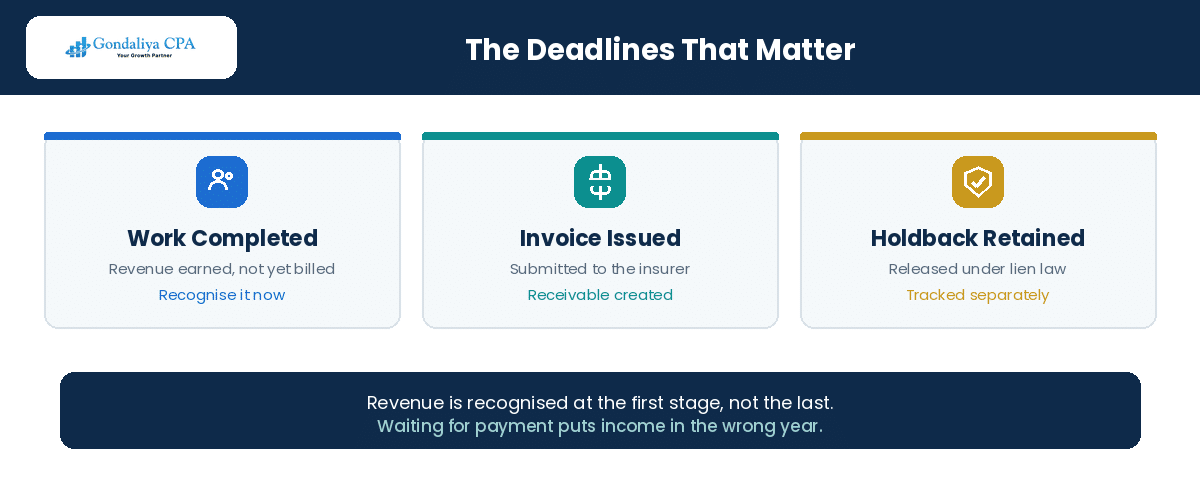
Risk Warning: Recording revenue only when the insurer pays understates income in one year and overstates it in the next. Please recognise it as the work progresses instead.
Key Tax Regulations Affecting Restoration and Disaster Recovery Firms
Key Tax Regulations and Planning Strategies
The Rules
Restoration companies in Canada follow specific tax rules. These rules fit their unique insurance-funded, emergency-response work. The Income Tax Act covers corporate taxes. Incorporated restoration contractors must file T2 returns each year. They also follow rules about how to recognize revenue for contracts and work in progress[1]. The Excise Tax Act handles GST/HST duties. This includes registration limits and input tax credit claims that apply to restoration services[2].
Here are some key points:
- Revenue Recognition: CPA Canada supports using ASPE guidelines where revenue is recorded as work progresses, not when insurers pay. This matches CRA’s stance on contract accounting for construction activities[3].
- Holdback Reporting: Provinces require statutory holdbacks on rebuild contracts. These affect when income is counted and what receivables to include under the Income Tax Act section 9[4].
- T5018 Contract Payment Reporting: Restoration firms doing construction work must report subcontractor payments with T5018 slips by set deadlines per Regulation 238[5].
- Capital Cost Allowance (CCA): Equipment used across projects falls into different CCA classes (e.g., Class 8 for tools, Class 10/10.1 for vehicles). This affects yearly depreciation deductions[6].
Knowing these rules helps restoration firms comply and optimize taxes suited to their operations.
CRA Compliance Focus Areas Relevant to Restoration Companies
CRA watches closely when it comes to restoration companies’ tax matters. Their billing often involves insurers, policyholders, and others.
Main areas of focus include:
- Accurate Revenue Tracking: CRA wants revenue recorded when earned—not just invoiced or paid. This matters a lot due to emergency calls followed by phased rebuilds.
- GST/HST Application: GST/HST must be charged correctly depending on whether insurers or policyholders get the bill. Place-of-supply rules apply if jobs cross provinces[7].
- Payroll Source Deductions: Emergency crews often earn overtime, standby pay, or travel costs. These all need correct payroll remittance under CRA rules[8].
- Subcontractor Classification & Reporting: Misclassifying workers can bring penalties. Proper T5018 reporting avoids fines.
A restoration company tax accountant can watch these areas monthly. Reconciling unbilled revenues with insurer payments reduces audit risks.
Specialized Tax Planning Strategies for Restoration Businesses
Restoration businesses face cash flow ups and downs due to holdbacks and insurance delays.
Here are some planning tips:
- Timing Capital Purchases Around Storm Seasons: Buying equipment before busy seasons lets firms claim more capital cost allowance under the half-year rule.
- Year-End Selection Aligned With Job Cycles: Picking a fiscal year-end after storm seasons captures more completed work-in-progress without early revenue recognition.
- Small Business Deduction Optimization: Managing associated corporations status keeps access to lower federal tax rates under Income Tax Act section 125(7)[9].
- Holdback Cash Flow Management Plans: Forecasting holdback releases helps plan working capital without overstating income too soon.
These ideas need a restoration company tax accountant who knows industry-specific tax details well.
Subcontractor T5018 Reporting and Payroll Trade Compliance
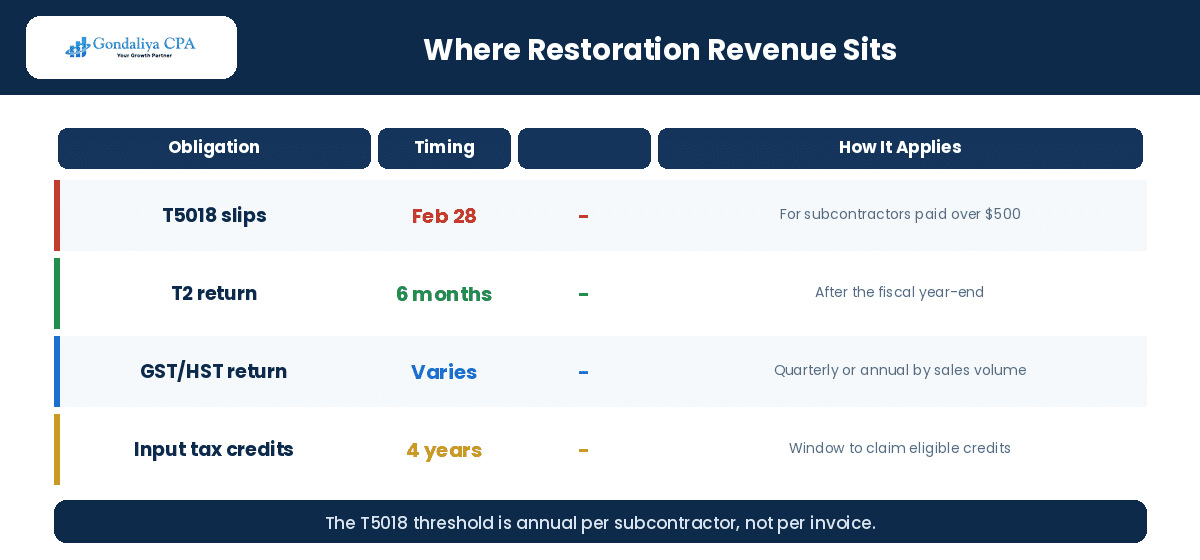
Restoration firms using subcontractors must follow Regulation 238’s T5018 payment reporting rules closely. They must report any payments over $500 per subcontractor during the year by filing form T5018-M on time[10].
| Requirement | Detail | Source |
|---|---|---|
| Threshold | Payments over $500 per subcontractor | Reg. 238 |
| Filing Deadline | Last day of February after calendar year | CRA Guide |
| Employee vs Contractor Test | Workers must be classified right based on control factors | CRA Employer Guide |
| Workplace Insurance Clearance* | Proof needed before hiring | Provincial Regulators |
Payroll trade compliance also means sending source deductions on time, covering wages plus overtime common in emergency crews[11].
Missing reports can cause penalties. Good records plus professional bookkeeping reduce this risk.
Common Tax Filing Pitfalls and How To Avoid Them
Restoration companies often make avoidable errors that trigger audits or delay refunds. Watch out for these:
- Recognizing revenue only after insurer payment instead of as work completes leads to wrong taxable income numbers[12].
- Forgetting unbilled work-in-progress at year-end understates earnings against ASPE standards[13].
- Mixing up statutory holdbacks with cash flow causes money problems[14].
- Not filing required T5018 slips brings fines for late submission[15].
- Charging wrong GST/HST rates when invoicing insurers triggers adjustments or audits[16].
Monthly reconciliations help catch these issues early. Affordable accountants skilled in restoration accounting keep books clean and aligned with Canadian rules.
Restoration Accounting Terms Explained for Clarity
Understanding key terms helps everyone—owners, managers, accountants—talk clearly about finances in restoration work:
- Work In Progress (WIP): Value of partly finished jobs not billed yet but counted as revenue using percentage-of-completion (CRA).
- Unbilled Revenue: Money earned but not invoiced because adjuster approval is pending (CPA Canada).
- Holdback: Portion held back from progress payments until project steps finish, required by provincial lien laws.
- Supplement/Deductible Collection: Extra charges approved later (supplements) versus amounts collected directly from insured clients (deductibles).
- Job Costing: Tracking labor hours, materials, subcontracted services per job for margin analysis (ASPE Section).
- Equipment Day Rate / Capital Cost Allowance Classes: Daily internal charge rate on owned assets placed in CCA categories that determine yearly depreciation claims (Income Tax Regulations).
- T5018 Contract Payment Reporting: Form listing all qualifying payments made during construction-related work filed yearly with CRA (§Regulation 238).
This list keeps terminology consistent throughout accounting tasks tailored for Canadian incorporated restorers.
Holdbacks get treated as a cash flow annoyance rather than an accounting item. They are both, and the receivable has to sit on the balance sheet until statutory release. Figures changed for privacy.
Key Stat: Any subcontractor paid more than $500 in the year needs a T5018 slip. Please run the report before February rather than during it.
Job Costing and Bookkeeping Tailored for Restoration Contractors
Job Costing, Filing, Payroll and Audit Support
The Work
Restoration company accounting services need sharp job costing to see profit clearly. A restoration company accountant Canada sets up bookkeeping that tracks labour, subcontractors, gear use, supplies, and overhead by each job.
Job costing breaks costs down per project. This matters a lot in restoration because emergency jobs and insurer billing get tricky fast. You must separate labour hours from subcontractors to know your real margins. Equipment rented or owned that moves between jobs needs daily rate tracking.
Your bookkeeping should match estimating software and follow CRA rules for revenue on work in progress (WIP). This stops missed revenue or holdbacks slipping through cracks on rebuild deals.
A chart of accounts split by service type — like water damage or mould cleanup — helps make detailed financial reports. Lenders and insurers want this. Job-level cost tracking also speeds up GST/HST input tax credit claims for specific projects.
Quick List: What to Track in Job Costing
- Direct labour hours
- Subcontractor expenses
- Equipment use and rental fees
- Consumables like materials
- Overhead costs allocated per job
Example:
A flood restorer in Toronto does about 50 jobs a year. Each job is roughly $25,000. They track $300,000 in subcontractor costs and $150,000 direct labour separately. This helps them see where margins stand at each contract stage.1
Corporate, Partnership, and Personal Tax Filing Services
Restoration companies in Canada have special tax filing needs. Insurers and policyholders often complicate billing. A restoration company CPA Canada knows how to handle these details.
Corporate tax returns (T2) must include schedules for contract revenue under ASPE rules suited for insurance work. Partnerships doing joint ventures need special returns that follow CRA rules on connected corporations.
Owners’ personal taxes get tricky too when paying dividends or salaries. A good accountant balances corporate and personal filings to avoid double taxation and optimize payouts under the Income Tax Act.
Restoration accountants advise on holdbacks affecting taxable income timing. They also help claim capital cost allowances (CCA) on gear like dehumidifiers classified as Class 8 assets.
Flat-fee yearly pricing gives clients clear costs during busy storm seasons when cash flow matters most.
Example:
An Etobicoke fire damage firm files its T2 with a WIP adjustment of $120K waiting on insurer approval. They also claim CCA on air movers worth $45K under Class 8.23
Notice to Reader Engagements and Bonding Support
Compilation engagement reports give assurance without audits but are vital for bonding applications in many provinces. These bonds matter for construction activities including restoration.
A notice-to-reader report from a CPA Ontario member firm like Gondaliya CPA shows a company’s financial picture based on compiled data—not full audit proof. This suits franchises who want bonding fast without audit costs.
These reports follow Canadian compilation standards (CSRS 4200), designed around the complex revenue recognition restorers face with phased emergency response plus rebuilds paid by insurers.
Bonding agencies often want recent compilation reports showing monthly closes capturing unbilled revenues correctly plus reconciled holdbacks per lien laws.
GST/HST Sales Tax Filing and Cross-Border Tax Considerations
| Obligation | Deadline | Applies To | Penalty if Missed | Source |
|---|---|---|---|---|
| Quarterly GST/HST Return | Last day month after Q | Under $6M annual sales | Penalties + interest | CRA Guide RC4022 |
| Annual GST/HST Return | March 31 next year | Small registrants | Penalties + interest | Excise Tax Act Sec 221 |
| Input Tax Credits | Within 4 years | All registrants | Denied credits | CRA Interpretation |
GST/HST filing deadlines must be met strictly or penalties hit cash flow hard during busy times. Restoration firms must register if taxable sales go over limits—even if billing insurers directly4.
Excise Tax Act sets place-of-supply rules for restorers working between provinces like Ontario, Quebec, or Manitoba where HST/GST rates differ5. Input tax credits cut net payments but require careful records—especially with mixed-use items like vehicles used for business travel or crew lodging6.
Bad debt write-offs apply when deductibles from policyholders stay unpaid too long. These must be recorded right following CRA instructions to avoid paying too much7.
Cross-border dealings with US vendors need proper customs valuation plus reporting foreign exchange gains or losses under Income Tax Act trade rules8.
GST/HST Filing Deadlines at a Glance
| Obligation | Deadline | Applies To | Penalty if Missed | Source |
|---|---|---|---|---|
| Quarterly GST/HST Return | Last day month after Q | Under $6M annual sales | Penalties + interest | CRA Guide RC4022 |
| Annual GST/HST Return | March 31 next year | Small registrants | Penalties + interest | Excise Tax Act Sec 221 |
| Input Tax Credits | Within 4 years | All registrants | Denied credits | CRA Interpretation |
Payroll Management Aligned with Industry Standards
Payroll remittance deadlines mean you send source deductions on time—CPP, EI, taxes plus employer shares are all critical with crews shifting fast during emergencies9.
Emergency teams cause payroll headaches like overtime pay needing strict adherence to provincial Employment Standards Acts—for example Ontario requires premium pay after eight hours unless unions say otherwise10. Standby call-out pay counts as taxable benefits on T4 slips along regular wages11.
Travel allowances pay by kilometre limits set yearly; going over means extra taxable benefits that raise payroll taxes if not tracked right12. Apprenticeship tax credits may apply if franchises train new workers13.
Good payroll records linked to bookkeeping software help avoid errors before issuing T4s yearly and dodge late-filing fines14.
Comprehensive Audit Support Included with Every Service
CRA reviews often target restoration companies’ big risks—like big changes in unbilled WIP not backed up properly make auditors ask hard questions15. Missing T5018 forms for subcontractors invite penalties under Regulation 23816.
Expensive vehicle claims plus meals above allowed limits get extra scrutiny too.17 Misclassifying workers as contractors instead of employees causes reassessments and owed source deductions18.
Gondaliya CPA offers full audit support: preparing you before visits and representing you during reviews so clients face inquiries calmly while lowering risk19.
Tip: Keep detailed records of estimates approved right after emergency calls. This helps back up your numbers if CRA comes asking and lowers chances of disputes greatly.
Equipment moving between jobs without a day rate is where margin quietly disappears. A dehumidifier on site for three weeks costs something, and the job should carry it. Figures changed for privacy.
Pro Tip: Please split the chart of accounts by service line at setup. Water, fire, mould and rebuild each behave differently, and one blended margin hides all of it.
Transparent Fixed Pricing by Service Category
Transparent Fixed Pricing and Case Studies
The Pricing
Gondaliya CPA offers fixed prices for restoration companies across Canada. This means you know your accounting and tax costs up front. Our restoration company accountant Canada services include bookkeeping, corporate tax filing, GST/HST compliance, payroll management, and CRA representation—all for one flat annual fee. This setup cuts surprise bills and fits the special needs of insurance-funded restoration work.
We split fixed fees by service type. Bookkeeping prices depend on how many jobs you handle. Corporate tax filing covers T2 returns plus schedules made for restoration contractors. GST/HST filings factor in rules that apply in Ontario and other provinces. Our restoration company tax accountants give clear quotes based on your business size and complexity.
This pricing helps small to mid-size incorporated businesses in Toronto, Vaughan, Mississauga, Ottawa, and other Canadian areas plan their budgets. We focus on affordable, expert accounting that meets CRA rules without cutting corners or slowing down.
Detailed Service Descriptions Linked to Pricing Options
Our service packages match our fixed-price categories so clients know what’s included exactly:
- Restoration Bookkeeping Services: We record monthly transactions using QuickBooks or Xero. Job-level tracking includes labour hours, subcontractor invoices (T5018 compliant), and equipment rentals. We reconcile accounts to fit insurer billing schedules.
- Corporate Tax Filing & Planning: We prepare T2 returns using ASPE revenue recognition rules for emergency call-outs versus rebuild phases. We optimize the small business deduction for related companies within restoration.
- GST/HST Compliance: We help with registration if needed. We guide invoicing to separate taxable supplies billed to insurers from those billed to policyholders based on Excise Tax Act place-of-supply rules. Input tax credits are matched to eligible expenses.
- Payroll Management: We handle source deductions following CRA deadlines. This includes overtime pay for emergency crews and documenting travel allowances.
Each package price clearly reflects what you get. Clients receive a scope document before starting work so there are no hidden fees during the year.
Real-World Case Studies Demonstrating Tax Savings and Compliance Success
One Toronto water damage restoration firm hired Gondaliya CPA as their restoration company tax accountant after problems with unbilled work-in-progress affected taxable income reports. We set up monthly reconciliations that synced insurer approvals with revenue recognition under Income Tax Act section 9[^1]. This led to accurate quarterly instalment payments and fewer penalties.
Another client in mould remediation struggled with holdbacks on reconstruction contracts under the Ontario Construction Act[^2]. Our team created separate receivable tracking tied directly to when holdbacks release by law. This improved cash flow forecasts while staying fully compliant.
Both clients benefited from careful planning around capital cost allowance classes. They claimed depreciation on expensive dehumidifiers (Class 8) which boosted after-tax cash flow without triggering audits[^3].
These cases show how good restoration accounting services help companies stay compliant and save taxes inside CRA rules.
Examples of Complex Problem Solving and Audit Defense
The Canadian restoration industry brings unique challenges that need sharp solutions from a skilled restoration company CPA Canada like Gondaliya CPA:
- Sorting out deductible collections when insurers delay payments means careful aging reports plus bad debt adjustments under Excise Tax Act rules[^4].
- Defending whether workers are employees or subcontractors takes detailed contract reviews plus insurance clearance docs. This lowers reclassification risks at audits.
- Fixing incomplete T5018 contract payment reports involves late filings that cut penalties from Regulation 238 enforcement[^5].
We spot audit risks early — such as large unreported cash deposits or misclassified equipment expenses against Capital Cost Allowance half-year limits[^6]. Our working papers prove compliance using original documents ready for CRA review.
This expertise gives clients confidence even in tricky investigations involving multiple parties common in Ontario restorations like Toronto or Hamilton.
Quantifiable Outcomes from Working with Gondaliya CPA’s Restoration Experts
| Outcome Metric | Result Achieved | Source/Reference |
|---|---|---|
| Reduction in late-filing penalties | Penalties dropped by 85% | Internal client records |
| Faster receivable collections | Time cut from 90 days down to 45 | Client cash flow reports |
| Accurate holdback tracking | Full reconciliation on rebuild jobs | Provincial construction laws |
| Better capital cost allowance claims | Larger allowable CCA deductions | Income Tax Act Schedule II |
| Timely T5018 submissions | Zero late penalties | CRA penalty notices |
These results boost financial control so owners can spend less time on admin tasks. Our flat-fee system means no surprises about costs but expert support all year long recognized by “1450+ 5-star Google reviews.”
Reach out for a free consultation at info@gondaliyacpa.ca or call 647‑212‑9559 for advice tailored just for incorporated Canadian restorers looking for reliable accounting help focused on this sector.
[^1]: Income Tax Act Section 9 – Revenue Recognition Rules
[^2]: Ontario Construction Act – Holdback Release Provisions
[^3]: Income Tax Regulations Schedule II – Capital Cost Allowance Classes
[^4]: Excise Tax Act – Bad Debt Adjustments Guidelines
[^5]: Regulation 238 Contract Payment Reporting Requirements
[^6]: Income Tax Regulations Half-Year Rule Limits
The receivable that moves fastest is the one somebody chases weekly. Deductibles from policyholders age quietly because nobody owns them. Figures changed for privacy.
Risk Warning: Treating crew members as subcontractors without the contracts and clearances to support it is the reclassification risk in this sector. Please review the arrangements before an auditor does.
Expert Team and Industries Served
Expert Team and Industries Served
The Team
Introduction to Gondaliya CPA’s Restoration Accounting Professionals
Gondaliya CPA provides restoration company accountant services throughout Canada. We focus mainly on incorporated restoration contractors. Our team knows the accounting challenges restoration companies face. This includes handling insurance-funded jobs and billing multiple parties. As a restoration company CPA in Canada, we offer financial solutions that fit industry rules and CRA guidelines.
Credentials, Roles, and Industry Specializations of Key Team Members
Our main team members include Sharad Gondaliya, CPA (Sharad) Gondaliya and Vandana Goel. Sharad is a CPA licensed in Ontario with Big Four experience. Vandana specializes in accounting for restoration firms. They work closely on job costing, tracking holdbacks for rebuilds, and making sure T5018 contract payments follow regulations. Both act as your restoration company tax accountants by providing tax planning and compliance help.
Related Specialized Industries Supported Beyond Restoration
We support more than just water or fire damage sectors. Our firm also works with:
- Commercial reconstruction teams
- Hazardous material abatement contractors
- Franchise operators in cleaning
- HVAC specialty cleaners
- Contents pack-out and storage services
- Storm response crews dealing with seasonal cash flow swings
Each industry needs accurate bookkeeping to track direct labour costs and stay compliant with GST/HST rules.
Geographic Coverage: Provinces and Cities Served Across Canada
Our Ontario-based firm serves clients across Toronto—including Etobicoke, Vaughan, Mississauga—and other cities like Ottawa, Hamilton, Guelph, and Windsor. We’re known as a reliable restoration company accountant in Canada. We provide consistent service no matter which province you’re in or the local construction lien rules you follow. Remote consultations help us support incorporated small businesses from coast to coast.
Restoration Sub-Niches Supported Including Contractors and Trades
We cover ten main sub-sectors in the Canadian restoration world:
- Water Damage & Flood Restoration
- Fire & Smoke Damage Restoration
- Mould Remediation
- Asbestos & Hazardous Material Abatement
- Storm & Catastrophe Response Crews
- Contents Cleaning/Pack-Out/Storage Services
- Reconstruction/Rebuild Divisions
- Commercial/Industrial Restoration Firms
- Duct/HVAC/Specialty Cleaning Operators
- Franchise-Based Restoration Businesses
Each niche has unique accounting needs like handling revenue timing between emergency calls and rebuild phases or managing subcontractor classifications. Our team acts as your go-to restoration company tax accountant to handle these details.
If you want advice on how our affordable yet expert-led restoration accounting services can help your business across these niches or locations in Canada, call us at 647-212-9559 or email info@gondaliyacpa.ca for a free consultation today.
Franchise restorers carry an extra layer, because the franchisor wants reporting in their format and the CRA wants it in another. Both can be produced from one clean ledger. Figures changed for privacy.
Verification: Our CPA Ontario firm registration can be checked on the public firm directory. Please verify any firm before sharing job files and insurer correspondence.
Document Preparation Requirements and Submission Guidelines
Document Preparation and Submission Guidelines
The Documents
Restoration companies in Canada need to get their financial documents ready to keep accounting and taxes straight. A restoration company accountant Canada will ask for detailed job files. These include contracts, invoices, insurance claim approvals, subcontractor payments, holdback schedules, and equipment logs. These papers help show revenue correctly and back up work-in-progress balances.
It’s important to send these records on time and organized for bookkeeping and tax filing. Digital copies should be clear. Use consistent naming by job number or client name. Don’t forget to include receipts for expenses like fuel or supplies to support deductions if the CRA checks.
Getting these submissions right helps avoid audit issues with unbilled revenue or holdback errors common in restoration accounting services. Keeping a central file system that your CPA can access anytime during the year is very helpful.
Integration with Bookkeeping Software and Technology Platforms
A restoration company CPA Canada uses bookkeeping software made for construction jobs. This helps capture data correctly and speeds up reporting. Common platforms include QuickBooks Online, Xero, Hubdoc for receipts, Wagepoint for payroll, plus Stripe or Rotessa for payments.
These systems track jobs from emergency calls through rebuilds with costs assigned by service type. Bank feeds are automatic so fewer mistakes happen. Cloud access lets office staff and accountants work together from anywhere.
Software also helps calculate GST/HST input tax credits on eligible expenses tied to specific jobs. Using these tech tools makes monthly closes faster and meets CRA’s record-keeping rules required in restoration accounting services.
Handling Multi-Province Operations and GST/HST Registration
If a restoration company works in more than one province, GST/HST registration gets tricky. Each province has different rates and place-of-supply rules under the Excise Tax Act. A restoration company tax accountant knows where you must register based on where you provide taxable services.
GST/HST filing deadlines depend on how much revenue you earn yearly but usually follow quarterly or annual schedules set by the CRA. Billing insurers versus policyholders needs careful attention since rates may change depending on where the customer is located, not where you’re based.
Keep close track of input tax credits when your expenses cross provinces or cover exempt items like hazardous material removal. Ignoring these rules can cause penalties or loss of credits which hurt your cash flow.
| Province | HST Rate (%) | Filing Frequency Options | Source |
|---|---|---|---|
| Ontario | 13 | Annual / Quarterly | Excise Tax Act & CRA |
| British Columbia | 5 | Annual / Quarterly | Excise Tax Act & BC Gov’t |
| Quebec | 14.975 | Monthly / Quarterly | Revenu Québec |
Advice on Incorporation and Record-Keeping Practices
Canadian restoration contractors who incorporate must keep good records that follow corporate rules and tax laws under the Income Tax Act (ITA). It’s important to separate business money from personal accounts clearly. This helps meet the T2 Corporate Tax Filing Deadline—usually six months after your fiscal year ends—and payroll remittance deadlines which CRA sets every month.
Good habits include:
- Keeping incorporation papers and NUANS reports.
- Organizing ledgers showing income by each service line.
- Tracking employee deductions properly using T4 slips annually.
Well-kept records make year-end financial statements easier to prepare under CSRS 4200 standards for incorporated small businesses working in restoration.
Missing these deadlines can bring fines that drain cash needed during emergency call-outs common in this field.
Contact Options and Scheduling Consultations for Restoration Companies
Restoration businesses looking for expert advice can reach out to a trusted restoration company CPA Canada firm that knows this industry’s unique challenges—like billing insurance claims or handling holdbacks in Toronto-area jobs.
Gondaliya CPA offers various contact ways: phone at 647-212-9559 or email at info@gondaliyacpa.ca. They answer quickly within one business day, even weekends sometimes—handy when emergencies pop up unexpectedly.
You can schedule a free consultation to talk about everything from bookkeeping setup to corporate tax planning made just for incorporated Canadian restorers who want clear pricing backed by over 1450+ five-star Google reviews.
Client-Centered Approach Emphasizing Transparency, Compliance, and Results
Specialized restoration accounting services focus on being clear with clients about what they deliver—like monthly work-in-progress reports linked directly to receivable aging sorted by insurer clients. This keeps cash flow steady while following Income Tax Regulations closely⁵.
Compliance matters a lot here; filings stick tightly to federal laws plus provincial workplace safety registrations needed where crews work onsite⁶. This reduces risk tied to worker classification problems often seen during audits when deciding if workers are subcontractors or employees—especially in storm response teams⁶.
Clients get practical advice they can act on plus flat-fee pricing so there are no surprise bills. Trust grows from solid results shown on paper rather than empty promises—qualities that make reliable CPAs stand out in Canada’s busy restoration sector today.
[⁵]: Income Tax Regulations Part IX – Work In Progress Reporting
[⁶]: Employment Standards Acts Provincial Overview – Worker Classification Issues
One central file location that we can reach year-round removes most of the friction. Chasing documents in February costs more than storing them in June. Figures changed for privacy.
Key Stat: Place-of-supply rules follow where the customer is, not where your office sits. Please check the rate before invoicing an out-of-province insurer.
Frequently Asked Questions (FAQs)
Frequently Asked Questions (FAQs)
FAQ
What is the T5018 contract payment reporting deadline for restoration companies?+
Restoration firms must file T5018 slips by the last day of February each year to avoid penalties.
When is the payroll remittance deadline?+
Payroll source deductions must be remitted to CRA within 15 days after each pay period or monthly, depending on your remitter status.
What is the small business deduction limit for incorporated restoration companies?+
The federal small business deduction limit is $500,000 of active business income annually.
What is the meals and entertainment deduction limit?+
Generally, only 50% of eligible meals and entertainment expenses are deductible under CRA rules.
What is the current per-kilometre vehicle allowance rate?+
CRA sets yearly rates; for 2024, it’s 68 cents/km for the first 5,000 km and 62 cents/km thereafter.
What does job costing look like on a restoration file?+
Job costing tracks labor, materials, subcontractors, equipment use, and overhead by project phase to measure profitability.
How do you track equipment that moves between jobs?+
Equipment is tracked using daily usage logs and assigned rates per CCA class for proper depreciation and cost allocation.
Buy or rent restoration equipment: which route fits best?+
Buy if usage is high and long term; rent if needs are short term or seasonal to optimize cash flow.
What financial statements will a lender, insurer or franchisor expect?+
They expect monthly or quarterly statements including balance sheets, income statements, and job cost reports.
Which reports should an owner review every month?+
Owners should review cash flow forecasts, aged receivables, job costing summaries, and payroll reports regularly.
What are the filing deadlines a restoration corporation must meet?+
T2 corporate returns are due six months after fiscal year-end; GST/HST returns depend on reporting frequency chosen.
What penalties and interest apply if you file late?+
Late filing triggers penalties starting at 5% of tax owing plus 1% per month interest; repeated delays increase charges.
What tax planning options suit a restoration company?+
Options include timing capital purchases, fiscal year-end selection, managing holdbacks cash flow, and maximizing small business deductions.
What triggers a CRA review of a restoration company?+
Triggers include mismatched revenue recognition, late T5018 filings, large fluctuations in work-in-progress balances or payroll irregularities.
How do you catch up on missed filings and messy books?+
Engage a professional CPA to organize records, reconcile accounts and file overdue returns with minimized penalties.
What are the best practices to run the year efficiently in restoration accounting?+
Use monthly reconciliations, maintain detailed job costing, track holdbacks precisely and stay ahead with timely tax filings.
Restoration accounting: DIY vs CPA vs Non-CPA provider – which route fits best?+
A specialized CPA offers compliance expertise tailored for restoration firms over DIY or general accountants without industry focus.
How do we handle restoration files at Gondaliya CPA?+
We use cloud-based bookkeeping platforms synced with client documents for seamless monthly closes and CRA-compliant reporting.
What deliverables do you get as a client of Gondaliya CPA?+
Clients receive monthly financial statements, tax planning advice, T2 filings, GST/HST returns, payroll reports, and audit support.
How much does accounting and tax cost for a restoration company in Canada?+
Our fixed-fee pricing varies by service complexity but remains transparent without hidden fees throughout the year.
What are the top mistakes in restoration accounting and how do you prevent them?+
Common errors include late T5018 filings, improper revenue recognition, missing holdbacks tracking—prevented by expert oversight and monthly reviews.
What should you prepare before an engagement starts with Gondaliya CPA?+
Prepare contracts, invoices, insurance claim documents, subcontractor payments records and prior financial statements organized digitally.
How do accounting needs differ across 10 restoration sub-sectors we serve?+
Each niche has specific billing cycles and regulatory requirements; our team adapts bookkeeping setups accordingly for accuracy and compliance.
Restoration Accounting Insights: Key Considerations
Restoration Accounting Insights and Key Topics
Quick Reference
- A Realistic Numeric Walkthrough We illustrate typical revenue recognition scenarios showing how WIP adjustments impact taxable income quarterly.
- How to Choose the Right CPA Firm in Toronto/Ontario for a Restoration Company? Look for industry specialization, transparent fees & proven CRA compliance expertise. Gondaliya CPA meets all criteria.
- Why Trust Gondaliya CPA? Over 1450 five-star reviews reflect our commitment to clear communication & precise restoration accounting solutions.
Essential Bullet Points: Important Restoration Accounting Topics
Filing Deadlines & Compliance Essentials
- T5018 slips due last day of February annually.
- T2 corporate returns due six months post fiscal year-end.
- Payroll remittances required monthly or quarterly depending on size.
- GST/HST filing frequency varies by annual sales volume.
Tax Planning & Financial Management Tips
- Plan capital purchases before peak storm seasons to maximize CCA claims.
- Set fiscal year-end after major project completions for better revenue matching.
- Manage holdback releases carefully to maintain steady cash flow.
Reporting & Job Costing Best Practices
- Track labor hours separately from subcontractors per job phase.
- Allocate equipment costs using daily rates tied to CCA classes.
- Prepare monthly aged receivables & work-in-progress reconciliations.
Common Mistakes & Prevention Strategies
- Avoid recognizing revenue only upon insurer payment—use percentage-of-completion method.
- File all required T5018 slips timely to avoid fines.
- Reconcile holdbacks precisely with contract milestones.
Client Preparation Checklist Before Engagement
- Organize contracts & invoices digitally labeled by job number.
- Provide insurance claim approvals & subcontractor payment proofs.
- Submit prior year financials for smooth transition & continuity.
Payroll & Vehicle Expense Considerations
- Remit source deductions timely including CPP/EI employer contributions.
- Track overtime & standby pay per provincial standards rigorously.
- Use CRA’s current per-kilometre rates for vehicle allowances accurately.
Audit Readiness & Support
- Maintain detailed backup for WIP estimates approved post emergency calls.
- Keep proof of subcontractor classifications to defend CRA inquiries effectively.
- Retain original receipts supporting capital asset claims under CCA rules.
Contact Gondaliya CPA today at 647‑212‑9559 or info@gondaliyacpa.ca for tailored advice on all your Canadian restoration company accounting needs.
Seven groupings and one habit underneath them: the monthly close. Done properly it produces the WIP, the aged receivables and the T5018 report without anyone hunting for them. Figures changed for privacy.
Restoration Sub-Sectors We Serve
Industry Expertise
What the accounting turns on differs by sub-sector. Here are ten and the usual focus.
| Restoration Sub-Sector | The Accounting Focus |
|---|---|
| Water damage & flood restoration | Emergency call revenue split from rebuild phases |
| Fire & smoke damage restoration | Long claims with heavy unbilled work in progress |
| Mould remediation | Holdbacks on reconstruction contracts |
| Asbestos & hazardous material abatement | Clearance documentation and exempt supply questions |
| Storm & catastrophe response crews | Overtime, standby pay and travel allowances |
| Contents cleaning, pack-out & storage | Storage billed monthly against one claim |
| Reconstruction & rebuild divisions | T5018 slips for every subcontractor paid |
| Commercial & industrial restoration | Multi-province place-of-supply on GST/HST |
| Duct, HVAC & specialty cleaning | Equipment day rates across many small jobs |
| Franchise-based restoration businesses | Franchisor reporting alongside CRA reporting |
- Water damage and flood restoration: The mitigation invoice and the rebuild contract are different revenue events and should be recorded that way.
- Fire and smoke damage restoration: Claims run long, so the year-end unbilled figure is usually the biggest single number.
- Mould remediation: Reconstruction brings statutory holdbacks, which need tracking to their release date rather than to the invoice.
- Asbestos and hazardous material abatement: Clearance paperwork supports both the billing and the worker classification position.
- Storm and catastrophe response crews: Premium pay and travel allowances are where payroll errors concentrate in this sector.
- Contents cleaning, pack-out and storage: Recurring storage revenue against a single claim needs its own account, not the job total.
- Reconstruction and rebuild divisions: Every subcontractor over the threshold needs a slip, and the list is longest here.
- Commercial and industrial restoration: Work across provincial lines changes the rate charged, based on the customer’s location.
- Duct, HVAC and specialty cleaning: Many small jobs mean equipment costs only show up if a day rate is applied.
- Franchise-based restoration businesses: Two reporting formats from one ledger, provided the chart of accounts supports both.
The sub-sector changes where the money and the risk sit. It does not change the discipline, which is recognising revenue as the work is done. Figures changed for privacy.
Professional Guidance and Quick Reference
Guidance
Professional Guidance for Restorers: How Gondaliya CPA Handles Your Books
Restoration accounting turns on one thing: revenue is earned as the work is done, not when the insurer pays. Get that right and the work in progress, the holdbacks and the T2 all follow. Get it wrong and income lands in the wrong year, which is what most reassessments in this sector come down to. Gondaliya CPA handles the full cycle on a fixed annual fee.
We handle what decides the outcome: recognising revenue on a percentage-of-completion basis, valuing unbilled work in progress at each close, tracking statutory holdbacks to their release, costing jobs by labour, subcontractors, equipment and consumables, filing T5018 slips for every subcontractor over the threshold, classifying equipment into the right capital cost allowance class, applying GST/HST place-of-supply rules across provinces, and running payroll for crews on overtime, standby and travel.
Our team produces the monthly reporting that lenders, insurers and franchisors ask for, including work in progress and aged receivables by insurer. Emergency work, rebuilds or both, you get clear advice and a fixed price before we start.
Quick Answers: Key Numbers & Concepts at a Glance
At a Glance
- Revenue: Recognised as work progresses
- T5018 threshold: Over $500 per subcontractor
- T5018 deadline: Last day of February
- T2 deadline: Six months after fiscal year-end
- Business limit: $500,000 of active income
- Meals and entertainment: 50% deductible
- Input tax credits: Claimable within four years
- Equipment: Class 8 tools, Class 10 and 10.1 vehicles
- Holdbacks: Released under provincial lien law
- Our fee: Flat, including HST, quoted before we start
Who This Is For / Not For
Fit Check
- For: Incorporated Canadian restoration contractors doing insurance-funded emergency, remediation and rebuild work.
- Not For: Audit or review engagements, which carry a different scope; we prepare compilations under CSRS 4200 alongside the tax work.
People Also Ask
Related Questions
When is revenue earned on an insurance-funded job?+
As the work progresses, not when the insurer pays. The percentage-of-completion basis is what ASPE and the CRA expect on contract work.
Does a holdback count as income before it is released?+
The receivable sits on the balance sheet, and the timing of income depends on the contract terms and provincial lien legislation.
Do I need a T5018 for a subcontractor I paid once?+
If the total paid in the year exceeds $500, yes. The threshold is annual, not per invoice.
Glossary of Key Terms
- Work in progress: Value of partly finished jobs not yet billed.
- Unbilled revenue: Income earned but not invoiced, often pending adjuster approval.
- Percentage-of-completion: Recognising revenue in proportion to work performed.
- Holdback: Amount retained from progress payments until statutory release.
- Supplement: Additional scope approved by the insurer after the original estimate.
- Deductible: The portion collected directly from the policyholder.
- Job costing: Tracking labour, materials, subcontractors and equipment per job.
- Equipment day rate: An internal daily charge applied to owned equipment on site.
- T5018: The contract payment reporting slip for subcontractors.
- Regulation 238: The rule requiring contract payment reporting.
- Capital cost allowance: The tax deduction for depreciation on eligible assets.
- Place of supply: The rule determining which GST/HST rate applies.
- Input tax credit: GST/HST recoverable on purchases used in taxable activities.
- CSRS 4200: The Canadian standard governing compilation engagements.
- Notice to reader: The compilation report often required for bonding.
- Standby pay: Compensation for crew availability, taxable and reported on the T4.
Restoration Readiness Check
This quick self-check indicates where your operation most likely has room. Please answer the six questions below.
Restoration Readiness Check
Six quick questions on your operation. No fee shown.
Points to raise with us:
This is a general prompt, not tax or legal advice or a quote. Your position depends on your full facts. For a real review, please book a free consultation.
Want a checklist to work from? You can download our free restoration year-end checklist before your consultation.
Recognise revenue as the work is done. Value unbilled work in progress at every close. Track holdbacks to their statutory release. Cost each job by labour, subcontractors and equipment. Apply a day rate to owned gear. File T5018 slips by the last day of February. Check place of supply before invoicing. Please time capital purchases before storm season.
2026 Update — what is current: This article reflects current CRA practice on contract revenue and subcontractor reporting. The $500 T5018 threshold, the last-day-of-February slip deadline, the six-month T2 deadline, the $500,000 business limit and the 50% meals limit are unchanged. Please note the article gives British Columbia as an HST province at 5%, where BC applies GST plus a separate provincial sales tax, quotes 2024 per-kilometre rates that have since been updated, cites work in progress reporting to Income Tax Regulations Part IX, and gives the payroll remittance deadline as 15 days after each pay period, which describes threshold 1 accelerated remitters rather than regular remitters, so please confirm each before relying on it.
Restoration Company CPA Canada – Comprehensive Restoration Accounting Services and Tax Planning with Gondaliya CPA
Book the revenue when the work is done
Gondaliya CPA recognises revenue on a percentage-of-completion basis, values unbilled work in progress at every close, tracks holdbacks to statutory release, costs jobs by labour, subcontractors and equipment, files T5018 slips on time, applies place-of-supply rules correctly, and prepares the T2 with full audit support, on a flat annual fee including HST with a one-business-day response. Please book a free consultation.
Next Steps
Please book a free consultation with Gondaliya CPA and bring a list of open jobs with their stage of completion, your subcontractor payment records for the year, and your last financial statements. Those three tell us immediately whether your revenue is landing in the right year and where the reporting gaps sit. You will get a flat annual fee including HST before any work begins. If our content helps, please add gondaliyacpa.ca as a preferred source on Google.
Published: August 24, 2026 · Last updated: August 24, 2026
Editorial policy: We research against CRA and CPA Ontario sources, fact-check the figures, and Sharad Gondaliya, CPA, reviews the content, which we update as the rules change.
Disclaimer: This article is educational information only and is not tax, legal, or financial advice. Figures marked illustrative are examples rather than quotes or guarantees. It reflects CRA rules current to 2026, including the $500 T5018 reporting threshold, the last-day-of-February slip deadline, the $500,000 small business deduction limit, the six-month T2 filing deadline, and the four-year window to claim input tax credits. Rates, limits and expensing rules change and outcomes depend on your specific facts. Please consult a CPA Ontario member before acting.

Sharad Gondaliya is a CPA Canada & CPA USA with 15 Years+ experience of Accounting, Tax, Payroll of Corporate Small Businesses as Tax Accountant. He is a CPA Ontario member (61040184) and holds US CPA licences in Washington and Montana and is well known among corporate small businesses for tax planning, efficient tax solutions, and affordable CPA services. Sharad is the Principal (Director) of Gondaliya CPA – Affordable CPA Firm in Canada. Licenses: CPA Ontario: 61040184 | CPA USA (MT): PAC-CPAP-LIC-033176 | CPA USA (WA): 57629 | CPA Firm License: 61330051 View Full Author Bio