



The Ultimate Guide to Accounting and Tax Services for Specialist Physicians in Canada
Gondaliya CPA serves as a specialist physician tax accountant and physician CPA Canada offering affordable physician accounting, corporate tax filing, and physician financial statements. Our firm specializes in accounting for specialist physicians, physician corporate tax filing, and delivering tailored tax solutions for Canadian physicians’ medical practices.
Quick Summary
Four things decide a specialist physician corporation’s result: whether income is recognised when billed or when paid, how clawbacks and rejected claims are recorded, how overhead is split in group arrangements, and the salary against dividend mix. Please note the T2 is due six months after the fiscal year-end.
| Aspect | Details |
|---|---|
| The income | Recognised when receivable, not on deposit. |
| The clawbacks | Tracked and reported against the billing. |
| The overhead | Split by agreement, with documentation. |
| The pay mix | Salary for RRSP room, dividends for cash. |
Reading time: 43 minutes.
Table of Contents
- Specialized Accounting Services for Physicians
- Comprehensive Physician Accounting Services
- Supporting Physicians Across Career Stages
- Transparent Pricing and Virtual Accounting
- Features That Differentiate Physician Accountants
- Client Experiences and Selecting a Partner
- Frequently Asked Questions
- Best Practices, Deliverables and Key Insights
- Physician Specialties We Serve
- Professional Guidance and Quick Reference
The Numbers That Matter
This article covers Canada, with Ontario and Toronto context, and reflects rules current to 2026. It assumes a specialist physician operating through a medicine professional corporation. Figures marked illustrative are examples, not quotes, and any masked engagement notes end with “Figures changed for privacy.” This is educational information only and not tax or legal advice. Professional corporation and shareholder rules are set provincially by the medical regulator, so please confirm the position in your province.
Specialized Accounting Services for Physicians in Canada
Specialized Accounting Services for Physicians
The Basics
Specialist physicians in Canada deal with unique money issues. They need accounting services that fit their work. A specialist physician accountant knows how medical finances work. They help you follow rules and find tax savings. These accountants offer important physician accounting services like bookkeeping, filing corporate taxes, and planning money matters just for doctors.
Why Choose a Specialist Physician Accountant?
Choosing a specialist physician tax accountant comes with perks. They know medical laws well and handle tricky stuff like billing income and clawbacks. This helps your money stay correct and legal.
A specialist physician accountant in Canada not only manages daily money tasks but also gives advice on future plans. This means you can spend more time with patients, less on paperwork.
How Canadian Regulations Impact Medical Professionals’ Finances
Rules in Canada change how doctors handle money. Setting up a medicine professional corporation can protect doctors from personal risks and save on taxes.
The Income Tax Act updates coming in 2026 will affect how doctors run their businesses. Knowing these changes helps meet the corporate tax filing deadline on time—usually six months after the year ends.
Understanding the Unique Financial Needs of Specialist Physicians
Specialist physicians get money from different places like hospitals, private visits, and locum work. Knowing when to count billing income matters—whether it’s when billed or when paid.
Also, clawbacks from health plans happen often. Doctors must keep good records to track these clawbacks well and report them correctly at year-end.
Income Diversity and Compensation Structures
Doctors earn money in many ways: locum jobs, teaching, or consulting besides their main work. Handling this right affects cash flow and taxes.
Choosing salary or dividends for payment as an incorporated specialist is tricky. Salary lets you add to RRSPs but dividends give quicker cash. Both affect personal and company taxes differently.
Expense Tracking and Practice Overhead
Keeping track of expenses saves money and prevents problems later. Deductible costs include professional fees, classes, and equipment used for patient care.
If you work in groups, splitting overhead costs must be recorded properly according to CRA rules. Clear records help during audits by showing your claims follow Canadian laws.
The Role of a Physician CPA in Managing Medical Practice Finances
A physician CPA in Canada handles everything about your practice’s money—from daily bookkeeping to yearly checks before tax filings (T2 returns).
They make sure your records match CRA rules and give peace of mind about meeting legal duties. This is key especially in places like Ontario or Toronto where laws change often.
Ensuring Regulatory Compliance
Sticking to corporate tax filing deadlines matters a lot. Missing them leads to fines plus growing interest charges!
CRA looks closely when reported incomes don’t match actual payments received—this can trigger reviews that cause stress later.
Regular talks with your CPA keep you updated on dates so you don’t miss anything important during busy workdays running your clinic.
Cash Flow Management Strategies
Managing retained earnings well keeps your practice stable over time. You must watch shareholder loans too since mixing them with personal spending can cause trouble.
Using budgets and checking finances often helps see how well things go. This way, you can plan confidently without surprises coming up suddenly down the road!
The gap between gross billings and what actually lands is where physician files go wrong. Clawbacks arrive months later and rarely get matched back to the original billing. Figures changed for privacy.
Risk Warning: A shareholder loan left outstanding past one year after the fiscal year-end becomes income. Please clear the balance before that window closes rather than after.
Comprehensive Physician Accounting Services
Comprehensive Physician Accounting Services
The Services
Specialist physicians in Canada need accounting services that fit their specific financial and legal needs. A specialist physician accountant Canada knows the tricky rules for medical professional corporations and different income types, like locum work or academic pay. These physician accounting services help keep books accurate, follow tax laws, and plan smartly within healthcare rules.
Physician accounting means handling many income sources while following CRA rules on how to report income and deduct expenses for medical work. Specialist physician tax accountants try to boost take-home pay without breaking Income Tax Act or provincial college rules. They also advise on corporate setups that affect who can be a shareholder and how to name the corporation properly.
Picking a CPA firm used to Ontario’s medicine professional corporation system cuts down mistakes with splitting overhead costs, clawbacks from provincial plans, or GST/HST exemptions for insured health services. This help is great for doctors moving from residency into their own practice by giving clear financial reports and forward-thinking tax tips.
Corporate Tax Filing for Physician Professional Corporations
It’s really important for physician professional corporations in Canada to file corporate taxes correctly. The T2 Corporate Tax Return filing deadline is six months after the fiscal year ends. If you miss it, penalties come with extra charges based on what you owe.
A good physician CPA Canada makes sure all needed forms come with the return — like Schedule 100 (Balance Sheet) and Schedule 125 (Income Statement). These show the right numbers following ASPE standards for medical practices. They check if your business can claim small business deductions and watch passive income limits that can lower those benefits.
Corporate tax filing also means matching gross billings against what hospitals or provinces paid. This helps show taxable income vs exempt stuff like insured health care services. Many firms offer flat fees yearly so costs are clear. They cover payroll slips (T4/T4A), GST/HST returns if needed, plus any late filings from past years.
Physician Financial Statements and Reporting
Financial statement preparation keeps things clear in a specialist’s incorporated practice. Medical practice accounting compliance means using Canadian ASPE standards with compilation engagements per CSRS 4200 rules.
Statements include trial balances coded by GIFI codes required by CRA schedules. Good reporting lets physicians see profit differences in areas like surgery or diagnostic imaging where overhead costs vary a lot. These compiled financials help when doctors want loans for new equipment or clinic space because lenders want proof of solid money management.
Compilation engagements give limited checks but cost less than audits and still satisfy most lenders. Regular updates let doctors decide quickly on paying themselves via salary vs dividends—this matters for RRSP room and CPP contributions among specialists with corporations.
Bookkeeping Solutions Designed for Doctors
Bookkeeping for doctors Canada must handle tricky receipt tracking plus sorting expenses right under Income Tax Act Section 18(1)(a). Specialists often have trouble splitting clinic overhead from personal costs if they share offices or work in groups.
Good bookkeeping uses tools like QuickBooks or Xero linked with Hubdoc to auto-reconcile bank feeds. This keeps transactions accurate all year long. Proper sorting separates deductible costs such as:
- Liability insurance premiums
- Continuing education fees (max $1,000 yearly per CRA)
- Staff wages with payroll deductions
- Vehicle mileage logs fitting $30K capital cost limit
- Conference travel split by business vs personal days
These details matter at year-end reviews.
Digitizing receipts cuts down paper mess and makes audits easier if CRA asks for proof after spotting odd claims like meals over 50% allowed.
Tax Planning Focused on Specialist Physicians’ Income Structures
Specialist physician tax planning looks at how to pay yourself best while balancing cash flow and saving for retirement through RRSPs made from earned salaries, not just dividends.
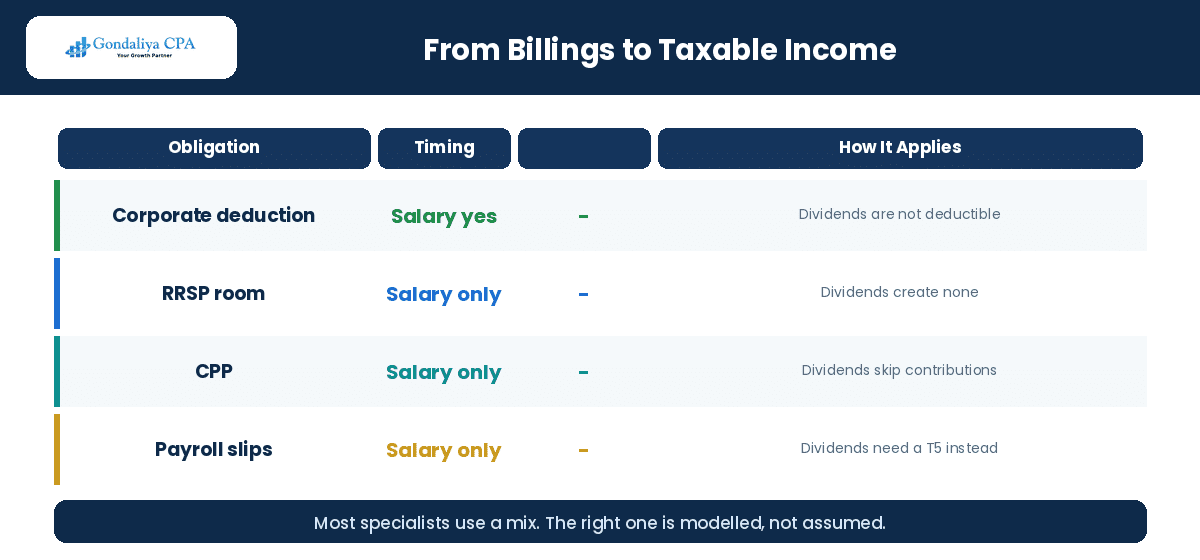
Choosing salary or dividends depends on CPP rules — CPP only applies when you pay salary — plus how taxes combine at personal level. Salary raises pensionable earnings but brings employer payroll taxes; dividends skip CPP but don’t add RRSP room or pension benefits many high-income specialists want.
Planning also includes timing bonuses near fiscal year-end to match low tax rates without failing reasonableness tests. Family member pay needs proof of real work due to CPSO shareholder rules.
| Remuneration Method | Corporate Deduction | Personal Tax Impact | Creates RRSP Room | Requires Payroll Slips |
|---|---|---|---|---|
| Salary | Yes | Subject to CPP & EI | Yes | Yes |
| Dividends | No | Eligible dividend rates apply* | No | No |
*Dividends get better tax rates but lack pension/CPP benefits.
Many specialists mix salary with dividends to balance money now versus savings later. Talking to a specialist physician accountant Canada about current laws (like 2026 small business deduction changes) helps pick the best plan.
For questions about specific specialties — say surgery overhead splits or psychiatry billing — contact Gondaliya CPA at info@gondaliyacpa.ca or call 647-212-9559 for a free chat focused on Canadian specialist physicians working via medicine professional corporations.
Most specialists we meet are paid entirely in dividends because it was simpler in year one. The RRSP room that was never created is the cost nobody quantified. Figures changed for privacy.
Key Stat: Only salary creates RRSP room and pensionable earnings. Please decide the mix at the start of the year rather than at the filing deadline.
Supporting Physicians Across Career Stages
Supporting Physicians Across Career Stages
The Stages
Specialist physicians in Canada deal with accounting and tax stuff that can get tricky. Whether you’re a resident, a community doctor, or running a medicine professional corporation, you need the right help. A specialist physician accountant Canada knows about billing rules and corporate tax filing. They also keep up with new things like the small business deduction limit for 2026. Working with a physician CPA Canada helps you understand income, deductions, pay methods, and planning ahead.
Accounting and Tax Solutions for Residents and Fellows
Residents and fellows don’t have much time for taxes. Specialist physician tax accountants step in to handle personal tax returns and income from hospital jobs or research grants.
Here’s what matters:
- Watching taxable benefits like moving costs or paid courses.
- Knowing RRSP room gained during residency.
- Planning for incorporation after fellowship.
- Checking which medical education expenses CRA accepts.
A physician CPA Canada can make bookkeeping easier by linking payroll slips (T4s) and investments. This stops missed deductions or credits.
Financial Management Services for Community Physicians and Hospitalists
Community doctors who work alone or in groups face specific accounting needs based on their billing from hospitals or provincial plans. Specialist physician accountants Canada focus on:
- Balancing total billings against what you actually get after expenses.
- Handling clawbacks if claims get rejected by CRA.
- Sorting out slips like T4A or T4 depending on your job type.
- Keeping track of installment payments since income can change.
Hospitalists might earn a mix of salary and other pay. How they get paid affects pensions and CPP. A specialist physician tax accountant helps with year-end reports and cash flow.
Incorporation and Corporate Tax Strategies for Physician Entrepreneurs
Incorporating can save taxes but it comes with rules from colleges like CPSO. A specialist physician accountant Canada can explain:
| Topic | Key Points | Source |
|---|---|---|
| Small Business Deduction Limit | $600,000 business limit applies per associated corporations starting 2026 | CRA Guide T2 |
| Shareholder Eligibility | Only certain shareholders allowed per authorization; family shareholders have limits | CPSO / OBCA |
| Corporate Income Recognition | Income counts when billed amounts are receivable; clawbacks may apply | Income Tax Act s9 & CRA |
Filing corporate taxes must follow these rules to avoid fines. Investing inside your corporation needs care because passive income reduces the small business deduction. Young specialists should get advice before incorporating after residency.
Retirement and Investment Planning for Physicians
Doctors need personal tax plans that match their retirement goals because incomes vary so much. Physician accounting services help with:
- Boosting RRSP contributions through pay setup in corporations.
- Using individual pension plans (IPPs) when they fit better than RRSPs.
- Managing saved earnings carefully to avoid extra passive income tax.
- Timing corporate withdrawals as dividends or salary to lower taxes.
Good retirement planning cuts future tax bills while following Canadian rules for professional corporations. Plans should update often as laws change by 2026 around share ownership and dividends.
For help made just for your career as a specialist physician in Toronto or Ontario, contact Gondaliya CPA at info@gondaliyacpa.ca or call 647‑212‑9559 today for a free chat about your situation.
Incorporating straight out of fellowship is not automatically right. If the income is not yet above what you spend, the corporation costs more than it saves in year one. Figures changed for privacy.
Risk Warning: Passive investment income inside the corporation erodes the small business deduction. Please model that before parking surplus cash in the company.
Transparent Pricing and Flexible Virtual Accounting Services
Transparent Pricing and Virtual Accounting
The Service
Specialist physician accountants in Canada offer fixed-fee pricing that fits your needs. These subscription plans make costs easy to predict. You won’t get surprise bills for bookkeeping, corporate tax filing, GST/HST returns, or CRA representation. Doctors who run incorporated practices prefer this clear pricing style.
Virtual accounting helps specialist physicians across Ontario—including Toronto, Mississauga, and Ottawa—get expert CPA help without leaving their office. This way, busy doctors can keep up with provincial rules for medical corporations. Combining transparent pricing with online service means you can handle finances smartly and cheaply.
Here’s what you get:
- Fixed-fee and subscription models
- No-surprise billing
If you need a specialist physician accountant Canada trusts, this approach keeps things simple.
How Digital Tools Enhance Physician Bookkeeping and Tax Preparation
Digital tools connect with your Electronic Medical Records (EMR) and practice management software. This link cuts down on typing errors when tracking money in your practice. Bookkeeping for doctors in Canada becomes much faster this way.
You can use safe platforms to share sensitive files during tax prep. A physician CPA Canada relies on keeps your info protected. Cloud programs like QuickBooks or Xero work well with payroll systems like ADP or Wagepoint to track salaries inside your corporation.
This tech helps record income from hospital billings or cosmetic procedures more accurately. It also makes year-end reports easier to finish under CSRS 4200 rules for specialist physician corporations.
Benefits include:
- Integration with EMR and practice management systems
- Secure document sharing
These tools make your accounting smoother and more reliable.
Step-by-Step Onboarding and Ongoing Client Support Process
First, you get an initial assessment that looks at your corporate setup, income sources (locum jobs or academic pay), overhead costs, and current bookkeeping status. Then we create a custom plan made just for your specialty’s tax needs.
A dedicated account manager helps you through every step:
- Filling out authorization forms
- Connecting digital tools
- Fixing past bookkeeping if needed
- Setting up payroll procedures
- Planning pay strategies (salary vs dividends)
- Handling annual close tasks including T2 filings by CRA deadlines
Support doesn’t stop there. You get answers within one business day plus weekend help too. This keeps you updated about rules affecting specialist physician accountants Canada-wide while protecting your practice’s finances.
Highlights include:
- Initial assessment and custom plan development
- Dedicated account manager support
This process aims to keep your accounting clear and stress-free.
Ensuring Confidentiality and Privacy in Physician Accounting
Physician accounting services must follow privacy laws like PIPEDA (Personal Information Protection and Electronic Documents Act) and Ontario’s PHIPA (Personal Health Information Protection Act). These rules protect health info that mixes with financial data in medical corporations.
Gondaliya CPA uses strong data storage with encrypted servers. Access is limited by multi-factor authentication so only authorized people see your info. Regular checks ensure all electronic communication stays private during bookkeeping or tax prep done remotely for specialists in Toronto/Ontario.
This means both patient privacy laws set by provincial colleges and client trust are taken seriously when offering affordable physician accountant help focused on incorporated specialists’ finances.
Key points:
- Adhering to PIPEDA and PHIPA standards
- Secure data storage and access controls
Keeping data safe is part of good physician accounting services.
For personalized advice about transparent pricing or how our secure virtual platform supports doctor bookkeeping services across Canada, call 647-212-9559 or email info@gondaliyacpa.ca today. We offer free consultations designed just for specialist physicians’ needs.
Physicians rarely have a spare hour during clinic. Everything we do runs asynchronously, because a process that needs a daytime phone call will not survive a surgical list. Figures changed for privacy.
Pro Tip: Please keep financial records separate from anything carrying patient identifiers. Mixing the two brings health privacy obligations into your accounting file unnecessarily.
Features That Differentiate Specialist Physician Accountants
Features That Differentiate Physician Accountants
The Difference
Specialist physician accountants in Canada get the money and tax stuff doctors deal with. They know about medical billing rules that change from province to province. Doctors who work part-time or do locums have tricky income details. These accountants know how to sort out overhead costs and academic payments that only doctors get.
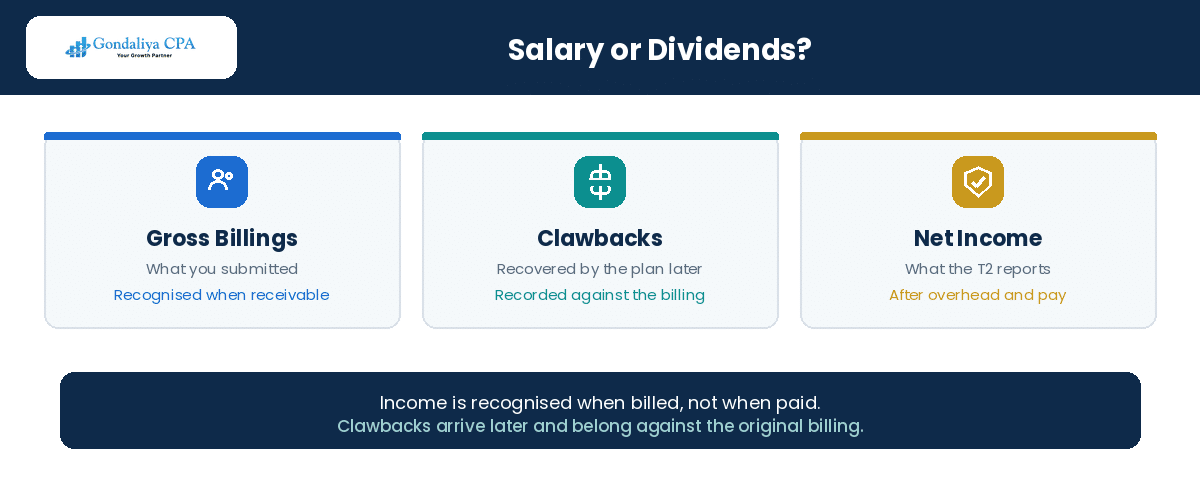
They can tell the difference between gross billings and what really gets paid after clawbacks or rejected claims. A specialist physician tax accountant knows the rules about who can own shares in a medical corporation. They follow Income Tax Act rules on paying family members fair wages.
Also, they make plans to save on taxes by watching limits on passive investment income. These limits affect how much small business deduction doctors get. Physician CPAs in Canada mix this special know-how with CPA Ontario rules. So, they give advice that fits doctors’ real situations well.
Advanced Technology and Cloud-Based Financial Management
Today’s physician accounting services use cloud software made for doctors in Canada. Tools like QuickBooks Online, Xero, Hubdoc, and Wagepoint help track bank transactions easily. They also handle payroll automatically while keeping CRA rules in mind.
Cloud platforms let doctors and accountants see money info anytime they want. This helps check if hospital billings match payments from provincial health plans fast. It’s important because clawbacks and delayed payments happen a lot.
Using these tools cuts mistakes when splitting costs among group members or associates. It also makes filing GST/HST easier when doctors offer both taxable cosmetic services and exempt insured care under Excise Tax Act rules.
Responsive Service from Dedicated Expert Teams
Gondaliya CPA works closely as a specialist physician accountant firm across Toronto and Canada. Their main guy is Sharad Gondaliya, CPA Gondaliya, CPA, with Vandana Goel, CPA helping on accounting tasks. They answer questions fast—usually within one business day—and even support weekends sometimes.
They offer flat-fee annual pricing that covers things like bookkeeping setup or cleanup, corporate tax filing, payroll help, compilation reports (CSRS 4200), GST/HST returns, and CRA representation for instalment reviews.
This quick service stops costly late filings or missed deadlines like T2 returns due six months after year-end or payroll remittance dates set by CRA. Over 1450 five-star Google reviews show clients across Canada trust them, including many in Toronto.
Addressing International Tax Issues and Cross-Border Compliance
Doctors who work across borders need clear international tax help inside their company accounts. Physician accounting services at Gondaliya CPA handle foreign income reporting on T2 returns and apply treaty benefits from Canada’s double taxation agreements (DTAs).
They manage US state filings if a doctor has US licensure but stays Canadian resident. Also, they look at transfer pricing if doctors consult abroad through related companies.
Corporate tax filing shows all global earnings correctly while using foreign tax credits to avoid double taxes under Income Tax Act rules. When locums happen in different countries, slips must follow source country laws but report properly in Canada.
Their work keeps everything legal with CRA while timing cash flow right around fluctuating international earnings common for academic doctors doing research grants outside Canada.
Utilizing Government Incentives and Credits Relevant to Medical Professionals
Specialist physician corporations can save taxes with government programs during incorporation or regular operations. Specialist physician tax accountants lead smart corporate tax filing strategies for these benefits.
One example is the Scientific Research & Experimental Development (SR&ED) credits for clinical research done inside medical practices. This credit lowers federal taxes if records are kept well alongside usual bookkeeping.
Other perks include recent rules letting immediate expensing of capital assets used directly in patient care facilities—this helps cash flow in incorporated setups limited by passive income affecting small business deductions.
Tax planning also looks at using individual pension plans paid by corporations—balancing salary and dividends—to grow retirement savings without extra CPP contributions.
These tips need deep understanding beyond typical small business advice since mistakes can cause audits or deferred tax bills years later.
Clinical research inside a practice often qualifies for SR&ED and almost never gets claimed. The work happened; the contemporaneous documentation is what was missing. Figures changed for privacy.
Verification: Our CPA Ontario firm registration can be checked on the public firm directory. Please verify any firm before granting access to your corporate records.
Client Experiences with Specialist Physician Accounting Services
Client Experiences and Selecting a Partner
The Evidence
Specialist physicians in Canada often face tricky financial issues. A specialist physician accountant Canada knows these well. They get how medical professional corporations work. They understand locum income, overhead splits, and local billing rules. Doctors using a physician CPA Canada get clear advice on corporate tax filing. They get smart tax plans to keep more of their money while staying legal.
Clients say that firms with medical accounting knowledge stand out. These firms handle doctor bookkeeping for Canada carefully. They file taxes on time and watch for new rules that affect specialists.
Testimonials and Case Studies
Doctors who use specialist physician tax planning feel more organized. They worry less about audits because their records follow CRA rules. One oncologist in Toronto said the service helped change how they pay salary and dividends. This worked well inside the small business deduction limit.
Another example was an anesthesiology group. They used overhead allocation models to share costs fairly among members. These stories show how good accounting helps decide when to incorporate, manage GST/HST for uninsured services, and track shareholder loans properly.
Real-World Examples of Tax Savings
Doing corporate tax filing the right way can save money by using small business deduction limits. Here’s a simple example:
| Scenario | Gross Billings | Salary Paid | Dividends Declared | Corporate Tax Payable* |
|---|---|---|---|---|
| Without Planning | $900,000 | $300,000 | $0 | $45,000 |
| With Specialist Accountant | $900,000 | $200,000 | $100,000 | $30,500 |
*These numbers are examples based on Ontario rates; actual results vary (see CRA T2 Guide).
Mixing salary and dividends saves personal tax and keeps RRSP room safe. It also grows company savings inside the corporation over time.
Recent Industry Updates and Insights Impacting Physicians’ Finances
The 2026 Income Tax Act update changes who can own shares in medicine professional corporations. These changes follow CPSO rules. Family shareholders have clear rules now.
GST/HST stays strict on exempt health services. But cosmetic or uninsured treatments may need GST/HST registration to avoid losing input tax credits. Many doctors slip up here if they mix services.
Doctors who keep up with updates can adjust bookkeeping or corporate setups before year-end tax filing (T2 is due April 30 after fiscal year ends).
CRA Regulatory Changes
The latest CRA T2 Guide explains how to count income from provincial billings versus hospital stipends. The CRA Payroll Guide covers payroll schedules for paying salaries inside medicine professional corporations.
Late filings or wrong T4/T5 slips risk penalties or audits. Auditors often check split income claims and shareholder loan balances — so it pays to have expert help during yearly reviews under CSRS 4200 standards (CPA Ontario).
Provincial Fee Schedule Adjustments
Provincial bodies like CPSO update fee schedules regularly. These affect which expenses doctors can deduct—like insurance premiums or education travel costs.
Professional corporation share ownership is controlled provincially too (OBCA s3.1 & CPSO). Rules limit shareholders mostly to family members and restrict outside investors.
Knowing these local rules helps doctors set up or change incorporations after residency or when joining group practices around Toronto or nearby cities.
Guidance for Physicians on Selecting the Right Accounting Partner
Picking a CPA firm familiar with specialist physicians helps avoid mistakes and saves money. Look for firms that:
- Have solid experience with incorporated specialists
- Know provincial college rules for medicine corporations
- Handle different incomes like locums and academic pay
- Offer flat-fee annual pricing so there are no surprises
- Communicate clearly and respond fast—even on weekends
Gondaliya CPA fits this model well. They serve Toronto/Ontario physicians with deep knowledge and personal care. They even offer free consultations.
Key Questions to Ask Your Specialist Physician Accountant
Before hiring, ask your accountant these questions:
- Do you provide flat-fee annual pricing that covers everything?
- How do you lower audit risks from split-income claims?
- What’s your experience with GST/HST registration for insured vs uninsured care?
- Can you share references from similar specialist doctors?
- How fast do you answer during busy tax seasons?
Clear answers help avoid surprises at year-end tax cleanups.
What To Expect From Your Accounting Team
Your team will assign a dedicated account manager who handles your files from start to finish—from first meeting to final T2 submission. You’ll get full financial statements made by ASPE standards through reports following CSRS 4200 rules (good if you want mortgages or loans).
Expect updates on overhead splits and customized pay plans balancing salary and dividends each year according to CRA passive income rules. Weekend support helps with urgent questions near deadlines.
This approach frees doctors from paperwork stress so they can focus on patients instead of numbers.
Clear Calls To Action: Booking Consultations And Accessing Tailored Services
Doctors wanting clearer finances should book a free discovery call at Gondaliya CPA today by phone 647‑212‑9559 or email info@gondaliyacpa.ca. Getting started early makes incorporation smoother under new College rules starting 2026.
They offer options based on your specialty’s billing—whether surgical specialties dealing with clawbacks or psychiatrists handling mixed insured/uninsured fees.
Take charge now knowing experienced Canadian CPAs manage every detail carefully during busy clinical years.
Contact Information And How To Begin Working With Gondaliya CPA
Ready to start stress-free accounting?
- Phone: 647‑212‑9559
- Email: info@gondaliyacpa.ca
Serving Toronto plus Etobicoke, Vaughan, Mississauga, Brampton, Scarborough, Ottawa, Oshawa, Guelph, Hamilton, North York, Windsor—and across Ontario nationwide.
Contact us today—our licensed team answers quickly (usually within one business day) and offers weekend/evening support so your questions never wait.
Overhead allocation is what breaks group practices, not tax. An agreed formula written down before the year starts prevents almost every dispute we get asked to referee. Figures changed for privacy.
Key Stat: Mixing insured and uninsured services changes your GST/HST position. Please get the registration question answered before you start offering cosmetic or uninsured work.
Frequently Asked Questions
Frequently Asked Questions
FAQ
What are the professional corporation share ownership rules for physicians in Canada?+
Physician corporations must follow provincial and federal rules. Shareholders often must be licensed doctors or family members. Outside investors are usually not allowed.
How does the shareholder loan repayment window work for physician corporations?+
Shareholder loans should be repaid within one year to avoid tax penalties. Delays can trigger CRA audits and interest charges.
What is the meals and entertainment deduction limit for specialist physicians?+
CRA allows only 50% of meals and entertainment expenses as a tax deduction. Proper documentation is essential for claims.
How often should physicians file GST/HST returns?+
GST/HST filing frequency depends on revenue. Most small practices file annually, while larger ones may file quarterly or monthly.
What are physician corporate instalment payments?+
These are periodic income tax payments made by corporations to CRA. Missing deadlines leads to penalties and interest.
What are the key considerations in professional corporation naming?+
Names must comply with provincial medical college rules and clearly reflect the medical nature of the practice. Avoid misleading terms.
How should clawbacks recoveries and rejected claims be accounted for?+
Doctors must record clawbacks accurately as reductions in income. Rejected claims require adjustments to revenue in financial statements.
How do overhead splits and group arrangements get recorded properly?+
Overhead costs shared in groups must be allocated fairly based on usage or agreement terms. Documentation should support cost sharing.
What is the best way to handle locum, academic, and consulting income?+
All income types must be recorded separately and reported correctly on tax filings to avoid CRA issues.
Does the small business deduction apply to physician corporations?+
Yes, but limits apply based on passive investment income and associated corporations rules effective from 2026.
How can vehicle and travel costs be managed for specialists?+
Keep detailed mileage logs and receipts. Only business-related travel expenses qualify as deductible under CRA guidelines.
Why is retained earnings management important for specialist physicians?+
Properly managing retained earnings avoids personal spending issues and ensures funds are available for practice growth or taxes.
What problems arise from shareholder loans mixed with personal spending?+
Mixing funds can lead to tax reassessments, penalties, and loss of corporate protections if CRA audits occur.
What filing deadlines must a physician corporation meet?+
T2 Corporate Tax Return is due six months after fiscal year-end. Payroll remittances have monthly or quarterly deadlines depending on size.
What penalties and interest apply for late filing by physician corporations?+
Late filings incur penalties starting at 5% plus 1% per month interest on unpaid taxes, increasing over time.
Essential Best Practices For Efficient Physician Corporation Management
Best Practices, Deliverables and Key Insights
Quick Reference
- Maintain clear records separating personal and corporate finances.
- Track all income sources accurately including locum, consulting, academic pay.
- Meet all CRA deadlines strictly to avoid fines or audits.
- Use digital tools like QuickBooks for seamless bookkeeping.
- Allocate overhead costs fairly among group members with proper documentation.
- Monitor shareholder loans regularly to ensure timely repayments.
- Plan salary vs dividend mix yearly based on tax laws changes.
- Keep detailed logs for meals, travel, vehicle expenses within CRA limits.
- Update accounting practices annually considering regulatory changes like 2026 tax updates.
Physician Accounting DIY vs CPA vs Non-CPA Provider Comparison
| Service Aspect | DIY | CPA Firm | Non-CPA Provider |
|---|---|---|---|
| Tax Knowledge | Limited | Expert | Moderate |
| Regulatory Compliance | Risk of errors | Ensured | Partial |
| Audit Risk Management | High | Low | Medium |
| Cost | Low upfront | Higher but value-based | Moderate |
| Personalized Advice | None | Yes | Limited |
Deliverables From Specialist Physician Accountant
- Accurate financial statements prepared under ASPE standards.
- Timely T2 corporate tax filings with all schedules included.
- Bookkeeping setup customized for medical practices.
- Payroll slips preparation (T4/T4A) for incorporated physicians.
- Tax planning reports optimizing salary/dividend mix.
- Support during CRA reviews or audits specific to physician corporations.
Top Mistakes And Prevention In Specialist Physician Accounting
- Mixing personal expenses with corporate funds—always separate accounts!
- Missing filing deadlines causing penalties—use reminders or CPA services.
- Ignoring clawbacks leading to misstated income—track diligently!
- Incorrect GST/HST registrations affecting input credits—get expert advice early.
- Overlooking shareholder loan repayment timing—repay promptly to avoid issues.
Preparation Before Engagement Starts With Gondaliya CPA
We assess your current bookkeeping status, corporate structure, billing types (locum/academic), overhead arrangements, and past filings first. Then we tailor a plan addressing your specialty’s unique financial needs.
Accounting Needs Differ Across Medical Specialties
Surgical specialists often face complex overhead splits; psychiatrists may have mixed insured/uninsured revenues; hospitalists require diverse pay handling; each needs tailored accounting strategies.
Realistic Numeric Walkthrough Example: Salary vs Dividends Mix
Example: With $900K gross billings: paying $200K salary + $100K dividends reduces corporate taxes by ~32%. This mix also creates RRSP room while managing CPP contributions effectively.
Choosing The Right CPA Firm In Toronto Ontario For Specialist Physicians
Select firms with proven expertise in medical professional corporations, knowledge of provincial college regulations, responsive support including weekends, transparent pricing models, plus strong client references like Gondaliya CPA offers.
Trust Reasons For Gondaliya CPA
Clients trust us because we combine deep specialist physician knowledge with fast responses, clear pricing, secure virtual platforms, thorough compliance checks, plus over 1450 five-star reviews nationwide.
Glossary Of Key Terms
- Clawback: Amounts deducted retroactively by health plans from billed income due to overpayments or disallowed claims.
- Small Business Deduction: Tax break limiting federal corporate tax rates on qualifying active business income up to a threshold.
- Shareholder Loan: Funds taken from corporation by shareholders that need timely repayment.
- Professional Corporation: Legally incorporated medical practice following provincial college rules.
- CSRS 4200: Canadian standard for compilation engagements allowing accountants limited assurance reporting.
International Tax Issues And Cross-Border Compliance For Physicians
Physicians earning outside Canada must report foreign income properly on T2 returns while applying treaty benefits to prevent double taxation under Canada’s DTAs. Foreign payroll filings may also apply if US licensure or consulting occurs abroad.
Government Incentives And Credits Relevant To Medical Professionals
Credits such as SR&ED reduce taxes when clinical research qualifies as scientific development work done within medical practices alongside immediate expensing of capital assets directly used in patient care settings help cash flow management in incorporated setups.
Client Experiences With Specialist Physician Accounting Services
Doctors report reduced audit stress when using dedicated specialist accountants who understand locum incomes, clawbacks accounting, overhead allocations, plus provide strategic tax planning boosting net take-home pay legally.
Testimonials And Case Studies
An oncologist saved $14K annually by balancing salary/dividend payouts expertly with Gondaliya CPA guidance; an anesthesiology group improved cost-sharing fairness across partners avoiding disputes—all showing practical benefits from specialized accounting support.
Recent Industry Updates And Insights Impacting Physicians’ Finances
Changes effective in 2026 impact small business deduction thresholds and shareholder eligibility inside medicine professional corporations requiring early planning before incorporation adjustments become mandatory under new CPSO guidelines.
CRA Regulatory Changes
CRA now scrutinizes timing differences between billed amounts versus received payments closely impacting taxable income calculations; payroll remittance schedules tighten requiring strict adherence; late T2 filings face increased penalties recently introduced by CRA revisions.
Provincial Fee Schedule Adjustments
Provincial bodies update allowable deductions regularly including professional fees reimbursements & education travel caps which affect expense claims doctors make during tax filings relevant for incorporated specialists abiding by OBCA & CPSO mandates.
Guidance For Physicians On Selecting The Right Accounting Partner
Choose firms that know specialist physicians well, offer flat-fee packages without surprises, handle complex incomes like locums/academics accurately, communicate transparently with fast replies even off-hours — characteristics exemplified by Gondaliya CPA team based in Toronto/Ontario region serving across Canada remotely too.
Key Questions To Ask Your Specialist Physician Accountant
- Do you provide all-in fixed fee pricing covering bookkeeping through T2 filing?
- How do you minimize audit risk around split-income claims?
- What experience do you have with GST/HST requirements related to insured vs uninsured services?
- Can you share references from similar specialist doctors you serve?
- How quickly do you respond during peak tax season?
What To Expect From Your Accounting Team At Gondaliya CPA
You get a dedicated manager guiding your files start-to-finish—from onboarding through annual T2 submission plus custom pay planning balancing salary/dividends yearly considering latest laws under CSRS 4200 standards plus weekend support near deadlines ensuring stress-free compliance all year round.
Clear Calls To Action: Booking Consultations And Accessing Tailored Services
Call Gondaliya CPA at 647‑212‑9559, or email info@gondaliyacpa.ca today for a free discovery call tailored specifically for specialist physicians seeking expert accountant advice across Canada—including Toronto & Ontario areas.
Nine best practices and one that carries the others: keep the corporate account clean. Every reassessment argument we have had started with a personal charge on a business card. Figures changed for privacy.
Physician Specialties We Serve
Industry Expertise
Which issue dominates differs by specialty. Here are ten and the usual focus.
| Specialty | The Accounting Focus |
|---|---|
| Surgical specialties | Overhead splits across group arrangements |
| Anesthesiology | Fair cost sharing among partners |
| Psychiatry | Mixed insured and uninsured fee treatment |
| Oncology | Salary and dividend mix at high billings |
| Diagnostic imaging & radiology | Equipment capital cost allowance claims |
| Dermatology & cosmetic practice | GST/HST registration on uninsured work |
| Hospitalists | Salary, stipend and slip type combinations |
| Academic & research physicians | Grant income and possible SR&ED claims |
| Locum & part-time specialists | Income from several payers in one year |
| Cross-border & US-licensed physicians | Treaty relief and foreign tax credits |
- Surgical specialties: Shared facility costs need a written allocation formula before the year starts.
- Anesthesiology: Group cost sharing is where disputes begin without documented usage bases.
- Psychiatry: The insured and uninsured mix decides whether registration is required at all.
- Oncology: High billings make the remuneration mix worth modelling rather than guessing.
- Diagnostic imaging and radiology: Equipment sits in specific CCA classes and the half-year rule applies.
- Dermatology and cosmetic practice: Cosmetic revenue can change the whole GST/HST position.
- Hospitalists: A mix of salary and other pay affects pension and CPP outcomes.
- Academic and research physicians: Grant income and clinical research each need separate tracking.
- Locum and part-time specialists: Several payers in one year make instalments hard to set.
- Cross-border and US-licensed physicians: Foreign income reports on the T2 with treaty relief applied.
The specialty changes which issue dominates. It does not change the discipline, which is clean records, tracked clawbacks and a planned pay mix. Figures changed for privacy.
Professional Guidance and Quick Reference
Guidance
Professional Guidance for Physicians: How Gondaliya CPA Runs Your Corporation
Specialist physician corporations turn on four things: whether income is recognised when billed or when paid, how clawbacks and rejected claims are recorded, how overhead is split in group arrangements, and the salary against dividend mix. Get those right and the T2 becomes routine. Gondaliya CPA handles the full cycle on a fixed annual fee.
We handle what decides the outcome: recognising billing income when it becomes receivable, tracking clawbacks and recoveries back to the original billing, allocating overhead in group practices with documentation that survives review, separating locum, academic and consulting income, modelling salary against dividends for RRSP room and CPP, protecting the small business deduction from passive income, applying GST/HST correctly across insured and uninsured services, and preparing compilation financial statements under CSRS 4200.
Our team works asynchronously and answers within one business day, weekends included, because clinic hours rarely leave room for accounting. Residency, first incorporation or an established group, you get clear advice and a fixed price before we start.
Quick Answers: Key Numbers & Concepts at a Glance
At a Glance
- Income: Recognised when receivable
- Clawbacks: Recorded against the original billing
- T2 deadline: Six months after year-end
- Shareholder loans: Repay within one year
- Meals limit: 50% of eligible expenses
- Salary: Creates RRSP room, attracts CPP
- Dividends: No RRSP room, no CPP
- Insured services: Generally GST/HST exempt
- Statements: Compilation under CSRS 4200
- Our response: One business day, weekends included
Who This Is For / Not For
Fit Check
- For: Incorporated Canadian specialist physicians operating through a medicine professional corporation.
- Not For: Advice on college or regulatory obligations, which sits with your provincial medical regulator; we handle the tax and accounting.
People Also Ask
Related Questions
Should I incorporate right after residency?+
Not always. Incorporation pays once your income comfortably exceeds what you spend personally, because retained earnings are the whole benefit.
Is my billing income taxed when billed or when paid?+
Generally when the amount becomes receivable, not when the payment lands. Clawbacks are then recorded against that billing.
Do I charge GST/HST on cosmetic procedures?+
Insured health services are exempt, but uninsured and cosmetic work can be taxable. The mix decides whether you must register.
Glossary of Key Terms
- Medicine professional corporation: An incorporated medical practice authorised by the provincial regulator.
- Gross billings: Amounts billed before clawbacks and rejected claims.
- Clawback: An amount recovered by a health plan after payment.
- Rejected claim: A billing declined by the payer, requiring a revenue adjustment.
- Overhead allocation: The agreed basis for splitting shared costs in a group practice.
- Locum income: Earnings from covering another physician’s practice.
- Shareholder loan: Funds drawn from the corporation that must be repaid.
- Small business deduction: The reduced federal rate on active business income up to the business limit.
- Passive investment income: Investment earnings inside the corporation that erode that limit.
- Eligible dividend: A dividend taxed at preferential personal rates.
- Individual pension plan: A corporate-funded retirement vehicle, sometimes preferable to an RRSP.
- CSRS 4200: The Canadian standard governing compilation engagements.
- ASPE: Accounting Standards for Private Enterprises, the framework used.
- GIFI code: The standardised financial index code required on T2 schedules.
- Exempt supply: An insured health service on which GST/HST is not charged.
- Instalments: Periodic corporate tax payments made through the year.
Physician Corporation Readiness Check
This quick self-check indicates where your operation most likely has room. Please answer the six questions below.
Physician Corporation Readiness Check
Six quick questions on your corporation. No fee shown.
Points to raise with us:
This is a general prompt, not tax or legal advice or a quote. Your position depends on your full facts. For a real review, please book a free consultation.
Want a checklist to work from? You can download our free physician year-end checklist before your consultation.
Record billing income when it becomes receivable. Track every clawback back to its billing. Document the overhead split before the year begins. Repay shareholder loans inside one year. Decide the salary and dividend mix early. Watch passive income against the business limit. Review GST/HST if you offer uninsured work. Please file the T2 inside six months.
2026 Update — what is current: This article notes 2026 changes to the small business deduction and to shareholder eligibility inside medicine professional corporations. The six-month T2 deadline, the one-year shareholder loan repayment window, the 50% meals limit and the CSRS 4200 compilation standard are unchanged. Please note the article gives the federal business limit as $600,000 where $500,000 is the current figure, states in one place that the T2 is due April 30 after the fiscal year-end where six months is correct, gives a continuing education cap of $1,000 per year which is not a general CRA limit, describes clawbacks as claims rejected by the CRA where provincial health plans issue them, and its salary and dividend example is illustrative rather than a calculated result, so please confirm each before relying on it.
specialist physician tax accountant and physician CPA Canada delivering affordable physician accounting, corporate tax filing, and financial statements
Get the income timing right first
Gondaliya CPA recognises billing income when receivable, reconciles clawbacks to the original billing, documents overhead allocation in group practices, models the salary and dividend mix against RRSP room and CPP, protects the small business deduction from passive income, reviews GST/HST on uninsured services, and prepares compilation statements under CSRS 4200, on a flat annual fee including HST with a one-business-day response. Please book a free consultation.
Next Steps
Please book a free consultation with Gondaliya CPA and bring your billing remittance statements, your last financial statements, and any group overhead agreement. Those three tell us immediately whether income is landing in the right year and whether your pay mix is doing what you assume it is. You will get a flat annual fee including HST before any work begins. If our content helps, please add gondaliyacpa.ca as a preferred source on Google.
Published: · Last updated:
Editorial policy: We research against CRA and CPA Ontario sources, fact-check the figures, and Sharad Gondaliya, CPA, reviews the content, which we update as the rules change.
Disclaimer: This article is educational information only and is not tax, legal, or financial advice. Figures marked illustrative are examples rather than quotes or guarantees. It reflects CRA rules current to 2026, including the six-month T2 filing deadline, the one-year shareholder loan repayment window, the 50% meals and entertainment limit, the CSRS 4200 compilation standard, and our one-business-day response commitment. Rates, limits and expensing rules change and outcomes depend on your specific facts. Please consult a CPA Ontario member before acting.

Sharad Gondaliya is a CPA Canada & CPA USA with 15 Years+ experience of Accounting, Tax, Payroll of Corporate Small Businesses as Tax Accountant. He is a CPA Ontario member (61040184) and holds US CPA licences in Washington and Montana and is well known among corporate small businesses for tax planning, efficient tax solutions, and affordable CPA services. Sharad is the Principal (Director) of Gondaliya CPA – Affordable CPA Firm in Canada. Licenses: CPA Ontario: 61040184 | CPA USA (MT): PAC-CPAP-LIC-033176 | CPA USA (WA): 57629 | CPA Firm License: 61330051 View Full Author Bio