



The Ultimate Guide to Agricultural Business Taxes in Canada
Agricultural business taxes Canada require careful attention to specific rules and deductions that apply to farming operations. Gondaliya CPA explains how understanding agricultural business tax credits, income reporting, and expense claims can help farmers reduce their overall farming business taxes effectively.
Quick Summary
Farming has its own rules layered on top of ordinary business tax, and most of the errors we see come from four places: what counts as farming income, whether losses are restricted, which capital cost allowance class an asset belongs in, and whether a supply is zero-rated, exempt or taxable.
- Separate farming income from rental and custom work, because the treatment differs.
- Test whether section 31 restricts your losses before claiming them against other income.
- Put machinery in Class 10 and quota in Class 14.1, not wherever seems close.
- Remember most farm products are zero-rated but farmland sales are generally taxable.
Reading time: 28 minutes.
Table of Contents
- Agricultural Business Tax Rules
- Allowable Farm Expenses
- Capital Cost Allowance for Farms
- Cash Versus Accrual and Inventory
- Filing Process and Deadlines
- GST/HST for Farms and Farmland
- Year-End Strategies and Planning
- Capital Gains, Succession and Structure
- Frequently Asked Questions
- Professional Guidance and Quick Reference
The Numbers That Matter
This article covers Canada, with Ontario and Toronto context, and reflects rules current to 2026. It is written for Canadian farm businesses of all structures — sole proprietors, partnerships and farm corporations — including crop, livestock, greenhouse, quota and agri-tourism operations. Provincial programs, land transfer tax and property assessment vary, so confirm locally. This is educational information only and not tax or legal advice.
Agricultural Business Tax Rules in Canada
Agricultural Business Tax Rules
Foundations
Getting a grip on agricultural business taxes in Canada helps farmers and agribusiness owners avoid headaches. The rules cover income reporting, deductions, and following the Income Tax Act. Depending on how your farm is set up, you’ll report income on either a T1 or T2 return.
- Income reporting: farmers may use cash or accrual accounting. Cash counts money when received; accrual counts sales when earned.
- Deductions: seed costs, capital cost allowance and running expenses reduce taxable income.
- Compliance: keep good records, since CRA may ask for proof on review.
What Makes Farm Taxes Different
Farm taxes work differently from other business taxes because of how income is characterised. The question is whether a receipt is income from a farming business, income from property, or income from a separate business such as custom work. Nothing in the Act calls this a lock; it is simply a factual determination, and it drives everything downstream.
- Not all money from your farm is farming income. Cash rent on land is generally property income; a crop share where you participate in the farming operation can be farming income.
- Custom work for neighbours may be a separate business rather than farming, and needs its own record trail.
- Your accounting method changes when income appears. Cash basis reports on receipt; accrual reports when earned.
Types of Farming Operations
- Incorporated family farms: limited liability, corporate filing, access to the small business deduction.
- Farm partnerships: partners report their share; a T5013 information return may be required.
- Custom operators: selling services rather than product, needing fees separated from farm income.
- Greenhouse growers: often a mix of zero-rated and taxable sales depending on what is sold and to whom.
- Part-time and hobby operations: where farming is not a chief source of income, losses may be restricted or, if there is no source of income at all, denied entirely.
Key Stat: The rule that catches part-time farmers is section 31, the restricted farm loss. Where farming is neither your chief source of income nor a combination of farming and a subordinate source, your deductible loss is capped at $2,500 plus half of the next $30,000 — a maximum of $17,500 a year. The excess is not lost; it carries back three years and forward twenty, but only against farming income. A true hobby with no reasonable expectation of profit is worse still: there is no source of income, so no loss at all.
Allowable Farm Expenses
Allowable Farm Expenses
Deductions
The CRA lets farmers deduct costs that are reasonable and tied to the farming business, supported by receipts or invoices. Paragraph 18(1)(a) requires the expense to be incurred to earn income, and section 67 requires the amount to be reasonable.
Full-time farms usually claim seed, feed, fertiliser, fuel, repairs, veterinary bills and insurance on farm assets. Part-time farms can claim similar costs but must apportion anything used partly outside the farming business.
| Expense Type | Deductible When | Proof Needed |
|---|---|---|
| Seeds and plants | Used in the farming business | Purchase invoice |
| Fertiliser and pesticides | Incurred to earn farming income | Supplier receipt |
| Livestock feed | For the commercial herd | Feeding logs plus receipts |
| Machinery fuel | Business use only | Fuel bills, apportioned if mixed use |
| Repairs | Maintaining productive assets | Repair invoices distinguishing repair from betterment |
| Property taxes | On farmland used in the business | Municipal assessment notices |
Other common deductions include advertising, insurance premiums on crops or livestock, and professional fees invoiced in the year. Personal life insurance is not deductible unless it is collateral for a business loan, and even then only within the limits in paragraph 20(1)(e.2).
Risk Warning: Prepaid inputs are the most common year-end error on a farm return. Buying fertiliser in December for spring delivery does not create a December deduction simply because the invoice is dated. An accrual-basis farm deducts when the goods are received; a cash-basis farm has more latitude but still needs the purchase to be a genuine prepayment for a real order, not a deposit parked with a supplier. Keep the purchase order, the contract and the delivery ticket together.
A greenhouse operator bought $12,000 of fertiliser before 31 December but took delivery in January. Signed agreements dated before year-end and digital invoices retained in Hubdoc supported the treatment on review. Figures changed for privacy.
Livestock: Inventory, Not Depreciable Property
Livestock is inventory for tax purposes, including breeding stock. There is no capital cost allowance class for animals — you do not depreciate a cow. Purchases enter inventory and affect income through the cost of goods sold and year-end inventory valuation under section 10.
Where a designated drought or flood region applies, section 80.3 allows a farmer who reduces breeding herd to defer part of the sale proceeds to a later year. That is the livestock deferral, and it is a different provision from the restricted farm loss in section 31.
A family farm claimed $8,500 on irrigation pump repairs, keeping vendor bills showing the parts replaced plus staff time logs. Because the work restored the pump rather than improving it, the cost stayed a current expense. Figures changed for privacy.
Capital Cost Allowance for Farms
Capital Cost Allowance for Farms
CCA
Capital cost allowance spreads the cost of an asset over time. Getting the class right matters more on a farm than in most businesses, because the rates differ sharply and quota sits in a class of its own.
| Asset | Class | Rate | Notes |
|---|---|---|---|
| Most buildings acquired after 1987 | Class 1 | 4% | 6% or 10% where the enhanced rates apply |
| Frame, log, stucco, galvanized or corrugated metal farm buildings with no footings | Class 6 | 10% | A narrow class, not the default for farm buildings |
| General equipment, furniture, fixtures, land drainage | Class 8 | 20% | Where not covered by a more specific class |
| Most farm machinery, tractors, combines, trucks | Class 10 | 30% | No cost ceiling |
| Passenger vehicles above the limit | Class 10.1 | 30% | Capped at $39,000 before tax for 2026 acquisitions |
| Leasehold improvements | Class 13 | Straight line | Over the lease term plus first renewal, minimum 5 and maximum 40 years |
| Goodwill, milk and egg quota | Class 14.1 | 5% | Not leasehold improvements |
| Manufacturing and processing machinery | Class 53, then Class 43 | 50%, then 30% | Class 53 closed to acquisitions after 2025 |
| Clean energy generation equipment | Class 43.1 / 43.2 | 30% / 50% | Distinct from Class 43 |
| Computers and systems software | Class 50 | 55% | Acquired after 18 March 2007 |
The half-year rule in Income Tax Regulations subsection 1100(2) limits the first-year claim to half the normal amount, unless an accelerated investment incentive or immediate expensing measure applies. Keep a clear asset register showing class, acquisition date and prior claims.
A custom farm bought a new tractor for $85,000 and placed it in Class 10. Under the ordinary first-year restriction the claim is $12,750, and equipment use logs separated business from personal use. Where an accelerated measure applies the first-year claim is higher, so the factor for the acquisition year needs checking. Figures changed for privacy.
Risk Warning: Capital cost allowance is a deferral, not a saving, and on a farm it comes back at the worst moment. Depreciating buildings and quota down to a low undepreciated capital cost and then selling triggers recapture, taxed as ordinary income in the year of sale — and recapture is not sheltered by the lifetime capital gains exemption, which applies only to the gain above original cost. On a quota position held for decades, the recapture can exceed the sheltered gain.
Cash Versus Accrual and Inventory
Cash Versus Accrual and Inventory
Accounting
Farming is one of the few businesses permitted to report on the cash basis, under section 28 of the Income Tax Act. Most other businesses must use accrual.
The cash method records income when received and expenses when paid. It is simpler and matches cash flow, which suits many farms. The accrual method records income when earned and expenses when incurred, giving a clearer picture and often used by incorporated farms.
If you switch methods you need CRA’s concurrence, and the change must be applied consistently thereafter.
Inventory Adjustments
Inventory is valued under section 10 at the lower of cost and fair market value, applied consistently. For cash-basis farmers, section 28 adds two adjustments that exist nowhere else in the Act:
| Adjustment | Effect | When It Applies |
|---|---|---|
| Mandatory inventory adjustment | Adds purchased inventory on hand back into income | Where a cash-basis farm reports a loss, to the extent of that loss |
| Optional inventory adjustment | Brings inventory value into income voluntarily | To use up personal credits in a low year |
| Deferred grain tickets | Defers income on delivered grain to the following year | Under a deferred payment contract, s.76(4) |
Keep delivery tickets, sales contracts and input invoices to support the numbers. Records must be kept for six years under section 230.
Pro Tip: The mandatory inventory adjustment is the one farms forget, and it works against you. A cash-basis farm reporting a loss must add back the value of purchased inventory still on hand — so a bad year with a full fertiliser shed may not produce the loss you expected. The optional adjustment runs the other way, letting you pull income forward in a year when personal credits would otherwise go unused. Decide both before year-end, not at filing.
Keep separate accounts or codes for non-farm activity such as agri-tourism or retail sales, since those often follow different GST/HST rules. Reconcile your bookkeeping against physical stock counts to catch errors before they reach the return.
Filing Process and Deadlines
Filing Process and Deadlines
Filing
Farms use different forms depending on structure. Incorporated farms file the T2. Sole proprietors report farm income on the T1. Partnerships may need a T5013 information return but do not pay tax directly.
| Obligation | Deadline | If Late |
|---|---|---|
| T2 corporate return | Six months after fiscal year-end | 5% of unpaid tax plus 1% per complete month, maximum 12 months |
| Balance of tax owing | Two months after year-end; three for an eligible CCPC | Interest compounded daily |
| Corporate instalments | Monthly under section 157; quarterly for eligible small CCPCs | Instalment interest |
| Individual farmer instalments | One instalment by 31 December under section 155 | Instalment interest |
| T4 and T4A slips | Last day of February | $10 per day, $100 minimum, $1,000 maximum for 1–50 slips |
| GST/HST returns | Monthly, quarterly or annually per your assigned period | Penalty and interest on amounts owing |
Payroll Remittance Thresholds
Remittance frequency depends on average monthly withholding amount, not on a flat three or seven day rule:
| Remitter Type | Average Monthly Withholding | Due |
|---|---|---|
| Regular | Under $25,000 | 15th of the month following |
| Accelerated, Threshold 1 | $25,000 to under $100,000 | Twice monthly |
| Accelerated, Threshold 2 | $100,000 or more | Within three working days of the pay period ending |
Late remittance attracts a penalty of 3% to 10% depending on how late, rising to 20% for a repeat failure.
Key Stat: Individual farmers get an instalment rule nobody else does. Under section 155, a farmer or fisher whose chief source of income is farming makes a single instalment of two-thirds of the estimated tax by 31 December, with the balance due 30 April — instead of four quarterly payments. It is a meaningful cash flow advantage, and farms that quietly pay quarterly are giving it up for nothing.
GST/HST for Farms and Farmland
GST/HST for Farms and Farmland
GST/HST
Most raw farm products are zero-rated under Schedule VI, Part IV of the Excise Tax Act. Zero-rated is not the same as exempt: a zero-rated sale is a taxable supply at 0%, so the farm still recovers the GST/HST it paid on fuel, feed, fertiliser and equipment as input tax credits. That is why most farms register voluntarily even below the $30,000 small supplier threshold in section 148.
Processed goods, agri-tourism admissions and most retail sales are taxable at the ordinary rate. Sharecrop rent has its own rule: a supply of farmland by lease is zero-rated to the extent the consideration is a share of a zero-rated crop, with any cash portion taxable.
Risk Warning: Selling farmland is generally a taxable supply — the opposite of what many farmers assume. All sales of land in Canada are taxable unless specifically exempted, and the farmland exemptions in Schedule V, Part I are narrow: a sale to a related individual for their personal use, a change of use to personal use, or certain personal-use property held by an individual or personal trust. Where farmland is sold as part of an ongoing farming business and the purchaser is a registrant acquiring substantially all the assets, the parties may jointly elect on Form GST44 so no tax is payable. Assuming bare land is automatically outside the tax is how an unbudgeted HST liability lands on a closing.
Keep clear sales agreements stating land use so the treatment is evident on review. Where buildings or a residence form part of the parcel, the proceeds need allocating, because the pieces are treated differently.
Year-End Strategies and Planning
Year-End Strategies and Planning
Planning
Prepaid inputs must be handled on when they arrive and what the contract says. Capital cost allowance claims need the right class and an updated asset register. Restricted farm loss exposure under section 31 should be tested before losses are claimed against other income, since that needs evidence of your other income sources.
Common errors we see:
- Mixing rental income with farming income
- Failing to separate custom work revenue
- Missing taxable retail or agri-tourism income
- Claiming input tax credits on personal or exempt use
- Omitting payroll slips for seasonal workers
- Leaving out government program payments such as AgriStability and AgriInvest
- Missing instalment deadlines
- Treating breeding livestock as depreciable property
Compensation and Family Payroll
You can pay wages to family members who actually work, at a rate reasonable for the work under section 67, backed by timesheets or contracts. Register payroll accounts properly and remit on schedule.
Seasonal and foreign workers need care. Register with CRA for payroll, deduct CPP where required unless an international social security agreement applies, and issue T4 slips by the last day of February.
Structure and Succession
Structure affects both tax and liability. Sole proprietors report farming income on the T1. Partnerships allocate to partners. Corporations file a T2, may access the small business deduction, and can defer personal tax on retained earnings.
Consider a farm of 500 acres, 200 head of cattle, $750,000 of revenue, $120,000 of payroll and $250,000 of capital investment. A corporation can retain earnings and defer personal tax on the retained portion; a sole proprietor includes all income immediately at personal rates. Incorporation also brings filing costs and formality, so the comparison is about more than the headline rate.
Capital Gains, Succession and Provincial Matters
Capital Gains, Succession and Structure
Succession
The lifetime capital gains exemption in section 110.6 shelters gains on qualified farm or fishing property. The limit is $1.25 million for dispositions on or after 25 June 2024, indexed annually from 2026, and it is a cumulative lifetime amount across all qualifying dispositions.
To qualify, the property must meet the use and ownership conditions, which look back across the whole period of ownership. Shares of a family farm corporation and interests in a family farm partnership carry a 24-month holding period and an asset-use test, so keep ownership records and evidence of farming use.
Succession planning ties the exemption into the estate plan. The section 73(3) rollover lets farm property transfer to a child at cost, deferring the gain — but the gain rolls forward to them rather than disappearing, so where the accrued gain is already near the exemption limit, triggering a gain and claiming the exemption now is often the better outcome. That choice is made at the time of transfer.
Risk Warning: A large sheltered gain can still attract alternative minimum tax. The exemption removes the regular tax, not the minimum tax calculation, and on a multi-million dollar farmland disposition the AMT can be substantial. It is recoverable against regular tax over the following seven years, but only if there is enough regular tax in those years to absorb it — which, for a retiring farmer with modest income afterwards, there often is not. Model it before the sale.
Provincial and Municipal Considerations
Land transfer tax applies on farmland purchases in most provinces, at rates that rise with price. Municipal assessment places farmland in a farm property class that is generally taxed at a reduced rate relative to residential, subject to eligibility requirements administered provincially.
Registration matters too: a business number, GST/HST registration once you exceed the threshold or elect voluntarily, a payroll account if you employ anyone, and in some cases commodity board registration.
A livestock farm paid $7,000 in property tax across pasture rented out and land it grazed itself. Splitting the cost by lease contract kept the farming deduction accurate and avoided overstating a loss that section 31 might have restricted. Figures changed for privacy.
Before You Start Year-End Work
Gather: last year’s notices of assessment, a trial balance, crop delivery tickets, input invoices, physical inventory counts, land title documents showing any change in use, quota purchase records, payroll registers including family wages, AgriStability and AgriInvest statements, and copies of recent GST/HST returns.
Frequently Asked Questions
Frequently Asked Questions
FAQ
What decides whether income is farming income or something else?+
The facts of the activity. Cash rent on land is generally property income, a crop share where you participate in the operation can be farming income, and custom work for others may be a separate business. The characterisation affects loss treatment, instalment rules and program eligibility, so it needs settling rather than assuming.
What is the restricted farm loss rule?+
Section 31 caps the farm loss deductible against other income where farming is not your chief source of income, at $2,500 plus half the next $30,000, to a maximum of $17,500. The restricted portion carries back three years and forward twenty, but only against farming income.
When is the payroll remittance deadline for farms?+
It depends on your average monthly withholding. Under $25,000 you are a regular remitter and pay by the 15th of the following month. From $25,000 to under $100,000 you remit twice monthly, and at $100,000 or more within three working days of the pay period ending.
How long must farmers keep tax records?+
Six years after the end of the taxation year, under section 230 of the Income Tax Act.
When do farmers pay instalments?+
An individual whose chief source of income is farming or fishing makes a single instalment of two-thirds of estimated tax by 31 December under section 155, with the balance due 30 April. Farm corporations pay monthly under section 157, or quarterly if they qualify as an eligible small CCPC.
Can I use cash accounting on a farm?+
Yes. Farming is one of the few businesses permitted to report on the cash basis, under section 28. Incorporated farms often use accrual for financial statement purposes even where cash reporting is available.
What are the mandatory and optional inventory adjustments?+
Both come from section 28 and apply to cash-basis farmers. The mandatory adjustment adds purchased inventory on hand back into income to the extent of a reported loss. The optional adjustment lets you voluntarily bring inventory value into income, typically to use personal credits in a low year.
Is breeding livestock depreciated?+
No. Livestock is inventory, not depreciable property, so there is no capital cost allowance class for animals. Purchases enter inventory and affect income through cost of goods sold and year-end valuation under section 10.
Which CCA class does farm machinery go in?+
Most farm machinery, tractors, combines and trucks go to Class 10 at 30%. Milk and egg quota goes to Class 14.1 at 5%. Most buildings acquired after 1987 go to Class 1, and land drainage to Class 8.
Is the sale of farmland subject to GST/HST?+
Generally yes. All sales of land in Canada are taxable unless specifically exempted, and the farmland exemptions in Schedule V Part I are narrow — mainly a sale to a related individual for personal use or a change of use to personal use. Where the land forms part of a sale of the farming business to a registrant, the parties may elect on Form GST44 so no tax is payable.
Are farm products zero-rated or exempt?+
Most raw farm products are zero-rated under Schedule VI Part IV, meaning taxable at 0%. Because they are taxable supplies, the farm still recovers input tax credits on its purchases — which is why registering is usually worthwhile even below the $30,000 threshold.
How much is the lifetime capital gains exemption on farm property?+
$1.25 million for dispositions on or after 25 June 2024, indexed annually from 2026. It is cumulative across a lifetime and shelters the capital gain, not recaptured capital cost allowance.
When is the T2 due for a farm corporation?+
Six months after the fiscal year-end. Balance owing is due two months after year-end, or three for an eligible CCPC claiming the small business deduction. Late filing costs 5% of the unpaid tax plus 1% per complete month to a maximum of 12.
Professional Guidance and Quick Reference
Professional Guidance and Quick Reference
Guidance
Farms get into difficulty in a predictable set of ways: rental and custom work income mixed into farming income, losses claimed without testing section 31, machinery and quota in the wrong capital cost allowance classes, breeding livestock depreciated as though it were equipment, and farmland sold on the assumption that bare land carries no GST/HST. Gondaliya CPA handles farm accounting on a flat annual fee.
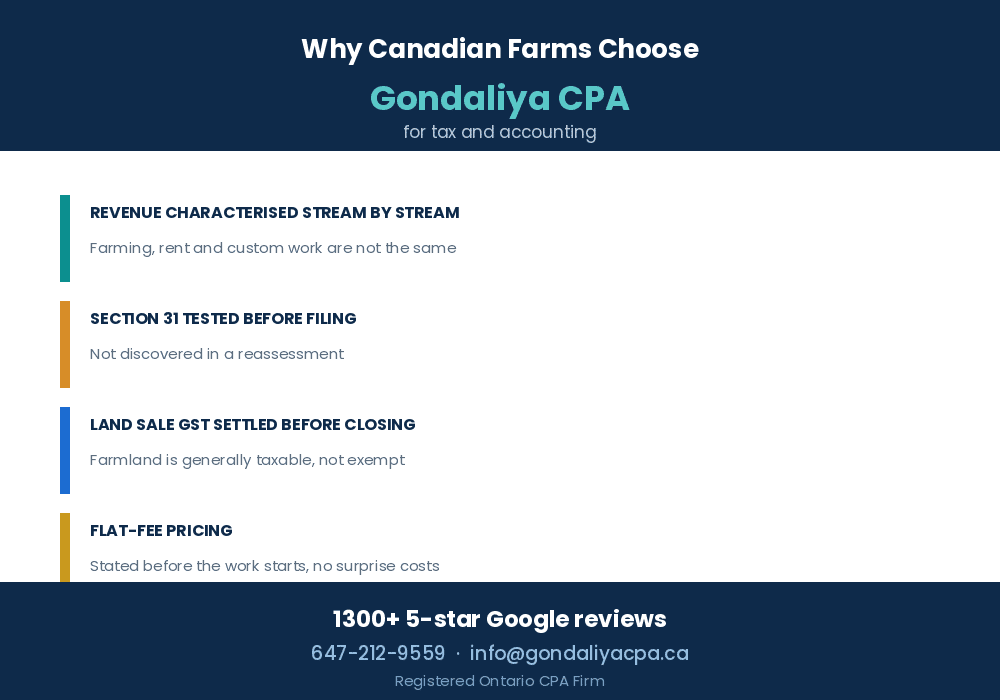
We handle what decides the outcome: characterising each revenue stream, testing restricted farm loss exposure before it reaches the return, assigning the right CCA class and tracking recapture against the eventual exit, deciding the inventory adjustments before year-end, and settling the GST/HST position on a land sale before closing rather than after.
Quick Answers: Key Numbers & Concepts at a Glance
At a Glance
| Question | Answer |
|---|---|
| Restricted farm loss | Section 31, capped at $17,500 a year |
| Livestock deferral | Section 80.3, prescribed drought or flood region |
| Cash basis reporting | Permitted for farming under section 28 |
| Inventory valuation | Section 10, lower of cost and fair market value |
| Deferred grain tickets | Subsection 76(4) |
| Individual farmer instalment | One payment by 31 December, section 155 |
| Most farm machinery | Class 10, 30% |
| Quota and goodwill | Class 14.1, 5% |
| Land drainage | Class 8, 20% |
| Lifetime capital gains exemption | $1.25M, section 110.6 |
| Farm products | Zero-rated, Schedule VI Part IV |
| Farmland sales | Generally taxable; narrow Schedule V Part I exemptions |
Who This Is For / Not For
Fit Check
- For: Canadian farm businesses of any structure — crop, livestock, greenhouse, quota and agri-tourism operations — particularly those with mixed revenue streams or a transfer in view.
- Not For: Hobby operations with no reasonable expectation of profit, where there is no source of income and therefore no deductible loss, and non-resident landowners, whose position runs on the cross-border rules.
People Also Ask
Quick Answers
Do farmers pay less tax in Canada?+
Not at a lower rate, but farming carries reliefs other businesses do not get: cash basis reporting, inventory adjustments, livestock deferral, a single December instalment for individuals, zero-rated product sales that still recover input tax credits, and the $1.25 million lifetime capital gains exemption on qualified farm property. The rate is the same; the timing and the reliefs differ.
Is a hobby farm tax deductible?+
It depends on whether there is a source of income at all. Where farming is carried on with a reasonable expectation of profit but is not your chief source of income, section 31 restricts the loss to $17,500 a year. Where there is no reasonable expectation of profit, there is no business source and no loss is deductible.
Do I charge GST/HST when I sell my crop?+
Most raw farm products are zero-rated, so you charge 0%. That still counts as a taxable supply, so you recover the GST/HST on your inputs. Processed products, agri-tourism and retail sales are usually taxable at the ordinary rate, and those need tracking separately.
Can I transfer the farm to my children without paying tax?+
The section 73(3) rollover defers the gain by transferring at cost, but it does not eliminate it — the accrued gain moves to your child. Where the gain is near or above $1.25 million, electing a higher transfer price to trigger a gain and claim the exemption is often better, and that choice is made at the time of transfer.
Is rented-out farmland still farming income?+
Cash rent is generally property income rather than farming income, which can affect loss treatment and program eligibility. A crop share arrangement where you participate in the farming operation is more likely to be farming income. The lease wording matters, and it also drives the GST/HST treatment of the rent.
Glossary of Key Terms
Plain-English Definitions
- Restricted farm loss: The section 31 cap on farm losses where farming is not the chief source of income.
- Mandatory inventory adjustment: The add-back of purchased inventory on hand where a cash-basis farm reports a loss.
- Optional inventory adjustment: A voluntary income inclusion of inventory value, used to absorb personal credits.
- Deferred grain ticket: A deferred payment arrangement under subsection 76(4) moving income to the following year.
- Livestock deferral: The section 80.3 deferral on forced herd reduction in a prescribed drought or flood region.
- Qualified farm or fishing property: Property meeting the use and ownership conditions for the lifetime capital gains exemption.
- Class 14.1: The 5% class holding goodwill and milk and egg quota.
- Zero-rated supply: A taxable supply at 0% that still allows input tax credits, unlike an exempt supply.
- Recapture: Previously claimed capital cost allowance brought back into income on disposition.
Essential Compliance Points
Reference
- Characterise each revenue stream as farming, property or a separate business.
- Test section 31 exposure before claiming farm losses against other income.
- Assign CCA classes deliberately, especially quota and buildings.
- Treat livestock as inventory, never as depreciable property.
- Decide the inventory adjustments before year-end, not at filing.
- Register for GST/HST even below the threshold, to recover input tax credits.
- Settle the GST/HST position on any land sale before closing.
- Check your payroll remitter threshold as the payroll grows.
- File T4 and T4A slips by the last day of February.
- Use the 31 December instalment date if you qualify under section 155.
- Keep six years of records after the end of the taxation year.
This quick self-check indicates where your operation most likely has room. Please answer the five questions below.
Farm Tax Check
Five quick questions on your operation. No fee shown.
Points to raise with us:
This is a general prompt, not tax or legal advice or a quote. Your position depends on your full facts. For a real review, please book a free consultation.
Characterise the money first — cash rent, crop share and custom work are not all farming income, and the answer drives loss treatment and instalment dates. Test section 31 before claiming a loss against off-farm income, because $17,500 is the ceiling where farming is not your chief source. Put machinery in Class 10 and quota in Class 14.1, and remember livestock is inventory, not something you depreciate. Decide the inventory adjustments before year-end. And settle the GST/HST on any land sale before closing, because farmland is generally taxable, not exempt.
2026 Update — what is current: The lifetime capital gains exemption on qualified farm or fishing property is $1.25 million for dispositions on or after 25 June 2024 and returns to annual indexation in 2026. The capital gains inclusion rate remains 50%; the proposed increase to two-thirds was cancelled on 21 March 2025 and never received Royal Assent. Class 53 closed to acquisitions after 2025, so manufacturing and processing machinery acquired from 2026 falls into Class 43 at 30%, while remaining eligible for the immediate expensing measures reinstated by Bill C-15. Unchanged for 2026: the restricted farm loss cap of $17,500 under section 31; cash basis reporting and the inventory adjustments under section 28; deferred grain tickets under subsection 76(4); livestock deferral under section 80.3; the 31 December instalment date for individual farmers under section 155; zero-rating of most farm products under Schedule VI Part IV with the $30,000 small supplier threshold in section 148; and the six-year record retention requirement under section 230.
Agricultural Business Taxes: How Gondaliya CPA Supports You
Mixed revenue, quota holdings, or a transfer in view?
We characterise each revenue stream, test restricted farm loss exposure before it reaches the return, assign CCA classes and track recapture against the eventual exit, decide the inventory adjustments before year-end, and settle the GST/HST on a land sale before closing — on a flat annual fee stated before the work starts.
Next Steps
Please book a free consultation with Gondaliya CPA and bring your last filed return, a list of land parcels and quota with purchase dates and costs, and a summary of revenue by stream — crop, livestock, rent, custom work and any retail. Those three show where the real position sits. You will get a flat fee stated before any work begins.
Published: · Last updated:
Editorial policy: Figures, deadlines and statutory references are verified against the Income Tax Act, the Excise Tax Act, their Regulations and CRA publications before publication, and updated when the rules change.
Disclaimer: This article is educational information only and is not tax, legal, or financial advice. Provincial programs, land transfer tax and property assessment rules vary. Rules change and outcomes depend on your specific facts. Please speak with a CPA before acting.

Sharad Gondaliya is a CPA Canada & CPA USA with 15 Years+ experience of Accounting, Tax, Payroll of Corporate Small Businesses as Tax Accountant. He is fully certified CPA Ontario and CPA USA and is well known among corporate small businesses for tax planning, efficient tax solutions, and affordable CPA services. Sharad is the Principal (Director) of Gondaliya CPA – Affordable CPA Firm in Canada. Licenses: CPA Ontario: 61040184 | CPA USA (MT): PAC-CPAP-LIC-033176 | CPA USA (WA): 57629 | CPA Firm License: 61330051 View Full Author Bio