



Clothing Store Year-End Accounting Checklist: How to Prepare Your Retail Business for Corporate Tax Filing in Canada
Clothing Store Year End Accounting and Corporate Tax Filing Guide by Gondaliya CPA Canada
Clothing store year end accounting is essential for accurate financial records, and Gondaliya CPA specializes in corporate tax filing to help retailers meet their tax obligations seamlessly. Their expertise in clothing store accountant Canada services ensures compliance with T2 filing requirements across Canada.
Every other figure on your return is documented by somebody else. Sales come off the point-of-sale system, wages off payroll, rent off a lease. Closing stock is yours alone, which is why clothing store accounting and corporate tax filing starts and ends with the count.
Quick Summary
A clothing store year end is an inventory exercise wearing a tax return. Get the count, the cut-off and the valuation right and the rest follows. Get them wrong and cost of goods sold, gross margin and taxable income are all wrong together.
Reading time: 50 minutes.
Table of Contents
- Choosing the Year End and What It Triggers
- The Inventory Count and Cut-Off
- Valuing the Stock
- Revenue, Returns and Liabilities
- The T2 Schedules and GIFI
- Deductions, Filing and Working With Us
- Frequently Asked Questions
- The Year-End Checklist
- Clothing Retailers We Serve
- Professional Guidance and Quick Reference
The Numbers That Matter
This article covers Canada, with Ontario and Toronto context, and reflects rules current to 2026. It applies to incorporated clothing stores, boutiques, multi-location apparel retailers and stores selling both in person and online. Figures marked illustrative are examples, not quotes, and any masked engagement notes end with “Figures changed for privacy.” This is educational information only and not tax or legal advice. Tariff classification and customs valuation are matters for the Canada Border Services Agency and a licensed customs broker, and sit outside accounting scope.
Choosing the Year End and What It Triggers
Choosing the Year End and What It Triggers
The Starting Point
Who Files a T2
Every corporation resident in Canada files a T2, whether or not it made money. That includes a dormant store and one that lost money.
An unincorporated boutique reports on the owner’s personal return instead, so nothing in this article about schedules or GIFI applies until you incorporate.
Picking the Date
You choose your fiscal year end when you first file, and clothing retail gives you a genuine reason to think about it rather than defaulting to the incorporation anniversary.
| Year End Timing | What It Means for the Count |
|---|---|
| After the post-holiday clearance | Stock at its lowest, count is fastest and cleanest |
| End of a season | Aged stock already marked down, valuation easier to support |
| Mid-season peak | Maximum stock on hand, longest count, hardest cut-off |
| December 31 | Counting during your busiest trading period |
A January or February year end is common in apparel for exactly this reason. The floor is thin, the markdowns have already happened, and the count takes hours rather than days.
Changing the year end later requires approval, so it is worth deciding properly at the start.
The Deadlines That Follow
| Obligation | Deadline | If Missed |
|---|---|---|
| T2 corporate return | Six months after fiscal year-end | 5% plus 1% per complete month, to twelve |
| Balance owing | Three months for eligible CCPCs, otherwise two | Interest from the due date |
| GST/HST return | Per your assigned reporting period | Penalty plus interest |
| Payroll remittances | Per your remitter type | Penalty and director liability |
| T4 and T4A slips | Last day of February | Penalty by slip count |
Please note the three-month payment window is not automatic. It applies to a CCPC that claimed the small business deduction, subject to the taxable income conditions. Assuming three months when only two apply produces interest you did not budget for.
Repeat late filing within the following three years attracts higher rates, so a second late year costs disproportionately more than the first.
Stores with a December year end count stock in the week they trade hardest. Moving the year end to February is the single cheapest improvement available to most boutiques. Figures changed for privacy.
Risk Warning: The three-month payment window is conditional, not automatic. Please confirm which applies before assuming you have the extra month.
The Inventory Count and Cut-Off
The Inventory Count and Cut-Off
The Count
Cost of goods sold is opening stock plus purchases less closing stock. Two of those three are documented by suppliers. The third is a number you produce, and it moves your taxable income dollar for dollar.
Running the Count
- Count as close to the year-end date as you practically can
- Count by SKU including size and colour, not by style
- Generate count sheets from the system rather than counting into a blank list
- Count the floor and the stock room separately, then combine
- Have a second person recount high-value lines
- Sign and date the sheets, and keep them
The signed sheets are the point. A closing inventory figure with no count behind it is an assertion, and it is the first thing requested if the return is reviewed.
Cut-Off
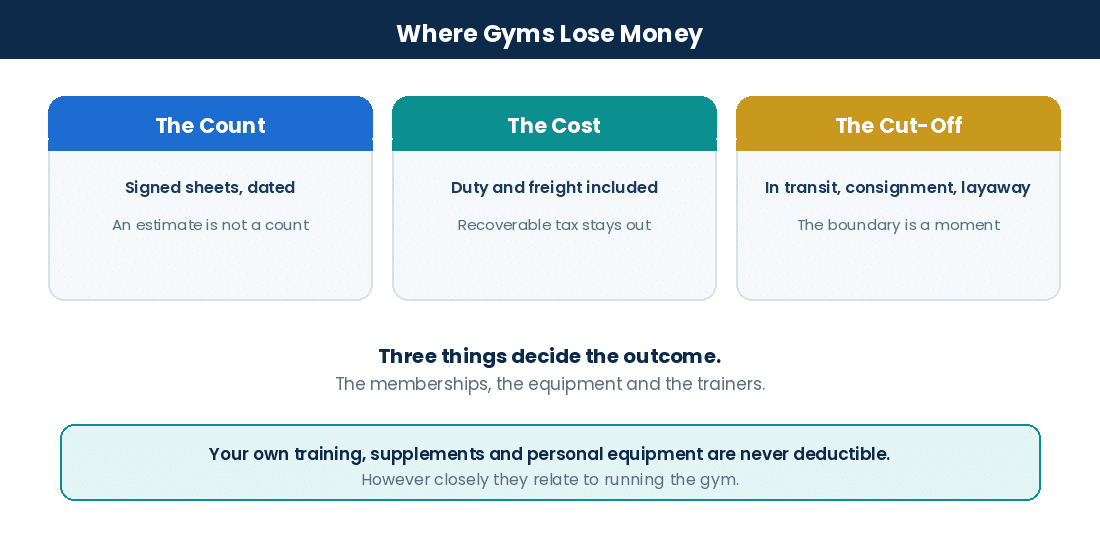
Cut-off is deciding what belongs in the count and what does not. It is where most errors live, because the boundary is a moment rather than a shelf.
| Situation | In the Count? | Why |
|---|---|---|
| Stock on the floor at year end | Yes | Owned and on hand |
| Goods in transit where title has passed | Yes | You own it, wherever it is |
| Goods in transit where title has not passed | No | Still the supplier’s |
| Consignment stock you hold for others | No | Not yours, though the payable is not either |
| Your stock out on consignment elsewhere | Yes | Still owned by you |
| Layaway held for a customer, not paid in full | Yes | Still yours until the sale completes |
| Sold and awaiting pickup | No | The sale has happened |
| Customer returns received after year end | No | Belongs to the following period |
Goods in transit turn on the shipping terms. Where title passes at the supplier’s dock, an inbound container is your inventory even though nothing has arrived. Where it passes on delivery, it is not. The purchase order and the supplier’s terms settle it, not where the boxes are.
Consignment
Consignment is common in apparel and gets recorded wrongly in both directions.
Stock you hold on consignment is not your inventory and not your payable. You have possession without ownership. When it sells, you recognise either the full sale with a cost, or just your commission, depending on the arrangement.
Your stock held by somebody else is still your inventory, wherever it physically is. It has to be counted and valued even though it is not in your building.
Get a written confirmation from the consignee of what they held at your year-end date. Memory is not a count sheet.
Supplier Deposits and Payables
A deposit paid to a supplier for a future season is a prepaid amount, not stock and not a cost. It sits as an asset until the goods arrive.
On the other side, goods received before year end but not yet invoiced still create a payable and belong in the count. Waiting for the invoice before recording either one understates both stock and liabilities.
The count and the cut-off are separate problems. Stores get the count right, then miss a container in transit that title had already passed on, and the whole cost of sales moves. Figures changed for privacy.
Key Stat: Closing inventory changes taxable income dollar for dollar. Please keep signed, dated count sheets as the support.
Valuing the Stock
Valuing the Stock
The Value
Counting tells you how many. Valuation tells you what they are worth, and in apparel that is the harder question because fashion stock loses value on a schedule.
What Cost Includes
| Cost | In Inventory? | Why |
|---|---|---|
| Supplier invoice price | Yes | The base purchase cost |
| Customs duty | Yes | Non-recoverable cost of acquiring the goods |
| Inbound freight | Yes | Cost of bringing stock to its location |
| Customs brokerage | Yes | Directly attributable to the import |
| Supplier discounts and credits | Reduces | Lowers what the goods actually cost |
| GST paid at the border | No | Recoverable as an input tax credit |
| Store rent, wages, marketing | No | Period costs, not attributable to a unit |
| Shipping to online customers | No | A selling cost, not a cost of the goods |
Apparel carries meaningful duty rates, so leaving duty out of cost understates what imported stock cost you. Recoverable border GST is the opposite: it should never sit in inventory, because you get it back.
A boutique imports a season at a supplier price of $40,000. Duty and inbound freight add $7,200 and brokerage $300. The landed cost is $47,500, roughly 19% above the invoice. Pricing and margin built on the invoice figure alone overstate profitability across the whole season. GST paid at the border is recovered separately and stays out of cost. Figures changed for privacy.
Valuation Method
Inventory is valued on a consistent, recognised basis. First in, first out and weighted average cost are both acceptable.
The rule that matters is consistency. Changing method between years, particularly in a year when margins were poor, invites the obvious question. Where a change is genuinely warranted, document the reason before you make it.
Lower of Cost and Net Realisable Value
Stock is carried at the lower of cost and what you can realistically sell it for, net of selling costs. In fashion retail this bites every single year.
Last season’s stock in broken size runs will not sell at full price and everybody knows it. Carrying it at cost overstates both your inventory and your income.
- Identify stock by season and age before valuing
- Value marked-down lines at the price they will realistically achieve
- Support the write-down with the actual markdown taken, or clearance results from comparable stock
- Write off damaged, soiled and single-item lines with a reason logged
- Keep the working, which is what supports the deduction
What a write-down cannot be is a figure chosen at year end to produce a result. The distinction is evidence.
Shrinkage
The gap between what the system says and what you count is shrinkage: theft, damage, and receiving errors where the carton did not contain what the packing slip said.
Record it as a separate line rather than burying it inside cost of sales. A margin that looks thin because of theft is a different problem from one that looks thin because you bought badly, and you cannot tell them apart from a single number.
Owner and Staff Merchandise
Clothing taken by the owner for personal use is not a cost of sales. Depending on the structure it is a shareholder benefit or a drawing, and it has to come out of inventory either way.
Staff discounts below cost can create a taxable benefit where the discount is not available to the general public. Apparel stores give generous staff pricing and rarely record it.
Fashion stock carried at cost two seasons after it landed is the adjustment we make most often. The markdown already happened commercially; the books just had not caught up. Figures changed for privacy.
Risk Warning: A write-down needs evidence of realisable value. Please support it with actual markdowns rather than a judgement at year end.
Revenue, Returns and Liabilities
Revenue, Returns and Liabilities
The Revenue
Reconciling the Point of Sale
The first year-end test is whether recorded revenue agrees to the point-of-sale system and to the bank. Where those three disagree, nothing downstream is reliable.
| Source | What to Match | Common Failure |
|---|---|---|
| Point-of-sale totals | Gross sales by day to recorded revenue | Never compared at all |
| Card processor statements | Gross sales, fee as an expense | Net deposit booked as revenue |
| Online platform payouts | Gross orders less fees and shipping | Payout treated as the sale |
| Cash | Till count to the deposit | No daily count, shortages invisible |
| Bank | Line by line to the ledger | Reconciled only at year end |
Processing fees are an expense, never a reduction of sales. Recording the net deposit understates revenue and loses the fee as a deduction, and the processor reports the gross figure independently.
Stores selling online carry a second layer, because the platform deducts commission, payment fees and sometimes shipping before paying out. Each needs separating.
Returns Around the Year End
Apparel return rates are high and they cluster after the holidays, which for many stores lands right on the year-end boundary.
A return before year end reverses the sale, reverses the cost, and puts resaleable stock back into the count. A return after year end belongs to the following period, even if it relates to a sale in the year just closed.
Where returns are material and predictable, an estimate of expected returns on year-end sales may be warranted. Base it on your own history rather than a round number, and document the basis.
Show returns as contra revenue rather than netting them into sales. A style running a return rate well above the store average is telling you about fit or quality, and netting hides it.
Gift Cards, Store Credit and Layaway
All three are money in hand for goods not yet delivered. None of them is revenue on receipt.
| Item | On Receipt | On Redemption |
|---|---|---|
| Gift card sold | Liability | Revenue, with cost released |
| Store credit issued on a return | Liability replacing the refund | Revenue when spent |
| Layaway deposit | Liability, stock stays in inventory | Revenue when the sale completes |
| Customer deposit on a special order | Liability until delivery | Revenue on delivery |
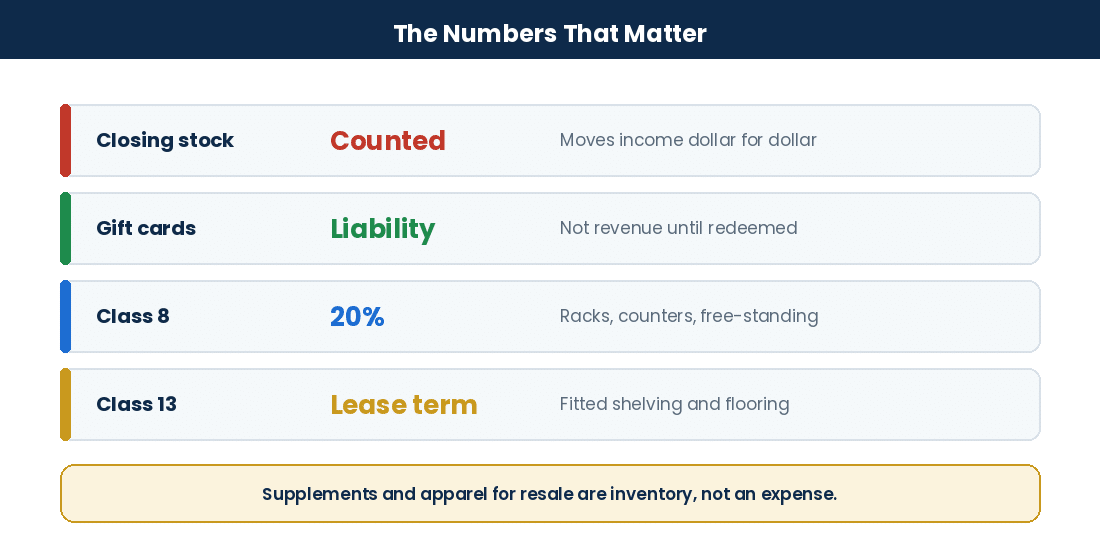
Gift cards sold in December are the classic year-end error. A store with a December or January year end can be carrying a substantial liability recorded as revenue, which overstates income in the year and empties the next.
Note that provincial consumer protection legislation restricts expiry on many gift cards, so the liability can persist for years. That is a legal question rather than an accounting one.
Accruals and Payables
Expenses incurred before year end belong in the year even where the invoice arrives later. In a clothing store that typically means:
- Goods received but not yet invoiced
- The final payroll period straddling the year end
- Vacation pay earned but not taken
- Rent or common area charges billed in arrears
- Professional fees for work already performed
- Utilities for the period up to year end
Vacation pay is the one most often missed. It is earned as staff work, not when they take the time, and in a store with a large part-time team it adds up.
December gift card sales recorded as revenue is worth real money on a January year end. The store had already sold the goods twice on paper. Figures changed for privacy.
Key Stat: A gift card is a liability until it is redeemed. Please check the balance before closing a year end that follows the holidays.
The T2 Schedules and GIFI
The T2 Schedules and GIFI
The Return
How the Numbers Get There
The trial balance maps into GIFI codes, which populate the financial statement schedules. Get the mapping wrong and the return still files, but the figures land in the wrong boxes and comparisons against sector norms go strange.
| Schedule | What It Covers |
|---|---|
| Schedule 100 | Balance sheet, including closing inventory |
| Schedule 125 | Income statement, including cost of goods sold |
| Schedule 141 | Notes checklist, covering who prepared the statements |
| Schedule 1 | Reconciliation of accounting income to taxable income |
| Schedule 8 | Capital cost allowance on fixtures and equipment |
| Schedule 50 | Shareholder information |
| Schedule 3 | Dividends paid and received |
| Schedule 11 | Transactions with shareholders, officers and employees |
| Schedule 24 | First-time filer after incorporation |
Please note Schedule 141 is the notes checklist rather than a financial statement schedule, and Schedule 8 covers depreciable property only. Inventory is not capital cost allowance; it sits on Schedule 100 and flows through cost of sales.
Schedule 1 and What Gets Added Back
Accounting income is not taxable income. Schedule 1 bridges them, and in a clothing store the recurring items are:
- Book depreciation removed, capital cost allowance added
- The non-deductible half of meals and entertainment
- Club dues and other specifically denied expenses
- Reserves booked for accounting that tax does not allow
- Penalties and fines
Each adjustment needs a working behind it. A Schedule 1 with round numbers and no support is an invitation.
Fixtures and Fit-Out
| Item | Class | Rate |
|---|---|---|
| Racks, mannequins, seating, counters, fitting room furniture | Class 8 | 20% |
| Point-of-sale terminals and computers | Class 50 | 55% |
| Store software | Class 12 | 100%, subject to the rules |
| Fitted shelving, flooring, lighting, fitting rooms built in | Class 13 | Over the lease term |
| Signage fixed to the premises | Class 13 | Over the lease term |
The split is fixed against free-standing. A rack you could wheel to another store is equipment; shelving built into the wall is a leasehold improvement.
Bill C-15 received Royal Assent on 26 March 2026, reinstating the accelerated investment incentive for most depreciable property acquired after 2024 and available for use before 2030. Leasehold improvements are among the excluded classes, so a fit-out and a set of display units may be treated differently. Recent purchases are worth reviewing rather than defaulting to the plain half-year rule.
Shareholder Items
Schedules 50 and 11 record who owns the company and what passed between the company and its people. In owner-operated retail those schedules are where merchandise draws, personal spending on the company card and loan balances surface.
Money taken that is not salary or dividends builds a shareholder loan. If it is not repaid within the period the Act allows, generally by the end of the following taxation year, the amount can be included in your personal income under section 15(2).
Clean it up before filing rather than explaining it afterwards.
Merchandise taken by the owner through the year is the item nobody tracks and everybody does. It comes out of inventory whether or not it was recorded. Figures changed for privacy.
Pro Tip: Please review the shareholder loan balance before year end, not after. The window to repay it without an income inclusion is finite.
Deductions, Filing and Working With Gondaliya CPA
Deductions, Filing and Working With Us
The Filing
The Small Business Deduction
A Canadian-controlled private corporation pays a reduced federal rate of 9% on active business income up to the federal business limit of $500,000, shared across associated corporations.
Ontario reduced its small business rate to 2.2% effective 1 July 2026. For a calendar-year corporation that produces a blended provincial rate of roughly 2.7% for 2026, giving a combined rate near 11.7% rather than the 12.2% that applied before the change. Retail is active business income, so a clothing store ordinarily qualifies.
Passive Income
Investment income held inside the corporation reduces the business limit once it passes a threshold, and the mechanism is often described wrongly.
The business limit is reduced by $5 for every $1 of adjusted aggregate investment income above $50,000, which eliminates the limit entirely at $150,000. It is not dollar for dollar, and the grind starts at $50,000 rather than $150,000.
A store with surplus cash sitting in investments can quietly lose part of its small business deduction without anyone noticing until the return is prepared.
GST/HST
Clothing sales are taxable supplies. You must register once taxable revenue exceeds $30,000 across four consecutive calendar quarters, which any store passes immediately.
Your reporting period is assigned based on taxable supplies: annual below $1.5 million, quarterly between $1.5 million and $6 million, monthly above that. Input tax credits recover the tax on stock, rent, fixtures and services, including GST paid at the border on imports, and each needs documentation showing the registration number or the customs accounting document.
Credits generally have to be claimed within four years. A store sitting on unclaimed import tax should check how far back it can still go.
Deductions Worth Getting Right
- Cost of goods sold at landed cost, with duty and freight included
- Rent, common area charges and utilities, coded by location
- Wages, employer CPP and EI, and accrued vacation pay
- Advertising and marketing, including online
- Capital cost allowance on fixtures and fit-out, correctly split
- Professional fees for bookkeeping, tax and legal work
- Bank and merchant processing charges as an expense
- Shrinkage and write-downs, shown separately
Nothing exotic. The money in a clothing store return is in the inventory figure and the classification, not in a deduction somebody forgot.
Filing and Payment
Corporations file electronically through Corporation Internet Filing or through a representative using certified software. NETFILE is the service for individual returns and does not apply.
Instalments are generally required where tax payable exceeds $3,000, paid monthly, with quarterly instalments available to eligible CCPCs that meet the compliance conditions. Basing them on last year without checking against how this year is trading is how seasonal retailers end up short.
What Draws a Review
- Closing inventory with no count behind it
- Gross margin materially out of line with the sector, unexplained
- Deposits exceeding reported sales
- A valuation method that changed without documentation
- Gift card sales in revenue with no liability balance
- A growing shareholder loan and personal spending in the accounts
Our CRA audit guide sets out what a review involves. Related sector reading sits in our guide to apparel brand tax and accounting mistakes, which covers the manufacturing and wholesale side.
How We Work With Clothing Retailers
We support incorporated stores on a flat annual fee covering bookkeeping with landed cost, inventory count planning and cut-off procedures, write-down support, point-of-sale and processor reconciliation, gift card and layaway liabilities, payroll and slips, the asset register with the Class 8 and Class 13 split, shareholder loan cleanup, GST/HST filing, financial statements and the corporate return.
Pricing is quoted before any work begins, including HST, with a one-business-day response and evening and weekend availability through the count.
Getting Started
Bring three things: your last inventory valuation report, a month of point-of-sale and processor statements, and your last filed corporate return. Those show us whether the stock figure is supportable, whether revenue reconciles, and what needs fixing.
Contact Gondaliya CPA at info@gondaliyacpa.ca, call 647-212-9559, or send us a message.
The inventory valuation report and the point-of-sale export settle a clothing store year end between them. Everything else is confirming they agree with each other. Figures changed for privacy.
Pro Tip: Please check whether investment income inside the company has crossed $50,000. The business limit starts grinding there, not at $150,000.
FAQs on Clothing Store Year-End Accounting
Frequently Asked Questions
FAQ
When is the T2 due for a clothing store?+
Six months after your fiscal year end. The balance owing is due three months after year end for eligible CCPCs and otherwise two, and that extension is conditional rather than automatic.
What is the late-filing penalty?+
5% of the unpaid tax plus 1% for each complete month the return is late, to a maximum of twelve months. Repeat late filing within the following three years attracts higher rates.
Should my year end fall after the holidays?+
It usually helps. Stock is at its lowest after clearance, markdowns have already happened, and the count takes hours rather than days.
What goes into the cost of imported clothing?+
Supplier invoice price plus customs duty, inbound freight and brokerage, less supplier credits. GST paid at the border stays out because it is recoverable.
Which inventory valuation methods are acceptable?+
First in, first out and weighted average cost are both acceptable. What matters is applying one consistently and documenting any change.
How do I write down last season’s stock?+
Value it at the price it will realistically achieve net of selling costs, supported by the actual markdown taken or clearance results from comparable stock.
How is consignment stock treated?+
Stock you hold for others is not your inventory. Your own stock held by somebody else still is, and should be confirmed in writing at the year-end date.
What about goods in transit at year end?+
It depends on the shipping terms. Where title has passed to you, it is your inventory even though it has not arrived. Where it has not, it is not.
How are supplier deposits recorded?+
As a prepaid amount sitting as an asset until the goods arrive, not as stock and not as a cost.
How do I reconcile point-of-sale to the bank?+
Match daily gross sales to recorded revenue, then to processor statements with fees expensed, then to the bank, allowing for refunds, gift cards and chargebacks.
Should card sales be recorded gross or net?+
Gross, with the processing fee as a separate expense. Recording the net deposit understates revenue and loses the fee as a deduction.
Are gift cards revenue when sold?+
No. A gift card sale is a liability until redeemed. Provincial consumer protection rules restrict expiry, so the balance can persist.
How are layaway deposits treated?+
As a liability, with the stock remaining in your inventory until the sale completes and the customer takes the goods.
Which capital cost allowance classes apply to store fixtures?+
Free-standing racks, mannequins and counters generally sit in Class 8 at 20%. Terminals are Class 50. Anything fixed to leased premises is Class 13 over the lease term.
What is the small business deduction rate in Ontario for 2026?+
Ontario reduced its small business rate to 2.2% effective 1 July 2026, giving a blended provincial rate of roughly 2.7% for a calendar-year corporation and a combined rate near 11.7%.
How does passive income affect the small business limit?+
The limit is reduced by $5 for every $1 of adjusted aggregate investment income above $50,000, eliminating it entirely at $150,000.
Sixteen questions and one underneath most of them: can you support the closing stock figure. It is the number that moves the tax bill and the one nobody else documents for you. Figures changed for privacy.
The Clothing Store Year-End Checklist
The Year-End Checklist
Quick Reference
Inventory
- Count as close to the year-end date as you practically can.
- Count by SKU including size and colour, from system-generated sheets.
- Sign and date the count sheets and keep them.
- Include goods in transit where title has passed to you.
- Exclude consignment stock you hold for others.
- Include your own stock held elsewhere, confirmed in writing.
- Keep layaway stock in inventory until the sale completes.
- Build cost from invoice price plus duty, freight and brokerage.
- Keep recoverable border GST out of inventory cost.
- Value at the lower of cost and net realisable value.
- Support write-downs with actual markdowns or clearance results.
- Show shrinkage as a separate line, not inside cost of sales.
Revenue and Liabilities
- Reconcile point-of-sale totals to recorded revenue.
- Record card and platform sales at gross with fees expensed.
- Count the till daily and reconcile it to the deposit.
- Show returns as contra revenue rather than netting them in.
- Hold gift cards, store credit and layaway deposits as liabilities.
- Check the gift card balance before closing a post-holiday year end.
- Accrue goods received but not yet invoiced.
- Accrue vacation pay earned but not taken.
- Remove owner merchandise draws from inventory.
Filing and Structure
- Map the trial balance to GIFI codes before preparing schedules.
- Split fixtures into Class 8 and Class 13 fit-out.
- Review whether the reinstated investment incentive applies to recent purchases.
- Support every Schedule 1 adjustment with a working.
- Clear the shareholder loan before the repayment window closes.
- Check whether investment income has passed $50,000.
- Claim input tax credits within the period allowed, including import tax.
- File electronically through Corporation Internet Filing or a representative.
- Review the instalment basis against how the year actually traded.
- Keep six years of records including signed count sheets.
For help closing your store’s year, contact Gondaliya CPA at info@gondaliyacpa.ca, call 647-212-9559, or book a free consultation.
Thirty-one points and one underneath them: what is on the shelf and what did it cost. Every clothing store correction we make starts with one of those two. Figures changed for privacy.
Clothing Retailers We Serve
Industry Expertise
Which issue dominates differs by the retailer. Here are ten and the usual focus.
| Clothing Retailer | Where the Year End Concentrates |
|---|---|
| Single boutique | The count and a supportable closing figure |
| Store importing directly | Landed cost including duty and freight |
| Fashion-led seasonal store | Write-downs on aged and broken runs |
| Store taking consignment stock | What belongs in the count and what does not |
| Store with heavy December trade | Gift card liabilities across the year end |
| Store offering layaway | Deposits held and stock still owned |
| Selling online and in store | Platform payouts recorded at gross |
| Multi-location chain | Transfers, cut-off and per-store margin |
| Owner-operated store | Merchandise draws and the shareholder loan |
| Behind on the books | A count established before returns are prepared |
- Single boutique: Closing stock moves taxable income dollar for dollar.
- Store importing directly: Duty belongs in cost; recoverable tax does not.
- Fashion-led seasonal store: Last season at cost is stock overstated.
- Store taking consignment stock: Possession is not ownership.
- Store with heavy December trade: A card sold is not a sale made.
- Store offering layaway: The deposit is a liability and the stock is still yours.
- Selling online and in store: The platform pays net; your books need gross.
- Multi-location chain: Transfers move at cost, and cut-off multiplies.
- Owner-operated store: What left the rail has to leave the inventory.
- Behind on the books: Count first, or the return gets prepared twice.
The retailer changes where the year end concentrates. It does not change the method, which is count the stock properly, cost it properly, then check the revenue reconciles. Figures changed for privacy.
Professional Guidance and Quick Reference
Guidance
Professional Guidance for Retailers: How Gondaliya CPA Handles Your File
Clothing stores lose money in a predictable set of ways: closing inventory estimated rather than counted, so the one figure that moves taxable income dollar for dollar has nothing behind it, stock costed at the supplier invoice when duty and freight make the landed cost materially higher, last season carried at cost when a broken size run will never sell at that price, consignment goods counted as inventory or own stock elsewhere left out, December gift card sales recorded as revenue on a post-holiday year end, platform payouts booked net so both revenue and the fee disappear, and merchandise taken by the owner never removed from stock. Gondaliya CPA handles clothing store year end accounting on a fixed annual fee.
We handle what decides the outcome: planning the count and the cut-off so goods in transit, consignment and layaway all land on the right side, building landed cost from invoice, duty, freight and brokerage while keeping recoverable tax out, valuing at the lower of cost and net realisable value with write-downs supported by actual markdowns, reconciling point-of-sale and processor statements to recorded revenue, holding gift cards and deposits as liabilities, mapping the trial balance to GIFI, splitting fixtures between Class 8 and Class 13, and clearing the shareholder loan before the window closes.
Our team starts with the inventory valuation report and a point-of-sale export, because those two show immediately whether the stock figure is supportable and whether the revenue reconciles. Single boutique, seasonal fashion store or multi-location chain, you get clear advice and a fixed price before we start.
Quick Answers
- Closing stock: Counted, signed and dated
- Landed cost: Invoice plus duty, freight, brokerage
- Border GST: Recoverable, so not in cost
- Valuation: Lower of cost and net realisable value
- Consignment: Possession is not ownership
- Gift cards: A liability until redeemed
- Fixtures: Class 8 at 20%, fit-out Class 13
- Small business limit: $500,000 federally
- Passive grind: Starts at $50,000, gone at $150,000
- Records: Six years retention
Who This Is For
- For: Incorporated clothing stores, boutiques, seasonal fashion retailers, multi-location apparel chains and stores selling both in person and online across Canada.
- Not For: Tariff classification and customs valuation, which are matters for the Canada Border Services Agency and a licensed customs broker rather than accounting.
People Also Ask
Do I have to count stock on the exact year-end date?+
As close as you practically can. Where the count falls a few days either side, roll it forward or back using documented movements.
Can I claim the full HST on imported stock?+
Yes where you are registered and hold the customs accounting document. The credit generally has to be claimed within four years.
What if my closing inventory has never been counted?+
That is the issue to fix first. Run a count now, establish a supportable figure, then work back rather than filing another estimated number.
Glossary of Key Terms
- T2: The corporation income tax return.
- GIFI: The coding system mapping your accounts onto the return.
- Cut-off: Deciding what belongs in the year and what does not.
- Landed cost: Invoice price plus duty, freight and brokerage.
- Net realisable value: What stock will realistically sell for, less selling costs.
- Write-down: Reducing carrying value where cost exceeds realisable value.
- Shrinkage: Stock loss from theft, damage or receiving error.
- Consignment: Holding goods you do not own, or placing goods you do.
- Goods in transit: Stock owned but not yet physically received.
- Contra revenue: Returns and discounts shown against sales, not netted in.
- Deferred revenue: Gift card and layaway money held as a liability.
- Class 8: The 20 percent class covering free-standing fixtures.
- Class 13: Leasehold improvements over the lease term.
- Schedule 1: The reconciliation of accounting income to taxable income.
- Shareholder loan: Company funds used personally, taxable if not repaid.
- Compilation engagement: Financial statements prepared under CSRS 4200.
Clothing Store Readiness Check
This quick self-check indicates where your operation most likely has room. Please answer the six questions below.
Clothing Store Readiness Check
Six quick questions on your store. No fee shown.
Points to raise with us:
This is a general prompt, not tax or legal advice or a quote. Your position depends on your full facts. For a real review, please book a free consultation.
Want a checklist to work from? You can download our free clothing store year-end checklist before your consultation.
Count as close to year end as you can and keep signed sheets. Get the cut-off right on goods in transit, consignment and layaway. Build landed cost from invoice, duty, freight and brokerage. Value at the lower of cost and net realisable value. Record card and platform sales at gross. Hold gift cards and deposits as liabilities. Clear the shareholder loan. Please keep six years of records.
2026 Update — what is current: This article reflects rules current to 2026. The $30,000 GST/HST registration threshold measured across four consecutive calendar quarters, the federal small business limit of $500,000, the Class 8 rate of 20%, Class 13 leasehold treatment over the lease term, the six-month T2 filing deadline, the 5% plus 1% per month late-filing penalty, the end-of-February slip deadline and the six-year retention requirement are unchanged. Ontario reduced its small business rate to 2.2% effective 1 July 2026, giving a blended provincial rate of roughly 2.7% for a calendar-year corporation and a combined rate near 11.7% rather than the previous 12.2%. Bill C-15 received Royal Assent on 26 March 2026, reinstating the accelerated investment incentive for most depreciable property acquired after 2024 and available for use before 2030, with leasehold improvements among the excluded classes. Please note that the passive income grind reduces the business limit by $5 for every $1 above $50,000 and eliminates it at $150,000, rather than beginning at $150,000; that the three-month balance-due window applies only to eligible CCPCs meeting the taxable income conditions and is not tied to a $3 million threshold; that corporations file through Corporation Internet Filing rather than NETFILE; that Schedule 141 is the notes checklist rather than a financial statement schedule and Schedule 8 covers depreciable property rather than inventory; and that we have not been able to verify a separate e-commerce payment processor reporting regime for fiscal years ending after 31 December 2025, so please confirm any such requirement before relying on it.
Clothing Store Year End Accounting Canada: How Gondaliya CPA Supports Retailers
Start with the inventory report
Gondaliya CPA plans the count and the cut-off so goods in transit, consignment and layaway land on the right side, builds landed cost from invoice, duty, freight and brokerage while keeping recoverable tax out, values at the lower of cost and net realisable value with write-downs supported by actual markdowns, reconciles point-of-sale and processor statements to recorded revenue, holds gift cards and deposits as liabilities, maps the trial balance to GIFI, splits fixtures between Class 8 and Class 13 and clears the shareholder loan before the window closes, on a flat annual fee including HST with a one-business-day response. Please book a free consultation.
Next Steps
Please book a free consultation with Gondaliya CPA and bring your last inventory valuation report, a month of point-of-sale and processor statements, and your last filed corporate return. Those three tell us immediately whether the stock figure is supportable, whether the revenue reconciles, and what remains to claim on the equipment, and where the documentation is thin. You will get a flat annual fee including HST before any work begins. If our content helps, please add gondaliyacpa.ca as a preferred source on Google.
Published: · Last updated:
Editorial policy: We research against CRA and CPA Ontario sources, fact-check the figures, and Sharad Gondaliya, CPA, reviews the content, which we update as the rules change.
Disclaimer: This article is educational information only and is not tax, legal, or financial advice. Figures marked illustrative are examples rather than quotes or guarantees. It reflects CRA rules current to 2026, including the $30,000 GST/HST threshold, the Class 8 rate, Class 13 leasehold treatment, the half-year rule, and the six-year retention requirement. Rates, limits and expensing rules change and outcomes depend on your specific facts. Please consult a CPA Ontario member before acting.

Sharad Gondaliya is a CPA Canada & CPA USA with 15 Years+ experience of Accounting, Tax, Payroll of Corporate Small Businesses as Tax Accountant. He is a CPA Ontario member (61040184) and holds US CPA licences in Washington and Montana and is well known among corporate small businesses for tax planning, efficient tax solutions, and affordable CPA services. Sharad is the Principal (Director) of Gondaliya CPA – Affordable CPA Firm in Canada. Licenses: CPA Ontario: 61040184 | CPA USA (MT): PAC-CPAP-LIC-033176 | CPA USA (WA): 57629 | CPA Firm License: 61330051 View Full Author Bio