



Common Section 85 Rollover Mistakes That Can Trigger Unnecessary Taxes for Canadian Business Owners
Common Section 85 rollover mistakes, such as T2057 election errors and incorrect filing, often lead to unnecessary taxes for Canadian business owners. Gondaliya CPA provides expert guidance on Section 85 rollovers, ensuring compliance, proper documentation, and avoiding tax rollover errors with CRA reviews.
Quick Summary
Four mistakes account for most failed rollovers: transferring property that does not qualify, setting the elected amount outside its floor and ceiling, taking boot above the elected amount, and filing Form T2057 late. Please note that each one converts a deferral into an immediate taxable gain, and that the fix is almost always cheaper before the CRA finds it than after.
| Aspect | Details |
|---|---|
| The floor | Adjusted cost base, or undepreciated capital cost. |
| The ceiling | Fair market value at the transfer date. |
| The trap | Boot above the elected amount is taxed now. |
| The deadline | The earliest return due date of any party. |
Reading time: 41 minutes.
Table of Contents
- Introduction to Section 85 Rollovers and Common Mistakes
- Eligible and Qualifying Property for Section 85 Elections
- How the Section 85 Election Works: Mechanics and Calculations Explained
- Advanced Planning Strategies and Risk Mitigation
- Provincial Considerations and Comparison to Related Provisions
- Expert Guidance, Real-World Applications, and Next Steps
- Frequently Asked Questions (FAQ)
- Additional Insights on Managing Section 85 Rollovers
- Industry Spotlights: Sectors We Serve
- Professional Guidance and Quick Reference
The Numbers That Matter
This article covers Canada, with Ontario and Toronto context, and reflects CRA rules current to 2026. It assumes a Canadian business owner transferring property to a corporation under Section 85. Figures marked illustrative are examples, not quotes, and any masked engagement notes end with “Figures changed for privacy.” This is educational information only and not tax or legal advice. Please work with your CPA and lawyer together, because the election and the corporate documents have to agree with each other.
Introduction to Section 85 Rollovers and Common Mistakes
Introduction to Section 85 Rollovers and Common Mistakes
The Basics
Common mistakes with Section 85 rollovers often cause Canadian business owners to pay extra taxes. These errors can trigger immediate capital gains or deemed dividends under the Income Tax Act. This article explains typical slip-ups like incorrect elected amounts and late T2057 filings. It offers clear guidance that follows CRA rules for Ontario and across Canada.
Many Section 85 mistakes happen because people misclassify eligible property or set wrong elected amounts. Others forget to file Form T2057 on time or lack enough supporting documents. These errors can lead to sudden capital gains taxes, deemed dividends under section 84.1, CRA reassessments, penalties up to $8,000 for late filing, and losing tax deferral benefits.
Understanding Section 85 Rollovers and Their Importance for Canadian Business Owners
It’s key to understand Section 85 rollover mistakes because they can cause unwanted tax hits. Subsection 85(1)(e.2) of the Income Tax Act lets business owners transfer assets into a corporation without paying tax right away — but only if done right.
Overview of Tax-Deferred Transfers Under Section 85
Section 85 allows tax-deferred transfers of certain eligible property types only. If you don’t follow Income Tax Act rules exactly — like choosing the wrong elected amount — the deferral won’t work. The elected amount should match either the adjusted cost base (ACB) or undepreciated capital cost (UCC), depending on the property type.
Common Section 85 Rollover Mistakes That Lead to Unnecessary Taxes
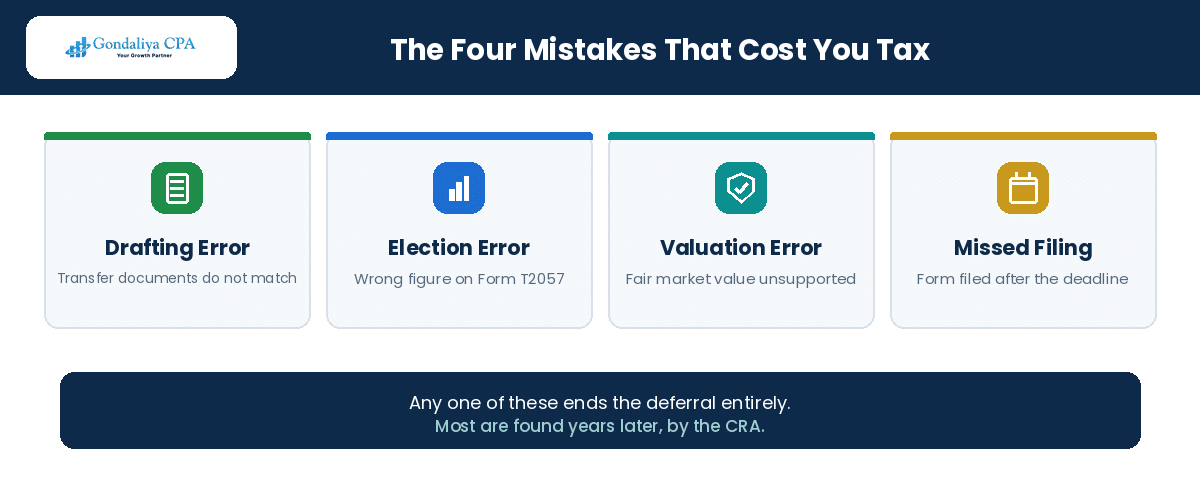
Here are common mistake types in Section 85 rollovers:
- Drafting Error: Mistakes in transfer documents.
- Election Error: Errors on Form T2057.
- Valuation Error: Wrong fair market value used.
- Missed Filing: Forms not filed on time.
If you transfer property that isn’t eligible, you’ll face immediate capital gains tax or your rollover may be denied altogether. Late election filings can trigger penalties that raise your tax bill.
Impact of Incorrect T2057 Elections and Filing Errors on Tax Liability
If you miss or file Form T2057 late, penalties can reach $8,000 plus risk losing the election entirely. You must file this form by the earliest due date between the transferor’s and transferee’s returns. Otherwise, you lose your chance at deferral.
Knowing when to file a late election versus an amended one matters too. They have different penalty rules and acceptance criteria from CRA guidelines.
Most rollovers we are asked to review were not obviously wrong at the time. The documents were signed, the form was filed, and one number sat outside its limit. Figures changed for privacy.
Risk Warning: A failed rollover does not announce itself. You find out when the reassessment arrives, by which point the interest has been running for two years.
Eligible and Qualifying Property for Section 85 Elections
Eligible and Qualifying Property for Section 85 Elections
The Property
A Section 85 rollover works when you transfer the right property to a corporation in exchange for shares. This move defers tax on any gains until later. But, many people mess up by including property that isn’t allowed under the Income Tax Act. That mistake can cause unwanted taxes right away.
Usually, you can transfer capital assets. These include depreciable property (like buildings or equipment) and goodwill. Inventory, which is stock you sell in the ordinary course of business, usually doesn’t qualify unless special CRA rules apply. Foreign property might be tricky because extra rules or limits can apply depending on where it is. Partnership interests also don’t count because they’re not seen as direct property transfers to a corporation.
If you try to transfer cash or inventory treated as ordinary income, CRA treats it as a sale at fair market value (FMV). That means you have to pay tax on any gains immediately instead of deferring it.
Here’s a quick look:
- Capital Property: Yes, this includes depreciable assets and land used in business.
- Inventory: No, it counts as income and triggers immediate gain or loss.
- Cash: No, immediate disposition at FMV applies.
- Foreign Property: Sometimes yes, but often no due to complex rules.
- Partnership Interests: No, these aren’t considered direct transfers.
Sources: CRA Folio S4-F3-C1, Income Tax Act s.85.
Consequences of Ineligible Property Transfers in a Section 85 Rollover
If you include assets that don’t qualify—like cash or inventory—the CRA treats the transfer like an immediate sale at FMV. This means you must report any gains or losses right away.
For instance, imagine rolling over $100,000 worth of inventory with an adjusted cost base (ACB) of $60,000. You’d face a taxable gain of $40,000 immediately instead of pushing that tax down the road. That’s the opposite of what Section 85 is supposed to do.
Also, foreign properties rolled over incorrectly can lead to penalties if valuation documents are weak or if reporting falls short during CRA checks. This ups your chances of reassessment and interest charges.
Business owners should separate their capital assets from inventories before making these elections. Skipping this step risks unnecessary taxes that could’ve been avoided with proper advice.
Typical Business Scenarios Involving Section 85 Rollovers: Incorporation, Estate Freeze, and Corporate Reorganizations
Section 85 rollovers pop up often during incorporation. When someone forms a corporation from an unincorporated business, they transfer eligible assets without paying tax immediately. Estate freezes use Section 85 too—they lock in asset values while letting heirs get future growth through shares.
Corporate reorganizations also depend on these rollovers. When companies merge or shift assets between related corporations, following Section 85 rules keeps taxes deferred.
Toronto-based SMB clients often need expert review services for these situations. Many miss key details about which assets qualify or don’t properly support their valuations before submitting form T2057.
In all cases:
- Transfer only eligible property.
- Keep solid records supporting your valuations.
- File elections accurately and on time.
Risks Associated with Transferring Appreciated Assets Without Proper Compliance
Picking the wrong elected amount causes problems fast. Setting it below allowable floors based on undepreciated capital cost (UCC) or above fair market value invites CRA adjustments. Those changes can trigger unexpected taxable gains.
Taking too much boot—that’s when non-share consideration goes beyond what you elected—also means paying tax right away.
Poor valuation records raise red flags during audits too. The CRA expects clear evidence backing elected amounts, especially in deals between related parties under subsection 69(1). Missing proof can lead to reassessments and penalties if elections are late or wrong.
These risks show why professional CPA oversight matters here. A knowledgeable CPA ensures numbers fit legal limits and advises on keeping all necessary paperwork ready.
Inventory is the one that catches people. A business rolls in everything on the balance sheet without separating stock from capital assets, and the stock is taxed at full value on day one. Figures changed for privacy.
Pro Tip: Split the asset list into capital property and inventory before anything is signed. That single step removes the most common reason a rollover produces an immediate gain.
How the Section 85 Election Works: Mechanics and Calculations Explained
How the Section 85 Election Works: Mechanics and Calculations Explained
The Mechanics
The Section 85 election helps Canadian business owners move property into a corporation without paying tax right away. You pick an amount between the property’s adjusted cost base (ACB) or undepreciated capital cost (UCC) and its fair market value (FMV). If you choose an amount below ACB or UCC, you’ll face immediate capital gains tax. Picking a number above FMV is not allowed.
Common mistakes happen when people set the elected amount too low or too high. This causes unwanted tax consequences. The Income Tax Act says the elected amount can’t be less than ACB for capital properties or UCC for depreciable assets. Nor can it be more than FMV at transfer time[1]. If this rule is broken, the tax office calculates “deemed proceeds,” leading to immediate gain recognition.
Section 84.1 can treat shares with paid-up capital higher than what you actually paid as dividends. That means extra tax for you[2]. Paid-up capital adjustments must happen on time to avoid surprise deemed dividends under subsection 85(2.1).
Knowing these rules helps avoid costly errors during asset transfers to corporations under Section 85.
[1] CRA Folio S4-F3-C1
[2] Income Tax Act section 84.1
Determining the Correct Elected Amount and Consideration Structure
Choosing the right elected amount is key to getting a valid Section 85 rollover without extra taxes. You must pick a number between the ACB/UCC and the FMV of the property at transfer date[3].
You can’t take boot—meaning non-share consideration—beyond zero. If you do, you must recognize a gain equal to that excess boot right away[4]. Picking an elected amount that’s too low or too high may cause CRA to reassess your transaction due to valuation errors or misfiling.
You need solid evidence supporting FMV, like recent appraisals, to avoid CRA adjustments[5]. Usually, consideration involves issuing shares worth at least part of the property’s value plus minimal boot when allowed.
Here’s a quick table to sum it up:
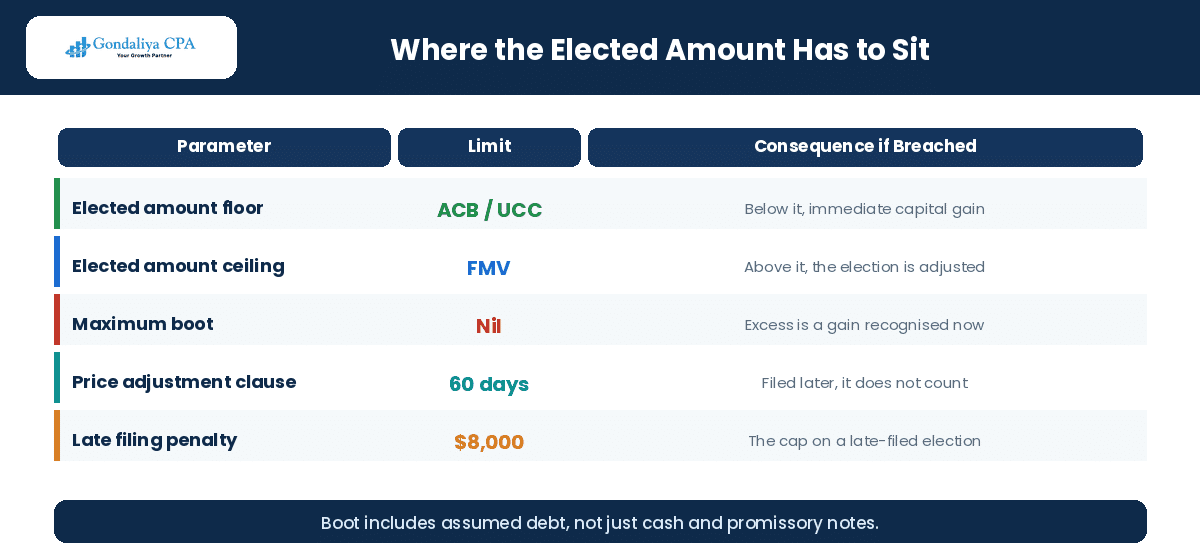
| Parameter | Requirement | Consequence if Violated | Source |
|---|---|---|---|
| Elected Amount Floor | ≥ Adjusted Cost Base / UCC | Immediate Capital Gain | CRA Folio S4-F3-C1 |
| Elected Amount Ceiling | ≤ Fair Market Value | Election Denied / Adjustment | Income Tax Act |
| Maximum Boot Allowed | Nil | Gain Recognition on Excess Boot | ITA s.85(1)(e.2) |
This calculation helps keep your rollover safe from reassessments and preserves tax deferral under Section 85.
[3] CRA Form T2057 Guide
[4] ITA subsection 85(1)(e.2)
[5] IC76-19R Valuation Guidelines
Avoiding the Boot Trap: Managing Excessive Boot and Shareholder Benefits
Boot means non-share consideration you get in a Section 85 deal, like cash, promissory notes, or debt assumed by the buyer. Taking too much boot triggers immediate taxable gains equal to that excess value under Canadian law[6].
Promissory notes count as boot because they are promises to pay later, not shares. If not done right, they cause income inclusion once transfer finishes[CRA T2057 Instructions].
When transferees take on debts tied directly to assets—say mortgages—that also counts as boot. Any excess over allowed limits leads to gain recognition[CRA Folio S4-F3-C1].
To avoid this trap:
- Keep non-share consideration strictly within allowed limits.
- Write down all forms of payment clearly.
- Make sure valuations reflect real values.
- Watch out for shareholder benefits if personal loans mix with corporate deals[Income Tax Act section 15].
Avoiding excessive boot keeps your rollover clean and stops costly audits over shareholder benefit issues.
[6] Income Tax Act subsection 85(1)(e); CRA Form T2057 instructions
Filing Requirements and Critical Deadlines for Form T2057 Election
Form T2057 must be filed on time with both the transferor’s personal return (T1) and transferee corporation’s return (T2). The deadline depends on which return gets filed first in the tax year of transfer[CRA Filing Deadline Guidance].
Missing this deadline risks penalties up to $8,000 based on Income Tax Act section 153(1.1)[ITA s153 penalty cap]. Plus, CRA might deny your election entirely—meaning immediate taxes instead of deferral.[CRA Penalty Information]
Late elections might get accepted but come with interest charges and extra scrutiny requiring good reasons.[CRA Late Filing Policy] Changing an election later has its own rules and also demands prompt action.[CRA Amended Elections FAQ]
Make sure you:
- Check yearly filing deadlines per taxpayer type.
- Keep proof of filing documents safe.
- Consult a CPA well before deadlines.
Filing Form T2057 on time protects your rollover benefits and lowers audit risks tied to late or missing submissions.[7][8]
Sources:
- Canada Revenue Agency – Eligible Property
- Income Tax Act Sections
- Form T2057 Instructions
Contact Gondaliya CPA today for help making sure your Section 85 election follows all rules in Toronto/Ontario — call 647‑212‑9559 or email info@gondaliyacpa.ca if you want free advice about common mistakes like wrong elected amounts or missed filings that hurt your business taxes.
Boot is the quiet one. A mortgage assumed by the corporation is boot, and owners rarely think of it that way until the number is compared against the elected amount. Figures changed for privacy.
Risk Warning: Assumed debt counts toward boot. Please total cash, notes and assumed liabilities together before deciding the elected amount, not afterwards.
Advanced Planning Strategies and Risk Mitigation
Advanced Planning Strategies and Risk Mitigation
The Planning
Common Section 85 rollover mistakes can cause you to pay extra taxes. These happen when immediate capital gains or deemed dividends get triggered under the Income Tax Act in Canada. This section talks about frequent errors like picking wrong elected amounts or filing Form T2057 late. It gives clear guidance that follows CRA rules for business owners in Ontario and across Canada.
Utilizing Capital Gains Exemption in Section 85 Transactions
The elected amount in a Section 85 rollover has to meet certain limits. You must pick an amount at least equal to the adjusted cost base (ACB) or undepreciated capital cost (UCC), depending on the property type. The Income Tax Act, subsection 85(1)(e.2), says if you pick an amount below ACB, you’ll get hit with an immediate capital gain tax.
For example:
- Transfer depreciable property with UCC $100,000
- Elect $80,000 instead
- Recapture income may arise due to undervaluation
The same goes for shares transferred below their ACB — that triggers taxable gains right away. Make sure to carefully calculate these amounts before filing Form T2057. Tracking your ACB and UCC correctly avoids costly tax reassessments caused by wrong elected amounts.
Implementing Price Adjustment Clauses to Protect Against Valuation Changes
Price adjustment clauses help protect you when asset values change after filing a Section 85 election but before closing the deal. The CRA says these clauses only count if you file them within 60 days of the election filing date, as per CRA Folio S4-F3-C1.
These clauses let you adjust prices up or down after transfer, based on actual asset values. This way, your election stays valid and doesn’t lead to unexpected taxes. Without timely price adjustment clauses, your election might fix values that don’t match true fair market value (FMV). That raises audit risks and possible reassessments.
Properly written price adjustment clauses cut down uncertainty when assets’ worth shifts during complex corporate reorganizations or fluctuating markets.
Integrating Section 85 with Other Rollover Provisions and Attribution Rules
Ignoring paid-up capital (PUC), adjusted cost base (ACB), and rules from section 84.1 can cause big problems during rollovers. Subsection 85(2.1) requires PUC adjustments calculated on the date shares are issued, reflecting what’s received in return.
If you miss this step, shareholder equity accounts get out of whack. That can change how future dividends get taxed.
Section 84.1 also creates risks: it treats some transfers as deemed dividends if they happen below FMV or involve certain share redemptions shortly after a rollover.
To avoid trouble:
- Track PUC carefully
- File elections accurately on Form T2057
- Understand attribution rules that affect related-party transactions
This applies especially to private corporations across Ontario and Canada.
Documentation Best Practices to Ensure CRA Compliance and Avoid Disputes
Poor or missing fair market value support invites CRA audits on Section 85 filings. You need strong proof like professional appraisals done near transaction dates.
CRA guidelines IC76-19R3 say keep detailed documents such as:
- Independent appraisal reports
- Comparable sales info
- How you worked out valuation methods
- Internal notes explaining assumptions
If your documentation is weak or missing, CRA can reassess taxes and charge penalties since they can’t verify your FMV claims during audits in Toronto or other areas.
Keeping solid valuation files shows good faith compliance with Canadian tax laws for corporate rollovers and cuts risk of disputes.
Preparing for CRA Reviews: Audit Focus Areas and Dispute Resolution Tips
CRA demands you keep records supporting your returns for at least six years after filing deadlines—this includes Section 85 election documents—under Income Tax Act rules.
Without proper records, it’s harder to fight reassessments caused by mistakes like missed deadlines or wrong figures.
Late-filing penalties max out at $8,000 based on the penalty basis found in section 153(1.1). If you come forward early through voluntary disclosure, interest might drop but penalties usually stick once charged.
During audits, CRA focuses on matching Form T2057 details with corporate returns schedules. They check if asset descriptions line up with elected amounts and fair market value backed by appraisals. They also confirm share issuance matches paid-up capital figures recorded correctly.
Contact Gondaliya CPA if you want help handling advanced planning strategies that reduce risks from common Section 85 rollover mistakes around Toronto/Ontario — call 647‑212‑9559 or email info@gondaliyacpa.ca for a free consultation today.
- Canada Revenue Agency – Eligible Property & Elected Amounts https://www.canada.ca/en/revenue-agency/services/forms-publications/publications/ic76-19r/eligible-property-elected-amts.html
- CRA Folio S4-F3-C1 – Price Adjustment Clauses https://www.canada.ca/en/revenue-agency/services/tax/businesses/topics/corporations/filing-corporation-income-tax-return/form-t2057-section-85-rollover-election.html
- Income Tax Act subsections 84(1) & 84(2); subsection 85(2.1) Paid-Up Capital Adjustments [Department of Justice]
- CRA IC76-19R3 – Fair Market Value Support Requirements https://www.canada.ca/en/revenue-agency/services/forms-publications/publications/ic76-19r/fair-market-value-support.html
- IT Bulletin IT169 – Appraisal Evidence Standards https://www.canada.ca/en/revenue-agency/services/tax/businesses/topics/corporations/appraisal-evidence.html
- Records Retention Policy – Income Tax Act s153(5); https://laws-lois.justice.gc.ca/eng/acts/I-3/page-20.html#h-1076470
- Late Filing Penalties Cap – Income Tax Act s153(1 …)
Valuation files are what decide a CRA review. An appraisal dated near the transfer settles the question; one commissioned after the audit letter rarely does. Figures changed for privacy.
Key Stat: A price adjustment clause has to be filed within 60 days of the election filing date to count. Please diarise it at the same time as the election itself.
Provincial Considerations and Comparison to Related Provisions
Provincial Considerations and Comparison to Related Provisions
The Provincial Layer
Section 85 rollovers mix federal tax rules with provincial laws, especially in Ontario. Getting provincial details right helps Canadian business owners avoid common Section 85 rollover mistakes that cause extra taxes.
Key Provincial Tax Considerations Including Land Transfer Tax and Ontario Business Corporations Act
Ontario charges Land Transfer Tax (LTT) on some property transfers into corporations. If you move real estate into a corporation, you might owe LTT—unless an exemption fits. Owners should check carefully because transferring land held as inventory or investments without planning can trigger extra provincial taxes.
The Ontario Business Corporations Act (OBCA) sets rules about corporate actions during Section 85 transfers. This includes issuing shares, passing resolutions, and changing articles. If corporate records don’t match the T2057 election filed with CRA, problems can arise. For example, failing to update articles or delay share issuance risks CRA rejecting the rollover.
CRA requires keeping all documents related to the rollover for six years after filing. This includes valuations, agreements, and board minutes. It’s necessary in case CRA audits or requests reassessments.
Income Tax Act subsection 85(2.1) says paid-up capital (PUC) must be adjusted after a rollover. Timing here matters a lot. Mistakes lead to wrong shareholder equity reports or unintended taxable dividends under section 84.1 when payouts happen later.
Many Toronto-area businesses face issues when corporate documents don’t match their election forms. For instance, if shares are not issued before the transfer date or promissory notes lack proper authorization matching amounts on Form T2057, CRA might deny tax deferral and tax gains immediately.
Professional Corporation Rules Affecting Section 85 Rollovers
Professional corporations—like those for doctors or dentists—follow special rules when doing Section 85 rollovers. These come from regulators like OHIP or RCDSO and add limits on what property can be transferred.
Share certificates must clearly show ownership changes that fit the rollover election. Missing this detail may invalidate the whole transaction both legally and for tax purposes.
Board resolutions should specifically mention compliance with professional corporation rules along with Income Tax Act rules. This helps CRA understand that all laws were followed during reviews.
These special rules protect public trust but also allow professionals to use tax deferrals properly without breaking their field’s regulations. Expert CPA advice is key for navigating these complex requirements in Ontario.
Comparing Section 85 with Section 85.1 (Share-for-Share Exchange), Section 86 (Share Reorganization), and Subsection 97(2) (Partnership Property Transfers)
Section 85 lets you move assets into a corporation without immediate tax, but it’s different from other provisions:
- Section 85.1 covers swapping shares within affiliated groups without triggering gains; it doesn’t apply when non-share payments happen.
- Section 86 handles internal share reorganizations inside one company—like changing classes or series of shares—not asset transfers.
- Subsection 97(2) deals only with partnership property moved when partners join or leave; it allows deferrals if conditions on partnership interests are met but not for normal incorporations using section 85.
Knowing these differences stops you from misusing rollover rules and accidentally triggering capital gains or recapture income because of wrong applications beyond each provision’s scope.12
| Provision | Purpose | Typical Use Case | Key Difference vs Section 85 |
|---|---|---|---|
| Section 85 | Asset transfer into corp | Incorporation & estate freeze | Used mainly for asset transfers |
| Section 85.1 | Share-for-share exchange | Affiliated group restructures | Only involves share swaps |
| Section 86 | Share reorganization | Internal share conversions | Changes share classes inside one company |
| Subsection 97(2) | Partnership property transfers | Partner admission/withdrawal | Applies only in partnership contexts |
^1: Canada Revenue Agency Folio S4-F3-C1
^2: Department of Justice – Income Tax Act sections
Strategic Framework for When to Use Section 85 in Business Transactions
Section 85 plays an important role in many business moves:
- Incorporation: Moving sole proprietorship assets into a new corporation lets owners avoid paying taxes right away while setting up corporate ownership.
- Estate Freeze: Rolling over assets at fair market value locks current values so future growth goes to others through preferred/common share setups.
- Corporate Reorganizations: Helps companies merge or spin off parts without having to report gains immediately.
Risks appear if people skip steps: late T2057 filings kill deferral benefits; picking elected amounts below cost causes capital gains; getting too much boot means some gains show up right away.3
Good practice includes:
- Checking which properties qualify per CRA guidelines.4
- Keeping proof of fair market value at the time.5
- Aligning legal documents carefully with elections.6
- Updating paid-up capital after transfers.7
- Watching for audit triggers CRA might spot later.8
Following this plan reduces risks much more than trying random fixes without understanding how federal and provincial rules work together — especially in Toronto where small businesses often face these issues.
^3: Canada Revenue Agency – Late-filed Elections Penalties Guidelines
^4: Canada Revenue Agency – Eligible Property Definitions
^5: Canada Revenue Agency – Fair Market Value Documentation Requirements
^6: Corporations Canada / Ontario Registry Filing Standards
^7: Income Tax Act subsection subsection
§(2)(1e)
[paid-up capital adjustment]
^8: CRA Audit Triggers & Review Procedures
For advice tailored to your situation about provincial factors affecting your section Common Section 85 Rollover Mistakes That Can Trigger Unnecessary Taxes, reach out to Gondaliya CPA’s team serving Toronto/Ontario clients nationwide via free consultation at info@gondaliyacpa.ca or call +1–647–212–9559 today.
Ontario Land Transfer Tax surprises people who assumed a rollover was purely federal. Real estate moving into a corporation is a provincial event as well as a tax election. Figures changed for privacy.
Risk Warning: The corporate minute book has to agree with Form T2057. Where shares were issued late or resolutions were never passed, the election is exposed regardless of how the numbers were calculated.
Expert Guidance, Real-World Applications, and Next Steps
Expert Guidance, Real-World Applications, and Next Steps
The Fix
The Role of Professional Advisors: CPA, Legal Counsel, and Business Valuators in Section 85 Planning
Professional advisors help make sure Section 85 rollovers go smoothly. A licensed CPA firm checks for common mistakes like wrong elected amounts or missed T2057 deadlines. Lawyers check that corporate paperwork matches the shares issued during the election. This avoids costly problems with the CRA.
Business valuators give fair market value (FMV) reports to back up numbers on Form T2057. Having good valuation records helps defend against CRA audits focused on related-party rules under section 69. When CPAs, lawyers, and valuators work together, they catch issues like non-eligible property transfers or paid-up capital adjustments done late under subsection 85(2.1).
Hiring experts early lowers risks from late-filing penalties. The CRA caps penalties for elections filed after deadlines but within allowed periods[1]. This teamwork protects business owners from unexpected taxes caused by errors in rollovers.
Canada Revenue Agency – Late-filed Elections Penalty Cap [CRA Reference]
Real-World Case Studies Illustrating Common Mistakes and Effective Solutions
Mistake 1: Transferring Property That Is Not Eligible for Section 85
A real estate investor in Toronto tried to rollover inventory land into their holding company using Section 85. Inventory land is not allowed under the Income Tax Act[2], so this led to immediate capital gains tax instead of deferral.
Solution: We caught this mistake before filing by carefully reviewing the assets. Then we changed the deal structure outside of Section 85 rules to avoid reassessments.
Mistake 2: Setting the Elected Amount Below the Floor or Above Fair Market Value
An online retailer chose an elected amount below undepreciated capital cost (UCC). The CRA adjusted it upward during an audit. This caused surprise income due to recapture.
Solution: We rechecked FMV floors with professional appraisals and filed an amended T2057 on time. This fixed tax deferral without extra penalties.
Mistake 3: Taking Too Much Boot
A construction business owner accepted promissory notes as boot that went beyond limits. This triggered immediate taxable gains, which defeated rollover benefits.
Solution: We analyzed boot limits using CRA guidelines[3]. Then we fixed corporate documents and share issuances to match boot taken. Late elections got accepted without big tax hits.
All cases follow Canadian federal rules, especially those applying in Ontario including Toronto.
Income Tax Act s.85(1)(e); Canada.ca Eligible Property
Folio S4-F3-C1 — Non-share Consideration Limits
How Gondaliya CPA Helps Canadian Business Owners Avoid Section 85 Rollover Errors
Gondaliya CPA is a licensed Ontario firm with expertise across Canada. We serve incorporated SMBs dealing with tricky rollover transactions like missed T2057 deadlines or timing paid-up capital fixes under subsection 85(2.1).
Clients decide if they want DIY fixes or expert help depending on their case complexity:
| Factor | DIY | Licensed CPA Firm | Non-CPA Provider | Verdict |
|---|---|---|---|---|
| Diagnosis Accuracy | Limited | High | Variable | CPAs provide best accuracy |
| Valuation Defensibility | Low | Professional appraisals | Often lacking | Only CPAs ensure solid valuations |
| Election Reinstatement | Difficult | Manageable with expertise | Risky | Trusted firms handle fixes well |
| CRA Representation | None | Included | Rare | Important for audit readiness |
Our review process covers everything from start to finish:
- Check prior returns and asset lists
- Confirm which properties qualify
- Calculate correct elected amounts
- Analyze boot limits and reconcile paid-up capital
- Review valuations along with legal papers
- Prepare late or amended elections if needed
- Manage penalty calculations and CRA communication
This reduces risks while restoring tax deferrals for clients in tech startups, medical practices, real estate, and more around Toronto/Ontario.
Steps to Take After Reading: Ensuring Compliance and Scheduling Professional Consultation
Deciding whether to fix a problem right away or wait for the CRA depends on these factors:
| Situation | Fix It Now | Wait For CRA |
|---|---|---|
| Available | Lower penalties | Requires quick action |
| Lower penalties | Needs quick action | Best if facts are clear |
Before starting a formal review, gather these documents:
- Filed Form T2057 copy (or note if missing)
- Full asset list with original cost/UCC numbers
- Corporate articles showing share classes at transfer time
- Transfer agreements detailing payment including any boot
- Relevant prior T2 returns showing paid-up capital balances
- Any valuation reports supporting FMV claims
Scheduling a no-obligation call lets you get specific advice quickly without upfront costs.
Sharad Gondaliya, CPA, has over 10 years helping Canadian business owners manage corporate reorganizations carefully in Toronto/Ontario.
Fixing a rollover before the CRA raises it is a different conversation from fixing one afterwards. The facts are the same; the penalties and the room to negotiate are not. Figures changed for privacy.
Pro Tip: If you suspect an error, please gather the minute book and the filed T2057 before calling anyone. Most questions are answered by comparing those two documents against each other.
Frequently Asked Questions (FAQ)
Frequently Asked Questions (FAQ)
FAQ
What is the difference between a late-filed election and an amended election for Section 85 rollovers?+
A late-filed election is submitting Form T2057 after the deadline but within the allowable period. An amended election corrects errors in a timely filed election. Penalty exposure varies between the two.
What conditions apply to late-filed elections under CRA rules?+
CRA accepts late-filed elections only if filed within specific time frames and accompanied by reasonable explanations. Penalties can apply up to $8,000.
When can an amended election be filed, and what are the benefits?+
An amended election is allowed when correcting errors before CRA audits or reassessments. It generally incurs lower or no penalties compared to late filings.
How much penalty exposure exists for late-filed versus amended elections?+
Late-filed elections face higher penalties up to $8,000. Amended elections typically have reduced penalties or none if filed promptly.
What corporate document mismatches commonly cause Section 85 rollover issues?+
Mismatches often involve inconsistent share certificates, missing or outdated board resolutions, incomplete articles of incorporation, and absent subscription agreements.
Why do share certificate issues affect Section 85 elections?+
Share certificates must reflect shares issued at the rollover date accurately. Discrepancies may cause CRA to deny tax deferral benefits.
How do board resolution issues impact Section 85 filings?+
Incomplete or missing board resolutions fail to show corporate approval for asset transfers and share issuances, risking election denial by CRA.
What problems arise from articles of incorporation issues during Section 85 rollovers?+
Incorrect or outdated articles can block proper share issuances aligned with rollover transactions, leading to compliance failures.
Why are subscription agreements critical in Section 85 transactions?+
They document the terms of share issuance and consideration. Missing agreements reduce audit defensibility and risk reassessment.
When must paid-up capital adjustments be completed in a Section 85 rollover?+
Paid-up capital adjustments must occur on the date shares are issued to avoid deemed dividends under section 84.1.
How does a price adjustment clause maintain validity in a Section 85 rollover?+
Price adjustment clauses protect against valuation changes if filed within 60 days of the election filing, keeping values accurate for tax deferral.
What is the required records retention period for Section 85 elections?+
CRA requires maintaining all relevant documents, including T2057 forms and valuations, for at least six years after filing deadlines.
How long is the CRA reassessment period for Section 85 rollovers?+
The standard reassessment period is three years from the original filing date but may extend with misrepresentation or omission cases.
Additional Insights on Managing Section 85 Rollovers
Additional Insights on Managing Section 85 Rollovers
Deeper Detail
How Does CRA Find Section 85 Rollover Errors?
CRA cross-checks T2057 filings against corporate returns and audits valuation support for discrepancies. Related-party transactions receive extra scrutiny.
What Other Filings Are Often Missed Around a Section 85 Transfer?
Missed filings include paid-up capital adjustments, provincial tax returns like Ontario Land Transfer Tax filings, and supporting corporate documentation updates.
Fixing Section 85 Errors: DIY vs CPA vs Non-CPA Provider
DIY fixes carry high risk due to complexity; non-CPA providers lack full authority; licensed CPAs offer precise corrections, penalty management, and audit representation.
How Do We Review and Correct Section 85 Rollovers at Gondaliya CPA?
We analyze prior returns, verify eligible properties, recalculate elected amounts, review corporate records, prepare amended or late elections, and liaise with CRA to minimize penalties.
What Deliverables Do You Get When Engaging Gondaliya CPA?
Clients receive detailed reports on error findings, corrected T2057 filings, updated corporate documents advice, penalty calculations, and comprehensive audit support materials.
How Much Does It Cost to Fix a Section 85 Rollover in Canada?
Costs vary by complexity but typically range from moderate fees for straightforward fixes to higher charges for extensive reconciliations involving legal and valuation experts.
What Are the Risks, CRA Compliance Issues, and Prevention Controls?
Risks include immediate tax liabilities from incorrect elections or boot excesses. Prevention controls involve timely filings, accurate valuations, matched corporate approvals, and professional oversight.
What Should an Owner Prepare Before a Section 85 Review Engagement Starts?
Gather copies of Form T2057 filings, asset lists with cost bases/UCCs, corporate records (articles/board minutes/share certificates), transfer agreements detailing boot consideration, prior tax returns showing paid-up capital balances, and valuation reports if available.
How Do Section 85 Rollover Mistakes Show Up Across Ten Industries We Serve?
Common issues include incorrect property classifications in real estate; valuation errors in manufacturing; missed deadlines in tech startups; excessive boot in construction; poor documentation in medical practices; among others requiring tailored strategies per industry sector.
A Realistic Numeric Walkthrough of Correct Elected Amount Calculation:
Example: Asset FMV $150k; ACB $100k; UCC $110k (if depreciable). Elect amount must be ≥ $100k/$110k and ≤ $150k. Taking boot = $0 ensures no immediate gain triggered.
How to Choose the Right CPA Firm in Toronto/Ontario to Fix a Section 85 Rollover?
Look for firms with demonstrated expertise in Canadian tax law including subsection 85(2.1), proven experience handling late/amended elections smoothly without costly penalties, strong client reviews locally around Toronto/Ontario area.
Why Trust Gondaliya CPA? (E-E-A-T) + Editorial Policy + Disclaimers:
Gondaliya CPA combines extensive technical knowledge with transparent processes under strict ethical standards. Our editorial content relies on current law and official CRA guidance. Disclaimers clarify that advice depends on individual circumstances requiring personalized consultation.
Next Steps: Ensure Compliance with Your Section 85 Rollover
- Review your current rollover documents thoroughly.
- Identify any inconsistencies or missing filings.
- Contact Gondaliya CPA early for expert assessment.
- Prepare requested documentation as outlined above.
- Schedule a consultation via info@gondaliyacpa.ca or call +1–647–212–9559.
- Act promptly to minimize penalties and protect tax deferrals.
The owners who come out best are the ones who checked their own file before anyone asked them to. Everything after that is easier and cheaper. Figures changed for privacy.
Industry Spotlights: Sectors We Serve
Industry Expertise
The mistake that shows up differs by sector. Here are eleven and the usual failure point.
| Industry | The Mistake We See Most |
|---|---|
| Real estate investors & holding companies | Land held as inventory rolled in as capital property |
| Construction, contractors & skilled trades | Promissory notes taken as boot above the elected amount |
| Technology startups & SaaS | Form T2057 filed after the earliest return deadline |
| Medical doctors & physician corporations | Professional corporation rules overlooked on share classes |
| Dentists & dental practices | Goodwill valued without written support |
| Daycare, childcare & CWELCC services | Elected amount set below undepreciated capital cost |
| E-commerce & online retailers | Stock on hand included in the transferred property |
| Consulting firms | Shares issued after the transfer date in the minute book |
| Restaurants & food and beverage | Equipment recapture missed on the depreciable assets |
| Property developers & builders | Ontario Land Transfer Tax not considered on the transfer |
| Transportation, logistics & trucking | Assumed vehicle financing not counted as boot |
- Real estate investors, landlords & holding companies: Whether land is capital property or inventory decides the whole outcome, and it is settled by how the business used it.
- Construction, general contractors & skilled trades: Notes payable to the owner are boot, and the total is often discovered only after the election is filed.
- Technology startups & SaaS: The deadline runs off whichever party files first, which catches founders who expect their own T1 date to govern.
- Medical doctors & physician professional corporations: Regulator rules on share ownership constrain what the election can actually do.
- Dentists & dental practices: Practice goodwill is the largest number in the transfer and the one most often unsupported.
- Daycare, childcare & CWELCC services: Equipment and leasehold pools carry their own floor, and electing below undepreciated capital cost produces recapture immediately.
- E-commerce & online retailers: Stock on hand is income property, so including it converts a deferral into a taxable sale.
- Consulting Firms: The minute book usually lags the transaction, and share issuance dates have to match the election.
- Restaurants & food and beverage: Kitchen equipment carries recapture exposure that gets overlooked next to the lease and the goodwill.
- Property developers & builders: The provincial land transfer cost can exceed the federal tax the rollover was meant to defer.
- Transportation, logistics & trucking: Financing assumed with the vehicles counts toward boot and is rarely added into the total.
The sector changes which number goes wrong. The review is the same each time: eligible property, elected amount, boot, then the filing date. Figures changed for privacy.
Professional Guidance and Quick Reference
Guidance
Professional Guidance on Section 85 Rollovers: How Gondaliya CPA Supports Canadian Business Owners
A Section 85 rollover either defers the gain or it does not, and the difference usually comes down to four numbers: what property moved, what amount was elected, how much boot was taken, and when Form T2057 was filed. Get one wrong and the deferral fails, often without anyone noticing until a reassessment arrives. Gondaliya CPA plans rollovers properly and reviews ones already done, on a fixed fee.
We handle what decides the outcome: separating eligible capital property from inventory, calculating the elected amount against its floor and ceiling, totalling boot including assumed debt, checking section 84.1 exposure on related-party transfers, reconciling paid-up capital under subsection 85(2.1), aligning the minute book with the election, and filing Form T2057 by the earliest applicable deadline. Where something has already gone wrong, we prepare late or amended elections and deal with the CRA on penalties.
Our team works from your asset list, your minute book and your prior returns rather than a template, and will tell you plainly whether a past rollover holds up. Planning ahead or repairing after the fact, you get clear advice and a fixed price before we start.
Quick Answers: Key Numbers & Concepts at a Glance
At a Glance
- Elected amount floor: Adjusted cost base or undepreciated capital cost
- Elected amount ceiling: Fair market value at transfer
- Maximum boot: Nil above the elected amount
- Election form: Form T2057
- Filing deadline: Earliest return due date of any party
- Late filing penalty: Up to $8,000
- Price adjustment clause: Within 60 days of the election filing
- Record retention: 6 years after filing deadlines
- Reassessment period: 3 years, longer with misrepresentation
- Paid-up capital: Adjusted on the date shares are issued
Who This Is For / Not For
Fit Check
- For: Canadian business owners planning a Section 85 transfer, or who suspect a past rollover was filed with an error in the elected amount, boot or timing.
- Not For: Transfers to partnerships or share-for-share exchanges, which fall under subsection 97(2) and section 85.1 rather than Section 85.
People Also Ask
Quick Answers
Can a rollover be fixed after the CRA has already reassessed?+
Sometimes, through an objection or an amended election depending on the facts. The options narrow considerably once a reassessment has issued, which is why early review matters.
Does every Section 85 rollover need a professional valuation?+
Not every one, but any transfer between related parties or involving hard-to-value assets should have written support prepared at the time rather than later.
How do I know if my own rollover was done correctly?+
Compare the filed T2057 against the minute book and the asset list. Mismatched share issuance dates and elected amounts outside their limits are the two most common findings.
Glossary of Key Terms
Plain-English Definitions
- Section 85 rollover: A transfer of eligible property to a corporation with tax deferred by election.
- Elected amount: The deemed proceeds chosen on Form T2057.
- Floor: Adjusted cost base, or undepreciated capital cost for depreciable property.
- Ceiling: Fair market value of the property at the transfer date.
- Boot: Non-share consideration such as cash, notes or assumed debt.
- Eligible property: Capital property, depreciable property and goodwill that qualify for the election.
- Inventory: Stock sold in the ordinary course, which generally does not qualify.
- Form T2057: The election form filed with the CRA.
- Late-filed election: Form T2057 submitted after the deadline but within the allowable period.
- Amended election: A correction to an election that was filed on time.
- Paid-up capital: The tax-recognised capital of a share class, adjusted under subsection 85(2.1).
- Section 84.1: The rule that can convert consideration into a deemed dividend between related parties.
- Price adjustment clause: A clause allowing the price to change if valuations are revised.
- Recapture: Previously claimed depreciation brought back into income.
- Land Transfer Tax: The Ontario provincial tax on transfers of real property.
- Subsection 97(2): The equivalent rollover provision for transfers to a partnership.
Section 85 Rollover Risk Check
This quick self-check indicates where your operation most likely has room. Please answer the six questions below.
Section 85 Rollover Risk Check
Six quick questions on your rollover. No fee shown.
Points to raise with us:
This is a general prompt, not tax or legal advice or a quote. Your position depends on your full facts. For a real review, please book a free consultation.
Want a checklist to work from? You can download our free Section 85 rollover error checklist before your consultation.
Separate capital property from inventory before anything is signed. Get valuations in writing, dated near the transfer. Total cash, notes and assumed debt together and keep the sum inside the elected amount. Keep the elected amount between its floor and its ceiling. Match the minute book to the election. File Form T2057 by the earliest deadline of any party, and diarise a price adjustment clause within sixty days.
2026 Update — what is current: The elected amount floor and ceiling, the boot rules, the Form T2057 filing deadline, the 60-day price adjustment clause window, the 6-year retention rule and the 3-year reassessment period are unchanged. Please note this article cites the $8,000 late filing penalty and record retention to section 153, where section 85(8) and section 230 are the provisions usually cited, so please verify those references before relying on them.
Common Section 85 Rollover Mistakes That Can Trigger Unnecessary Taxes for Canadian Business Owners – Avoid T2057 Election and Filing Errors with Gondaliya CPA
Check the four numbers before you file
Gondaliya CPA confirms which property qualifies, calculates the elected amount against its floor and ceiling, totals boot including assumed debt, checks section 84.1 exposure, reconciles paid-up capital, aligns your minute book with the election, and files Form T2057 on time, on a fixed fee with a one-business-day response. Please book a free consultation.
Next Steps
Please book a free consultation with Gondaliya CPA and bring your asset list with cost bases, the filed Form T2057 if there is one, and your corporate minute book. Those three answer most questions in the first meeting. Whether you are planning the transfer or checking one already done, you will get a fixed fee before any work begins. If our content helps, please add gondaliyacpa.ca as a preferred source on Google.
Published: August 19, 2026 · Last updated: August 19, 2026
Editorial policy: We research against CRA and CPA Ontario sources, fact-check the figures, and Sharad Gondaliya, CPA, reviews the content, which we update as the rules change.
Disclaimer: This article is educational information only and is not tax, legal, or financial advice. Figures marked illustrative are examples rather than quotes or guarantees. It reflects CRA rules current to 2026, including the elected amount floor at adjusted cost base or undepreciated capital cost, the ceiling at fair market value, the nil maximum on boot, the $8,000 late filing penalty, and the 60-day price adjustment clause window. Rates, limits and expensing rules change and outcomes depend on your specific facts. Please consult a CPA Ontario member before acting.

Sharad Gondaliya is a CPA Canada & CPA USA with 15 Years+ experience of Accounting, Tax, Payroll of Corporate Small Businesses as Tax Accountant. He is a CPA Ontario member (61040184) and holds US CPA licences in Washington and Montana and is well known among corporate small businesses for tax planning, efficient tax solutions, and affordable CPA services. Sharad is the Principal (Director) of Gondaliya CPA – Affordable CPA Firm in Canada. Licenses: CPA Ontario: 61040184 | CPA USA (MT): PAC-CPAP-LIC-033176 | CPA USA (WA): 57629 | CPA Firm License: 61330051 View Full Author Bio