



CPA Compilation Report Within 48 Hours for FedDev Ontario’s RTRI Tariff Relief Applications
The CPA Compilation Report RTRI tariff relief plays a key role in supporting businesses applying for tariff relief in Canada, especially with programs like FedDev Ontario. Gondaliya CPA offers expert guidance to ensure your RTRI tariff relief application meets all requirements for successful approval.
Reading time: 28 minutes.
Table of Contents
- CPA Compilation Report and RTRI Tariff Relief: Purpose and Impact
- Funding Details and Support Types for RTRI Applications
- Eligibility Criteria and Qualification Requirements
- Application Process and Tools
- Priority Sectors Supported by RTRI and Rationale Behind Focus Areas
- Program Benefits, Additional Resources, and Support Contacts
- Frequently Asked Questions
- Businesses We Serve
- Professional Guidance and Quick Reference
The Numbers That Matter
Program parameters here reflect FedDev Ontario’s published RTRI pages as at 16 September 2026, following the expansion announced on 25 August 2026 and the enhanced intake opened on 8 September 2026. FedDev Ontario states it may modify the guidelines at any time without notice, so confirm the current position before you apply. Compilation engagements provide no assurance. This is educational information only and not tax, legal or financial advice.
CPA Compilation Report and RTRI Tariff Relief: Purpose and Impact
CPA Compilation Report and RTRI Tariff Relief: Purpose and Impact
Purpose
The CPA Compilation Report matters a lot when dealing with the Regional Tariff Response Initiative (RTRI). It helps businesses get the financial proof they need for FedDev Ontario. This report shows clear numbers and facts about a company’s finances. Southern Ontario incorporated businesses get an edge by having this report ready fast. It makes applying for support smoother and more reliable.
Background on FedDev Ontario and Regional Tariff Response Initiative (RTRI)
FedDev Ontario works to grow Southern Ontario’s economy. It offers money programs to help local businesses thrive. The Regional Tariff Response Initiative (RTRI) focuses on helping companies that face extra costs because of tariffs. These are often manufacturers or exporters in the area. RTRI gives aid to ease these added expenses. That way, businesses can keep going strong despite tariff challenges.
Key Objectives of RTRI for Southern Ontario Businesses
The main goals of RTRI include:
- Offering both repayable and non-repayable funding.
- Helping companies cover tariff-related cost increases.
- Supporting innovation and investment in local firms.
This initiative tries to keep Southern Ontario businesses steady and growing, even when times get tough.
Overview of RTRI’s Role in Supporting Tariff Relief Applications in Canada
RTRI plays a key role for Canadian companies hit by tariffs. It offers funds that help lower extra costs from tariffs. A solid CPA Compilation Report is part of the application process. This report proves the business’s financial health. It meets funder rules for honesty and clear info. Having this document ready can make a big difference when applying for tariff relief in Canada.
Please be precise about what the statements do and do not do. A CPA compilation report presents financial information without assurance. It gives the reviewer a consistent set of figures that agree to what you enter on the form, and that consistency is the value, not any opinion on the numbers.
Quick Navigation Links to Main Sections
Want to know more about our CPA compilation services or timing?
- Our CPA compilation report service page covers the engagement itself
- The 48-hour turnaround commitment applies once records and sign-off are complete
- Where the books are behind, catch-up bookkeeping services come first
- Where returns are outstanding, catch-up corporate tax filing runs alongside
The application asks for financial statements. It does not ask for an audit. Most applicants over-buy assurance they were never required to have. Figures changed for privacy.
Key Stat: A compilation engagement under CSRS 4200 carries no assurance. Not limited assurance, and it is not a Notice to Reader, which is a retired term.
Funding Details and Support Types for RTRI Applications
Funding Details and Support Types for RTRI Applications
Funding
Types of Funding Available Under RTRI: Non-Repayable and Repayable Contributions
The Regional Tariff Response Initiative (RTRI) gives two kinds of funding to help Canadian businesses dealing with tariffs. One type is non-repayable contributions. These funds don’t need to be paid back and cover costs tied to handling tariff problems. The other is repayable contributions, which are like loans. Businesses must pay these back according to agreed terms. They’re usually for bigger projects needing upfront money.
FedDev Ontario manages these funding streams and sets rules about who can apply and how. If you plan to file an RTRI tariff relief application, check carefully which funding type fits your needs best.
Funding Amounts, Coverage Percentages, and Project Timelines
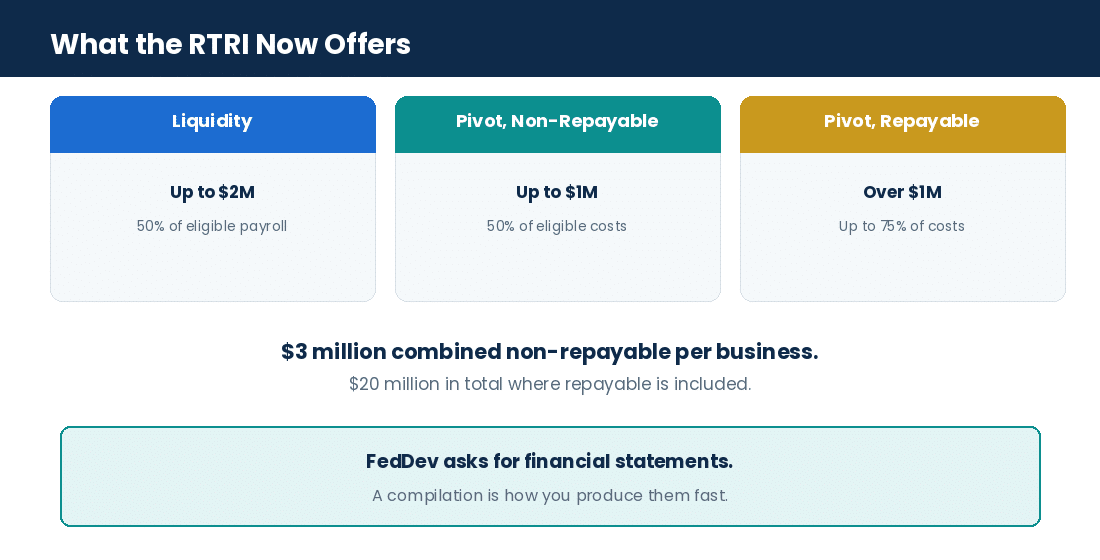
Funding amounts change depending on the chosen stream. FedDev Ontario usually caps how much money a business or project can get. Coverage often falls between 50% and 75% of eligible costs but this can vary.
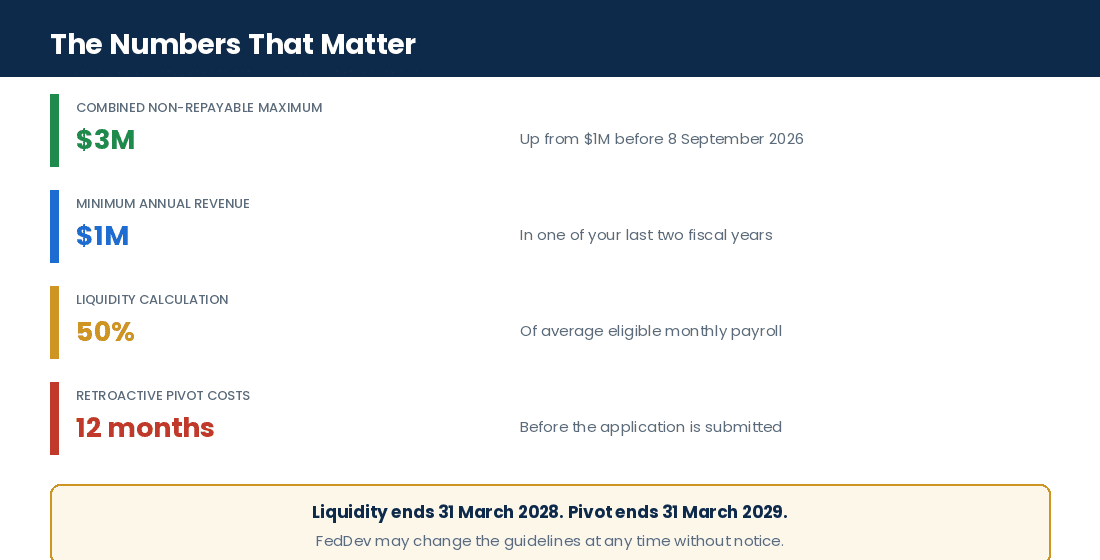
Liquidity assistance runs for up to 12 months and must end no later than 31 March 2028, while pivot projects must be completed no later than 31 March 2029, to finish work and report expenses. It’s key that your financial papers, including CPA Compilation Reports, line up with these deadlines when you apply in Canada.
| Support Type | Funding | Coverage | Period |
|---|---|---|---|
| Liquidity assistance | Non-repayable, up to $2 million | Up to 50% of eligible costs | Up to 12 months, ending no later than 31 March 2028 |
| Pivot project, non-repayable | Up to $1 million | Up to 50% of eligible costs | Completed no later than 31 March 2029 |
| Pivot project, repayable | Over $1 million | Up to 75% of eligible costs | Completed no later than 31 March 2029 |
Maximum Funding Limits and Stacking Rules with Other Government Assistance
RTRI sets maximum funding limits per applicant to stop businesses from getting too much help by mixing multiple government programs. These stacking rules cap how much aid you can receive from federal, provincial, or other sources combined.
You’ll need to reveal any other government assistance you get during your tariff relief application process across Canada. This keeps things transparent and follows FedDev Ontario’s rules on total public support.
| Aspect | Description |
|---|---|
| Maximum funding limit | Fixed per business/project; depends on the stream. Up to $3 million combined non-repayable, being $2 million liquidity assistance plus $1 million for a non-repayable pivot project, and up to $20 million in total RTRI funding where repayable support is included. |
| Stacking rule | Limits total government assistance combined. For pivot projects, combined municipal, provincial and federal assistance will normally not exceed 90% of total eligible project costs, and may be up to 100% for projects led by Indigenous applicants. |
| Disclosure requirement | Must list all government aid received at same time, including EI Work-Sharing, wage or employment supports, provincial liquidity programs and other federal business assistance. |
Please take the disclosure row seriously. Government assistance already received is not a reason to hold back, but omitting it is a misrepresentation on the application, and it is the kind of thing that surfaces later rather than never.
Eligible Cost Categories and Retroactive Expense Treatment
Costs you can claim under RTRI include those caused directly by tariffs. For example:
- Higher material costs
- Freight charges from trade delays
- Buying equipment to lower import reliance
- Consulting fees for tariff strategies
For pivot projects, FedDev Ontario may cover some expenses incurred before applying — up to 12 months back — but confirm exact timing when you apply.
Your CPA Compilation Report must clearly list these costs so your RTRI application meets requirements. Where equipment is being purchased, note that the accounting and the tax treatment diverge: the cost is capitalised and written off through capital cost allowance over years, while the contribution is received now. Our corporate tax planning service deals with the timing difference that creates.
Example of Funding Calculation for a Business Project under RTRI
Here’s a simple example: a manufacturing company in southern Ontario applies for non-repayable funds via FedDev Ontario’s RTRI program.
- Eligible project cost: $120,000 CAD
- Approved coverage rate: 50%
- Possible grant amount = $120,000 × 50% = $60,000 CAD
This estimate helps with budgeting but doesn’t guarantee approval or final funds. FedDev Ontario reviews every case based on submitted info including CPA-prepared financials.
Assumptions (Illustrative)
| Metric | Non-Repayable Pivot | Repayable Pivot |
|---|---|---|
| Eligible expenses total | $120,000 CAD | $1,600,000 CAD |
| Contribution rate | 50% | 75% |
| Contribution estimate | $60,000 CAD | $1,200,000 CAD |
| Repayment | None | Repayable on agreed terms |
Figures illustrative. Two points follow from the second column. The higher 75% rate only applies where the pivot project exceeds $1 million, and that funding is a repayable contribution rather than a grant. A business comparing the two streams is comparing $60,000 it keeps against $1.2 million it pays back, which is a financing decision rather than a funding one.
The business then uses compiled statements matching this budget while following FedDev Ontario’s timelines for funding requests.
The 75% rate reads as the better deal until you notice it is repayable. Applicants anchor on the percentage and skip the row underneath. Figures changed for privacy.
Key Stat: Liquidity assistance is calculated at 50% of average eligible monthly payroll for up to 12 months, capped at $2 million. It is a payroll-based calculation, not a loss-based one.
For help preparing a CPA Compilation Report RTRI tariff relief package with FedDev Ontario, reach out to Gondaliya CPA at info@gondaliyacpa.ca or call 647-212-9559 anytime for guidance without obligation.
Eligibility Criteria and Qualification Requirements
Eligibility Criteria and Qualification Requirements
Eligibility
Before applying for the RTRI tariff relief, you need to understand the eligibility rules. FedDev Ontario sets the requirements for which businesses in Canada can apply. They look at your business type, financial details, and location. Knowing these helps you figure out if you should move forward. A CPA compilation report often plays a key role here.
Core Eligibility Gates for RTRI Tariff Relief Applications
To apply for RTRI tariff relief, your business must be an incorporated for-profit business located and operating in southern Ontario. It also needs to operate in areas covered by FedDev Ontario’s program. You have to show that tariffs or supply problems hurt your business, and that the business was viable prior to tariffs.
A CPA compilation report helps prove this. This report shows your financials based on information you give but does not include an audit or assurance. Firms like Gondaliya CPA can produce this report fast — usually within 48 hours after they get all your documents and sign-off.
Example: Say a manufacturing company in Toronto sends their documents Monday morning. Gondaliya CPA will finish the compilation report by Wednesday, making sure the tariff relief application goes in on time.
Specific Must-Haves Including Incorporation, Revenue, and Employee Thresholds
Your business must be legally incorporated and registered in Canada. If you are not yet incorporated, our incorporation services handle that first, since the gate is absolute. It should mainly work in the regions FedDev Ontario covers. You also need to meet a revenue rule of at least $1 million in annual revenue in one or both of your last two fiscal years, and to report your current employee numbers on the application.
You’ll need to provide:
- Proof of incorporation
- Financial statements showing yearly revenue above a set minimum
- Payroll records confirming how many employees you have
These papers back up your application and let the CPA prepare the required compilation report.
Example: A tech startup in southern Ontario has $3 million yearly revenue and 25 employees. These numbers match eligibility criteria checked during the compilation process.
Automatic Disqualifiers and Ineligible Business Types
Some businesses can’t apply for RTRI tariff relief. FedDev Ontario excludes non-incorporated sole proprietors, not-for-profit organizations and government bodies seeking liquidity support for their own operating expenses, and companies outside the supported areas or unable to demonstrate direct or indirect tariff exposure. Not-for-profit organizations in southern Ontario whose primary focus is to support businesses are eligible under a separate applicant category.
Also:
- Businesses without clear financial records cannot get a proper compilation report.
- Companies that cannot show they were viable prior to tariffs usually do not qualify.
- Companies in insolvency proceedings, or unable to demonstrate they are a going concern, usually do not qualify.
- Charities and not-for-profits whose activities are not trade-related, where liquidity support is sought for their own operating expenses.
The going-concern point is worth separating out. A business that was already failing before the tariffs applied is a different case from one that was viable and then hit, and the program is built around the second. Compiled statements show the position but do not assert it, so the narrative and the supporting evidence carry that argument.
Check official rules before applying because they might change.
Example: A family-owned retail shop without incorporation finds out it can’t submit an RTRI tariff relief application since it lacks formal status.
Demonstrating Tariff Impact: Sales Threshold Method and Direct Disruption Narrative
When applying across Canada, you must show how tariffs hurt your sales. There are three main ways:
- Sector Exposure: Operate in a sector impacted by Section 232 or Section 338 tariffs, including indirect exposure as a supply chain partner to an affected exporter, or another tariff impacted sector.
- Sales Threshold Method: Show that at least 25% or more of your revenue comes from goods that are ultimately exported to the U.S., using compiled financials.
- Direct Disruption Narrative: Write a clear story about how tariffs caused significant cost increases, supply chain troubles, or loss of revenue or customers, with proof like purchase orders or changed contracts after tariffs started.
Gondaliya CPA helps clients prepare these reports correctly while following standards for compiled — not audited — statements under CSRS 4200 rules.
Example: An online retailer shows monthly sales down 15% after new duties hit six months ago. They add a note explaining supplier delays tied directly to tariffs with supporting documents in their package.
Please note that the sales threshold route is the only one of the three the statements can evidence on their own. The other two need documents from outside the accounting records, which is where most of the preparation time actually goes.
Special Provisions for Indigenous-Led Businesses and Contact Information
Indigenous-led businesses might get special treatment under some parts of FedDev Ontario’s programs. This can mean extra help or different rules that reflect challenges faced by Indigenous entrepreneurs. An Indigenous applicant without a CRA business number may provide a three-digit band number instead, and combined government assistance on pivot projects may be up to 100% of eligible costs for projects led by Indigenous applicants.
Still, these businesses must follow normal document rules, including providing a CPA-prepared compilation report when needed. Gondaliya CPA works with clients across Canada to meet these needs smoothly.
For questions about eligibility or special cases like Indigenous-led businesses applying for tariff relief Canada-wide, reach out at:
Gondaliya CPA Professional Corporation
Phone: 647-212-9559
Email: info@gondaliyacpa.ca
Our team guides you through creating your compilation report while keeping all rules in mind.
The viability-before-tariffs test catches people out. A business that was already struggling reads the criteria as being about need, when it is about cause. Figures changed for privacy.
Risk Warning: Please do not treat a compilation as evidence of going concern or of tariff causation. It presents figures without assurance. The causation argument lives in the narrative and the supporting documents.
Want to check if your business meets core gates for RTRI tariff relief? Or need a quick CPA compilation report? Contact us today at info@gondaliyacpa.ca or call 647‑212‑9559 for a free talk.
Application Process and Tools
Application Process and Tools
Process
The RTRI tariff relief application needs clear financial papers. A CPA Compilation Report RTRI tariff relief applicants can trust helps make the process smooth. FedDev Ontario and other regional agencies across Canada manage this program. Knowing the steps and using the right tools lets businesses create accurate applications that follow the rules.
Step-by-step Guide to Preparing and Submitting an RTRI Application
To prepare an RTRI tariff relief application, Gondaliya CPA guides clients through key stages. We help collect needed financial info under CSRS 4200 standards. First, we check your business records. Then, we create a CPA Compilation Report FedDev Ontario accepts with your submission.
- Initial Check: See if you qualify by checking incorporation, location (southern Ontario), revenue and trade exposure.
- Collect Papers: Gather trial balances, bank statements, T2 tax returns, GST/HST filings, payroll details, loan contracts.
- Agree on Scope: Sign an engagement letter stating what we both will do, naming FedDev Ontario as an intended user.
- Prepare Report: Compile financial data without assurance; include note on accounting basis per CSRS 4200.
- Review & Deliver: Partner reviews report for errors; typically done within 48 hours after all records come in.
- Help Submit: Guide you on how to send your documents via FedDev Ontario’s portal but don’t submit for you.
This method helps finish on time and meets all rules for Regional Tariff Response Initiative funding.
Using Available Support Tools such as Self-Screening Calculators
Before full application prep, review the eligibility and funding guidance published by FedDev Ontario, including its RTRI infographic and online information sessions. They help check if your business fits the rules.
These tools tell you:
- If your sector or area qualifies
- How tariffs affect your business
- What funding you might get based on your project
Using these early saves time by avoiding wrong claims or half-finished apps needing fixes later.
Gondaliya CPA uses information from these sources during first talks to focus on what you really need compiled — so no extra work.
Required Documentation and Evidence for Successful Tariff Relief Applications
| Document | Who Provides It | Time Period Covered | What if Missing |
|---|---|---|---|
| Trial Balance | Client or Bookkeeper | Most recent fiscal year | Catch-up bookkeeping |
| Bank Statements | Bank | Matching statement dates | Get copies quickly |
| Corporate Tax Returns (T2) | Chartered Professional Accountant | Two most recently completed fiscal years | File outstanding returns |
| GST/HST Returns | Business Owner | Relevant quarters | Submit missing forms |
| Payroll Records | Employer | Most recent 12 months, with CRA remittance reports | Update missing info |
| Evidence of tariff impact | Client | Period since the tariffs applied | Assemble invoices and customs documents |
You may also need loan or lease agreements if they affect costs related to tariffs under this program.
Gondaliya CPA alerts clients early about missing papers that could slow down processing. Where returns are outstanding, our corporate tax filing and GST/HST filing services bring those current first, since the trial balance has to agree to something that has actually been filed.
Common Reasons Applications Are Declined and How to Avoid Them
In Canada, many tariff relief applications get rejected over avoidable mistakes tied to incomplete or inconsistent paperwork rather than eligibility problems.
- Trial balance numbers don’t match filed tax returns
- Revenue reported on the form does not match the attached financial statements
- Late corporate tax filing hurting review timelines
- Missing bank statements that show expected cash flows
- Payroll remittances don’t match payments made
- No clear explanation about loans affecting costs in tariff calculations
Avoid these by having a careful pre-submission check done by accountants familiar with RTRI rules. They ensure all documents match up without giving assurance opinions, which are not available under compilation engagements per CSRS 4200.
Working with experts like Gondaliya CPA reduces risk with detailed intake lists and quick report delivery designed for this program’s needs in Toronto and Ontario businesses applying nationwide. Where the ledger itself is the problem, our bookkeeping and accounting services rebuild it before anything is compiled.
Coordination with FedDev Ontario and Other Regional Development Agencies
Good communication between your CPA and agencies like FedDev Ontario keeps things moving smoothly during your application but doesn’t replace your duty to provide complete and correct info.
- Explaining document needs based on official updates
- Quickly replying when funders ask questions about compiled reports
- Advising clients about changes in programs announced periodically in 2026
We follow professional rules under CSRS 4200. Still, final approval decisions rest with government bodies running tariff relief programs nationally.
Where a funding review raises questions that spill into your tax position, our CRA audit resolution services deal with that separately. The two processes are distinct, and it helps to keep them that way.
The revenue on the form against the revenue on the statements is the single most common mismatch, and it takes two minutes to check before submission. Figures changed for privacy.
Pro Tip: Please reconcile the trial balance to the filed T2 before anything is signed. Every other document flows from that one agreeing.
Sources
- Federal Economic Development Agency for Southern Ontario — Program details, feddev-ontario.canada.ca
- CSRS 4200 Compilation Engagements, CPA Canada Handbook
- Government of Canada — Income Tax Act
- CRA Filing Deadlines & Requirements
Need help preparing your RTRI tariff relief application? Contact us at info@gondaliyacpa.ca or call 647‑212‑9559 for a free chat focused on southern Ontario businesses handling this tricky process well.
Priority Sectors Supported by RTRI and Rationale Behind Focus Areas
Priority Sectors Supported by RTRI and Rationale Behind Focus Areas
Scope
The Regional Tariff Response Initiative (RTRI) is open to businesses in all tariff-impacted sectors, including those hit hardest by rising tariffs on imported goods. These include construction, manufacturing, transportation, tech startups tied to cross-border supply chains, e-commerce firms depending on overseas suppliers, and food and beverage companies facing higher costs. The idea is to back sectors where tariffs push up expenses or hurt competitiveness.
FedDev Ontario runs the RTRI program. It mainly helps southern Ontario businesses that show clear tariff-related cost pressures. This focus fits with federal goals to keep jobs and encourage innovation during trade challenges.
Businesses applying for RTRI tariff relief must send financial documents. A CPA Compilation Report FedDev Ontario accepts forms part of their application. This report doesn’t provide assurance but shows the business’s financial situation clearly.
| Sector | Reason for Focus |
|---|---|
| Construction & Skilled Trades | High import content subject to new tariffs |
| Manufacturing | Direct material cost increases impacting margins |
| Transportation & Logistics | Freight cost inflation due to border duties |
| Technology Startups | Cross-border supply chains needing adaptation |
| E-commerce & Retail | Imported inventory price sensitivity |
| Food & Beverage | Input and packaging costs rising against fixed retail pricing |
Please read this as illustrative rather than exhaustive. The enhanced RTRI is open across all tariff-impacted sectors, so a business outside this list is not excluded by being outside it. What matters is whether the exposure can be evidenced.
Fundable Activities Covering Technology Adoption, Market Expansion, and Supply Chain Optimization
The RTRI tariff relief application covers projects that help companies adjust to new tariffs. Fundable activities include:
- Technology adoption: Buying or setting up software and hardware like inventory systems or automation tools to cut reliance on imports with high tariffs.
- Market expansion: Finding new sales markets outside areas hit by tariffs.
- Supply chain optimization: Changing how businesses buy or ship goods to lower tariff costs.
Applicants must explain these projects in detail. They back their claims with compiled financial statements prepared under CSRS 4200 standards. The CPA Compilation Report submitted does not include audits but helps funders see project costs clearly.
| Activity | Description | Documentation Required |
|---|---|---|
| Technology Adoption | Software/hardware investments reducing costs | Compiled financial statements |
| Market Expansion | New sales channels outside high-tariff zones | Project budget details |
| Supply Chain Optimization | Revised sourcing/logistics plans minimizing duty impact | Compiled activity reports |
This setup directs money toward real fixes that boost business strength. It also follows FedDev Ontario’s rules for government funding in Canada.
Key Restrictions Including One Active Project Rule and Application Limitations
The RTRI has some important rules applicants need to know:
- A business may apply for liquidity assistance and a pivot project at the same time, and previous RTRI recipients may also be eligible for liquidity support.
- Only incorporated for-profit businesses in eligible FedDev Ontario areas, with at least $1 million in annual revenue in one of their last two fiscal years, can apply.
- Funding covers ongoing and future projects, and for pivot projects costs may be eligible up to 12 months before the application is submitted.
- The same labour cost cannot be funded under both liquidity assistance and a pivot project.
Risk Warning: The “one active project” rule that circulates in earlier guidance is not the current position. A business may request liquidity assistance and a pivot project together, and previous RTRI recipients may be eligible for the liquidity support introduced in September 2026. Please check the published guidelines on the day you apply.
Two further corrections to guidance still in circulation. Costs are not restricted to future work: pivot project costs may reach back up to 12 months before submission. And eligibility is not limited to small and medium enterprises as such, the gate being an incorporated for-profit business in the FedDev Ontario region with at least $1 million of revenue in one of its last two fiscal years.
| Restriction | Description | Documents/Remarks |
|---|---|---|
| Concurrent Applications | Liquidity assistance and a pivot project may be requested together | Client declaration required |
| Incorporation Requirement | Must be an incorporated for-profit business located in eligible regions | Business registration proof |
| Retroactive Costs | Pivot project costs may reach back up to 12 months before submission | Detailed timeline submission |
| No Double-Funding of Labour | The same labour cost cannot sit in both streams | Payroll allocation schedule |
These limits spread funds fairly and stop one company from getting multiple payouts for the same cost.
Gondaliya CPA helps clients understand these limits when compiling reports. Clients give full records about project timelines and budgets. The compilation reports then show this info but don’t decide if the business qualifies — FedDev Ontario makes those calls.
Role of RTRI Within the Broader Tariff Response Framework in Canada
RTRI is part of Canada’s wider plan to deal with import tariffs hurting businesses. Agencies like FedDev Ontario run it regionally, focusing on southern Ontario incorporated businesses directly affected by tariffs. Together the regional development agencies are delivering $3.45 billion nationally.
It works alongside other federal and provincial programs that aim to reduce trade troubles. These include the Canada Strong Diversification Fund, additional BDC liquidity support, Rapid Response Supports for Workers and Employers, and new flexibilities under the Large Enterprise Tariff Loan facility. Together, they try to keep Canadian industries stable despite outside pressures.
Knowing how RTRI fits helps businesses prepare their applications better. It also guides how they create CPA Compilation Reports for government funding linked to tariffs.
Understanding Eligibility for Related Programs and Alternative Funding Options
Other than RTRI by FedDev Ontario, many Canadian funding programs exist. Some focus on innovation grants or export help across Canada, while others restrict eligibility by region like RTRI does.
If businesses want multiple grants, they should check each program’s rules carefully. Some forbid overlapping projects with the same funds. Also, required documents vary widely among different programs.
A good CPA Compilation Report can support several applications if tailored right. Gondaliya CPA advises clients early about which paperwork fits each program based on official guidelines from feddev-ontario.canada.ca or canada.ca. This helps avoid incomplete applications that delay getting tariff relief money across Canada’s changing support system.
One set of compiled statements usually serves several applications. The narrative changes per program; the financial statements rarely need to. Figures changed for privacy.
For expert guidance crafting your CPA Compilation Report supporting your FedDev Ontario Regional Tariff Response Initiative application promptly from Toronto and Ontario, contact us at 647-212-9559 or info@gondaliyacpa.ca today for a free consultation focused exclusively on incorporated businesses navigating complex government filing requirements efficiently.
Applicants read the sector list as a gate. It is not. The gate is evidence of exposure, and a business nobody would call tariff-affected can clear it on the numbers. Figures changed for privacy.
Sources cited from official feddev-ontario.canada.ca pages unless otherwise noted.
Program Benefits, Additional Resources, and Support Contacts
Program Benefits, Additional Resources, and Support Contacts
Benefits
Benefits of Using CPA Compilation Reports for RTRI Tariff Relief Applications
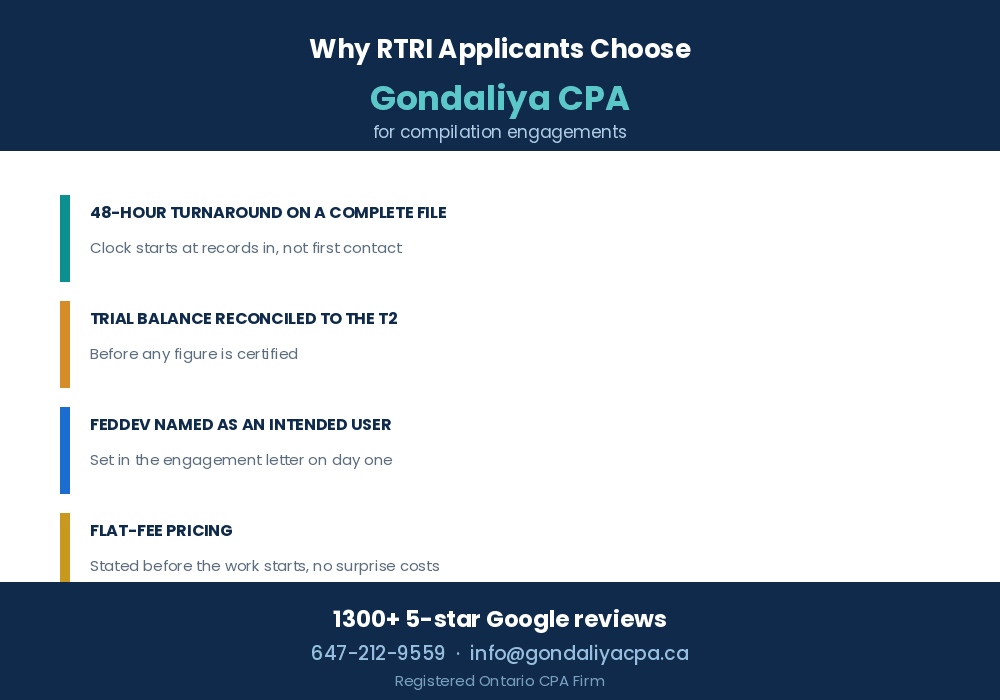
A CPA Compilation Report helps your RTRI tariff relief application by showing your business’s financial info clearly. It uses CSRS 4200 rules and presents data without audit opinions. This lets funders see your position based on the numbers you provide. Gondaliya CPA usually delivers this report within 48 hours after getting all records and the go-ahead.
Using a pro compilation report cuts mistakes in your documents. It matches what FedDev Ontario wants for financial clarity in tariff relief submissions. It also stops delays from missing or unclear evidence. This report doesn’t guarantee funding or cover all program needs alone, but it does boost your credibility across Canada.
Positioning RTRI Within FedDev Ontario’s Broader Support Network
The Regional Tariff Response Initiative (RTRI) belongs to FedDev Ontario’s bigger plan to help southern Ontario businesses facing tariff cost increases. FedDev runs RTRI alongside other programs that aim to grow regional economies and build strength.
RTRI gives non-repayable funds, and repayable contributions for larger transformative projects, to eligible incorporated businesses. These businesses must show need with detailed financial docs — like compiled statements — and plans to handle tariff issues. Knowing how RTRI fits in the larger federal support system helps applicants use resources smartly and follow each program’s rules.
Applicants should check official FedDev Ontario updates often for changes in regions, funding times, and required papers since these can shift yearly.
Practical Advice for Strengthening Applications and Preparing Required Evidence
To get RTRI funds, you need to submit clear financial documents following the program’s guidelines. You should provide:
- Compiled interim or year-end financial statements covering the needed periods
- Trial balances that match tax filings like T2 returns
- Schedules showing inventory buys affected by tariffs
- Bank statements showing cash flow
- Prior CRA notices of assessment when relevant
Gondaliya CPA asks clients to send full trial balances, bank statements, past T2 filings, GST/HST returns if needed, payroll summaries if they apply, loan contracts affecting liabilities, plus any old compiled reports for comparison.
Sending organized records early speeds up review. Our 48-hour turnaround starts once we accept files. Missing reconciliations or tax mismatches cause delays; preparing ahead avoids those problems.
| Document Type | Purpose | Typical Period | Notes |
|---|---|---|---|
| Trial Balance | Base for compiling reports | Latest fiscal period(s) | Must match filed tax returns |
| Bank Statements | Verify cash | Last 3–6 months | Shows liquidity |
| Prior T2 Tax Returns | Confirm income | Past fiscal years | Checks consistency |
| GST/HST Returns | Sales tax reporting | Relevant quarters | Needed if registered |
| Loan/Lease Agreements | Show liabilities | Current contracts | Impacts balance sheet accuracy |
Where any of these cannot be produced because the underlying records are behind, our corporate tax cleanup service deals with that before the compilation starts. Compiling from a ledger that does not reconcile just moves the problem into the application.
Access to Additional Resources: Guides, Webinars, and Downloadable Tools
FedDev Ontario offers guides online that walk you through applying for RTRI tariff relief — including what financial documentation to prepare. They cover steps for gathering documents and checking eligibility.
Gondaliya CPA also provides webinars explaining common mistakes in government fund applications. You can also download our free RTRI compilation checklist, made for Canadian incorporated businesses applying under the initiative.
If you want quick answers about compilation engagements or specific filing questions across Canada’s tariff relief programs, our FAQ section covers popular topics simply.
Contact Information and Consultation Services Offered by Gondaliya CPA for RTRI Applicants
Businesses needing help with their compilation report for FedDev Ontario applications can reach Gondaliya CPA by phone at 647‑212‑9559 or email info@gondaliyacpa.ca. Our team works fast under strict government deadlines across Toronto and Ontario and nationwide.
We give free consultations to understand your needs before starting — with no pressure. Fees are quoted before work begins, including HST, and our engagements carry a 30-day money-back arrangement and a 60-day fee-matching arrangement, with evening and weekend availability throughout your application process. You can see indicative pricing on our fee calculator, and our small business accounting page covers the ongoing work.
Working with CPAs who know CSRS 4200 accounting standards and federal grant rules helps make sure your materials meet expected formats. This reduces costly re-submissions due to technical errors.
Applicants arrive asking for a compilation and need a reconciliation first. The 48 hours is real, but it starts when the ledger agrees to the filed return. Figures changed for privacy.
Frequently Asked Questions (FAQs) on CPA Compilation Reports for RTRI Tariff Relief
Frequently Asked Questions
FAQ
What is an Engagement Letter in a CPA compilation?+
An Engagement Letter outlines the scope, responsibilities, and terms between Gondaliya CPA and clients before starting the compilation work, and it names the intended users of the statements.
Who can be a Third-Party User of a CPA Compilation Report?+
Third-party users include lenders, government agencies like FedDev Ontario, or investors who rely on the compiled financial statements for decisions. They are identified in the engagement letter before the work begins.
What is the difference between Compilation Work by a CPA vs Non-CPA provider?+
A CPA works under CSRS 4200 with professional standards, working papers and regulatory accountability. A non-CPA provider may produce something that looks similar without those controls behind it.
Can I Get the Statements Myself or Should I Hand Them to a CPA Firm?+
You can prepare your own statements but handing them to Gondaliya CPA ensures compliance with CSRS 4200 and a consistent set of figures to attach to your application.
What Does a Compilation Not Do for My Application?+
It does not audit or verify financial data. It only compiles information provided by your business without assurance or opinion, and it does not assert that you are a going concern or that tariffs caused your position.
What Mistakes Delay an RTRI Application Related to Compilation Reports?+
Mismatched trial balances, incomplete records, missing engagement letters, revenue on the form that differs from the statements, and late submissions.
How Does Gondaliya CPA Produce a Compilation Report in 48 Hours?+
Streamlined document collection, a fixed intake list, and partner review built into the workflow. The clock starts once all records are in and the ledger reconciles.
What Deliverables Do You Get From Gondaliya CPA’s Compilation Service?+
A formal CPA Compilation Report prepared under CSRS 4200 with notes on the basis of accounting, and the signed engagement letter identifying intended users.
How Much Does a CPA Compilation Report Cost in Canada?+
It depends on the number of periods, the state of the records and whether reconciliation work is needed first. Fees are quoted before work begins, including HST.
Why Trust Gondaliya CPA for Your RTRI Tariff Relief Application?+
We are a Registered Ontario CPA Firm working under CSRS 4200, with cross-border expertise in Canadian and USA (Washington and Montana) standards and firm registration verifiable at cpaontario.ca.
How much non-repayable funding is available under the RTRI?+
Up to $2 million in liquidity assistance and up to $1 million for a non-repayable pivot project, to a combined maximum of $3 million. Including repayable pivot funding, total RTRI support can reach $20 million per business.
How is liquidity assistance calculated?+
At 50% of average eligible monthly payroll for up to 12 months, capped at $2 million. Where the payroll-based amount does not meet a demonstrated need because of high essential operating expenses, up to 50% of eligible operating costs may be considered on an exceptional basis.
Can a company in insolvency proceedings apply?+
Generally no. The program is built around businesses that were viable before the tariffs applied, so a company that cannot demonstrate going concern will usually not qualify.
Is Notice to Reader the same as a compilation report?+
No. Notice to Reader is a retired term. Compilation engagements have been performed under CSRS 4200 since 2021, and the report states that no assurance is provided.
Two questions come up on nearly every call: whether an audit is required, and whether Notice to Reader still exists. Neither, in both cases. Figures changed for privacy.
Businesses We Serve
Businesses We Serve
Industries
Tariff-exposed businesses share the same application issues. Here are ten and the usual finding.
| Business | The Issue That Usually Appears |
|---|---|
| Manufacturers | Input cost increases spread across jobs, never isolated |
| Steel and aluminium fabricators | Section 232 exposure obvious but never documented |
| Auto parts suppliers | Indirect exposure through an affected exporter |
| Food and beverage processors | Packaging and input costs against fixed retail pricing |
| Construction and skilled trades | Material cost escalation buried in job costing |
| Transportation and logistics | Freight inflation not separated from fuel |
| Importers and distributors | Duty recorded in cost of goods with no separate line |
| E-commerce and retail | Landed cost never calculated per unit |
| Technology firms with hardware | Cross-border supply chain exposure unrecognised |
| Exporters to the United States | The 25% revenue test never actually measured |
- Manufacturers: Isolate the input cost line.
- Steel and aluminium fabricators: Document what is obvious.
- Auto parts suppliers: Indirect exposure still counts.
- Food and beverage processors: Show the margin compression.
- Construction and skilled trades: Pull escalation out of job costs.
- Transportation and logistics: Separate freight from fuel.
- Importers and distributors: Give duty its own account.
- E-commerce and retail: Calculate landed cost per unit.
- Technology firms with hardware: Map the supply chain.
- Exporters to the United States: Measure the 25% before claiming it.
The sector changes. The gap does not: the exposure is real and nobody has put a number on it in the ledger. Figures changed for privacy.
Key Points on CPA Compilation Reports and RTRI Applications
Professional Guidance and Quick Reference
Guidance
- Registered Ontario CPA Firm working under CSRS 4200, with registration verifiable at cpaontario.ca.
- Serving clients in Canada and USA (Washington & Montana) with cross-border expertise.
- Engagement Letter defines clear roles and intended users before we begin your compilation report.
- Working Papers maintain a documentation trail supporting your financial data.
- Compilation engagement reports state plainly that no assurance is provided on the compiled statements.
- Notice to Reader is a retired term; CSRS 4200 replaced it, and the assurance level is none rather than limited.
- DIY compilation risks missing technical details required by FedDev Ontario.
- Hiring Gondaliya CPA reduces risk of application delay due to report errors.
- We advise when you should compile yourself or use a CPA firm.
- Our process avoids common mistakes that delay funding decisions.
- Clients receive detailed deliverables: report, notes, engagement letter included.
- Fees quoted before work begins, including HST, with no hourly billing.
- Our FAQ covers typical client questions on tariff relief reporting needs.
- Next Steps: Contact Gondaliya CPA to start your RTRI tariff relief application confidently.
Quick Answers: Key Numbers & Concepts at a Glance
At a Glance
| Question | Answer |
|---|---|
| Liquidity assistance | Non-repayable, up to $2M, 50% of eligible costs |
| Non-repayable pivot project | Up to $1M, 50% of eligible costs |
| Repayable pivot project | Over $1M, up to 75% of eligible costs |
| Combined non-repayable maximum | $3 million per business |
| Total RTRI maximum | $20 million including repayable |
| Minimum revenue | $1M in one of the last two fiscal years |
| Liquidity end date | No later than 31 March 2028 |
| Pivot project end date | No later than 31 March 2029 |
| Retroactive pivot costs | Up to 12 months before submission |
| Stacking ceiling, pivot projects | Normally 90%; up to 100% for Indigenous applicants |
| National RTRI envelope | $3.45 billion across all RDAs |
| Assurance on a compilation | None |
Who This Is For / Not For
Fit Check
- For: Incorporated for-profit businesses located and operating in southern Ontario with at least $1 million of revenue in one of their last two fiscal years, that can evidence tariff impact and need financial statements prepared quickly.
- Not For: Unincorporated businesses, businesses outside the FedDev Ontario catchment area, those unable to demonstrate direct or indirect tariff exposure, companies in insolvency proceedings, and not-for-profits seeking liquidity support for their own operating expenses.
People Also Ask
Quick Answers
Is the RTRI a grant or a loan?+
Both, depending on the stream. Liquidity assistance and pivot projects up to $1 million are non-repayable. Pivot projects above $1 million are repayable contributions at up to 75% of eligible costs.
Do I need audited financial statements to apply?+
The application asks for financial statements and does not specify an audit. Most private companies attach compiled statements prepared under CSRS 4200, which carry no assurance. What matters is that the revenue figures agree to what you enter on the form.
How long does an RTRI application take to prepare?+
The financial statements are usually the fastest part, at 48 hours once records are complete. The impact narrative, the evidence to support it and the cash flow forecast typically take longer.
Can a business that already received RTRI funding apply again?+
Previous RTRI recipients may be eligible for the liquidity support introduced in the September 2026 expansion. Existing recipients should contact their project officer.
What if my revenue is just under $1 million?+
The test looks at one or both of your last two fiscal years, so a stronger prior year can carry you over even if the current year is down.
Glossary of Key Terms
Plain-English Definitions
- RTRI: The Regional Tariff Response Initiative, delivered nationally by Canada’s regional development agencies.
- FedDev Ontario: The Federal Economic Development Agency for Southern Ontario.
- Liquidity assistance: Non-repayable short-term support based on 50% of average eligible monthly payroll.
- Pivot project: Investment to improve productivity, competitiveness and resilience against future trade disruption.
- Compilation engagement: An engagement under CSRS 4200 presenting financial information without assurance.
- Engagement Letter: The written agreement setting out scope, responsibilities and intended users.
- Third-Party User: A lender, investor or funder relying on the compiled statements.
- Working Papers: The documentation trail supporting the compiled figures.
- Stacking: The combined limit on government assistance toward the same eligible costs.
- Going concern: Whether the business can be expected to continue operating, which the program tests as viability before tariffs.
- Section 232 and Section 338: The United States tariff measures used to define sector exposure.
- Non-repayable contribution: Funding that does not have to be paid back.
- Repayable contribution: Funding paid back on agreed terms, used for pivot projects above $1 million.
- Eligible costs: The costs a contribution rate is applied to.
- Intended user: The party named in the engagement letter as relying on the statements.
- Trial balance: The listing of ledger balances the statements are compiled from.
This quick self-check indicates whether your file is ready. Please answer the five questions below.
RTRI Readiness Check
Five quick questions on your business. No fee shown.
Points to raise with us:
This is a general prompt, not tax or legal advice or a quote. Your position depends on your full facts. For a real review, please book a free consultation.
The RTRI application asks you to attach financial statements whose revenue figures match what you enter on the form, and a compilation engagement under CSRS 4200 is the usual way a private company produces them quickly. Understand the two streams before you apply: liquidity assistance is calculated at 50% of average eligible monthly payroll for up to 12 months, while pivot projects fund longer-term competitiveness work and can reach back 12 months for costs already incurred. Note that the 75% coverage band applies only to repayable contributions above $1 million. Reconcile the trial balance to the filed T2 before anything is certified, and check the published guidelines on the day you apply.
2026 Update — what is current as at 16 September 2026: On 25 August 2026 the Government of Canada announced a $7.5-billion package including an additional $1.5 billion for the RTRI, bringing the national total delivered by the regional development agencies to $3.45 billion. Applications for the enhanced initiative opened on 8 September 2026. The non-repayable ceiling rose to $3 million combined — up to $2 million of liquidity assistance plus up to $1 million for a non-repayable pivot project — with total RTRI funding reaching $20 million where repayable support is included. Liquidity assistance is calculated at 50% of average eligible monthly payroll for up to 12 months, ending no later than 31 March 2028; pivot projects must complete by 31 March 2029. Eligibility centres on a $1 million minimum revenue threshold in one of the last two fiscal years, across all sectors. Please note that the “one active project” restriction and the “no retroactive funding” rule described in earlier guidance are not the current position, and that Notice to Reader is a retired term replaced by CSRS 4200, under which a compilation carries no assurance rather than limited assurance. FedDev Ontario states it may modify the guidelines at any time without notice.
RTRI Compilation Reports: How Gondaliya CPA Supports You
Applying to the RTRI and need statements attached?
We reconcile the trial balance to your filed T2, compile statements under CSRS 4200 with FedDev Ontario named as an intended user, and flag the mismatches before a reviewer sees them — typically within 48 hours of a complete file, on a flat fee stated before the work starts.
Next Steps
Please book a free consultation with Gondaliya CPA and bring your last two filed T2 returns, your current trial balance, and twelve months of payroll registers with the matching CRA remittance reports. Those three tell us within minutes whether the statements can be compiled this week. You will get a flat fee stated before any work begins, including HST. You can also send us a message if you would rather start in writing.
Published: · Last updated:
Editorial policy: Program parameters are taken from FedDev Ontario’s published RTRI pages and Government of Canada announcements, checked on the publication date. FedDev Ontario may modify the guidelines at any time without notice, so confirm the current position before applying.
Disclaimer: This article is educational information only and is not tax, legal, or financial advice, and is not a representation about eligibility or the outcome of any application. Compilation engagements under CSRS 4200 provide no assurance. Please speak with a CPA before acting.

Sharad Gondaliya is a CPA Canada & CPA USA with 15 Years+ experience of Accounting, Tax, Payroll of Corporate Small Businesses as Tax Accountant. He is fully certified CPA Ontario and CPA USA and is well known among corporate small businesses for tax planning, efficient tax solutions, and affordable CPA services. Sharad is the Principal (Director) of Gondaliya CPA – Affordable CPA Firm in Canada. Licenses: CPA Ontario: 61040184 | CPA USA (MT): PAC-CPAP-LIC-033176 | CPA USA (WA): 57629 | CPA Firm License: 61330051 View Full Author Bio