



The Ultimate Guide to Accounting and Tax Services for Demolition Contractors in Canada
Demolition Contractor CPA Canada: Accounting Services, Job Costing, T5018 Reporting and Compliance by Gondaliya CPA
As a trusted demolition contractor CPA Canada, Gondaliya CPA specializes in job costing, T5018 reporting, payroll reporting, and construction lien rules for demolition crews, abatement contractors, and scrap and salvage operators. We provide financial statement preparation, payroll slips, GST/HST registration, and CRA representation to keep your demolition accounting compliant and efficient.
Strip-out crews, abatement specialists and salvage operators each hit the same three problems: costs that will not stay attached to a job, holdbacks landing in the wrong period, and subcontractor slips filed late. Our demolition contractor accounting and tax services handle all three on a fixed annual fee.
Quick Summary
Demolition contractors deal with tricky accounting. Tracking project costs like labour, equipment, permits and disposal fees takes real discipline. Without it, profits slip away and records stop matching. Handling revenue across several projects at once, on different contract types, makes it harder again.
Reading time: 49 minutes.
Table of Contents
- Accounting Challenges in Demolition
- Job Costing and Progress Billing
- T5018 and Subcontractor Classification
- Holdbacks, Lien Rules and GST/HST
- Payroll, Equipment and Capital Cost Allowance
- Incorporation, Compliance and Audit Risk
- Frequently Asked Questions
- Essential Compliance Points
- Demolition Operations We Serve
- Professional Guidance and Quick Reference
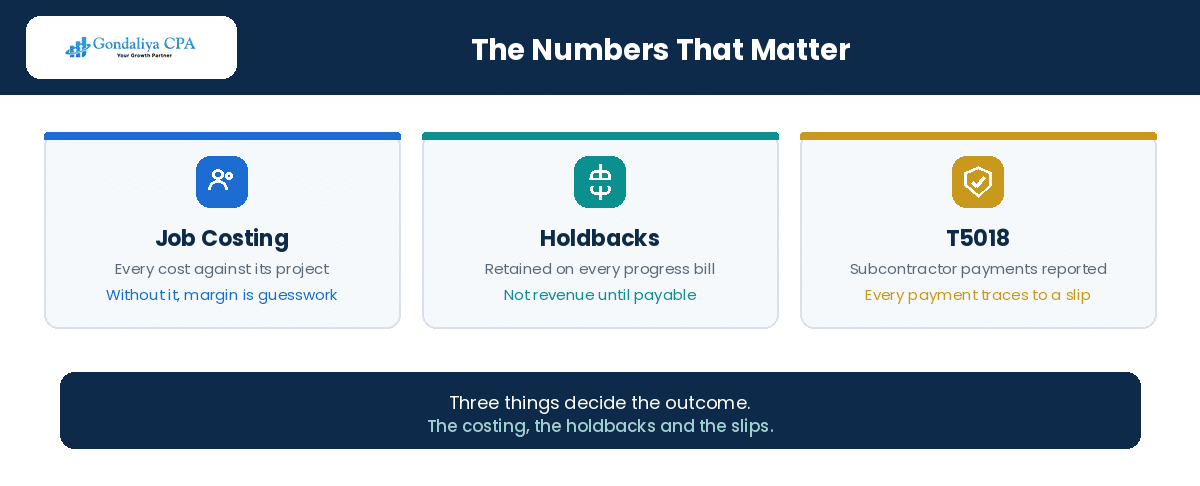
The Numbers That Matter
This article covers Canada, with Ontario and Toronto context, and reflects rules current to 2026. It assumes an incorporated demolition contractor, abatement specialist, excavation firm or salvage operator. Figures marked illustrative are examples, not quotes, and any masked engagement notes end with “Figures changed for privacy.” This is educational information only and not tax or legal advice. Construction lien legislation, designated substance regulation, municipal permitting and workers’ compensation registration are legal and regulatory matters that sit outside accounting; please take those to the appropriate authority or counsel.
Understanding Accounting Challenges for Demolition Contractors
Accounting Challenges in Demolition
The Basics
Why Demolition Accounting Is Different
Keeping track of project costs takes real care. Labour, equipment, permits and disposal fees all attach to specific jobs, and if they do not, your margin becomes a guess.
Handling revenue across several projects at once is harder still. Some contracts are fixed price, others charge by time or by unit, and each recognises revenue differently.
- Track every project expense against the job it belongs to
- Manage varied payment terms across concurrent contracts
- Apply revenue recognition consistently
Compliance Requirements Specific to the Sector
Demolition companies report income under the Income Tax Act and handle GST/HST under the Excise Tax Act like any business. What sets the sector apart is the layer on top.
Firms working with designated substances such as asbestos face strict regulatory requirements. Those obligations are safety law rather than tax law, but they generate costs that have to be classified correctly and documented.
- Report contract income in the right period
- Apply GST/HST correctly on progress billings and holdbacks
- Document abatement and disposal costs properly
What an Accountant Brings
Cash flow on long projects is the constant pressure. Money goes out on labour, equipment and disposal well before a progress bill is certified, and the holdback stays behind after that.
A demolition contractor accountant works on the areas that decide the outcome: capital cost allowance on heavy equipment, work-in-progress schedules that survive review, budgeting from your own historical data, and instalment planning that fits lumpy income.
Salvage Operators and Abatement Contractors
Scrap and salvage operators need every sale documented. Weigh tickets tie the quantity to the price and to the deposit, and without them the revenue figure is unsupported.
Abatement contractors need costs tied directly to the jobs they relate to, both for margin analysis and for the deduction. Clean records make a CRA review straightforward rather than expensive.
- Keep weigh tickets for every scrap sale
- Attach abatement costs to the specific job
- Maintain an audit trail from ticket to invoice to deposit
Scrap revenue reaching the bank without a weigh ticket behind it is the first thing a reviewer pulls on a demolition file. The amount is rarely the problem; the missing paperwork is. Figures changed for privacy.
Risk Warning: Costs that are not attached to a job are costs you cannot price from. Please set up job codes before the next contract starts, not after.
Job Costing and Progress Billing
Job Costing and Progress Billing
The Costing
Project-Based Costing That Works
Job costing has to be clear. Log labour hours, equipment use, disposal fees, subcontractor costs, permits and surveys against the job they belong to.
Overhead is allocated on a consistent basis so margins are not distorted. Use a chart of accounts built for demolition rather than a generic one. Record equipment costs by asset: depreciation, fuel, repairs and rentals.
Cloud accounting with receipt capture automates most of the expense tracking. Match debris weigh tickets against disposal invoices monthly so discrepancies surface while they are small.
Compare estimated against actual cost by phase every month. Catching an overrun in month three is a management decision; catching it at year end is just a worse number.
Progress Billing and Revenue Recognition
Demolition companies usually bill as work proceeds rather than waiting for completion. Revenue is recognised on progress or on completion depending on the contract and the accounting policy applied.
For long-term contracts, the percentage-of-completion method measures progress against a defensible basis such as cubic metres removed, phases certified or costs incurred to date against total expected costs.
Several items commonly land in the wrong period:
| Item | Correct Treatment |
|---|---|
| Deposits received before work starts | A liability until the work is performed |
| Approved change orders | Added to contract value once the client approves |
| Unapproved change orders | Not recognised as revenue until settled |
| Statutory holdbacks | Not revenue until the holdback becomes payable |
| Work in progress at year end | Measured and scheduled, not estimated loosely |
A monthly billing cycle tied to accurate job costing improves cash flow and makes the year-end work far shorter.
A Toronto strip-out contractor holds a $500,000 contract, has completed work representing 60% of expected costs, and has billed $300,000 with a 10% holdback retained. Revenue is recognised on the completed portion, the $30,000 holdback sits outside revenue until it becomes payable, and the work-in-progress schedule reconciles the two. Figures changed for privacy.
Work in Progress at Year End
The work-in-progress schedule is the document that decides whether your year end holds up. It lists each open contract, the value, costs incurred to date, the percentage complete, revenue recognised and amounts billed.
Over-billings and under-billings both appear on the balance sheet, and both matter to a lender or bonding company reading your statements.
Preparing this properly requires the job costing to have been maintained through the year. It cannot be reconstructed convincingly in March.
The work-in-progress schedule is the first thing a bonding company asks for and the last thing most demolition contractors have ready. Building it monthly turns a two-week job into an hour. Figures changed for privacy.
Key Stat: A deposit received before work starts is a liability, not revenue. Please keep it out of income until the work is performed.
T5018 Reporting and Subcontractor Classification
T5018 and Subcontractor Classification
The Slips
When T5018 Applies
If your primary business activity is construction and you pay subcontractors for construction services, you file T5018 information returns reporting those payments.
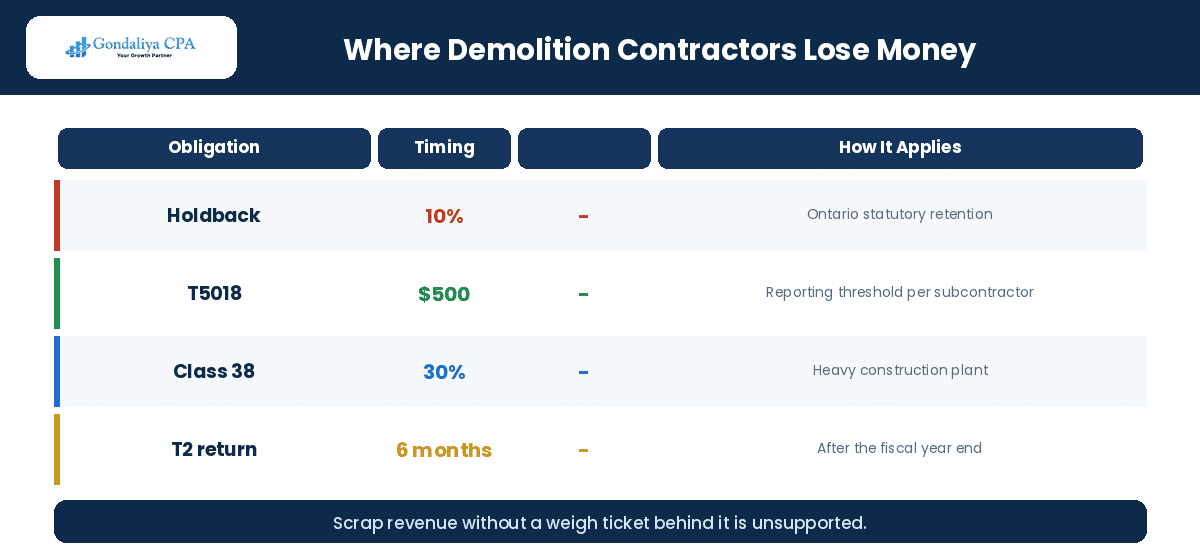
The reporting threshold is $500 in total payments to a subcontractor in the reporting period. Amounts below that do not have to be reported, though many contractors report everything for consistency.
The return is due six months after the end of your reporting period. You elect either a calendar year or your fiscal year as the reporting period, and once chosen you keep it. Our T5018 filing requirements page covers the mechanics in detail.
Report gross payments including any GST/HST charged, unless you have elected otherwise. Late filing brings penalties that scale with the number of slips.
Employee or Subcontractor
The classification decides your payroll obligations, your workers’ compensation position and which slip you issue. The CRA looks at the substance of the relationship:
- Control: Who decides how and when the work is done
- Tools and equipment: Who supplies the machinery and who bears its cost
- Chance of profit and risk of loss: Whether the worker can profit from efficiency or lose on a bad quote
- Integration: How embedded the worker is in your business
Demolition sits in a difficult spot here. A crew member who shows up when told, uses your excavator and is paid hourly looks like an employee whatever the invoice says.
| Position | What You Do | Slip Issued |
|---|---|---|
| Employee | Withhold CPP, EI and income tax; remit on schedule | T4 |
| Subcontractor providing construction services | Pay gross, no withholding | T5018 |
| Other self-employed service provider | Pay gross, no withholding | T4A where applicable |
What Goes Wrong
Misclassification is expensive in both directions. Treating an employee as a subcontractor means the CRA can assess the source deductions that should have been withheld, plus penalties and interest, and directors carry personal exposure on unremitted amounts.
Issuing the wrong slip is a separate problem. A worker who should have received a T4 receiving a T5018 creates a mismatch the CRA can see directly.
Where the position is genuinely unclear, a ruling can be requested. That is often cheaper than defending an assumption two years later.
The T5018 reconciliation against the subcontractor ledger is where discrepancies show up. Payments recorded but never slipped, and slips issued for amounts nobody can trace. Figures changed for privacy.
Risk Warning: An invoice from a worker does not make them a subcontractor. Please test the relationship against the CRA factors before the first payment.
Holdbacks, Lien Rules and GST/HST
Holdbacks, Lien Rules and GST/HST
The Holdbacks
How Holdbacks Work
Provincial construction legislation requires a statutory holdback from progress payments. In Ontario the Construction Act sets this at 10% of the value of services or materials supplied.
The holdback is released after the statutory period following certification or publication of substantial performance. The exact trigger and period are set by the legislation, so please confirm the current requirement with counsel rather than assuming a figure.
For accounting purposes what matters is timing:
- The holdback is not recognised as revenue until it becomes receivable
- Holdbacks payable to your own subcontractors are a liability, not a cost you have settled
- Both sides need tracking by project, not in one lump
A demolition firm working a $500,000 contract has $50,000 retained as statutory holdback across progress bills. That amount stays out of revenue until it becomes payable under the legislation, and the holdback schedule shows the position by project each month. Figures changed for privacy.
Lien Legislation and Your Records
Lien legislation protects unpaid contractors and suppliers. It does not change how your corporation is taxed, but it does require clear records of retainage across projects, and the deadlines it imposes are unforgiving.
Deposits received before work starts sit as liabilities and become revenue as the work is performed. Tracking them alongside the lien timeline stops double counting.
Failing here is a legal and cash flow problem more than a tax one, but in a sector with thin margins that distinction is academic.
GST/HST Registration and Filing
Registration is required once taxable revenue exceeds $30,000 measured across four consecutive calendar quarters. Most demolition contractors pass that in their first months. You can register for GST/HST at any point, and registering early lets you recover tax on equipment purchases.
You charge the rate applying to the place of supply. Ontario is 13%. Most demolition and construction services are taxable supplies.
Input tax credits are available on purchases used in your commercial activity, supported by invoices showing the supplier’s registration number.
GST/HST on Progress Billings and Holdbacks
GST/HST generally becomes payable on the earlier of when consideration is paid and when it becomes due, which for progress billings is usually the invoice.
Holdbacks are treated separately. Where an amount is held back under legislation or the contract, the tax on that portion is generally accounted for when the holdback is paid or becomes payable, rather than at the original invoice.
Getting this wrong means remitting tax on money you have not received, which in a sector with 10% retained on every bill is a real cash flow cost.
Filing frequency is assigned by the CRA based on your taxable supplies. Annual filing applies below $1.5 million, quarterly between $1.5 million and $6 million, and monthly above that.
Remitting GST/HST on the holdback portion at invoice date is the single most common cash flow error we correct on demolition files. It funds the CRA out of money the client is legally holding. Figures changed for privacy.
Key Stat: Tax on a statutory holdback is generally accounted for when the holdback becomes payable. Please check your filings are following that treatment.
Payroll, Equipment and Capital Cost Allowance
Payroll, Equipment and Capital Cost Allowance
The Assets
Payroll for Demolition Crews
Payroll needs tight control over source deductions tied to site records. Demolition crews commonly earn shift premiums and overtime because of the conditions, and premium pay for designated substance work has to be recorded properly.
Employees receive T4 slips showing wages and deductions, filed by the last day of February. Source deductions are remitted on the schedule set by your remitter type, which depends on your average withholding rather than a fixed rule.
Workers’ compensation registration is a provincial matter and the board differs by province. Ontario employers deal with the WSIB; British Columbia employers deal with WorkSafeBC. Please register with the board for the province where the work is performed.
Capital Cost Allowance on Heavy Equipment
Equipment classification drives your deduction. Common positions for demolition assets:
| Asset | Typical Class | Notes |
|---|---|---|
| Heavy construction equipment | Class 38 at 30% | Excavators and similar plant acquired for construction use |
| General machinery and furniture | Class 8 at 20% | Catch-all where no specific class applies |
| Passenger and general vehicles | Class 10 at 30% | Class 10.1 above the prescribed cost ceiling |
| Heavy freight trucks | Class 16 at 40% | Applies to specified heavy trucks and tractors |
| Small tools under the threshold | Class 12 at 100% | Written off quickly where the item qualifies |
The half-year rule limits the claim to half the normal amount in the year an asset becomes available for use. Please confirm the class for each machine rather than applying one class across the fleet, since the difference between 20% and 40% compounds quickly.
Safety equipment and protective gear is usually expensed given cost and replacement frequency, though a substantial system may be capital.
Buy, Lease or Rent
| Factor | Buying | Leasing | Renting |
|---|---|---|---|
| Upfront cost | High | Moderate and periodic | Low |
| Capital cost allowance | Yes, half-year rule applies | No, payments deducted | No, fees deducted |
| Maintenance | Owner | Depends on the lease | Rental company |
| On disposal | Recapture or terminal loss possible | None | None |
| Cash flow effect | Large initial outlay | Spread evenly | Minimal |
Own equipment you will use for years, since the depreciation and the residual value both accrue to you. Lease where predictable payments matter more than ownership. Rent where use is occasional, and note that GST/HST input tax credits are available on rental charges either way.
Watch recapture on disposal. Selling a machine for more than its remaining class balance produces income, and contractors upgrading a fleet in one year are often surprised by it.
A fleet upgrade in a single year can generate recapture large enough to wipe out the deduction the new equipment was supposed to create. Modelling it first changes the timing decision. Figures changed for privacy.
Pro Tip: Please model the recapture before selling older machines. The tax result of a disposal often decides which fiscal year the sale should fall in.
Incorporation, Compliance and Audit Risk
Incorporation, Compliance and Audit Risk
The Structure
Incorporating a Demolition Business
Incorporation gives limited liability, which matters more in demolition than in most trades. It also opens access to the small business deduction on the first $500,000 of active business income for a Canadian-controlled private corporation, shared across associated corporations.
The obligations that come with it are real:
- File a T2 corporate return within six months of fiscal year-end
- Keep records of contract income, work in progress and holdbacks
- Operate payroll where you have employees
- File GST/HST returns on your assigned period
- File T5018 information returns for subcontractor payments
The balance owing is due earlier than the return, generally two months after year-end or three months for eligible CCPCs.
Tax Planning That Fits the Sector
Planning for a demolition business works around the shape of the work:
- Choosing a fiscal year-end that falls between major projects rather than mid-contract
- Managing work in progress so income lands in the period it was earned
- Timing equipment purchases against the available-for-use rule
- Balancing salary and dividends, reviewed annually rather than fixed
- Forecasting instalments against lumpy income to avoid interest
Income arriving in chunks tied to milestones makes instalment forecasting genuinely difficult. Updating the forecast after each significant contract win keeps you out of the interest charges.
Reducing Audit Exposure
The patterns that draw attention in this sector are consistent:
- Scrap sale deposits with no weigh tickets behind them
- Subcontractor payments in the ledger that never appear on a T5018
- Holdbacks recognised as revenue in the wrong period
- Work-in-progress balances that move without explanation
- Input tax credits claimed without supplier invoices
Detailed job costing files with monthly progress billing reconciliation answer most of these before they become questions. Our CRA audit guide covers what a review involves.
Bad Debts, Scrap Sales and Disposal Costs
A bad debt is deductible where the amount was included in income and you have genuinely tried to collect. Keep the invoices, the record of collection attempts and the write-off approval.
Scrap metal sales are taxable revenue and generally carry GST/HST. Weigh tickets prove quantity and price. Disposal costs including landfill and handling charges should tie back to those tickets or to the waste manifests.
This is where a clean audit trail pays for itself, because the documents already exist. They just need keeping together.
Catch-Up Filing and CRA Representation
If your filings are behind, the corporate late-filing penalty is 5% of the unpaid balance plus 1% per complete month to a maximum of twelve, with interest running separately.
Catch-up work rebuilds the position from bank statements, contracts and payables records, then prepares the outstanding returns and slips. Where the delay had a genuine cause, a taxpayer relief request may reduce the penalties.
Once authorized, we deal with the CRA on your behalf on assessments, queries and disputes.
Working With Gondaliya CPA
We work with incorporated demolition contractors on a flat annual fee covering bookkeeping with job costing, work-in-progress schedules, GST/HST filings, payroll and slips, T5018 returns, financial statements prepared under ASPE with a compilation engagement, and the corporate return.
Statements prepared to that standard are what a lender or bonding company expects to see, which matters in a sector where bonding capacity decides which contracts you can bid.
Contact Gondaliya CPA at info@gondaliyacpa.ca, call 647-212-9559, or send us a message.
Bonding capacity is the reason demolition contractors care about their statements. A clean work-in-progress schedule has won our clients more contracts than any deduction we found. Figures changed for privacy.
Pro Tip: Please reconcile the subcontractor ledger to your T5018 slips before filing. Every payment recorded should appear, and every slip should trace to payments.
FAQs on Demolition Contractor Accounting
Frequently Asked Questions
FAQ
What is the T2 filing deadline for an incorporated demolition contractor?+
Six months after fiscal year-end. The balance owing is due earlier, generally two months after year-end or three months for eligible CCPCs.
How do provincial holdback rules affect demolition contractors?+
Construction legislation requires a statutory holdback from progress payments, 10% in Ontario. The amount is not revenue until it becomes payable under the legislation.
When must a demolition contractor register for GST/HST?+
Once taxable revenue exceeds $30,000 across four consecutive calendar quarters. Most demolition businesses pass that quickly.
When are T5018 information returns due?+
Six months after the end of your reporting period. You elect a calendar year or your fiscal year as that period and keep it consistent.
What is the T5018 reporting threshold?+
$500 in total payments to a subcontractor for construction services in the reporting period. Many contractors report everything for consistency.
What payroll remittance deadlines apply?+
They depend on your remitter type, which is set by your average monthly withholding rather than a fixed schedule.
Which capital cost allowance classes apply to demolition equipment?+
Heavy construction plant commonly falls into Class 38 at 30%, general machinery into Class 8 at 20%, vehicles into Class 10, and specified heavy trucks into Class 16 at 40%.
How does the half-year rule work?+
It generally limits your claim to half the normal capital cost allowance in the year an asset becomes available for use.
How are change orders treated for revenue recognition?+
Approved change orders increase contract value and are recognised as the related work is performed. Unapproved change orders are not recognised until settled.
How long must demolition contractors keep records?+
Six years from the end of the tax year they relate to, including job costing files, weigh tickets, contracts and slips.
Is GST/HST payable on the holdback at the time of invoicing?+
Generally the tax on a statutory holdback is accounted for when the holdback is paid or becomes payable, rather than at the original progress billing.
What happens if a subcontractor is really an employee?+
The CRA can assess the source deductions that should have been withheld, plus penalties and interest, and directors carry personal exposure on unremitted amounts.
Twelve questions and one underneath most of them: has this been earned yet. Holdbacks, deposits and change orders all turn on that. Figures changed for privacy.
Essential Compliance Points for Demolition Contractors
Essential Compliance Points
Quick Reference
Filing and Deadlines
- Corporate return: T2 within six months of fiscal year-end.
- Balance owing: Two or three months after year-end by circumstance.
- Late filing: 5% of the unpaid balance plus 1% per complete month, to twelve.
- T5018: Six months after the end of your elected reporting period.
- T5018 threshold: $500 in payments to a subcontractor in the period.
- Slips: T4 and T4A by the last day of February.
- GST/HST: Filing frequency assigned by taxable supplies.
- Payroll: Remittance schedule set by your remitter type.
- Records: Six years from the end of the tax year.
Revenue, Holdbacks and Job Costing
- Recognise contract revenue consistently, using percentage of completion for long contracts.
- Keep statutory holdbacks out of revenue until they become payable.
- Treat deposits received before work starts as liabilities.
- Recognise approved change orders only once the client has approved them.
- Maintain a work-in-progress schedule monthly, not at year end.
- Reconcile progress billings to the job costing every month.
- Allocate overhead on a consistent and documented basis.
- Match debris weigh tickets to disposal invoices.
Assets, Payroll and Records
- Confirm the capital cost allowance class for each machine individually.
- Apply the half-year rule in the year an asset becomes available for use.
- Model recapture before disposing of equipment.
- Test each worker against the CRA control, tools and risk factors.
- Reconcile the subcontractor ledger to your T5018 slips before filing.
- Register with the workers’ compensation board for the province where work is performed.
- Record premium pay for designated substance work correctly.
- Hold supplier invoices with registration numbers for every input tax credit.
- Keep weigh tickets supporting every scrap and salvage sale.
For assistance built for incorporated Canadian demolition contractors, contact Gondaliya CPA at info@gondaliyacpa.ca, call 647-212-9559, or book a free consultation.
Twenty-six points and one underneath them: know what you have earned, what you are holding and what is still being held from you. Every demolition file we fix started with those three blurring together. Figures changed for privacy.
Demolition Operations We Serve
Industry Expertise
Which issue dominates differs by the work you take. Here are ten and the usual focus.
| Demolition Operation | Where the Exposure Sits |
|---|---|
| Commercial strip-out contractor | Progress billing and work-in-progress schedules |
| Structural demolition firm | Heavy equipment classes and recapture on disposal |
| Asbestos and abatement specialist | Designated substance premium pay and job costing |
| Excavation and site preparation | Equipment utilisation across concurrent jobs |
| Scrap and salvage operator | Weigh tickets supporting every sale |
| Contractor using many subcontractors | T5018 reconciliation and worker classification |
| Firm holding large holdback balances | Revenue timing and GST/HST on holdbacks |
| Contractor bidding bonded work | Statements a bonding company will accept |
| Business upgrading its fleet | Recapture modelled before disposal |
| Behind on filings | Catch-up and taxpayer relief before CRA contact |
- Commercial strip-out contractor: Monthly billing only works if job costing keeps pace.
- Structural demolition firm: One class applied across the fleet costs real money.
- Asbestos and abatement specialist: Premium pay and survey costs belong to specific jobs.
- Excavation and site preparation: Machine time has to be charged to the job that used it.
- Scrap and salvage operator: No ticket means the revenue is unsupported.
- Contractor using many subcontractors: Every payment should trace to a slip.
- Firm holding large holdback balances: Taxed early, this is money you cannot yet collect.
- Contractor bidding bonded work: The work-in-progress schedule decides your capacity.
- Business upgrading its fleet: Recapture can undo the deduction you bought.
- Behind on filings: Coming forward first costs far less than being found.
The work changes where the exposure sits. It does not change the method, which is cost every job properly, keep holdbacks out of revenue, then reconcile the slips. Figures changed for privacy.
Professional Guidance and Quick Reference
Guidance
Professional Guidance for Contractors: How Gondaliya CPA Handles Your File
Demolition contractors lose money in a predictable set of ways: statutory holdbacks recognised as revenue before they are payable, GST/HST remitted on the holdback portion at invoice date rather than when it becomes payable, subcontractor payments sitting in the ledger with no T5018 slip against them, crew treated as subcontractors when the working relationship says employee, one capital cost allowance class applied across a mixed fleet, and scrap sales reaching the bank with no weigh ticket behind them. Gondaliya CPA handles demolition contractor accounting on a fixed annual fee.
We handle what decides the outcome: job costing by project and phase covering labour, machine time, disposal and permits, work-in-progress schedules built monthly rather than at year end, holdback tracking on both sides of the contract, GST/HST timing on progress billings and holdbacks, T5018 reconciliation against the subcontractor ledger, worker classification tested against the CRA factors, capital cost allowance class assignment machine by machine, and recapture modelling before a fleet disposal.
Our team starts with the work-in-progress schedule and the holdback position, because those two decide both your reported profit and your tax bill. Strip-out, structural, abatement or salvage, you get clear advice and a fixed price before we start.
Quick Answers: Key Numbers & Concepts at a Glance
At a Glance
- Corporate return: T2, six months after year end
- Late filing: 5% plus 1% per month, to twelve
- T5018: Six months after your reporting period ends
- T5018 threshold: $500 per subcontractor
- Ontario holdback: 10% statutory retention
- Holdbacks: Not revenue until payable
- GST/HST: $30,000 registration threshold
- Heavy plant: Class 38 at 30%
- First year: Half-year rule applies
- Records: Six years retention
Who This Is For / Not For
Fit Check
- For: Incorporated demolition contractors, abatement specialists, excavation and site preparation firms, and scrap and salvage operators across Canada.
- Not For: Construction lien claims, designated substance regulation, municipal permitting and workers’ compensation disputes, which need counsel or the relevant authority.
People Also Ask
Related Questions
Do I report GST/HST on the T5018 slip?+
Report gross payments including any GST/HST charged, unless a different election applies. Please confirm the treatment for your reporting period.
Can I claim input tax credits before the holdback is released?+
Input tax credits on your own purchases follow the normal rules and are not deferred because your customer is holding back part of your fee.
Should scrap sales go through the corporation?+
Yes, where the scrap arises from work the corporation performed. Personal sale of company-derived material creates a shareholder benefit problem.
Glossary of Key Terms
- T2: The corporation income tax return.
- T5018: The information return reporting subcontractor payments.
- Job costing: Attributing every cost to the project that incurred it.
- Work in progress: Contract work performed but not yet billed.
- Percentage of completion: Recognising revenue as the work progresses.
- Holdback: An amount retained from progress payments under legislation.
- Substantial performance: The milestone that starts the holdback release period.
- Change order: An approved variation altering contract value.
- Over-billing: Billing ahead of the work performed.
- Capital cost allowance: Tax depreciation on equipment and vehicles.
- Class 38: The 30 percent class covering heavy construction plant.
- Half-year rule: The first-year restriction on CCA claims.
- Recapture: Income arising where proceeds exceed the class balance.
- Input tax credit: GST/HST recoverable on business purchases.
- Weigh ticket: The record supporting a scrap or disposal transaction.
- Compilation engagement: Financial statements prepared under CSRS 4200.
Demolition Contractor Readiness Check
This quick self-check indicates where your operation most likely has room. Please answer the six questions below.
Demolition Contractor Readiness Check
Six quick questions on your operation. No fee shown.
Points to raise with us:
This is a general prompt, not tax or legal advice or a quote. Your position depends on your full facts. For a real review, please book a free consultation.
Want a checklist to work from? You can download our free demolition contractor compliance checklist before your consultation.

Cost every job separately by phase. Keep statutory holdbacks out of revenue until payable. Account for GST/HST on holdbacks when they become payable. Reconcile subcontractor payments to T5018 slips. Build the work-in-progress schedule monthly. Confirm the CCA class for each machine. Keep weigh tickets for every scrap sale. Please keep six years of records.
2026 Update — what is current: This article reflects rules current to 2026. The six-month T2 filing deadline, the 5% plus 1% per month late-filing penalty, the $500 T5018 reporting threshold, the six-month T5018 filing deadline after the elected reporting period, the $30,000 GST/HST registration threshold, the half-year and available-for-use rules and the six-year retention requirement are unchanged. Please note that capital cost allowance classes sit in Schedule II of the Income Tax Regulations, while Regulation 238 is the contract payment reporting provision behind the T5018 itself; that heavy construction plant commonly falls into Class 38 rather than Class 10, which covers vehicles; that the corporate balance owing is due two months after year-end or three months for eligible CCPCs rather than four; and that the statutory holdback percentage and release period are set by provincial construction legislation, which changes independently of tax law and should be confirmed with counsel.
Demolition Contractor CPA Canada: How Gondaliya CPA Keeps Contractors Compliant
Start with the work in progress
Gondaliya CPA builds job costing by project and phase, prepares work-in-progress schedules monthly rather than at year end, tracks holdbacks on both sides of every contract, applies the correct GST/HST timing to progress billings and holdbacks, reconciles subcontractor payments against T5018 slips, tests worker classification against the CRA factors, assigns capital cost allowance classes machine by machine and models recapture before a fleet disposal, on a flat annual fee including HST with a one-business-day response. Please book a free consultation.
Next Steps
Please book a free consultation with Gondaliya CPA and bring a current contract with its progress billings, a list of your equipment with purchase dates, and your last filed corporate return. Those three tell us immediately whether revenue is landing in the right period, what remains to claim on the fleet, and where the documentation is thin. You will get a flat annual fee including HST before any work begins. If our content helps, please add gondaliyacpa.ca as a preferred source on Google.
Published: · Last updated:
Editorial policy: We research against CRA and CPA Ontario sources, fact-check the figures, and Sharad Gondaliya, CPA, reviews the content, which we update as the rules change.
Disclaimer: This article is educational information only and is not tax, legal, or financial advice. Figures marked illustrative are examples rather than quotes or guarantees. It reflects CRA rules current to 2026, including the six-month T2 and T5018 deadlines, the $500 T5018 threshold, the 10% Ontario statutory holdback, the half-year rule, and the six-year retention requirement. Rates, limits and expensing rules change and outcomes depend on your specific facts. Please consult a CPA Ontario member before acting.

Sharad Gondaliya is a CPA Canada & CPA USA with 15 Years+ experience of Accounting, Tax, Payroll of Corporate Small Businesses as Tax Accountant. He is a CPA Ontario member (61040184) and holds US CPA licences in Washington and Montana and is well known among corporate small businesses for tax planning, efficient tax solutions, and affordable CPA services. Sharad is the Principal (Director) of Gondaliya CPA – Affordable CPA Firm in Canada. Licenses: CPA Ontario: 61040184 | CPA USA (MT): PAC-CPAP-LIC-033176 | CPA USA (WA): 57629 | CPA Firm License: 61330051 View Full Author Bio