



Executive Coach Tax Filing in Canada: How to Report Coaching Income, Expenses & Business Taxes
Executive coach tax filing Canada explained: deadlines, prepaid packages, deductions and GST/HST
Executive coach tax filing Canada requires understanding key aspects like executive coach tax return Canada, allowable business expenses, and executive coach tax deductions Canada. Gondaliya CPA offers clear guidance on managing executive coaching income tax, ensuring accurate filings and maximizing benefits for your executive coaching business tax filing needs.
Quick Summary
A self-employed coach files the T1 by 15 June but pays any balance by 30 April. Prepaid coaching packages are included under 12(1)(a) with a reserve available under 20(1)(m) for sessions not yet delivered. And a corporation’s balance is due two months after year-end, three only for a CCPC claiming the small business deduction.
Reading time: 47 minutes.
Table of Contents
- Three Things You Have Been Told
- Obligations and Filing Requirements
- Income and Business Expenses
- Tax Returns and Compliance
- Structuring for Tax Efficiency
- Step-by-Step Filing Process
- Working with Gondaliya CPA
- Frequently Asked Questions
- Essential Topics and Best Practices
- Businesses We Serve
- Professional Guidance and Quick Reference
The Numbers That Matter
This article covers Canada, with Ontario and Toronto context, and reflects rules current to 1 October 2026. It is written for executive, leadership and business coaches operating as sole proprietors or through a corporation, including those selling multi-session packages, working with associates, or serving clients outside Canada. Gondaliya CPA performs compilation engagements; we do not perform audits or review engagements, and where a lender requires one we refer it out. Figures marked illustrative are examples, not quotes, and any masked engagement notes end with “Figures changed for privacy.” This is educational information only and not tax or legal advice.
Three Things You Have Been Told
Three Things You Have Been Told
The Corrections
Three points about coaching tax circulate widely and all three are wrong. The first is stated backwards in guidance that then states it correctly two sections later.
You File on 15 June and Pay on 30 April
Risk Warning: the two self-employed dates are routinely stated the wrong way round. Guidance saying “file by April 30 but pay until June 15 without fines” has inverted both.
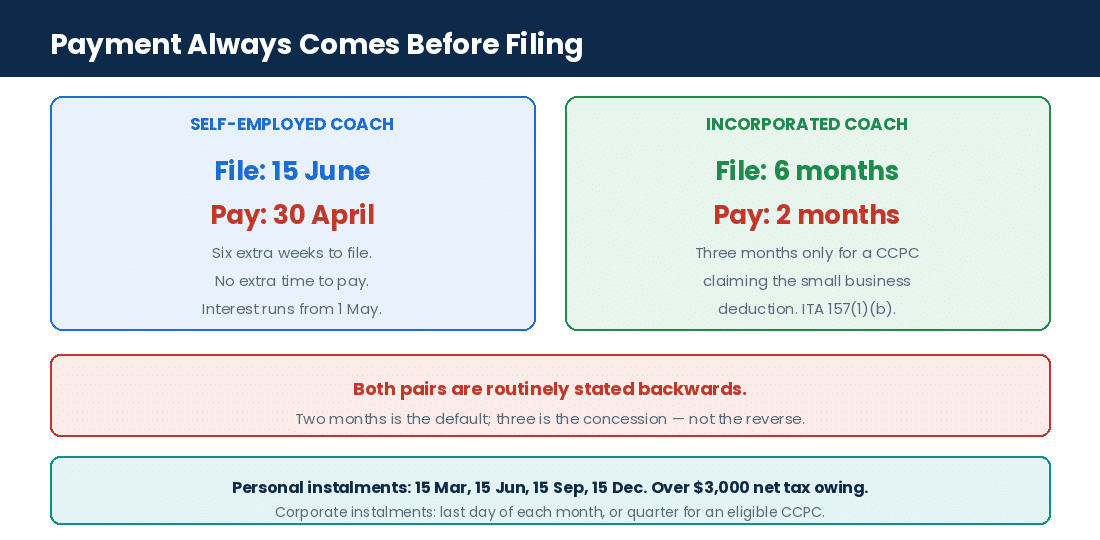
A self-employed coach files the T1 by 15 June under subsection 150(1), and the balance is due 30 April under subsection 156.1(4). You get six extra weeks to file; you get no extra time to pay. Interest under subsection 161(1) runs from 1 May regardless of the filing extension.
| Structure | File by | Pay by |
|---|---|---|
| Self-employed coach | 15 June | 30 April |
| Incorporated coach | Six months after year-end | Two months; three for a CCPC claiming the SBD |
The corporate row carries the same trap in reverse. Guidance stating “three months normally, two months if you’re a small associated business” has it backwards: two months is the default under paragraph 157(1)(b), and three months is the concession for a Canadian-controlled private corporation claiming the small business deduction with taxable income within the business limit.
Prepaid Packages Have Their Own Provision
Risk Warning: “separate prepaid sessions as unearned revenue until delivered” is the accounting answer, not the tax answer. For tax, paragraph 12(1)(a) includes amounts received for services not yet rendered — the deferral is not automatic.
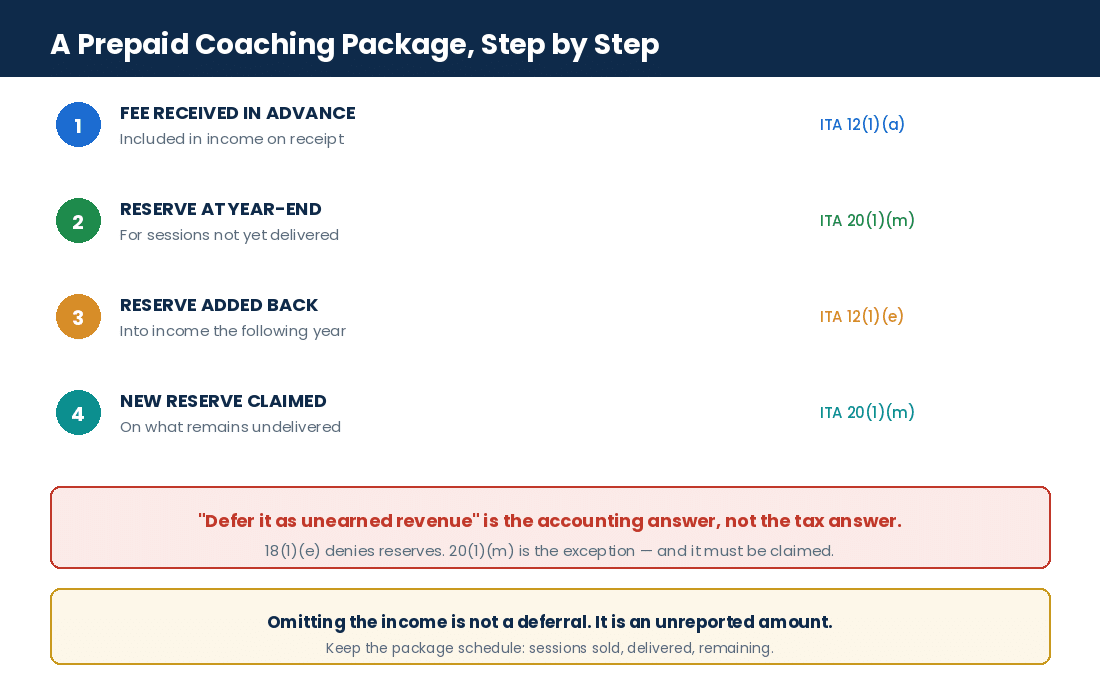
What makes it work is paragraph 20(1)(m), which permits a reserve for services reasonably expected to be delivered after year-end. That reserve is an exception to paragraph 18(1)(e), which otherwise denies reserves outright. Claim the reserve and it is added back to income the following year, then re-claimed on whatever remains undelivered.
| Step | Provision | Effect |
|---|---|---|
| Package fee received in advance | 12(1)(a) | Included in income when received |
| Reserve for undelivered sessions | 20(1)(m) | Deducted at year-end |
| Reserve added back | 12(1)(e) | Into income the following year |
| New reserve claimed | 20(1)(m) | On what remains undelivered |
Accrual Is Mandatory, Not Customary
Guidance saying coaches “usually use accrual accounting” or “should use” it understates the position. Business income is computed under section 9 on the accrual basis, and amounts are included when receivable under paragraph 12(1)(b). The cash method in section 28 is confined to farming and fishing. There is no election available to a coach.
A Toronto coach sold a $24,000 twelve-month package in November and reported nothing, on the basis that only two sessions had been delivered.
Paragraph 12(1)(a) included the full $24,000 on receipt. The fix was a 20(1)(m) reserve for the ten undelivered sessions, which produced almost the same answer — but only because it was claimed on the return. Simply omitting the income is an unreported amount, not a deferral. Figures changed for privacy.
Understanding Executive Coach Tax Filing in Canada
Obligations and Filing Requirements
Foundations
Key Federal and Provincial Tax Responsibilities
Coaching income is business income under section 9, included when receivable under paragraph 12(1)(b), with amounts received for services not yet rendered caught by paragraph 12(1)(a). Deductions follow paragraph 18(1)(a), subject to reasonableness in section 67.
Provincial tax is calculated on the same federal base. For a corporation, income is allocated among provinces under Regulations 400(2) and 402 on Schedule 5 where a permanent establishment exists in more than one — which for a coach usually means one province, since a client’s location does not create a permanent establishment.
Registration Needs for Tax Purposes
Key Stat: there are two routes across the $30,000 threshold, and most guidance gives only one. The threshold itself is in section 148 of the Excise Tax Act — section 240(1) is the requirement to register, not the threshold.
Exceed $30,000 in four consecutive calendar quarters and you cease to be a small supplier at the end of the month following that quarter, with a further month to register. Exceed it in a single calendar quarter and you cease immediately, on the supply that crosses it, with 29 days to register. A coach who sells one large corporate engagement can cross in a single quarter.
The measure is taxable supplies, not gross revenue. Coaching services are fully taxable, so for most practices the two figures are the same — but if any of your revenue is from a different, exempt source, it does not count toward the threshold.
Key Tax Concepts Relevant to Executive Coaches in Canada: Income Categories, Applicable Tax Rates and Brackets
| Structure | Return | Rate |
|---|---|---|
| Sole proprietor | T1 with form T2125 | Personal graduated rates |
| Corporation, small business income | T2 with GIFI | 12.2% combined in Ontario |
| Corporation, general rate income | T2 with GIFI | 26.5% combined in Ontario |
T2125 is a form, not a schedule. For a corporation, GIFI comprises Schedule 100 (balance sheet), Schedule 125 (income statement) and Schedule 141 (notes checklist). Financial statements for a private company follow ASPE, which is the Canadian framework — “GAAP” on its own no longer identifies a standard here.
Differentiating Between Self-Employed and Corporate Tax Filing: Advantages and Disadvantages of Each Structure
| Aspect | Sole proprietor | Corporation |
|---|---|---|
| Liability | Unlimited personal | Limited to corporate assets |
| CPP | Both halves on self-employment earnings | On salary only; none on dividends |
| Deferral | None — taxed as earned | Earnings retained at 12.2% |
| Home workspace | Claimed under 18(12) | Rent paid under a written agreement |
| Admin | One return | T2, GIFI, possibly payroll and slips |
The CPP row is the one new coaches underestimate. A sole proprietor pays both the employee and employer halves on self-employment earnings above the $3,500 basic exemption, plus CPP2 above the first ceiling. Half is deductible; the other half is a credit. On a six-figure practice this is several thousand dollars that simply does not arise on dividends.
Overview of Executive Coaching Business Taxes and Reporting Standards: Registration, Compliance Status and Core Reporting Guidelines
- Business name registration provincially where you operate under a name other than your own.
- A Business Number from CRA, with programme accounts added as needed: RT for GST/HST, RP for payroll, RC for corporate income tax.
- A corporation’s fiscal year-end is set under subsection 249(1) of the Income Tax Act — a federal matter, not an Ontario rule.
- Records retained six years from the end of the taxation year to which they relate, paragraph 230(4)(b).
Income and Business Expense Management for Executive Coaches
Income and Business Expenses
Income & Expenses
Identifying and Reporting Executive Coaching Income
- Fees invoiced during the year, whether or not collected, under paragraph 12(1)(b).
- Retainers and package fees received in advance, included under paragraph 12(1)(a), with a 20(1)(m) reserve for undelivered sessions.
- Work completed but not yet invoiced at year-end, carried as work in progress under subsection 10(5).
- Referral fees, licensing and assessment tool revenue, each coded separately.
- Foreign client fees, converted at the rate on the transaction date under subsection 261(2).
Allowable Business Expenses Specific to Executive Coaching
| Expense | Treatment | Authority |
|---|---|---|
| Coaching certification maintaining your credential | Fully deductible | ITA 18(1)(a) |
| A qualification conferring a lasting new credential | May be capital | ITA 18(1)(b) |
| Assessment tool licences, psychometric instruments | Deductible as incurred | ITA 18(1)(a) |
| Professional association dues | Deductible | 18(1)(a); 18(1)(l) denies club dues |
| Marketing, website, content production | Deductible | ITA 18(1)(a) |
| Meals and entertainment with clients | 50% | ITA 67.1 — not section 67 |
| Liability insurance | Deductible over the policy period | ITA 18(9) |
| Travel recharged to a client | Generally part of your taxable supply | Unless genuine agency |
Section 67.1 is the meals limitation; section 67 is the general reasonableness test. There are no special “public speaker expense rules” for recharged travel — a disbursement billed on to a client is ordinarily consideration for your supply, taxable and deductible in the usual way, unless a true agency relationship is documented.
Executive Coach Tax Deductions Canada: What Can Be Claimed
Risk Warning: the home workspace does not have to be your “main” place of work. Subsection 18(12) provides two alternative tests. Test (a) is the individual’s principal place of business, with no exclusivity requirement. Test (b) is exclusive use plus regular client meetings — and a coach who meets clients at home on a regular basis may qualify under (b) even with another office.
The real limit is that the deduction cannot create or increase a loss, with the excess carried forward. And 18(12) applies to an individual: an incorporated coach pays rent to the shareholder under a written agreement instead.
- Vehicle: a logbook with date, destination, purpose and kilometres. The simplified method allows a full base year then a three-month sample, provided business use stays within 10 percentage points. Limits: $1,100 monthly lease, $39,000 in Class 10.1, $350 monthly loan interest under section 67.2.
- Capital cost allowance: computers in Class 50 at 55%, office furniture in Class 8 at 20%, tools under $500 in Class 12 at 100%. The claim is gated by the available-for-use rule in subsections 13(26) to (32), and the half-year rule is suspended for eligible property acquired after 31 December 2024 under Bill C-15.
- Bad debts under paragraph 20(1)(p)(i) where previously included in income and established to have gone bad, with the GST/HST recovered separately under section 231 of the Excise Tax Act.
Record-Keeping and Bookkeeping Best Practices
- An invoice register showing issued, paid and outstanding at year-end.
- A package schedule showing sessions sold, delivered and remaining — the working paper behind the 20(1)(m) reserve.
- Receipts coded by category at entry, in QuickBooks Online or Xero with bank feeds reconciled monthly.
- Mileage logs and home workspace measurements held with the return.
- Records kept six years from the end of the taxation year under paragraph 230(4)(b) — not six years from filing.
Handling GST/HST and Payroll Considerations
- Registration under subsection 240(1) once the section 148 threshold is passed, by either route.
- Rate by place of supply — for a service, generally the recipient’s address obtained in the ordinary course of business, under Schedule IX and the Place of Supply Regulations.
- Input tax credits under section 169, available once registered — including voluntarily below the threshold — with documentary support under 169(4) and a four-year claim window.
- Filing frequency: annual to $1.5M of taxable supplies, quarterly to $6M, monthly above.
- T4 slips for employees and T4A for associates above $500 of fees for services, both due the last day of February under Regulation 205(1).
- Payroll remitted by your band under section 153 and Regulation 108, with penalties under subsection 227(9).
A coach with a dedicated home office and a shared downtown space had stopped claiming the home workspace entirely, having read that it must be the “main” place of work.
Clients were met at home weekly and the room was used for nothing else, so test (b) of 18(12) applied regardless of the other office. Roughly $4,800 a year had been left unclaimed for three years. Figures changed for privacy.
Tax Returns and Compliance for Executive Coaches
Tax Returns and Compliance
Compliance
Preparing the Executive Coach Tax Return (T1 and T2)
| Structure | Return filed | Key form or schedule |
|---|---|---|
| Sole proprietor | T1 personal | Form T2125 — Statement of Business or Professional Activities |
| Incorporated coach | Corporate T2 | GIFI Schedules 100, 125 and 141 |
Both run on accrual. December invoices collected in February belong in the December year, and a package sold in November is included on receipt under 12(1)(a) with the reserve claimed against it.
Corporate Tax Filing Requirements for Incorporated Coaches
| Obligation | Deadline | Provision |
|---|---|---|
| T2 return | Six months after fiscal year-end | ITA 150(1)(a) |
| Balance of tax | Two months; three for a CCPC claiming the SBD | ITA 157(1)(b) |
| Corporate instalments | Last day of each month or quarter | ITA 157(1)(a), 157(1.1) |
| T4 and T4A slips | Last day of February | Reg 205(1) |
| Ontario Annual Return | Six months after year-end | Ontario Business Registry |
Corporate balance dates sit in 157(1)(b). Section 156 is personal instalments and has nothing to do with a corporation’s payment date. Corporate instalments are the last day of each month, or each quarter for an eligible CCPC — not 15 March, 15 June, 15 September and 15 December, which are the personal dates under 156(1).
Common Tax Credits and Incentives Accessible to Executive Coaches
Risk Warning: three credits commonly listed for coaches do not apply. The Canada Workers Benefit (section 122.7) is a personal refundable credit for low-income workers, unavailable to a corporation and out of reach for most coaching incomes. SR&ED excludes research in the social sciences and humanities under paragraph 248(1)(g), which is where coaching methodology research lands. And investment tax credits under section 127 apply to qualified property in prescribed Atlantic regions or to SR&ED — a computer bought in Toronto gets capital cost allowance, not an ITC.
The Apprenticeship Job Creation Tax Credit is real, but it requires a Red Seal apprentice in a prescribed trade, which a coaching practice does not employ.
What actually reduces a coach’s tax: the small business deduction under section 125 on the first $500,000 of active business income, capital cost allowance, the 20(1)(m) reserve, and input tax credits once registered.
Compliance Deadlines and Penalties
| Item | Rule | Provision |
|---|---|---|
| Late filing penalty | 5% of unpaid tax plus 1% per complete month, to 12 months | ITA 162(1) |
| Repeat late filing | Doubled: 10% plus 2% per month to 20 months | ITA 162(2) |
| Arrears interest | Compounded daily at the prescribed rate | ITA 161(1) |
| Personal instalments | Required where net tax owing exceeds $3,000 | ITA 156.1(2) |
| Failure to keep records | $25 per day, minimum $100, maximum $2,500 | ITA 162(7) |
The late filing penalty is 162(1), not 162(7), and interest compounds daily rather than “daily then monthly”. Personal instalments fall on 15 March, 15 June, 15 September and 15 December, triggered where net tax owing exceeds $3,000 in the current year and in either of the two preceding years.
An incorporated coach filed every T2 on time at the six-month mark and paid the balance with the return.
The balance had been due at three months throughout, as a CCPC claiming the small business deduction. Nothing was late in filing terms, so no 162(1) penalty arose — but arrears interest under 161(1) had compounded daily on a three-month gap, every year, for four years. Figures changed for privacy.
Structuring Your Executive Coaching Business for Tax Efficiency
Structuring for Tax Efficiency
Structure
Incorporation vs. Sole Proprietorship Analysis
The case for incorporating a coaching practice rests on three things: limited liability, the 12.2% Ontario combined rate on retained active business income, and the absence of CPP on dividends. The case against is cost, complexity, and an earlier payment date.
Worked example. A Toronto coach billing $120,000 who draws only $70,000 leaves $50,000 inside the corporation at roughly 12.2% rather than at a personal marginal rate. The deferral is real; the eventual tax on distribution is not avoided. Figures changed for privacy.
Choosing the Right Structure for Your Goals
- Expected profit, and how much of it you need personally.
- Whether liability exposure justifies the structure.
- Whether associates will be engaged, and on what basis.
- Where clients are located, which affects GST/HST rate but not usually the corporate filing position.
- Appetite for administration: a corporation means a T2, GIFI, possibly payroll and slips.
Strategic Tax Planning Tailored for Executive Coaching Professionals, and Long-Term Planning for Income and Deductions
- The 20(1)(m) reserve calculated from the package schedule each year-end.
- Invoice timing reviewed before the cut-off, bearing in mind that not invoicing does not defer anything already receivable.
- Capital purchases timed against the available-for-use rule and the half-year rule suspension.
- Tax planning on salary versus dividends, including TOSI under section 120.4 where family members hold shares — and note the excluded shares test is unavailable to a services business, so the usual route out is the excluded business test or a reasonable salary for work actually done.
- Shareholder loans cleared within one year after the corporation’s year-end under subsection 15(2.6), or subsection 15(2) includes them in income. Section 80.4 imputes an interest benefit on any balance.
Utilizing Professional Advisory Services and Maximizing Tax Benefits While Maintaining Compliance
- Mileage logs, home workspace measurements, associate contracts and the package schedule kept as working papers, not reconstructed.
- Personal and business accounts fully separated.
- Every claimed expense traceable to an invoice or receipt, as paragraph 18(1)(a) and section 67 require.
Balancing Tax Savings with Legal Requirements
The line is drawn by the provisions themselves: meals at 50% under 67.1, reserves only where the Act permits one, shareholder draws characterised correctly as salary, dividend or loan at the time they are taken. Filing on time and paying on time are separate obligations, and meeting the first does not excuse the second.
Safeguarding Against CRA Reviews
The most common trigger on a coaching file is reporting bank deposits as income instead of invoiced amounts, because the deposit total will not reconcile to the GST/HST returns or to the receivables balance. Others: personal expenses claimed as business costs, package revenue with no reserve working paper, and vehicle claims without a logbook.
Assessment and reassessment sit in section 152, with the normal reassessment period of three years for a CCPC and an individual. Sections 156 and 157 are instalments, not audit provisions.
Cash Flow Management and Forecasting
- The payment date diarised separately from the filing date — 30 April for an individual, two or three months for a corporation.
- Instalments forecast from the prior year, since a package-heavy year can push net tax owing past $3,000 unexpectedly.
- Package cash held against the sessions still to deliver, because the money arrives before the work does.
- GST/HST collected treated as held on trust, not as working capital.
Key Stat: there is no 2026 change to instalment timing or electronic filing for coaches. Personal instalment dates remain 15 March, 15 June, 15 September and 15 December under subsection 156(1), and the $3,000 threshold is unchanged.
Mandatory electronic filing of the T2 under subsection 150.1(2.1) has applied to most corporations since 2024, and the information return e-filing threshold dropped from 50 returns to 5 for returns filed after 2023. Those are the real changes, and both predate 2026.
Step-by-Step Process for Executive Coach Tax Filing in Canada
Step-by-Step Filing Process
Process
The Sequence
- Gather income records: invoices issued, amounts outstanding at year-end, and package fees received in advance.
- Build the package schedule — sessions sold, delivered, remaining — which supports the 20(1)(m) reserve.
- Code expenses by category and separate capital from current.
- Prepare the home workspace and vehicle working papers.
- Reconcile associate payments and issue T4 or T4A slips by the last day of February.
- Reconcile GST/HST collected and input tax credits claimed.
- Prepare the T1 with form T2125, or the T2 with GIFI.
- Pay first, file second: 30 April and 15 June for an individual; two or three months and six months for a corporation.
Timeline for Preparing and Submitting Returns
| Obligation | Filing deadline | Payment due |
|---|---|---|
| Self-employed coach | 15 June | 30 April |
| Incorporated coach | Six months after year-end | Two months; three for an eligible CCPC |
| Personal instalments | — | 15 March, 15 June, 15 September, 15 December |
| Corporate instalments | — | Last day of each month or quarter |
| T4 and T4A slips | Last day of February | — |
Checklist for Required Documentation
- Invoices issued during the year, with outstanding amounts identified.
- Receipts for every claimed expense.
- Bank and credit card statements for reconciliation.
- Client contracts, package terms and retainer agreements.
- Mileage logs linking trips to client meetings.
- Associate payment records and slips issued.
- Home workspace measurements and the related household bills.
- Prior year return, notice of assessment and instalment reminders.
Technical Requirements and Documentation
- Accrual throughout, with the package schedule reconciling to the revenue line.
- Records retained six years from the end of the taxation year under paragraph 230(4)(b), with GST/HST records under section 286 of the Excise Tax Act. Section 169 is input tax credit documentation — a different requirement.
- Electronic records readable and retrievable for the full period; digital storage is acceptable.
- Taxable supplies tracked against the section 148 threshold.
- Foreign client billings converted and flagged for place of supply.
Organizational Tips for Paperwork, and Digital and Paper Record Strategies
- Folders by type: Invoices, Expenses, Bank, Contracts, Associates, Working Papers.
- Consistent file naming with dates: Invoice_20260131_ClientName.pdf.
- Monthly reconciliation rather than an annual reconstruction.
- Digital first, with QuickBooks Online or Xero on bank feeds and Hubdoc capturing receipts.
- Signed original contracts retained on paper where the engagement warrants it.
Tools and Software Recommendations for Bookkeeping and Tax Management
- Recommended apps and platforms: QuickBooks Online or Xero as the ledger, Hubdoc for receipt capture, and Wagepoint where payroll is run.
- Integration tips for easy accounting: connect bank feeds so transactions flow without double entry, set categories for recurring costs once, capture receipts on mobile at the point of spend, and diarise instalment and payment dates in the same calendar.
- Export formats checked against what your CPA needs for the compilation, so year-end is a handover rather than a rebuild.
Common Challenges Faced by Executive Coaches During Tax Filing: Addressing Missed Income or Expenses and Preventing Wrong Claims and Errors
- Year-end invoices omitted because payment arrived later.
- Package revenue either fully omitted or fully taxed, rather than included and reserved.
- Bank deposits reported as income.
- Meals claimed at 100% rather than the 50% allowed by section 67.1.
- Associates paid without the correct slip, or classified as contractors without testing it.
- Vehicle claims unsupported by a logbook.
Where a prior year is wrong, the Voluntary Disclosures Program under Information Circular IC00-1R6 may limit penalties if you come forward before CRA makes contact. Penalty and interest relief is separately available under subsection 220(3.1) on Form RC4288, within ten calendar years.
A coach missed roughly $12,000 of December invoices because they were paid the following February.
Under paragraph 12(1)(b) they were receivable in December. A voluntary disclosure corrected it at a materially lower cost than waiting for the reassessment, which would have come anyway once the GST/HST return and the income statement were compared. Figures changed for privacy.
Working with Gondaliya CPA on Executive Coach Taxes
Working with Gondaliya CPA
Services
When to Consult a Tax Professional: Key Signals
- Taxable supplies approaching $30,000, by either threshold route.
- Instalment reminders arriving because net tax owing passed $3,000.
- Coaching income alongside employment income from another source.
- Associates engaged and needing T4 or T4A slips.
- Multi-session packages sold in advance, where the reserve position matters.
- Books that show deposits rather than invoiced revenue.
- Clients outside Canada, raising place of supply and zero-rating.
Benefits of Early Consultation
Most of what goes wrong on a coaching file is structural rather than arithmetic, and it is set in place long before the return is prepared. A package schedule that exists from January supports a reserve; one assembled in May supports an argument. The same is true of the home workspace measurement and the mileage log.
Gondaliya CPA’s Approach to Personalized Tax Support: Customized Advisory Sessions, Contact and Onboarding
| Deliverable | What it contains |
|---|---|
| Accrual income summary | Invoiced against received, reconciled |
| Receivable and package schedule | Sessions sold, delivered, remaining — supporting the 20(1)(m) reserve |
| Expense schedule | Deductible costs by category, capital separated |
| Home office working paper | Measurements and apportionment under 18(12) |
| Registration memo | GST/HST position against the section 148 threshold |
| Associate summary | Classification and slip preparation |
| GST/HST reconciliation | Output tax against input tax credits |
| Compiled financial statements | Prepared under CSRS 4200, providing no assurance |
A compilation engagement under CSRS 4200 assembles statements from information supplied by management, with a basis of accounting note and a report stating that no assurance is provided. It is the right engagement for a coaching corporation and it is not a light audit.
Pricing
| Factor | Effect on fee |
|---|---|
| Annual revenue | More transactions, more reconciliation |
| Business structure | A corporation adds the T2, GIFI and possibly payroll |
| Number of associates | Each adds classification work and a slip |
| GST/HST registration | Adds returns and reconciliation |
| Package complexity | Drives the reserve working paper |
We quote a flat annual fee including HST on your specific situation before any work begins. Call 647-212-9559 or email info@gondaliyacpa.ca for a free, no-pressure conversation about what yours would be.
Service Options and Coverage
- DIY: workable where income is simple and accrual is genuinely understood. The common casualty is the package reserve.
- Non-CPA preparers: affordable, but typically weaker on 20(1)(m), 18(12) and worker classification, and unable to issue a compilation report.
- Licensed CPA firm: handles the corporate return, the reserve, the classification question, and represents you if CRA asks.
Staying Updated With Changing Tax Regulations Affecting Executive Coaches: Ongoing Support, Education, Monitoring Strategies and Annual Review Practices
- Strategies for monitoring updates: annual confirmation of the GST/HST threshold position and filing frequency.
- The package schedule reviewed quarterly, not annually.
- Instalment reminders checked against the forecast rather than paid blind.
- Prior-year errors corrected through voluntary disclosure where the conditions are met.
- CRA representation on income reconciliation, deduction support and classification.
How Gondaliya CPA Supports Accurate and Timely Tax Filings
We convert cash-based records into accrual figures before anything is prepared, so invoiced revenue, deposits and the GST/HST returns all agree. Instalment positions are monitored rather than discovered, the payment date is diarised apart from the filing date, and the whole engagement runs on a flat annual fee including HST with no surprises at the end.
Additional Resources for Continued Financial Education and Support, and Encouragement to Take Proactive Steps
CRA’s guide T4002 covers business and professional income and is the correct reference for a coaching practice — RC4070 is Information for Canadian Small Businesses and is often cited in its place. Beyond that: section 9 for the income rule, paragraphs 12(1)(a) and 20(1)(m) for packages, subsection 18(12) for the workspace, and section 148 of the Excise Tax Act for the threshold. The practical step is to start the package schedule and the mileage log now, because both are far cheaper to keep than to reconstruct.
A practice came to us having been told that instalment rules and electronic filing requirements were changing in January 2026.
Neither was true. Personal instalments remain 15 March, 15 June, 15 September and 15 December with a $3,000 threshold, and mandatory T2 e-filing began in 2024. The client had been budgeting for a change that did not exist. Figures changed for privacy.
Frequently Asked Questions
Frequently Asked Questions
FAQ
What records do I need, and for how long?+
Invoices, receipts, bank statements, contracts, mileage logs and the package schedule. Retention is six years from the end of the taxation year to which the records relate, under paragraph 230(4)(b) — not six years from the filing date. Section 286 of the Excise Tax Act imposes the same period for GST/HST records.
How do instalments affect executive coach tax payments?+
Personal instalments are required where net tax owing exceeds $3,000 in the current year and in either of the two preceding years, under subsection 156.1(2), due 15 March, 15 June, 15 September and 15 December. Corporate instalments are different: last day of each month under 157(1)(a), or each quarter for an eligible CCPC.
What employment income and expenses apply to executive coaches?+
Salaries to employees are deductible with CPP, EI and income tax withheld and remitted by your band under section 153 and Regulation 108. Associates engaged as contractors are a cost of sales with a T4A above $500. Only business-related costs are deductible under paragraph 18(1)(a).
Can I claim home office expenses for my coaching business?+
Subsection 18(12) gives two alternative tests: (a) the home is your principal place of business, with no exclusivity requirement; or (b) the space is used exclusively for the business and you meet clients there on a regular and continuous basis. A coach with another office can still qualify under (b). The deduction cannot create or increase a loss. An incorporated coach pays rent under a written agreement instead.
How are vehicle expenses handled?+
On the business-use share, supported by a logbook with date, destination, purpose and kilometres. The simplified method allows a base year then a three-month sample within 10 percentage points. Limits apply: $1,100 monthly lease, $39,000 in Class 10.1, $350 monthly loan interest under section 67.2. Travel between home and a regular place of business is personal.
What equipment expenses can I deduct?+
Through capital cost allowance: computers in Class 50 at 55%, office furniture in Class 8 at 20%, tools under $500 in Class 12 at 100%. The claim is gated by the available-for-use rule in subsections 13(26) to (32), and the half-year rule is suspended for eligible property acquired after 31 December 2024.
How do associates impact my filings?+
Classification first, slip second. Test against the Wiebe Door factors as refined in Sagaz and Connor Homes, with CRA Guide RC4110 and a ruling available on Form CPT1. Employees get a T4 with source deductions; contractors a T4A above $500. Both due the last day of February.
When must I register for GST/HST?+
Once you cease to be a small supplier under section 148: over $30,000 of taxable supplies across four consecutive quarters, or over $30,000 in a single quarter, which ends the status immediately with 29 days to register. Section 240(1) is the requirement to register; 148 is the threshold.
What applies when serving clients abroad?+
The income is taxable in Canada regardless. For GST/HST, services supplied to a non-resident are generally zero-rated under Schedule VI, Part V — which is not the same as exempt. Zero-rated means 0% charged and input tax credits still recoverable. Within Canada, the rate follows the recipient’s address under the place of supply rules.
How do I handle bad debts?+
Deduct under paragraph 20(1)(p)(i) where the amount was previously included in income and is established to have become bad, with collection efforts documented. Paragraph 20(1)(l) is the separate doubtful debt reserve. The GST/HST already remitted is recovered separately under section 231 of the Excise Tax Act — the step most practices miss.
What should owner pay look like in an incorporated practice?+
Salary is deductible to the corporation, creates RRSP room and attracts CPP. Dividends are not deductible, create no RRSP room and carry no CPP — but where paid to family they are tested under TOSI in section 120.4, and the excluded shares exception is unavailable to a services business. The mix is a calculation, not a rule.
What triggers a CRA review for coaches?+
Bank deposits reported instead of invoiced income, package revenue with no reserve working paper, personal costs claimed as business, meals at 100%, vehicle claims without a logbook, and associate payments with no slip. Assessment sits in section 152, with a three-year normal reassessment period for an individual or CCPC.
File it yourself or hand it to a CPA firm: which route fits a coach?+
DIY works where income is simple and accrual is genuinely applied. The usual casualty is the 20(1)(m) package reserve, which is easy to get wrong in both directions. A licensed firm handles the corporate return, the reserve, worker classification and CRA correspondence, and only a licensed firm can issue a CSRS 4200 compilation report.
Are meal expenses fully deductible?+
No — 50% under section 67.1, with the input tax credit recaptured to 50% for registrants. The provision is 67.1, not section 67, which is the general reasonableness test.
Do I need payroll slips if I pay assistants or associates?+
Yes. T4 for employees with source deductions withheld and remitted; T4A for self-employed associates where fees for services exceed $500 in the calendar year, under Regulation 200(1). Both filed by the last day of February.
Do I report package income when sold or when delivered?+
Included when received, under paragraph 12(1)(a). The deferral comes from claiming a 20(1)(m) reserve for sessions not yet delivered, which is added back the following year and re-claimed on the remainder. Simply omitting the income is not a deferral.
Must I use accrual accounting?+
Yes. Business income is computed on the accrual basis under section 9, with amounts included when receivable under paragraph 12(1)(b). The cash method in section 28 applies only to farming and fishing. It is not a choice.
How much does coaching accounting cost in Canada?+
A flat annual fee including HST, quoted on your situation before work begins. What moves it is revenue, structure, number of associates, whether you are GST/HST registered, and how complex the package schedule is.
Eighteen questions, and the two on prepaid packages carry more money than the rest combined on a coaching file.
They are also where the accounting answer and the tax answer diverge, which is why practices get one of them right and the other wrong. Figures changed for privacy.
Key Points: Executive Coach Tax & Accounting Essentials
Essential Topics and Best Practices
Quick Reference
Top Filing Mistakes Executive Coaches Should Avoid
- Reporting bank deposits instead of invoiced income.
- Omitting year-end invoices because payment came later.
- Package revenue omitted entirely, rather than included under 12(1)(a) and reserved under 20(1)(m).
- Filing and payment dates transposed — file 15 June, pay 30 April.
- Meals claimed at 100% rather than 50% under section 67.1.
- Home workspace abandoned over an exclusivity requirement that test (a) does not impose.
- Associate payments made without a slip, or classified without testing.
- GST/HST registration missed on the single-quarter route.
What to Prepare Before Filing: Executive Coach Tax Checklist
- Invoice list, including unpaid amounts at year-end.
- Receipts for all claimed expenses.
- Bank statements for reconciliation against invoices.
- Client contracts, package terms and retainer agreements.
- Mileage logs documenting business kilometres.
- The package schedule supporting the reserve.
- Home workspace measurements and household bills.
Which Filing Steps Matter Across 10 Key Areas
- Income recognition: accrual under section 9, receivable under 12(1)(b).
- Prepaid packages: included under 12(1)(a), reserved under 20(1)(m).
- Expense classification: current against capital, with 67.1 on meals.
- GST/HST: threshold under section 148, place of supply, input tax credits under 169.
- Payroll and slips: T4 and T4A by the last day of February.
- Capital assets: Class 50 at 55%, available-for-use, half-year rule suspended.
- Home workspace: 18(12), two alternative tests, loss restriction.
- Record retention: six years from the taxation year-end, 230(4)(b).
- Instalments: $3,000 threshold, quarterly for individuals.
- Return preparation: T1 with T2125, or T2 with GIFI.
How to Choose a CPA Firm in Ontario for Executive Coaches
- A working position on the 20(1)(m) reserve, not just a mention of deferred revenue.
- Comfort with both T1 with T2125 and T2 with GIFI, since coaches often move between them.
- A flat annual fee quoted before work begins.
- A licence verifiable on the CPA Ontario public directory.
- Clarity that a compilation provides no assurance.
Points Worth Carrying
- File 15 June, pay 30 April.
- Corporate balance at two months; three only for an eligible CCPC.
- Corporate payment dates are 157(1)(b), not section 156.
- Packages: 12(1)(a) in, 20(1)(m) reserve out.
- Accrual is mandatory, not customary.
- The $30,000 threshold is section 148, with two routes across it.
- 18(12) test (a) has no exclusivity requirement.
- Meals are 67.1, not section 67.
- CWB, SR&ED and investment tax credits do not apply to coaching.
- Records run six years from the year-end, 230(4)(b).
Thirty-five points, and the ten at the end are all things a coach was told confidently by something they read.
None are obscure. They are ordinary rules with the dates reversed, the section number wrong, or a credit attached that was never available. Figures changed for privacy.
Businesses We Serve
Industry Expertise
Coaching practices share the same issues whoever they coach. Here are ten and the usual finding.
| Practice | The Issue That Usually Appears |
|---|---|
| Executive and leadership coaches | Package revenue with no 20(1)(m) reserve working paper |
| Career and transition coaches | Bank deposits reported as income |
| Team and organisational coaches | Associates paid without a slip or classification test |
| Coaches with corporate clients | GST/HST crossed in a single quarter, registration late |
| Coaches serving clients abroad | Zero-rated treated as exempt, input tax credits forgone |
| Home-based coaches | Workspace claim abandoned over a supposed exclusivity rule |
| Newly incorporated coaches | Balance paid at six months instead of two or three |
| Coaches with assessment tool licences | Capital and current costs not separated |
| Sole proprietors at scale | CPP on both halves not forecast into instalments |
| Coaches with shareholder draws | Loans left outstanding past the 15(2.6) window |
- Executive and leadership coaches: build the package schedule from January.
- Career and transition coaches: invoiced, not deposited.
- Team and organisational coaches: classify, then slip.
- Coaches with corporate clients: watch the single-quarter route.
- Coaches serving clients abroad: zero-rated still recovers input tax.
- Home-based coaches: test (a) requires no exclusivity.
- Newly incorporated coaches: pay before you file.
- Coaches with assessment tool licences: annual licence is current; a perpetual one may be capital.
- Sole proprietors at scale: CPP both halves, plus CPP2.
- Coaches with shareholder draws: one year after the corporate year-end.
The clients change. The questions do not: was it invoiced or deposited, was the session delivered, and which date is the payment date.
A leadership coach and a career transition coach look nothing alike commercially and file nearly identical returns. Figures changed for privacy.
Professional Guidance and Quick Reference
Guidance
Professional Guidance: How Gondaliya CPA Handles Your Coaching Practice
Executive coaches get into difficulty in a predictable set of ways: transposing the two self-employed dates, when the T1 is filed by 15 June and the balance is paid by 30 April; paying a corporate balance at six months when paragraph 157(1)(b) sets it at two months, extended to three only for a CCPC claiming the small business deduction; treating prepaid packages as deferred revenue for tax, when paragraph 12(1)(a) includes them on receipt and the deferral comes from a 20(1)(m) reserve claimed on the return; reporting bank deposits rather than invoiced amounts, which will never reconcile to the GST/HST returns; abandoning the home workspace claim over an exclusivity requirement that test (a) of subsection 18(12) does not impose; claiming meals in full when section 67.1 allows 50%; and budgeting for credits — the Canada Workers Benefit, SR&ED, investment tax credits — that a coaching practice cannot access. Gondaliya CPA handles executive coach accounting on a flat annual fee.
We handle what decides the outcome: building the package schedule so the 20(1)(m) reserve is a calculation rather than an argument, reconciling invoiced revenue to deposits and to the GST/HST returns, testing the GST/HST threshold on both the four-quarter and single-quarter routes, measuring the home workspace against both limbs of 18(12), separating capital from current on assessment tools and equipment, classifying associates before the slip run, diarising the payment date separately from the filing date, forecasting instalments including CPP on both halves for a sole proprietor, and preparing compiled statements under CSRS 4200 that state plainly that no assurance is provided.
Our team starts with one month of invoices, your package list and your last return. Whoever you coach, you get clear advice and a fixed price before we start.
Quick Answers
At a Glance
- Self-employed filing: 15 June
- Self-employed payment: 30 April
- Corporate filing: six months after year-end
- Corporate payment: two months; three for an eligible CCPC
- Packages in: ITA 12(1)(a)
- Packages reserved: ITA 20(1)(m)
- Accrual: mandatory, section 9
- GST/HST threshold: $30,000, ETA 148
- Home workspace: ITA 18(12), two tests
- Meals: 50%, ITA 67.1
- Instalments: over $3,000 net tax owing
- Records: six years from the taxation year-end
Who This Is For
Fit Check
- For: Executive, leadership, career and team coaches in Canada, operating as sole proprietors or through a corporation, including those selling packages, engaging associates or serving clients abroad.
- Not For: Employed coaches on a T4, whose expenses run through form T2200 on a personal return, and practices requiring a review or audit engagement, which we refer out.
People Also Ask
Quick Answers
Do I file on 30 April or 15 June?+
You file by 15 June and pay by 30 April. The filing extension does not extend the payment date, and interest under 161(1) runs from 1 May either way.
Is my corporate balance due at three months?+
Two months is the default under paragraph 157(1)(b). Three months is the concession for a CCPC claiming the small business deduction with taxable income within the business limit — the opposite way round from how it is often stated.
Can I just defer package income until the sessions happen?+
Not automatically. Paragraph 12(1)(a) includes the fee on receipt. The deferral is a 20(1)(m) reserve, which must be claimed on the return and is added back the following year.
Does my home office have to be used only for the business?+
Not under test (a) of subsection 18(12), the principal-place-of-business test. Test (b) requires exclusive use plus regular client meetings — and a coach meeting clients at home may qualify under (b) even with another office.
Can I claim SR&ED on my coaching methodology?+
No. Research in the social sciences and humanities is excluded from the SR&ED definition by paragraph 248(1)(g), which is where coaching methodology research sits.
Glossary of Key Terms
Glossary
- Accrual basis: Income when receivable, not when banked.
- Paragraph 12(1)(a): Includes amounts received for services not yet rendered.
- Paragraph 12(1)(b): Includes amounts receivable for services rendered.
- Paragraph 20(1)(m): The reserve for undelivered goods and services.
- Paragraph 18(1)(e): Denies reserves generally; 20(1)(m) is its exception.
- Subsection 10(5): Work in progress on unbilled completed work.
- Subsection 18(12): The two alternative home workspace tests.
- Section 67.1: The 50% meals and entertainment limitation.
- Section 148 (ETA): The $30,000 small supplier threshold.
- Zero-rated: Taxed at 0%, with input tax credits still recoverable.
- Exempt: No tax charged and no input tax credit recovery.
- Form T2125: Statement of Business or Professional Activities.
- GIFI: Schedules 100, 125 and 141 filed with the T2.
- TOSI: Tax on split income, section 120.4.
- Subsection 15(2.6): The one-year shareholder loan repayment window.
- CSRS 4200: The compilation engagement standard, providing no assurance.
Executive Coach Tax Check
This quick self-check indicates where your practice most likely has room. Please answer the five questions below.
Executive Coach Tax Check
Five quick questions on your business. No fee shown.
Points to raise with us:
This is a general prompt, not tax or legal advice or a quote. Your position depends on your full facts. For a real review, please book a free consultation.
Want a checklist to work from? You can download our free executive coach tax checklist before your consultation.
File your T1 by 15 June and pay the balance by 30 April, because the filing extension does not extend the payment date and interest runs from 1 May regardless. If you are incorporated, pay the balance at two months, or three if you are a CCPC claiming the small business deduction, which is the opposite of how it is usually stated. Include prepaid package fees on receipt under paragraph 12(1)(a) and claim a 20(1)(m) reserve for the sessions you have not yet delivered, rather than simply leaving the money off the return. Report invoiced amounts, not bank deposits, since deposits will never reconcile to your GST/HST returns. Measure your home workspace against both limbs of subsection 18(12), because test (a) requires no exclusive use and test (b) can work even when you have another office. Claim meals at 50% under section 67.1. Test the $30,000 threshold on both routes, since one large corporate engagement can cross it in a single quarter. Zero-rated supplies to non-residents still recover input tax, so do not treat them as exempt. And please keep six years of records from the year-end.
2026 Update — what is current: This article reflects rules current to 1 October 2026. The 15 June filing date and 30 April payment date for self-employed individuals, the six-month T2 filing deadline under 150(1)(a), the 50% meals limit in section 67.1, the $500 T4A threshold, the last-day-of-February slip deadline under Regulation 205(1) and the six-year retention requirement under 230(4)(b) are unchanged. Please note that a corporation’s balance is due two months after year-end under paragraph 157(1)(b), extended to three only for a CCPC claiming the small business deduction — section 156 governs personal instalments; that prepaid coaching packages are included under paragraph 12(1)(a) with a reserve available under paragraph 20(1)(m), an exception to the denial in 18(1)(e); that accrual is mandatory under section 9, the cash method in section 28 being confined to farming and fishing; that the $30,000 small supplier threshold sits in section 148 of the Excise Tax Act, not section 240(1), and can be crossed in a single quarter as well as over four; that supplies to non-residents are generally zero-rated under Schedule VI Part V, so input tax credits remain recoverable; that subsection 18(12) provides two alternative home workspace tests with a loss restriction; that the half-year rule is suspended for eligible property acquired after 31 December 2024 under Bill C-15; and that mandatory electronic filing of the T2 under 150.1(2.1) has applied since 2024, with the information return threshold reduced to five returns for filings after 2023 — there are no 2026 changes to instalment timing or electronic filing.
Executive Coach Tax Filing Canada: How Gondaliya CPA Supports Coaching Practices
Start with one month of invoices and your package list
Gondaliya CPA builds the package schedule so the 20(1)(m) reserve is a calculation rather than an argument, reconciles invoiced revenue to deposits and to the GST/HST returns, tests the $30,000 threshold on both routes, measures the home workspace against both limbs of 18(12), separates capital from current on equipment and assessment tools, classifies associates before the slip run, diarises the payment date separately from the filing date, and files the GST/HST, the compiled statements and your T1 or T2 from one reconciled set of books — on a flat annual fee including HST with a one-business-day response. Please book a free consultation.
Next Steps: Optimizing Your Executive Coach Tax Filing
Please book a free consultation with Gondaliya CPA and bring one month of invoices, your list of active packages with sessions remaining, and your last return. Those three settle the accrual question, the reserve question and the deadline question, which is where most of the exposure sits for a coaching practice. You will get a flat annual fee including HST before any work begins. We serve Toronto, Vaughan, Mississauga, Brampton, Ottawa and the rest of Ontario, and work with coaches across Canada. If our content helps, please add gondaliyacpa.ca as a preferred source on Google.
Published: · Last updated:
Editorial policy: We research against CRA, CPA Canada and CPA Ontario sources, fact-check the figures, and Sharad Gondaliya, CPA, reviews the content, which we update as the rules change.
Disclaimer: This article is educational information only and is not tax, legal, or financial advice. Figures marked illustrative are examples rather than quotes or guarantees. It reflects rules current to 2026, including the 15 June filing and 30 April payment dates, the corporate balance dates in paragraph 157(1)(b), the paragraph 20(1)(m) reserve, the subsection 18(12) workspace tests and the six-year retention requirement. Rates and limits change and outcomes depend on your specific facts. Please consult a CPA Ontario member before acting.

Sharad Gondaliya is a CPA Canada & CPA USA with 15 Years+ experience of Accounting, Tax, Payroll of Corporate Small Businesses as Tax Accountant. He is a CPA Ontario member (61040184) and holds US CPA licences in Washington and Montana and is well known among corporate small businesses for tax planning, efficient tax solutions, and affordable CPA services. Sharad is the Principal (Director) of Gondaliya CPA – Affordable CPA Firm in Canada. Licenses: CPA Ontario: 61040184 | CPA USA (MT): PAC-CPAP-LIC-033176 | CPA USA (WA): 57629 | CPA Firm License: 61330051 View Full Author Bio