



How Fire Protection Contractors in Canada Can Reduce Taxes and Improve Cash Flow With Strategic Tax Planning
Fire Protection Contractor Year End Accounting and Corporate Tax Filing: Expert Guide by Gondaliya CPA Canada
Fire protection contractor year end accounting and corporate tax filing require careful attention to maximize tax savings and reduce corporate taxes in Canada. Gondaliya CPA specializes in strategic tax planning, contractor business expenses, and CRA tax planning to help fire protection companies manage cash flow and claim all eligible deductions.
Sprinkler installers, alarm and detection firms and extinguisher service companies all invoice work they will not be paid in full for until substantial performance is certified. That gap between billing and collection is the defining feature of fire protection contractor accounting and tax planning, and it is where the tax opportunity sits.
Quick Summary
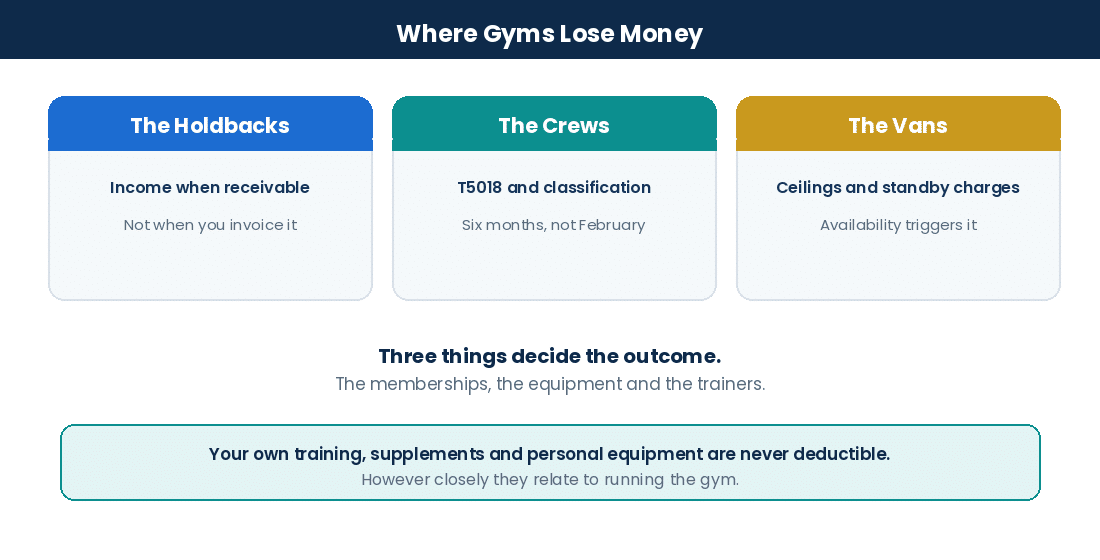
Fire protection work combines construction lien holdbacks, heavy subcontractor use, service vehicles and licensed technicians. Holdback timing, T5018 reporting, worker classification and vehicle treatment decide most of the tax outcome, and three of the four are commonly handled wrongly.
Reading time: 50 minutes.
Table of Contents
- Holdbacks and When Income Arises
- Work in Progress and Revenue Timing
- Subcontractors, T5018 and Classification
- Vehicles, Equipment and the 2026 Change
- Structure, Pay and the Small Business Deduction
- GST/HST, Compliance and Working With Us
- Frequently Asked Questions
- Key Planning Points
- Fire Protection Businesses We Serve
- Professional Guidance and Quick Reference
The Numbers That Matter
This article covers Canada, with Ontario and Toronto context, and reflects rules current to 2026. It applies to incorporated fire protection contractors including sprinkler and suppression installers, alarm and detection firms, extinguisher service companies and inspection and monitoring providers. Figures marked illustrative are examples, not quotes, and any masked engagement notes end with “Figures changed for privacy.” This is educational information only and not tax or legal advice. Construction lien legislation differs by province and its interpretation is a legal question, so please confirm your own position with counsel. Contractor licensing, technician certification and fire code compliance sit outside accounting scope.
Holdbacks and When Income Arises
Holdbacks and When Income Arises
The Big One
This is the single largest planning item in fire protection work and the one most often handled by simply ignoring it.
What a Holdback Is
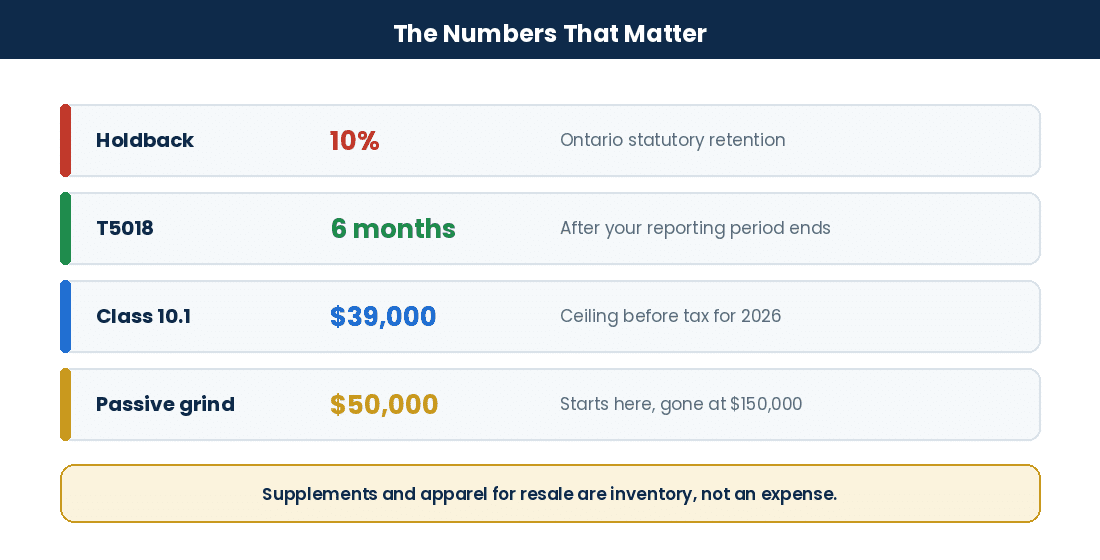
Construction lien legislation requires the payer to retain a percentage of every payment as security for lien claimants. In Ontario the statutory holdback is 10% of the value of the work, retained until the lien period expires following certification of substantial performance.
You have invoiced it. You have earned it commercially. You cannot legally demand it yet.
The Tax Treatment
The Income Tax Act deals with this directly. Where an amount is held back under a law relating to construction liens, it is not included in income until the day it becomes receivable, which is generally when the holdback becomes payable under the legislation.
That is a genuine deferral written into the Act, not a planning trick. A contractor reporting holdbacks as income when invoiced is paying tax early on money the law says is not yet receivable.
A sprinkler contractor with a December year end has $150,000 of statutory holdback outstanding at year end on projects where substantial performance has not been certified. Excluded from income until receivable, that amount falls into the following year instead. The work is the same; the timing of the tax is not. Figures changed for privacy.
The deferral is not permanent. It moves the income to the year the holdback becomes receivable, which in a steady business means a permanent one-year lag rather than a permanent saving. In a growing business the lag grows with you.
Getting It Right
- Maintain a holdback schedule by project, not a single balance
- Record the date of substantial performance and the expiry of the lien period
- Track holdback receivable separately from ordinary accounts receivable
- Track holdback payable to your own subcontractors on the same basis
- Keep the certificates and the contract terms with the schedule
- Release to income when the amount becomes receivable, documented
The schedule is the support. A single holdback figure nobody can break down by project is a number you cannot defend if it is questioned.
The Other Side
You hold back from your subcontractors too. Those amounts are your liability and, on the same principle, the deduction timing follows the same logic as the income.
Contractors frequently defer the receivable and expense the payable in full, which is having it both ways. Apply the treatment consistently in both directions.
A Legal Question, Not Only a Tax One
Whether an amount is a statutory holdback under lien legislation, a contractual retention negotiated between the parties, or a disputed amount being withheld makes a difference. The three look identical on a bank statement.
Only the first attracts the statutory treatment. Please have the contract terms reviewed rather than assuming everything held back qualifies.
Holdbacks reported as income when invoiced is the most expensive routine error in this sector. It is also the easiest to fix, because the schedule usually already exists in the project files. Figures changed for privacy.
Risk Warning: A negotiated retention is not automatically a statutory holdback. Please have the contract terms confirmed before applying the deferral.
Work in Progress and Revenue Timing
Work in Progress and Revenue Timing
The Timing
Contracts That Cross a Year End
Fire protection work rarely starts and finishes inside one fiscal year. A suppression system in a new building runs across months, with rough-in, installation, testing and certification each months apart.
Where a contract straddles the year end, revenue is recognised as the work is performed rather than when the invoice goes out or the cash arrives. The cost of that work belongs in the same period.
What Sits in Work in Progress
| Item | Treatment at Year End |
|---|---|
| Work performed but not yet billed | Accrued revenue with matching cost |
| Materials on site, not yet installed | Inventory, not yet a cost of the contract |
| Progress billed ahead of work done | Deferred revenue, a liability |
| Statutory holdback on billed work | Excluded until receivable |
| Subcontractor work performed, not invoiced | Accrued cost |
| Deposits taken on a service contract | Liability until the service is delivered |
The two errors that cancel out on paper but distort the year are billing ahead and working ahead. A contractor who has billed a mobilisation payment for work not yet started has a liability, not revenue. One who has installed a system and not yet invoiced has revenue, not nothing.
Service and Monitoring Contracts
Inspection, testing and monitoring agreements behave differently from installation work. An annual monitoring contract billed in advance is earned month by month across the term.
Billing a year of monitoring in January and recognising it all on receipt overstates that year. The unearned portion sits as deferred revenue at year end.
This matters more than contractors expect, because recurring service revenue is often the most valuable part of the business and the part a buyer looks at hardest.
Materials and Inventory
Sprinkler heads, pipe, fittings, panels, detectors and extinguishers held in the shop or on the truck are inventory. They become a cost when installed or sold, not when purchased.
- Count shop and truck stock at year end
- Value at cost, including freight in
- Separate materials allocated to specific jobs from general stock
- Write down obsolete or superseded stock with a reason logged
- Keep the count sheets
Van stock is the item most often missed. A fleet of six service trucks each carrying several thousand dollars of parts is a real inventory balance nobody counts.
Why the Timing Is Worth Getting Right
None of this changes what you earn over the life of the business. It changes which year the tax falls in, and in a business with instalments and a seasonal cash cycle that matters.
It also changes what your statements say. A contractor showing a strong year because of billing ahead and a poor one because the timing corrected has statements a lender will not trust.
Van stock across a service fleet is a real inventory balance and almost never counted. On a six-truck operation it is often the largest single adjustment we make. Figures changed for privacy.
Key Stat: Monitoring billed a year in advance is earned monthly. Please carry the unearned portion as deferred revenue at year end.
Subcontractors, T5018 and Classification
Subcontractors, T5018 and Classification
The People
The T5018 Obligation
Where your primary source of business income is construction activity, you must report payments to subcontractors for construction services on a T5018 information return.
The deadline is widely misquoted. It is not the end of February. The return is due within six months of the end of the reporting period you have chosen, and you may report on either a calendar year or your fiscal period, applying the choice consistently.
| Point | Position |
|---|---|
| Who reports | Businesses whose primary income is construction |
| What is reported | Payments to subcontractors for construction services |
| Reporting period | Calendar year or fiscal period, applied consistently |
| Deadline | Six months after the end of the reporting period |
| Threshold | A minimum total applies per subcontractor |
| Mixed invoices | Report the construction portion; goods only are excluded |
The mixed invoice point catches fire protection firms specifically. A subcontractor invoice covering both supply of equipment and installation labour needs the construction services portion identified. Where the invoice does not split it, the full amount may need reporting.
Our guide to T5018 filing requirements covers the mechanics in full.
Employee or Subcontractor
Fire protection firms run crews that look like employees and invoice like contractors. The classification is decided by the working relationship, not the invoice.
- Control: Who directs the work, sets the hours and decides the sequence
- Tools: Who supplies the van, the equipment and the materials
- Chance of profit and risk of loss: Whether the worker can profit from efficiency or carries real cost exposure
- Integration: How embedded the worker is in your operation
A technician working your schedule, in your van, with your materials, on jobs you won, at rates you set, is an employee whatever the invoice says. A specialist engineering firm engaged for a design package is not.
Misclassification means the CRA can assess the source deductions that should have been withheld, plus penalties and interest, and directors carry personal exposure on unremitted amounts.
Licensed Technicians and Certification
Fire protection is a certified trade. Costs of maintaining technician certification, code training and manufacturer accreditation are deductible business expenses where incurred for the business.
Where you pay for an employee’s certification required to do the job, that is a business cost rather than a taxable benefit. Where the training is personal or leads to a qualification the individual takes with them for their own purposes, the analysis changes.
Safety Equipment and Site Costs
- Personal protective equipment supplied to crews, deductible and not a benefit
- Uniforms and branded workwear, deductible where required for the job
- Tool allowances, taxable unless meeting the conditions for a reimbursement
- Site meals, generally subject to the 50% limitation
- Travel and accommodation on out-of-town projects, deductible with records
The 50% meal limitation catches contractors out because crews eat on site daily. There are narrow exceptions, but the general rule applies to most site meals.
The T5018 deadline is misquoted as the end of February on more contractor files than any other single date. It is six months after your reporting period ends. Figures changed for privacy.
Risk Warning: T5018 is not due at the end of February. Please file within six months of the end of your chosen reporting period.
Vehicles, Equipment and the 2026 Change
Vehicles, Equipment and the 2026 Change
The Assets
Which Class Applies
| Asset | Class | Rate |
|---|---|---|
| Threading machines, groovers, pipe tools, test equipment | Class 8 | 20% |
| Service vans and pickups used in the business | Class 10 | 30% |
| Passenger vehicles above the prescribed ceiling | Class 10.1 | 30%, capped |
| Zero-emission vehicles | Class 54 | Higher ceiling |
| Computers, tablets, service scheduling terminals | Class 50 | 55% |
| Application software | Class 12 | 100%, subject to the rules |
| Hand tools costing under the prescribed amount | Class 12 | 100% |
| Shop fit-out in leased premises | Class 13 | Over the lease term |
The Passenger Vehicle Ceiling
For 2026 the Class 10.1 capital cost ceiling is $39,000 before tax, up from $38,000 in 2025. The Class 54 zero-emission ceiling is $61,000. Deductible lease cost is capped at $1,100 per month before tax and deductible interest at $350 per month on a passenger vehicle loan.
The figure of $34,000 still circulating in contractor guidance is well out of date. Please check the ceiling for the year of acquisition rather than the current one.
The more useful question for this trade is whether the ceiling applies at all. A vehicle that meets the conditions for exclusion from the passenger vehicle definition is not subject to the cap, and service vans configured for work often qualify. The exclusions are specific and turn on seating, configuration and the proportion of business use, so please have your own vehicles reviewed rather than assuming either way.
The 2026 Capital Cost Allowance Change
Bill C-15 received Royal Assent on 26 March 2026, reinstating the accelerated investment incentive. For most depreciable property acquired after 2024 and available for use before 2030, the half-year rule is effectively suspended and an enhanced first-year deduction applies, phasing down after 2029.
Certain classes are excluded, including leasehold improvements. Equipment and vehicles are within the general property covered.
For a contractor who re-equipped in the last two years, this matters. If the return applied the plain half-year rule throughout, the first-year claim may have been understated and is worth reviewing.
Available for Use
An asset only starts earning capital cost allowance once it is available for use. A truck delivered in the final week of your year but not yet plated and in service does not help that year.
Where a purchase is being timed around year end, the delivery date is not the relevant one.
Personal Use and Standby Charges
Where a company vehicle is available to an owner or employee for personal use, a taxable benefit arises: a standby charge based on availability, plus an operating expense benefit for costs the business paid.
Technicians taking service vans home overnight is standard practice in this trade and is exactly the fact pattern that creates the charge, because the standby charge turns on availability rather than distance driven.
A logbook recording business and personal kilometres is what supports a reduced charge where business use is high. Certain clearly marked work vehicles carrying tools and equipment attract different treatment, but that depends on the vehicle and the actual use, so please confirm rather than assume.
Buy, Lease or Finance
The answer depends on cash position and replacement cycle rather than tax alone. Buying gives you the capital cost allowance and any recapture on disposal. Leasing gives a level monthly deduction capped at the prescribed limit. Financing sits between, with interest deductible subject to the monthly cap on passenger vehicles.
Model recapture before disposing of equipment. Larger first-year deductions make recapture more likely later, because the class balance falls faster than the asset loses value.
Service vans going home with technicians is normal and almost never reported as a benefit. It is the adjustment we make most often on a fire protection payroll review. Figures changed for privacy.
Key Stat: The Class 10.1 ceiling for 2026 is $39,000 before tax, not the $34,000 still quoted in older guidance.
Structure, Pay and the Small Business Deduction
Structure, Pay and the Small Business Deduction
The Structure
The Small Business Deduction
A Canadian-controlled private corporation pays a reduced federal rate of 9% on active business income up to the federal business limit of $500,000, shared across associated corporations.
Ontario reduced its small business rate to 2.2% effective 1 July 2026, giving a blended provincial rate of roughly 2.7% for a calendar-year corporation and a combined rate near 11.7% rather than the 12.2% that applied before.
The limit is also ground down where taxable capital employed in Canada is large, and separately where passive investment income is significant. A contractor holding substantial equipment and receivables can approach the taxable capital threshold without feeling wealthy.
Passive Income
The business limit is reduced by $5 for every $1 of adjusted aggregate investment income above $50,000, eliminating it entirely at $150,000.
It is not dollar for dollar and it does not begin at $150,000. Contractors who accumulate cash between projects and park it in investments can lose part of the deduction without noticing.
Salary and Dividends
| Method | Deductible to Company | Creates RRSP Room | CPP Required | Slip |
|---|---|---|---|---|
| Salary | Yes | Yes | Yes, both shares | T4 |
| Dividends | No | No | No | T5 |
A blend usually works best. Salary creates RRSP room and CPP entitlement and is deductible to the company. Dividends avoid payroll cost and offer timing flexibility in a year when work was thin.
The right mix changes annually with your income, your RRSP position and what the company needs to retain. Setting it once and never revisiting it is the common error.
Bonuses accrued at year end must be paid within the period the Act allows for the company to keep the deduction. Declaring a bonus and never paying it produces a denied deduction.
Family Members
Paying a spouse or family member for dispatch, scheduling, invoicing or administration is legitimate where they genuinely do the work and the rate matches what you would pay anyone else.
Support it with a timesheet and a job description. Dividends to family members who do not meaningfully contribute can be caught by the tax on split income at the top marginal rate.
Shareholder Loans
Money taken that is not salary or dividends builds a shareholder loan balance. If it is not repaid within the period the Act allows, generally by the end of the following taxation year, the amount can be included in your personal income under section 15(2).
In a business with lumpy cash flow the temptation to draw against a good month is real. Track the balance quarterly rather than discovering it at year end.
Personal Services Business Risk
A contractor incorporated and working substantially for a single general contractor or building owner carries personal services business exposure. Where the individual would reasonably be regarded as an employee of the payer but for the corporation, the rules apply.
The consequence is severe: no small business deduction and most expense deductions denied, leaving a punitive rate. Protection comes from multiple clients, control over the work, supplying your own equipment and carrying real risk.
A one-client sprinkler operator using the client’s materials on the client’s schedule is exposed regardless of what the contract says.
A contractor working almost entirely for one general contractor is the personal services business fact pattern. It is worth restructuring before the CRA raises it, not after. Figures changed for privacy.
Pro Tip: Please check whether investment income has crossed $50,000. The business limit starts grinding there at $5 per $1, not at $150,000.
GST/HST, Compliance and Working With Gondaliya CPA
GST/HST, Compliance and Working With Us
The Compliance
GST/HST on Progress Billings
Fire protection services are taxable supplies. You must register for GST/HST once taxable revenue exceeds $30,000 across four consecutive calendar quarters.
Progress billings raise a timing question contractors often get wrong. Tax is generally accounted for on the earlier of when consideration is paid and when it becomes due, which for a progress billing is typically the invoice date rather than the payment date.
That means the tax on a progress claim can fall due before the customer has paid you, and on a holdback the mismatch is sharper still. Budget for it rather than discovering it when the return is prepared.
Input Tax Credits
Input tax credits recover the tax you pay on pipe, fittings, panels, detectors, vehicles, shop rent, subcontractors and professional fees. Each needs a supplier invoice showing the registration number.
Claim on the invoice date where you are entitled to, rather than waiting for payment. Credits generally have to be claimed within four years, and contractors sitting on unclaimed tax from an equipment-heavy year should check how far back they can still go.
Deadlines
| Obligation | Deadline | If Missed |
|---|---|---|
| T2 corporate return | Six months after fiscal year-end | 5% plus 1% per complete month, to twelve |
| Balance owing | Three months for eligible CCPCs, otherwise two | Interest from the due date |
| T5018 return | Six months after your reporting period ends | Penalty by slip count |
| GST/HST return | Per your assigned reporting period | Penalty plus interest |
| Payroll remittances | Per your remitter type | Penalty and director liability |
| T4 and T4A slips | Last day of February | Penalty by slip count |
Instalments are generally required where tax payable exceeds $3,000, paid monthly, with quarterly instalments available to eligible CCPCs meeting the compliance conditions. Basing them on last year without checking against current work is how seasonal contractors end up short.
If the CRA Assesses You
Where you disagree with an assessment, a notice of objection must generally be filed within 90 days of the date of the notice. Missing that window costs the right to object, so diarise it the day the assessment arrives.
Where past filings were wrong, the Voluntary Disclosures Program may reduce penalties, provided the disclosure is complete and made before the CRA raises the issue.
What Draws a Review
- Subcontractor payments with no T5018 filed
- Crews on T5018 slips who look like employees
- Vehicles going home with no standby charge reported
- Holdback treatment applied to receivables but not payables
- Work in progress absent from a business with contracts crossing the year end
- A growing shareholder loan and personal spending in the accounts
Our CRA audit guide sets out what a review involves.
How We Work With Fire Protection Contractors
We support incorporated contractors on a flat annual fee covering bookkeeping with job costing, the holdback schedule by project, work in progress and deferred revenue on service contracts, van and shop stock, T5018 preparation, worker classification review, payroll and slips, the asset register with vehicle and equipment classes, standby charge calculations, GST/HST filing, financial statements and the corporate return.
Pricing is quoted before any work begins, including HST, with a one-business-day response.
Getting Started
Bring three things: a holdback schedule or the project list it can be built from, a sample of subcontractor invoices, and your last filed corporate return. Those show us whether the deferral is being claimed, whether T5018 is being handled, and what needs fixing.
Contact Gondaliya CPA at info@gondaliyacpa.ca, call 647-212-9559, or send us a message.
The project list and a handful of subcontractor invoices settle a fire protection file quickly. They show the holdback position and the T5018 exposure in the same hour. Figures changed for privacy.
Pro Tip: Please budget for GST/HST on progress billings. The tax can fall due before the customer has paid the claim.
FAQs on Fire Protection Contractor Tax Planning
Frequently Asked Questions
FAQ
What is the holdback percentage in Ontario?+
The statutory holdback under Ontario construction lien legislation is 10% of the value of the work, retained until the lien period expires following certification of substantial performance.
When does holdback income become taxable?+
Where an amount is held back under construction lien legislation, it is excluded from income until it becomes receivable, which is generally when it becomes payable under that legislation.
Is a negotiated retention the same as a statutory holdback?+
No. Only amounts held back under lien legislation attract the statutory treatment. A contractual retention or a disputed amount is a different question, so please have the contract reviewed.
Should I defer holdbacks payable to my subcontractors too?+
Apply the treatment consistently in both directions. Deferring the receivable while expensing the payable in full is having it both ways.
When is the T5018 return due?+
Six months after the end of your chosen reporting period, which may be the calendar year or your fiscal period. It is not due at the end of February.
Which payments go on a T5018?+
Payments to subcontractors for construction services, where your primary source of business income is construction. Payments purely for goods are excluded.
How do I treat an invoice covering both equipment and installation?+
The construction services portion is reportable. Where the invoice does not separate them, the full amount may need reporting, so ask subcontractors to split their invoices.
Are my technicians employees or subcontractors?+
It depends on control, tools, chance of profit and integration. A technician on your schedule, in your van, with your materials, on jobs you won is usually an employee.
How is work in progress handled at year end?+
Work performed but not billed is accrued revenue with matching cost. Amounts billed ahead of work done are deferred revenue, a liability.
How are annual monitoring contracts recognised?+
Earned across the term rather than on receipt. The unearned portion sits as deferred revenue at year end.
Do I need to count van stock?+
Yes. Parts held on service trucks are inventory. Across a fleet it is often a substantial balance nobody counts.
What is the passenger vehicle ceiling for 2026?+
$39,000 before tax under Class 10.1, up from $38,000 in 2025. The $34,000 figure in older guidance is out of date.
Does the ceiling apply to my service vans?+
Not necessarily. Vehicles meeting the conditions for exclusion from the passenger vehicle definition are not capped, and work-configured vans often qualify, but please have your own vehicles reviewed.
Did the capital cost allowance rules change in 2026?+
Yes. Bill C-15 received Royal Assent on 26 March 2026, reinstating the accelerated investment incentive with an enhanced first-year deduction for most property acquired after 2024.
When does a van going home create a taxable benefit?+
When the vehicle is available for personal use. The standby charge turns on availability rather than distance, plus an operating benefit for costs you paid.
How does passive income affect my small business deduction?+
The limit is reduced by $5 for every $1 of adjusted aggregate investment income above $50,000, eliminating it entirely at $150,000.
Sixteen questions and two underneath most of them: when does the income actually arise, and who is really an employee. Those two settle most fire protection files. Figures changed for privacy.
Key Planning Points for Fire Protection Contractors
Key Planning Points
Quick Reference
Holdbacks and Revenue Timing
- Maintain a holdback schedule by project, not a single balance.
- Record substantial performance dates and lien period expiry.
- Exclude statutory holdback from income until it becomes receivable.
- Apply the same treatment to holdbacks payable to subcontractors.
- Confirm whether an amount is a statutory holdback or a negotiated retention.
- Accrue work performed but not yet billed, with matching cost.
- Carry amounts billed ahead of work done as deferred revenue.
- Recognise monitoring and service contracts across the term.
- Count shop and van stock at year end and keep the sheets.
Subcontractors and People
- File T5018 within six months of your reporting period end, not February.
- Choose calendar or fiscal reporting and apply it consistently.
- Ask subcontractors to split equipment supply from installation labour.
- Test each worker against control, tools, risk and integration.
- Run technicians who work your schedule through payroll.
- Deduct certification and code training incurred for the business.
- Supply protective equipment as a business cost, not a benefit.
- Apply the 50% limitation to site meals.
Assets, Structure and Filing
- Use the $39,000 Class 10.1 ceiling for 2026 acquisitions.
- Check whether your service vans fall outside the passenger vehicle definition.
- Review whether the reinstated investment incentive applies to recent purchases.
- Confirm the available-for-use date before claiming on new equipment.
- Report standby charges where vans are available personally.
- Keep vehicle logs distinguishing business from personal kilometres.
- Check whether investment income has passed $50,000.
- Revisit the salary and dividend mix annually.
- Monitor the shareholder loan balance quarterly.
- Budget for GST/HST falling due on progress billings before payment.
- Diarise the 90-day objection deadline the day an assessment arrives.
- Keep six years of records including holdback schedules and count sheets.
For help with your contracting company’s taxes, contact Gondaliya CPA at info@gondaliyacpa.ca, call 647-212-9559, or book a free consultation.
Twenty-nine points and one underneath them: the holdback schedule. It drives the revenue timing, the payable side and the cash position at once. Figures changed for privacy.
Fire Protection Businesses We Serve
Industry Expertise
Which issue dominates differs by the operation. Here are ten and the usual focus.
| Fire Protection Business | Where the Planning Concentrates |
|---|---|
| Sprinkler and suppression installer | Statutory holdbacks and revenue timing |
| Alarm and detection contractor | Work in progress across the year end |
| Extinguisher service company | Van stock and recurring service revenue |
| Inspection and testing provider | Contracts billed in advance, earned monthly |
| Monitoring provider | Deferred revenue on annual agreements |
| Contractor using subcontract crews | T5018 reporting and classification |
| Multi-van service fleet | Standby charges and vehicle classes |
| Recently re-equipped shop | The reinstated investment incentive |
| Single-client operator | Personal services business exposure |
| Behind on filings | Holdback position settled before returns |
- Sprinkler and suppression installer: Holdback is not income until it is receivable.
- Alarm and detection contractor: Work done belongs in the year it was done.
- Extinguisher service company: Parts on the truck are inventory.
- Inspection and testing provider: Billed in advance is not earned in advance.
- Monitoring provider: The unearned portion is a liability at year end.
- Contractor using subcontract crews: Six months, not the end of February.
- Multi-van service fleet: Availability triggers the benefit, not mileage.
- Recently re-equipped shop: A larger first-year claim may be available.
- Single-client operator: One client is the exposure, whatever the contract says.
- Behind on filings: Fix the holdback position first or file twice.
The operation changes where the planning concentrates. It does not change the method, which is get the holdback timing right, settle who is an employee, then classify the fleet properly. Figures changed for privacy.
Professional Guidance and Quick Reference
Guidance
Professional Guidance for Contractors: How Gondaliya CPA Handles Your File
Fire protection contractors lose money in a predictable set of ways: reporting statutory holdbacks as income when invoiced rather than when they become receivable, deferring holdbacks receivable while expensing holdbacks payable in full, filing T5018 at the end of February when the deadline is six months after the reporting period ends, crews on subcontractor slips who work the company schedule in company vans, service vans going home overnight with no standby charge reported, van stock never counted, monitoring contracts billed annually and taken into income on receipt, and vehicle claims built on a cost ceiling that has not applied for years. Gondaliya CPA handles fire protection contractor accounting on a fixed annual fee.
We handle what decides the outcome: building a holdback schedule by project with substantial performance dates and lien period expiry, excluding statutory holdback from income until receivable and applying the same treatment to the payable side, accruing work performed but not billed and deferring amounts billed ahead, counting shop and van stock, preparing T5018 on the correct period and deadline, testing worker classification against the CRA factors, applying the current vehicle ceilings and checking whether the reinstated investment incentive applies, and calculating standby charges where vans are available personally.
Our team starts with the project list and a handful of subcontractor invoices, because those two show the holdback position and the T5018 exposure in the same hour. Sprinkler installer, alarm contractor or service and monitoring provider, you get clear advice and a fixed price before we start.
Quick Answers
- Holdback: 10% in Ontario, income when receivable
- Both sides: Same treatment receivable and payable
- T5018: Six months after your period ends
- Work in progress: Accrue what you performed
- Monitoring: Earned across the term
- Van stock: Inventory, counted at year end
- Class 10.1: $39,000 ceiling for 2026
- Standby charge: Triggered by availability
- Passive grind: Starts at $50,000, gone at $150,000
- Records: Six years retention
Who This Is For
- For: Incorporated fire protection contractors including sprinkler and suppression installers, alarm and detection firms, extinguisher service companies and inspection and monitoring providers across Canada.
- Not For: Construction lien interpretation, contractor licensing, technician certification and fire code compliance, which sit with counsel or the relevant authority rather than accounting.
People Also Ask
When is GST/HST due on a progress billing?+
Generally on the earlier of payment and when consideration becomes due, which for a progress claim is usually the invoice date rather than when the customer pays.
Am I at risk of the personal services business rules?+
If you work substantially for one general contractor using their materials on their schedule, yes. The consequence is loss of the small business deduction and most expense claims.
How long do I have to object to an assessment?+
A notice of objection must generally be filed within 90 days of the date on the notice. Missing that window costs the right to object.
Glossary of Key Terms
- T2: The corporation income tax return.
- Statutory holdback: The percentage retained under construction lien legislation.
- Substantial performance: The certification that starts the lien period running.
- Receivable: The point at which holdback income must be recognised.
- Retention: A negotiated amount withheld, distinct from statutory holdback.
- Work in progress: Work performed but not yet billed.
- Deferred revenue: Amounts billed or collected ahead of the work.
- T5018: The contract payment information return for construction.
- Class 8: The 20 percent class covering tools and equipment.
- Class 10: The 30 percent class covering vehicles.
- Class 10.1: A separate class for each vehicle above the ceiling.
- Accelerated investment incentive: The enhanced first-year deduction reinstated in 2026.
- Standby charge: The taxable benefit from a vehicle being available.
- Personal services business: An incorporated employee arrangement taxed punitively.
- Shareholder loan: Company funds used personally, taxable if not repaid.
- Notice of objection: The formal dispute filed within 90 days of an assessment.
Fire Protection Readiness Check
This quick self-check indicates where your operation most likely has room. Please answer the six questions below.
Fire Protection Readiness Check
Six quick questions on your company. No fee shown.
Points to raise with us:
This is a general prompt, not tax or legal advice or a quote. Your position depends on your full facts. For a real review, please book a free consultation.
Want a checklist to work from? You can download our free fire protection contractor tax checklist before your consultation.
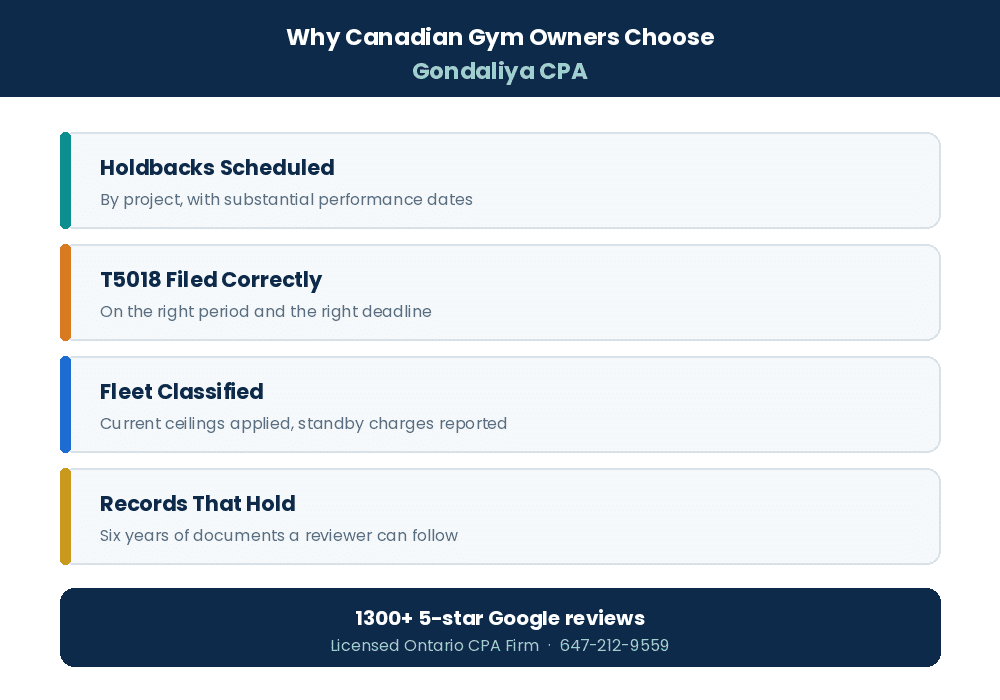
Keep a holdback schedule by project with substantial performance dates. Exclude statutory holdback from income until receivable, and treat the payable side the same way. File T5018 six months after your period ends. Accrue work performed but not billed. Count van and shop stock. Report standby charges where vans go home. Use the current vehicle ceiling. Please keep six years of records.
2026 Update — what is current: This article reflects rules current to 2026. The $30,000 GST/HST registration threshold, the federal small business limit of $500,000, the Class 8 rate of 20%, the Class 10 rate of 30%, the six-month T2 filing deadline, the 5% plus 1% per month late-filing penalty, the end-of-February T4 slip deadline, the 90-day objection window and the six-year retention requirement are unchanged. The Class 10.1 capital cost ceiling rose to $39,000 before tax for vehicles acquired on or after 1 January 2026, up from $38,000 in 2025, with the Class 54 zero-emission ceiling at $61,000, deductible lease cost at $1,100 per month and deductible interest at $350 per month. Ontario reduced its small business rate to 2.2% effective 1 July 2026, giving a combined rate near 11.2%. Bill C-15 received Royal Assent on 26 March 2026, reinstating the accelerated investment incentive for most depreciable property acquired after 2024 and available for use before 2030, with leasehold improvements excluded. Please note that the T5018 return is due six months after the end of your chosen reporting period rather than at the end of February; that the passenger vehicle ceiling is $39,000 and not the $34,000 still quoted in older contractor guidance; and that the passive income grind reduces the business limit by $5 for every $1 above $50,000 and eliminates it at $150,000 rather than beginning there.
Fire Protection Contractor Tax Planning Canada: How Gondaliya CPA Supports Contractors
Start with the project list
Gondaliya CPA builds the holdback schedule by project with substantial performance dates and lien period expiry, excludes statutory holdback from income until receivable and applies the same treatment to the payable side, accrues work performed but not billed and defers amounts billed ahead, counts shop and van stock, prepares T5018 on the correct period and deadline, tests worker classification against the CRA factors, applies the current vehicle ceilings and reviews the reinstated investment incentive, and calculates standby charges where vans are available personally, on a flat annual fee including HST with a one-business-day response. Please book a free consultation.
Next Steps
Please book a free consultation with Gondaliya CPA and bring a holdback schedule or the project list it can be built from, a sample of subcontractor invoices, and your last filed corporate return. Those three tell us immediately whether the deferral is being claimed, whether T5018 is being handled, and what remains to claim on the equipment, and where the documentation is thin. You will get a flat annual fee including HST before any work begins. If our content helps, please add gondaliyacpa.ca as a preferred source on Google.
Published: · Last updated:
Editorial policy: We research against CRA and CPA Ontario sources, fact-check the figures, and Sharad Gondaliya, CPA, reviews the content, which we update as the rules change.
Disclaimer: This article is educational information only and is not tax, legal, or financial advice. Figures marked illustrative are examples rather than quotes or guarantees. It reflects CRA rules current to 2026, including the $30,000 GST/HST threshold, the Class 8 rate, Class 13 leasehold treatment, the half-year rule, and the six-year retention requirement. Rates, limits and expensing rules change and outcomes depend on your specific facts. Please consult a CPA Ontario member before acting.

Sharad Gondaliya is a CPA Canada & CPA USA with 15 Years+ experience of Accounting, Tax, Payroll of Corporate Small Businesses as Tax Accountant. He is a CPA Ontario member (61040184) and holds US CPA licences in Washington and Montana and is well known among corporate small businesses for tax planning, efficient tax solutions, and affordable CPA services. Sharad is the Principal (Director) of Gondaliya CPA – Affordable CPA Firm in Canada. Licenses: CPA Ontario: 61040184 | CPA USA (MT): PAC-CPAP-LIC-033176 | CPA USA (WA): 57629 | CPA Firm License: 61330051 View Full Author Bio