

How to File a T2 Corporation Tax Return in Toronto
Filing T2 corporation tax return Toronto is simple with this stepwise guide, covering corporation income tax filing, required financial statements, supporting schedules like Schedule 1, and the quickest way to file corporate taxes using CRA EFILE. Toronto businesses can meet filing deadlines, avoid incomplete schedules and inaccurate income reporting, while benefiting from expert corporate tax accountant advice for 2025 compliance and tax optimization.
Request a Free Consultation
Filing your T2 corporation tax return in Toronto doesn’t have to be overwhelming. We offer comprehensive corporate tax filing services to ensure your T2 returns, schedules, and financial statements are prepared accurately and submitted on time. Our corporate tax accountants in Toronto specializes in helping small and medium-sized businesses across Toronto navigate CRA requirements, reduce audit risks, and optimize tax savings legally.
How to File a T2 Corporation Tax Return in Toronto: A Stepwise Guide by Gondaliya CPA Corporate Tax Experts
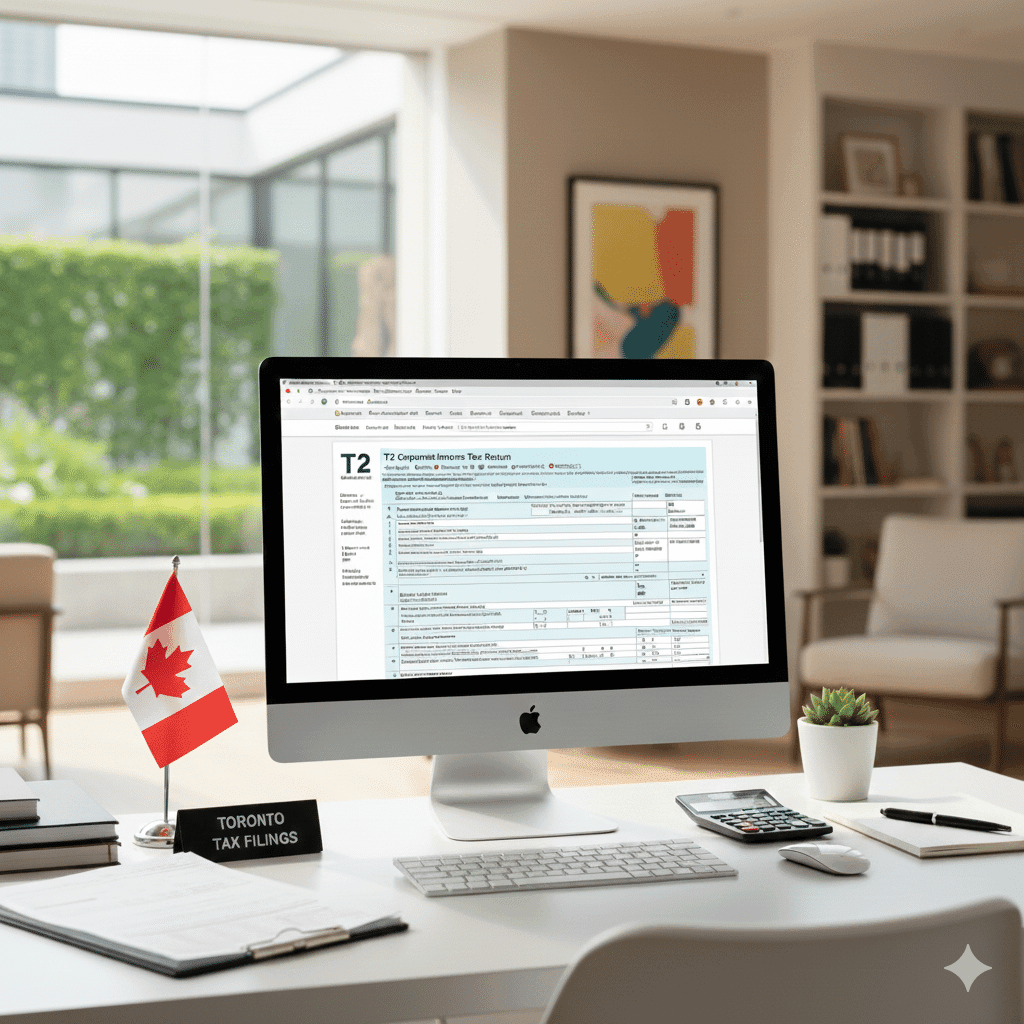
What is the T2 Corporation Income Tax Return?
The T2 Corporation Income Tax Return is a form Canadian companies must file. It shows your income, deductions, and taxes owed to the Canada Revenue Agency (CRA). If your business runs in Toronto, you have to file this return. The rules come from corporate tax regulations in Canada. Usually, you need to submit the return within six months after your fiscal year ends.
Who Needs to File a T2 Return in Toronto? Resident vs. Non-Resident Corporations
If your company earns money from business in Canada, you must file a T2 return. This applies whether your corporation lives here or not.
- Resident Corporations: These are firms set up under Canadian laws or controlled mainly in Canada.
- Non-Resident Corporations: These companies operate outside Canada but get income from Canadian sources. They have to file a non-resident corporation tax return.
Knowing your status helps with meeting your business tax obligations Toronto demands.
T2 vs. T2 Short Return: Choosing the Right Form
You have two options when filing corporate taxes:
- T2 Standard Form: Most businesses use this full form. It covers all the details CRA expects.
- T2 Short Return: Smaller companies with simple finances might use this easier form, called the simplified T2 form.
Picking the right form saves time and avoids mistakes.
Understanding CCPC (Canadian-Controlled Private Corporation) Status
A Canadian-Controlled Private Corporation (CCPC) gets some special tax benefits in Canada. To be a CCPC, you must meet these rules:
- The company has to be private.
- Canadians must own over 50% of voting shares.
- No one outside Canada or public firms can control it.
Knowing if you’re a CCPC matters because it changes what tax credits and rates apply. For example, CCPCs pay lower federal taxes on up to $500,000 of active business income each year.
Getting these basics about the T2 return and your duties right helps businesses handle their taxes better and use possible benefits from correct filing.
Key T2 Filing Requirements, Deadlines, and the Electronic Filing Mandate
Filing Deadlines: When is Your T2 Corporation Income Tax Return Due in Toronto?
If you run a business in Toronto, you gotta know when to file your T2 Corporation Income Tax Return. The CRA says you must file within six months after your fiscal year ends. So, if your year finishes on December 31, you have until June 30 next year.
But wait, paying your taxes is different. Usually, corporations pay taxes within two months after the fiscal year ends. For Canadian-Controlled Private Corporations (CCPCs) that qualify for the small business deduction, this extends to three months.
Missing these deadlines means penalties and interest charges. You want to pay taxes on time and file on time to avoid trouble with CRA.
Here’s a quick look:
- File T2 return within 6 months after fiscal year-end.
- Pay taxes within 2 months after fiscal year-end.
- CCPCs with small business deduction get 3 months to pay.
Keep track of your fiscal year-end reporting dates to stay clear of penalties.
Tax Payment Deadlines and Options for CCPCs
Canadian-Controlled Private Corporations have some special rules:
- Tax Payment Deadline: CCPCs using the small business deduction get three months after their fiscal year ends to pay without penalty.
- Instalment Payments: If your net tax payable is over $3,000 (or $1,800 for Quebec residents), you must pay monthly or quarterly instalments.
- Small Business Deduction: Eligible CCPCs get lower federal tax rates on active business income up to $500,000. Paying taxes on time helps you keep this benefit.
Managing these dates well can help Toronto businesses handle cash flow better while following CRA’s rules.
Mandatory Electronic Filing via CRA EFILE for 2024 Onwards
Starting in 2024, most corporations must file their T2 returns electronically through CRA’s EFILE system. This law aims to speed things up and reduce mistakes.
Here’s what you need to know:
- Corporations with over $1 million in gross revenue or those who filed electronically before must use EFILE.
- Electronic filing cuts down errors from manual work.
- Certified tax software makes preparing and sending returns easier.
Filing electronically means faster confirmation from CRA and quicker refunds if you’re owed money. Plus, digital copies are stored safely online.
Exceptions to the Electronic Filing Mandate
Even though most must file electronically now, some can still send paper returns:
- Non-resident corporations without a permanent Canadian establishment may use paper forms.
- Some inactive or dissolved companies might be exempt based on CRA’s criteria.
If you think your corporation fits an exception, talk with a corporate tax accountant who knows Ontario rules before filing by hand.
Stick closely to these deadlines and mandates. Use tools like CRA’s My Business Account portal to make things smoother. Gondaliya CPA can help prepare documents and submit your return right so you stay compliant and manage corporate taxes without headaches.
A Step-by-Step Guide to Preparing and Filing Your T2 Return
Filing your T2 corporation tax return in Toronto might feel tricky at first. But if you break it down, it’s easier to handle. This guide walks you through each step—from gathering your financial info to sending your return online. Following this helps you meet corporate tax compliance without stress.
Gathering Required Financial Statements and Supporting Schedules
First, gather all the financial papers you need for business income reporting. Here’s what to get together:
- Financial statements: These include balance sheets, income reports, and cash flow documents.
- Supporting schedules: These show detailed expenses, capital cost allowance (CCA), and more.
- Payroll records: Keep proof of employee wages, benefits, and deductions.
- Bookkeeping records: Collect receipts, invoices, and bank statements that back up your numbers.
- Past returns: These help keep things consistent.
Good financial record keeping during the year makes this much simpler. Having everything ready cuts down mistakes when filling out your T2 forms.
Completing the Main Forms: T2 and Schedule 1
The heart of filing is filling out Form T2 Corporation Income Tax Return along with Schedule 1 – Net Income (Loss) for Income Tax Purposes.
- On Form T2, report total revenue, expenses you can deduct, taxable income amounts, tax credits, and payments made.
- Use Schedule 1 to adjust your accounting net income to taxable income by adding or removing amounts CRA doesn’t count as deductible or taxable.
Make sure every part is done. Incomplete schedules or wrong income reporting often cause delays or audits. Double-check your figures against your documents before sending.
Using CRA Online Tools: My Business Account and My Payment Portal
CRA offers some handy online tools for managing corporate taxes:
- With My Business Account, you can check balances, track refunds, manage payments, update info, and file returns through EFILE-certified software (usually with a pro).
- The My Payment Portal lets you pay taxes online fast—no separate bank login needed.
Signing up early with these portals saves time and helps you keep track of deadlines and payments right away.
Filing Your T2 Return Electronically Through CRA EFILE
Starting in 2024, most companies have to file their T2 returns using CRA’s electronic system called EFILE. Filing this way speeds things up. It also cuts errors and confirms receipt immediately.
To file electronically:
- Fill out all forms using approved tax software that works with EFILE.
- Review everything carefully in the software before submitting.
- Send your return through the secure EFILE channel yourself (if authorized) or via a licensed Toronto accountant or tax pro who knows local rules.
- Save copies of your submitted return plus confirmation messages from CRA for future use or audits.
Electronic filing helps meet corporation income tax obligations on time under Canadian law while reducing paperwork loads a lot compared to mailing paper forms.
| Step | Action | Notes |
|---|---|---|
| 1 | Gather financial statements & receipts | Make sure they are complete & accurate |
| 2 | Complete Form T2 & Schedule 1 | Check that adjustments follow guidelines |
| 3 | Register/Access My Business Account | Keep track of filings & payments |
| 4 | File return via certified EFILE software | Required since 2024 |
If you want help at any point—from organizing data to audit support—talking with corporate tax accountants who know Toronto businesses can make a difference.
Tax Payments, Installments, and Deductions
Understanding Tax Payment Deadlines to Avoid Penalties
If your corporation is in Toronto, you must pay taxes on time. The T2 Corporation Income Tax Return has to be filed within six months after your fiscal year ends. But wait—payments are due earlier, usually two months after the fiscal year-end. For Canadian-controlled private corporations (CCPCs), you get an extra month, so three months total.
Missing these deadlines brings penalties and interest from the Canada Revenue Agency (CRA). The penalty starts at 5% of what you owe and adds 1% for each month late, up to a whole year. Interest charges add up daily on any unpaid amount.
Here’s how to avoid penalties:
- File your T2 return within six months.
- Pay your tax within two or three months, depending on your company type.
- Check payments on CRA’s My Business Account portal.
Paying and filing on time keeps your business in good standing with tax officials. Don’t delay—it costs more later.
Paying Corporate Taxes in Installments: A Practical Guide
Lots of companies pay their corporate taxes in installments instead of one big lump sum at year-end. These recurring corporate tax instalments split the cost over the year. That makes money management easier.
You must pay installments if you owe more than $3,000 in federal taxes a year (or $1,800 if you’re in Quebec). Payments come monthly or quarterly based on CRA’s rules.
CRA uses one of three ways to figure out installment amounts:
- No-calculation option: equal payments based on last year’s taxes.
- Prior-year option: calculates from last year’s numbers.
- Current-year option: based on your current estimates if they seem reliable.
Paying installments helps avoid huge end-of-year bills and stops extra interest from underpaying. Use CRA tools like My Payment Portal to keep track of due dates.
Common Tax Deductions and Credits for Corporations in Toronto
Toronto businesses can save money by using tax credits and deductions designed for corporations. They lower how much tax you owe.
Common Corporate Tax Deductions include:
- Business expenses like rent, utilities, or office supplies.
- Salaries and wages paid to employees.
- Capital Cost Allowance (CCA), which covers depreciation on assets like equipment or vehicles.
Tax Credits available are:
- Scientific Research & Experimental Development (SR&ED) Credit for R&D projects.
- Investment Tax Credits for buying certain property that helps innovation or saves energy.
Small businesses can especially benefit from deductions on startup costs or fees during incorporation.
Using these credits and deductions lowers the total corporate tax payable while following CRA rules for Ontario companies.
The Small Business Deduction: Eligibility and Calculation
The Small Business Deduction (SBD) cuts the federal tax rate for active business income up to $500,000 a year. It’s a big help for small corporations in Toronto wanting to save money legally.
To qualify, you need to:
- Be a Canadian-controlled private corporation (CCPC).
- Run an active business mainly in Canada during the tax year.
The SBD drops federal rates from 15% down closer to 9%. That means much less tax compared to standard rates above $500K income. Ontario also offers lower provincial small business rates similar to this deal.
Calculating SBD means finding net active income below $500K after adjustments like excluding some investment income as per CRA rules. Keeping good records helps when claiming this deduction on your T2 return through electronic filing methods now required since 2024.
Knowing your corporate tax payment deadlines is key. Paying installments correctly spreads costs out and avoids interest charges. Taking advantage of deductions and credits—including the Small Business Deduction—helps lower taxes owed by Toronto businesses. Gondaliya CPA helps clients prepare and file T2 returns smoothly with up-to-date CRA rules in mind.
Common Filing Mistakes, Avoiding Penalties, and CRA Resources
Common T2 Filing Mistakes to Avoid: Incomplete Schedules and Inaccurate Income Reporting
Filing your T2 corporation tax return in Toronto needs care. A big mistake is sending in incomplete schedules. Each schedule supports a part of your return. Missing or half-filled forms slow down processing or cause audits. For instance, Schedule 1 changes accounting income into taxable income. If you leave it incomplete, tax calculations go wrong.
Another error is reporting business income incorrectly. You must list all revenue clearly. Keep supporting financial statements and receipts handy. Forgetting small income sources or mixing up expenses causes issues with the CRA.
To avoid these errors:
- Collect all financial records first.
- Check each form to make sure it’s complete.
- Use clear documents for every amount.
- Compare with last year’s return for consistency.
Doing this helps filing go smoothly. You cut down the chance of mistakes that waste time and money.
Potential Penalties for Late Filing or Inaccurate Information
The CRA charges penalties if you file late or submit wrong info on your corporate tax return. The late filing penalty starts at 5% of unpaid tax plus 1% more each month, up to 12 months total. If you’re late often, fees get higher.
Interest also builds up daily on taxes you still owe until paid in full. So paying on time matters as much as filing on time.
Giving false information risks reassessments and more fines under Canadian tax law.
To avoid penalties:
- File your T2 within six months after your fiscal year ends.
- Pay any taxes owing within two months—or three months if you are a Canadian-controlled private corporation.
- Keep accurate records backed by verifiable documents.
Staying on top of this protects your business’s money and reputation during tax season.
Leveraging CRA’s Online Resources and Support for T2 Filing
The CRA provides online tools that make T2 filing easier for Toronto corporations:
CRA EFILE T2: Most companies must efile returns starting in 2024 using this secure system. EFILE checks data before submission and speeds processing compared to paper forms.
My Business Account Portal: This portal shows account balances, tracks refund status, manages instalment payments, updates contact info, and lets you talk securely with the CRA—all in one place.
My Payment Portal: Pay corporate taxes electronically here fast—no cheques or bank visits needed.
These government tools cut paperwork headaches and give real-time updates about your tax status. Getting used to them early means less last-minute stress near deadlines.
| T2 Filing Step-by-Step Checklist |
|---|
| Gather all required documents: financial statements, payroll records, receipts Complete main forms: T2 Corporation Income Tax Return & Schedule 1 Fill out supporting schedules relevant to your business activities Review all entries carefully; check totals & signatures Submit electronically via CRA EFILE system by deadline Make payment using My Payment Portal within due date limits |
This short checklist keeps you organized from start to finish. It helps reduce errors while meeting rules efficiently.
Avoid common mistakes like missing schedules or wrong income reports. Use official CRA tools to help your Toronto business file corporate taxes right every year. Gondaliya CPA experts can guide you through everything—from prep to post-filing—to keep you compliant and confident in 2025.
Gondaliya CPA: Your Partner for Corporate Tax Filing in Toronto
Filing a T2 corporation tax return in Toronto can be tricky. But with the right help, it gets easier. Gondaliya CPA knows how to handle corporate tax filing and tax preparation services for businesses in Toronto. We get that meeting CRA deadlines matters a lot. Late or wrong filings can bring costly penalties.
Our corporate tax accountants guide you through electronic filing rules and make sure your numbers add up. Need advice on penalty rules under Canadian tax law? Or want tips on getting the most deductions? We offer reliable solutions for Ontario corporations at affordable rates.
Picking a tax consultant service in Toronto helps you follow rules and improve your business’s tax situation. Gondaliya CPA stands as one of the trusted accounting firms in Toronto and Ontario for these needs.
How Gondaliya CPA Supports Every Step of the T2 Filing Process: Data Prep to Filing
Preparing your T2 return starts way before you send it off. We help you gather all financial papers — statements, payroll info, receipts, past returns. Reporting income correctly is super important. Mistakes can cause audits or penalties.
We walk you through filling key forms like the main T2 Corporation Income Tax Return and Schedule 1 adjustments. Using CRA’s online tools like My Business Account makes entering data smoother and keeps track of your submissions.
Here’s what we do:
- Collect supporting documents so they’re easy to find
- Check numbers against original papers
- Make sure all required schedules are included
- Point out deductions your business can claim
This careful prep cuts down errors that slow processing or cause later reassessments.
Post-Filing Audit Assistance from Gondaliya CPA
Sometimes CRA audits businesses after filing. This can stress you out. Getting professional audit help eases the process a lot. Gondaliya CPA reviews audit notices fast, crafts detailed replies, and talks with auditors for you.
We reduce risk by clearing up differences early while protecting your rights during audits. Our ongoing tax filing support gives peace of mind beyond just filing—plus it keeps your business reputation safe.
T2 Filing Deadlines Calendar for Toronto Businesses
| Fiscal Year-End | T2 Filing Deadline (6 months later) | Tax Payment Deadline* | Notes |
|---|---|---|---|
| December 31 | June 30 | February 28 / May 31 | CCPCs get extra time to pay |
| March 31 | September 30 | May 31 / August 31 | Standard payment due dates |
| June 30 | December 31 | August 31 / November 30 | Pay on time to avoid penalties |
*Tax payment is usually two months after fiscal year-end; three months if you qualify as a Canadian-Controlled Private Corporation (CCPC).
Meeting deadlines keeps you from corporate tax filing penalties Canada-wide. These fines can include interest plus extra fees depending on how late filings are (source).
FAQs: Your T2 Questions Answered by Gondaliya CPA
When is the T2 due in Toronto?
You must file your T2 return six months after your corporation’s fiscal year-end. For example, if it ends December 31st, file by June 30th next year. Taxes owed need paying within two months—unless you’re a CCPC; then payment time extends to three months without penalty.
What forms are needed for the T2 return?
At minimum, send Form T2 with Schedule 1 (Net Income Adjustments). Other schedules might be required too, like Schedule 100 (Balance Sheet) or Schedule 125 (Income Statement). These forms show detailed financial info as per CRA rules.
How do I file electronic T2 returns?
Most corporations now must file electronically via CRA’s EFILE system starting in 2024 unless exempted—for example, small non-profits or inactive companies. Certified software makes this easy by letting you submit directly through programs popular among Toronto businesses.
Where can I find a corporate tax accountant in Toronto?
Look for licensed pros who know corporate taxes and local rules well—like those at trustworthy firms offering full services from bookkeeping to final return prep such as Gondaliya CPA. Expert advice helps ensure accuracy while spotting savings specific to Ontario companies facing changing federal-provincial laws.
Working with experienced people who know how to file t2 corporation tax returns correctly —and using CRA-required digital tools—helps cut risks linked to late or wrong filings big time. That way, you can focus more on growing your business confidently under Canada’s current tax rules today.
FAQs: Additional T2 Corporation Tax Return Queries for Toronto Businesses
What is the role of a corporate tax accountant Toronto in T2 filing?
A corporate tax accountant Toronto prepares your T2 return, ensures compliance, and advises on deductions to optimize your tax position.
Can non-resident corporation tax return requirements differ in Toronto?
Yes. Non-resident corporations without a permanent establishment may have unique filing rules and electronic filing exceptions.
How does the tax return penalty fees system work for late filings?
CRA charges 5% of unpaid taxes plus 1% monthly up to 12 months as penalty fees for late T2 returns.
What corporate tax payment deadlines must Toronto businesses remember?
File within six months of fiscal year-end; pay taxes within two months, or three months if you qualify as a CCPC.
What is the importance of supporting documentation in corporate tax filing?
Supporting documentation like financial statements and payroll records validate income and deductions during audits.
Which tax preparation software is certified for T2 filing in Canada?
Use CRA approved tax software with EFILE certification to submit accurate and compliant T2 returns electronically.
How does accessing My Business Account help with corporate tax compliance Toronto?
My Business Account tracks payments, refund status, filing history, and communicates securely with CRA online.
Key Corporate Tax Filing Compliance Points for Toronto Businesses
- Prepare complete financial statements: income statement, balance sheet, cash flow statement.
- Keep bookkeeping records and business receipts organized throughout the year.
- Use corporate tax software compatible with CRA EFILE for timely submissions.
- Follow the tax return checklist to avoid common mistakes and penalties.
- Monitor fiscal year-end tax obligations closely to meet all deadlines.
- Manage recurring tax payments or instalments based on taxable income thresholds.
- Utilize government tax portals such as CRA’s My Payment Portal for seamless payments.
- Maintain proper payroll records including CPP contributions and EI premiums remittance in Toronto.
- Stay updated on corporate tax regulations Canada-wide, including provincial corporate tax changes.
- Consult a professional tax consultant services Toronto firm like Gondaliya CPA for tailored advice.
- Understand audit assistance procedures and prepare to respond promptly if contacted by CRA’s Sudbury or Winnipeg Tax Centre.
- Review prior year tax returns to maintain consistency and accuracy in reporting.
This checklist ensures business tax compliance while easing the corporation income tax filing process in Toronto.
Filing your T2 corporate tax return correctly is essential for protecting your business from penalties, audits, and unnecessary tax exposure. With constantly evolving CRA requirements, having expert guidance can make a measurable difference in both compliance and long-term tax efficiency. Gondaliya CPA supports Toronto corporations with accurate filing, strategic planning, and clear advice tailored to your business goals. Whether you’re filing your first return or managing ongoing compliance, our CPA-led team helps you stay confident and prepared year after year. Schedule your Free Consultation today and take the stress out of corporate tax filing.

Sharad Gondaliya is a CPA Canada & CPA USA with 14 Years+ experience of Accounting, Tax, Payroll of Corporate Small Businesses as Tax Accountant. He is fully certified CPA Ontario and CPA USA and is well known among corporate small businesses for tax planning, efficient tax solutions, and affordable CPA services. Sharad is the Principal (Director) of Gondaliya CPA – Affordable CPA Firm in Canada. Licenses: CPA Ontario: 61040184 | CPA USA (MT): PAC-CPAP-LIC-033176 | CPA USA (WA): 57629 | CPA Firm License: 61330051 View Full Author Bio