



Notary Bookkeeping Guide: How to Track Client Fees, Legal Service Revenue, Expenses, and Profitability
Notary bookkeeping Canada: Gondaliya CPA’s guide to notary business accounting and financial reporting
Notary bookkeeping Canada is essential for accurate notary business accounting, and Gondaliya CPA offers expert guidance on client fees tracking, expenses tracking, and notary financial reporting. Their services include bookkeeping for notaries, notary tax preparation, and cash flow management to support professional services bookkeeping and profitability analysis.
Most notarial practices come to us with the same three questions: what did I actually earn, what am I holding for clients, and what can I claim. Our notary accounting and tax services answer all three on a fixed annual fee.
Quick Summary
Notary bookkeeping Canada is a must for anyone running a notary practice here. You have to keep close track of client fees, income, and expenses. Doing this right keeps you on the safe side with the rules. It also shows if your business makes money or loses it. When you get these basics down, managing your money becomes easier.
Reading time: 47 minutes.
Table of Contents
- Notary Bookkeeping Essentials
- Core Services in Notary Bookkeeping
- Frequent Bookkeeping Errors
- Supporting Growth and Governance
- Resources and Additional Support
- Pricing and Getting Started
- Frequently Asked Questions
- Essential Practices and Advanced Topics
- Notary Practices We Serve
- Professional Guidance and Quick Reference
The Numbers That Matter
This article covers Canada, with Ontario and Toronto context, and reflects rules current to 2026. It assumes an incorporated notary practice, mobile signing agent or multi-staff notarial office. Note that the notarial role differs by province: notaries public in Ontario are appointed under provincial legislation with a defined scope, while notaries in British Columbia are a separate regulated profession with wider powers. Figures marked illustrative are examples, not quotes, and any masked engagement notes end with “Figures changed for privacy.” This is educational information only and not tax or legal advice. Fee tariffs, trust account rules and record retention set by your regulator sit alongside, not instead of, CRA requirements.
Notary Bookkeeping Essentials for Canadian Professionals
Notary Bookkeeping Essentials
The Basics
Why Accurate Tracking Matters
Good notary business accounting needs solid record-keeping. When you track client fees and expenses well, you can:
- Follow CRA rules without problems.
- See which services make money and which don’t.
- Keep an eye on cash flow so you don’t run short.
If your records are wrong, you risk penalties or miss chances to earn more. Setting up a proper system to track fees is the foundation.
Our Approach to Notary Financial Reporting
Gondaliya CPA offers notary bookkeeping services built for Canadian professionals. Here is how we work:
- We build a chart of accounts that fits your income and expense types.
- We produce monthly financial reports so you know how the practice is doing.
- We make sure your books meet CRA requirements, which lowers review risk.
The goal is to make handling your money simpler so you can focus on serving clients.
Benefits of Professional Bookkeeping
Working with a firm that understands notarial practice brings real advantages:
- Save time: More hours for clients and paperwork that actually earns.
- Get expert input: Someone who knows the details specific to notary accounting in Canada.
- Cut mistakes: Established practices that reduce the errors common in do-it-yourself bookkeeping.
The result is smoother operations and more reliable reporting, both of which you need if the practice is to grow steadily.
The first thing we look at on a notary file is whether registry fees sit in revenue. Almost always they do, and the reported income is overstated as a result. Figures changed for privacy.
Risk Warning: Money collected to pass on to a registry or government body is not your income. Please track it separately from the first entry.
Core Services in Notary Bookkeeping and Accounting
Core Services in Notary Bookkeeping
The Services
Notary bookkeeping Canada needs careful record-keeping because notarial work has distinct income and expense types. Good accounting keeps you within CRA rules and gives you clear information for decisions. Specialized services help incorporated notaries, mobile agents and small offices across Ontario and Canada.
Bookkeeping Built for Notaries
Notary bookkeeping services must handle income such as document fees, travel charges, disbursements and government fees. A clear chart of accounts keeps these separate from expenses like rent or professional dues.
Good books prevent the mistakes that lead to CRA queries or incorrect tax figures. Monthly reconciliation makes sure client payments match invoices for appointments or signings.
Client Payment Reconciliation and Receivables
Tracking client fees is central to cash flow in a notary office. Every invoice gets a unique number tied to the appointment or service.
Deposits from card processors need to match gross sales, not just the net amount after the processor takes its fee. Recording only the net figure understates both revenue and expenses.
Reconciliation means checking e-transfer receipts and cash logs regularly. This catches missing or duplicated payments. An aged receivables report shows late invoices so you can act before the money is at risk.
| Payment Method | Record Gross | Fees Withheld | Matching Record | Timing |
|---|---|---|---|---|
| Credit card | Yes | Processor fee | Deposit report plus invoice | Daily or monthly |
| E-transfer | Yes | None | Bank statement | Immediate |
| Cash | Yes | Not applicable | Cash log plus receipt | Same day close |
Cash Flow Management
Cash flow oversight means watching money coming in from clients against what goes out for payroll, rent, supplies and taxes.
Under the accrual basis, income is recognized when the service is performed rather than when payment lands. Amounts received in advance stay in a liability account until the work is done.
Regular forecasting spots gaps during slower periods, such as seasons with fewer real estate closings or immigration files.
Preparing and Analysing Financial Statements
Financial reports depend on clean data showing every income source clearly.
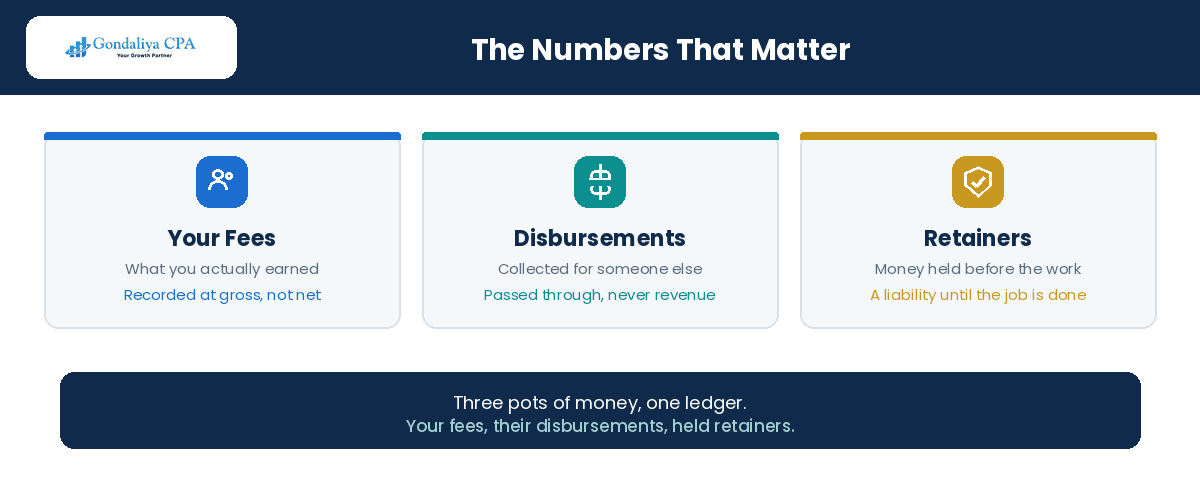
Your own fees should appear separately from disbursements passed through at cost without markup. Looking at profit by service line shows what actually earns:
- Travel costs for mobile signings against the related fees charged
- Real estate package pricing against the time actually spent
- Margin on translation or apostille add-on services
Reports typically comprise a profit and loss statement split by fee type plus a balance sheet showing any shareholder loan balance, prepared under the compilation standard.
These reports help set fees within your regulator’s requirements while meeting the CRA’s six-year retention rule.
Tax Preparation and Compliance
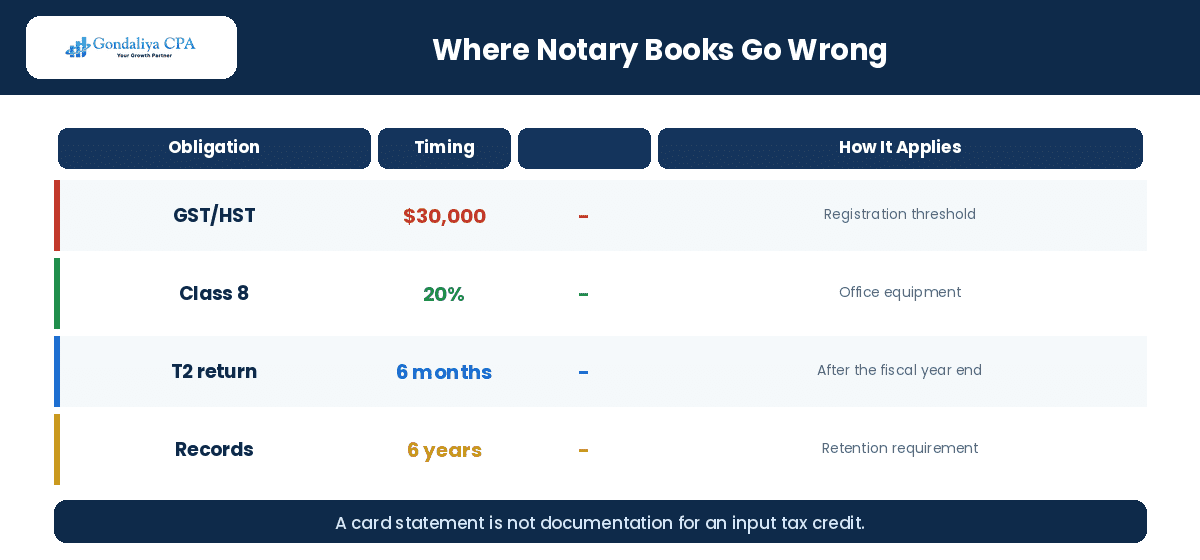
GST/HST deadlines must be met. Late filing brings penalties plus interest. Input tax credits need documentation showing the purchase and the supplier’s registration number; a bank entry alone is not enough.
Records must be kept beyond the return itself. Digital copies are acceptable provided they remain accessible and legible when requested.
Tax preparation also looks at deductions such as insurance premiums tied to your licensed work rather than personal cover, and at whether shareholder loan accounts have been used to absorb personal costs.
Software and Tools
Cloud accounting is popular among Canadian notaries who want a shared ledger plus automated billing for recurring appointments.
Platforms with multiple user access suit offices with several staff, and receipt capture apps handle the documentation side. Payment processing integrations reduce the manual matching work.
Using software cuts the manual errors common in do-it-yourself setups and speeds up the monthly close.
Recording only the net deposit from a card processor is the most common single error we see. Both revenue and the processor fee disappear, and the margin looks better than it is. Figures changed for privacy.
Key Stat: Record card deposits at gross with the processor fee shown as an expense. Please do not book the net figure as revenue.
Frequent Bookkeeping Errors Encountered by Notaries
Frequent Bookkeeping Errors
The Errors
Notary bookkeeping runs into a familiar set of mistakes. One significant error is treating net payment processor deposits as full revenue, which makes income look wrong and hides the processing cost. Another is mixing personal and business costs, which creates shareholder loan exposure under section 15(2) of the Income Tax Act.
Many notaries also fail to track disbursements separately from their own fees, which causes trouble on GST/HST reporting because it obscures whether you acted as agent or principal.
Some rely on credit card statements without keeping receipts, which puts input tax credits at risk. Mobile signing agents often skip vehicle logbooks, without which mileage claims cannot be supported. Finally, delaying the monthly close builds a backlog of unpaid invoices and unreconciled accounts.
The common mistakes in short:
- Recording net deposits as full income
- Mixing personal and business expenses
- Not separating disbursements from fees
- Keeping weak expense documentation
- Skipping vehicle logbooks for mileage claims
- Delaying the monthly close, causing backlog errors
How Inaccurate Tracking Hurts Profitability
Getting the numbers wrong affects what your practice actually earns. When client payments are not recorded properly, gross income on your corporate return is misstated, which can bring queries or reassessment. Revenue also gets overstated when amounts received before the work is done are counted as earned.
On the expense side, failing to separate reimbursed costs from genuine deductions inflates spending. That lowers taxable income on paper but risks losing input tax credits where receipts are weak. Vehicle costs claimed without logbooks are questioned as a matter of routine.
Cash flow suffers when payments arrive late or do not match invoices, delaying collection and raising bad debt risk.
The result is that you lose sight of true profit per appointment or document. Key impacts:
- Misstated income on tax returns
- Wrong expense deductions affecting tax
- Risk of denied GST/HST credits
- Poor cash flow from late payment recording
- Less clarity on real profitability
Improving Accuracy
You can fix these by adding controls:
- Create a chart of accounts specific to notarial work, separating travel surcharges, government fees collected as agent, and translation services from notarizations
- Use bank accounts only for the business to avoid mixing funds
- Capture receipts electronically through a cloud tool linked to your ledger
- Close the books monthly, checking processor deposits at gross against invoices less withheld fees
- Track client payments using aged receivables reports to chase overdue bills quickly
- Keep detailed mileage logs tied to specific trips for mobile signing work
Working with someone who understands both the CRA rules and your provincial regulator’s requirements keeps the practice on solid ground.
Audit Support and Fixing Discrepancies
If your records show problems during an internal check or a CRA review, getting help quickly reduces the exposure.
Common triggers are differences between reported revenue and bank deposits, or missing documentation behind GST/HST credit claims.
Gondaliya CPA helps prepare by:
- Rebuilding past transaction records from the available information
- Identifying unrecorded cash appointments
- Explaining the agent and principal treatment of pass-through registry fees
- Correcting shareholder loan balances caused by mixed personal and business spending
We also match invoice dates against deposit dates and check payroll against slip filing deadlines. Catching problems early prevents expensive reassessments and builds credibility with reviewers. Our CRA audit guide sets out what to expect.
The agent versus principal question on registry fees decides your GST/HST position and your revenue figure at the same time. Getting it wrong distorts both. Figures changed for privacy.
Risk Warning: A card statement is not documentation for an input tax credit. Please keep the supplier invoice showing the registration number.
Supporting Notary Business Growth and Governance
Supporting Growth and Governance
The Growth
Good bookkeeping practices help your practice grow and stay on track. Accurate records show how the business is performing, which lets you make better decisions and meet your obligations. They also make cash flow, cost and income visible, all of which you need to run the practice smoothly.
- Keep clear, up-to-date financial records
- Track all fees, expenses and income carefully
- Follow CRA rules to avoid problems
- Use the accounting to understand where money moves
Financial Reporting and Governance
Financial reports keep the business transparent. You need current income statements, balance sheets and cash flow reports so you can see the position at any time. Track every client fee and every cost.
Use accounting software that suits professional services. Check monthly that bank deposits match invoices, and account for GST/HST where it applies. Keep solid records so you are ready if the CRA reviews your file.
Review shareholder loan balances regularly to avoid an income inclusion under section 15(2). Honest reporting also builds credibility with lenders because it shows the money is handled responsibly.
What to do:
- Produce monthly financial statements
- Use reliable bookkeeping software
- Reconcile bank deposits against invoices each month
- Review shareholder loan accounts regularly
Budgeting for Sustainable Expansion
A budget plans growth without surprises. It sets out expected income from document charges and travel fees, alongside spending on rent, insurance and equipment.
Use your own historical figures to forecast, and build in room for equipment repairs or extra staffing during busy periods.
Compare actual spending against budget regularly. This surfaces problems early enough to fix them. A workable budget prevents overspending while leaving room to invest in marketing or mobile signing capacity.
- Forecast income and costs from your own past data
- Include a reserve for unexpected expenses
- Check budget against actual figures regularly
- Use the budget to guide investment decisions
Profitability Analysis
Profitability analysis shows which services earn most relative to their cost. Look at gross margin by job type, comparing real estate signings against translation work.
Separate direct costs such as registry fees from general overhead so you see true profit by client type. Watch unpaid invoices so cash does not sit uncollected.
This informs pricing. Your fees must respect any tariff your regulator sets while remaining competitive locally. It also tells you where to spend your time, perhaps on consulting alongside notarizing.
- Calculate margin per service line
- Track direct costs separately from overhead
- Monitor unpaid invoices closely
- Use the analysis to set fees and allocate time
Integrating Bookkeeping With Broader Services
Linking bookkeeping with your other accounting work saves time and prevents mistakes. Combining payroll with monthly bank reconciliation produces a smoother workflow.
Cloud software gives live visibility, which speeds up corporate return preparation and helps with GST/HST filings on taxable notarial services.
This makes year-end review straightforward, so lenders get reliable figures about your incorporated practice.
- Combine payroll with bank reconciliation
- Use cloud tools for current information
- Meet corporate filing deadlines without a scramble
- Produce financial statements stakeholders can rely on
For advice on keeping your books clean while meeting your professional obligations, contact Gondaliya CPA at info@gondaliyacpa.ca or call 647-212-9559.
Margin by service line is the report notaries find most useful and least often have. Real estate packages and one-off affidavits earn very differently per hour. Figures changed for privacy.
Pro Tip: Please set up your chart of accounts by service line before the year starts. Splitting revenue afterwards means reworking every entry.
Resources, Networks, and Additional Support
Resources and Additional Support
The Support
Notary bookkeeping needs solid tools and expert input to keep client fees and service revenue straight. The right resources make tracking easier and keep you aligned with Canadian tax rules.
Revenue Tracking Tools and Guidance
Tracking client fees correctly is central to notary business accounting. Practice management and accounting software handles charges such as document fees, travel costs and other payments, covering invoicing, payment matching and recognising income at the right point.
Guidance for incorporated notaries explains how to distinguish money received in advance from money actually earned, and how to keep receipts, invoices and engagement records that satisfy the CRA.
These tools cut mistakes. They create a routine for monthly bank reconciliation and receivables monitoring, which surfaces problems before they affect cash flow.
Working With a Firm That Knows the Sector
Gondaliya CPA works with notarial practices across Ontario and Canada as a firm licensed by CPA Ontario. We use cloud accounting tools so clients can see their position at any time.
These platforms pull data from payment systems and track expenses in a way that respects trust account requirements and any fee tariff your regulator sets. We work with both solo notaries and multi-staff offices, tailoring the account structure to varied income streams such as translation or mobile signing fees.
Our engagements include guidance on GST/HST filing for taxable notarial work, and our flat annual fee covers support if the CRA reviews your income or expenses.
Collaboration and Shared Resources
Incorporated notaries benefit from working with an accountant who understands their specific challenges. Mobile signing agents in particular gain from shared approaches to vehicle logs and appointment scheduling that feed into the bookkeeping.
These arrangements help run billing cycles smoothly across locations or team members while respecting the file retention rules your regulator sets.
Combining tax planning with regular bookkeeping lets smaller offices grow while keeping financial controls strong enough to withstand a CRA review.
Client Access and Account Management
We provide secure client access to your accounting information, so you can see aged receivables, tax credit claims, payroll summaries, trial balances and disbursement records in real time.
Clients upload digital receipts directly to their ledger, which matters because the CRA expects supporting documents rather than bank statements alone. Automated reminders help close the books monthly, including shareholder loan checks that prevent an unexpected income inclusion.
This arrangement keeps client and accountant aligned on deadlines such as the annual corporate filing date.
For advice on notary bookkeeping built for your office, reach out at 647-212-9559 or info@gondaliyacpa.ca.
Practices that give us live access to the ledger get their questions answered the same day. Practices that email a shoebox in April get answers in May. Figures changed for privacy.
Key Stat: The CRA expects supporting documents, not just bank statements. Please capture the receipt at the point of purchase.
Pricing and Getting Started With Gondaliya CPA
Pricing and Getting Started
Next Steps
Clear Pricing
Gondaliya CPA charges a flat annual fee for notary bookkeeping services. That fee covers monthly bank reconciliation, receivables tracking, disbursement management, payroll posting, GST/HST filing support and year-end financial statements prepared under ASPE. The flat price lets incorporated notaries budget without surprise bills.
Several things affect where your fee lands:
| Factor | Why It Matters |
|---|---|
| Appointment volume | More appointments mean more transactions |
| Transaction count | More invoices and payments take more time |
| Payment processors | Multiple processors add reconciliation steps |
| Staff headcount | More employees means more payroll work |
| Catch-up months needed | A backlog increases the initial workload |
| Receipt documentation quality | Weak records slow everything down |
This suits solo practices and multi-staff offices alike, giving honest pricing without hourly charges.
How to Get Started
Getting started is straightforward. Call 647-212-9559 or email info@gondaliyacpa.ca to set up a free conversation. We review your current record-keeping, look at the chart of accounts against your practice type, whether solo notary or mobile signing agent, and discuss any cleanup needed.
After that you provide access to your cloud accounting file along with bank statements and payment processor reports. Our team reviews the information, cleans up historical data where needed, then sets up a monthly closing process that fits how you work.
It is collaborative: you supply the source documents, we make sure everything meets the CRA’s books and records requirements. We also structure the accounts so tax preparation is straightforward, and run quarterly reviews so you can see cash flow and profit by service line.
How to Reach Us
Several ways to get in touch:
- Phone support on weekdays, with evening and weekend availability during busy periods
- Email any time, with replies usually within one business day
- Free consultation bookings online or by phone
- Enquiry through our contact page to send details before a meeting
These get you quick answers on questions such as the tax treatment of amounts held for clients, input tax credit eligibility on professional dues, or vehicle logbook requirements for mobile signing.
You get clear communication from licensed Ontario CPAs who understand both the federal rules and the provincial differences affecting notaries in British Columbia against Ontario.
Getting Started Today
If you are an incorporated Canadian notary looking for help with bookkeeping, call Gondaliya CPA at 647-212-9559 or email info@gondaliyacpa.ca for a free conversation about your practice.
Affordable notary bookkeeping improves accuracy and cuts review risk through steady record-keeping that matches what the CRA expects. Let a qualified team handle the accounting so you can focus on serving clients.
The fee question we get asked most is whether catch-up work is included. It is quoted separately because the volume varies enormously, and we tell you the number before starting. Figures changed for privacy.
Pro Tip: Please bring your last filed return and a recent processor statement to the first call. Those two show us most of what we need to quote accurately.
FAQs on Notary Bookkeeping Canada
Frequently Asked Questions
FAQ
What is pass-through accounting for notary disbursements?+
It means recording a disbursement exactly as paid, without markup, so your own fee stays separate from the amount you collected on the client’s behalf.
How should invoice numbering be handled?+
Assign unique sequential numbers tied to each appointment or service. This makes payment matching and receivables tracking far simpler.
Why does shareholder loan monitoring matter?+
It prevents personal spending accumulating in the company account. An unrepaid balance can be included in income under section 15(2) of the Income Tax Act.
When is revenue recognized for a notary practice?+
Under the accrual basis, income is recognized when the service is performed rather than when payment is received. Amounts received in advance are a liability until earned.
What are the GST/HST filing deadlines for notaries?+
They depend on your assigned reporting period, which may be monthly, quarterly or annual. Late filing brings penalties and interest.
Why is a monthly close important?+
It confirms bank deposits match invoices, catches errors while they are small, and keeps the books ready for tax reporting rather than requiring a year-end scramble.
How should mobile signing agents track vehicle expenses?+
Keep a logbook recording the date, distance, destination and business purpose of each trip. Without it the business-use portion cannot be supported.
What penalties apply for inadequate records?+
The CRA can apply penalties for failing to keep or produce adequate records, and separately deny deductions and credits that cannot be supported. The amounts depend on the provision engaged.
How do payroll obligations affect a notary practice with staff?+
Source deductions must be remitted on the schedule set by your remitter type, and T4 or T4A slips filed by the end of February following the calendar year.
What software suits notary bookkeeping?+
Cloud accounting with receipt capture and payment processor integration works well. The key features are a chart of accounts by service line and gross recording of processor deposits.
Ten questions and one underneath most of them: is this money mine. Fees, disbursements and retainers each answer that differently. Figures changed for privacy.
Essential Practices and Advanced Topics
Essential Practices and Advanced Topics
Quick Reference
Practices That Keep the Books Accurate
- Use an invoice control log to track issued invoices systematically.
- Maintain a daily cash log so cash payments reconcile quickly.
- Match receipts promptly against recorded expenses to support input tax credits.
- Separate client deposits clearly from earned revenue to reflect the refund obligation.
- Track pass-through registry fees separately as amounts collected as agent.
- Post payroll on time using software linked to your bookkeeping system.
- Monitor chargebacks so client accounts are adjusted when payments reverse.
- Reconcile bank statements monthly against invoices and processor reports.
- Apply capital cost allowance correctly, with office equipment generally in Class 8 at 20%.
- Apply the 50% limit on meals and entertainment under section 67.1 of the Income Tax Act.
Advanced Topics in Financial Management
- Manage bad debt write-offs with documentation supporting the decision, adjusting taxable income correctly.
- Conduct profitability analysis by fee type using monthly reporting, with year-end statements compiled under CSRS 4200.
- Build budgets that respect any fee tariff your regulator sets while supporting sustainable growth.
- Apply electronic record guidelines so digital documents remain accessible and legible for six years.
- Prepare financial statements under ASPE, tailored to a small incorporated notary practice.
- Review the agent versus principal position on disbursements annually, since it drives both revenue and GST/HST.
- Monitor the shareholder loan balance quarterly rather than discovering it at year-end.
- Track deferred revenue on prepaid work so income lands in the period it is earned.
For help optimizing your notary bookkeeping, contact Gondaliya CPA at info@gondaliyacpa.ca or call 647-212-9559 today.
Eighteen points and one underneath them: know what you earned, what you are holding and what you collected for someone else. Every notary bookkeeping problem starts with blurring those three. Figures changed for privacy.
Notary Practices We Serve
Industry Expertise
Which issue dominates differs by practice. Here are ten and the usual focus.
| Notary Practice | Where the Exposure Sits |
|---|---|
| Solo notary, newly incorporated | Chart of accounts separating fees from disbursements |
| Mobile signing agent | Vehicle logbook supporting mileage claims |
| High card payment volume | Gross versus net recording of processor deposits |
| Real estate focused practice | Pass-through registry fees and agent treatment |
| Practice taking retainers | Deferred revenue until the work is done |
| Multi-staff notarial office | Payroll remittance timing and slip filing |
| Translation and apostille add-ons | Margin by service line |
| Owner using one bank account | Shareholder loan balance building unnoticed |
| Practice with slow payers | Aged receivables and bad debt write-offs |
| Behind on the monthly close | Backlog of unreconciled accounts |
- Solo notary, newly incorporated: Set the account structure before the first invoice.
- Mobile signing agent: No log means no defensible mileage claim.
- High card payment volume: Net recording hides both revenue and the processor fee.
- Real estate focused practice: Registry fees passed on are not your income.
- Practice taking retainers: Money held is a liability until earned.
- Multi-staff notarial office: Remittance dates depend on your remitter type.
- Translation and apostille add-ons: These often earn better per hour than notarizing.
- Owner using one bank account: The loan balance surfaces at year-end as income.
- Practice with slow payers: Aged reporting turns collection into a routine.
- Behind on the monthly close: Small errors compound into a year of rework.
The practice changes where the exposure sits. It does not change the method, which is separate your fee from the disbursement, record deposits at gross, then close every month. Figures changed for privacy.
Professional Guidance and Quick Reference
Guidance
Professional Guidance for Notaries: How Gondaliya CPA Handles Your File
Notary practices run into trouble in a predictable set of ways: registry fees passed through to a government body booked as revenue, card processor deposits recorded net instead of gross, retainers taken into income before the work is done, personal spending run through the practice account building an untracked shareholder loan, mileage claimed on mobile signings with no logbook behind it, and input tax credits claimed from card statements with no supplier invoice. Gondaliya CPA handles notary bookkeeping on a fixed annual fee.
We handle what decides the outcome: building a chart of accounts that separates your fees from disbursements, settling the agent versus principal position on pass-through registry fees, recording processor deposits at gross with the fee shown as an expense, holding retainers in deferred revenue until earned, running aged receivables so collection becomes routine, keeping the shareholder loan balance clean, supporting mileage with a proper logbook, and preparing ASPE financial statements under the compilation standard.
Our team starts with the chart of accounts, because separating fees from disbursements fixes the revenue figure and the GST/HST position at the same time. Solo notary, mobile signing agent or multi-staff office, you get clear advice and a fixed price before we start.
Quick Answers: Key Numbers & Concepts at a Glance
At a Glance
- Corporate return: T2, six months after year end
- GST/HST: $30,000 registration threshold
- Slips: T4 and T4A by end of February
- Payroll: Schedule set by remitter type
- Retainers: A liability until the work is done
- Disbursements: Passed through at cost, not revenue
- Processor deposits: Recorded at gross
- Equipment: Class 8 at 20%
- Meals: 50% deductible
- Records: Six years retention
Who This Is For / Not For
Fit Check
- For: Incorporated notaries public, mobile signing agents, multi-staff notarial offices and BC notaries across Canada.
- Not For: Regulator licensing, fee tariff setting and notarial practice standards, which need your provincial authority rather than accounting advice.
People Also Ask
Related Questions
Do I charge GST/HST on a registry fee I pass through?+
It depends on whether you act as agent or principal for that fee. The distinction changes both the GST/HST treatment and whether the amount is your revenue, so please have it reviewed.
Is a retainer taxable when I receive it?+
For income tax it is deferred revenue until the work is done. For GST/HST the timing can differ. The two regimes are not always aligned.
Should my notary practice be incorporated?+
It depends on income level, whether you employ others and how much you leave in the business. Incorporation adds cost and filing obligations, so the benefit has to justify it.
Glossary of Key Terms
- T2: The corporation income tax return.
- Disbursement: A third-party fee paid on the client’s behalf.
- Pass-through: An amount collected and remitted without markup.
- Principal versus agent: Whether you report gross or net on a collected fee.
- Retainer: Funds received before the work is performed.
- Deferred revenue: Unearned income recorded as a liability.
- Gross recording: Booking full revenue with processor fees shown separately.
- Aged receivables: A report grouping unpaid invoices by how overdue they are.
- Chargeback: A card payment reversed after it was recorded.
- Shareholder loan: Company funds used personally, taxable if not repaid properly.
- Section 15(2): The shareholder benefit and loan provision.
- Input tax credit: GST/HST recoverable on business purchases.
- Class 8: The 20% class covering most office equipment.
- ASPE: Accounting standards for private enterprises.
- CSRS 4200: The standard governing compilation engagements.
- Monthly close: The routine reconciling all accounts each month.
Notary Practice Readiness Check
This quick self-check indicates where your operation most likely has room. Please answer the six questions below.
Notary Practice Readiness Check
Six quick questions on your practice. No fee shown.
Points to raise with us:
This is a general prompt, not tax or legal advice or a quote. Your position depends on your full facts. For a real review, please book a free consultation.
Want a checklist to work from? You can download our free notary bookkeeping checklist before your consultation.

Separate your fees from pass-through disbursements. Record processor deposits at gross with fees shown as an expense. Hold retainers in deferred revenue until earned. Run aged receivables monthly. Keep business and personal accounts separate. Log mileage for every mobile signing. Close the books every month rather than at year end. Please keep six years of records.
2026 Update — what is current: This article reflects rules current to 2026. The six-month T2 filing deadline, the $30,000 GST/HST registration threshold, the end-of-February slip deadline, the Class 8 rate of 20%, the 50% limit on meals and entertainment, section 15(2) shareholder loan exposure, the documentary requirements for input tax credits and the six-year retention requirement are unchanged. Please note that the meals and entertainment limit sits in section 67.1 rather than section 18; that the records and books requirement sits in section 230 rather than Schedule II, which contains capital cost allowance classes; that penalties for inadequate records depend on the provision engaged rather than a single flat amount; and that fee tariffs, trust account rules and file retention set by your provincial regulator change independently of CRA requirements and should be confirmed with that authority.
Notary Bookkeeping Canada: How Gondaliya CPA Keeps Notarial Practices CRA Compliant
Start with the chart of accounts
Gondaliya CPA builds a chart of accounts separating your fees from disbursements, settles the agent versus principal position on pass-through registry fees, records processor deposits at gross with the fee shown as an expense, holds retainers in deferred revenue until earned, runs aged receivables so collection becomes routine, keeps the shareholder loan balance clean, supports mileage with a proper logbook and prepares ASPE financial statements under the compilation standard, on a flat annual fee including HST with a one-business-day response. Please book a free consultation.
Next Steps
Please book a free consultation with Gondaliya CPA and bring a sample client invoice, a recent payment processor statement, and your last filed corporate return. Those three tell us immediately whether fees and disbursements are separated, whether deposits are recorded at gross, and what needs correcting. You will get a flat annual fee including HST before any work begins. If our content helps, please add gondaliyacpa.ca as a preferred source on Google.
Published: · Last updated:
Editorial policy: We research against CRA and CPA Ontario sources, fact-check the figures, and Sharad Gondaliya, CPA, reviews the content, which we update as the rules change.
Disclaimer: This article is educational information only and is not tax, legal, or financial advice. Figures marked illustrative are examples rather than quotes or guarantees. It reflects CRA rules current to 2026, including the six-month T2 filing deadline, the $30,000 GST/HST threshold, the Class 8 rate, section 15(2) shareholder loan exposure, and the six-year retention requirement. Rates, limits and expensing rules change and outcomes depend on your specific facts. Please consult a CPA Ontario member before acting.

Sharad Gondaliya is a CPA Canada & CPA USA with 15 Years+ experience of Accounting, Tax, Payroll of Corporate Small Businesses as Tax Accountant. He is a CPA Ontario member (61040184) and holds US CPA licences in Washington and Montana and is well known among corporate small businesses for tax planning, efficient tax solutions, and affordable CPA services. Sharad is the Principal (Director) of Gondaliya CPA – Affordable CPA Firm in Canada. Licenses: CPA Ontario: 61040184 | CPA USA (MT): PAC-CPAP-LIC-033176 | CPA USA (WA): 57629 | CPA Firm License: 61330051 View Full Author Bio