



Year-End Accounting Checklist for Electronics Resellers in Canada
Year end accounting for electronics resellers is vital for accurate GST/HST reconciliation, inventory valuation year end, and COGS reconciliation. Gondaliya CPA offers expert services in corporate tax preparation, accounts payable and receivable reconciliation, and year-end adjusting entries to ensure electronic reseller compliance with CRA records.
Quick Summary
Four things decide an electronics reseller’s year-end: whether serialized stock was counted and valued at the lower of cost or market, whether marketplace payouts reconcile to recorded sales, whether shareholder loans were repaid in the window, and whether the T2 was filed on time. Please note that records must be kept six years.
| Aspect | Details |
|---|---|
| The inventory | Counted by serial, valued lower of cost or market. |
| The payouts | Marketplace gross reconciled to deposits. |
| The loans | Shareholder balances repaid in the window. |
| The filing | T2 within six months, payment sooner. |
Reading time: 40 minutes.
Table of Contents
- Confirm Your Fiscal Year-End Date
- Canadian Corporate Tax Deadlines
- Prepare Your Accounting System and Records
- Essential Year-End Bookkeeping Tasks
- Inventory and Asset Reviews
- Payroll, GST/HST, Statements and Closing
- Frequently Asked Questions (FAQs)
- Sub-Sectors, Glossary and Next Steps
- Electronics Sub-Sectors We Serve
- Professional Guidance and Quick Reference
The Numbers That Matter
This article covers Canada, with Ontario and Toronto context, and reflects rules current to 2026. It assumes an incorporated electronics reseller, distributor or marketplace seller carrying serialized inventory. Figures marked illustrative are examples, not quotes, and any masked engagement notes end with “Figures changed for privacy.” This is educational information only and not tax or legal advice. Deadlines shift with your fiscal year-end, so please confirm your own dates before acting.
Confirm Your Fiscal Year-End Date for Electronics Resellers in Canada
Confirm Your Fiscal Year-End Date
The Timing
Understanding the Importance of Fiscal Year-End Selection
Picking the right fiscal year-end matters a lot for electronics resellers. It shapes how you do your year-end bookkeeping electronics and handle corporate tax payment due dates. Your corporate taxes follow your chosen fiscal year, so planning is key.
The T2 Filing Deadline usually comes six months after your fiscal year ends. For example, if your year-end is December 31st, you need to file by June 30th. Also, GST/HST Filing Deadlines depend on your revenue. Some businesses file quarterly; others file yearly. Matching these dates with your fiscal year can make filing easier.
Missing deadlines can cause penalties or interest charges from the Canada Revenue Agency (CRA). These extra costs can hurt your business budget. Knowing the deadlines helps keep things on track.
Here’s what to remember:
- Year-end bookkeeping electronics must be accurate and timely.
- Corporate tax payment due date depends on your fiscal year-end.
- The T2 Filing Deadline is six months after your fiscal period closes.
- GST/HST Filing Deadlines vary but often align with your year’s cycle.
Customizing fiscal year-end for electronics resellers
Electronics resellers can adjust their fiscal year-end to fit their business needs better. This choice lets you match your reporting with busy sales times like holidays or product launches.
If most sales happen in November and December because of holiday shopping, setting the year-end at January 31st might work better. This gives you time after the rush to count inventory and see how the whole year did.
You also want to watch shareholder loan repayment windows closely. The CRA says if you repay loans within one calendar year, you avoid extra taxes under Section 15(2) of the Income Tax Act. So timing repayments near your year-end can help with cash flow.
Another thing is the half-year rule for CCA (Capital Cost Allowance). It limits how much depreciation you can claim in the first tax year after buying an asset. Picking the right month to close books can let you claim more CCA and keep expenses clear.
Key points:
- Align fiscal years with big sales periods for better insights.
- Plan shareholder loan repayments around your fiscal year-end carefully.
- Use CCA half-year rule rules to get proper tax deductions.
Confirming a good fiscal year-end date that fits electronics reselling in Canada helps you avoid problems with corporate tax preparation like T2 filing and stay on top of GST/HST remittances.
A January year-end after the holiday rush gives you a clean count on stock that has already moved. A December close catches the warehouse at its busiest and least accurate. Figures changed for privacy.
Risk Warning: The filing deadline and the payment deadline are not the same date. Please note the balance is due months before the return is.
Understand Canadian Corporate Tax Deadlines Relevant to Electronics Businesses
Canadian Corporate Tax Deadlines
The Deadlines
If you run an electronics reseller, your year end accounting needs careful timing. Canadian corporate tax deadlines matter a lot. Incorporated electronics businesses have to track when to file returns, pay taxes, and meet other rules. Missing dates can cost you penalties and interest. Here’s a breakdown of the main deadlines for T2 filings, GST/HST returns, payroll slips, and shareholder loans that apply to electronics resellers in Canada.
Key Filings and Deadlines to Note
Electronics resellers in Canada face several key deadlines every year:
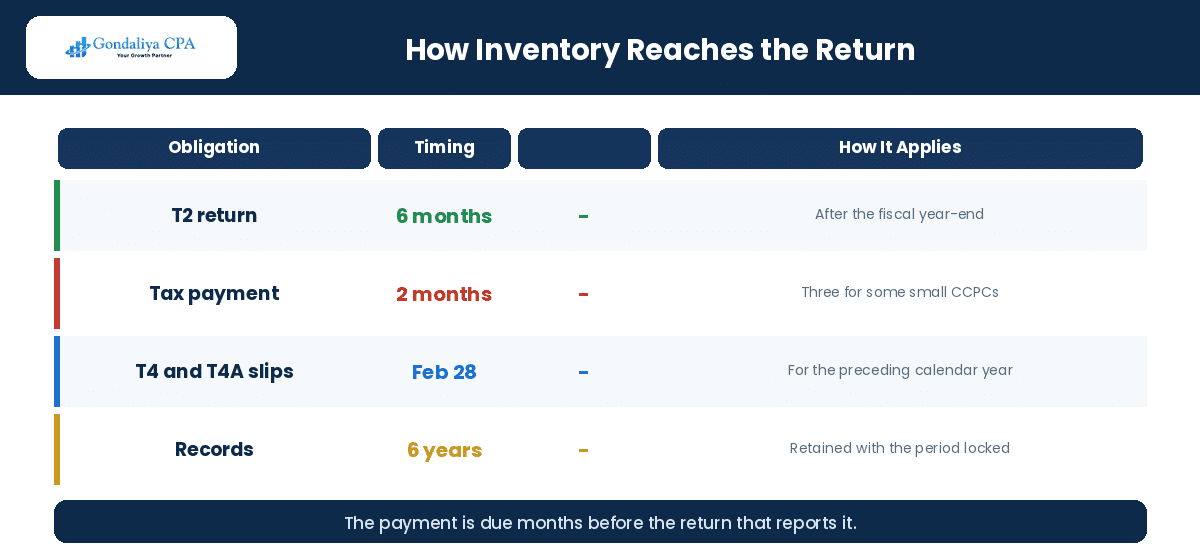
- T2 Filing Deadline: File your corporate income tax return (T2) within six months after your fiscal year ends.
- Corporate Tax Payment Due Date: Pay any taxes owed within two months after year-end—three months if you qualify for the small business deduction.
- GST/HST Filing Deadline: Your GST/HST return deadline depends on how often you report: monthly, quarterly, or annually.
- Payroll Slip (T4/T4A) Deadline: Employers must file employee slips by the last day of February after the calendar year ends.
- Shareholder Loan Repayment Window: Under Income Tax Act section 15(2), shareholder loans must be paid back or added to income within one year after the fiscal year ends.
Missing these deadlines can bring trouble with the CRA and hurt your business standing.
T2 Corporate Tax Deadlines
The deadline to file your T2 corporate income tax return is six months after your fiscal year ends.
For example, if your year ends December 31st, then you have until June 30th to file. But remember: any tax you owe must be paid earlier—within two months of year-end. If you qualify as a Canadian-controlled private corporation claiming the small business deduction, you get three months.
Late filing penalties start at 5% of unpaid taxes plus 1% per month up to twelve months. The CRA charges interest every day on late payments until fully paid.
Example:
Say your electronics resale company in Ontario has a March 31st fiscal year end. You must file your T2 return by September 30th but pay taxes by May 31st. If you miss either date, expect penalties starting from those deadlines.
| Obligation | Deadline | Applies To | Consequence If Missed | Source |
|---|---|---|---|---|
| T2 Return Filing | Six months post-year end | All corporations | Late-filing penalty + interest | CRA T2 Guide |
| Corporate Tax Payment | Two or three months post-year end* | Corporations | Interest charges + penalties | Income Tax Act |
*Three-month payment applies if small business deduction applies under ITA s125(1).
GST/HST Filing Periods
If your electronics business is registered for GST/HST, you must report sales tax collected regularly. You get assigned a filing frequency: monthly, quarterly, or annually.
Returns usually must be filed one month after the reporting period ends—for instance, annual filers with December 31st year-end file by January 31st.
Reconciling GST/HST means matching tax collected against sales records. You must also keep receipts for input tax credits on purchases like inventory freight and duties. Keeping good records helps avoid audit problems caused by unclaimed marketplace fees or bad debt adjustments common in electronics resale.
Remember:
- Apply correct place-of-supply rules based on where goods ship.
- Keep solid proof of input tax credits as required by CRA.
Failing these rules can lead to reassessments and penalties under sections covering false statements or omissions during filing periods.
CRA Compliance Requirements
Certain timelines also affect shareholder loans and payroll slip filings:
- Shareholder Loan Repayment Window: Under Income Tax Act section 15(2), shareholders who borrow from their corporation must repay loans within one year of the fiscal year end. Otherwise, amounts become taxable benefits included in personal income.
This rule often surprises electronics resellers who use company funds informally.
- Payroll Slip Deadlines (T4/T4A): Employers must send employee income slips (T4s) and contractor payments (T4As) to CRA by February 28th following the calendar year. Copies should also go to employees.
Late slip filings trigger fines starting at $100 per slip depending on how late they are—a big risk when managing seasonal staff common in electronic retail stores.
For help with corporate tax deadlines specific to electronics businesses across Toronto/Ontario and all of Canada, contact Gondaliya CPA at info@gondaliyacpa.ca or call 647‑212‑9559 today for a free consultation focused on affordable expert support based on current CRA rules.
Informal draws from the company account are the quiet problem in owner-operated resellers. They look like nothing until the year closes and the balance is still sitting there. Figures changed for privacy.
Key Stat: Slip penalties start per slip, so a seasonal team turns a small oversight into a large bill. Please prepare T4 and T4A slips before February rather than during it.
Prepare Your Accounting System and Records for Year-End Closing
Prepare Your Accounting System and Records
The Setup
Getting your accounting system and records ready is key for smooth electronics reseller year end accounting. It helps you keep financial reports accurate, follow Canadian tax rules, and file corporate taxes on time. A solid electronics business year end checklist covers checking your documents, updating bookkeeping, sorting papers, and syncing sales from e-commerce platforms.
Reviewing Systems and Documentation
You want to check your systems before year-end to avoid costly mistakes around the shareholder loan repayment window, corporate tax payment due date, and payroll slip deadlines (T4/T4A). Here’s why:
- The shareholder loan repayment window must be tracked closely. If you miss it, loans might count as income under section 15(2) of the Income Tax Act.
- Corporate tax payments are usually due within two months after your fiscal year ends. Paying late means penalties and interest from CRA.
- Payroll slips like T4 or T4A need to be filed by February 28 of the next year. Missing that date also brings penalties that get worse over time.
Make sure these deadlines match your company’s fiscal period. Regular checks stop you from missing filings or repayments.
Ensuring Up-to-Date Accounting Software and Backups
Year end bookkeeping electronics calls for updated software. You’ll need programs that handle:
- Inventory rules like landed cost including freight and duty
- Managing serialized stock
- Tracking warranty returns
- Calculating GST/HST correctly for CRA
Don’t forget to back up all data before closing books. Losing data now can delay preparing financial reports or T2 tax returns. Cloud apps like QuickBooks or Xero can back up automatically and suit electronics resellers in Canada.
Also, updated software helps you reconcile GST/HST smoothly before filing deadlines. You might file monthly or quarterly depending on your registration.
Organizing Supporting Documentation
Good organization speeds up accountant reviews at year-end. Important papers include:
- Bank and credit card statements
- Marketplace processor reports
- Supplier invoices with import duties
- Inventory lists showing serialized items
- Payroll records with wages paid
- Loan agreements with repayment details
- Any CRA notices about assessments or disputes
Your accountant needs clear invoices to match GST/HST collected with sales. This matches input tax credits claimed against output taxes reported for sales channels — including exports zero-rated properly.
Keeping a digital folder where both staff and accountants can reach papers cuts errors caused by missing documents during busy times.
Addressing E-commerce Platform Integration for Sales Records
E-commerce platforms make reconciling marketplace payouts to sales tricky. Gross sales usually don’t equal net deposits after fees, refunds (chargebacks), or discounts applied directly in marketplaces.
You can integrate platform data feeds into bookkeeping software for real-time matching between gross sales from marketplaces like Amazon Seller Central versus actual bank deposits.
Make sure you separate platform fees held temporarily by operators from final payments. This helps treat timing differences right under Income Tax Act rules on accrual versus cash basis taxpayers.
Catching these mismatches early lets you fix them before finalizing cost of goods sold (COGS) calculations tied to inventory tracked by serial numbers — very important in electronics retail where product lifespans move fast.
For help tailored to Canadian incorporated electronics resellers in Toronto/Ontario or across Canada, contact Gondaliya CPA at 647-212-9559 or info@gondaliyacpa.ca for advice focused on compliance with federal laws.
Landed cost is where electronics margins actually live. Freight and duty left out of inventory make every gross margin figure wrong all year. Figures changed for privacy.
Pro Tip: Please back up before you close, not after. A locked period built on lost data costs more to rebuild than the close itself.
Complete Essential Year-End Bookkeeping Tasks for Electronics Resellers
Essential Year-End Bookkeeping Tasks
The Bookkeeping
Year-end bookkeeping electronics means checking everything carefully. You want your numbers to be right before the new year. If you run an incorporated Canadian electronics resale business, a solid electronics business year end checklist can save you from mistakes. It helps during the electronics reseller year end accounting.
Reconciling Bank and Credit Card Accounts
You must reconcile bank and credit card accounts before closing books. It proves all money movements match your records. Here’s what to do:
- Accounts payable reconciliation means matching supplier bills with payments you made. Mistakes here can cause paying twice or hurting vendor trust.
- Accounts receivable reconciliation checks if customer invoices line up with what they paid. Missing this can hide unpaid bills or recording errors.
Check marketplace payouts to sales by comparing sales on Amazon, eBay, or others to actual deposits after fees or refunds. This stops you from misstating income or missing platform costs.
Good reconciliation lowers CRA audit risks. Plus, it makes corporate tax filing easier.
Reviewing and Cleaning Your Chart of Accounts
Your chart of accounts should be tidy for year-end adjusting entries and financial statements prepared at year-end.
- Remove accounts for products no longer sold—electronics change fast.
- Make sure accounts are classified right; like separating warranty reserves from other liabilities.
- Adjust entries fix unpaid bonuses, prepaid expenses, depreciation (capital cost allowance), and inventory write-downs for obsolete stock.
A neat chart keeps trial balances clear and helps with compilation reports under CSRS 4200 rules.
Verifying Income and Expense Records Accuracy
Check your income equals actual sales and expenses include all deductible costs before the corporate tax payment due date.
- Compare total revenues from all marketplaces, direct sales, returns (RMA), and restocking fees.
- Review expenses carefully—exclude personal spending but include costs like freight-in added to inventory under section 10.
Missing the T2 filing deadline Canada causes penalties with daily interest. Correct income also supports GST/HST reporting linked to taxable supplies.
Managing Accounts Receivable and Accounts Payable Before Year-End
Stay on top of receivables and payables to avoid surprises at year-end:
- Review aging reports for unpaid customer invoices. Follow up fast on overdue payments; this can reduce bad debt risks.
- Check supplier statements against purchase records; adjust accruals if goods arrived but aren’t invoiced yet.
This matches CRA cut-off rules so your costs of goods sold (COGS) and expenses are correct.
Addressing Outstanding Customer Payments and Vendor Bills
Handle unpaid balances carefully before closing books:
- The shareholder loan repayment window Canada requires repayment within a year after your fiscal period ends to avoid extra taxes under section 15(2).
Look over shareholder loan accounts before year-end. Spot needed repayments or missing documents that might trigger CRA reviews.
Make sure vendor bills are recorded as liabilities even if not paid by balance sheet date. Missing these distorts working capital figures important for loans or financing.
Handling Bad Debts and Uncollectible Accounts
Bad debts affect your profit and GST/HST reports:
- Write off debts only after trying hard to collect them.
For GST/HST reconciliation for electronics resellers:
- Adjust input tax credits when bad debts link to taxable sales.
- Keep proper proof CRA requires when you claim these in filings.
Doing this right protects you from future reassessments and keeps your bookkeeping solid during electronic reseller accountant Canada work.
If you want help with incorporated Canadian electronics resellers’ year-end bookkeeping tasks, call Gondaliya CPA at 647‑212‑9559 or email info@gondaliyacpa.ca for advice.
Marketplace deposits net of fees are the reason reported revenue drifts low. The fee is a deductible expense, and netting it off hides both numbers. Figures changed for privacy.
Risk Warning: Goods received but not yet invoiced still belong in the year they arrived. Please accrue them, or the cost of goods sold lands in the wrong period.
Conduct Inventory and Asset Reviews Specific to Electronics Reseller Operations
Inventory and Asset Reviews
The Inventory
Performing Physical Inventory Counts Including Serialized Stock
Doing a physical inventory count is a must for good electronics reseller year end accounting. This step checks the real stock you have so your year end bookkeeping electronics matches what’s on hand. For an electronics business, serialized stock needs extra care because each item has its own unique ID that must be tracked.
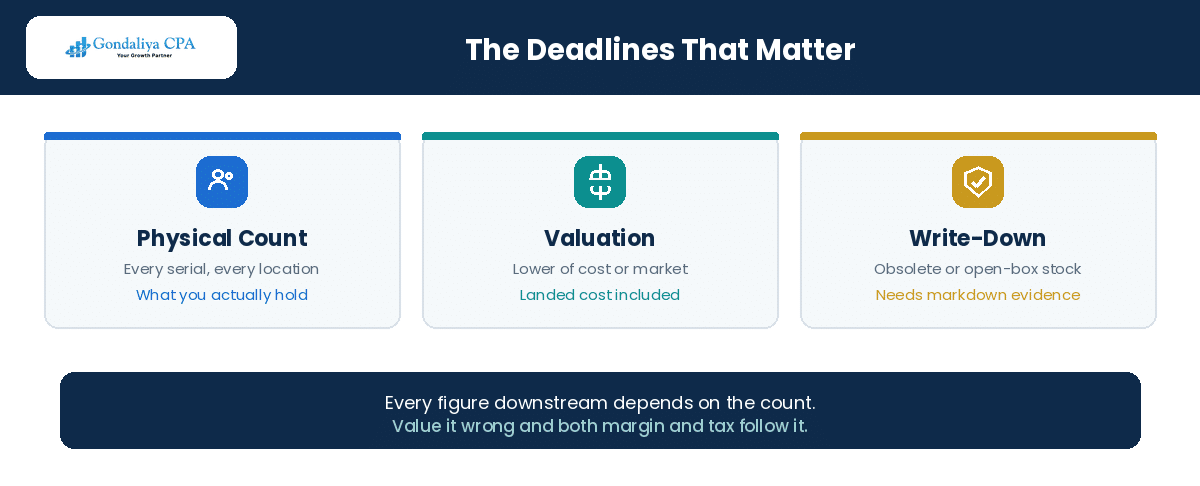
Plan to do the count close to your fiscal year-end, but before you lock in your financial statements. Use detailed sheets or digital tools that record serial numbers and quantities together. Count inventory in all places—warehouses, stores, consignment spots, and goods still being shipped.
If numbers don’t match up, check right away. Differences might mean theft, loss, or data mistakes that change cost of goods sold (COGS) and taxes. Skipping this can lead to wrong inventory values and bad tax reports.
Here’s what to do:
- Count each serialized item with its ID.
- Separate old or broken stock while counting.
- Write down any changes clearly for your accountant.
- Keep proof like signed count sheets.
This method follows CRA rules about keeping good books under the Income Tax Act.
Valuing Inventory Considering Fast Obsolescence and Warranty Returns
Electronics inventory changes fast. New models appear quickly, making some items outdated. For tax purposes, CRA says you value inventory at the lower of cost or market value under section 10 of the Income Tax Act. Cost means what you paid plus freight or duties; market value is what it costs now to replace minus selling costs.
Because tech moves so fast, some stock loses value fast. To support write-downs on old stock, keep proof like sales reports or records showing price cuts. Without that, CRA might reject your claim and increase taxes.
When dealing with RMAs (Return Merchandise Authorization), warranty returns, or refurbished units:
- Check returned items; if they can be resold as open-box, value them lower.
- You might need to set aside money for future repairs.
- Track refurbished items separately from new stock with their own cost basis.
Keep good RMA logs and restocking notes to make year-end bookkeeping electronics accurate and tax-compliant.
Reviewing Fixed Assets, Depreciation, and Capital Cost Allowance (CCA)
Checking fixed assets is part of the electronics business year end checklist. Capital buys like demo gear or IT equipment usually qualify for CCA claims under Schedule II classes.
The half-year rule limits how much CCA you can claim on new assets in their first year unless they were ready to use before year-end. Check when assets became available carefully because early claims can trigger penalties.
Look over capital spending for these points:
- Put assets in the right class (computers usually go in class 50).
- Make sure invoices prove purchases happened in the fiscal period.
- See if recent laws let you expense some equipment faster starting 2026.
Recording depreciation correctly helps follow tax rules and lowers audit risks tied to wrong classifications or timing errors.
Table: Key Considerations When Reviewing Fixed Assets Before Year-End
| Review Item | Importance | Source |
|---|---|---|
| Asset classification | Correct CCA class affects deduction | Income Tax Regulations Sched II |
| Availability date | Determines half-year rule application | CRA T2 Guide |
| Invoice verification | Confirms eligible capital expense | Income Tax Act Section 18 |
| Immediate expensing eligibility* | Accelerates deduction potential | CRA Legislative Update 2026 |
* Applies only if conditions from Canadian tax rules effective after Dec 31st, 2025 are met.
Doing accurate physical counts including serialized stock; valuing quickly outdated inventory with RMAs in mind; plus checking fixed asset purchases and using the right CCA treatment helps Canadian electronics resellers keep books clean. This gets financial statements ready for taxes across Canada without issues.
The write-down that gets accepted is the one with a price-cut report behind it. The one that gets denied is the one supported only by a view that the stock feels old. Figures changed for privacy.
Key Stat: Available for use, not purchased, is what starts the capital cost allowance clock. Please check the commissioning date on anything bought near year-end.
Ensure Payroll Year-End Compliance for Your Electronics Business
Payroll, GST/HST, Statements and Closing
The Close
Closing out payroll at year-end is a must for incorporated electronics resellers in Canada. It helps you dodge penalties and keeps your records straight. You’ll want to check employee and contractor info, sort out payroll deductions like CPP and EI, handle bonus payment timing, and get those T4 or T4A slips ready before CRA deadlines. Good year-end bookkeeping electronics practices keep you on track with tax rules.
Verifying Employee and Contractor Information
Getting employee and contractor details right is key for electronics reseller year end accounting. Double-check legal names, Social Insurance Numbers (SIN), job status, pay rates, and contract terms. Mistakes here can mess up slip issuance or trigger audits. A skilled electronics reseller accountant Canada-based will compare this info against payroll registers to catch any errors.
- Confirm legal name and SIN
- Verify employment or contractor status
- Check pay amounts and contract terms
- Cross-check with payroll records
Reconciling Payroll Deductions (CPP, EI) and Bonus Payment Windows
You need to match all deductions like Canada Pension Plan (CPP) contributions and Employment Insurance (EI) premiums against what’s been paid before closing the books. Pay attention to bonus payments too. Bonuses not paid within 89 days after fiscal year-end might not be deductible under Income Tax Act section 78(1). Shareholder loans also have that same 89-day repayment window under section 15(2), or else they could trigger extra tax issues.
| Task | Deadline | Result if Missed | Source |
|---|---|---|---|
| CPP/EI remittance payment | Last day of month after pay date | Penalties & interest | CRA Guide |
| Bonus paid | Within 89 days post fiscal year | Deductions lost; taxable benefit | ITA Section 78(1) |
| Shareholder loan repaid | Within 89 days post fiscal year | Deemed shareholder benefit applies | ITA Section 15(2) |
Preparing and Issuing Payroll Slips by CRA Deadlines
Make sure T4 slips for employees and T4A slips for contractors show all earnings, deductions, taxable benefits, including bonuses paid that year. These forms must reach recipients by February 28 of the following year. Late slips bring daily penalties until fixed.
Review GST/HST Requirements and Prepare for Return Filing
Checking GST/HST records against what you claimed is vital for your electronics business to follow Excise Tax Act rules at year-end. Marketplace payouts need special care since platforms collect taxes differently, which changes how you report sales.
Start by matching GST/HST recorded in your books with marketplace statements showing gross sales minus fees taken out before payout. This impacts reported revenue on returns. Claiming input tax credits right means keeping good proof of eligible expenses per CRA rules.
GST/HST filing deadline hits one month after your reporting period ends. Missing it leads to penalties or interest charges.
Finalize Financial Statements and Year-End Adjusting Entries
You must prepare full financial statements: income statements showing revenues less costs plus expenses; balance sheets listing assets like inventory (valued per section 10), liabilities such as accounts payable, and equity sections—following ASPE standards when possible.
Record adjusting journal entries to fix inventory differences found during counts, accrue expenses not billed yet, or defer prepaid costs properly. Look over expense claims closely to sort deductible business costs from capital ones that get depreciation via Capital Cost Allowance classes.
Corporate tax payments usually share due dates with T2 return balances owed—about six months after fiscal year end—to avoid interest on late payments.
Plan Corporate Tax Preparation and Strategic Year-End Tax Planning
Review shareholder loans at fiscal close fast because repaying them within 89 days after year-end can avoid bad tax hits under Income Tax Act section 15(2). If you miss this window, you might face deemed shareholder benefits that add to personal taxable income.
Timing income recognition or moving some deductible expenses before closing can save on corporate taxes. But this needs expert advice tailored to quick-moving electronics products prone to obsolescence.
Remember: T2 filing deadline is six months after your fiscal year’s last day. Plan instalments carefully to skip penalties or daily interest if late.
Close Your Books and Set Up for the New Fiscal Year
Back up all finalized data safely then lock your accounting periods so no more edits sneak in while keeping audit trails per CRA rules (at least six years). Use past performance info to create budgets that update business goals based on tech market trends you serve.
Improve processes spotted this cycle—like automating receipt capture with QuickBooks integration—to cut manual mistakes next time. This supports smoother electronics reseller year end accounting workflows.
Double-check your corporation’s exact fiscal year-end date well ahead so management accountants align deadlines properly. That avoids conflicts between internal reports and official filings that cause stress near cutoffs.
How Gondaliya CPA Supports Electronics Resellers with Year-End Accounting and Compliance
Gondaliya CPA offers services focused on incorporated Canadian electronics resellers—from gadget sellers to wholesale distributors—with deep know-how about industry-specific stuff like serialized stock tracking, return handling, warranty reserves, plus marketplace payout reconciliations across Toronto/Ontario regions nationwide.
We guide clients through thorough prep following CRA documentation rules helping audits run smoothly while cutting costly bookkeeping fixes later. Reach out at info@gondaliyacpa.ca or call 647-212-9559 for a free chat about your electronic business’s yearly close.
Sharad Gondaliya, CPA, has over 10 years helping Canadian business owners.
Locking the period is the step people skip. An open prior year quietly accumulates entries that make your filed return stop agreeing with your books. Figures changed for privacy.
Verification: Our CPA Ontario firm registration can be checked on the public firm directory. Please verify any firm before granting access to your accounting file.
Frequently Asked Questions (FAQs) for Electronics Reseller Year End Accounting
Frequently Asked Questions (FAQs)
FAQ
What are the top year-end mistakes electronics resellers make?+
Failing to reconcile GST/HST properly, missing shareholder loan repayments, inaccurate inventory valuation, and late T2 filing cause penalties and interest.
How can I prepare before the year-end engagement starts?+
Organize records, update accounting software, confirm fiscal year-end date, and track outstanding receivables and payables early.
What deliverables should I expect from my CPA for year-end?+
Accurate financial statements, adjusting journal entries, tax filings including T2 and GST/HST returns, and a clear summary of compliance tasks.
What is the shareholder loan repayment window?+
Loans must be repaid within 89 days after fiscal year-end to avoid taxable benefits under Income Tax Act section 15(2).
How does the half-year rule for CCA affect my asset depreciation?+
It limits CCA claims in the first year for new assets unless they were available before year-end, reducing initial tax deductions.
What evidence supports obsolete inventory write-downs?+
Sales reports showing price reductions, inventory aging records, and documentation of damaged or returned goods validate write-down claims.
Should I pay bonuses or dividends before year-end?+
Yes. Paying bonuses within 89 days preserves deduction eligibility; dividends must follow CRA rules to avoid extra taxes.
What are best practices for faster, cheaper year-end bookkeeping?+
Keep digital records organized, automate reconciliations with integrated software, and schedule early reviews to spot errors.
Is it better to do year-end filing DIY vs CPA vs non-CPA provider?+
A CPA ensures CRA compliance and handles complex issues. Non-CPA providers may lack industry-specific expertise. DIY risks costly mistakes.
How do I choose the right CPA firm for electronics year-end accounting?+
Look for experience with incorporated electronics resellers, knowledge of GST/HST rules, inventory valuation skills, and solid client references.
Essential Year-End Items Across 10 Electronics Sub-Sectors
Sub-Sectors, Glossary and Next Steps
Quick Reference
- Resellers must track serialized inventory precisely.
- Distributors require strict cost of goods sold (COGS) reconciliation.
- Marketplace sellers need detailed fee and payout reports.
- Refurbishers should document repair costs for asset value accuracy.
- Retailers benefit from advanced point-of-sale integration.
- Wholesalers must verify large volume purchase invoicing.
- E-commerce platforms need sales data synchronization with books.
- Repair centers track warranty reserves carefully.
- Importers calculate landed costs including duties accurately.
- Exporters handle zero-rated GST/HST sales with proof of shipment.
Glossary of Key Terms in Electronics Year-End Accounting
- T2 Filing: Corporate income tax return filed within six months post fiscal year-end.
- GST/HST Reconciliation: Matching collected taxes against sales records per CRA guidelines.
- Shareholder Loan Repayment Window: Period to repay loans to avoid taxable benefits.
- Half-Year Rule: Limits capital cost allowance claims in first asset tax year.
- Adjusting Journal Entries: Corrections made to accounting records at year-end for accuracy.
- Inventory Valuation: Calculating stock value using lower of cost or market principle.
- COGS (Cost of Goods Sold): Direct costs tied to inventory sold during the period.
Next Steps: Optimizing Your Electronics Business Year-End
- Contact Gondaliya CPA early to schedule your year-end review tailored for electronics resellers in Canada.
- Gather all relevant documents: bank statements, invoices, payroll records, shareholder loan agreements.
- Update your accounting system and backup data securely before closing books.
- Perform physical inventory counts including serialized items and note obsolescence or warranty returns.
- Review fixed assets carefully applying correct CCA classes and half-year rule provisions.
- Prepare payroll slips timely ensuring CPP/EI reconciliations meet CRA deadlines.
- Verify GST/HST accounts align with marketplace sales and input tax credit requirements.
- Request financial statements with all adjusting entries prepared by your accountant before T2 filing deadlines.
Trust Gondaliya CPA to guide you through Canadian electronics reseller year end bookkeeping challenges efficiently and compliantly across all sub-sectors nationwide.
Ten sub-sectors and one common failure: the count. Everything downstream, from margin to tax, rests on knowing what is actually on the shelf. Figures changed for privacy.
Electronics Sub-Sectors We Serve
Industry Expertise
Which year-end task dominates differs by sub-sector. Here are ten and the usual focus.
| Sub-Sector | The Year-End Focus |
|---|---|
| Resellers | Serialized inventory counted item by item |
| Distributors | Cost of goods sold reconciled to movement |
| Marketplace sellers | Fee and payout reports matched to deposits |
| Refurbishers | Repair costs carried into the unit value |
| Retailers | Point-of-sale data tied into the ledger |
| Wholesalers | High-volume purchase invoicing verified |
| E-commerce platforms | Sales feeds synchronised to the books |
| Repair centres | Warranty reserves estimated and supported |
| Importers | Landed cost including freight and duty |
| Exporters | Zero-rated sales with proof of shipment |
- Resellers: Serial numbers are the only reliable way to prove what is physically on hand.
- Distributors: Volume makes small per-unit costing errors add up quickly across the year.
- Marketplace sellers: Gross sales and net deposits differ by fees, refunds and holdbacks.
- Refurbishers: Repair labour and parts belong in the carrying value of the unit.
- Retailers: An integrated till removes the manual step where most errors enter.
- Wholesalers: Large invoices need matching to receipts before the period locks.
- E-commerce platforms: A feed that drifts out of sync produces a revenue figure nobody can defend.
- Repair centres: A warranty reserve needs a basis, not a round number.
- Importers: Duty and freight left out of inventory move profit into the wrong year.
- Exporters: Zero-rating holds only where the shipping documentation supports it.
The sub-sector changes which year-end task carries the most risk. It does not change the discipline, which is count it, value it, reconcile it, then file. Figures changed for privacy.
Professional Guidance and Quick Reference
Guidance
Professional Guidance for Electronics Resellers: How Gondaliya CPA Closes Your Year
Electronics year-ends turn on inventory. Stock that was current in March is obsolete by December, and the write-down that reflects that reality gets denied without evidence behind it. Count it by serial, value it at the lower of cost or market, and the rest of the close follows. Gondaliya CPA handles the full cycle on a fixed annual fee.
We handle what decides the outcome: physical counts covering serialized stock across every location, section 10 valuation with markdown evidence for obsolescence, landed cost including freight and duty, RMA and warranty reserve treatment, marketplace payout reconciliation against recorded sales, capital cost allowance classes and the available-for-use test, shareholder loan repayment before the window closes, GST/HST reconciliation, and the T2 filed on time.
Our team locks the period once the close is signed off, because an open prior year quietly stops agreeing with the return you filed. Reseller, distributor or marketplace seller, you get clear advice and a fixed price before we start.
Quick Answers: Key Numbers & Concepts at a Glance
At a Glance
- Inventory: Lower of cost or market, section 10
- Landed cost: Purchase plus freight and duty
- Write-downs: Need markdown or aging evidence
- T2 filing: Six months after year-end
- Tax payment: Two months, three for some CCPCs
- Slips: T4 and T4A by the last day of February
- CCA: Half-year rule on first-year claims
- Computers: Usually Class 50
- Marketplace: Report gross, expense the fee
- Records: Six years, with the period locked
Who This Is For / Not For
Fit Check
- For: Incorporated Canadian electronics resellers, distributors, refurbishers and marketplace sellers carrying serialized inventory.
- Not For: Audit or review engagements, which carry a different scope; we prepare compilations alongside the year-end work.
People Also Ask
Related Questions
Can I write down stock just because a newer model launched?+
Not on that alone. The write-down needs evidence, such as price-cut reports or aging records showing the stock is selling below cost.
Is the shareholder loan window one year or 89 days?+
The general rule under section 15(2) runs to the end of the following fiscal year. Please confirm your own dates before relying on a shorter window.
Do marketplace fees reduce my reported sales?+
No. Report gross sales and show the platform fee as a separate expense, otherwise both figures are understated.
Glossary of Key Terms
- Serialized stock: Inventory tracked by a unique identifier per unit.
- Landed cost: Purchase price plus freight, duty and brokerage attributable to the goods.
- Section 10 valuation: The Income Tax Act rule valuing inventory at the lower of cost or market.
- Obsolescence write-down: A reduction in carrying value supported by markdown evidence.
- Cost of goods sold: The direct cost of inventory sold during the period.
- RMA: Return merchandise authorisation, the process governing customer returns.
- Warranty reserve: An accrual for expected future repair or replacement cost.
- Open-box: A returned unit resold at a reduced carrying value.
- Marketplace payout: The net deposit after platform fees, refunds and holdbacks.
- Capital cost allowance: The tax deduction for depreciation on eligible assets.
- Half-year rule: The restriction limiting first-year capital cost allowance.
- Available for use: The point at which an asset is ready to operate and CCA may begin.
- Adjusting journal entry: A correcting entry posted at year-end.
- Cut-off: The rule placing a transaction in the correct period.
- Shareholder loan: Funds drawn from the corporation that must be repaid.
- CSRS 4200: The Canadian standard governing compilation engagements.
Electronics Year-End Readiness Check
This quick self-check indicates where your operation most likely has room. Please answer the six questions below.
Electronics Year-End Readiness Check
Six quick questions on your close. No fee shown.
Points to raise with us:
This is a general prompt, not tax or legal advice or a quote. Your position depends on your full facts. For a real review, please book a free consultation.
Want a checklist to work from? You can download our free electronics year-end checklist before your consultation.

Count the stock by serial number across every location. Carry freight and duty into inventory cost. Support write-downs with markdown evidence. Reconcile marketplace payouts to recorded sales. Check the available-for-use date on new assets. Clear shareholder loans inside the window. Lock the period once it is signed off. Please file the T2 inside six months.
2026 Update — what is current: This article notes immediate expensing provisions applying to assets acquired after December 31, 2025. The six-month T2 deadline, the two- and three-month payment dates, the last-day-of-February slip deadline, section 10 lower of cost or market valuation and the half-year rule are unchanged. Please note the article gives the shareholder loan window as one year after the fiscal year-end in three places and as 89 days in two others, applies the 89-day bonus rule to shareholder loans where it governs unpaid remuneration under section 78(4), states corporate tax payments share a due date with the T2 where they fall due earlier, and cites Income Tax Act section 230 for bonus timing where it governs books and records, so please confirm each before relying on it.
Electronics Reseller Year End Accounting and Bookkeeping Checklist for Canadian Businesses by Gondaliya CPA
Count it before you value it
Gondaliya CPA runs serialized physical counts, values inventory at the lower of cost or market with markdown evidence, carries freight and duty into landed cost, reconciles marketplace payouts to recorded sales, applies the right CCA classes and available-for-use dates, clears shareholder loans in the window, and files the T2 on time, on a flat annual fee including HST with a one-business-day response. Please book a free consultation.
Next Steps
Please book a free consultation with Gondaliya CPA and bring your inventory listing with serial numbers, your marketplace payout reports, and your last financial statements. Those three tell us immediately whether the stock on the books matches the stock on the shelf and whether revenue reconciles to what was deposited. You will get a flat annual fee including HST before any work begins. If our content helps, please add gondaliyacpa.ca as a preferred source on Google.
Published: · Last updated:
Editorial policy: We research against CRA and CPA Ontario sources, fact-check the figures, and Sharad Gondaliya, CPA, reviews the content, which we update as the rules change.
Disclaimer: This article is educational information only and is not tax, legal, or financial advice. Figures marked illustrative are examples rather than quotes or guarantees. It reflects CRA rules current to 2026, including the six-month T2 filing deadline, the two- and three-month corporate tax payment dates, the last-day-of-February slip deadline, the half-year rule on capital cost allowance, and the six-year record retention requirement. Rates, limits and expensing rules change and outcomes depend on your specific facts. Please consult a CPA Ontario member before acting.

Sharad Gondaliya is a CPA Canada & CPA USA with 15 Years+ experience of Accounting, Tax, Payroll of Corporate Small Businesses as Tax Accountant. He is a CPA Ontario member (61040184) and holds US CPA licences in Washington and Montana and is well known among corporate small businesses for tax planning, efficient tax solutions, and affordable CPA services. Sharad is the Principal (Director) of Gondaliya CPA – Affordable CPA Firm in Canada. Licenses: CPA Ontario: 61040184 | CPA USA (MT): PAC-CPAP-LIC-033176 | CPA USA (WA): 57629 | CPA Firm License: 61330051 View Full Author Bio