



Yoga Studio Tax Write-Offs in Canada: Rent, Teacher Payments, Training & Studio Expenses
Yoga studio tax deductions Canada and taxes Canada explained: Rent, teacher payments, certification, and input tax credits for yoga businesses
Claiming yoga studio tax deductions Canada involves expenses like rent, teacher payments, certification fees, and advertising costs, along with input tax credits on taxable supplies. Gondaliya CPA guides yoga studios, including multi-location and franchise studios, through corporate tax filing and understanding exemption rules for educational services.
Quick Summary
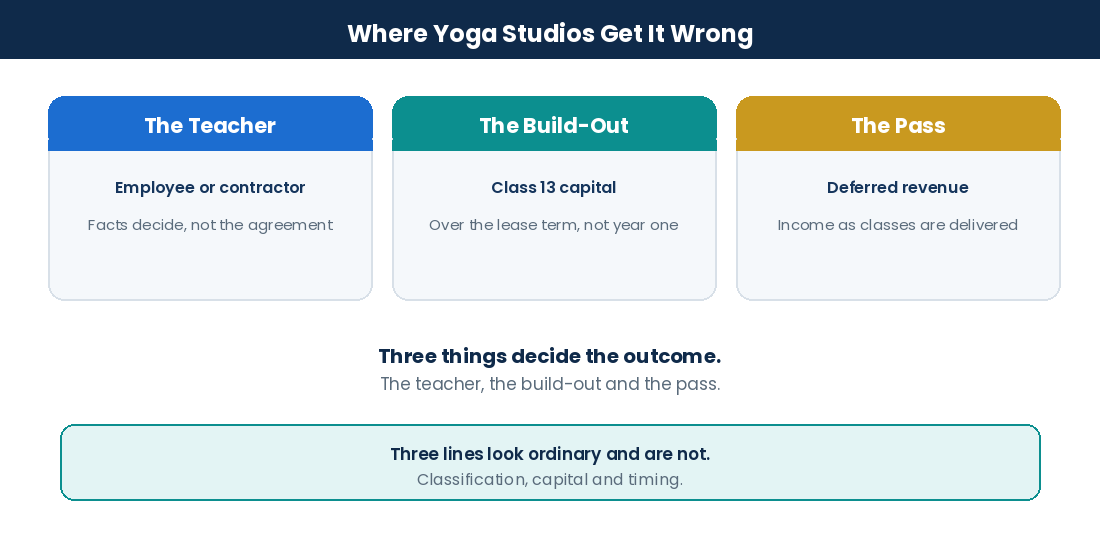
The three are worker classification on teacher payments, capital treatment on the build-out, and revenue timing on prepaid memberships. Each is easy to book the wrong way and each is examined when a studio is reviewed.
Reading time: 53 minutes.
Table of Contents
- The Three Lines That Are Not Simple
- Overview and Eligible Expenses
- Certification, Advertising and Operating Costs
- GST/HST and Input Tax Credits
- Payroll, Assets and Bookkeeping
- Planning, Mistakes and Working With Us
- Frequently Asked Questions
- Essential Topics and Best Practices
- Businesses We Serve
- Professional Guidance and Quick Reference
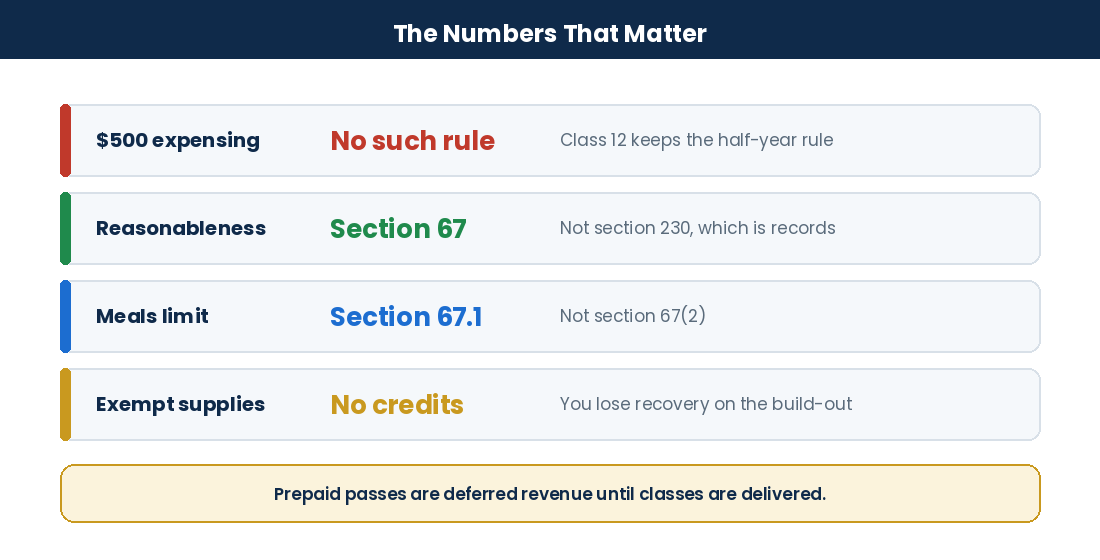
The Numbers That Matter
This article covers Canada, with Ontario and Toronto context, and reflects rules current to 2026. It is written for incorporated Canadian yoga studios, including multi-location and franchise operations. Figures marked illustrative are examples, not quotes, and any masked engagement notes end with “Figures changed for privacy.” This is educational information only and not tax or legal advice. Provincial rules differ, so please confirm the position where you operate.
The Three Lines That Are Not Simple
The Three Lines That Are Not Simple
Classification, Capital, Timing
What Looks Ordinary and Is Not
| The Line | What It Looks Like | What It Actually Is |
|---|---|---|
| Teacher payments | An expense you book and move on | A classification question with payroll consequences |
| Studio build-out | A cost of opening | Capital, written off over the lease term |
| Prepaid memberships | Revenue when the money arrives | Deferred until the classes are delivered |
Each one is booked correctly by a studio that thought about it and incorrectly by a studio that did not. None of the three is difficult once the decision is made; the cost comes from never making it.
Who the Teacher Is
Whether a teacher is an employee or a contractor is decided on the facts, not on the wording of an agreement or on what is customary in the industry.
| Factor | Points Toward Employment |
|---|---|
| Control | The studio sets the schedule, the sequence and the standards |
| Tools | The studio provides the space, props and sound |
| Profit or loss | The teacher has no financial risk in the class |
| Integration | The teacher appears on the schedule as part of the studio |
Most studio-scheduled classes look like employment on those factors. A visiting teacher running their own workshop and taking the door risk looks different.
Getting this wrong is expensive because the reassessment covers the employer contributions never made, not just the withholding. Please also note one contradiction that appears in guidance on this topic: a contractor paid on a T4A does not have withholding taken. If withholding is required, the person is an employee.
What the Build-Out Is
Flooring, mirrors, ballet barres, partition walls, ventilation for a hot room and reception millwork are leasehold improvements. They are capital, and they go into Class 13, written off over the lease term rather than at a fixed rate.
Deducting a build-out in full in the opening year is one of the most common errors on a studio’s first return, and it produces a reassessment that reaches back to that year.
When the Membership Money Is Income
A ten-class pass sold in November for classes taken through March is not November revenue. Business income is computed on the accrual basis, and unearned amounts sit as deferred revenue until the classes are delivered.
- Track passes and memberships by classes remaining, not by amount collected
- Recognise revenue as classes are used or as the membership period runs
- Deal with expiry according to your own terms and record it consistently
- Reconcile the deferred balance to the booking system monthly
A studio with a strong January intake and a December year end can otherwise report a year that never happened, and pay tax on it.
January intake and a December year end is the combination that catches studios. The bank balance is real and most of it is not yet revenue. Figures changed for privacy.
Risk Warning: A studio build-out is a Class 13 leasehold improvement, not an opening-year expense. Please do not deduct it in full.
Overview of Yoga Studio Tax Deductions and Taxes in Canada
Overview and Eligible Expenses
The Basics
An incorporated studio pays corporate tax on income after deductible costs. Getting the deductions right lowers what you pay; getting the classification right keeps it that way.
Understanding Corporate Tax Filing for Yoga Studios
An incorporated studio files a T2 Corporation Income Tax Return each year, due six months after the fiscal year end. Payment is due earlier: generally three months for an eligible Canadian-controlled private corporation and two months for other corporations.
Those are two different dates and studios miss the earlier one regularly. Diarise them separately.
Keep records through the year rather than assembling them in the spring. A studio that reconciles monthly closes its year in days; one that does not spends weeks on it.
Identifying Eligible Yoga Business Expenses for Tax Purposes
| Expense Type | Treatment | Condition | Record Required |
|---|---|---|---|
| Rent | Deductible | Business premises | Lease agreement |
| Utilities | Deductible | Allocated where space is shared | Utility bills |
| Teacher Payments | Deductible | Correct slips issued for the classification | Payment records and agreements |
| Training Costs | Usually deductible | Maintaining or improving existing skills | Receipts and course details |
| Props and small equipment | Generally current | Consumable or low value | Purchase receipts |
| Build-out | Capital, Class 13 | Over the lease term | Lease plus contractor invoices |
The last two rows are added because they are the boundary. A stack of mats is a current cost. A floor is not.
The Role of Rent and Leasehold Improvements in Studio Deductions
Rent is deductible as incurred. Improvements to the leased space are capital and enter Class 13, amortised over the lease term including renewal options within limits.
Please note that Class 13 is not a declining balance class with a rate. It is a straight-line write-off over the term, which is why a five-year lease and a fifteen-year lease produce very different annual deductions on identical work.
Where you own the premises rather than lease them, the analysis differs: the building is Class 1 and improvements to it follow the building.
Tax Treatment of Teacher Payments and Payroll Reporting Requirements
| Status | Withholding | Slip | Employer Cost |
|---|---|---|---|
| Employee | Income tax, CPP and EI withheld | T4 | Employer CPP and EI contributions |
| Contractor | None | T4A where reporting applies | None |
Slips are due by the last day of February for the preceding calendar year. Late slips attract a penalty on a sliding scale based on how many are outstanding and how late they are, not a flat amount per slip.
Have a written agreement with every teacher setting out the arrangement. It does not decide classification on its own, but its absence makes an already difficult conversation harder.
A Note on Home Premises
Guidance on this topic routinely describes prorating household costs by the area used for the business. That is the sole proprietor method.
A corporation does not prorate. Where a director teaches or administers from home, the corporation pays a reasonable amount under a proper arrangement, or reimburses specific supported costs. Applying the proprietor method to an incorporated studio is one of the most common errors we correct on these files, and the article you are reading is written for incorporated studios.
Studios that incorporated after a year of teaching solo often carry the proprietor home office method forward without noticing it no longer applies. Figures changed for privacy.
Key Stat: Class 13 is a straight-line write-off over the lease term, not a rate. The lease length decides the annual deduction on identical work.
Certification, Advertising and Operating Costs
Certification, Advertising and Operating Costs
The Detail
Certification and Teacher Training Expenses: What Qualifies as a Deduction?
Training costs are deductible where they maintain or improve existing skills used in the business. Costs that acquire a new qualification are treated differently.
- Course fees for ongoing education
- Workshops improving teaching skills
- Certifications maintaining existing credentials
- Training paid by the studio for its employees, as part of their employment
An initial qualification obtained before the business existed generally does not qualify. Where training confers a lasting benefit rather than maintaining current ability, the cost may need to be capitalised rather than deducted.
Please note one correction. Guidance suggesting such costs go to Class 14.1 is misapplying that class, which deals with goodwill and similar property of the business rather than an individual’s qualification. Where a training cost is not currently deductible, the analysis is whether it is a personal cost or a capital outlay of the corporation, and that turns on the facts.
Illustrative example. A Toronto studio pays $2,400 plus HST for advanced certification for two employed teachers, maintaining credentials the studio requires them to hold. The cost is deductible as an employment-related training expense. Figures changed for privacy.
Advertising and Marketing Costs for Yoga Studios: Tax Implications
| Expense Type | Treatment | Condition | Record Required |
|---|---|---|---|
| Digital Ads | Deductible | Directed at earning income | Invoices and campaign reports |
| Print Flyers | Deductible | Reasonable in scale | Receipts and distribution records |
| Client Meals | 50% deductible | Business related | Detailed receipts with purpose noted |
| Sponsorships | Deductible | A business purpose is documented | Contracts and payment evidence |
| Branded apparel worn by teachers | Deductible | Studio branded, not general clothing | Invoices and design proofs |
The 50% limit on meals and entertainment sits in section 67.1. Guidance citing section 67(2) is naming the wrong provision; section 67 is the general reasonableness requirement.
One further point on advertising. Advertising directed at a Canadian market placed with foreign broadcasters or in foreign periodicals can face restrictions, so where a campaign runs matters as well as what it costs.
Managing Studio Operating Expenses: Utilities, Insurance, and Software Costs
- Hydro and gas, including heating for a hot room
- Water and waste
- Internet and phone
- Liability insurance covering the business
- Equipment and contents insurance
- Booking and scheduling software subscriptions such as MindBody or Acuity
- Accounting software and payment processing fees
Where a space is shared with a retail unit or another use, allocate on a defensible basis such as floor area or metered consumption, and document the method. An allocation you cannot explain is one that will be adjusted.
On processing fees, record settlements gross with the fee as an expense. Where a processor deducts its fee before settlement and only the net is recorded, both revenue and expense are understated and the recoverable tax on the fee disappears.
Accounting for Income from Retail Sales, Apparel, and Workshops
Mats, apparel and props sold to students are taxable sales, and the stock is inventory until sold. Count it at the year end and value it at the lower of cost and net realizable value.
- Keep retail revenue separate from class revenue in the chart of accounts
- Record cost of goods sold against retail revenue
- Count inventory physically, with the sheet signed
- Claim credits on wholesale purchases where the invoice supports it
Workshops behave like memberships on timing. A deposit taken before the year end for a workshop running afterwards is deferred revenue, not income.
Handling Taxes for Online, Corporate and Workplace Yoga Classes
Online classes and corporate programmes are supplies in the same way as studio classes, and generally taxable. Where the recipient is outside Canada the position can differ, so a studio with international students should confirm rather than assume.
Two practical points for these streams. Corporate contracts are usually invoiced monthly, so the sales tax and the revenue recognition follow the invoicing rather than the contract signing. And instructors delivering corporate sessions raise the same classification question as studio teachers.
Booking platform and merchant fees carry recoverable tax where the invoice contains the prescribed information, which for these providers usually means downloading the tax document rather than relying on the statement.
Processor fees recorded net are the quiet one. The revenue looks fine, the expense never appears, and the recoverable tax on the fee is simply lost. Figures changed for privacy.
Risk Warning: The 50% meals limit is section 67.1, not section 67(2). Please check any citation before relying on the surrounding advice.
GST/HST Obligations for Yoga Studios in Canada
GST/HST and Input Tax Credits
Sales Tax
When to Register
Register once taxable sales exceed $30,000 over four consecutive calendar quarters, or in a single calendar quarter. Class fees, workshops, teacher training and retail sales all count toward the threshold.
Please note the single-quarter test, which most guidance omits. A studio with a strong January can cross $30,000 in one quarter, long before four quarters have passed, and the obligation runs from that point. Our page on GST/HST registration covers the mechanics.
Distinguishing Taxable Supplies from Exempt Educational Services
Yoga instruction supplied by a commercial studio is generally taxable. An instructor holding a certification does not make the class exempt, and neither does describing it as education.
Exemptions in this area are narrow and depend on who is supplying the service and under what authority. They generally attach to particular kinds of body or particular statutory recognition, rather than to the content of the class. A private studio should assume its classes are taxable unless it has confirmed a specific exemption applies to it.
The distinction matters in both directions. Exempt supplies carry no tax on the way out and no credit recovery on related costs. A studio that wrongly treats classes as exempt loses its input tax credits as well as charging incorrectly.
Input Tax Credits: How to Claim and Maximize Benefits
| Expense Type | Credit Available | Condition | Records Needed |
|---|---|---|---|
| Studio Rent | Yes | Business use portion | Lease and invoices |
| Equipment Purchases | Yes | Full credit on the purchase, with CCA separately for income tax | Invoice and asset register |
| Utilities | Yes | Business use portion where shared | Utility bills and allocation basis |
| Advertising and Marketing | Yes | Reasonable amounts | Invoices |
| Booking and processing fees | Yes | Tax document obtained | Provider tax invoices |
Every claim needs an invoice carrying the prescribed information, including the supplier’s registration number above a modest threshold. That single line is where most denied claims originate. Our guide to input tax credits in Canada sets out the requirements in full.
Note the second row carefully. For sales tax, the credit on equipment is claimed in full when acquired; capital cost allowance is the separate income tax mechanism spreading the cost. Guidance describing the credit as subject to CCA is conflating two different taxes.
Where revenue is near the threshold, registering voluntarily is often worth it. A studio fitting out a space recovers tax on the build-out and equipment, and that is usually the largest single recovery it will ever make.
Compliance with the Reasonableness Requirement
Expenses must be reasonable in the circumstances. That requirement sits in section 67 of the Income Tax Act. Guidance citing section 230(5) is naming the books and records provision, which is a different rule about keeping documents rather than about the size of a claim.
- Meals and entertainment are generally limited to 50%
- Entertainment needs a documented business purpose
- Salaries to family members are tested against the work actually performed
- Training must relate to skills used in the business
Tax Considerations for Multi-location and Franchise Yoga Studios
- Payroll remittances follow the assigned remitter type, which changes as withholdings grow
- Provincial employer levies and workplace insurance apply separately from federal payroll
- Worker classification must be applied consistently across sites
- Shared costs such as marketing need an allocation basis that is documented
- Associated corporations share one small business deduction limit between them
The last point is the one growing groups miss. Where locations are held in separate corporations under common control, they are generally associated and the $500,000 limit is shared, not multiplied.
Our GST/HST filing service and corporate tax planning service handle these together for multi-site operators.
Studios treating classes as exempt lose the credits on rent, build-out and equipment. The mistake costs more on the recovery side than on the charging side. Figures changed for privacy.
Key Stat: Exempt supplies carry no credit recovery. Please confirm your classes are actually exempt before treating them that way.
Payroll Compliance, Assets and Bookkeeping
Payroll, Assets and Bookkeeping
The Operations
Worker Classification, Source Deductions, and T4/T4A Slips
For employees, withhold income tax, CPP and EI and remit by the deadline for your remitter type. A regular remitter pays by the 15th of the month following the payroll. Issue T4 slips by the last day of February.
For contractors, no withholding applies. Where reporting is required, a T4A is issued. Please note the contradiction that appears in guidance on this: if withholding is required, the worker is an employee. A T4A and source deductions do not go together.
Illustrative example. A Toronto studio pays a substitute teacher $1,200 in December. The studio sets the class time, provides the space and props, and lists the teacher on its public schedule. On those facts the teacher is an employee, so CPP and EI are withheld and remitted, and a T4 is issued by the last day of February. Figures changed for privacy.
Amounts withheld are held in trust. Directors can be assessed personally for amounts not remitted, which places this in a different category from an ordinary tax debt.
Managing Payroll for Solo Teachers, Mobile Instructors and Wellness Centres
| Arrangement | Typical Position |
|---|---|
| Studio hires teachers on its own schedule | Generally employment, with payroll |
| Instructor invoices several unrelated venues | More likely a business of their own |
| Gym brings in a visiting teacher it directs | The direction points toward employment |
| Teacher runs their own workshop, takes the door | Their own business, with their own risk |
The pattern across the table is the same: the more the venue controls and the less risk the teacher carries, the more it looks like employment. Working for several venues helps the contractor case but does not settle it on its own.
Immediate Expensing and Capital Cost Allowance for Yoga Studio Assets
| Asset | Treatment | Note |
|---|---|---|
| Mats, blocks, straps, bolsters | Generally a current expense | Low value and consumable in use |
| Sound system, heaters, fans | Class 8 at 20% | Half-year rule, or the incentive where it applies |
| Computers and systems software | Class 50 at 55% | Application software is Class 12 |
| Flooring, mirrors, partitions, hot room ventilation | Class 13 | Over the lease term |
| Buildings you own | Class 1 at 4% | Improvements follow the building |
A correction on the $500 threshold. Guidance stating that items under $500 can be immediately expensed “per Schedule II section 1100(1)(b)” is citing the wrong provision and overstating the rule. The $500 figure appears in Class 12, which covers tools and similar items at a 100% rate, and Class 12 property is generally still subject to the half-year rule. Studio props are usually current costs because they are low-value consumables in practice, not because a $500 immediate expensing rule exists.
On 2026. Bill C-15 received Royal Assent on 26 March 2026, reinstating the accelerated investment incentive for most depreciable property acquired after 2024 and available for use before 2030. Where it applies, an enhanced first-year deduction replaces the ordinary half-year rule. Vague references to “new rules from January 2026” or “property bought after March 31st” do not describe this measure accurately.
The claim year is decided by when an asset becomes available for use, not by the invoice date, and the claim is a maximum rather than an obligation.
Tax Reporting and Bookkeeping Best Practices for Yoga Businesses
- Link your accounting software, such as QuickBooks or Xero, to the booking system so class revenue reconciles
- Reconcile the deferred revenue balance to unused passes monthly
- Record processor settlements gross with fees expensed
- Keep retail revenue and inventory separate from class revenue
- Maintain an asset register with dates, cost and availability for use
- Keep personal spending out of business accounts entirely
Records must be kept for six years from the end of the taxation year they relate to. That is the correct measure; describing it as six years from filing understates the period where a return was filed late.
Provincial Nuances and CRA Compliance
Employment insurance premium rates differ in Quebec because of the provincial parental insurance plan, and several provinces impose employer health levies once payroll exceeds a threshold. Both change the employer cost of the same wage.
Workplace safety insurance is provincial and separate from payroll withholding. In Ontario that is a WSIB registration, and it is frequently overlooked by studios adding their first employed teachers.
The deferred revenue reconciliation takes twenty minutes a month and settles the single largest question on a studio return. Figures changed for privacy.
Risk Warning: There is no general $500 immediate expensing rule. Class 12 carries a 100% rate but is generally still subject to the half-year rule.
Planning, Common Mistakes and Working With Gondaliya CPA
Planning, Mistakes and Working With Us
The Engagement
Leveraging Professional Dues, Music Licensing, and Booking Platform Expenses
- Dues to yoga and fitness associations connected to the business
- Music licensing fees for playing copyrighted music in class
- Booking and scheduling platform subscriptions
- Payment processing fees
All are deductible where reasonable and tied to the business, with contracts, invoices and payment evidence retained. Note that these are deducted as incurred rather than as paid, since business income and expenses are computed on the accrual basis.
Music licensing is worth flagging specifically. Playing recorded music in a commercial class generally requires a licence, and the fee is an ordinary operating cost. Studios that have never addressed it have a compliance question rather than a tax one.
Advertising Costs and Business Use of Home
Advertising is deductible where reasonable and directed at earning income: online campaigns, flyers, social posts, local sponsorships, signage and studio-branded apparel.
On home use, the treatment depends entirely on the structure. A sole proprietor prorates household costs by the area used exclusively for the business. An incorporated studio does not. It pays a reasonable amount under a proper arrangement or reimburses supported costs, and that route should be chosen deliberately rather than by default.
Preparing for CRA Reviews: Documentation and Record-Keeping
| Record | What It Supports |
|---|---|
| Lease agreement | Rent deduction and the Class 13 amortisation period |
| Contractor invoices for the build-out | The capital amount and its date |
| Teacher agreements | The classification analysis |
| Payroll records and slips | Wage deductions and remittances |
| Booking system reports | Revenue and the deferred balance |
| Purchase invoices with registration numbers | Input tax credits |
| Course details and receipts | Training deductions |
| Signed inventory count | Retail stock at the year end |
Keep these for six years from the end of the year concerned. Electronic records are acceptable provided they stay readable; a platform migration that leaves years of reports inaccessible is a retention failure even though the data existed once.
Common Mistakes to Avoid in Yoga Studio Tax Deductions and Reporting
| Common Mistake | What Happens | How To Fix It |
|---|---|---|
| No T4 or T4A slips issued | Penalties and reassessment on classification | Decide status, run payroll, issue slips by the last day of February |
| Build-out expensed in full | Reassessment reaching back to the opening year | Capitalise to Class 13 over the lease term |
| Prepaid memberships booked as revenue | Tax paid a year early | Reconcile deferred revenue to unused passes monthly |
| Classes treated as exempt | Credits lost on rent, build-out and equipment | Confirm the position before treating supplies as exempt |
| Registration missed after crossing the threshold | Tax owed on sales already made | Track both threshold tests, not just the four-quarter one |
| Personal costs claimed without support | Denied deductions, and it colours the rest of the file | Separate accounts and immediate coding to the loan account |
| Processor settlements recorded net | Revenue, expense and recoverable tax all understated | Record gross with the fee expensed |
Strategic Advice for Growing Studios
- Automate payroll before the teacher count makes manual calculation unreliable
- Keep a fixed asset register with purchase dates, cost and availability for use
- Track deferred revenue as a live balance, not a year-end adjustment
- Watch association where a second location goes into a separate corporation
- Review the sales tax filing frequency as revenue grows
- Consider the quick method only after comparing it against your actual credits
The last point deserves a note. The quick method can suit a service business with few input costs, but a studio carrying rent, a build-out and equipment usually has substantial credits, and the quick method would forgo most of them. Model it before electing.
Choosing Tax Help: DIY, CPA or Non-CPA Provider
| Route | Strength | Weakness |
|---|---|---|
| DIY | Lowest direct cost | Classification, capital and timing decisions made by default |
| Non-CPA provider | Moderate cost, handles routine bookkeeping | Depth varies considerably on the three decisions |
| CPA firm | Technical depth and regulatory accountability | Higher direct cost |
Note that anyone you authorise may deal with the CRA in Canada, so the difference is capability rather than legal authority.
Why Trust Gondaliya CPA With Your Yoga Studio Taxes
Gondaliya CPA works with incorporated Canadian studio and wellness businesses on bookkeeping, payroll, GST/HST filings, corporate tax and CRA representation, including multi-location operators.
Sharad Gondaliya, CPA (Canada & USA), leads the team with 15+ years of experience. Fees are quoted before work begins, including HST, with a one-business-day response and evening and weekend availability. Our engagements carry a 30-day money-back arrangement and a 60-day fee-matching arrangement.
Bring three things to a first conversation: your lease, your teacher agreements, and a booking system report showing unused passes and memberships. Those three settle the three decisions.
Contact Gondaliya CPA at info@gondaliyacpa.ca, call 647-212-9559, or send us a message. Where records have drifted, our catch-up bookkeeping services handle the correction first, and our bookkeeping and accounting services keep it running afterwards.
The booking report showing unused passes is the document nobody brings and the one that changes the reported year most. Figures changed for privacy.
Pro Tip: Please model the quick method against your actual credits before electing. A studio with a build-out usually recovers more under the ordinary method.
Frequently Asked Questions on Yoga Studio Tax Write-Offs
Frequently Asked Questions
FAQ
What makes a yoga studio expense deductible?+
It must be incurred to earn business income, be reasonable in the circumstances under section 67, and be supported by documentation. Personal costs do not qualify.
How do you deduct studio rent and common area charges?+
Rent on business premises is deductible as incurred, including common area charges under the lease. Where space is shared with another use, allocate on a documented basis.
Are studio build-outs, flooring, and mirrors deductible or capital expenses?+
Capital. They are leasehold improvements in Class 13, written off over the lease term rather than deducted in the year the work is done.
What utilities and occupancy costs can you claim?+
Hydro, gas, water, waste, internet and phone supporting the studio. Heating for a hot room is an ordinary operating cost. Shared utilities need an allocation you can explain.
Which training, certification, and continuing education costs are deductible?+
Costs maintaining or improving skills already used in the business. An initial qualification obtained before the business existed generally does not qualify.
Can a studio deduct its own teacher training program costs?+
Where the studio pays for employed teachers to maintain or improve credentials it requires, yes, as an employment-related cost with the usual documentation.
How are props, mats, and studio equipment treated for tax purposes?+
Low-value consumable props are generally current costs. Sound systems, heaters and fans go to Class 8 at 20%. There is no general $500 immediate expensing rule.
What software, booking, and marketing costs can you deduct?+
Booking and scheduling subscriptions, accounting software, processing fees and advertising, where reasonable and directed at earning income.
Which insurance, dues, and professional fees are deductible?+
Liability and contents insurance for the business, association dues connected to the studio, and professional fees, all with invoices retained.
Can a solo teacher deduct a home studio and travel expenses?+
A sole proprietor prorates household costs by the area used exclusively for the business. An incorporated studio does not prorate; it uses a reasonable arrangement or reimbursement.
Are retreats, workshops, and travel deductible for yoga studios?+
Only to the extent they relate to the business. A retreat combining teaching with a holiday requires the personal portion to be excluded, and the split documented.
How do retail sales of mats, apparel, and props affect taxes?+
Retail income is taxable and the stock is inventory until sold. Track it separately from class revenue and record cost of goods sold against it.
What costs are not deductible for yoga studios?+
Personal expenditure, fines and penalties, the disallowed portion of meals and entertainment, and any claim without supporting documentation.
Buy or lease studio equipment and space improvements: which fits at tax time?+
Buying gives capital cost allowance over years. Leasing gives a deduction for the payments. The comparison should turn on cost and cash flow, not on tax alone.
How do memberships and class packages affect year-end reporting?+
They create deferred revenue. Income is recognised as classes are delivered or the membership period runs, not when the money is received.
Where does GST/HST fit for a yoga studio?+
Register once taxable sales exceed $30,000 on either threshold test. Studio classes are generally taxable, and registered studios recover tax on rent, build-out and equipment.
Sixteen questions, and three of them are really the same question about whether a cost belongs to this year or a later one. Figures changed for privacy.
Essential Yoga Studio Tax Topics and Best Practices
Essential Topics and Best Practices
Quick Reference
Essential Yoga Studio Tax Topics Explained
- Half-Year CCA Rule: Limits the first-year claim to half the addition, unless the reinstated investment incentive applies.
- Meals and Entertainment Limit: Generally 50%, under section 67.1.
- Per-Kilometre Travel Rate: Prescribed rates are set annually and tiered by distance, so use the current year’s figures.
- Payroll Remittance Deadlines: By your assigned remitter type; the 15th of the following month for a regular remitter.
- T4 and T4A Slip Deadline: The last day of February for the preceding calendar year.
- Records Retention Period: Six years from the end of the taxation year the records relate to.
- Class 13: Leasehold improvements, written off over the lease term rather than at a rate.
- Deferred Revenue: Prepaid passes and memberships, recognised as classes are delivered.
Best Practices to Capture Every Deduction
- Reconcile deferred revenue to unused passes every month.
- Decide teacher classification deliberately, and document the reasoning.
- Capitalise the build-out to Class 13 with the lease term recorded.
- Record processor settlements gross, with fees expensed.
- Keep retail revenue, inventory and cost of goods sold separate from class revenue.
- Check invoices carry the supplier’s registration number before claiming credits.
- Track both GST/HST threshold tests, not only the four-quarter one.
- Maintain an asset register with dates, cost and availability for use.
- Keep personal spending out of business accounts entirely.
- Issue T4 and T4A slips by the last day of February.
Corrections Worth Carrying
- The reasonableness rule is section 67, not section 230(5).
- The meals limit is section 67.1, not section 67(2).
- There is no general $500 immediate expensing rule.
- Class 13 covers the build-out; Class 14.1 does not cover personal certification.
- A T4A and source deductions do not go together.
- An incorporated studio does not prorate home premises by area.
- Exempt supplies carry no input tax credit recovery.
- The T4 late penalty is a sliding scale, not $100 per slip.
For tailored guidance on maximizing your yoga studio tax write-offs Canada, contact Gondaliya CPA at info@gondaliyacpa.ca, call 647-212-9559, or book a free consultation.
Twenty-six points, and the eight in the last group are corrections to citations that appear confidently in guidance studios actually read. Figures changed for privacy.
Businesses We Serve
Industry Expertise
Studio and wellness businesses share the same issues. Here are ten and the usual finding.
| Business | The Issue That Usually Appears |
|---|---|
| Yoga and pilates studios | Prepaid passes recorded as revenue on receipt |
| Hot yoga studios | Build-out and ventilation expensed in the opening year |
| Multi-location studio groups | Association sharing one small business deduction limit |
| Barre and spin studios | Teacher classification never actually decided |
| Personal trainers and coaches | Proprietor home office method applied after incorporating |
| Wellness centres with retail | Retail inventory never counted or costed |
| Studios running teacher training | Training treated as exempt when it is taxable |
| Studios taking online bookings | Processor settlements recorded net of fees |
| New studios near the threshold | Registration missed on the single-quarter test |
| Anyone buying equipment | Post-2024 purchases on the plain half-year rule |
- Yoga and pilates studios: Deferred until delivered.
- Hot yoga studios: Class 13, over the lease.
- Multi-location studio groups: One limit, shared.
- Barre and spin studios: Decide it, then document it.
- Personal trainers and coaches: Corporations do not prorate.
- Wellness centres with retail: Count it, cost it, separate it.
- Studios running teacher training: Generally taxable.
- Studios taking online bookings: Record gross, expense the fee.
- New studios near the threshold: Watch both tests.
- Anyone buying equipment: Check the 2026 incentive.
The class changes. The three decisions do not: who the teacher is, what the build-out is, and when the membership money becomes income. Figures changed for privacy.
Professional Guidance and Quick Reference
Guidance
Professional Guidance: How Gondaliya CPA Handles Your Studio
Yoga studios get into difficulty in a predictable set of ways: recording prepaid passes and memberships as revenue when the money arrives rather than as classes are delivered, deducting the studio build-out in full in the opening year when it is a Class 13 leasehold improvement written off over the lease term, never actually deciding whether teachers are employees or contractors and then issuing the wrong slips or none, applying the sole proprietor home premises method to an incorporated studio, treating classes or teacher training as exempt and losing the input tax credits on rent, build-out and equipment, and recording processor settlements net so revenue, expense and recoverable tax are all understated. Gondaliya CPA handles studio accounting on a flat annual fee.
We handle what decides the outcome: reconciling deferred revenue to unused passes monthly, capitalising the build-out to Class 13 with the lease term recorded, testing teacher classification on the facts and issuing the correct slips by the last day of February, confirming the sales tax position before supplies are treated as exempt, applying the reinstated investment incentive to eligible equipment, and watching association where a second location goes into a separate corporation.
Our team starts with your lease, your teacher agreements and a booking report showing unused passes. Whatever your studio, you get clear advice and a fixed price before we start.
Quick Answers
- Build-out: Class 13, over the lease term
- Prepaid passes: Deferred until delivered
- Teacher status: Decided on the facts, not the contract
- Slips: Due the last day of February
- Home premises: A corporation does not prorate
- Classes: Generally taxable, not exempt
- Exempt supplies: No credit recovery on costs
- Reasonableness: Section 67, not section 230
- Meals limit: Section 67.1, at 50%
- $500 expensing: No general rule exists
Who This Is For
- For: Incorporated Canadian yoga studios, including hot yoga, multi-location and franchise operations, and studios running teacher training.
- Not For: Sole proprietors, whose home premises and vehicle treatment differ, or a statement of prescribed rates which are set annually.
People Also Ask
Is the reasonableness rule section 67 or section 230?+
Section 67. Section 230 is the books and records provision, which is about keeping documents rather than the size of a claim.
Do I need to charge tax on teacher training I run?+
Generally yes. Training supplied by a commercial studio is taxable in the same way as classes, and a certification held by the instructor does not change that.
When are T4 and T4A slips due?+
By the last day of February for the preceding calendar year. Late slips attract a penalty on a sliding scale rather than a flat amount per slip.
Glossary of Key Terms
- Deferred revenue: Prepaid passes and memberships not yet delivered.
- Accrual basis: Income when earned, expenses when incurred.
- Leasehold improvement: Work on leased premises, capital in nature.
- Class 13: Leasehold improvements, written off over the lease term.
- Class 8: Equipment such as sound systems and heaters, at 20%.
- Class 12: Application software and certain items under $500, at 100%.
- Half-year rule: Half the addition in the year of availability for use.
- Available for use: When an asset becomes eligible for depreciation.
- Worker classification: Employee or contractor, decided on the facts.
- T4 slip: The annual statement for an employee.
- T4A slip: The reporting slip used for certain payments to contractors.
- Taxable supply: A supply carrying GST/HST, with credits recoverable.
- Exempt supply: A supply carrying no tax and no credit recovery.
- Input tax credit: Recovery of tax paid on business costs.
- Reasonableness: The section 67 requirement on the size of a claim.
- Trust amounts: Collected sales tax and payroll source deductions.
Studio Readiness Check
This quick self-check indicates where your operation most likely has room. Please answer the six questions below.
Studio Readiness Check
Six quick questions on your studio. No fee shown.
Points to raise with us:
This is a general prompt, not tax or legal advice or a quote. Your position depends on your full facts. For a real review, please book a free consultation.
Want a checklist to work from? You can download our free yoga studio deduction checklist before your consultation.
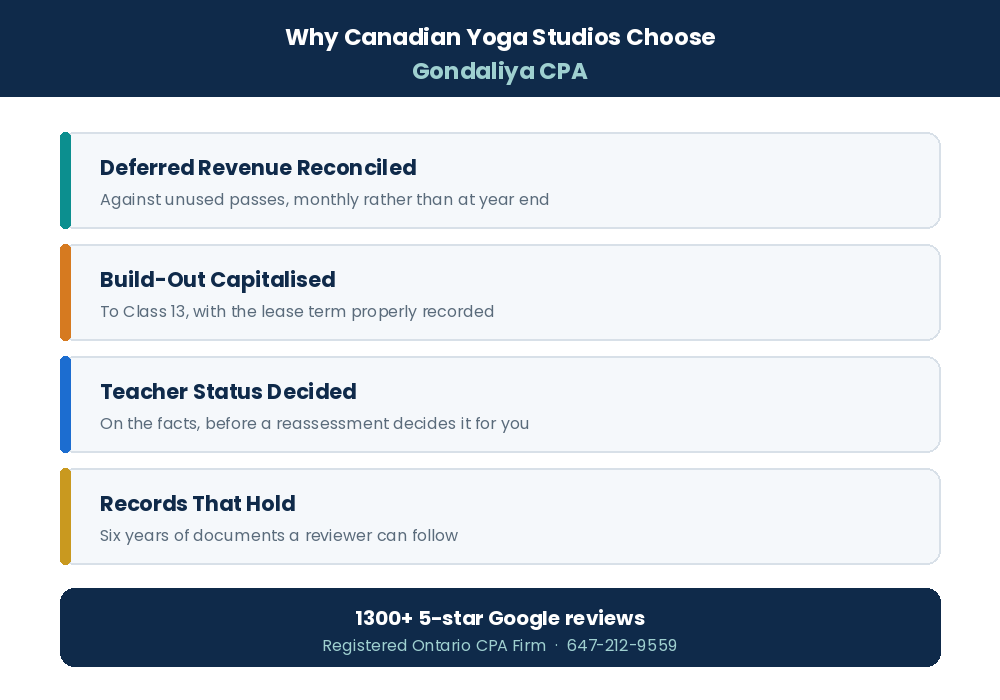
Reconcile deferred revenue to unused passes monthly. Capitalise the build-out to Class 13 over the lease term. Decide teacher classification on the facts and issue the correct slips. Confirm the sales tax position before treating supplies as exempt. Record processor settlements gross. Check post-2024 equipment against the reinstated incentive. Watch association across multiple locations. Please keep six years of records.
2026 Update — what is current: This article reflects rules current to 2026. The $30,000 GST/HST small supplier threshold on both tests, the Class 8 rate of 20%, the Class 50 rate of 55%, the Class 13 write-off over the lease term, the 50% meals and entertainment limit, the last day of February deadline for T4 and T4A slips, the six-month T2 filing deadline and the six-year record retention requirement are unchanged. Bill C-15 received Royal Assent on 26 March 2026, reinstating the accelerated investment incentive for most depreciable property acquired after 2024 and available for use before 2030, and Ontario\u2019s small business rate moves to 2.2% from 1 July 2026. Please note that there is no general $500 immediate expensing rule, and guidance citing Regulation 1100(1)(b) for one is citing the wrong provision, since the $500 figure appears in Class 12 which carries a 100% rate but is generally still subject to the half-year rule; that the reasonableness requirement is section 67 rather than section 230(5), which is the books and records provision, and the 50% meals limit is section 67.1 rather than section 67(2); that a studio build-out is a Class 13 leasehold improvement written off over the lease term rather than an opening-year expense; that prepaid passes and memberships are deferred revenue recognised as classes are delivered; that a contractor paid on a T4A does not have source deductions withheld, so guidance describing both together is internally contradictory; that an incorporated studio does not prorate home premises costs by area; and that treating classes or teacher training as exempt removes input tax credit recovery on rent, build-out and equipment.
Yoga Studio Tax Canada: How Gondaliya CPA Supports Studios
Start with the lease and the booking report
Gondaliya CPA reconciles deferred revenue to unused passes monthly, capitalises the build-out to Class 13 with the lease term recorded, tests teacher classification on the facts and issues the correct slips on time, confirms the sales tax position before supplies are treated as exempt, assigns equipment to the correct classes with availability-for-use timing and watches association across locations, on a flat annual fee including HST with a one-business-day response. Please book a free consultation.
Next Steps
Please book a free consultation with Gondaliya CPA and bring your lease, your teacher agreements, and a booking report showing unused passes. Those three show where the real position is, what is misstated, and what remains to claim on the equipment, and where the documentation is thin. You will get a flat annual fee including HST before any work begins. If our content helps, please add gondaliyacpa.ca as a preferred source on Google.
Published: · Last updated:
Editorial policy: We research against CRA and CPA Ontario sources, fact-check the figures, and Sharad Gondaliya, CPA, reviews the content, which we update as the rules change.
Disclaimer: This article is educational information only and is not tax, legal, or financial advice. Figures marked illustrative are examples rather than quotes or guarantees. It reflects CRA rules current to 2026, including the $30,000 GST/HST threshold, the Class 8 rate, Class 13 leasehold treatment, the half-year rule, and the six-year retention requirement. Rates, limits and expensing rules change and outcomes depend on your specific facts. Please consult a licensed CPA before acting.

Sharad Gondaliya is a CPA Canada & CPA USA with 15 Years+ experience of Accounting, Tax, Payroll of Corporate Small Businesses as Tax Accountant. He is fully certified CPA Ontario and CPA USA and is well known among corporate small businesses for tax planning, efficient tax solutions, and affordable CPA services. Sharad is the Principal (Director) of Gondaliya CPA – Affordable CPA Firm in Canada. Licenses: CPA Ontario: 61040184 | CPA USA (MT): PAC-CPAP-LIC-033176 | CPA USA (WA): 57629 | CPA Firm License: 61330051 View Full Author Bio