



Corporate Tax Cleanup for Businesses Facing CRA Reviews or Audits
Gondaliya CPA provides thorough corporate tax cleanup and CRA audit assistance Canada services, including fixing bookkeeping errors for CRA and managing tax risk for startups, skilled trades, and transportation companies. Our team supports overdue corporate tax filing, corporate financial statement cleanup, and tax dispute resolution Canada to protect your business from unnecessary penalties.
Quick Summary
Corporate tax cleanup helps businesses facing CRA audits or reviews. It fixes bookkeeping mistakes, makes sure tax laws are followed, and prepares papers for CRA questions.
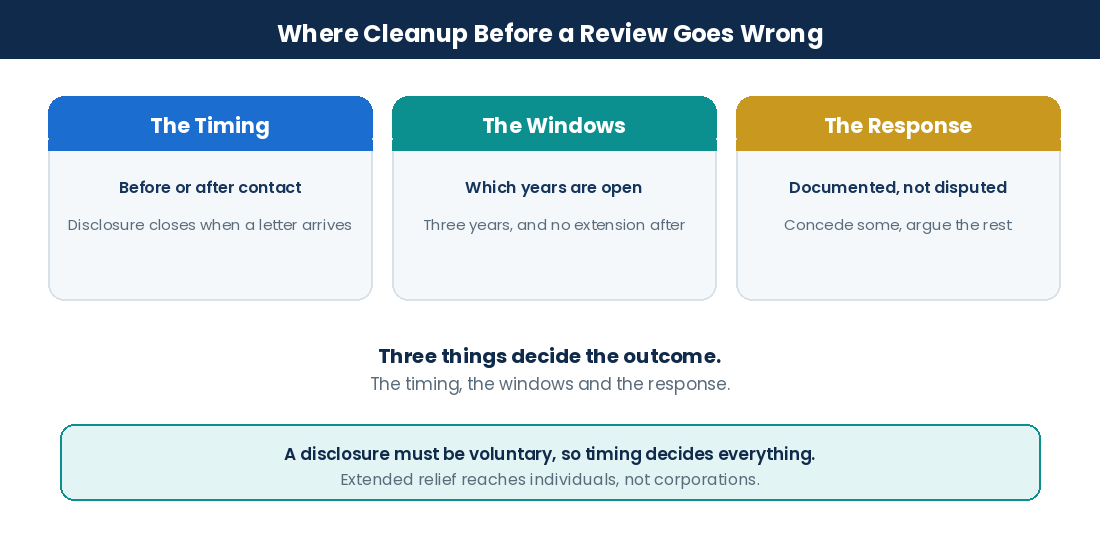
The timing decides which version you get. Before contact, correction and disclosure are both available. Once a letter arrives, disclosure on that matter generally closes and the work becomes defending a position in real time.
| Service | DIY Approach | CPA Support |
|---|---|---|
| Time Required | High | Low |
| Accuracy | Mixed | High |
| Compliance Assurance | Low | High |
| Stress Level | High | Low |
Who it is for: Companies that need help with late filings, those under CRA audits, or anyone wanting their corporate taxes sorted properly.
Who it is not for: Businesses with no issues or those who want to handle finances themselves.
Reading time: 54 minutes.
Table of Contents
The Numbers That Matter
This article covers Canada, with Ontario and Toronto context, and reflects rules current to 2026. It is written for incorporated Canadian businesses. Figures marked illustrative are examples, not quotes, and any masked engagement notes end with “Figures changed for privacy.” This is educational information only and not tax or legal advice. What a cleanup produces depends entirely on your own figures and records, so no article can tell you what yours is worth.
Before Contact and After Contact
Before Contact and After Contact
The Timing
Two Different Jobs
Most guidance treats corporate tax cleanup as one service. It is not. What is available to you depends entirely on whether the CRA has already made contact about the matter.
| Position | What Is Available |
|---|---|
| Before contact | Correction, adjustment requests, and disclosure where a penalty would apply |
| After contact | Correction and response. Disclosure on that matter is generally closed |
The Voluntary Disclosures Program requires the disclosure to be voluntary. That single word carries the whole condition. Once the CRA has written to you about a year or an issue, coming forward on it is no longer voluntary, and the relief that route offers generally goes with it.
This is why “we will look at the books after this quarter” is a decision rather than a delay. A business that knows something is wrong has a window, and the window is not defined by a date. It closes when a letter arrives.
What Changes After a Letter
- The scope is set by someone else rather than by you
- Corrections have to be defensible immediately, not eventually
- Everything provided becomes part of the record the outcome is built on
- Timelines are imposed rather than chosen
- The penalty position hardens as the file develops
None of that makes cleanup pointless after contact. It makes it different work, done under different constraints, and it is worth being clear about which one you are buying.
What Cleanup Cannot Fix
Two limits are worth stating plainly before anything else, because both cost money to discover late.
The first is documentation that never existed. A bank statement shows money left the account, not what it bought. Reconstruction from genuine underlying data is legitimate; creating a document after the fact is a different act entirely and is far more serious than the original error.
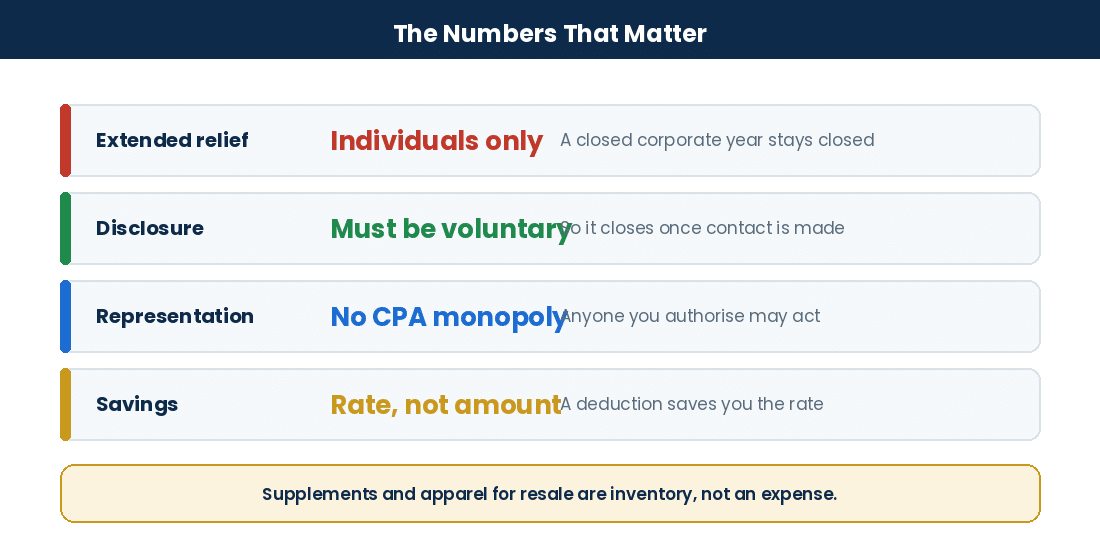
The second is a closed year. A corporation can generally adjust a return within the normal reassessment period, usually three years from the notice of assessment. Unlike an individual, a corporation has no extended relief allowing a refund beyond that. Once the window closes on a corporate year, an unclaimed deduction in it is gone.
The businesses that come to us before a letter arrives have options the ones who wait do not. It is the same books and a different set of routes. Figures changed for privacy.
Risk Warning: Voluntary disclosure requires the disclosure to be voluntary. Please act before the CRA makes contact, because afterwards that route generally closes on the matter.
Who Should Do the Work
Who Should Do the Work
The Options
What Is Corporate Bookkeeping Cleanup?
Corporate bookkeeping cleanup means checking and fixing a business’s financial records. It makes sure all transactions are correct and match Canadian tax rules. This process includes:
- Finding and fixing errors in records.
- Matching accounts payable and receivable with bank statements.
- Checking that all paperwork follows Canadian tax laws.
- Identifying costs paid personally and never entered.
- Reconciling revenue to sales tax filings.
Cleaning up your books reduces exposure if the CRA reviews you. It also shows clearly how your business is actually performing.
When Your Business Needs Catch-Up Filing for Corporate Tax Compliance
You need catch-up filing if your business missed tax deadlines. Signs you need help catching up:
- Late T2 Corporation Income Tax Returns.
- Missed GST/HST filings that could cause extra charges.
- Delayed financial statements that might bring more CRA attention.
- Notices about missing returns that have not been answered.
Getting professional help makes catch-up filing faster and lowers the penalty risk from late submissions. Note that an unfiled year cannot be adjusted, so catch-up corporate tax filing has to come first where returns are missing entirely.
DIY vs CPA vs Non-CPA for Corporate Tax Matters
When you need corporate tax audit help, CRA review support, or corporate tax cleanup, picking the right route matters. You can do it yourself, hire a CPA, or work with a non-CPA professional. Each has consequences for your position.
DIY Approach: Pros and Cons
Many small businesses handle their own tax work to save money. It can look manageable and carries real risk.
- Pros:
- Costs less upfront.
- You control your records and filings.
- You have instant access to your paperwork.
- Cons:
- Tax rules get complex quickly.
- You might miss what actually draws CRA attention.
- It takes considerable time and can cause delays.
- You assess your own position, which is difficult to do objectively.
If you handle it yourself, fixing bookkeeping errors or replying to audit letters is demanding work. Without help, deadlines get missed and penalties follow.
Non-CPA Professionals: What You Should Know
Bookkeepers and tax preparers without a CPA designation can help, within limits.
- They may fix straightforward bookkeeping issues for audits or overdue filings.
- They can act as an authorised representative where you appoint them, though the depth of technical support varies considerably.
- They usually do not perform compilation engagements or financial statement work to a professional standard.
One correction to a claim that appears widely. In Canada there is no professional monopoly on CRA representation. Anyone you authorise can deal with the CRA on your behalf, so the difference is not legal authority. It is technical depth, professional accountability and what happens when a position has to be argued rather than simply submitted.
Why Choose a Registered CPA?
CPAs have the skills to handle complex corporate tax cleanup and audits.
| Aspect | DIY | Non-CPA Professional | Registered CPA |
|---|---|---|---|
| Expertise in Corporate Tax | Limited | Moderate | Extensive |
| Audit Representation | You act for yourself | Available if authorised | Available if authorised |
| Handling Complex Cleanup | Risky | Partial | Comprehensive |
| Compliance Assurance | Low | Variable | Professional standards apply |
| Strategic Tax Planning | Minimal | Basic | Advanced |
| Professional Accountability | None | Varies | Regulated by CPA Ontario |
A Registered CPA knows the rules and applies them so your records hold up when tested, while identifying deductions you are entitled to. CPAs also handle voluntary disclosures and deal with auditors directly on your behalf. The final row is added because it is the substantive difference: a designation carries regulatory accountability, and you can verify a firm on the CPA Ontario public directory.
Anyone you authorise can deal with the CRA. What differs is what happens when a position needs arguing rather than simply filing. Figures changed for privacy.
Key Stat: There is no professional monopoly on CRA representation in Canada. Please choose on technical depth and accountability rather than on assumed authority.
Gondaliya CPA Process for Corporate Tax Cleanup and Audit Assistance
Our Process and Deliverables
The Method
Our process aims to bring clear results during your corporate tax cleanup. We focus on CRA audit assistance Canada-wide, especially for Ontario small and medium businesses.
Step 1: Initial Assessment & Documentation Review
We start by checking your financial statements, past filings, bookkeeping records, and any CRA notices. This identifies problems before anything else is built on them.
We also establish two things at this stage that determine what follows: whether the CRA has already made contact about the matter, and which taxation years remain open. Both change what is available to you.
Step 2: Bookkeeping Reconciliation & Error Correction
Our team fixes errors in your ledgers, including missing transactions, to match the applicable Canadian standards and industry practices such as construction costing.
A note on terminology, since older guidance still uses the retired term. Financial statements for Canadian private companies are prepared under ASPE, and where a CPA compiles them the engagement is performed under CSRS 4200. “Canadian GAAP” and “Notice to Reader” are both retired descriptions.
Step 3: Catch-Up Filing & Compliance Alignment
If we find overdue or incomplete returns:
- We prepare missing T2 Corporation Income Tax Returns.
- We align everything with current legislation and recent changes.
- We address late-filing penalties where relief may be available.
- We assess whether disclosure is appropriate, before contact rather than after.
This reduces the risk of further penalties and puts you in position before any official review begins. The fourth item is added because sequencing matters: disclosure and ordinary catch-up filing are different routes with different consequences.
Step 4: Customized Audit Defence Strategy Development
From our findings:
- We build replies for every issue auditors raise.
- We assemble the documentation that supports your claims.
- We advise on internal controls to prevent the same findings recurring.
- We identify which positions will not hold, so effort goes where it counts.
This applies whether you face an initial review or a full audit through to reassessment. The last point is worth stating: defending an indefensible position costs money on the way to the same outcome, and knowing that at the start produces better results on everything else.
Step 5: Ongoing Support During Review/Audit
We become your point of contact throughout CRA communication:
- Handle correspondence professionally.
- Attend meetings with you.
- Give updates so you know the position at all times.
- Keep a dated log of every request and every document provided.
- Build a documented submission at the proposal stage, before assessment.
The proposal stage deserves particular attention. Before an assessment issues, the CRA generally sets out the adjustments it intends to make and invites a response. It is the cheapest and most effective point to change an outcome, and it is routinely treated as a formality.
Key Deliverables in Corporate Tax Audit Help and Cleanup
Here is what you get when hiring professionals focused on corporate tax cleanup plus audit help.
| Deliverable | Description |
|---|---|
| Financial Statement Reconciliation | Matching your books against bank statements and source documents |
| Overdue Return Preparation | Filing past-due T2 returns under current federal and provincial rules |
| Bookkeeping Error Identification | Finding classifications that change taxable income in either direction |
| Corrective Journal Entries | Corrections posted properly into the accounting records |
| Detailed Audit Response Package | Organised evidence indexed to each auditor request |
| Minimized Penalty Exposure Analysis | Assessment of where relief or a due diligence argument may apply |
| Maximized Deduction Recovery | Identification of missed expenses within the open years |
| Minimal Disruption Plan | Scheduling that fits around operations to limit downtime |
| Request and Response Log | A dated record of everything asked and everything provided |
These form a full service for businesses wanting solid support through a review or audit while staying compliant throughout.
Knowing how handling it yourself compares with professional support, and seeing how the process runs, helps avoid costly errors under CRA scrutiny. For advice on your own situation call 647-212-9559 or email info@gondaliyacpa.ca.
The request log is the least interesting deliverable and the one that settles arguments six months later. Memory is not evidence for either side. Figures changed for privacy.
Pro Tip: Please treat the proposal stage as the main event. Responding there is faster, cheaper and more likely to work than objecting afterwards.
Pricing Factors for Corporate Tax Cleanup and CRA Audit Support
Pricing, Risks and the Checklist
The Practicalities
Knowing what affects pricing helps when you prepare for corporate tax cleanup or CRA audit help. Costs change depending on complexity and how much work is required.
| Pricing Factor | Description | Impact on Cost |
|---|---|---|
| Scope of Cleanup Required | How much correction is needed for bookkeeping errors, missing filings or financial statements. | Bigger cleanup means higher fees |
| Number of Years Under Review | Count of fiscal years needing cleanup or audit preparation. | More years cost more |
| Complexity of Financial Records | Volume and difficulty of transactions, multiple revenue sources, intercompany dealings. | Complex records raise prices |
| Industry-Specific Requirements | Sectors such as construction or real estate carry particular rules. | Specialised knowledge adds to fees |
| Urgency & Deadlines | Compressed turnaround to reply to the CRA or complete filings. | Rush work costs extra |
| Level of Representation Needed | Full audit representation, or preparation support only. | Full representation costs more |
| Compliance Risk Exposure | Where penalty exposure exists, more care is required in the cleanup. | Higher risk means more work |
These factors shape your plan. Fees are quoted before work begins, including HST, so you know the position before committing.
Risks and CRA Compliance for Businesses
Skipping proper tax compliance causes real problems during a CRA review or audit. Knowing the risks lets you act early.
- Incomplete bookkeeping may cause missed deductions and wrong taxable income.
- Filing late brings penalties and interest charges.
- Misclassified transactions lead to reassessments by CRA.
- Undisclosed income or assets may trigger serious consequences.
- Penalties from ignoring rules hurt finances and reputation.
- Errors that trigger audits cause extra scrutiny.
- Unremitted trust amounts follow directors personally.
The last item is added because it sits in a different risk class from the rest. Source deductions and collected sales tax are held in trust, and directors can be assessed personally for amounts not remitted, for up to two years after ceasing to hold office.
Corporate Tax Audit and Cleanup Checklist for Businesses
Breaking down cleanup tasks makes the work manageable. Use this checklist to prepare for CRA reviews.
- Gather all financial papers: bank statements, invoices, receipts.
- Reconcile bank accounts and ledgers; check they match transactions.
- Review past tax filings to spot errors needing correction.
- Correct bookkeeping mistakes like wrong categories or missing items.
- Prepare adjusted financial statements showing true business position.
- Collect supporting documents that back up reported numbers.
- Respond quickly to any CRA notices to avoid penalties.
- Set up internal controls to keep future records accurate.
- Establish which taxation years remain open before deciding what to fix.
- Identify every deposit that is not revenue, and label it.
This list fits many small businesses, including doctors, dentists and property developers, and helps avoid common audit difficulties.
Numeric Example: Impact of Corporate Tax Cleanup on a Small Business
Consider a startup in Toronto with late filings over three years and disorganised books. The figures below are illustrative only, and the tax effect is calculated at an assumed combined small business rate of 12.2%.
Before Cleanup
- Unreported expenses: $50,000
- Overstated revenues: $20,000
- Taxable income as filed: $350,000
After Professional Corporate Tax Cleanup
Adjusted Figures Table
| Description | Amount |
|---|---|
| Reported Revenue ($) | $480,000 |
| Adjusted Expenses ($) | $200,000 |
| Taxable Income ($) | $280,000 |
Savings Realized Table
| Description | Before Cleanup | After Cleanup | Difference |
|---|---|---|---|
| Taxable income | $350,000 | $280,000 | -$70,000 |
| Tax at 12.2% | $42,700 | $34,160 | -$8,540 |
Please read that second table carefully, because it is where published examples usually break down. A $70,000 reduction in taxable income does not save $70,000 in tax. It saves the reduction multiplied by the corporation’s effective rate, which for a small business claiming the small business deduction is modest. Examples showing a much larger drop are not describing Canadian corporate tax.
Two further qualifications. The rate itself changes: Ontario’s small business rate moves to 2.2% from 1 July 2026, altering the combined figure. And penalty and interest amounts cannot be added to an illustration like this, because both are formula-based on your own amounts and periods, and the prescribed interest rate changes quarterly and compounds daily.
Fixing bookkeeping errors early with a CPA who handles corporate tax audit work brings taxable income to where it should have been. It also limits penalties from late filings, though what those come to depends entirely on your figures.
For advice fitting your business, whether e-commerce or transport, contact Gondaliya CPA at 647-212-9559 or info@gondaliyacpa.ca.
Every cleanup example we see online overstates the saving by an order of magnitude. A deduction saves you the rate, not the amount. Figures changed for privacy.
Risk Warning: A reduction in taxable income saves tax at your effective rate, not the full amount. Please treat any example showing otherwise with caution.
Corporate Tax Cleanup and CRA Support for Specific Industries
Cleanup by Industry
By Sector
Corporate tax cleanup and CRA audit help vary considerably from one industry to another. Every business has its own rules, reporting needs and audit risks. Knowing these differences produces corporate tax cleanup plans that fit CRA requirements with less disruption.
Doctors and Dentists: Unique Financial Reporting Needs
Doctors and dentists deal with several income sources, such as patient fees and insurance payments. Cleaning up corporate taxes means sorting these correctly.
CRA review support checks things like:
- Expenses for medical supplies, office rent, staff pay, and training
- Correct bookkeeping so audits do not start unnecessarily
Corporate tax audit help also includes:
- Matching patient billing with income reported
- Making sure deductions follow CRA rules
- Getting documents ready for CRA questions about practice costs
- Apportioning sales tax credits across exempt and taxable supplies
Please note the last item specifically. Most medical services are exempt rather than zero-rated, so tax paid on costs is not fully recoverable and credits must be apportioned on a defensible basis. Practices claiming in full on mixed supplies are the ones that get adjusted. A further point: a corporation does not prorate home premises costs by space used, which is the sole proprietor method.
Daycare Businesses: Compliance for Grants and Subsidies
Daycares must report finances carefully to keep government funding. Bookkeeping affects taxes and grants alike.
CRA review support focuses on:
- Checking payroll because of wage subsidies
- Showing expenses allowed by childcare programs
- Fixing accounts tied to parent fees versus subsidies
Cleaning up corporate taxes helps daycares avoid difficulty if funding is questioned. Clear records satisfy both tax law and grant conditions. One correction worth carrying: childcare services are exempt supplies, not zero-rated, so tax paid on costs is not recoverable.
Real Estate Professionals and Property Developers: Complex Transaction Tracking
Real estate work involves many parties, changing values, capital gains, HST issues, loans and land sales. These make bookkeeping demanding before or during a CRA audit in Canada.
Main points include:
- Tracking acquisition costs against sale proceeds
- Sorting capital expenditure from operating costs correctly
- Reconciling trust accounts in property deals
- Establishing whether a gain is on capital or income account
CRA audit help focuses on showing clear money flows affecting taxable income, and on missed rental income or incorrect development cost claims. The capital against income question is the one that produces the largest adjustments in this sector, and it turns on intention at acquisition rather than on how the gain is described afterwards.
Construction Companies and Skilled Trades: Project-Based Accounting
Construction firms use project accounting where revenue is tracked by contract stage or completion percentage. Errors produce wrong reported profits, which draws attention to labour and subcontractor spending.
Corporate tax audit help works on:
- Matching job costing with ledger entries
- Supporting asset depreciation claims under Canadian tax rules
- Contract payment reporting for subcontractors
- Worker classification, tested on the facts rather than the contract
CRA review support steps in when filed returns do not match project cash flows shown in invoices or timesheets. Two current points: Bill C-15 received Royal Assent on 26 March 2026, reinstating the accelerated investment incentive for most depreciable property acquired after 2024 and available for use before 2030; and where the corporation owns a vehicle, it claims the costs in full and reports a taxable benefit rather than prorating by business use.
Startups: Early-Stage Compliance and Growth
Startups grow quickly and often do not keep tidy records early on. They must still file correctly. Weak books raise risk if the CRA reviews losses or credits claimed.
Corporate tax cleanup handles common startup issues like:
- Organising shareholder equity records properly
- Matching early expenses to qualifying rules
- Setting internal controls before scaling up
- Identifying costs paid personally before the business account existed
CRA review support helps startups correct filing mistakes early. One point that catches founders: Canada has no start-up cost amortisation regime and no election of the kind found in United States law. Expenditure incurred before the business actually commenced is generally not deductible, and when a business commenced is a question of fact.
E-commerce Businesses: Digital Sales & Multi-Jurisdictional Taxes
E-commerce firms handle sales across provinces plus cross-border transactions. Their books often need cleaning before a formal CRA case involving multiple jurisdictions.
Key points include:
- Recording online sales by location correctly
- Applying and remitting the right provincial rates
- Documenting inventory value changes with fast turnover
- Recording processor settlements gross, with fees as an expense
Clean books help e-commerce businesses meet changing rules. The processor point catches many operators: where fees are deducted before settlement, recording only the net amount understates both revenue and expense while the processor reports the gross, creating a mismatch through nothing more than how the entry was made.
Restaurants: Cash Transactions & Inventory Management
Restaurants handle significant cash and perishable stock, which draws attention during CRA review support checks.
Corporate tax audit help focuses on:
- Reliable POS systems matching daily cash to bank deposits
- Food and drink inventory tracking in the accounting records
- Checking employee tip declarations match payroll data
These steps reduce risk from underreported income, a common trigger in restaurant reviews. Kitchen equipment bought in a busy month is also routinely coded to supplies and never reaches the asset register, which quietly costs the depreciation claim.
Transportation & Logistics Companies: Fuel Maintenance & Cross-Border Considerations
Transportation companies track costs including fuel, vehicle upkeep affecting depreciable assets, and cross-border duties. These fall under corporate tax cleanup supported by CRA audit assistance.
Areas of focus are:
- Logging fuel use matched with invoices carefully
- Consistent capitalisation for fleet vehicle costs over time
- Keeping customs documentation supporting imports and exports
- Reconciling fuel purchased against distance travelled
Handling these details removes doubt about deductions and helps transport businesses through a review without extended delay.
Each industry needs its own approach to corporate tax cleanup combined with a considered response at every stage of a CRA review. Expert help keeps your business compliant while saving time and money, whether facing routine checks or a detailed examination.
Every sector has one recurring finding, and it is almost never the one the owner expects. Knowing yours before an auditor does is the whole advantage. Figures changed for privacy.
Key Stat: Childcare and most medical services are exempt supplies, not zero-rated. Please do not assume tax paid on costs is recoverable.
Choosing a Firm and Working With Gondaliya CPA
Choosing a Firm and Working With Us
The Engagement
How to Choose a CPA Firm for Corporate Tax Audit Help and Cleanup
Picking the right CPA firm matters when dealing with corporate tax audits or cleaning up financial records. You want solid Corporate Tax Audit Help, dependable CRA Review Support, and CRA Audit Assistance Canada that fits your business.
Here are some things to watch for when choosing a CPA firm:
- Specialized Knowledge in Corporate Tax Audits:
Find a firm with real experience handling CRA audits for companies. General accounting skills are not the same thing. - Good History with CRA Reviews:
Firms that have taken clients through reviews know the common findings and what documentation answers them. - Full-Service Help:
Your CPA should cover bookkeeping correction, catch-up filing, financial statements and dispute resolution. Gaps between providers cost time during an audit. - Clear Pricing:
Choose a firm that quotes fees before work begins. Flat fees and fee-matching arrangements are straightforward to compare. - Open Communication:
You want someone who keeps you informed and responds quickly by phone or email. - Local Knowledge of Canadian Laws:
Firms familiar with both federal and provincial rules give advice that fits your situation. - Verifiable Registration:
A firm should be checkable on the CPA Ontario public directory. Ours is.
Check out this quick comparison:
| Criteria | DIY Approach | Non-CPA Bookkeepers | Registered CPA Firms |
|---|---|---|---|
| Understanding of CRA Audits | Limited | Moderate | Extensive |
| Ability to Respond Strategically | Low | Moderate | High |
| Comprehensive Cleanup Services | No | Partial | Full |
| Risk Mitigation Strategies | None | Basic | Advanced |
| Transparent Fees | Not applicable | Varies | Quoted before work begins |
| Regulatory Accountability | None | Varies | CPA Ontario |
Going with a Registered CPA means expert help suited to the complexities of Canadian corporate taxes, with accountability you can verify independently.
Why Gondaliya CPA for Your Corporate Tax Audit & Cleanup Needs
When a review arrives or records need correcting, Gondaliya CPA supports small and medium businesses across Ontario.
Experienced Team You Can Trust
Sharad Gondaliya, CPA, leads our team with 15+ years handling:
- Multi-year CRA audits.
- Clear advice on answering CRA notices.
- Detailed bookkeeping correction aimed at audit readiness.
- Support across healthcare, real estate, construction, startups, e-commerce, restaurants, transport and daycare, with sector-specific handling.
We Keep You Informed
An unexpected review is unsettling. We make sure you know the position at every point rather than guessing what comes next. We focus on:
- Spotting issues early through careful record checks.
- Correcting problems in line with Canadian tax law.
- Preparing documentation that meets CRA requirements without delay.
Simple Pricing
We quote fees before work begins, including HST, with a 30-day money-back arrangement and a 60-day fee-matching arrangement. No hidden costs during cleanup or audit work, and a one-business-day response with evening and weekend availability.
Real Results From Clients
Our Google review record reflects the businesses we have taken through catch-up filings and audits. We tell clients plainly where a position will not hold, which makes for a smaller engagement and a better outcome.
If you want straight talk about handling corporate tax issues while staying compliant, call us at 647-212-9559 or email info@gondaliyacpa.ca to book a consultation.
Secure Your Corporate Tax Future With Expert Support
Questions about corporate tax cleanup, CRA reviews or audits call for help focused on fixing issues properly. Bring three things: the CRA letter if you have one, your last filed corporate return, and your most recent sales tax return. Those establish where you stand and which routes remain open.
Reach out at 647-212-9559 or info@gondaliyacpa.ca, or send us a message. Our comparison of a CRA audit against a CRA review explains which letter you have received.
Bringing the letter, the last return and the last sales tax return takes an hour to review and tells you which routes are still open. Figures changed for privacy.
Pro Tip: Please verify any firm on the CPA Ontario public directory before engaging them. It takes a minute and it is the one check nobody makes.
FAQs on Corporate Tax Cleanup and CRA Audit Assistance
Frequently Asked Questions
FAQ
What is the difference between a CRA review and a CRA audit?+
A review looks at specific parts of your filings, usually a few items on one return, handled by correspondence. An audit is broader, covers your records for one or more years, and has a named auditor assigned. The letter tells you which you have.
What triggers a CRA audit or review for a Canadian corporation?+
Income unlike others in your sector, deductions changing sharply year to year, late or missed filings, routine selection, third-party information conflicting with what you reported, and complex dealings such as related-party or foreign transactions.
How can Gondaliya CPA help respond to CRA audit notices?+
We check the notice for deadlines and scope, authorise as your representative, gather the documents requested, explain issues clearly to the auditor, deal with the CRA directly, and advise on your position throughout.
What is involved in bookkeeping reconciliation for audits?+
Checking bank statements against the books, matching invoices, receipts and payments, finding missing liabilities or assets affecting tax, correcting wrong entries, and confirming the accounting records agree with the underlying documents.
Can Gondaliya CPA help with overdue corporate tax filing support?+
Yes. We identify which returns are most urgent, assemble past financial information even where records are incomplete, and file catch-up returns. Where a penalty would apply, we assess whether disclosure is available before you file.
What are common penalties for corporate tax non-compliance?+
Late filing at 5% of unpaid tax plus 1% per complete month, a higher rate for repeated failures, failure-to-remit penalties rising in tiers, gross negligence penalties requiring culpability, and interest compounding daily.
Does Gondaliya CPA offer small business audit protection?+
We carry out pre-audit reviews to identify weak points, set up controls, monitor compliance, and represent clients in CRA dealings. No firm can prevent selection, so the honest description is preparation rather than protection.
How long does a corporate tax cleanup process typically take?+
It depends on unfiled years, record condition, document availability and how quickly information arrives. We give a timeline after reviewing your position rather than quoting a standard range, because published ranges rarely match real files.
What support does Gondaliya CPA provide for CRA reassessment assistance?+
We analyse the basis for the reassessment, prepare a documented response, address penalties separately from the tax, and handle objections and Appeals. A corporation has 90 days from the notice to object.
Does a cleanup before contact differ from one after?+
Substantially. Before contact, correction and disclosure are both available. Once the CRA writes to you about a matter, disclosure on it generally closes and the work becomes defending a position in real time.
Can I still recover deductions from earlier years?+
Within the normal reassessment period, generally three years from the notice of assessment for a CCPC. Unlike an individual, a corporation has no extended relief beyond that, so a closed year stays closed.
Do I need a CPA to represent me before the CRA?+
No. There is no professional monopoly on representation in Canada, and anyone you authorise can act for you. The difference is technical depth, professional accountability and what happens when a position must be argued.
What is the proposal stage?+
Before an assessment issues, the CRA generally sets out the adjustments it intends to make and invites a response. It is the cheapest and most effective point to change an outcome, and it is commonly treated as a formality.
What if the supporting documents no longer exist?+
The deduction generally cannot be claimed. Reconstruction from genuine underlying data is legitimate and suppliers will often reissue invoices. Creating a document after the fact is a different act and far more serious.
Are financial statements still prepared under Canadian GAAP?+
No. Canadian private company statements are prepared under ASPE, and where a CPA compiles them the engagement is performed under CSRS 4200. Both “Canadian GAAP” and “Notice to Reader” are retired descriptions.
How much tax will a cleanup actually save?+
The reduction in taxable income multiplied by your effective rate, which for a small business claiming the small business deduction is modest. Examples showing a saving close to the full adjustment are not describing Canadian corporate tax.
Sixteen questions and one underneath several of them: has the CRA already made contact. That single fact changes what is available. Figures changed for privacy.
Key Points on Corporate Tax Cleanup & CRA Audit Support by Gondaliya CPA
Key Points on Cleanup and Audit Support
Quick Reference
What We Do
- We provide thorough catch-up filing for overdue corporate taxes under current laws.
- Legal & tax representation includes full audit defence and communication with CRA officials.
- Our transparent pricing covers all services clearly without hidden fees.
- Industry-specific cleanup adapts to requirements for doctors, real estate professionals, startups, and more.
- We offer tailored tax dispute resolution assistance during reassessments or appeals.
- Our deliverables table outlines precise tasks for effective cleanup and audit readiness.
- Pricing factors reflect case complexity to help clients budget accordingly.
- We identify risks and ensure strict CRA compliance through detailed reviews.
- A comprehensive corporate tax cleanup checklist helps businesses prepare thoroughly.
- Ongoing compliance services maintain accurate records post-audit for peace of mind.
Timing and Windows
- Disclosure requires the disclosure to be voluntary, so it generally closes once the CRA makes contact.
- A corporation can generally adjust a return within three years of the notice of assessment.
- There is no extended refund relief for corporations, so a closed year stays closed.
- Sales tax credits run on a separate and generally longer clock than income tax deductions.
- Records must be kept six years from the end of the year they relate to.
- A corporation has 90 days from a notice of reassessment to object.
- There is no reassessment time limit where misrepresentation was involved.
What the Numbers Actually Do
- Numeric examples demonstrate how cleanup adjusts taxable income and penalty exposure.
- A reduction in taxable income saves tax at your effective rate, not the full amount.
- Penalty and interest figures are formula-based on your own amounts and periods.
- The prescribed interest rate changes quarterly and compounds daily.
- Ontario’s small business rate moves to 2.2% from 1 July 2026.
- Liens and garnishments are collection actions rather than penalties.
- Unremitted trust amounts follow directors personally, for up to two years after leaving office.
For expert corporate tax audit help or CRA review support across Canada, schedule a free consultation with Gondaliya CPA.
Twenty-four points across three groups. The middle one decides whether the third one matters at all. Figures changed for privacy.
Businesses We Serve
Industry Expertise
What cleanup involves differs by business. Here are ten and the usual finding.
| Business | The Cleanup Finding That Usually Appears |
|---|---|
| Medical and dental practices | Credits claimed in full on mixed exempt and taxable supplies |
| Daycare operators | Subsidy and parent fee accounts not separated |
| Real estate and developers | Capital against income treatment, and trust account reconciliation |
| Construction and trades | Job costing not agreeing to the ledger |
| Startups | Pre-commencement costs claimed, and shareholder equity records |
| Online sellers | Processor settlements recorded net rather than gross |
| Restaurants | Equipment coded to supplies, never reaching the register |
| Transport operators | Fuel not reconciled to distance, vehicle costs prorated |
| Owner-managed corporations | Costs paid personally and never entered anywhere |
| Anyone with unfiled years | Filing first, because an unfiled year cannot be adjusted |
- Medical and dental practices: Apportion on a real basis.
- Daycare operators: Exempt is not zero-rated.
- Real estate and developers: Intention at acquisition decides it.
- Construction and trades: Tie the jobs to the ledger.
- Startups: Canada has no start-up amortisation.
- Online sellers: Gross, with fees as expense.
- Restaurants: Check supplies for equipment.
- Transport operators: Full claim, plus a benefit.
- Owner-managed corporations: Bring the personal statements.
- Anyone with unfiled years: File, then adjust.
The business changes the finding. It does not change the first question, which is whether the CRA has already made contact. Figures changed for privacy.
Professional Guidance and Quick Reference
Guidance
Professional Guidance: How Gondaliya CPA Handles Your Cleanup
Businesses lose ground on cleanup in a predictable set of ways: waiting until a letter arrives, which closes the disclosure route on that matter, never establishing which taxation years are still open before deciding what to correct, assuming a corporation gets the extended refund relief that only individuals receive, planning around published examples whose arithmetic does not correspond to any Canadian corporate rate, correcting one year while leaving identical treatment in others, treating the proposal letter as a formality, and confusing collection actions such as liens with penalties. Gondaliya CPA handles cleanup and CRA support on a fee quoted before work begins.
We handle what decides the outcome: establishing whether contact has been made and which years remain open, sequencing correction and disclosure in the right order, reconciling records and identifying costs paid personally, preparing compilation financial statements under CSRS 4200 reported on ASPE, filing catch-up returns before adjusting anything, assembling documented audit response packages, building a real submission at the proposal stage, and objecting within 90 days where the reassessment is wrong.
Our team starts with the CRA letter if you have one, your last filed corporate return and your most recent sales tax return. Those three establish where you stand. Whatever your sector, you get clear advice and a fixed price before we start.
Quick Answers
- First question: Has the CRA made contact
- Before contact: Correction and disclosure both open
- After contact: Disclosure generally closed on that matter
- Adjustment window: Generally three years for a CCPC
- Corporations: No extended refund relief
- Unfiled years: File first, adjust second
- Statements: ASPE, compiled under CSRS 4200
- Representation: No professional monopoly in Canada
- Savings: The adjustment times your rate, not the amount
- Objection: 90 days from the notice
Who This Is For
- For: Incorporated Canadian businesses facing a CRA review or audit, or with records they know need correcting before one arrives.
- Not For: A prediction of what a cleanup will recover or a review will produce, since both depend entirely on your own figures and records.
People Also Ask
What are liens and garnishments?+
Collection actions, not penalties. They arise where an assessed amount goes unpaid, and they are a separate matter from the penalty and interest applied to the assessment itself.
Does an objection stop collection?+
Not in every case. Restrictions apply and differ for large corporations, and interest generally continues to accrue on the disputed amount.
What should I bring to the first meeting?+
The CRA letter if you have one, your last filed corporate return, and your most recent sales tax return. Those establish where you stand and which routes remain open.
Glossary of Key Terms
- Corporate tax cleanup: Correcting records and filings so they hold up under examination.
- Bookkeeping reconciliation: Matching the books to bank statements and source documents.
- Catch-up filing: Submitting returns for years never filed.
- Adjustment request: A documented request to change a filed return.
- Voluntary Disclosures Program: Correcting filings before CRA contact.
- Normal reassessment period: Generally three years for a CCPC.
- ASPE: The standards Canadian private company statements are prepared under.
- CSRS 4200: The standard governing a CPA compilation engagement.
- Compilation engagement: Statements assembled by a CPA, with no assurance provided.
- Audit response package: Organised evidence indexed to each auditor request.
- Proposal letter: Intended adjustments set out before assessment.
- Notice of reassessment: The formal revision of a previously assessed return.
- Notice of objection: A formal dispute, filed within 90 days for a corporation.
- Due diligence: An argument that a penalty should not apply despite an error.
- Taxpayer relief: A discretionary request to cancel penalties and interest.
- Trust amounts: Source deductions and collected sales tax, which follow directors.
Cleanup Readiness Check
This quick self-check indicates where your operation most likely has room. Please answer the six questions below.
Cleanup Readiness Check
Six quick questions on your position. No fee shown.
Points to raise with us:
This is a general prompt, not tax or legal advice or a quote. Your position depends on your full facts. For a real review, please book a free consultation.
Want a checklist to work from? You can download our free cleanup and audit checklist before your consultation.
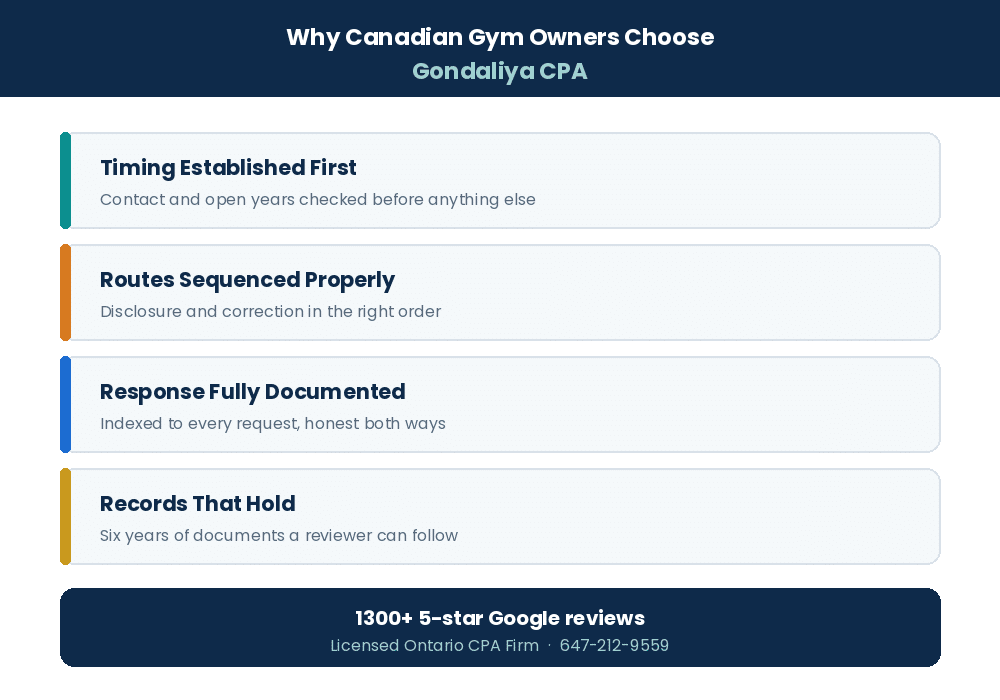
Establish whether the CRA has made contact before anything else. Check which years are still open. File unfiled years before adjusting anything. Sequence disclosure and correction in the right order. Bring the personal card statements. Remember a corporation gets no extended refund relief. Build a real submission at the proposal stage. Please keep six years of records.
2026 Update — what is current: This article reflects rules current to 2026. The generally three-year normal reassessment period for a CCPC, the six-year record retention requirement, the 90-day period for a corporation to file a notice of objection, and the 5% plus 1% per month corporate late-filing penalty structure are unchanged. Bill C-15 received Royal Assent on 26 March 2026, reinstating the accelerated investment incentive for most depreciable property acquired after 2024 and available for use before 2030, and Ontario\u2019s small business rate moves to 2.2% from 1 July 2026. Please note that the Voluntary Disclosures Program requires the disclosure to be voluntary, so it generally closes on a matter once the CRA has made contact about it; that the extended taxpayer relief permitting a refund up to ten years back applies to individuals and graduated rate estates and not to corporations, so a closed corporate year stays closed; that there is no professional monopoly on CRA representation in Canada and anyone you authorise may act for you, so tables describing CPA representation as a legal authority others lack are inaccurate; that Canadian private company financial statements are prepared under ASPE with compilation engagements performed under CSRS 4200, both “Canadian GAAP” and “Notice to Reader” being retired descriptions; that a reduction in taxable income saves tax at the corporation\u2019s effective rate rather than the full amount, so worked examples showing a saving close to the adjustment itself are not describing Canadian corporate tax; that penalty and interest figures are formula-based on your own amounts and periods with the prescribed rate changing quarterly and compounding daily; that liens and garnishments are collection actions rather than penalties; and that Canada has no start-up cost amortisation regime of the kind found in United States law.
Corporate Tax Cleanup for CRA Reviews Canada: How Gondaliya CPA Supports Businesses
Start with the timing question
Gondaliya CPA establishes whether the CRA has made contact and which years remain open, sequences correction and disclosure in the right order, reconciles records and identifies costs paid personally, prepares compilation financial statements under CSRS 4200 reported on ASPE, files catch-up returns before adjusting anything, assembles documented audit response packages, builds a real submission at the proposal stage and objects within 90 days where the reassessment is wrong, on a fee quoted before work begins including HST with a one-business-day response. Please book a free consultation.
Next Steps
Please book a free consultation with Gondaliya CPA and bring the CRA letter if you have one, your last filed corporate return, and your most recent sales tax return. Those three tell us where you stand, which routes are open, and what remains to claim on the equipment, and where the documentation is thin. You will get a flat annual fee including HST before any work begins. If our content helps, please add gondaliyacpa.ca as a preferred source on Google.
Published: · Last updated:
Editorial policy: We research against CRA and CPA Ontario sources, fact-check the figures, and Sharad Gondaliya, CPA, reviews the content, which we update as the rules change.
Disclaimer: This article is educational information only and is not tax, legal, or financial advice. Figures marked illustrative are examples rather than quotes or guarantees. It reflects CRA rules current to 2026, including the $30,000 GST/HST threshold, the Class 8 rate, Class 13 leasehold treatment, the half-year rule, and the six-year retention requirement. Rates, limits and expensing rules change and outcomes depend on your specific facts. Please consult a CPA Ontario member before acting.

Sharad Gondaliya is a CPA Canada & CPA USA with 15 Years+ experience of Accounting, Tax, Payroll of Corporate Small Businesses as Tax Accountant. He is a CPA Ontario member (61040184) and holds US CPA licences in Washington and Montana and is well known among corporate small businesses for tax planning, efficient tax solutions, and affordable CPA services. Sharad is the Principal (Director) of Gondaliya CPA – Affordable CPA Firm in Canada. Licenses: CPA Ontario: 61040184 | CPA USA (MT): PAC-CPAP-LIC-033176 | CPA USA (WA): 57629 | CPA Firm License: 61330051 View Full Author Bio