



Step-by-Step CRA Audit Process in Canada: What Business Owners Should Expect
Quick Summary
The CRA audit process Canada involves detailed CRA tax audit steps designed to ensure business compliance with income tax laws, as outlined in the Income Tax Audit Manual. Gondaliya CPA provides a practical business tax audit guide covering audit best practices and tax audit survival tips for a smooth CRA audit experience.
The addition this guide makes is the second layer. Alongside the stages, an auditor applies specific verification methods, and knowing which one is being used tells you what is actually being tested.
Reading time: 54 minutes.
Table of Contents
- The CRA Audit Process at a Glance
- Strengthening Financial Records
- The Process Step by Step
- The Methods Auditors Actually Use
- Tailored Audit Considerations
- After the Audit, and Working With Us
- Frequently Asked Questions
- Essential Points on CRA Audit Procedures
- Businesses We Serve
- Professional Guidance and Quick Reference
The Numbers That Matter
This article covers Canada, with Ontario and Toronto context, and reflects rules current to 2026. It is written for incorporated Canadian businesses. Figures marked illustrative are examples, not quotes, and any masked engagement notes end with “Figures changed for privacy.” This is educational information only and not tax or legal advice. A criminal investigation follows a separate process with different powers and rights, and anyone who suspects one should obtain legal advice immediately.
The CRA Audit Process at a Glance
The CRA Audit Process at a Glance
The Shape
The CRA audit process Canada makes sure businesses follow income tax laws. It breaks down into several clear CRA tax audit steps found in the Income Tax Audit Manual. Knowing these steps helps business owners deal with audits better.
Here’s a quick look at the process:
- Notification: The CRA sends a letter to let the business know an audit will happen.
- Document Request: They ask for specific financial records to check.
- Review Phase: Auditors look over the papers to see if rules are followed.
- Meeting Preparation: Business owners get ready to talk with auditors and explain things.
- Proposal Stage: Intended adjustments are set out, with time to respond before assessment.
- Audit Outcome: After checking everything, auditors share what they found and say if changes or penalties apply.
This setup keeps things clear and lets businesses see what is coming next. The proposal stage is added to the source list deliberately, because it is where the outcome is still changeable and leaving it out hides the one point that matters most.
Who should read this guide?
- Small business owners facing an audit.
- Financial professionals who want to understand the audit steps.
- Anyone curious about how corporate audits work in Canada.
If you do not handle business finances or taxes, this might not be for you.
By following this business tax audit guide from Gondaliya CPA, you get a solid idea of what to expect and how to respond during your CRA audit experience.
The Second Layer
The stage list above is the visible structure. Underneath it, an auditor applies specific verification methods, and those decide what is actually being tested at each stage.
Owners prepare for the stages, because that is what every guide describes. Then a request arrives for personal bank statements, or for the records of a related company nobody mentioned, and it feels arbitrary. It is not. It is a recognised method, and knowing which one is in play tells you what the auditor is trying to establish.
Those methods are set out in their own section below, because they are the part business owners are least prepared for.
Owners are ready for the stages. They are not ready to be asked for a personal bank statement, and that request is where most audits become uncomfortable. Figures changed for privacy.
Key Stat: The proposal stage belongs in any accurate audit timeline. Please treat it as the main event rather than a formality.
Proactive Steps: Strengthening Financial Records for CRA Compliance
Strengthening Financial Records
Before It Starts
Keeping your financial records clear and organised helps a great deal when dealing with the CRA audit process in Canada. Good business record keeping supports tax filing accuracy and reduces the difficulty if the CRA asks to review your books. Whether you track transactions by hand or use electronic record keeping tools, having everything recorded correctly makes a real difference.
Canadian companies must keep accounting records showing income, expenses, assets and liabilities clearly. This means retaining invoices, receipts, bank statements, contracts and payroll details. Keeping these records current avoids mistakes on tax returns and strengthens your position if the CRA opens a business tax audit.
Electronic bookkeeping improves how you organise data. It automates some work and stores digital copies safely. Paper or digital matters less than having complete and easily located records when the CRA asks. One qualification: electronic records must remain readable and retrievable throughout the retention period, and a system migration that leaves years of attachments unreadable is a retention failure even though the data technically exists.
Corporate Bookkeeping Cleanup Explained
A corporate bookkeeping cleanup means going back over old financial records to fix errors before they cause problems with the CRA. This cleanup often happens where a business has not kept up with proper books or needs to prepare for an audit.
Cleanup work includes:
- Matching bank accounts with transactions
- Checking entries against original documents
- Fixing wrong categories or missing information
- Making sure all expenses are recorded correctly
- Reconciling revenue to sales tax filings
- Identifying costs paid personally and never entered
This step builds a good base for catch-up filings where past tax returns were late or incomplete. It also meets rules about books and records retention, which require businesses in Canada to keep supporting papers for at least six years after the related tax year ends.
Doing cleanups regularly reduces the risk of errors surfacing during a CRA compliance review process and improves financial clarity overall. Our corporate tax cleanup service handles this work.
When Catch-Up Filing Becomes Necessary
Catch-up filing means submitting corporate tax returns after missing deadlines. You will need to do this if:
- Annual returns were not filed on time
- You find income you overlooked during your own checks
- The CRA tells you that some filings are missing
Filing late means facing penalties and interest. It can also draw extra attention in audits because it reads as non-compliance.
Before you file catch-up returns:
- Check previously filed information against updated bookkeeping.
- Include all taxable events from missed periods.
- Be ready to explain delays if auditors ask.
- Consider whether disclosure is appropriate before the CRA makes contact.
The fourth point matters because timing decides it. Where a past filing was wrong in a way carrying a penalty, the Voluntary Disclosures Program may reduce the consequences, but only where you come forward before the CRA raises the issue. Once contact is made, that route generally closes. Catch-up corporate tax filing handles the returns themselves.
Common Financial Record Risks and CRA Compliance
| Risk Factor | Description | Impact on Audit Process |
|---|---|---|
| Incomplete Documentation | Missing invoices or receipts do not support the figures | Causes doubts and leads to possible adjustments |
| Poor Record Organization | Disorganised files slow document retrieval | Lengthens audits and adds administrative work |
| Misclassification of Expenses | Wrong expense categories affect the tax | Can cause reassessment and possible penalties |
| Lack of Electronic Backup | No digital copies limit what can be produced | Makes verification hard and risks losing data |
| Untimely Reconciliation | Late bank statement matching creates gaps | Raises questions about the completeness of revenue |
| Unlabelled Deposits | Loans and transfers not identified when received | Read as unreported income until you show otherwise |
Knowing these common problems helps businesses tighten controls before any stage in the CRA tax audit steps process. The last row is added because it is the single most common finding on owner-managed files.
Audit-Ready Financial Record Checklist
Keep this checklist handy to stay ready at each step of a Canadian corporate tax audit.
| Document Type | Purpose |
|---|---|
| Invoices & Receipts | Prove income and deductible expenses |
| Bank Statements | Show cash coming in and going out |
| Payroll Records | Confirm employee pay, slips and remittances |
| Contracts & Agreements | Show business obligations |
| GST/HST Returns | Confirm sales taxes collected or paid |
| Expense Reports | Detail business spending |
| Asset Register | Support depreciation claims and record disposals |
| Shareholder Loan Detail | Explain amounts moving between owner and company |
Update this list often so you can quickly answer requests during the audit notification process (CRA) phase. Fast access reduces delays that could cause difficulty later.
The businesses that find an audit manageable are the ones that could produce the records in a week. Everything else follows from that. Figures changed for privacy.
Risk Warning: Electronic records must stay readable for six years. Please check that a system migration has not left old attachments unopenable.
The CRA Audit Process: Step-by-Step Overview for Businesses
The Process Step by Step
The Stages
Knowing the CRA audit process in Canada helps business owners stay calm and prepared. This section shows each step clearly and sets out your rights. Whether it is a GST/HST review or a corporate income tax audit, knowing what to expect reduces difficulty and improves how you handle it.
Audit Initiation: Notification and Initial Contact
The CRA starts an audit by sending a formal notice of audit. This tells you that your business records will be examined. The notice includes:
- Which fiscal years they will check
- What specific transactions or areas are targeted
- How you should respond
- The auditor assigned, and contact details
After that, an auditor will contact you directly with information on what happens next and what documents to send.
Make sure to confirm anyone claiming to be from the CRA before sharing information. Written notices are normal. Be careful with unexpected telephone calls until you verify who they are. Two additions to that advice: authorise your representative before substantive contact begins, and ask for the scope in writing covering years, taxes and issues. Both take minutes and both shape everything after them.
Document Requests and Financial Record Review
After notification, prepare for a close examination of your records against a CRA document request list made for your business. They usually ask for:
- Income statements and balance sheets
- Bank statements and cancelled cheques
- Sales invoices and receipts
- Payroll files
- GST/HST returns
- Contracts for significant transactions
You can send these electronically or on paper as directed by the auditor. Labelling documents clearly and ordering them by date speeds things up. Send copies rather than originals, and keep a log of what was requested and what was provided, with dates.
The CRA carefully reviews your financial documentation to check whether the reported figures agree with the source records.
The Audit Examination and Meeting Preparation
Before meeting with auditors, prepare properly:
- Go over all documents you sent
- Explain any unusual or unexpected transactions
- Make a summary of key financial information
- Talk with staff who handle your books
- List questions you want to ask the auditors
- Brief staff to refer questions rather than answer them
Whether the audit is on-site or remote, be courteous and help reasonably without providing information that was not requested. Where a field visit is proposed, ask whether it can be held at your representative’s office instead. It is granted more often than businesses expect and it changes the character of the whole examination.
Different CRA Audit Types: Desk, Field, GST/HST, Corporate Income Tax
| Audit Type | What It Means |
|---|---|
| Desk Audit | Conducted off-site on records you send, focused on identified issues |
| Field (On-Site) | Auditor attends premises to examine records directly and speak with people |
| GST/HST Audit | Checks compliance with Goods & Services Tax and Harmonized Sales Tax rules |
| Corporate Income Tax | Examines corporate returns across one or more fiscal years |
They follow similar stages but vary in depth depending on what was identified beforehand. Please note that the GST/HST row carries a different risk profile from the others, because tax collected is held in trust and directors can be personally liable for amounts not remitted.
CRA Investigation Stages and Timeline
Audits vary considerably in length. The stages generally run:
- Notification setting out scope and the records required
- Review of the materials provided
- Follow-up questions and further requests
- A proposal setting out intended adjustments, with time to respond
- Reassessment Notice: Issued where the CRA adjusts the figures after completing its work
- Tax Return Verification: Confirmation of the final position through the reassessment
Most audits last months depending on complexity, though cooperating early can shorten them. Guidance quoting a fixed range of weeks is not reliable, because duration turns on the number of years, the issues, the state of the records and the auditor’s workload.
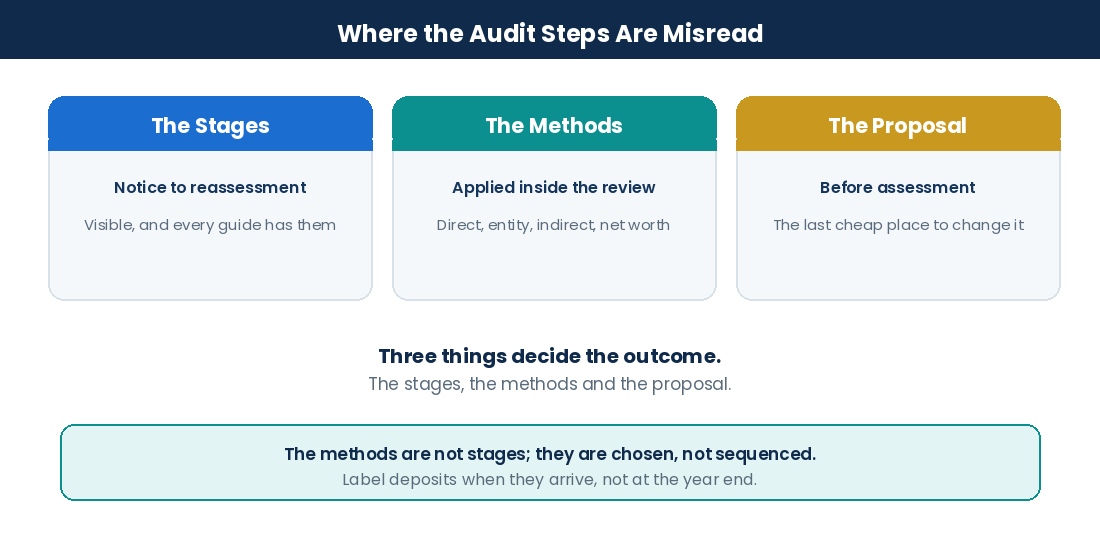
A correction on ordering. Guidance often lists the Economic Entity Approach, Indirect Verification and Lifestyle Audits as stages two, three and four of a timeline. They are not stages. They are verification methods an auditor may apply at any point during the review, and presenting them as a sequence obscures what they actually are. They are set out properly in the next section.
Rights and Responsibilities During a CRA Audit
When facing a Canadian tax audit, know your rights and duties clearly.
Your Rights Include:
- Getting written notice before the audit starts
- Knowing what is being examined
- Having access to advice from professionals such as CPAs
- Keeping personal information protected
- Responding to proposed adjustments before assessment
- Objecting to an assessment you disagree with
Your Responsibilities Are To:
- Work cooperatively without obstructing the examination
- Give accurate documents promptly
- Speak up clearly about problems or questions
Being respectful helps resolve matters faster while staying within Canadian tax laws. Cooperation means answering what was asked, completely. It does not require volunteering material outside the scope, and there is no obligation to speculate about something you are unsure of.
Audit Outcome and Reassessment Process
When the audit concludes:
- Auditors set out their findings with any adjustments proposed
- You respond to the proposal, in writing and with documents, before anything is finalised
- Where the tax changes, the CRA issues a Notice of Reassessment
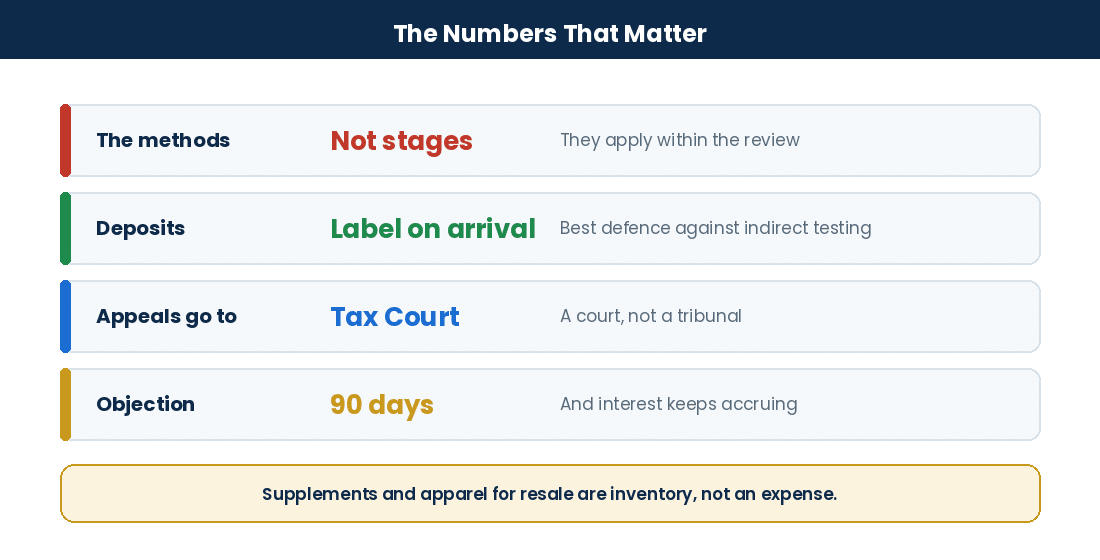
- You can object within 90 days if you disagree
- You can appeal further to the Tax Court of Canada
Two corrections here. Step two is added because responding at the proposal stage is cheaper and more effective than objecting afterwards. And the final step goes to the Tax Court of Canada, which is a superior court of record, not an administrative tribunal.
Resolving matters calmly usually saves money and time compared with prolonged disputes. Running through all these stages takes focus, and help from someone who knows Canadian small business audits makes the process considerably easier.
The stage list is accurate but incomplete without the proposal. Businesses that skip it spend far more objecting than they would have spent answering. Figures changed for privacy.
Key Stat: Appeals from an objection go to the Tax Court of Canada, a superior court of record. Please do not plan on an administrative tribunal.
The Methods Auditors Actually Use
The Methods Auditors Actually Use
The Second Layer
Why These Are Not Stages
The four approaches below are verification methods, applied inside the review phase rather than in sequence. An auditor may use none of them, one, or several, depending on what the direct examination of records establishes.
They matter because each one signals a different concern. A request that seems arbitrary usually is not, and identifying the method tells you what is being tested and what would answer it.
Direct Verification
The default. Figures on the return are traced back through the ledger to source documents, and the treatment applied is tested against the rules.
Most audits stay here. Where the records support the filing, the review concludes and no other method becomes necessary. The other three appear where direct verification runs into gaps.
Economic Entity Approach
What it is: Examining related businesses under common ownership together rather than in isolation.
What it signals: A concern that transactions between related entities have shifted income or costs in a way that would not survive examination on its own.
What answers it: Contemporaneous documentation for inter-company transactions, evidence that terms were reasonable, and consistent treatment on both sides. Where several corporations share ownership, the related-party file is worth preparing before it is asked for.
Indirect Verification of Income
What it is: Testing reported income against external data such as deposits, rather than working forward from the sales ledger.
What it signals: A concern that revenue may be incomplete, usually because deposits exceed reported income or the records are not reliable enough to work from directly.
What answers it: Every deposit identified and explained. Loans, transfers between accounts, owner contributions, insurance settlements and refunds are not revenue, but an unexplained deposit is treated as unreported income until you demonstrate otherwise. Labelling deposits when they arrive is the single most effective preparation against this method.
The Net Worth Method
What it is: Comparing assets against liabilities across periods to test whether reported income accounts for the change.
What it signals: A serious concern, usually applied where records are inadequate to verify income any other way.
What answers it: Documentation for non-income sources of funds, such as loans, gifts, inheritances, sales of personal property or amounts already taxed. This is the method under which personal and household records may be examined, and it is where audits most often become uncomfortable for owners who did not expect it.
Lifestyle Comparison
What it is: Testing whether reported income is consistent with observed personal expenditure.
What it signals: The same underlying concern as the net worth method, approached from the spending side.
What answers it: The same evidence. Where personal spending is funded from sources other than current business income, those sources need documenting.
What to Take From This
| Method | What Triggers It | What Prepares You |
|---|---|---|
| Direct verification | Standard approach | Complete, reconciled records |
| Economic entity | Related corporations | Documented inter-company terms |
| Indirect verification | Deposits exceeding revenue | Every deposit labelled on arrival |
| Net worth | Records inadequate to verify income | Evidence of non-income funding sources |
| Lifestyle comparison | Spending inconsistent with income | The same evidence |
The pattern is consistent. The indirect methods appear where direct verification cannot be completed, which means the strongest defence against all of them is records good enough that direct verification works.
Where any of the last three methods appears, the audit has moved somewhere that warrants representation if you do not already have it. These approaches produce estimates rather than traced figures, and displacing an estimate is harder than supporting a claim.
When a request for personal records arrives, the method has changed. That is the moment to have someone in the room, not three months later. Figures changed for privacy.
Risk Warning: The net worth and lifestyle methods produce estimates. Please get representation when either appears, because displacing an estimate is harder than supporting a claim.
Tailored Audit Considerations for Canadian Industries
Tailored Audit Considerations
By Sector
The CRA audit process Canada looks different depending on the industry. Each sector has its own rules and ways of doing business. Knowing these helps you prepare and stay calm during a business audit in Canada. Different industries face different challenges, so it is worth knowing what applies to you.
CRA Focus Areas for Doctors and Dentists
Doctors and dentists see the CRA pay close attention to their income and expenses. The agency checks:
- Income from fee-for-service, capitation, or private billing.
- Expenses like office rent, medical supplies, and education.
- HST/GST filings on taxable services.
- Rules for professional corporations.
Keeping good records is key. Also, seeking professional tax advice helps deal with complex healthcare rules and keeps you clear of difficulty. One point worth adding: most medical services are exempt rather than zero-rated, so tax paid on costs is not fully recoverable and credits have to be apportioned on a defensible basis. Practices that claim in full on mixed supplies are the ones that get adjusted.
Audit Insights for Daycare Businesses
Daycare businesses face some unique audit concerns:
- Reporting government subsidies versus parent fees properly.
- Correct employee vs. contractor classifications.
- Claiming depreciation through Capital Cost Allowances on buildings or equipment.
Because daycares often deal with public funds, keeping detailed financial documents is important. Clear statements matching real operations help lower audit risk. Please note that childcare services are exempt supplies, not zero-rated, so tax paid on costs is not recoverable. Guidance describing them as zero-rated has the consequence backwards.
Real Estate, Property Developers, and Construction Audits
For property developers and construction firms, the CRA looks at:
- Accurate project costs showing materials and labour separate from overheads.
- Consistent inventory valuation affecting taxable income.
- GST/HST filings related to property sales.
- Whether a gain is on account of capital or income, which turns on intention at acquisition.
Skilled trades must report payroll properly and manage subcontractors carefully. The CRA examines cash flows closely here. Two current points: contract payment reporting for subcontractors is a standard comparison, and Bill C-15 received Royal Assent on 26 March 2026, reinstating the accelerated investment incentive for most depreciable property acquired after 2024 and available for use before 2030, which affects equipment-heavy files.
Tax Compliance for Startups and E-commerce Businesses
Startups often struggle with proper bookkeeping as they grow quickly. Common issues include:
- Missing or incomplete records.
- Mixing personal and business expenses.
- Delays in GST/HST registration affecting input credits.
E-commerce businesses must watch cross-border sales where customs duties or provincial taxes may apply. Starting with good controls helps handle typical startup audit challenges. A further point specific to online sellers: where payment processor fees are deducted before settlement, recording only the net amount understates both revenue and expense while the processor reports the gross, which creates a mismatch purely through how the entry was made.
Restaurant, Transportation, and Logistics Audit Points
Restaurants often get examined on cash handling due to the volume of daily sales. Watch for:
- Accurate sales tracking through POS systems.
- Proper reporting of employee tips.
- Controls over inventory losses.
Transportation companies get checked on fuel claims and vehicle expenses. Logistics firms should ensure contracts match invoices, especially when using third-party carriers.
One correction on vehicles, because it recurs across guidance. Where the corporation owns the vehicle, it claims the costs in full and reports a taxable benefit for personal use. It does not apply a business-use percentage to reduce the claim. That proration is the sole proprietor method, and applying it to a corporation understates the deduction while leaving an unreported benefit at the same time.
Restaurants and transport are examined on the same thing under different names: whether the cash and the distance agree with what was reported. Figures changed for privacy.
Pro Tip: Please claim corporate vehicle costs in full and report a benefit, rather than prorating by business use.
After the Audit: Reassessment and Resolution
After the Audit, and Working With Us
The Outcome
Knowing what happens after a CRA audit helps you handle results better. You can accept findings or challenge them.
CRA Reassessment Process Explained
The CRA reassessment process means the agency adjusts your tax return after the audit. This may mean owing more tax plus interest, or in some cases a refund.
If you disagree, a corporation has 90 days from the date of the Notice of Reassessment to file an objection. This starts a formal review by an Appeals officer independent of the audit.
One qualification on collections, because guidance overstates it. Filing an objection does not simply stop all collection activity in every case. Restrictions apply, and they differ for large corporations, where a portion of the amount remains collectible. Interest also generally continues to accrue on the disputed amount, so there is a cash decision about whether to pay pending the objection.
Acting quickly keeps your rights intact and often avoids larger disputes later.
Responding to CRA Audit Letters and Disagreements
After an audit, the CRA sends letters explaining what was found. You must reply by the deadlines, sometimes sending further documents or clarifying issues.
When you respond:
- Check every point carefully against your records
- Write clear explanations backed by documents
- Stay factual and avoid an argumentative tone
- Ask a CPA if unsure how to answer
- Concede plainly what is genuinely correct
Good communication here prevents avoidable penalties. The fifth point is added because it works: a submission that concedes two points cleanly and argues three with evidence gets a better outcome than one disputing everything, since the reader can tell which arguments were considered.
Potential Penalties and Interest
| Scenario | Penalty Structure | Interest |
|---|---|---|
| Late filing penalty | 5% of unpaid tax plus 1% per complete month, to twelve | Compounds daily, separately from penalty |
| Repeated late filing | A higher rate where demanded and previously penalised within three years | Continues to accrue |
| Failure to remit | A percentage of the amount, rising in tiers with lateness | Continues to accrue |
| Gross negligence penalty | A substantial percentage of the understated amount, requiring culpability | Continues to accrue |
Please note that no article can tell you what a particular situation will cost. Every one of these is a calculation on your own figures, and worked examples showing a fixed penalty rate and a fixed interest rate over a stated number of months are illustrations of arithmetic rather than statements of what you would owe. The prescribed interest rate changes quarterly and compounds daily, and a gross negligence penalty requires more than an error.
Paying an assessed amount promptly reduces the interest that accrues on it, which is the one reliable statement in this area.
Professional CPA Audit Support in Canada
Facing a CRA audit is demanding for business owners. A professional CPA audit support service guides you through the process, making sure you follow the rules. CPAs handle representation, keep communication clear, and give advice based on your situation.
Working with a CPA means your position is protected during an audit. They help organise your financial papers, answer document requests promptly, and represent you at meetings with CRA auditors.
DIY vs. CPA vs. Non-CPA Support for Audits
| Aspect | DIY Tax Audits Canada | Non-CPA Audit Help Canada | Hiring a CPA |
|---|---|---|---|
| Expertise | Limited; easy to make mistakes | Some knowledge, no formal accounting background | Trained professionals, current on tax law |
| Compliance Accuracy | Higher risk of error | Varies by experience | Held to professional standards |
| Cost | Lowest upfront, risk of cost later | Medium, less predictable | Fixed fees quoted before work begins |
| Time Commitment | Substantial | Less than DIY but still demanding | Handled on your behalf |
| Representation | You deal with the CRA yourself | Limited | Authorised representative throughout |
| Risk Management | You carry it alone | Moderate | Scope and disclosure actively managed |
Gondaliya CPA’s Audit Support Process
- Audit Preparation Tips: Start early by gathering financial documents with our checklist.
- Timely Responses: We reply promptly to all auditor requests within deadlines.
- Clear Communication: We keep the channel open between you and the auditor, explaining matters plainly.
- Cooperation With Auditor: We help schedule meetings and answer questions professionally.
- Scope Management: We agree the years, taxes and issues in writing and keep disclosure to them.
- Proposal Submissions: We build a documented response before any assessment issues.
This approach reduces delays and helps avoid extra reassessments or penalties.
Key Deliverables from CPA Audit Support
| Deliverable | Description |
|---|---|
| Audit Documentation Checklist | A list showing needed records such as invoices, receipts and contracts |
| Financial Documentation for Audit | Organised statements including bank reconciliations, ledgers and trial balances |
| Audit Working Papers Summary | Summary reports showing the key findings supporting your position |
| Request and Response Log | A dated record of everything asked and everything provided |
Factors Influencing CPA Audit Support Pricing
| Pricing Factor | Description |
|---|---|
| Complexity & Scope | Number, type and volume of transactions affect the work required |
| Flat Fee Model | Quoted before work begins, including HST, so budgets are clear |
| Industry-Specific Requirements | Sectors such as construction or real estate involve particular issues |
| Urgency & Response Times | Compressed timelines require more resource |
| Additional Services | Cleanup, catch-up filing or appeals are quoted separately |
Selecting the Right CPA Firm for Audit Assistance
- Tax Law Compliance Selection Criteria: Make sure the firm keeps current with Canadian tax rules for your business type.
- Taxpayer Appeal Rights Knowledge: Check that they handle objections and appeals, not just the audit itself.
- Experienced Auditors: Look for firms proven in handling audits like yours and businesses your size.
- Industry-Specific Expertise: Specialists in your sector improve results.
Pick a firm that mixes technical skill with straight answers. Bring the CRA letter, the returns for the years covered and your records for the scope. Contact Gondaliya CPA at info@gondaliyacpa.ca, call 647-212-9559, or send us a message. Our comparison of a CRA audit against a review explains which letter you have received.
Worked penalty examples with a fixed rate and a fixed interest figure look precise and are not. The real numbers depend entirely on your own. Figures changed for privacy.
Risk Warning: Filing an objection does not stop all collection activity in every case, and interest generally continues to accrue.
Frequently Asked Questions about CRA Business Audits
Frequently Asked Questions
FAQ
What is the typical CRA audit process in Canada?+
The CRA starts by sending a letter setting out what will be examined. It requests documents and reviews your records, sometimes with a meeting. Adjustments are generally proposed before assessment, with time to respond, then a reassessment issues if the figures change.
How should I respond to a CRA audit letter?+
Reply promptly and carefully. Read the letter closely, gather the papers requested, and communicate clearly with the auditor. Authorise a representative before substantive contact, and answer what was asked rather than sending everything you hold.
What triggers a small business tax audit in Canada?+
Inconsistencies against third-party information, expenses disproportionate to income, figures unlike comparable businesses, late filings, and routine verification. Selection alone carries no implication about your file.
What are my rights during a CRA business tax audit?+
Written notice, information about what is being examined, access to professional advice, privacy protection, an opportunity to respond to proposed adjustments before assessment, and the right to object afterwards.
Can I appeal a Notice of Reassessment from the CRA?+
Yes. A corporation has 90 days from the date of the notice to object. The objection goes to an Appeals officer independent of the audit, and a further appeal lies to the Tax Court of Canada.
How long does a typical corporate tax audit take in Canada?+
It varies considerably by number of years, issues, record condition and workload. Months is common. Guidance quoting a fixed range is not reliable, though prompt responses do shorten the process.
What happens after completing a GST/HST audit in Canada?+
The CRA may adjust tax owing or refunds based on what it finds about credits claimed and tax collected. Please remember tax collected is held in trust, so directors can carry personal exposure for amounts not remitted.
Is it necessary to hire professional help during an audit dispute resolution?+
Not mandatory, but valuable. A representative assesses what a request is really asking, keeps disclosure within scope, and builds a submission at the proposal stage, which is where outcomes actually change.
How do I ensure ongoing compliance following an audit outcome?+
Fix the process behind each adjustment, not just the numbers. Correcting the years examined without changing how the books are kept means the same finding arrives at the next audit.
What is the CRA indirect verification of income?+
Testing reported income against external data such as deposits, rather than working forward from the sales ledger. It appears where revenue may be incomplete or the records are not reliable enough to work from directly.
How does the CRA economic entity audit approach work?+
Related businesses under common ownership are examined together rather than in isolation, to test whether transactions between them shifted income or costs.
How does a lifestyle comparison work in a tax audit?+
Reported income is tested against observed personal spending. Where spending is funded from sources other than current business income, those sources need documenting.
What is the net worth method?+
Assets are compared against liabilities across periods to test whether reported income accounts for the change. It is generally applied where records are inadequate to verify income any other way.
Are those methods stages of an audit?+
No. They are verification approaches applied within the review phase, in any order or not at all. Guidance listing them as sequential stages has misunderstood what they are.
What distinguishes a CRA desk audit from a field audit?+
A desk audit is conducted off-site on records you send. A field audit involves attending premises, which need not be yours. A request to hold it at your representative’s office is often granted.
What is involved in the audit closure process?+
The auditor sets out findings, generally with a proposal before assessment. A reassessment issues where figures change, and the objection and appeal routes remain open afterwards.
Sixteen questions and one underneath several of them: which method is being applied. That answers what the request is really for. Figures changed for privacy.
Essential Points on CRA Audit Procedures & Compliance Review
Essential Points on CRA Audit Procedures
Quick Reference
Before and During
- Audit documentation checklist helps organise required financial papers for smooth submission during audits.
- Taxpayer bill of rights guarantees fair treatment and clear communication throughout the audit process.
- Electronic document submission speeds up data delivery while maintaining security during audits.
- Audit representative services help manage communications between taxpayers and CRA auditors professionally.
- Alternative audit locations may be arranged where an on-site visit is impractical, including a representative’s office.
- Audit delay causes often stem from late document submissions or lack of cooperation from the taxpayer’s side.
- Scope agreed in writing at the outset makes any later expansion a conversation rather than a drift.
- Every deposit labelled on arrival is the most effective single preparation against indirect verification.
The Verification Methods
- Loan documentation review ensures proper reporting of borrowed funds affecting taxable income calculations.
- Net worth method assesses assets versus liabilities to verify reported income accuracy during audits.
- Spouse and household financial records might be reviewed for comprehensive income verification under certain audits.
- Indirect verification tests reported income against external data such as deposits rather than the sales ledger.
- Economic entity approach examines related businesses under common ownership together rather than separately.
- These are methods applied within the review phase, not sequential stages of a timeline.
Outcome and Dispute
- Reassessment objection process allows disputing adjustments made by CRA within specified timelines following audits.
- Penalties and interest on taxes accrue when payments are late or returns contain errors identified in audits.
- Tax appeal filing provides a formal avenue for challenging reassessment outcomes beyond initial objections.
- A corporation has 90 days from the notice to object, and appeals go to the Tax Court of Canada.
- The proposal stage before assessment is the cheapest and most effective place to change an outcome.
- Interest generally continues to accrue on a disputed amount while an objection is outstanding.
Working With Professionals
- Small to medium business auditing requires tailored approaches based on industry-specific risks and compliance needs.
- Industry-specific audit considerations address unique compliance challenges faced by healthcare, real estate, construction, e-commerce and transportation sectors.
- CPA audit assistance offers expert guidance through complex audit stages reducing risks and ensuring proper compliance adherence.
- Records kept to a standard that supports direct verification are the best defence against every indirect method.
For personalised support with any stage of your CRA tax audit process Canada, schedule a free consultation with Gondaliya CPA today.
Twenty-four points across four groups. The middle group is the one owners have never read anywhere else. Figures changed for privacy.
Businesses We Serve
Industry Expertise
Which method appears differs by business. Here are ten and what usually gets tested.
| Business | What Usually Gets Tested |
|---|---|
| Cash-handling retail and hospitality | Deposits against reported revenue |
| Owner-managed corporations | The shareholder account, in both directions |
| Groups with related corporations | Inter-company terms, under the economic entity approach |
| Businesses with weak records | Income indirectly, since direct verification will not complete |
| Medical and dental practices | Apportionment across exempt and taxable supplies |
| Childcare operators | Subsidy reconciliation, with no recovery on exempt costs |
| Construction and trades | Subcontractor reporting and worker classification |
| Online sellers | Processor settlements recorded net rather than gross |
| Transport operators | Fuel and vehicle costs reconciled to distance |
| Equipment-heavy operators | Class assignment and the reinstated incentive |
- Cash-handling retail and hospitality: Label deposits on arrival.
- Owner-managed corporations: Watch the loan account.
- Groups with related corporations: Document the terms.
- Businesses with weak records: Fix them before the audit does.
- Medical and dental practices: Apportion on a real basis.
- Childcare operators: Exempt is not zero-rated.
- Construction and trades: Test classification early.
- Online sellers: Gross, with fees as expense.
- Transport operators: Distance should agree with fuel.
- Equipment-heavy operators: The 2026 change may help.
The business changes what gets tested. It does not change the defence, which is records good enough that direct verification completes. Figures changed for privacy.
Professional Guidance and Quick Reference
Guidance
Professional Guidance: How Gondaliya CPA Handles Your Audit
Businesses come unstuck in a CRA audit in a predictable set of ways: preparing for the stages without knowing the verification methods applied inside them, leaving deposits unlabelled so loans and transfers read as unreported income, keeping records too weak for direct verification and so inviting the indirect methods, letting a field visit run at their own premises where staff answer informally, treating the proposal letter as a formality rather than the last cheap chance to change the outcome, assuming an objection stops all collection activity, and planning around worked penalty examples whose arithmetic does not correspond to their own figures. Gondaliya CPA supports businesses through audits on a fee quoted before work begins.
We handle what decides the outcome: authorisation before substantive contact, scope and venue agreed in writing, records prepared for the scope with deposits identified and reconciliations complete, controlled disclosure with a full request log, technical answers in writing, recognition of which verification method is in play and what actually answers it, a documented submission at the proposal stage, and objections within 90 days where the reassessment is wrong.
Our team starts with the CRA letter, the returns for the years covered and your records for the scope. Those three tell us where the exposure sits. Whatever your sector, you get clear advice and a fixed price before we start.
Quick Answers
- The stages: Notice, documents, review, proposal, reassessment
- The methods: Direct, economic entity, indirect, net worth
- They are not stages: They apply inside the review
- Best defence: Records that support direct verification
- Deposits: Label them when they arrive
- Venue: Often can sit at your CPA’s office
- Proposal stage: The cheapest place to change it
- Objection: 90 days for a corporation
- Appeal: Tax Court of Canada, not a tribunal
- Records: Six years, and readable throughout
Who This Is For
- For: Incorporated Canadian businesses facing or expecting a CRA audit, and the financial professionals supporting them.
- Not For: A prediction of what a particular audit will produce, since outcomes depend entirely on your own facts and records.
People Also Ask
Does filing an objection stop collection?+
Not in every case. Restrictions apply and differ for large corporations, where a portion remains collectible. Interest also generally continues to accrue on the disputed amount.
What should I do if asked for personal bank records?+
Take advice. That request signals a change of method, and the indirect approaches produce estimates that are harder to displace than ordinary claims are to support.
How long must I keep records?+
Six years from the end of the year they relate to, and longer for capital property. Electronic records must remain readable throughout that period.
Glossary of Key Terms
- Notice of audit: The letter opening an examination.
- Scope: The years, taxes and issues the examination covers.
- Desk audit: Conducted off-site on records you send.
- Field audit: Conducted at premises, which need not be yours.
- Direct verification: Tracing returns back through the ledger to source documents.
- Economic entity approach: Examining related businesses together.
- Indirect verification: Testing income against external data such as deposits.
- Net worth method: Comparing assets and liabilities across periods.
- Lifestyle comparison: Testing income against observed personal spending.
- Working papers: The auditor\u2019s record of tests performed and conclusions.
- Proposal letter: Intended adjustments set out before assessment.
- Notice of reassessment: The formal revision of a previously assessed return.
- Notice of objection: A formal dispute, filed within 90 days for a corporation.
- Tax Court of Canada: The court hearing appeals from objections.
- Books and records retention: Six years from the end of the year concerned.
- Normal reassessment period: Generally three years for a CCPC.
Audit Readiness Check
This quick self-check indicates where your operation most likely has room. Please answer the six questions below.
Audit Readiness Check
Six quick questions on your audit. No fee shown.
Points to raise with us:
This is a general prompt, not tax or legal advice or a quote. Your position depends on your full facts. For a real review, please book a free consultation.
Want a checklist to work from? You can download our free audit steps checklist before your consultation.
Learn the methods, not only the stages. Label every deposit that is not revenue as it arrives. Keep records good enough that direct verification completes. Ask to hold a field visit at your accountant\u2019s office. Take advice the moment personal records are requested. Build a real submission at the proposal stage. Object within 90 days. Please keep six years of records.
2026 Update — what is current: This article reflects rules current to 2026. The six-year books and records retention requirement, the generally three-year normal reassessment period for a CCPC, the 90-day period for a corporation to file a notice of objection, and the 5% plus 1% per month corporate late-filing penalty structure are unchanged. Bill C-15 received Royal Assent on 26 March 2026, reinstating the accelerated investment incentive for most depreciable property acquired after 2024 and available for use before 2030. Please note that the economic entity approach, indirect verification of income, the net worth method and lifestyle comparison are verification methods applied within the review phase, not sequential stages of an audit timeline, and guidance listing them as stages two, three and four has misunderstood them; that appeals from an objection go to the Tax Court of Canada, a superior court of record, rather than to an administrative tribunal; that filing an objection does not stop all collection activity in every case, with different restrictions applying to large corporations, and interest generally continues to accrue on the disputed amount; that penalty structures are formula-based on the amounts and periods involved so worked examples using a fixed penalty rate and a fixed interest rate are illustrations of arithmetic rather than statements of what would be owed, with the prescribed rate changing quarterly and compounding daily; that a gross negligence penalty requires culpability rather than merely an error; that the proposal stage before assessment belongs in any accurate timeline; and that a corporation claims vehicle costs in full and reports a taxable benefit rather than prorating by business use.
The CRA Audit Process Canada: How Gondaliya CPA Supports Businesses
Start with the letter and the records
Gondaliya CPA authorises representation before substantive contact, agrees scope and venue in writing, prepares records for the scope with every deposit identified and reconciliations complete, provides documents through one controlled channel with a full request log, recognises which verification method is in play and what actually answers it, builds a documented submission at the proposal stage and objects within 90 days where the reassessment is wrong, on a fee quoted before work begins including HST with a one-business-day response. Please book a free consultation.
Next Steps
Please book a free consultation with Gondaliya CPA and bring the CRA letter, the returns for the years covered, and your records for the scope. Those three tell us where the exposure sits, what the response should be, and what remains to claim on the equipment, and where the documentation is thin. You will get a flat annual fee including HST before any work begins. If our content helps, please add gondaliyacpa.ca as a preferred source on Google.
Published: · Last updated:
Editorial policy: We research against CRA and CPA Ontario sources, fact-check the figures, and Sharad Gondaliya, CPA, reviews the content, which we update as the rules change.
Disclaimer: This article is educational information only and is not tax, legal, or financial advice. Figures marked illustrative are examples rather than quotes or guarantees. It reflects CRA rules current to 2026, including the $30,000 GST/HST threshold, the Class 8 rate, Class 13 leasehold treatment, the half-year rule, and the six-year retention requirement. Rates, limits and expensing rules change and outcomes depend on your specific facts. Please consult a CPA Ontario member before acting.

Sharad Gondaliya is a CPA Canada & CPA USA with 15 Years+ experience of Accounting, Tax, Payroll of Corporate Small Businesses as Tax Accountant. He is a CPA Ontario member (61040184) and holds US CPA licences in Washington and Montana and is well known among corporate small businesses for tax planning, efficient tax solutions, and affordable CPA services. Sharad is the Principal (Director) of Gondaliya CPA – Affordable CPA Firm in Canada. Licenses: CPA Ontario: 61040184 | CPA USA (MT): PAC-CPAP-LIC-033176 | CPA USA (WA): 57629 | CPA Firm License: 61330051 View Full Author Bio