



Corporate Tax Deduction Strategy Guide for Canadian Businesses Before Year-End Filing
Tax deductions for corporations in Canada are essential for reducing taxable income, and Gondaliya CPA highlights practical corporate tax deduction strategies along with the key business expense deductions the CRA accepts. Understanding these deductions helps you manage year end tax deduction planning effectively while staying compliant with CRA requirements.
Quick Summary
A deduction has to be reasonable and tied to earning business income, and you need the records to prove it. Current expenses come off this year; capital assets are written down over time through Capital Cost Allowance. Before year-end, you accelerate legitimate expenses, defer income where the rules allow, and confirm every claim is documented. Please plan early, because the internal cutoff is your fiscal close, not the filing date.
| Aspect | Details |
|---|---|
| Core test | The expense must be reasonable and incurred to earn business income. |
| Current vs capital | Current costs deduct now; capital assets deduct over time through CCA. |
| Records | Keep invoices, receipts, and support for six years after the tax year. |
| Timing | Your year-end is the cutoff for pushing deductions into the current year. |
Reading time: 25 minutes.
Table of Contents
- What Counts as a Deductible Business Expense
- Common Deduction Categories the CRA Accepts
- Capital Cost Allowance Strategies
- Filing Requirements and Deadlines
- Year-End Timing and Strategy
- Corporate vs Personal, Incorporation, and Selling
- Common Mistakes and How We Help
- Glossary of Key Terms
- Frequently Asked Questions
- People Also Ask
Corporate Deductions at a Glance
This article covers Canada, with Toronto and Ontario context, and reflects CRA and Department of Finance rules current to 2026. It addresses incorporated businesses filing a T2 return. Items marked “illustrative” are examples, not quotes, and any masked engagement notes end with “Figures changed for privacy.” This is educational information only and not tax, legal, or financial advice. Fees include HST. Please confirm your own situation with a Registered CPA before acting.
What Counts as a Deductible Business Expense
The Basics
Tax deductions for corporations in Canada lower the income that gets taxed, so the corporation pays less. The whole exercise comes down to one test and one habit: the cost must be reasonable and connected to earning business income, and you must keep clear records to prove it.
The CRA Test for a Deductible Expense
The CRA treats business expenses as the costs you pay to run the business, which you subtract from income before tax. Common deductible costs include salaries and wages, rent or lease payments for your workspace, utilities like electricity and internet, and office supplies used day to day. To qualify, the expense has to be reasonable and tied to producing income, and it has to be backed by a receipt or invoice.
A client claimed a large “consulting” cost with no invoice behind it. We asked for support, found none, and left it out rather than risk a reassessment. The deduction you cannot document is the one that costs you later. Figures changed for privacy.
Current Expenses vs Capital Expenses
Knowing the difference changes how fast you save tax. A current expense is used up inside one fiscal year, like office supplies, monthly utilities, or advertising you expense right away. A capital expense is a long-lived asset, like equipment or a building, and you cannot deduct it all at once. Instead you write off part of the cost each year through Capital Cost Allowance.
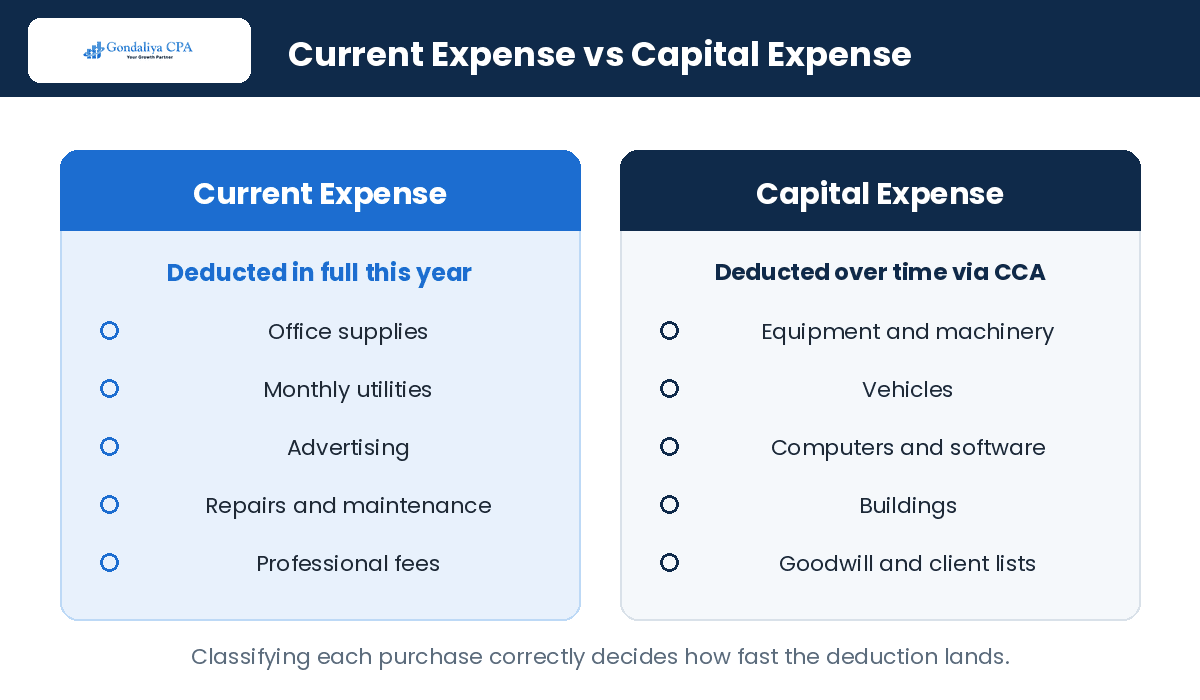
Pro Tip: Before year-end, sort each larger purchase into current or capital. Getting this right decides whether the deduction lands this year in full or is spread over several years through CCA, and it is one of the easiest places to leave money on the table.
GST/HST Input Tax Credits
A corporation registered for GST/HST can claim input tax credits to recover the sales tax paid on purchases used in the business. This keeps cash moving by offsetting the tax you collect against the tax you pay. Filing on time matters: miss a filing or make an error, and you can face penalties or lose the credit, so please review your GST/HST activity through the year rather than at the last minute.
A new client had never claimed input tax credits on their startup purchases. We caught the missed credits within the allowed window and recovered the tax. Registering and tracking GST/HST from day one would have freed that cash sooner. Figures changed for privacy.
Documentation the CRA Expects
Every claim needs three things: a real business purpose, a receipt or invoice showing what was bought and when, and organized files that support the numbers on your T2. Digital or paper is fine as long as it is complete. Following these rules lets you claim everything you are entitled to while keeping audit risk low.
Key Stat: The federal small business deduction lowers the corporate tax rate to 9% on the first $500,000 of active business income for a Canadian-controlled private corporation (CRA, canada.ca). Protecting that low rate is one of the main reasons year-end planning pays off.
Common Deduction Categories the CRA Accepts
Deduction Categories
Most corporate deductions fall into a handful of categories. Each has its own rules, but the same test applies throughout: reasonable, tied to income, and documented.
Advertising
Advertising costs are usually deductible when they directly support earning income, including print, online, radio, and signage, provided they are reasonable and backed by receipts or contracts. Some items do not qualify: political contributions are not deductible advertising, and promotional gifts must be reasonable and clearly tied to earning income. Canadian-content rules do not change whether an ad is deductible, though they can matter for certain separate tax credits.
A client wanted to write off a political donation as advertising. We explained it does not qualify and moved it out of the claim. Keeping non-deductible items out is as important as capturing the deductible ones. Figures changed for privacy.
Bad Debts
You can deduct a bad debt only if the amount was already included in income and then became uncollectible after reasonable collection efforts. The debt must come from normal sales, you need proof you tried to collect, and if you recover part of it later you adjust the deduction. Handled this way, bad-debt write-offs lower taxable income cleanly without audit friction.
Interest and Bank Charges
Interest on money borrowed to earn business income is deductible, and bank charges on a business operating account are deductible when kept separate from personal banking. Interest on borrowing used for exempt or passive purposes is a different matter. Please sort these early, because reclassifying them after year-end is slow and costly.
| Type | Deductible | Note |
|---|---|---|
| Interest on business loans | Yes | Borrowing must fund revenue-generating use |
| Bank service charges | Yes | Operating account only, kept separate from personal |
| Interest on exempt or passive funds | No | Not tied to earning active business income |
An owner ran business and personal spending through one account, so the interest was tangled. We split the accounts and traced the business borrowing, which made the deductible portion clear. Clean accounts turned a grey area into a simple claim. Figures changed for privacy.
Legal, Accounting, and Professional Fees
Fees tied directly to earning income are generally deductible, such as contract drafting, dispute resolution linked to operations, financial statement preparation, T2 returns, payroll processing, GST/HST filings, and SR&ED claim support. Fees to buy or sell an asset usually fall under capital rules instead. Some consulting is case by case, and marketing advice qualifies only when it is tightly linked to generating revenue.
Insurance Premiums
Most business insurance premiums are deductible, including property insurance on assets, liability insurance for third-party claims, and key-person life insurance when it is properly tied to a compensation or financing arrangement. Personal life insurance premiums are generally not deductible unless structured correctly under the rules. Good bookkeeping keeps these clean so nothing surprises you at year-end.
Business Start-Up Costs
Timing matters here. Costs incurred before the business actually begins are generally capital in nature, while normal operating costs once the business is running are deductible in the year. Pre-start items such as incorporation legal fees are typically recovered over time rather than deducted immediately. Please be clear about the date the business commenced, because it sets which side of the line each cost falls on.
Capitalizing Interest
Capitalizing interest means adding borrowing costs into the cost of a capital asset rather than expensing them right away. It generally applies where you are constructing a building or acquiring equipment expected to last beyond one fiscal year. The choice changes both your reported profit and your deduction timing.
| Aspect | Capitalized interest | Expensed interest |
|---|---|---|
| Timing | Added to the asset and written off over its life | Deducted immediately |
| Effect on tax | Deduction deferred | Immediate reduction |
| Typical use | Buildings and machinery | Operating loans |
| Support needed | Documents linking the borrowing to the asset | Proof the borrowing is operational |
SR&ED Credits
The Scientific Research and Experimental Development program supports wages, materials, and overhead tied directly to qualifying research and development work, through investment tax credits that can be refundable for a CCPC. The requirement is documentation: your records must separate genuine experimental development from routine upgrades. Technology and SaaS companies claim this most often, and the claim is only as strong as the contemporaneous notes behind it.
Repairs vs Improvements
Routine maintenance that keeps an asset working is deductible now. An improvement that adds value or extends the asset’s life is a capital cost, written off over time through CCA. The line matters because it changes your cash flow and your risk of a reassessment.
| Expense | Immediate Deduction | Basis |
|---|---|---|
| Routine repairs | Yes | Restores existing function |
| Asset improvements | No | Adds value or extends useful life; claimed through CCA |
A client treated a full equipment rebuild as a repair. It added years of life, so it belonged in capital and CCA, not a current deduction. Correcting it up front avoided a reassessment on a large amount. Figures changed for privacy.
Other Common Categories
Several more categories are deductible with proper support. Delivery, freight, and courier charges tied to getting goods sold or to earning income qualify when invoiced clearly. Fuel used by business equipment such as generators is deductible, kept separate from motor-vehicle fuel, which is tracked differently. Business taxes such as provincial sales tax on purchases, municipal property tax, and operating licences are deductible, while fines and penalties for breaking the law are not. Arm’s-length management and administration fees for genuine services are deductible when documented, but disguised shareholder payments draw CRA scrutiny.
Risk Warning: Fines and penalties are never deductible, and management fees paid to a related party without real services behind them get reassessed as dividends. If a fee cannot be supported with a service and an invoice, please do not claim it.
CRA – Business Expenses Accessed July 2026 · CRA – Deducting Taxes, Fees and Fines Accessed July 2026 · CRA – Bad Debts (IC71R4) Accessed July 2026 · CRA – Interest and Bank Charges (ITA s.20) Accessed July 2026
Capital Cost Allowance Strategies
CCA
Corporations do not deduct depreciation directly. Instead, they claim Capital Cost Allowance, which writes off part of a capital asset’s cost each year at a rate set by its CCA class. Tracking this carefully lowers taxable income and is a core part of year-end planning.
How CCA Classes Work
Each asset type sits in a class with its own rate. Accelerated measures can let you claim a larger deduction in the first year, which improves cash flow by cutting tax sooner. The common classes below cover most small-business assets.
| Asset | CCA Class | Rate | Notes |
|---|---|---|---|
| General equipment, machinery, and tools | Class 8 | 20% | Declining balance |
| Vehicles (general) | Class 10 | 30% | Passenger vehicles above the CRA cost limit use Class 10.1 |
| Computer hardware and systems software | Class 50 | 55% | Declining balance |
| Intangibles such as goodwill and client lists | Class 14.1 | 5% | Declining balance; replaced eligible capital property |
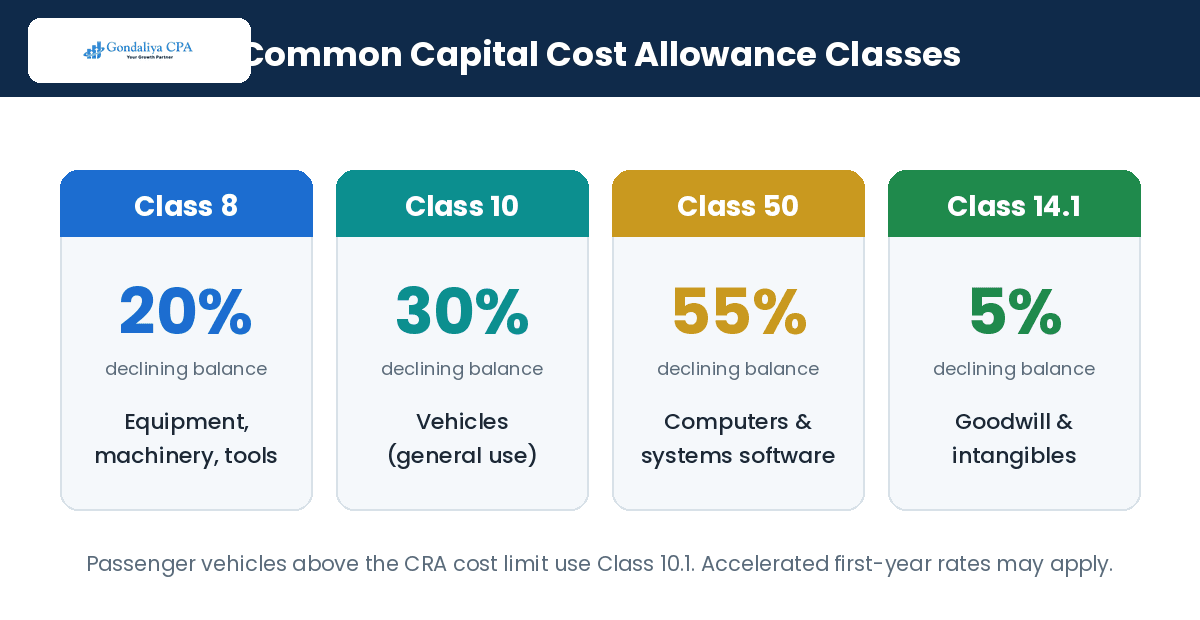
A client bought computers late in the year and assumed the deduction was small. Class 50 sits at 55%, and with the first-year rules the write-off was far larger than they expected. Timing the purchase before year-end pulled real tax forward. Figures changed for privacy.
Accelerated Write-Offs for Productive Assets
Businesses buying equipment to lift productivity, like machinery or technology, can often apply enhanced first-year CCA. When you plan year-end deductions, please flag eligible assets bought during the year, because claiming the accelerated rate cuts taxable income faster. This fits the goal of most year-end strategies: improve after-tax returns on what you have already invested.
Purpose-Built Rental Housing
Certain purpose-built rental housing qualifies for faster CCA than ordinary residential buildings, under federal measures aimed at rental supply. Incorporated landlords and real-estate investors can use this to improve their position, provided they keep proper records of the property and the costs.
An incorporated landlord did not know their new rental build qualified for a higher CCA rate. We applied the correct class and the first-year deduction jumped. The right classification, not a new expense, produced the saving. Figures changed for privacy.
Intangibles and Class 14.1
Intangible assets such as goodwill and customer lists, once handled as eligible capital property, now sit in CCA Class 14.1 at a 5% declining-balance rate. This grouped intangibles into one class and simplified the yearly claim. If your corporation carries goodwill on the books, please make sure it is tracked in Class 14.1 so the deduction is not missed.
CCA is where careful classification pays off most. Getting each asset into the right class and claiming accelerated rates where they apply often saves more than chasing small current expenses. Please review your capital additions before year-end, every year.
CRA – Guide T4002 Business and Professional Income Accessed July 2026 · CRA – Capital Cost Allowance Classes Accessed July 2026 · Department of Finance – Accelerated Investment Incentive Accessed July 2026
Filing Requirements and Deadlines
Filing & Deadlines
Deductions only help if the return is filed correctly and on time. Every incorporated business files a T2 Corporation Income Tax Return each year, even in a year with no income or a loss.
The T2 Return, Nil Returns, and Penalties
The T2 reports income, deductible costs, CCA claims, and credits. A corporation with no activity still files a nil return unless the CRA says otherwise. Filing late triggers a penalty of 5% of the unpaid tax, plus 1% for each full month the return is late, up to 12 months. Filing on time also keeps your access to the deductions and planning that lower the bill.
| Obligation | Requirement |
|---|---|
| T2 filing | Every incorporated business must file, each year |
| Nil return | Required even with no income or activity |
| Filing deadline | Six months after the fiscal year-end |
| Balance owing | Generally due two months after year-end; three months for many CCPCs |
| Late-filing penalty | 5% of the balance, plus 1% per month up to 12 months |
| Record retention | Six years after the tax year they relate to |
CRA Deadline: File the T2 within six months of your fiscal year-end, and pay any balance owing within two months, or three months for many CCPCs claiming the small business deduction (CRA, canada.ca). Interest runs on late payments even when the return itself is not yet due.
A corporation with no sales for the year assumed it did not need to file. The nil return was still required, and catching it avoided a penalty and kept the account current. A quiet year is not a skip year. Figures changed for privacy.
Salaries, Shareholder Loans, and Benefits
Salaries are deductible when the pay matches the work done, and employer CPP contributions are deductible too. Shareholder loans need care: if a loan is not repaid within the required time, it can be added back to the shareholder’s income as a taxable benefit. Fringe benefits like health plans often qualify, while personal perks usually do not. Reporting these correctly keeps deductions intact and avoids costly reassessments.
An owner drew funds through a shareholder loan and left it outstanding past the deadline. We flagged it before it became a taxable benefit and arranged repayment in time. A calendar reminder saved a real tax hit. Figures changed for privacy.
Losses and Missed Credits
When expenses beat revenue, the result is a non-capital loss. You can carry it back three years or forward twenty to offset profits in other years, which lowers current or future tax. Many corporations also miss valuable credits beyond simple deductions, such as SR&ED or the Apprenticeship Job Creation Credit. Tracking losses in QuickBooks or Xero and checking credit eligibility each year keeps these from slipping.
A client had a loss year followed by a strong one and had not carried the loss forward. We applied it against the profitable year and cut the tax owing. The loss was an asset sitting unused on the file. Figures changed for privacy.
CRA – T2 Corporation Income Tax Guide (T4012) Accessed July 2026 · CRA – Penalties and Interest Accessed July 2026 · CRA – Record Keeping Requirements Accessed July 2026 · CRA – Non-Capital Losses Accessed July 2026
Year-End Timing and Strategy
Timing
Year-end planning is where legitimate timing lowers the bill. Spending early or deferring income, within the rules, can reduce tax for the year. The point is to claim everything you qualify for without giving the CRA a reason to question it.
Accelerate Expenses and Defer Income
You can pull deductible costs into the current year: office supplies, repairs, professional fees, and prepaid insurance are common examples, each backed by records. Where the rules allow, you can also delay recognizing income until after year-end. The CRA follows accrual accounting and wants proof the timing is real, so mixing up expense types or dates invites a challenge. Please keep the support tight.
Before a client’s year-end, we reviewed upcoming costs and moved a planned repair and a renewal into the current year. Both were real and documented, and they trimmed the year’s taxable income. Timing, not aggressive claims, did the work. Figures changed for privacy.
Make Final Claims Before Year-End
Before the books close, capture everything. Look at bills and invoices you owe but have not paid; if they are properly accrued, they reduce taxable income now. The T2 is filed within six months of year-end, but your internal cutoff for pushing costs into the current year is the fiscal close itself.
Classify Expenses for Maximum, Safe Savings
How you classify a cost decides how much you save this year. The table below shows how common costs behave.
| Expense | Treatment |
|---|---|
| Office supplies | Fully deductible in the year |
| Capital assets | Written off over time through CCA |
| Meals and entertainment | 50% deductible, with limited exceptions |
| Vehicle costs | Deductible based on the business-use percentage |
A client deducted client meals in full. The rule allows 50%, so we corrected it before filing. A small fix on the return prevented an easy audit adjustment later. Figures changed for privacy.
2026 Update — what is current: For 2026, the capital gains inclusion rate remains 50% (the proposed increase was cancelled), and the Lifetime Capital Gains Exemption sits at $1,275,000 for qualified small business corporation shares (Department of Finance Canada, canada.ca). Ontario’s small-business corporate income tax rate was cut from 3.2% to 2.2% effective July 1, 2026, which brings the combined federal and Ontario small-business rate to 11.2% on income earned from that date (Government of Ontario, ontario.ca). Please factor the July 1 change into any year-end that straddles that date.
Check Your Readiness
Before you book your year-end, a quick self-check shows where the gaps are. Please answer the six questions below.
Year-End Deduction Readiness Checker
Six quick questions to see how ready your corporation is before year-end. No fee shown.
Ready:
This is a general prompt, not tax or legal advice or a quote. Your actual planning depends on your books and your year-end. For a real review, please book a free consultation.
Want this as a one-pager? You can download the free year-end corporate tax deduction checklist and bring it to your first call. You can also estimate your bill with our corporate tax calculator.
Corporate vs Personal, Incorporation, and Selling
Bigger Picture
Corporate deductions do not stop at the company line. How you pay yourself, whether you incorporate, and how you eventually sell all interact with tax.
Balancing Corporate and Personal Tax
Deductions affect both the company and your personal return once you take salary or dividends. Keeping profit inside the corporation defers personal tax but can raise provincial cost if passive investment income climbs. Paying salary triggers personal tax now but builds RRSP room. There is no single right answer, so please work it through with an accountant who looks at both sides.
An owner defaulted to all dividends every year. After reviewing both returns together, a salary-and-dividend mix built RRSP room and fit their goals better. The best split showed up only when we looked at the whole picture. Figures changed for privacy.
Incorporation: Pros and Cons
Incorporation brings the small business deduction on up to $500,000 of active income, limited liability, and credibility with clients and lenders. The trade-offs are more paperwork through the T2, stricter record keeping, and possible double taxation on dividends compared with a sole proprietorship, plus the extra cost, though a flat-fee firm keeps that predictable. Weighing these honestly is the start of a good deduction strategy.
A growing sole proprietor asked whether to incorporate. We ran the numbers, and at their income level the small business rate and liability protection made incorporation worthwhile. The decision came from their figures, not a rule of thumb. Figures changed for privacy.
Selling the Business
A sale needs planning, because tax hits sellers and buyers differently. A share sale can access the Lifetime Capital Gains Exemption, while an asset sale can trigger recapture of CCA claimed earlier. Timing the sale, and using available losses first, can lower the gain reported. Estate freezes and family transfers add more options for owner-managed firms.
Before a sale closed, we applied prior losses against the year’s gain to lower the amount reported. Sequencing the loss ahead of the closing date made a measurable difference. Planning the order of events mattered as much as the price. Figures changed for privacy.
Common Mistakes and How We Help
Avoiding Pitfalls
Most deduction problems come from a short list of avoidable mistakes: mixing personal and business costs, missing receipts, misclassifying capital versus current expenses, and missing deadlines that cost penalties or lost deductions.
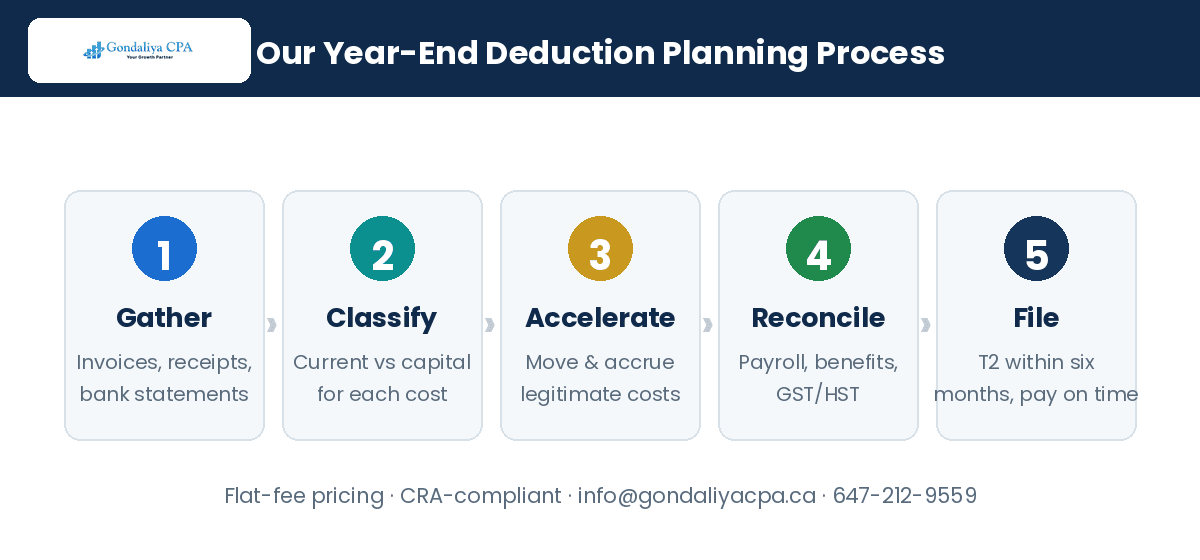
Stay Audit-Ready
Keep original invoices organized by date and category, note the business purpose on each claim, use consistent bookkeeping software, and run a quick internal review before you file. Bookkeeping tools categorize expenses, store digital receipts, flag deadlines, and reconcile bank statements against claims, which keeps you ready if the CRA ever checks.
A client faced a CRA query and had every receipt filed by category. We answered in one pass and closed it quickly. The tidy records, kept all year, turned a stressful letter into a short reply. Figures changed for privacy.
How Gondaliya CPA Helps
Gondaliya CPA works with incorporated SMBs across Toronto, Mississauga, Vaughan, Brampton, Ottawa, and all of Canada, remotely and on flat-fee pricing so the cost is clear. We handle bookkeeping, year-end planning, T2 filing, GST/HST, and payroll, and we time deductions to protect the small business rate while keeping you audit-ready. A free consultation is enough to see whether doing it yourself works or full service fits your size and industry.
Industry-Specific Deduction Rules
Some sectors carry rules that do not apply elsewhere, and missing them costs real money:
- Short-term rentals: where a rental does not meet municipal licensing and zoning requirements, deductions on that property can be denied. Please confirm compliance before claiming maintenance, utilities, or management fees.
- Long-haul trucking: meals are 50% deductible as a general rule, with a higher rate available to eligible long-haul drivers. Detailed trip logs separating road time from home time are what support the claim.
- Mining, oil, and gas: these sectors carry sector-specific measures such as depletion and resource allowances, alongside the ordinary business deductions.
- Extractive sector reporting: companies in mining, oil, and gas extraction file annual reports on payments to governments under the Extractive Sector Transparency Measures Act, and the expense classifications in those reports need to align with what is claimed on the T2.
- Technology and SaaS: SR&ED claims, deferred revenue, and cross-border GST/HST are the recurring items.
Payments to Foreign Affiliates
Payments between a Canadian corporation and a foreign affiliate carry their own rules. Interest and royalties may attract withholding tax, and transfer pricing requires documentation showing the transactions were priced at arm’s length. Without that support, the CRA can adjust income and assess additional tax. Please document cross-border arrangements when they are made, not when they are questioned.
Keeping Your Records Secure
Tax filing involves sensitive financial information, and the CRA requires records to be kept for six years after the fiscal year-end. We store client documents in cloud systems such as QuickBooks with Hubdoc capture, with access limited by role, so the records are both retrievable and protected. Please send sensitive material through the secure portal rather than email.
Our Take: The biggest year-end wins are rarely exotic. They are clean books, correct classification, and claiming what you already earned the right to claim. Please start a few weeks before your close, not the week the return is due.
Glossary of Key Terms
Plain-English Definitions
- Business expense: A reasonable cost incurred to earn business income, deductible against that income.
- Current expense: A cost used up within one fiscal year, deductible in full that year.
- Capital expense: A long-lived asset deducted over time through Capital Cost Allowance rather than all at once.
- Capital Cost Allowance (CCA): The yearly tax deduction that writes off part of a capital asset’s cost by class.
- CCA class: The category that sets an asset’s write-off rate, such as Class 8, 10, 50, or 14.1.
- Small business deduction (SBD): The measure that lowers the corporate rate to 9% federally on the first $500,000 of active business income for a CCPC.
- Active business income: Income from running the business, as opposed to passive investment income.
- Input tax credit: A credit that recovers GST/HST paid on business purchases.
- Non-capital loss: A loss carried back three years or forward twenty to offset income in other years.
- Recapture: Previously claimed CCA added back to income when an asset is sold for more than its remaining value.
- Lifetime Capital Gains Exemption (LCGE): The exemption on qualifying share sales, $1,275,000 for qualified small business corporation shares.
- T2 return: The Corporation Income Tax Return every incorporated business files each year.
Frequently Asked Questions
FAQ
What is the deadline for filing a corporate T2 return in Canada?+
A corporation files its T2 within six months after the fiscal year-end. Any balance owing is generally due two months after year-end, or three months for many CCPCs.
What penalty applies for late T2 filing?+
The penalty is 5% of the unpaid tax, plus 1% for each full month the return is late, up to 12 months. Interest also runs on unpaid balances.
How are home workspace costs deducted?+
You deduct the business-use portion of eligible workspace costs based on how much of the space is used for work. There is no flat dollar cap; the claim follows the reasonable business-use share and the applicable CRA rules.
How much of meals and entertainment is deductible?+
Generally 50% of eligible meals and entertainment costs are deductible, with limited exceptions.
How long must a corporation keep its records?+
Keep books, records, and supporting documents for six years from the end of the last tax year they relate to.
What is the small business deduction limit?+
The small business deduction applies to the first $500,000 of active business income, taxed at the 9% federal small business rate for an eligible CCPC.
What common deductions can Canadian corporations claim?+
Common deductions include salaries, rent, utilities, professional fees, advertising, interest on business borrowing, and CCA on eligible capital assets.
Does classifying an expense really change my tax?+
Yes. A current expense deducts in full this year, while a capital cost is written off over several years through CCA, so classification changes both timing and audit safety.
What documentation does the CRA expect?+
Receipts, invoices, contracts, and clear records showing the business purpose of each claim.
Who benefits most from year-end deduction planning?+
Any incorporated business that wants to lower taxable income legally and protect the small business rate benefits from planning before the fiscal close.
Are business start-up costs deductible?+
Costs incurred before the business begins are generally capital in nature and recovered over time, while normal operating costs after commencement are deductible in the year. The commencement date decides which applies.
Should interest be capitalized or expensed?+
Interest on borrowing used to construct a building or acquire long-lived equipment is generally capitalized into the asset and written off over its life. Interest on operating loans is expensed and deducted immediately.
What is the SR&ED program?+
It supports wages, materials, and overhead tied to qualifying research and development through investment tax credits, which can be refundable for a CCPC. Documentation separating experimental development from routine work is essential.
Do industry-specific deduction rules apply to my business?+
Possibly. Short-term rentals, long-haul trucking, mining, oil and gas, and technology companies each carry rules that do not apply to other sectors, including licensing requirements and extractive-sector reporting.
Year-End Deduction Checklist
- Review all accrued expenses before your fiscal year-end.
- Claim every allowable business expense supported by a receipt.
- Use accelerated CCA classes where they apply.
- Separate personal from business spending.
- Keep accurate books in QuickBooks or Xero.
- Retain documentation for six years.
- Leave out non-deductible items such as fines and personal meals beyond the limit.
Who This Is For / Not For
- For: Incorporated Canadian SMBs planning a T2 and wanting to lower tax safely.
- Not For: Unincorporated sole proprietors filing only a personal return, or businesses seeking aggressive positions outside CRA rules.
People Also Ask
Quick Answers
Can a corporation deduct expenses in a year with no income?+
Yes. Expenses can create a non-capital loss, which you carry back three years or forward twenty to offset income in other years.
Are business meals fully deductible for a corporation?+
No. Meals and entertainment are generally 50% deductible, with limited exceptions.
Is buying equipment before year-end worth it for the deduction?+
It can be, if the purchase is genuine and needed. Accelerated first-year CCA on eligible assets can pull a meaningful deduction into the current year.
Contact Gondaliya CPA at 647-212-9559 or info@gondaliyacpa.ca for help planning your corporate tax deductions before year-end.
Lower this year’s tax the safe way
Gondaliya CPA handles bookkeeping, year-end planning, and T2 filing at flat, fixed fees, timing your deductions to protect the small business rate while keeping you audit-ready. Please book a free consultation to start.
Next Steps
Year-end tax savings come from clean books, correct classification, and claiming what you have already earned the right to claim, done before the fiscal close rather than the filing week. Please gather your records, list your capital purchases, confirm your year-end and T2 due date, and bring us the gaps. Reach out for a free consultation, call 647-212-9559, or email info@gondaliyacpa.ca. If our content helps, please add gondaliyacpa.ca as a preferred source on Google.
Published: July 1, 2026 · Last updated: August 12, 2026
Disclaimer: This article is educational information only and is not tax, legal, or financial advice. It reflects CRA and Department of Finance rules current to 2026, including the 50% capital gains inclusion rate, the $1,275,000 Lifetime Capital Gains Exemption, and Ontario’s small-business rate reduction to 2.2% effective July 1, 2026. Outcomes depend on your specific facts and rules can change. Please consult a Registered CPA in Canada or Ontario before acting. Fees include HST.

Sharad Gondaliya is a CPA Canada & CPA USA with 15 Years+ experience of Accounting, Tax, Payroll of Corporate Small Businesses as Tax Accountant. He is a CPA Ontario member (61040184) and holds US CPA licences in Washington and Montana and is well known among corporate small businesses for tax planning, efficient tax solutions, and affordable CPA services. Sharad is the Principal (Director) of Gondaliya CPA – Affordable CPA Firm in Canada. Licenses: CPA Ontario: 61040184 | CPA USA (MT): PAC-CPAP-LIC-033176 | CPA USA (WA): 57629 | CPA Firm License: 61330051 View Full Author Bio