



How Proper Year-End Accounting Can Help You Avoid CRA Penalties and Tax Reassessment
CRA penalties in Canada can significantly impact your business if corporate tax reassessment issues arise, making year end accounting services and T2 compliance essential for accuracy. Gondaliya CPA offers expert guidance to help you address penalties, stay compliant, and manage corporate taxes efficiently.
Quick Summary
Penalties and reassessments are largely preventable. File the T2 within six months, pay the balance on time, report every dollar of income, keep six years of records, and back each claim with a document. Clean monthly books make all of that automatic. Please treat year-end as the checkpoint, not the scramble.
| Aspect | Details |
|---|---|
| Main risk | Late filing, unreported income, and weak documentation. |
| Best defence | On-time filing, accurate records, and full reporting. |
| Reassessment window | Three years for a CCPC, four for other corporations. |
| Records | Keep books and support for six years after the tax year. |
Reading time: 25 minutes.
Table of Contents
- CRA Penalties and Reassessments Explained
- Who Must File a T2 Return
- Filing Deadlines and Payment Requirements
- The CRA Reassessment Process
- Common Penalties and How to Avoid Them
- Year-End Accounting Essentials for Compliance
- The CRA Audit Process and How We Help
- Glossary of Key Terms
- Frequently Asked Questions
- People Also Ask
CRA Risk at a Glance
This article covers Canada, with Toronto and Ontario context, and reflects CRA and Income Tax Act rules current to 2026. It addresses incorporated businesses filing a T2 return, with financial statements prepared under ASPE, the standard most private corporations use. Items marked “illustrative” are examples, not quotes, and any masked engagement notes end with “Figures changed for privacy.” This is educational information only and not tax, legal, or financial advice. Fees include HST. Please confirm your own situation with a Registered CPA before acting.
CRA Penalties and Reassessments Explained
The Basics
CRA penalties are charges the Canada Revenue Agency applies when a corporation breaks a tax rule, most often by filing late, underreporting income, or claiming what it cannot support. A reassessment is the CRA revisiting a filed return, and if it finds a problem you can owe more tax, plus interest and penalties.
Common Types of CRA Penalties
Three come up most often. The late-filing penalty applies when the T2 is filed after the deadline. A failure-to-report-income penalty applies when income is left off the return. The gross negligence penalty is the most serious, applied where a false statement or omission is made knowingly or in circumstances amounting to gross negligence. Each one costs money and draws further attention.
| Penalty | What It Means |
|---|---|
| Late filing | Charged when the T2 is filed after the deadline; grows the longer it is late |
| Failure to report income | Applies when income is omitted, with a heavier penalty for repeated failures |
| Gross negligence | 50% of the tax related to a false statement or omission |
A client had a side stream of income they assumed was too small to matter and left it off. We caught it during year-end and reported it properly, avoiding a failure-to-report penalty on a repeat basis. Reporting everything, however small, is always cheaper. Figures changed for privacy.
Why Reassessments Happen
Reassessments are triggered by mismatches between what you report and what third parties report, by random CRA verification, and by tips suggesting misreporting. The defence is the same in every case: accurate books, complete reporting, and documents that support each figure. Please make that your standard, not your exception.
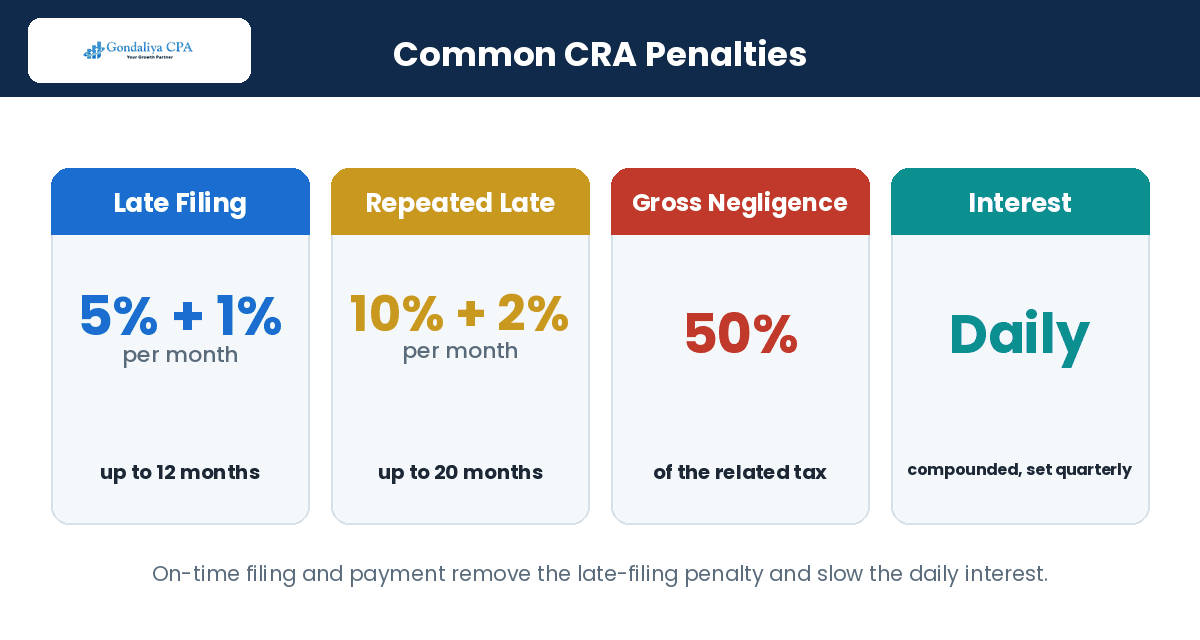
Key Stat: The late-filing penalty is 5% of the unpaid tax, plus 1% for each full month the return is late, up to 12 months. A repeated late filing after a formal demand raises that to 10% plus 2% per month, up to 20 months. Filing on time removes the penalty entirely.
A client filed a T2 a few months late and was surprised the penalty kept climbing each month. We filed the next years early and set reminders, and the penalties stopped. The fix was the calendar, not the accounting. Figures changed for privacy.
Who Must File a T2 Return
Filing Obligation
If your corporation carries on business in Canada, you file a T2 every year, even with no profit, a loss, or no activity at all. Missing the filing is one of the fastest ways to invite penalties and a reassessment.
Resident and Non-Resident Corporations
Resident corporations, including active, inactive, and non-profit companies incorporated federally or provincially, must file within six months of the fiscal year-end. Non-resident corporations file when they carry on business in Canada, hold taxable Canadian property, or earn Canadian-source income such as rent, and they need proper paperwork ready when claiming a treaty exemption. Knowing your status keeps you clear of avoidable trouble.
| Corporation Type | Filing Obligation | Common Challenge |
|---|---|---|
| Resident | Must file an annual T2 return | Keeping accurate books |
| Non-resident | Conditional, based on activity and treaties | Proving treaty exemptions |
A dormant holding company had not filed for a couple of years because it had no income. We brought the filings current before the CRA acted. No activity does not mean no filing, and catching up early kept the penalties small. Figures changed for privacy.
Special Situations to Watch
A few cases need care even when little seems to have happened. A zero-activity corporation still files unless it has been formally dissolved. Selling a capital asset means reporting the gain or loss on the T2. Rental income from Canadian property must be reported, and provincial tax can apply. Foreign companies claiming treaty relief need solid proof at filing. Each of these, handled loosely, can extend the CRA’s reach into your return.
Risk Warning: Understating proceeds on a property sale, or leaving a disposition off the return, is exactly the kind of misrepresentation that lets the CRA reassess beyond the normal window. Please report dispositions in full, with documents.
A client sold a property and recorded only the net cash received, not the full proceeds. We corrected the reporting before filing, which kept the return inside the normal reassessment window. Reporting the full figure, not the leftover, is what protected them. Figures changed for privacy.
Filing Deadlines and Payment Requirements
Deadlines
Filing and paying on time is the single most reliable way to avoid penalties. The dates are fixed, so please work backward from them.
The Core Dates
The T2 is due six months after the fiscal year-end. The balance owing is due two months after year-end, or three months for an eligible CCPC. Instalments, when they apply, are generally four payments a year based on the prior year’s tax. If your year ends December 31, you file by June 30 the following year. Miss the filing and the late-filing penalty starts immediately; miss a payment and interest runs.
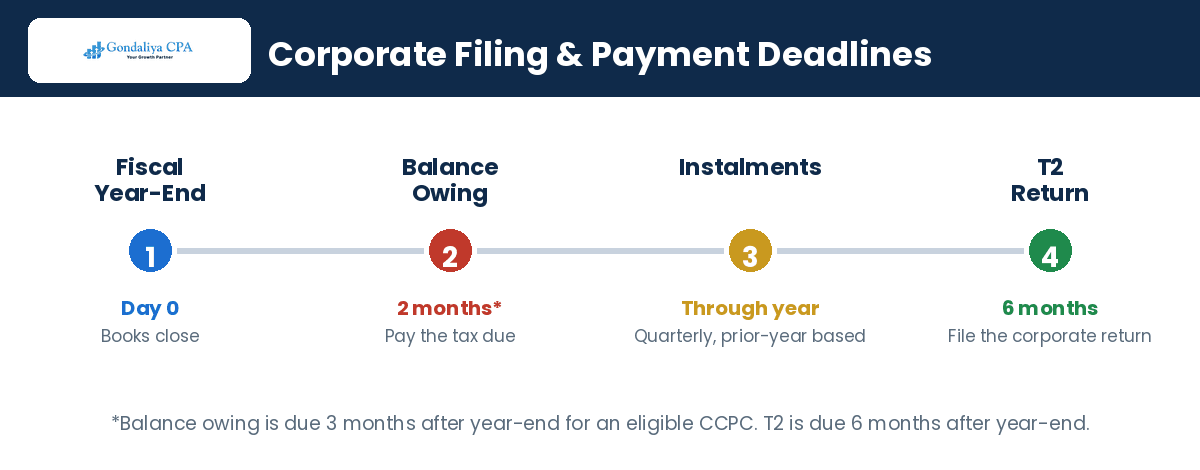
| Obligation | Timing |
|---|---|
| T2 filing | Six months after fiscal year-end |
| Balance owing | Two months after year-end; three months for an eligible CCPC |
| Instalments | Generally quarterly, based on the prior year’s tax |
| Record retention | Six years after the tax year they relate to |
A profitable client filed on time but overlooked instalments, so interest quietly built through the year. We set a quarterly instalment schedule from the prior year’s tax, and the interest stopped. The fix was a calendar, not a cheque they could not afford. Figures changed for privacy.
Electronic Filing and Functional Currency
Most corporations file the T2 electronically, which speeds processing and cuts the errors that paper invites. A corporation that operates in a foreign currency can elect to report in that functional currency using the CRA’s prescribed election form (Form T1296), filed on time. Both choices reduce friction and lower the chance of a penalty or a reassessment.
CRA Deadline: File the T2 within six months of year-end, pay the balance within two months (three for an eligible CCPC), and keep records for six years. Interest runs on a late balance even before the return itself is due, so please pay on time.
The CRA Reassessment Process
Reassessment
A reassessment is the CRA reopening a filed return to check it against the law. Knowing the time limits, and what extends them, helps you keep records long enough and respond correctly.
Normal and Extended Periods
The normal reassessment period is three years for a CCPC and four years for other corporations, measured from the date of the original notice of assessment. That window extends by three more years where there is misrepresentation from neglect, carelessness, or wilful default, or fraud, and certain foreign or transfer-pricing matters can extend it further. Accurate records are what let you stand behind a return years later.
| Period | Duration | When It Applies |
|---|---|---|
| Normal (CCPC) | 3 years | Standard window after the notice of assessment |
| Normal (other corporations) | 4 years | Standard window after the notice of assessment |
| Extended | 3 additional years | Misrepresentation, wilful default, or certain disclosures |
| Unlimited | No limit | Fraud, or where a waiver is filed |
A client received a reassessment on a return from a few years back and had kept every supporting document. We answered in one package and closed it without a change. The records they almost threw out are what protected them. Figures changed for privacy.
Unlimited Reassessment and Waivers
Where there is fraud, the CRA can reassess with no time limit. Stop-the-clock rules can also pause the period during an audit or when the CRA issues an information order for documents. Taxpayers can extend the normal period themselves by filing a waiver, Form T2029 for general matters or Form T652 for transfer pricing, which is sometimes useful when working through a complex dispute.
During a drawn-out review, we filed a general waiver so the client had time to gather support rather than face a rushed reassessment. Used deliberately, the waiver worked in their favour. It is a tool, and timing it well matters. Figures changed for privacy.
Real Estate and Dispositions
Property sales get special attention. Understating proceeds or leaving out a disposition invites a longer reassessment and closer scrutiny, so clear documents on every real-estate transaction are essential. Please keep the closing statements, adjustments, and supporting math on file.
Common Penalties and How to Avoid Them
Penalties
Most penalties fall into a short, well-known list, and each has a clear prevention.
Late Filing, Gross Negligence, and Interest
Filing late triggers the 5% plus 1% per month penalty, up to 12 months, and a repeat after a demand raises it to 10% plus 2% per month, up to 20 months. A false statement or omission made knowingly or through gross negligence carries a penalty of 50% of the related tax. Interest is charged from the deadline until you pay, compounded daily, at a prescribed rate the CRA sets each quarter. Accurate, on-time filing removes most of this exposure.
A client came to us mid-way through a late year, worried about a large penalty. We filed quickly to stop the monthly penalty from climbing and arranged payment to slow the daily interest. Acting fast, rather than waiting, saved real money. Figures changed for privacy.
Disclosure Rules and the Voluntary Disclosures Program
Corporations must report certain aggressive transactions under the mandatory disclosure rules, and missing that carries its own penalties. The Voluntary Disclosures Program lets a taxpayer fix unreported income or errors before the CRA acts, which can reduce or remove penalties when done properly and early. The General Anti-Avoidance Rule targets arrangements that abuse the tax system with no real business purpose, so please keep planning grounded in genuine commercial reasons.
A client realized a prior return had understated income and came to us before any CRA contact. We used the Voluntary Disclosures Program to correct it, which softened the outcome considerably. Coming forward first is almost always better than being found. Figures changed for privacy.
Foreign and Digital Reporting
Corporations with foreign holdings file forms such as T1134 for foreign affiliates and T1135 for specified foreign property, and errors here draw the CRA’s international team. Digital-economy businesses, including online sellers, must track GST/HST across provinces and report it correctly. Accurate bookkeeping is what keeps foreign and online revenue reported cleanly.
An e-commerce client selling across provinces had not tracked GST/HST by jurisdiction. We rebuilt the records and filed correctly before it became a problem. For online sellers, the reporting detail is where the risk hides. Figures changed for privacy.
Nearly every penalty on this list is preventable with three habits: file on time, report everything, and document each claim. Please build those into your year, and the CRA rarely has a reason to look twice.
2026 Update — what is current: For 2026, the CRA’s late-filing penalty and daily-compounded interest framework are unchanged, and the reassessment windows remain three years for a CCPC and four for other corporations. The enhanced mandatory disclosure rules and a strengthened General Anti-Avoidance Rule remain in force, so documentation matters more than ever. On the rate side, Ontario’s small-business corporate income tax rate was cut from 3.2% to 2.2% effective July 1, 2026. Please keep your records tight, because the compliance bar has risen, not fallen.
Year-End Accounting Essentials for Compliance
Year-End Essentials
Strong year-end accounting is what turns compliance from a worry into a routine. It produces accurate returns and the records that back them.
Deductions, Credits, and Documentation
Claim the deductions and credits you are entitled to, from salaries, rent, and utilities to Capital Cost Allowance and credits like SR&ED, and back each one with a receipt or invoice. Without evidence, a claim can be reversed on review, adding tax, interest, and penalties. Please keep financial records for six years after filing, as the law requires.
A client had claimed a credit but could not locate the supporting work when the CRA asked. We reconstructed what we could and removed what we could not defend. The lesson stuck: the document is the deduction. Figures changed for privacy.
Financial Statements and T2 Schedules
Year-end accounting produces statements under Canadian standards that feed the T2 schedules. The balance sheet and income statement flow into Schedule 100 and Schedule 125, and shareholder details go on Schedule 50. For many small incorporated businesses, a compilation engagement accompanies the statements; a compilation provides no assurance, but well-prepared schedules keep the return clean and reduce the errors that cause delays or reassessments.
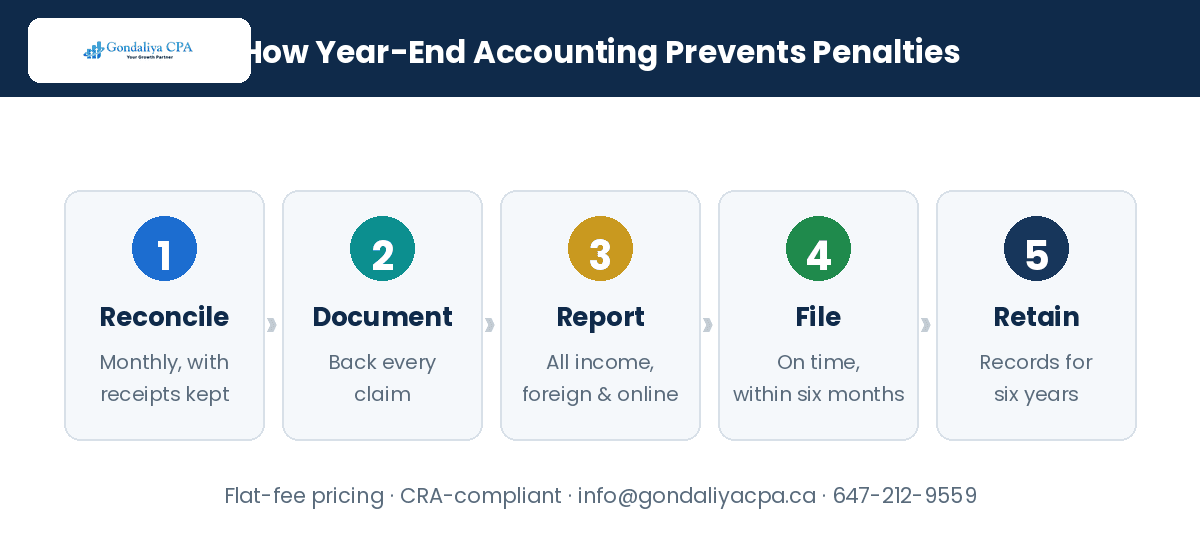
Pro Tip: Reconcile bank accounts monthly, track expenses in the CRA’s categories, review payroll remittances on schedule, and save receipts digitally. These four habits prevent most of the errors that get returns flagged. Please make them monthly, not annual.
A client’s prior schedules did not tie the balance sheet to the income statement, and the CRA queried it. We rebuilt Schedule 100 and Schedule 125 from a clean trial balance so they agreed exactly. Consistent schedules answered the question on their own. Figures changed for privacy.
Monthly Bookkeeping Beats a Year-End Scramble
Recording transactions as they happen stops the backlog that breeds mistakes at close. Monthly reconciliation in QuickBooks or Xero, clean expense tracking, and digital receipts give you a return you can defend and problems you can catch early. The corporations that rarely see penalties are simply the ones that keep current books.
We moved a client from a shoebox of receipts to monthly reconciliations. The next year-end was fast, the return was clean, and a small error surfaced in March instead of at filing. Current books quietly removed the risk. Figures changed for privacy.
The CRA Audit Process and How We Help
Audits & Support
An audit checks whether your income, deductions, credits, and documents meet the rules. Knowing what the CRA looks at helps you prepare records that answer the questions before they are asked.
| Topic | What the CRA Checks |
|---|---|
| Revenue recognition | Whether all income streams are fully declared |
| Expense eligibility | Whether deductions match allowed business costs |
| Transfer pricing | How related companies price transactions |
| Capital Cost Allowance | Whether CCA is calculated correctly by asset class |
| Related-party transactions | Whether prices reflect fair market value |
A client with related companies faced questions on how the intercompany charges were priced. Because we had documented the basis at the time, the answer was ready. Contemporaneous notes turned a hard question into a simple one. Figures changed for privacy.
A client received an audit query on expense eligibility and had every invoice categorized and on file. We responded in a single package and the file closed with no change. Organized records turned a stressful letter into a short reply. Figures changed for privacy.
Check Your Penalty Risk
Before year-end, this quick self-check shows where your exposure sits. Please answer the six questions below.
CRA Penalty Risk Checker
Six quick questions to gauge your penalty and reassessment exposure. No fee shown.
On track:
This is a general prompt, not tax or legal advice or a quote. Your actual exposure depends on your books and filings. For a real review, please book a free consultation.
Want this as a one-pager? You can download the free avoid-CRA-penalties year-end checklist and bring it to your first call. You can also estimate your bill with our corporate tax calculator.
How Gondaliya CPA Helps
Gondaliya CPA works with incorporated SMBs across Toronto, Mississauga, Vaughan, Etobicoke, Brampton, Scarborough, Ottawa, and all of Canada, remotely and on a flat annual fee so the cost is clear. We keep your books current, prepare accurate statements and T2 schedules, file on time, handle GST/HST and foreign reporting, and stand with you if the CRA reviews a return. A free consultation is enough to see where your risk sits.
What You Receive
Every year-end engagement produces a complete Financial Statement Package:
- Balance sheet and income statement prepared under Canadian standards.
- The relevant T2 schedules, including Schedule 100, Schedule 125, and Schedule 50.
- A CPA compilation report, which presents the statements without assurance.
- Written notes on anything corrected or worth attention next year.
The compilation process usually takes two to four weeks from receiving your records, with clear communication throughout, and we respond to client messages within one business day.
What to Prepare Before You Start
Please have these ready so the work moves without stalls: bank statements, payroll records, sales and expense invoices, receipts supporting your deductions, asset purchase details, and your prior tax filings.
DIY, Non-CPA, or a Registered CPA Firm
| Option | Cost | Risk of errors and penalties | Professional review |
|---|---|---|---|
| DIY | Low | High | None |
| Non-CPA provider | Moderate | Moderate, with limited expertise | Limited |
| Registered CPA firm | Flat fee | Low, with full T2 compliance | Full, with accountability |
The Tools and Capabilities Behind the Work
We run bookkeeping in QuickBooks and Xero with Hubdoc capturing receipts, and payroll through ADP or Wagepoint, so the records feeding your T2 are complete and current. Beyond the year-end itself, we prepare SR&ED tax credit claims, handle transfer pricing documentation, manage GST/HST for digital-economy and online sellers, and use waiver forms T2029 and T652 where a reassessment period needs managing deliberately. Gondaliya CPA is a CPA Ontario Registered Firm, and we tailor reporting across more than ten industries including technology, retail, manufacturing, real estate, and professional services.
Our Take: Penalty defence is not clever arguments after the fact; it is clean records and on-time filing before the fact. Please invest a little each month, and year-end stops being the moment you worry about the CRA.
Glossary of Key Terms
Plain-English Definitions
- T2 return: The Corporation Income Tax Return every incorporated business files each year.
- T2 compliance: Following the CRA’s rules on corporate tax returns, records, and reporting.
- Reassessment: The CRA reopening a filed return to check it against the law.
- Normal reassessment period: Three years for a CCPC, four for other corporations, from the notice of assessment.
- Late-filing penalty: 5% of the unpaid tax plus 1% per month, up to 12 months, on a first offence.
- Gross negligence penalty: 50% of the tax related to a false statement or omission.
- Interest: Charged on unpaid amounts from the deadline, compounded daily at a quarterly prescribed rate.
- Voluntary Disclosures Program: A CRA program to correct unreported income or errors before the CRA acts.
- Waiver (T2029 / T652): Forms that extend the normal reassessment period by agreement.
- Capital Cost Allowance (CCA): The yearly tax deduction that writes off part of a capital asset’s cost by class.
- Compilation engagement: Financial statements prepared with no assurance provided.
- CCPC: A Canadian-controlled private corporation, eligible for certain tax preferences and deadlines.
Frequently Asked Questions
FAQ
What is the penalty for filing a T2 late?+
5% of the unpaid tax plus 1% for each full month the return is late, up to 12 months. A repeat after a formal demand raises it to 10% plus 2% per month, up to 20 months.
How long can the CRA reassess my corporate return?+
The normal period is three years for a CCPC and four for other corporations from the notice of assessment. It extends by three more years for misrepresentation, and has no limit in cases of fraud or where a waiver is filed.
Do I still file a T2 if my corporation had no activity?+
Yes. An inactive corporation files a T2 each year until it is formally dissolved, unless the CRA has advised otherwise.
How is CRA interest calculated?+
Interest runs on unpaid amounts from the deadline, compounded daily, at a prescribed rate the CRA sets each quarter.
What is the gross negligence penalty?+
It is 50% of the tax related to a false statement or omission made knowingly or in circumstances amounting to gross negligence.
Can the Voluntary Disclosures Program reduce penalties?+
Yes. Correcting unreported income or errors through the program before the CRA acts can reduce or remove penalties, when done properly and early.
How long must I keep my records?+
Keep books, records, and supporting documents for six years from the end of the last tax year they relate to.
How much does year-end accounting cost at Gondaliya CPA?+
Our flat annual fee for year-end accounting is $2,400, HST included, for a typical incorporated SMB, with the scope confirmed up front after we review your records.
What documents should I have ready for year-end?+
Bank statements, payroll records, sales and expense invoices, asset purchase details, and prior tax filings.
How do I choose a CPA firm in Toronto or Ontario?+
Verify licensing on the CPA Ontario directory, look for experience with incorporated SMBs, and confirm clear flat-fee pricing and a strong review record.
How long does the compilation process take?+
Usually two to four weeks from receiving your records, with clear communication throughout. We respond to client messages within one business day.
What deliverables do I receive after year-end?+
A complete Financial Statement Package: balance sheet, income statement, the relevant T2 schedules including Schedule 100, Schedule 125, and Schedule 50, and a CPA compilation report.
Which industries do you prepare year-end reporting for?+
More than ten, including technology, retail, manufacturing, real estate, and professional services, with the reporting tailored to each sector’s requirements.
Avoid-Penalties Checklist
- File the T2 within six months of year-end, every year.
- Pay the balance within two months, or three for an eligible CCPC.
- Report all income, including foreign and online sales.
- Back every deduction and credit with a document.
- Reconcile monthly and keep receipts.
- Retain records for six years.
- File foreign reporting (T1135 or T1134) when it applies.
Who This Is For / Not For
- For: Incorporated Canadian SMBs that want to stay compliant and avoid CRA penalties.
- Not For: Unincorporated sole proprietors filing only a personal return.
People Also Ask
Quick Answers
Can I file my T2 without a CPA compilation report?+
You can, but without professional review you carry more risk of errors that lead to penalties or a reassessment.
Does Gondaliya CPA handle multi-provincial corporate filings?+
Yes. We manage filings across provinces and confirm compliance with the applicable CRA and provincial rules.
What most often triggers a corporate reassessment?+
A mismatch between what you report and what third parties report to the CRA, along with unreported income and weak documentation.
Contact Gondaliya CPA at 647-212-9559 or info@gondaliyacpa.ca for help avoiding CRA penalties and staying T2 compliant.
Stay compliant, avoid the penalties
Gondaliya CPA keeps your books current, files your T2 on time, and stands with you if the CRA reviews a return, all on a flat annual fee. Please book a free consultation to start.
Next Steps
Avoiding CRA penalties comes down to on-time filing, complete reporting, and documented records, all built on clean monthly books. Please confirm your filing and payment dates, tidy your records, report everything, and bring us anything you are unsure about. Reach out for a free consultation, call 647-212-9559, or email info@gondaliyacpa.ca. If our content helps, please add gondaliyacpa.ca as a preferred source on Google.
Published: July 6, 2026 · Last updated: August 12, 2026
Disclaimer: This article is educational information only and is not tax, legal, or financial advice. It reflects CRA and Income Tax Act rules current to 2026. Penalty, interest, and reassessment rules depend on your specific facts and can change. Please consult a Registered CPA in Canada or Ontario before acting. Fees include HST.

Sharad Gondaliya is a CPA Canada & CPA USA with 15 Years+ experience of Accounting, Tax, Payroll of Corporate Small Businesses as Tax Accountant. He is a CPA Ontario member (61040184) and holds US CPA licences in Washington and Montana and is well known among corporate small businesses for tax planning, efficient tax solutions, and affordable CPA services. Sharad is the Principal (Director) of Gondaliya CPA – Affordable CPA Firm in Canada. Licenses: CPA Ontario: 61040184 | CPA USA (MT): PAC-CPAP-LIC-033176 | CPA USA (WA): 57629 | CPA Firm License: 61330051 View Full Author Bio