



How Past Account Clean-Up Can Fix Bookkeeping Errors and Prepare Your Business for Tax Filing
At Gondaliya CPA, our CPA bookkeeping services provide thorough tax preparation support alongside detailed year-end bookkeeping cleanup. We focus on correcting inaccurate financial records, performing accounting reconciliation services, and preparing reliable documents for smooth corporate tax filing and T2 filing preparation.
At Gondaliya CPA, our CPA bookkeeping services provide thorough tax preparation support alongside detailed year-end bookkeeping cleanup. We focus on correcting inaccurate financial records, performing accounting reconciliation services, and preparing reliable documents for smooth corporate tax filing and T2 filing preparation.
Quick Summary
Past account clean-up fixes bookkeeping errors and gets your records ready to file. It finds duplicates, missing transactions, and misclassifications, reconciles every account, checks GST/HST and payroll, and prepares the supporting documents for your T2. Do it before the deadline and filing is accurate and calm. Please clean the books first, then file once, correctly.
| Aspect | Details |
|---|---|
| What it does | Fixes errors and readies records for corporate tax filing. |
| What it fixes | Duplicates, missing entries, misclassifications, unreconciled accounts. |
| Tax-prep link | Reconciled ledgers, checked GST/HST, confirmed payroll, ready documents. |
| Why it matters | An accurate base means a smooth, low-risk T2 filing. |
Reading time: 27 minutes.
Table of Contents
- What Cleanup Does for Tax Filing
- The Errors Cleanup Fixes
- The Cleanup Process, Phase by Phase
- Common Bookkeeping Challenges
- Software and Secure Handling
- Compliance, Audit Readiness, and Tax Prep
- How Gondaliya CPA Helps
- Industry Spotlights: Sectors We Represent
- Glossary of Key Terms
- Frequently Asked Questions
- People Also Ask
Cleanup for Filing at a Glance
This article covers Canada, with Toronto and Ontario context, and reflects CRA and accounting rules current to 2026. It assumes an incorporated business keeping records under ASPE and filing a T2, with cleanup delivered as a compilation, not an audit or review. Items marked “illustrative” are examples, not quotes, and any masked engagement notes end with “Figures changed for privacy.” This is educational information only and not tax, legal, or financial advice. Fees include HST. Please confirm your own situation with a Registered CPA before acting.
What Cleanup Does for Tax Filing
The Basics
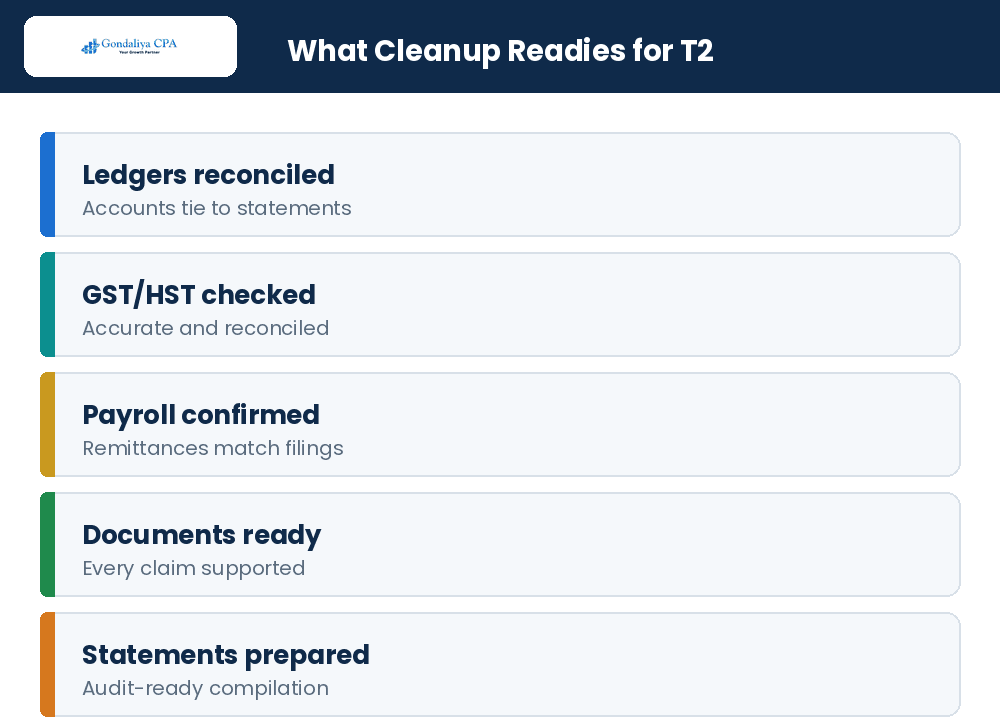
Past account clean-up and corporate tax filing are two halves of the same job. Cleanup corrects the errors and reconciles the accounts; tax prep turns those clean books into a return that meets CRA requirements. When the year-end data is accurate, the financial statements are reliable and the T2 follows smoothly.
Fix First, File Second
Correcting accounting errors before tax time saves costly fixes later. Unreconciled bank accounts, expenses in the wrong category, duplicate records, and missing invoices all distort the numbers a return is built on. Cleanup finds and fixes them, then tax prep reconciles the ledgers, checks GST/HST, confirms payroll, and prepares the documents the T2 needs. Please treat cleanup as the first step of filing, not a separate chore.
Key Stat: Accurate year-end data is what makes financial statements reliable and tax compliance easy. Errors caught during cleanup are cheap to fix; the same errors caught by the CRA after filing are not. Please find them before you file.
A client filed under deadline pressure on unreconciled books, then faced a costly correction when the numbers did not hold up. The next year we cleaned up first and filed calmly. Fixing before filing turned a scramble into a routine. Figures changed for privacy.
The Errors Cleanup Fixes
The Errors
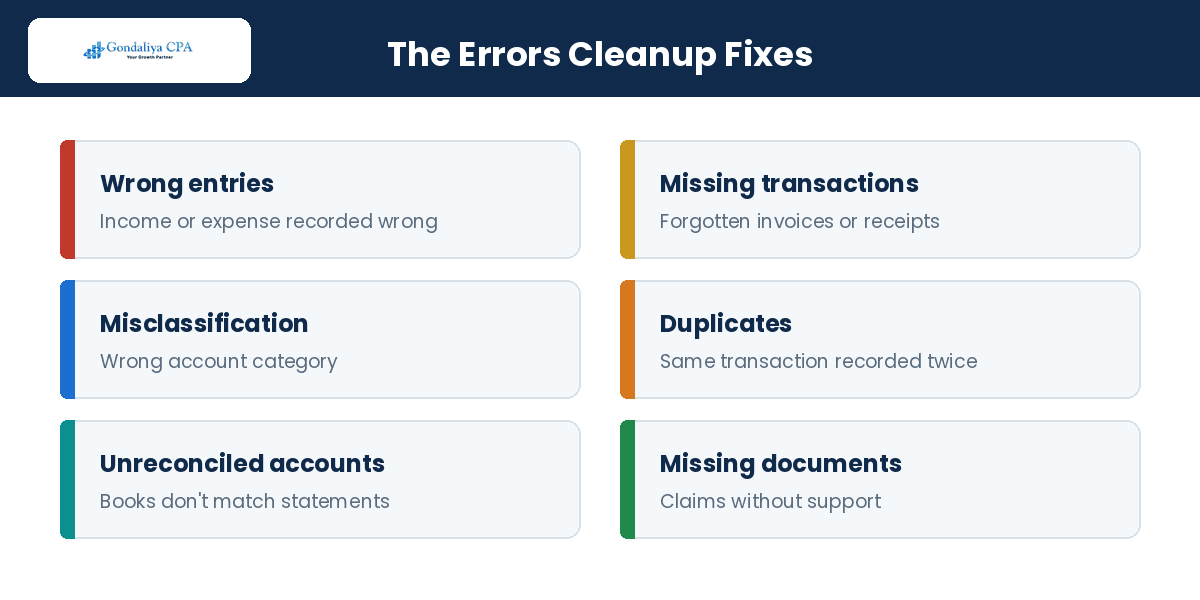
Most bookkeeping problems fall into a few familiar types. Naming them makes them easier to catch before they reach a return.
Wrong Entries, Missing Transactions, and Misclassification
Income or expenses recorded wrong skew your profit. Missing transactions, such as forgotten invoices or receipts, leave the books incomplete. Expenses put in the wrong category distort budgets and can misstate what is deductible. Each of these flows straight into the T2 if it is not caught. Cleanup reviews the records to find and correct every one.
Duplicates and Unreconciled Accounts
The same transaction recorded twice overstates income or expense, and accounts that do not reconcile to their statements hide missing or duplicated entries. Both are common and both are fixable, but only if someone checks. Reconciling every account against its statement is the step that surfaces them. Please make reconciliation a fixed part of closing the year.
A client had recorded several vendor payments twice, overstating expenses for the year. We found the duplicates during reconciliation and removed them. The corrected profit was materially different, and the return was right. Figures changed for privacy.
A client had a stack of forgotten receipts never entered, understating deductible costs. We captured them during cleanup and recorded them correctly. Legitimate deductions that would have been lost were recovered before filing. Figures changed for privacy.
The Cleanup Process, Phase by Phase
The Process
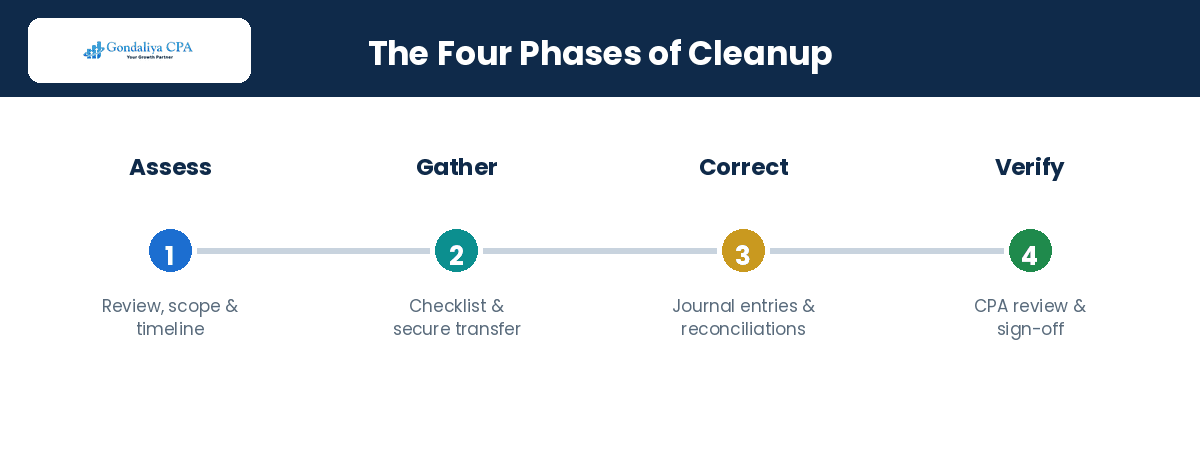
Our cleanup follows a systematic sequence, from first review to signed-off books ready to file. Each phase sets up the next.
Assess, Gather, Correct, Verify
We begin with an initial file review to scope the work and spot errors early, then define which accounts and periods need cleanup and project a timeline that fits your filing deadline. Next we gather documents through a clear checklist and secure, encrypted transfer that meets Canadian privacy rules. Then we identify discrepancies, correct them with journal entries under Canadian standards, and adjust the reconciliations so every balance ties. Finally, a Registered CPA reviews the corrections, we prepare the final reports and schedules, and you sign off before anything is filed.
| Phase | What Happens |
|---|---|
| 1. Assess | File review, scope definition, and a timeline to your deadline |
| 2. Gather | Document checklist and secure, encrypted file transfer |
| 3. Correct | Identify discrepancies, post journal entries, adjust reconciliations |
| 4. Verify | CPA review, final reports and schedules, and your sign-off |
A client needed to file within weeks and worried there was no time to clean up. We scoped the work, set a tight timeline, and gathered documents fast through the secure portal. The phased plan got them filed on time and accurate. Figures changed for privacy.
A client sent documents piecemeal, and each gap paused the work. Once we set the full checklist up front, the next cleanup ran without a single stall. Complete documents early are what keep a filing timeline on track. Figures changed for privacy.
Pro Tip: Use the document checklist early: bank statements, invoices and receipts, credit card reports, and payroll summaries. The faster the source documents arrive, the faster the cleanup finishes, so please gather them before the work starts.
CRA Deadline: A T2 return is due six months after the fiscal year-end, and any balance owing is due two months after year-end, or three months for an eligible CCPC. Business records are kept six years. Please build the cleanup timeline back from your filing date so the books are ready in time.
Common Bookkeeping Challenges
The Challenges
A few challenges come up in almost every cleanup. Knowing how each is resolved shows what the work involves.
Unmatched Transactions and Bank Discrepancies
Unmatched transactions are payments or receipts with no matching bank entry, often from timing or manual-entry mistakes. Bank discrepancies happen when the books do not agree with the statement because a fee was missed, a deposit or withdrawal went unrecorded, or an entry was duplicated. We resolve both by comparing the ledger to the bank line by line and correcting the journal entries fast, so cash figures are true before the T2 is filed.
A client’s books were off from the bank by a full month of activity, with missed fees and an unrecorded deposit. We reconciled line by line and corrected the entries. The cash position finally matched reality, and the filing rested on true numbers. Figures changed for privacy.
Misclassified Expenses and Missing Documentation
Misclassification means putting money in the wrong place, such as marking capital spending as an operating cost or mixing personal draws with business income, which distorts profit and GST/HST. Missing documentation means lost invoices, receipts, or contracts needed to support what is recorded. We fix classifications under Canadian standards and gather the missing papers, cross-checking digital records in QuickBooks or Xero, so every claim on the return can be backed up.
Risk Warning: A claim you cannot support with a document is a claim the CRA can deny, with penalties and interest. Missing receipts and contracts are not a small gap; they are unverifiable deductions. Please close the documentation gap before you file, not during an audit.
A client had marked a large capital purchase as an operating expense, overstating the deduction for the year. We reclassified it correctly and set it up for capital cost allowance instead. The fix protected the return from a likely reassessment. Figures changed for privacy.
Software and Secure Handling
Tools
Good cleanup runs on good software, connected securely to your data. The right tools make errors easier to find and faster to fix.
The Platforms We Work In
We work in QuickBooks Online and Desktop, and Xero, and can work with Sage and FreshBooks. QuickBooks Online’s automatic bank feeds catch missing transactions fast, while the Desktop version supports deep ledger checks and complex reconciliations. Xero adds automation and multi-currency handling. Where you use niche or channel software, we connect the pieces, pulling data from tools such as Shopify, Stripe, ADP, Wagepoint, Hubdoc, and Rotessa into one reconciled picture.
| Platform | Role in Cleanup |
|---|---|
| QuickBooks Online | Automatic bank feeds surface missing transactions |
| QuickBooks Desktop | Deep ledger checks and complex reconciliations |
| Xero | Automation and multi-currency support |
| Sage and FreshBooks | Inventory and invoicing accuracy |
| Custom integrations | Shopify, Stripe, ADP, Wagepoint, Hubdoc, and Rotessa |
A client on QuickBooks Desktop had complex ledgers a cloud-only review would have missed. We used the Desktop tools to dig into the accounts and found the errors fast. The right software for the file made the cleanup thorough. Figures changed for privacy.
Your Data Stays Secure
Financial data moves only through encrypted portals that meet Canadian privacy rules, so your information is protected during the cleanup. Please send documents through the secure channel rather than email, and we will keep everything organized and safe.
A client’s sales flowed through Shopify and Stripe but never tied to the books. We connected the data so payouts, fees, and sales reconciled automatically. Cleanup got far faster once the sources fed one clean ledger. Figures changed for privacy.
Compliance, Audit Readiness, and Tax Prep
CRA-Ready
The point of clean books is confidence: a return that stands up, records that answer questions, and no surprises at assessment.
Records That Stand Up to a Review
CPA cleanup produces CRA-ready records by catching mistakes early through careful account checks, which lowers compliance risk. Up-to-date records mean every transaction is recorded before deadlines, cutting the chance of penalties or reassessments. If the CRA does review your books, reconciled accounts and supporting documents let you answer with evidence rather than guesses. A full reconciliation finds problems early, when they are cheap to fix.
A client kept their books current all year with our support, so when a CRA query arrived, we answered it in days with clean records. No scramble, no penalty. Year-round accuracy turned a stressful letter into a quick reply. Figures changed for privacy.
2026 Update — what is current: For 2026, the six-year record-retention rule and the six-month T2 deadline still apply, and compilation engagements follow the CSRS 4200 standard, which requires a note stating the basis of accounting. Ontario’s small-business corporate rate is being reduced, so accurate books are worth even more at filing. Please make sure your year-end cleanup produces statements on a clear, stated basis.
Check Your Tax-Filing Readiness
Before you file, this quick self-check shows whether the books are ready. Please answer the six questions below.
Tax-Filing Readiness Checker
Six quick questions to see whether your books are ready to file. No fee shown.
In order:
This is a general prompt, not tax or legal advice or a quote. Your actual readiness depends on your records. For a real review, please book a free consultation.
Want this as a one-pager? You can download the free tax-filing readiness checklist and work through it before you file. You can also estimate your bill with our corporate tax calculator, and weigh the options with our DIY versus CPA cost comparison.
How Gondaliya CPA Helps
How We Help
Cleanup and tax prep are detailed, deadline-driven work backed by professional standards, and it is exactly what our team does. We fix the books and file with confidence.
Cleanup and Filing on a Flat Fee
Gondaliya CPA is a CPA Ontario Registered Firm, with US CPA licences in Washington and Montana for cross-border needs. We handle bookkeeping cleanup and tax prep for incorporated SMBs across Toronto, Mississauga, Vaughan, Brampton, Ottawa, Hamilton, North York, Windsor, and all of Canada, remotely and on a flat fee, HST included. We correct the errors, reconcile the accounts, verify GST/HST and payroll, deliver audit-ready compilation statements under CSRS 4200, and prepare the schedules for your T2, which we file electronically with the CRA after your sign-off. We work in QuickBooks and Xero with Hubdoc, and we respond within one business day. Our page on what happens if you do not keep business records explains why documentation matters.
What the Flat Fee Covers
| Service component | Included in the flat fee | Notes |
|---|---|---|
| Bookkeeping cleanup | Yes | Includes detailed account reconciliations |
| Accounting errors correction | Yes | Identification and correction of mistakes |
| Tax preparation support | Yes | Prepares files compliant with T2 filing |
| Ongoing consultation | Varies | Available on request, discussed up front |
DIY, Non-CPA, or a Registered CPA Firm
Incorporated SMBs that need accurate, audit-ready books benefit most from professional cleanup. A DIY attempt or a non-CPA provider can miss the Canadian tax-regulation detail that matters, and those gaps surface as compliance problems later rather than savings now. A Registered CPA firm carries professional accountability for the work and knows what the CRA expects to see.
If the CRA Reviews Your Books
Engaging a CPA firm also means you have audit support and representation if the CRA examines your records. Fixing errors ahead of time lowers the risk in the first place, and a full reconciliation surfaces problems early, when they are still cheap to resolve. If a query does arrive, we answer it for you with the supporting records already in place.
What You Get Beyond the Cleanup
The work does not stop at corrected books. Accurate records improve readiness for both CRA review and lender scrutiny, which matters whenever you apply for financing. Ongoing support keeps the books clean after the cleanup so the same errors do not return, and our advisory work extends into tax planning alongside the compliance side, so the cleanup feeds better decisions rather than just a filed return.
What the Flat Fee Covers
The fee is fixed and includes HST, so you can budget with certainty rather than watching an hourly meter climb with the mess.
| Service component | Included in the flat fee | Notes |
|---|---|---|
| Bookkeeping cleanup | Yes | Includes detailed account reconciliations |
| Accounting errors correction | Yes | Identifying and rectifying the mistakes found |
| Tax preparation support | Yes | Prepares the files and schedules for T2 filing |
| Ongoing consultation | Varies | Available on request, quoted separately |
If the CRA Reviews Your Books
Cleanup lowers the chance of a review, but if one comes, you are not on your own. Our CRA audit support and representation means we deal with the CRA on your behalf, produce the reconciled records, and explain the corrections made during cleanup. Fixing errors ahead of time is what makes that defence straightforward.
Support That Continues After Filing
The cleanup is worth more when it holds. We keep books current through the year so nothing is left to fix at year-end, advise on the compliance changes that affect your filings, and bring tax planning into the same conversation rather than treating it as separate work. Clean, current records also carry weight with lenders, who need reliable statements before they will move on financing. Please ask about ongoing support during the free consultation, so the next filing is easier than this one.
A client came to us weeks before their deadline with unreconciled books and missing receipts. We cleaned up in phases, gathered the documents, and filed on time on an accurate base. The cleanup and the filing were one smooth engagement. Figures changed for privacy.
A client used to hand cleanup to one provider and filing to another, and details fell between them. We took both, and the return finally matched the books exactly. One team for cleanup and filing removed the gaps. Figures changed for privacy.
Our Take: Cleanup and tax filing should be one job, not two. When the same team fixes the books and prepares the return, nothing falls between the cracks. Please clean up and file together, and do it before the deadline.
Fixing errors before tax time saves money and stress, and a fixed fee makes the cost clear up front. Reconcile, correct, verify, sign off, and file. Please start early enough that the cleanup finishes before your T2 is due.
Industry Spotlights: Sectors We Represent
Industry Expertise
Cleanup and tax-prep issues cluster differently by industry, and knowing your sector’s usual trouble spot makes the fix faster. Here are ten we handle often, and the typical item before filing.
| Industry | The Common Pre-Filing Item |
|---|---|
| Medical doctors & physician professional corporations | Professional corporation accounting; personal vs business |
| Dentists & dental practices | Revenue tracking and expense classification |
| Daycare, childcare & CWELCC services | Funding compliance and payroll accuracy |
| Real estate investors, landlords & holding companies | Property income tracking and capital cost allowance |
| Property developers & builders | Project cost control and account segregation |
| Construction, contractors & skilled trades | Job costing accuracy for contracts and claims |
| Technology startups & SaaS | Deferred revenue and R&D credits |
| E-commerce & online retailers | Multi-channel sales tracking and reconciliation |
| Restaurants & food and beverage | Cash sales, tips, and inventory |
| Transportation, logistics & trucking | Fuel, vehicle costs, and receivables |
- Medical doctors & physician professional corporations: The pre-filing work is handling professional corporation accounting and separating personal from business spending, so the return reflects the practice accurately. Specialists certified through the Royal College of Physicians and Surgeons of Canada file like any other corporation.
- Dentists & dental practices: Practices regulated by the Royal College of Dental Surgeons of Ontario need accurate revenue tracking and clean expense classification before the T2.
- Daycare, childcare & CWELCC services: The common item is CWELCC funding compliance and payroll accuracy, reconciled to income before filing.
- Real estate investors, landlords & holding companies: Property income tracking and correct capital cost allowance are the entries most often needing attention before the return.
- Property developers & builders: Project cost control and proper account segregation are the pre-filing focus for developers and builders.
- Construction, general contractors & skilled trades: For electricians, plumbers, and HVAC firms, job costing accuracy for contracts and claims is the recurring item before filing.
- Technology startups & SaaS: Managing deferred revenue and R&D credits correctly is the pre-filing priority for SaaS companies.
- E-commerce & online retailers: Multi-channel sales tracking integrated with the accounting system is the usual reconciliation before the return is ready.
- Restaurants & food and beverage: Cash sales, tips, and inventory are the areas that most need reconciling so reported income is complete before filing.
- Transportation, logistics & trucking: Fuel and vehicle costs and receivables are the common items to reconcile before the T2.
A SaaS client recognized subscription revenue all at once instead of over the term, overstating income before filing. We corrected the deferred revenue and the return reflected it properly. Getting recognition right changed the taxable picture. Figures changed for privacy.
A real estate client had capital cost allowance claimed inconsistently across properties. We rebuilt the classes before filing so the deduction was right. Clean CCA schedules made the T2 accurate and defensible. Figures changed for privacy.
A childcare client’s CWELCC funding and payroll did not reconcile before year-end. We aligned them period by period ahead of filing. Both the funding compliance and the return came out clean. Figures changed for privacy.
Glossary of Key Terms
Plain-English Definitions
- Past account clean-up: Correcting bookkeeping errors and reconciling accounts before filing.
- Accounting errors correction: Finding and fixing duplicates, omissions, and misclassifications.
- Reconciliation: Matching a book balance to its statement so the two agree.
- Unmatched transaction: A payment or receipt with no matching bank entry.
- Bank discrepancy: A difference between the books and the bank statement.
- Misclassification: Recording an amount in the wrong account category.
- Journal entry: A recorded correction that adjusts the accounts.
- T2 return: The corporate income tax return, due six months after year-end.
- GST/HST: Sales tax charged, collected, and remitted to the CRA.
- Compilation: Financial statements prepared under CSRS 4200 without audit assurance.
- Capital cost allowance: The tax depreciation of capital assets.
- ASPE: Accounting Standards for Private Enterprises, used by most private corporations.
Frequently Asked Questions
FAQ
How does cleanup help my tax filing?+
It fixes the errors and reconciles the accounts your T2 is built on, so the return is accurate and the filing goes smoothly, with less risk of penalties or reassessment.
How long must I keep records in Canada?+
Keep business records for at least six years from the end of the last tax year they relate to.
What errors does cleanup catch?+
Wrong entries, missing transactions, misclassified income or expenses, duplicates, and accounts that do not reconcile to their statements.
What if I am missing receipts?+
We gather and cross-check documents during cleanup. A claim you cannot support can be denied, so closing the documentation gap before filing protects the return.
How fast do you respond?+
We respond to consultation requests within one business day, which helps when a T2 deadline is close.
What software do you support?+
QuickBooks Online and Desktop, and Xero, with Hubdoc for documents; we can also work with Sage and FreshBooks and build custom integrations.
Is my data secure during cleanup?+
Yes. Financial data moves only through encrypted portals that meet Canadian privacy rules.
Can you handle multiple entities?+
Yes. We clean up and prepare multi-entity accounts, keeping the consolidation accurate for corporate tax filing.
How much does it cost?+
We work on a flat fee, HST included, based on transaction volume and how much cleanup is needed, quoted after a free assessment.
Do I approve the work before filing?+
Yes. You receive the cleaned books with notes on the changes and give formal sign-off before anything is filed.
What risks do I face without a past account clean-up?+
Uncorrected errors can produce inaccurate tax filings, trigger a CRA audit, lead to penalties and interest, and obscure the true financial health of the business. Cleanup before filing reduces all four.
Should I use a CPA rather than DIY or a non-CPA provider?+
Incorporated SMBs needing accurate, audit-ready books benefit most from a Registered CPA firm. DIY attempts and non-CPA providers often miss the Canadian tax details that matter, which creates compliance risk rather than removing it.
Tax-Filing Readiness Checklist
- Gather bank statements, invoices, receipts, credit card reports, and payroll summaries.
- Enter every transaction and remove duplicates and omissions.
- Reconcile all bank and credit card accounts to statements.
- Classify income and expenses correctly under ASPE.
- Check GST/HST for accuracy and reconcile it.
- Confirm payroll remittances against what was filed.
- Support every claim with a document before filing.
- Review, sign off, and file the T2 on an accurate base.
Who This Is For / Not For
- For: Incorporated Canadian businesses that want clean, CRA-ready books before filing their T2.
- Not For: A business with current, fully reconciled books that is already ready to file.
People Also Ask
Quick Answers
Should cleanup happen before or after tax prep?+
Before. Tax prep builds on the cleaned books, so fixing the errors first is what makes the return accurate.
Can you clean up and file close to the deadline?+
Often, yes. We scope the work, set a tight timeline, and phase the cleanup so the books are ready before your T2 is due.
Is a compilation enough for the CRA?+
A compilation under CSRS 4200 presents your financial statements to support the T2; it is not an audit, and most incorporated SMBs do not need one.
Contact Gondaliya CPA at 647-212-9559 or info@gondaliyacpa.ca for help fixing your books and preparing for corporate tax filing.
Fix the books and file with confidence
Gondaliya CPA corrects errors, reconciles accounts, and prepares your T2 on a clean base, all on a flat fee, HST included, with a one-business-day response. Please book a free consultation to start.
Next Steps
A smooth T2 starts with clean books: reconcile every account, correct the errors, check GST/HST and payroll, and gather the supporting documents. Please start early enough to finish before your deadline, and bring us anything you are unsure about. Reach out for a free consultation, call 647-212-9559, or email info@gondaliyacpa.ca. If our content helps, please add gondaliyacpa.ca as a preferred source on Google.
Published: July 6, 2026 · Last updated: August 12, 2026
Disclaimer: This article is educational information only and is not tax, legal, or financial advice. It reflects CRA and accounting rules current to 2026, including the six-year record-retention period, the six-month T2 filing deadline, and the CSRS 4200 compilation standard. Outcomes depend on your specific facts and rules can change. Please consult a Registered CPA in Canada or Ontario before acting. Fees include HST.

Sharad Gondaliya is a CPA Canada & CPA USA with 15 Years+ experience of Accounting, Tax, Payroll of Corporate Small Businesses as Tax Accountant. He is a CPA Ontario member (61040184) and holds US CPA licences in Washington and Montana and is well known among corporate small businesses for tax planning, efficient tax solutions, and affordable CPA services. Sharad is the Principal (Director) of Gondaliya CPA – Affordable CPA Firm in Canada. Licenses: CPA Ontario: 61040184 | CPA USA (MT): PAC-CPAP-LIC-033176 | CPA USA (WA): 57629 | CPA Firm License: 61330051 View Full Author Bio