



Common T3 Tax Return Mistakes That Can Cost Trusts and Estates Money in Canada
TLDR: T3 tax return mistakes can lead to estate tax filing errors that increase risks during CRA trust reviews, but Gondaliya CPA offers expert guidance to avoid common trust tax return issues like incorrect beneficiary reporting and missed trust deductions in Canada. Their professional trust tax preparation ensures tax compliance for estates and reduces late T3 filing issues.
Quick Summary
T3 tax return mistakes lead to estate tax filing errors that raise risk during a CRA trust review. The costly ones are late filing, incorrect beneficiary reporting, missed trust deductions, and distributing before the clearance certificate arrives. Please note the daily penalty runs even when the trust owes no tax at all.
| Aspect | Details |
|---|---|
| The deadline | 90 days after the trust’s tax year-end. December 31 year-end means March 31. |
| The daily penalty | $25 a day for the return, minimum $100, maximum $2,500. |
| The expensive one | Gross negligence: the greater of $2,500 or 5% of the trust’s highest property value. |
| The executor trap | Distributing before the clearance certificate. The CRA takes 120 days. |
Reading time: 27 minutes.
Table of Contents
- The T3 Return: What It Is and When It Is Due
- Trust Types, Year-Ends, and the 21-Year Rule
- Preparing and Filing the Return
- Slips, Summaries, and Submission Rules
- The Mistakes: Income, Beneficiaries, and Missed Deductions
- Late Filing, Penalties, and Interest
- Executor Mistakes and the Clearance Certificate
- Compliance, Planning, and Choosing a Provider
- Industry Spotlights: Sectors We Represent
- Glossary of Key Terms
- Frequently Asked Questions
- People Also Ask
What Mistakes Actually Cost
This article covers Canada, with Ontario and Toronto context, and reflects CRA trust rules current to 2026. It assumes a resident trust or estate with a calendar year-end unless stated otherwise, and it does not cover Quebec’s separate provincial trust return. Items marked “illustrative” are examples, not quotes, and any masked engagement notes end with “Figures changed for privacy.” This is educational information only and not tax, legal, or financial advice. Fees include HST. Trust rules are moving quickly, so please confirm your own situation with a Registered CPA before acting.
The T3 Return: What It Is and When It Is Due
The Basics
Filing a trust’s T3 return is a must if you want to stay on the right side of Canadian tax rules. The T3 return, also called the Trust Income Tax and Information Return, is needed when a trust makes money or sells capital property, and since the enhanced reporting rules arrived, most express trusts file whether or not they earned anything. Knowing what is required helps you avoid costly mistakes that bring penalties.
The Deadline, Stated Properly
Here is where the first mistake usually starts. The T3 return is due 90 days after the trust’s tax year-end, not on a fixed calendar date and not 90 days after the trust was set up. Because most trusts have a December 31 year-end, that works out to March 31 the following year, which is why people repeat “March 31” as if it were the rule. It is the consequence of the rule, not the rule itself. A trust with a different year-end has a different date, and a graduated rate estate with a non-calendar year-end almost always does. The return, the slips, and any balance owing all land on the same day. Our page on when the T3 trust return is due sets out the timing.
What Late Filing Costs
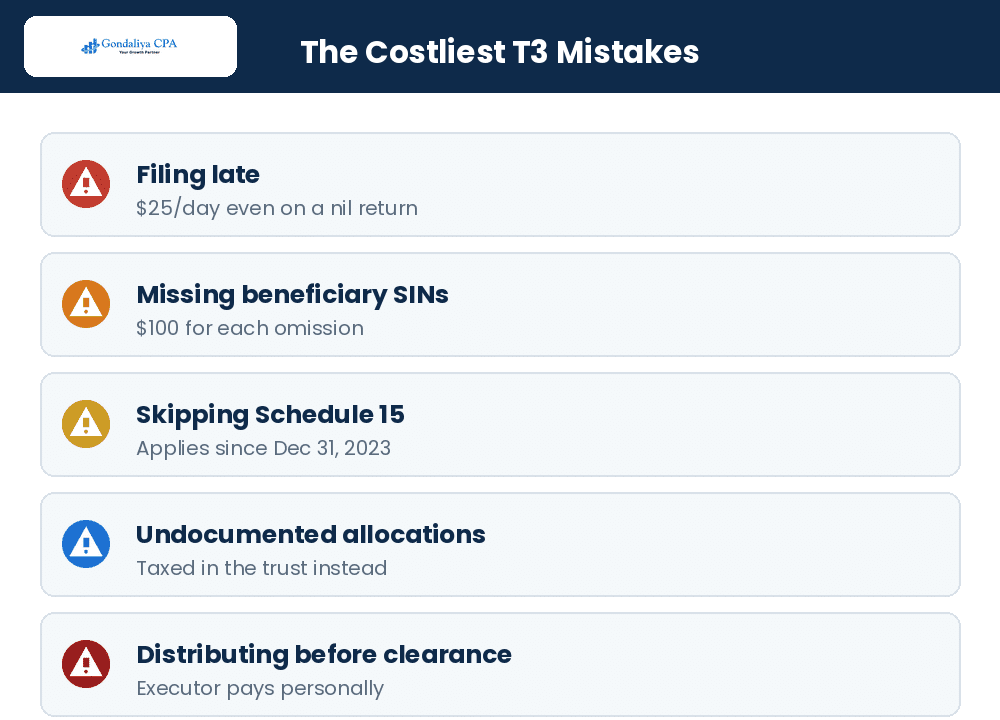
Late filings cost you $25 per day, with a minimum of $100 and a maximum of $2,500, and that penalty applies even where the trust owes no tax at all. Getting clearance certificates on Form TX19 from the CRA takes time, so please ask for these well before making distributions.
| Item | What applies |
|---|---|
| Standard filing deadline | 90 days after year-end. December 31 year-end means March 31. |
| Late filing penalty | $25 per day, minimum $100, maximum $2,500 |
| Clearance certificate processing | CRA service standard: 120 calendar days |
A trustee counted 90 days from the date the trust was created rather than from its year-end, and filed months early one year and months late the next. The count runs from the year-end, every year. Figures changed for privacy.
Key Stat: At $25 a day, the penalty hits $750 at 30 days late, $1,500 at 60 days, and reaches the $2,500 cap in roughly 100 days. A trust that owed nothing and filed four months late still pays the full $2,500.
A trustee told us the trust had no income, so there was nothing to file and nothing to pay. Both halves were wrong. The filing obligation applied and the daily penalty had been running for months on a nil return. Figures changed for privacy.
Trustee and Executor Roles in Trust and Estate Tax Compliance
Trustees and executors have important jobs making sure estates follow tax laws. They manage money and give it out according to wills or other documents.
Mistakes here can cost estates big money.
Common executor mistakes include bad record keeping or wrong tax reporting.
Hiring trust tax services helps avoid these issues and keeps things clean with the CRA.
Knowing deadlines, trust types, key terms, and responsibilities lowers the chance of errors in this complex process where trustees hold real responsibility for getting things right without extra costs later.
Trust Types, Year-Ends, and the 21-Year Rule
Classification
Choosing the wrong trust type is a quiet mistake. It does not bounce the return; it just taxes the trust wrongly for years.
Year-Ends Are Not a Choice for Most Trusts
This is worth correcting because it is repeated everywhere. Inter vivos trusts do not get to pick a year-end. Their tax year is the calendar year, ending December 31, full stop. The only real flexibility belongs to a graduated rate estate, whose executor may select a non-calendar year-end within twelve months of the death. So “trusts mostly follow calendar years unless they choose otherwise” is backwards: they follow the calendar year because they must.
The Three Types, Taxed Correctly
There are different kinds of trusts in Canada, and the tax treatment is where people get it wrong most often:
- Graduated Rate Estates (GRE): Estates get graduated tax rates for up to 36 months after death, if the conditions are met and the designation is made on the first return.
- Testamentary Trusts: Created through wills when someone dies. This is the correction that matters: a testamentary trust that is not a GRE is taxed at the top marginal rate on its first dollar of retained income, not at graduated personal rates. Only the GRE window, and a qualified disability trust, get the brackets.
- Inter Vivos Trusts: Set up while someone is alive. They pay tax on retained income at the top marginal rate, with a December 31 year-end.
Each type has different filing needs, including Ontario’s Estate Administration Tax on assets going through probate. Reading that sentence properly changes the planning: if retained income is taxed at the top rate anyway, allocating income to beneficiaries in lower brackets is usually the point of the exercise.
The 21-Year Deemed Disposition Rule
The 21-Year Deemed Disposition Rule says most trusts must act as if they sold all their assets every 21 years at market value. This triggers capital gains taxes even if no actual sale happens, and it can be a very large bill if nobody planned for it. Planning options include distributing assets to beneficiaries on a rollover basis before the date arrives. The date is knowable decades in advance, which is what makes missing it so expensive.
A testamentary trust had been filed for years as if graduated rates applied, because the GRE window had long closed and nobody re-checked. The top rate had applied throughout. Classification is not a one-time decision. Figures changed for privacy.
Preparing and Filing the Return
The Process
Filing a trust’s T3 tax return in Canada takes care and focus. You start by gathering all the money information: income, capital gains or losses, expenses, and payments to beneficiaries. Trustees report all this on the T3 forms following CRA rules.
Get the Details Right Before You Start
Check beneficiary names and Social Insurance Numbers. Make sure income is split correctly and deductions go to the trust, not to the individuals. Common estate tax filing errors come from mixing up income or wrongly sharing it among beneficiaries. Professional trust tax preparation helps catch mistakes before they become problems. Know which schedules apply, such as Schedule 9 for income allocations and designations to beneficiaries, and meet the deadlines carefully. You also need the trust account number: it identifies the trust to the CRA, and an incorrect one causes processing delays. If the trust has no number yet, register through the CRA’s Trust Account Registration service or apply on Form T3APP.
The Final Return for a Ceased Trust or Estate
The final T3 return closes out a trust or estate’s tax life when it ends. It combines all leftover income, gains, expenses, and distributions up to that date. CPAs who know trust taxes help executors prepare this final return properly, dealing with the tricky parts like the deemed disposition on death under subsection 70(5) of the Income Tax Act, or the graduated rate estate rules. Missing information or late filing causes penalties here. Before you hand out estate assets, get a clearance certificate from the CRA proving no taxes are owed. Giving out assets too soon puts executors personally at risk.
Records You Need to Keep
You need solid records for trust tax returns. Keep the trust deed or will that sets the terms, details on all income sources like interest and dividends, documents for buying or selling capital property, beneficiary information with SINs, and records of distributions approved by trustees. Missing SINs cause reporting errors that slow down processing and can bring a review. Keep your files neat so filing goes smoothly each year and if the CRA checks your records. Hold them for six years after filing. Our note on what happens if you don’t keep records explains why this matters.
A trust claimed no trustee fees or investment counsel fees for several years because nobody asked whether it could. Retained income was taxed at the top rate on a bigger number than necessary. Figures changed for privacy.
Pro Tip: Ask for beneficiary SINs on the day you are appointed, not the month the return is due. Failing to provide a beneficiary’s SIN, business number, or trust number on a T3 slip costs $100 for each omission, and beneficiaries are always slower to respond than trustees expect.
A trust return was rejected on an incorrect trust account number that had been carried forward from an old file for two years. Nothing about the tax was wrong. The identifier was. Figures changed for privacy.
Slips, Summaries, and Submission Rules
The Slips
Trustees must file slips every year: T3 slips for Canadian resident beneficiaries and NR4 slips for non-residents. These come with a summary showing the totals.
Slips Must Match the Return
Slips have to match the return amounts exactly, or the CRA will ask why. Plan early by matching payments to records before sending slips through the CRA portals by the due date. The slips are due with the return, 90 days after the trust’s year-end, not on a separate calendar date. Missing Schedule 15 disclosures about beneficial owners raise review risk too.
The Electronic Filing Threshold Changed
This one catches people who learned the old rule. You must file electronically where you file more than 5 information returns of the same type for a calendar year. The old threshold was 50, and it is long gone. Filing on paper when electronic filing is required carries a penalty of $125, assessed per type of information return, so a trust that paper-files 6 T3 slips and 6 NR4 slips can be assessed twice.
| Obligation | Deadline | If missed |
|---|---|---|
| T3 return | 90 days after year-end | $25 per day, minimum $100, maximum $2,500 |
| T3 slips and summary | Same date as the return | Minimum $100, up to $7,500 for the slips |
| NR4 slips and summary | Same date as the return | Assessed separately from the T3 slips |
| Paper filing over the threshold | More than 5 returns of a type | $125 per type of information return |
Postmark and Timestamp Rules
Mailed returns need official postmarks as proof they were sent on time. Electronic filing uses timestamps instead. If you miss the deadline, penalties apply even where the mail was slow beyond your control, which is a good reason to send early or file electronically. The beneficial ownership reporting on Schedule 15 is filed with the return, so it shares the same deadline.
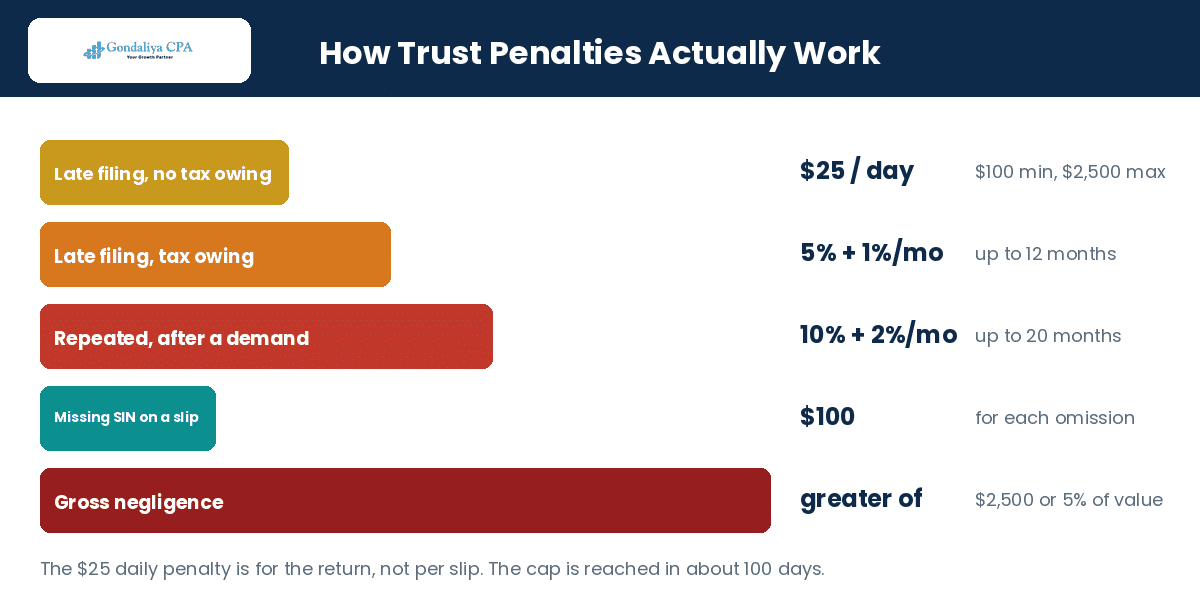
Risk Warning: The daily penalty is not charged per slip per day. It is $25 a day for failing to file the return, capped at $2,500. Please be careful with sources claiming each slip multiplies the daily rate: that is not how the T3 penalty works, and the wrong number leads to the wrong decision about whether to file now or wait.
A trustee paper-filed six T3 slips and six NR4 slips, over the electronic threshold on both. Two separate $125 penalties followed for something that took minutes to avoid. Figures changed for privacy.
The Mistakes: Income, Beneficiaries, and Missed Deductions
The Errors
People often mess up their T3 returns. Common mistakes include forgetting to disclose Schedule 15, mixing up beneficiary allocations, filing late, using the wrong trust type, or handing out assets before getting the clearance certificate. These slip-ups can cost more in taxes or trigger a CRA review.
Income Reporting and Beneficiary Details
Trustees make a set of recurring mistakes when reporting income and listing beneficiaries:
- Assigning income to the wrong beneficiaries without proper paperwork
- Leaving out beneficiaries’ Social Insurance Numbers
- Using old or wrong versions of T3 slips
These errors cause confusion and can lead the CRA to double-check or reassess. Trustees should verify beneficiary information, include SINs, and use the current slip versions every tax year.
Missed Trust Deductions
Trusts often skip claiming deductions they are allowed to take. For example, management fees paid to trustees or outside parties, trustee remuneration approved under the trust deed, and investment counsel fees where they relate to managing the trust’s assets. Missing these makes taxable income look bigger than it really is. Trusts also sometimes fail to apply capital gains designations correctly at either the trust or beneficiary level. Claiming all eligible expenses lowers the tax owed for both trusts and estates, and since retained income in a non-GRE trust is taxed at the top rate, a missed deduction there is expensive.
Incomplete Estate Accounting
Many estates have messy records. Common issues include missing or incomplete trust deeds, no signed minutes documenting trustee decisions on distributions or elections, and unclear records about which beneficiaries get what. Without solid paperwork backing up the amounts on the T3 return, such as signed resolutions, trustees risk disputes and trouble during a CRA review. Keeping detailed minute books and updated trust deed copies clears this up. The documentation is not bureaucracy; it is the evidence that the allocation you reported actually happened.
Wrong Trust Type Code
Filing under the wrong trust type code raises flags with CRA reviewers. Calling an inter vivos trust something else invites a detailed look at who really owns what through the Schedule 15 disclosures. Wrong entity coding leads to incorrect taxation and possible reassessment.
A trust had been paying tax on retained investment income for several years while two beneficiaries sat in far lower brackets with no allocation ever made. Nothing was illegal. It was simply money left on the table, every year. Figures changed for privacy.
A trustee allocated income to a beneficiary with no resolution, no minute, and no paper trail. On review, the allocation could not be supported and the income was taxed in the trust at the top rate. The decision was real; the documentation was not. Figures changed for privacy.
Late Filing, Penalties, and Interest
The Cost
Filing a T3 return late means daily penalties apply, and this section is where the numbers most often get repeated wrongly. Here they are properly.
| Penalty type | Rate or amount | Limit |
|---|---|---|
| Late filing, no tax owing | $25 per day for the return | Minimum $100, maximum $2,500 |
| Late filing, tax owing | 5% of the unpaid tax plus 1% per month | Up to 12 months |
| Repeated failure after a demand | 10% plus 2% per month | Up to 20 months |
| Gross negligence, failure to file | Greater of $2,500 or 5% of highest property value | No fixed cap |
| False statement or omission | Greater of $100 or 50% of understated tax | No fixed cap |
| Missing beneficiary SIN on a slip | $100 | Per omission |
Reading the Gross Negligence Penalty Correctly
Two different penalties get confused here, and the difference is thousands of dollars. Where a person knowingly, or in circumstances amounting to gross negligence, fails to file the T3 return for a trust that is not a listed trust, the penalty is the greater of $2,500 or 5% of the highest fair market value of all property held by the trust at any time in the year. On a trust holding property worth $2,000,000, that 5% is $100,000. Separately, a false statement or omission carries a penalty equal to the greater of $100 or 50% of the understated tax or overstated credits. Both can bite; neither is “five times the understated amount,” and the trust-specific one is tied to property value rather than tax. Interest compounds daily on unpaid amounts after the deadline.
It Piles Up Across Years
The penalty can add up fast if you miss multiple years, because each year’s return carries its own. Repeat late filers also face more scrutiny, and where the CRA has issued a demand to file and has assessed a late-filing penalty in any of the three preceding years, the rate rises to 10% plus 2% per month for up to 20 months. Our CRA penalties and interest guide sets out how these interact. If several years are outstanding, the Voluntary Disclosures Program may reduce or cancel penalties where you come forward before the CRA contacts you, and our page on what happens if you don’t file your trust return covers the options.
CRA Deadline: The return, the slips, and the balance are all due 90 days after the trust’s tax year-end. Once you are past it, filing sooner is always cheaper than filing later, and coming forward before the CRA contacts you is cheaper again. Please do not let a missed year sit.
A family trust had three unfiled years. Each year carried its own daily penalty, so the exposure was not one $2,500 problem but three. We brought them current together rather than one at a time. Figures changed for privacy.
A client asked whether to wait for a better moment to file a late trust return. Waiting only added days at $25 each, and it risked losing the voluntary route entirely once a CRA letter arrived. We filed. Figures changed for privacy.
Executor Mistakes and the Clearance Certificate
Personal Liability
Executors have their own pitfalls, and this is the section where the mistake is paid for personally rather than by the estate.
The Sequencing Mistake
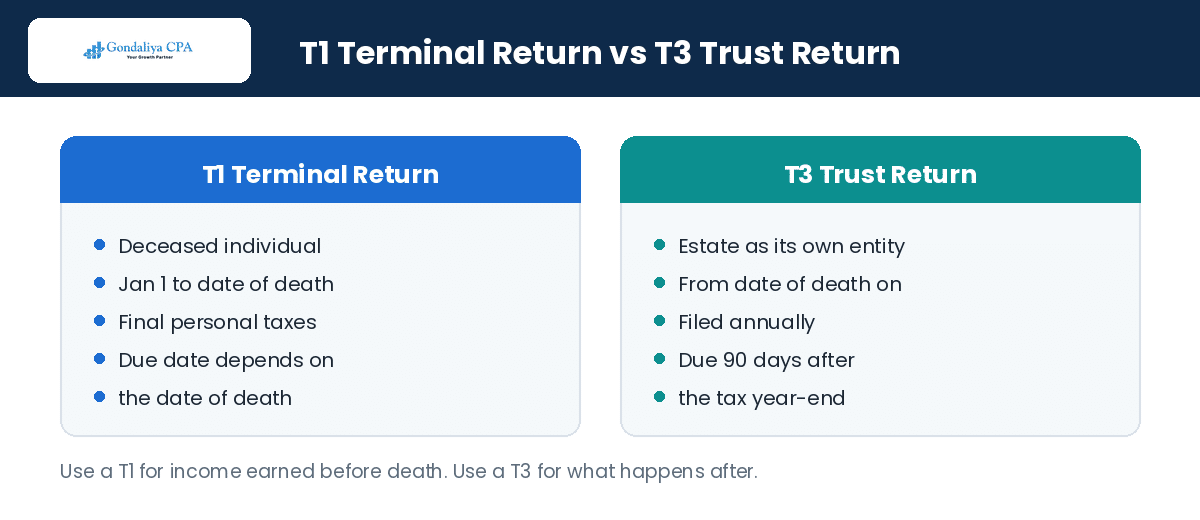
The order matters. The terminal T1 covers the deceased’s personal income to the date of death and is filed first; the T3 covers the estate from the date of death onward. Neither is the mistake on its own. The mistake is requesting the clearance certificate before everything is filed and assessed, because the CRA will not issue it until all returns are filed and assessed, all balances are paid or secured, and no objections or adjustment requests are outstanding. Applying early does not start the clock; the file simply sits. On timing, note the terminal return is not always due April 30: where the death occurred between January 1 and October 31, the terminal return is due April 30 of the following year, but where death occurred between November 1 and December 31, it is due six months after the date of death.
| Filing Type | Applies To | Reporting Period | Notes |
|---|---|---|---|
| T1 Terminal Return | Deceased individual | January 1 to date of death | Final personal taxes; due April 30 following the year of death, or six months after death where death occurred November 1 to December 31 |
| T3 Trust Return | Estate as a separate entity | From date of death onward | Filed annually; includes distributions |
Bottom line: Use a T1 for income earned before death. Use a T3 for what happens after.
Distributing Too Early
Distributing estate assets before getting a clearance certificate is the most expensive mistake on this page. Subsection 159(2) of the Income Tax Act requires a legal representative to obtain a clearance certificate before distributing property under their control. Without it, an executor who distributes is personally liable for unpaid amounts, up to the value of what was distributed. The money is gone to the beneficiaries and the liability stays with the executor. Please treat the certificate as the gate, not the paperwork.
The Real Timeline
Here is a correction worth planning around: the CRA’s published service standard for a clearance certificate request is 120 calendar days from receipt of a complete request, which it aims to meet 90% of the time. That is roughly four months, not four to eight weeks. The certificate itself is free to request. Add the time to file and have every return assessed first, and an executor should be thinking in terms of many months before a final distribution, not weeks. Telling beneficiaries otherwise sets up a conversation you will have to have again.
| Executor mistake | Consequence | How to prevent |
|---|---|---|
| Distributing before clearance | Personal liability up to the amount distributed | Wait for the certificate |
| Requesting clearance too early | File sits; no meaningful clock | File and have all returns assessed first |
| Assuming four to eight weeks | Promises to beneficiaries you cannot keep | Plan on the 120-day standard |
| Letting the GRE window lapse | Top-rate tax on retained income | Plan allocations inside 36 months |
| Poor record keeping | Allocations cannot be supported | Signed minutes and resolutions |
The GRE Window Closes on Its Own
The graduated rate estate window simply ends 36 months after death. It is not a deadline you miss so much as a door that closes, and once it does, retained income is taxed at the top rate with no relief. Executors who spend the first two years gathering documents and the third year planning have usually lost most of the benefit.
An executor distributed the estate to relieve family pressure, months before clearance. A reassessment arrived afterwards. The beneficiaries had spent the money and the liability was his alone. Figures changed for privacy.
An executor submitted the TX19 with two returns still unassessed, then waited, believing the 120 days was running. It was not. We completed the assessments and resubmitted. Figures changed for privacy.
Compliance, Planning, and Choosing a Provider
The Fix
Most of this article is avoidable with a calendar and a checklist. Some of it needs advice.
Where Schedule 15 Actually Stands
Another correction, because this one is repeated constantly. Schedule 15, Beneficial Ownership Information of a Trust, is not a future requirement arriving in 2026. It has applied to trust tax years ending on or after December 31, 2023, and it must be filed annually with the T3 return even when nothing has changed from the prior year. It requires details for each reportable entity: trustees, settlors, beneficiaries, and controlling persons such as a protector. What is genuinely new for 2026 is bare trusts: they were not required to file for the 2023, 2024, and 2025 tax years, and legislation enacted in 2026 requires certain bare trusts to file for year-ends from December 31, 2026, with exceptions. There is also no separate “bare trust registration” to complete; a bare trust that must report gets a trust account number and files a T3 return with Schedule 15 like any other trust.
Planning That Saves Real Money
Good planning cuts estate tax in Ontario. Ontario’s Estate Administration Tax is worth stating correctly: there is no tax on the first $50,000 of the estate’s value, and $15 for each $1,000, or part thereof, above $50,000. The old $5 per $1,000 tier on the first $50,000 was eliminated for certificates applied for from January 2020, so a $500,000 estate pays $6,750, not $7,000. Assets with named beneficiaries and jointly held property with right of survivorship generally bypass probate. An Estate Information Return must also be filed with the Ministry of Finance within 180 calendar days after the estate certificate is issued. Beyond probate, the 21-year deemed disposition can be planned around by distributing before the date, and the graduated rate estate window gives you up to three years of graduated rates if the elections happen on time. Proper Schedule 9 allocations move income to beneficiaries’ rates instead of the trust’s top rate. Our estate and trust tax planning service works through these, and our tax-saving strategies for trust and estate returns go into more depth.
If a CRA Notice Arrives
Read the notice carefully to find out what is wrong. Gather all related documents including old filings. Contact a CPA who knows trust issues quickly. Consider the voluntary disclosure route before reassessments get worse. Fix errors fast by filing amended returns, which reduces penalties compared with waiting. Ignoring CRA letters raises audit risk and leads to bigger problems later, for trustees and executors alike. Our guide on how to respond to a CRA audit letter sets out the first steps, and CRA audit representation means we deal with the officer instead of you.
Benefits of Professional Trust Tax Preparation
Trust tax services help lower the chances of T3 tax return mistakes and estate tax filing errors. Professionals handle income reporting, beneficiary allocations, and follow CRA rules for trusts in Canada. This care avoids penalties from late or wrong filings. Plus, CPAs can plan trust taxes smartly to save money on deductions and capital gains while staying legal.
Registered CPA firms check work carefully and know current laws. They manage tricky paperwork well. These steps reduce audit risks and keep estate taxes in line with the rules.
DIY, Non-CPA, or a CPA Firm
Many trustees make T3 mistakes filing themselves, often because they do not know Schedule 15 exists or how to issue slips properly. Non-CPA providers may miss details or work from outdated rules, which is exactly how “file electronically over 50 slips” and “$5 per $1,000 probate” keep circulating.
| Factor | DIY filing | CPA firm | Non-CPA provider |
|---|---|---|---|
| Compliance accuracy | Low, many errors | High, expert review | Medium, varies |
| Knowledge of CRA rules | Limited | Extensive and current | Often outdated |
| Handling complex cases | Hard | Skilled | Limited |
| Audit readiness | Poor | Strong support | Unpredictable |
| Schedule 15 reporting | Often incomplete | Yes | Maybe incomplete |
What Our Process Looks Like
We start by gathering the trust deed, prior T3 returns, investment information, beneficiary details including SINs, and distribution records. Then we review the governing documents, look for errors in past returns, calculate the income split among beneficiaries, prepare or correct the T3 slips, complete Schedule 15, check everything before filing electronically, and handle any CRA questions afterwards. You receive the corrected T3 returns, updated slips, summary reports, tie-outs between trustees and beneficiaries, CRA receipts, and notes on avoiding the same errors next year. We work in TaxCycle for the returns, QuickBooks Online or Xero for the underlying records, and TaxDome so you can see where your file stands without chasing us.
What Drives the Fee
We charge a flat annual fee, HST included, quoted in writing after a free consultation and before any work starts. What sets it is the trust type, the number of beneficiaries and therefore slips, whether capital property is held, how complex the Schedule 15 reporting is, how many years need correcting, the volume of amended slips, the stage of the estate, and how much advisory depth you want. Fixed pricing means no surprise bills. We reply within one business day and are available evenings and weekends. We have been a Registered Ontario CPA Firm, we back the work with a 30-day money-back guarantee in 2026 and a 60-day fees-matching policy, and we serve incorporated SMB clients and families across Toronto, Ontario, and all of Canada, remotely.
| Fee driver | Why it moves the fee |
|---|---|
| Trust type | More complex trusts take more work |
| Number of beneficiaries | More beneficiaries mean more slips |
| Capital property held | Capital gains reporting adds schedules |
| Schedule 15 complexity | Detailed ownership information adds time |
| Years needing correction | Fixing several years costs more than one |
| Amended slip volume | More amended slips, more work |
| Estate stage | Different stages change the scope |
| Advisory depth | Planning work is beyond bare compliance |
Questions Worth Asking Any Firm
Before choosing a provider, ask whether they are Registered by CPA Ontario and whether you can verify it, whether they have experience with trusts like yours, whether they can name what changed recently for trusts and get the date right, whether the pricing is clear and fixed, whether they can show client reviews, whether they will represent you if the CRA reviews the trust, and how they handle Schedule 15. A firm that tells you Schedule 15 starts in 2026 has answered the third question for you.
Our Take: Almost none of the money lost on T3 returns is lost to hard tax questions. It is lost to a date nobody diarized, a SIN nobody chased, an allocation nobody documented, and a distribution nobody waited on. The technical work is the easy part.
A client came to us after a provider filed a trust return with no Schedule 15, on the view that it started in 2026. It had applied for years. We corrected the filings. Please check the date your adviser gives you. Figures changed for privacy.
Diarize the 90-day date, chase SINs on day one, document every allocation with a signed resolution, get Schedule 15 right for every year it has applied, and never distribute before the clearance certificate arrives. Those five habits prevent nearly every T3 penalty we see.
2026 Update — what is current: Schedule 15 has applied since trust years ending December 31, 2023 and is filed annually. Bare trusts, exempt for 2023 through 2025, must file for year-ends from December 31, 2026 under legislation enacted in 2026, with exceptions. Electronic filing is required above 5 information returns of a type. Ontario probate is nil on the first $50,000 and $15 per $1,000 above. The clearance certificate standard is 120 days.
Check Your T3 Mistake Risk
This quick self-check flags where a trust or estate filing is most likely to go wrong. Please answer the six questions below.
T3 Mistake Risk Check
Six questions on the errors that cost the most. No fee shown.
Clear:
This is a general prompt, not tax or legal advice or a quote. Your actual position depends on the trust’s terms and facts. For a real review, please book a free consultation.
Want this as a one-pager? You can download our free T3 mistake prevention checklist, made for Canadian trusts and estates.
Industry Spotlights: Sectors We Represent
Industry Expertise
The T3 mistake that shows up depends on the structure. Here are ten sectors and the error we see most in each.
| Industry | The Mistake We See Most |
|---|---|
| Medical doctors & physician professional corporations | Family trust filings skipped because the trust had no income |
| Dentists & dental practices | Trust holding practice shares left out of Schedule 15 |
| Daycare, childcare & CWELCC services | Owner’s estate and the licence handled on different timelines |
| Real estate investors, landlords & holding companies | Bare trust on title never identified as a trust at all |
| Property developers & builders | Nominee corporations on land treated as paperwork, not trusts |
| Construction, contractors & skilled trades | Allocations made with no signed trustee resolution |
| Technology startups & SaaS | Trust classification never revisited before an exit |
| E-commerce & online retailers | The 21-year date arriving unplanned as the business grows |
| Restaurants & food and beverage | Property trust and operating company reported inconsistently |
| Transportation, logistics & trucking | Estate distributed before the clearance certificate |
| Industry | Typical Errors | Common CRA Issues | How CPA Helps | Notes |
|---|---|---|---|---|
| Medical Doctors | Confusing professional corp vs personal holdings | Investment incomes misreported | Correct classification advice | CPSO licensing relevant |
| Dentists | Missing RCDSO benefits and deductions | Wrong expense claims | Align accounting with standards | RCDSO registrations |
| Childcare / CWELCC | Incomplete subsidy reconciliations | GST/HST claim problems | Bookkeeping supports eligibility | CWELCC program rules |
| Real Estate Investors | Capital gain errors; holding company misuse | Bare trustee filings overlooked | Structure planning reduces probate | Holding companies |
| Construction | Payroll vs subcontractor errors | GST/HST rebate confusion | Streamlined payroll reduces flags | Labour code awareness |
| Technology Startups | Stock option mismanagement | Valuation disputes | Stock compensation optimization | SaaS revenue recognition |
| E-commerce Retailers | Inventory valuation mistakes | Cross-border sales reporting | Better inventory tracking | Customs and tariff codes |
| Restaurants / Food | Cash handling issues | Employee benefits misreporting | Strong bookkeeping cuts irregularities | Food safety licensing |
| Transportation | Fuel rebate miscoding | Vehicle lease treatment | Fleet management tools improve records | Trucking regulations |
These examples show why sector knowledge matters when filing trust and estate taxes in Ontario or Toronto.
- Medical doctors & physician professional corporations: Family trusts holding professional corporation shares are frequently unfiled because they earned nothing, which has not been the test for years. Specialists certified through the Royal College of Physicians and Surgeons of Canada face the same obligation as anyone else, and the licensing body is the College of Physicians and Surgeons of Ontario rather than OHIP, which is the insurance plan.
- Dentists & dental practices: Where a trust holds shares in a practice regulated by the Royal College of Dental Surgeons of Ontario, the trust is its own filer with its own Schedule 15, separate from the practice’s corporate return.
- Daycare, childcare & CWELCC services: When an owner dies, the estate return and the continuity of the CWELCC-funded licence run on different clocks, and the estate’s 90-day date does not wait for the licensing question to resolve.
- Real estate investors, landlords & holding companies: The single most common miss. If title sits in one name while someone else holds the beneficial interest, that is a bare trust, and the owner usually does not know the word applies to them.
- Property developers & builders: Nominee corporations holding land are bare trusts, and one project can involve several, each with its own reporting from the 2026 year-ends.
- Construction, general contractors & skilled trades: For electricians, plumbers, and HVAC firms with family trusts over the operating company, allocations get decided verbally at year-end and never documented, which is the version that fails on review.
- Technology startups & SaaS: A trust set up years ago and never revisited is a poor thing to discover during exit diligence. The classification and the filings should be clean before a buyer looks.
- E-commerce & online retailers: Where a trust has held shares since the business was worth little, the 21-year deemed disposition lands on a much larger number than anyone modelled.
- Restaurants & food and beverage: Property in a trust alongside the operating company needs both sides reported consistently; mismatches are what draw the questions.
- Transportation, logistics & trucking: Owner-operator estates often distribute the equipment quickly to keep the work moving, which is precisely the distribution the clearance certificate is meant to gate.
A developer client treated three nominee corporations as conveyancing paperwork. Each was a bare trust with its own reporting from the 2026 year-end. We built the files before the deadline rather than after it. Figures changed for privacy.
A trucking estate distributed two vehicles to keep contracts running, before clearance. When a balance surfaced, the executor carried it personally. Commercial pressure is not a defence. Figures changed for privacy.
Glossary of Key Terms
Plain-English Definitions
- T3 return: The Trust Income Tax and Information Return, filed by trusts and estates.
- T3 slip: The slip showing each beneficiary’s share of trust income.
- Trust account number: The CRA identifier for the trust, without which you cannot file.
- Terminal return: The final T1 covering the deceased’s income to the date of death.
- Graduated Rate Estate: An estate taxed at graduated rates for up to 36 months after death.
- Testamentary trust: A trust created by a will; taxed at the top rate unless it is a GRE.
- Inter vivos trust: A trust created during life, with a December 31 year-end.
- Bare trust: An arrangement where the trustee holds title but the beneficial owner keeps control.
- Schedule 9: Income allocations and designations to beneficiaries.
- Schedule 15: Beneficial ownership information, filed annually with the T3 return.
- 21-year deemed disposition: The rule treating most trusts as selling assets every 21 years.
- Clearance certificate: The CRA confirmation on Form TX19 that taxes are settled.
- Gross negligence penalty: The greater of $2,500 or 5% of the trust’s highest property value.
- Estate Administration Tax: Ontario’s probate tax; nil on the first $50,000, $15 per $1,000 above.
Frequently Asked Questions
FAQ
What penalties apply for late T3 filing?+
$25 per day for the return, minimum $100, maximum $2,500, even with no tax owing. If tax is owing, add 5% of the balance plus 1% per month up to 12 months. The daily penalty is for the return, not multiplied per slip.
What are gross negligence penalties for trusts?+
Where a failure to file is knowing or grossly negligent and the trust is not a listed trust, the penalty is the greater of $2,500 or 5% of the highest fair market value of all trust property in the year. A separate false statement penalty is the greater of $100 or 50% of the understated tax.
Why must executors wait for a TX19 clearance certificate?+
Subsection 159(2) requires it before distributing. Without it, the executor is personally liable for unpaid amounts up to the value distributed. The CRA’s service standard is 120 calendar days from a complete request.
Can trustees face personal liability for unpaid estate taxes?+
Yes. Distributing assets before obtaining the clearance certificate makes the executor personally liable for taxes found later, up to the amount distributed.
What is the importance of the trust account number?+
It identifies the trust to the CRA. It must be accurate or the return will not process. Register through the CRA’s Trust Account Registration service or apply on Form T3APP.
How do Schedule 9 beneficiary income allocations work?+
Schedule 9 allocates and designates trust income to beneficiaries so it is taxed at their rates rather than the trust’s top rate. Correct allocations prevent reassessment, and each one should be supported by a signed resolution.
When did Schedule 15 beneficial ownership reporting start?+
It applies to trust tax years ending on or after December 31, 2023, and is filed annually even when nothing changed. It is not a 2026 requirement. What is new for 2026 is bare trust filing.
When must a bare trust file?+
Bare trusts were not required to file for the 2023, 2024, and 2025 tax years. Legislation enacted in 2026 requires certain bare trusts to file for year-ends from December 31, 2026, with exceptions. There is no separate bare trust registration; you obtain a trust account number and file a T3 with Schedule 15.
What is the difference between inter vivos and testamentary trusts?+
Inter vivos trusts form during life with a December 31 year-end. Testamentary trusts arise on death. Both are taxed at the top marginal rate on retained income unless the estate qualifies as a graduated rate estate.
Can trustee remuneration and management fees be deducted?+
Trustee fees approved under the trust deed, management fees, and investment counsel fees relating to the trust’s assets are generally deductible where reasonable and properly documented.
How do amended returns reduce penalty exposure?+
Correcting quickly stops the daily penalty growing and is treated better than waiting for a review. If a year was never filed, the Voluntary Disclosures Program may reduce or cancel penalties if you come forward first.
How much do T3 services cost in Canada?+
We charge a flat annual fee, HST included, set by the trust’s complexity and quoted in writing after a free consultation, with no hidden charges.
Where can I find official CRA Schedule 9 guidance?+
The CRA website offers detailed instructions on Schedule 9 for trust income reporting. Following it helps avoid mistakes.
How do I correctly code the trust type for T3 returns?+
Choose the correct classification, inter vivos, testamentary, or GRE, to avoid misfiling penalties and trigger the appropriate tax treatment.
What is the significance of the 36-month Graduated Rate Estate (GRE) window?+
GRE status offers reduced rates for up to three years after death if elections are timely filed by trustees.
Where can I find TX19 clearance certificate guidance from the CRA?+
The CRA’s official site provides step-by-step instructions on applying for TX19 certificates required before estate asset distribution.
What risks arise from filing under the wrong trust entity type?+
Wrong entity coding leads to incorrect taxation and possible reassessments or penalties from CRA audits.
What are common pitfalls in initial or first-year estate filings?+
Missing deadlines, incorrect income allocation, and incomplete beneficiary data increase audit risk during initial filings.
Why is prompt filing before the beneficial ownership reporting deadline important?+
Schedule 15 is filed with the T3 return and has applied to trust years ending on or after December 31, 2023. Filing on time keeps the trust compliant and avoids penalties, and bare trusts have their own first filing for year-ends from December 31, 2026.
How does capital gains designation affect beneficiaries’ taxes?+
Proper capital gains allocation ensures beneficiaries pay correct amounts at their rates rather than higher trust rates.
Why is clear beneficiary designation documentation crucial?+
Signed resolutions and minutes prove income allocation decisions, reducing disputes during CRA audits or beneficiary conflicts.
What happens if minute records or signed resolutions are missing in estate accounting?+
Incomplete documentation raises red flags with the CRA, increasing audit likelihood and potential reassessment penalties.
What audit representation services do CPA firms like Gondaliya CPA provide for trusts?+
They manage communication with CRA auditors, gather documents, explain filings, and protect clients’ interests during reviews.
How does participation in the CRA trust review program affect estates?+
This program audits trusts’ compliance thoroughly; unprepared trustees risk penalties from errors found in income or ownership reports.
T3 Mistake Prevention Checklist
- Diarize 90 days after the trust’s year-end, not a remembered March 31.
- Chase beneficiary SINs on day one; each omission on a slip costs $100.
- Use the current year’s slip versions, never last year’s.
- File Schedule 15 for every year ending on or after December 31, 2023.
- Confirm the trust type code against the trust deed before filing.
- Document every allocation with a signed trustee resolution.
- Claim trustee fees, management fees, and investment counsel fees.
- File electronically above 5 information returns of a type.
- File and have every return assessed before requesting the TX19.
- Never distribute before the clearance certificate is in hand.
- File initial or first-year estate returns without delay to meet CRA deadlines and avoid compliance risks.
- Allocate capital gains precisely among beneficiaries using clear designations documented legally.
Estate Tax Return Document Checklist
- Trust Deed or Will: the rules document
- Trust Account Number: confirm with the CRA
- Beneficiary Details and SINs: needed for slips
- Investment Statements: income proof
- Property Records: if capital property is involved
- Prior-Year T3 Returns and Slips: for checking
- Distribution and Meeting Minutes: allocation proof
- Schedule 15 Data: beneficial ownership information
Having these ready speeds up reviews and fixes.
Who This Is For / Not For
- For: Trustees and executors of Canadian trusts and estates, and business owners whose shares or property sit in a trust.
- Not For: Quebec-only trust filings, which involve a separate provincial return we do not cover here.
People Also Ask
Quick Answers
Is the T3 penalty charged per slip per day?+
No. The $25 daily penalty applies to the failure to file the return, capped at $2,500. The slips carry their own penalty, with a $100 minimum and a $7,500 maximum.
How much is Ontario probate on a $500,000 estate?+
$6,750. There is no Estate Administration Tax on the first $50,000, then $15 per $1,000 above it. The old $5 per $1,000 tier on the first $50,000 no longer applies.
Do I still file a T3 if the trust earned nothing?+
Usually yes. The obligation attaches to the trust’s existence, not its income, unless a listed-trust exception applies. The daily penalty runs on a nil return too.
Contact Gondaliya CPA today at 647-212-9559 or info@gondaliyacpa.ca for guidance on common T3 tax return mistakes, estate tax filing errors, and trust tax return complexities, through trust tax services built for incorporated SMB clients and families across Toronto and Ontario. For the full picture, please read our ultimate guide to trust and estate tax returns.
Stop a T3 mistake before it costs you
Gondaliya CPA reviews the trust, finds the errors in prior returns, brings filings current, and deals with the CRA, on a flat annual fee, HST included, with a one-business-day response. Please book a free consultation.
Next Steps
T3 mistakes cost money in a boring way: a date, a SIN, a resolution nobody signed, a distribution nobody waited on. Double-check the beneficiary allocations, file on time, report the income accurately, get Schedule 15 right for every year it has applied, and hold the distribution until the clearance certificate arrives. If a year is already late, filing now is cheaper than filing later and coming forward first is cheaper than being found. Please call 647-212-9559, email info@gondaliyacpa.ca, or book a free consultation. If our content helps, please add gondaliyacpa.ca as a preferred source on Google.
Published: July 15, 2026 · Last updated: July 15, 2026 ·
Editorial policy: Our editorial policy is simple: we research against CRA and Ontario sources, fact-check the figures, and Sharad Gondaliya, CPA, reviews the content, which we update as the rules change.
Disclaimer: This article is educational information only and is not tax, legal, or financial advice. It reflects CRA trust and estate rules current to 2026, including the 90-day filing deadline, the late-filing penalty of $25 per day to a maximum of $2,500, the gross negligence penalty equal to the greater of $2,500 or 5% of the trust’s highest property value, the 120-day clearance certificate service standard, and Ontario’s Estate Administration Tax of nil on the first $50,000 and $15 per $1,000 above. Trust reporting rules have changed repeatedly and remain subject to further amendment, and outcomes depend on your specific facts. Please consult a Registered CPA in Canada or Ontario before acting. Fees include HST.

Sharad Gondaliya is a CPA Canada & CPA USA with 15 Years+ experience of Accounting, Tax, Payroll of Corporate Small Businesses as Tax Accountant. He is a CPA Ontario member (61040184) and holds US CPA licences in Washington and Montana and is well known among corporate small businesses for tax planning, efficient tax solutions, and affordable CPA services. Sharad is the Principal (Director) of Gondaliya CPA – Affordable CPA Firm in Canada. Licenses: CPA Ontario: 61040184 | CPA USA (MT): PAC-CPAP-LIC-033176 | CPA USA (WA): 57629 | CPA Firm License: 61330051 View Full Author Bio