



The Ultimate Guide to Trust and Estate Tax Returns (T3) in Canada: Filing, Planning, and Tax-Saving Strategies
T3 tax return Canada involves filing trust and estate tax returns accurately, and Gondaliya CPA offers expert T3 return preparation services to ensure compliance with Canadian tax laws. Whether you need help with trust tax return or estate tax return Canada filings, Gondaliya CPA provides clear guidance and support throughout the process.
Quick Summary
A T3 Trust Income Tax and Information Return reports a trust’s or estate’s income, capital gains, and allocations to beneficiaries. It is due 90 days after the trust’s tax year-end, and most express trusts now have to file whether or not they earned a dollar. Please get the trust account number early and the beneficiary details right; those two things cause most of the delays.
| Aspect | Details |
|---|---|
| What you file | Form T3RET with its schedules, plus T3 slips for beneficiaries. |
| When | Within 90 days of the trust’s tax year-end. |
| Who must file | Express trusts and estates, usually even with no income. |
| Cost of missing it | $25 a day, from $100 up to $2,500, plus more if tax is owing. |
Reading time: 29 minutes.
Table of Contents
- What a Trust Is and What the T3 Return Covers
- Who Must File: Trust Types, GREs, and Bare Trusts
- Returns After Death and the Documents You Need
- Schedule 15, Income, Transfers, and Dispositions
- Step by Step: From Trust Account Number to Filing
- Deadlines, Penalties, and Payment
- Tax Planning and Tax-Saving Strategies
- Executor Duties, Clearance Certificates, and After Filing
- Industry Spotlights: Sectors We Represent
- Glossary of Key Terms
- Frequently Asked Questions
- People Also Ask
The Numbers That Matter
This article covers Canada, with Ontario and Toronto context, and reflects CRA trust rules current to 2026. It assumes a resident trust or estate with a calendar year-end unless stated otherwise, and it does not cover Quebec’s separate provincial trust return. Items marked “illustrative” are examples, not quotes, and any masked engagement notes end with “Figures changed for privacy.” This is educational information only and not tax, legal, or financial advice. Fees include HST. Trust rules are moving quickly, so please confirm your own situation with a Registered CPA before acting.
What a Trust Is and What the T3 Return Covers
The Basics
A trust is a legal setup where one person, called the trustee, holds assets for someone else, known as the beneficiary. In Canada, trusts often help with estate planning, protecting assets, or lowering taxes. The T3 return covers income made by these trusts, and it must be filed every year. It reports any money the trust earned that year, including interest, dividends, and capital gains, and Canadian law sets special rules for this kind of income.
The T3 Trust Income Tax and Information Return
The T3 Trust Income Tax and Information Return, or T3 return, must be filed by express trusts in Canada. The return reports taxable income from investments inside the trust, and it also tells beneficiaries how much income they get through T3 slips. Because it is tricky to split income among beneficiaries correctly, trusts and estates need filing help from people who know the rules. One point that surprises many trustees: a trust that earned nothing at all usually still has to file, because the filing obligation now attaches to the existence of the trust rather than to its income.
Graduated Rate Estate (GRE)
A Graduated Rate Estate is an estate that pays taxes at graduated rates instead of flat ones. To be a GRE in Canada, an estate must start when someone dies and lasts up to 36 months after death. Testamentary trusts taxed this way get lower taxes than other trusts, because the graduated brackets are only available during this window. Every other trust is taxed at the top marginal rate on its first dollar of retained income, which is exactly why the 36-month window matters so much.
What Qualifies as Estate Income
Estate income comes from different places, such as rent from properties owned by the estate or profits from investments made before death. Capital gains happen when assets like real estate are sold for more than their original price. Estates and trusts must report these correctly on their returns.
- Rental income: Money earned by renting out property
- Investment returns: Gains from stocks or bonds
- Capital gains: Profit from selling assets that increased in value
Executors and Trustees
Executors handle many tasks after someone dies. They pay debts and make sure the estate follows the will, or the law if there is no will. This includes preparing final tax returns and dealing with the taxes the CRA sets for deceased people. Trustees have similar jobs but focus on managing ongoing trusts based on legal documents that explain how money should be handled until certain events happen, like beneficiaries reaching certain ages. Both executors and trustees must file returns on time. Missing deadlines can cause penalties and problems that affect beneficiaries’ rights across Canadian provinces and territories.
Key Stat: The capital gains inclusion rate remains one-half. A proposed increase was announced and then reversed, and the CRA administers the enacted one-half rate. Please ignore any planning built on the higher rate that never came into force.
A client assumed their family trust did not need to file because it held only a property and earned no income. The filing obligation applied anyway. We caught it before the penalty clock ran far. No income does not mean no return. Figures changed for privacy.
Who Must File: Trust Types, GREs, and Bare Trusts
Filing Requirement
In Canada, certain trusts and estates must file a T3 return to report income, capital gains, and distributions. Knowing these rules helps executors meet their responsibilities with the CRA, and staying on top of it avoids trouble later.
When a T3 Return Is Required
You must file a T3 return if a trust or estate exists during the year, and in most cases that holds even where there is no taxable income. Estates classified as a Graduated Rate Estate within 36 months after death file for each of their tax years. Express trusts, both inter vivos and testamentary, must file unless they fall inside one of the narrow listed-trust exceptions, such as certain trusts holding assets under a low fair market value threshold throughout the year. The GRE lets estates pay graduated rates before switching to top rates, and executors should check whether their situation needs filing under the current rules.
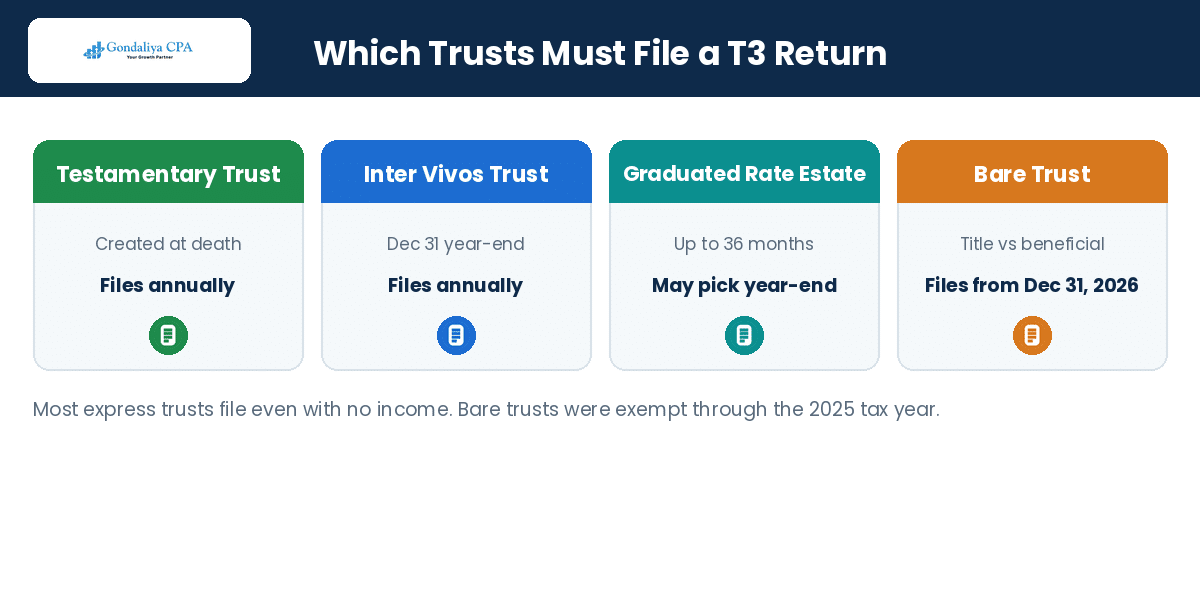
| Trust type | Filing required? | Notes |
|---|---|---|
| Testamentary trust | Yes | Created at death; files during the GRE window and after |
| Inter vivos trust | Yes | Calendar year-end; files within 90 days |
| Graduated Rate Estate | Yes | May choose a non-calendar year-end within 36 months |
| Bare trust | Yes, for year-ends from December 31, 2026 | Exempted through the 2025 tax year; exceptions now apply |
Bare Trusts: What Actually Happened
Bare trusts deserve their own paragraph, because the story has been confusing. A bare trust is an arrangement where the trustee holds legal title but the beneficial owner keeps control, and it is far more common than people expect: a parent on a child’s property title, a nominee corporation holding land for a developer, a joint bank account opened for convenience. Enhanced reporting was supposed to catch these, but the CRA did not require bare trusts to file for the 2023, 2024, or 2025 tax years while the rules were sorted out. Legislation enacted in 2026 settled the question, and certain bare trusts must file for tax years ending December 31, 2026 and onward, with exceptions for arrangements such as where all the legal owners are also the beneficiaries, or where related individuals hold a property that could be a principal residence. Please do not read the earlier reprieve as a permanent exemption.
Risk Warning: If you were told bare trusts do not have to file, that advice has expired. The exemption covered specific past tax years only. Please identify every bare trust arrangement you are part of now, because the information takes time to gather and the penalties are not small.
A client held a rental property in a nominee corporation and had never considered it a trust. It was a bare trust. We identified it and started the reporting file early rather than at the deadline. Naming the arrangement correctly is the whole first step. Figures changed for privacy.
Returns After Death and the Documents You Need
After a Death
When someone dies, more than one return is usually in play, and executors need to keep them straight.
The Returns Required
The Final T1 Income Tax and Benefit Return, the terminal return, reports income from January 1 up to the date of death. The Estate Tax Return, the T3 trust return, covers income earned by the estate after death or during administration. Sometimes multiple T3 returns are required if several trusts form within the estate. Executors handle these carefully: the terminal T1 covers personal income until death, and the trust returns report ongoing earnings in the estate.
Documents to Gather
Getting these papers ready helps prepare the returns properly:
- Original or certified copies of the trust deed or will showing terms and beneficiaries
- Records of all trust or estate income sources
- Prior years’ tax returns for the decedent or trust
- Beneficiary information, including SINs, to issue correct T3 slips
- Proof for capital property transactions
- Beneficial ownership details for Schedule 15
Having these on hand makes filing easier and faster with fewer mistakes. Please start collecting them the week you are appointed, not the month the return is due.
Pro Tip: Chase the beneficiary SINs first. They are the single most common thing missing at filing time, and failing to provide a beneficiary’s SIN on a T3 slip carries a $100 penalty for each omission. People are slow to hand them over, so ask early.
An estate we assisted stalled two weeks short of the deadline because one beneficiary abroad would not send a SIN. We filed on time and amended after. Asking on day one rather than day sixty would have removed the whole scramble. Figures changed for privacy.
Schedule 15, Income, Transfers, and Dispositions
The Reporting
Trusts and estates must list their financial activities correctly, and since the enhanced rules arrived, they must also disclose who stands behind the trust.
Reporting the Income and the Gains
Interest, dividends, and rental income earned after death go on specific lines in Form T3RET. Capital gains from selling assets show up on Schedule 1 attached to Form T3RET. The 21-Year Deemed Disposition Rule means most trusts are treated as selling assets every 21 years at market value, which can trigger capital gains taxes unless planned otherwise. Distinguishing what income stays in the trust from what is paid out matters, since beneficiaries get taxed through slips, and mistakes can invite a CRA review.
What Schedule 15 Actually Asks
Schedule 15, Beneficial Ownership Information of a Trust, asks for details on each reportable entity connected to the trust: the trustees, the settlors, the beneficiaries, and any controlling persons such as a protector who can direct decisions without being formally named. For each one you report the name, address, date of birth for individuals, jurisdiction of residence, and taxpayer identification number, plus changes during the reporting period. It applies to trust tax years ending on or after December 31, 2023, so this is not a new requirement arriving later; it is already here, and it must be filed with the T3 return every year even when nothing has changed from the prior year. Accurate details keep you clear of penalties.
| Reportable entity | Who it captures |
|---|---|
| Trustees | Anyone holding legal title and administering the trust |
| Settlors | Anyone who contributed property to the trust |
| Beneficiaries | Those entitled to income or capital, including contingent ones |
| Controlling persons | Protectors and others who can direct trustee decisions |
A client’s trust deed named a protector nobody thought to report, because he had never acted. He still met the controlling person test. We added him to Schedule 15. Read the deed, not the habit. Figures changed for privacy.
A trust we reviewed was approaching its 21-year mark with substantial unrealized gains and no plan. We modelled the deemed disposition and the distribution options well ahead. That rule arrives on schedule; it should never be a surprise. Figures changed for privacy.
Step by Step: From Trust Account Number to Filing
The Process
Here is the sequence, from registering the trust to receiving confirmation.
Get the Trust Account Number First
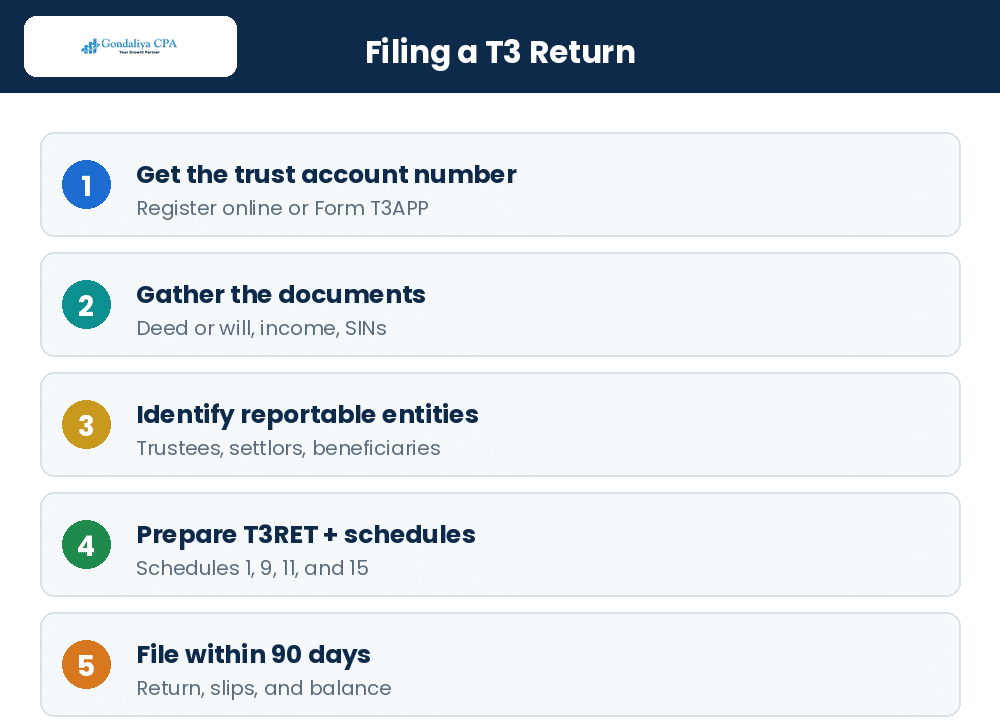
You need a trust account number to file a T3 return. It lets the CRA track filings linked to the trust or estate, and getting it early avoids trouble. Trustees or executors can register through the Trust Account Registration service in My Account, My Business Account, or Represent a Client, which returns the number on screen, or apply by mail using Form T3APP, Application for Trust Account Number, with a signed copy of the trust document or the last will and testament. Without this number, you cannot file T3 returns or issue slips. This applies to both inter vivos trusts and testamentary estates, and registering early helps avoid late filing and penalties.
Complete the Return Accurately
Preparing the T3 return means reporting income, capital gains, deductions, and beneficiary shares exactly as the CRA wants. You use Form T3RET plus schedules including Schedule 1 for capital gains, Schedule 9 for income allocations and designations to beneficiaries, Schedule 11 for federal tax, and Schedule 15 for beneficial ownership. Trustees should collect all financial papers: investment statements, distribution agreements, prior returns if any, and proof of beneficiaries’ shares. Common mistakes happen when income types are wrong or shares are not properly divided. Using certified software built for trust returns helps keep things right, and a CPA firm that works on trust returns regularly can lower the risk by making sure every schedule fits the current rules.
The Terminal T1 and Optional Returns
The final personal income tax return after death is the terminal T1. It covers all income up to death plus any deemed dispositions triggered then. An executor’s responsibilities include handling this last personal return alongside any estate returns like the T3RET where distributions or complex assets remain. You need to gather slips such as T4s for employment income plus estate documents like investment summaries. Executors should also obtain a clearance certificate from the CRA before handing out assets, which confirms no taxes are owed by the deceased or the estate. Beyond the terminal return, the Income Tax Act allows separate optional returns for certain kinds of income, such as rights or things, which can let more than one set of graduated brackets and credits apply and reduce the overall tax. Professional help matters here, to avoid double counting or missing credits that only work if the election is made in time.
Filing Methods
The CRA accepts electronic filing through certified software built for trust and estate submissions, and paper filing by mail with printed forms plus signed declarations where needed. Electronic filing speeds up processing and catches many errors automatically, unlike paper forms which can arrive incomplete and cause delays. Where you file more than 5 information returns of the same type for a calendar year, you must file them electronically. Whichever route you take, trustees must send official T3 slips showing beneficiary allocations with each yearly report, and the slips must go out on time. Choosing electronic filing fits modern compliance, lowers risk, and keeps records ready in the event of a review.
A first-time executor tried to file without registering the trust first and could not proceed. We registered it and the return went in on time. The account number is step one, not a detail to sort out later. Figures changed for privacy.
Deadlines, Penalties, and Payment
The Deadline
The T3 deadline is tighter than the corporate one, and the penalties start immediately.
The 90-Day Rule
The T3 return, the slips, and any balance owing are all due no later than 90 days after the trust’s tax year-end. Most trusts have a December 31 year-end, so a family trust ending December 31 must file by March 31 the following year. Missing this starts daily penalties that add up fast until they reach the cap. Executors working on final years face tight timing too: the final personal returns and the clearance certificate request must be finished before assets go out, to avoid the personal liabilities set out in the executor rules. Our page on when the T3 trust return is due covers the timing in detail.
| Obligation | Deadline | Applies to | Penalty if late |
|---|---|---|---|
| File the annual T3 return | Within 90 days after year-end | All affected trusts and estates | $25 a day, minimum $100, maximum $2,500 |
| Issue beneficiary slips | Same date as the annual filing | Trustees | $25 a day per slip type, minimum $100, maximum $2,500 |
| Pay the balance due | Same date as the annual filing | Estates and trusts | 5% of unpaid tax plus 1% per month, plus interest |
The Penalties in Full
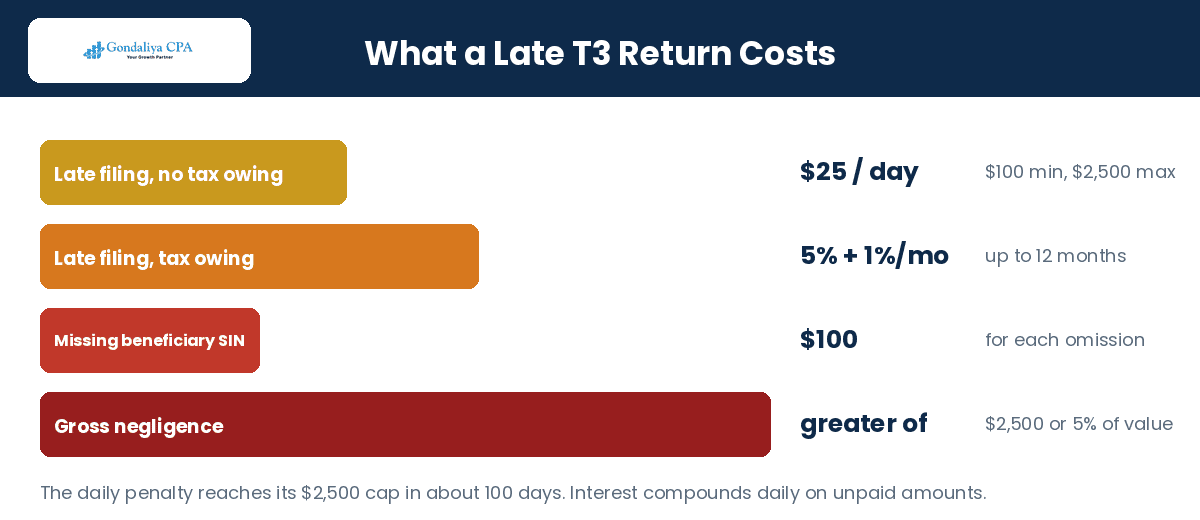
The standard late-filing penalty is $25 for each day the return is late, from a minimum of $100 to a maximum of $2,500, and it applies even where no tax is owing. Where tax is owing, a further penalty of 5% of the unpaid balance plus 1% for each complete month the return is late, up to 12 months, applies on top. Schedule 15 carries its own daily penalty stream. Where a failure to file, or a false statement or omission, is made knowingly or in circumstances amounting to gross negligence, the penalty is the greater of $2,500 or 5% of the highest fair market value of all property held by the trust at any time in the year, which on a property worth $1,000,000 means $50,000. Failing to provide a beneficiary’s SIN, business number, or trust number on a slip costs $100 for each omission. Interest compounds daily on unpaid amounts. If you have already missed a filing, the Voluntary Disclosures Program may reduce or cancel penalties where you come forward before the CRA contacts you, and our page on what happens if you don’t file your trust return explains the options.
A trustee filed the T3 on time but held the slips back until the beneficiaries asked for them. The slips carry their own daily penalty from the same date. The return and the slips are one deadline, not two. Figures changed for privacy.
CRA Deadline: The T3 return, the T3 slips, and the balance owing are all due 90 days after the trust’s tax year-end. For a December 31 year-end that is March 31. The daily penalty reaches its $2,500 cap in about 100 days. Please diarize the date the moment the trust exists.
A trustee thought the T3 followed the April personal deadline and filed in late April. The return was already a month late and the daily penalty had been running. The 90-day rule catches people who assume it matches T1 timing. Figures changed for privacy.
Tax Planning and Tax-Saving Strategies
The Planning
This is where a trust return stops being paperwork and starts being money.
Allocating Income to Beneficiaries
Estates in Canada can choose specific income options on the T3 return to reduce tax bills. The return lets trustees or executors allocate income to beneficiaries, which can cut taxes by using their lower personal rates rather than the trust’s top rate. Spreading income during the graduated rate estate period, which lasts up to 36 months after death, helps avoid higher taxes once this period ends. Trust returns also offer choices around capital gains reserves and eligible dividends, which affect whether income gets taxed in the trust or in the beneficiaries’ hands. Making the right election means looking at each beneficiary’s situation and when income lands in the fiscal year. You have to follow the CRA rules during preparation, and missing the deadline for an election could mean paying more tax than needed. Where it suits the family better to tax the income inside the trust, designations under subsections 104(13.1) and 104(13.2) can do that, subject to conditions. Our tax-saving strategies for trust and estate returns go through the options.
Capital Gains, Losses, and the 21-Year Clock
Capital gains inside trusts and estates follow special rules, and the biggest is the 21-year deemed disposition, which treats a trust as if it sold its assets every 21 years at market value. This forces trusts to recognize built-up gains unless an exception applies. When estates file, they must report capital gains from asset sales before final distribution on Schedule 1 of the T3RET. Trustees should track losses too, since losses reduce taxable gains but have limits on how far back they can be applied. Good planning means watching when deemed dispositions arrive. Strategies include distributing assets to beneficiaries on a rollover basis before that date, or using testamentary trusts whose 21-year clock starts at death.
Deductions, Credits, and Provincial Rules
When preparing a T3 return, it is key to spot all deductions and credits allowed. Common deductions include trustee fees for managing the estate, accounting costs tied to preparing trust returns, charitable donations made by the trust or estate, and expenses related to earning investment income. Tax credits like the dividend gross-up and tax credit lower overall taxes if claimed on Schedule 11. Problems arise if deductions get missed or mixed up between beneficiaries and retained income, and keeping good records helps during a review. Federal rules cover most of the T3 return across Canada, but provinces add their own layers. In Ontario, including Toronto, the graduated rate estate benefits apply fully during the 36-month window, and Ontario also charges Estate Administration Tax outside the federal filings, paid when you apply for probate. Other provinces may treat elements differently, so knowing the local rules matters if property sits in more than one place. Our estate and trust tax planning service works through these together.
Choosing the Year-End
Graduated Rate Estates have a flexibility no other trust gets: the executor can select a non-calendar year-end, ending on any date within twelve months of the death, and can then use up to three tax years inside the 36-month window. That lets income be matched against beneficiaries’ own years more precisely rather than piling up inside a highly taxed estate. Inter vivos trusts get no such choice; their tax year ends December 31, and the return follows 90 days later. Using this well can cut total taxes over time, but it needs precise records, and a late change risks penalties under the beneficial ownership rules.
Our Take: Managing elections in the first three years after death is the single biggest lever in Canadian estate tax. Once the graduated rate estate window closes, every retained dollar is taxed at the top rate. Please plan the allocations before the window shuts, not after.
An estate retained income inside the trust rather than allocating it to beneficiaries in lower brackets during the GRE window. We restructured the allocations for the remaining years. The graduated rates are only available for a short time; using them is the whole point. Figures changed for privacy.
A client’s executor set a calendar year-end for a GRE out of habit, giving up the chance to match income to beneficiaries’ years. We could not undo it. Choosing the first year-end deliberately is a one-time decision worth real money. Figures changed for privacy.
Executor Duties, Clearance Certificates, and After Filing
Personal Liability
This section is the one executors should read twice, because the liability here is personal.
Collecting Information and Notifying the CRA
Executors and trustees need to collect the documents that matter: the will or trust deed, bank statements, investment information, previous tax returns, beneficiary details, and property values. Getting these early helps avoid mistakes. Next, they must notify the CRA of the death promptly. Here is what to collect: the trust deed or will, financial statements and investment records, prior year returns, beneficiary information, and property appraisals. Having these ready makes filing easier.
Personal Liability and the Clearance Certificate
Executors face personal liability if they slip up. Filing late can cost 5% of unpaid taxes plus 1% per month after that, and without a clearance certificate, executors may pay from their own pockets if taxes remain unpaid. To lower the risk, keep detailed records, meet all the deadlines, and consider engaging a CPA who works with trust returns regularly. Before giving out assets from an estate or trust, getting a clearance certificate from the CRA is essential. It confirms all owed taxes are settled, including those reported on the final T3 trust return. Without it, executors stay responsible for any taxes found later. To apply, submit Form TX19, Asking for a Clearance Certificate, with the supporting documents after filing the final returns. This protects beneficiaries and executors by confirming full compliance.
| Issue | Effect | How to prevent |
|---|---|---|
| Missing beneficiary details | Delays and review risk | Collect data early and verify |
| Late filing penalties | Fines plus interest | Track deadlines strictly |
| Wrong capital gains reporting | Reassessment risk | Get a professional review |
| Not filing Schedule 15 | Daily monetary penalties | Use reminders and expert help |
| Distributing before clearance | Personal liability for the executor | Wait for the certificate |
Common Issues and Fixes
Estate filing often runs into problems: missing beneficiary information, skipping prior year filings, wrong capital gains reporting on Schedule 1, not filing Schedule 15, and late filing. To fix these, gather all documents carefully upfront, use checklists made for trust return preparation, engage CPAs skilled in testamentary trusts, file electronically and on time using approved software, double-check the slips before submitting, correct errors fast with amended slips, and talk to the CRA where needed. This kind of planning reduces risk and smooths out the filing.
After You File
Once you send the return, check that the CRA received it and started working on it. If you file electronically, confirmation usually arrives within a few weeks; paper forms take longer. You can call the CRA or check the trust’s online account. Getting confirmation on time helps avoid delays with refunds or assessments and shows you met the deadline. Keep copies of all receipts and letters. The CRA might ask for more information after reviewing your return, often on income splits, who benefits, capital gains, or Schedule 15. Answer quickly and with the correct papers to avoid penalties or a wider audit. Common problems include incomplete forms, late slip distribution, and wrong beneficiary information. At Gondaliya CPA, we check everything carefully before filing, which lowers the chance of a review. If a CRA letter does arrive, our CRA audit representation team responds for you.
Records to Keep
Executors and trustees need detailed records. Keep trust deeds or wills, income reports, capital gains details, beneficiary income splits, and copies of filed T3 returns and slips. These help if the CRA reviews the file or when applying for the clearance certificate at estate closure. Keep records for six years after the end of the tax year, the standard CRA rule. Good record keeping protects executors from personal risk, and our note on what happens if you don’t keep records explains why.
| Document type | Retention period | Purpose |
|---|---|---|
| Filed T3 returns and slips | 6 years | Proof for audits and checks |
| Trust deeds and wills | Indefinite | Legal proof of authority |
| Beneficiary allocation data | 6 years | Track income distribution |
| Capital gains schedules | 6 years | Support tax calculations |
How Gondaliya CPA Helps
Gondaliya CPA is a CPA Ontario Registered Firm, with US CPA licences in Washington and Montana for cross-border matters. We support trusts and estates for small business owners and families across Toronto, Etobicoke, Vaughan, Mississauga, Brampton, Scarborough, Ottawa, Hamilton, Guelph, Windsor, Oshawa, and all of Canada, remotely, on a flat annual fee, HST included, with no surprise bills. Our process begins with a document review, then data entry into the CRA forms using certified software, then a review with you, then electronic filing and confirmation. You receive completed T3RET forms, beneficiary T3 slips, filing confirmation, and guidance on what comes next, plus post-filing support if the CRA asks questions. We handle testamentary trusts, graduated rate estates, multiple beneficiaries across provinces, and the interaction with Ontario probate. Choosing between doing it yourself, a non-CPA provider, or a CPA firm depends on complexity: a simple inter vivos trust may be manageable alone, an estate with real estate sales is worth professional help, and multi-level family trusts are where a CPA earns the fee. When you are choosing a firm, look for experience with Canadian trust and estate law, transparent fees, good communication, capability with GREs, electronic filing, and proactive compliance support. Please contact us early in the administration, not the week before the deadline.
Hiring a CPA firm experienced in T3 returns can help by:
- Cutting compliance risks
- Optimizing income allocation to lower taxes legally
- Timing clearance certificate applications right
- Representing you if CRA audits happen
What Deliverables Do You Get from Gondaliya CPA?
- Completed electronic or paper-filed T3RET forms
- Beneficiary information slips compliant with CRA deadlines
- Filing confirmation notices from CRA
- Post-filing support including audit assistance
Why Trust Gondaliya CPA for Your T3 Returns
- Registered CPAs specializing in trusts and estates tax law
- Up-to-date knowledge of CRA rules including Schedule 15 changes
- Transparent pricing with personalized client support
- Proven experience serving Toronto and Ontario small businesses
| Feature | DIY | Non-CPA provider | Gondaliya CPA |
|---|---|---|---|
| Complexity handling | Low | Medium | High |
| Accuracy assurance | Low | Moderate | High |
| Tax optimization | None | Limited | Extensive |
| CRA audit support | None | Limited | Full |
| Flat fee pricing | Not applicable | Variable | Transparent |
In one testamentary trust file, five beneficiary slips were issued against total taxable income reported at $350,000. We prepared the T3RET including the Schedule 1 capital gains reporting once the documents were complete. The document-gathering, not the preparation, sets the pace. Figures changed for privacy.
An executor distributed the estate before the clearance certificate arrived, then a reassessment landed. The money was gone and the liability was his. Waiting for the certificate is not a formality; it is the executor’s protection. Figures changed for privacy.
Summary of Key Points for Executors and Trustees
Executors filing final estate returns must submit terminal T1 returns plus T3 trust returns if assets stay in the estate over a year. Trustees must:
- Allocate trust income correctly to beneficiaries using slips
- File on time without missing deadlines
- Reply quickly to any CRA questions
- Keep detailed records backing up all numbers reported
Missing these duties can bring penalties, especially around Schedule 15 beneficial ownership reporting rules.
Register the trust, gather the beneficiary details early, file within 90 days of the year-end, use the graduated rate estate window while it is open, and never distribute before the clearance certificate. Those five things prevent almost every trust filing problem we see.
2026 Update — what is current: Schedule 15 applies to trust years ending on or after December 31, 2023, and must be filed annually even when nothing changed. Bare trusts were not required to file for the 2023, 2024, and 2025 tax years, but legislation enacted in 2026 brings certain bare trusts in for year-ends from December 31, 2026, with exceptions. The capital gains inclusion rate remains one-half. Please review any bare trust arrangement now.
Check Your T3 Filing Readiness
This quick self-check shows where your trust or estate filing stands. Please answer the six questions below.
T3 Filing Readiness Checker
Six quick questions on your trust or estate return. No fee shown.
In place:
This is a general prompt, not tax or legal advice or a quote. Your actual filing obligation depends on the trust’s terms and facts. For a real review, please book a free consultation.
Want this as a one-pager? You can download the free T3 trust and estate return checklist and work through it before you file.
Industry Spotlights: Sectors We Represent
Industry Expertise
Trusts show up in almost every client structure we work with, usually holding shares or property. Here are ten sectors and where the trust issue lands in each.
Gondaliya CPA supports sectors such as real estate holdings trusts, family business trusts, investment portfolios, charitable foundations, professional corporations’ trusts, and agricultural estates requiring precise trust accounting.
| Industry | The Trust Issue |
|---|---|
| Medical doctors & physician professional corporations | Family trusts holding professional corporation shares |
| Dentists & dental practices | Trust in the practice structure and succession on death |
| Daycare, childcare & CWELCC services | Owner’s estate and continuity of the licence holder |
| Real estate investors, landlords & holding companies | Bare trusts holding title, now reportable |
| Property developers & builders | Nominee corporations on land are bare trusts |
| Construction, contractors & skilled trades | Family trusts and owner succession |
| Technology startups & SaaS | Trusts holding shares ahead of an exit |
| E-commerce & online retailers | Trust share ownership and the 21-year clock |
| Restaurants & food and beverage | Property held in trust alongside the operating company |
| Transportation, logistics & trucking | Estate of the owner-operator and asset transfer |
- Medical doctors & physician professional corporations: Family trusts holding professional corporation shares are common, and each one now files annually with a Schedule 15. Specialists certified through the Royal College of Physicians and Surgeons of Canada face the same trust reporting as any other family.
- Dentists & dental practices: Practices regulated by the Royal College of Dental Surgeons of Ontario often sit inside a trust structure, and succession on the death of a principal brings the estate return into play.
- Daycare, childcare & CWELCC services: When an owner dies, continuity of the licence and the estate’s reporting have to be handled together, and the timing is tight.
- Real estate investors, landlords & holding companies: This is the sector most affected by the bare trust rules. If title sits in one name while another person holds the beneficial interest, that is a bare trust and reporting now applies.
- Property developers & builders: Nominee corporations holding land for a project are bare trusts, and a single project can involve several of them.
- Construction, general contractors & skilled trades: For electricians, plumbers, and HVAC firms, family trusts holding the operating shares are the usual structure, and owner succession is where the estate return arrives.
- Technology startups & SaaS: Trusts holding founder shares ahead of an exit need the allocations planned before the sale, not after it.
- E-commerce & online retailers: Where a trust has held shares for years, the 21-year deemed disposition is the date to watch as the business grows in value.
- Restaurants & food and beverage: Property held in trust alongside the operating company is a frequent structure, and both sides need reporting.
- Transportation, logistics & trucking: When an owner-operator dies, the estate has to deal with equipment transfers and the terminal return together.
A developer client had three nominee corporations across two projects, each holding land for the beneficial owner. All three were bare trusts. We built the reporting file for each. One structure, several returns. Figures changed for privacy.
A physician client’s family trust had held the professional corporation shares for years with no filings, because it had no income. The obligation applied regardless. We brought the filings current. Figures changed for privacy.
A landlord client had added an adult child to a property title for convenience, creating a bare trust nobody intended. We reviewed the beneficial ownership and set up the reporting. Convenience arrangements are still arrangements. Figures changed for privacy.
Glossary of Key Terms
Plain-English Definitions
- T3 return: The Trust Income Tax and Information Return, filed by trusts and estates.
- T3RET: The main T3 return form, supported by its schedules.
- T3 slip: The slip showing each beneficiary’s share of trust income.
- Trustee: The person or institution holding legal title to trust property.
- Beneficiary: The person entitled to income or capital from the trust.
- Settlor: The person who contributed property to the trust.
- Express trust: A trust created deliberately, by deed or by will.
- Bare trust: An arrangement where the trustee holds title but the beneficial owner keeps control.
- Graduated Rate Estate: An estate taxed at graduated rates for up to 36 months after death.
- Terminal return: The final T1 personal return covering income to the date of death.
- Schedule 15: The beneficial ownership information filed annually with the T3 return.
- 21-year deemed disposition: The rule treating most trusts as selling assets every 21 years.
- Clearance certificate: The CRA confirmation, requested on Form TX19, that taxes are settled.
- Estate Administration Tax: Ontario’s probate tax, paid separately from federal filings.
Frequently Asked Questions
FAQ
What is involved in T3 return preparation?+
T3 return preparation includes collecting trust income, capital gains, deductions, and beneficiary allocations. Gondaliya CPA ensures accurate filing using CRA-approved software.
Who should file a T3 tax return in Canada?+
Trustees of express trusts and estates earning income after death must file. Executors handling Graduated Rate Estates also file for each tax year within the 36 months. Most express trusts file even with no income.
When is the T3 return due?+
Within 90 days of the trust’s tax year-end. For a December 31 year-end, that is March 31. The slips and any balance owing are due the same day.
What is the late-filing penalty for T3 returns?+
$25 per day, from a minimum of $100 to a maximum of $2,500, even with no tax owing. If tax is owing, add 5% of the balance plus 1% per month up to 12 months. Gross negligence brings the greater of $2,500 or 5% of the trust’s highest property value.
Do bare trusts have to file?+
They were not required to file for the 2023, 2024, and 2025 tax years. Legislation enacted in 2026 requires certain bare trusts to file for year-ends from December 31, 2026, with exceptions. Please have your arrangement reviewed.
What documents should I prepare before starting a T3 return?+
Trust deeds or the will, income statements, prior returns, beneficiary SINs, capital property details, and distribution agreements.
How does the clearance certificate work?+
Form TX19 requests a clearance certificate confirming all estate taxes are paid before assets are distributed. It protects the executor from personal liability for amounts found later.
How many beneficiary slips does a trust usually issue?+
It varies with how many beneficiaries receive distributions. Many trusts issue between 1 and 10 slips, though complex structures issue more. Above 5 slips of a type, electronic filing is required.
What risks come with filing a T3 return incorrectly?+
Late-filing penalties, wrong capital gains reporting, missed Schedule 15 filings, SIN omission penalties, and CRA review.
What is the difference between DIY, a non-CPA provider, and a CPA firm?+
DIY suits simple trusts with no complex assets. Non-CPAs offer basic filing help. A CPA firm handles complex estates, the elections, and the CRA correspondence.
How much do T3 trust and estate return services cost in Canada?+
We charge a flat annual fee, HST included, set by the trust’s complexity, covering the federal filing, with no hidden charges. It is quoted in writing after a free consultation.
How do trust and estate returns show up across industries Gondaliya CPA serves?+
Industries like real estate, investment firms, family businesses, and non-profits often require tailored trust tax services for compliance and planning.
How does the T3 return process work at Gondaliya CPA?+
We begin with document review, followed by data entry into CRA forms using certified software. After review with clients, we file electronically and provide confirmation.
What deliverables do you get from Gondaliya CPA’s T3 services?+
Clients receive completed T3RET forms, beneficiary slips (T3 slips), filing confirmation receipts, and guidance on compliance requirements.
T3 Return Checklist
- Register the trust and get the trust account number before anything else.
- Locate the trust deed or will and confirm the terms and beneficiaries.
- Collect beneficiary SINs early; each omission on a slip costs $100.
- Identify every trustee, settlor, beneficiary, and controlling person for Schedule 15.
- Assemble income records and proof for every capital property transaction.
- Pull prior year returns for the trust or the deceased.
- Diarize the filing date: 90 days after the trust’s tax year-end.
- Request the clearance certificate on Form TX19 before distributing anything.
Who This Is For / Not For
- For: Trustees and executors of Canadian trusts and estates, and business owners whose shares or property sit in a trust.
- Not For: Quebec-only trust filings, which involve a separate provincial return we do not cover here.
People Also Ask
Quick Answers
Does a trust with no income still file a T3 return?+
Usually yes. Since the enhanced rules, the obligation attaches to the trust’s existence rather than its income, unless a listed-trust exception applies.
Is a joint bank account a bare trust?+
It can be. Where an account is opened for convenience and the beneficial ownership stays with one person, that is a bare trust arrangement worth reviewing.
Can I still fix a trust return I never filed?+
Often yes. The Voluntary Disclosures Program may reduce or cancel penalties where you come forward voluntarily, before the CRA contacts you.
Contact Gondaliya CPA at 647-212-9559 or info@gondaliyacpa.ca for expert help with your trust or estate return, T3 preparation, and the elections that go with it.
Get your T3 trust or estate return handled properly
Gondaliya CPA handles the document review, preparation, slips, filing, and the CRA follow-up, on a flat annual fee, HST included, with a one-business-day response. Please book a free consultation early in the administration.
Next Steps
Trust and estate filing rewards early action more than almost any other area of Canadian tax. The trust account number, the beneficiary details, the year-end choice for a graduated rate estate, and the clearance certificate all have to happen in the right order, and the 90-day clock does not wait. Please contact us early during the administration, gather the documents while they are easy to find, and get the elections modelled while the graduated rate window is still open. Book a free consultation, call 647-212-9559, or email info@gondaliyacpa.ca. If our content helps, please add gondaliyacpa.ca as a preferred source on Google.
Published: July 15, 2026 · Last updated: July 15, 2026
Disclaimer: This article is educational information only and is not tax, legal, or financial advice. It reflects CRA trust and estate rules current to 2026, including the 90-day filing deadline, the 36-month graduated rate estate window, the 21-year deemed disposition rule, the one-half capital gains inclusion rate, and the standard late-filing penalty of $25 per day to a maximum of $2,500. Trust reporting rules have changed repeatedly and remain subject to further amendment, and outcomes depend on your specific facts. Please consult a Registered CPA in Canada or Ontario before acting. Fees include HST.

Sharad Gondaliya is a CPA Canada & CPA USA with 15 Years+ experience of Accounting, Tax, Payroll of Corporate Small Businesses as Tax Accountant. He is a CPA Ontario member (61040184) and holds US CPA licences in Washington and Montana and is well known among corporate small businesses for tax planning, efficient tax solutions, and affordable CPA services. Sharad is the Principal (Director) of Gondaliya CPA – Affordable CPA Firm in Canada. Licenses: CPA Ontario: 61040184 | CPA USA (MT): PAC-CPAP-LIC-033176 | CPA USA (WA): 57629 | CPA Firm License: 61330051 View Full Author Bio