



How to Catch Up on Multiple Years of Unfiled Corporate Tax Returns Without Making Costly CRA Mistakes
Catch-up corporate tax filing is essential to resolve unfiled corporate tax returns and avoid CRA late filing penalties. Gondaliya CPA offers expert corporate tax accountant services to help with overdue corporate tax return filings, corporate tax cleanup, and ensure CRA corporate tax compliance smoothly.
Quick Summary
Catching up on several years of unfiled T2 returns works best in one order: come forward before the CRA does, rebuild the books so opening balances carry across years, file every year electronically, then apply for relief. Please note the Voluntary Disclosures Program is only available while the CRA has not yet contacted you about the missing returns.
| Aspect | Details |
|---|---|
| The deadline | Six months after the fiscal year-end, with the balance due earlier. |
| The penalty | 5% plus 1% per month, rising to 10% plus 2% on repeated failure. |
| The window that closes | Voluntary Disclosures, lost once a demand letter arrives. |
| The 2026 rule | Electronic filing, with a $1,000 penalty per manual return. |
Reading time: 29 minutes.
Table of Contents
- What is Catch-Up Corporate Tax Filing?
- The CRA Voluntary Disclosure Program (VDP) and Its Benefits
- Penalties and Risks Associated with Late Corporate Tax Filing
- Common Client Scenarios Requiring Catch-Up Corporate Tax Filing
- How Do We Handle Catch-Up Corporate Tax Filing at Gondaliya CPA?
- Deliverables, Pricing, and Preparing for Catch-Up Corporate Tax Filing
- Building Confidence Through Transparency and Support
- Frequently Asked Questions (FAQs) on Catch-Up Corporate Tax Filing
- Industry Spotlights: Sectors We Represent
- Professional Guidance and Quick Reference
What Falling Behind Costs
This article covers Canada, with Ontario and Toronto context, and reflects CRA rules current to 2026. It assumes a Canadian incorporated business with one or more unfiled T2 returns. “Illustrative” figures are examples, not quotes, and any masked engagement notes end with “Figures changed for privacy.” This is educational information only and not tax, legal, or financial advice. Fees include HST. Penalty, interest, and relief rules change, so please confirm your own situation with a Registered CPA before acting.
What is Catch-Up Corporate Tax Filing?
What is Catch-Up Corporate Tax Filing?
The Basics
Catch-up corporate tax filing means sending in your overdue corporate tax returns, especially T2 returns. This happens when a business misses its deadlines and needs to get back on track with the Canada Revenue Agency (CRA). Doing this helps companies avoid penalties and stay compliant.
Definition and Scope of Catch-Up Filing
Catch-up corporate tax filing covers preparing and submitting any unfiled corporate tax returns from previous years. A corporate tax accountant can guide you through this process. They make sure your documents are correct and submitted properly. It’s not just about filing late returns but also handling any fees or interest that pile up because of the delay.
Who Needs Catch-Up Corporate Tax Filing?
If your business has unfiled corporate tax returns, you probably need catch-up filing. Sometimes companies forget deadlines or get busy with other tasks, leading to late filings. If you find yourself in a late corporate tax filing situation, it’s smart to get help fast. This lowers the chance of bigger problems down the road.
Key Reasons Businesses Fall Behind on Corporate Tax Returns
Many things cause businesses to miss their filings:
- Owners might not know the deadlines.
- Changes in management or operations can distract from taxes.
- Money problems might make taxes less urgent.
- Canadian tax rules can be confusing without an expert’s help.
An owner had three years unfiled and assumed the oldest year had somehow expired. It had not; it was simply the year carrying the largest accumulated penalty. Nothing ages out on its own. Figures changed for privacy.
Key Terms and Concepts
Knowing these terms makes catch-up filing easier to understand:
Corporate Tax Return (T2) Overview
The T2 form is what Canadian corporations file every year. It reports income, expenses, and taxes owed. Not filing it leads to penalties from the CRA.
Unfiled vs. Late Corporate Tax Returns: Differences and Implications
| Aspect | Unfiled Returns | Late Returns |
|---|---|---|
| Definition | Not filed at all | Filed after deadline |
| Penalties | Higher initial penalties | Lower initial penalties but interest adds up |
| Compliance Risk | High risk of CRA taking action | Risk grows if ignored |
Knowing this helps business owners act quickly when they’re behind.
Importance of Timely Corporate Tax Filing for CRA Compliance
Filing your catch-up returns on time keeps you in good standing with the CRA. It cuts down on fines like late-filing fees or repeated failure penalties. Staying on top of your taxes protects your business reputation. Also, it makes audits less stressful.
Hiring a good corporate tax accountant helps your company meet CRA rules smoothly. Then you can focus on running your business without worrying about old filings.
The CRA Voluntary Disclosure Program (VDP) and Its Benefits
The CRA Voluntary Disclosure Program (VDP) and Its Benefits
The Relief
Eligibility Criteria for VDP
The CRA Voluntary Disclosure Program (VDP) lets businesses fix mistakes or missing info in their tax filings. This includes catch-up corporate tax filing if they missed some corporate tax returns before. To qualify, the business must come forward before the CRA starts checking or sending demands for late corporate tax filing. If a company has many years of unfiled T2 returns, it can still use VDP to lower penalties and interest—if it meets the rules.
You can disclose things like income not reported before, deductions missed, or failure to file T2 returns on time. But if CRA already contacted you about those problems or sees signs of fraud or serious carelessness, the disclosure won’t be accepted.
Getting help from a good corporate tax accountant early makes success more likely.
Which Businesses Qualify for Voluntary Disclosure?
Small- or medium-sized incorporated businesses in Canada that need catch-up corporate tax filing because of unfiled corporate tax returns might qualify for VDP relief. This covers dormant corporations that didn’t file nil returns, plus active businesses behind on several years.
Businesses must give full and correct info for all overdue years. Partial info risks rejection. Corporations with overdue notices but no collections yet benefit most by submitting voluntary disclosures quickly with help from CPAs who know late corporate tax filing rules well.
Requirements and Deadlines for Submitting Applications
To apply for voluntary disclosure, a business must share all missing details from earlier filed T2 returns within six months after each fiscal year ends—this matches the standard T2 Filing Deadline set by CRA. If you apply later, penalty relief may not apply unless separate taxpayer relief rules help.
Applications need full documents backing up corrected amounts plus payment plans for what’s owed and any interest compounded daily until paid. Sending the application before CRA sends formal demand letters improves chances of acceptance under VDP.
Types of Relief Available Through VDP
Penalty Reduction
One big perk of VDP is cutting down—or even wiping out—the late-filing penalty on overdue T2 returns. Normally, the penalty is 5% plus 1% per month for up to 12 months after the deadline.
If failures happen over multiple years without fixing them sooner, penalties go higher: 10% plus 2% per month capped at 20 months. VDP can reduce these penalties a lot depending on when and how complete your disclosure is. A pro’s help keeps penalties low while staying within rules.
Interest Relief Options
Interest on overdue amounts builds up daily until fully paid—even during VDP processing—but you might get some relief by also asking for taxpayer relief within a ten-year limit.
Usually, interest doesn’t get waived automatically. But if you show hardship clearly, CRA may grant relief during review by CPAs who understand current policies about taxpayer relief limits.
Legal Protection Against Criminal Prosecution
If you come forward voluntarily with unfiled or wrong info, eligible companies avoid criminal charges linked to later discoveries by CRA.
This protection encourages fixing problems early instead of waiting for CRA enforcement that can cause bigger fines or criminal charges against directors if neglect was willful. Expert guidance helps you get full benefits from this legal shield in Canada’s tax system.
Risk Warning: The Voluntary Disclosures Program rewards being first. Once the CRA has written to you about the missing returns, the relief you were eligible for yesterday is generally gone. Please do not wait for the letter to decide.
Penalties and Risks Associated with Late Corporate Tax Filing
Penalties and Risks Associated with Late Corporate Tax Filing
The Cost
Overview of CRA Penalties for Late Filing and Non-Compliance
Filing your corporate tax return late brings specific penalties from the Canada Revenue Agency (CRA). If you turn in unfiled corporate tax returns after the deadline, expect fees that grow over time. These charges hit even if you don’t owe taxes. So, catch-up corporate tax filing matters to avoid big bills.
If a company fails to file more than once within a year, the CRA adds repeated failure to file penalties. On top of that, interest builds up every day on any unpaid amount from the due date until it’s paid. Knowing this helps business owners see why overdue filings should get fixed fast.
- Late corporate tax filing means fines and interest.
- Unfiled corporate tax returns can lead to multiple penalties.
- Catch-up corporate tax filing stops more fees from piling up.
Failure to File Penalties
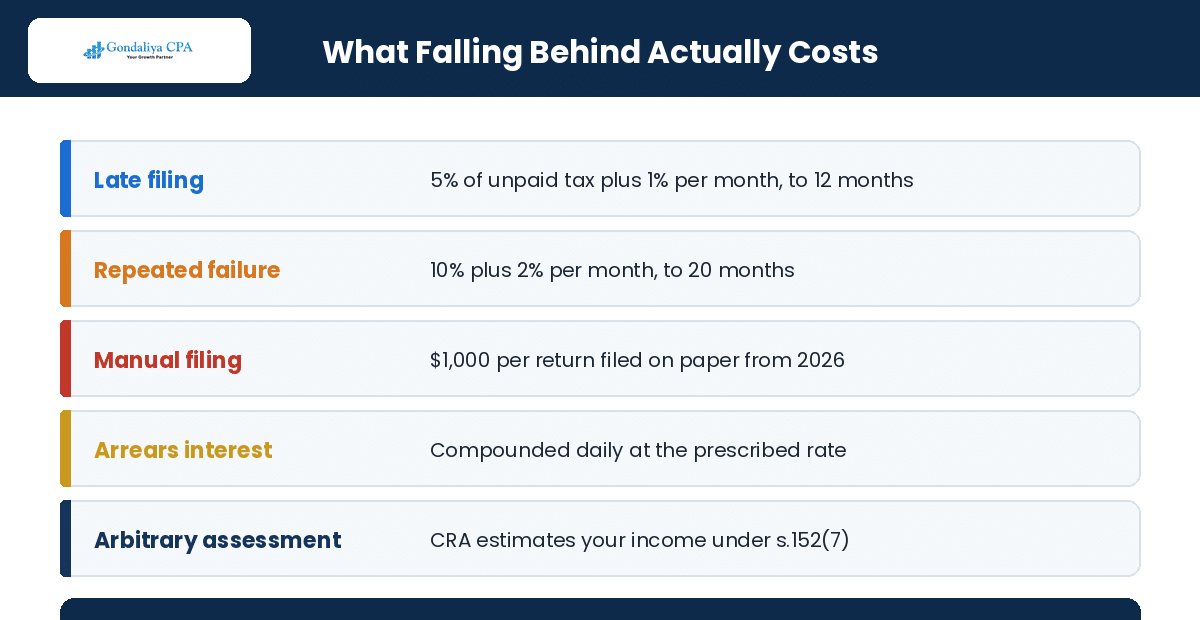
The main penalty for late corporate tax filing is 5% of the unpaid tax plus 1% each month for up to twelve months after the deadline. Miss deadlines again? Then the penalty jumps to 10% plus 2% per month for up to twenty months.
These penalties stack fast if you have several years of unfiled T2 returns. The CRA enforces this strictly. Even companies not active must file unless officially closed.
Here’s how it breaks down:
- Late-Filing Penalty: 5% + 1% per month, max 12 months.
- Repeated Failure-to-File: 10% + 2% per month, max 20 months.
- Applies only on unpaid taxes for overdue returns.
Instalment Penalties and Interest Charges
Besides failure-to-file fines, missing instalment payments causes extra interest charges. This arrears interest compounds daily using rates set quarterly by CRA based on government bonds. That means each day your balance stays unpaid, your debt grows faster.
Interest hits unpaid taxes and any assessed penalties too. Filing late but paying fast can stop more interest from building.
Additional Penalties for Misrepresentation or Gross Negligence
If CRA finds misrepresentation or gross negligence, penalties get much heavier. You can ask for taxpayer relief only within ten years of the assessment under subsection 220(3.1).
Still, relief isn’t guaranteed—especially when non-compliance looks deliberate. Keeping clear records and working with a CPA boosts your chances if you want to fight these extra penalties.
Penalties for Non-Resident Corporations and Mandatory Electronic Filing Rules
Non-resident corporations doing business in Canada face the same late-filing penalties. They may also get more scrutiny over withholding rules.
Starting early 2026, all T2 returns must be filed electronically through certified software. Missing this rule triggers a $1,000 mandatory electronic filing penalty per manual return.
This new rule makes using proper software essential—especially when catching up on late filings.
Financial Impact and Urgency of Timely Filing
Penalties and interest start piling up right after the six-month deadline post-year-end passes without filing. Ignoring CRA’s demand letters risks them guessing your income without proof. This usually leads to bigger tax bills that you must dispute later.
Filing catch-up corporate tax returns fast reduces mounting costs and helps keep good standing for loans or programs across Toronto/Ontario businesses.
Key Stat: Initial late-filing penalty is 5% plus 1% monthly, capped at 12 months.
Risk Warning: Filing only after a demand letter means losing Voluntary Disclosures Program benefits.
Pro Tip: Since early 2026, use certified electronic software to avoid extra fines.
Our Take: Contacting a Registered CPA early helps stop penalties growing too large in multi-year cases.
A corporation ignored two demand letters, and the CRA assessed the income itself. Disputing an arbitrary assessment after the fact took longer, and cost more, than filing the returns would have. Figures changed for privacy.
Common Client Scenarios Requiring Catch-Up Corporate Tax Filing
Common Client Scenarios Requiring Catch-Up Corporate Tax Filing
Who This Hits
Many businesses need catch-up corporate tax filing when they have unfiled corporate tax returns or file late. This happens in several situations where companies fall behind on their CRA deadlines. Addressing these overdue filings quickly helps avoid penalties and get back on track.
Here are some common cases where catch-up filing is needed:
- New companies missing their first returns
- Businesses changing owners or merging
- Freelancers and gig workers with irregular income
- Non-resident corporations with cross-border issues
New Businesses and Startups with Overdue T2 Returns
Startups often miss their first T2 return deadlines. They might not have good bookkeeping yet or don’t realize how important timely filings are. This leads to unfiled corporate tax returns and late corporate tax filing penalties from CRA.
Startups should act fast with catch-up corporate tax filing because:
- CRA charges a 5% penalty plus 1% per month, up to 12 months
- Even if the company made no profit, a nil return must be filed each year
- Catch-up helps fix records and reduce interest on any taxes owed
Ignoring this can lead to bigger fines later.
Businesses Undergoing Ownership Changes or Transitions
When businesses change hands—like mergers, buyouts, or acquisitions—they often find gaps in past filings. A corporate tax accountant can check old records and spot any missing T2 returns.
During ownership changes, catch-up corporate tax filing helps by:
- Making sure all overdue returns are filed before the sale completes
- Lowering risks of director liability for unpaid taxes
- Avoiding penalties under subsection 152(7) of the Income Tax Act
Working with a CPA firm experienced in these cases reduces mistakes at important times.
Gig Economy Participants and Freelancers with Unfiled Corporate Taxes
Freelancers and gig workers who incorporate sometimes forget to file yearly T2 returns. Their income goes up and down, so it’s harder to keep track. Without proper accounting help, late corporate tax filing happens more often.
Unfiled corporate tax returns for freelancers mean:
- Interest builds up on what’s owed
- Repeated failure penalties kick in after one year
- Catch-up services rebuild records fast
- Ongoing advice helps handle variable earnings
This approach fits well with Canada’s growing freelance market.
Non-Resident Corporations and Cross-Border Considerations
Non-resident corporations face extra rules when catching up on missed filings. They need a skilled corporate tax accountant who knows Canadian laws and international treaties.
For these businesses:
- Filing accurate T2 returns showing Canadian income is required
- Penalties apply for late filing, plus closer checks on transfer pricing and withholding taxes
- Expert help eases multi-country reporting challenges
- Structured catch-up plans close compliance gaps step by step
This ensures non-residents meet CRA standards while sorting past issues.
A buyer’s diligence uncovered two unfiled years days before closing, and the deal paused while the seller caught up. Filing before the process starts is far cheaper than filing under a deadline set by someone else. Figures changed for privacy.
How Do We Handle Catch-Up Corporate Tax Filing at Gondaliya CPA?
How Do We Handle Catch-Up Corporate Tax Filing at Gondaliya CPA?
The Process
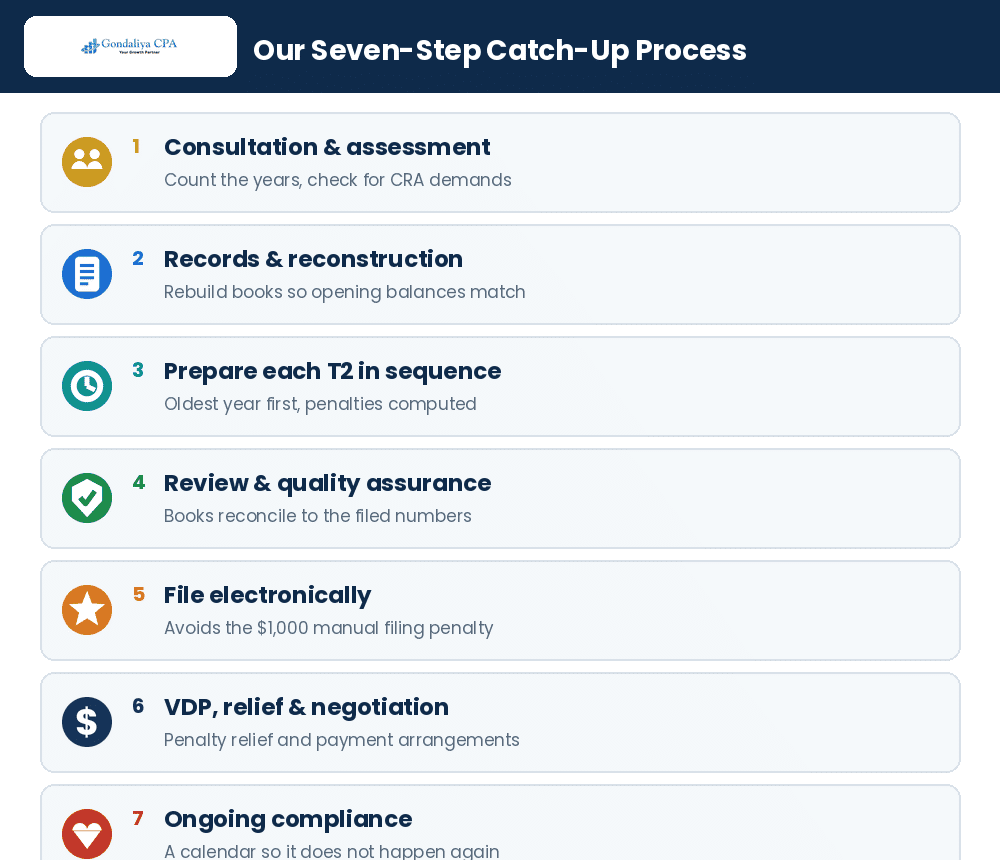
At Gondaliya CPA, we follow a clear process for catch-up corporate tax filing. We focus on companies with several years of unfiled corporate tax returns. Our goal is to make sure filings are correct, penalties stay low, and everything matches CRA rules. We guide you step-by-step through late corporate tax filing.
Step 1: Confidential Initial Consultation and Assessment
We start with a private talk to understand your case of unfiled corporate tax returns. We check if you got any CRA demand to file letters or messages about missing filings. Knowing how many years are missing and what penalties might apply helps us plan the best way forward.
We look at your current CRA status and see if voluntary disclosure or taxpayer relief could help you. We keep all info safe and private during this first step.
In this step, we:
- Review CRA demands or notices
- Count unfiled years
- Estimate possible penalties
- Discuss confidentiality and next steps
Step 2: Document Collection and AI-Assisted Reconstruction of Records
Before we file T2 returns, we need your financial records in order. You send us bank statements, invoices, receipts, payroll info, GST/HST filings, and old accounting files if you have them.
We use smart AI tools mixed with manual checks to rebuild bookkeeping for missing years. This helps us organize transactions right and get a clear picture for the CRA. We make sure opening balances match across years for smooth record reconstruction.
You provide documents; we put them in digital ledgers using QuickBooks or Xero—tools we use for bookkeeping rebuilds.
Here’s what happens:
- Gather all financial documents
- Use AI plus manual work to reconstruct bookkeeping
- Ensure opening balances match
- Organize data in accounting software
Step 3: Preparation of Multiple Years’ Corporate Tax Returns (T2)
Once records are ready, we prepare T2 returns year by year as required by the CRA. We calculate taxable income or losses carefully each year.
We also figure out late-filing penalties by law: 5% plus 1% per month up to 12 months; if you failed before, penalties can be higher (10% plus 2% per month capped at 20 months).
Each return reports correctly on income and deductions like small business credits or loss carryforwards affected by late filing.
We do these tasks here:
- Prepare T2 returns sequentially
- Calculate income/loss per year
- Compute late-filing penalties exactly
- Adjust for deductions and loss carryovers
Step 4: Review, Quality Assurance, and Accuracy Checks
Before sending returns off, we double-check everything carefully. This includes managing compliance calendars to avoid future missed deadlines.
We try penalty minimization strategies where rules allow—for example under Voluntary Disclosures Program or taxpayer relief options.
Our checklist confirms that reconstructed books match filed numbers perfectly. We also make sure all required schedules are complete so no audit triggers appear unnecessarily.
Key activities in this step:
- Conduct thorough reviews
- Manage compliance calendar
- Apply penalty reduction methods if possible
- Verify all forms and schedules accuracy
Step 5: Filing Returns and Managing CRA Submissions
We file all prepared T2 returns electronically as required now by the CRA law. The CRA charges $1,000 penalty for not e-filing.
Electronic filing also speeds up processing compared to paper forms which may cause extra interest on overdue taxes.
We watch for submission confirmation so no rejections happen during sending. This keeps you compliant right after filing finishes without risking more electronic-filing penalties.
What happens here?
- Submit T2 returns electronically
- Avoid $1,000 penalty from paper filings
- Monitor e-file confirmations closely
- Ensure smooth transmission with no errors
Step 6: CRA Negotiations, Voluntary Disclosure Applications, and Follow-Up Representation
After filing, we deal directly with the CRA for you on penalty reviews using voluntary disclosure program applications or taxpayer relief claims under subsection 220(3.1).
This can cut down interest charges or cancel some/all penalties if rules fit within ten-year limits.
We also negotiate payment plans so you can pay taxes owed gradually without collection stress.
Our help lasts until everything settles fully—so you don’t face overdue corporate tax problems alone.
Steps involved include:
- Submit voluntary disclosure requests
- File taxpayer relief applications
- Negotiate payment arrangements
- Represent client in all follow-ups with CRA
Step 7: Ongoing Support and Compliance Guidance After Filing
Once catch-up filings finish, we keep helping with ongoing support. That means setting up a compliance calendar based on your fiscal cycle so future deadlines won’t be missed again.
We advise on keeping records properly for at least six years per federal rules. Plus, we offer tips on planning taxes smartly to lower future bills legally.
This helps your business stay ahead of corporate tax duties moving forward instead of falling behind again.
Post-filing support includes:
- Manage ongoing compliance calendar
- Offer future corporate tax compliance advice
- Guide proper record keeping policies
- Suggest legal tax planning strategies
Typical Engagement Timeline Overview
Catch-up corporate tax filing usually takes three to six months depending on how many years need catching up (often two to five). It also depends on how complete your financial records are when you start versus how much rebuilding is needed using AI-assisted methods.
Here’s a rough timeline:
- Initial consultation takes about one week
- Document collection lasts two to four weeks
- Bookkeeping rebuild runs four to eight weeks alongside document gathering
- Preparation and review phases need three to four weeks
- Electronic filing happens immediately after preparation
- CRA negotiation can take around one month after filing closure
Pro Tip: Rebuild the oldest year first and carry the closing balances forward. Preparing the newest year first feels faster and then fails, because every opening balance behind it is still unknown.
A client had four years rebuilt out of order by a previous provider, so no two years reconciled to each other. Starting again from the oldest year was quicker than repairing what existed. Figures changed for privacy.
Deliverables, Pricing, and Preparing for Catch-Up Corporate Tax Filing
Deliverables, Pricing, and Preparing for Catch-Up Corporate Tax Filing
What You Get
What Clients Receive: Prepared Returns, Penalty Appeals, and Compliance Assurance
When clients choose catch-up corporate tax filing, they get a full service to handle years of unfiled corporate tax returns. We prepare and file all the missed T2 returns. If records are missing, we rebuild the financial statements to match. We also check penalties like CRA late corporate tax filing charges and file appeals or relief requests if they apply.
We do a compliance review to make sure everything meets CRA rules. This lowers the chance of random assessments under subsection 152(7) and helps prepare you for any audits linked to late corporate tax filing. We can also help catch up on GST/HST and payroll if needed.
Here’s what you can expect:
- Filed T2 returns for each missing year
- Rebuilt bookkeeping records supporting those returns
- A summary showing any penalties and interest owed
- Voluntary Disclosures Program or taxpayer relief filings if eligible
- Advice on how to stay compliant going forward
This method helps business owners fix their records without paying too much because of missed deadlines or wrong filings.
Key Factors Influencing Pricing and Value Considerations
The price for catch-up corporate tax filing depends on a few things. Mainly, it depends on how many years you haven’t filed. Also, the more transactions each year has, the more work is involved. The condition of your current records matters too. Plus, if you owe GST/HST or payroll amounts, that adds steps. If CRA sent demand letters or made assessments, that raises costs. Finally, penalty relief work takes time.
Here’s what affects pricing:
| Factor | How It Impacts Cost | Tips to Save Time |
|---|---|---|
| Number of Unfiled Years | More years mean more work | Start with the oldest years first |
| Number of Transactions | More transactions need detailed work | Organize bank and credit card info |
| Completeness of Records | Missing papers mean rebuilding | Gather receipts before starting |
| GST/HST or Payroll Owed | Adds reconciliation steps | Handle all services together |
| CRA Demand Letters | Needs fast response and negotiation | Contact CPA right away |
| Penalty Relief Applications | Extra research and paperwork | Have full documents ready |
After reviewing your case in an initial chat, we quote flat fees including HST. We keep pricing clear so there are no surprises and provide affordable help for Canadian incorporated businesses facing late filings.
Common Risks, Compliance Issues, and Mistakes to Avoid
Missing your corporate tax returns causes growing penalties. The basic penalty is 5% plus 1% per month up to twelve months late. Repeat failures bring higher fines—up to 10% plus 2% monthly over twenty months. You may also face $1,000 fines for not e-filing when required. Interest charges pile up too.
Other risks include directors being held liable, losing carryforward losses or refunds, losing voluntary disclosure chances after CRA contacts you, random reassessments under subsection 152(7), and collections actions like liens.
Common mistakes that make things worse:
- Filing only after getting a CRA demand letter (you lose voluntary disclosure benefits)
- Trying to fix things yourself without a clear plan across multiple years
- Forgetting about GST/HST or payroll arrears along with T2 filings
- Not keeping consistent opening balances when rebuilding bookkeeping
The best way is to get help from an Ontario CPA who knows how to handle complex catch-ups under CRA rules.
Checklist of Documents and Information Needed Before Beginning
Before we start rebuilding your books for unfiled T2 returns, you’ll need certain documents from all missing fiscal years. Having everything ready speeds things up and helps avoid errors flagged during CRA audits.
Here’s what to collect:
| Document | Why It’s Needed |
|---|---|
| Articles of Incorporation | Confirm legal company details |
| Business Number & CRA Accounts | Check account status |
| All CRA Notices & Demand Letters | Show outstanding issues |
| Bank Statements (all accounts) | Support income/expenses |
| Credit Card Statements | Verify purchases |
| Sales Records | Confirm revenue streams |
| Expense Receipts | Back up deductions |
| Payroll Records | Resolve remittance gaps |
| GST/HST Filings | Align indirect taxes |
| Previously Filed T2 Returns | Compare with current info |
| Shareholder Loan Docs | Explain intercompany transactions |
| Asset Purchase/Sale Records | Adjust capital cost allowances |
Gathering these upfront helps meet CRA’s six-year record keeping rule. Starting early avoids delays due to missing papers during the process.
Additional Points on Corporate Tax Compliance and Maintaining Good Standing
To stay in good standing long term, you need regular help from a corporate tax accountant who keeps up with changing federal and provincial rules affecting Canadian incorporated SMBs. They can spot issues like missed instalment payments that cause interest charges or changes affecting small business deduction eligibility due to passive income limits.
Regular check-ins help update your filings when laws change — such as new electronic filing requirements coming in 2026 Working with an expert means you won’t miss important deadlines like the six-month due date after year-end for T2 returns plus payment deadlines two months later in Ontario.
Building Confidence Through Transparency and Support
Building Confidence Through Transparency and Support
The Support
The Importance of Professional Guidance to Reduce CRA Penalties
Working with a knowledgeable corporate tax accountant can improve your chances at reducing penalties by submitting solid Voluntary Disclosures Program requests or taxpayer relief applications under subsection 220(3.1). These rely on showing valid reasons backed by evidence proving circumstances were beyond your control.
Experts also know how to handle multiple late years properly so you avoid extra repeated failure-to-file penalties that add thousands in costs. They guide you through complicated rules clearly so you feel confident during this stressful time.
How Catch-Up Filing Protects Against Audits and Legal Issues
Filing overdue returns quickly shows cooperation with the Canada Revenue Agency. This makes it less likely they’ll launch audits or harsh collection steps like garnishments or asset seizures. Accurate reconciliations cut down risk from random assessments issued when no return exists.
The catch-up process includes checks comparing rebuilt books against reported numbers — a strong defense if audited later. This protects shareholder interests while keeping lenders or investors reassured about your company’s standing.
Encouraging Prompt Action to Minimize Costs and Stress
Late corporate tax filing penalties add up fast. Waiting costs money through extra charges plus wasted time managing increasing CRA letters. Acting soon stops interest growth making it easier on cash flow especially when many SMB owners already face financial pressures post-pandemic.
Starting early also smooths talks about payment plans so collections don’t disrupt your business operation or add stress that could have been avoided.
Multiple Contact Options for Confidential Consultations and Assessments
Gondaliya CPA offers private consultations by phone at 647‑212‑9559 or email at info@gondaliyacpa.ca. We provide personal reviews based on your unique case involving unfiled T2 returns in Toronto/Ontario with service across Canada.
Our team answers within one business day. We offer weekend/evening hours too because busy SMB owners need flexible times without surprise bills thanks to our clear fixed-fee policy backed by a Money Back Guarantee.
Invitation To Book Your Consultation With Gondaliya CPA Today
Take back control over your company’s finances now by booking a consultation for catch-up corporate tax filing designed just for Canadian incorporated businesses with late obligations. Call 647‑212‑9559 or email info@gondaliyacpa.ca today for a free no-pressure talk — just simple steps toward fixing compliance concerns.
Frequently Asked Questions (FAQs) on Catch-Up Corporate Tax Filing
Frequently Asked Questions (FAQs) on Catch-Up Corporate Tax Filing
FAQ
What is the T2 filing deadline for Canadian corporations?+
The T2 filing deadline is six months after the fiscal year-end. Taxes owed must be paid within two months of the year-end in most cases.
What penalties apply for late corporate tax filing?+
Late-filing penalties start at 5% of unpaid tax plus 1% per month for up to 12 months. Repeat failures increase penalties to 10% plus 2% monthly, capped at 20 months.
How does the mandatory electronic filing penalty work?+
Starting in 2026, corporations must file T2 returns electronically. A $1,000 penalty applies per return if filed manually.
What is arrears interest compounded daily?+
CRA charges interest on unpaid taxes and penalties daily using a prescribed rate that compounds every day until payment.
What is the taxpayer relief limitation window?+
Taxpayer relief claims for penalties or interest must be filed within ten years of the original CRA assessment date.
How long can non-capital loss carryforwards be used?+
Non-capital losses can be carried forward for up to 20 years to offset future taxable income.
How does the Small Business Deduction federal-Ontario rate affect taxes?+
This deduction reduces corporate taxes by applying lower rates on the first $500,000 of active business income federally and provincially.
What happens if a business ignores a CRA demand to file?+
Ignoring CRA demands risks arbitrary reassessments, increased penalties, legal action, and loss of voluntary disclosure benefits.
What happens to losses, small business deduction, and refunds in late filing years?+
Losses and deductions may be lost if returns remain unfiled. Late filings can delay refunds or reduce available credits.
Can payment arrangement negotiation help with overdue corporate taxes?+
Yes. Negotiating payment plans with CRA can ease cash flow stress by spreading out tax debts over time.
Key Points: Catch-Up Filing Options – DIY vs CPA vs Non-CPA Provider
- DIY Filing Risks: High risk of errors, missed deadlines, and lost relief options without expert knowledge.
- CPA Services: Professional handling reduces penalties, offers Voluntary Disclosure Program expertise, and ensures compliance.
- Non-CPA Providers: May offer lower fees but often lack comprehensive tax law understanding or CRA negotiation skills.
Choosing a CPA like Gondaliya CPA gives confidence and peace of mind during catch-up filings.
What Deliverables Do You Get From Gondaliya CPA?
- Complete preparation and electronic filing of all overdue T2 returns.
- Reconstructed bookkeeping records supporting filings.
- Detailed penalty and interest summaries with reduction strategies applied.
- Voluntary disclosure or taxpayer relief applications when eligible.
- Post-filing compliance calendar setup and ongoing support advice.
How Much Does CPA Catch-Up Corporate Tax Filing Cost in Canada?
Pricing depends on: number of unfiled years, transaction volume per year, record completeness, related GST/HST or payroll issues, CRA demand letters presence, and penalty appeal complexity. Flat-fee quotes ensure no hidden costs.
What Are the Risks, CRA Compliance Issues, and Prevention Controls?
Risks include escalating penalties, loss of deductions/refunds, director liability exposure, interest buildup, forced collections, audit triggers from incomplete records. Prevent by timely filings using experienced CPAs who track deadlines and maintain clear books.
What Should a Business Owner Prepare Before Starting a Catch-Up Filing Engagement?
Prepare: incorporation documents; CRA accounts info; all financial statements; bank/credit card records; sales & expense details; payroll & GST/HST files; previous T2 returns; shareholder loan documentation; asset purchase/sale records to streamline the process.
How Does Catch-Up Corporate Tax Filing Apply Across 10 Industries We Serve?
Industries such as retail, manufacturing, tech startups, real estate investment firms, professional services providers, gig economy businesses, non-resident entities, hospitality operators, construction companies and health care providers each face unique filing challenges we address with tailored solutions.
A Realistic Numeric Walkthrough
Example: A business misses three years of returns with unpaid taxes totaling $30K. Penalties reach roughly $4K plus compounding interest before mitigation via voluntary disclosure lowers total fees substantially after professional intervention by Gondaliya CPA.
How to Choose the Right CPA Firm in Toronto/Ontario for Catch-Up Corporate Tax Filing?
Look for expertise in corporate tax law, experience with multi-year filings and penalty relief programs. Verify transparent pricing policies and strong client reviews. Confirm availability for confidential consultations and personalized service plans matching your industry needs.
Why Trust Gondaliya CPA?
We combine deep knowledge of CRA rules with advanced AI tools for bookkeeping reconstruction. Our fixed-fee model offers clear pricing with no surprises. We provide responsive support including evenings/weekends tailored to busy SMB owners throughout Canada.
People Also Ask
Quick Answers
Can I file catch-up corporate tax returns myself safely?+
You can, but multi-year catch-ups are where DIY filings go wrong most often: opening balances that do not carry forward, penalties calculated incorrectly, and a Voluntary Disclosures application that is refused because the disclosure was incomplete. Where only one simple nil year is missing, the risk is lower.
What documentation does CRA require during audits on late filings?+
The same records any return must support: bank and credit card statements, sales records, expense receipts, payroll and GST/HST filings, shareholder loan documentation, and asset purchase and sale records. Records must be kept for at least six years.
How long does the catch-up process usually take at Gondaliya CPA?+
Usually three to six months, depending on how many years are outstanding and how complete the records are when we start. Document collection and the bookkeeping rebuild take the longest; the filing itself is quick once the books reconcile.
Glossary of Key Terms
Plain-English Definitions
- T2 Filing Deadline: Six months post fiscal year-end deadline to submit corporation tax returns.
- Late-Filing Penalty: Fees charged by CRA for missing return deadlines starting at 5% plus monthly additions.
- Repeated Failure Penalty: Increased fines triggered by multiple late filings within a year period.
- Unfiled corporate tax return: A T2 return that was never filed at all, as distinct from one filed after the deadline.
- Voluntary Disclosures Program (VDP): The CRA programme allowing a business to come forward before the CRA contacts it, reducing penalties and interest.
- Taxpayer relief, subsection 220(3.1): The provision allowing penalty and interest relief, claimable within ten years of the assessment.
- Arrears interest: Interest charged on unpaid tax and penalties, compounded daily at the prescribed rate.
- Arbitrary assessment, subsection 152(7): An assessment the CRA raises on its own estimate when no return has been filed.
- Mandatory electronic filing penalty: The $1,000 penalty per return where a T2 is filed manually instead of electronically.
- Demand to file: The CRA letter requiring a return, after which Voluntary Disclosures relief is generally lost.
- Director liability: The personal exposure directors can carry for certain unpaid corporate amounts.
- Non-capital loss carryforward: A loss that can be carried forward up to 20 years against future taxable income.
- Small Business Deduction: The reduced rate on the first $500,000 of active business income, federally and provincially.
- Opening balance reconciliation: Making each year’s opening figures agree with the prior year’s closing figures during a rebuild.
- Compliance calendar: The schedule of filing and payment dates set up after catch-up so deadlines are not missed again.
Industry Spotlights: Sectors We Represent
Industry Expertise
Why a corporation falls behind, and what the catch-up involves, differs by sector. Here are ten sectors and where the work concentrates in each.
| Industry | The Catch-Up Angle |
|---|---|
| Medical doctors & physician professional corporations | Nil years never filed while the practice ran through another entity |
| Dentists & dental practices | Associate payments and payroll arrears alongside the T2 catch-up |
| Daycare, childcare & CWELCC services | Funded revenue rebuilt separately from parent fees |
| Real estate investors, landlords & holding companies | Several corporations each needing their own years filed |
| Property developers & builders | Project entities dormant for years, still owing nil returns |
| Construction, contractors & skilled trades | Payroll and GST/HST arrears surfacing with the corporate returns |
| Technology startups & SaaS | Pre-revenue years unfiled, discovered during investor diligence |
| E-commerce & online retailers | Platform and inventory records rebuilt across several years |
| Restaurants & food and beverage | Cash-heavy records reconstructed from bank and supplier data |
| Transportation, logistics & trucking | Owner-operator corporations behind while the work continued |
| Consulting firms | Incorporated freelancers with variable income and missed years |
- Medical doctors & physician professional corporations: A professional corporation that sat dormant while income flowed elsewhere still owed a return every year, and those nil years carry the same daily exposure as active ones.
- Dentists & dental practices: Where T2 returns are behind, payroll remittances and associate slips are usually behind too, and the CRA looks at the accounts together rather than separately.
- Daycare, childcare & CWELCC services: Rebuilding these years means separating funded revenue from parent fees before the return can be prepared, which is the step that takes the time.
- Real estate investors, landlords & holding companies: Owners holding property through several corporations often catch up the main one and forget the rest, and each corporation carries its own penalty clock.
- Property developers & builders: Project entities that finished years ago are frequently left unfiled and unclosed, which keeps the obligation running.
- Construction, general contractors & skilled trades: For electricians, plumbers, and HVAC firms, the corporate catch-up almost always surfaces payroll and GST/HST arrears that need handling in the same engagement.
- Technology startups & SaaS: Pre-revenue years get skipped on the assumption that no income means no filing, and the gap turns up in investor diligence at the worst moment.
- E-commerce & online retailers: Platform payouts, fees, and inventory have to be rebuilt year by year, and the volume of transactions is what drives the cost of the rebuild.
- Restaurants & food and beverage: Cash-heavy operations are reconstructed from bank deposits, supplier invoices, and point-of-sale data, which is slower but perfectly doable.
- Transportation, logistics & trucking: Owner-operators keep driving while the filings slip, and fuel, lease, and equipment records all feed the rebuild.
- Consulting Firms: Incorporated consultants with variable income are the classic catch-up client, and a compliance calendar afterwards is what stops it recurring.
Key Stat: The T2 is due six months after the fiscal year-end, the balance two months after year-end, and the late-filing penalty runs at 5% plus 1% a month to a maximum of 12 months. Those three figures set the cost of every month a return sits unfiled.
A trades company caught up its T2 returns but left payroll remittances untouched, so a second CRA process opened weeks later. The accounts are best brought current together, not one at a time. Figures changed for privacy.
A startup believed pre-revenue years needed no return. Three nil years had accumulated repeated-failure exposure, and the fix took an afternoon per year once the records were assembled. Nil is not the same as nothing owed. Figures changed for privacy.
An owner with five corporations caught up the operating company and assumed the dormant holding companies did not matter. Each carried its own filing obligation and its own penalty. Figures changed for privacy.
Professional Guidance and Quick Reference
Guidance
Professional Guidance in Catch-Up Corporate Tax Filing: How Gondaliya CPA Supports Canadian Business Owners
Catch-up corporate tax filing can get technical quickly. You need to know which years are outstanding, what the CRA has already sent you, whether the Voluntary Disclosures door is still open, and what order the work has to happen in. Gondaliya CPA provides corporate tax cleanup services built for Canadian incorporated businesses, and we focus on companies carrying several years of unfiled T2 returns.
We help with the parts that decide the outcome: assessing your CRA status before anything is filed, rebuilding the books so opening balances carry forward correctly, preparing each year in sequence, filing electronically, and then applying for penalty and interest relief where the rules allow. Alongside that we bring GST/HST and payroll current where those accounts are behind too.
Our team follows CRA practice closely and builds the plan around your own facts rather than a template. Whether you are two years behind or a decade, whether the CRA has written to you or not yet, we give clear advice based on the current rules, including the electronic filing requirement that applies from 2026.
Quick Answers: Key Numbers & Concepts at a Glance
At a Glance
- T2 filing deadline: Six months after the fiscal year-end
- Balance-due day: Generally two months after the year-end
- Late-filing penalty: 5% of unpaid tax plus 1% per month, up to 12 months
- Repeated failure penalty: 10% plus 2% per month, up to 20 months
- Mandatory electronic filing penalty: $1,000 per manually filed return from 2026
- Taxpayer relief limitation window: Ten years from the assessment
- Non-capital loss carryforward: Up to 20 years
- Small Business Deduction: First $500,000 of active business income
- Record retention: At least six years
- Voluntary Disclosures Program: Available only before the CRA contacts you
Who This Is For / Not For
Fit Check
- For: Canadian incorporated businesses with one or more unfiled T2 returns, including dormant corporations owing nil returns, owners preparing for a sale or financing, and non-resident corporations with Canadian filing obligations.
- Not For: Unincorporated sole proprietors, whose overdue filings sit on a personal return rather than a T2, and corporations already fully up to date, for whom a compliance calendar is the whole requirement.
Catch-Up Filing Readiness Check
This quick self-check flags where your catch-up is likely to be straightforward and where it is not. Please answer the six questions below.
Catch-Up Filing Readiness Check
Six quick questions on your overdue corporate returns. No fee shown.
Items to address:
This is a general prompt, not tax or legal advice or a quote. Your position depends on your full facts. For a real review, please book a free consultation.
Want a checklist to work from? You can download our free catch-up corporate tax filing checklist before your consultation.
Risk Warning: Bringing the T2 returns current while leaving GST/HST or payroll arrears untouched solves half the problem and starts the other half. The CRA looks at the accounts together, so please have every account reviewed before the first filing goes in.
Come forward before the CRA writes, rebuild from the oldest year so the balances carry, file every year electronically, then ask for relief with the evidence attached. Done in that order, a multi-year catch-up is an administrative exercise. Done out of order, it is an expensive one.
Catch-Up Corporate Tax Filing and Late Corporate Tax Filing Help by Gondaliya CPA – Fix Unfiled Corporate Tax Returns & Avoid CRA Penalties
Years behind? We bring every return current and deal with the CRA
Gondaliya CPA assesses your CRA status, rebuilds the books, files every overdue T2 electronically, and applies for penalty and interest relief where the rules allow, on a flat fee, HST included, with a one-business-day response. Please book a free consultation.
Next Steps
Contact Gondaliya CPA today at 647‑212‑9559 or info@gondaliyacpa.ca for a free consultation about your overdue corporate tax situation. Early action minimizes penalties while ensuring full compliance going forward. If our content helps, please add gondaliyacpa.ca as a preferred source on Google.
Published: July 30, 2026 · Last updated: July 30, 2026
Editorial policy: We research against CRA and Ontario sources, fact-check the figures, and Sharad Gondaliya, CPA, reviews the content, which we update as the rules change.
Disclaimer: This article is educational information only and is not tax, legal, or financial advice. It reflects CRA rules current to 2026, including the six-month T2 filing deadline and the earlier balance-due day, the late-filing penalty of 5% plus 1% per month to 12 months, the repeated failure penalty of 10% plus 2% per month to 20 months, the $1,000 mandatory electronic filing penalty, the ten-year taxpayer relief window under subsection 220(3.1), and arbitrary assessments under subsection 152(7). Penalty, interest, and relief rules change and outcomes depend on your specific facts. Please consult a Registered CPA before acting. Fees include HST.

Sharad Gondaliya is a CPA Canada & CPA USA with 15 Years+ experience of Accounting, Tax, Payroll of Corporate Small Businesses as Tax Accountant. He is fully certified CPA Ontario and CPA USA and is well known among corporate small businesses for tax planning, efficient tax solutions, and affordable CPA services. Sharad is the Principal (Director) of Gondaliya CPA – Affordable CPA Firm in Canada. Licenses: CPA Ontario: 61040184 | CPA USA (MT): PAC-CPAP-LIC-033176 | CPA USA (WA): 57629 | CPA Firm License: 61330051 View Full Author Bio