



How a Nominee Director Can Help Non-Resident Business Owners Maintain Canadian Corporate Compliance
Nominee director Canada services are essential for non resident corporations aiming to meet resident director requirements Canada while maintaining Canadian corporate compliance. Gondaliya CPA offers affordable nominee director services and expert corporate director services Canada to support foreign owned corporation Canada in fulfilling director requirement for Canadian corporation and ensuring smooth Canadian corporation for non residents operations.
Quick Summary
A nominee director satisfies Canadian residency law on the board of a non-resident owned corporation, files what has to be filed, and keeps the corporation in good standing, while the owner keeps control through the nominee agreement. Please note the nominee is a real director carrying real fiduciary duties, which is exactly why the agreement, the indemnity, and the ISC register have to be right from the first day.
| Aspect | Details |
|---|---|
| The requirement | Canadian residency on the board, federally and in Ontario. |
| The mechanism | A nominee director appointed under a written nominee agreement. |
| The ongoing work | Annual returns, ISC register updates, registered office, records. |
| Who it suits | Foreign investors owning Canadian corporations from abroad. |
Reading time: 30 minutes.
Table of Contents
- Nominee Director Services in Canada: Meeting Resident Director Requirements
- Privacy Protection and Confidentiality in Nominee Director Agreements
- Initial Consultation: Assessing Corporate Needs and Residency Obligations
- Social Proof and Credibility
- Legal Insights and Compliance Framework
- Transparent Pricing Structure and No Hidden Fee Policies
- Frequently Asked Questions
- Key Takeaways, Glossary, and Next Steps
- Industry Spotlights: Sectors We Represent
- Professional Guidance and Quick Reference
The Numbers That Matter
This article covers Canada, with Ontario and Toronto context, and reflects corporate and CRA rules current to 2026. It assumes a privately held corporation with one or more non-resident owners. “Illustrative” figures are examples, not quotes, and any masked engagement notes end with “Figures changed for privacy.” This is educational information only and not tax, legal, or immigration advice; director arrangements require a lawyer alongside your CPA. Fees include HST. Corporate statutes differ by province and change, so please confirm your own situation before appointing anyone.
Nominee Director Services in Canada: Meeting Resident Director Requirements
Nominee Director Services in Canada: Meeting Resident Director Requirements
The Basics
If you own a non-resident corporation in Canada, you need a nominee director. This person acts as your local representative on the board. Canadian law requires at least one director to be a resident of Canada. Without this, your company might face legal issues. The nominee director service helps foreign business owners follow these rules while running their company smoothly.
Understanding the Role of a Nominee Director for Non-Resident Corporations
A nominee director plays an important role for non-resident corporations. They help meet Canadian corporate compliance by making sure documents are filed and rules are followed. By having a local nominee director, you avoid dealing with everyday legal duties yourself.
Here’s what they do:
- Attend board meetings
- Sign key documents
- Follow federal and provincial rules
This setup lets non-residents fulfill the rule of having at least one resident Canadian on the board without direct daily involvement.
Importance of Resident Directors under Canadian Corporate Compliance
Having a resident director matters beyond just ticking regulatory boxes. It builds trust with banks, suppliers, and government bodies. It also lowers the chance of fines or other problems from not meeting residency rules.
Some benefits include:
- Easier access to banking services
- Better reputation with clients and partners
- Lower risk of penalties linked to residency laws
These points explain why hiring professional help like Gondaliya CPA makes sense for hassle-free compliance and cost control.
An owner abroad had incorporated federally and then discovered no one on the board satisfied the residency rule, which stalled the bank onboarding entirely. Appointing a resident director properly, with the consent and filings in order, unblocked it. The board composition is checked earlier than most owners expect. Figures changed for privacy.
How Gondaliya CPA Supports Non-Resident Businesses with Corporate Governance
Gondaliya CPA offers services made for non-resident corporations in Canada. We know the rules can get tricky. Our team guides you through governance needs while avoiding common risks.
Our nominee director service includes:
- Appointing skilled resident directors familiar with local laws
- Advising on any legal changes that affect your company
- Helping with yearly filings and other official paperwork
With our affordable nominee director service fee, you can relax knowing your company stays compliant. This frees up your time to grow your business in areas like real estate or tech startups.
Privacy Protection and Confidentiality in Nominee Director Agreements
Privacy Protection and Confidentiality in Nominee Director Agreements
The Agreement
When you appoint a nominee director in Canada, you get a legal nominee director agreement. This agreement spells out what the nominee can and cannot do. It keeps things private by setting clear confidentiality rules. Usually, an indemnity agreement comes with it to protect the nominee from personal risk caused by decisions made by the company’s owner.
Non-resident companies use nominee directors to stay compliant but keep ownership details under wraps. These agreements limit who can see sensitive info, sticking to what law demands without spilling more. This setup balances the need for transparency with keeping secrets safe — something foreign investors often want when managing Canadian companies quietly.
Risk Warning: Confidentiality in a nominee arrangement never extends to beneficial ownership. The individuals with significant control must still be recorded and kept current, whoever sits on the board. Please treat the ISC register as the one thing a nominee arrangement cannot make private.
Legal Compliance with Canada Business Corporations Act and Provincial Laws
Canadian corporate compliance means following both federal CBCA rules and provincial laws about resident directors. The CBCA says most federally incorporated companies need at least 25% of their directors to be Canadian residents unless an exemption applies. Ontario’s Business Corporations Act has similar rules but gives some leeway for companies registered outside the province.
Non-resident corporations across Canada rely on appointing a qualified resident or nominee director to meet these rules. This keeps them up to date with filings like annual returns and director changes. If they don’t follow these laws, they risk penalties such as losing their business status or facing restrictions.
Ensuring Seamless Operations for Non-Resident Corporations
Non-resident corporations in Canada depend on smooth corporate governance support from professional nominee directors. These directors handle tasks like running board meetings remotely, keeping accurate minutes, and filing reports on time.
A registered office is crucial here. It acts as the official spot where legal papers arrive and records stay safe. Nominee directors usually manage this address too, ensuring regulators like Corporations Canada or provincial offices always have a point of contact.
This approach helps avoid problems from missed deadlines or poor communication — common issues for foreign-owned firms working from afar.
Registered Office and Mailing Address Solutions in Ontario
Ontario law requires every corporation to have a registered office inside the province where official mail can be sent fast. For non-residents without a local presence, mailing address services in Ontario solve this problem effectively.
These services securely receive government notices like annual return reminders from the Ontario Business Registry or tax-related letters from CRA. Having corporate records physically stored in Toronto also makes audits easier while meeting federal and provincial record-keeping laws.
Registered office providers set up clear document forwarding rules so remote clients don’t miss anything important due to distance.
Flexibility and Governance Support through Professional Corporate Director Services
Professional nominee director services in Canada offer flexible governance setups that fit non-resident corporations’ needs. Besides meeting resident director requirements, they provide ongoing advice on duties like avoiding conflicts of interest, handling indemnity agreements, and arranging insurance coverage.
This support keeps governance steady even when shareholders change or companies restructure—common for small-to-medium firms outside Canada’s borders. Some CPA firms combine accounting help with directorship roles so owners rest easy knowing their company stays compliant year-round without hiccups.
Advantages of Using Affordable Nominee Director Services for Foreign Investors
Affordable nominee director options let foreign investors follow complex residency rules without big costs. Many Registered firms charge flat fees that include HST and cover appointment steps, consent forms with indemnity clauses, plus ongoing checks required by authorities.
This clear pricing avoids surprise bills often seen with separate service providers. Extra perks may include CRA representation during audits or tax help geared toward cross-border owners of non-resident Canadian businesses.
Choosing affordable but skilled nominees lowers risks linked to bad appointments—like invalid filings or losing control over key decisions—helping foreign investors run Canadian corporations smoothly over time.
Our Take: The cheapest nominee arrangement is rarely the least expensive one. A name on a form with no agreement behind it costs nothing until a bank asks who controls the company or a filing is missed, and then it costs a great deal. The agreement is the product, not the appointment.
Initial Consultation: Assessing Corporate Needs and Residency Obligations
Initial Consultation: Assessing Corporate Needs and Residency Obligations
The Process
The initial consultation looks at your company’s structure, residency rules, and what you must do to stay legal in Canada. You need to know about nominee director Canada and resident director Canada rules to meet Canadian corporate compliance from the start. We check if you must appoint a local or nominee director under laws like the CBCA or Ontario Business Corporations Act.
We also study who owns your corporation, where you do business in Canada, and your past filings. This helps us give you advice that fits your situation. For owners of a non resident corporation Canada, understanding residency duties helps avoid fines from missed filings or wrong directorships. Plus, we explain how nominee directors can fill in when resident directors are needed but not available.
Appointment of Nominee Director: Step-by-Step Guidance
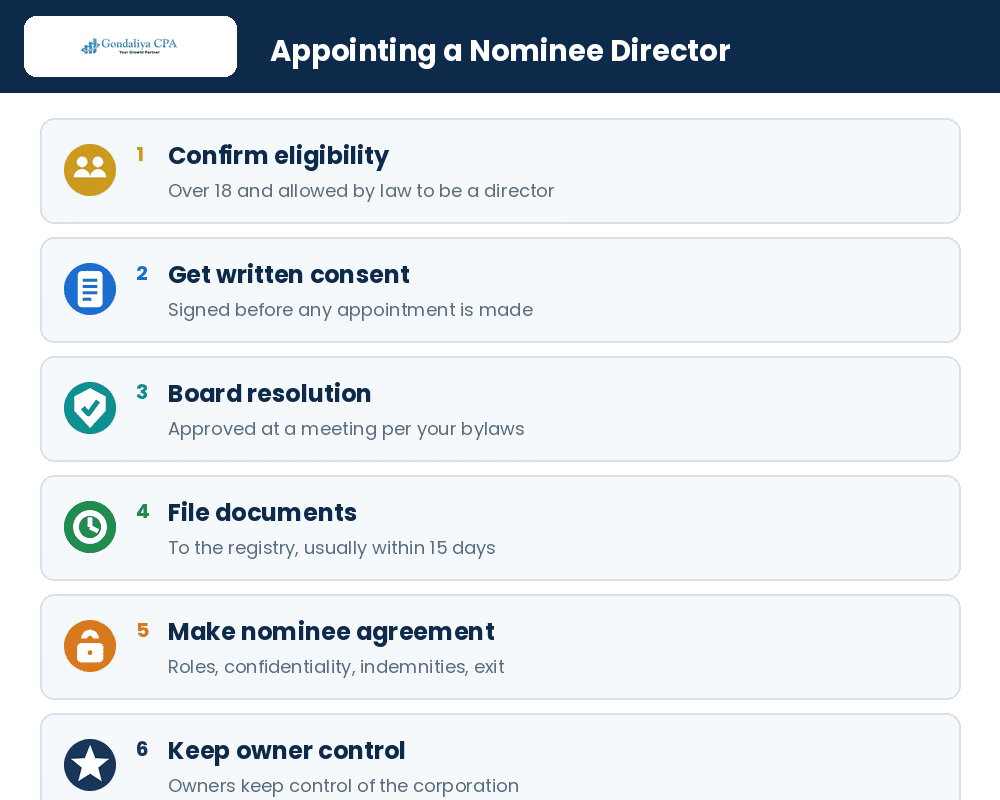
Here’s how to appoint a nominee director properly. Following these steps keeps things legal and protects your interests.
- Confirm Eligibility: Make sure the person is over 18 and allowed by law to be a director[3].
- Get Written Consent: Have the nominee agree in writing before any appointment.
- Board Resolution: Approve the appointment through a board meeting per your bylaws.
- File Documents: Send required forms to Corporations Canada or provincial registry within deadlines (usually 15 days)[4].
- Make Nominee Agreement: Create a contract detailing roles, confidentiality, indemnities, and how either side can end it.
- Keep Owner Control: Set rules so owners keep control even if someone else acts as director.
- Plan Resignations/Replacements: Have clear steps for resigning directors and new appointments.
This process meets resident director requirements Canada and lowers risks from poor management or loss of control.
Ongoing Management and Annual Nominee Agreements to Maintain Compliance
Keeping up with Canadian corporate compliance means more than just one appointment:
- Watch Annual Return Filing Deadlines
File returns on time to avoid penalties or losing good standing[5]. - Update ISC Register Regularly
Keep Individuals with Significant Control info current each year[6]. - Renew Nominee Agreements Annually
Check consent yearly and update indemnities as laws change about fiduciary duties. - Be Clear About Fees
Explain nominee director service fee upfront including filings, communication, and record keeping.
We also watch for changes in rules that affect reports or liabilities tied to being a director in non-resident corporations.
Transparent Communication and Reporting for Corporate Governance
Good governance needs open talks between nominees, owners, accountants, and regulators:
- Directors have fiduciary duties to act honestly; breaking these can bring personal liability within set time limits[7].
- Share important company changes quickly so problems don’t get worse.
- Follow regular reporting with financial statements made per CPA standards plus keep all official records.
- Write down decisions clearly to show what local directors did versus owner instructions. This helps during audits by CRA or Corporations Canada[8].
Being transparent builds trust while keeping foreign-owned companies on track with Canadian corporate compliance rules.
How Gondaliya CPA Facilitates Smooth Director Transitions and Compliance Updates
Gondaliya CPA helps non-resident business owners deal with complex residency laws through affordable nominee director services:
- We handle onboarding with identity checks as FINTRAC requires.
- Offer advice matching incorporation choices with resident director rules.
- Process all government filings on nominations so no deadlines are missed.
- Prepare custom nomination agreements with protection clauses reducing risk.
- Alert clients early about ISC register updates & annual return due dates.
- Manage resignations and replacements smoothly so operations don’t stop.
- Provide clear fees up front so you won’t get surprise charges.
Our team keeps Canadian corporate compliance going without interruptions so foreign-owned firms can focus on their work.
A group appointed a nominee but never filed the change with the registry, so the public record still showed the old board when the bank ran its check. Filing inside the window is what makes the appointment visible to everyone who matters. Figures changed for privacy.
Social Proof and Credibility
Social Proof and Credibility
Credibility
Verified CPA Firm Credentials and Industry Certifications
Gondaliya CPA is a Registered Ontario CPA firm. It’s fully recognized by CPA Ontario. This means it meets all the professional standards for corporate services in Canada. Sharad Gondaliya leads the firm. He holds CPA licenses in both Canada and the USA. Specifically, he’s Registered in Washington and Montana states. Sharad brings over ten years of experience focused on nominee director Canada services and rules for non resident corporation Canada compliance.
The firm is registered with NUANS and follows Corporations Canada regulations closely. Clients can trust that their Canadian corporate compliance needs get handled properly. The firm stays updated with the 2026 changes to director residency rules and ISC register transparency laws.
Client Testimonials and Google Reviews Highlighting Service Reliability
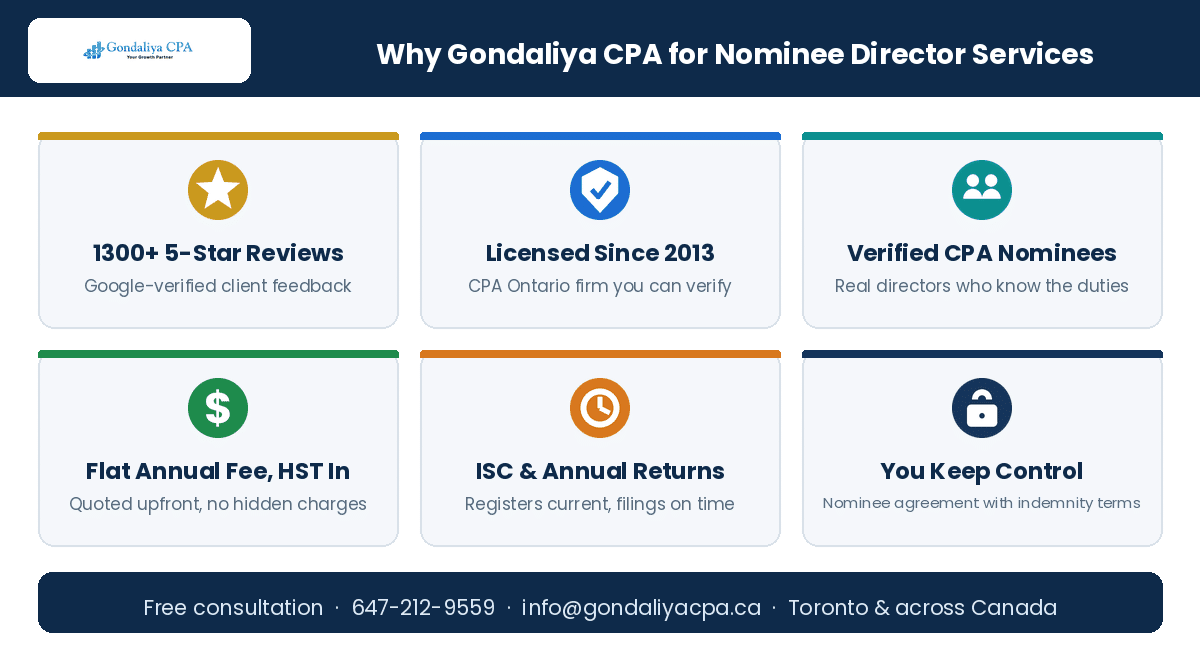
Gondaliya CPA has more than 1300 five-star reviews on Google. Clients often mention how quick the firm responds—usually within one business day. They also like the clear flat-fee pricing, which avoids surprise bills later on. These reviews show that people trust the firm when dealing with sensitive tasks, like appointing nominee directors or managing local directors for companies owned by non-residents.
The high number of positive reviews proves the firm delivers solid, affordable nominee director services while handling Canadian corporate compliance well.
Case Studies Demonstrating Success with Non-Resident Business Nominee Director Setups
Gondaliya CPA helped many non-resident corporations across Canada set up nominee directors properly. They make sure appointments follow federal CBCA rules as well as specific provincial laws like those under Ontario Business Registry.
One example involved setting up an Ontario corporation with a non resident director. This setup kept annual filings on time and ensured ISC register updates happened without delays—cutting down risks from wrong reporting or losing company control.
Another case focused on CRA tax residency rules. The team analyzed how central management works through resident directors, helping foreign-owned firms stay registered for GST/HST and meet withholding tax duties abroad.
These stories show how expert help lowers risks tied to improper directorships or missed filings under new 2026 Canadian compliance laws.
Corporate Clients Served Across Toronto, GTA, and Ontario Regions
Gondaliya CPA serves small to mid-sized businesses in many places including Toronto, Vaughan, Mississauga, Brampton, Scarborough, Ottawa, Oshawa, Guelph, Hamilton, North York, and Windsor. This wide reach makes them experts in local director needs for foreign-owned companies across the Greater Toronto Area (GTA).
They know both federal CBCA requirements that apply nationwide plus special rules under the Ontario Business Corporations Act.
Clients come from various fields such as:
- Real estate investors owning multiple properties via separate companies
- Tech startups needing flexible governance setups
- Medical professionals forming physician professional corporations
- E-commerce businesses expanding across borders
All these clients benefit from proper nominee director Canada arrangements that meet current legal demands for Canadian corporate compliance.
Legal Insights and Compliance Framework
Legal Insights and Compliance Framework
The Law
Directors’ Residency Requirements under the Canada Business Corporations Act
The Canada Business Corporations Act (CBCA) requires federally incorporated companies to have a certain number of resident Canadian directors on their board. For distributing corporations—those that can pay dividends—at least 25% of directors must be Canadian residents. This rule helps keep local accountability and matches Canada’s corporate governance rules.
Non-resident corporations in Canada need to appoint a resident director to meet these legal demands and follow Canadian corporate compliance. Ignoring this can lead to fines or even dissolution by Corporations Canada. Provinces like Ontario have their own rules too. For instance, Ontario demands at least one resident Canadian director no matter what type of corporation it is.
Many non-resident business owners use nominee director services in Canada. These nominees serve as official resident directors while the actual owners stay abroad and keep control.
Here’s a quick overview:
- Federal (CBCA): Minimum 25% resident Canadian directors on the board (if shares are issued).
- Ontario: At least one resident Canadian director required always.
- British Columbia: No mandatory residency rules, but having one is recommended.
| Selected Residency Requirements | Under CBCA and Provincial Laws |
|---|---|
| [1] Corporations Canada – Director Residency | |
| [2] Corporations Canada – Compliance Obligations | |
| [3] Ontario Ministry of Public and Business Service Delivery – Director Requirements |
Distinctions Between Nominee Director and Resident Director Roles
A resident director is someone who lives in Canada and legally meets the residency requirement. They have full responsibilities as directors, like acting honestly, using care, and following laws.
A nominee director steps in mainly to meet residency rules when the real owners live outside Canada. Even though nominee directors have the same legal standing, they usually act under instructions from those owners via agreements that keep control with them.
Here’s how they differ:
- Legal status: Both are directors, but nominees might have limited freedom based on contracts.
- Fiduciary duty: Resident directors answer directly to the company; nominees follow owner directions closely.
- Control: Resident directors can decide independently; nominees mostly act for non-resident owners.
- Liability: Both face legal risks unless nominees get proper indemnity protection.
Nominee directors help foreign-owned companies follow local laws without making owners move or be physically present.
Managing Non-Resident Corporation Compliance and Regulatory Obligations
Non-resident corporations in Canada must do more than just appoint resident or nominee directors. They also have ongoing duties such as:
- Filing annual returns on time with Corporations Canada or provincial bodies.
- Keeping accurate minute books showing shareholder decisions.
- Updating Information about Individuals with Significant Control (ISC register).
- Holding meetings as required by law within set deadlines.
- Maintaining a registered office within their jurisdiction.
- Submitting tax filings like T2 returns with Schedule 97 if needed.[4]
Missing any of these duties can bring fines or even risk losing corporate status.
Managing these obligations well means staying organized and often getting help from professionals offering nominee director services. These services fit into broader compliance plans made for foreign-owned companies.
For example, we helped a Toronto tech startup fully owned by U.S investors keep their ISC register up-to-date every quarter. We also handled annual filings on time, cutting down their risk with Canadian tax authorities.
Risks and Responsibilities Associated with Nominee Director Appointments
Using a nominee director comes with risks you should know about:
- Legal liability: Nominees can be held personally responsible for failures like unpaid taxes or other breaches—even if they follow owner instructions.
- Loss of control: If not structured well, nominees might act against the owner’s interests.
- Transparency issues: Wrong information about ownership on ISC registers can attract government scrutiny.
- Reputation damage: Banks or auditors may question nominee arrangements if they seem unclear or risky.
You can reduce these risks by having clear contracts that define what nominees can do. Indemnity clauses help protect them too, especially if backed by Directors & Officers insurance.[5]
Always make sure nominee roles comply strictly with Canadian corporate compliance rules set by bodies like Corporations Canada.
Location Requirements for Corporate Records, Registered Office, and Meetings
Canadian law says every corporation must keep its registered office address inside its jurisdiction. For federal companies, this means an address in any province or territory. Provincial companies must follow their own location rules.[6] The registered office is where official papers get served, including government notices like CRA letters—important even for non-residents running Canadian corporations.
Corporate records—such as minute books holding board or shareholder decisions—must stay at this address too and be open during business hours.[7] Annual general meetings usually happen here or another agreed spot within the jurisdiction unless bylaws say otherwise.
Keeping records and meetings in the right place supports clear governance, which is key for smooth Canadian corporate compliance—especially when foreign owners manage cross-border operations.
Addressing Common Legal Questions Related to Nominee Director Services in Canada
What powers does a nominee director have?+
Legally, nominee directors hold the same powers as others. Still, they mostly act under contracts that limit their choices to client instructions.[8]
Can I appoint more than one nominee director?+
Yes, as long as your board meets residency rules for your incorporation type.[9]
Are there limits on who can be a nominee?+
Yes. Directors cannot be disqualified by law—for example, being bankrupt stops someone from serving.[10]
Does having a nominee affect my company’s taxes?+
Yes. The director’s residence affects where CRA thinks your company’s central management happens. This impacts taxes and treaty benefits.[11]
These answers help foreign business owners handle tricky rules using reliable nominee director services that fit current Canadian corporate compliance laws.
Sources & References available upon request following strict citation protocols per section content above.
Transparent Pricing Structure and No Hidden Fee Policies for Nominee Director Services
Transparent Pricing Structure and No Hidden Fee Policies for Nominee Director Services
The Fees
Gondaliya CPA keeps nominee director service fees clear and simple. We offer flat annual pricing that covers everything for non-resident corporations in Canada. This includes mandatory filings, ISC register updates, and ongoing compliance checks. There are no surprise charges or hidden fees.
This pricing helps business owners plan their budgets without worrying about extra costs linked to resident director Canada rules or changing regulations. Fixed fees cover all you need to keep your corporation in good standing under the federal CBCA or Ontario Business Corporations Act.[1][2]
Here’s what our flat fee includes:
- Nominee director appointment — meets residency rules
- Annual return filing — avoids penalties for late submission
- ISC register maintenance — ensures transparency as required
- Registered office address — needed for official mail
- CRA registration support — helps with tax and GST/HST filings
[1]: Corporations Canada – Director Residency Requirements (Accessed June 2026)
[2]: Ontario Business Registry – Resident Director Rules (Accessed June 2026)
How to Appoint a Nominee Director through Gondaliya CPA
Appointing a nominee director properly means following Canadian corporate laws carefully. Gondaliya CPA helps you do this right so you meet resident director Canada standards.
First, your nominee must give written consent showing they are eligible under CBCA or provincial rules. This prevents problems like bankruptcy or criminal record disqualifications.[3] Then, we prepare board resolutions to approve the appointment and file all necessary paperwork on time with Corporations Canada or the right provincial office.
We also draft nominee agreements that include indemnity terms and keep you in control of your non-resident corporation in Canada. This process lowers risks tied to wrong info on ISC registers and fulfills legal duties directors must follow.
Key steps include:
- Check nominee eligibility based on residency rules
- Get signed consent-to-act forms
- Draft board resolutions for appointment approval
- File notices quickly with authorities
- Create indemnity agreements protecting everyone
[3]: Corporations Canada – Eligibility & Disqualification of Directors (Accessed June 2026)
Meet Our Lead CPAs and Professional Nominee Director Team
Gondaliya CPA is a Registered Ontario CPA firm with strong skills in corporate tax and compliance for SMBs across cities like Toronto, Vaughan, Mississauga, Brampton, Ottawa, Hamilton, and more.
Sharad Gondaliya CPA leads the team with over ten years helping foreign-owned companies handle Canadian corporate governance, including resident director duties.[4] Vandana Goel CPA supports with accounting system setups that link smoothly to statutory reports.
Our nominee directors are experienced CPAs who know their fiduciary duties under CBCA and provincial laws. They keep your corporation compliant while you stay in control.
[4]: Verified License (Accessed June 2026)
Comparison of Professional Nominee Director Services Versus Informal Alternatives
You might wonder if you need a professional nominee director or just a registered agent—or maybe try doing it yourself. Here’s how they differ:
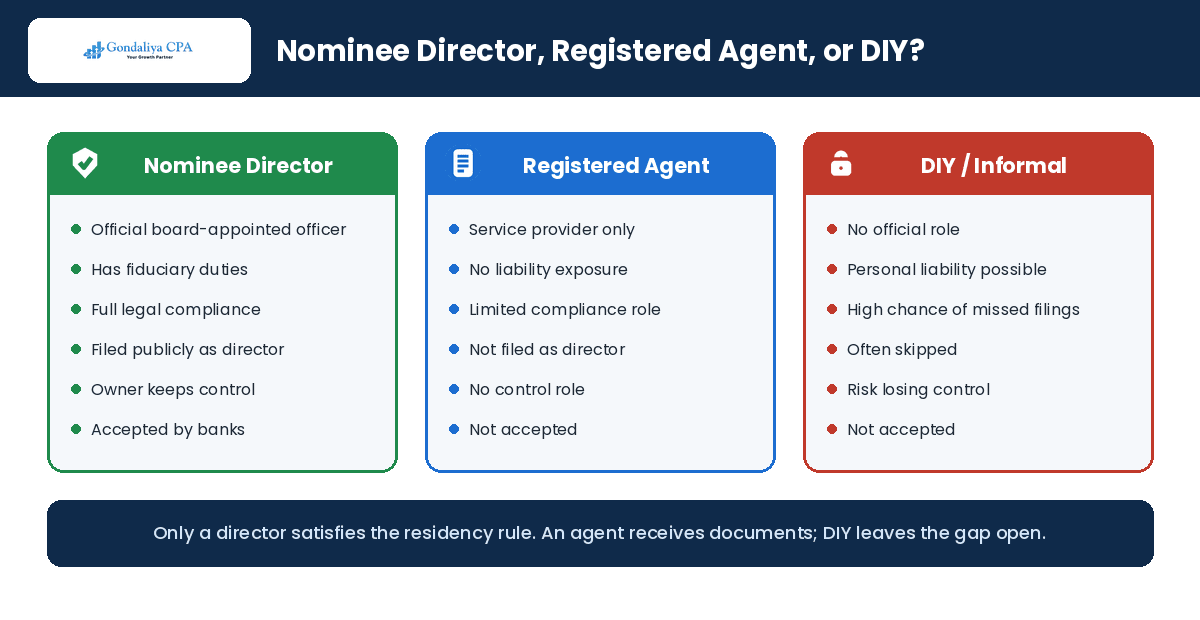
| Feature | Professional Nominee Director | Registered Agent | DIY / Informal Alternative |
|---|---|---|---|
| Legal Status | Official board-appointed officer | Service provider only | No official role |
| Liability Exposure | Has fiduciary duties | None | Personal liability possible |
| Compliance Responsibility | Full legal compliance enforced | Limited | High chance of missed filings |
| Public Filings | Filed publicly as director | Not filed as director | Often skipped |
| Control Over Corporation | Owner keeps control | None | Risk losing control |
| Banking Acceptance | Accepted | Not accepted | Not accepted |
For non-resident corporations needing strict Canadian corporate compliance and resident directors, a verified professional nominee director offers better protection than agents or informal options.[5] DIY may seem cheaper but can lead to fines from late filings or wrong ISC register data that banks don’t like.[6]
[5]: Corporations Canada – Roles & Responsibilities (Accessed June 2026)
[6]: FINTRAC Guidance on Corporate Transparency Risks (Accessed June 2026)
Risk Mitigation Strategies with Verified CPA Nominee Director Partnerships
Using verified CPAs as nominee directors helps avoid common problems in running a non-resident corporation under Canadian law.
Directors must act honestly and carefully; failing this can bring personal liability for things like unpaid wages,[7] unpaid source deductions,[8] GST/HST debts,[9] environmental fines,[10] and more. A skilled CPA knows these risks well and understands legal protections like due diligence documentation.[11]
Wrong use of nominees—like fake appointments without real independence—can lead regulators to suspend registrations. Banks may then refuse accounts because of failed checks.[12]
We manage risks by:
- Checking backgrounds before appointing
- Using clear nomination agreements that define roles
- Holding regular review meetings with records
- Filing updates on time to keep public records current
- Advising on directors’ insurance where needed
These steps follow Canadian corporate compliance standards while keeping fees reasonable.
[7]: Employment Standards Act – Wages Liability (June 2026 Access).
[8]: CRA Source Deductions Penalties Overview (June 2026 Access).
[9]: GST/HST Act Section on Directors’ Liability (June 2026 Access).
[10]: Environmental Protection Acts Provincial Variances[Ontario Ministry Environment Website].(June 2026 Access).
[11]: Statutory Defences Under CBCA s122(1).[CorporationsCanada].(June 2026 Access).
[12]: FINTRAC Enforcement Actions Summary[FINTRAC Website].(June 2026).
Contact Gondaliya CPA for Personalized Nominee Director Consultation and Corporate Compliance Support
If you want expert help to keep your non-resident corporation fully compliant in Canada, get in touch with Gondaliya CPA. We provide free consultations focused on appointing trusted local resident directors while protecting your ownership rights throughout incorporation and compliance stages across Ontario, Toronto, and beyond.
Call us at 647‑212‑9559 or email info@gondaliyacpa.ca. Our team replies fast and has “1300+ five-star Google reviews.” Let us handle the admin work so you can focus on growing your business legally within Canada’s rules.
2026 Update — what is current: The CBCA residency rule and the Ontario requirement for at least one resident Canadian director both continue to apply. Annual returns are due within 60 days of the anniversary date, director-appointment forms usually within 15 days, and the ISC register must be kept current. GST/HST registration is triggered once taxable supplies exceed $30,000 annually in Canada.
Frequently Asked Questions
Frequently Asked Questions
FAQ
What is the minimum resident director requirement in Canada?+
Canadian federal corporations must have at least 25% of directors as Canadian residents. Ontario requires at least one resident director regardless of size.
When is the annual return filing deadline for non-resident corporations?+
Annual returns must be filed within 60 days of the corporation’s anniversary date. Missing this risks penalties or dissolution.
What is the ISC register filing deadline?+
Corporations must update their Individuals with Significant Control (ISC) register annually, usually by the annual return filing date.
What does the director liability limitation period mean?+
Directors have a limited timeframe to face personal liability for breaches, generally up to 2 years after an incident.
How does Part XIII withholding tax rate affect non-resident corporations?+
Part XIII tax applies to payments like dividends to non-residents. Proper nominee directors help ensure correct tax treaty applications.
What does the nominee director service fee cover?+
It covers appointment, annual filings, ISC updates, registered office address, and CRA registration support with transparent pricing.
How is a CRA business number issued for a non-resident corporation?+
CRA issues a business number when registering for taxes such as GST/HST. Nominee directors often assist with this process.
When does GST/HST registration trigger for foreign-owned corporations?+
Registration is mandatory when taxable supplies exceed $30,000 annually in Canada.
Who should consider using nominee director services in Canada?+
Foreign investors owning Canadian corporations who need to meet resident director laws and maintain compliance should use these services.
What are the risks of using a nominee director incorrectly?+
Risks include legal liabilities, loss of control, transparency issues, and damage to reputation or banking relations.
How do nominee directors differ from registered agents?+
Nominee directors are board members with fiduciary duties; registered agents only receive official documents without governance powers.
What are the options: DIY vs CPA-supported vs Non-CPA providers for nominee director services?+
DIY risks compliance errors; non-CPA providers may lack legal expertise; CPA-supported services offer professional guidance and risk mitigation.
How does Gondaliya CPA support non-resident owners?+
We provide verified nominee directors, handle filings, advise on compliance updates, and ensure smooth governance year-round.
What deliverables come with Gondaliya CPA’s nominee director service?+
You receive appointment documentation, annual return filings, ISC register maintenance, registered office service, and tax registration assistance.
How much do nominee director services cost in Canada?+
Fees vary but Gondaliya CPA offers flat annual rates covering all essentials with no hidden charges for full compliance support.
What should you prepare before appointing a nominee director? (Checklist)+
Prepare corporate documents, confirm nominee eligibility, gather signed consents, draft resolutions, and plan indemnity agreements.
How do non-resident ownership needs differ across industries we serve?+
Real estate investors prioritize trust structures; tech startups seek flexible governance; professionals require strict compliance controls.
How to choose the right Canadian firm for non-resident corporate compliance?+
Select Registered CPAs with proven experience, transparent pricing, timely communication, and strong local knowledge like Gondaliya CPA.
Key Takeaways, Glossary, and Next Steps
Key Takeaways, Glossary, and Next Steps
Quick Reference
Quick Comparison Table: Nominee Director vs Registered Agent vs DIY
| Factor | Nominee Director | Registered Agent | DIY |
|---|---|---|---|
| Legal Role | Director | Document Receiver | No official role |
| Liability | Yes (fiduciary duties) | None | High risk |
| Compliance | Full oversight | Limited | Often incomplete |
| Public Filings | Required | Not required | Usually missed |
| Control | Owner retains control | None | Potential loss |
| Banking Access | Accepted by banks | Usually rejected | Not accepted |
Key Takeaways: Risks and Prevention Controls
- Use verified CPAs as nominees to reduce legal risks.
- Maintain clear nomination agreements with indemnity clauses.
- Keep ISC register accurate to avoid government scrutiny.
- File all annual returns promptly to prevent penalties.
- Monitor changes in residency laws yearly.
Next Steps (Text-Only CTA)
Contact Gondaliya CPA today for your free consultation on nominee director appointment. Secure compliant governance that fits your non-resident corporation’s needs in Canada. Call 647‑212‑9559 or email info@gondaliyacpa.ca.
People Also Ask
Quick Answers
Can I appoint more than one nominee director in Canada?+
Yes, if residency rules are met.
Does a nominee director affect my company’s tax status?+
Yes, it influences central management location and withholding taxes.
Are there hidden fees in nominee director services?+
Reputable firms like Gondaliya CPA offer flat fees without surprises.
Glossary of Key Terms
- Resident Director: A Canadian resident legally appointed to a corporation’s board.
- Nominee Director: A locally appointed individual representing foreign owners on the board.
- ISC Register: A federal register detailing individuals who have significant control over a corporation.
Why Trust Gondaliya CPA?
We are Registered Ontario CPAs specializing in corporate compliance for foreign-owned businesses. Our extensive experience ensures up-to-date adherence to residency rules and transparent pricing. Our 1300+ five-star Google reviews reflect our commitment to client satisfaction and reliability in managing complex regulations efficiently.
Want a checklist to work from? You can download our free nominee director appointment checklist before your consultation.
Industry Spotlights: Sectors We Represent
Industry Expertise
Where a nominee director matters most varies by sector, usually because of what the corporation holds and how much local presence the business needs. Here are ten sectors and where the compliance pressure tends to sit.
| Industry | The Non-Resident Angle |
|---|---|
| Medical doctors & physician professional corporations | Professional corporation rules on top of residency law |
| Dentists & dental practices | Regulator conditions alongside the board composition |
| Daycare, childcare & CWELCC services | Licensing that expects a genuine local presence |
| Real estate investors, landlords & holding companies | Multiple corporations, each needing a compliant board |
| Property developers & builders | Extra-provincial registration across project entities |
| Construction, contractors & skilled trades | Payroll and source deductions tied to the registered office |
| Technology startups & SaaS | Founders abroad, investor diligence on governance |
| E-commerce & online retailers | GST/HST registration for non-resident sellers |
| Restaurants & food and beverage | Municipal licences requiring a local point of contact |
| Transportation, logistics & trucking | Permits and board resolutions across provinces |
| Consulting firms | Registry upkeep and ISC disclosures for foreign consultants |
- Medical doctors & physician professional corporations: Professional corporation statutes carry their own restrictions on who may hold shares or sit on the board, and those rules usually bite before the general residency requirement does.
- Dentists & dental practices: A practice regulated by the Royal College of Dental Surgeons of Ontario faces certificate conditions alongside incorporation, so the board composition has to satisfy both.
- Daycare, childcare & CWELCC services: Childcare operations need real local presence for licensing and inspection, so the practical support a resident director provides matters as much as the formality.
- Real estate investors, landlords & holding companies: Owners holding several properties through separate companies need each corporation to carry a compliant board and a current ISC register, not just the main one.
- Property developers & builders: Multiple project entities often mean extra-provincial registration in each province of operation, on top of the director filings.
- Construction, general contractors & skilled trades: Payroll and source deduction accounts attach to the registered office, so the address and the board need to be settled before the first hire.
- Technology startups & SaaS: Founders abroad can incorporate quickly, and transparent governance with a documented nominee agreement is what survives investor diligence later.
- E-commerce & online retailers: Non-resident vendors selling into Canada have their own GST/HST registration rules to work through alongside the director requirement.
- Restaurants & food and beverage: Municipal licences and food safety oversight expect a local contact who can respond, which is a practical argument for a resident director beyond the statute.
- Transportation, logistics & trucking: Permits and board resolutions across provinces mean the corporate records have to keep pace with the operating footprint.
- Consulting Firms: Foreign consultants benefit from a resident director who keeps the registry information current plus the ISC disclosures required federally, which builds client confidence.
Key Stat: Federally, at least 25% of directors must be resident Canadians, and the annual return is due within 60 days of the anniversary date. Those two numbers decide most of what a non-resident owned corporation has to organise in its first year.
A real estate investor held six properties through six separate corporations and had arranged a compliant board for only the parent. Each corporation carries its own director and register obligations, so the other five were quietly out of compliance. Figures changed for privacy.
A technology startup with founders abroad faced investor diligence and could not produce a signed nominee agreement, only an email trail. Rebuilding the documentation mid-diligence cost weeks. Governance paperwork is cheapest before anyone asks for it. Figures changed for privacy.
An e-commerce seller shipping into Canada assumed the director requirement was the only obstacle, and had passed the GST/HST registration threshold without registering. The two obligations run in parallel, not in sequence. Figures changed for privacy.
Professional Guidance and Quick Reference
Guidance
Professional Guidance in Nominee Director Services: How Gondaliya CPA Supports Non-Resident Business Owners
Nominee director arrangements in Canada can get technical quickly. You need to know which statute governs your corporation, what the board has to look like under it, and what has to be filed and when. Gondaliya CPA provides corporate compliance services built for non-resident owners, and we focus on foreign-owned corporations that need a resident presence on the board without giving up control of the company.
We help with the appointment itself, the consent and board resolution, the registry filings, the nominee agreement and its indemnity terms, the registered office, the ISC register, and the CRA registrations that follow. Our goal is to keep the corporation in good standing while the ownership stays exactly where you want it.
Our team follows Corporations Canada and provincial registry practice closely, and we build plans around your own facts rather than a template. Whether you are incorporating for the first time or repairing a board that no longer satisfies the residency rule, we give clear advice based on the current law, including the 2026 changes affecting director residency and ISC register transparency.
Quick Answers: Key Numbers & Concepts at a Glance
At a Glance
- Federal resident director requirement (CBCA): At least 25% of directors must be resident Canadians
- Ontario resident director requirement: At least one resident Canadian director
- Annual return deadline: Within 60 days of the corporation’s anniversary date
- Director appointment filing window: Usually 15 days from the change
- ISC register: Updated annually, usually by the annual return filing date
- Director liability limitation period: Generally up to 2 years after an incident
- GST/HST registration threshold: $30,000 of taxable supplies annually in Canada
- Part XIII withholding: Applies to payments such as dividends paid to non-residents
- Nominee director: A real director with real fiduciary duties, appointed under a written agreement
- Registered office: An address inside the jurisdiction that receives legal documents
Who This Is For / Not For
Fit Check
- For: Foreign investors and non-resident owners of Canadian corporations who must satisfy a resident director requirement, keep annual returns and the ISC register current, and open or maintain Canadian banking.
- Not For: Anyone seeking to use a nominee arrangement to conceal beneficial ownership, which the significant-control rules exist specifically to prevent, or owners whose board already satisfies the residency rule without help.
Glossary of Key Terms (Expanded)
Plain-English Definitions
- Nominee director agreement: The written contract setting out the nominee’s role, confidentiality, indemnities, and how either side can end the arrangement.
- Indemnity agreement: The contract protecting a nominee director against certain liabilities arising from the role.
- Consent to act: The nominee’s signed agreement to serve, obtained before the appointment is made.
- Board resolution: The formal approval of the appointment, passed at a meeting in line with the bylaws.
- CBCA: The Canada Business Corporations Act, the federal incorporation statute.
- Ontario Business Corporations Act: The Ontario incorporation statute, with its own director requirements.
- Distributing corporation: A corporation that can pay dividends, subject to the 25% resident director rule federally, and taxed at the applicable corporate tax rate.
- Individuals with Significant Control: The people who ultimately own or control the corporation, recorded in the ISC register.
- Annual return: The yearly corporate filing, due within 60 days of the anniversary date.
- Minute book: The corporate record of board and shareholder decisions, kept at the registered office.
- Extra-provincial registration: Registering to carry on business in a province other than the one of incorporation.
- Central management and control: The test that looks at where a corporation is really directed, relevant to tax residency.
- Part XIII withholding: The withholding on passive amounts such as dividends paid to non-residents.
- Schedule 97: The T2 schedule reporting additional information for non-resident corporations where required.
- Directors & Officers insurance: Cover that can sit behind an indemnity to protect a director personally.
Risk Warning: A nominee who is a name on a form and nothing more is the arrangement regulators and banks look at hardest. Directors’ duties are statutory and cannot be signed away, so an agreement that pretends otherwise protects nobody. Please have the nominee agreement drafted so the duties are respected and the scope is limited properly instead.
A nominee director is worth it when the residency rule genuinely applies to your corporation, or when a bank will not open an account without a local director or officer. Where neither is true, the honest answer is that you may not need one, and the jurisdiction you incorporate in is the decision to look at first.
Pro Tip: Build the ISC register at incorporation rather than at the first annual return. Retrofitting it later means reconstructing ownership history under time pressure, and it is the single record most likely to be asked for by a bank, an auditor, or a registry.
An owner asked whether a nominee could keep their name off the record entirely. It cannot: the significant-control rules require the real owners to be recorded whoever sits on the board. Being clear about that at the outset avoided a compliance problem later. Figures changed for privacy.
A corporation changed nominee directors without recording the resignation or filing the replacement, leaving a gap in the public record and in the minute book. Handling resignations and appointments as one sequenced step closed it. Transitions are where records break. Figures changed for privacy.
Nominee Director Requirement Check
This quick self-check flags what your corporation is likely to need. Please answer the six questions below.
Nominee Director Requirement Check
Six quick questions on what your corporation needs. No fee shown.
Items to address:
This is a general prompt, not tax, legal, or immigration advice or a quote. Requirements depend on your jurisdiction and facts. For a real review, please book a free consultation.
Nominee Director Canada and Resident Director Canada Services for Non Resident Corporations with Canadian Corporate Compliance by Gondaliya CPA
Own a Canadian corporation from abroad? We keep the board and the filings compliant
Gondaliya CPA appoints a verified resident director, drafts the nominee agreement with indemnity terms, files the notices on time, maintains the ISC register and registered office, and supports your CRA registrations, on a flat annual fee, HST included, with a one-business-day response. Please book a free consultation.
Published: July 29, 2026 · Last updated: July 29, 2026
Disclaimer: This article is educational information only and is not tax, legal, or immigration advice, and director arrangements require a lawyer alongside your CPA. It reflects corporate and CRA rules current to 2026, including the CBCA resident-director requirement, the Ontario requirement for at least one resident Canadian director, the 60-day annual return deadline, the usual 15-day filing window for director changes, the ISC register obligation, and the $30,000 GST/HST registration threshold. Corporate statutes differ by province and change. Please consult a Registered CPA and a lawyer before acting. Fees include HST.

Sharad Gondaliya is a CPA Canada & CPA USA with 15 Years+ experience of Accounting, Tax, Payroll of Corporate Small Businesses as Tax Accountant. He is fully certified CPA Ontario and CPA USA and is well known among corporate small businesses for tax planning, efficient tax solutions, and affordable CPA services. Sharad is the Principal (Director) of Gondaliya CPA – Affordable CPA Firm in Canada. Licenses: CPA Ontario: 61040184 | CPA USA (MT): PAC-CPAP-LIC-033176 | CPA USA (WA): 57629 | CPA Firm License: 61330051 View Full Author Bio