



How Dental Clinics Can Reduce Taxes and Increase Profit with Strategic CPA Tax Planning
Dental tax planning is essential for dentists seeking effective corporate tax strategies, and Gondaliya CPA offers expert services as a dentist tax accountant to optimize your dental corporation tax approach. With specialized knowledge in accounting for dental corporations, incorporated dentist tax planning, and CPA tax planning for dentists, Gondaliya CPA helps maximize tax savings and improve your dental practice profit.
Quick Summary
Strategic dental tax planning reduces a clinic’s tax and lifts its profit by combining the right corporate structure, compliant income splitting, well-timed equipment purchases, and an exit plan built years before the sale. Please note the savings compound only when the work is done across the year and documented, because the CRA tests reasonableness and TOSI on the records you keep, not on the intention behind them.
| Aspect | Details |
|---|---|
| The structure | Incorporation once income passes the small business deduction limit. |
| The annual levers | Salary and dividend mix, income splitting within TOSI, CCA timing. |
| The transaction | Asset versus share purchase, and the lifetime capital gains exemption. |
| Who it suits | Incorporated dentists and dental professional corporations in Ontario and Canada. |
Reading time: 28 minutes.
Table of Contents
- Dental Tax Planning Fundamentals for Dentists
- Income Splitting and Corporate Tax Strategies
- Acquisition, Financing, and Equipment Tax Planning
- Retirement, Succession, and Exit Planning for Dentists
- Ongoing Compliance and Year-Round Tax Planning
- How Gondaliya CPA Assists Dentists with Incorporation and Corporate Tax Planning
- FAQs on Dental Tax Planning and Dentist CPA Services
- Key Numbers at a Glance for Dental Tax Planning
- Industry Spotlights: Sectors We Represent
- Professional Guidance and Quick Reference
The Numbers That Matter
This article covers Canada, with Ontario and Toronto context, and reflects CRA rules current to 2026. It assumes an incorporated dental practice or dental professional corporation. “Illustrative” figures are examples, not quotes, and any masked engagement notes end with “Figures changed for privacy.” This is educational information only and not tax, legal, or financial advice. Fees include HST. Corporate and professional rules change, so please confirm your own situation with a Registered CPA before acting.
Industry Spotlights: Sectors We Represent
Industry Expertise
Dental clinics sit alongside other owner-managed sectors we serve, and the tax planning levers shift with the assets each business holds. Here are ten sectors and where the planning opportunity concentrates.
| Industry | The Tax Planning Angle |
|---|---|
| Dentists & dental practices | Incorporation timing, CCA on equipment, LCGE on a sale |
| Medical doctors & physician professional corporations | Salary and dividend mix against passive income limits |
| Daycare, childcare & CWELCC services | Retained profit and succession within the family |
| Real estate investors, landlords & holding companies | Holding companies and the adjusted cost base |
| Property developers & builders | Asset versus share structuring across project entities |
| Construction, contractors & skilled trades | Equipment CCA and owner compensation planning |
| Technology startups & SaaS | Estate freeze and QSBC qualification before an exit |
| E-commerce & online retailers | Inventory, GST/HST and volatile profit timing |
| Restaurants & food and beverage | Property held apart from the operating company |
| Transportation, logistics & trucking | Fleet financing, lease versus purchase decisions |
| Consulting firms | Income splitting within TOSI and instalment planning |
- Dentists & dental practices: Everything in this article, from the incorporation threshold to the lifetime capital gains exemption on a practice sale, is built around how a dental corporation actually earns and distributes profit.
- Medical doctors & physician professional corporations: Physicians face the same salary and dividend decision, with passive investment income inside the corporation the usual constraint on the small business deduction.
- Daycare, childcare & CWELCC services: Where profit is retained and the business passes to family, the estate freeze and family trust questions are the same ones a dentist asks.
- Real estate investors, landlords & holding companies: Property held in a holding company alongside the practice needs the adjusted cost base tracked and the GST/HST treatment planned on any transfer.
- Property developers & builders: Asset versus share structuring across several project entities is the same analysis a dentist runs when buying or selling a practice.
- Construction, general contractors & skilled trades: Equipment capital cost allowance and owner compensation are the two recurring levers, exactly as they are for a clinic buying chairs and imaging.
- Technology startups & SaaS: An estate freeze and early QSBC share testing before an exit matter more here than anywhere, and the mechanics match a dental practice sale.
- E-commerce & online retailers: Volatile profit makes instalment and dividend timing the main lever, alongside GST/HST registration on taxable sales.
- Restaurants & food and beverage: Holding the property apart from the operating company protects it, the same logic that applies when a dentist owns the clinic premises.
- Transportation, logistics & trucking: Fleet financing turns the lease versus purchase question into an annual decision, run on the same net present value comparison set out above.
- Consulting Firms: Income splitting within the TOSI rules and quarterly instalment planning are the recurring work for owner-managed consultancies.
Key Stat: The small business deduction applies to the first $500,000 of active business income, taxed in Ontario at 3.2%, and passive investment income above $50,000 begins eroding that limit. Those three numbers decide where most dental corporate tax planning starts.
An owner paid dividends to a spouse who held shares but did no work in the clinic, expecting a lower personal rate. TOSI applied instead, so the split achieved nothing and created a reassessment. Involvement, documented, is the whole test. Figures changed for privacy.
A clinic had built a sizeable investment portfolio inside the operating corporation and was losing part of the small business deduction to the passive income grind without noticing. Reviewing it during the year, rather than at filing, changed the outcome. Figures changed for privacy.
A dentist agreed a practice sale price before anyone looked at whether the shares qualified for the lifetime capital gains exemption. Cash sitting in the corporation had put the active asset test at risk, and there was no runway left to purify. Structure belongs before price. Figures changed for privacy.
An associate buying into a practice was funded by a private loan documented as a shareholder advance, which created an unintended income inclusion risk. Restructuring the financing properly before closing removed it. Figures changed for privacy.
Professional Guidance and Quick Reference
Guidance
Professional Guidance in Dental Tax Planning: How Gondaliya CPA Supports Canadian Dentists
Dental tax planning can get tricky. You need know-how to handle professional corporation rules, CRA laws and the timing of every decision that affects the return. Gondaliya CPA offers corporate tax planning services that fit your practice, and we focus on incorporated dentists and dental professional corporations across Toronto, Ontario and Canada.
We help you with the levers that move the number: when to incorporate against the small business deduction limit, the salary and dividend mix, income splitting tested against the TOSI rules, capital cost allowance and purchase timing, passive investment income against the $50,000 threshold, GST/HST on taxable services, and the lifetime capital gains exemption on an eventual sale.
Our team follows CRA and Ontario practice closely and builds the plan around your own facts rather than a template. Whether you are incorporating, buying into a practice, financing equipment, or preparing an exit, we give clear advice based on the current rules, including what changes in 2026.
Quick Answers: Key Numbers & Concepts at a Glance
At a Glance
- Small Business Deduction limit: $500,000 of active business income
- Ontario small business corporate tax rate: 3.2% after the small business deduction
- Adjusted aggregate investment income threshold: $50,000
- GST/HST registration threshold: $30,000 of taxable supplies
- QSBC share holding period: 24 months without breaks
- QSBC active asset test: At least 90% of company assets active in the business
- CCA Class 8, general equipment: 20%, including dental chairs
- CCA Class 12, small tools: Items costing less than $5,000
- CCA Class 50 and 52: Computers and software
- TOSI: Applies where family payments do not reflect real involvement
Glossary of Key Terms
Plain-English Definitions
- Dental professional corporation (DPC): The corporation through which a dentist practises, recognized by RCDSO and subject to CRA rules.
- Small business deduction: The reduced corporate tax rate on the first $500,000 of active business income.
- Passive investment income: Investment income inside the corporation, which erodes the small business deduction above $50,000.
- TOSI: Tax on Split Income, taxing split income at top rates where family members are not genuinely involved.
- Excluded shares: Shares meeting the TOSI exception tests, based on real work done and ownership conditions.
- Capital cost allowance (CCA): The deduction spreading equipment cost across years by asset class.
- Recaptured depreciation: The clawback of earlier CCA claims that can arise on an asset sale.
- Asset purchase: Buying specific assets such as equipment, goodwill or patient lists rather than the company.
- Share purchase: Buying the whole company, including all assets and debts.
- QSBC shares: Qualified small business corporation shares, which must meet CRA holding and active asset tests.
- Lifetime capital gains exemption (LCGE): The exemption sheltering capital gains on qualifying shares.
- Vendor take-back mortgage: Seller financing on a practice purchase, needing clear paperwork.
- Individual Pension Plan (IPP): A registered plan used alongside or instead of an RRSP to defer tax.
- Estate freeze: Locking today’s share value so future growth accrues to the next generation.
- EBITDA margin: The profit measure buyers use when valuing a practice.
People Also Ask
Quick Answers
At what income should a dentist incorporate?+
The usual trigger is income beyond the small business deduction limit, because that is where the gap between the corporate rate and the personal top rate starts working every year. Below it, the cost of the second set of filings often outweighs the benefit.
Can a dentist use a holding company alongside the practice corporation?+
Yes, and it is common. Moving surplus up to a holding company can protect the practice corporation’s small business deduction and keep the practice shares clean for the lifetime capital gains exemption, subject to the association and professional corporation rules.
Is it better to lease or buy dental equipment?+
It depends on the clinic’s cash flow and how long the equipment will be used. Buying gives capital cost allowance and builds equity; leasing gives steady monthly costs that are fully deductible as incurred. Comparing net present values over the expected life is the way to decide.
How early should a dentist plan a practice sale?+
Years, not months. The 24-month share holding period and the 90% active asset test are both measured at the sale, and cash accumulating in the corporation is what usually breaks the second one. Purification takes time that a signed offer does not allow.
The practices that keep the most after tax are not the ones with the most aggressive structures. They are the ones where the incorporation happened at the right time, the family payments were documented before they were made, the equipment was bought with the class and the timing in mind, and the shares were tested for the exemption long before a buyer appeared.
Dental Tax Planning and Corporate Strategies for Dentists: Gondaliya CPA’s Expert Dentist Tax Accountant Services
Dental Tax Planning Fundamentals for Dentists
Tax Planning for Dental Practices: Key Considerations in Ontario
The Basics
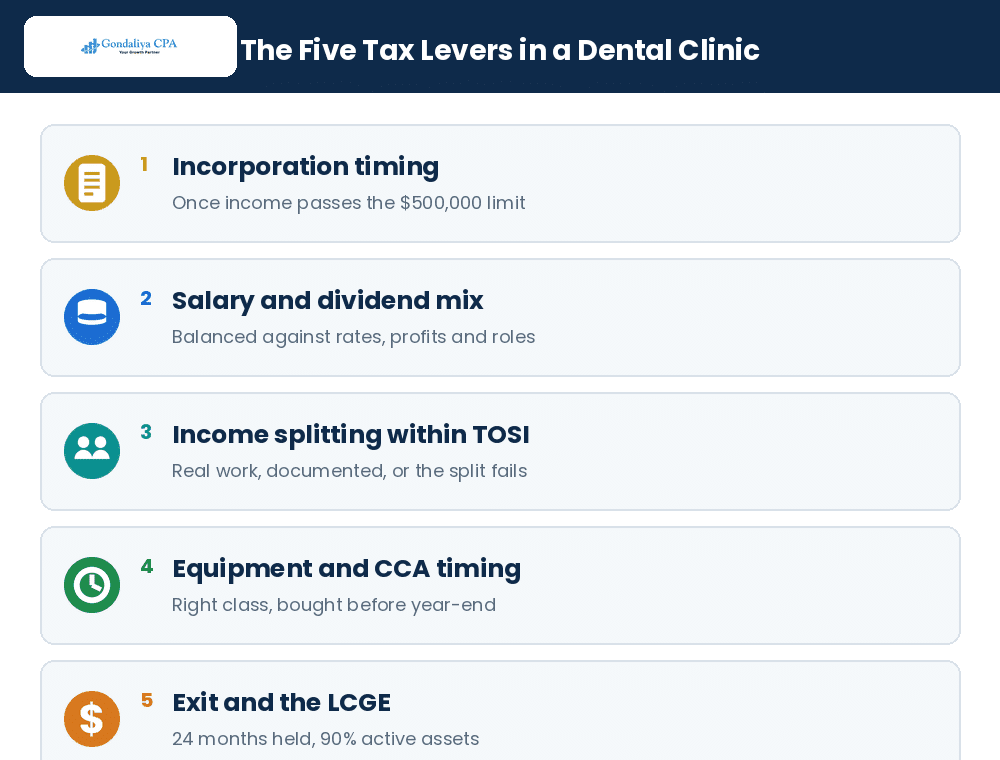
Dental tax planning helps dentists keep more of what they earn while following Canada Revenue Agency (CRA) rules. A dentist CPA or dental accountant knows the best ways to handle taxes for dental offices. They can guide dentists through tax laws and make sure nothing is missed.
- Understand your tax obligations.
- Use strategies that fit your dental practice.
- Stay up to date with CRA changes.
When Should a Dentist Incorporate? Timing and Income Threshold Analysis
Dentists should think about incorporating once their income goes beyond the small business deduction limit. This limit is currently $500,000. Incorporated dentists pay less tax on income inside the corporation than they would personally. Also, incorporation offers some protection for personal assets and opens doors to deductions that solo dentists might not get.
- Incorporate after passing the income threshold.
- Take advantage of lower corporate tax rates.
- Protect personal assets from business risks.
A dentist incorporated a year later than the numbers supported, and the profit retained in that gap was taxed personally at the top rate instead of the small business rate. The timing decision, not the structure itself, is where the money was. Figures changed for privacy.
Benefits and Drawbacks of Incorporation for Dental Professionals
Incorporation brings several benefits:
- Lower corporate tax rates save money.
- Liability protection keeps personal assets safe.
- Income splitting lets family members share earnings through shares.
But there are some downsides too:
- More paperwork and rules to follow.
- Extra costs for setting up and running the corporation.
- Corporate tax filing deadlines differ from those for individuals.
Ontario Dental Professional Corporation Rules and Compliance
A Dental Professional Corporation (DPC) must follow CRA rules carefully. Dentists need to keep clear records, file reports on time, and obey laws for health professionals in Ontario.
These rules help ensure that everything runs smoothly and legally within dental corporations.
College of Dental Surgeons of Ontario (CDSO) Requirements for Dental Incorporation
Dentists who want to incorporate in Ontario must meet CDSO rules. This means holding the right licenses and paying membership fees each year. These dues help support the profession’s standards. Following these requirements means the dental corporation stays legal and enjoys protections like limited liability.
Step-by-Step Incorporation Process for Dentists in Ontario
- Pick a corporate name that meets Ministry guidelines.
- File Articles of Incorporation with ServiceOntario; pay required fees.
- Get necessary licenses including registration with RCDSO.
- Set up corporate records:
- Open a bank account under the corporation’s name
- Keep bookkeeping accurate and up to date
- Follow all annual filing deadlines from CRA and CDSO.
Doing these steps right helps dentists avoid problems while benefiting from incorporation under Canadian law specific to dental practices.
Our Take: Incorporation is a threshold decision, not an ambition. Below the small business deduction limit it usually adds cost without adding benefit; above it, the gap between the corporate rate and the personal top rate does the work every single year. The question is always when, not whether.
Income Splitting and Corporate Tax Strategies
Income Splitting Strategies for Dental Practices: An Overview
The Splitting
Income splitting helps dentists spread income among family members in lower tax brackets. This can reduce the total family tax bill. For incorporated dental practices, using income splitting smartly boosts after-tax cash flow while staying within CRA rules.
Dental accountants who know the dental field spot income-splitting chances that fit each practice’s situation. Common methods include paying a spouse a salary, sharing dividends with family shareholders, or paying adult children involved in the business. You need proper records and must follow CRA rules closely to avoid trouble.
Spousal Income Splitting: Salary vs. Dividends and CRA Compliance
Spouses often get paid by salary or dividends when they help in the dental practice or own shares.
- Salary: The spouse must actually work reasonable hours for a fair wage. This cost reduces corporate income but you need timesheets or contracts to prove it.
- Dividends: Dividends depend on ownership, not work done. They don’t lower corporate taxes but provide personal returns taxed differently.
The CRA watches these moves carefully with tests on reasonableness and TOSI rules. Salaries should match actual duties; paying too much risks denied deductions or reassessments. Dividends to non-active shareholders can trigger TOSI penalties unless exceptions apply.
A dentist CPA advises balancing salary and dividends based on tax rates, company profits, and family roles. This helps keep more money after tax without breaking rules.
Risk Warning: A salary to a family member is only as strong as the evidence behind it. Without timesheets, a written contract, and a wage that matches the duties actually performed, the deduction is the first thing a reviewer removes. Please put the paperwork in place before the first payment, not after a query.
Understanding Tax on Split Income (TOSI) Rules for Dentists
TOSI rules stop people from aggressively splitting income to family members who don’t really work in the business. It taxes that income at the highest rates.
For dentists with professional corporations:
- Family getting dividends or other income must meet “excluded share” tests, based on real work done.
- The “excluded business” rule applies if over 90% of revenue comes from unrelated clients.
If these rules aren’t met, split incomes get taxed heavily.
Dental tax planning means checking how much family members work, invest, and contribute before sharing income that may be hit by TOSI.
Income Splitting with Adult Children: Opportunities and Limitations
Dentists may involve adult kids as shareholders or employees for succession planning and tax benefits.
Some ways include:
- Paying adult children reasonable salaries for real work in the clinic.
- Giving dividends if they hold excluded shares and meet active involvement tests by CRA.
But there are limits. Passive ownership without real effort triggers full TOSI penalties. Poor paperwork also risks denied deductions or audits.
Dentist CPAs suggest clear written agreements about roles plus regular checks to keep benefits under current laws.
A practice paid dividends to an adult child who held shares but did no work in the clinic, expecting a lower rate. TOSI applied at the top rate instead, so the split achieved nothing and created a reassessment. Involvement, documented, is what makes the difference. Figures changed for privacy.
Structuring Dental Corporations for Tax Efficiency
Setting up a dental professional corporation brings legal and tax advantages for Ontario dentists:
Benefits
- You get small business deduction up to $500,000 which cuts federal/provincial corporate taxes compared to self-employment.
- You can keep earnings inside the corporation at lower tax rates before paying yourself.
- Being a regulated entity under RCDSO builds patient trust.
Drawbacks
- There are extra admin costs like annual T2 filings, careful bookkeeping especially for payroll (T4/T5), plus partial GST/HST rules because health services partly qualify.
- Passive investment income limits affect eligibility for small business deduction; dentists need to watch this yearly after 2026 rule changes.
- You must follow both RCDSO provincial rules on practice scope plus federal tax rules about what activities your corporation can do.
A dentist CPA guides you balancing profit retention with these rules so your practice grows steadily under Canada’s changing tax laws.
Acquisition, Financing, and Equipment Tax Planning
Tax Strategies for Buying and Selling Dental Practices
The Transaction
Dental tax planning matters a lot when you buy or sell a dental practice. Knowing the difference between asset purchase and share purchase helps you save on taxes. Using the lifetime capital gains exemption (LCGE) can also boost your after-tax money.
Asset Purchase vs. Share Purchase: Tax Implications and Purchase Price Allocation
When buying a practice, you usually choose between buying assets or shares. An asset purchase means you buy specific things like equipment, goodwill, or patient lists. This lets buyers spread out the purchase price among assets to claim capital cost allowance (CCA). But sellers might face higher taxes due to recaptured depreciation.
A share purchase means buying the whole company, including all assets and debts. Sellers can use the LCGE if they qualify as small business corporation (QSBC) shares under CRA rules. Buyers don’t get CCA step-ups but avoid immediate tax hits and take on company liabilities.
Allocating the purchase price carefully in an asset deal helps lower taxes by placing values in proper CCA classes while following fair market value rules.
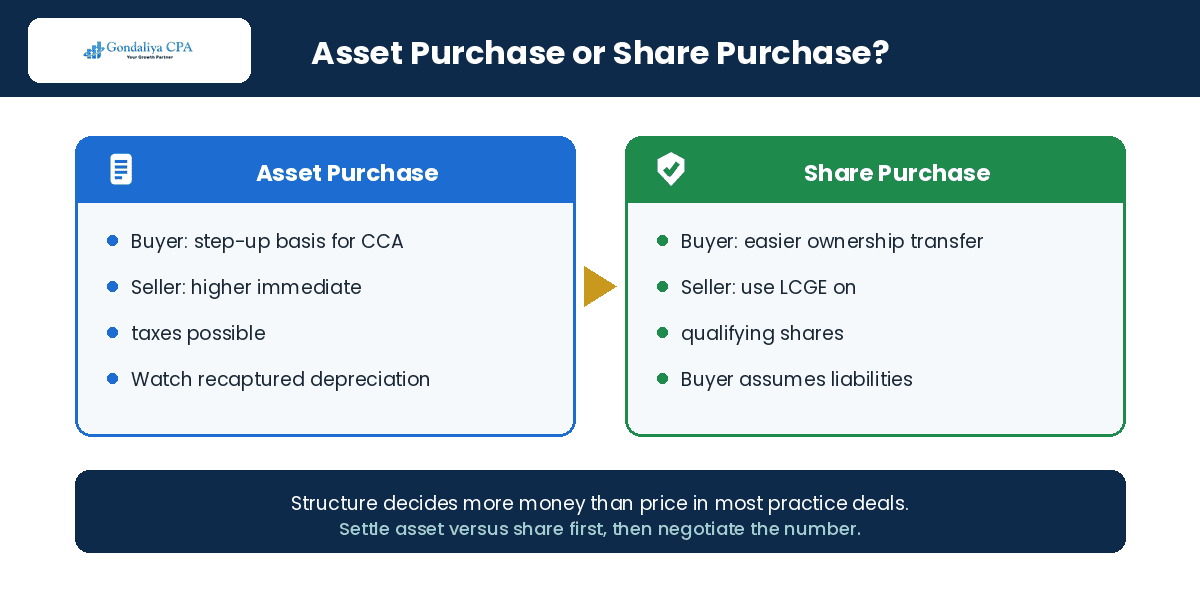
| Transaction Type | Buyer’s Benefit | Seller’s Benefit | Key Tax Consideration |
|---|---|---|---|
| Asset Purchase | Step-up basis; maximize CCA claims | Possibly higher taxable gain | Recapture of earlier CCA deductions |
| Share Purchase | Easier transfer; no step-up basis | Access to LCGE on QSBC shares | Must check corporate liabilities |
Financing Options and Tax Considerations for Dental Practice Acquisitions
Getting money for a dental practice needs teamwork with your dentist tax accountant or dental accountant. They help make sure interest expenses are deductible and cash flow stays healthy.
Common financing ways:
- Bank loans: Interest is usually deductible for professional corporations.
- Vendor take-back mortgages: These often come with flexible terms but need clear paperwork.
- Private loans: Often used for associate buy-ins; must avoid problems with shareholder loans under CRA rules.
Tax rules want interest to be reasonable, linked directly to making income in your incorporated dental practice. Your dentist CPA will guide when to pay interest for best tax results.
Transition Planning: Associate to Owner Structures and Tax Efficiency
Moving associates into ownership requires smart income splitting while following CRA’s TOSI (Tax On Split Income) rules. These rules stop unfair dividend sharing with family members who don’t work actively.
Key tips:
- Pay salaries that fit the work done.
- Use excluded shares when possible under TOSI exceptions.
- Keep clear roles in associate agreements.
Good planning cuts personal taxes without breaking TOSI rules. Your dental accountant helps set this up clearly.
Equipment Purchases: Depreciation and Capital Cost Allowance (CCA) Planning
Buying dental equipment involves big costs, so planning depreciation is smart. You can reduce taxes by claiming capital cost allowance (CCA) on these purchases.
Canada allows immediate expensing of up to $1.5 million per year under recent changes—good news for dental clinics looking to write off new equipment fast.
Your dentist CPA will help pick correct CCA classes like:
- Class 8 (20%): General equipment including dental chairs
- Class 43(1)/43(2): Clean energy stuff if it applies
- Class 12: Tools costing less than $5,000
- Class 50/52: Computers and software
Buying equipment before your fiscal year ends boosts deductions in that tax year, saving cash flow now.
Pro Tip: Equipment bought in the final weeks of a fiscal year still lands in that year’s claim, but only if it is available for use. Please make sure the chair is installed and operating, not sitting in a crate, before the year-end closes.
Lease Versus Purchase Decisions: Financial and Tax Impact for Dental Clinics
Choosing to lease or buy equipment depends on your clinic’s needs and tax goals. Your dental accountant can break down pros and cons.
Why buy?
- You get accelerated CCA deductions that cut taxable income quickly.
- Owning builds equity over time—helpful when selling later.
Why lease?
- Monthly costs stay steady, helping budgets.
- Lease payments count as operating expenses fully deductible right away.
Compare net present values of both options based on how long you expect to use the gear. That way, you find what works best for your clinic’s finances during dental tax planning.
A buyer and seller were negotiating price without ever discussing structure, and the asset-versus-share choice moved more money between them than the price gap they were arguing over. Structure first, price second, is the cheaper order. Figures changed for privacy.
Retirement, Succession, and Exit Planning for Dentists
Retirement, Succession, and Exit Planning for Dentists
The Exit
Retirement, succession, and exit planning matter a lot when it comes to dental tax planning. Dentists need to protect their wealth and make sure their practice changes hands smoothly. A dentist CPA or dentist tax accountant helps dental professionals through these tricky steps. They aim to get the best after-tax results while following CRA rules.
Retirement Planning Essentials for Dental Professionals
Retirement planning for dentists means setting up money plans that fit how dental corporations work. A dental accountant helps dentists save more by using registered plans like RRSPs and IPPs (Individual Pension Plans). These plans let you put off taxes in ways the government allows.
Other ideas include:
- Maxing out RRSP/IPP contributions: Use any unused room to lower taxes.
- Incorporated dentist tax planning: Keep money inside your professional corporation to pay less tax now.
- Tax-smart investments: Watch passive income so you don’t lose small business deductions.
- Estate freezes: Lock current share values so future gains pass to others efficiently.
A dentist CPA works with you to match your retirement goals with your practice’s profits, avoiding surprises on taxes.
Exit Planning: Succession Options and Their Tax Implications
Exit planning means deciding how you hand over your dental practice while paying as little tax as possible. You can sell assets, transfer shares inside the family or associates, or merge with another practice. Each way has different tax effects under Canadian law.
Dentist CPAs focus on:
- Choosing asset or share sales based on capital gains treatment.
- Using the lifetime capital gains exemption amount when selling qualifying shares.
- Setting up holding companies for easier transfers.
Your plan must meet CRA’s rules about qualified small business corporation (QSBC) shares to get tax breaks. Starting early gives time to fix company setups before selling.
Lifetime Capital Gains Exemption (LCGE): Qualification and Application
The LCGE lets incorporated dentists protect up to $971,190* of capital gains from federal taxes when they sell QSBC shares. To qualify:
- You must own the shares for at least 24 months without breaks.
- At least 90% of company assets have to be active in business during that time.
Dental accountants check if you meet these rules well before selling. Missing details might cause you to lose this exemption completely.
Using LCGE cuts your taxes a lot but needs careful timing with your overall dental tax planning—like balancing pay and passive income.
*Amount for 2026; CRA updates this yearly
Risk Warning: The 24-month ownership test and the 90% active asset test are both checked as at the sale, and cash piling up inside the corporation is what most often breaks the second one. Please have the share qualification reviewed years before a sale, because purification takes time that a signed offer does not leave you.
Preparing Your Dental Practice for Sale: Tax and Financial Benchmarks
Getting your dental practice ready for sale means checking key numbers buyers watch closely. A good dental accountant reviews profits, cash flow, equipment value, lease terms, associate agreements, and debts. These factors shape how much buyers will pay.
Key points to check:
| Benchmark | Description |
|---|---|
| EBITDA Margin | Profit measure showing how well the business runs |
| Debt-to-equity Ratio | Shows financial risk for buyers |
| Asset Valuation Accuracy | Confirms true value of your equipment |
| Lease Agreement Terms | Good leases help keep the business stable |
| Associate Contracts & Buy-ins | Clear agreements avoid future disagreements |
This thorough check helps avoid price disputes later. It also reduces audit risks from things like goodwill or shareholder loans misuse.
Measuring Performance: Dental Practice Financial KPIs and Industry Metrics
Tracking financial KPIs lets dentists stay on top of their clinic’s health—especially before planning an exit. A dentist CPA helps monitor numbers like revenue per chair hour, staff costs as a percent of expenses, patient retention rates, average procedure fees, accounts receivable turnover days, and net profit margin after corporate taxes.
Watching these numbers regularly helps you decide when to reinvest in the practice or take money out. This fits well with smart dental tax planning that balances today’s cash flow with future wealth growth.
Sharad Gondaliya, CPA (Canada & USA), has over 10 years helping Canadian business owners with smart financial decisions.
Need help with retirement or exit plans? Contact our Registered Ontario firm specializing in incorporated SMB dentistry at info@gondaliyacpa.ca or call 647‑212‑9559 today.
Ongoing Compliance and Year-Round Tax Planning
Ongoing Compliance and Year-Round Tax Planning
Compliance
Dental tax planning takes steady work all year long. You need to keep up with rules and plan ahead. A dentist CPA or dental accountant helps your practice follow CRA rules while making smart tax moves.
Common Tax Compliance Issues and CRA Audit Triggers for Dental Practices
Dental offices face certain tax issues that can cause CRA audits. Problems often show up when income is not classified right or shareholder benefits are reported wrong. Also, dentists sometimes don’t apply TOSI rules well or lack good proof for expenses.
Here are some common audit triggers:
- Paying family members salaries without clear roles.
- Having too much passive investment income in the professional corporation.
- Incorrect capital cost allowance (CCA) claims on dental gear.
- GST/HST filing mistakes about exempt versus taxable items.
Good dental tax planning spots these problems early. Keep clear books, follow CRA rules exactly, and keep solid records for every deduction claimed. If a letter does arrive, our CRA audit representation team responds on the corporation’s behalf.
GST/HST and Municipal Business Taxes Relevant to Dental Clinics
Dental clinics deal with tricky GST/HST rules. Some services are exempt, like general dental care, but others like braces or cosmetic work are taxable. If your taxable sales go over $30,000 a year, you must register for GST/HST and file returns on time.
Local business taxes differ by city in Ontario. Your municipal code affects how much you pay in local levies.
A smart dental tax plan checks if signing up voluntarily for HST helps you get input tax credits on big buys, like new equipment or lease improvements. Knowing what’s exempt keeps you from costly mistakes when you file your returns.
Location-Specific Considerations: Ontario and GTA Demographics Affecting Practices
Ontario’s small business corporate tax rate is 3.2% on the first $500,000 active business income for professional corporations after the small business deduction.
Dentists in Toronto and the GTA should note their professional corporation annual filing deadlines—usually six months after their fiscal year ends—to avoid fines.
Where you practice matters too. Patient demographics in places like Vaughan or Mississauga influence your cash flow cycles. It helps to blend local market trends with your tax planning.
Quarterly and Annual Tax Planning Checklist for Dental Professionals
Quarterly checks plus a yearly list keep your taxes on track:
- Check payroll each quarter to meet T4 slip salary rules.
- Match accounts payable and receivable quarterly.
- Watch passive investment income yearly; it can limit deductions.
- File professional corporation tax returns yearly before deadlines.
- Update associate agreements when changes happen that affect pay or taxes.
Sticking to this routine lowers risks and helps you claim all legal deductions.
Maintaining Accurate Bookkeeping and Corporate Tax Filing for Dentists
Keeping good books is key. A dentist CPA or dentist tax accountant can set this up right. Use programs like QuickBooks or Xero to track expenses clearly between capital assets and day-to-day costs.
Tax returns (T2) must be spot-on too. Show salaries, dividends, and retained earnings correctly because mistakes here bring audits that waste time and money.
Regular reconciliations plus expert reviews make sure every entry supports real claims. This smooths dealings with taxing bodies across Ontario including Toronto offices.
Specialized Accounting Services Supporting Dental Practices’ Compliance and Growth
Gondaliya CPA offers services built just for dentists managing complex taxes. We advise on how to set up your corporation best, create compensation plans that follow TOSI rules, optimize CCA claims on expensive tools, and handle bookkeeping made for RCDSO standards.
We keep track of deadlines like the professional corporation annual filing date so you avoid penalties. Plus, we give clear reports showing where you might reduce taxes legally by timing dividends or buying assets smartly.
Working with Gondaliya CPA means you get focused help with medical/dental sector knowledge plus hands-on experience with SMB incorporation challenges in Ontario’s busy markets.
How Gondaliya CPA Assists Dentists with Incorporation and Corporate Tax Planning
How Gondaliya CPA Assists Dentists with Incorporation and Corporate Tax Planning
Our Work
Gondaliya CPA works closely with dentists on dental tax planning. We help dentists set up incorporation to lower corporate taxes. Our dentist CPAs and dental accountants follow CRA rules carefully. They create plans that fit each dental practice in Ontario. This way, dentists keep more of their income after taxes.
Comprehensive Tax Preparation, Bookkeeping, and Advisory Services for Dental Practices
Our dentist tax accountants handle all your tax needs. We take care of T2 corporate tax filing, payroll, and GST/HST returns. We clean up bookkeeping and offer advice year-round. Using QuickBooks and Xero helps us keep your books accurate. This makes sure your dental accounting is always ready for audits. Plus, we find every possible deduction allowed by Canadian tax law.
Here’s what we cover:
- Corporate tax filings
- Payroll management
- Bookkeeping cleanup
- GST/HST returns
- Ongoing financial advice
Strategic Business Advisory Tailored to Dental Professionals’ Unique Financial Goals
We offer business advice designed just for dental pros. Our dentist CPAs talk about how to plan pay, manage passive income, and buy capital assets at the right time. We help set up family shareholder arrangements that follow TOSI rules too. These plans aim to boost profits while staying within CRA guidelines for professional corporations.
We focus on:
- Compensation planning
- Passive investment income management
- Timing for buying assets
- Family shareholder arrangements under TOSI
Supporting Dental Practice Acquisition, Financing, and Transition Planning
When dentists buy or sell practices, we guide them through the process. Our dentist tax accountants explain differences between asset sales and share sales. We discuss how goodwill affects lifetime capital gains exemption (LCGE). We also advise on using holding companies for flexible financing options. Plus, we assist with succession planning based on current CRA rules in Ontario.
Key services include:
- Practice purchase or sale advice
- Asset vs share sale guidance
- Goodwill valuation impact on LCGE
- Holding company setup for financing
- Succession planning support
Transparent Service Packages and Pricing for Ontario Dentists
We charge a flat annual fee including HST made just for incorporated dental practices in Toronto and Ontario. This clear pricing covers all main services—from filings to consultations—so no surprise bills pop up later. We break down costs based on number of corporations, transactions, payroll work, equipment use, and depth of planning needed.
Our pricing offers:
- Flat annual fee with HST included
- Coverage of core services
- Clear cost breakdowns by activity level
Contact Gondaliya CPA for Expert Dental Tax Planning and Accounting Consultation
Need trusted dental tax planning? Our experienced dentist CPA team serves dentists across Toronto and Ontario. Call us at 647-212-9559 or email info@gondaliyacpa.ca today. We provide strategies focused on incorporated dental clinics looking to improve profits under Canada’s changing tax rules.
FAQs on Dental Tax Planning and Dentist CPA Services
FAQs on Dental Tax Planning and Dentist CPA Services
FAQ
What is strategic dental tax planning and why does it increase profit?+
Strategic dental tax planning helps dentists reduce taxable income by using tailored corporate structures, deductions, and timing strategies. This increases net profit and cash flow.
How does the small business deduction work for a dental professional corporation?+
Dental professional corporations qualify for the small business deduction on the first $500,000 of active business income, lowering the Ontario small business corporate tax rate to 3.2%.
What are the biggest tax savings opportunities for incorporated dentists in Canada?+
Key savings come from income splitting, claiming capital cost allowance on equipment, using the lifetime capital gains exemption, and deferring personal taxes through retained earnings.
What tax deductions can dental clinics claim?+
Dental clinics can deduct expenses like staff salaries, equipment depreciation (CCA), rent, utilities, office supplies, professional fees, and interest on practice loans.
How do dental equipment purchases and CCA reduce corporate tax?+
Claiming capital cost allowance (CCA) spreads depreciation costs over years. Immediate expensing up to $1 million helps write off new equipment faster, reducing taxable income.
How should dentists handle family compensation and TOSI rules?+
Dentists must pay family members reasonable salaries or dividends following CRA’s TOSI rules to avoid penalties. Proper documentation and active involvement are required.
How does GST/HST apply to a dental practice?+
Most general dental services are GST/HST exempt. Taxable items like orthodontics require registration if taxable revenues exceed $30,000 per year.
How do you plan for a practice purchase, sale, or associate buy-in?+
Plan between asset vs share purchases carefully to optimize taxes. Use holding companies for financing and comply with CRA rules on goodwill and LCGE eligibility.
Salary vs dividends: How should a dentist pay themselves?+
A mix of salary and dividends balances tax efficiency. Salaries provide RRSP room; dividends offer lower personal tax rates but do not create RRSP room.
DIY vs CPA vs Non-CPA provider — which route fits?+
DIY suits simple needs but risks errors. Non-CPA firms may lack specialized knowledge. A dentist CPA ensures compliance and tailored tax-saving strategies.
How do we build a dental tax plan at Gondaliya CPA?+
We analyze your practice financials, corporate structure, income streams, family roles, and growth plans. Then we tailor strategies to maximize deductions and comply with CRA.
What deliverables do you get from Gondaliya CPA’s dentist accounting services?+
You receive timely tax filings, payroll management, bookkeeping accuracy, strategic advice reports, compliance checklists, and ongoing financial guidance.
How much does a dentist CPA cost in Canada?+
Costs vary by service scope but typically include flat annual fees covering core accounting plus extra fees for complex planning or multiple corporations.
What are the risks, CRA compliance issues, and prevention controls for dentists?+
Risks include audit triggers from misclassified income or expenses and TOSI violations. Prevention includes clear record-keeping, documented salaries/dividends, and timely filings.
What should you prepare before dental tax planning starts? (Checklist)+
Prepare financial statements, incorporation documents, shareholder agreements, payroll records, expense receipts, prior tax returns, and CRA correspondence.
Key Numbers at a Glance for Dental Tax Planning
Key Numbers at a Glance for Dental Tax Planning
Quick Reference
| Item | Figure |
|---|---|
| Small Business Deduction Limit | $500,000 |
| Ontario Small Business Corporate Tax Rate | 3.2% |
| Lifetime Capital Gains Exemption Amount | $971,190 (2026) |
| Adjusted Aggregate Investment Income Threshold | $50,000 |
| Capital Cost Allowance Immediate Expensing Limit | $1 million (2026) |
| Professional Corporation Annual Filing Deadline | 60 days after fiscal year-end |
| T4 Slip Required Salary Threshold | $500 |
| GST/HST Registration Threshold | $30,000 (taxable supplies only) |
Who This Is For / Not For
- For: Incorporated dentists seeking tax optimization in Ontario; dental practices aiming to comply with CRA; dentists planning retirement or succession; those buying/selling practices.
- Not For: Sole proprietors without incorporation; non-dental professionals; clinics outside Canada looking for local advice; those who want DIY without expert help.
Quick Comparison Table: Asset Purchase vs Share Purchase
| Factor | Asset Purchase | Share Purchase |
|---|---|---|
| Buyer Benefit | Step-up basis for CCA | Easier ownership transfer |
| Seller Benefit | Higher immediate taxes possible | Use LCGE on qualifying shares |
| Tax Consideration | Recaptured depreciation risk | Assumes company liabilities |
How To Choose the Right Dentist Tax Accountant in Toronto/Ontario?
Look for credentials (CPA), experience in dental sector taxation, understanding of Ontario’s professional corporation laws. Ask about client references and transparent pricing.
Why Trust Gondaliya CPA?
Gondaliya CPA has over 10 years serving Canadian dentists with specialized knowledge in incorporated dental practice accounting. We follow strict editorial policies ensuring accurate advice under current CRA regulations.
2026 Update — what is current: The small business deduction limit is $500,000 of active business income, taxed in Ontario at the 3.2% small business corporate rate. The adjusted aggregate investment income threshold is $50,000. GST/HST registration is required once taxable supplies exceed $30,000. Qualifying QSBC shares must be held 24 months with at least 90% active business assets to access the lifetime capital gains exemption.
Dental Tax Planning Fit Check
This quick self-check flags where the planning opportunities and the risks sit for your clinic. Please answer the six questions below.
Dental Tax Planning Fit Check
Six quick questions on your clinic’s planning position. No fee shown.
Planning points flagged:
This is a general prompt, not tax or legal advice or a quote. Your position depends on your full facts. For a real review, please book a free consultation.
Want a checklist to work from? You can download our free dental tax planning checklist before your consultation.
Reduce the tax, increase the profit, and keep the practice compliant
Gondaliya CPA structures the corporation, documents the compensation, times the equipment, and prepares the exit, on a flat annual fee, HST included, with a one-business-day response. Please book a free consultation.
Next Steps
Contact Gondaliya CPA at info@gondaliyacpa.ca or call 647‑212‑9559 to schedule your consultation. Get expert guidance tailored to incorporated dentists looking to maximize profits while ensuring full compliance. If our content helps, please add gondaliyacpa.ca as a preferred source on Google.
Published: July 29, 2026 · Last updated: July 29, 2026
Disclaimer: This article is educational information only and is not tax, legal, or financial advice. It reflects CRA and Ontario rules current to 2026, including the $500,000 small business deduction limit, the 3.2% Ontario small business corporate tax rate, the $50,000 adjusted aggregate investment income threshold, the $30,000 GST/HST registration threshold on taxable supplies, and the 24-month and 90% active asset tests for QSBC shares. Rules change and outcomes depend on your specific facts. Please consult a Registered CPA before acting. Fees include HST.

Sharad Gondaliya is a CPA Canada & CPA USA with 15 Years+ experience of Accounting, Tax, Payroll of Corporate Small Businesses as Tax Accountant. He is fully certified CPA Ontario and CPA USA and is well known among corporate small businesses for tax planning, efficient tax solutions, and affordable CPA services. Sharad is the Principal (Director) of Gondaliya CPA – Affordable CPA Firm in Canada. Licenses: CPA Ontario: 61040184 | CPA USA (MT): PAC-CPAP-LIC-033176 | CPA USA (WA): 57629 | CPA Firm License: 61330051 View Full Author Bio