



Tax Planning Strategies Every Incorporated Dentist Should Know Before Year-End
TLDR: Incorporated dentist tax planning is essential for dental professionals seeking effective year-end accounting and financial management. Gondaliya CPA offers expert services as a dental corporation accountant, providing guidance on professional corporation tax planning, shareholder salary vs dividends dentists, and dental clinic financial planning to maximize tax savings.
Quick Summary
Year-end planning for a dental corporation comes down to four levers: the salary and dividend mix, family payments tested against TOSI, capital cost allowance timing on equipment, and passive investment income measured against the small business deduction. Please note every one of them has to be decided before the fiscal year closes, because afterwards they are simply reported.
| Aspect | Details |
|---|---|
| The compensation lever | Salary builds RRSP room; dividends avoid payroll taxes. |
| The family lever | Reasonable payments, documented, tested against TOSI. |
| The asset lever | CCA classes and purchase timing before year-end. |
| The threshold to watch | Passive income above $50,000 grinding the small business deduction. |
Reading time: 32 minutes.
Table of Contents
- Introduction to Incorporated Dentist Tax Planning and Professional Corporation Accounting
- When Incorporation Makes Sense for Dentists in Ontario
- Tax Planning Strategies for Incorporated Dentists
- Year-End and Ongoing Financial Management
- Annual and Quarterly Tax Planning Checklist
- Expert Dental CPA Services and Getting Started
- Frequently Asked Questions
- Key Takeaways for Incorporated Dentist Tax Planning
- Industry Spotlights: Sectors We Represent
- Professional Guidance and Quick Reference
The Numbers That Matter
This article covers Canada, with Ontario and Toronto context, and reflects CRA and RCDSO rules current to 2026. It assumes an incorporated dentist operating through a dental professional corporation. Figures marked illustrative are examples, not quotes, and any masked engagement notes end with “Figures changed for privacy.” This is educational information only and not tax, legal, or financial advice. Rates, limits, and professional rules change, so please confirm your own situation with a Registered CPA before acting.
Introduction to Incorporated Dentist Tax Planning and Professional Corporation Accounting
Introduction to Incorporated Dentist Tax Planning and Professional Corporation Accounting
The Basics
Incorporated dentist tax planning helps dental pros who work within a corporate setup. It lets dentists make smart money moves, follow Canada Revenue Agency (CRA) rules, and pay less tax where possible. A dentist CPA or dental corporation accountant guides dentists through these tricky areas. They give advice that fits the dentist’s specific needs.
Understanding Dental Professional Corporations
Dental professional corporations are special legal entities made just for dentists. They have some benefits over working alone, such as:
- Protecting personal assets from business risks
- Offering chances to save on taxes
- Making it easier to grow the practice
In Ontario, the Royal College of Dental Surgeons of Ontario (RCDSO) sets the rules for these corporations. Following RCDSO rules keeps dentists in good standing while they enjoy the perks of being incorporated.
The Importance of Corporate Taxes Efficiency
Managing corporate taxes well matters a lot for incorporated dentists. A good dentist CPA helps them find ways to pay only what they owe, not more. These accountants know all about:
- When to take salary vs. dividends
- Qualifying for small business deductions
- Claiming expenses like buying equipment or paying for courses
With this help, a dental corporation accountant can lower taxable income and keep more cash in the business.
Conclusion
Incorporated dentist tax planning takes skill in accounting and knowledge of dental regulations. Working with an experienced dentist CPA makes things simpler. These pros help dentists make smarter money decisions while following CRA rules. If you want better financial results in your professional corporation, getting help from experts like Gondaliya CPA could be a wise move.
An owner drew everything as dividends for three years and built no RRSP room at all. Switching part of the draw to salary the following year created contribution room the practice profit could actually fund. Figures changed for privacy.
When Incorporation Makes Sense for Dentists in Ontario
When Incorporation Makes Sense for Dentists in Ontario
The Threshold
Incorporated dentist tax planning can help dentists save money and manage their taxes better. A dental corporation accountant or dentist CPA can guide you on whether incorporating fits your practice goals and income. It also helps keep you on the right side of Canadian tax laws.
Income Threshold Considerations for Dental Professionals
If you’re thinking about incorporating, pay attention to these key income points:
- Small Business Deduction (SBD) Business Limit: You can earn up to $500,000 in active business income to qualify for the SBD. In Ontario, the combined corporate tax rate on this amount is about 12.2% after provincial credits.
- Corporate Income Tax Rate (Ontario Combined): Small businesses, including dental corporations, pay a combined federal-provincial rate of roughly 12.2%. Income over that hits a general rate near 26.5%.
- RRSP Dollar Limit: Your RRSP contribution room equals 18% of your earned income, up to a yearly max set by the CRA. How much salary versus dividends you take affects your earned income and thus your RRSP room.
Knowing these numbers helps dentists decide how to balance salary and dividends. This balance also affects retirement savings potential.
| Key Number | Value | Source |
|---|---|---|
| Small Business Deduction Limit | $500,000 | CRA – Small Business Deduction |
| Ontario Combined Corporate Tax Rate (SBD) | 12.2% | Canada.ca – Corporate Rates |
| RRSP Contribution Rate | 18% of Earned Income* | CRA – RRSP Limits |
*Annual maximum dollar limits apply.
A dentist earning about $520,000 of active business income sat just over the $500,000 limit, so roughly $20,000 was taxed at the general rate rather than the small business rate for no planning reason at all. Figures changed for privacy.
Key Benefits of Incorporating a Dental Practice
Incorporation offers some clear perks for dentists:
- Income Splitting Opportunities Under TOSI Rules: You can pay family members reasonable salaries without triggering Tax on Split Income (TOSI), if shares qualify as excluded shares. This lowers the family’s overall tax bill.
- Salary vs Dividends for an Incorporated Dentist: Which Is Better? Salary creates RRSP room and requires CPP contributions but means payroll taxes. Dividends skip CPP costs but don’t build RRSP room and might trigger TOSI if not handled right. Mixing salary and dividends usually works best.
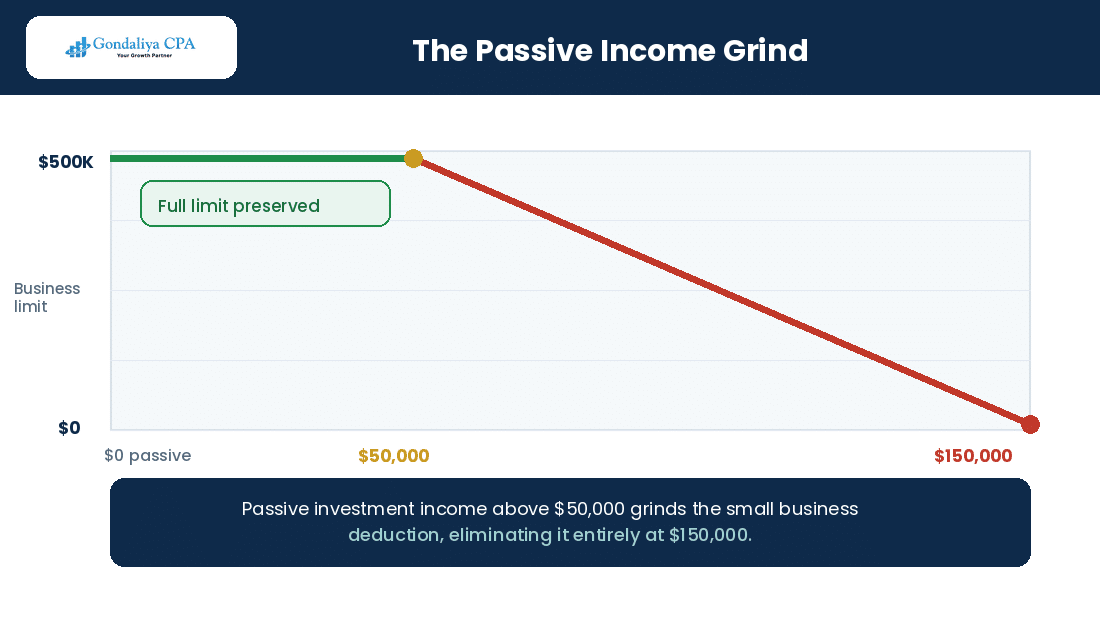
- Passive Investment Income Grind Threshold: If passive investment income inside your corporation goes over $50,000, it reduces your small business deduction until it’s gone at $150,000 income. Smart planning keeps this grind in check.
A dentist CPA or dental corporation accountant knows these rules well. They help you get the best out of incorporation in Ontario.
Potential Drawbacks to Incorporation
Incorporation has downsides too:
- EI Eligibility for Incorporated Dentists: Usually, incorporated dentists can’t get Employment Insurance benefits unless they opt into EI as self-employed before deadlines.
- CPP Contribution Rate (Employer + Employee Combined): Both employer and employee CPP rates apply on salaries from the corporation — about 11.9% total — raising payroll costs compared to dividends alone.
- Risks: CRA Compliance Issues and Prevention Controls: Mistakes like wrong shareholder loan treatment, unreasonable family wages, missed source deductions, or losing small business deductions due to associated corporations can lead to penalties. Careful bookkeeping and advice from Registered CPAs who know dental corporations help prevent issues.
Being aware of these risks lets you decide if incorporation suits your practice’s needs.
Overview of Ontario Dental Professional Corporation Rules
Ontario has specific rules for dental professional corporations:
- You must get a certificate of authorization from the Royal College of Dental Surgeons of Ontario (RCDSO) before operating as a professional corporation here.
- Only Registered dentists registered with RCDSO can hold shares tied to clinical services. Non-dentist shareholders are usually not allowed unless through specially structured holding companies following RCDSO rules.
These rules affect how you run your corporation and do tax planning at year-end with help from skilled dental accountants familiar with Ontario’s laws.
College of Dental Surgeons of Ontario Requirements
The RCDSO also controls naming and operation rules:
- Your corporation’s name must include “Professional Corporation” or “PC” to show its status clearly
- You need to stay Registered by reporting continuing education yearly through RCDSO databases
Working with a Registered Ontario CPA firm helps keep everything compliant while managing finances for incorporated dentists in Toronto or anywhere in Canada.
[CTA]: For tailored advice on incorporating your dental practice within CRA rules, contact Gondaliya CPA at info@gondaliyacpa.ca or call 647‑212‑9559 today.
Key Stat: The small business deduction applies to the first $500,000 of active business income at roughly 12.2% in Ontario, against a general rate near 26.5%. That gap of about 14 points on every dollar above the limit is what most year-end planning is protecting.
Tax Planning Strategies for Incorporated Dentists
Tax Planning Strategies for Incorporated Dentists
The Strategies
Tax planning for incorporated dentists means making smart choices to keep more of your money and stay on the right side of the CRA. You’ll want to find the best mix of salary and dividends. You’ll also have to watch out for TOSI rules that limit income splitting. Claiming capital cost allowance (CCA) and handling GST/HST correctly are part of the deal too. A dental corporation accountant can guide you through these tricky areas and help you save tax.
Effective Use of Salary Versus Dividends for Dentists
Choosing salary or dividends affects your CPP contributions, RRSP room, payroll taxes, and TOSI risk. Salary creates RRSP room because it counts as earned income. But it means paying employer and employee CPP, plus payroll remittances. Dividends skip payroll taxes but don’t add RRSP room or CPP benefits. They can also cause TOSI problems if family members get dividends without excluded shares.
Here’s a quick comparison:
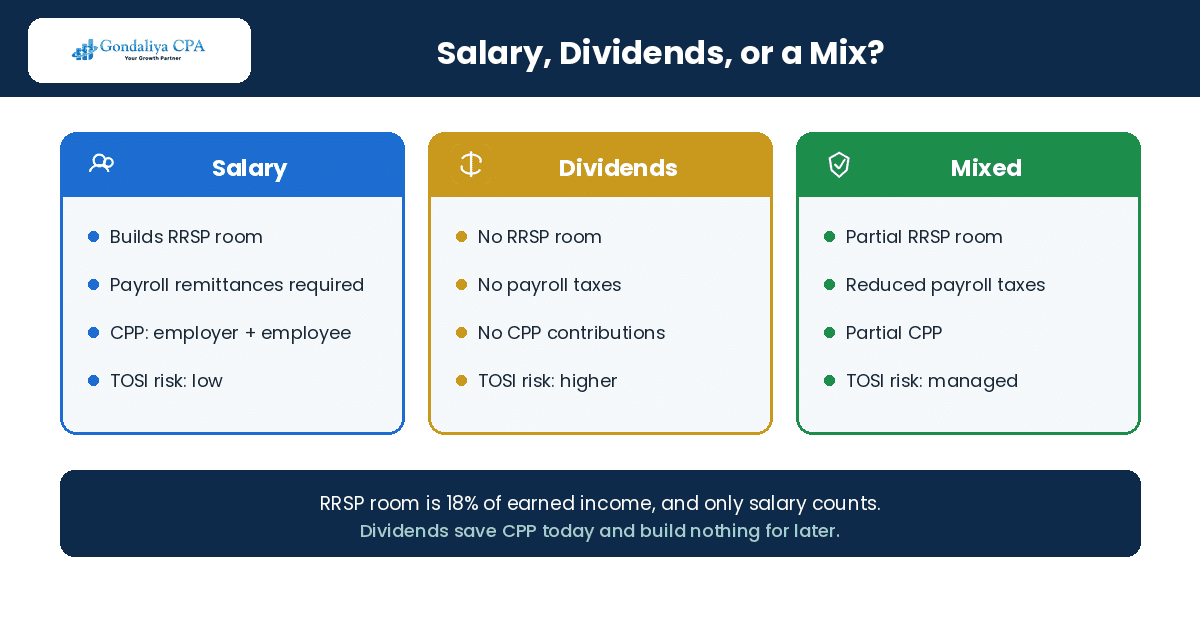
- Salary: Builds RRSP room, requires payroll remittances, triggers CPP contributions.
- Dividends: No RRSP room, no payroll taxes, higher TOSI risk.
- Mixed: Balances both benefits and risks.
A good plan often uses a mix of salary and dividends to fit your situation best.
A dentist paying $200,000 entirely as dividends had no earned income, so no RRSP room accrued that year. Moving $120,000 to salary created about $21,600 of room at the 18% rate, at the cost of the CPP contributions that came with it. Figures changed for privacy.
Income Splitting Opportunities Under TOSI Rules
TOSI limits the benefit of sprinkling income among family members by taxing certain dividends at the highest rate. Paying family through a dental corporation takes care: wages must match real work done. Dividends should go only to those with excluded shares or meet reasonableness tests.
To avoid TOSI trouble when paying family:
- Pay fair market value for any work they do.
- Confirm if family members hold excluded shares.
- Keep detailed records showing how compensation was set.
This way, you keep income splitting legal under CRA rules.
Spousal and Family Shareholder Planning
Payments to spouses or adult kids must pass the reasonableness test plus follow TOSI rules. This means pay should match what they actually do compared to industry standards.
Key tips:
- Put roles in writing with employment agreements.
- Avoid paying too much compared to their involvement.
- Watch for changes in shareholder status that affect eligibility.
If you don’t follow these rules, CRA may reassess payments at top rates with penalties. Good planning lowers audit risks and helps distribute wealth properly.
A spouse was paid $45,000 for administrative work with no contract, no timesheets, and no job description. The work was genuine; without documentation it could not be defended, and the deduction was at risk. Figures changed for privacy.
Tax-Efficient Structuring for Dental Practice Purchases and Sales
When buying or selling a practice, some advanced tax tools help save money. Individual Pension Plans (IPPs) let dentists over 40 contribute more than RRSPs by setting defined benefit plans funded by the corporation.
Capital Dividend Accounts (CDAs) allow tax-free capital dividends from life insurance proceeds or capital gains if assets are structured correctly inside your corporation.
Planning ahead with your dental corporation accountant is key here—especially since Ontario’s RCDSO has rules about dental professional corporations.
Capital Cost Allowance and Equipment Depreciation Guidance
Dental equipment usually falls under Class 8 CCA at 20% declining balance. Leasehold improvements go in Class 13 and amortize over lease terms. New immediate expensing options let you deduct full costs in the purchase year up to limits—handy for cutting taxes before year-end.
Other deductible costs include continuing education fees, staff wages tied directly to patient care, software subscriptions used for practice management, plus home office portions when allowed by CRA guidelines.
Timing matters: buying equipment late may delay CCA claims. Prepaying expenses can help cash flow and boost deductions before year-end closes.
A clinic bought a $70,000 unit two weeks before year-end expecting a $14,000 Class 8 claim. The half-year rule cut the first-year claim to $7,000, and the asset also had to be available for use before the year closed. Figures changed for privacy.
GST/HST Compliance Challenges for Dental Practices
Most basic dental services are exempt from GST/HST. However, orthodontic appliances count as zero-rated goods allowing input tax credits on related purchases. Cosmetic procedures usually attract full GST/HST charges—even if your revenue is low enough that you’d normally skip registration.
You can’t claim input tax credits against exempt revenues unless you use proper allocation methods each year. Decisions about registering depend heavily on your mix of services—common in multi-service clinics around Toronto and Ontario.
Sharad Gondaliya, CPA (Canada & USA), has 10+ years working with Canadian business owners including incorporated dentists through these tax details clearly.
[CTA] Need specific advice about your dental practice’s tax matters? Reach Gondaliya CPA at 647-212-9559 or info@gondaliyacpa.ca — a no-pressure chat awaits.
Risk Warning: Input tax credits cannot be claimed against exempt dental revenue. A clinic with a small proportion of taxable work can only claim a matching proportion of its credits, and claiming the full amount is one of the most common reassessments we see in dentistry. Please have the allocation method set before the return is filed.
Year-End and Ongoing Financial Management
Year-End and Ongoing Financial Management
The Year-End
Managing finances well at year-end and throughout the year matters a lot for incorporated dentists. It helps with paying the right taxes, staying on good terms with the CRA, and growing the practice. A dental corporation accountant handles tasks like bookkeeping, filing taxes on time, finding tax deductions, planning retirement, tracking finances, and avoiding audit problems.
Dental Corporation Bookkeeping Essentials
Good bookkeeping is the base of smart dentist tax planning. Incorporated dentists must pay payroll remittances when CRA asks for them to dodge fines. The deadline to file T4 slips is February 28 after the calendar year ends. T5 slips for dividends must be filed by then too if needed. Keeping all records in order—like lab fees, staff wages, equipment buys, and leasehold improvements—helps with correct tax filings.
It’s key to watch shareholder loans closely to avoid unintended taxes under subsection 15(2). Using cloud tools like QuickBooks or Xero can make this easier and show your practice’s money flow clearly.
- Payroll remittances on time prevent penalties.
- File T4 and T5 slips by February 28.
- Track every expense: labs, wages, equipment.
- Record shareholder loans properly.
- Use online accounting software for real-time updates.
A shareholder loan of $55,000 drawn in one year and still outstanding at the end of the next was included in the owner’s personal income. Clearing it before the second year-end would have avoided the inclusion entirely. Figures changed for privacy.
Annual Corporate Tax Filing Requirements
Your dental corporation must file a T2 corporate tax return within six months of its fiscal year-end. For instance, if your year ends December 31, you have until June 30 next year. The date to pay any tax owing is usually two months after year-end but can be three months for eligible small businesses in Ontario.
The CRA expects all forms that go with the T2 return: things like capital cost allowance schedules, salary vs dividend details, passive income reports affecting small business deductions, plus info on related-party deals.
Late filing means penalties start at $250 per month up to 12 months. Plus interest charges pile up on unpaid taxes. Your dental corporation accountant should help you avoid last-minute issues by preparing early.
- File T2 return within six months after fiscal year-end.
- Pay any balance due within two or three months.
- Include all required schedules and disclosures.
- Late filing causes monthly penalties and interest.
Key Tax Deductions and Allowable Expenses for Dentists
Incorporated dentists can write off several expenses before the fiscal year closes:
| Expense Category | Deductible | Limit or Condition | Documents Needed |
|---|---|---|---|
| Dental Equipment | Yes | Follows CCA class rates | Purchase invoice |
| Leasehold Improvements | Yes | Amortized over lease duration | Lease agreement + invoices |
| Staff Wages | Yes | Must be reasonable | Payroll records |
| Lab Fees | Yes | Fully deductible | Supplier invoices |
| Professional Dues | Yes | Standard receipts required | Receipts |
Planning for Retirement, Succession, and Lifetime Capital Gains Exemption
Retirement planning uses RRSP limits tied to earned income reported from salary—not dividends—from your dental corporation. You can contribute up to 18% of that income yearly, capped federally (around $32,060). Paying yourself a salary helps build RRSP room while balancing cash flow now.
When you plan succession, selling shares may qualify for a lifetime capital gains exemption (LCGE). Dentistry corporations often meet rules letting owners exempt up to about $913,630 CAD from capital gains tax when they sell shares. Setting this up right early avoids surprise taxes later on.
Coordinate these plans with your CPA so today’s pay strategy fits your long-term wealth goals.
- RRSP room based on salary income only.
- Up to 18% contribution limit annually (federal cap applies).
- LCGE covers up to around $913k on qualified small business shares.
- Early planning avoids extra tax during sales or transfers.
A dentist agreed a practice sale price before anyone checked whether the shares qualified for the exemption. Cash accumulated inside the corporation had put the active asset test at risk, and there was no runway left to purify. Figures changed for privacy.
Dental Practice Financial Benchmarks and KPIs
Keeping an eye on financial numbers shows how well your practice runs alongside tax management:
- Revenue per operatory
- Staff costs compared to revenue
- Overhead as a percentage of billings
- Effective corporate tax rate after small business deduction (SBD)
- CPP contributions versus benefits earned
- Passive investment income inside the corporation
These figures guide choices about hiring or spending that affect tax deductions too. Comparing yourself with Canadian industry averages spots areas where better bookkeeping boosts profits and keeps reporting clean.
Common CRA Audit Triggers and Risk Areas
Dental corporations face audit risks mainly because of:
- Late payroll source deduction payments causing penalties.
- Paying family members wages that seem too high triggering reassessments.
- Dividend payouts ignoring excluded share rules leading to top-rate TOSI taxes.
- Shareholder loans not properly documented causing personal income inclusions under subsection 15(2).
- Mixing personal expenses through company accounts damaging expense claims.
- Losing small business deduction due to association between multiple companies without proper coordination.
Avoid these by keeping detailed documents reviewed regularly with your dental corporation accountant before any audit chance appears.
Sharad Gondaliya CPA advises incorporated dentists across Toronto and Canada on handling financial management focused on dentistry corporations’ needs.
Pro Tip: Set the compensation mix in the first quarter of the fiscal year, not the last. Payroll remittances follow salary decisions monthly, so a salary decided in month twelve cannot be remitted across the eleven months that have already passed.
Annual and Quarterly Tax Planning Checklist
Annual and Quarterly Tax Planning Checklist
The Calendar
Incorporated dentist tax planning needs careful attention all year. Dental corporations must follow deadlines, check their structure, meet reporting duties, and handle practice sales or purchases wisely. This checklist points out key quarterly tasks and tips for managing tax efficiently.
Q1 to Q4 Timelines and Best Practices for Dental Corporations
Dental corporations have important dates to remember. Filing the T2 corporate tax return six months after the fiscal year ends is crucial. Payroll source deductions must be sent on time, either monthly or quarterly, depending on your status. Also, T4 slips for salaries and T5 slips for dividends go in by the last day of February each year.
Here’s a quick look:
- T2 Corporate Tax Return: File within six months after your fiscal year ends.
- Payroll Source Deductions: Send monthly or quarterly based on your payroll size.
- T4 Slips: File by February 28 for salary payments.
- T5 Slips: File by February 28 for dividends paid.
Missing these can trigger penalties or cause problems with employee RRSP room calculations. Keep a calendar so you don’t forget.
Incorporation and Structure Review
Wondering if a dentistry professional corporation is worth it? It depends on your income, risk level, and plans to pass the practice on. The Royal College of Dental Surgeons of Ontario (RCDSO) sets rules dental corporations must follow.
You’ll need a certificate from RCDSO to operate professionally in Ontario. Shareholders must mainly be Registered dentists. Naming rules also apply.
A dentist CPA or dental corporation accountant will help check:
- If you follow RCDSO’s shareholder rules.
- If your corporate name meets standards.
- How limited liability protects you.
- How taxes work between personal and corporate levels.
This review helps you find tax planning options while staying fully legal.
Tax Compliance and Reporting Deadlines
Sticking to CRA deadlines saves money and hassle. Key points include:
- File your T2 Corporate Tax Return within six months of your fiscal year end.
- Pay your Payroll Source Deductions on time—monthly or quarterly per CRA rules.
- Make sure you know your RRSP contribution deadline, which includes the first 60 days of the new year. Your limit is 18% of earned income.
Good bookkeeping keeps you ahead here. Record expenses before deadlines. Regularly reconcile accounts so you don’t miss payments or make errors.
A clinic missed one monthly payroll remittance during a staff transition. The remittance was small; the penalty and the follow-up correspondence took far longer to resolve than the payment itself would have. Figures changed for privacy.
Practice Acquisition, Sale, and Holding Company Considerations
Holding companies can help manage passive investment income in dental corporations but can get tricky with small business deductions.
Key things to watch:
- If passive income inside your corporation passes $50,000, it slowly cuts down your small business deduction until it vanishes at $150,000.
- Groups with multiple locations may be “associated corporations.” That means they share one small business limit. Each firm’s deduction drops accordingly.
When buying or selling a practice:
- Use proper valuations so capital gains fit lifetime exemption rules.
- Time asset transfers carefully to claim equipment expenses right away.
Working early with a dentist CPA helps sort these details under Canadian tax rules while keeping more money in your pocket.
Two clinics owned by the same dentist each earned about $400,000 of active business income. As associated corporations they shared one $500,000 limit, so roughly $300,000 fell outside the small business rate. Figures changed for privacy.
Expert Dental CPA Services and Getting Started
Expert Dental CPA Services and Getting Started
Our Work
If you’re an incorporated dentist in Ontario, tax planning can make a big difference. A dentist CPA knows the tax rules that apply to dental professionals with their own corporation. They help reduce your taxes and keep you on the right side of CRA regulations. By planning your year-end carefully, you can lower corporate taxes, balance your salary and dividends, and file everything on time. This works for dentists all over Toronto and across Canada.
Accounting and Advisory Services for Dental Practices
Dental corporation accountants focus on what dental practices need. They handle bookkeeping that matches how clinics work, manage payroll with CPP/EI rules in mind, prepare corporate tax returns (T2), and sort out GST/HST filings—making sure exempt dental supplies are counted properly.
A dentist CPA offers advice like:
- How to mix salary and dividends for the best tax result, keeping RRSP room and TOSI rules in check.
- Ways to handle passive investment income so it doesn’t cut into your business limit.
- Which capital cost allowance (CCA) classes fit dental equipment purchases.
- Understanding RCDSO certificate impacts on your corporation status.
This approach helps your practice grow while staying compliant with CRA.
Transparent Pricing and Service Packages
Dentist CPAs keep their pricing clear. At Gondaliya CPA, we offer a flat annual fee plus HST that covers key services like:
- Corporate tax filing
- Bookkeeping checks focused on dental expenses (like lab fees or leasehold improvements)
- Payroll for associates or family members following TOSI rules
- CRA representation when needed
Here’s a quick look at what’s included:
| Service Component | Included in Flat Fee? | Notes |
|---|---|---|
| Corporate Tax Filing (T2) | Yes | Includes checking small business deduction eligibility |
| Year-End Tax Planning | Yes | Models salary vs dividend compensation |
| Bookkeeping Review | Yes | Focuses on dental supplies & wages |
| Payroll Processing | Optional | Extra fee if associates have complex pay arrangements |
| GST/HST Return Preparation | Optional | Depends on taxable versus exempt sales |
This way, you won’t get surprise bills but still get expert care.
Case Studies: Tax Planning Successes for Dental Clinics
Here are some examples of how incorporated dentists improved their tax outcomes:
- Multi-location General Dentist Group – Toronto
- Made $850K revenue; paid $250K salary; planned dividends.
- Bonus payments timed just before year-end boosted small business deduction use.
- Result: About $28K saved on combined federal-provincial corporate taxes (approximate).
- Orthodontist Incorporation
- Had high passive income from investments inside the corp.
- Restructured holding company to cut down investment income impact.
- Result: Kept full business limit; deferred personal taxes by timing dividends.
Both cases balanced salary, dividends, CPP contributions, and TOSI risks specific to dentists with RCDSO certificates.
Figures changed for privacy; based on Gondaliya CPA client engagements 2025–26.
How to Begin Working with a Dental Corporation Accountant
- Initial Chat
Talk about your incorporation status, clinic size/location (say, Toronto), and bookkeeping tools like QuickBooks or Xero. - Send Documents
Share your articles of incorporation, RCDSO certificates, past T2 returns, payroll records including associate or family salaries checked against reasonableness tests. - Review Your Setup
The accountant checks how you pay yourself—salary vs dividends—and looks at any passive investments affecting your small business deduction. - Year-End Close Help
Coordinate purchase timing for equipment that can be expensed immediately under new CCA rules starting 2026; review lab fees too. - Set Up Ongoing Support
Agree on how to communicate—expect replies within one business day plus some weekend or evening help if needed at Gondaliya CPA.
Starting early means you get the most from an accountant who knows Ontario’s rules for incorporated dentists.
Suggested internal links: Corporate Tax Filing → Contact → Bookkeeping → Payroll
Legal Disclaimer and Reference Table: Incorporation vs Sole Proprietorship for Ontario Dentists
Tax planning changes quite a bit depending on whether you’re incorporated or a sole proprietor dentist in Ontario. The CRA taxes these differently, and only incorporated dentists need an RCDSO certificate. Here’s a simple comparison at year-end time:
| Aspect | Incorporated Dentist | Sole Proprietor Dentist |
|---|---|---|
| Legal Entity | Separate legal entity | Individual owner |
| Liability Protection | Limited liability | Unlimited personal liability |
| Income Splitting | Possible via salary/dividends (TOSI applies) | Not possible |
| Passive Investment Income Impact | Can reduce small business deduction threshold | No impact |
| Small Business Deduction Eligibility | Up to $500K shared among associated corps | Not available |
| Payroll Obligations | Required if paying salary | N/A |
| Tax Filing Requirements | Annual T2 return | Personal T1 reporting |
| RCDSO Certificate Requirement | Mandatory | N/A |
| Capital Cost Allowance Claims Allowed | Allowed | Allowed |
Business limit reduces when investment income passes certain CRA thresholds. This table helps compare but doesn’t replace advice tailored to your situation.
A dentist compared incorporating against staying a sole proprietor at about $190,000 of net income. The corporate route deferred tax on the retained portion, but only the amount actually left in the company, which was smaller than expected once personal spending was counted. Figures changed for privacy.
Frequently Asked Questions
Frequently Asked Questions
FAQ
What is year-end tax planning for an incorporated dentist and why does it matter?+
Year-end tax planning helps dentists optimize taxes before the fiscal year closes. It ensures deductions are claimed, income is balanced, and CRA compliance is met. Proper planning saves money and reduces audit risks.
When is a dentistry professional corporation worth it and what are the RCDSO rules?+
A dental corporation is worthwhile if you want liability protection, tax savings, and income splitting. The RCDSO requires a certificate of authorization. Only Registered dentists can hold shares tied to clinical services.
Salary vs dividends for an incorporated dentist: which is better?+
Salary builds RRSP room but triggers CPP and payroll taxes. Dividends avoid payroll taxes but do not create RRSP room and may cause TOSI issues. A mix usually balances benefits and risks effectively.
| Factor | Salary | Dividends | Mixed |
|---|---|---|---|
| RRSP Room | Yes | No | Partial |
| CPP Contributions | Employer & Employee apply | None | Partial |
| Payroll Taxes | Yes | No | Reduced |
| TOSI Risk | Low | Higher | Managed |
| Cash Flow Flexibility | Lower | Higher | Balanced |
How does the small business deduction work for a dental corporation?+
Dental corporations qualify for a $500,000 business limit. Income below this pays reduced tax rates (~12.2% in Ontario). Passive investment income above $50,000 gradually reduces this limit.
What can an incorporated dentist actually deduct before year-end?+
Dentists can deduct dental equipment (CCA Class 8), leasehold improvements, staff wages, lab fees, professional dues, and continuing education expenses if properly documented before year-end.
What are the deadlines an incorporated dentist cannot miss?+
File T2 corporate tax return within six months after fiscal year-end. Submit T4 and T5 slips by February 28. Remit payroll source deductions monthly or quarterly as required.
How do you pay family members through a dental corporation without a TOSI problem?+
Pay family members reasonable salaries for actual work done. Ensure they hold excluded shares or meet reasonableness tests under TOSI rules. Keep detailed records and formal agreements.
What advanced year-end strategies suit higher-earning dentists?+
Higher earners benefit from Individual Pension Plans (IPPs), capital dividend accounts (CDAs), income sprinkling within TOSI limits, and holding companies to manage passive investment income.
A realistic numeric walkthrough of salary vs dividends for dentists?+
For $200K total payout: paying $120K salary creates RRSP room but higher CPP; $80K dividends reduce CPP but risk TOSI; mixed approach balances tax savings and retirement benefits.
Dentist tax planning: DIY vs dentist CPA vs non-CPA provider — which route fits?+
DIY suits simple cases with low revenue but carries risk. Dentist CPAs specialize in dental corp rules offering tailored advice and audit support. Non-CPA providers may lack dental-specific expertise.
How do we handle year-end planning for dental corporations at Gondaliya CPA?+
We review your financials, balance salary/dividends, identify deductible expenses, ensure compliance with CRA/RCDSO rules, file timely returns, and advise on tax-saving opportunities unique to dentists.
What deliverables do you get from Gondaliya CPA’s services?+
Clients receive detailed tax plans, corporate filings (T2), bookkeeping reviews focused on dental expenses, payroll management aligned with TOSI rules, plus audit support when needed.
How much does a dentist CPA cost in Canada?+
Typical annual fees range based on complexity from CAD 3,000 to 10,000 plus HST. Fees cover bookkeeping checks, tax filing, payroll management, advisory services tailored to dental corporations.
What are the risks, CRA compliance issues and prevention controls?+
Risks include late remittances penalties, unreasonable family wages triggering reassessments, improper shareholder loans causing personal income inclusions, and losing small business deductions due to associated corporations.
What should a dentist prepare before a year-end planning engagement starts?+
Prepare incorporation documents, RCDSO certificates, past tax returns (T2), payroll records including associate/family wages with job descriptions, recent bookkeeping reports showing expenses/income.
How does year-end planning differ across 10 dental practice profiles?+
Small solo practices focus on cash flow management; multi-location groups prioritize passive income handling; orthodontists emphasize capital asset strategies; high-income practices require complex IPPs and shareholder planning.
How to choose the right dentist CPA in Toronto/Ontario?+
Select CPAs with dental industry experience, strong knowledge of RCDSO regulations, clear pricing structures, proven client references in dentistry incorporation cases.
A dentist asked for the numeric walkthrough on a $200,000 payout. Splitting it $120,000 salary and $80,000 dividends created about $21,600 of RRSP room and roughly $8,000 of combined CPP, which was the trade being made rather than a free saving. Figures changed for privacy.
Key Takeaways for Incorporated Dentist Tax Planning
Key Takeaways for Incorporated Dentist Tax Planning
Quick Reference
- Plan salary vs dividend mix early to optimize RRSP room and reduce payroll costs.
- Claim all eligible CCA classes before year-end for dental equipment depreciation benefits.
- Monitor passive investment income inside the corporation to protect small business deduction limits.
- Pay family members only reasonable salaries backed by proper documentation to avoid TOSI issues.
- Meet all CRA filing deadlines strictly: T2 returns within six months; slips by February 28; payroll remittances monthly or quarterly as required.
- Use professional advice from specialized dentist CPAs like Gondaliya CPA for tailored strategies respecting Ontario’s RCDSO rules.
Frequently Asked Questions
Can I claim home office expenses through my dental corporation?+
Yes if you use part of your home exclusively for business purposes following CRA guidelines on reasonable allocation.
Are cosmetic dentistry services taxable for GST/HST purposes?+
Yes; cosmetic services attract full GST/HST while basic services often remain exempt or zero-rated depending on nature.
Can I incorporate if I’m not Registered yet with RCDSO?+
No; incorporation as a dental professional corporation requires an active license and certificate from RCDSO in Ontario.
Does incorporating affect my EI eligibility as a dentist?+
Typically yes; incorporated dentists generally cannot claim EI unless they opt into self-employed EI programs prior to deadlines.
For precise guidance tailored to your practice’s needs contact Gondaliya CPA at info@gondaliyacpa.ca or call 647‑212‑9559 today.
Industry Spotlights: Sectors We Represent
Industry Expertise
The year-end levers described here apply well beyond dentistry. Here are ten sectors and where the same decisions land in each.
| Industry | The Year-End Decision |
|---|---|
| Dentists & dental practices | Salary and dividend mix against RCDSO share rules |
| Medical doctors & physician professional corporations | The same compensation question under a different college |
| Daycare, childcare & CWELCC services | Funded revenue timing against the business limit |
| Real estate investors, landlords & holding companies | Passive income grinding the small business deduction |
| Property developers & builders | Associated corporations sharing one $500,000 limit |
| Construction, contractors & skilled trades | Equipment purchase timing and CCA classes |
| Technology startups & SaaS | Founder compensation and lifetime capital gains planning |
| E-commerce & online retailers | Inventory and prepaid expense timing before year-end |
| Restaurants & food and beverage | Family wages tested for reasonableness |
| Transportation, logistics & trucking | Fleet CCA across classes and the half-year rule |
| Consulting firms | Shareholder loans cleared before the deadline |
- Dentists & dental practices: The subject of this article. The RCDSO share rules narrow who can hold shares, which shapes every income splitting option before the compensation mix is even set.
- Medical doctors & physician professional corporations: Physicians face the identical salary and dividend question, with their own college conditions on shareholders and corporate naming.
- Daycare, childcare & CWELCC services: Funded revenue arriving late in the year can push a centre over the business limit, so the timing matters as much as the amount.
- Real estate investors, landlords & holding companies: This is where the passive income grind bites hardest, and it is the same $50,000 threshold a dental corporation watches on its investment portfolio.
- Property developers & builders: Multiple project corporations under common control are usually associated, sharing one business limit between them exactly as multi-location clinics do.
- Construction, general contractors & skilled trades: Equipment bought close to year-end runs into the half-year rule, the same trap a dentist meets buying a chair in December.
- Technology startups & SaaS: Founders planning an exit face the same qualifying share tests that decide whether a practice sale gets the lifetime capital gains exemption.
- E-commerce & online retailers: Prepaid expenses and inventory positions moved before year-end change the deduction, which is the retail version of prepaying lab or supply costs.
- Restaurants & food and beverage: Family members on payroll are common and are tested the same way, against what the work is actually worth.
- Transportation, logistics & trucking: Fleet assets sit across several CCA classes, and getting the classification right decides the claim just as it does with dental equipment.
- Consulting Firms: Incorporated consultants draw against the shareholder loan through the year, and clearing it before the deadline is the single most common year-end correction we make.
Across owner-managed year-end files in one quarter, the two most frequent corrections were an uncleared shareholder loan and family wages with no supporting documentation. Neither is specific to dentistry. Figures changed for privacy.
Professional Guidance and Quick Reference
Guidance
Professional Guidance in Dental Corporation Tax Planning: How Gondaliya CPA Supports Incorporated Dentists
Year-end planning for a dental corporation can get technical quickly. You need to know how much salary the corporation should pay, whether family payments will survive a reasonableness test, which CCA class an asset belongs in, how much passive income sits inside the company, and what the RCDSO permits on shareholdings. Gondaliya CPA provides tax planning and corporate filing services built for incorporated dentists.
We help with the work that changes the number: modelling the salary and dividend mix against RRSP room and CPP cost, documenting family compensation, timing equipment purchases and applying the half-year rule, monitoring passive investment income against the $50,000 grind threshold, and checking whether associated corporations are sharing one business limit.
Our team follows CRA and RCDSO practice closely and builds the plan around your own facts rather than a template. Whether you are incorporating for the first time, running several locations, or planning a sale, we give clear advice based on the current rules.
Quick Answers: Key Numbers & Concepts at a Glance
At a Glance
- Small business deduction limit: $500,000 of active business income
- Ontario combined rate on SBD income: About 12.2%
- General rate above the limit: Near 26.5%
- Passive income grind: Starts at $50,000, eliminated at $150,000
- RRSP contribution rate: 18% of earned income, salary only
- Combined CPP on salary: About 11.9%
- Dental equipment: CCA Class 8, 20% declining balance
- Leasehold improvements: CCA Class 13, over the lease term
- T2 filing deadline: Six months after fiscal year-end
- T4 and T5 slips: February 28
Who This Is For / Not For
Fit Check
- For: Incorporated dentists in Ontario and across Canada, multi-location dental groups, orthodontists managing passive investment income, and dentists planning a practice sale or succession.
- Not For: Dentists not yet Registered with the RCDSO, who cannot hold a dental professional corporation, and associates employed by another practice with no corporation of their own.
People Also Ask
Quick Answers
Does taking dividends instead of salary always save tax?+
No. Dividends avoid CPP and payroll remittances, but they create no RRSP room and no CPP entitlement. The saving is real in the year; whether it is a saving overall depends on what the RRSP room and the CPP benefit were worth to you.
Why does investment income inside my corporation raise my tax bill?+
Because passive investment income above $50,000 grinds the small business deduction, eliminating it at $150,000. Active income that would have been taxed at roughly 12.2% moves toward the general rate near 26.5%.
When should year-end planning actually happen?+
Well before the year-end. Salary decisions drive monthly payroll remittances, equipment has to be available for use, and bonuses have to be declared in time. After the fiscal year closes, the numbers are reported rather than planned.
Glossary of Key Terms
Plain-English Definitions
- Dental professional corporation: The corporation through which a Registered dentist practises, authorized by the RCDSO.
- RCDSO: The Royal College of Dental Surgeons of Ontario, which sets the rules for dental corporations.
- Certificate of authorization: The RCDSO approval required before operating as a professional corporation.
- Small business deduction: The reduced corporate rate on the first $500,000 of active business income.
- Business limit: The $500,000 threshold, shared among associated corporations.
- Associated corporations: Corporations under common control that must share one business limit.
- Passive investment income: Investment earnings inside the corporation that grind the business limit above $50,000.
- TOSI: Tax on Split Income, taxing certain family payments at the top rate.
- Excluded shares: Shareholdings that can take a family member outside the TOSI rules.
- Reasonableness test: The check that family compensation matches the work actually performed.
- Capital cost allowance: The tax depreciation claim on equipment and improvements.
- Half-year rule: The rule limiting the first-year CCA claim on a newly acquired asset to half.
- Shareholder loan: An owner draw from the corporation, taxable under subsection 15(2) if left outstanding.
- Capital dividend account: The account allowing tax-free capital dividends to shareholders.
- Individual Pension Plan: A corporate-funded defined benefit plan allowing higher contributions than an RRSP.
- Lifetime capital gains exemption: The exemption available on qualifying small business share sales.
Dental Corporation Year-End Check
This quick self-check flags which year-end levers are still open for your practice. Please answer the six questions below.
Dental Corporation Year-End Check
Six quick questions on the levers that matter. No fee shown.
Levers to review:
This is a general prompt, not tax or legal advice or a quote. Your position depends on your full facts. For a real review, please book a free consultation.
Want a checklist to work from? You can download our free incorporated dentist year-end checklist before your consultation.
Decide the compensation mix early, document every family payment, buy equipment with the half-year rule in mind, watch passive income against the $50,000 threshold, and clear the shareholder loan before the deadline. Those five decisions account for most of the tax an incorporated dentist can still influence.
2026 Update — what is current: The small business deduction still applies to the first $500,000 of active business income, with the passive income grind running from $50,000 to $150,000. RRSP room remains 18% of earned income from salary. Slips are due February 28 and the T2 six months after year-end. Please confirm the current RRSP dollar cap and lifetime capital gains exemption amount before relying on the figures quoted in this article.
Incorporated Dentist Tax Planning and Dentist CPA Services: Expert Dental Corporation Accounting and Year-End Strategies by Gondaliya CPA
Plan your dental corporation year-end while the levers are still open
Gondaliya CPA models the salary and dividend mix, documents family compensation, times the equipment purchases, watches the passive income threshold, and files the T2, on a flat annual fee with a one-business-day response. Please book a free consultation.
Next Steps
Year-end tax planning rewards early action more than almost anything else in a dental corporation. The compensation mix drives payroll all year, equipment has to be in use before the year closes, and a shareholder loan left outstanding past the deadline cannot be undone afterwards. Please contact us at 647-212-9559 or info@gondaliyacpa.ca, gather your incorporation documents, RCDSO certificate, and prior returns, and let us review the position while there is still time to act on it. If our content helps, please add gondaliyacpa.ca as a preferred source on Google.
Published: July 31, 2026 · Last updated: July 31, 2026
Editorial policy: We research against CRA, RCDSO, and Ontario sources, fact-check the figures, and Sharad Gondaliya, CPA, reviews the content, which we update as the rules change.
Disclaimer: This article is educational information only and is not tax, legal, or financial advice. Figures marked illustrative are examples rather than quotes or guarantees. It reflects CRA and RCDSO rules current to 2026, including the $500,000 small business deduction limit shared among associated corporations, the passive investment income grind from $50,000 to $150,000, RRSP room at 18% of earned income, CCA Class 8 at 20% with the half-year rule, and shareholder loan treatment under subsection 15(2). Rates, dollar limits, and professional rules change and outcomes depend on your specific facts. Please consult a Registered CPA before acting.

Sharad Gondaliya is a CPA Canada & CPA USA with 15 Years+ experience of Accounting, Tax, Payroll of Corporate Small Businesses as Tax Accountant. He is fully certified CPA Ontario and CPA USA and is well known among corporate small businesses for tax planning, efficient tax solutions, and affordable CPA services. Sharad is the Principal (Director) of Gondaliya CPA – Affordable CPA Firm in Canada. Licenses: CPA Ontario: 61040184 | CPA USA (MT): PAC-CPAP-LIC-033176 | CPA USA (WA): 57629 | CPA Firm License: 61330051 View Full Author Bio