



How Canadian Startups Can Maximize SR&ED Tax Credits and Recover R&D Costs
TLDR: Gondaliya CPA specializes in SR&ED tax credit Canada, assisting startups with SR&ED claims by ensuring eligibility through scientific research, technological uncertainty, and systematic investigation documentation. Their expertise helps recover startup development costs and maximize R&D tax credits while meeting CRA SR&ED application requirements effectively.
Quick Summary
SR&ED is the one credit that pays a pre-revenue startup in cash. A CCPC earns up to 35% refundable on the first $3 million of qualifying spend, and everything after that depends on three things: proving technological uncertainty, showing a systematic investigation, and holding contemporaneous records. Please note the 18-month deadline is absolute, and a missed claim cannot be revived.
| Aspect | Details |
|---|---|
| The rate | 35% refundable for CCPCs, 15% basic otherwise. |
| The limit | $3 million of qualified expenditures per year. |
| The test | Technological uncertainty plus systematic investigation. |
| The deadline | 18 months after fiscal year-end, with no extensions. |
Reading time: 33 minutes.
Table of Contents
- SR&ED Tax Credit Canada: Core Concepts and Benefits for Startups
- SR&ED Eligibility for Startups: Key Criteria and Industry Examples
- CRA SR&ED Application Process
- Maximizing Innovation Tax Credits and Recovering Startup Development Costs
- The Value of Working with an SR&ED Accountant
- Answers to Key Questions About R&D Tax Credits and Startup Claims
- Frequently Asked Questions (FAQs) on SR&ED and Related Topics
- Comparisons, Costs and Preparation
- Industry Spotlights: Sectors We Represent
- Professional Guidance and Quick Reference
The Numbers That Matter
This article covers Canada, with Ontario and Toronto context, and reflects CRA rules current to 2026. It assumes an incorporated Canadian startup, typically a CCPC, carrying out research or development work. Figures marked illustrative are examples, not quotes, and any masked engagement notes end with “Figures changed for privacy.” This is educational information only and not tax, legal, or financial advice. Rates, limits, and programme rules change, so please confirm your own situation with a Registered CPA before acting.
SR&ED Tax Credit Canada: Core Concepts and Benefits for Startups
SR&ED Tax Credit Canada: Core Concepts and Benefits for Startups
The Basics
Understanding Scientific Research and Experimental Development (SR&ED) Program
The Scientific Research and Experimental Development (SR&ED) program helps Canadian businesses do research and make new things. The government gives money back through tax credits to encourage this work. Startups get special help to support their ideas and projects.
Definition and Purpose of SR&ED
SR&ED means work that tries to solve a science or technology problem. This work can be testing new ideas or doing experiments. The program’s goal is to help by:
- Giving investment tax credits based on R&D spending
- Offering refundable R&D tax credits for small businesses, even if they don’t owe taxes
These credits lower the cost of trying new things.
Overview of SR&ED Tax Incentives
In Canada, SR&ED tax credits come in two main types:
- Refundable Investment Tax Credits: These let companies get cash back for part of what they spent.
- Non-Refundable Investment Tax Credits: These only reduce taxes owed but can be saved or used later.
Knowing which type fits your startup helps with making claims.
Why SR&ED Matters for Canadian Startups
For startups that are incorporated, SR&ED offers real benefits:
- They can get back lots of money from startup SR&ED claims.
- The extra funds help them pay for more innovation without worrying too much about costs.
- Using these credits keeps them competitive by letting them create new stuff often.
So, the SR&ED tax credit Canada program helps startups grow while saving money on R&D.
A founder assumed SR&ED only mattered once the company was profitable. The credit is refundable for a CCPC, so it paid out in a year with no tax owing at all, which is exactly when the cash was most useful. Figures changed for privacy.
Key Stat: A CCPC earns a 35% refundable investment tax credit on the first $3 million of qualified expenditures each year. Refundable means cash, not a deduction, so it arrives whether or not the corporation owes tax.
SR&ED Eligibility for Startups: Key Criteria and Industry Examples
SR&ED Eligibility for Startups: Key Criteria and Industry Examples
The Test
Assessing Technological Uncertainty and Systematic Investigation Requirements
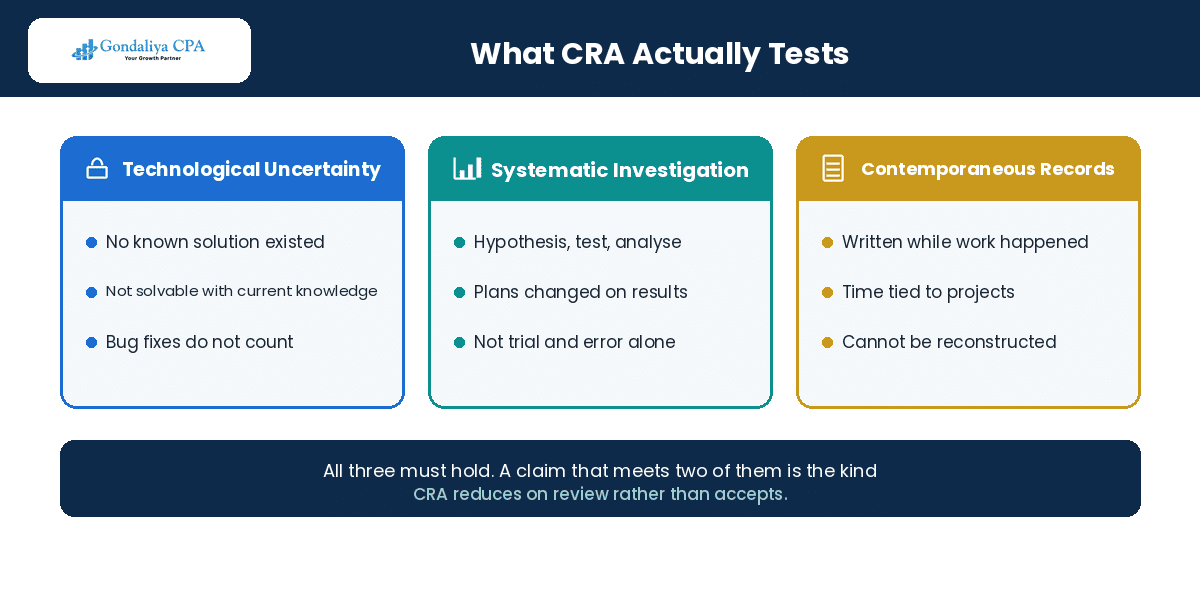
The SR&ED tax credit Canada helps startups with real tech problems. These startups work on new or better products, processes, or software. To get the credit, projects must show technological uncertainty. They also need to follow a clear plan to find solutions.
What Qualifies as Technological Uncertainty?
Technological uncertainty happens when a startup can’t easily solve a problem with what they know now. Maybe the tech is not ready or the solution is unknown and needs testing. For example, a software startup tries to build an AI algorithm that works better than existing ones. If they don’t know if it will succeed, that is uncertainty.
CRA says simple tasks like fixing bugs or making small design changes don’t count. The work must tackle hard scientific or tech problems that don’t have clear answers.
Systematic Investigation Explained
Systematic investigation means working step by step to solve problems. The startup makes guesses (hypotheses), runs tests, studies results, and changes plans based on what they learn.
Startups need to show this process clearly in their SR&ED claims. It proves they did real research and not just random tries.
Key Documentation Needs
The CRA needs good records made while the project is happening. These include:
- Detailed project notes about goals and problems
- Logs of time workers spent on the project
- Notes on trials and errors
- Software version histories showing changes
- Test results that prove experiments
Clear papers help startups pass CRA reviews and get R&D tax credits Canada offers.
Typical SR&ED Projects in Software, Technology, and Engineering Startups
Many startups in Canada claim SR&ED credits by doing real R&D in software, AI, and engineering fields.
Examples by Industry
- Software & AI Development: Startups building new algorithms or solving tough coding problems qualify. Making machine learning models with unknown data behaviors fits here too.
- Engineering Startups Ontario: Companies creating prototypes with new materials or fixing mechanical issues often qualify as experimental development under SR&ED rules.
These industries face tech challenges that need careful testing and good documentation following CRA rules.
Common Eligible and Ineligible Activities
Eligible work includes:
- Creating new tech through experiments
- Research solving specific technical questions
- Building prototypes to fix real problems
Excluded work includes things like:
| Activity | Qualifies? | Reason |
|---|---|---|
| Routine debugging | No | Doesn’t solve tech uncertainty |
| Market research | No | Not science or tech research |
| Style changes | No | Only cosmetic improvements |
Knowing what counts helps startups focus claims on the right expenses under Canadian programs like SR&ED.
Sharad Gondaliya, CPA, has helped many Canadian business owners file startup SR&ED claims well in Toronto/Ontario for over 10 years.
A team claimed a full quarter of engineering time on a project where most of the work was routine integration. Splitting the genuinely uncertain work from the routine build reduced the claim but made the remainder defensible. Figures changed for privacy.
Risk Warning: Routine debugging, cosmetic changes, and market research do not qualify, and including them weakens the whole claim rather than just that line. Please separate the genuinely uncertain work from the routine build before filing.
CRA SR&ED Application Process
CRA SR&ED Application Process
The Process
The CRA SR&ED application process helps startups in Canada get money back for research and development work. The SR&ED tax credit Canada offers is a way to recover costs spent on R&D. Startups need to follow rules and meet deadlines to make startup SR&ED claims under R&D tax credits Canada programs.
- Find projects that qualify
- Keep records of costs
- File before deadlines
Step-by-Step Guide to Filing an SR&ED Claim
Filing a startup SR&ED claim takes clear steps. First, find projects with technical problems you try to solve. Then, gather proof of salaries, contractor fees, materials, and other expenses.
It helps to hire an SR&ED accountant early on. Gondaliya CPA helps startups at every step—from finding projects to writing reports that explain your work.
Next, fill out the right forms like Form T661 carefully. Attach your claim with your T2 corporate tax return. Don’t miss the strict deadline set by CRA.
Timelines and Critical Deadlines
You must file your SR&ED claim within 18 months after your company’s fiscal year ends or when you file your T2 return — whichever comes first. Miss this deadline and you lose your chance forever.
Here’s what you should know:
- Late claims don’t get accepted.
- Missing the deadline means no refunds.
- Prepare early; track work as you go.
- If you file T2 without claiming, no changes allowed later.
Knowing this timing protects your startup’s chances for R&D tax credits Canada offers.
SR&ED Documentation Requirements and Best Practices
CRA wants proper documentation that shows all research activities claimed. Good records help if CRA audits your claim later.
Essential Records to Maintain
For software startups, keep time tracking tied directly to R&D work like coding new features or testing ideas. Logs should list dates worked and who did what.
Other important documents are:
- Technical descriptions of experiments
- Notes on problem-solving
- Version control showing code changes
- Test results
- Payroll records linked to eligible work
These prove money went to real tech progress—not just routine fixes excluded by CRA.1
| Evidence Type | Purpose | Source Example | How Often |
|---|---|---|---|
| Time Tracking | Show hours on qualified tasks | Timesheets / software logs | Daily/weekly |
| Technical Narratives | Explain experiments & tech problems | Project reports | Per project |
| Version Control Logs | Track code changes over time | Git commit history | Continuous |
| Payroll Registers | Show wages tied to eligible tasks | Accounting system | Monthly |
1: See CRA – What Work Qualifies
Tips for Effective Project Tracking
Start tracking early and often. Don’t wait till year-end to piece it all together. Use digital tools like version control and time-tracking apps that fit developer workflows well.
At Gondaliya CPA, we do intake interviews then keep in touch during the year using QuickBooks and Hubdoc tools.2 This keeps data real-time and matches eligible spending exactly in startup SR&E claims.
2: Based on our work with Toronto startups
A startup reconstructed a year of development notes from memory two weeks before the deadline. CRA asked for contemporaneous evidence, and reconstructed narratives carry far less weight than a commit history written at the time. Figures changed for privacy.
Common Mistakes That Impact Startup SR&ED Claims
Errors like filing late or wrong expense types can cut refunds or reject parts of your claim under Canada’s startup research tax credits program.
Pitfalls to Avoid
Watch out for:
- Filing after the absolute deadline: this means no refund at all.3
- Calling routine tasks experimental work (like normal bug fixes) leads to denied expenses.4
- Not adjusting government help against claimed amounts can cause problems too.5
How to Respond to CRA Reviews
- They check technical stories about your innovations plus financial details.
- They might ask for more documents proving you kept records.
- Sometimes they visit sites and talk with staff.
- If they find problems, you can object with more proof with help from your CPA.
Gondaliya CPA helps clients respond quickly and keep as much eligible spending as possible under the rules.
Sharad Gondaliya, CPA, has over 10 years helping Canadian businesses handle federal incentive programs carefully.
Contact us anytime at info@gondaliyacpa.ca or call 647-212-9559 for questions about getting R&D funding through correct startup SR&E claims under Canadian law.
Maximizing Innovation Tax Credits and Recovering Startup Development Costs
Maximizing Innovation Tax Credits and Recovering Startup Development Costs
The Maximizing
Canadian startups can get more from SR&ED tax credit Canada by spotting eligible expenses and sticking to CRA rules. Handling startup SR&ED claims right helps you get back R&D costs. Plus, many CCPCs can claim refundable R&D tax credits. Knowing what counts as scientific research eligibility boosts your chance of a bigger claim.
Strategies to Increase SR&ED Refunds for New Businesses
To maximize your startup’s innovation funding, catch all eligible research and development costs. This means tracking salaries, contractor payments, materials, and overhead tied to experiments. Whether you get refundable or non-refundable R&D tax credits depends on your CCPC status and taxable capital limits.
Pick the best way to calculate your claim—traditional or proxy method—to possibly increase refunds and ease paperwork. Keep solid records so you’re ready if CRA audits you. Good docs include project logs, time sheets, tech notes, and clear money records.
- Track all staff time on R&D projects
- Keep contracts showing R&D work for contractors
- Save receipts for materials used in tests
- Use detailed or proxy method for overhead claims
Optimizing Eligible Expenditures
Eligible expenditures under SR&ED cover wages paid to workers doing qualifying activities. Contractor payments can count too if contracts say they do R&D work directly.
Materials used or changed in experiments also qualify but not routine supplies that don’t help tech progress. Overhead costs claim works two ways: the traditional way needs exact cost details; the proxy method uses a flat rate based on labour costs.
| Expenditure Type | Claim Eligibility | Key Point |
|---|---|---|
| Salaries & Wages | Yes | Must link to qualified R&D work |
| Contractor Payments | Yes | Contract must show R&D role |
| Materials Consumed | Yes | Used or changed during experiments |
| Overhead | Traditional or Proxy Method | Choose based on record keeping |
Leveraging Provincial and Federal Incentives
Ontario startups get both provincial R&D tax credits Ontario Canada and federal investment tax credit ITC under SR&ED. These layered provincial federal benefits stack well but watch out: government grants may cut how much you claim because of CRA rules about assistance adjustments.
Provincial credits often add more refundable money but come with their own rules. Track all Canadian innovation funding carefully so you don’t accidentally double claim and risk penalties.
- Combine provincial and federal incentives smartly
- Check grant terms before claiming
- Document every funding source
Overview of Additional Canadian Innovation Funding and Tax Incentives
Grants or forgivable loans change how much you can claim under SR&ED because they lower your eligible expenses one-for-one per CRA rules. Forgivable loans count like grants here too.
Other Canadian innovation incentives exist outside SR&ED, like regional economic development funds. Mixing these with SR&ED means planning ahead so one doesn’t cancel out another benefit.
Knowing how these funds interact helps startups get more total support without CRA problems later.
Sharad Gondaliya, CPA, has helped many Canadian business owners with startup SR&ED claims in Toronto/Ontario over 10+ years.
A company received a provincial grant covering part of its development salaries and claimed the same salaries in full under SR&ED. The grant reduced the eligible base dollar for dollar, and the correction came after the claim had been filed. Figures changed for privacy.
Pro Tip: Decide between the traditional and proxy method before the year starts, not at filing. The proxy method uses a flat percentage of eligible salaries, which suits a lean team with light bookkeeping; the traditional method needs actual overhead tracked all year.
The Value of Working with an SR&ED Accountant
The Value of Working with an SR&ED Accountant
The Specialist
How a CPA Supports Startup SR&ED Claims
A CPA helps startups claim the SR&ED tax credit Canada offers. They explain how Scientific Research and Experimental Development tax incentives work. This helps startups get more innovation funding. A good CPA finds eligible projects, prepares claims, and makes sure the CRA rules are followed.
Specialized Knowledge and Guidance
CPAs know the CRA eligibility rules for startup SR&ED claims well. They make sure all R&D activities are tracked before the deadline. This stops mistakes that could lower your refund or cause audits. They also help organize technical stories, time sheets, and cost details to keep things clear.
Ensuring Compliance with CRA Requirements
Filing for R&D tax credits Canada-wide needs to follow CRA rules closely. An accountant checks that all proof is ready to pass any audits. They remind you that claim deadlines don’t change or extend. Preparing claims right lowers the chance of denied expenses or less credit later.
Choosing an Accountant with SR&ED Experience
Picking an accountant who knows startup SR&ED claims makes filing easier and faster. Startups need money quickly, so speed matters.
Key Qualities to Look For
- Choose firms with fixed fees so you avoid surprise bills.
- Look for quick replies and support if you face an audit.
These help keep your costs down and worries low.
Gondaliya CPA fits this well. They offer clear pricing and fast answers. They work well with Canadian startups focused on tech innovation.
Benefits of a Dedicated SR&ED Specialist
Specialist CPAs usually finish claims in about 20 business days (just a guide). They understand changing rules like those for 2026 spending limits and better refundable credit rates.
Working with these experts helps your startup get the most from research tax credits. These credits support industries like software, engineering, and clean technology by giving back money to fuel new ideas.
Sharad Gondaliya, CPA, has over 10 years of helping many Canadian business owners.
Answers to Key Questions About R&D Tax Credits and Startup Claims
Answers to Key Questions About R&D Tax Credits and Startup Claims
Key Questions
Frequently Asked Questions
Who Can Claim SR&ED?
Incorporated startups in Canada, especially Canadian-controlled private corporations (CCPCs), can claim the SR&ED tax credit Canada offers. The CRA sets rules for eligibility. Your work needs to involve scientific research or experimental development. It must deal with technological uncertainty and follow a careful investigation. The goal should be to make a new or better technology. Startups have to check if their projects fit these rules before filing startup SR&ED claims.
How Much Can Startups Expect to Receive?
CCPC startups may get a 35% refundable tax credit on up to $3 million in eligible spending each year. If you spend more than $3 million or are not a CCPC, then the basic 15% tax credit applies. This lower rate is not refundable, so it lowers taxes owed but does not give cash back. Also, the $3 million limit lowers when your taxable capital goes over $10 million and stops completely at $50 million.
What Are the Most Common Claim Challenges?
Startups often face these issues:
- Keeping detailed records like time sheets and notes (CRA wants proof).
- Showing real technological uncertainty—not just normal fixes or tweaks.
- Finishing claim paperwork on time with correct government grant adjustments.
Failing on these points can mean smaller refunds or longer CRA checks.
When Should You Engage an SR&ED Accountant?
Getting help from a CPA who knows SR&ED early makes a big difference. A good accountant finds which activities qualify and helps keep good records. They explain the difference between refundable and non-refundable credits. They also handle tricky parts like government grants that affect your claim. Plus, they can support you if CRA audits your claim.
For help with your startup’s R&D tax credits under Canada’s SR&ED program, contact Gondaliya CPA at 647-212-9559 or info@gondaliyacpa.ca. They offer free consultations for incorporated startups in Toronto and Ontario.
Key Stat: CCPCs get 35% refundable ITC on first $3M of eligible expenses [CRA].
Statutory Requirement: Projects must show tech uncertainty, systematic study, and seek tech progress [CRA].
Risk Warning: Missing proper records risks partial or full rejection by CRA [CRA].
Pro Tip: Hiring an experienced CPA early improves claim accuracy and audit readiness [CPA Ontario].
Our Take: Careful planning turns startup R&D spending into useful innovation tax credits.
Sharad Gondaliya, CPA, has over 10 years helping Canadian business owners with these claims.
A first-time claimant asked how long the money takes to arrive. Preparation ran about three weeks once the documentation was complete, and the refund followed the T2 assessment rather than the claim submission itself. Figures changed for privacy.
Frequently Asked Questions (FAQs) on SR&ED and Related Topics
Frequently Asked Questions (FAQs) on SR&ED and Related Topics
FAQ
What is the Basic Investment Tax Credit Rate for SR&ED?+
The basic investment tax credit rate is 15% of eligible R&D expenditures for corporations that do not qualify as CCPCs.
What is the Enhanced Refundable Credit Rate for CCPCs?+
CCPCs can claim an enhanced refundable tax credit rate of up to 35% on the first $3 million of qualified expenditures.
How Does the Annual Expenditure Limit Affect SR&ED Claims?+
The annual limit caps the amount eligible for enhanced credits at $3 million per year for CCPCs, above which the basic rate applies.
What Is the Taxable Capital Reduction Phase-Out Range?+
When a CCPC’s taxable capital exceeds $10 million, its enhanced credit gradually reduces until it phases out completely at $50 million.
What Is the Prescribed Proxy Amount Percentage?+
The proxy method uses a fixed percentage (usually 55%) of eligible salaries to estimate overhead costs related to SR&ED projects.
When Is the SR&ED Claim Reporting Deadline?+
Claims must be filed within 18 months after the fiscal year-end or with your T2 corporate tax return, whichever is earlier.
What Is a Typical SR&ED Claim Preparation Turnaround Time?+
Experienced accountants often prepare claims within 15 to 20 business days from receiving complete documentation.
How Many Industry Spotlights Does Gondaliya CPA Cover?+
We cover over ten industries including software, AI, engineering, clean tech, manufacturing, and life sciences.
Which Locations Does Gondaliya CPA Serve in Ontario and Canada?+
We serve startups in Toronto, Etobicoke, Vaughan, Mississauga, Brampton, Scarborough, Ottawa, Oshawa, Guelph, Hamilton, North York, and Windsor.
Comparisons, Costs and Preparation
Comparisons, Costs and Preparation
Quick Reference
Comparison: Traditional Method vs Proxy Method for Overhead Claims
- Traditional Method: Requires detailed tracking of actual overhead expenses. This method demands thorough bookkeeping but may yield precise claims.
- Proxy Method: Uses a flat percentage of salaries to calculate overhead. It simplifies reporting but offers less accuracy.
Choose based on your record-keeping ability and desired claim accuracy.
Government Assistance Adjustment Example
If you receive a grant covering part of your R&D costs, reduce those costs claimed under SR&ED by the grant amount. This ensures no double benefit from government funding.
Market Research and Routine Maintenance Exclusion Table
| Activity | Qualifies? | Reason |
|---|---|---|
| Market Research | No | Not related to scientific R&D |
| Routine Maintenance | No | Does not address tech uncertainty |
Only activities solving technological challenges qualify for credits.
SR&ED Route: DIY vs Contingency Consultant vs CPA Firm
- DIY: Low cost but high risk due to complex rules and potential errors.
- Contingency Consultant: You pay only if you get a refund; may lack full CPA expertise.
- CPA Firm: Offers expert knowledge with fixed fees and audit support; best for compliance and maximum refunds.
Gondaliya CPA recommends hiring experienced CPAs for best results.
What Deliverables Do You Get When Hiring Gondaliya CPA?
You receive:
- Complete claim packages ready for CRA submission.
- Detailed technical narratives explaining R&D work.
- Accurate cost breakdowns linked to projects.
- Ongoing audit support if needed.
This ensures smooth claim processing and maximizes credits.
How Much Do SR&ED Services Cost in Canada?
Service fees vary by project size but typically range from $3,000 to $10,000. Fixed fee options help avoid surprises and maintain budgets.
Risks and Compliance Issues with SR&ED Claims
Improper documentation or missed deadlines risks partial or full claim denial. Non-compliance can lead to audits or penalties.
Prevention Controls for Successful SR&ED Claims
Maintain organized records early. Track all time and expenses clearly. Consult your CPA regularly during your fiscal year.
What Should a Startup Prepare Before an SR&ED Engagement Starts?
Startups should prepare:
- Project descriptions outlining technological challenges.
- Time tracking logs tied to specific tasks.
- Payroll records linking wages to R&D activities.
- Documentation of materials used in experiments.
Having these ready speeds up claims preparation.
How Does SR&ED Apply Across 10 Industries We Serve?
SR&ED applies broadly in industries like software development, engineering prototyping, biotechnology research, clean technology innovation, advanced manufacturing processes, data analytics models, AI solutions development, environmental technologies, telecommunications advances, and agricultural technology improvements.
A Realistic Numeric Walkthrough of an SR&ED Claim
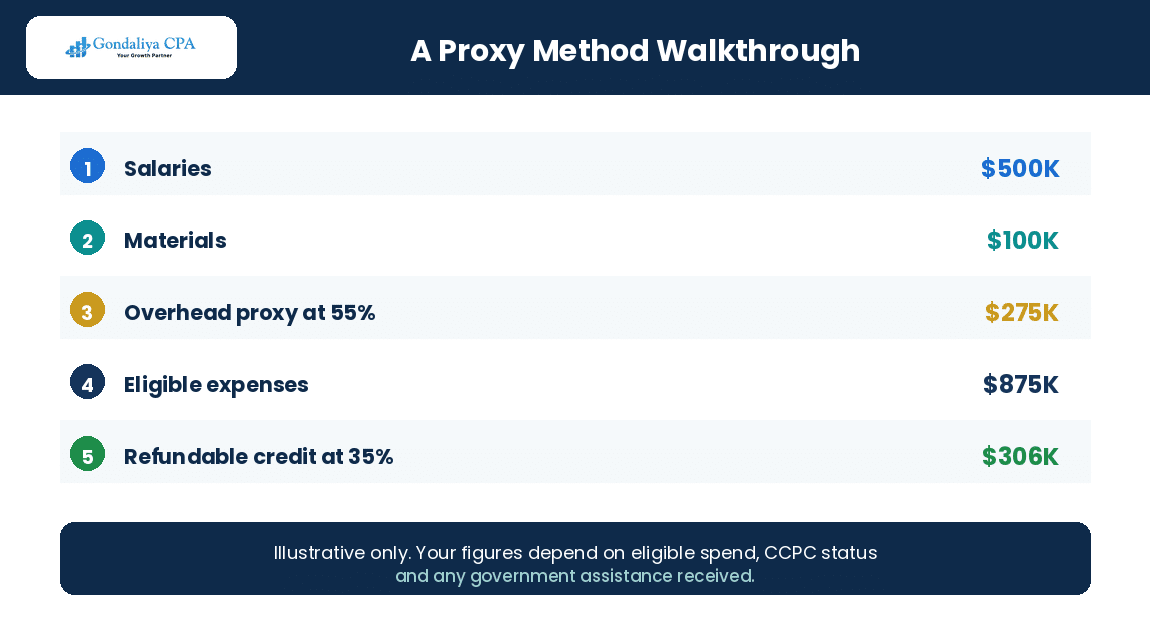
For example: A startup spends $500K on salaries plus $100K on materials using proxy method at 55%. The total overhead proxy would be $275K (55% of salaries). Eligible expenses equal $875K claimed at 35%, yielding approximately $306K refundable credit.
How to Choose the Right SR&ED Accountant in Toronto/Ontario?
Look for:
- Proven experience with startup claims.
- Transparent pricing with no hidden fees.
- Quick turnaround times.
- Good communication skills and audit support capability.
Gondaliya CPA matches these criteria well.
Why Trust Gondaliya CPA?
We offer over a decade of hands-on experience helping Canadian startups maximize their innovation credits while ensuring strict CRA compliance across diverse industries and regions including Toronto and surrounding cities.
A startup with about $500,000 of eligible salaries modelled the proxy method against the traditional one. The proxy figure was higher and needed no overhead tracking, which is the usual outcome for a small team working mostly on development. Figures changed for privacy.
Industry Spotlights: Sectors We Represent
Industry Expertise
SR&ED reaches further than software. Here are eleven sectors and where the qualifying work usually sits in each.
| Industry | Where the Qualifying Work Usually Sits |
|---|---|
| Technology startups & SaaS | New algorithms and unsolved architecture problems |
| Construction, contractors & skilled trades | Novel methods and materials tested on site |
| Property developers & builders | Building system prototypes and energy performance testing |
| Transportation, logistics & trucking | Routing algorithms and telematics development |
| E-commerce & online retailers | Recommendation engines and fraud detection models |
| Restaurants & food and beverage | Food process and shelf-life experimentation |
| Consulting firms | Internal tools built to solve technical problems |
| Dentists & dental practices | Device or materials development, rarely clinical practice |
| Medical doctors & physician corporations | Device and diagnostic development outside routine care |
| Real estate investors & holding companies | Rarely eligible, since holding activity is not development |
| Daycare, childcare & CWELCC services | Rarely eligible, since service delivery is not experimentation |
- Technology startups & SaaS: The largest group of claimants. The credit rests on the problems that had no known solution, not on the volume of code shipped.
- Construction, general contractors & skilled trades: Testing a new method or material on site can qualify as experimental development, though routine build work does not.
- Property developers & builders: Prototyping building systems or testing energy performance can qualify where the outcome was genuinely uncertain at the start.
- Transportation, logistics & trucking: Routing and telematics development is often overlooked, because the company thinks of itself as an operator rather than a developer.
- E-commerce & online retailers: Recommendation engines and fraud models involve real uncertainty; configuring an off-the-shelf platform does not.
- Restaurants & food and beverage: Process and shelf-life experimentation can qualify, which surprises operators who assume the programme is only for technology firms.
- Consulting Firms: Internal tooling built to solve a technical problem can qualify, even where the firm sells services rather than software.
- Dentists & dental practices: Clinical practice is not SR&ED, but a practice developing a device or material with an uncertain outcome may have a claim.
- Medical doctors & physician professional corporations: The same distinction applies: device and diagnostic development can qualify, routine patient care cannot.
- Real estate investors, landlords & holding companies: Rarely eligible. Holding and managing property is not experimental development, whatever the scale.
- Daycare, childcare & CWELCC services: Rarely eligible. Delivering a Registered service is not systematic investigation, so planning here focuses on other credits instead.
Across first-time SR&ED reviews in one year, the most common finding was eligible work in a company that had never considered itself a research business. The second was documentation that existed but was not tied to projects. Figures changed for privacy.
Professional Guidance and Quick Reference
Guidance
Professional Guidance on SR&ED Claims: How Gondaliya CPA Supports Canadian Startups
An SR&ED claim is part technical and part financial, and both halves have to hold up. You need to identify which work involved genuine technological uncertainty, describe the systematic investigation in terms CRA recognises, tie salaries and contractor payments to that work, choose between the traditional and proxy overhead methods, adjust for any government assistance, and file inside the eighteen-month window. Gondaliya CPA prepares SR&ED claims for Canadian startups.
We handle the work that determines the refund: intake interviews to find eligible projects, technical narratives written against CRA criteria, cost schedules linked to projects, the Form T661 filing alongside the T2, and audit support if CRA reviews the claim.
Our team follows CRA practice closely and builds the claim around your own facts rather than a template. Whether this is a first claim or a repeat filing after a review, we give clear advice based on the current rules.
Quick Answers: Key Numbers & Concepts at a Glance
At a Glance
- Enhanced refundable rate: 35% for CCPCs
- Basic rate: 15%, non-refundable
- Annual expenditure limit: $3 million
- Taxable capital phase-out: Begins at $10 million, ends at $50 million
- Prescribed proxy amount: Usually 55% of eligible salaries
- Reporting deadline: 18 months after fiscal year-end
- Claim form: Form T661, filed with the T2
- Typical preparation time: 15 to 20 business days
- Government assistance: Reduces eligible expenses dollar for dollar
- Typical service fee range: $3,000 to $10,000
Who This Is For / Not For
Fit Check
- For: Incorporated Canadian startups and CCPCs carrying out development work with genuine technical uncertainty, and companies that have never claimed but may have eligible work in prior years still inside the window.
- Not For: Non-incorporated businesses, which cannot claim federal investment tax credits, and companies whose work is routine configuration, maintenance, or cosmetic change.
People Also Ask
Quick Answers
Can non-incorporated businesses claim SR&ED?+
No; only incorporated companies such as CCPCs qualify for federal investment tax credits under SR&ED programs.
Does government funding affect my claim amount?+
Yes; government assistance reduces eligible expenses dollar-for-dollar as per CRA rules.
How far back can a first-time claimant go?+
Only as far as the eighteen-month window allows. A fiscal year that ended more than eighteen months ago is closed, which is why a first review should start with the years still open rather than the current one.
Glossary of Key Terms
Plain-English Definitions
- CCPC: Canadian-Controlled Private Corporation eligible for enhanced refundable credits.
- ITC: Investment Tax Credit earned through qualifying R&D expenses.
- Proxy Method: Simplified calculation method estimating overhead costs.
- Technological Uncertainty: Situations where solutions are unknown through current knowledge.
- Fiscal Year-End: The date when company’s accounting period ends used for filing deadlines.
- SR&ED: Scientific Research and Experimental Development, the federal research credit programme.
- Systematic investigation: A step-by-step process of hypothesis, testing, and analysis.
- Experimental development: Work to achieve technological advancement in a product or process.
- Refundable credit: A credit paid out in cash even where no tax is owing.
- Non-refundable credit: A credit that reduces tax owing and can be carried to other years.
- Form T661: The SR&ED claim form filed alongside the T2 return.
- Traditional method: Overhead claimed using actual tracked costs rather than a flat rate.
- Qualified expenditures: The spend that the credit rate is applied to.
- Annual expenditure limit: The $3 million ceiling on spend eligible for the enhanced rate.
- Taxable capital: The measure that phases out the enhanced rate between $10 and $50 million.
- Government assistance: Grants and forgivable loans that reduce eligible expenses.
SR&ED Eligibility Check
This quick self-check flags whether your work is likely to support a claim. Please answer the six questions below.
SR&ED Eligibility Check
Six quick questions on your development work. No fee shown.
Points to address:
This is a general prompt, not tax or legal advice or a quote. Your position depends on your full facts. For a real review, please book a free consultation.
Want a checklist to work from? You can download our free SR&ED claim checklist before your consultation.
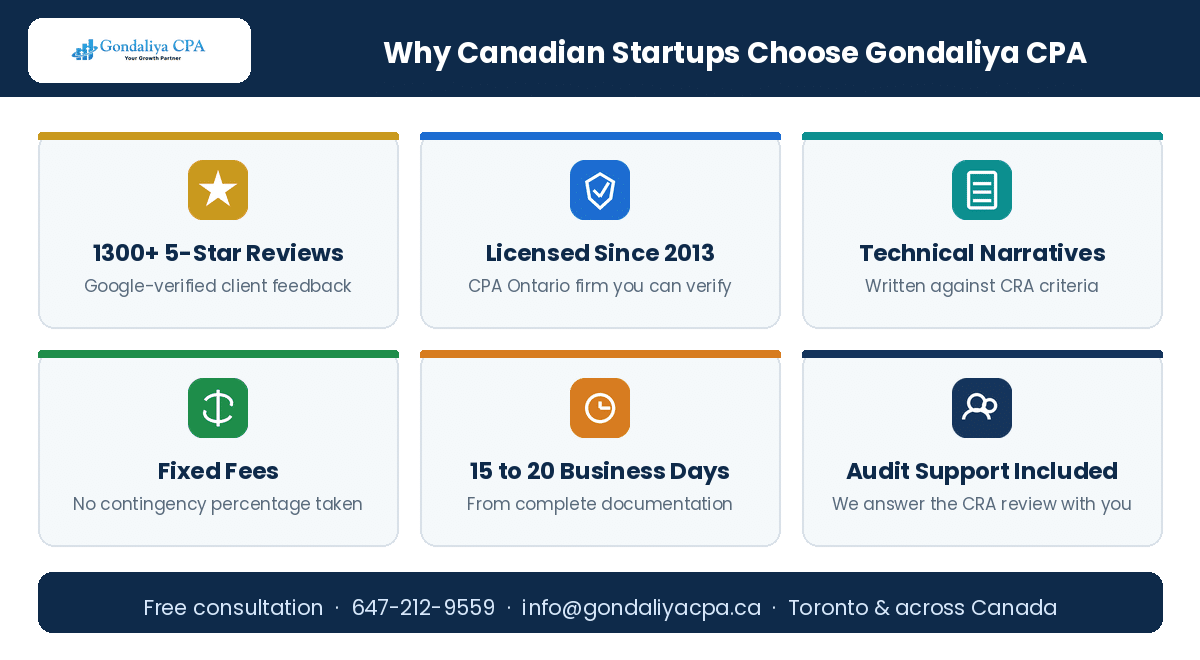
Identify the uncertain work rather than all the work, document it while it happens, tie salaries and contractor payments to projects, choose the overhead method deliberately, deduct any government assistance, and file inside eighteen months. Those six steps decide most of what a startup recovers.
2026 Update — what is current: The enhanced refundable rate remains 35% for CCPCs on the first $3 million of qualified expenditures, with the basic rate at 15%. The taxable capital phase-out still runs from $10 million to $50 million, and the reporting deadline remains 18 months after the fiscal year-end. Please confirm the current expenditure limit, proxy percentage, and any announced changes to refundable rates before relying on the figures in this article.
SR&ED Tax Credit Canada: How Gondaliya CPA Helps Startup SR&ED Claims and Maximize R&D Tax Credits
Turn your development work into a refund before the window closes
Gondaliya CPA identifies eligible projects, writes the technical narratives, builds the cost schedules, files Form T661 with your T2, and supports you through any CRA review, on fixed fees with a one-business-day response. Please book a free consultation.
Next Steps
Contact Gondaliya CPA today at info@gondaliyacpa.ca or call 647-212-9559 to discuss your startup’s SR&ED eligibility assessment and start maximizing your R&D tax credits now! If our content helps, please add gondaliyacpa.ca as a preferred source on Google.
Published: August 5, 2026 · Last updated: August 5, 2026
Editorial policy: We research against CRA and Department of Finance Canada sources, fact-check the figures, and Sharad Gondaliya, CPA, reviews the content, which we update as the rules change.
Disclaimer: This article is educational information only and is not tax, legal, or financial advice. Figures marked illustrative are examples rather than quotes or guarantees. It reflects CRA rules current to 2026, including the 35% enhanced refundable rate for CCPCs, the 15% basic rate, the $3 million annual expenditure limit, the taxable capital phase-out from $10 million to $50 million, the 55% prescribed proxy amount, and the 18-month reporting deadline. Rates, limits, and programme rules change and outcomes depend on your specific facts. Please consult a Registered CPA before acting.

Sharad Gondaliya is a CPA Canada & CPA USA with 15 Years+ experience of Accounting, Tax, Payroll of Corporate Small Businesses as Tax Accountant. He is a CPA Ontario member (61040184) and holds US CPA licences in Washington and Montana and is well known among corporate small businesses for tax planning, efficient tax solutions, and affordable CPA services. Sharad is the Principal (Director) of Gondaliya CPA – Affordable CPA Firm in Canada. Licenses: CPA Ontario: 61040184 | CPA USA (MT): PAC-CPAP-LIC-033176 | CPA USA (WA): 57629 | CPA Firm License: 61330051 View Full Author Bio