



How to Choose the Best CPA for Your Dental Practice in Canada
Gondaliya CPA offers specialized dental CPA Canada services, providing dentist accountants in Canada skilled in dental practice tax planning, bookkeeping, and corporate tax filing. Our expertise includes dental incorporation, payroll management, GST/HST return filing, and strategies to reduce dental practice taxes while ensuring RCDSO compliance and effective financial planning for multi-location dental groups.
Quick Summary
Choosing a CPA for a dental practice comes down to four checks: licensing with CPA Ontario, working knowledge of RCDSO shareholder rules, correct handling of associate payments on T4A rather than T4, and a fee that is stated in full before the work starts. Please note the classification question alone carries the largest penalty exposure in most dental files.
| Aspect | Details |
|---|---|
| The licensing check | A Registered Ontario CPA firm you can verify publicly. |
| The regulatory check | RCDSO rules on who may hold shares and act as director. |
| The payroll check | Associates on T4A, employees on T4, reviewed annually. |
| The pricing check | Flat annual fee covering the full scope, stated up front. |
Reading time: about 7 minutes
Table of Contents
- Dental CPA Services in Canada for Dentists and Dental Practices
- Core Accounting and Tax Services Tailored for Dental Practices
- Process Transparency and Client Engagement
- Meet Your Lead Dental Accountant at Gondaliya CPA
- Geographic Coverage and Additional Client Support
- How to Get Started with Gondaliya CPA’s Dental Accounting Services
- Frequently Asked Questions (FAQs)
- Additional Insights: Key Dental Practice Accounting Topics
- Industry Spotlights: Sectors We Represent
- Professional Guidance and Quick Reference
The Numbers That Matter
This article covers Canada, with Ontario and Toronto context, and reflects CRA and RCDSO rules current to 2026. It assumes a dentist operating through a dental professional corporation, or considering one. Figures marked illustrative are examples, not quotes, and any masked engagement notes end with “Figures changed for privacy.” This is educational information only and not tax, legal, or financial advice. Rates, limits, and professional rules change, so please confirm your own situation with a Registered CPA before acting.
Dental CPA Services in Canada for Dentists and Dental Practices
Dental CPA Services in Canada for Dentists and Dental Practices
The Difference
Dental CPAs in Canada focus only on accounting and tax work for dental practices. They know the money side of dentistry well. This means they keep your practice following the rules while helping you pay less tax where you can. A dentist accountant Canada can take care of your finances so you can spend more time with patients and less time on paperwork.
Key Challenges Faced by Dental Practices in Tax Planning and Accounting
Dental practices face some tough issues with taxes and accounting:
- CRA Compliance: Following Canada Revenue Agency rules stops fines.
- RCDSO Standards: The Royal College of Dental Surgeons of Ontario has strict rules dental corporations must meet.
- Small Business Deduction Rate: Knowing how this works affects your profits.
- Passive Investment Income Threshold: This limit changes if you get certain deductions.
- Number of Permitted Shareholder Categories: Only certain people can own shares in a professional corporation.
These things make dental accounting tricky without help from experts who know CRA rules and RCDSO standards.
How Specialized Dental CPA Services Address These Challenges
Dental CPA services use their special knowledge to fix these problems:
- They handle professional corporation regulations to keep your practice legal.
- They manage GST/HST compliance so your taxes on sales are right.
- They take care of Associate Dentist T4A Reporting, which means they report payments made to associate dentists correctly.
Because they know the rules well, these CPAs reduce risks and help save money by planning smartly.
Benefits of Choosing a Dental-Focused Accountant for Your Practice
There are clear reasons to hire a dental-focused accountant:
- They come from a Registered Ontario CPA firm, so they follow all local laws.
- Their flat-fee pricing minimizes surprises, making costs easier to plan.
- Their understanding of how associate payments work helps keep payroll smooth and legal.
Using a specialized accountant makes managing money easier and your dental practice run smoother.
A practice came to us after a general firm had issued T4 slips to two associates who worked under contractor agreements. The slips did not match the contracts, and correcting the position took longer than a full year of bookkeeping. Figures changed for privacy.
Key Stat: The small business deduction applies to the first $500,000 of active business income at a 9% federal rate, and passive investment income above $50,000 erodes it. For a dental corporation holding investments, that single threshold usually moves more tax than any bookkeeping decision.
Core Accounting and Tax Services Tailored for Dental Practices
Core Accounting and Tax Services Tailored for Dental Practices
The Services
Comprehensive Dental Practice Bookkeeping and Financial Reporting
A dental CPA Canada knows the ins and outs of bookkeeping for dental offices. They keep financial records clean and clear, helping dentists meet tax rules and make smart business moves. A dentist accountant Canada handles daily transactions, matches bank statements, watches bills and payments, and puts together monthly or quarterly reports. These reports show how much the practice earns, spends, and holds in cash.
Dental practice tax accountants add value by tracking specific things like lab fees, associate payments, equipment wear-and-tear, and leasehold improvements. They spot expenses that can be deducted while following CRA rules closely.
Good bookkeeping helps with timely filings such as T2 returns and GST/HST payments. It also makes it easier to prepare reports under CSRS 4200 standards when banks or partners ask. Many use tools like QuickBooks or Xero paired with Hubdoc to capture documents automatically and cut down mistakes.
- Track daily transactions
- Reconcile bank accounts
- Monitor payables and receivables
- Prepare clear financial statements
- Use accounting software integrated with document capture
Corporate Tax Filing and Planning for Dental Professional Corporations
A CPA for dental practice knows the tax filing duties that apply to incorporated dentists in Canada. Every dental professional corporation must file a T2 return yearly showing income earned.
The small business deduction rate applies up to $500,000 of taxable income per corporate group[^1]. But watch out—passive investment income over $50,000 shrinks this deduction[^2]. Knowing these limits helps dentists save on taxes without surprises.
Good planning splits pay between salary and dividends wisely. This balances tax deferral while respecting rules on split income (TOSI). Dentists also time equipment buys to use immediate expensing rules coming in 2026[^3], allowing full write-offs on Class 8 dental equipment up to $1 million yearly.
Some firms set up holding companies carefully while following RCDSO rules about who can be shareholders[^4].
- File annual T2 returns
- Understand small business deduction & limits
- Plan salary vs dividends for tax benefits
- Use immediate expensing on eligible assets
- Consider holding companies within regulations
Managing Payroll and CRA Compliance for Dental Offices
Payroll is vital when a dental office hires staff or associates. Payroll services calculate source deductions—income tax withheld plus CPP contributions—and issue T4 slips every year following CRA rules[^5].
Associates usually get T4A slips since they’re self-employed, not employees with T4s. Mistakes here risk penalties if CRA decides associates are actually employees based on control factors[^6].
Payroll compliance also means paying taxes on time, keeping good records of hours worked versus contract terms, and reporting benefits properly if offered. Systems like ADP or Wagepoint help keep payroll accurate using current rates.
Checking payroll regularly stops costly errors like worker misclassification or missed installment payments during busy times like year-end closing.
- Calculate source deductions correctly
- Issue T4 slips for employees; T4As for associates
- Keep detailed work hour records
- Use reliable payroll software
- Review classifications regularly
A clinic paid a hygienist as a contractor on the strength of a verbal arrangement. CRA looked at who set the schedule and who supplied the equipment, and the position could not be sustained on those facts. Figures changed for privacy.
GST/HST Return Filing Specifics for Dental Services
GST/HST filing can be tricky since most basic dental care is exempt from GST/HST under Schedule V[^7]. Cosmetic procedures may be taxable at provincial rates.
Dentists must separate exempt from taxable revenue on their returns. Input tax credits (ITCs) apply only to taxable supplies—not exempt health care—to avoid audits[^8].
Dentists need GST/HST registration if taxable revenues go over $30,000 in four straight calendar quarters. Below that they’re small suppliers who don’t charge GST/HST but can’t claim ITCs either[^9].
Keeping detailed billing codes helps track revenue streams clearly for both compliance reviews and managing overhead costs by service type.
- Separate exempt vs taxable services
- Claim ITCs only on taxable supplies
- Register if revenue passes $30K threshold
- Keep clear billing codes
Handling Capital Cost Allowance and Immediate Expensing of Dental Equipment
Capital cost allowance (CCA) lets dentists deduct asset depreciation over years. Class 8 covers medical/dental gear depreciated at 20% declining balance each year[^10].
From 2026, immediate expensing allows full write-offs up to $1 million per year on eligible property including Class 8 equipment like digital imaging machines or sterilizers used in clinics[^11]. This speeds up deductions compared to spreading them out over time.
It’s important to separate leasehold improvements from tangible assets because different CCA classes apply[^12]. Your dental practice tax accountant tracks this carefully during year-end close so taxation is right.
- Apply Class 8 CCA at 20% annually
- Use immediate expensing limit starting 2026
- Separate leasehold improvements from equipment
- Work with tax accountant for accurate tracking
Employee vs Contractor Status Management in Dental Practices
Deciding if hygienists or associates are employees or contractors affects payroll taxes big time. Wrong classification can cause penalties if CRA finds misclassification later[^13].
CRA looks at many factors: who controls schedules? Who provides tools? Can the worker earn profit or suffer loss? How much are they part of core practice operations?[^14]
Associates usually have contracts as independents getting T4As rather than employment agreements with regular paychecks producing T4s[^15].
Clear contracts plus regular reviews reduce confusion around status and keep everything in line with rules. If issues appear later, voluntary disclosures programs can help fix them without heavy penalties[^16].
- Review control & integration factors
- Define roles clearly in written agreements
- Issue correct tax slips: T4 vs T4A
- Perform periodic status checks
- Use voluntary disclosure if needed
For help with these areas specifically designed for incorporated dentists across Ontario, Toronto, or anywhere else in Canada, reach out at info@gondaliyacpa.ca or call 647‑212‑9559 for a no-cost chat about your unique needs involving dental CPA Canada knowledge supporting your compliance every step of the way.
References:
- CRA – Small Business Deduction
- CRA – Passive Investment Income Rules
- Canada Gazette – Immediate Expensing Update 2026
- RCDSO – Professional Corporation Requirements
- CRA – Payroll Deductions
- CRA – Employee vs Self-Employed Determination
- CRA – GST/HST Health Care Supplies Guide
- Ibid., Input Tax Credit Restrictions section
- Ibid., Registration Threshold section
- CRA – Capital Cost Allowance Classes & Rates
- See reference ^3 above – Immediate Expensing Limit details
- See reference ^10 above – Leasehold Improvements distinction
- See reference ^6 above – Worker Classification Risks
- Ibid., Control Factors Explained
- Gondaliya CPA experience advising clients re: associate agreements
- Voluntary Disclosures Program overview
Risk Warning: Input tax credits cannot be claimed against exempt dental revenue. A clinic with a small proportion of cosmetic work can only recover a matching proportion of its credits, and claiming the full amount is one of the most common reassessments we see. Please have the allocation set before the return is filed.
Process Transparency and Client Engagement
Process Transparency and Client Engagement
The Process
Step-by-Step Overview of Our Dental Accounting Process
Dental CPAs in Canada focus only on dental practices. They know the rules for professional corporations well. This means your tax and accounting fit your dental business perfectly.
First, we check your corporation setup. That includes confirming your certificate under RCDSO rules. Next, we organize or improve your bookkeeping. We use QuickBooks or Xero, set up with dental-specific accounts.
We record transactions monthly or quarterly. These cover patient payments, associate fees, lab costs, and payroll. When the year ends, we prepare adjusting entries for things like dental equipment depreciation (CCA) and lease improvements.
Then, we create financial statements following CSRS 4200 standards. After that, we file the T2 corporate tax return on time to avoid penalties. Along the way, we give advice on cash flow and tax planning aimed at dentists.
This clear process keeps you compliant with laws and helps your practice grow within Canada’s dental industry rules.
Initial Consultation and Practice Discovery Meeting
The first meeting matters a lot. It helps us learn about your finances and figure out how a dentist accountant Canada can help you beyond just bookkeeping.
Here are some questions you should ask:
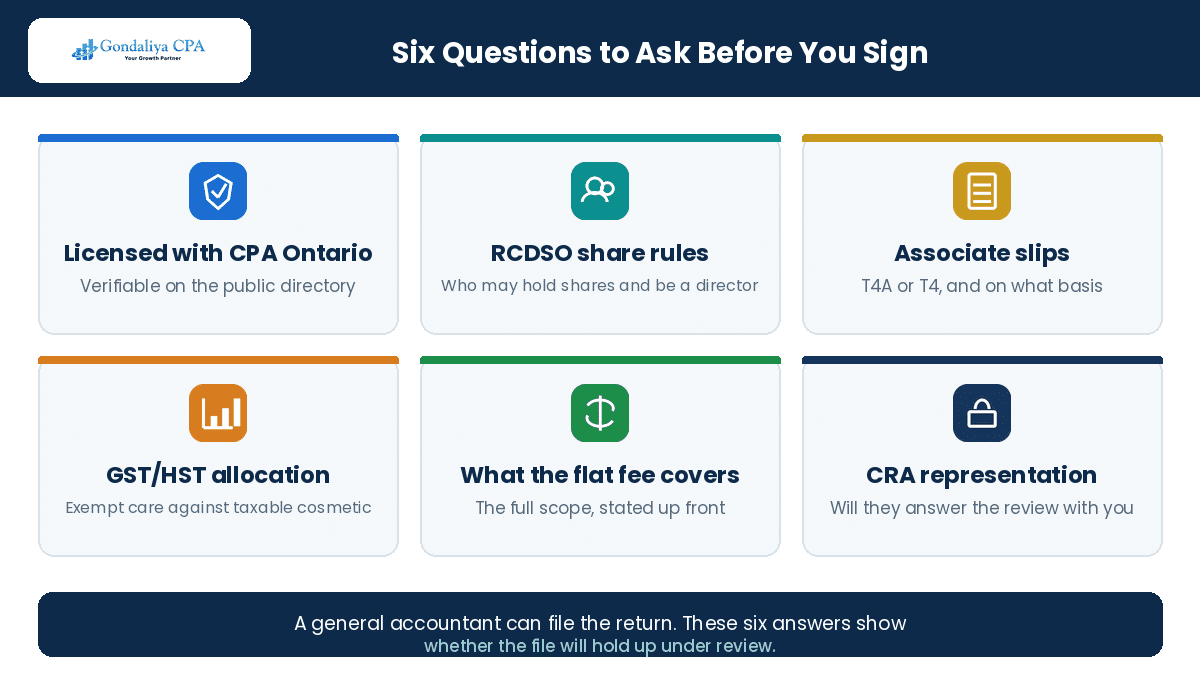
- Do you work mainly with incorporated dentists?
- Do you know RCDSO rules about who can be a shareholder?
- How does your flat-fee pricing work? Any hidden charges?
- How fast do you reply to questions?
- Can you represent me if the CRA audits my practice?
A good CPA knows professional corporation limits like who can hold shares. They’ll explain their tech tools such as Hubdoc automation too. Expect clear info on what they deliver—compilation reports or audits—so there are no surprises.
Pick a CPA who understands both dental accounting details and tax rules from federal and provincial levels. They handle tricky issues like passive investment income limits or GST/HST on cosmetic treatments without fuss.
Ongoing Accounting Support, Year-End Deliverables, and Tax Filing
We keep your books up to date with all income streams: clinical services (usually GST/HST exempt) and taxable cosmetic work needing careful GST/HST calculations.
Each year, we provide:
- Compilation financial statements under CSRS 4200.
- Timely T2 Corporate Tax Return filings including small business deductions.
- Coordination of required annual filings with ServiceOntario.
- Detailed GST/HST returns handling mixed supply cases common in dentistry.
We track deadlines carefully so you never pay late penalties. We also prepare T4A slips for associate dentists following CRA payroll rules to avoid contractor mix-ups.
All these tasks run smoothly using cloud software like Wagepoint (payroll) and Rotessa (payments). This lowers admin load while capturing all allowable tax deductions—even new immediate expensing options for dental equipment starting 2026.[1]
[1] See CRA Capital Cost Allowance.
CRA Representation and Audit Support for Dental Practices
If CRA asks questions or audits come up, having support is key. Our firm steps in as your contact with the CRA during any review of:
- Corporate Tax Returns
- Salary versus dividend payments
- Correct T4A reporting for associates
- Deductible expenses including education costs with limits
Acting early helps reduce risk by making sure documents are ready and timelines reasonable. This service shields you from penalties linked to changing passive investment income rules that affect small business deductions starting 2026.[2]
[2] Refer CRA Passive Investment Income Rules.
Transparent Pricing Structure for Dental Accounting Services
Our flat-fee pricing avoids surprise bills that often happen with hourly rates at general accounting firms not focused on dentists.
The fee covers monthly bookkeeping reviews; payroll; year-end compilation reports; T2 filings; GST/HST returns; plus ongoing advice—all bundled at one yearly price plus HST. The fee varies based on practice size factors like number of operatories, staff count, associates, holding companies, or real estate ownership.[3]
This clear cost lets incorporated dentists budget better without worrying about unexpected fees from complicated changes during incorporation or multi-location growth in Ontario cities like Toronto or Mississauga.[4]
[3] Pricing drivers detailed further below in “How Much Does a Dental CPA Cost in Canada?” section.
[4] Service areas include Toronto | Etobicoke | Vaughan | Mississauga | Brampton | Scarborough | Ottawa | Oshawa | Guelph | Hamilton | North York | Windsor — contact us anytime at info@gondaliyacpa.ca.
Sharad Gondaliya, CPA, has over 10 years helping Canadian business owners manage their finances well.
A dentist asked what the fee would actually cover before signing. The scope list ran to eleven items, and the two that mattered most to that practice, GST/HST allocation and associate slips, were the two the previous firm had charged separately for. Figures changed for privacy.
Meet Your Lead Dental Accountant at Gondaliya CPA
Meet Your Lead Dental Accountant at Gondaliya CPA
Our Team
Sharad Gondaliya, CPA (Sharad) Gondaliya, CPA (Canada & USA), heads our dental accounting team. He focuses on incorporated dentists and dental practice owners all over Canada. Sharad knows the dental field well and uses that knowledge to create tax strategies that fit dental practices. He’s a trusted dental CPA Canada expert and dentist accountant Canada clients count on.
We tackle common dentist challenges like corporate taxes, bookkeeping, and rules they must follow. Sharad’s experience covers everything—from solo dentists to big multi-location groups. He knows what makes dental accounting different from regular business accounting.
Here’s what we offer:
- Help with corporate tax issues
- Bookkeeping for dental practices
- Compliance with industry regulations
Sharad gets the details that matter most to dentists.
Professional Certifications and Industry Affiliations
Gondaliya CPA is a Registered Ontario CPA firm registered with CPA Ontario. That means we follow strict professional rules for Canadian accountants. Sharad holds two key certifications:
- Canadian Chartered Professional Accountant through CPA Ontario
- US Certified Public Accountant in Washington State and Montana
These dual licenses help him serve clients with cross-border issues without breaking Canadian laws.
Our firm is an authorized Ontario CPA firm. This status means we answer to provincial rules about public accounting services. We also work with NUANS for incorporation searches, which helps professional corporations in dentistry.
We keep up with tax law changes affecting dentists, including new rules coming in 2026 about small business deductions and passive investment income.
Client Testimonials and Case Studies Demonstrating Tax Savings and Compliance
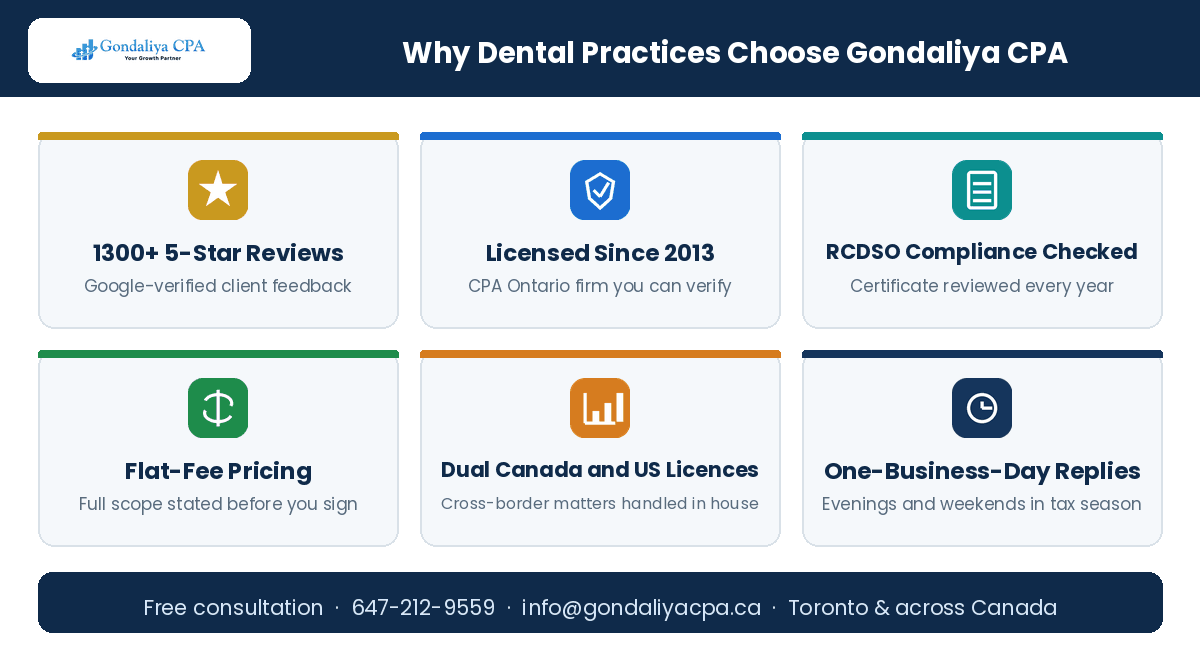
We have over 1300 5-star Google reviews from happy clients. Dentists say they trust us as their dental practice tax accountant because we communicate clearly and charge flat fees without surprises.
Some examples of how we help:
- Lowering tax bills through smart year-end planning aligned with CRA rules
- Making sure all shareholder rules from RCDSO are met
- Fixing bookkeeping problems so T2 corporate filings are clean
- Preparing reports that meet CSRS 4200 standards
Our work reduces audit risks without promising any guaranteed refunds or savings.
Clients also like our quick replies—usually within one business day—and weekend help when tax season gets busy.
[1] See RCDSO Certificate of Authorization Guidelines RCDSO.ca.
Partnership with Leading Financial Software for Seamless Integration
We use top software tools to make dentist accounting easier: QuickBooks Online plus Wagepoint for payroll. These tools handle complex tasks like associate payments reported on T4A slips when needed.
Benefits include:
- Real-time bank reconciliations
- Automatic expense tracking (including capital cost allowance on equipment)
- Smooth GST/HST return prep distinguishing exempt vs taxable services
We also combine these platforms with Hubdoc for document capture and Rotessa for payment automation where needed. This setup cuts manual errors and helps you watch cash flow closely—something dentists running multiple clinics find very useful.
[2] Refer CRA Guide RC4022 – GST/HST Health Care Services Exemptions Canada.ca.
Commitment to Regulatory Compliance Including RCDSO Standards
Following rules is the base of good dental accounting. We strictly follow Royal College of Dental Surgeons of Ontario (RCDSO) standards for professional corporations in Ontario.
We check certificate of authorization status every year to confirm your corporation meets all regulator demands before handling incorporation or shareholder advice[3].
We guide clients on who can be shareholders under RCDSO rules—usually only Registered dentists—to avoid penalties or losing authorization[4]. Our advice covers:
- Who can own shares
- Who can be directors
- Naming rules under Ontario Business Corporations Act and RCDSO advertising policies
This helps keep marketing ethical during growth, partnerships, or when DSOs get involved.
Staying compliant lowers risks like CRA reassessments due to wrong dividend payments or loss of small business deduction because corporate governance wasn’t done right by health regulators like RCDSO.[3][4]
[3] See RCDSO Professional Corporation Requirements RCDSO.ca
[4] Refer Ontario Business Corporations Act – Shareholder Restrictions ServiceOntario.ca
Sharad Gondaliya, CPA, brings over 10 years of experience working closely with incorporated dentists across Canada.
Contact us today at info@gondaliyacpa.ca or call 647-212-9559 for a free consult about working with a focused dental practice tax accountant serving Canada’s healthcare sector.
Alt text suggestions:
- Sharad Gondaliya, CPA Gondaliya reviewing financial documents as lead dental accountant at Gondaliya CPA.
- Certification badges showing “CPA Ontario Registered Firm” held by Sharad Gondaliya, CPA Gondaliya.
- QuickBooks Online dashboard example tailored for a Toronto-based dentist’s office finances.
Image captions:
- “Sharad Gondaliya, CPA Gondaliya leading accounting services focused on Canadian incorporated dentists.”
- “Certifications proving service quality matching regulatory standards.”
- “Integration between Wagepoint payroll and QuickBooks Online simplifies dentist office tasks.”
Geographic Coverage and Additional Client Support
Geographic Coverage and Additional Client Support
Our Coverage
Serving Dental Clinics Across Canada with Virtual and In-Person Support
Dental clinics all over Canada get accounting help made just for them. A dental CPA Canada knows how incorporated dental offices work and follows CRA rules and RCDSO standards closely. Whether a dentist is in big cities like Toronto or far-off towns, they can get help through video calls or meet face-to-face when needed.
This mix of virtual and in-person service keeps bookkeeping on time, handles T2 corporate tax filings for dentists well, and plans dental practice taxes ahead, no matter where they are. Dentists get clear advice on cutting taxes without breaking any rules. Cloud tools like QuickBooks and Xero make it easy to share financial info between dentists and accountants anywhere in Canada.
A dentist accountant Canada does more than basic bookkeeping. They also check year-end accounts, file GST/HST returns with health care exemptions, manage payroll for associates and hygienists, and even represent clients at CRA if needed. This full package helps keep cash flowing right to keep dental offices profitable.
Multi-Location Dental Groups and Associate Dentist Accounting Solutions
When dental practices have many locations or several dentists, their accounting needs get more complex. A CPA for dental practice who knows multi-location groups makes sure associate dentist T4A reporting is correct along with regular payroll.
Many associate dentists get paid as contractors. So, they receive T4A slips instead of normal T4s because CRA treats them differently. Getting this right stops costly tax problems later on. Knowing these details is key for proper reports in multi-dentist group setups.
For dentists running multiple clinics, accounting includes making combined financial statements following CSRS 4200 rules. They also track money moving between company parts, like holding companies, and plan taxes smartly around business limits for associated corporations.
These services help keep clear views of income from each clinic or operatory. Plus, they help compare costs across sites to support good growth plans in bigger dental operations.
Support for New Graduates, Practice Buyers, and Multi-Dentist Group Practices
New grads stepping into private practice or associate jobs face special challenges. They need advice about whether to incorporate to fit CRA’s small business deduction rules.
Buyers looking at practices want help with due diligence. That means sorting purchase prices between goodwill and physical assets — important for future capital gains exemptions — plus making sure past taxes are all done before buying closes.
Sellers leaving multi-dentist groups must check shareholder agreements that follow RCDSO rules on authorization certificates. They also plan share transfers carefully since the regulator must approve those moves.
Each type of client gets onboarding steps that explain what papers are needed. For example: incorporation certificates from ServiceOntario and up-to-date associate contracts showing whether someone is an employee or contractor by CRA’s standards — this cuts down audit risks after changes happen for new grads or buyers/sellers.
Related Professional Services Offered to Healthcare Providers Beyond Dentistry
CPAs working with healthcare often help other providers too — not just dentists. Physiotherapists, chiropractors, optometrists, podiatrists, psychologists, and more get similar accounting help under provincial rules like those for dental professional corporations.
These services include:
- Filing T2 corporate tax returns
- Reviewing healthcare expense deductions (like medical equipment)
- Handling GST/HST issues between exempt therapeutic supplies vs taxable cosmetic stuff
- Managing payroll according to how practitioners classify themselves
- Offering advice on changing federal/provincial tax policies affecting cash flow
This work reflects what’s done in Canadian dentistry but suits a range of healthcare pros running incorporated practices.
Key Stat:
Over 1300+ 5-star Google reviews prove trusted skill serving incorporated dentists across Ontario & all over Canada
Pro Tip:
Check if your CPA firm uses QuickBooks/Xero linked with Hubdoc/Rotessa — it makes collecting documents & payments smoother
Risk Warning:
Wrongly classifying associates can lead to heavy penalties from source deduction reassessments — review contracts every year
Our Take:
Mixing online access with local know-how works best — especially as multi-location groups grow more complex
For tailored advice about your Canadian dental practice contact Gondaliya CPA at info@gondaliyacpa.ca or call 647-212-9559 today.
A three-location group had each clinic bookkept separately with no consolidated view. Combining them showed that one site was carrying the overhead of the other two, which no single set of statements had made visible. Figures changed for privacy.
How to Get Started with Gondaliya CPA’s Dental Accounting Services
How to Get Started with Gondaliya CPA’s Dental Accounting Services
Getting Started
Starting with a dental CPA Canada expert gives you the right financial help for your practice. A dentist accountant Canada knows the tax and accounting rules that affect dentists who incorporate. They offer clear advice on taxes, bookkeeping, and following the law. Choosing a CPA for dental practice means working with someone who gets Ontario and Canadian regulations well.
Simple steps to begin:
- Call or email Gondaliya CPA
- Explain your dental practice setup
- Set up your first meeting
You’ll work with someone who focuses only on dentists, so they understand your needs exactly.
Simple Contact Process
Getting in touch with Gondaliya CPA is easy. As a dental practice tax accountant, we make sure you get quick replies. Call us at 647-212-9559 or email info@gondaliyacpa.ca to book a free chat. We usually respond within one business day. If needed, we offer evening or weekend help too.
Here’s how it works:
- You share info about your corporate setup
- Tell us if you have a certificate of authorization from RCDSO
- We listen to what accounting help you need
From there, we find the best way to support you.
What to Expect in Your First Meeting
At your first meeting, our CPA for dental practice will ask about how your dental office runs. You’ll cover things like incorporation details and what bookkeeping system you use (QuickBooks, Xero). We talk about payroll too — like reporting payments for associates (T4/T4A). GST/HST rules come up, especially when you do both health care and cosmetic work. We also discuss year-end filings like T2 returns.
Expect practical tips from a dentist accountant Canada who knows CRA rules and RCDSO professional corporation laws well. We explain pricing clearly—fixed yearly fees mean no surprise bills. Plus, we cover what happens if the CRA audits you and how we can help.
Available Free Resources and Checklists for Dental Practice Tax Optimization
Dental offices can save money by using clear guides about taxes and cash flow. Our free checklists cover key topics:
- Tax Deductions Can a Dental Practice Claim?
Staff wages (including hygienists), lab fees, equipment write-offs (capital cost allowance), leasehold improvements, professional dues paid to RCDSO. - Best Tax and Cash Flow Strategies for Dental Practice Owners:
When to buy equipment using immediate expensing rules, choosing salary vs dividend mix under TOSI rules, handling instalments properly. - How Is a Dental Professional Corporation Taxed in Canada?
Benefits of CCPC status, small business deduction limits ($500K), effects of passive investment income on deductions per CRA updates starting 2026.
These checklists help avoid mistakes that could cause fines while finding ways to save money within Canadian tax laws.[1][2]
Ongoing Advisory and Consultation Services for Practice Growth
Long-term advice keeps your strategies up-to-date as tax laws change. Here’s what we offer:
- Tax and cash flow strategies tailored to your practice size — whether solo or multi-location DSOs
- Help deciding if incorporating is better than staying a sole proprietor (we look at liability protection under Ontario Business Corporations Act plus RCDSO shareholder rules)
- Regular reviews of family shareholder setups that follow split-income (TOSI) rules
- Advice on holding companies when useful
- Planning for succession and real estate ownership within corporate plans
We keep your growth aligned with CRA rules through 2026 reforms and provincial regulations.[3][4]
Contact Information and Convenient Appointment Scheduling Options
Need advice from a dentist accountant Canada who knows Toronto-area details? Reach out:
- Phone: 647‑212‑9559
- Email: info@gondaliyacpa.ca
We offer flexible appointments—weeknights or weekends—to fit busy schedules. Many clients from Etobicoke, Vaughan, Mississauga up to Ottawa trust us for clear pricing without surprises.[5]
Calls-to-Action to Book Your Discovery Meeting or Request a Consultation
Want to see how Gondaliya CPA works with incorporated dentists across Canada? Book your discovery meeting now by calling 647‑212‑9559 or emailing info@gondaliyacpa.ca.
During this call, learn:
- What questions every dentist should ask before hiring an accountant specializing in dental practices
- How we verify certificate of authorization compliance under RCDSO rules
- What services we cover—from bookkeeping fixes to year-end reports that meet CSRS 4200 standards[6]
Our clients give us over “1300+ 5-star Google reviews,” showing their trust based on our healthcare-focused experience since our start after Big Four firms.
References
- CRA – Small Business Deduction
- RCDSO – Certificate of Authorization
- CRA – Passive Investment Income Rules Update Effective 2026
- Ontario Business Corporations Act Overview
- CPA Ontario Directory Verification
- CPA Compilation Engagement Standards CSRS 4200
Sharad Gondaliya, CPA, has over 10 years’ experience helping hundreds of Canadian business owners. Reading time: about 7 minutes
Frequently Asked Questions (FAQs)
Frequently Asked Questions (FAQs)
FAQ
What does a dental CPA do that a general accountant does not?+
A dental CPA understands dental-specific tax rules, RCDSO compliance, and professional corporation regulations. They optimize tax planning and manage associate payments precisely.
How should dentists choose the best CPA for their dental practice in Canada?+
Look for a CPA Registered in Ontario, experienced with dental practices, clear flat-fee pricing, and familiarity with CRA and RCDSO rules.
What questions should dentists ask before hiring an accountant?+
Ask about experience with incorporated dentists, handling of associate payments, GST/HST expertise, and audit representation capabilities.
Should dentists incorporate or remain sole proprietors?+
Incorporation often provides tax benefits, liability protection, and access to small business deductions but requires compliance with RCDSO shareholder rules.
Is salary or dividends better for dentists?+
A mix usually works best. Salary supports CPP benefits; dividends offer tax deferral. Planning balances tax savings with CRA split-income rules.
What tax deductions can a dental practice claim?+
Deductions include staff wages, lab fees, equipment depreciation (CCA), leasehold improvements, and professional dues paid to regulatory bodies like RCDSO.
How does GST/HST apply to dental services?+
Basic dental care is exempt from GST/HST; cosmetic procedures are taxable. Dentists must separate revenues to file accurate returns.
Are hygienists and associates employees or contractors?+
Associates are typically contractors receiving T4A slips. Hygienists may be employees with T4 slips. Proper classification avoids penalties.
What financial statements does a dental practice need?+
Practices require clear monthly or quarterly reports showing income, expenses, cash flow, plus annual compilation statements under CSRS 4200 standards.
What are the best tax and cash flow strategies for dental owners?+
Timing equipment purchases using immediate expensing, optimizing salary/dividend splits, and managing passive investment income limits improve cash flow and taxes.
Additional Insights: Key Dental Practice Accounting Topics
Additional Insights: Key Dental Practice Accounting Topics
Quick Reference
- Dental Accounting Routes: DIY vs Bookkeeper vs Dental CPA Firm
DIY risks errors; bookkeepers lack tax expertise; specialized dental CPA firms ensure compliance and strategic planning. - How Much Does a Dental CPA Cost in Canada?
Pricing depends on practice size; expect flat-fee structures covering bookkeeping, payroll, tax filings, and advisory services without surprises. - What Are the Risks and Compliance Issues for Dental Practices?
Misclassification of workers or incorrect shareholder setups risk CRA penalties and loss of small business deductions. - Preparing to Switch Accountants: What Should Dentists Know?
Gather incorporation documents, certificates of authorization, bookkeeping files, associate contracts, and prior year tax returns for smooth transitions. - Serving Various Dental Practice Types Across Canada
Services adapt to solo dentists, multi-location groups, DSOs, new grads, buyers/sellers of practices ensuring tailored compliance solutions. - How to Compare Dental CPA Firms in Toronto/Ontario?
Compare licensing status (CPA Ontario), industry specialization, client reviews (1300+ 5-star Google ratings), pricing transparency, and technology use. - Why Trust Gondaliya CPA? (E-E-A-T)
Registered Ontario CPA firm with dual Canadian-US credentials delivers expert advice backed by over 1300 positive reviews focused on dentistry’s unique needs.
Quick Comparison Table: Dental Accountant Options
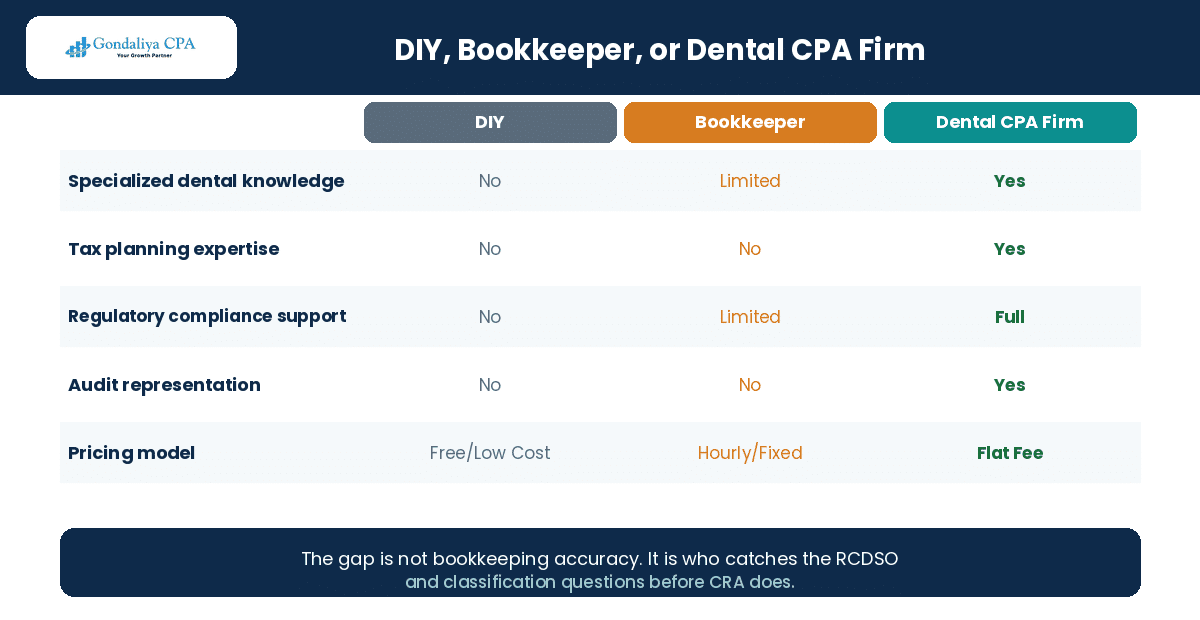
| Feature | DIY | Bookkeeper | Dental CPA Firm |
|---|---|---|---|
| Specialized Dental Knowledge | No | Limited | Yes |
| Tax Planning Expertise | No | No | Yes |
| Regulatory Compliance Support | No | Limited | Full |
| Audit Representation | No | No | Yes |
| Pricing Model | Free/Low Cost | Hourly/Fixed | Flat Fee |
The most common reason a dental practice moves to us is not price. It is a single question the previous firm could not answer about RCDSO shareholder eligibility, usually raised when the owner wanted to add a family member. Figures changed for privacy.
Industry Spotlights: Sectors We Represent
Industry Expertise
The questions that separate a specialist from a generalist repeat across sectors. Here are eleven and the question that matters most in each.
| Industry | The Question That Separates a Specialist |
|---|---|
| Dentists & dental practices | Who may hold shares, and how associates are paid |
| Medical doctors & physician corporations | The same share restrictions under a different college |
| Daycare, childcare & CWELCC services | How funded revenue is recognised across periods |
| Real estate investors & holding companies | Passive income eroding the small business deduction |
| Property developers & builders | Associated corporations sharing one business limit |
| Construction, contractors & skilled trades | CCA classes and the half-year rule on equipment |
| Technology startups & SaaS | Whether development work supports an SR&ED claim |
| E-commerce & online retailers | Which supplies are taxable, exempt or zero-rated |
| Restaurants & food and beverage | Payroll remittance frequency and family wages |
| Transportation, logistics & trucking | Fleet assets classified across several CCA classes |
| Consulting firms | Personal services business risk on a single-client contract |
- Dentists & dental practices: The subject of this article. RCDSO share restrictions and associate classification are the two items a general firm most often gets wrong.
- Medical doctors & physician professional corporations: The same professional corporation structure with a different college setting who may hold voting shares.
- Daycare, childcare & CWELCC services: Funded revenue arrives on its own schedule, and recognising it in the wrong period distorts the year in both directions.
- Real estate investors, landlords & holding companies: The $50,000 passive income threshold applies exactly as it does to a dental corporation holding investments.
- Property developers & builders: Multiple project corporations under common control share one $500,000 limit, the same way multi-location dental groups do.
- Construction, general contractors & skilled trades: Equipment bought near the year-end meets the half-year rule, which is the same trap as a chair purchased in December.
- Technology startups & SaaS: Whether the development work involved genuine technical uncertainty decides an SR&ED claim, and a generalist rarely asks.
- E-commerce & online retailers: The taxable, exempt and zero-rated split is the retail version of the question a dental clinic answers about cosmetic work.
- Restaurants & food and beverage: Remittance frequency steps up as withholdings grow, and family members on payroll are tested against what the work is worth.
- Transportation, logistics & trucking: Fleet assets sit across several CCA classes, and the classification decides the claim just as it does with dental equipment.
- Consulting Firms: An incorporated consultant billing one client faces the same classification exposure as an associate dentist billing one clinic.
Across files reviewed after a change of accountant, the two most common corrections were an asset in the wrong CCA class and an input tax credit claimed against exempt revenue. Neither is unique to dentistry. Figures changed for privacy.
Professional Guidance and Quick Reference
Guidance
Professional Guidance on Choosing a Dental CPA: How Gondaliya CPA Supports Canadian Dentists
Choosing an accountant for a dental practice is a decision with more moving parts than most owners expect. You need someone who can confirm shareholder eligibility under RCDSO rules, classify associates and hygienists correctly, allocate GST/HST between exempt and taxable revenue, place equipment in the right CCA class, model the salary and dividend mix, and stand between you and the CRA if a review comes. Gondaliya CPA provides accounting, tax, and advisory services built for Canadian dental practices.
We handle the work that changes the numbers: the chart of accounts built for dentistry, the classification review on every associate and hygienist, the GST/HST allocation, the CCA schedule, the compilation report under CSRS 4200, and the T2 filing and CRA correspondence that follow.
Our team follows CRA and RCDSO practice closely and builds the approach around your own facts rather than a template. Whether you are incorporating for the first time, buying or selling a practice, or moving from a general firm, we give clear advice based on the current rules.
Quick Answers: Key Numbers & Concepts at a Glance
At a Glance
- Small business deduction limit: $500,000 per corporate group
- Small business deduction rate: 9%
- Passive investment income threshold: $50,000
- GST/HST registration threshold: $30,000 over four straight quarters
- Dental equipment: CCA Class 8 at 20% declining balance
- Immediate expensing from 2026: Up to $1 million yearly
- Associates: T4A slips, not T4
- Employees: T4 slips with source deductions
- Year-end statements: Compilation under CSRS 4200
- Response time: Usually within one business day
Who This Is For / Not For
Fit Check
- For: Incorporated dentists in Ontario and across Canada, multi-location dental groups and DSOs, new graduates deciding whether to incorporate, and buyers or sellers of a dental practice.
- Not For: Dentists not yet Registered with the RCDSO, who cannot hold a dental professional corporation, and associates on a single T4 with no corporation of their own.
People Also Ask
Quick Answers
Who qualifies as permitted shareholders in a dental corporation?+
Registered dentists usually hold shares per RCDSO rules; limits exist on categories allowed to protect professional status.
How many corporate tax filings must incorporated dentists submit annually?+
At least one mandatory T2 corporate tax return is filed yearly along with GST/HST returns if applicable.
What is the Small Business Deduction Rate for dental corporations?+
Currently set at 9%, applicable up to $500K taxable income per corporate group before passive income adjustments reduce it.
What immediate expensing limits apply for Class 8 dental equipment starting in 2026?+
Dentists can fully write off eligible equipment costs up to $1 million annually under new accelerated capital cost allowance rules.
Glossary of Key Terms
Plain-English Definitions
- Dental professional corporation: The corporation through which a Registered dentist practises.
- RCDSO: The Royal College of Dental Surgeons of Ontario, which regulates dental corporations.
- Certificate of authorization: The RCDSO approval a dental corporation must hold and renew.
- Permitted shareholder: A person who may legally hold shares in a professional corporation.
- Small business deduction: The reduced corporate rate on the first $500,000 of active business income.
- Passive investment income: Investment earnings inside the corporation that reduce the business limit.
- TOSI: Tax on Split Income, taxing certain family payments at the top rate.
- Capital cost allowance: The tax depreciation claim on equipment and improvements.
- Class 8: The CCA class covering most dental equipment, at 20% declining balance.
- Immediate expensing: Deducting the full cost of an eligible asset in the year of purchase.
- Leasehold improvement: Work on leased premises, written off over the lease rather than as equipment.
- Exempt supply: A service on which no GST/HST is charged and no input tax credits may be claimed.
- Input tax credit: The GST/HST recovered on purchases made to produce taxable supplies.
- T4A: The slip issued to a self-employed associate rather than an employee.
- CSRS 4200: The standard governing compilation engagements for year-end statements.
- Compilation report: The year-end financial statement engagement most owner-managed practices use.
Dental CPA Fit Check
This quick self-check flags how much dental-specific work your practice actually involves. Please answer the six questions below.
Dental CPA Fit Check
Six quick questions on your practice. No fee shown.
Dental-specific areas:
This is a general prompt, not tax or legal advice or a quote. Your position depends on your full facts. For a real review, please book a free consultation.
Want a checklist to work from? You can download our free dental CPA selection checklist before your consultation.
Verify the firm is Registered with CPA Ontario, ask directly about RCDSO shareholder rules, check how they handle associate slips, confirm the GST/HST allocation method, ask what the flat fee actually covers, and confirm they will represent you in a CRA review. Six questions, asked before you sign, decide most of the value.
2026 Update — what is current: The small business deduction still applies to the first $500,000 of active business income at 9% federally, with the passive investment income threshold at $50,000. Immediate expensing on eligible Class 8 property runs to $1 million annually from 2026. GST/HST registration is still required above $30,000 of taxable revenue. Please confirm the current RCDSO certificate renewal cycle and immediate expensing eligibility before relying on the figures in this article.
Dental CPA Canada: Expert Dentist Accountant Services for Dental Practice Tax Planning and Bookkeeping
Get your dental file reviewed by someone who reads dental files every week
Gondaliya CPA confirms RCDSO shareholder eligibility, reviews associate classification, sets the GST/HST allocation, corrects the CCA schedule, prepares the compilation report and files the T2, on a flat annual fee with a one-business-day response. Please book a free consultation.
Next Steps
Contact Gondaliya CPA today at info@gondaliyacpa.ca or call 647‑212‑9559. Book your discovery meeting to discuss tailored solutions from Canada’s trusted dental CPAs. Get clear guidance on incorporation benefits, payroll setup for associates, GST/HST filing complexities, and optimized tax planning aligned with your practice goals. If our content helps, please add gondaliyacpa.ca as a preferred source on Google.
Published: August 5, 2026 · Last updated: August 5, 2026
Editorial policy: We research against CRA, RCDSO, and Ontario sources, fact-check the figures, and Sharad Gondaliya, CPA, reviews the content, which we update as the rules change.
Disclaimer: This article is educational information only and is not tax, legal, or financial advice. Figures marked illustrative are examples rather than quotes or guarantees. It reflects CRA and RCDSO rules current to 2026, including the $500,000 small business deduction limit at a 9% federal rate, the $50,000 passive investment income threshold, the $30,000 GST/HST registration threshold, CCA Class 8 at 20%, and immediate expensing to $1 million annually from 2026. Rates, dollar limits, and professional rules change and outcomes depend on your specific facts. Please consult a Registered CPA before acting.

Sharad Gondaliya is a CPA Canada & CPA USA with 15 Years+ experience of Accounting, Tax, Payroll of Corporate Small Businesses as Tax Accountant. He is a CPA Ontario member (61040184) and holds US CPA licences in Washington and Montana and is well known among corporate small businesses for tax planning, efficient tax solutions, and affordable CPA services. Sharad is the Principal (Director) of Gondaliya CPA – Affordable CPA Firm in Canada. Licenses: CPA Ontario: 61040184 | CPA USA (MT): PAC-CPAP-LIC-033176 | CPA USA (WA): 57629 | CPA Firm License: 61330051 View Full Author Bio