



The Ultimate Guide to Accounting and Tax Services for Startups in Canada
Gondaliya CPA offers reliable startup accounting services Canada, including bookkeeping, corporate tax planning, and payroll support tailored for Canadian startups. Our team specializes in tax filing, GST/HST filing, CRA compliance, and financial statements to support early-stage founders and incorporated startups effectively.
Quick Summary
Startup accounting in Canada runs on four foundations: a chart of accounts built for your industry, a fiscal year-end chosen deliberately, cloud bookkeeping in place from day one, and every CRA deadline diarized. Please note the T2 is mandatory even with no revenue, and the penalties for missing it do not scale down for a company that made nothing.
| Aspect | Details |
|---|---|
| The filing floor | T2 every year, six months after the fiscal year-end. |
| The rate that matters | 9% federal on the first tranche of active business income. |
| The credit that pays cash | SR&ED refundable at 35% on eligible costs. |
| The threshold to watch | GST/HST registration once revenue reaches $30,000. |
Reading time: approximately 9 minutes
Table of Contents
- Introduction and Importance of Startup Accounting Services in Canada
- Challenges Faced by Canadian Startups in Accounting and Tax Compliance
- Corporate Tax Filing and Planning for Startups
- Startup-Focused Expertise with Registered CPA Ontario Professionals
- Step-by-Step Process for Engaging Startup Accounting Services
- Additional Resources and Geographic Service Coverage
- FAQs: Startup Accounting and Tax Services Canada
- The Ultimate Guide Highlights: Key Numbers & Terms for Startups
- Industry Spotlights: Sectors We Represent
- Professional Guidance and Quick Reference
The Numbers That Matter
This article covers Canada, with Ontario and Toronto context, and reflects CRA rules current to 2026. It assumes an incorporated Canadian startup, typically a CCPC, or a founder preparing to incorporate. Figures marked illustrative are examples, not quotes, and any masked engagement notes end with “Figures changed for privacy.” This is educational information only and not tax, legal, or financial advice. Rates, limits, and filing requirements change, so please confirm your own situation with a Registered CPA before acting.
Introduction and Importance of Startup Accounting Services in Canada
Introduction and Importance of Startup Accounting Services in Canada
The Basics
Startup Accounting Services Canada: Supporting Early-Stage Founders and Incorporated Startups
Startup accounting services in Canada help early-stage founders handle their business finances. A startup CPA takes care of bookkeeping, taxes, and compliance. This lets incorporated startups focus on growing their business without worrying about money matters.
Understanding the Unique Needs of Canadian Startups
Canadian startups face special challenges that need focused help. A startup tax accountant in Canada knows these challenges well. They offer services like cash flow tracking, expense management, and planning that fit Canadian rules.
Tailored Solutions for Early-Stage Growth and Compliance
Growing a startup requires close financial attention. A startup CPA provides tax planning made just for startups. They also help meet CRA compliance rules to keep your business in good standing.
Why Specialized Accounting Matters for Canadian Startups
Corporate tax filing in Canada can be tricky, especially when dealing with T2 returns from incorporated companies. Using specialized accounting reduces mistakes and lowers the chance of penalties.
Legal and Tax Complexities for Startups
Startups must follow legal rules under Ontario law and CRA regulations. Missing these rules can lead to fines or damage to a startup’s reputation. Getting expert advice helps avoid these problems.
Benefits of CPA Expertise in Startup Finance
A startup CPA gives valuable financial advice and guidance. They often act like a strategic CFO to help startups plan better and run smoother.
Key Benefits of Engaging a Startup CPA in Canada
Hiring a startup CPA brings many benefits:
- Tax strategies that save money for Canadian startups
- Help claiming SR&ED credits that reduce taxable income
- Guidance through complex tax processes
- Support for sustainable business growth
These services make it easier for startups to focus on their innovation while keeping finances in order.
A founder incorporated in March and assumed no return was due until the company had revenue. The first T2 was still required, and the late-filing position had to be corrected before a lender would look at the file. Figures changed for privacy.
Key Stat: The T2 is mandatory for every incorporated company each year, even with no income and no operations. Penalties and interest attach to the filing obligation itself, not to the amount of tax owing.
Challenges Faced by Canadian Startups in Accounting and Tax Compliance
Challenges Faced by Canadian Startups in Accounting and Tax Compliance
The Challenges
Canadian startups often struggle with accounting and tax rules. Keeping financial records right can feel tricky. Startup accounting services Canada experts, including startup tax accountants Canada, help companies stay on track. They make sure the numbers add up and laws get followed.
Common Financial and Tax Issues for Startups in Canada
Startups run into problems like filing corporate taxes on time or figuring out small business deductions. A startup CPA Canada can clear up these confusions and prevent costly errors.
Some common issues are:
- Corporate Tax Filing Complexity: New companies must submit T2 returns even without income[1]. Late filing brings fines.
- Small Business Deduction Eligibility: Being a CCPC matters for getting better tax rates[2].
- Pre-Incorporation Costs: Expenses before starting need careful tracking to claim later.
- Tax Planning Gaps: Without help from a startup tax accountant Canada, firms may miss credits like SR&ED or new expensing rules[3].
Here’s an example: We helped a SaaS startup in Toronto that didn’t pick the right fiscal period. Fixing this on time stopped penalties from piling up.
Managing Cash Flow and Bookkeeping Complexities
Bookkeeping matters but can get messy when transaction volumes jump. Startup accounting services Canada stress good bookkeeping systems that fit young businesses.
Tricky parts include:
- Juggling multiple bank accounts makes reconciling tough.
- Separating shareholder loans from regular cash is needed.
- Using digital tools like Hubdoc or QuickBooks Online to keep receipts.
- Handling payroll remittances carefully as employees join.
Keeping bookkeeping steady avoids mistakes that mess with financial reports or GST/HST returns. Using cloud software early cuts down manual work and shows cash flow live[4].
For instance, we set up Xero for an e-commerce client near Mississauga. They had 250+ monthly payments via Stripe, all tracked smoothly every quarter.
Navigating CRA Compliance and Regulatory Requirements
CRA rules need close attention across taxes, GST/HST returns, and payroll deductions. Businesses must watch deadlines and thresholds.
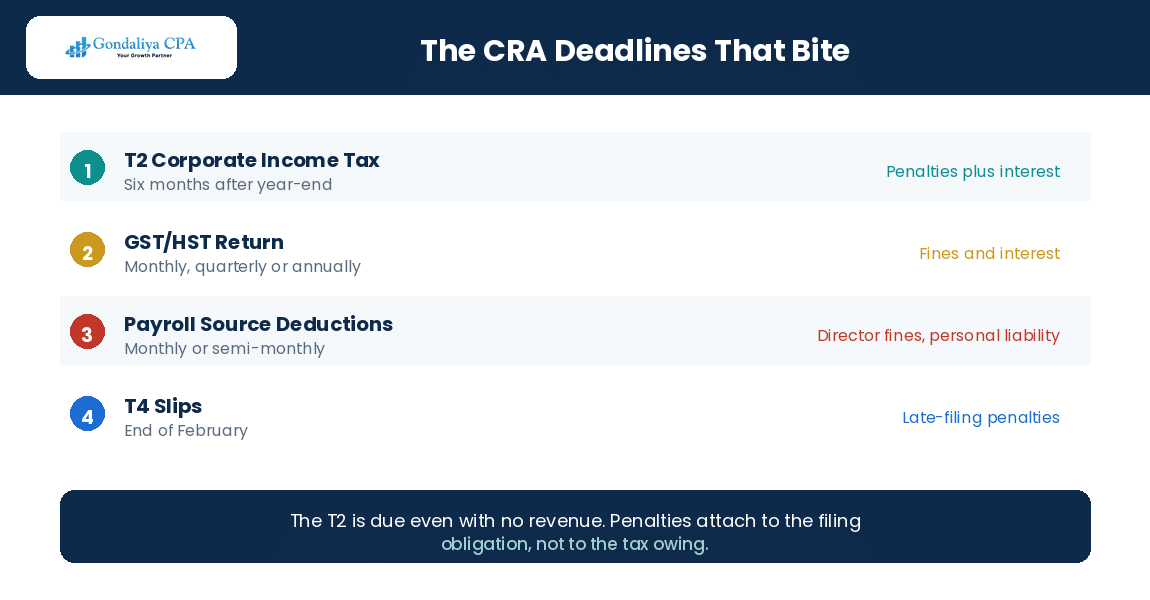
| Obligation | Deadline | Applies To | Consequence if Missed |
|---|---|---|---|
| T2 Corporate Income Tax | Six months after year-end | All incorporated businesses | Penalties plus interest |
| GST/HST Return | Monthly/Quarterly/Annually* | Businesses over $30K sales[5] | Fines and interest |
| Payroll Source Deductions | Monthly/Semi-monthly | Employers | Director fines + personal liability |
*Filing schedule depends on yearly sales according to CRA.[6]
To stay clear of trouble, watch instalment dates tied to your income projections. Register when crossing sales limits[7].
Example: A Vaughan tech startup changed payroll remittance mid-year after hiring more staff. That move kept directors safe from fines linked to missed reports.
A company crossed the GST/HST threshold mid-year and registered three months late. The tax still had to be remitted on the sales made in between, and it had never been collected from the customers. Figures changed for privacy.
Reporting and Accounting Challenges Related to Funding, Grants, and Investors
Getting funding or grants adds reporting steps needing accurate records. Compilation engagements per CSRS 4200 help here[8].
Issues involve:
- Correct SR&ED claims with the refundable ITC rate after new 2026 limits[9].
- Making financial statements clear for investors without full audits.
- Matching grant money against eligible costs while keeping proof ready for checks.
Working with a CPA firm focused on startups makes sure records are solid but affordable[10].
One client near Ottawa raised Series A funding using compilation reports we prepared. Those reports gave investors trust without expensive audits.
Sharad Gondaliya, CPA, has 10+ years helping Canadian business owners get their accounting right.
[1]: CRA – Corporation Income Tax Guide
[2]: CRA – Small Business Deduction
[3]: Finance Act Update – Immediate Expensing Changes Effective 2026
[4]: CPA Ontario – Best Practices Bookkeeping
[5]: CRA – GST/HST Registration Thresholds
[6]: CRA – Instalments Guide
[7]: CPA Canada Compilation Engagement Standard CSRS 4200 Overview
[8]: SR&ED Program Updates Effective January 2026
[9]: Corporations Act Ontario Annual Filings Guidance
If you want advice on your startup’s accounting issues, email Gondaliya CPA at info@gondaliyacpa.ca or call 647‑212‑9559. We serve Toronto/Ontario areas like Etobicoke, Vaughan, Mississauga, Brampton, and other places across Canada.
Risk Warning: Unremitted payroll source deductions attach personally to directors, not just to the corporation. That exposure survives a change of role and is the one liability a founder cannot leave behind with the company. Please diarize the remittance schedule from the first pay run.
Corporate Tax Filing and Planning for Startups
Corporate Tax Filing and Planning for Startups
The Services
Corporate tax filing and planning help startups meet Canada Revenue Agency (CRA) rules while managing their tax bills. A startup tax accountant in Canada helps new businesses prepare T2 returns on time and plan their taxes smartly to pay only what’s needed.
Preparation and filing of T2 returns
All Canadian-controlled private corporations (CCPCs), including startups, must file a T2 Corporation Income Tax Return. This is true even if the company made no money or didn’t operate. Filing the T2 means gathering detailed financial info and matching CRA schedules and GIFI codes correctly.
A startup tax accountant in Canada helps by:
- Reporting taxable income using accrual accounting.
- Claiming allowable deductions like pre-incorporation costs.
- Filling out schedules for small business deduction.
- Calculating instalment payments if needed.
Filing on time avoids penalties. Since 2026, most CCPCs must file digitally with CRA, so accuracy is even more critical.
Strategic corporate tax planning
Planning your corporate taxes helps control cash flow and reduces what you owe legally. Startup CPAs in Canada offer advice on:
- Picking the best fiscal year-end for your business cycle.
- Making full use of the $600,000 small business limit.
- Applying capital cost allowance rules, including new immediate expensing options.
- Deciding between salary or dividends for owners.
- Keeping proper records of shareholder loans.
Good planning also spots chances to claim SR&ED credits early. A CPA with startup accounting services in Canada can catch opportunities missed by DIY filings.
Bookkeeping and Payroll Services Tailored for Startups
Bookkeeping builds a solid base for accounting. When paired with payroll management, it keeps financial records neat and follows CRA rules while fitting startup needs.
Monthly reconciliations and payroll administration
Reconciliation means checking bank transactions against statements every month. It stops mistakes or fraud before they grow. Payroll admin calculates deductions like income tax, CPP, EI and sends payments to CRA on time.
Startup accounting services Canada usually cover:
- Monthly bank account reconciliations using QuickBooks or Xero.
- Running payroll through tools like ADP or Wagepoint with prompt pay stubs.
- Preparing yearly T4 slips before CRA deadlines.
Startup CPA Canada professionals oversee these tasks to avoid late fees that can cause liability for directors.
Cloud-based bookkeeping solutions
Cloud bookkeeping lets you see your finances live from anywhere — perfect if your team works remotely or you juggle multiple projects. These systems pull bank data automatically which cuts down manual errors common when growing fast.
Benefits include:
| Feature | Why It Helps |
|---|---|
| Automated Bank Feeds | Speeds up reconciliation |
| Receipt Capture Tools | Makes expense tracking easy |
| Multi-user Access | Lets accountants and clients work together |
| Integration | Links well with payroll & billing |
Digital backups follow CRA’s record rules while keeping originals safe offline.
GST/HST Filing and CRA Electronic Filing Assistance
Startups have to register for GST/HST once revenue hits $30,000 unless exempted as small suppliers. Correct GST/HST filings avoid interest charges while e-filing makes compliance simpler since 2026.
Ensuring accurate GST/HST remittance
GST/HST returns require careful math on taxes collected vs input credits each period — monthly or quarterly based on sales size. Mistakes happen when zero-rated goods get mixed up or exempt sales aren’t tracked right.
Startup accounting services Canada help by:
- Setting up correct coding in software
- Training staff on invoice rules per CRA
- Watching thresholds that trigger registration
This cuts risks of late registration penalties and retroactive bills.
Electronic tax filing support
Since 2026, CRA demands electronic filing for most incorporated startups’ T2 returns and GST/HST reports. Startup CPAs guide clients to use certified software that uploads returns straight into My Business Account portals fast without paper delays.
E-filing means quicker processing, fewer errors thanks to auto-checks, instant confirmation receipts, and less paperwork hassle so founders can focus elsewhere.
A startup carried $18,000 of pre-incorporation costs on a personal credit card with no record tying them to the business. Most were deductible; without documentation only a fraction could be claimed after incorporation. Figures changed for privacy.
Compilation Engagements and Financial Statement Preparation
Compilation engagements create financial statements from client data without giving opinions but work fine for many startups’ needs like updates to investors or banks under CPA Canada’s CSRS 4200 standard.
Investor-ready compilations
These reports show clear snapshots combining balance sheets, income statements, and cash flows using GIFI codes required by investors especially in Toronto/Ontario tech scenes where transparency matters a lot.
They aren’t audits but look professional enough to give stakeholders confidence. Startup accountants know common SaaS challenges like deferred revenue recognition well.
Annual financial statement generation
Annual compilations meet legal requirements tied to incorporation plus lender agreements needing regular reviews even if no audits happen. Timely reports rely on steady month-end closings through ongoing bookkeeping so last-minute rushes don’t delay filings before fiscal deadlines set by Ontario laws.
Incorporation and Business Structuring Services for Startups
Choosing the right business structure early shapes how complex taxes get later. Expert advice saves money and hassle when incorporating in Ontario or across Canada.
Choosing the right business structure
Deciding between sole proprietorships or corporations depends mostly on how much liability protection you want versus expected profits. Corporations often qualify for CCPC benefits with lower federal/provincial rates capped at $600K active business income post-incorporation. Investors also prefer corporations since they show governance which is key in tech sectors serviced by firms like Gondaliya CPA.
Incorporation documentation and compliance
Incorporating means filing articles federally via Corporations Canada or provincially following strict deadlines for initial annual returns plus registering GST/HST and payroll accounts timely. Startup accounting services canada guide founders through this maze avoiding delays that trigger fines since rules got tighter from 2026 onward.
Specialized Services: SR&ED Claims, Audit Support, And Tax Cleanup
Expert help speeds up claiming Scientific Research & Experimental Development (SR&ED) credits which refund important innovation costs across Canada. It also helps handle audits calmly while cleaning messy past records sets a solid base for growth.
Claiming SR&ED credits efficiently
Good SR&ED claims need solid documents showing eligible costs matched clearly with project steps following CRA’s tight rules updated recently emphasizing labour cost details since January 2026. Experienced startup tax accountants spot qualifying work often missed otherwise boosting refund amounts well beyond self-prepared claims.
Responding to CRA audits and notices
Getting a letter from CRA about audits calls for quick professional replies explaining disputed points backed by well-kept records throughout your business life cycle. This lowers chances of penalties while letting founders keep focused on running their companies especially in busy Toronto/Ontario SMB communities.
Clean up historical accounting records
Fixing old books cleans errors made from random entries before working with pros who correct mistakes reconcile accounts then build trustworthy starting figures needed before doing compilation engagements later. This step builds trust both inside your team and with outside parties like banks or investors helping long-term success across many industries served here.
Sharad Gondaliya, CPA, has over 10 years helping Canadian business owners.
Reading time: approximately 9 minutes
Pro Tip: Choose the fiscal year-end deliberately at incorporation. It sets the T2 deadline, the instalment schedule, and which side of a year-end an asset purchase falls on. The first period can run up to 53 weeks, and changing it later requires CRA approval.
Startup-Focused Expertise with Registered CPA Ontario Professionals
Startup-Focused Expertise with Registered CPA Ontario Professionals
Our Expertise
Startup accounting services Canada need special skills for new incorporated businesses. A startup CPA Canada knows the common challenges founders face. They help with compliance, tax plans, and financial reports. Accounting for startups means more than just bookkeeping. It includes advice on incorporation, shareholder loans, and CRA filings for Canadian-controlled private corporations (CCPCs). Using fully Registered Ontario CPAs guarantees following provincial rules and national CPA Canada standards.
- Specialized help for startup accounting
- Guidance on incorporation and shareholder matters
- Compliance with CRA and provincial rules
Deep Knowledge of Canadian Startup Landscape
A startup tax accountant Canada must handle federal and provincial tax rules. Incorporated startups across Canada face different obligations than other business types. They deal with corporate income tax returns (T2), small business deductions, GST/HST registrations, payroll deductions, and deadlines set by the CRA. Startups also get advice on pre-incorporation expenses and timely filings—even when they have little or no revenue.
- Understanding tax filings like T2 returns
- Help with GST/HST registration thresholds
- Payroll source deduction management
Industry-Specific Experience and Credentials
Canadian startups benefit from accountants who know industry incentives like SR&ED claims. These claims provide refundable tax credits for innovation-driven firms. Corporate tax filing for startups needs accurate schedules like Schedule 50 and proper GIFI codes that match the sector. Firms working with tech or health ventures often know relevant regulatory bodies such as OHIP or RCPSC.
- Expertise in SR&ED tax credits
- Precise corporate tax filing support
- Sector-specific knowledge for tech & health startups
Flexible and Scalable Accounting Solutions for Growing Startups
Scalable startup accounting solutions change as your company grows—from seed to growth phase—without breaking what’s working. Growth stage startup CPA services include better financial controls, monthly reports, cash flow forecasts, investor statements, expanded payrolls, and multi-entity consolidation if needed.
Adaptable Service Packages for Every Stage
Bookkeeping tailored to startups focuses on categorizing early transactions like R&D expenses or grants. It fits neatly into CRA-compliant records. Payroll services for early-stage companies make sure remittances happen at the right times based on employee count. They also handle T4 slips at year-end.
- Bookkeeping that fits startup needs
- Payroll set up for small teams
- Compliance with CRA record rules
On-Demand Support for Scaling Operations
Financial reporting compliance Canada means keeping up with changing laws about disclosures under CSRS 4200 compilation engagements. Strategic CFO advisory startups get help optimizing capital structures and budgets aimed at extending runway—common among venture-backed companies.
- Up-to-date financial compliance monitoring
- CFO guidance focused on growth metrics
- Budget planning suited to scaling firms
Integration with Leading Accounting Software and Digital Tools
QuickBooks setup for startups offers a user-friendly system optimized for small business workflows. It automates bank feeds which helps meet CRA’s digital receipt retention policies.
QuickBooks Online, Xero, and Cloud Platforms
Cloud-based bookkeeping solutions Canadian startups use allow real-time collaboration between clients and accountants anywhere—from Toronto offices to remote teams across the country. This keeps filings accurate during quarterly GST/HST runs or payroll processing via tools like ADP or Wagepoint.
- QuickBooks and Xero integration
- Cloud platforms support remote work
- Real-time updates for accuracy
Secure Document Sharing and Collaboration
Digital tools in startup accounting Canada boost security with encrypted portals such as Hubdoc. Integrations like Rotessa automate collections while protecting confidential info required by regulators and investors.
- Encrypted document portals
- Payment automation integration
- Strong confidentiality safeguards
Transparent Pricing Models and Satisfaction Guarantees
Flat fee pricing startup accounting Canada offers predictable costs instead of hourly surprises. Founders see clear annual budgets covering core tasks like T2 corporate filings plus required compilation reports.
Flat Fees And No Hidden Charges
Cost-effective startup CPA services Toronto emphasize fixed annual fees including HST. These cover bookkeeping up to about 500 transactions per month plus standard payroll processing capped at ten employees—unless there’s growth mid-year needing adjustment.
- Clear flat fee pricing
- Inclusive bookkeeping & payroll packages
- Fees scale only if service volume changes
Money-Back Or Satisfaction Policies
Client satisfaction guarantee Gondaliya CPA backs every contract with a 30-Day Money Back Guarantee plus a 60-Day Fee-Matching Policy. They respond within one business day—even weekends or evenings—to urgent questions during critical fiscal periods like year-end post-incorporation filing via Corporations Canada.
- Money-back promise within 30 days
- Fee matching policy within 60 days
- Fast response even outside normal hours
Client Success Stories And Verified Social Proof
Canadian startup testimonials Gondaliya CPA gathers show reliable service helping clients reduce compliance risks while maximizing credits such as SR&ED refunds during product development phases—all aligned with CRA’s latest guidelines effective 2026.
Testimonials From Canadian Startup Founders
Gondaliya CPA client reviews Toronto start-ups praise clear communication paired with deep knowledge of cross-border US expansions alongside Canadian duties. Their “1300+ 5-star Google reviews” reflect trust built since the firm started after Big Four experience shaped its affordable focus.
Case Studies Showing Real Outcomes
Startup financial success stories Canada show real results: fewer late-filing penalties, higher investor confidence supported by professional compilation engagements meeting CSRS 4200 without costly audits too soon. This proves why choosing CPAs specialized in incorporated SMBs matters at every growth step across Ontario and beyond.
A seed-stage company asked what the flat fee would cover as headcount grew. The bookkeeping volume mattered less than the payroll count, and the fee stepped only when the team passed the threshold in the engagement. Figures changed for privacy.
Step-by-Step Process for Engaging Startup Accounting Services
Step-by-Step Process for Engaging Startup Accounting Services
The Process
Working with startup accounting services in Canada follows a clear process. First, the startup CPA Canada firm learns about your business. Then, they build a plan that fits your needs, keeps you within rules, and helps lower your taxes. This method cuts down risks and supports steady growth.
Initial Consultation and Needs Assessment
The first step in accounting for startups is a chat where the startup CPA Canada reviews your business setup and goals. They check things like:
- How often bookkeeping should happen
- When to file corporate taxes
- GST/HST registration timing
- Payroll setup needs
- Reporting requirements
They also spot any urgent CRA issues or funding questions.
This means advice fits your situation, not just a standard script. For example, tech startups may need help with SR&ED claims. Meanwhile, retail businesses might focus on inventory tracking.
Customized Engagement Proposal
After learning what you need, you get a customized engagement proposal. It shows what startup accounting services Canada will deliver. The proposal lists:
- Service details like bookkeeping frequency or GST filings
- Fixed yearly fees including HST
It sets clear expectations for reports like CSRS 4200 compilations or year-end T2 tax returns. This upfront clarity helps founders plan budgets without surprise bills while getting expert help from their chosen startup CPA Canada team.
Streamlined Onboarding and Ongoing Support
Onboarding focuses on moving data smoothly and setting up systems fast. Your accountant links bank accounts using QuickBooks or Xero. They also automate receipt capture with tools like Hubdoc.
Ongoing support covers:
- Regular check-ins
- Answers to daily questions on expenses or CRA letters
- Reminders about deadlines like tax instalments or payroll payments
They respond quickly—usually within one business day—to keep things running well for startups in Canada.
Efficient Setup of Accounting Systems
Strong accounting systems keep financials accurate from the start. Startup CPA Canada sets up charts of accounts tailored to your industry.
They arrange cloud software that matches your fiscal year per CRA rules (up to 53 weeks). Bank feeds connect securely. Personal and business expenses stay separate. Shareholder loans get tracked if needed.
These steps cut errors at year-end and make reports easier later.
Continuous Assistance for Day-to-Day Queries
Startups can reach their startup tax accountant Canada anytime with routine questions like:
- How to match transactions right
- How new CRA rules affect digital sales reporting by 2026
This ongoing help stops costly mistakes such as missing GST registrations that lead to penalties or forgetting deductions that hurt cash flow when growing fast.
Comprehensive Advisory Including Tax Optimization and Compliance Risk Management
Beyond daily tasks, advisors cover planning tax moves for Canadian-controlled private corporations (CCPCs). Startup CPAs explain how to:
- Maximize small business deduction use
- Manage passive income rules carefully
These points matter especially after new laws starting in 2026 about capital cost allowances.
They watch shareholder loans under subsection 15(2) rules to avoid taxable benefits surprises. Proper SR&ED claim documents also help reduce audit risks. This oversight lets founders scale operations smoothly across Ontario, Toronto, and other areas.
Guidance on Deductions, Grants, and Credits
Accounting pros find all possible deductions like pre-incorporation costs. They also help claim credits such as refundable SR&ED investment tax credits backed by project records.
They assist with provincial incentives alongside federal programs useful for sectors like:
- Health tech clinics needing OHIP compliance
- Childcare providers using CWELCC subsidies
- Tech firms chasing R&D grants with tracked expenses
This guidance helps startups save cash during early sales phases across Canada while dealing with local rules carefully through trusted startup accounting services Canada-wide.
Proactive Compliance Monitoring
Keeping up with deadlines avoids fines tied to late filings under current CRA policies.
Regular checks confirm timely T2 return submissions—even if no revenue exists—and payroll remittances meet federal schedules across provinces like Mississauga, Vaughan, Ottawa, Hamilton, Windsor—all covered by expert teams offering flat fees without surprise charges.
Cloud-based alerts warn about upcoming deadlines early so corrections happen before audits become costly. This lets founders stay focused on innovation rather than paperwork challenges common among new companies just starting out after incorporation.[10]
Remote-Friendly Collaboration and Cloud-Based Accounting Solutions
Many startups work remotely today across Canada’s business hubs like Toronto/Ontario. Virtual tools allow smooth cooperation anywhere anytime at Gondaliya CPA Professional Corporation.[11]
Cloud platforms show real-time financial health across devices used onsite or offsite daily. Accountants become trusted partners providing advice based on current data flows that sync automatically.
These setups scale easily whether adding new entities or handling US cross-border matters due to dual Canadian/US licensing held by the firm.[13]
Service Delivery Across Canada
Startup accounting services cover all major cities from Vancouver BC’s tech scene through Calgary AB’s energy sector to Montreal QC’s creative hubs down to Niagara near the US border.
Clients benefit from consistent federal rules plus provincial adjustments as needed—no matter their location—thanks to pan-Canadian coverage by Registered pros following strict practice standards.[14]
Integrated workflows link all advisors locally and nationally speeding up responses vital in fast-moving markets typical for high-growth startups now active throughout the country.[15]
Utilization of Virtual Tools for Seamless Support
Virtual tools include QuickBooks Online or Xero tailored per client operations plus Wagepoint payroll automation that cuts human error risk when calculating statutory remittances precisely.
Strict internal controls maintain data accuracy throughout remote service delivery ensuring quick fixes when urgent problems arise digitally anytime requested.
This approach avoids interruptions even during global disruptions since pandemic times changed how entrepreneurs work with accountants—focusing effort where it counts most on growing product-market fit rather than manual entries taking too much time historically.
Contact us at info@gondaliyacpa.ca or call 647-212-9559 for a free consultation about your startup accounting services in Canada made around your specific challenges as you grow an incorporated business nationwide.
Sharad Gondaliya, CPA, has over 10 years’ experience helping many Canadian business owners.
CPA Ontario | US CPA licences in Washington and Montana | Registered Ontario CPA Firm | 1300+ 5-star Google reviews
A remote founding team in three time zones ran bookkeeping through a shared spreadsheet for a year. Moving to cloud software with bank feeds cut the year-end close from six weeks to under two. Figures changed for privacy.
Additional Resources and Geographic Service Coverage
Additional Resources and Geographic Service Coverage
Our Coverage
Supporting Startups Across Major Canadian Cities with Local Expertise
Startup accounting services Canada need local knowledge about tax rules and business laws. Incorporated startups in Ontario, especially those in Toronto, require a startup tax accountant Canada who knows the CRA’s specific rules there. This means understanding Ontario’s corporate tax rates, payroll deadlines, and local incorporation rules.
Our firm helps startups in many cities like Toronto, Etobicoke, Vaughan, Mississauga, Brampton, Scarborough, Ottawa, Oshawa, Guelph, Hamilton, North York, and Windsor. Each place gets advice that fits its market while following both federal and provincial laws. Working with a startup CPA Canada who knows these areas well lowers the chance of missing deadlines or making mistakes on filings.
Access to Free Resources to Maximize Tax Deductions and Financial Efficiency
Startups in Canada can improve their finances by using tax deductions like the small business deduction under CCPC rules or SR&ED investment tax credits for research projects. Corporate tax filing for startups must include careful tracking of pre-incorporation costs and ongoing expenses to claim all possible deductions.
The CRA offers free guides on how to track startup expenses and GST/HST registration thresholds for new businesses[^1]. Using these tools helps companies keep good records needed for deductions without causing audits or fines.
Startups can also use government calculators to figure out instalment payments or input tax credit eligibility. These help along with advice from a startup CPA Canada who stays updated on 2026 rules about immediate expensing limits under capital cost allowance[^2].
Dedicated Contact Points and Scheduling for Consultations
A CPA firm Toronto Ontario that focuses on startups gives founders direct contact during key times like year-end or when raising funds. Booking consultations early allows smart planning around incorporation accounting or complex structures like holding companies.
Clients get clear ways to reach out by phone (647-212-9559) or email (info@gondaliyacpa.ca). We reply within one business day and can offer weekend or evening help if needed. A free consultation lets clients share their unique situation before any fees come up. It also explains fixed yearly prices so there are no surprise bills.
This method builds trust with open talk plus expert advice made just for incorporated SMBs facing Canada’s tax challenges.
Related Services to Complement Startup Accounting Needs
Startups often need more than just bookkeeping and corporate tax filing. We offer extra services that grow with your business:
- CFO Advisory Services for Startups: Help with cash flow forecasts; investor reports; budgets matching growth plans.
- Payroll Remittance Compliance: Accurate calculations and timely payments of source deductions as CRA requires.
- GST/HST Filing: Preparing and submitting returns on schedule—quarterly or monthly—depending on revenue size.
These services cover key parts of your financial cycle while freeing founders from tedious admin work so they can focus on growing their startup.
CRA Small Business Deduction
CRA Capital Cost Allowance Immediate Expensing Update 2026
If you want advice on how our team supports your incorporated startup’s accounting needs across Canada—including Toronto—call us at 647‑212‑9559 or email info@gondaliyacpa.ca. We offer no-obligation consultations focused just on your success as an emerging business owner needing trusted expertise in startup accounting services Canada.
FAQs: Startup Accounting and Tax Services Canada
FAQs: Startup Accounting and Tax Services Canada
FAQ
What are startup accounting and tax services in Canada?+
Startup accounting and tax services cover bookkeeping, corporate tax filing, GST/HST compliance, payroll, and financial reporting tailored for new incorporated businesses.
When should a Canadian startup hire an accountant?+
Hire an accountant at incorporation or before your first tax filing to ensure compliance and proper financial setup.
What corporate tax filings does a Canadian startup need to make?+
Startups must file T2 returns, Schedule 1, GIFI codes, and instalment payments if required by CRA rules.
How do startups claim SR&ED credits in Canada?+
Startups claim SR&ED credits by documenting eligible R&D expenses according to CRA guidelines to receive refundable investment tax credits.
What is the difference between sole proprietorship and incorporation for startups?+
Incorporation offers liability protection and better tax benefits; sole proprietorship is simpler but exposes owners to personal liability.
Which financial statements does a startup need?+
Startups need a balance sheet, income statement, and notes for investors, banks, or legal compliance.
How can startups optimize taxes using salary vs dividend mix?+
A balanced salary-dividend mix can reduce taxes by managing CPP contributions and personal income taxes efficiently.
What are the most common accounting mistakes startups make?+
Common mistakes include mixing personal/business expenses, late filings, poor bookkeeping, and missing tax credits.
How much do startup accounting services cost in Canada?+
Costs vary by transaction volume, number of accounts, industry specifics, and service complexity like payroll or CFO advisory.
The Ultimate Guide Highlights: Key Numbers & Terms for Startups
The Ultimate Guide Highlights: Key Numbers & Terms for Startups
Quick Reference
- Small Business Deduction Rate: 9% federal
- Business Limit for small business deduction: $500,000
- SR&ED Refundable ITC Rate: 35% on eligible costs
- Maximum length of first fiscal period: 53 weeks
- Payroll Remittance Frequency: Monthly or quarterly based on employee count
- Corporate Tax Return Deadline: Six months after fiscal year-end
- Number of Annual Filings Typically Required: Six filings including T2 & GST/HST returns
Setting Up Startup Accounting Correctly From Day One
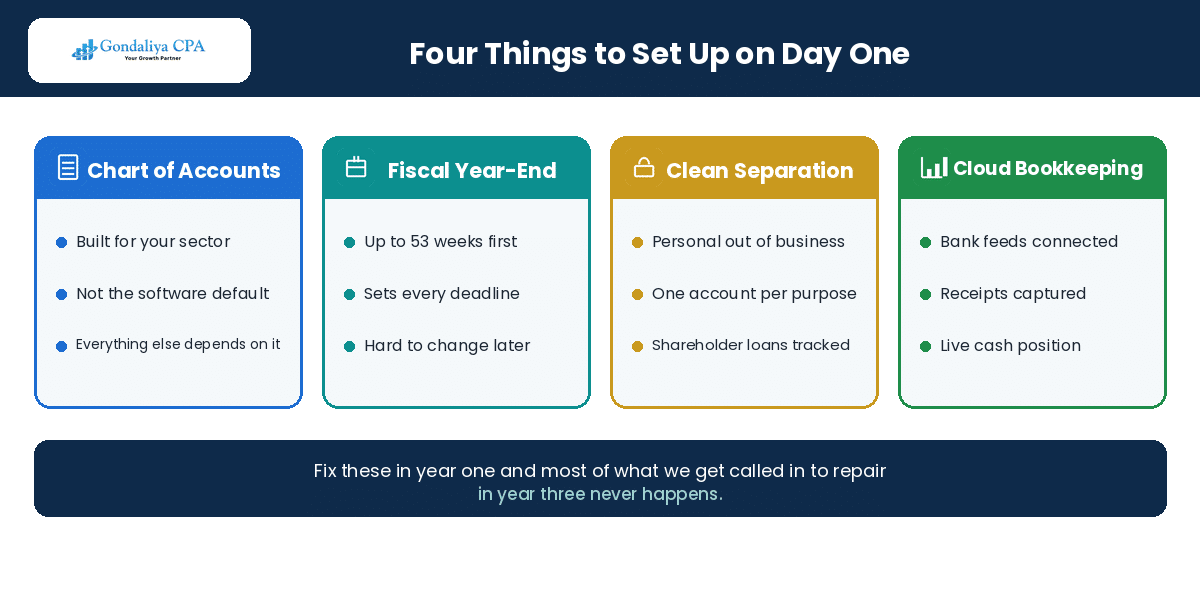
- Establish chart of accounts reflecting your industry and business needs
- Use software like QuickBooks Online or Xero integrated with Hubdoc for receipt capture
- Separate personal from business transactions strictly from the start
- Set fiscal year-end aligned with business cycle to optimize tax planning
Startup Accounting Route Comparison: DIY vs Bookkeeper vs CPA Firm
| Factor | DIY | Bookkeeper | CPA Firm (e.g., Gondaliya CPA) |
|---|---|---|---|
| Complexity Handling | Low | Medium | High |
| Tax Planning | Limited | Some | Comprehensive |
| CRA Compliance | Risk of Errors | Moderate | Expert Accuracy |
| SR&ED & Credits | Often Missed | Partial | Full Maximization |
| Audit Support | None | Minimal | Full Support |
| Cost | Low | Moderate | Higher but cost-effective |
What Deliverables Do You Get from Gondaliya CPA?
- Monthly reconciliations and bookkeeping reports
- Timely T2 corporate tax filings with schedules
- GST/HST filings per CRA deadlines electronically submitted since 2026
- Payroll runs including T4 slips preparation annually
- Compilation engagement financial statements under CSRS 4200 standard
- Strategic CFO advisory for growth and fundraising support
How We Deliver Startup Accounting & Tax Services at Gondaliya CPA
| Step | Description |
|---|---|
| Initial Consultation | Assess startup’s financial needs |
| Engagement Proposal | Customized fixed-fee plan covering all tasks |
| Onboarding Setup | Software integration; bank feeds linked |
| Monthly Bookkeeping | Regular reconciliations; transaction tracking |
| Payroll & Compliance | Payroll runs; remittance filing per schedule |
| Tax Filing & Planning | Prepare T2; advise on deductions & instalments |
| Ongoing Advisory | Support on audits, SR&ED claims & cash flow |
What Tax Deductions, Credits & Planning Opportunities Apply to Startups?
- Claim pre-incorporation costs as expenses post-incorporation
- Use small business deduction up to $500K taxable income federally at 9% rate
- Maximize refundable SR&ED credits at 35% on qualified R&D expenditures
- Plan optimal salary/dividend mix for owners to reduce CPP contributions
- Track loss carryforwards from prior years to offset taxable income
Best Accounting and Tax Strategies for Canadian Startups
- Retain records for minimum six years per CRA requirements
- Adopt cloud accounting software early to maintain real-time financial control
- Monitor cross-border taxation if expanding into US markets due to dual CPA licensing
- Use electronic filing tools since mandatory from 2026 to avoid penalties
- Keep detailed shareholder loan documentation under subsection 15(2) rules
Glossary of Key Terms for Startup Accounting in Canada
- T2 Return: Corporate income tax return required annually by CRA.
- GIFI Codes: Standardized codes used in corporate tax filings detailing financial info.
- SR&ED: Scientific Research & Experimental Development refundable tax credit program.
- CCPC: Canadian-Controlled Private Corporation qualifying for special tax treatments.
- Payroll Remittance: Payments sent regularly to CRA covering employee source deductions.
Next Steps: Engage Gondaliya CPA for Your Startup’s Accounting Needs
- Contact us via info@gondaliyacpa.ca or call 647‑212‑9559 for a free consultation.
- Discuss your current situation and growth plans with our expert team.
- Receive a custom proposal tailored to your startup’s requirements.
- Begin streamlined onboarding with cloud tools integration.
- Enjoy ongoing support through every stage of your startup journey.
Founders most often ask which single thing matters most in year one. It is the chart of accounts. Everything downstream, from the GST/HST coding to the SR&ED cost schedule, is easier when the categories were right at the start. Figures changed for privacy.
Industry Spotlights: Sectors We Represent
Industry Expertise
Startup accounting shifts by sector. Here are eleven and the first thing we set up in each.
| Industry | What We Set Up First |
|---|---|
| Technology startups & SaaS | SR&ED cost tracking and deferred revenue accounts |
| E-commerce & online retailers | Payment processor feeds and GST/HST coding |
| Consulting firms | Shareholder loan tracking and the salary mix |
| Construction, contractors & skilled trades | Equipment CCA schedule and subcontractor records |
| Property developers & builders | Project-level costing across associated corporations |
| Real estate investors & holding companies | Passive income monitored against the business limit |
| Transportation, logistics & trucking | Fleet assets classified by CCA class |
| Restaurants & food and beverage | Payroll remittance schedule from the first hire |
| Daycare, childcare & CWELCC services | Funded revenue recognition and subsidy tracking |
| Dentists & dental practices | Exempt and taxable revenue split, plus associate slips |
| Medical doctors & physician corporations | College share rules before any compensation planning |
- Technology startups & SaaS: The chart of accounts has to separate development labour from everything else on day one, because that split is what an SR&ED claim rests on later.
- E-commerce & online retailers: High transaction volumes through payment processors need automated feeds, or reconciliation becomes the largest task in the month.
- Consulting Firms: Founders draw against the shareholder loan through the year, and tracking it properly avoids a taxable benefit under subsection 15(2).
- Construction, general contractors & skilled trades: Equipment purchases land in different CCA classes, and the half-year rule decides the first-year claim.
- Property developers & builders: Project corporations under common control are associated, sharing one business limit rather than one each.
- Real estate investors, landlords & holding companies: Passive income inside the corporation erodes the small business deduction, so it needs watching from the first year.
- Transportation, logistics & trucking: Fleet assets sit across several CCA classes, and the classification decides the deduction in every year that follows.
- Restaurants & food and beverage: Payroll starts early and remittance frequency steps up as withholdings grow, which makes director liability live from the first pay run.
- Daycare, childcare & CWELCC services: Funded revenue arrives on its own schedule, and recognising it in the wrong period distorts the year in both directions.
- Dentists & dental practices: Exempt clinical revenue and taxable cosmetic work have to be split from the start, or the input tax credits cannot be supported.
- Medical doctors & physician professional corporations: The college restricts who may hold shares, which narrows the compensation options before tax planning even begins.
Across first-year startup files in one quarter, the two most common corrections were personal expenses run through the business account and a chart of accounts that had never been adapted from the software default. Figures changed for privacy.
Professional Guidance and Quick Reference
Guidance
Professional Guidance in Startup Accounting: How Gondaliya CPA Supports Canadian Founders
Startup accounting gets specific quickly. You need a chart of accounts that suits the sector, a fiscal year-end chosen for a reason, GST/HST registration timed against the threshold, payroll set up before the first hire, shareholder loans tracked properly, and every CRA deadline diarized. Gondaliya CPA provides bookkeeping, corporate tax filing, payroll, and advisory services built for Canadian startups.
We handle the work that keeps the file clean: cloud bookkeeping with bank feeds and receipt capture, monthly reconciliations, payroll runs and T4 slips, GST/HST returns, compilation statements under CSRS 4200, SR&ED claim support, and the T2 filing and CRA correspondence that follow.
Our team follows CRA practice closely and builds the setup around your own facts rather than a template. Whether you have just incorporated, are preparing for a raise, or need prior years cleaned up, we give clear advice based on the current rules.
Quick Answers: Key Numbers & Concepts at a Glance
At a Glance
- Small business deduction rate: 9% federal
- Business limit: $500,000
- SR&ED refundable ITC rate: 35% on eligible costs
- First fiscal period: Up to 53 weeks
- T2 deadline: Six months after fiscal year-end
- GST/HST registration: Once revenue reaches $30,000
- Payroll remittance: Monthly or quarterly, based on employee count
- Record retention: Minimum six years
- Typical annual filings: Six, including T2 and GST/HST returns
- Electronic filing: Mandatory for most incorporated startups from 2026
Who This Is For / Not For
Fit Check
- For: Newly incorporated Canadian startups, founders preparing for a first raise who need compilation statements, and companies with prior years that need cleaning up before an investor or lender review.
- Not For: Unincorporated sole proprietors with a single income stream and no employees, where the compliance burden does not yet justify the cost.
People Also Ask
Quick Answers
Does a startup with no revenue still file a T2?+
Yes. The obligation attaches to the corporation, not to the income. A nil return is still a return, and the penalties for missing it apply regardless.
How long can the first fiscal period run?+
Up to 53 weeks. Choosing the end date deliberately sets every deadline that follows, so it is worth deciding at incorporation rather than by default.
Can pre-incorporation costs be claimed?+
Often yes, where the expense relates to the business and is documented. The difficulty is usually evidence rather than eligibility, so keep the records from the start.
Glossary of Key Terms
Plain-English Definitions
- T2 Return: Corporate income tax return required annually by CRA.
- GIFI Codes: Standardized codes used in corporate tax filings detailing financial info.
- SR&ED: Scientific Research & Experimental Development refundable tax credit program.
- CCPC: Canadian-Controlled Private Corporation qualifying for special tax treatments.
- Payroll Remittance: Payments sent regularly to CRA covering employee source deductions.
- Small business deduction: The reduced corporate rate on the first tranche of active business income.
- Business limit: The threshold above which the general corporate rate applies.
- Capital cost allowance: The tax depreciation claim on equipment and other assets.
- Immediate expensing: Deducting the full cost of an eligible asset in the year of purchase.
- Compilation engagement: Financial statements prepared from client data without an opinion.
- CSRS 4200: The standard governing compilation engagements in Canada.
- Instalments: Periodic tax payments made through the year rather than at assessment.
- Shareholder loan: An owner draw from the corporation, taxable under subsection 15(2) if left outstanding.
- Pre-incorporation costs: Business expenses incurred before the corporation existed.
- Input tax credit: The GST/HST recovered on purchases made to produce taxable supplies.
- Fiscal year-end: The date the accounting period closes, which sets the filing deadlines.
Startup Accounting Setup Check
This quick self-check flags which parts of your accounting setup still need attention. Please answer the six questions below.
Startup Accounting Setup Check
Six quick questions on your setup. No fee shown.
Items to address:
This is a general prompt, not tax or legal advice or a quote. Your position depends on your full facts. For a real review, please book a free consultation.
Want a checklist to work from? You can download our free startup accounting setup checklist before your consultation.
Build the chart of accounts for your sector, choose the year-end deliberately, separate personal from business spending strictly, get cloud bookkeeping running early, register for GST/HST on time, and diarize every CRA deadline. Those six decisions in year one prevent most of what we later get called in to fix.
2026 Update — what is current: Electronic filing is now required for most incorporated startups’ T2 returns and GST/HST reports. The small business deduction still applies at 9% federally, SR&ED remains refundable at 35% for CCPCs on eligible costs, and immediate expensing rules under capital cost allowance have been updated. Please confirm the current business limit, expensing thresholds, and SR&ED expenditure caps before relying on the figures in this article.
Startup Accounting Services Canada: Expert Startup CPA Canada for Bookkeeping, Tax Filing, and Corporate Tax Planning
Get the setup right in year one, not in year three
Gondaliya CPA builds the chart of accounts, sets the year-end, connects the bookkeeping, runs payroll, files the T2 and GST/HST returns, and prepares compilation statements, on a flat annual fee including HST with a one-business-day response. Please book a free consultation.
Next Steps
Contact us via info@gondaliyacpa.ca or call 647‑212‑9559 for a free consultation. Discuss your current situation and growth plans with our expert team, receive a custom proposal tailored to your startup’s requirements, and begin streamlined onboarding with cloud tools integration. If our content helps, please add gondaliyacpa.ca as a preferred source on Google.
Published: August 5, 2026 · Last updated: August 5, 2026
Editorial policy: We research against CRA, CPA Canada, and provincial sources, fact-check the figures, and Sharad Gondaliya, CPA, reviews the content, which we update as the rules change.
Disclaimer: This article is educational information only and is not tax, legal, or financial advice. Figures marked illustrative are examples rather than quotes or guarantees. It reflects CRA rules current to 2026, including the 9% federal small business deduction rate, the $500,000 business limit, the 35% SR&ED refundable ITC rate, the 53-week maximum first fiscal period, the six-month T2 deadline, and the $30,000 GST/HST registration threshold. Rates, dollar limits, and filing requirements change and outcomes depend on your specific facts. Please consult a Registered CPA before acting.

Sharad Gondaliya is a CPA Canada & CPA USA with 15 Years+ experience of Accounting, Tax, Payroll of Corporate Small Businesses as Tax Accountant. He is a CPA Ontario member (61040184) and holds US CPA licences in Washington and Montana and is well known among corporate small businesses for tax planning, efficient tax solutions, and affordable CPA services. Sharad is the Principal (Director) of Gondaliya CPA – Affordable CPA Firm in Canada. Licenses: CPA Ontario: 61040184 | CPA USA (MT): PAC-CPAP-LIC-033176 | CPA USA (WA): 57629 | CPA Firm License: 61330051 View Full Author Bio