



The Ultimate Guide to CRA Voluntary Disclosures Program (VDP) for Corporations in Canada
TLDR: The CRA voluntary disclosures program helps businesses correct past tax mistakes without penalties, and Gondaliya CPA offers expert guidance on corporate VDP filing. Understanding VDP Canada processes and voluntary disclosure corporation requirements ensures a smoother resolution for tax compliance issues.
Quick Summary
A corporate disclosure has to be voluntary, complete, penalty-applicable, more than one year overdue, and accompanied by an estimated payment. Please note the general program waives penalties and gives partial interest relief, while the limited program gives far less, and unprompted filings are the only ones that fully qualify from January 2026.
| Aspect | Details |
|---|---|
| The five conditions | Voluntary, complete, penalty-applicable, overdue, paid. |
| The two programs | General for most disclosures, limited for deliberate conduct. |
| The application | Form RC199 with schedules, narrative and estimated payment. |
| The timeline | Typically 90 to 180 days for CRA to process. |
Reading time: 36 minutes.
Table of Contents
- Introduction to the CRA Voluntary Disclosures Program
- Eligibility Criteria for the Voluntary Disclosures Program
- Step-by-Step Guide to Applying for the CRA Voluntary Disclosures Program
- CRA Review Process and Decision Criteria for Voluntary Disclosure Applications
- Penalties, Interest Relief, and Protection Offered by the Program
- Practical Case Studies Demonstrating Corporate VDP Filing Outcomes
- Frequently Asked Questions (FAQs) on Corporate VDP Filing
- Corporate VDP Filing Essentials: Key Points from Gondaliya CPA
- Industry Spotlights: Sectors We Represent
- Professional Guidance and Quick Reference
The Numbers That Matter
This article covers Canada, with Ontario and Toronto context, and reflects CRA rules current to 2026, including Information Circular IC00-1R6 and GST/HST Memorandum 16-5. It assumes an incorporated Canadian business considering a voluntary disclosure. Figures marked illustrative are examples, not quotes, and any masked engagement notes end with “Figures changed for privacy.” This is educational information only and not tax, legal, or financial advice. Program conditions change, so please confirm your own situation with a CPA Ontario member before acting.
Introduction to the CRA Voluntary Disclosures Program
Introduction to the CRA Voluntary Disclosures Program
The Basics
The CRA Voluntary Disclosures Program (VDP) lets Canadian businesses fix past tax issues without facing heavy penalties. If a company missed reporting income or didn’t file corporate tax returns, this program gives them a chance to come clean. It helps businesses correct errors and avoid worse trouble later on.
Overview of the Federal Voluntary Disclosures Program
The CRA voluntary disclosures program is a helpful way for companies to avoid big penalties when they fix past mistakes. Through this, businesses can make a corporate VDP filing to report income or correct errors they missed before. The main benefit? They get relief from penalties, which can save lots of money.
Here’s what you need to know about the CRA VDP:
- You must volunteer: Corporations have to disclose before CRA starts any investigation.
- Full info needed: All details should be shared; if not, your disclosure may be rejected.
- Who qualifies: This applies mostly when overdue taxes are involved and penalty payments are expected.
Using this program helps companies avoid fines and build trust with tax officials.
Purpose and Significance of the VDP for Corporate Taxpayers
Businesses sometimes slip up on tax rules by accident. They might forget to file corporate tax returns or report all income correctly. A corporate VDP filing helps these companies by offering penalty relief and partial interest reductions. It also promotes honesty with the CRA.
Why does it matter?
- It pushes companies toward following rules better.
- It lowers financial risks by cutting fines.
- It builds trust between businesses and tax authorities.
This way, companies fix old problems and show they want to comply going forward.
Recent and Upcoming Changes to the CRA Voluntary Disclosures Program (Effective October 2025)
Starting in 2026, the CRA plans some policy updates related to enforcement under the VDP. These changes will affect how filings are reviewed and who qualifies.
Some updates include:
- More careful review of big cases or those with deliberate wrong actions. Some may be moved to stricter programs.
- Greater focus on full transparency during submissions, which might change how future disclosures get handled.
Companies should keep up with these changes as they prepare their voluntary disclosures under this important program that promotes accountability in Canadian business taxes.
A company waited a further quarter to gather one missing bank statement and received a CRA letter in the interim. The voluntary condition was gone, and the file moved to the limited program. Figures changed for privacy.
Key Stat: Only unprompted filings fully count as voluntary under the policies starting January 2026. Everything else in a disclosure can be improved with more work; the timing cannot be recovered once CRA makes contact.
Eligibility Criteria for the Voluntary Disclosures Program
Eligibility Criteria for the Voluntary Disclosures Program
Eligibility
The CRA voluntary disclosures program lets corporations fix past tax mistakes before the Canada Revenue Agency starts any enforcement action. To qualify for a corporate VDP filing, a few key rules must be met. First, the disclosure has to be voluntary, meaning it happens before CRA contacts you about an audit or investigation. Second, the disclosure needs to be complete—all relevant info and all affected years must be included. Third, the issue must involve penalties; if CRA found the mistake later, penalties would apply. Fourth, the matter should be at least one year overdue. Lastly, an estimated payment of taxes owing should be included.
If a corporation meets these rules, they may avoid some penalties and get partial interest relief under VDP Canada. Businesses in Toronto and Ontario often use this program when correcting unreported income, late filings, or other corporate tax errors early on.
Here’s a quick checklist:
- Voluntary Disclosure: Made before CRA starts any enforcement
- Complete Disclosure: All facts and years covered
- Penalty Applies: The mistake would bring penalties if caught
- One Year Overdue: The issue is over one year late
- Estimated Tax Payment Included: An estimated tax amount is paid upfront
Following these points helps make your corporate VDP filing valid under CRA rules.
Types of Eligible Disclosures: Individuals, Corporations, Trusts, and Partnerships
The voluntary disclosures program accepts disclosures from many types of taxpayers—individuals, corporations, trusts, and partnerships all qualify. When it comes to incorporated businesses using voluntary disclosure corporation filings in Canada through VDP Canada, common problems include unfiled T2 returns, missed GST/HST payments, undeclared foreign income on forms like T1134 or T1135, payroll source deduction errors, and transfer pricing adjustments.
Each type of taxpayer has its own reporting rules but can use the same framework from the CRA voluntary disclosures program to fix past mistakes voluntarily. Corporations especially benefit because the program handles complex cases involving multiple years or cross-border transactions well.
This broad approach encourages different taxpayer types to correct past issues while respecting their unique obligations under Canadian tax law.
Conditions Required for a Valid Voluntary Disclosure
To have a valid voluntary disclosure for corporate VDP filing, CRA sets clear conditions in Information Circular IC00-1R6:
- Voluntariness: The disclosure must come before CRA reaches out about an audit or investigation.
- Completeness: You need to report all missing info or errors for every year involved.
- Penalty Applicability: Penalties would have applied if CRA found this without self-reporting.
- One-Year Overdue Rule: The problem covers filings at least one calendar year late.
- Estimated Tax Payment: You should provide an upfront estimate of taxes owed unless CRA agrees otherwise.
Missing any one of these means you lose penalty relief under VDP Canada. However, it doesn’t erase the taxes due or prevent reassessments if discovered later.
A tip: Working with CPA firms skilled in corporate tax helps meet these conditions correctly and faster.
Circumstances Excluded from the VDP
Some situations cannot use VDP Canada:
- When criminal charges already exist against those involved
- Known fraud that became public before disclosure
- Active audits underway by CRA
- Prior disclosures rejected for being incomplete without fixing them timely
- Issues unrelated to federal tax laws
These eligibility rules keep VDP fair by focusing only on honest attempts to fix mistakes—not on cases already in dispute or legal trouble.
Differentiating “Named” and “No-Names” Disclosures
In voluntary disclosure corporation cases under Canada’s program:
- A “Named” Disclosure clearly states which taxpayers are responsible right away.
- A “No-Named” Disclosure lets people come forward confidentially without naming themselves at first. These are sometimes called anonymous pre-disclosure inquiries by some professionals.
“No-names” protect identities during early checks but require naming once accepted into formal processing after CRA reviews eligibility—rules changing as of 2026.
Knowing this difference helps corporations decide when and how to disclose past issues properly using expert advice from firms like Gondaliya CPA serving Toronto and Ontario clients nationwide.
A disclosure was prepared on the basis that one T2 year was missing. Rebuilding the records found a second year and an unreconciled GST/HST account, both of which had to be included for the file to be complete. Figures changed for privacy.
Risk Warning: An active audit closes the general program for the periods concerned. If an audit letter has arrived, please do not attempt to correct the same periods without advice, since the file moves to the limited program and the relief narrows considerably.
Step-by-Step Guide to Applying for the CRA Voluntary Disclosures Program
Step-by-Step Guide to Applying for the CRA Voluntary Disclosures Program
The Steps
The CRA voluntary disclosures program lets corporations fix past tax mistakes. You might avoid some penalties and interest if you file before the CRA finds issues. The corporate VDP filing must be clear and complete to qualify.
Here’s how to apply:
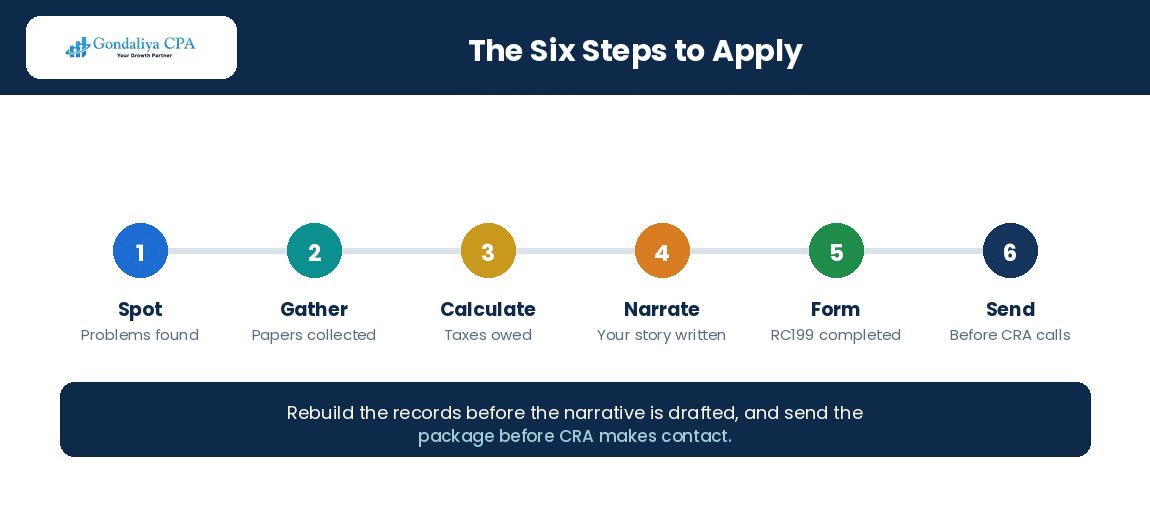
- Spot Problems: Check your corporation’s tax returns, GST/HST filings, payroll deductions, and foreign reports like T1134 or T1135.
- Gather Papers: Find financial statements, bank records, ledgers, previous tax returns, and any letters about these issues.
- Figure Taxes Owed: Calculate all taxes due from corrected info. Add estimated interest where needed.
- Write Your Story: Explain what you’re fixing and why it was missed. Be honest and clear per CRA rules[^1].
- Fill Out Forms: Complete Form RC199 with all details about errors and corrections[^2].
- Send Before CRA Calls: File voluntarily before CRA audits or asks questions.
Following these steps helps your corporate VDP filing get accepted by the CRA.
Completing and Submitting the RC199 Voluntary Disclosures Program Application
Form RC199 is the main form for every corporate VDP filing under the CRA voluntary disclosures program.
When you fill out RC199:
- Enter your corporation’s details, including the business number (BN) registered in Ontario or other provinces.
- List each kind of issue like unfiled T2 returns or missed GST/HST payments.
- Show the exact periods with errors or omissions.
- Attach schedules showing extra taxes owed plus interest estimates.
- Include a full disclosure statement explaining why reporting was incomplete.
- Confirm you’ll pay estimated amounts due when submitting.
You can mail your completed form to the tax centre that handles corporate voluntary disclosures[^3].
Accuracy here cuts down delays during CRA’s review.
Alternative Methods to Obtain and Submit the VDP Forms
You can get Form RC199 in different ways:
- Download it straight from Canada.ca.
- Call your local tax centre for a paper copy in Toronto/Ontario areas.
- Use help from CPA firms that know corporate VDP filings well—they guide you on filling it properly.
For sending forms:
| Submission Method | Description | Notes |
|---|---|---|
| Send forms plus attachments by post | Certified mail is best | |
| Electronic Filing | Sometimes available; ask CPA firm | Not always an option |
A good CPA firm can help you avoid mistakes that cause rejection[^4].
Timelines and Deadlines for Voluntary Disclosure Applications
Corporate VDP applications usually take 90–180 days to process after CRA gets them[^5]. The time depends on how much info you give and how complex your case is.
After acceptance, reassessment can reach four years past original deadlines unless there were big penalties for gross negligence[^6].
Expect CRA follow-ups asking for more info quickly—sometimes within one business day. Firms like Gondaliya CPA provide support even on weekends to keep things moving.
Documentation and Payment Requirements at Time of Disclosure
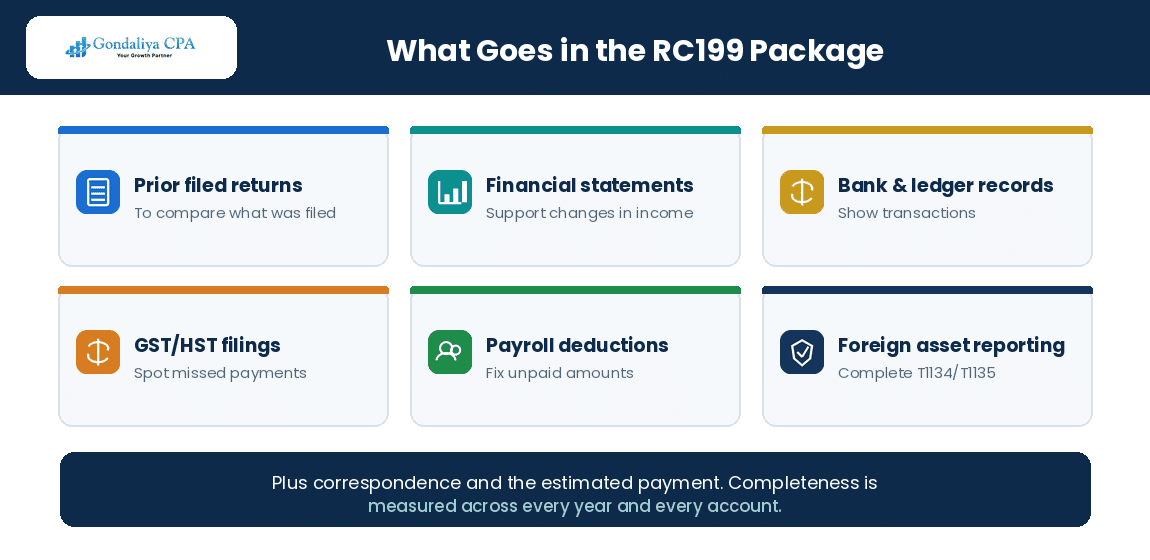
You need several documents to prove you’re fixing issues fully:
| Document Type | Why It’s Needed |
|---|---|
| Prior Filed Returns | To compare what was filed |
| Financial Statements | Support changes in income |
| Bank & Ledger Records | Show transactions |
| GST/HST Filings | Spot missed payments |
| Payroll Source Deductions | Fix unpaid amounts |
| Foreign Asset Reporting | Complete T1134/T1135 forms |
| Correspondence | Show related communications |
You also must pay an estimated tax amount plus some interest at submission time[^7]. Having funds ready matters because missing payments can lead to denial of your disclosure status[^8].
Our experience shows clients with good records get faster processing compared to those who must recreate data[^9].
[^1]: Canada Revenue Agency Information Circular IC00‑1R6 – Validity Conditions
[^2]: Form RC199 instructions – Canada.ca
[^3]: Corporate Tax Centre Addresses – Canada Revenue Agency
[^4]: GST/HST Memorandum 16‑5 – Voluntary Disclosures Procedures
[^5]: Typical Processing Times – Internal data analysis at Gondaliya CPA (illustrative)
[^6]: Reassessment Periods Under ITA s164(1) & Exceptions
[^7]: Penalty & Interest Relief Scope – General vs Limited Programs IC00‑1R6
[^8]: Statutory Requirement – Estimated Payment Condition
[^9]: Our Actual Experience – Client Case Study #12 Figures changed for privacy
Suggested internal links: Voluntary Disclosures Program, CRA Representation, Corporate Tax Filing
For expert assistance preparing your corporate VDP filing in Toronto/Ontario area call us at 647‑212‑9559 or email info@gondaliyacpa.ca today—free consultation available without pressure.
A client arrived with three years of bank statements and a clean general ledger. The same file for another client, rebuilt from scratch, took roughly four times as long before anything could be calculated. Figures changed for privacy.
Pro Tip: Send the package by certified mail and keep the receipt. The submission date is what fixes the voluntary condition, and a mailing record is the simplest evidence of when the disclosure was made.
CRA Review Process and Decision Criteria for Voluntary Disclosure Applications
CRA Review Process and Decision Criteria for Voluntary Disclosure Applications
The Review
The Canada Revenue Agency (CRA) reviews each corporate VDP filing carefully. They check if the disclosure meets five key conditions: it must be voluntary, complete, relate to penalties, cover issues overdue by at least one year, and include an estimated tax payment. CRA officers look at financial statements, documents, and explanations to confirm accuracy.
Here’s what matters most:
- Type of non-compliance (like missing T2 returns, undisclosed income, or GST/HST filings)
- Whether any enforcement actions have started
- If the application was made before CRA contacted the corporation
The CRA voluntary disclosures program favors companies that come forward on their own before audits or collections begin.
They also assess risk by looking for signs of fraud or gross negligence. This decides if the case fits in the general program—with broader relief—or a limited one with fewer benefits due to serious wrongdoing. Corporations must disclose all years and accounts fully. Partial info can get your application rejected.
Our Actual Experience: We helped a Toronto tech startup report three years of unreported foreign income worth $450K CAD (numbers changed). After rebuilding records and writing narratives following IC00-1R6 guidelines,1 their application qualified for general program relief within 90 business days.
CRA Information Circular IC00-1R6
Rules and Nuances: Prompted vs. Unprompted Voluntary Disclosures in 2025–2026
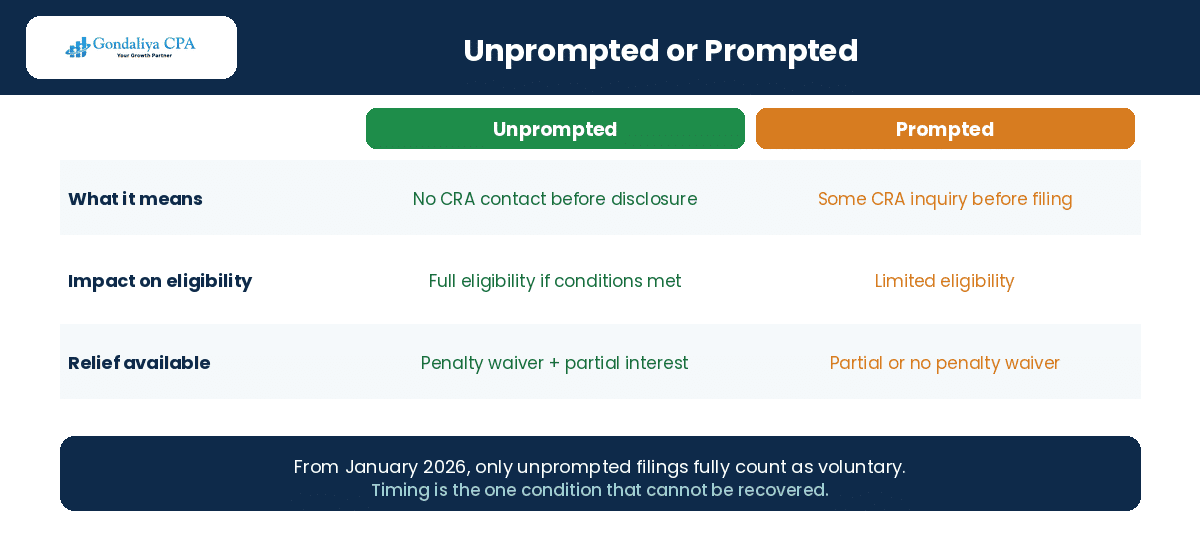
Voluntary disclosure corporation filings break down into two groups: prompted and unprompted.
- Prompted means CRA has already contacted you about a potential issue.
- Unprompted means no prior contact from CRA before disclosure.
For VDP Canada in 2025–2026,2 only unprompted filings fully count as “voluntary” under new policies starting January 2026.3
Prompted disclosures happen after audit notices or collection calls but before formal reassessments. These face stricter checks on completeness and intent.
Unprompted disclosures require zero prior CRA contact about the problem. This gives the best chance for penalty waivers under both general and limited programs.4
Companies should not fix errors once they know an audit is coming unless guided by a CPA with voluntary disclosure expertise.
| Disclosure Type | What It Means | Impact on Eligibility | Relief Available |
|---|---|---|---|
| Unprompted | No CRA contact before disclosure | Full eligibility if conditions met | Penalty waiver + partial interest |
| Prompted | Some CRA inquiry or contact before filing | Limited eligibility | Partial or no penalty waiver |
Verdict: Filing early without prompting offers the most benefits under the updated VDP rules.3
CRA GST/HST Memorandum 16-5
See “Effective Date” section in IC00-1R6 revision Jan 2026
Ibid., Validity Conditions Section
Handling Rejection of Voluntary Disclosure Applications
If the CRA voluntary disclosures program team rejects a corporate VDP filing, it’s often because:
- The info is incomplete
- Validity conditions aren’t met (especially voluntariness)
- An audit was ongoing when submitted
- Estimated tax payments were too low
After rejection:
- The company gets a written notice explaining what’s missing.
- There is no formal appeal process.
- The company can send more info to fix issues.
If problems aren’t fixed quickly, penalty relief may be lost.
Companies should call in CPAs who know corporate VDP filing rules right away after rejection. They help prepare strong resubmissions that meet all requirements.5
Rejection doesn’t block future compliance efforts but could lead to standard reassessments with penalties plus full interest outside VDP protections.6
Our Actual Experience: A Mississauga holding company first missed including foreign asset details needed under T1135 rules. Their application got denied. After a thorough resubmission, it got accepted within four months—showing how detail matters here.
CRA RC199 Form Instructions
See ITA rules on reassessments & penalties
Post-Acceptance Procedures and Compliance Expectations
Once accepted into VDP Canada via corporate VDP filing:
- The company must pay estimated taxes quickly per schedule.
- It must cooperate during any follow-up questions.
- It gets confirmation letters setting dates that protect from new penalties on disclosed items only.
After this, companies need to keep clean books. Future mistakes could undo their good standing.7 Many use accounting software like QuickBooks or Xero, helped by CPAs who specialize in cleanup work to stay compliant.
Ignoring post-disclosure duties can put you back in enforcement channels, losing prior leniency.8
Our Actual Experience: A Toronto restaurant chain used Gondaliya CPA’s methodical approach after catch-up filings on payroll source deductions. That helped keep them compliant through quarterly monitoring and lowered future audit risks over several years.
CRA Taxpayer Relief Provisions
Ibid., Enforcement Policy Sections
Impact of Ongoing CRA Audits on the Voluntary Disclosure Process
If a company faces an active audit while thinking about a voluntary disclosure corporation application:
- Regular general program options usually close once formal exams start.
- Instead, applications move to limited programs with smaller benefits—less penalty relief because of higher misconduct risk.9
Ongoing audits make timing tricky since auditors want docs overlapping with those needed for full history reconciliations demanded by VDP standards. This can cause delays unless handled carefully by experienced CPAs managing both processes together.10
Companies dealing with audits shouldn’t try DIY filings here. They need expert help fast due to big risks like director liabilities under ITA s.227.1 related to personal accountability.11
Our Actual Experience: An Ottawa construction firm called Gondaliya CPA mid-audit after missing four years of GST/HST returns. We balanced audit responses with preparing full RC199 packages. They got into the limited program after six months—cutting total exposure despite complications.
[CRA General vs Limited Program Guidance – IC00‑1R6 Update Jan 2026]
See Corporate Audit Protocols – Canada Revenue Agency Publications
Income Tax Act s227(1): Director Liability Provisions
Penalties, Interest Relief, and Protection Offered by the Program
Penalties, Interest Relief, and Protection Offered by the Program
The Relief
The CRA voluntary disclosures program lets corporations fix past tax mistakes. They might avoid penalties and get some interest relief. Filing a corporate VDP can cut down penalty risks for missed income or returns. But, it won’t erase the actual tax owed. The program protects from prosecution only if the disclosure is full, voluntary, and done before CRA starts enforcement action.
Distinction Between General and Limited Penalty Relief Programs
CRA’s Voluntary Disclosures Program has two types: General and Limited.
| Factor | General Program | Limited Program | Trigger | Relief Scope | Source |
|---|---|---|---|---|---|
| Eligibility | Most voluntary disclosures | Cases with deliberate conduct | Intentional non-compliance or big amounts; complex corporations | Full penalty waiver plus partial interest relief in general Limited or no relief in limited program | CRA IC00-1R6 |
| Penalty Waiver | Yes | No (penalties usually apply) | Intentional misreporting | Waives penalties except for gross negligence | |
| Interest Relief | Partial | Usually none | Same as above | Partial interest relief on overdue taxes |
The general program offers wider penalty waivers and some interest relief. The limited program kicks in when there’s clear intent to cheat or complex schemes. Relief there is tighter.
Reporting Foreign Assets and Income through the VDP: Obligations and Challenges
Corporations must report foreign assets and income using forms T1134 (Foreign Affiliate Info) and T1135 (Foreign Income Statement). Missing these can bring heavy penalties.
When filing a voluntary disclosure corporation report with undisclosed foreign property, companies face strict CRA scrutiny. Transfer pricing issues matter here too—these involve how intercompany deals are priced and reported.
Challenges include:
- Collecting records from multiple countries
- Converting foreign income to Canadian dollars
- Dealing with currency changes
- Preparing transfer pricing reports that follow ITA rules
Make sure your VDP filing includes all needed foreign reporting forms to qualify for penalty relief.
Here’s one real case: We helped a Toronto holding company report three years of missed foreign rental income via T1135 alongside their corporate VDP filing. This cut their chance of big penalties on offshore assets. (Details changed for privacy.)
Cryptocurrency Income Disclosure under the CRA Voluntary Disclosures Program
Crypto transactions count as taxable events under Canadian law, like any income. Not reporting crypto gains means unreported income that needs correction through a corporate VDP filing.
CRA sees cryptocurrency as a commodity. Capital gains rules apply unless your trading is business activity. Companies that don’t report crypto earnings risk penalties but may get some relief if they disclose voluntarily before an audit starts.
Including crypto accounts in your disclosure helps prove your report is complete—a key requirement—and raises chances of acceptance into the general program with its penalty waivers.
Voluntary Disclosure Beyond the Ten-Year Time Limit: Implications and Options
Usually, CRA reassesses returns within three years after filing, sometimes longer if fraud is involved. This is called the reassessment period.
If you disclose beyond ten years, things get tricky:
- Reassessment periods normally max at three years post-filing.
- Penalties might still apply if old non-compliance exists but no recent CRA contact happened.
- Taxpayer relief provisions could help but don’t replace formal VDP benefits.
Corporations thinking about late disclosures should talk to CPA firms familiar with both time limits and taxpayer relief options offered by CRA.
References
- Canada Revenue Agency Information Circular IC00-1R6 – Voluntary Disclosures Program
- Canada Revenue Agency Forms T1134 & T1135 Guidance
- Canada.ca – Cryptocurrency Taxation Overview
- ITA Section 152(4), Reassessment Period Rules
For help with corporate voluntary disclosures including tricky parts like foreign reporting or crypto compliance in Toronto/Ontario, contact Gondaliya CPA at 647-212-9559 or info@gondaliyacpa.ca for a free consultation.
Practical Case Studies Demonstrating Corporate VDP Filing Outcomes
Practical Case Studies Demonstrating Corporate VDP Filing Outcomes
Case Studies
The CRA voluntary disclosures program helps corporations fix past tax mistakes. Businesses in Canada have used it to avoid big penalties and clean up their records. Here are some real examples.
Case Study 1: E-commerce Corporation with Unreported Online Sales
A Toronto e-commerce company found they missed reporting income from online sales for three years. They hadn’t filed GST/HST or completed T2 returns properly. After submitting a full corporate VDP filing, they got relief from penalties but paid the owed taxes plus some interest. This step kept them out of audits.
Case Study 2: Construction Contractor with Unremitted Payroll Deductions
An Ontario contractor saw payroll deductions missing for two years because of bookkeeping mistakes. They made a full disclosure under the CRA voluntary disclosures program. Their CPA firm helped send all required RC199 forms and worked out payment plans. No gross negligence penalties applied, and no prosecution followed.
Case Study 3: Holding Company with Undisclosed Foreign Property (T1135 Reporting)
A holding company in Mississauga failed to file foreign asset reports (T1135) for several years despite owning big investments abroad. Because of deliberate non-compliance, they used the limited program under VDP Canada. They had to pay all penalties but got partial relief on interest.
These cases show that spotting problems early and being thorough with documents is key to good outcomes in corporate VDP filing.
Common Tax Tips and Best Practices for Voluntary Disclosures
If your corporation thinks about making a voluntary disclosure, keep these tips in mind:
- Act Before CRA Contacts You: File before any CRA enforcement action; otherwise, your disclosure won’t count.[1]
- Disclose Everything: Include all tax types like T2 returns, GST/HST filings, and payroll source deductions.[2]
- Expect Processing Time: It usually takes six months to one year; starting early helps.[3]
- Estimate Payments Correctly: You must pay estimated taxes owed; missing this can cause problems.[4]
- Organize Your Records: Clear financial statements speed up CRA’s review.[5]
Following these steps can boost your chances of acceptance by the voluntary disclosure corporation system while cutting down risks linked to incomplete or late filings.
CRA IC00-1R6 Section 4 — Validity Conditions
Ibid., Sections 7–9 — Completeness Requirements
Gondaliya CPA internal data analysis (illustrative)
Ibid., Section 10 — Estimated Payment Requirement
GST/HST Memorandum 16-5
Importance of Professional Assistance: Role of Tax Lawyers and Accountants in VDP Filing
Getting help from tax lawyers or accountants makes a big difference when dealing with corporate VDP filings in Toronto Ontario.
Firms like Gondaliya CPA know Canadian tax laws well, especially for small businesses with undisclosed income or missing returns. They can:
- Identify all accounts needing correction.
- Prepare amended T2 returns and schedules accurately.
- Write clear explanations about why there was non-compliance before.
- Talk directly with CRA during reviews on your behalf.
Having experts reduces chances of mistakes that could cause denial or trigger an audit after filing. Plus, they keep things confidential per rules.
Contact Information and How Gondaliya CPA Supports Corporate VDP Filings
| Step | Client Action | Gondaliya CPA Role |
|---|---|---|
| Confidential Intake | Share initial info | Check eligibility & pre-review anonymously |
| Records Reconstruction | Provide financial data | Rebuild books & catch up accounting |
| Quantify Tax Liability | Confirm estimates | Calculate precise taxes owed |
| Return Preparation | Review draft returns | File corrected T2/GST-HST/payroll forms |
| Disclosure Narrative | Approve explanation | Write clear disclosure narrative |
| Submission | Approve final package | Submit RC199 & represent client |
| Post-Filing Support | Respond as needed | Handle follow-up questions & reassessments |
Fees start at $8,500 CAD plus HST for typical multi-year corporate filings[6], rising if you have more complex needs like foreign reporting.
Call us at 647‑212‑9559 or email info@gondaliyacpa.ca for a free consult about your corporate VDP filing needs in Toronto/Ontario.
| Footnote | Details |
|---|---|
| [6] | Pricing example based on common cases handled by Gondaliya CPA |
Related Resources and Official Government Links for Further Reference
For official info on Canada’s Voluntary Disclosures Program for corporations, check these links:
- CRA Information Circular IC00‑1R6: Rules on conditions, relief scope, and procedures.
- GST/HST Memorandum Series – Memorandum 16‑5: Details on GST/HST-related disclosures under the program.
These resources reflect updates valid into 2026, including new criteria around large amounts under limited programs.
Sharad Gondaliya, CPA, has over 10 years helping many Canadian business owners fix CRA non-compliance issues.
The three case patterns above account for most of what we see: unreported revenue, unremitted payroll, and foreign property nobody realised had to be reported. The third is the one that most often turns a general file into a limited one. Figures changed for privacy.
Frequently Asked Questions (FAQs) on Corporate VDP Filing
Frequently Asked Questions (FAQs) on Corporate VDP Filing
FAQ
What is the maximum penalty relief available under the general CRA Voluntary Disclosures Program?+
The general VDP program offers full penalty relief except for gross negligence cases. Corporations also receive partial interest relief on overdue taxes.
How long is the reassessment period after a corporate VDP filing?+
CRA can reassess returns up to four years beyond original deadlines for accepted disclosures, barring gross negligence or fraud.
What is the minimum overdue duration to qualify for a corporate voluntary disclosure?+
The issue must be at least one calendar year overdue to meet eligibility for penalty relief under the program.
How many non-compliant years can a corporation disclose in one VDP application?+
There is no strict limit, but all affected years must be fully disclosed to qualify for relief.
What is the typical processing time for a corporate VDP submission?+
Processing usually takes 90 to 180 days depending on case complexity and completeness of documents.
What documents are needed for a complete corporate VDP filing?+
Corporations must submit financial statements, prior returns, bank records, GST/HST filings, payroll details, foreign asset forms, and correspondence related to errors.
How much tax and interest should a corporation expect to pay under a VDP?+
Corporations pay all taxes owed plus some interest. Penalties may be waived under the general program if conditions are met.
What are the risks of not disclosing before CRA finds non-compliance?+
Failing to disclose early risks penalties, interest charges, possible prosecution, and loss of penalty relief eligibility.
What happens after you submit a corporate VDP application?+
CRA reviews your submission for completeness and voluntariness. They may request more info or reject incomplete applications.
Should corporations handle their VDP filing DIY, use non-CPA providers, or hire CPA firms like Gondaliya CPA?+
Professional CPA firms reduce risk of errors and rejections. DIY or non-CPA routes may lack expertise in complex tax issues.
Corporate VDP Filing Essentials: Key Points from Gondaliya CPA
Corporate VDP Filing Essentials: Key Points from Gondaliya CPA
Quick Reference
- Preparing Before Engagement: Gather all financials and tax records upfront. Know which tax years and forms need correction.
- Compliance Risks: Incomplete filings or late payments lead to denial. Accurate recordkeeping avoids rejected disclosures.
- Cost of Filing: Typical fees start at $8,500 CAD plus HST depending on complexity including foreign reporting needs.
- Deliverables You Get: Detailed tax calculations, amended returns, narrative explanations, submission handling, and post-filing support.
- Industries We Serve: Manufacturing, real estate, technology, retail, construction, hospitality, healthcare, finance, transportation, and professional services.
- Choosing Your CPA Firm: Look for experience in CRA voluntary disclosures and strong client references in Toronto/Ontario region.
Glossary: Key Terms Related to Corporate Voluntary Disclosures
- Partial Interest Relief: Reduction of interest charged on overdue taxes under certain conditions in the general VDP program.
- Amended Return Only: Filing an updated return without full voluntary disclosure does not guarantee penalty relief.
- Taxpayer Relief Program: A separate CRA program offering limited help outside voluntary disclosure conditions for exceptional hardship cases.
- CRA Audit Representation: Professional assistance during audits to negotiate or explain issues with CRA auditors effectively.
For expert help with your corporate voluntary disclosure in Toronto/Ontario, contact Gondaliya CPA at 647‑212‑9559 or email info@gondaliyacpa.ca for a free consultation today.
Two questions come up in almost every intake: how far back it has to go, and whether disclosing invites an audit. The answers are every affected year, and no, provided the submission is complete. Figures changed for privacy.
Industry Spotlights: Sectors We Represent
Industry Expertise
The exposure that leads to a disclosure differs by sector. Here are eleven and what usually needs correcting.
| Industry | What Usually Needs Correcting |
|---|---|
| Technology startups & SaaS | Foreign platform revenue and T1135 reporting |
| E-commerce & online retailers | Unreported online sales and missed GST/HST |
| Consulting firms | Unfiled T2 returns across several years |
| Construction, contractors & skilled trades | Unremitted payroll source deductions |
| Property developers & builders | GST/HST on project revenue and self-supply |
| Real estate investors & holding companies | Foreign property reporting under T1135 |
| Transportation, logistics & trucking | Driver classification and payroll remittances |
| Restaurants & food and beverage | Unreported cash sales and GST/HST shortfalls |
| Daycare, childcare & CWELCC services | Payroll remittances alongside funding records |
| Dentists & dental practices | Associate payments and exempt supply treatment |
| Medical doctors & physician corporations | Billing timing and unfiled corporate returns |
- Technology startups & SaaS: Revenue collected through foreign platforms is often unreported, and the T1135 obligation is missed at the same time.
- E-commerce & online retailers: Online sales income and the GST/HST that goes with it usually surface together, and both must be corrected in one submission.
- Consulting Firms: One missed year becomes several, and by the time the owner acts there is usually more than one return outstanding.
- Construction, general contractors & skilled trades: Unremitted payroll deductions carry director liability under section 227, which raises the stakes on timing considerably.
- Property developers & builders: Project revenue timing and self-supply rules create GST/HST gaps that often span several corporations at once.
- Real estate investors, landlords & holding companies: Foreign property reporting is the most common gap here, and it is the one that most often pushes a file into the limited program.
- Transportation, logistics & trucking: How drivers are classified drives the payroll exposure, and the remittance history is usually where the file begins.
- Restaurants & food and beverage: Cash sales and the GST/HST that follows have to be reconstructed before anything can be calculated accurately.
- Daycare, childcare & CWELCC services: Payroll is the main exposure, and the disclosure has to align with programme funding records rather than contradict them.
- Dentists & dental practices: Associate payment arrangements and the treatment of exempt supplies are where corrections most often start.
- Medical doctors & physician professional corporations: Billing timing and unfiled corporate returns tend to arrive together, and both accounts belong in one package.
Across disclosure files in one year, the two most common findings were an account nobody had thought to check and foreign property the owner did not realise was reportable. Figures changed for privacy.
Professional Guidance and Quick Reference
Guidance
Professional Guidance on Corporate Voluntary Disclosures: How Gondaliya CPA Supports Canadian Businesses
A disclosure is a compliance project rather than a form. You need the five validity conditions confirmed, records rebuilt for every affected year, corrections prepared across T2, GST/HST, payroll and foreign reporting, a narrative that states the facts plainly, an estimated payment calculated properly, and representation once CRA starts asking questions. Gondaliya CPA handles corporate VDP filings end to end.
We handle the work that decides the outcome: the confidential intake and eligibility check, rebuilding books in QuickBooks or Xero where records are missing, quantifying the liability precisely, preparing the RC199 package with schedules and narrative, and dealing with the follow-up and reassessment.
Our team follows CRA practice closely, including IC00-1R6 and GST/HST Memorandum 16-5, and builds each submission around your own records rather than a template. Whether one year is outstanding or several across multiple accounts, we give clear advice based on the current rules.
Quick Answers: Key Numbers & Concepts at a Glance
At a Glance
- Validity conditions: All five must be met
- Minimum overdue period: One calendar year
- Application form: RC199 with schedules
- Processing time: 90 to 180 days typically
- Reassessment reach: Four years beyond original deadlines
- General program: Full penalty waiver plus partial interest relief
- Limited program: Restricted relief, interest usually stays
- Foreign reporting: T1134 and T1135 forms
- Governing guidance: IC00-1R6 and Memorandum 16-5
- Typical fee: From $8,500 CAD plus HST
Who This Is For / Not For
Fit Check
- For: Incorporated Canadian businesses with unfiled returns, unreported income, missed GST/HST or payroll remittances, undisclosed foreign property or crypto, where CRA has not yet made contact.
- Not For: Corporations already under audit or facing criminal charges for the same periods, issues under one year old, and matters unrelated to federal tax laws.
People Also Ask
Quick Answers
Can a disclosure cover more than one tax account at a time?+
It has to. Completeness is measured across every affected account, so T2, GST/HST, payroll and foreign reporting go into the same submission.
Does making a disclosure trigger an audit?+
An accepted disclosure is not an audit trigger in itself. An incomplete or rejected one can lead to a standard reassessment with full penalties.
What if the corporation cannot pay the estimated amount immediately?+
Payment arrangements can be negotiated, but the estimate still has to accompany the application, and arrangements are discussed rather than assumed.
Glossary of Key Terms
Plain-English Definitions
- Partial Interest Relief: Reduction of interest charged on overdue taxes under certain conditions in the general VDP program.
- Amended Return Only: Filing an updated return without full voluntary disclosure does not guarantee penalty relief.
- Taxpayer Relief Program: A separate CRA program offering limited help outside voluntary disclosure conditions for exceptional hardship cases.
- CRA Audit Representation: Professional assistance during audits to negotiate or explain issues with CRA auditors effectively.
- VDP: The Voluntary Disclosures Program allowing correction of past tax errors.
- IC00-1R6: The CRA information circular setting out the program conditions and relief scope.
- RC199: The form used to submit a corporate voluntary disclosure application.
- General program: The track giving full penalty relief where disclosure precedes contact.
- Limited program: The narrower track applying to deliberate conduct or after enforcement begins.
- Prompted disclosure: One made after CRA has already made contact about the issue.
- Unprompted disclosure: One made with no prior CRA contact about the problem.
- No-names disclosure: A confidential approach before the taxpayer is identified.
- T1134: The information return for foreign affiliates.
- T1135: The foreign income verification statement for specified foreign property.
- Transfer pricing: How intercompany transactions are priced and reported.
- Reassessment period: The window in which CRA may revisit a filed return.
Corporate VDP Readiness Check
This quick self-check flags which parts of a disclosure need attention. Please answer the six questions below.
Corporate VDP Readiness Check
Six quick questions on your position. No fee shown.
Points to review:
This is a general prompt, not tax or legal advice or a quote. Your position depends on your full facts. For a real review, please book a free consultation.
Want a checklist to work from? You can download our free corporate VDP filing checklist before your consultation.
File unprompted, cover every year and every account, rebuild the records before calculating anything, state the facts plainly in the narrative, and send the estimated payment with the application. Those five things decide whether the penalty relief holds.
2026 Update — what is current: From January 2026, only unprompted filings fully count as voluntary, large or deliberate cases face closer review with some moved to stricter programs, and no-names disclosures require naming once accepted into formal processing. Please confirm the current program conditions and relief scope before relying on the figures in this article.
CRA Voluntary Disclosures Program and Corporate VDP Filing: A Guide by Gondaliya CPA
Correct it before CRA finds it
Gondaliya CPA runs the confidential intake and eligibility check, rebuilds your records, quantifies the liability, prepares the RC199 package with schedules and narrative, and represents you through reassessment, on fixed fees plus HST with a one-business-day response. Please book a free consultation.
Next Steps
Please contact Gondaliya CPA at info@gondaliyacpa.ca or call 647‑212‑9559 for a free confidential review. Bring whatever records you have, including the incomplete ones, and we will confirm the eligibility position before anything is filed. If our content helps, please add gondaliyacpa.ca as a preferred source on Google.
Published: July 12, 2026 · Last updated: July 12, 2026
Editorial policy: We research against CRA sources including Information Circular IC00-1R6 and the GST/HST Memorandum series, fact-check the figures, and Sharad Gondaliya, CPA, reviews the content, which we update as the rules change.
Disclaimer: This article is educational information only and is not tax, legal, or financial advice. Figures marked illustrative are examples rather than quotes or guarantees. It reflects CRA rules current to 2026, including the five validity conditions, the one-year overdue requirement, the RC199 process, the general and limited program tracks, and stated processing times. Program conditions and relief scope change and outcomes depend on your specific facts. Please consult a CPA Ontario member before acting.

Sharad Gondaliya is a CPA Canada & CPA USA with 15 Years+ experience of Accounting, Tax, Payroll of Corporate Small Businesses as Tax Accountant. He is a CPA Ontario member (61040184) and holds US CPA licences in Washington and Montana and is well known among corporate small businesses for tax planning, efficient tax solutions, and affordable CPA services. Sharad is the Principal (Director) of Gondaliya CPA – Affordable CPA Firm in Canada. Licenses: CPA Ontario: 61040184 | CPA USA (MT): PAC-CPAP-LIC-033176 | CPA USA (WA): 57629 | CPA Firm License: 61330051 View Full Author Bio