



The Ultimate Guide to Catch-Up Bookkeeping Services for Small Businesses in Canada
Catch-up bookkeeping services Canada help small businesses bring their books up to date with accurate, CRA-ready bookkeeping records. Gondaliya CPA offers affordable bookkeeping cleanup Canada and bookkeeping tax preparation services to ensure your accounting records are clean before tax filing.
Quick Summary
Catch-up fills in what was never recorded, cleanup corrects what was recorded wrongly, and most backlogs need both. Please note the payroll and GST/HST side is where the real exposure sits, because unremitted source deductions carry personal director liability rather than just a corporate penalty.
| Aspect | Details |
|---|---|
| The two services | Catch-up adds missing entries, cleanup fixes existing ones. |
| The workflow | Seven steps, from document intake to CPA sign-off. |
| The exposure | Late T2 penalties, payroll remittances, GST/HST mismatches. |
| The outcome | Reconciled ledger, trial balance, CRA-ready records. |
Reading time: 33 minutes.
Table of Contents
- What Are Catch-Up Bookkeeping Services and When Are They Needed?
- The Process of Catch-Up Bookkeeping: Step-by-Step Workflow
- Common Challenges Leading to Bookkeeping Backlogs
- Pricing Models for Catch-Up Bookkeeping and Cleanup Services in Canada
- Technologies and Tools Used for Efficient Bookkeeping Cleanup and Catch-Up
- How Gondaliya CPA Supports Small Business Bookkeeping Cleanup and Catch-Up
- FAQs on Catch-Up Bookkeeping Services for Small Businesses in Canada
- Key Numbers at a Glance: Catch-Up Bookkeeping Essentials
- Industry Spotlights: Sectors We Represent
- Professional Guidance and Quick Reference
The Numbers That Matter
This article covers Canada, with Ontario and Toronto context, and reflects CRA rules current to 2026. It assumes a small business, often incorporated, with overdue or disorganised bookkeeping records. Figures marked illustrative are examples, not quotes, and any masked engagement notes end with “Figures changed for privacy.” This is educational information only and not tax, legal, or financial advice. Deadlines, penalties and requirements change, so please confirm your own situation with a CPA Ontario member before acting.
What Are Catch-Up Bookkeeping Services and When Are They Needed?
What Are Catch-Up Bookkeeping Services and When Are They Needed?
The Basics
Catch-up bookkeeping services in Canada help small businesses fix their overdue financial records. If you’ve missed tracking some months or even years, these services update your books. They make sure your records meet Canada Revenue Agency (CRA) rules. Plus, they get you ready for tax time or audits. Many small businesses face late bookkeeping problems. Catch-up bookkeeping can sort out those problems and stop you from paying fines.
When do you need catch-up bookkeeping?
- When records fall behind by several months
- If tax filing deadlines have been missed
- After busy periods when paperwork piles up
- When switching accountants or bookkeepers
This kind of service brings everything current so your business stays in good standing.
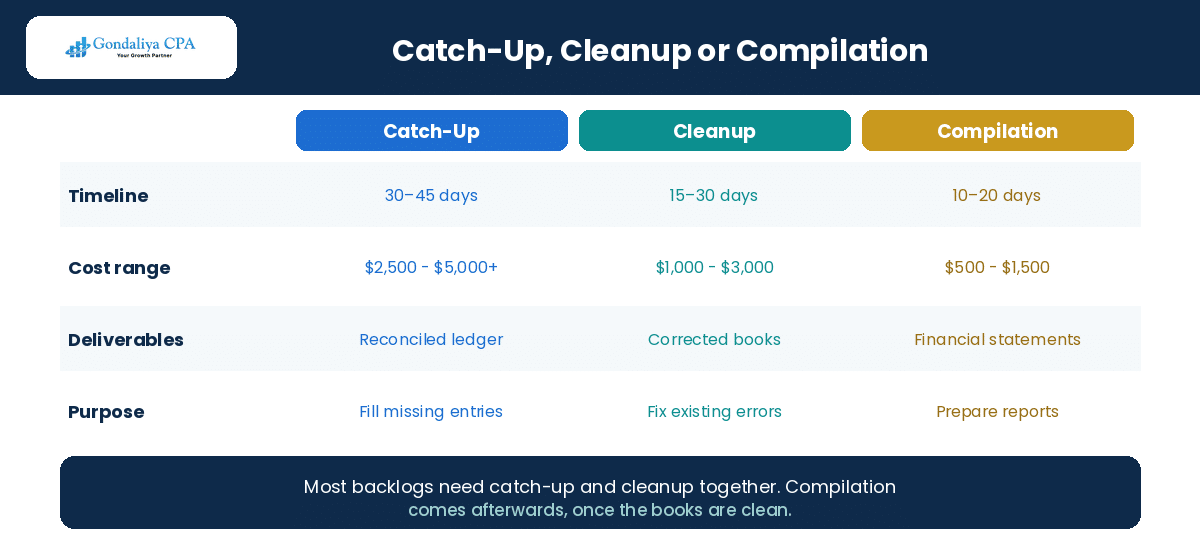
Understanding Bookkeeping Cleanup vs Catch-Up in Canada
Bookkeeping cleanup and catch-up bookkeeping sound similar but do different things.
| Service Type | Purpose | Scope |
|---|---|---|
| Bookkeeping Cleanup | Fix errors in existing records | Corrects mistakes in what’s already recorded |
| Catch-Up Bookkeeping | Update missing past transactions | Adds transactions that were never recorded |
Cleanup focuses on fixing messy or wrong info in the books you already have. Catch-up fills in blanks for months or years not recorded at all. Both help small business bookkeeping stay reliable and useful.
Also, cleanup sometimes includes accounting compilation — putting together statements from cleaned data. This can be needed if your business wants clear financial reports after fixing the books.
Who Benefits from Catch-Up and Cleanup Services for Small Businesses
Small businesses often find catch-up and cleanup services helpful, especially when things get out of hand.
Who should think about these services?
- Incorporated Small Businesses: They deal with more complex rules and reports.
- Toronto Small Businesses: Fast-moving city life means paperwork gets ignored easily.
- Contractors & Freelancers: Irregular income makes it easy to miss entries.
- E-commerce Sellers: Lots of sales can mean many missed or messy transactions.
These services help owners focus on running their business instead of stressing over past mistakes or missing info. For many small business bookkeeping needs, a catch-up or cleanup might be just what’s needed to get back on track.
A client thought they needed twelve months of catch-up work. The first three months were recorded but wrongly categorised, so the engagement was really nine months of catch-up and three of cleanup, which changed both the timeline and the fee. Figures changed for privacy.
Key Stat: Unremitted payroll source deductions carry personal liability for directors under ITA section 227.1. That is the one part of a backlog where the exposure follows the individual rather than staying with the corporation.
The Process of Catch-Up Bookkeeping: Step-by-Step Workflow
The Process of Catch-Up Bookkeeping: Step-by-Step Workflow
The Workflow
Catch-up bookkeeping services in Canada help small businesses fix messy records. First, they gather all financial papers like bank statements, invoices, receipts, payroll info, and past tax forms. Then, they sort these by date and type of transaction.
The main steps are:
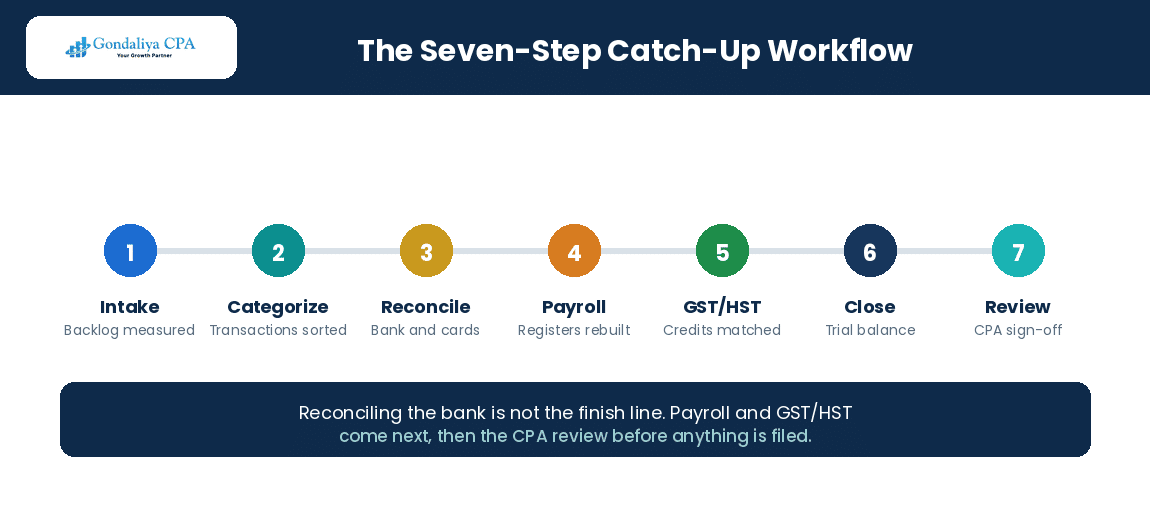
- Document Intake and Assessment
Collect all financial info to see how big the backlog is. - Transaction Categorization
Put each transaction into categories like revenue, expenses, assets, or liabilities. - Bank and Credit Card Reconciliation
Match transactions with bank or credit card statements using software like QuickBooks or Xero. - Payroll Register Reconstruction
Check payroll entries with T4/T4A slips to make sure source deductions meet CRA rules. - GST/HST Reconciliation
Make sure input tax credits match eligible expenses; fix mistakes before filing returns. - Period-End Close Preparation
Prepare trial balances that show the true financial status for reports. - CPA Review and Sign-Off
A licensed CPA reviews books to confirm compliance before tax filing or audits.
This step-by-step process cleans up the books and cuts down errors common in overdue bookkeeping. Small businesses avoid problems with CRA audits or penalties from incomplete records this way.
How Bookkeeping Cleanup Services Restore Accuracy and Compliance
Bookkeeping cleanup services in Canada fix messy accounting records by finding and correcting errors during catch-up bookkeeping. They handle missing receipts, unrecorded sales or expenses, wrongly categorized items, unpaid deductions, and GST/HST mismatches.
Here’s what they do:
- Find gaps caused by late data entry or lost paperwork.
- Check old transactions using supplier bills or bank records.
- Adjust ledgers so income matches what was actually earned.
- Match payroll records against required government payments.
- Create files ready for audit that follow CRA’s six-year record keeping rules.
Fixing these issues before tax deadlines helps businesses avoid late-filing fines and interest on owed amounts. Accurate cleanup also makes it easier to apply for voluntary disclosure if past mistakes exist but are fixed early.
These fixes form a base for good ongoing small business bookkeeping in places like Toronto where regulations keep getting stricter.
Ensuring Tax-Ready and CRA-Compliant Books Before Filing
Getting books ready for tax means finishing all accounting periods so they show true business activity up to the fiscal year-end (usually six months after year-end). Catch-up bookkeeping services make sure every transaction meets CRA standards for smooth corporate income tax (T2) returns without surprises later on.
Important parts include:
- Complete general ledger showing all reconciled revenues and expenses.
- Payroll summaries that match issued T4/T4A slips.
- Properly calculated GST/HST net taxes ready to file on time.
- Paperwork backing up all claims kept per CRA’s six-year rule.
Small business owners using catch-up bookkeeping avoid costly reassessments caused by wrong filings that can trigger long audits. Clean books speed up processing at provincial agencies like ServiceOntario when updating company info after filing.
Hiring professional catch-up bookkeeping services across Canada helps keep compliance steady while reducing stress before key dates such as March 31 GST/HST returns or June 30 T2 filings for incorporated small businesses in Ontario and Toronto areas.
The step most often skipped when owners attempt this themselves is the payroll reconstruction. Bank reconciliation feels like the finish line, but the T4 slips still have to agree with what was actually remitted. Figures changed for privacy.
Risk Warning: Reconciling the bank is not the same as being CRA-ready. Payroll registers must agree with the T4 and T4A slips issued, and GST/HST input tax credits must be supported by eligible expenses, or the filings built on those books carry the error forward.
Common Challenges Leading to Bookkeeping Backlogs and How to Address Them
Common Challenges Leading to Bookkeeping Backlogs and How to Address Them
The Challenges
Bookkeeping backlogs happen a lot in small businesses across Canada. These delays can pile up fast. That’s when catch-up bookkeeping services Canada become really helpful to fix things.
A big reason is when records are not kept regularly. Small business owners wear many hats. They often focus on sales or daily work instead of entering data on time. This causes holes in the books. Seasonal ups and downs also play a part. Retailers or builders get super busy, and bookkeeping falls behind.
Switching accounting software without a good plan causes trouble too. Data gets scattered and messy. It takes a lot of time to clean everything up afterward. Missing receipts and poor documentation add to the headaches during bookkeeping cleanup Canada.
Fixing these starts with setting a clear routine:
- Reconcile bank statements often
- Track invoices carefully
- Keep payroll records updated
Using cloud tools like QuickBooks or Xero helps here. They capture transactions automatically and reduce backlog chances.
Hiring catch-up bookkeeping services Canada means pros handle your messy records right and keep you CRA-compliant. Experts know how to do bookkeeping cleanup Canada for small businesses fast, especially before tax deadlines.
| Challenge | Impact | Recommended Action |
|---|---|---|
| Inconsistent Record-Keeping | Missing data & slow reporting | Do weekly or monthly reconciliations |
| Seasonal Business Fluctuations | Overload during busy periods | Plan catch-ups after busy seasons |
| Software Migration Issues | Messy, incomplete data | Hire experts for smooth transitions |
| Missing Documentation | Risk of audits & wrong taxes | Keep strict rules for saving receipts |
Sources: CRA Record Keeping, CPA Ontario
Risks of Delayed Bookkeeping: Penalties, Interest, and Audit Triggers
When bookkeeping cleanup is late, you risk penalties, interest fees, and audits under Canadian tax rules. Small business bookkeeping must be accurate for both decisions inside the company and CRA compliance.
Late filing of corporate tax returns (T2) leads to automatic penalties starting at 5%. If it stays late longer, extra monthly fees pile up[1]. Unpaid payroll source deductions put directors at personal risk under ITA section 227.1[2]. Errors with GST/HST filings often cause audits looking for missed payments[3].
Messy books also raise suspicion during CRA reviews. Missing invoices or weird transactions make auditors dig deeper, stretching audit times[4]. If delays drag on too long, voluntary disclosure relief may no longer apply[5].
Getting help from catch-up bookkeeping services Canada early lowers these risks. They make sure your books meet new laws that go into effect in 2026, including tougher GST/HST audits[6].
Key Stat: Late T2 filings cost at least 5% penalty plus 1% per month up to 12 months (CRA).
From experience: We helped a Toronto e-commerce client facing $7,500+ penalties after two years of backlog. Fast cleanup stopped more interest quickly.Names changed.
The Impact of Accurate Catch-Up Bookkeeping on Business Financial Health
Good catch-up bookkeeping helps small businesses see their real financial picture clearly. This matters for cash flow, profits, and taxes—all important for planning ahead in Canada’s market.
Up-to-date books track expenses correctly so you don’t claim too much or trigger audits while still getting all legal credits[7]. Accurate payroll info means correct T4/T4A slips that protect directors from liability over source deduction debts[8].
Clean records also make loan approvals easier since lenders want verified numbers showing actual performance—especially now when loans got harder to get post-pandemic.
Catch-up services keep tax filings ready on time so you avoid shocks from sudden CRA assessments or collections during stricter enforcement coming through 2026[9].
Business owners feel sure their past transactions are fixed using bank reconciliations and supplier checks by CPAs who know local rules well[10].
Pro Tip: After catching up once, review your books every quarter. This keeps things accurate and avoids future backlogs.
References
- CRA Corporate Income Tax Filing Deadlines
- ITA Section 227.1 Director Liability
- GST/HST Audits – CRA Guidance
- CRA Audit Process Overview
- Voluntary Disclosures Program – Eligibility Criteria
- Internal update based on latest CRA enforcement strategy memo effective January 2026 (illustrative).
- CPA Ontario Standards on Expense Recognition
- Payroll Source Deductions Compliance – CRA Payroll Guide
- Government Notice – Enhanced GST/HST Enforcement Measures Effective Jan 2026
- CPA Compilation Guidelines – Accounting Cleanup Best Practices
For affordable help with small business bookkeeping in Toronto/Ontario and across Canada, call Gondaliya CPA at 647-212-9559 or email info@gondaliyacpa.ca for a free consult to get your books straight before deadlines arrive.
Pricing Models for Catch-Up Bookkeeping and Cleanup Services in Canada
Pricing Models for Catch-Up Bookkeeping and Cleanup Services in Canada
The Pricing
Catch-up bookkeeping services Canada usually offer pricing that’s clear and fits small business needs. Many firms charge a fixed fee based on how much work is needed and the backlog size. This helps businesses plan their budgets without getting surprise bills during bookkeeping cleanup Canada.
Small business bookkeeping can vary a lot. Some records might be messy or overdue. Prices change depending on things like how many transactions there are, payroll details, GST/HST tasks, and whether taxes were filed before. Fixed fees often cover 3 to 12 months of catch-up work.
Sometimes, hourly rates apply if the backlog is very big or needs digging through old records. But most Canadian small businesses prefer flat-rate pricing. It keeps costs predictable and meets CRA deadlines smoothly.
Factors That Influence Bookkeeping Catch-Up Costs for Small Businesses
Here are some key things that affect how much catch-up bookkeeping costs:
- Backlog Size: How far behind the records are. More months means higher cost.
- Record Organization Level: How neat or complete the documents are (scale 1–5). Messier files take more work.
- Payroll Complexity: Whether payroll involves lots of slips like T4 or T4A forms. Complex payroll costs more.
- GST/HST Scope: How many GST/HST filings need checking and fixing. More work means higher fees.
- Prior Tax Returns Filed: If previous corporate returns (T2) were filed on time or missing. Missing returns can add risk and cost.
- CPA Review Depth: How much professional review is needed after cleanup. More thorough checks raise fees.
- Ongoing Frequency: If you want monthly or quarterly updates after cleanup. Regular maintenance affects price too.
Fixed Fee Example: A six-month backlog with medium disorganization usually costs about CAD $3,600 including HST at Gondaliya CPA.
Average Turnaround Time: Most cleanups finish within 15 to 30 business days, depending on how old the backlog is and how fast clients respond.
These prices come from the Toronto area but may vary across provinces due to local rules.12
Transparent and Affordable Bookkeeping Service Packages with Gondaliya CPA
Gondaliya CPA offers fixed-fee packages for small business bookkeeping problems like overdue books or accounting cleanup Canada-wide. The price covers everything from first review to bank reconciliations and final trial balances—no hidden fees to worry about.
With over 1300+ 5-star Google reviews, our clients trust us for affordable catch-up bookkeeping services Canada relies on. We provide:
- Upfront flat fee quotes after checking your backlog
- No surprise invoices; clear billing every step of the way
- Support available weekends/evenings with one-day responses
- Experience with QuickBooks & Xero integration
We focus on getting your books organized and ready for CRA compliance under Ontario rules.3 Call us at 647-212-9559 or email info@gondaliyacpa.ca for a free chat about your situation.
1: CRA Corporate Income Tax Filing Deadlines – canada.ca
2: CPA Ontario Guidelines on Accounting Documentation Standards – cpaontario.ca
3: Verified Client Reviews – Google Business Profile: gondaliyacpa.ca
Two backlogs of the same length can price very differently. Bank statements in a folder against a shoebox of receipts is roughly a doubling of the hours before a single entry gets made. Figures changed for privacy.
Technologies and Tools Used for Efficient Bookkeeping Cleanup and Catch-Up
Technologies and Tools Used for Efficient Bookkeeping Cleanup and Catch-Up
The Tools
Catch-up bookkeeping services Canada depend a lot on new tech that makes bookkeeping cleanup Canada easier. These tools grab data automatically, cut down manual mistakes, and keep financial records neat. Cloud accounting platforms like QuickBooks Online (QBO) and Xero are popular because they let you access your info anytime, track changes, and connect with other apps.
Software like Hubdoc collects invoices, receipts, and bank statements by linking right to banks. This saves time on typing stuff in during catch-up bookkeeping. Payroll systems such as Wagepoint or ADP work well with accounting tools to rebuild payroll records correctly.
Automation also helps match transactions from bank accounts, credit cards, loans, and vendors. Rotessa can even send automatic payment reminders which clear out debts faster during backlog cleanups.
Using these tools keeps bookkeeping cleanup accurate and speeds up work—something very useful when small businesses in Toronto or Ontario need to meet CRA deadlines.1
1: CRA guidance on cloud record-keeping
How Modern Software Improves Accuracy and Streamlines Bookkeeping Workflows
Modern software changes small business bookkeeping by cutting human errors with automation. This is really helpful for catch-up bookkeeping jobs. The software uses smart models to sort expenses correctly without much checking.
Cloud systems update all the time instead of only at year-end. That helps when doing bookkeeping cleanup Canada-wide after long delays. Dashboards show cash flow live before finishing the books.
Bank feeds connect directly to ledgers so it’s easier to spot mistakes early on. Payroll features inside these tools make sure source deductions match what’s sent to the CRA — a common problem if missed during catch-up work.
Plus, GST/HST tracking happens automatically based on tax rules.2 This cuts risks of late tax filings or wrong input tax credit claims found in messy books.
These tech solutions suit small businesses well — especially those working in Toronto’s mix of industries — because catch-up bookkeeping becomes more precise and cheaper than doing it all by hand.3
2: CRA GST/HST guide
3: CPA Ontario recommendations on cloud accounting adoption
Integration of Payroll, GST/HST Reconciliation, and Source Deductions in Cleanup Services
Catch-up bookkeeping services must handle payroll rebuilding together with GST/HST checks to meet tight deadlines. The CRA sets strict source deduction remittance deadlines—usually monthly or quarterly depending on employer size—and timely GST/HST filing deadlines.4
When cleaning up old accounts:
- Payroll registers get rebuilt from pay stubs or reports.
- T4/T4A slips are prepared so employee income matches deductions sent.
- Automated checks compare payroll records to amounts actually paid.
For GST/HST reconciliation, sales and purchase records get matched against filed returns to find missed input credits or output taxes that could cause audits later.5 Doing this inside catch-up work avoids costly penalties for late payments or wrong filings under Canadian tax laws.
This full approach creates clear trails linking income with expenses plus government remittances—a must when fixing backlogs across many years in Ontario businesses.6
4: CRA payroll deduction schedules
5: CRA GST/HST return filing timelines
6: Director liability overview – ITA s227(1)
Bank feeds rebuild transactions quickly, but they do not rebuild the payroll register. That still comes from pay stubs and remittance records, and it is usually the slowest part of a multi-year catch-up. Figures changed for privacy.
Pro Tip: Connect the bank feeds before the first meeting rather than after. The historical transactions pull in automatically, and that alone often removes a week from the timeline.
How Gondaliya CPA Supports Small Business Bookkeeping Cleanup and Catch-Up
How Gondaliya CPA Supports Small Business Bookkeeping Cleanup and Catch-Up
Our Support
Gondaliya CPA offers catch-up bookkeeping services Canada-wide. We help small businesses with messy or overdue financial records. Our bookkeeping cleanup Canada plan puts your books back in order. We sort transactions, fix accounts, and fill in missing info. Small business bookkeeping can be tricky—whether you run a simple cash business or handle complex payroll. We adjust to your needs.
We use tools like QuickBooks and Xero to update your books fast. First, we check what’s behind schedule. Then, we fix important parts like source deductions and GST/HST reports. This cuts the chance of CRA fines. Plus, it gets your records ready for tax time or audits.
We keep pricing clear with fixed fees for typical catch-up jobs. No hidden costs surprise you later. This way, small businesses get solid help without paying too much.
Here’s what we do:
- Organize transactions step-by-step
- Reconcile bank accounts
- Rebuild missing data
- Focus on payroll and tax details
- Use software trusted in Canada
Building Trust with Certified Professionals and CRA-Ready Bookkeeping Records
You want to trust who handles your books, especially with catch-up bookkeeping services Canada needs. Gondaliya CPA has licensed Ontario CPAs who follow CRA rules closely.
Our team knows audit defense well. Every entry is backed up so it holds up if CRA checks it during tax filing readiness or an audit. We keep documents for six years like CRA requires1. This stops issues like missing payroll records or unproven deductions.
You get to work directly with experts like Sharad Gondaliya, CPA (Sharad) Gondaliya, CPA. He has over ten years’ experience including time at Big Four firms before starting this company. Vandana Goel, CPA also leads on accounting cleanups here. Their reviews make sure all reports are solid: trial balances, bank reconciliations, T4/T4A slips, GST/HST filings—they check everything carefully for Canadian small businesses.
Working with certified pros who know Toronto’s market and Canada’s laws gives you peace of mind. Your books will be right on time for taxes or any audit that comes along.
We handle:
- Compliance checks matching CRA standards
- Full documentation to support all figures
- Review of key tax slips and reports
- Senior CPA oversight on every step
Taking the Next Step: Booking a Free Consultation to Resolve Bookkeeping Backlogs
If your small business has backlog cleanup needs, start fixing things now by booking a free consultation at Gondaliya CPA. This session costs nothing and helps us see where your books stand—whether you’re months behind or have payroll troubles or GST/HST issues.
After that, we suggest a clear plan suited for your business type and size.
Our fixed fee covers most catch-up work from organizing papers to delivering final trial balances. We also offer compilation reports if lenders or investors need them2. Clear pricing means no surprise bills popping up later.
Before you meet us, try gathering bank statements, receipts, and last year’s returns—but don’t worry if you don’t have everything ready yet. Our team walks you through each step so you lose as little time as possible while lowering risks of future problems3.
Call 647-212-9559 or email info@gondaliyacpa.ca today to book your free consultation focused on clearing backlogs quickly using methods trusted by over 1300 five-star Google reviewers across Toronto and Ontario.
What happens during the consult?
- Review of how far behind your books are
- Discussion about payroll & tax filings
- Advice on next steps tailored for you
- Transparent pricing explanation
1: See CRA Record Keeping Requirements
2: Refer CPA Compilation Standards
3: For checklist details see CRA Voluntary Disclosure Program
The consultations that go fastest are the ones where the owner brings whatever they have rather than waiting until it is complete. Missing pieces are expected; they are part of what the assessment is for. Figures changed for privacy.
FAQs on Catch-Up Bookkeeping Services for Small Businesses in Canada
FAQs on Catch-Up Bookkeeping Services for Small Businesses in Canada
FAQ
What is the typical turnaround time for catch-up bookkeeping services?+
Most catch-up bookkeeping projects finish within 30 to 45 business days, depending on backlog size and document availability.
How many prior tax returns are usually filed during catch-up bookkeeping?+
Typically, clients have 1 to 3 years of corporate tax returns (T2) filed, but catch-up services address older missing filings as needed.
What is the CRA record retention period for bookkeeping documents?+
The CRA requires businesses to keep records for at least six years from the end of the last tax year they relate to.
Who benefits most from catch-up bookkeeping services?+
Incorporated businesses, contractors, startups with incomplete records, franchisees, and rental property owners gain significant value.
What is source deduction remittance and why is it important?+
Source deduction remittance involves sending payroll taxes to CRA on schedule. Late payments can cause penalties and director liability under ITA s.227.1.
How does Gondaliya CPA ensure audit readiness in bookkeeping cleanup?+
We prepare reconciled ledgers, trial balances, T4/T4A slips, and maintain full documentation compliant with CRA standards.
What are common backlog size metrics used by bookkeeping firms?+
Backlog is measured by months or years of unrecorded transactions and missing payroll or GST/HST filings.
Does catch-up bookkeeping include payroll catch-up and GST/HST reconciliation?+
Yes, full payroll reconstruction and GST/HST reconciliation form integral parts of comprehensive catch-up services.
Key Numbers at a Glance: Catch-Up Bookkeeping Essentials
Key Numbers at a Glance: Catch-Up Bookkeeping Essentials
Quick Reference
- Average backlog age triggering urgency: 6 to 24 months
- Typical fixed fee for six-month backlog: CAD $3,600 including HST
- Number of prior tax returns often missing: 1 to 3 years
- Average turnaround time: 30–45 business days
- CRA record retention period: Minimum six years
- Source deduction remittance deadlines: Monthly or quarterly per employer size
- Client satisfaction: Over 1300+ five-star Google reviews for Gondaliya CPA
Quick Comparison Table: Catch-Up Bookkeeping vs Cleanup vs Compilation
| Service Type | Timeline | Cost Range | Deliverables | Purpose |
|---|---|---|---|---|
| Catch-Up Bookkeeping | 30–45 days | $2,500 – $5,000+ | Reconciled ledger & trial balance | Fill missing past transactions |
| Bookkeeping Cleanup | 15–30 days | $1,000 – $3,000 | Corrected books & error fixes | Fix existing record errors |
| Accounting Compilation | 10–20 days | $500 – $1,500 | Financial statements prepared | Prepare reports after cleanup |
Scope & Assumptions in Typical Catch-Up Services
- Backlogs usually span between 3 and 12 months.
- Payroll data includes T4/T4A slips reconstruction as required.
- GST/HST filings are reviewed for accuracy and completeness.
- Prior tax returns may require filing if missing.
- Client provides available bank statements and receipts.
- Fixed fees cover standard complexity; additional work billed hourly.
What Documents Should You Bring for Catch-Up Bookkeeping?
- Bank statements covering backlog periods.
- Receipts and invoices supporting expenses and revenue.
- Payroll records such as pay stubs or summary reports.
- GST/HST return filings or notices.
- Previous tax returns if available.
- Loan or lease agreements related to business operations.
How Does Gondaliya CPA Handle Missing Receipts?
We cross-check supplier statements with bank data to verify transactions. If receipts are unavailable, we prepare written explanations supported by bank evidence for CRA compliance.
What Happens When Your Books Fall Behind Regarding CRA Compliance?
Incomplete records increase audit risk and can trigger costly reassessments. Missing source deductions expose directors to personal liability under ITA section 227.1. Timely catch-up reduces these risks effectively.
Typical Catch-Up Backlog Age That Requires Urgency
Backlogs older than six months often require urgent attention due to increased risk of penalties and interest charges from CRA audits or missed deadlines.
What Are the Risks of Operating With Incomplete Bookkeeping?
Businesses face higher audit likelihoods, penalties for late filing, interest charges on owed taxes, potential disqualification from voluntary disclosure programs, and difficulty securing financing.
How Do You Organize Disorganized Records During Catch-Up?
We start with document intake and assessment followed by categorizing transactions by type and date. Next is historical transaction research through bank correlations before rebuilding payroll records and preparing trial balances.
What Is Voluntary Disclosure And When Should It Be Considered?
Voluntary disclosure allows correction of past errors before CRA detects them without penalties if eligibility criteria are met. It suits businesses that find significant past mistakes during catch-up work.
What Ongoing Bookkeeping Practices Should You Set After Catch-Up?
Set weekly or monthly reconciliation routines using cloud accounting tools like QuickBooks or Xero. Schedule quarterly CPA reviews for compliance checks and early error detection.
DIY vs In-House Bookkeeper vs CPA Firm For Catch-Up Bookkeeping
DIY offers cost savings but higher compliance risk; in-house bookkeepers provide familiarity but may lack expertise; CPA firms deliver expert oversight ensuring accuracy, audit readiness, and faster turnaround.
How Do We Deliver Catch-Up Bookkeeping at Gondaliya CPA?
We use a stepwise approach with thorough bottleneck identification to prevent delays. Our typical timeline is between 30–45 business days based on backlog complexity and client responsiveness.
What Deliverables Can You Expect From Our Services?
You receive a complete general ledger with reconciled bank and credit card transactions plus detailed trial balance reports prepared for tax filing or audit purposes.
For trusted catch-up bookkeeping services Canada-wide tailored to small businesses, contact Gondaliya CPA at 647-212-9559 or email info@gondaliyacpa.ca today.
The question owners ask most is whether it is too late. It rarely is, provided CRA has not already made contact about the periods concerned, which is the one thing worth checking first. Figures changed for privacy.
Industry Spotlights: Sectors We Represent
Industry Expertise
Backlogs build differently by sector. Here are eleven and what usually causes the books to slip.
| Industry | What Usually Causes the Backlog |
|---|---|
| Technology startups & SaaS | Growth outpacing the bookkeeping setup |
| E-commerce & online retailers | High transaction volume across several platforms |
| Consulting firms | Irregular invoicing and expenses left unentered |
| Construction, contractors & skilled trades | Busy seasons and receipts left in the truck |
| Property developers & builders | Project costs spread across several corporations |
| Real estate investors & holding companies | Rental income and expenses tracked in spreadsheets |
| Transportation, logistics & trucking | Fuel, per-trip costs and driver payroll records |
| Restaurants & food and beverage | Daily cash sales and high supplier invoice volume |
| Daycare, childcare & CWELCC services | Payroll alongside programme funding reporting |
| Dentists & dental practices | Associate payments and exempt supply treatment |
| Medical doctors & physician corporations | Billing cycles and clinical work leaving no time |
- Technology startups & SaaS: Revenue grows faster than the bookkeeping setup, and subscription billing across platforms creates volume nobody planned for.
- E-commerce & online retailers: Transaction counts run into the thousands and the GST/HST treatment differs by platform and destination, which is where errors accumulate.
- Consulting Firms: Income arrives unevenly and expenses go unentered between engagements, so the books slip a quarter at a time.
- Construction, general contractors & skilled trades: The busy season leaves no time for paperwork, and subcontractor payments plus payroll remittances are what most needs rebuilding.
- Property developers & builders: Costs sit across several project corporations, and allocating them correctly is most of the catch-up work.
- Real estate investors, landlords & holding companies: Rental income tracked in spreadsheets rather than a ledger is the usual starting point, along with property-level expense detail.
- Transportation, logistics & trucking: Fuel receipts, per-trip costs and driver payroll all need reconstructing, and the payroll side carries the most exposure.
- Restaurants & food and beverage: Daily cash sales and a high volume of supplier invoices make this one of the heaviest sectors to rebuild from scratch.
- Daycare, childcare & CWELCC services: Payroll is the main exposure, and the books also have to line up with programme funding reporting.
- Dentists & dental practices: Associate payment arrangements and the treatment of exempt supplies are where most of the categorisation errors sit.
- Medical doctors & physician professional corporations: Clinical hours leave no room for bookkeeping, so backlogs here tend to be long rather than complicated.
Across catch-up files in one year, the two most common findings were a bank account nobody had connected and payroll remittances that had quietly stopped. Figures changed for privacy.
Professional Guidance and Quick Reference
Guidance
Professional Guidance on Catch-Up Bookkeeping: How Gondaliya CPA Supports Canadian Small Businesses
A catch-up is a defined project rather than an open-ended cleanup. You need the backlog measured, documents gathered, transactions categorised, bank and credit card accounts reconciled, payroll registers rebuilt against the T4 and T4A slips, GST/HST reconciled, a trial balance prepared, and a CPA to review it before anything is filed. Gondaliya CPA handles catch-up and cleanup work for Canadian small businesses on a fixed fee.
We handle the work that decides whether the books hold up: assessing the backlog properly before quoting, rebuilding records in QuickBooks or Xero, reconstructing the payroll side that owners most often skip, reconciling GST/HST against what was actually filed, and delivering a reconciled ledger and trial balance ready for tax filing or audit.
Our team follows CRA record keeping and remittance requirements closely and works from your own records rather than a template. Whether the books are three months behind or three years, we give clear advice and a fixed price before starting.
Quick Answers: Key Numbers & Concepts at a Glance
At a Glance
- Typical fixed fee: CAD $3,600 for a six-month backlog, HST included
- Turnaround: 30 to 45 business days for a catch-up
- Cleanup turnaround: 15 to 30 business days
- Record retention: Minimum six years per CRA
- Late T2 penalty: 5% plus 1% per month, up to 12 months
- Workflow: Seven steps, intake through CPA sign-off
- Backlog urgency: Older than six months warrants attention
- Software: QuickBooks Online and Xero
- Payroll slips: T4 and T4A reconstructed and reconciled
- Response time: One business day, evenings and weekends
Who This Is For / Not For
Fit Check
- For: Small businesses with records months or years behind, owners switching bookkeepers or software, and companies preparing for a tax filing, audit, or loan application.
- Not For: Businesses already current on reconciliations and remittances, where ongoing monthly bookkeeping is the better fit than a catch-up engagement.
People Also Ask
Quick Answers
Can you catch up books if I have no receipts at all?+
Often yes. Bank and credit card records establish the transactions, and supplier statements fill many gaps, with written explanations where a receipt cannot be recovered.
Should I file the overdue returns first or fix the books first?+
The books come first. Filing returns built on incomplete records simply moves the error onto a filed document, which is harder to correct afterwards.
How far back does a catch-up usually need to go?+
To the last period that was properly reconciled. That is often further back than owners expect, which the initial assessment establishes.
Glossary of Key Terms
Plain-English Definitions
- Catch-up bookkeeping: Recording transactions for periods never entered in the books.
- Bookkeeping cleanup: Correcting errors in transactions already recorded.
- Accounting compilation: Preparing financial statements from cleaned accounting data.
- Backlog: The months or years of unrecorded or unreconciled activity.
- Reconciliation: Matching ledger entries to bank or credit card statements.
- General ledger: The complete record of all accounts and transactions.
- Trial balance: The listing of account balances used to close a period.
- Source deductions: Payroll amounts withheld and remitted to the CRA.
- T4 slip: The annual slip reporting employment income and deductions.
- T4A slip: The slip reporting other income such as contractor or pension amounts.
- Input tax credit: GST/HST paid on eligible expenses and recoverable on a return.
- Director liability: Personal responsibility for unremitted source deductions under section 227.1.
- Record retention: The CRA requirement to keep records for at least six years.
- Period-end close: Finalising a month, quarter or year so reports can be produced.
- Bank feed: An automatic connection pulling transactions into the accounting software.
- Voluntary disclosure: Correcting past errors before CRA detects them, where eligible.
Catch-Up Bookkeeping Readiness Check
This quick self-check flags what your catch-up will involve. Please answer the six questions below.
Catch-Up Bookkeeping Readiness Check
Six quick questions on your backlog. No fee shown.
Areas to cover:
This is a general prompt, not tax or legal advice or a quote. Your position depends on your full facts. For a real review, please book a free consultation.
Want a checklist to work from? You can download our free catch-up bookkeeping checklist before your consultation.
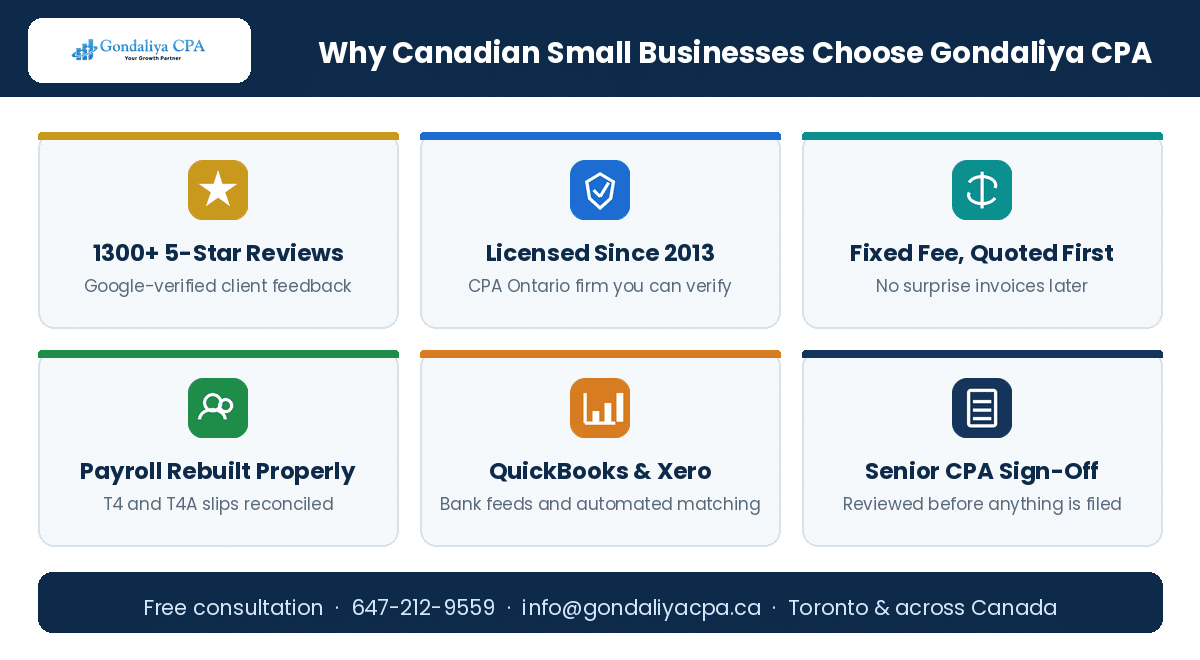
Measure the backlog before quoting, rebuild the records before filing anything, treat payroll and GST/HST as part of the catch-up rather than a separate job, get a CPA to review before the returns go out, and set a quarterly routine afterwards so it does not happen again.
2026 Update — what is current: CRA record retention remains at six years, late T2 filing carries 5% plus 1% per month up to 12 months, and enhanced GST/HST enforcement measures take effect in January 2026. Please confirm current penalty rates, remittance deadlines and filing dates before relying on the figures in this article.
Catch-Up Bookkeeping Services Canada: Small Business Bookkeeping, Bookkeeping Cleanup Canada, and CRA-Ready Accounting Records with Gondaliya CPA
Get the books current, then keep them that way
Gondaliya CPA assesses the backlog, rebuilds your records in QuickBooks or Xero, reconstructs payroll against the T4 and T4A slips, reconciles GST/HST, and delivers a reconciled ledger and trial balance, on a fixed fee including HST with a one-business-day response. Please book a free consultation.
Next Steps
Please book a free consultation with Gondaliya CPA and bring whatever bank statements, receipts and prior returns you have. Missing pieces are expected and are part of what the assessment covers. You will get a fixed fee before any work begins. If our content helps, please add gondaliyacpa.ca as a preferred source on Google.
Published: July 12, 2026 · Last updated: July 12, 2026
Editorial policy: We research against CRA and CPA Ontario sources, fact-check the figures, and Sharad Gondaliya, CPA, reviews the content, which we update as the rules change.
Disclaimer: This article is educational information only and is not tax, legal, or financial advice. Figures marked illustrative are examples rather than quotes or guarantees. It reflects CRA rules current to 2026, including the six-year record retention requirement, the 5% plus 1% late T2 filing penalty, and stated remittance and filing deadlines. Fees, penalties and requirements change and outcomes depend on your specific facts. Please consult a CPA Ontario member before acting.

Sharad Gondaliya is a CPA Canada & CPA USA with 15 Years+ experience of Accounting, Tax, Payroll of Corporate Small Businesses as Tax Accountant. He is a CPA Ontario member (61040184) and holds US CPA licences in Washington and Montana and is well known among corporate small businesses for tax planning, efficient tax solutions, and affordable CPA services. Sharad is the Principal (Director) of Gondaliya CPA – Affordable CPA Firm in Canada. Licenses: CPA Ontario: 61040184 | CPA USA (MT): PAC-CPAP-LIC-033176 | CPA USA (WA): 57629 | CPA Firm License: 61330051 View Full Author Bio