



How a CPA Can Help Corporations Prepare a Strong CRA Voluntary Disclosure and Avoid Costly Filing Errors
TLDR: As a trusted CPA for CRA VDP, Gondaliya CPA offers professional voluntary disclosure services in Canada tailored to corporate clients needing corporate VDP accountant expertise. Their CRA disclosure assistance focuses on helping businesses manage voluntary disclosures smoothly while minimizing risks with CRA compliance.
Quick Summary
The Voluntary Disclosures Program turns on five conditions: voluntary, complete, penalty-applicable, more than one year overdue, and accompanied by an estimated payment. Please note the general program gives full penalty relief while the limited program gives far less, and which one applies is decided almost entirely by when you file.
| Aspect | Details |
|---|---|
| The five conditions | Voluntary, complete, penalty-applicable, overdue, paid. |
| The two tracks | General program before contact, limited program after. |
| The preparation work | Records rebuilt, all tax types covered, narrative drafted. |
| The submission | RC199 with amended returns and supporting documents. |
Reading time: 34 minutes.
Table of Contents
- What is the CRA Voluntary Disclosure Program (VDP)?
- Key Eligibility Criteria for CRA Voluntary Disclosure Program
- Tracks Within the CRA Voluntary Disclosure Program
- CRA Review and Decision-Making
- Common Mistakes in VDP Filings and How to Prevent Them
- Voluntary Disclosure Strategies That Support Successful Applications
- Frequently Asked Questions
- Key Points on Professional VDP Preparation Workflow by Gondaliya CPA
- Industry Spotlights: Sectors We Represent
- Professional Guidance and Quick Reference
The Numbers That Matter
This article covers Canada, with Ontario and Toronto context, and reflects CRA rules current to 2026, including Information Circular IC00-1R6. It assumes an incorporated Canadian business considering a voluntary disclosure. Figures marked illustrative are examples, not quotes, and any masked engagement notes end with “Figures changed for privacy.” This is educational information only and not tax, legal, or financial advice. Rules and program conditions change, so please confirm your own situation with a CPA Ontario member before acting.
What is the CRA Voluntary Disclosure Program (VDP)?
What is the CRA Voluntary Disclosure Program (VDP)?
The Basics
The Canada Revenue Agency (CRA) Voluntary Disclosure Program (VDP) lets corporations fix past tax mistakes without facing penalties or prosecution. This program helps businesses clean up their compliance issues while cutting down on possible fines. Hiring a CPA for CRA VDP can make sure disclosures are done right. That way, companies boost their chances of getting accepted by the CRA.
History and Evolution of the VDP
The VDP started as a way for taxpayers to come forward and correct errors on their own. Over time, it changed to help incorporated SMBs in Canada better. Now it covers things like missed tax returns and hidden income. The goal is to encourage corporations to self-report by offering relief from penalties if they disclose before being caught.
Purpose and Benefits of Voluntary Disclosure
Using voluntary disclosure has clear benefits:
- Penalty Reduction: Companies may avoid or reduce penalties through the program.
- Full Compliance: It helps businesses get fully up to date with tax laws.
- Tax Compliance Efficiency: Services like voluntary disclosure services Canada guide firms smoothly back into good standing.
Importance of VDP for Corporations in Canada
Corporations in Canada must keep up with tax rules to operate well. Joining the VDP plays a key role here.
Restoring Compliance and Protecting Business Reputation
Filing all corporate taxes properly brings compliance back on track. Taking action early reduces chances that relief will be denied or cut down. Working with a professional ensures all documents are correct, which shields your business’s good name from authority checks.
Potential Relief from Penalties and Prosecution
One big perk of using the General VDP is that it can lower or remove penalties linked to old tax problems. With help from a corporate VDP accountant, businesses follow complex rules more easily. This also protects them against future audits or legal trouble tied to past mistakes.
To wrap it up, knowing how the CRA’s Voluntary Disclosures Program works helps Canadian corporations stay compliant while avoiding extra costs from earlier filing slip-ups.
A company began preparing a disclosure and received a CRA letter about the same period two weeks later. The voluntary condition was lost, and the file moved from full penalty relief to a far narrower outcome. Figures changed for privacy.
Key Stat: The voluntary condition is the one that can be lost simply by waiting. Every other condition can be worked on; timing is the only one that runs against you while you prepare.
Key Eligibility Criteria for CRA Voluntary Disclosure Program
Key Eligibility Criteria for CRA Voluntary Disclosure Program
Eligibility
The Canada Revenue Agency’s (CRA) Voluntary Disclosures Program (VDP) lets companies fix past tax mistakes or missing info before the CRA steps in. To join, a corporation must meet specific rules checked by a corporate VDP accountant or CPA for CRA VDP filings. These rules make sure disclosures are voluntary, complete, and qualify for penalty relief.
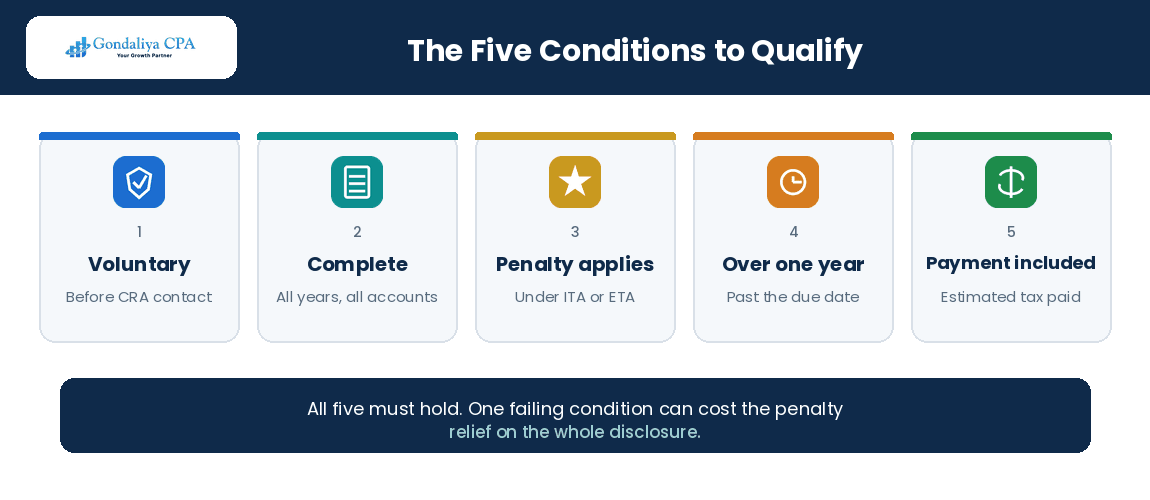
There are five main conditions to qualify:
- The disclosure must be voluntary, made before any CRA audit or contact.
- It has to be complete, with all relevant info included.
- It should relate to an offence that can get penalized.
- The issue needs to be at least one year overdue.
- The company must estimate and pay taxes owed with the application.
If any condition isn’t met, the CRA may deny penalty relief or reduce interest.1
Corporations seeking voluntary disclosure services in Canada usually hire a CPA to handle these requirements correctly. A good CPA checks that everything fits the rules and prepares thorough applications tailored for Toronto/Ontario businesses.
| Key Eligibility Condition | Description | CPA Role in Verification | CRA Reference |
|---|---|---|---|
| Voluntariness | Disclosure happens before CRA enforcement action | Confirm no audits/contact occurred; check timing | IC00-1R6 §3 |
| Completeness | All years and accounts fully reported | Review all records; find missing info | IC00-1R6 §4 |
| Penalty Applicability | Offence involves penalties under ITA/ETA | Decide if non-compliance triggers penalties | IC00-1R6 §§5–7 |
| One-Year Overdue | Issue is more than one year past due date | Calculate deadlines precisely | IC00-1R6 §8 |
| Estimated Payment | Tax owing estimated and paid with application | Accurately figure tax due including interest estimates | IC00-1R6 §§9–10 |
1: Canada Revenue Agency Information Circular IC00-1R6 – Voluntary Disclosures Program.
Requirements for VDP Participation
To take part in the CRA’s Voluntary Disclosures Program, companies must follow strict procedural rules set by the agency. They need to send a full application showing they want to comply going forward.
Getting help from a CPA firm that knows corporate VDP filings makes things easier. Accuracy and speed matter here since the CRA sets tight time limits during reviews.2 Gondaliya CPA promises to reply within one business day after clients ask questions, keeping the process moving fast.
Main requirements include:
- Apply before any formal audit or investigation starts.
- Provide complete documents for all affected fiscal years.
- Calculate all owed taxes correctly plus estimated payments.
- Give a clear explanation about why earlier compliance failed — without downplaying facts.
Following these steps cuts the chance of rejection from incomplete paperwork or common errors seen in self-filed disclosures.3
Gondaliya CPA uses solid knowledge of Canadian corporate tax law and tools like QuickBooks and Xero to rebuild records quickly—especially when originals are missing or messy.
2: Canada Revenue Agency GST/HST Memorandum 16‑5 – Guidelines on Filing Procedures Under VDP
3: Gondaliya CPA internal response time policy; average initial consultation turnaround: <24 hours
Types of Errors and Common Scenarios Triggering VDP Applications
Corporate taxpayers often use voluntary disclosure services after spotting serious errors themselves or getting informal notices from tax authorities. Knowing typical mistakes helps avoid costly reassessments and denial of penalty relief under the program.4
Common error types that lead to Corporate VDP applications include:
Incomplete Disclosure
Not reporting all income sources, forgetting foreign asset reports (T1135), missing payroll deductions filings, or skipped GST/HST returns hurts completeness demanded by CRA. Partial disclosures might reduce penalty relief or get outright refused if key info is left out.5
Unfiled T2 Returns
Companies ignoring several years of T2 returns face extra fines plus more scrutiny on related accounts like GST/HST and payroll taxes. Fixing this quickly with pro help avoids audits where anonymity disappears.6
Underestimated Tax Liability
Underreporting taxable amounts means paying too little tax with your disclosure application — a big no-no since estimated payment is required. CPAs carefully calculate taxes using current rates and programs affecting interest.7
Weak Narrative Explanation
A short or vague explanation about why compliance failed lowers trust with CRA reviewers. They want honesty without trying to hide details.8 Experienced CPAs write clear stories that follow CRA expectations.
Here’s a quick table showing how common errors impact applications—and how expert accountants stop them:
| Error Type | Impact on Application | How a Corporate VDP Accountant Prevents It |
|---|---|---|
| Incomplete Disclosure | Denial or reduced penalty relief due to missing info | Thorough review & cross-check across all accounts |
| Unfiled T2 Returns | Bigger fines & loss of “no-name” protection | Identify gaps; prepare catch-up filings |
| Underestimated Tax Liability | Application rejected without proper payment | Precise tax calculation using updated rates & program rules |
| Weak Narrative Explanation | Less trust from reviewers hurting acceptance chances | Detailed factual narrative crafted per CRA guidance |
4: Information Circular IC00‑1R6 – Causes for Denial / Reduction
5: Ibid., Section 4 – Completeness Requirement
6: Corporations Canada Filing Obligations + ITA s227 Director Liability Notes
7: Interest Relief Rules — General vs Limited Programs Explained [CRA]
8: Best Practices Guide — Drafting Effective Disclosure Narratives [CRA Guidance]
For expert guidance handling complex eligibility criteria while avoiding common mistakes that cause many corporate voluntary disclosures to fail, it pays off to consult a licensed Ontario firm offering specialized corporate VDP accountant services. Starting early raises chances of success under Canadian regulations.
A disclosure covered four T2 years but omitted the GST/HST account entirely. Completeness is measured across all accounts, not just the one that prompted the file, and the omission had to be corrected before review continued. Figures changed for privacy.
Risk Warning: Completeness means every year, every account and every tax type. A disclosure that covers corporate tax but leaves out payroll or GST/HST is incomplete, and partial disclosures can be refused outright rather than accepted in part.
Tracks Within the CRA Voluntary Disclosure Program: General and Limited Program
Tracks Within the CRA Voluntary Disclosure Program: General and Limited Program
The Two Tracks
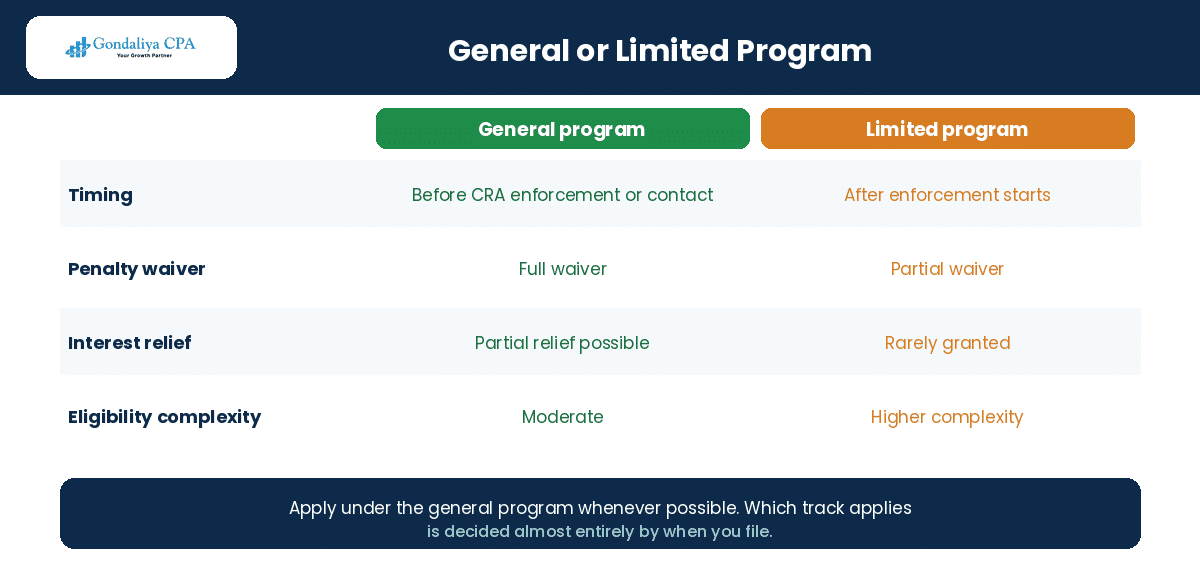
Understanding the Two Tracks of VDP
The Canada Revenue Agency’s Voluntary Disclosures Program (VDP) offers two main tracks for corporations. They are the general program and the limited program. Both help businesses fix past mistakes but differ in rules and benefits.
The general program relief applies when a company comes forward before the CRA starts any enforcement action or contacts them. This track can waive all penalties and offer some interest relief on amounts owed. It encourages companies to fix errors early.
On the other hand, the limited program relief covers cases where disclosure happens after the CRA begins enforcement but before charges or prosecution. Penalty waivers here are smaller, and interest relief is rare—only in special cases. This path faces stricter review since disclosure came later.
A corporate VDP accountant plays an important role here. They decide which track fits best based on timing, type of error, and available records. Picking right helps companies get the most relief and avoid rejection.
Here’s a quick comparison:
- Timing:
- General: Before CRA enforcement or contact
- Limited: After enforcement starts
- Penalty Waiver:
- General: Full waiver
- Limited: Partial waiver
- Interest Relief:
- General: Partial relief possible
- Limited: Rarely granted
- Eligibility Complexity:
- General: Moderate
- Limited: Higher complexity
Basically, it pays to apply under the general program whenever possible since it offers better relief options.
Step-by-Step Application Process for Corporate VDP
Getting a voluntary disclosure right takes careful steps from start to finish. A CPA for CRA VDP filings guides corporations through this process:
- Check Eligibility:
Make sure all conditions are met—like being voluntary, complete info, applicable penalties, overdue by over a year, and readiness to pay estimated amounts. This avoids denied applications. - No-Name Review:
To keep things confidential before official filing, accountants run a no-name review. This checks that everything needed is ready without alerting CRA too soon. - Gather Records & Catch Up Books:
Collect all financial statements, bank info, GST/HST filings, payroll details including source deductions—everything needed to correct past returns fully. - Calculate Taxes Owed:
Figure out tax amounts plus interest using general or limited program rules per CRA’s RC199 guidelines. - Prepare Amended Returns:
Update T2 income tax returns plus related schedules for GST/HST changes or payroll corrections if required. Include foreign reporting forms like T1134 or T1135 when relevant. - Write Disclosure Narrative:
Craft a clear explanation of why errors happened without downplaying facts. Show honest intent—that matters for approval chances. - Estimate Payment Plan:
Calculate what’s owed after payments made so far and plan how client will pay ahead of submission deadlines per RC199 instructions. - Submit RC199 Form & Documents:
Send in completed form along with all amended returns and support papers using the official RC199 disclosure package format. - CRA Communication Support:
CPA handles follow-ups with CRA after filing—answering questions or providing extra info until final reassessment finishes.
Following these steps helps avoid incomplete filings or late submissions that reduce benefits or cause denials across voluntary disclosure services Canada-wide.
Working with voluntary disclosure services at Gondaliya CPA ensures your corporate filing meets CRA standards while seeking maximum penalty waivers under either VDP track.
A no-name review found two unfiled years the client had not mentioned and an unreconciled payroll account. Both were fixed before the formal submission, which is exactly what that step is for. Figures changed for privacy.
Pro Tip: Run the no-name review before anything is filed. It confirms the file is complete without identifying the corporation, and it is the only stage where gaps can be found without any consequence attached to finding them.
CRA Review and Decision-Making
CRA Review and Decision-Making
The Review
The Canada Revenue Agency (CRA) carefully reviews each corporate Voluntary Disclosures Program (VDP) submission. They check for eligibility, completeness, and compliance. Using a CPA for CRA VDP filings helps improve accuracy. A corporate VDP accountant offers expert voluntary disclosure services in Canada. They guide corporations through tough rules and speak for them during the CRA’s review.
Assessment of Eligibility and Completeness
Before filing, a CPA checks that all five key conditions are met:
- Disclosure must be voluntary—no prior CRA enforcement contact.
- It must be complete, covering all relevant years and accounts.
- The penalties or possible penalties should apply.
- The info must be at least one year overdue.
- Estimated taxes owing should be paid or arranged.
This check helps avoid common mistakes that lead to rejection.
A CPA also decides if the case fits the general program or the limited program relief. The general program gives more penalty relief but requires full cooperation without deliberate errors. The limited program is for cases involving gross negligence or fraud but still offers some interest reduction. CPAs use current CRA rules to plan applications that get the best outcome while following regulations.
| Eligibility Condition | What It Means | How a CPA Checks | Result if Not Met | Source |
|---|---|---|---|---|
| Voluntary | No earlier CRA audit/contact | Review letters and timelines | Disclosure rejected | IC00-1R6 §3 |
| Complete | All years/accounts included | Check financial records | Partial acceptance or denial | IC00-1R6 §4 |
| Penalty Applies | Penalties would normally apply | Analyze tax returns | No penalty relief | IC00-1R6 §5 |
| One Year Overdue | Info is more than 12 months late | Confirm due dates | Not eligible | IC00-1R6 §7 |
| Estimated Payment Included | Taxes owing paid or arranged | Calculate tax + interest | Application delayed or rejected |
Possible Outcomes: Acceptance, Partial Acceptance, or Rejection
The CRA may accept the disclosure fully, partially accept it with some penalties remaining, or reject it altogether. Denials often happen when key periods are missed or required foreign income forms (like T1134/T1135) aren’t filed. Submitting after an audit notice arrives or underpaying estimated taxes also causes trouble. Weak explanations and missing payroll source deductions hurt chances too.
Filing a VDP without a CPA is risky. Denial means full penalties plus interest might follow. Experienced accountants review records thoroughly before submitting to avoid these mistakes.
Common errors causing denial:
- Leaving out entire fiscal years
- Underreporting GST/HST amounts
- Forgetting foreign asset forms
- Filing after CRA enforcement started
- Poor explanation narratives
These errors lower chances of relief under both general and limited programs.
Financial Implications: Taxes, Penalties, Interest, Fees, Payment Arrangements
Knowing how taxes, penalties, and interest add up is key when preparing your voluntary disclosure. A good corporate VDP accountant makes sure these numbers match the law exactly and helps arrange payment plans with the CRA.
Calculation of Taxes, Interest, and Penalties
CPAs base tax calculations on reconstructed financial info over all relevant years—T2 returns, GST/HST filings, payroll reports, foreign income documents, and any director liability rules.
Interest treatment varies by program:
- General program may waive some interest depending on timing.
- Limited program usually lets you reduce penalties partially but most interest stays.
Estimated payments include total amounts owed minus what’s already paid. These must go with your application unless you have special approval.
Accurate numbers avoid rejection from underpayments or losing relief benefits.
Negotiating Payment Arrangements With CRA
Large balances from disclosures can stress cash flow. CPAs help negotiate installment plans with the CRA that fit legal limits while keeping your business stable.
Success depends on clear communication backed by detailed records prepared during filing prep—another reason to work with skilled professionals in Canadian business tax compliance.
Industry-Specific Considerations: Corporate Restructuring and Tax Compliance
Filing corporate VDPs needs industry know-how because each sector has different common issues—real estate companies face different challenges than tech startups or medical firms billing OHIP.17181920
At Gondaliya CPA, we adapt our approach based on your industry:
- Private intake to spot risks like unreported cash sales common in restaurants.21
- Catch up bookkeeping using QuickBooks or Xero to clean records.22
- Covering all tax types—T2/GST-HST/payroll/foreign reports—for full accuracy.
- Preparing detailed RC199 packages with strong narratives following 2026 policy updates.
- Handling post-submission queries to speed up decisions.
- Setting up ongoing compliance reviews to avoid future problems.23
This method fits well with corporate restructuring where fixing past tax errors links closely to growth plans needing steady tax compliance support across Ontario—Toronto included—and nationwide.
[^1]: CRA Information Circular IC00‑1R6
[^2]: Ibid., Sections General vs Limited Programs
[^3]: T1134 Foreign Affiliate Reporting
[^4]: Ibid., Enforcement Contact Definition
[^5]: Ibid., Estimated Payment Requirement
[^6]: Ibid., Disclosure Narrative Guidelines
[^7]: Payroll Source Deductions – Canada.ca
[^8]: Common Errors Table – See Section “What Errors Cause Denial”
[^9]: Corporate Income Tax Filing Requirements – T2 Guide
[^10]: GST/HST Memorandum Series #16–5
[^11]: Payroll Remittance Rules – Service Canada Resources
[^12]: Foreign Income Reporting Obligations – T1135 Form Guidance
[^13]: Director Liability Provisions ITA s227(1)
[^14]: Interest Relief Scope – General vs Limited Programs per IC00‑r06
[^15]: RC199 Submission Instructions – Required Payments
[^16]: Installment Agreement Procedures – Official CRA Policies
[^17]-[23] Industry Spotlights & Workflow Details per Gondaliya CPA Internal Documentation
For expert help with your corporation’s voluntary disclosure—from checking eligibility through filing—contact us at info@gondaliyacpa.ca or call 647‑212‑9559 for a free consultation focused on Toronto/Ontario businesses needing reliable CPA for CRA VDP support across Canada.
Common Mistakes in VDP Filings and How to Prevent Them
Common Mistakes in VDP Filings and How to Prevent Them
The Mistakes
Typical Errors During VDP Submission
Many corporations trip up when filing a Voluntary Disclosures Program (VDP) application. These slip-ups can cost them the relief they seek from the CRA:
- Incomplete Disclosure: Not reporting all years, accounts, or tax types breaks the CRA’s rule for full disclosure. They require all past errors to be revealed.
- Filing After CRA Contact: If the CRA has already contacted you about an issue, submitting a VDP loses its voluntary status. Relief won’t apply then.
- Underestimated Tax Calculation: Miscalculating taxes owed leads to underpayment. This may cause your application to be rejected or only partly accepted.
- Weak or Inadequate Narrative: A vague or unclear explanation of facts and fixes makes it hard for the CRA to trust your disclosure.
- Omitted Foreign Reporting: Forgetting foreign income or assets, like missing T1134 or T1135 forms, means incomplete info and possible penalties.
These errors increase risks a lot. Hiring a corporate VDP accountant helps spot these early and fix them properly.
Importance of Professional Representation for CRA Disclosure Assistance
Getting a CPA involved matters when you’re dealing with voluntary disclosure services in Canada. A CPA Ontario Registered Firm that knows corporate VDP filings offers big benefits:
- They make sure your submission follows all five key rules of the CRA’s Voluntary Disclosures Program (like being voluntary, complete, involving penalties, meeting deadlines, and estimated payments).
- They rebuild records and figure out tax numbers right across things like T2 returns, GST/HST files, payroll deductions, and foreign asset reports.
- They write strong narratives that fit IC00‑1R6 rules while showing full facts clearly—no hiding stuff.
- They handle fast replies to CRA questions during review—timing matters here because CRA deadlines are strict.
- They offer clear pricing with no surprise bills and quick response times—even on weekends or evenings.
Gondaliya CPA knows Toronto/Ontario businesses well and has over 1300 five-star Google reviews that show clients trust their work. This kind of pro help cuts down risk compared to going it alone.
Recent Regulatory Changes and Updates to the CRA Voluntary Disclosures Program
In 2026, the Canada Revenue Agency updated its Voluntary Disclosures Program rules.[7] These changes matter for corporations thinking about applying:
| Update Area | What Changed | Source |
|---|---|---|
| Expanded Eligibility Criteria | Clearer rules on who fits in general vs limited programs; more paperwork needed | IC00‑1R6 (2026 update) |
| Interest Relief Adjustments | New rules on waiving interest; partial interest might now be charged back | IC00‑1R6 Appendix |
| Enhanced No-name Disclosure | Updated advice on asking anonymously before making formal disclosures | IC00‑1R6 Section 8 |
| GST/HST Specific Provisions | New thresholds set for including missed GST/HST filings | GST/HST Memorandum 16–5 |
These updates mean you really need a corporate VDP accountant who knows current laws well. Staying informed helps avoid costly mistakes when following new compliance rules.
References
- Canada Revenue Agency Information Circular IC00‑1R6 — Validity Conditions
- Ibid., Section on Effective Date & Enforcement Action Rule
- Ibid., Tax Calculation Requirements & Estimated Payment Rules
- Ibid., Guidance on Disclosure Narrative Content
- Ibid., Foreign Reporting Obligations – T1134/T1135 Schedules
- Canada.ca — Overview: Voluntary Disclosures Program Eligibility Criteria
- Canada Revenue Agency Information Circular IC00‑1R6 — Policy Update Effective 2026
Text-only CTA
Need help preparing your voluntary disclosure under Canada’s updated VDP? Call Gondaliya CPA at 647-212-9559 or email info@gondaliyacpa.ca for a free consultation focused on your corporation’s needs in Toronto/Ontario.
An owner drafted their own narrative in three sentences and it read as an excuse rather than an explanation. Rewriting it factually, with dates and causes set out plainly, changed how the file was received. Figures changed for privacy.
Voluntary Disclosure Strategies That Support Successful Applications
Voluntary Disclosure Strategies That Support Successful Applications
The Strategies
If your corporation needs to fix past tax filing mistakes, working with a CPA for CRA VDP help makes a big difference. Voluntary disclosure services Canada offers can guide you through the CRA’s rules so your corporate disclosure gets accepted. This expert advice cuts down on mistakes and helps you send in clear, complete paperwork.
Strategies for Corporate VDP Success
Making a successful corporate voluntary disclosure takes careful prep and smart planning based on your company’s situation. Some key steps are:
- Full Review: Look closely at all past tax returns, GST/HST filings, payroll deductions, and foreign income reports. Don’t miss any detail.
- Honest Disclosure: Tell the whole story. Leaving stuff out or hiding facts risks rejection by the CRA.
- File Before CRA Contact: You have to submit before the CRA starts an audit or enforcement. Otherwise, relief won’t apply.
- Correct Tax Calculations: Work out taxes and interest properly, following program rules to avoid surprises.
- Clear Explanation: Write a straight-up, factual explanation of issues. Don’t try to downplay mistakes or skip important info.
A corporate VDP accountant knows these steps well. They keep your application solid and follow the latest CRA policies (see Information Circular IC00-1R6). That boosts your chances to get penalties reduced or waived.
Services Offered: Corporate Tax, Accounting, GST/HST, International Tax
Our CPA firm covers many areas related to voluntary disclosures. Here’s what we do:
| Service Area | Description |
|---|---|
| Corporate Tax Returns Preparation | Fix and file T2 returns for all relevant years |
| GST/HST Filing Errors Correction | Spot and fix missed or wrong GST/HST remittances |
| Payroll Source Deductions | Correct unreported CPP/QPP contributions, EI premiums, and taxes |
| Foreign Income Reporting | Prepare T1134/T1135 forms for foreign affiliates or assets |
These services cover most common gaps that lead companies into trouble when filing voluntary disclosures. Having skilled CPAs handle it means fewer errors that might cause denial or limit penalty relief under the VDP.
Service Areas: Toronto, GTA, and Ontario Coverage for VDP Filings
We help incorporated businesses all over Toronto and the Greater Toronto Area — places like Etobicoke, Vaughan, Mississauga, Brampton, Scarborough, North York — plus all across Ontario. Even if you’re outside Ontario, we can support you remotely using secure digital tools.
No matter where in Ontario you are located, you get access to expert CPA help for your CRA voluntary disclosure needs while keeping everything confidential and fast.
Pricing, Confidential Review, and Contact Information for Assistance
Gondaliya CPA offers fixed fees that include HST for full corporate VDP filings in Canada. Prices depend on how many years need correcting and how complex things are (taxes, GST-HST, payroll issues, foreign income).
We also give free confidential reviews upfront. This helps figure out if you qualify before you commit.
To book a free chat with a corporate VDP accountant who really knows Canadian tax laws:
- Call 647‑212‑9559
- or email info@gondaliyacpa.ca
You’ll get a quick reply—usually within one business day—and we’re available evenings and weekends too. That way you get clear advice at every step of your voluntary disclosure process.
Key Stat: Companies that disclose voluntarily using professional applications can cut penalties by up to 100% under the general program according to CRA guidelines.1
1 See CRA Information Circular IC00-1R6
Frequently Asked Questions
Frequently Asked Questions
FAQ
What is CRA IC00-1R6 and why is it important for VDP?+
CRA IC00-1R6 is the official guideline detailing rules for Canada’s Voluntary Disclosures Program. It clarifies eligibility, penalty relief, and disclosure requirements.
How does Gondaliya CPA ensure fast response times during VDP?+
Gondaliya CPA commits to replying within one business day to client inquiries, ensuring timely guidance throughout the voluntary disclosure process.
What risks do SMBs face if they file VDP without a CPA?+
SMBs risk penalty denial, interest charges, and rejection due to errors in tax estimation, incomplete narratives, or missed filing deadlines when filing alone.
Why is payroll source deductions accuracy critical in voluntary disclosures?+
Incorrect payroll remittances trigger penalties and can void penalty relief. Proper catch-up filings ensure compliance with CPP/QPP, EI, and tax remittances.
What role does foreign income reporting play in VDP submissions?+
Reporting foreign assets via T1134 and T1135 forms is mandatory. Omission leads to denial of penalty relief and possible prosecution under CRA enforcement.
How does Gondaliya CPA assist with RC199 form submission?+
We prepare complete RC199 packages including amended returns and detailed narratives to meet CRA standards and reduce rejection risks.
What should corporations know about CRA enforcement contact history regarding VDP eligibility?+
Disclosures made after any CRA contact lose voluntary status. Verifying enforcement history early avoids costly filing mistakes.
When is limited program relief applicable under the VDP?+
Limited program applies to cases involving gross negligence or repeated non-compliance after CRA enforcement starts but before prosecution.
How do amended returns support successful corporate voluntary disclosures?+
Amended returns correct past errors comprehensively across T2, GST/HST, payroll, and foreign reporting schedules to meet completeness requirements.
What are common tax estimation errors that jeopardize penalty relief?+
Underestimating taxes owed or ignoring interest calculations often causes application rejection or partial acceptance by CRA reviewers.
Key Points on Professional VDP Preparation Workflow by Gondaliya CPA
Key Points on Professional VDP Preparation Workflow by Gondaliya CPA
The Workflow
- Conduct thorough eligibility confirmation steps per CRA IC00-1R6 guidelines.
- Perform no-name review before formal submission to verify completeness without alerting CRA.
- Reconstruct records using QuickBooks and Xero for accurate catch-up filings.
- Prepare all amended returns including corporate tax (T2), GST/HST corrections, payroll source deductions, and foreign income reports (T1134/T1135).
- Draft detailed disclosure narratives explaining reasons for non-compliance clearly and honestly.
- Calculate estimated payments precisely to avoid tax estimation errors that delay approval.
- Submit full RC199 form packages electronically with all supporting documentation.
- Provide expert CRA representation post-submission to handle correspondence and questions promptly.
- Negotiate payment arrangements post-VDP when large balances arise to maintain cash flow stability.
Essential Considerations for CPA Firm Selection in Voluntary Disclosure Services
- Proven expertise in corporate VDP filings with strong knowledge of ITA/ETA penalty conditions.
- Track record of managing director liability issues tied to delayed corporate tax return retention periods.
- Transparent pricing with no surprise bills covering all aspects of the preparation workflow.
- Positive client feedback reflected in 5-star Google reviews demonstrating trustworthiness.
- Efficient communication protocols including rapid response times even outside regular hours.
Industry-Specific VDP Cases Handled by Gondaliya CPA
- Real estate holding companies needing comprehensive tax cleanup amid restructuring activities.
- Transportation businesses addressing payroll source deduction lapses while reconciling past GST/HST filings.
- Construction contractors correcting underreported revenues with detailed foreign income disclosures as applicable.
Why Ongoing Compliance Setup Is Vital After VDP Approval
Setting up regular compliance reviews prevents repeated non-compliance pitfalls that trigger future penalties or limit benefits from limited program relief options.
Avoiding DIY Risks in Canadian Corporate Voluntary Disclosure Programs
DIY attempts often result in incomplete applications due to overlooked multiple account types (T2, GST/HST, payroll), weak explanations, or inaccurate estimated payment calculations causing delays or denials.
For reliable voluntary disclosure services Canada-wide from Gondaliya CPA, contact us at info@gondaliyacpa.ca or call 647‑212‑9559 today.
The files that go smoothly all share one thing: the records were rebuilt before the narrative was drafted, not after. Writing the explanation first tends to produce a story the numbers then have to fit. Figures changed for privacy.
Industry Spotlights: Sectors We Represent
Industry Expertise
The gap that triggers a disclosure differs by sector. Here are eleven and what usually turns up first.
| Industry | What Usually Turns Up First |
|---|---|
| Technology startups & SaaS | Foreign platform income and T1135 reporting gaps |
| E-commerce & online retailers | GST/HST on cross-border and marketplace sales |
| Consulting firms | Unfiled T2 returns across several quiet years |
| Construction, contractors & skilled trades | Subcontractor payments and payroll source deductions |
| Property developers & builders | GST/HST on self-supply and unreported project revenue |
| Real estate investors & holding companies | Rental income and foreign property reporting |
| Transportation, logistics & trucking | Driver classification and payroll remittance lapses |
| Restaurants & food and beverage | Unreported cash sales and GST/HST shortfalls |
| Daycare, childcare & CWELCC services | Payroll remittances alongside programme funding records |
| Dentists & dental practices | Associate payments and exempt supply treatment |
| Medical doctors & physician corporations | OHIP billing timing and unfiled corporate returns |
- Technology startups & SaaS: Revenue arriving through foreign platforms often goes unreported, and the T1135 obligation is missed alongside it.
- E-commerce & online retailers: GST/HST on marketplace and cross-border sales is the usual gap, and it has to be corrected in the same disclosure as the income.
- Consulting Firms: A quiet year turns into an unfiled return, and unfiled returns accumulate faster than owners expect once the first one is missed.
- Construction, general contractors & skilled trades: Subcontractor payments and payroll source deductions are the common exposure, and director liability attaches to the remittances.
- Property developers & builders: Self-supply rules and project revenue timing produce GST/HST gaps that span several corporations at once.
- Real estate investors, landlords & holding companies: Rental income and foreign property holdings both need reporting, and the T1135 threshold catches more owners than expected.
- Transportation, logistics & trucking: Driver classification decisions drive payroll exposure, and the remittance history is usually where the file starts.
- Restaurants & food and beverage: Cash sales and the GST/HST that follows them are the classic issue, and both have to be reconstructed before filing.
- Daycare, childcare & CWELCC services: Payroll is the main exposure, and the disclosure has to sit alongside programme funding records without contradicting them.
- Dentists & dental practices: Associate payment arrangements and the treatment of exempt supplies are where corrections most often begin.
- Medical doctors & physician professional corporations: Billing timing and unfiled corporate returns are the usual pair, and both accounts need covering in one submission.
Across disclosure files in one year, the two most common gaps were an account nobody thought to check and a year the owner had genuinely forgotten existed. Figures changed for privacy.
Professional Guidance and Quick Reference
Guidance
Professional Guidance on CRA Voluntary Disclosures: How Gondaliya CPA Supports Canadian Corporations
A disclosure is a compliance project rather than a form. You need eligibility confirmed against all five conditions, records rebuilt across every affected year, amended returns prepared for each tax type, a narrative that states the facts plainly, an estimated payment calculated properly, and someone to answer CRA questions after submission. Gondaliya CPA handles corporate voluntary disclosures from the first review through to reassessment.
We handle the work that determines the outcome: running the no-name review, rebuilding books in QuickBooks or Xero where records are missing, preparing T2, GST/HST, payroll and foreign reporting corrections together, drafting the narrative to IC00-1R6 expectations, and representing you through the CRA’s review.
Our team follows CRA practice closely and builds each submission around your own records rather than a template. Whether you have one unfiled year or several across multiple accounts, we give clear advice based on the current rules.
Quick Answers: Key Numbers & Concepts at a Glance
At a Glance
- Conditions to qualify: All five must be met
- Minimum overdue period: More than one year
- Submission form: RC199 with supporting documents
- General program: Full penalty waiver possible
- Limited program: Partial waiver, interest rarely relieved
- Governing circular: IC00-1R6
- Foreign reporting forms: T1134 and T1135
- Estimated payment: Required with the application
- No-name review: Before formal submission
- Our response time: One business day
Who This Is For / Not For
Fit Check
- For: Incorporated Canadian businesses with unfiled returns, unreported income, missed GST/HST or payroll remittances, or foreign reporting gaps, where CRA has not yet made contact.
- Not For: Corporations already under audit or enforcement for the same periods, where the voluntary condition is no longer available, and errors under one year old, which are not yet eligible.
People Also Ask
Quick Answers
Can I make a disclosure anonymously first?+
A no-name review can confirm the file is complete before you identify the corporation. The formal RC199 submission itself is not anonymous.
What happens if CRA rejects the disclosure?+
Full penalties and interest may apply as though no disclosure was made, which is why completeness is checked thoroughly before anything is submitted.
How far back does a disclosure need to go?+
Every year with an error, not just the recent ones. Completeness is measured across all affected years and all tax accounts.
Glossary of Key Terms
Plain-English Definitions
- VDP: The Voluntary Disclosures Program allowing correction of past tax errors.
- IC00-1R6: The CRA information circular setting out the program rules.
- RC199: The form used to submit a voluntary disclosure application.
- General program: The track giving full penalty relief where disclosure precedes contact.
- Limited program: The narrower track applying after enforcement has begun.
- Voluntariness: The condition that disclosure precede any CRA enforcement action.
- Completeness: The condition that all years and accounts be fully reported.
- No-name review: A confidential check of the file before the corporation is identified.
- Estimated payment: The tax owing calculated and paid with the application.
- Disclosure narrative: The written explanation of why compliance failed.
- T2 return: The corporate income tax return filed annually.
- T1134: The information return for foreign affiliates.
- T1135: The foreign income verification statement for specified foreign property.
- Source deductions: Payroll amounts withheld and remitted to the CRA.
- Director liability: Personal responsibility of directors for certain unremitted amounts.
- Reassessment: The CRA’s revised assessment following the disclosure.
Voluntary Disclosure Eligibility Check
This quick self-check flags which disclosure conditions need attention. Please answer the six questions below.
Voluntary Disclosure Eligibility Check
Six quick questions on your position. No fee shown.
Points to review:
This is a general prompt, not tax or legal advice or a quote. Your position depends on your full facts. For a real review, please book a free consultation.
Want a checklist to work from? You can download our free voluntary disclosure checklist before your consultation.
Move before CRA does, cover every year and every account rather than the ones that prompted the file, rebuild the records before calculating anything, state the facts plainly in the narrative, and pay the estimated amount with the application. Those five things decide whether the relief holds.
2026 Update — what is current: IC00-1R6 was updated in 2026 with clearer general and limited program criteria, revised interest relief rules, updated no-name disclosure guidance, and new GST/HST provisions under Memorandum 16-5. Please confirm the current program conditions and relief scope before relying on the figures in this article.
CPA for CRA VDP: Expert Corporate VDP Accountant and Voluntary Disclosure Services in Canada
Fix it before CRA finds it
Gondaliya CPA runs the confidential eligibility review, rebuilds your records, prepares T2, GST/HST, payroll and foreign reporting corrections together, drafts the narrative, and represents you through the CRA’s review, on a fixed fee including HST with a one-business-day response. Please book a free consultation.
Next Steps
Please contact Gondaliya CPA at info@gondaliyacpa.ca or call 647‑212‑9559 for a free confidential review. Bring whatever records you have, including the incomplete ones, and we will work out the eligibility position before anything is filed. If our content helps, please add gondaliyacpa.ca as a preferred source on Google.
Published: July 10, 2026 · Last updated: July 10, 2026
Editorial policy: We research against CRA sources including Information Circular IC00-1R6 and the GST/HST Memorandum series, fact-check the figures, and Sharad Gondaliya, CPA, reviews the content, which we update as the rules change.
Disclaimer: This article is educational information only and is not tax, legal, or financial advice. Figures marked illustrative are examples rather than quotes or guarantees. It reflects CRA rules current to 2026, including the five VDP conditions, the one-year overdue requirement, the RC199 submission process, and the general and limited program tracks. Program conditions and relief scope change and outcomes depend on your specific facts. Please consult a CPA Ontario member before acting.

Sharad Gondaliya is a CPA Canada & CPA USA with 15 Years+ experience of Accounting, Tax, Payroll of Corporate Small Businesses as Tax Accountant. He is a CPA Ontario member (61040184) and holds US CPA licences in Washington and Montana and is well known among corporate small businesses for tax planning, efficient tax solutions, and affordable CPA services. Sharad is the Principal (Director) of Gondaliya CPA – Affordable CPA Firm in Canada. Licenses: CPA Ontario: 61040184 | CPA USA (MT): PAC-CPAP-LIC-033176 | CPA USA (WA): 57629 | CPA Firm License: 61330051 View Full Author Bio