



How Professional Catch-Up Bookkeeping Can Help Canadian Businesses Fix Records Before a CRA Review
Gondaliya CPA specializes in bookkeeping cleanup Canada and catch-up bookkeeping CRA solutions designed to bring your accounts in line with CRA requirements. By addressing bookkeeping errors and providing clear financial documentation, their services make tax preparation smoother and more reliable.
Quick Summary
Fixing records before a review is a different job from routine bookkeeping. The CRA can look back three years normally and six where serious errors are suspected, records must be kept six years, and unremitted source deductions carry personal director liability. Please note the work takes 30 to 90 business days, which is longer than most review letters allow.
| Aspect | Details |
|---|---|
| The timing | Before a letter arrives, not after. |
| The scope | Reconciliations, payroll rebuild, GST/HST, adjustments. |
| The exposure | Denied deductions, penalties, director liability. |
| The outcome | Balanced trial balance and audit-ready documentation. |
Reading time: 35 minutes.
Table of Contents
- Bookkeeping Cleanup Canada and Catch-Up Bookkeeping CRA Solutions Overview
- Building CRA-Ready Financial Records
- What’s Included in Year-End Cleanup Services
- Pricing Factors for Backlog and Cleanup Services
- Who Needs Year-End Cleanup and Backlog Services
- Best Practices for CRA-Ready Books All Year
- Frequently Asked Questions
- Key Points on Choosing the Right CPA Firm for Your Bookkeeping Needs
- Industry Spotlights: Sectors We Represent
- Professional Guidance and Quick Reference
The Numbers That Matter
This article covers Canada, with Ontario and Toronto context, and reflects CRA rules current to 2026. It assumes an incorporated small or medium business with overdue records facing or anticipating a CRA review. Figures marked illustrative are examples, not quotes, and any masked engagement notes end with “Figures changed for privacy.” This is educational information only and not tax, legal, or financial advice. Retention rules, penalties and review procedures change, so please confirm your own situation with a CPA Ontario member before acting.
Bookkeeping Cleanup Canada and Catch-Up Bookkeeping CRA Solutions Overview
Bookkeeping Cleanup Canada and Catch-Up Bookkeeping CRA Solutions Overview
The Basics
Get Your Books in Order Before Tax Time or a CRA Review
Catch-up bookkeeping CRA services help Canadian small businesses fix and organize overdue financial records. They reduce penalties and the risk of reassessment by the CRA. When businesses catch up on their books on time, they avoid costly fines. This also helps them stay ready if the CRA decides to review their records. Keeping your books tidy makes audits easier to handle.
Year-End Catch-Up Bookkeeping Services Explained
Year-end catch-up bookkeeping covers key tasks that make your financial records accurate. These include:
- Year-End Reconciliations: Matching bank statements with your books to spot errors.
- Adjustments: Fixing mistakes to show the true financial picture.
- Payroll Reconstruction: Recording all payroll details correctly, like T4 slips.
- GST/HST Cleanup: Making sure GST/HST filings match up to avoid owing money.
These steps get your business ready for tax season and any CRA reviews coming up.
Key Differences Between Catch-Up Bookkeeping and Cleanup
Here’s a quick look at how catch-up bookkeeping, bookkeeping cleanup, and accounting compilation differ:
| Service Type | Focus Area | Purpose |
|---|---|---|
| Catch-Up Bookkeeping | Fixing backlog | Meet CRA rules before a review |
| Bookkeeping Cleanup | Organizing existing files | Improve record accuracy |
| Accounting Compilation | Full reporting | Create detailed financial reports |
Catch-up bookkeeping deals mostly with fixing old problems to follow CRA rules. That’s why it matters for businesses with upcoming reviews.
When Businesses Need Catch-Up Bookkeeping and Past Account Cleanup
Incorporated SMBs often need catch-up bookkeeping when facing CRA reviews soon. This happens when:
- They are behind on bank reconciliations because of messy records.
- Their accounting isn’t up-to-date before tax time.
Getting professional help for these issues lowers the risk of trouble during a CRA check. It helps make sure the books are correct and complete before submission.
A client received a review letter and asked whether the books could be rebuilt in the thirty days the letter allowed. Two years of records took closer to ten weeks, and an extension had to be requested rather than assumed. Figures changed for privacy.
Key Stat: Backlog resolution typically runs 30 to 90 business days. A CRA review letter usually gives you far less than that, which is why the work belongs before the letter rather than after it.
Building CRA-Ready Financial Records
Building CRA-Ready Financial Records
The Records
CRA Audit-Ready Documentation and Tax Filing Preparation
CRA-ready documentation requirements
Keeping CRA-ready bookkeeping means holding onto all your financial papers carefully. You must save invoices, receipts, bank statements, payroll records, and contracts. The CRA asks Canadian businesses to keep these for six years. Also, GST/HST net tax reconciliation needs to happen regularly—either every quarter or once a year—to match what you owe and pay. This helps prevent trouble during a CRA bookkeeping review. When you have your documents ready and correct, you lower the chance of reassessment.
Tax filing preparation tips
To clean up your books in Canada, start by sorting all your source documents well before tax time. Payroll records have to be complete so that T4 and T4A slips are correct. Check that GST/HST returns agree with what’s in your books. Any differences might cause an audit or review. Using cloud tools like QuickBooks or Xero can help keep everything updated and ready to show if needed. Keeping ledgers current means less last-minute rushing.
Prior-Year & Multi-Year Cleanups for Compliance
Importance of multi-year bookkeeping cleanup
It’s really important to clear old bookkeeping backlogs because the CRA can look back up to three years after you file your return. But if there’s suspected fraud or serious mistakes, they can go back six years. Lots of businesses get stuck when receipts or entries are missing from past years. Usually, fixing this backlog takes about 30 to 90 business days depending on how messy it is. Cleaning up makes sure you follow the rule to keep records for six years.
Compliance with CRA standards
Good bookkeeping helps stop penalties for missing payroll taxes or other source deductions. When you have accurate history in your books, you lower the risk of costly reassessments during a review or audit. Catch-up bookkeeping services fill in missing info and bring accounts up to date with what the law says now.
Year-End Reconciliations and Adjustments
Reconciliation procedures explained
In Canada, bank reconciliation means checking that all your recorded transactions match the bank statements exactly. You want to catch mistakes like double entries, forgotten deposits, or charges you didn’t approve. Credit card reconciliation works the same way—making sure expenses match receipts and are sorted right.
Adjustment entries for accurate reporting
Sometimes you need adjustments if payroll records are missing or incomplete. You might rebuild payroll registers so T4/T4A slips come out right. Other fixes include adding accrued expenses or correcting revenue numbers before closing the year. These tweaks make sure financial statements show what really happened without holes that could cause questions.
Accurate Bookkeeping Importance During CRA Reviews
Role of accurate records in CRA reviews
Having accurate catch-up bookkeeping gives you proof when the CRA checks your income and expenses. Fixing late records ahead of time shows you’re honest and can reduce penalties if they find mistakes later.
Audit risk management
Using pro cleanup services helps businesses across Toronto Ontario—and beyond—keep their books straight all year long. This lowers how often audits happen because fewer errors pop up in messy records.
Common CRA Penalties Caused by Inaccurate Records
Late filing penalties
When returns come in late, the government charges penalties based on how much you owe plus daily interest until paid off. Getting help from catch-up bookkeepers early can stop these fees from growing bigger.
Payment penalties
Late payments on payroll taxes or GST/HST lead to extra fees under Canadian law. If source deductions stay unpaid too long, company directors might face legal trouble too.
Interest implications
Interest builds up fast on overdue taxes from past years that need cleanup work. Acting quickly cuts down those compounding costs tied to ignoring backlogs.
How Accurate Bookkeeping Protects Against Late Filing and Payment Penalties
Keeping your books current with Gondaliya CPA’s catch-up bookkeeping stops late-filing fines before they start. Their HST-inclusive fixed pricing is clear and fair for small incorporated businesses in Ontario including Toronto. Staying on top of your finances means filing on time and lowers tax risks overall.
Sharad Gondaliya, CPA, brings 10+ years of experience helping hundreds of Canadian business owners get their books CRA-ready.
The look-back period is what surprises owners most. A return filed three years ago is still open, and where serious errors are suspected the window doubles, which is why old periods cannot simply be left alone. Figures changed for privacy.
Risk Warning: Unpaid source deductions are the one exposure that reaches the individual. Corporate penalties stay with the corporation, but directors can be held personally liable under section 227.1, which makes payroll the first thing to reconstruct rather than the last.
What’s Included in Year-End Cleanup Services
What’s Included in Year-End Cleanup Services
The Scope
Year-end cleanup services get your business records ready for the CRA by fixing overdue bookkeeping and sorting out any mistakes. They cover catch-up bookkeeping CRA tasks and general bookkeeping cleanup Canada-wide. The service also checks that your GST/HST net tax reconciliation meets the CRA’s timeline. Payroll record retention is key since the CRA requires you to keep payroll records for at least six years[1]. This work makes sure your books are correct and complete before any CRA audit.
Here’s what you can expect:
- Organizing bank statements and receipts
- Fixing misclassifications from earlier periods
- Updating ledgers to show real transactions
- Checking payroll registers against T4/T4A slips
The goal is clean, reliable books that hold up under review and lower the risk of reassessments.
Process of Catch-Up Bookkeeping
Catch-up bookkeeping means bringing all your financial records up to date before a CRA bookkeeping review. It starts with collecting missing source documents like invoices, bank statements, credit card reports, and payroll info.
Then, you do bank and credit card reconciliation Canada-wide to find any missing or unmatched transactions. This step makes sure every transaction has the right supporting papers.
Next is payroll reconstruction. This fixes incomplete or lost employee pay records by rebuilding payroll details using payslips or reports from services like ADP or Wagepoint[2]. Correct payroll data helps meet CRA rules on deductions.
Catch-up bookkeeping CRA services follow Canadian accounting rules strictly and focus on finishing on time—important if a review is coming soon.
Process of Past Account Cleanup
Bookkeeping cleanup Canada deals with past errors like wrongly categorized expenses or revenue mistakes that mess up taxable income. This process fixes problems found during reviews or audits before they become bigger issues with the CRA.
Unlike catch-up work that clears backlogs, cleanup focuses on correcting errors. It often covers several years at once. Accounting compilation differences happen here when financial statements need changes because books don’t match up[3].
Typical steps include:
- Reviewing journal entries for mistakes
- Adjusting ledger accounts as needed
- Reclassifying transactions (like capital vs operating costs)
- Keeping detailed notes for audit trails
Financial Reconciliation and Record Correction
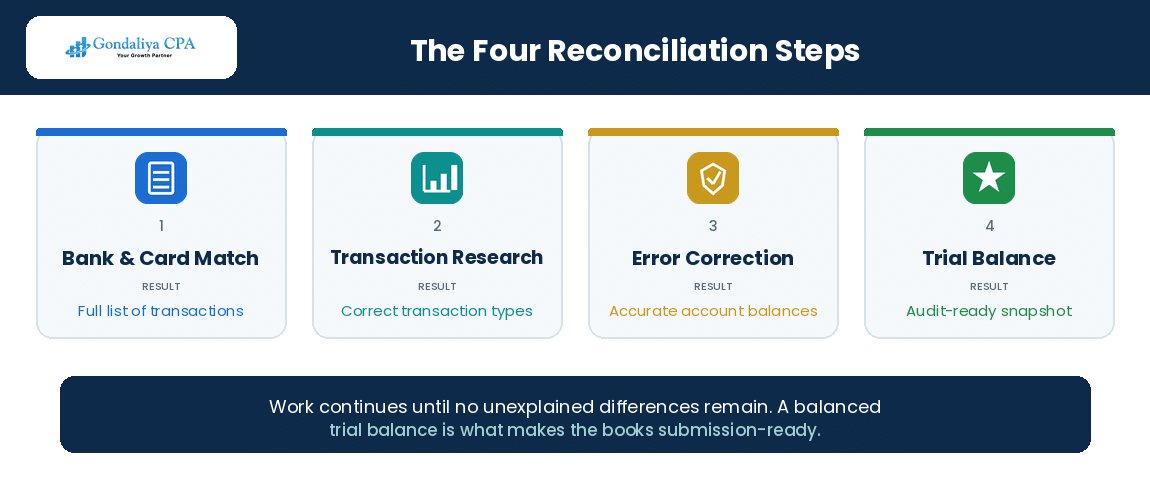
Financial reconciliation sorts out differences between what’s recorded and what actually shows in bank or credit card accounts across Canada. It means researching transactions to clear up unclear items and fixing errors before a CRA review.
This process finds problems like double payments or missed deposits that can change reported income[4]. Fixing these helps if auditors ask about amounts on tax returns.
The work follows set steps until no unexplained differences remain, meeting CPA Ontario standards[5]. A balanced trial balance means your books are ready for submission.
Here’s a quick look:
| Step | Purpose | Result |
|---|---|---|
| Bank & Credit Card Match | Find unmatched items | Full list of transactions |
| Transaction Research | Clear up vague entries | Correct transaction types |
| Error Correction | Remove duplicates/missing posts | Accurate account balances |
| Trial Balance Finalization | Make sure ledgers balance | Audit-ready snapshot |
GST/PST Tracking and Payroll Support
GST/HST net tax reconciliation must fit the CRA’s timelines exactly to avoid late filing penalties[6]. Year-end cleanup checks input credits against collected taxes over reporting periods. It confirms returns match actual sales and purchases tracked by cloud tools like QuickBooks Online or Xero, popular among Toronto firms including Gondaliya CPA.
Payroll records must be kept carefully for six years after filing, showing earnings, CPP/QPP contributions, EI premiums, and tax deductions per pay period as required by ITA s230(1)[7].
Good tracking avoids trouble during source deduction audits, which often happen alongside GST/HST reviews when paperwork is incomplete[8].
Proof Readiness with Receipts, Invoices, and Statements
Missing receipts cause big problems when the CRA asks for proof of expenses claimed[9]. If original receipts are lost, use other evidence such as:
- Supplier statements confirming purchases[10]
- Bank or credit card statements showing payments[11]
- Written explanations describing lost documents[12]
- Emails, orders, or contracts backing claims[13]
The CRA expects reasonable effort to provide proof within their six-year record keeping rule[14]. Fixing missing documents lowers chances of denied deductions, which could lead to penalties[15].
Showing cooperation through proper handling also helps if you need to use voluntary disclosure programs later on[16].
A file arrived with no receipts for an entire year. Supplier statements and card records rebuilt most of it, and written explanations covered the rest, which held up on review because the effort was documented rather than assumed. Figures changed for privacy.
Pro Tip: Where a receipt cannot be found, write the explanation at the time you discover the gap rather than when CRA asks. A contemporaneous note attached to the supporting bank entry carries more weight than one written months later.
Pricing Factors for Backlog and Cleanup Services
Pricing Factors for Backlog and Cleanup Services
The Pricing
Pricing for catch-up bookkeeping CRA and bookkeeping cleanup Canada depends on a few key things. Knowing these helps small business owners plan their budget. They get CRA-ready records without surprise costs.
Size of backlog
The amount of overdue transactions changes the price for bookkeeping cleanup Canada. Big backlogs take more time to sort, check, and fix old data. For example:
- A 12-month backlog with many transactions costs more.
- A 3-month backlog with fewer entries costs less.
Catch-up bookkeeping CRA pricing goes up because each extra month means finding missing receipts, fixing payroll, and doing GST/HST reconciliations.
Complexity of records
Records get complex when there are different transaction types, industry rules, payroll issues, or many bank accounts. Simple retail shops have easy invoices and bank statements. But businesses facing CRA bookkeeping review often mix personal and business expenses or deal with cash sales. That makes reconciling harder. Fixing bookkeeping errors flagged by CRA takes more CPA time during catch-up work.
Level of CPA involvement
Hiring a CPA Ontario member firm like Gondaliya CPA means expert help for CRA review support but affects cost. Basic catch-up work might be done by bookkeepers under supervision. Complex cases like voluntary disclosure or audit representation need senior CPAs involved. More professional help gives better tax compliance but costs more because of expertise and risk coverage.
Transparent Pricing and Cost-Saving Benefits
Gondaliya CPA offers fixed annual pricing that includes HST. This covers catch-up bookkeeping services for Canadian incorporated SMBs getting ready before a CRA review or audit letter reply. This clear pricing avoids surprise bills common with hourly rates and helps you budget better.
Fixed fees cover a full accounting cleanup including bank reconciliation Canada tasks using QuickBooks or Xero tools—this speeds up work and cuts costs versus DIY attempts or non-CPA providers without automation.
Clients get packages that bundle catch-up corporate tax filing plus ongoing payroll catch-up too. That saves money instead of paying multiple vendors for separate jobs.
Risks in Backlog Bookkeeping and CRA Compliance
Facing a CRA review with poor records brings big risks:
- Missing receipts can cause deduction denial, raising taxable income.
- Penalties may apply if mistakes seem careless.
- Unpaid source deductions risk director liability under ITA s.227.1.
- GST/HST debts grow with interest plus trigger audits.
- Collections actions start if balances stay unpaid past reassessment deadlines.
Canada Revenue Agency is strict about keeping records at least six years.[1] Poor documents weaken your case during reviews that focus on accurate business records.[2]
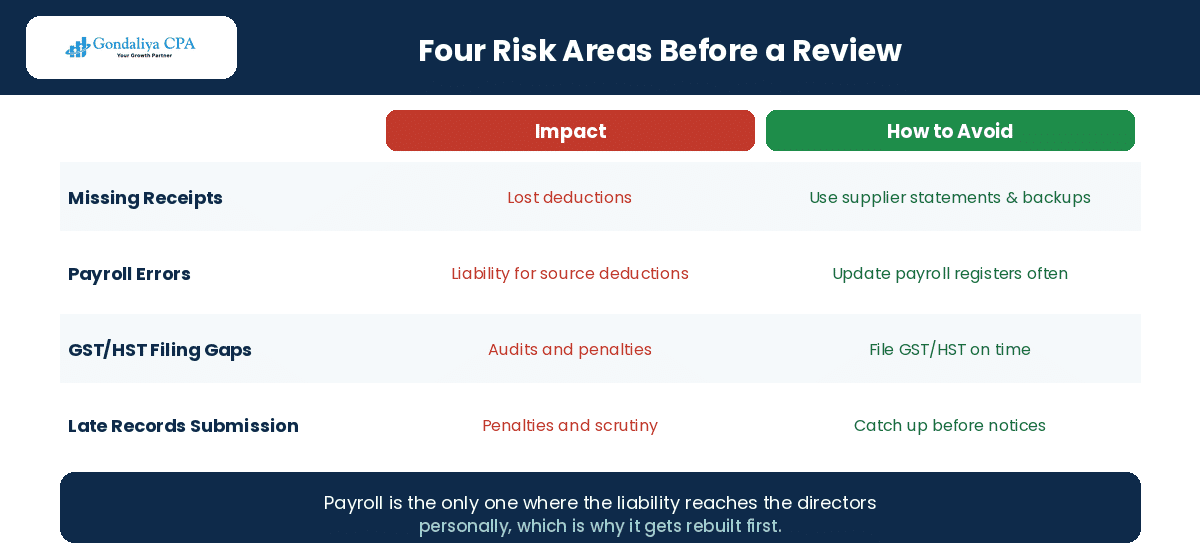
| Risk Area | Impact | How to Avoid |
|---|---|---|
| Missing Receipts | Lost deductions | Use supplier statements & backups |
| Payroll Errors | Liability for source deductions | Update payroll registers often |
| GST/HST Filing Gaps | Audits and penalties | File GST/HST on time |
| Late Records Submission | Penalties and scrutiny | Catch up before notices |
[1]: CRA Record Retention Guidelines
[2]: CRA Review Procedures
Comparing DIY vs CPA vs Non-CPA Bookkeeping Services
Choosing between DIY, an in-house bookkeeper, or a CPA firm changes risk levels and readiness before CRA steps in:
DIY Approach:
Looks cheap since you pay nothing upfront but it’s risky. Mistakes are easy to miss leading to costly reassessments later. You probably don’t know all Canadian tax rules needed during reviews.[3]
In-House Bookkeeper:
Handles daily tasks but might lack skills for tricky issues from old gaps CRA flags.[4] Also, if staff leaves suddenly, continuity breaks near deadlines.
CPA Firm Engagement:
Provides expert knowledge spotting errors that CRA targets plus full support through audit steps—best for Toronto SMBs who want dependable results fast.[5]
| Factor | DIY | In-House Bookkeeper | Licensed CPA Firm |
|---|---|---|---|
| Compliance Risk | High | Medium | Low |
| Audit Readiness | Poor | Fair | Excellent |
| Speed & Efficiency | Slow | Moderate | Fast |
| Cost | No upfront | Salaries + benefits | Fixed fee (with HST) |
| Representation | None | Limited | Full (CRA communications) |
Bottom line: A skilled Ontario CPA firm focusing on catch-up bookkeeping lowers chances of costly errors before your next CRA letter comes.
[3]: CRA Voluntary Disclosure Program
[4]: Payroll Records Requirements – Ontario
[5]: Gondaliya CPA client case files (example)
Industry-Specific Bookkeeping Benefits
Catch-up bookkeeping changes by industry because each has its own challenges that come up during a CRA-ready check:
- Medical Doctors / Physician Corporations: OHIP billing is complex; slow invoicing raises audit chances.
- Dentists: Seasonal cash flow needs detailed expense proof before review.
- Childcare Providers / CWELCC Participants: Funding claims require perfect grant accounting before inspections.
- Real Estate Investors / Holding Companies: Many properties mean lots of transactions needing careful bank reconciliation Canada.
- Construction Contractors / Skilled Trades: Cash payments plus subcontractor T4A slips cause gaps that must be fixed pre-assessment.
Each industry’s backlog pattern matches its business cycles affecting how urgent catching up is—for example: e-commerce sellers grow fast so their unfiled returns pile up quicker causing early agency alerts.[6]
Here’s a quick look at industries with their backlog trends:
| Industry | Backlog Pattern | Season/Cash Notes | CRA Focus | Why Catch-Up Matters |
|---|---|---|---|---|
| Medical Doctors | Moderate delays | Fee-for-service cycles | Billing accuracy | Critical revenue proof |
| Dentists | Short bursts post-season | Cash common | Expense checks | Avoid penalties |
| Childcare | Claim periods | Grant audits planned | Documentation | Completeness Needed for subsidies |
| Real Estate Investors | Multi-year deferrals | Rental income ups/downs | Portfolio clarity | Avoid reassessments |
| Construction Contractors | Irregular invoicing | Subcontractor reporting | Payroll/source deductions | Accuracy prevents fines |
| E-commerce Sellers | Rapid backlog growth | Online payments | Sales matching | Prevent mismatch flags |
Cleaning up per industry helps build strong paper trails essential under the new 2026 rules focusing on cloud accounting tools like QBO and Xero used widely today.
[6]: Gondaliya CPA internal analysis reports (example)
647‑212‑9559 • info@gondaliyacpa.ca • Free consultation available now
Two backlogs of identical length priced very differently because one mixed personal and business spending on the same card. Separating those transactions took longer than entering all the clean ones. Figures changed for privacy.
Who Needs Year-End Cleanup and Backlog Services
Who Needs Year-End Cleanup and Backlog Services
Who Needs It
Businesses with messy or late financial records need year-end cleanup and backlog services. This helps them have CRA-ready bookkeeping. Many small and medium businesses in Canada struggle to keep books up to date. Fast growth, seasonal changes, or few accounting staff cause delays. These delays can cause problems during a CRA bookkeeping review.
Year-end cleanup fits companies with missing bank reconciliations, lost receipts bookkeeping problems, or unposted transactions. It also helps businesses facing tax deadlines or CRA reviews from past years. Using catch-up bookkeeping CRA services fixes accounts and gets records ready before a CRA check.
Some common examples are incorporated SMBs in Toronto and Ontario like construction contractors dealing in cash, e-commerce sellers with many sales, landlords who skip updates, and startups missing early filings. Cleaning up early cuts down audit risks and helps meet Canadian tax rules.1
Checklist for Choosing the Appropriate Bookkeeping Service
Picking the right service depends on your current books and what you need for a CRA bookkeeping review:
| Criteria | Catch-Up Bookkeeping CRA | Bookkeeping Cleanup Canada |
|---|---|---|
| Records Status | Big backlog | Small errors |
| Scope | Rebuild missing periods | Fix existing data |
| Focus | Past reconstruction | Ongoing fixes |
| Cost Range | Medium to higher | Lower |
| Best For | Businesses behind months of filing | Those needing routine fixes |
Think about these points:
- Do you need a full catch-up because of missed years? Or just some cleanups?
- Check payroll needs—some services handle T4/T4A slips better.
- Look at your GST/HST filing—oddities might need special fixes.
- Find a provider who knows how to prep for CRA checks.
This checklist helps solve your bookkeeping issues fast before any formal review.2
Common Warning Signs of Inaccurate Books
Bad books often cause costly problems when the CRA sends a review letter. Watch for these red flags that mean you need bookkeeping cleanup Canada fast:
- Bank Statements Not Reconciled: Skipped monthly checks make revenue numbers doubtful.
- Missing Receipts Bookkeeping Issues: No proof for deductions hurts your case.
- Too Many Adjustments: Lots of fixes show sloppy data entry.
- Payroll Gaps: Missing source deductions create risk under Income Tax Act s.227.13.
- GST/HST Filing Problems: Taxes collected don’t match what’s sent in — that invites audits4.
Ignoring these signs means bigger penalties and interest charges from the CRA.
How to Choose a CPA for Bookkeeping Services
Picking a CPA with experience in catch-up bookkeeping CRA can get you ready before the CRA requests business records.
Look at firms like Gondaliya CPA who offer:
- Licensed Ontario CPAs following local rules
- Know-how fixing big backlogs for real estate and tech startups
- Clear flat fees—no surprise bills
- Quick replies plus weekend or evening help
- Cloud tools like QuickBooks/Xero synced with Hubdoc for safe documents
Ask if they have handled clients through CRA reviews or audits in Toronto/Ontario specifically.5 This ensures advice fits your region’s rules.
Recognizing Bookkeeping Errors and Audit Triggers
Bookkeeping mistakes often start CRA review triggers that hit small businesses all over.
Common triggers include:
- Income doesn’t match between T-slips and bank deposits
- Expense claims look way too high compared to industry norms
- Payroll source deduction errors found during checks
- Suspicious GST/HST input credit claims beyond allowed limits6
These errors boost audit chances but you can fix them early by using catch-up bookkeeping CRA support. That keeps ledgers clean before official notices arrive.
Knowing usual errors lets you correct problems and lowers reassessment chances.7
Real-World Examples of Costly Bookkeeping Mistakes
We’ve seen cases where poor bookkeeping cleanup Canada left clients open to trouble during CRA reviews:
Example: E-Commerce Seller With Two-Year Backlog (Illustrative)
Scenario: An online shop put off sales entries for two years. This caused unmatched GST/HST returns that triggered an audit letter from the CRA Toronto office.
Problems Found:
- Lost receipts worth $25K CAD hurting expense claims
- Bank accounts not reconciled for 18 months
- Incomplete payroll records risking source deduction issues
After Cleanup:
- Trial balance completed matching revenue and expenses
- Payroll T4 slips fixed preventing director liability
- Stronger document backup lowered reassessment chances
Numbers changed to protect privacy.8
Stories like this show why quick catch-up bookkeeping saves many Canadian businesses from costly problems caused by messy books.
[^1]: Canada Revenue Agency – Record Keeping
[^2]: CPA Ontario – Professional Standards
[^3]: Income Tax Act Section 227(1)
[^4]: GST/HST Audits – Canada Revenue Agency
[^5]: Gondaliya CPA Firm Credentials
[^6]: Audit Triggers – Canadian Tax Foundation
[^7]: Voluntary Disclosure Program Guidance – Canada Revenue Agency
[^8]: Our Actual Experience — Figures changed for privacy
The warning sign owners notice least is the volume of adjusting entries. A ledger that needs constant correcting is usually telling you the underlying entry process is wrong, not just the numbers. Figures changed for privacy.
Best Practices for CRA-Ready Books All Year
Best Practices for CRA-Ready Books All Year
Best Practices
Keeping your books CRA-ready all year stops last-minute panic and costly mistakes. Catch-up bookkeeping CRA done right keeps your records neat and legal with Canadian tax rules. Doing bookkeeping cleanup Canada regularly finds errors early so you avoid penalties.
Here’s what to do: record transactions on time, reconcile your bank accounts every month, and sort expenses by CRA categories. Also, save your records safely as digital files. This helps you stay compliant and ready if the CRA asks for documents.
Using cloud tools like QuickBooks or Xero helps too. They automate data entry and make GST/HST net tax reconciliation timelines easier. Staying ahead stops big backlogs that can cause extra work before audits.
Monthly Bookkeeping Checklist and Cloud Tools
A monthly checklist makes catch-up bookkeeping CRA simpler:
- Reconcile all bank accounts with your books.
- Check credit card statements against expenses.
- Review payroll registers for correct deductions.
- Finish GST/HST net tax reconciliation on time.
- File returns promptly to avoid penalties.
- Store invoices, receipts, and contracts digitally.
Cloud accounting tools help a lot. Hubdoc grabs supplier invoices automatically. Wagepoint handles payroll correctly for Canadian laws.
Doing this every month cuts errors in a CRA bookkeeping review. It also keeps financial info fresh—key if the CRA asks for your records or if you need to fix past issues soon.1
Keeping Digital Copies of Receipts and Proper Expense Categories
Missing receipts often cause deduction problems in a CRA review. Digital copies fix that by stopping lost papers and making it easy to find receipts fast.
CRA expects these documents:
- Sales invoices
- Purchase receipts
- Bank statements
- Payroll slips (T4/T4A)
Sorting expenses right helps when doing bank reconciliation Canada tasks. It matches transactions clearly to ledger entries.
If some docs are missing, you can use backup proof like supplier statements or credit card reports. But this might not be enough alone.2 Good explanations plus steady recordkeeping lower the risk of reassessments from bookkeeping mistakes seen often in small businesses.
| Document Type | Why Required | Keep For | If Missing |
|---|---|---|---|
| Invoices & Receipts | Show deductions are valid | 6 years | Deductions denied; reassessed |
| Bank Statements | Verify transactions | 6 years | More scrutiny |
| Payroll Records | Validate source deductions | 6 years | Penalties, interest charges |
How Bookkeeping Clean-Up Helps Fix Past Issues
Bookkeeping cleanup Canada fixes errors that pile up over time. It’s more than just catch-up entries. You check accounts closely, find old mistakes, fix wrong categories, handle missing transactions, and rebuild payroll or GST/HST filings properly.3
Here’s how the services differ:
| Service Type | What It Does | Time Needed | Cost Level | Purpose | Who Needs It |
|---|---|---|---|---|---|
| Catch-Up Bookkeeping | Enter backlog transactions; basic reconciliations | Short-term | Low | Update books quickly | Businesses behind on daily entries |
| Bookkeeping Cleanup | Fix errors; adjust accounts | Medium-term | Medium | Improve accuracy before audit | Those needing thorough fixes |
| Accounting Compilation | Prepare formal financial statements | Long-term | High | Provide CPA-reviewed reports | Companies needing official reports |
Cleanup digs deeper than catch-up but takes more time. Both matter before answering CRA questions about old records.4
Rebuilding records means checking deposits match sales reported, payments match purchase orders, and payroll totals line up with T4s. This is key before audits start, especially in places like Toronto where they watch compliance closely.5
Next Steps for Restoring Clarity in Business Records
- Collect all documents including past returns and any CRA notices.
- Get complete bank and credit card statements for the backlog period.
- Organize invoices and receipts by date or category.
- Provide login info for cloud software (QuickBooks/Xero).
- Share payroll details like hours worked, pay rates, plus T4/T4A slips.
- Note any deadlines from CRA letters.
At Gondaliya CPA we first assess how organized your records are and how old the backlog is.6 This sets realistic timelines based on your needs in Toronto/Ontario or anywhere in Canada. We use tools like Hubdoc with careful manual checks to finish trial balances ready for CPA review before filing or audits.
We give clients clear checklists upfront about what to provide and keep them updated regularly to avoid surprises while following Canadian retention rules through changes coming by 2026.7
Accurate Monthly Reporting, Reconciliations, and Local Support
Monthly reporting needs exact bank reconciliation Canada steps plus matching credit card statements at each month-end close.8 Payroll register reconstruction is key when past pay runs lack full details needed by law.9
Local know-how matters since rules differ across provinces like Ontario—things such as pay deadlines or holiday impacts vary around Toronto. We’ve seen many SMB clients struggle with cash flow ups and downs that make bookkeeping tricky.10
Hiring pros keeps things steady even if staff leave suddenly or take time off. This way you stay ready year-round without hidden risks buried deep inside messy ledgers.11
The habit that prevents the most rework is the monthly reconciliation. Clients who keep it up rarely need a catch-up at all, and the ones who lapse for a quarter usually lapse for a year. Figures changed for privacy.
Pro Tip: Diarize the monthly reconciliation as a fixed date rather than a task to do when there is time. The businesses that never fall behind are the ones where it happens on the same day each month regardless of how busy things are.
Frequently Asked Questions
Frequently Asked Questions
FAQ
What is catch-up bookkeeping CRA and why is it important?+
Catch-up bookkeeping CRA updates overdue financial records to meet Canada Revenue Agency standards. It helps avoid penalties and prepares businesses for CRA bookkeeping reviews.
How does bookkeeping cleanup Canada differ from catch-up bookkeeping?+
Bookkeeping cleanup Canada corrects errors in existing records, while catch-up bookkeeping focuses on entering missing transactions and bringing books current before a CRA review.
What does CRA-ready bookkeeping include?+
CRA-ready bookkeeping involves accurate records, payroll retention for six years, timely GST/HST net tax reconciliation, and organized source documents like invoices and receipts.
How long does typical backlog resolution take?+
Backlog resolution usually takes 30 to 90 business days depending on the size and complexity of the records needing cleanup or catch-up.
What are the key compliance risks of poor bookkeeping records?+
Poor records risk reassessments, penalties for late filing or payments, director liabilities, and increased audit chances by the CRA.
How long must payroll records be retained in Canada?+
Payroll records must be kept for at least six years according to Canadian tax law to support source deduction audits.
What is the GST/HST net tax reconciliation timeline?+
Businesses must reconcile GST/HST quarterly or annually to match collected taxes against input credits before filing returns on time.
What pricing structure does Gondaliya CPA offer for catch-up bookkeeping?+
Gondaliya CPA provides fixed annual pricing inclusive of HST, offering clear budgeting without surprise fees for incorporated small and medium-sized businesses.
How quickly can clients expect responses from Gondaliya CPA?+
Clients typically receive prompt replies during business hours with options for weekend or evening support when needed.
Who benefits most from catch-up bookkeeping services?+
Contractors, self-employed individuals, rental owners, e-commerce businesses, startups, and SMBs needing audit-ready financials benefit greatly.
What are accounting compilation differences compared to catch-up bookkeeping?+
Accounting compilation prepares formal financial statements reviewed by a CPA. Catch-up bookkeeping focuses on data entry and error correction before such reporting.
Why is period-end close and trial balance preparation critical?+
Accurate period-end close and trial balance ensure balanced ledgers ready for CPA review and prevent discrepancies during CRA submission.
Does Gondaliya CPA provide submission support and CRA representation?+
Yes. Gondaliya CPA offers submission assistance and handles communications with the CRA including responses to review letters.
Can you file voluntary disclosure through Gondaliya CPA?+
Yes. Gondaliya CPA supports filing voluntary disclosure to correct past mistakes while minimizing penalties under CRA guidelines.
Key Points on Choosing the Right CPA Firm for Your Bookkeeping Needs
Key Points on Choosing the Right CPA Firm for Your Bookkeeping Needs
Quick Reference
- Look for firms experienced in catch-up bookkeeping CRA tailored to Canadian regulations.
- Confirm transparent pricing with no hidden fees; fixed annual pricing is preferred.
- Choose CPAs who offer clear deliverables like trial balances, reconciliations, and audit-ready files.
- Prioritize firms providing ongoing bookkeeping support beyond cleanup services.
- Consider client reviews; 5-Star Google reviews indicate trusted service quality.
- Select providers knowledgeable about industry-specific issues for contractors or startups.
- Ensure local expertise in Toronto/Ontario tax compliance and record retention rules.
Benefits of Engaging a Licensed CPA Firm over DIY or In-House Bookkeepers
- CPA Ontario members reduce compliance risks with deep knowledge of Canadian tax law.
- They provide audit-ready documentation with professional review and sign-off.
- CPAs handle complex payroll reconstructions aligned with CRA requirements.
- Firms like Gondaliya CPA offer comprehensive packages including voluntary disclosure filings.
- Professional firms respond quickly to CRA inquiries, reducing client stress during audits.
Industry-Specific Notes on Backlog Resolution
- Contractors need careful payroll source deduction checks due to cash payments.
- Rental owners require accurate bank reconciliations matching tenant deposits.
- E-commerce startups often face rapid sales volume backlogs needing timely catch-up entries.
- Self-employed professionals benefit from precise expense tracking to avoid flagged deductions.
Next Steps (Text Only CTA)
Contact Gondaliya CPA today at 647‑212‑9559 or info@gondaliyacpa.ca for a free consultation. Get your books organized with expert catch-up bookkeeping CRA solutions that keep you compliant year-round. Avoid costly penalties with proactive cleanup services designed specifically for Canadian incorporated SMBs.
The single question worth asking any firm is whether they have taken a client through a CRA review, not just prepared books. The two are different jobs and the second one is where representation matters. Figures changed for privacy.
Industry Spotlights: Sectors We Represent
Industry Expertise
What the CRA looks at differs by sector. Here are eleven and where the review usually focuses.
| Industry | Where a Review Usually Focuses |
|---|---|
| Technology startups & SaaS | Sales matching across platforms and missing early filings |
| E-commerce & online retailers | GST/HST returns against actual online sales |
| Consulting firms | Expense claims against industry norms |
| Construction, contractors & skilled trades | Cash payments and subcontractor T4A slips |
| Property developers & builders | Project costs allocated across corporations |
| Real estate investors & holding companies | Tenant deposits matched to reported rental income |
| Transportation, logistics & trucking | Driver payroll and source deduction remittances |
| Restaurants & food and beverage | Cash sales against declared revenue |
| Daycare, childcare & CWELCC services | Grant accounting and funding claim documentation |
| Dentists & dental practices | Seasonal expense proof and associate payments |
| Medical doctors & physician corporations | OHIP billing accuracy and invoicing timing |
- Technology startups & SaaS: Growth outpaces the bookkeeping setup, and early filings missed in the first year are what surface later.
- E-commerce & online retailers: Backlogs grow fastest here, and mismatched GST/HST returns are the most common trigger for a letter.
- Consulting Firms: Expense ratios out of line with the sector attract attention, so the categorisation work matters as much as the entries.
- Construction, general contractors & skilled trades: Cash payments and subcontractor T4A slips create the gaps, and the payroll side carries director liability.
- Property developers & builders: Costs sit across several corporations, and allocating them correctly is most of the reconstruction work.
- Real estate investors, landlords & holding companies: Tenant deposits have to match reported rental income across every property, which is where multi-year deferrals show up.
- Transportation, logistics & trucking: Driver classification drives the payroll exposure, and remittance history is usually where the review starts.
- Restaurants & food and beverage: Cash sales and high supplier invoice volume make this one of the heaviest sectors to reconstruct before a review.
- Daycare, childcare & CWELCC services: Grant accounting has to be complete before an inspection, and funding claims need documentation that matches the ledger.
- Dentists & dental practices: Seasonal cash flow means expense proof needs assembling ahead of time rather than during the review itself.
- Medical doctors & physician professional corporations: OHIP billing complexity and slow invoicing raise audit chances, and the revenue proof has to be reconstructable.
Across cleanup files in one year, the two most common review triggers were GST/HST returns that did not match reported sales and payroll remittances that had quietly stopped. Figures changed for privacy.
Professional Guidance and Quick Reference
Guidance
Professional Guidance on Pre-Review Cleanup: How Gondaliya CPA Supports Canadian Businesses
Fixing records before a review is a defined project. You need the backlog assessed, source documents gathered, bank and credit card accounts reconciled, payroll registers rebuilt against the T4 and T4A slips, GST/HST net tax reconciled, adjusting entries posted, a trial balance finalised, and a CPA to review it before anything goes to the CRA. Gondaliya CPA handles that work and the representation that follows.
We handle what determines whether the records hold up: assessing organisation and backlog age before quoting, rebuilding in QuickBooks or Xero with Hubdoc, reconstructing payroll where the exposure is personal, reconciling GST/HST against what was actually filed, and responding to CRA correspondence on your behalf.
Our team follows CRA record retention and remittance requirements closely and works from your own records rather than a template. Whether a letter has arrived or you are getting ahead of one, we give clear advice and a fixed price before starting.
Quick Answers: Key Numbers & Concepts at a Glance
At a Glance
- Backlog resolution: 30 to 90 business days
- Record retention: Six years, including payroll
- Normal look-back: Three years after filing
- Extended look-back: Six years where serious errors are suspected
- Director liability: ITA section 227.1 on source deductions
- Payroll retention basis: ITA section 230(1)
- GST/HST reconciliation: Quarterly or annually
- Reconciliation steps: Match, research, correct, finalise
- Software: QuickBooks Online, Xero, Hubdoc, Wagepoint
- Pricing: Fixed annual, HST included
Who This Is For / Not For
Fit Check
- For: Incorporated SMBs with unreconciled accounts, missing receipts, payroll gaps or GST/HST mismatches, whether a review letter has arrived or you are getting ahead of one.
- Not For: Businesses already current on reconciliations and remittances, where ongoing monthly bookkeeping is the better fit than a cleanup engagement.
People Also Ask
Quick Answers
A CRA review letter has arrived. Is it too late to fix the books?+
Not too late, but the timeline tightens. The work still takes 30 to 90 business days, so an extension is usually requested rather than the deadline simply being missed.
Will fixing old records draw attention to them?+
Accurate records reduce scrutiny rather than invite it. Where past errors are significant, voluntary disclosure may be the better route before CRA makes contact.
Which part of a backlog matters most to get right?+
Payroll. Unremitted source deductions reach the directors personally under section 227.1, while other errors stay with the corporation.
Glossary of Key Terms
Plain-English Definitions
- Catch-up bookkeeping: Entering backlog transactions to bring records current.
- Bookkeeping cleanup: Correcting errors in records already entered.
- Accounting compilation: Formal financial statements prepared from cleaned data.
- CRA bookkeeping review: A CRA examination of business records and filings.
- Reassessment: A revised CRA assessment following a review or audit.
- Bank reconciliation: Matching recorded transactions to bank statements exactly.
- Adjusting entry: A correction posted to reflect what actually happened.
- Trial balance: The listing of balances confirming the ledgers agree.
- Payroll reconstruction: Rebuilding pay records from stubs and remittance data.
- Source deductions: Payroll amounts withheld and remitted to the CRA.
- Director liability: Personal responsibility for unremitted deductions under section 227.1.
- GST/HST net tax: Tax collected less input tax credits claimed.
- Input tax credit: GST/HST paid on eligible expenses and recoverable on a return.
- Record retention: The six-year requirement to keep supporting documents.
- Audit trail: Documentation linking each entry back to its source.
- Voluntary disclosure: Correcting past errors before CRA detects them, where eligible.
CRA Review Readiness Check
This quick self-check flags where your records are exposed before a review. Please answer the six questions below.
CRA Review Readiness Check
Six quick questions on your records. No fee shown.
Areas exposed:
This is a general prompt, not tax or legal advice or a quote. Your position depends on your full facts. For a real review, please book a free consultation.
Want a checklist to work from? You can download our free CRA review readiness checklist before your consultation.
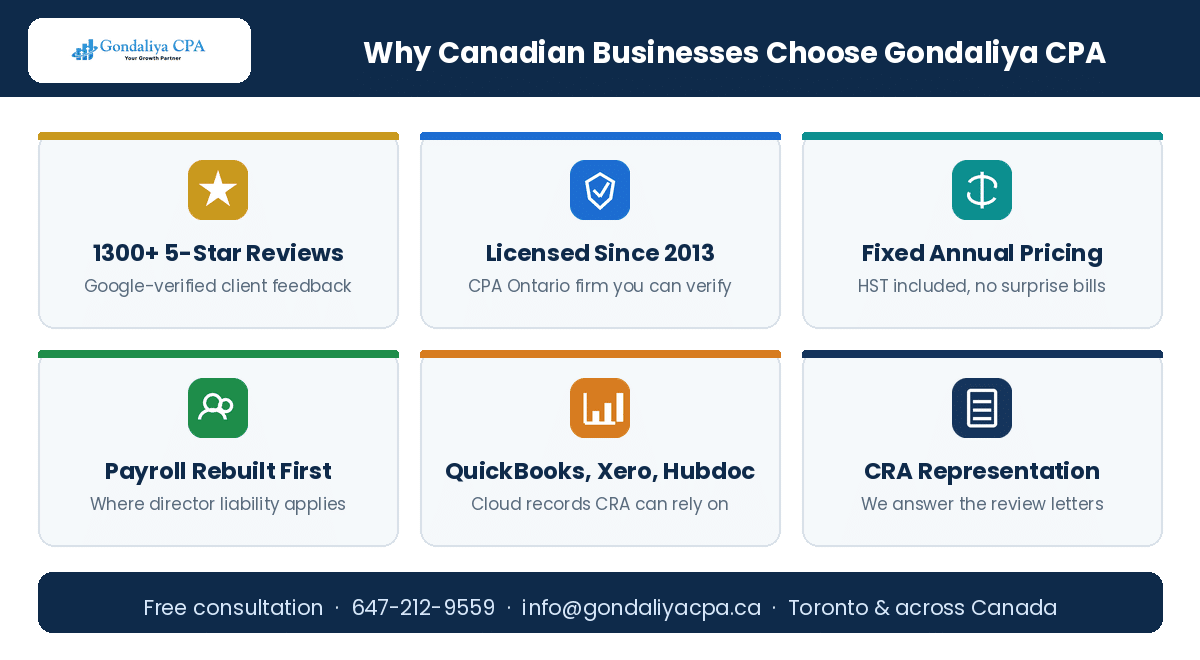
Do the work before the letter arrives, start with payroll because that exposure is personal, reconcile GST/HST against what was actually filed rather than what should have been, document the effort where receipts are missing, and finish with a balanced trial balance a CPA has signed off on.
2026 Update — what is current: CRA record retention remains six years including payroll, the normal reassessment look-back is three years with six where serious errors are suspected, and 2026 rules place greater emphasis on cloud accounting records from tools such as QBO and Xero. Please confirm current retention rules, penalty rates and review procedures before relying on the figures in this article.
Bookkeeping Cleanup Canada and Catch-Up Bookkeeping CRA Solutions to Meet CRA Requirements with Gondaliya CPA
Fix the records before the letter, not after it
Gondaliya CPA assesses the backlog, reconciles bank and credit card accounts, rebuilds payroll against the T4 and T4A slips, reconciles GST/HST net tax, finalises the trial balance, and represents you in CRA correspondence, on fixed annual pricing including HST with a one-business-day response. Please book a free consultation.
Next Steps
Please book a free consultation with Gondaliya CPA and bring your bank statements, receipts, payroll details and any CRA correspondence. If a letter has already arrived, please note its deadline so we can plan around it rather than past it. If our content helps, please add gondaliyacpa.ca as a preferred source on Google.
Published: July 12, 2026 · Last updated: July 12, 2026
Editorial policy: We research against CRA and CPA Ontario sources, fact-check the figures, and Sharad Gondaliya, CPA, reviews the content, which we update as the rules change.
Disclaimer: This article is educational information only and is not tax, legal, or financial advice. Figures marked illustrative are examples rather than quotes or guarantees. It reflects CRA rules current to 2026, including the six-year record retention requirement, the three-year normal reassessment period, and director liability under section 227.1. Retention rules, penalties and review procedures change and outcomes depend on your specific facts. Please consult a CPA Ontario member before acting.

Sharad Gondaliya is a CPA Canada & CPA USA with 15 Years+ experience of Accounting, Tax, Payroll of Corporate Small Businesses as Tax Accountant. He is a CPA Ontario member (61040184) and holds US CPA licences in Washington and Montana and is well known among corporate small businesses for tax planning, efficient tax solutions, and affordable CPA services. Sharad is the Principal (Director) of Gondaliya CPA – Affordable CPA Firm in Canada. Licenses: CPA Ontario: 61040184 | CPA USA (MT): PAC-CPAP-LIC-033176 | CPA USA (WA): 57629 | CPA Firm License: 61330051 View Full Author Bio