



Startup Incorporation in Canada: How to Choose the Right Business Structure and Save Taxes
TLDR:
Startup incorporation Canada is simplified with Gondaliya CPA, offering expert guidance on corporation registration Canada and the startup incorporation process, including choosing the right business structure. Their startup CPA services help new businesses save taxes and meet compliance requirements effectively.
Quick Summary
Incorporation comes down to four choices: the structure itself, federal against provincial, the share classes you create, and how you pay yourself once profits appear. Please note the compliance clock starts the day the certificate issues, with the annual return, the ISC register, and the CRA accounts all running on their own timelines.
| Aspect | Details |
|---|---|
| The structure choice | Sole proprietorship, partnership, or corporation. |
| The jurisdiction choice | Federal under CBCA or provincial under OBCA. |
| The share choice | Common and preferred classes set at incorporation. |
| The compliance clock | Annual return, ISC register, and CRA accounts. |
Reading time: 34 minutes.
Table of Contents
- Introduction to Startup Incorporation in Canada
- Choosing the Right Business Structure for Your Startup
- The Incorporation Steps in Order
- Comprehensive Incorporation Services for Startups
- Maintaining Compliance and Maximizing Tax Advantages
- Supporting Your Startup’s Growth with Expert CPA Services
- FAQs on Startup Incorporation and Compliance in Canada
- Essential Compliance Elements for Canadian Startups
- Industry Spotlights: Sectors We Represent
- Professional Guidance and Quick Reference
The Numbers That Matter
This article covers Canada, with Ontario and Toronto context, and reflects CRA, Corporations Canada, and ServiceOntario rules current to 2026. It assumes a founder incorporating a startup, federally or provincially. Figures marked illustrative are examples, not quotes, and any masked engagement notes end with “Figures changed for privacy.” This is educational information only and not tax, legal, or financial advice. Fees, thresholds, and filing requirements change, so please confirm your own situation with a Registered CPA before acting.
Introduction to Startup Incorporation in Canada
Introduction to Startup Incorporation in Canada
The Basics
Starting a business in Canada? Incorporating your startup is an important move. It means setting up your business as a corporation, a legal entity separate from you. This step offers some key perks like limited liability and possible tax savings. Many entrepreneurs choose to incorporate a startup Canada to protect themselves and plan their finances better.
What is Incorporation and Why It Matters for Startups
Incorporation means creating a corporation that stands on its own legally. The company becomes its own entity, not just an extension of its owners. This setup protects your personal stuff—like your house or savings—from company debts or lawsuits.
Here’s why it matters:
- Your personal assets stay safe.
- The corporation pays taxes, not you personally.
- Corporations often pay less tax on profits than individuals.
Because of these points, many startups find that startup incorporation Canada gives them room to grow without exposing their personal money to risk.
Overview of Business Structures: Sole Proprietorship, Partnership, Corporation
| Structure | What It Means | Things To Think About |
|---|---|---|
| Sole Proprietorship | One person owns everything | You have full control but face unlimited risk |
| Partnership | Two or more people share ownership | Responsibilities and risks are shared |
| Corporation | A separate legal entity owned by shareholders | Limits your personal risk; more complex setup |
Your choice depends on things like how much control you want and how much risk you can handle.
Key Benefits of Incorporating a Startup in Canada
- You get limited liability protection, so you’re not personally on the hook for company debts.
- You may qualify for the small business deduction limit, which lowers taxes on the first $500,000 earned.
- Tax planning gets easier—you can decide how to pay yourself with salary or dividends.
These benefits can make a big difference when running a growing startup.
How Incorporation Supports Tax Efficiency and Asset Protection
Incorporation does more than just protect your assets; it helps with taxes too. Here’s how:
- Companies can keep earnings inside at lower tax rates before paying you.
- The Lifetime Capital Gains Exemption (LCGE) may let you avoid tax on profits if you sell shares in certain small businesses.
- You can mix salary and dividends to reduce your overall tax bill depending on your needs.
So, using incorporation smartly helps your startup save money and keeps your personal stuff safe. It’s not just about following rules—it’s about making choices that work for you in Canada’s business world.
A founder operated unincorporated for two years while losses accumulated, then incorporated. The losses stayed personal and could not move into the corporation, which is the one decision that cannot be undone afterwards. Figures changed for privacy.
Key Stat: The small business deduction applies to the first $500,000 of active business income, and it is the single largest reason most profitable startups incorporate. Below that threshold the corporate rate sits well under personal marginal rates.
Choosing the Right Business Structure for Your Startup
Choosing the Right Business Structure for Your Startup
The Structure
Picking the right business structure matters a lot when you want to incorporate a startup Canada-wide. This choice changes your taxes, legal risks, rules to follow, and how easy it is to get money from investors. Incorporating means your business becomes its own legal thing. That keeps your personal stuff safe from company debts but adds more paperwork and rules.
If you plan to incorporate a startup Canada, think about what you want for the business, how much risk you can take, how much money you need, and how complex your operations are. Corporation registration Canada means following rules that separate the company from you. That helps protect you but also means sticking to governance rules either federally or provincially.
Comparing Sole Proprietorship, Partnership, and Corporation for Startups
| Factor | Sole Proprietorship | Partnership | Corporation | Best For |
|---|---|---|---|---|
| Liability | Unlimited personal liability | Shared unlimited liability | Limited to investment | Businesses with big risks |
| Taxation | Personal income tax rates | Income passes through | Pays corporate tax; dividends | Businesses wanting tax breaks |
| Compliance Cost | Very low | Medium | Higher due to filings & reports | Those needing formal setup |
| Capital Raising | Hard | Shared resources | Easier by selling shares | Startups needing investors |
| Continuity | Ends if owner leaves/dies | Ends if partner leaves | Continues without shareholders | Businesses planning long-term |
Corporations give better protection and funding options than sole proprietorships or partnerships but need more work on compliance.
From what we see in Toronto tech startups, many choose incorporation early because investors expect it despite higher costs at first. Figures changed for privacy.
Federal vs Provincial Incorporation: Differences and Considerations
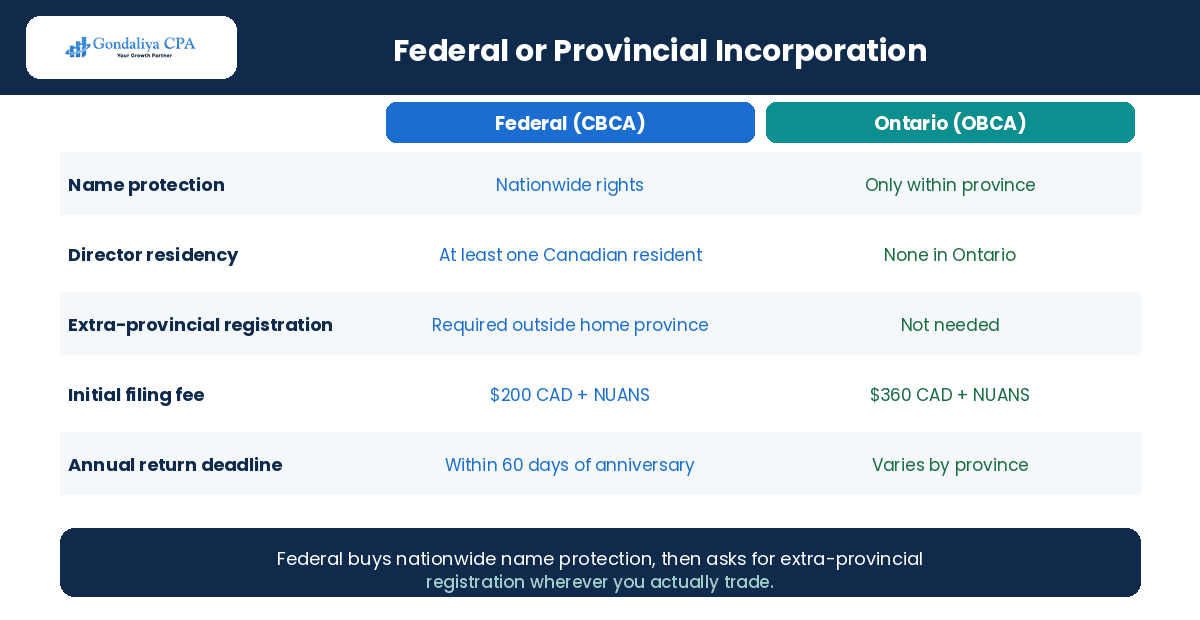
When you think about startup incorporation Canada offers two main routes: federal under CBCA or provincial like Ontario’s OBCA. Both create separate companies but differ in name protection, director rules, fees, and ongoing requirements.
Here’s what differs:
- Name Protection: Federal covers all Canada; provincial protects only inside the province.
- Director Residency: Federal needs at least one director living in Canada; Ontario does not.
- Extra-provincial Registration: Federal requires registering in provinces where you do business.
- Filing Fees: Federal fees usually cost more upfront than Ontario’s.
- Annual Returns: Deadlines vary depending on where you incorporate.
Quick comparison:
| Factor | Federal (CBCA) | Provincial (OBCA – Ontario) | Notes |
|---|---|---|---|
| Name Protection | Nationwide rights | Only within province | Corporations Canada / ServiceOntario |
| Director Residency Req’d | At least one Canadian resident | None in Ontario | CBCA s105 / OBCA s106 |
| Extra-provincial Reg’n | Must register outside home province | Not needed | ISED / ServiceOntario info |
| Initial Filing Fee | $200 CAD + NUANS $25 (HST included) | $360 CAD + NUANS $25 (HST included) | Official websites |
| Annual Return Deadline | Within 60 days of anniversary | Varies by province | Registry sites |
If you want protection across Canada, federal is better. If your startup mainly works in one province like Ontario and wants lower costs first, provincial might be best.
We’ve seen e-commerce startups choose federal for selling everywhere. Local service providers pick provincial to fit local laws. Figures changed for privacy.
Selecting a Share Structure That Fits Your Startup’s Needs
Corporation registration Canada requires picking share classes when setting up your company. These shares decide who gets votes and who gets paid dividends first. Common shares usually mean voting rights; preferred shares often pay fixed dividends but no votes. This helps attract investors without losing control right away.
Having multiple share types lets founders set vesting schedules that release ownership based on hitting goals. Tech startups often do this to keep their teams motivated while protecting long-term interests with shareholder agreements made by lawyers.1
Think about:
- How many founders/shareholders there are
- Balancing voting vs non-voting shares
- Dividend rights per share class
- Rules on selling or transferring shares
- Future financing needs that might add new share classes
A good share structure smooths out management later and can qualify shareholders for tax benefits like the lifetime capital gains exemption on small business shares.2
From experience working with Toronto SaaS companies, multi-class shares help bring in investors without giving up too much founder control early on. Figures changed for privacy.
1 Getting legal help with shareholder agreements is wise.
2 See CRA IT Bulletin IT–490R3 about small business corporation shares.
Legal Requirements for Corporate Governance in Canada
Corporation registration Canada comes with rules to keep companies accountable after they form. Both federal CBCA and provincial laws like OBCA set these standards:
- Having directors meet residency rules (federal needs at least 25% Canadian residents)
- Keeping a registered office address inside the right jurisdiction
- Maintaining an up-to-date minute book with decisions recorded
- Filing annual returns on time with government offices
- Starting 2026, keeping a register of individuals with significant control3
Directors must act honestly and responsibly for the company’s interests.4 Missing filings can lead to penalties or even dissolution notices from regulators.5
Founders should check with experts on board setup—especially if they work in regulated fields needing special professional corporations overseen by bodies like OHIP or RCDSO.6
In our work supporting clients around Ottawa, Guelph, and Hamilton, staying ahead on registers reduces regulatory questions during audits. Figures changed for privacy.
3 Bill C‑xxx amendment effective January 2026 requires significant control registers.
4 CBCA Part XV outlines director duties; CPA Code of Conduct principles apply.
5 Late annual return penalties explained on Corporations Canada FAQs.
6 Professional corporations have extra rules from licensing authorities.
Risk Warning: A missed annual return can lead to administrative dissolution, and a dissolved corporation cannot sign contracts, hold a bank account, or receive funding until it is revived. Please diarize the filing window from the day the certificate issues.
The Incorporation Steps in Order
The Incorporation Steps in Order
The Steps
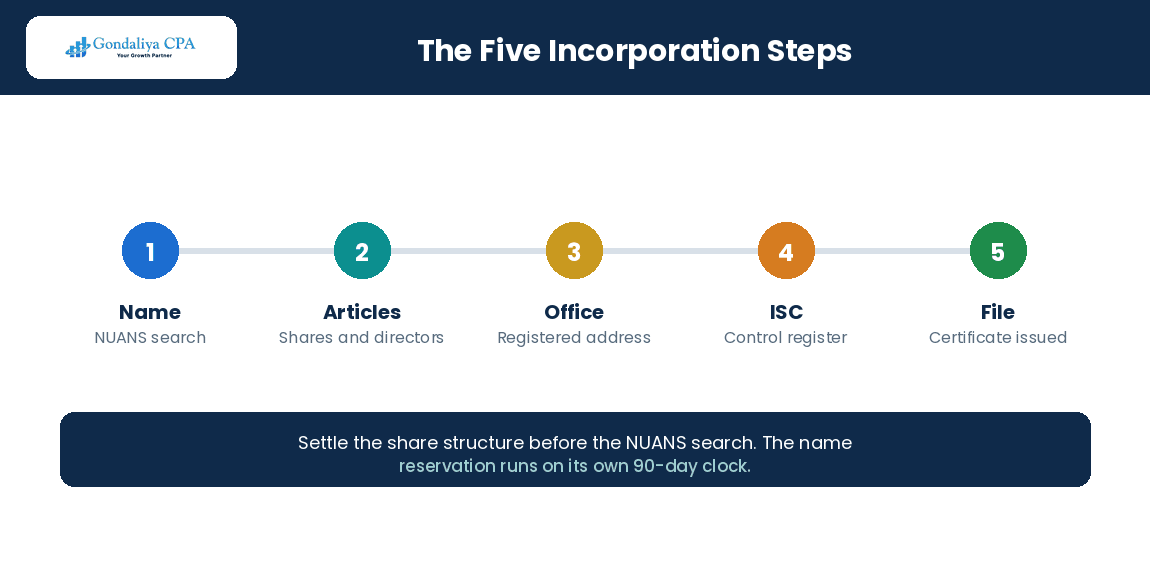
Step 1: Naming Your Corporation – Guidelines and Name Search Process
Choosing your corporation’s name comes first when you incorporate a startup Canada-wide. The name must stand out, not confuse people, and follow federal or provincial rules. You need corporate name approval before moving on. For federal incorporations, Corporations Canada asks for a NUANS (Newly Upgraded Automated Name Search) report. This report checks if your name clashes with any existing businesses or trademarks.
The NUANS search holds your proposed name for 90 days. This helps stop rejections during corporation registration Canada procedures. If you want to skip the unique name step, you can pick a numbered corporation instead. But numbered names don’t help much with branding.
Federal incorporations always include submitting the NUANS report along with articles of incorporation. Ontario and other provinces might ask for their own searches or accept federally approved names via ServiceOntario.
Quick tips:
- Run your NUANS search early to avoid delays.
- Pick a name that follows naming laws—no banned words or similar-sounding names.
- Think about trademark conflicts beyond the NUANS report for future safety.
If you’re starting up in Toronto or anywhere in Canada, nailing the corporate name approval cuts down delays in startup incorporation Canada steps.[1][2]
Step 2: Preparing and Filing Articles of Incorporation
Articles of Incorporation make your company official in Canada. This legal document shows how your company is set up and governed. It lists things like the company’s legal name, share structure setup (what kinds of shares exist and how many), rules about share transfers, where your registered office is, number of directors, and any special agreements between founders.
Choosing the right share structure early affects who controls what among founders and investors later on. It also helps with tax planning, like deciding who gets dividends or uses capital gains exemptions.
You file articles online through Corporations Canada for federal setups or through provincial bodies like ServiceOntario for Ontario businesses. Being accurate here avoids extra fees or hold-ups from fixing mistakes after filing.
Remember:
- Set clear common vs preferred shares depending on what founders want.
- Add director info following residency rules (see next section).
- Check everything matches CBCA/OBCA laws before sending it off.[3]
This paper kicks off official startup incorporation Canada moves toward running your business.[4]
Step 3: Setting Up Registered Office Address and Board of Directors
Every Canadian corporation needs a registered office address inside its legal area. It can’t be just a P.O Box—it must be a real place where you can get official mail during business hours.
For federal corporations under CBCA rules:
- You need at least one director per company[5].
- At least 25% of directors must live in Canada unless you have only one director—in that case, they must live in Canada[6].
Ontario and other provinces have similar or sometimes tighter residency rules (ServiceOntario).
Picking directors who meet these standards keeps you legal from day one. It also builds trust with investors and regulators.
Quick summary:
| Requirement | Federal (CBCA) | Ontario (OBCA) | Notes |
|---|---|---|---|
| Minimum Directors | One | One | Must meet residency conditions |
| Director Residency | ≥25% Canadian residents | Majority Canadian residents | Single-director corp = resident |
| Registered Office Location | Physical address within jurisdiction | Same | No P.O Boxes allowed |
Getting this right stops fines or even losing your company status.[7][8]
Step 4: Filing Information on Individuals with Significant Control
Federal corporations now must keep an Individuals with Significant Control (ISC) register. This record lists people who have major control over the company—usually folks owning more than 25% voting shares or those making big decisions by law[9].
This ISC register helps Corporations Canada fight fraud by making ownership clearer starting January 2026[10]. You must update it quickly when changes happen—within set time limits—and keep it ready if officials ask. But it stays private, unlike public filings.
Keeping an accurate ISC register adds another layer of compliance while running your startup after incorporation.[11]
Step 5: Submitting the Incorporation Application and Paying Fees
You send in your complete application to make your business official under federal law with Corporations Canada ($200 CAD fee) or provincially through ServiceOntario ($360 CAD fee)[12]. These fees cover processing articles and related documents like NUANS reports if needed.
The corporations canada filing process usually takes about five to ten business days unless issues arise; faster services cost extra[13]. Provinces take similar times using online systems designed for easy filings.
Once you pay:
- You get a Certificate of Incorporation showing you’re officially registered.
- Initial filings begin as required by your location.
- You start setting up a minute book holding key corporate papers.
- CRA account registrations follow so you can handle taxes right away.
Paying on time after preparing well cuts down paperwork delays letting you start running smoothly.[14]
Additional Considerations: NUANS Report, Minute Book Setup, and CRA Account Registration
After filing comes ongoing work to keep things legit:
- NUANS Report Validity: Watch that your reserved name stays valid before filing to avoid having to do another search if it expires.
- Minute Book Maintenance: A minute book holds vital papers — bylaws, articles updates, shareholder resolutions, director meeting notes — all needed for audits and smooth management[15].
- CRA Accounts Registration New Corporation: Once you get your certificate and business number BN assigned, register GST/HST accounts (RT), payroll accounts (RP), import/export licenses if needed—all done fast prevents CRA penalties[16].
Doing these right helps keep your new startup compliant from day one whether in Toronto/Ontario or anywhere else across Canada.
Sharad Gondaliya, CPA, has over 10 years experience helping many Canadian business owners start their companies without stress.
A founder reserved a NUANS name, then took four months to finalise the share structure. The reservation lapsed and the search had to be run again, which is avoidable simply by settling the structure first. Figures changed for privacy.
Pro Tip: Settle the share structure before running the NUANS search. The name reservation runs on its own clock, and share class decisions are the step that most often takes longer than founders expect.
Comprehensive Incorporation Services for Startups
Comprehensive Incorporation Services for Startups
Our Services
Starting a business in Canada? Incorporating your startup means your company becomes its own legal entity. This gives you limited liability protection and access to tax benefits. Our services handle all parts of corporation registration Canada-wide. We help you with name approval, filing articles, setting up share structures, and registering with the right authorities.
We make the whole process easier by combining legal steps with smart tax planning. This way, you can focus on growing your business while we take care of the paperwork and rules from day one.
Here’s what we cover:
- Federal or provincial incorporation options
- Name approval or numbered corporations
- Articles filing and share structure setup
- Regulatory registrations for your area
Gondaliya CPA’s Startup Incorporation Services Overview
Gondaliya CPA offers services designed for startup founders who want expert help without breaking the bank. We manage corporation registration Canada-wide, guiding you from your first call to receiving your official certificate and setting up CRA accounts.
Our team knows both federal rules under CBCA and Ontario’s OBCA very well. We’ve worked with many industries like tech startups, e-commerce stores, professional services, health clinics, real estate, construction, restaurants, transport logistics, childcare programs under CWELCC, and cross-border companies.
We make sure your corporation follows all filing requirements including:
- NUANS name searches or choosing a numbered corporation
- Director residency rules
- Individuals with Significant Control (ISC) register updates
- Annual return deadlines
- Setting up bookkeeping systems like QuickBooks or Xero
Personalized CPA-Led Advice on Incorporation and Tax Planning
Our startup CPA services do more than just register your company. We advise on the best corporate structures to help you save on taxes. Incorporating in Canada brings benefits like the small business deduction limit — now $500,000 taxable income — which lowers federal corporate tax rates compared to personal income tax rates.
We look at paying yourself through salary or dividends in ways that work with CRA rules. This keeps options open for things like lifetime capital gains exemption tied to qualified small business shares (QSBC). Using Section 85 rollovers lets you move assets into the corporation without paying taxes right away — a handy tool for early-stage businesses.
This kind of advice helps reduce taxes legally while keeping you in line with changing rules that will start in 2026 about ISC register updates and annual filings.
Business Number Registration and CRA Account Setup
Every new corporation in Canada must get a Business Number (BN). This number is your company’s ID for CRA programs like:
- Corporate income tax (RC0001)
- GST/HST accounts if revenue goes over $30,000 (small supplier threshold)
- Payroll accounts if you hire staff
- Other info returns if needed
You have to register for a BN soon after incorporation. CRA requires it so they can track tax filings even if you don’t earn income yet. Missing this step may cause penalties or delay GST/HST credits you could claim on expenses before registration.
Setting up these accounts right is important because it affects how often you pay GST/HST (monthly or quarterly) and ensures payroll deductions happen correctly when you start paying employees.
Ongoing Compliance Support Including Annual Returns and Regulatory Filings
Your compliance work starts as soon as you incorporate. You must file an annual return within 60 days after your incorporation anniversary every year. This goes either through Corporations Canada federally or ServiceOntario provincially depending on where you incorporated.
If you miss this deadline, your company risks losing good standing status. That can mess with contracts or funding opportunities later.
From 2026 onward, corporations must keep their ISC register updated within 15 days after any change. Laws now require more transparency around who controls the company.
You also need to keep minute books up to date with directors’ resolutions and shareholder meeting notes based on CBCA/OBCA rules.
On top of that:
- File T2 corporate tax returns even if no profit made
- Submit GST/HST returns on time depending on your schedule
- Handle payroll remittances properly if applicable
Our firm helps clients stay on track so they avoid fines from missed deadlines or missing documents.
Transparent and Affordable Pricing With No Hidden Fees
Incorporating your startup in Canada comes with one flat annual fee, including HST, confirmed in writing before any work starts. It includes everything:
- Initial consultation
- Preparing and filing articles
- NUANS name search
- Advice on share structure
- ISC register setup following 2026 regulations
- Registering first-year CRA program accounts (BN, GST/HST, payroll) as needed
- Creating minute books per CSA standards
- Guidance on choosing fiscal year-end dates
- A compliance calendar to track key dates
Here are factors that can affect cost:
| Pricing Driver | Impact on Cost | Tips | Questions to Ask |
|---|---|---|---|
| Federal vs Provincial Filing | Federal usually costs more | Pick based on where you’ll operate | Which jurisdiction fits my needs? |
| Named vs Numbered Corporation | Named requires NUANS search | Use numbered for quicker process | What are pros/cons of each? |
| Share Classes Complexity | More classes mean more drafting | Keep share classes simple | How many share classes do I need? |
| Number of Founders | More founders need extra docs | Group agreements when possible | Does adding founders raise costs? |
| Extra-provincial Registrations | Adds fees | Only register where needed | Where else will I do business? |
| Minute Book Preparation | Included but complexity varies | – | – |
| CRA Account Setup | – | – | – |
Get in touch at info@gondaliyacpa.ca or call 647‑212‑9559 for a free chat about incorporating without surprise fees.
Sharad Gondaliya, CPA, has over ten years’ experience helping Canadian business owners get their companies started right.
A two-founder startup asked whether to add a third share class for a future investor who had not yet committed. Waiting kept the articles simple, and the class was added later by amendment when the round actually closed. Figures changed for privacy.
Maintaining Compliance and Maximizing Tax Advantages
Maintaining Compliance and Maximizing Tax Advantages
The Compliance
Understanding Startup Compliance Requirements Post-Incorporation
When you incorporate a startup in Canada, compliance duties kick in right away. You must file an annual return within about 60 days after your incorporation anniversary. This keeps your corporation in good standing with Corporations Canada or ServiceOntario. The Individuals with Significant Control (ISC) register needs updates fast—any changes have to be reported within 15 days to show who controls the company. Also, keeping a minute book is required. This book holds your official records: articles of incorporation, resolutions, director and shareholder lists, plus meeting minutes. Missing these steps can lead to fines or even losing your corporate status.
Here’s a quick list of key compliance points post-incorporation:
- File annual returns on time (about 60 days after incorporation anniversary)
- Update the ISC register within 15 days of any change
- Maintain a complete minute book with all official documents
Startups should set reminders or use software to track deadlines. Hiring CPA services can help you avoid mistakes and keep everything on schedule during corporation registration Canada-wide.
Strategies for Tax-Efficient Salary and Dividend Planning
Incorporating a startup in Canada offers tax advantages that founders can use by planning salary and dividend payouts wisely. The small business deduction lets Canadian-controlled private corporations (CCPCs) pay less tax on the first $500,000 of active business income annually. Keeping earnings inside the company delays some personal taxes.
Founders often mix salary and dividends to get the best tax outcome. Salary payments build RRSP contribution room and CPP credits. Dividends avoid payroll taxes but don’t add to registered plan limits. Balancing these two income types helps manage tax bills and cash flow.
Don’t forget the lifetime capital gains exemption (LCGE). It protects up to $913,630 on profits when selling qualified small business corporation shares after holding them long enough. Setting up your share structure early ensures you qualify later.
Here’s what to remember about salary vs dividend planning:
- Small business deduction reduces taxes on first $500,000 income
- Salary earns RRSP room and CPP credits
- Dividends avoid payroll taxes but don’t add retirement savings room
- LCGE shields large gains from tax on qualifying shares
CPA experts familiar with startup incorporation Canada can help keep your plans tax-smart and compliant.
Managing CRA Notices and Accounting Obligations with Expert Support
After incorporating, you must register key CRA accounts quickly. First, get your Business Number (BN) then open an RC0001 corporate income tax account. If your sales go over $30,000 per year—the GST/HST small supplier threshold—you also need a GST/HST account to collect the right taxes.
If you hire employees, register for a payroll deductions account (RP). This lets you remit CPP contributions, EI premiums, and income tax withholding properly. Skipping this risks penalties and interest on late payments.
Getting help from Registered CPA firms makes this easier. They know how to use My Business Account portals for correct registrations and set up authorized contacts with CRA agents for smooth communication. This reduces paperwork headaches during your startup’s critical first year across Canada.
Main CRA registrations for new corporations include:
- Business Number (BN)
- Corporate income tax account (RC0001)
- GST/HST account if sales > $30,000
- Payroll deductions account (RP) before paying employees
CPA guidance saves time and prevents costly errors here.
Importance of Annual Return Filing and Corporate Record Keeping
Filing annual returns on time matters a lot. Missed deadlines could lead to administrative dissolution under federal or provincial rules if you don’t act fast enough afterward. These returns update details like directors’ names and addresses via online portals like Corporations Canada or ServiceOntario.
You must also keep corporate records safe for at least six years after each fiscal year ends, following CRA rules. This includes financial statements, minute books, ISC registers, T2 corporate filings, and backup documents.
Good record keeping helps you stay ready for audits or shareholder questions later on. Many startups benefit from CPA services offering compliance calendars plus digital bookkeeping tools like QuickBooks integrated into their daily routines—this keeps everything tidy while growing in Ontario or Toronto areas popular for new incorporations.
Key record-keeping tips:
- File annual returns before deadline
- Keep all records for six years per CRA guidelines
- Store financial statements, minute books, ISC registers safely
Structured tracking avoids surprises during growth phases after corporation registration Canada-wide.
References
- Corporations Canada – Annual Return Filing Window
- ISED – Individuals With Significant Control Register Requirements
- ServiceOntario – Minute Book Maintenance Guidelines
- CRA – Small Business Deduction Limits
- CPA Canada – Salary vs Dividend Income Planning Insights
- CRA – Lifetime Capital Gains Exemption Details
- CRA – Business Number Registration Process
- CRA – GST/HST Small Supplier Threshold Rules
- CRA Payroll Deductions Account Setup Information RP Account
- Corporations Canada / ServiceOntario – Annual Return Deadlines & Consequences
Supporting Your Startup’s Growth with Expert CPA Services
Supporting Your Startup’s Growth with Expert CPA Services
Our Support
Starting a business is tough. That’s why startup CPA services help founders manage corporation registration Canada-wide. They make sure your startup follows rules and handles taxes right. A Registered Ontario CPA firm guides you on which business structure fits best. They also help decide if federal or provincial incorporation suits your needs. Plus, they set up CRA program accounts to keep things smooth. This support lowers risks and helps your startup grow steadily.
Case Studies Highlighting Successful Startup Incorporations by Gondaliya CPA
Gondaliya CPA helped many startups get incorporated all over Canada. We work with tech startups, e-commerce shops, service firms, and more. Here are some examples:
- A Toronto SaaS company got federally incorporated with several share classes. This helped attract investors and made small business deduction easier.
- An Ottawa health tech startup used a holding company and planned its fiscal year-end smartly.
- A Mississauga daycare registered provincially under OBCA and stayed compliant with CWELCC rules using our affordable incorporation services.
In each case, we studied the legal structure their industry needs in Canada. Then we created tax filing plans after incorporation that matched their goals perfectly.
Advisory Consultations for Incorporation Insights and Strategic Planning
When you want to incorporate a startup Canada-wide, advice matters. Our consultations help you clear up big questions like sole proprietorship vs corporation or federal vs provincial options. We cover:
- Picking the right business type based on risks and money needs
- Tax perks from incorporating, including lifetime capital gains exemption
- New rules about individuals with significant control (ISC) register starting 2026
- Filing annual returns and handling CRA requirements smoothly
These sessions help you make smart choices for long-term growth. We also guide on setting up accounting tools like QuickBooks or Xero to keep records neat.
How to Get Started: Booking a Consultation and Next Steps for Incorporation
To start corporation registration Canada-wide, book a free consultation at Gondaliya CPA. Call 647‑212‑9559 or email info@gondaliyacpa.ca. We’ll talk about where you want to register—federal or Ontario—share structures, expected revenue that might need GST/HST registration, payroll issues, and if cross-border stuff applies.
- You get a custom checklist listing needed documents like proposed names (including NUANS search) and director info following new 2026 residency rules.
- We confirm what our affordable incorporation services cover—articles drafting through ISC register setup.
- We guide you through filings step by step so your certificate arrives on time along with initial returns.
- We set up CRA accounts like business number RC0001 registrations plus bookkeeping platforms matching your fiscal year-end.
This clear plan cuts compliance risks and sets your corporation right within Canadian laws.
Sharad Gondaliya, CPA, has 10+ years of experience helping hundreds of Canadian business owners.
A founder asked whether a holding company was worth setting up on day one. With no assets to hold and no dividends flowing, it added cost without benefit, and it was added two years later when it actually did something. Figures changed for privacy.
FAQs on Startup Incorporation and Compliance in Canada
FAQs on Startup Incorporation and Compliance in Canada
FAQ
What is the ISC register and why is it important?+
The ISC register lists Individuals with Significant Control owning over 25% of voting shares or having major influence. It improves corporate transparency and must be updated within 15 days of changes.
When must the initial return be filed after incorporation?+
The initial return filing deadline is within 60 days after your corporation’s anniversary date each year to maintain good standing.
What is the small business deduction limit for Canadian startups?+
Canadian-controlled private corporations benefit from a small business deduction limit of $500,000 CAD, reducing federal tax on active business income.
At what sales level do startups need to register for GST/HST?+
Startups must register for GST/HST once their revenue exceeds $30,000 CAD in a calendar quarter or over four consecutive quarters.
How long can the first fiscal period of a new corporation last?+
The maximum length of a corporation’s first fiscal period is 53 months from the date of incorporation.
What percentage of directors must be Canadian residents under CBCA?+
At least 25% of directors must be Canadian residents for federal CBCA corporations unless there is only one director who must reside in Canada.
What are preferred shares and why do startups use them?+
Preferred shares pay fixed dividends and have priority on payouts but usually do not have voting rights. They help attract investors without losing founder control.
Why are shareholder agreements important during incorporation?+
Shareholder agreements set rules on share transfers, voting rights, and dispute resolution. They protect founders and investors as the startup grows.
When should a startup file its T2 corporation income tax return?+
A T2 return must be filed within six months after the fiscal year-end, even if no taxes are owed, to comply with CRA rules.
What payroll source deductions are required for startups with employees?+
Startups must deduct CPP contributions, Employment Insurance premiums, and income tax from employee paychecks and remit them to CRA.
Essential Compliance Elements for Canadian Startups
Essential Compliance Elements for Canadian Startups
Quick Reference
- File annual returns within 60 days of your incorporation anniversary.
- Update the ISC register within 15 days after any change in control.
- Maintain an accurate minute book with meeting minutes and resolutions.
- Register your Business Number (BN) along with CRA program accounts: RC0001 (income tax), RT (GST/HST), RP (payroll).
- Comply with extra-provincial registration if you operate outside your incorporation province.
- Keep records securely for at least six years as per CRA requirements.
- Use digital compliance tools like QuickBooks or Xero for bookkeeping and record management.
- Register import/export licenses if your startup involves cross-border trade.
- Follow CWELCC rules when operating childcare programs under Ontario regulations.
- Professional corporations must adhere to licensing requirements from bodies such as OHIP or RCDSO.
- Choose an appropriate corporate bank account aligned with your corporation structure.
These steps ensure ongoing compliance and support growth after incorporation with Gondaliya CPA’s expert assistance.
Industry Spotlights: Sectors We Represent
Industry Expertise
The incorporation decision shifts by sector. Here are eleven and the choice that matters most in each.
| Industry | The Choice That Matters Most |
|---|---|
| Technology startups & SaaS | Multi-class shares, because investors expect them |
| E-commerce & online retailers | Federal, for name protection across provinces |
| Consulting firms | Share structure, since personal services business risk starts here |
| Construction, contractors & skilled trades | Incorporating early, because liability exposure is real |
| Property developers & builders | Separate corporations per project, and the shared business limit |
| Real estate investors & holding companies | A holding company only once there is something to hold |
| Transportation, logistics & trucking | Extra-provincial registration where routes cross borders |
| Restaurants & food and beverage | Provincial, with the payroll account opened before the first hire |
| Daycare, childcare & CWELCC services | Provincial under OBCA, aligned to programme requirements |
| Dentists & dental practices | A professional corporation, with RCDSO share restrictions |
| Medical doctors & physician corporations | A professional corporation, with college share restrictions |
- Technology startups & SaaS: Investors expect common and preferred classes with room for vesting, so the articles are usually drafted with a future round already in mind.
- E-commerce & online retailers: Selling nationally makes federal name protection worth the higher filing fee, though it brings extra-provincial registration with it.
- Consulting Firms: An incorporated consultant billing one client faces personal services business risk, and the share structure is where that conversation starts.
- Construction, general contractors & skilled trades: Limited liability is the main driver here rather than tax, because the exposure on a job site is genuine and immediate.
- Property developers & builders: Project corporations under common control are associated, so they share one $500,000 business limit rather than one each.
- Real estate investors, landlords & holding companies: A holding company earns its cost once there are retained earnings or property to separate, and rarely before then.
- Transportation, logistics & trucking: Operating across provincial lines triggers extra-provincial registration, which is a filing rather than a second incorporation.
- Restaurants & food and beverage: Payroll starts almost immediately, so the RP account has to exist before the first pay run rather than after it.
- Daycare, childcare & CWELCC services: Provincial incorporation aligns with how the funding programme is administered, which simplifies the reporting that follows.
- Dentists & dental practices: A dental professional corporation needs a certificate of authorization, and the college decides who may hold shares before tax planning begins.
- Medical doctors & physician professional corporations: The same structure under a different college, with share restrictions that narrow the income splitting options from the outset.
Across incorporations completed in one year, the two most common regrets were a single share class where a round later arrived, and provincial registration where the business turned out to sell nationally. Figures changed for privacy.
Professional Guidance and Quick Reference
Guidance
Professional Guidance on Startup Incorporation: How Gondaliya CPA Supports Canadian Founders
Incorporation looks like a form and behaves like a set of decisions. You need the structure chosen, the jurisdiction settled, the name cleared through NUANS, the share classes drafted, the directors meeting residency rules, the registered office in place, the ISC register opened, and the CRA accounts registered. Gondaliya CPA handles incorporation and the compliance that follows for Canadian startups.
We handle the work that shapes what comes next: advising on federal against provincial, drafting the share structure with a future round in mind, filing the articles, setting up the minute book, opening the BN and program accounts, and putting a compliance calendar against the annual return and ISC deadlines.
Our team follows CBCA, OBCA and CRA practice closely and builds the structure around your own facts rather than a template. Whether you are incorporating for the first time, converting from a sole proprietorship, or restructuring ahead of a raise, we give clear advice based on the current rules.
Quick Answers: Key Numbers & Concepts at a Glance
At a Glance
- Small business deduction limit: $500,000 of active business income
- Federal filing fee: $200 CAD plus NUANS $25 (HST included)
- Ontario filing fee: $360 CAD plus NUANS $25 (HST included)
- NUANS reservation: Holds the name for 90 days
- Director residency, federal: At least 25% Canadian resident
- Annual return: Within 60 days of the anniversary
- ISC register update: Within 15 days of a change
- GST/HST registration: Above $30,000 of revenue
- Record retention: Six years after the fiscal year
- Processing time: Roughly five to ten business days
Who This Is For / Not For
Fit Check
- For: Founders deciding whether and how to incorporate, sole proprietors approaching the point where the small business deduction outweighs the compliance cost, and startups preparing for an investor round.
- Not For: Very small side businesses with minimal profit, where the annual filings would cost more than the tax saved, and businesses already incorporated with a firm handling the compliance.
People Also Ask
Quick Answers
Can I incorporate first and decide the share structure later?+
Technically yes, but amending articles costs time and money. Settling the classes before filing is far simpler, particularly where an investor round is expected.
Does incorporating federally mean I can skip provincial registration?+
No. A federal corporation still registers extra-provincially in each province where it carries on business, which adds cost rather than removing it.
What happens if I miss the annual return?+
The corporation loses good standing and, if left long enough, faces administrative dissolution. Reviving it is possible but slower and more expensive than filing on time.
Glossary of Key Terms
Plain-English Definitions
- Incorporation: Creating a corporation that exists as a separate legal entity from its owners.
- CBCA: The Canada Business Corporations Act, governing federal incorporations.
- OBCA: The Ontario Business Corporations Act, governing Ontario incorporations.
- NUANS: The Newly Upgraded Automated Name Search report clearing a proposed corporate name.
- Articles of Incorporation: The founding document setting out name, shares, directors and registered office.
- Numbered corporation: A corporation using an assigned number instead of a chosen name.
- Common shares: Shares that usually carry voting rights and residual value.
- Preferred shares: Shares paying fixed dividends with priority but usually no votes.
- ISC register: The record of individuals with significant control over the corporation.
- Registered office: The physical address in the jurisdiction where official mail is received.
- Minute book: The corporate record holding articles, bylaws, resolutions and meeting minutes.
- Annual return: The yearly filing keeping the corporation in good standing.
- Business Number: The CRA identifier under which program accounts are opened.
- CCPC: A Canadian-Controlled Private Corporation, eligible for the small business deduction.
- LCGE: The Lifetime Capital Gains Exemption available on qualifying small business shares.
- Section 85 rollover: A transfer of assets into a corporation on a tax-deferred basis.
Incorporation Structure Check
This quick self-check flags which incorporation decisions still need settling. Please answer the six questions below.
Incorporation Structure Check
Six quick questions on your plans. No fee shown.
Decisions to settle:
This is a general prompt, not tax or legal advice or a quote. Your position depends on your full facts. For a real review, please book a free consultation.
Want a checklist to work from? You can download our free startup incorporation checklist before your consultation.
Choose the structure for your liability and tax position rather than habit, pick the jurisdiction based on where you will actually trade, settle the share classes before filing, meet the director residency rules, open the CRA accounts immediately, and diarize the annual return and ISC deadlines. Those six decisions set up everything that follows.
2026 Update — what is current: Federal corporations must maintain an Individuals with Significant Control register and update it within 15 days of any change. The small business deduction still applies to the first $500,000 of active business income, and federal director residency remains at 25%. Please confirm current filing fees, the LCGE limit, and ISC reporting requirements before relying on the figures in this article.
Startup incorporation Canada: How to incorporate a startup Canada with Gondaliya CPA for corporation registration and tax benefits
Incorporate once, properly, rather than amending it later
Gondaliya CPA advises on structure and jurisdiction, runs the NUANS search, drafts the share classes, files the articles, builds the minute book, opens the CRA accounts, and sets the compliance calendar, on a fixed annual fee including HST with a one-business-day response. Please book a free consultation.
Next Steps
To start corporation registration Canada-wide, please book a free consultation at Gondaliya CPA. Call 647‑212‑9559 or email info@gondaliyacpa.ca and we will cover jurisdiction, share structure, GST/HST registration, payroll, and any cross-border considerations before anything is filed. If our content helps, please add gondaliyacpa.ca as a preferred source on Google.
Published: July 6, 2026 · Last updated: July 6, 2026
Editorial policy: We research against CRA, Corporations Canada, ISED, and ServiceOntario sources, fact-check the figures, and Sharad Gondaliya, CPA, reviews the content, which we update as the rules change.
Disclaimer: This article is educational information only and is not tax, legal, or financial advice. Figures marked illustrative are examples rather than quotes or guarantees. It reflects CRA, CBCA and OBCA rules current to 2026, including the $500,000 small business deduction limit, the 25% federal director residency requirement, the 60-day annual return window, the 15-day ISC update deadline, the $30,000 GST/HST threshold, and stated filing fees. Fees, thresholds, and requirements change and outcomes depend on your specific facts. Please consult a Registered CPA before acting.

Sharad Gondaliya is a CPA Canada & CPA USA with 15 Years+ experience of Accounting, Tax, Payroll of Corporate Small Businesses as Tax Accountant. He is a CPA Ontario member (61040184) and holds US CPA licences in Washington and Montana and is well known among corporate small businesses for tax planning, efficient tax solutions, and affordable CPA services. Sharad is the Principal (Director) of Gondaliya CPA – Affordable CPA Firm in Canada. Licenses: CPA Ontario: 61040184 | CPA USA (MT): PAC-CPAP-LIC-033176 | CPA USA (WA): 57629 | CPA Firm License: 61330051 View Full Author Bio