



CRA VDP vs. Amending a Corporate Tax Return: Which Option Is Better for Your Business?
TLDR: Amend corporate tax return Canada is essential when correcting corporate tax filing errors or unreported income amendment, and Gondaliya CPA guides you through the CRA VDP process for penalty relief and interest treatment. Our CPA tax compliance services also cover voluntary disclosure corporation applications, T2 adjustment requests, and strategies to reduce penalty exposure during the reassessment period.
Quick Summary
The choice turns on three facts: how old the error is, whether penalties could attach to it, and whether the CRA has already made contact. Please note that once an audit begins, the disclosure route closes and only the amendment route remains, with no penalty protection.
| Aspect | Details |
|---|---|
| The amendment | Fixes math, classification and missed deductions. No penalty relief. |
| The disclosure | Covers unreported income and unfiled returns. Penalty relief possible. |
| The timing | Three years to amend, more than one year overdue to disclose. |
| The risk | Gross negligence penalties reach 50% of the unpaid tax. |
Reading time: 32 minutes.
Table of Contents
- Comparing CRA VDP and Amendments: When to Use Each for Corporate Tax Corrections
- Eligibility Criteria for Voluntary Disclosure and Corporate Tax Amendments
- Step-by-Step Process to Amend Corporate Tax Returns and Submit a Voluntary Disclosure
- Review Procedures, Outcomes, and Relief Available Through VDP and Amendments
- Practical Considerations and Case Examples of Corporate Tax Corrections in Canada
- Additional Resources and Support for Corporate Tax Compliance and Disclosure
- Frequently Asked Questions (FAQs) on CRA VDP vs Amendment and Corporate Tax Corrections
- Key Points on Corporate Tax Correction Processes at Gondaliya CPA
- Industry Spotlights: Sectors We Represent
- Professional Guidance and Quick Reference
The Numbers That Matter
This article covers Canada, with Ontario and Toronto context, and reflects CRA rules current to 2026. It assumes an incorporated business that has found an error in a filed T2 return and is deciding between an adjustment request and a voluntary disclosure. Figures marked illustrative are examples, not quotes, and any masked engagement notes end with “Figures changed for privacy.” This is educational information only and not tax, legal, or financial advice. Periods, penalty rates and program conditions change, so please confirm your own situation with a CPA Ontario member before acting.
Comparing CRA VDP and Amendments: When to Use Each for Corporate Tax Corrections
Comparing CRA VDP and Amendments: When to Use Each for Corporate Tax Corrections
The Comparison
Fixing corporate tax returns in Canada can be confusing. Many business owners wonder if they should use the CRA Voluntary Disclosures Program (VDP) or just amend their T2 return. Knowing how these two differ helps you avoid trouble and pay less in penalties.
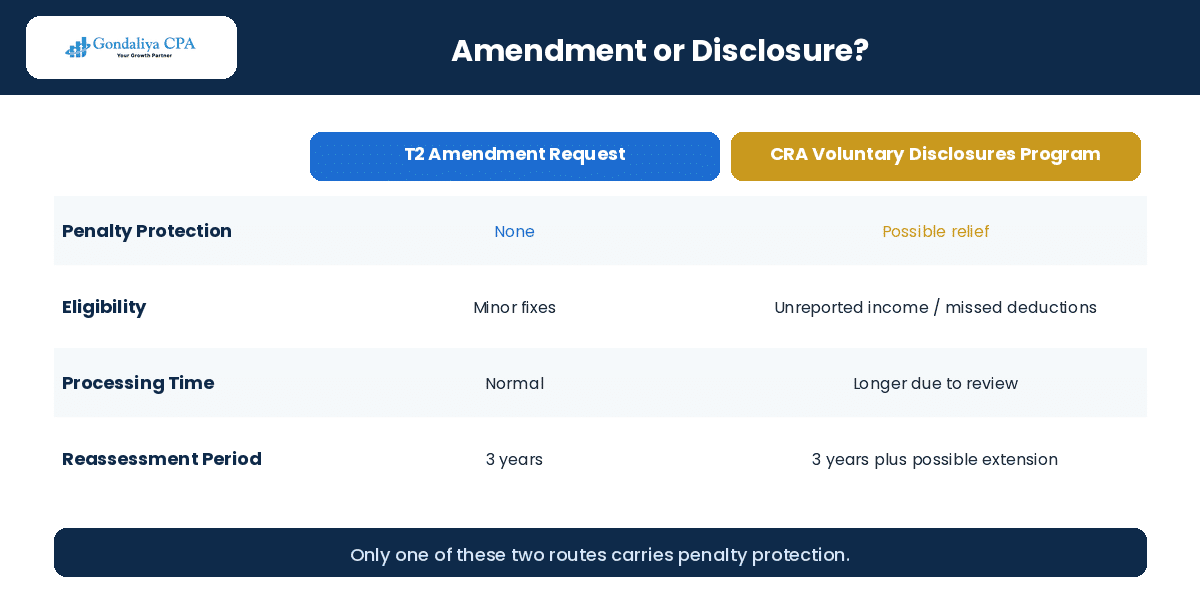
Differences Between CRA Voluntary Disclosures Program and T2 Amendment Requests
The CRA Voluntary Disclosures Program lets companies fix unreported income or other mistakes without penalties. It’s for businesses that want to come clean before the CRA notices. On the other hand, a T2 amendment request is when you officially change your already filed return because of errors. Both aim to fix problems, but they work differently:
- Penalty Protection: The VDP can protect you from penalties if you meet rules. Amending a return won’t stop penalties.
- Who Can Use It: The VDP is for voluntary, full disclosures about missed income or deductions that could cost taxes. Amendments cover smaller mistakes.
- How Long It Takes: Amendments usually process in the normal time the CRA takes. VDPs may take longer since CRA checks everything carefully.
- What You Must Tell CRA: VDP needs all facts upfront, including past errors or missing info.
Scenarios Suitable for Voluntary Disclosure versus Simple Amendments
Deciding between VDP and amendments depends on your case:
- If your company missed reporting big amounts of income over years and the CRA hasn’t started any enforcement like audits, the VDP makes sense.
- But if you find small errors like math mistakes or forgotten deductions with no risk of penalty, just file an amendment.
Knowing when to pick which option helps reduce risks and clears up your tax issues quickly.
Impact on Reassessment Period, Penalties, and Interest Treatment
Both options affect how long the CRA can check your return:
- Normally, reassessment lasts three years from filing date unless there’s serious wrongdoing. This applies to both amendments and VDP.
- The VDP might lower interest charges on unpaid taxes if you qualify since it shows you acted in good faith.
Here’s a quick look:
| Aspect | T2 Amendment Request | CRA Voluntary Disclosures Program |
|---|---|---|
| Penalty Protection | None | Possible relief |
| Eligibility | Minor fixes | Unreported income / missed deductions |
| Processing Time | Normal | Longer due to review |
| Reassessment Period | 3 years | 3 years plus possible extension |
To sum up, knowing these differences helps you choose the right way to fix corporate tax mistakes under Canadian rules. Pick carefully based on what fits your situation best.
The decision is usually settled by one question rather than a weighing of pros and cons. If penalties could attach to the amount and the CRA has not made contact, the disclosure route is the one that protects you. Figures changed for privacy.
Key Stat: A T2 adjustment request carries no CRA fee, and the normal reassessment period runs three years from the notice of assessment. Neither of those facts gives you penalty protection.
Eligibility Criteria for Voluntary Disclosure and Corporate Tax Amendments
Eligibility Criteria for Voluntary Disclosure and Corporate Tax Amendments
The Eligibility
Knowing who fits the CRA Voluntary Disclosures Program (VDP) versus when to simply fix a corporate tax return in Canada helps businesses avoid trouble. Both options have different rules. These affect penalties, interest, and how corrections work.
Who Qualifies for the CRA Voluntary Disclosures Program in Canada
The CRA VDP lets companies admit past mistakes on tax returns before CRA starts any checks or actions. To be a voluntary disclosure corporation here, you need to meet some strict rules:
- Voluntary: You must come forward before the CRA begins an audit, investigation, or enforcement related to your problem.
- Complete Info: You have to reveal all the details about the error or missing info. No hiding stuff.
- Risk of Penalties: There must be possible penalties or interest because of missed income, deductions, or unfiled returns.
- One-Year-Past-Due Rule: The issue should be at least one year late from when it was originally due.
- Pay or Plan to Pay: The company agrees to pay what’s owed now or set up a payment plan.
If you follow these rules, you can get some penalty relief. Usually, that means no penalties except if gross negligence is involved. The exact details are in Information Circular IC00-1R6.
Here’s a key fact:
Corporations using VDP avoid penalties but still pay the taxes owed. Cases of gross negligence don’t get full penalty relief.
This program fits companies facing big penalty risks. Like if a store finds they forgot to report sales on an online platform. Using VDP may save more than just fixing the return.
Conditions and Requirements for Filing a T2 Adjustment Request
If you just want to correct small mistakes on your corporate tax return without risking penalties, filing a T2 adjustment request is better. Here’s what matters:
- Type of Error: Simple errors like math slips, misclassifying expenses, or missing deductions found within reassessment periods.
- Reassessment Period: Corrections must happen within three years after the original notice of assessment.
- No Ongoing Audits: No current CRA audits or investigations on those issues.
- Good Records: You need all documents ready to prove your corrections.
The CRA doesn’t charge any fee for T2 adjustment requests. But having clear info helps speed things up and avoids extra questions.
Example:
Say a company in Toronto notices it put capital asset purchases in the wrong expense group two years after filing. A T2 adjustment fixes this quickly with no penalty risk if done soon enough.
| Condition | Requirement | Source |
|---|---|---|
| Error type | Math mistakes / classification / missed deduction | CRA – T2 Adjustment Requests |
| Reassessment period | Within 3 years after Notice of Assessment | ITA s.152(4) |
| Enforcement contact | None ongoing | IC00‑1R6 |
| Documentation | Full supporting records | CPA Canada standards |
Exclusions and Limitations under Both Processes
Both voluntary disclosures and amendments have important limits:
Gross Negligence Penalty Rate
If CRA finds gross negligence—that means deliberate tax evasion—penalty relief is denied even with VDP.
One-Year-Past-Due Rule
VDP applies only if the issue is at least one year past due. If not, you usually fix things by amendment within reassessment windows as long as no audit has started.
Other limits include:
- You still owe all taxes and interest owed even if penalties are waived unless other taxpayer relief applies.
- If disclosure isn’t truly voluntary, you lose access to VDP benefits and may face audits with full penalties.
Choosing between “CRA VDP vs amendment” depends on timing, how much risk there is, your records’ completeness, and if CRA has contacted you before.
Sharad Gondaliya, CPA, has over 10 years helping Canadian business owners keep their books straight.
The one-year rule is what surprises owners most. An error found nine months after the deadline cannot go through the disclosure route yet, which changes the sequencing of the whole engagement. Figures changed for privacy.
Risk Warning: Gross negligence is the ceiling on relief. Where the CRA concludes the omission was deliberate, penalty relief is denied even under a disclosure, and the exposure reaches half the unpaid tax.
Step-by-Step Process to Amend Corporate Tax Returns and Submit a Voluntary Disclosure
Step-by-Step Process to Amend Corporate Tax Returns and Submit a Voluntary Disclosure
The Process
How to Prepare and Submit a T2 Adjustment Request for Corporate Tax Correction
A T2 adjustment request fixes mistakes on your corporate tax return in Canada. You use it when you want to correct errors but don’t need penalty protection. This can cover things like wrong expense classifications, missed deductions, or math mistakes.
To prepare your T2 adjustment request:
- Find the exact error on the original return.
- Gather proof like invoices, bank statements, or contracts.
- Fill out Form T2 Adjustment Request or send an amended return through CRA’s My Business Account.
- Figure out if you owe more tax or if you should get a refund.
- Write down why you need these changes.
There is no fee from CRA for filing a T2 adjustment. But if you hire a CPA to help fix your corporate taxes, they might charge a fee.
Quick steps:
| Step | What to Do |
|---|---|
| Spot the error | Pinpoint the exact mistake |
| Gather proof | Collect invoices, ledgers, bank records |
| File request | Submit Form T2 Adjustment via paper or e-file |
| Pay tax owed | Pay what you owe fast to avoid extra interest |
This method suits companies that want to fix simple errors before CRA starts any audit or enforcement. It doesn’t remove penalties or interest if those already apply.
Filing a Complete and Eligible CRA Voluntary Disclosure Program Application
The CRA Voluntary Disclosures Program (VDP) lets companies fix past tax errors and maybe dodge penalties or prosecution. It works if you might face penalties because of late filings or unreported income over a year old.
Here’s how to file a VDP application:
- Make sure you volunteer — no active audits or enforcement notices.
- Give full details of all facts, years, and amounts affected.
- Fill out Form RC199 to start the VDP process.
- Add detailed letters explaining why you missed the rules.
- Include all supporting papers like past returns, bank info, payroll data, and GST/HST filings.
- Suggest payment plans if paying right away is hard.
CRA demands full and timely disclosures per Information Circular IC00-1R6 rules.
Key conditions:
| Condition | What It Means |
|---|---|
| Voluntariness | No ongoing audit or enforcement |
| Completeness | Full info about everything |
| Penalty Exposure | Penalties possible without VDP |
| One-Year Past Due Rule | More than 1 year since filing deadline |
If accepted, VDP may reduce penalties but won’t erase taxes owed plus interest unless special relief applies.
Important Documentation and Timelines to Observe
Good paperwork helps both amendment requests and VDP applications go smoothly. Also, watch important deadlines:
- Corporate Record Retention: Keep books and records at least six years after the last taxation year they cover (Corporations Canada).
- Normal Reassessment Period: CRA usually reassesses corporate returns within three years of the original assessment date (CRA ITA s152(4)). After that, changes aren’t accepted unless under special relief rules.
- One-Year-Past-Due Rule: For voluntary disclosures of late files or missing income more than one year overdue; eligibility depends strictly on this rule (CRA Record Keeping Requirements, Canadian Revenue Agency – Normal Reassessment Period).
Your documents should include:
- Original filed returns
- Financial statements
- Bank statements
- Payroll summaries
- GST/HST payment details
- Shareholder loan records
Keep these organized so review happens faster whether amending returns or using VDP.
Working with a CPA or Tax Professional for Compliance and Accuracy
Hiring a CPA Ontario member helps make sure your corporate tax corrections are right. Whether amending returns or submitting voluntary disclosure corporation applications under CRA programs, expert help counts.
Gondaliya CPA offers fixed-fee services in Toronto/Ontario for incorporated businesses facing issues like missed deductions, unreported revenue fixes, GST/HST errors, payroll source deduction problems—trusted by over 1300 five-star reviews showing clients get fast replies (even weekends on request).
Reasons to work with pros:
- Spot if penalties apply or simple fixes suffice
- Prepare exact adjustment requests based on current rules
- Fill out RC199 forms plus write clear explanation letters
- Arrange payment plans that suit cash flow
- Represent clients in talks with CRA during audits
Experts reduce risks from choosing wrong between amendments vs voluntary disclosure programs — a choice that affects penalty relief chances under Canadian law.
Contact Gondaliya CPA at 647‑212‑9559 / info@gondaliyacpa.ca for free consults focused on fixing past tax returns while staying compliant across Ontario & Canada.
Where a T2 adjustment goes slowly, the cause is nearly always the explanation. The corrected figure is right, but nothing on file tells the reviewer why it changed, so a question comes back. Figures changed for privacy.
Review Procedures, Outcomes, and Relief Available Through VDP and Amendments
Review Procedures, Outcomes, and Relief Available Through VDP and Amendments
The Outcomes
CRA’s Review Process for Voluntary Disclosure Applications and Amendments
The CRA treats voluntary disclosure corporation requests differently than normal amendments. When you amend corporate tax return Canada filings outside the VDP, CRA checks if the corrections fit within usual reassessment periods. They just want to make sure the changes are right. But no penalty relief comes with this.
With a VDP application, CRA digs deeper. They check if your disclosure is voluntary and complete. It must cover errors at least a year old that could lead to penalties or interest. CRA looks at all the years you disclose at once to decide on relief.
Both methods need solid paperwork like corrected returns, bank records, GST/HST filings, payroll info, and shareholder details. But VDP asks for more openness about missed income or mistakes to grant penalty relief.
So, if you want corporate tax correction, pick carefully before sending files to CRA offices in Toronto or anywhere in Ontario.
Possible CRA Decisions: Acceptance, Rejection, or Additional Information Requests
After you send in your amendment or voluntary disclosure corporation request to fix tax mistakes:
- Acceptance:
If you filed an amended T2 return on time and no penalties are likely, CRA usually accepts it after checking docs and numbers. For qualified VDP cases that meet all rules — including being truly voluntary — CRA grants partial or full penalty and interest relief but makes you pay owed taxes. - Rejection:
If your amendment is incomplete or late with no good excuse; or if your voluntary disclosure fails (like if you’re under audit), CRA will reject it. No penalty protection follows here; enforcement may start. - Additional Info Requests:
Often, CRA asks for more proof to clear up differences between your original and corrected filings. Answer fast to boost acceptance chances but know it won’t guarantee approval.
Make sure you prepare detailed support schedules when amending past T2 returns in Canada to avoid hold ups.
Penalty Relief, Interest Treatment, and Protection from Prosecution through VDP
Choosing voluntary disclosure corporation over just amending corporate tax return Canada filings has perks:
- Penalty Relief: Following IC00‑1R6 rules, accepted disclosures usually wipe out gross negligence penalties on undisclosed amounts — something standard amendments can’t do.
- Interest Treatment: You still owe any unpaid taxes no matter what, but interest might be reduced partially under VDP’s relief options.
- Protection From Prosecution: If CRA accepts your voluntary disclosure properly, you get protection against criminal charges tied to what you revealed. Amended returns don’t offer this shield since they lack formal protection.
That’s why many companies facing big risks work with CPA firms skilled in both approaches before deciding how to fix old tax returns safely.
Understanding the Risk of Gross Negligence Penalty and How VDP Mitigates It
Gross negligence penalties can hit up to 50% on unpaid taxes caused by careless errors like forgetting income. These punish bad behavior but also catch those who mess up without fixing things fast.
Just filing an amended return doesn’t stop these penalties once CRA finds them.
But:
- Using the Voluntary Disclosures Program means corporations coming forward voluntarily before audits can avoid most gross negligence penalties.
- Relief varies depending on when you disclose—limited vs general tracks apply near assessment deadlines.
Picking the wrong path between amendment vs VDP could cost your business a lot. Talk to pros who know current rules up through 2026 about gross negligence penalties.
Sharad Gondaliya, CPA, has over 10 years helping many Canadian business owners get their finances sorted out.
Protection from prosecution is the difference owners tend to overlook. An amendment corrects the return, but it carries no formal shield, and that distinction only matters once it is too late to change route. Figures changed for privacy.
Pro Tip: When the CRA comes back asking for more proof, answer within days rather than weeks. A prompt, complete reply does not guarantee acceptance, but a slow one materially reduces the odds.
Practical Considerations and Case Examples of Corporate Tax Corrections in Canada
Practical Considerations and Case Examples of Corporate Tax Corrections in Canada
The Examples
Common Types of Corporate Tax Filing Errors Addressed by VDP or Amendments
Companies make different types of errors when filing corporate taxes. These mistakes decide if they should use CRA’s Voluntary Disclosures Program (VDP) or simply amend corporate tax return Canada with a T2 change.
Here are some common errors:
- Math errors like wrong calculations. Usually, these need an amendment.
- Classification mistakes, such as mislabeling expenses or income types. These often get fixed with amendments.
- Missed credits or deductions that the company forgot to claim. If there’s no penalty risk, an amended return usually works.
- Unreported income, for example cash sales or foreign earnings. This often calls for a VDP because penalties and interest may apply.
- Unfiled past returns that need full disclosure under VDP rules.
- GST/HST errors and unpaid source deductions. These can trigger penalties, so voluntary disclosure may be required.
Deciding between CRA VDP vs amendment depends on penalty risk and whether the issue is still voluntary. Amendments fix mistakes within reassessment limits but don’t protect against penalties. VDP can stop penalties and prosecution but has strict rules from the CRA.
Case Illustrations of Successful Voluntary Disclosures and Tax Return Amendments
We’ve seen companies benefit from picking the right path based on their case.
Example 1: Fixing Minor Classification Errors
A tech startup in Toronto found it overstated asset costs on its T2 returns for two years. Since there was no penalty threat and they caught it early, they filed amended returns quickly. This kept things simple and clean.
Example 2: Voluntary Disclosure for Unreported Income
An Ontario e-commerce firm discovered unreported platform sales over three years, past one year late, with interest added. They used our help to file a full RC199 VDP application. The CRA waived gross negligence penalties after full disclosure, and payment plans were arranged to protect shareholder value.
These examples show how knowing when to amend versus disclose affects money saved and staying compliant.
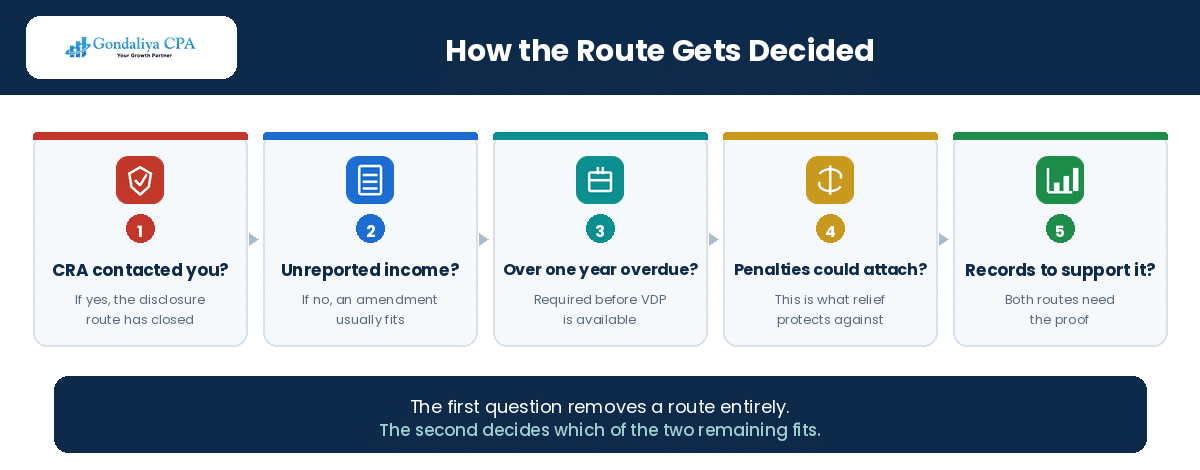
Strategies to Minimize Penalty Exposure During the Reassessment Period
To keep penalties low, act fast when you spot errors. Here’s how:
- Catch mistakes early: Check records often before reassessment deadlines end (usually three years after filing).
- Check voluntariness: Fix problems before CRA starts looking to qualify for relief options like VDP.
- Keep solid proof: Gather bank statements, invoices, payroll info, and foreign asset details to back up corrections.
- Assess penalty risk: Look if any errors involve gross negligence or repeat issues that lead to bigger penalties under ITA s.163(2).
- Pick correction method wisely: Use amendments if only small math or classification fixes exist with no penalty risk; choose VDP otherwise.
Doing this cuts chances of an audit getting worse and can help get better relief in 2026 after policy updates on gross negligence.
Tips for Disclosing Unreported Income and Foreign Asset Reporting under VDP
Reporting unreported income—especially foreign assets—is tricky but needed under Canada’s voluntary disclosure corporation rules:
- Disclose fully all affected tax years; partial reports may get rejected.
- Add detailed reconciliations showing where unreported funds came from, backed by third-party papers if possible.
- For missed foreign asset reports (like T1135 forms), give exact valuations using current exchange rates at relevant times per Corporations Canada rules.
- Write clear reasons why income wasn’t reported before plus what steps fixed the problem inside your company—this supports the “voluntary” claim needed for relief.
- Work with pros who know how to fill out Form RC199 well for complex cross-border cases common among holding companies or real estate investors in Ontario/Toronto.
These tips help build trust during CRA’s review in their updated 2026 approach focused more on openness than punishment.
The two cases above illustrate the split neatly. Same firm, same year, opposite routes, because one had no penalty exposure and the other had three years of unreported platform sales behind it. Figures changed for privacy.
Additional Resources and Support for Corporate Tax Compliance and Disclosure
Additional Resources and Support for Corporate Tax Compliance and Disclosure
The Resources
Overview of CRA Tax Audit Process Relevant to Corporate Tax Filing Errors
The Canada Revenue Agency (CRA) checks corporate tax filings to make sure they are correct. When companies find mistakes, like wrong income reports or missed deductions, they can fix these by amending their T2 return or using the Voluntary Disclosures Program (VDP). The audit usually starts with a letter asking for info. If the CRA finds problems, it may change the tax amount owed.
Knowing this process helps companies fix their taxes properly. Amending a return works if done within the normal time allowed, but it does not remove penalties if they apply. The VDP can stop penalties and prosecution if the disclosure is honest and complete. Picking the wrong option might lead to bigger fines or extra interest.
Businesses in Toronto and Ontario should watch for audit triggers, like mismatched data from other sources. Keeping good records helps support either choice.
Importance of Timely Disclosure and Accurate Documentation Submission
Fixing corporate tax mistakes quickly matters a lot. Whether you file an amended T2 return or send a voluntary disclosure corporation request, acting fast lowers risks. You have to follow deadlines like the reassessment period or meet VDP rules that say your disclosure must be late by over a year.
Clear records back up your claims. These include financial reports, bank statements, GST/HST filings, payroll info, shareholder loan data, and foreign asset details if needed.
If you send incomplete papers, processing slows down or your VDP relief might get denied. Fixing returns without full truth means you could lose penalty protection even if you pay taxes owed right away.
Good record keeping makes talking with CRA auditors easier when fixing corporate tax problems in Canada.
CPA Tax Compliance Services Including VDP Assistance and Corporate Tax Correction
Getting help from a CPA Ontario member who knows amend corporate tax return Canada rules can make a big difference. Firms like Gondaliya CPA help businesses in Toronto and nearby areas figure out when to use CRA VDP vs amendment options.
- Finding out what errors exist and how serious they are.
- Checking risks for penalties vs chances to go voluntary.
- Preparing corrected tax returns with all details.
- Filling out Form RC199 for VDP requests.
- Setting up payment plans with CRA.
- Speaking for clients during follow-ups after submissions.
Working with skilled CPAs avoids mistakes like missing info or filing late that hurt relief chances. They know common filing errors in industries such as real estate or e-commerce.
Gondaliya CPA offers fixed fees and quick replies without surprise costs — very helpful during tricky fixes involving fines or interest.
How to Contact Gondaliya CPA for Expert Guidance on CRA Voluntary Disclosure and Amendments
If you run a corporation and wonder about voluntary disclosure corporation applications or want to amend corporate tax return Canada filings, Gondaliya CPA can help. They offer free talks to understand your case in Toronto/Ontario areas plus across Canada.
You can reach them by:
- Phone: 647‑212‑9559
- Email: info@gondaliyacpa.ca
They usually answer within one business day. Weekend or evening help fits busy schedules too. First chats focus on your specific issues before suggesting the best way to fix things under 2026 CRA rules on adjustments and VDP.
Getting advice early improves your chances of fixing things well without extra problems.
Links to Official CRA Publications, Forms (e.g., Form RC199), and Relevant Tax Authorities Information
Here are official links for checking details about CRA VDP vs amendment choices:
| Resource | Description | Link |
|---|---|---|
| Information Circular IC00‑1R6 | Explains how the Voluntary Disclosures Program works | Canada.ca – IC00‑1R6 |
| Form RC199 – Application for Voluntary Disclosures Program Relief | Form needed to apply for voluntary disclosure | Canada.ca – Form RC199 |
| T2 Corporation Income Tax Return Guide | Instructions on amending returns using T2 adjustments | Canada.ca – T2 Guide |
| GST/HST Memorandum 16–5 – Voluntary Disclosures Program Details Specific To GST/HST Filings | Rules about corrections for GST/HST under VDP | Canada.ca – Memo 16–5 |
These help show differences between fixing returns normally and making full voluntary disclosures — important stuff before moving forward.
Audit triggers are rarely mysterious. Most begin with data that does not match, a slip filed by a third party against a figure that never appeared on the return. Figures changed for privacy.
Frequently Asked Questions (FAQs) on CRA VDP vs Amendment and Corporate Tax Corrections
Frequently Asked Questions (FAQs) on CRA VDP vs Amendment and Corporate Tax Corrections
FAQ
What is the difference between amending a T2 and filing a voluntary disclosure?+
Amending a T2 fixes minor errors within the reassessment period without penalty relief. Filing a voluntary disclosure corrects major omissions or errors outside normal periods, possibly avoiding penalties.
When is a simple T2 adjustment request the right route?+
Use a T2 adjustment for small mistakes like math errors or missed deductions when no audits are ongoing and reassessment deadlines apply.
When does a corporation need the Voluntary Disclosures Program instead?+
VDP applies if the error involves unreported income, large omissions, or missed filings beyond one year with potential penalties and no CRA enforcement started.
What are the CRA conditions a corporate VDP application must meet?+
The disclosure must be voluntary, complete, relate to issues over one year past due, involve potential penalties, and be made before any audit or enforcement.
What are the risks of amending when you should have disclosed?+
Filing an amendment instead of VDP may lead to full penalties, interest charges, and no protection from prosecution.
How does timing decide which route is still available?+
If inside three years of assessment with no audit, amend. If late or at penalty risk with no audit started, use VDP. After audits begin, options narrow significantly.
CRA VDP vs Amended T2 vs Taxpayer Relief Request: What is the difference?+
VDP offers penalty relief for voluntary disclosures. Amended T2 fixes errors without penalty relief. Taxpayer Relief addresses extraordinary hardship but doesn’t cover voluntary errors.
What records support each route?+
Both require original returns, financial documents, invoices, bank statements, and payroll info. VDP needs fuller disclosure including all related facts and prior omissions.
How do you assess which option fits before you file anything?+
Evaluate error size, timing since filing, audit status, penalty risk, and completeness of records. CPA advice helps avoid costly mistakes.
What does CRA review under each route?+
CRA reviews accuracy for amendments; for VDP they check voluntariness, completeness, and penalty eligibility before granting relief.
How do you handle missing records before correcting a return?+
Try reconstructing data from third-party sources or estimates. Document efforts made to find info to support corrections or disclosures.
What happens if CRA denies the adjustment or the disclosure?+
CRA rejects amendments if late or incomplete; rejects VDP if not fully voluntary or after audit starts. This may trigger penalties and enforcement actions.
What compliance systems prevent a repeat correction?+
Maintain accurate bookkeeping, regular tax reviews by CPAs, staff training on tax rules, and internal controls for timely reporting.
Key Points on Corporate Tax Correction Processes at Gondaliya CPA
Key Points on Corporate Tax Correction Processes at Gondaliya CPA
Quick Reference
- Normal T2 Reassessment Period: CRA allows corrections within three years of notice of assessment.
- VDP One-Year-Past-Due Rule: Disclosures must concern issues more than one year overdue to qualify for VDP relief.
- Gross Negligence Penalty Rate: Penalties can reach 50% on unpaid taxes due to intentional errors without proper disclosure.
- Corporate Record Retention Requirement: Keep all relevant tax records for at least six years after the fiscal year ends.
- Maximum Voluntary Disclosure Relief: VDP can eliminate most penalties but taxes and some interest remain payable.
- T2 Adjustment Request Fee: No fees apply to filing adjustment requests directly with CRA. CPA fees vary by service scope.
- Typical VDP Processing Time: Processing may take several months due to thorough CRA review processes.
- Fixed Fee for Corporate Tax Correction: Gondaliya CPA offers transparent fixed fees tailored to your correction complexity.
Scope and Assumptions in Corporate Tax Corrections
- Services cover tax return amendments and voluntary disclosures under Canadian law up to 2026 rules.
- Timely submission within reassessment periods or one-year past due for disclosures is assumed.
- Clients provide full cooperation with accurate documentation.
- Services exclude legal defense in criminal tax matters.
- Advice tailored to incorporated businesses across Ontario & Canada served by Gondaliya CPA.
How to Choose the Right CPA Firm in Toronto/Ontario for Corporate Tax Correction?
- Select firms licensed by CPA Ontario with Canadian tax expertise.
- Look for fixed-fee pricing models to avoid surprises.
- Check client reviews for responsiveness and accuracy.
- Confirm knowledge of both amendment and VDP procedures.
- Prefer firms offering free initial consultations like Gondaliya CPA.
- Ensure availability during busy seasons including weekends if needed.
What Deliverables Do You Get from Gondaliya CPA’s Corporate Tax Correction Services?
- Detailed assessment report outlining correction options.
- Prepared Form T2 adjustments or RC199 voluntary disclosure applications.
- Comprehensive support documents ready for CRA submission.
- Strategic payment plan arrangements if applicable.
- Clear communication on timelines and potential outcomes.
- Representation in follow-ups with CRA auditors as needed.
What Are the Risks of Choosing the Wrong Correction Route?
- Increased penalties if serious omissions aren’t voluntarily disclosed via VDP.
- Longer processing delays when incorrect forms filed.
- Higher interest charges due to delayed payments.
- Potential loss of protection from prosecution in severe cases.
- Risk of triggering detailed audits increasing costs and stress.
What Should a Corporation Prepare Before a Correction or VDP Engagement Starts?
- Original filed tax returns for all affected years.
- Supporting financial documents: invoices, bank statements, contracts.
- GST/HST filings and payroll summaries relevant to corrections.
- Shareholder loan details if impacting taxable income.
- A summary letter explaining discovered mistakes clearly.
How Does the VDP vs Amendment Choice Apply Across 10 Industries We Serve?
Each industry has unique filing complexities:
- Retail – Unreported cash sales often require VDP.
- Real Estate – Missed capital cost allowances usually amended.
- Tech Startups – Small expense misclassifications amendable quickly.
- E-Commerce – Foreign revenue omissions fit well in VDP programs.
- Manufacturing – Inventory valuation errors corrected by amendment mostly.
- Professional Services – Overlooked income calls for voluntary disclosure sometimes.
- Construction – GST/HST remittance errors may need VDP reliefs at times.
- Hospitality – Payroll source deduction mistakes often amended routinely.
- Transportation – Fuel tax credits missed corrected by amendments usually.
- Finance/Investment Firms – Complex foreign asset issues often require full disclosures via VDP.
For expert assistance on corporate tax corrections or voluntary disclosures contact Gondaliya CPA at 647‑212‑9559 or info@gondaliyacpa.ca for personalized help.
The route is chosen once per matter and cannot be undone later. That is why the assessment happens first, before any form is prepared or anything reaches the CRA. Figures changed for privacy.
Industry Spotlights: Sectors We Represent
Industry Expertise
Each sector arrives at the correction question differently. Here are eleven and which route usually fits.
| Industry | Typical Error and Usual Route |
|---|---|
| Technology startups & SaaS | Expense misclassification, usually amended |
| E-commerce & online retailers | Foreign and platform revenue omissions, usually VDP |
| Consulting firms | Overlooked income, sometimes VDP |
| Construction, contractors & skilled trades | GST/HST remittance errors, sometimes VDP |
| Property developers & builders | Project cost timing errors, usually amended |
| Real estate investors & holding companies | Missed capital cost allowance, usually amended |
| Transportation, logistics & trucking | Missed fuel tax credits, usually amended |
| Restaurants & food and beverage | Unreported cash sales, usually VDP |
| Daycare, childcare & CWELCC services | Subsidy revenue timing, usually amended |
| Dentists & dental practices | Shareholder benefit adjustments, route depends |
| Medical doctors & physician corporations | Unfiled returns, usually VDP |
- Technology startups & SaaS: Small expense misclassifications carry no penalty risk, so an amendment normally settles them quickly.
- E-commerce & online retailers: Foreign and marketplace revenue omissions bring penalty exposure, which points to the disclosure route.
- Consulting Firms: Overlooked income calls for a disclosure where the amount is material and more than a year overdue.
- Construction, general contractors & skilled trades: GST/HST remittance errors can attract penalties, so the route depends on the size and age of the gap.
- Property developers & builders: Cost timing across project corporations is usually a classification question, correctable by amendment.
- Real estate investors, landlords & holding companies: Missed capital cost allowance is a claim never made rather than income never reported, so an amendment fits.
- Transportation, logistics & trucking: Missed fuel tax credits are recoverable by amendment where the period is still open.
- Restaurants & food and beverage: Unreported cash sales carry the clearest penalty exposure of any category here, and belong in a disclosure.
- Daycare, childcare & CWELCC services: Subsidy revenue recognised in the wrong period is a timing correction rather than an omission.
- Dentists & dental practices: Shareholder benefits sit on the line, and whether penalties could attach decides the route.
- Medical doctors & physician professional corporations: Unfiled returns are the classic disclosure case, because the exposure is penalties rather than a wrong figure.
Two files can look identical on the surface and take opposite routes. The deciding factor is whether the correction adds income that was never reported or simply reclassifies something already on the return. Figures changed for privacy.
Professional Guidance and Quick Reference
Guidance
Professional Guidance on Corporate Tax Corrections: How Gondaliya CPA Supports Canadian Businesses
Choosing between an adjustment request and a voluntary disclosure is a judgment made once, and it cannot be revisited once something has been filed. The error has to be characterised correctly, the reassessment period has to be checked against the filing date, penalty exposure has to be assessed honestly, and enforcement contact has to be ruled out. Gondaliya CPA does that assessment before anything is prepared, on a fixed fee.
We handle what decides the outcome: identifying whether the correction adds unreported income or reclassifies existing figures, confirming which years remain open, preparing either the T2 adjustment with its supporting schedules or the RC199 with its explanation letter, proposing a payment arrangement where tax is owing, and representing you through the review.
Our team works from your own records rather than a template, and will tell you plainly when the cheaper route is also the riskier one. Whether the error is one year old or five, you get clear advice and a fixed price before we start.
Quick Answers: Key Numbers & Concepts at a Glance
At a Glance
- Normal reassessment period: Three years from the notice of assessment
- VDP minimum age: More than one year past due
- Record retention: At least six years after the fiscal year ends
- Gross negligence penalty: Up to 50% of the unpaid tax
- T2 adjustment fee: No CRA fee applies
- VDP processing: Several months, review is thorough
- Penalty relief: Available under VDP, never under a plain amendment
- Prosecution protection: VDP only, once properly accepted
- Governing provisions: ITA s.152(4), s.163(2), s.220(3.1)
- Program guidance: Information Circular IC00-1R6
Who This Is For / Not For
Fit Check
- For: Incorporated businesses that have found an error in a filed T2 return and need to decide whether penalty exposure makes a disclosure the safer route.
- Not For: Corporations already under audit or enforcement on the matter, where the disclosure route has closed, or current-year returns not yet filed.
People Also Ask
Quick Answers
Can I file both an amendment and a disclosure?+
Not for the same issue. The route is chosen once per matter, which is why the assessment happens before anything is submitted.
Does an amendment restart the reassessment clock?+
No. The normal period still runs from the original notice of assessment, so a late-discovered error can fall outside it entirely.
What if only some years are inside the reassessment period?+
That is common, and it often points toward a disclosure covering all years rather than amendments covering only the recent ones.
Glossary of Key Terms
Plain-English Definitions
- T2 adjustment request: A formal request to change a corporate return already filed.
- Voluntary Disclosures Program: The CRA route for correcting errors before detection, with penalty relief.
- Form RC199: The application form used to make a voluntary disclosure.
- Normal reassessment period: Three years from the notice of assessment under section 152(4).
- Notice of assessment: The CRA statement confirming how a filed return was assessed.
- Gross negligence penalty: A penalty under section 163(2) for deliberate or reckless errors.
- Taxpayer relief request: A separate route seeking waivers for hardship or extraordinary circumstances.
- Voluntariness: The requirement that no CRA enforcement has begun on the matter.
- Completeness: The requirement to disclose every affected year, account and fact.
- One-year-past-due rule: The requirement that the issue be over a year overdue for VDP.
- Unreported income: Revenue that was earned but never included in a filed return.
- Classification error: An amount recorded in the wrong account or expense category.
- Capital cost allowance: The deduction for depreciation of capital assets over time.
- T1135: The form reporting specified foreign property holdings.
- Interest relief: Partial reduction of interest available under section 220(3.1).
- Prosecution protection: The shield from criminal charges attaching to an accepted disclosure.
Correction Route Check
This quick self-check indicates which correction route is likely to fit. Please answer the six questions below.
Correction Route Check
Six quick questions on the error. No fee shown.
Points to raise with us:
This is a general prompt, not tax or legal advice or a quote. Your position depends on your full facts. For a real review, please book a free consultation.
Want a checklist to work from? You can download our free correction route checklist before your consultation.
Check enforcement contact first, because it removes one route entirely. Then ask whether the correction adds unreported income or simply reclassifies what is already there. Unreported income with penalty exposure and more than a year overdue points to a disclosure. Everything else, inside the open period, is an amendment.
2026 Update — what is current: Policy notes effective January 2026 revise corporate tax correction practices, the general and limited relief tracks continue to apply, and the CRA’s stated approach leans further toward openness over punishment. The three-year reassessment period, six-year retention rule and gross negligence rate under section 163(2) are unchanged. Please confirm current policy before relying on the figures in this article.
CRA VDP vs amendment: How to amend corporate tax return Canada and corporate tax correction options with Gondaliya CPA
Get the route right the first time
Gondaliya CPA assesses the error, confirms which years remain open, checks whether penalties could attach, and prepares either the T2 adjustment or the RC199 disclosure with full supporting documents and a payment arrangement where tax is owing, on a fixed fee with a one-business-day response. Please book a free consultation.
Next Steps
Please book a free consultation with Gondaliya CPA before filing anything, because the route is chosen once. Bring the original returns for every affected year, the supporting documents you have, and tell us plainly whether the CRA has been in touch. You will get a fixed fee before any work begins. If our content helps, please add gondaliyacpa.ca as a preferred source on Google.
Published: August 13, 2026 · Last updated: August 13, 2026
Editorial policy: We research against CRA and CPA Ontario sources, fact-check the figures, and Sharad Gondaliya, CPA, reviews the content, which we update as the rules change.
Disclaimer: This article is educational information only and is not tax, legal, or financial advice. Figures marked illustrative are examples rather than quotes or guarantees. It reflects CRA rules current to 2026, including the three-year normal reassessment period under ITA s.152(4), gross negligence penalties under s.163(2), taxpayer relief under s.220(3.1), the one-year-past-due rule, and the six-year record retention requirement. Fees, periods and program conditions change and outcomes depend on your specific facts. Please consult a CPA Ontario member before acting.

Sharad Gondaliya is a CPA Canada & CPA USA with 15 Years+ experience of Accounting, Tax, Payroll of Corporate Small Businesses as Tax Accountant. He is a CPA Ontario member (61040184) and holds US CPA licences in Washington and Montana and is well known among corporate small businesses for tax planning, efficient tax solutions, and affordable CPA services. Sharad is the Principal (Director) of Gondaliya CPA – Affordable CPA Firm in Canada. Licenses: CPA Ontario: 61040184 | CPA USA (MT): PAC-CPAP-LIC-033176 | CPA USA (WA): 57629 | CPA Firm License: 61330051 View Full Author Bio