



Common VDP Filing Mistakes That Can Put a Canadian Corporation’s Voluntary Disclosure at Risk
Avoiding CRA voluntary disclosure mistakes in Canada is key to securing general or limited relief under the Voluntary Disclosures Program, and Gondaliya CPA offers expert advice on selecting a qualified VDP accountant Canada for seamless corporate tax compliance. They assist with GST/HST reporting, amended T2 return filing, payment arrangements, and address common CRA rejection reasons to reduce penalty and interest risks.
Quick Summary
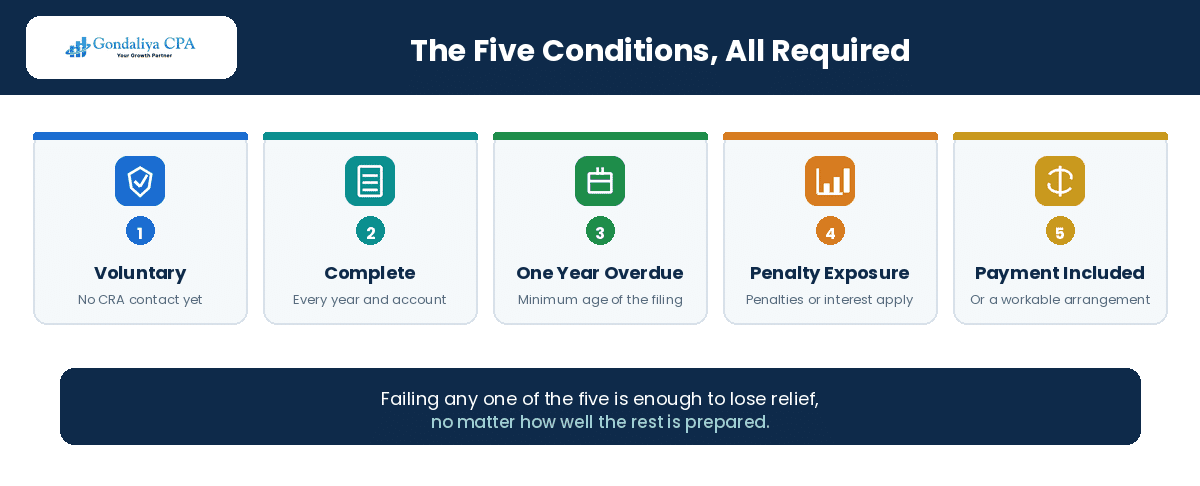
A corporate disclosure has to be voluntary, complete, at least one year overdue, carry penalty or interest exposure, and include payment or a payment arrangement. Please note that failing any one of those five is enough to lose relief entirely, no matter how well the rest is prepared.
| Aspect | Details |
|---|---|
| The five conditions | Voluntary, complete, one year overdue, penalty exposure, payment. |
| The two tracks | General relief for a full waiver, limited relief for a partial one. |
| The form | RC199, fully completed and signed by an authorized person. |
| The timing | Before any CRA enforcement contact, or it is no longer voluntary. |
Reading time: 33 minutes.
Table of Contents
- What Is the Voluntary Disclosures Program (VDP)?
- Avoiding Common CRA Voluntary Disclosure Mistakes in Canada
- Preparing a Complete and Accurate VDP Submission for Corporations
- The Role of a VDP Accountant in Canada for Corporate Filers
- Practical Advice for Successful Voluntary Disclosure and Future Compliance
- Resources and Support for Canadian Corporations Considering VDP
- Frequently Asked Questions (FAQ) on VDP Filing Mistakes and Corporate Voluntary Disclosure
- Key Insights on Corporate Voluntary Disclosure at Gondaliya CPA
- Industry Spotlights: Sectors We Represent
- Professional Guidance and Quick Reference
The Numbers That Matter
This article covers Canada, with Ontario and Toronto context, and reflects CRA rules current to 2026. It assumes an incorporated business considering a corporate disclosure for T2, GST/HST, payroll or foreign reporting. Figures marked illustrative are examples, not quotes, and any masked engagement notes end with “Figures changed for privacy.” This is educational information only and not tax, legal, or financial advice. Program conditions, forms and deadlines change, so please confirm your own situation with a CPA Ontario member before acting.
What Is the Voluntary Disclosures Program (VDP)?
What Is the Voluntary Disclosures Program (VDP)?
The Basics
The Voluntary Disclosures Program (VDP) lets Canadian taxpayers fix past tax mistakes without penalties. Corporations can come forward to report missed income or correct errors. But watch out—VDP filing mistakes Canada can cause your application to be rejected.
Key Features of the VDP:
- The taxpayer must start the disclosure.
- You have to share all details about past taxes.
- Corporations must meet CRA’s rules to qualify.
Knowing these points helps avoid CRA voluntary disclosure mistakes and smooths your corporate VDP application.
Key Changes to the Voluntary Disclosures Program Effective 2025
Big changes hit the VDP in 2025. These aim to make things fair but also stricter.
Here’s what’s new:
- Clearer split between general and limited relief tracks.
- Tougher eligibility, especially for prior disclosures and timing.
- More rejections if info is missing or wrong.
So, corporations should learn these changes well. Ignoring them leads to CRA voluntary disclosure mistakes when applying through corporate VDP applications.
Who Qualifies for the VDP Under Current CRA Conditions?
To join the VDP now, corporations need to follow CRA’s rules exactly:
- You must disclose voluntarily; if CRA already started an audit, you’re out.
- Provide all financial records; incomplete files get tossed.
- Show that you owe taxes or interest to face penalties.
A good VDP accountant Canada can guide you through these rules and avoid common mistakes with corporate VDP applications.
Differentiating Between General and Limited Relief Tracks
Knowing which relief track fits your case matters a lot. Each offers different penalty protections:
| Track Type | What It Means | Penalty Protection |
|---|---|---|
| General Relief | Meets all conditions; you get full penalty waivers | Full waiver |
| Limited Relief | Doesn’t meet all rules but still gets some relief | Partial waiver |
Picking wrong can cause costly CRA voluntary disclosure mistakes in your corporate VDP application.
Common Corporate Tax Mistakes Addressed by VDP
- Leaving out some income sources when reporting.
- Making errors on T2 returns like wrong deductions.
- Forgetting important documents during audits.
Fixing these common VDP filing mistakes Canada helps companies avoid penalties and builds trust with CRA by being clear about their tax records.
The question owners ask first is almost never the one that decides the file. It is not whether the error was serious, it is whether the CRA has already made contact about it. Figures changed for privacy.
Key Stat: Five conditions must all be satisfied. Voluntary, complete, at least one year overdue, penalty or interest exposure, and payment or a payment arrangement included with the submission.
Avoiding Common CRA Voluntary Disclosure Mistakes in Canada
Avoiding Common CRA Voluntary Disclosure Mistakes in Canada
The Mistakes
If your corporation wants to use the Voluntary Disclosures Program (VDP) in Canada, you need to avoid some common filing mistakes. These errors can ruin your chances of success. Problems like incomplete applications or using the wrong CRA forms happen a lot. Knowing about typical VDP filing mistakes Canada and how to fix them helps with your corporate VDP application.
Typical Filing Errors That Jeopardize VDP Success
Many corporate VDP submissions fail because of simple but serious mistakes:
- Incomplete Applications: Leaving out tax years or not listing all tax accounts means you didn’t tell the full story. The CRA won’t accept that.
- Incorrect Use of CRA Forms: Using old forms or forms meant for something else causes delays or outright rejection.
- Unsigned RC199 Forms: This form is required for every disclosure. If it’s not signed or filled out right, the CRA will toss it.
These slip-ups break CRA voluntary disclosure rules and often block penalty relief. Make sure Form RC199 is fully done and signed by an authorized person before you send it in.
Risks of Incomplete Disclosure and Documentation Issues
Submitting a disclosure without all needed documents puts your relief at risk:
- Missing Supporting Documents: Leaving out financial records, bank statements, or payroll info hurts your case. The CRA might dig deeper.
- Failing to Report All Relevant Years: You have to report every affected year that’s at least one year overdue. Forgetting years leads to reassessments outside the disclosure.
Incomplete papers show a lack of honesty expected under the program. They also increase chances the CRA rejects your application for not having enough proof.
| Risk Area | Impact | How To Prevent |
|---|---|---|
| Missing Financial Records | Delay or denial of application | Collect all documents early |
| Partial Year Reporting | Lose penalty and interest relief | Include every applicable year |
How Incorrect or Missing RC199 Forms Affect Application Outcomes
Form RC199 is your official ask for penalty and interest relief. Mistakes here cause big problems:
- If it’s unsigned, the CRA will reject your disclosure right away.
- If it’s incomplete — missing company name, business number, contact info, or error details — expect delays.
CRA says only fully completed and signed RC199 forms get accepted[1]. Not following this rule means no penalty protection, even if everything else is correct.
Understanding CRA Enforcement Actions Related to Voluntary Disclosures
You have to apply before any enforcement action starts:
- If you already got audit letters, assessments, garnishments, or other enforcement notices about what you want to disclose, you can’t use VDP anymore.
It matters when you discover the problem versus when CRA finds it. Once enforcement begins—like an audit triggered by missing T2 returns—penalty relief ends[2].
That’s why contacting a qualified VDP accountant early in Canada matters a lot: they help spot issues before enforcement kicks in.
Consequences of Failing to Meet VDP Eligibility Requirements
Missing any eligibility rule brings serious trouble:
- Your whole corporate VDP application may be denied.
- You won’t get penalty relief; interest keeps piling up.
- CRA can reassess tax for up to six years—or longer if they think you were grossly negligent.
Also, rejected applications might expose directors personally under IT s. 227.1 liability rules[4]. This risk grows if false info was given on purpose during disclosure attempts.
You must meet five main criteria exactly: being voluntary; complete info; penalties/interest exposure; at least one-year past due; and payment plans included[4].
Sharad Gondaliya CPA (Canada & USA) has helped many Canadian businesses handle tough corporate tax rules safely by avoiding errors like these.
Caption: Properly signed Form RC199 ensures valid voluntary disclosure submission per CRA guidelines
Schema types list: BlogPosting / FAQPage / BreadcrumbList / Person / HowTo
Reading time: 5 minutes
An unsigned RC199 is the most avoidable rejection there is. The package can be complete in every other respect and it still comes back, which is why the signature is checked before anything else goes out. Figures changed for privacy.
Risk Warning: Once the CRA has made enforcement contact about the matter, the disclosure is no longer voluntary and relief is gone. Timing is not a detail on these files, it is the threshold question.
Preparing a Complete and Accurate VDP Submission for Corporations
Preparing a Complete and Accurate VDP Submission for Corporations
The Submission
When a corporation applies to the voluntary disclosure program (VDP), the submission has to be clear and accurate. CRA looks closely for mistakes in filing, so errors can lead to rejection. Corporations should include all tax years and accounts involved, like T2 returns, GST/HST filings, and payroll details.
It’s important to put the legal business name and number on Form RC199. Also, explain clearly what mistakes are being fixed and how they happened. Common CRA voluntary disclosure mistakes include leaving out info or forgetting to sign forms.
Partial fixes don’t work well. You have to cover all issues at once. Plus, if CRA already contacted you about these errors, your VDP application won’t qualify. Many companies work with a Canada-based VDP accountant to catch these common pitfalls before sending anything.
Essential Documents to Include: Amended T2 Returns, GST/HST Reporting, and Payroll Source Deductions
Your VDP application must come with all corrected returns. This includes:
- Amended T2 corporate income tax returns for every year you’re fixing.
- Adjusted GST/HST returns if sales tax figures changed.
- Updated payroll source deductions like CPP/QPP contributions, EI premiums, and income tax withheld.
Missing any of these can cause your whole submission to be incomplete—one of the top CRA voluntary disclosure mistakes. You can add documents like financial statements or bank reconciliations to back up your case. But remember: these don’t replace formal amended returns.
Make sure every document matches what you explain on Form RC199. If numbers don’t line up, CRA will slow things down during their review.
Meeting CRA Timelines and Deadlines for Voluntary Disclosure
The CRA only accepts disclosures about problems that are at least one year overdue and haven’t been enforced yet. If you apply too soon or after they start an audit or investigation, your voluntary status disappears.
You need to send your full package quickly once you find errors that meet their criteria in IC00-1R6 Information Circular. Waiting too long can add interest charges and risks getting caught by CRA’s data checks like those on foreign assets (T1135).
Use bookkeeping controls to keep track of deadlines. Many corporations rush submissions and make VDP filing mistakes Canada-wide because they ignore timing rules.
Payment Arrangements and Managing Interest and Penalty Exposure
When applying through VDP, you must pay what you owe or make an arrangement that covers taxes plus interest. Penalties might get reduced depending on whether you qualify for general or limited relief tracks introduced in 2026.
Interest usually stays payable unless special relief applies under ITA section 220(3.1). If you don’t offer a payment plan that fits the rules on Form RC199, your application gets rejected immediately.
It helps to work with a CPA who knows how to calculate total amounts owed before applying. Being honest about how much you can pay improves chances of settling without extra trouble like director liabilities from unpaid payroll remittances.
| Payment Aspect | Requirement | Consequence if Missing |
|---|---|---|
| Full payment / arrangement | Must be included with submission | Application rejected |
| Interest calculation | Must be included even if penalty relief applies | Extra charges build up |
| Penalty relief track choice | Must be chosen correctly per 2026 update | Relief denied; penalties charged |
What to Expect During CRA Review and Settlement Stages
Once your corporate VDP application goes through proper channels — like the process used by Gondaliya CPA — CRA reviews everything closely. They check each year and account disclosed against your filings and sometimes third-party info.
They might ask questions if amended returns don’t match originals or if documents are missing during early screening at regional offices (mainly Toronto for Ontario companies).
CRA first confirms if your application still qualifies before figuring out final taxes owed with penalties or interest based on how serious the mistake was.
After that comes negotiation where you might adjust payment terms within legal limits protecting taxpayers’ rights.
If all goes well, you get an official acceptance letter stating settlement terms. If not, CRA might start an audit which can hurt your company’s reputation and expose directors to personal liability under ITA section 227.1.
Knowing what’s ahead helps lower stress for small businesses trying corporate VDP applications with expert CPAs who handle Ontario and Toronto area cases regularly through firms like Gondaliya CPA.
Where a submission stalls is almost always a mismatch. The amended return says one figure, the explanation letter says another, and the review sits until someone reconciles the two. Figures changed for privacy.
Pro Tip: Calculate the total owing, tax plus interest, before the package goes out rather than waiting for the CRA to assess it. A payment arrangement proposed on realistic numbers holds up far better than one revised later.
The Role of a VDP Accountant in Canada for Corporate Filers
The Role of a VDP Accountant in Canada for Corporate Filers
The Adviser
A VDP accountant in Canada helps companies prepare and submit their corporate VDP applications. They know the rules and avoid common CRA voluntary disclosure mistakes. This skill makes sure the application fits CRA’s demands and has a better chance to get accepted.
Why Engaging a Qualified VDP Accountant Can Minimize Disclosure Risks
Hiring a good VDP accountant cuts down risks tied to voluntary disclosures. They spot problems early on. Common CRA voluntary disclosure mistakes include missing tax info, lost financial papers, or picking the wrong penalty relief track. A pro accountant checks all info carefully before filing to stop costly errors.
They also know tricky CRA rules, like the one-year past-due rule and payment plan requirements. This helps keep penalties or CRA enforcement action away. A smart accountant protects the company’s interests and keeps things legal.
Expert Assistance with Financial Records Reconstruction and Bookkeeping Cleanup
Corporate VDP applications need full supporting documents that show corrected tax details over several years. Many companies lose invoices, forget transactions, or have messy records that cause trouble.
An expert CPA firm can rebuild these records by checking bank statements, confirming with suppliers, and fixing ledgers. They clean up bookkeeping so past data matches corrected returns well. This process fills in gaps caused by missing supporting documentation and makes the tax disclosure stronger under the Voluntary Disclosures Program.
Handling Shareholder Benefits and Foreign Asset Reporting With Professional Support
Shareholder benefits often cause problems during disclosures because Canadian tax law treats them strictly. Also, foreign asset reporting forms T1134/T1135 require precise info. Forgetting these can lead to CRA voluntary disclosure mistakes that result in rejection or reassessment.
VDP accountants make sure shareholder benefit changes follow Income Tax Act rules. They also figure out related costs like interest or penalties correctly. For foreign asset filings T1134/T1135, they check global asset lists closely and fix any differences before sending the corporate application. This cuts down risk from wrong tax reports on international assets.
How a VDP Accountant Navigates CRA Compliance Systems and Audit Triggers
CRA uses compliance systems that watch taxpayer actions closely. Things like audit letters or enforcement actions can stop an application from counting as “voluntary.” An experienced accountant knows this well and times corporate VDP filings right.
They check if the company had past contact with CRA enforcement before filing. This changes whether they qualify under IC00-1R6 rules a lot. They manage talks with CRA carefully — sometimes using anonymous discussions — to keep things private and avoid triggering audits too soon that could ruin relief chances.
Gondaliya CPA’s Approach to Representing Clients Before CRA
At Gondaliya CPA, we know Canadian taxes well and have handled tough corporate disclosures all over Toronto/Ontario. We do:
- Check eligibility with up-to-date 2026 policies
- Rebuild financials using QuickBooks & Hubdoc tools
- Prepare Form RC199 plus all needed documents accurately
- Plan payment schedules that ease cash flow pressure
- Represent clients directly during all CRA talks with quick replies
Our steps help avoid errors common in DIY filings while offering peace of mind backed by 1300+ 5-star Google reviews — all at flat fees without surprise bills.
Text CTA: Contact us today at 647-212-9559 or info@gondaliyacpa.ca for your free consultation on navigating your corporate Voluntary Disclosures Program filing confidently.
Image alt text: “CPA reviewing detailed financial documents for a Canadian corporation’s Voluntary Disclosure Program application.”
Image caption: “Expert CPA support is essential for accurate corporate VDP filings compliant with CRA standards.”
The anonymous pre-disclosure discussion is the step most owners do not know exists. It lets the eligibility question get answered before any identifying information leaves the office. Figures changed for privacy.
Practical Advice for Successful Voluntary Disclosure and Future Compliance
Practical Advice for Successful Voluntary Disclosure and Future Compliance
The Advice
Voluntary disclosure works best when you plan carefully. Avoid common VDP filing mistakes Canada-wide by knowing when to use the Voluntary Disclosures Program. Also, learn how to lower the chances of CRA rejection and keep your business tax compliant after filing. Remember, director liability is real, so understand the risks. Being open and honest throughout your corporate VDP application helps a lot.
When to Use the Voluntary Disclosures Program Versus Routine Amendments
Use a corporate VDP application only if you fix old tax errors that carry penalties or interest and meet CRA’s rules. Small fixes like correcting minor mistakes or updating current-year returns? File those as an amended T2 return instead.
Choose the VDP if:
- You missed reporting income, GST/HST filings, or source deductions.
- Penalties or interest have built up because of late filing or underreporting.
- The mistake is for periods at least one year overdue.
- CRA hasn’t started any enforcement actions on these issues.
For simple fixes with no penalty risk or audits, an amended T2 return works best. Using an amendment when you should file a voluntary disclosure might get your relief denied and cause penalties.1
Key Stat: CRA says a corporate VDP application must be at least one year overdue with penalty or interest exposure.2
Strategies to Reduce the Risk of CRA Rejection and Voluntary Disclosure Denial
Avoiding CRA voluntary disclosure mistakes needs good prep and help from a trusted VDP accountant Canada-wide. Here’s what to do:
- Disclose everything: Cover all tax years, related companies, accounts (T2, GST/HST, payroll), and foreign assets.
- Provide solid paperwork: Send signed Form RC199 plus financial records that show corrected amounts.
- File on time: Don’t wait until after CRA contacts you about enforcement; then it’s no longer voluntary.
- Explain payment plans: If you can’t pay now, share clear payment arrangements.
Hiring a CPA experienced in corporate VDP applications cuts down chances of missing stuff — that’s why most applications get rejected.3
Pro Tip: Talk to a CPA early. They’ll catch problems before you send anything in.
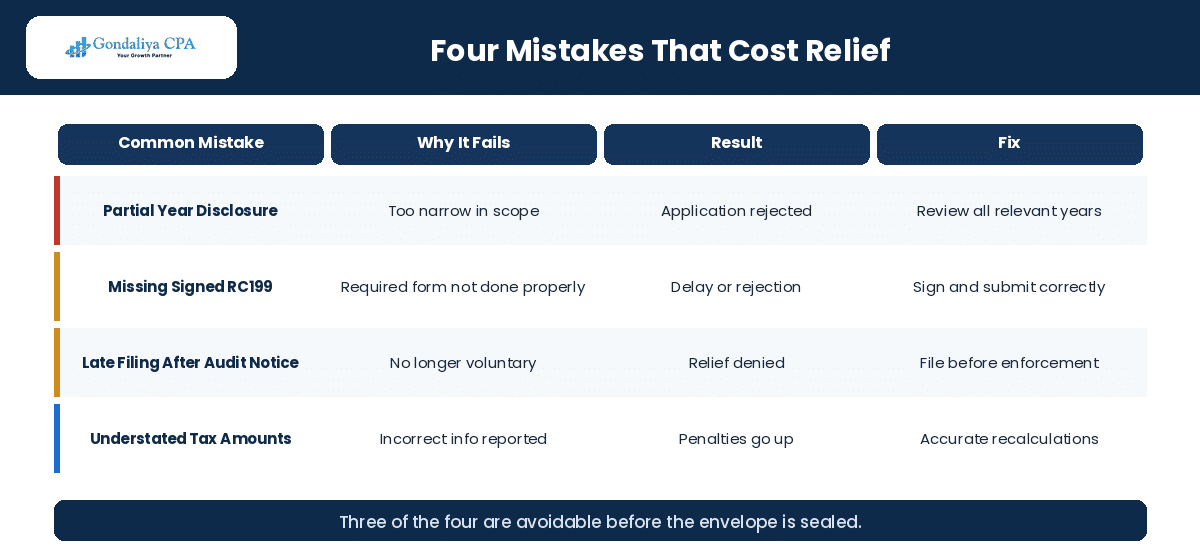
| Common Mistake | Why It Fails | Result | Fix |
|---|---|---|---|
| Partial Year Disclosure | Too narrow in scope | Application rejected | Review all relevant years |
| Missing Signed RC199 | Required form not done properly | Delay or rejection | Sign and submit correctly |
| Late Filing After Audit Notice | No longer voluntary | Relief denied | File before enforcement |
| Understated Tax Amounts | Incorrect info reported | Penalties go up | Accurate recalculations |
Maintaining Corporate Tax Compliance Post-VDP Submission
After submitting your VDP, put systems in place so you don’t need another disclosure later. Try these:
- Do monthly bookkeeping checks using software like QuickBooks or Xero.
- Set automated reminders for T2 deadlines and GST/HST payments.
- Use payroll tools like ADP or Wagepoint to keep source deductions right.
- Get annual CPA reviews for things like shareholder loans.
Keep records for six years so you’re ready if CRA audits again.4 These steps stop accidental errors that can cause fresh problems.
Our real-world example: A Toronto real estate company started monthly checks after their disclosure. They cut GST-HST filing errors from three times a year to zero within one year. Figures changed for privacy.
Understanding Director Liability and Long-Term Implications of Disclosure
If you mess up your disclosure or give wrong info, directors could face serious liability under ITA s.227.1 rules about unpaid taxes due to gross negligence or willful default.5 Know this:
- The VDP does not erase the actual tax owing.
- Directors stay responsible if wrongdoing is found.
- Being fully open lowers reputation damage but won’t always stop prosecution.
- Keeping watch on compliance protects directors from future personal risk.
Directors should get professional advice early during their corporate VDP application. Missing important info might cause reassessments beyond what the program covers.
Heads up: Leaving out key numbers ups chances of losing relief and drawing director scrutiny during audits.
Importance of Transparent Communication and Full Disclosure in Applications
Being completely upfront builds trust needed for CRA approval. This means revealing all major facts about past mistakes including:
- Every affected fiscal year, even small ones
- Related party deals that affect numbers
- Foreign assets needing T1134/T1135 reports
- Past attempts at fixing issues outside official channels
Leaving things out causes delays, partial relief, or full penalty rejections later.6
Good CPA firms double-check everything before sending forms like RC199 with detailed explanation letters ready for questions.
1: CRA Information Circular IC00‑1R6
2: Ibid., Section 3 – Eligibility Conditions
3: CRA Form RC199 Instructions
4: Corporations Canada Record Retention Requirements
5: Income Tax Act s.227(1); see also CRA Director Liability Guidance
6: CRA Voluntary Disclosures Program Overview
For help avoiding costly mistakes on your corporate VDP application in Toronto/Ontario—including Etobicoke, Vaughan, Mississauga—contact Gondaliya CPA today at 647‑212‑9559 or info@gondaliyacpa.ca
Resources and Support for Canadian Corporations Considering VDP
Resources and Support for Canadian Corporations Considering VDP
The Resources
Canadian corporations thinking about a corporate VDP application should watch out for common CRA voluntary disclosure mistakes. These errors can cost you time and money. Knowing the right resources helps avoid VDP filing mistakes Canada-wide. Use support options to make the process smoother.
How to Contact Expert VDP Accountants at Gondaliya CPA for Assistance
If you want a VDP accountant Canada trusts, Gondaliya CPA is a good choice. Our Ontario-based firm knows how to handle your corporate VDP application the right way. We catch filing errors and fix them fast. You get clear pricing, no hidden fees, and answers within one business day—even on weekends.
Call 647-212-9559 or email info@gondaliyacpa.ca anytime. We offer free advice for incorporated businesses in Toronto and across Canada.
Where to Find Official CRA Guidelines and Updated Policy Documents
The Canada Revenue Agency shares official guides about the Voluntary Disclosures Program. These explain who qualifies, how relief works, and which forms you need—like form RC199.
Important docs include:
- Information Circular IC00-1R6, which compares general vs limited relief
- GST/HST Memorandum 16-5 on indirect tax disclosures
Check these regularly when preparing your corporate VDP application. They help you avoid common CRA voluntary disclosure mistakes.
Useful links:
- CRA Voluntary Disclosures Program Overview
- Information Circular IC00-1R6 (VDP Conditions)
- Form RC199 – Application for Voluntary Disclosure
Accessing Anonymous Pre-Disclosure Discussions and Support Services
Before you apply to the Voluntary Disclosures Program, you can ask for anonymous pre-disclosure talks with the CRA. This lets you check if your case qualifies without revealing who you are or triggering enforcement.
These talks help avoid common CRA voluntary disclosure mistakes by clarifying eligibility. They also show you what info to include so your application isn’t rejected.
Starting this step with help from Gondaliya CPA makes sense. We know how to ask the right questions while keeping your info safe during early checks.
Additional Tools for Managing Corporate Tax Errors and Voluntary Disclosure Documentation
Handling corporate tax errors means keeping good records and preparing detailed schedules that the CRA asks for in a corporate VDP application.
| Tool Type | Examples | Why Use Them |
|---|---|---|
| Accounting Software | QuickBooks, Xero | Clean books and reports |
| Payroll Systems | ADP, Wagepoint | Correct source deduction calculations |
| Document Capture | Hubdoc | Automatic bank statement downloads |
| Payment Platforms | Stripe, Rotessa | Match cash flows |
Using these with a trusted VDP accountant Canada-wide lowers risks of missed info or wrong numbers that cause problems later.
Staying Informed on 2026 CRA Policy Updates and Compliance Developments
In 2026, CRA changes rules about corporate disclosures under the Voluntary Disclosures Program. Here’s what’s new:
- Separate tracks for general vs limited relief affect penalty waivers
- Tighter rules about when enforcement contact starts
- Updated Form RC199 needs more details about related companies
- New rules on GST/HST wash transactions during disclosures
If you don’t keep up with these changes, you might repeat past CRA voluntary disclosure mistakes. Checking official updates often at Canada.ca keeps your corporate VDP application on point. That helps avoid rejections caused by missing or wrong info flagged after submission.
Related-company detail on the updated form catches people out. A disclosure covering one corporation now needs the associated entities named, and a submission that omits them comes back for completion. Figures changed for privacy.
Frequently Asked Questions (FAQ) on VDP Filing Mistakes and Corporate Voluntary Disclosure
Frequently Asked Questions (FAQ) on VDP Filing Mistakes and Corporate Voluntary Disclosure
FAQ
What records and financial information must support a corporate VDP filing?+
Corporations must include amended T2 returns, GST/HST reports, payroll source deductions, and all relevant financial documents. Complete and accurate paperwork strengthens the VDP application.
How does timing affect whether a disclosure is still voluntary?+
Disclosures must be made before CRA starts enforcement actions like audits or assessments. Once CRA initiates enforcement, penalty relief through VDP no longer applies.
What happens if a disclosure is found to be incomplete or inaccurate?+
CRA may reject the application or reassess tax liabilities. Incomplete disclosures risk losing penalty relief and increase chances of audits or director liability.
How do you prepare corrected corporate returns before filing a disclosure?+
Review past filings, reconstruct missing records, adjust income and deductions accurately, and ensure consistency with supporting documents before submission.
What should a corporation do if a VDP application is denied or only partly accepted?+
They should consult a qualified CPA to review the denial reasons, consider appealing, and plan for compliance to avoid future issues with CRA.
How do VDP filings apply across 10 industries we serve?+
Different sectors have unique tax nuances. Gondaliya CPA customizes VDP strategies to industry-specific needs, ensuring accurate disclosures for varied business types.
What compliance systems prevent a repeat disclosure?+
Implement bookkeeping software, regular CPA reviews, automated payment reminders, and maintain organized records for audits and tax filing accuracy.
VDP Filing Route: DIY vs Bookkeeper vs CPA Firm — Which Fits?+
DIY risks errors; bookkeepers handle records but may lack expertise in complex VDP rules. CPA firms provide full compliance guidance, improving acceptance chances.
Key Insights on Corporate Voluntary Disclosure at Gondaliya CPA
Key Insights on Corporate Voluntary Disclosure at Gondaliya CPA
Quick Reference
- CRA VDP Application Processing Time: Typically 6 to 12 months depending on complexity and documentation quality.
- CRA Reassessment Period: Up to six years from the original assessment date; longer for gross negligence cases.
- Record Retention Requirement: Corporations must keep tax records for at least six years after the end of the tax year.
- Income Tax Act s.152: Governs reassessment timelines and limits for CRA enforcement actions.
- ITAA s.227.1 (Director Liability): Directors may face personal liability for unpaid taxes due to willful neglect or gross negligence.
- Form RC199: The official form required to apply for voluntary disclosure relief; must be fully completed and signed.
- CRA Director Liability Guidance: Details responsibilities of directors regarding corporate tax debts.
- GST/HST Memorandum 16-5: Offers instructions on indirect tax reporting during voluntary disclosures.
- Amended Corporate Tax Return: Used to correct errors outside voluntary disclosure when no penalties apply.
- Taxpayer Relief Request: Separate from VDP; used for penalty waivers due to hardship or exceptional circumstances.
- Audit Response: Proper documentation and timely replies minimize negative audit outcomes post-disclosure.
- CRA No-name Discussion Pre-Disclosure: Allows anonymous inquiry with CRA about potential disclosures without triggering enforcement.
Choosing the Right CPA Firm in Toronto/Ontario for a Corporate VDP Filing
- Look for firms experienced in Canada’s 2026 updated VDP policies.
- Confirm expertise with Form RC199 preparation and submission accuracy.
- Ensure firm can handle complex reconciliations including shareholder benefits and foreign asset reports (T1134/T1135).
- Choose firms offering transparent pricing without hidden fees.
- Select accountants skilled in negotiation with CRA during settlement stages.
What Deliverables Do You Get from Gondaliya CPA’s Corporate VDP Service?
- Complete eligibility assessment aligned with CRA rules.
- Fully prepared Form RC199 with detailed explanations of errors fixed.
- Amended T2 returns and adjusted GST/HST filings ready for submission.
- Payment plan proposals tailored to corporate cash flow needs.
- Representation during all CRA communications until final resolution.
How Much Does a Corporate VDP Filing Cost in Canada?
Fees vary by complexity but typically range from flat rates of $3,000 to $10,000 plus HST at Gondaliya CPA, depending on scope of work involved.
Key Numbers at a Glance
| Item | Detail | Notes |
|---|---|---|
| Typical processing time | 6–12 months | Depends on case complexity |
| Record retention | Minimum 6 years | Required by Corporations Canada |
| Maximum reassessment period | 6 years (longer if negligence) | Per ITA s.152 |
| Penalty relief | Full or limited | Based on general vs limited track |
| Typical filing fee | $3,000 – $10,000 + HST | Flat fee structure at Gondaliya CPA |
Quick Comparison Table: Corporate VDP vs Amended T2 vs Taxpayer Relief Request
| Filing Type | Purpose | Penalties/Interest Relief | Best For |
|---|---|---|---|
| Corporate VDP | Correct past errors with penalty exposure | Penalties reduced/waived | Errors >1 year overdue involving penalties |
| Amended T2 Return | Fix minor errors without penalties | No penalty relief | Simple corrections without penalty risk |
| Taxpayer Relief Request | Seek waiver due to hardship | Possible penalties waived | Financial hardship or exceptional cases |
Direct Answer: What Is the Difference Between General vs Limited Relief Tracks?
General relief offers full penalty waiver if all conditions are met; limited relief gives partial waiver when some conditions fail but still reduces penalties partially.
For expert help avoiding costly corporate VDP filing mistakes in Canada, contact Gondaliya CPA today at 647‑212‑9559 or info@gondaliyacpa.ca
Which track a file lands in is decided by the facts, not by what is requested on the form. Where all five conditions hold the general track follows, and where one does not the limited track is what remains. Figures changed for privacy.
Industry Spotlights: Sectors We Represent
Industry Expertise
Each sector reaches a disclosure by a different route. Here are eleven and what usually needs correcting.
| Industry | What Usually Needs Disclosing |
|---|---|
| Technology startups & SaaS | Cross-border revenue and shareholder benefits |
| E-commerce & online retailers | Unreported marketplace sales and GST/HST gaps |
| Consulting firms | Unfiled T2 returns across several years |
| Construction, contractors & skilled trades | Cash receipts and unremitted source deductions |
| Property developers & builders | Project income timing across corporations |
| Real estate investors & holding companies | Rental income and foreign property on T1135 |
| Transportation, logistics & trucking | Driver payroll and unremitted deductions |
| Restaurants & food and beverage | Cash sales and GST/HST collected but unfiled |
| Daycare, childcare & CWELCC services | Subsidy revenue reported against payroll records |
| Dentists & dental practices | Associate payments and shareholder benefits |
| Medical doctors & physician corporations | Unfiled returns and personal expenses in the corporation |
- Technology startups & SaaS: Revenue earned across borders and benefits taken by founders are the two areas most often needing correction.
- E-commerce & online retailers: Marketplace sales go unreported and the GST/HST collected on them never reaches a filed return.
- Consulting Firms: Returns go unfiled quietly for several years, and the disclosure has to cover every one of them.
- Construction, general contractors & skilled trades: Cash receipts and unremitted source deductions carry the heaviest exposure, because the second reaches directors personally.
- Property developers & builders: Income timing across several project corporations needs untangling before any figure can be disclosed.
- Real estate investors, landlords & holding companies: Rental income and foreign property reporting on T1135 are the two that most often trigger CRA data matching.
- Transportation, logistics & trucking: Driver payroll and the remittances behind it are where the director liability question arises.
- Restaurants & food and beverage: Cash sales and GST/HST collected but never filed are the usual combination, and both belong in the same disclosure.
- Daycare, childcare & CWELCC services: Subsidy revenue has to reconcile against payroll records before the corrected returns hold together.
- Dentists & dental practices: Associate payment arrangements and shareholder benefits are the categories the CRA looks at hardest.
- Medical doctors & physician professional corporations: Unfiled returns and personal costs run through the corporation account for most physician disclosures.
Across corporate disclosures in one year, unremitted source deductions and unfiled returns were the two most common triggers, and the first is the one that carries personal consequences. Figures changed for privacy.
Professional Guidance and Quick Reference
Guidance
Professional Guidance on Corporate Voluntary Disclosures: How Gondaliya CPA Supports Canadian Corporations
A corporate disclosure is won or lost before it is filed. Eligibility has to be confirmed, every affected year and account has to be identified, the records behind the corrected figures have to be rebuilt, Form RC199 has to be completed and signed by an authorized person, and payment or a payment arrangement has to accompany the submission. Gondaliya CPA handles all of it on a fixed fee.
We handle what decides the outcome: checking whether the CRA has already made enforcement contact, using an anonymous pre-disclosure discussion where that question is genuinely open, reconstructing the books so the amended T2, GST/HST and payroll figures reconcile to each other, preparing the explanation letter that accompanies the form, and representing you through the review and settlement stages.
Our team works from your own records rather than a template, and tells you plainly where a disclosure will hold and where it will not. Whether the exposure is one year or six, you get clear advice and a fixed price before we start.
Quick Answers: Key Numbers & Concepts at a Glance
At a Glance
- Processing time: Typically 6 to 12 months
- Conditions to meet: All five, without exception
- Minimum age: At least one year overdue
- Relief tracks: General for full waiver, limited for partial
- Required form: RC199, completed and signed
- Reassessment period: Up to six years, longer if gross negligence
- Record retention: Minimum six years after the tax year ends
- Director liability: ITA section 227.1 on unremitted amounts
- Interest relief: ITA section 220(3.1) where it applies
- Pre-disclosure: Anonymous discussion available before filing
Who This Is For / Not For
Fit Check
- For: Incorporated businesses with unfiled returns, unreported income, unremitted source deductions or unreported foreign assets, where the CRA has not yet made enforcement contact.
- Not For: Minor current-year corrections with no penalty exposure, where an amended T2 return is the right route, or situations where enforcement has already begun.
People Also Ask
Quick Answers
Can I withdraw a disclosure once it has been submitted?+
Submissions can be amended or supplemented while under review. Withdrawing entirely is a different question and should be discussed with your CPA before anything is sent.
Does the CRA tell me whether I qualify before I file?+
Not formally, but an anonymous pre-disclosure discussion lets the eligibility question be explored without identifying the corporation or triggering enforcement.
Does a disclosure cover more than one tax account?+
It should. A corporate disclosure normally spans T2, GST/HST and payroll together, because leaving one account out makes the disclosure incomplete.
Glossary of Key Terms
Plain-English Definitions
- Voluntary Disclosures Program: The CRA route for correcting past tax errors before detection.
- Form RC199: The application form for voluntary disclosure relief.
- General relief: Full penalty waiver where all conditions are met.
- Limited relief: Partial waiver where some conditions are not met.
- Voluntary: Made before the CRA takes any enforcement action on the matter.
- Enforcement action: An audit letter, assessment, garnishment or similar CRA contact.
- Complete disclosure: Covering every affected year, account and related entity.
- Amended T2 return: A corrected corporate income tax return for a prior year.
- Source deductions: Payroll amounts withheld and owed to the CRA.
- Director liability: Personal responsibility for unremitted amounts under section 227.1.
- Reassessment period: The window in which the CRA may reassess a filed return.
- Gross negligence: Conduct beyond carelessness, which extends CRA time limits.
- T1135: The form reporting specified foreign property holdings.
- T1134: The form reporting foreign affiliates of a Canadian entity.
- Taxpayer relief request: A separate route seeking waivers for hardship or exceptional circumstances.
- Pre-disclosure discussion: An anonymous conversation with the CRA about eligibility before filing.
Corporate VDP Eligibility Check
This quick self-check indicates whether a corporate disclosure is likely to qualify. Please answer the six questions below.
Corporate VDP Eligibility Check
Six quick questions on your position. No fee shown.
Points to raise with us:
This is a general prompt, not tax or legal advice or a quote. Your position depends on your full facts. For a real review, please book a free consultation.
Want a checklist to work from? You can download our free corporate VDP checklist before your consultation.
Check enforcement contact before anything else, because it decides whether the program is available at all. Then cover every year and account in one submission, sign the RC199 properly, reconcile the amended returns to the explanation letter, and include payment or a realistic arrangement.
2026 Update — what is current: The general and limited relief tracks are separated, enforcement-contact rules are tighter, Form RC199 requires more detail about related companies, and new rules apply to GST/HST wash transactions during disclosures. Please confirm the current form version and program conditions before relying on the figures in this article.
Avoiding CRA Voluntary Disclosure Mistakes in Canada: Expert Tips on Corporate VDP Application and Choosing the Right VDP Accountant Canada
Get the eligibility question answered first
Gondaliya CPA confirms whether the program is still available to you, rebuilds the records behind the corrected figures, prepares Form RC199 with a full explanation letter, proposes a workable payment arrangement, and represents you through review and settlement, on a fixed fee with a one-business-day response. Please book a free consultation.
Next Steps
Please book a free consultation with Gondaliya CPA before you contact the CRA yourself. Bring whatever returns, notices, statements and payroll records you have, and tell us plainly whether the CRA has been in touch, because that single fact shapes everything that follows. You will get a fixed fee before any work begins. If our content helps, please add gondaliyacpa.ca as a preferred source on Google.
Published: August 13, 2026 · Last updated: August 13, 2026
Editorial policy: We research against CRA and CPA Ontario sources, fact-check the figures, and Sharad Gondaliya, CPA, reviews the content, which we update as the rules change.
Disclaimer: This article is educational information only and is not tax, legal, or financial advice. Figures marked illustrative are examples rather than quotes or guarantees. It reflects CRA rules current to 2026, including the five Voluntary Disclosures Program conditions, the general and limited relief tracks, director liability under section 227.1, and the six-year record retention and reassessment periods. Fees, forms and program conditions change and outcomes depend on your specific facts. Please consult a CPA Ontario member before acting.

Sharad Gondaliya is a CPA Canada & CPA USA with 15 Years+ experience of Accounting, Tax, Payroll of Corporate Small Businesses as Tax Accountant. He is a CPA Ontario member (61040184) and holds US CPA licences in Washington and Montana and is well known among corporate small businesses for tax planning, efficient tax solutions, and affordable CPA services. Sharad is the Principal (Director) of Gondaliya CPA – Affordable CPA Firm in Canada. Licenses: CPA Ontario: 61040184 | CPA USA (MT): PAC-CPAP-LIC-033176 | CPA USA (WA): 57629 | CPA Firm License: 61330051 View Full Author Bio