



What Documents Does a Corporation Need for a CRA Voluntary Disclosure Application?
VDP documents Canada are essential for businesses seeking to correct past tax reporting errors through CRA voluntary disclosure documents. Gondaliya CPA offers expert guidance on corporate VDP filing and ensures all VDP application requirements are met for a smooth submission process.
Quick Summary
The package is built around Form RC199, but the form is the smallest part of it. Please note the completeness condition is what the CRA actually tests, and it is satisfied by records that reconcile to each other rather than by volume of paper.
| Aspect | Details |
|---|---|
| The core form | Form RC199, signed by an authorized officer. |
| The returns | Amended T2 with schedules, GST/HST, payroll, foreign forms. |
| The proof | Statements, ledgers, trial balances, bank records. |
| The condition | Completeness, with estimates labelled and methodology shown. |
Reading time: 30 minutes.
Table of Contents
- Voluntary Disclosures Program Overview and Recent Updates
- Eligibility for CRA Voluntary Disclosure: Who Can Apply
- VDP Application Requirements and Preparation
- Submission Process for Corporate VDP Filing and Individual Applications
- Post-Submission Review, Acknowledgment, Related Resources, and Support Options
- Privacy, Legal Notices, and Additional Information
- FAQs on VDP Documents and CRA Voluntary Disclosure
- Essential Corporate VDP Filing Components Checklist
- Industry Spotlights: Sectors We Represent
- Professional Guidance and Quick Reference
The Numbers That Matter
This article covers Canada, with Ontario and Toronto context, and reflects CRA rules current to 2026. It assumes an incorporated business assembling a voluntary disclosure package covering T2, GST/HST, payroll or foreign reporting. Figures marked illustrative are examples, not quotes, and any masked engagement notes end with “Figures changed for privacy.” This is educational information only and not tax, legal, or financial advice. Forms, processing times and documentation standards change, so please confirm your own situation with a CPA Ontario member before acting.
Voluntary Disclosures Program Overview and Recent Updates
Voluntary Disclosures Program Overview and Recent Updates
The Basics
Overview of the Voluntary Disclosures Program in Canada
The Voluntary Disclosures Program (VDP) is run by the Canada Revenue Agency (CRA). It lets companies fix past tax mistakes without facing penalties. The program encourages honesty and helps businesses report any missed income or wrong filings on their own.
Purpose and Benefits of the CRA Voluntary Disclosures Program
The VDP aims to get taxpayers to follow the rules on their own. When companies use this program, they can get:
- Lower penalties or sometimes no penalties at all.
- Possible relief from interest charges on unpaid taxes.
- Confidence knowing they fixed their tax issues without CRA enforcement.
Key Sections and Requirements Within the Program
To apply under the VDP, corporations need to meet some important rules set by CRA:
- The company shouldn’t have been already contacted about an audit for what they want to disclose.
- They must give all details about missed income or wrong info.
- Applications have to be sent soon after discovering mistakes.
Knowing these rules helps businesses file properly under this program.
Changes Made to the Voluntary Disclosures Program Effective October 1, 2025
Starting October 1, 2025, there are changes affecting how corporations use the VDP. These updates focus on clearer rules for documents and better CRA oversight.
New Documentation Standards
One big change means stricter proof is needed during disclosure:
- Companies must keep detailed records showing their finances for certain years.
- CRA now wants better electronic recordkeeping. Businesses should keep digital copies with paper ones.
These updates show CRA’s effort to keep things clear while watching corporate tax reporting closely. Corporations thinking about the VDP should know about these new rules going forward.
Electronic recordkeeping is where most packages now come up short. Paper is still accepted, but a digital set that can be cross-referenced quickly moves through review noticeably faster. Figures changed for privacy.
Key Stat: Thirteen components make up a complete corporate filing package. The CRA does not weigh them equally, but a package missing any one of them is incomplete by definition.
Eligibility for CRA Voluntary Disclosure: Who Can Apply
Eligibility for CRA Voluntary Disclosure: Who Can Apply
The Eligibility
The Voluntary Disclosures Program (VDP) helps corporations fix past tax mistakes by sending in complete VDP documents in Canada. To apply for corporate VDP filing, companies must follow the rules set by the Canada Revenue Agency (CRA). Knowing these rules makes sure your disclosure is accepted and handled without problems.
Who is Eligible to Apply for the Voluntary Disclosures Program
Corporations can use the VDP if they missed reporting income, forgot to file T2 returns, or left out GST/HST payments. But they must come forward before the CRA starts any audit or enforcement. Eligible businesses include incorporated ones across Ontario and all over Canada. They seek to avoid penalties from incomplete or wrong tax filings.
Here are the key points:
- The corporation must share info not given to CRA before.
- The disclosure has to be voluntary — before any audit or investigation begins.
- The application should cover all years and accounts involved.
- Applicants need to send a full set of CRA voluntary disclosure documents proving accuracy.
This program helps businesses fix missed income, forgotten source deductions, foreign asset reports (like T1134 or T1135), shareholder benefit errors, and other gaps with proper paperwork.
Situations Not Eligible Under the VDP Guidelines
Some cases don’t qualify for the VDP. These rules keep relief for true voluntary disclosures only. Examples of ineligible cases include:
- Disclosure made after getting an audit notice or enforcement letter from CRA.
- Cases where fraud or gross negligence was found before disclosure.
- Issues already being appealed through CRA’s objection process.
- Applications missing required papers as per VDP application requirements.
If your case fits these, you should try other compliance methods. Incomplete packages often get refused and can lead to extra penalties.
Detailed Eligibility Conditions Checklist for Applicants
To check if you qualify for corporate VDP filing with the right CRA voluntary disclosure documents, look at this checklist:
| Condition | Requirement | Source |
|---|---|---|
| Voluntariness | Disclosure sent before any audit or enforcement contact | IC00–1R6 §3 |
| Completeness | Application covers all relevant years and accounts | Form RC199 instructions |
| Accuracy & Support | Genuine records given; no fake or backdated papers; clear estimates | IC00–1R6 §7 |
| Taxpayer Status | Corporation registered with a valid business number | Corporations Canada registry |
| No Ongoing Appeals/Reviews | No active objections on disclosed matters | IC00–1R6 §4 |
| Disclosure Scope Includes: | ||
| – Corporate Income Tax Returns | – Full T2 returns including all schedules | – ITA s. 220(3.1), Form RC199 |
| – GST/HST Filings | – All missing GST/HST returns | – GST/HST Memorandum 16–5 |
| – Payroll Remittances | – Reconciled unremitted source deductions | – Payroll Records Guidance |
| – Foreign Reporting Forms | – Required T1134/T1135 forms included | – ITA §§233.3 & 233.4 |
Not meeting any part can slow down your application or cause outright denial of relief under this program.
Sharad Gondaliya, CPA, has helped many Canadian business owners straighten out their books over 10+ years.
An active objection on the same matter disqualifies the disclosure, and owners are frequently unaware one is still open. Checking the objection status is a five-minute job that has saved several files. Figures changed for privacy.
Risk Warning: Backdated or altered records do more damage than the original error. They fail the accuracy condition outright and can convert a penalty question into an enforcement one.
VDP Application Requirements and Preparation
VDP Application Requirements and Preparation
The Documents
Preparing Your CRA Voluntary Disclosure Documents
Getting your CRA voluntary disclosure documents ready means gathering all records that fix past mistakes in your corporate taxes. Your corporate VDP filing must have tax returns, financial statements, and schedules that match the CRA’s VDP application requirements. Having everything complete cuts down on follow-ups and helps you get relief under the program.
You’ll usually need:
- Past T2 returns with schedules
- GST/HST filings if they apply
- Payroll remittance summaries with T4 slips
- Bookkeeping records like ledgers and trial balances
- Bank statements showing income
- Shareholder loan papers if needed
- Foreign reporting forms such as T1134 or T1135
Make sure all documents are real and match each other to avoid delays. Also, write a clear disclosure letter that explains what you’re fixing. This letter goes with Form RC199—the official form for VDP submissions to CRA.
Pre-Disclosure Discussion: Optional Preliminary Consultation Process
Before you send in your voluntary disclosure, you can have a pre-disclosure talk with CRA. This step is optional but helpful. It lets you ask about eligibility without starting enforcement actions.
At Gondaliya CPA, we help clients with this process confidentially. We check if you qualify for full or partial relief based on how soon you’re disclosing (usually within one year late), what documents you have ready, and whether any audits or investigations are ongoing.
This chat spots missing info early and shows how to put together your corporate VDP filing correctly. It saves mistakes before submitting by making sure you know exactly which documents CRA wants under the latest rules coming in 2026.[1]
Required Documents and Forms Including RC199 Application Form
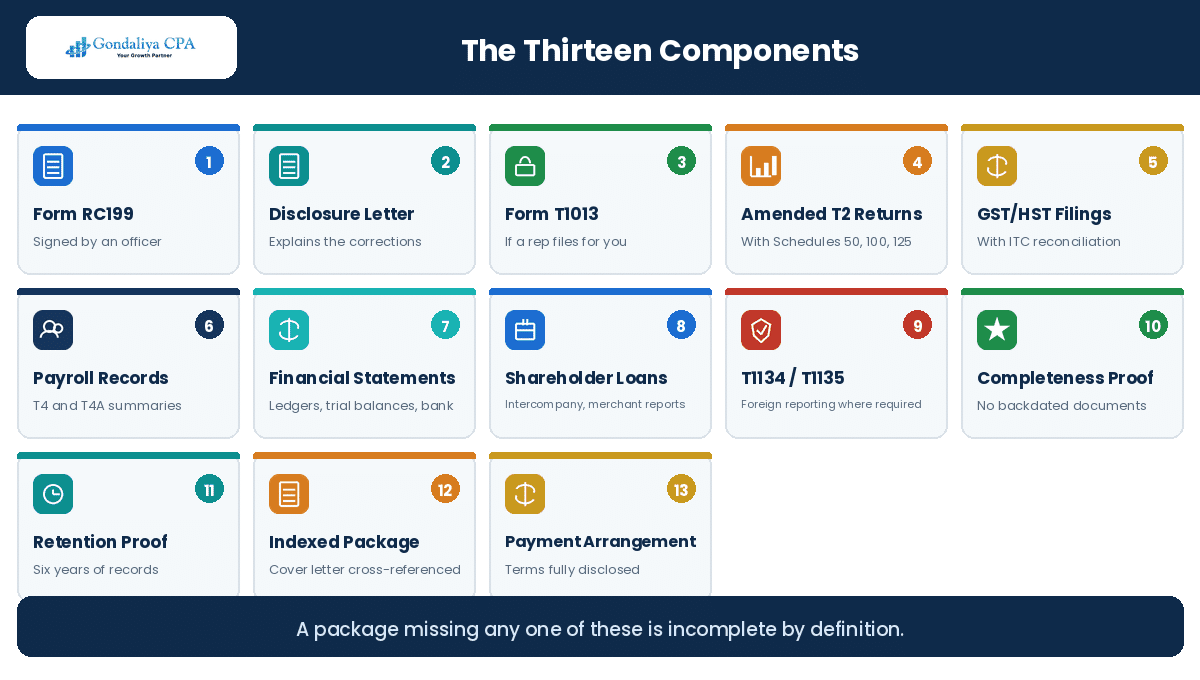
The main paper for any Canadian corporate voluntary disclosure is Form RC199. It asks officially for penalty relief tied to wrong or missing info. Alongside RC199, include:
- A full disclosure letter explaining fixes
- Authorization if someone else files for you
- Amended T2 Corporation Income Tax Returns for all years fixed
- Supporting schedules like Schedule 50 (for shareholder details)
- GST/HST returns and payroll remittances including T4/T4A slips
- Proof of any payment plans if full payment can’t happen now
CRA wants these docs to meet their completeness condition—all facts affecting taxes must be fully shown with proof.[2] Missing stuff risks rejection or slow processing.
| Document Type | Purpose | Source | Years Covered | If Missing |
|---|---|---|---|---|
| Form RC199 | Official VDP application | Canada.ca / CRA website | All disclosed years | Cannot proceed without it |
| Disclosure Letter | Explains what’s being corrected | Taxpayer or CPA | Current submission | May delay acceptance |
| Amended T2 Returns | Shows corrected income & deductions | Corporate accounting system | Past 3–10 years | Likely rejection |
| Payroll Remittances | Supports source deduction fixes | Payroll provider/files | Relevant periods | May trigger audit |
| GST/HST Returns | Adjusts sales tax declarations | Accounting software | Applicable years | Extra scrutiny possible |
[1]: See IC00‑1R6; Canada.ca
[2]: Refer IC00‑1R6 Completeness Condition section
Instructions for Downloading and Completing VDP Documents (Software Requirements)
VDP documents Canada require careful prep using software that CRA accepts electronically. The main form—RC199—is a PDF you can download from the CRA website. You fill it out digitally but can’t file it online yet; send it physically unless new 2026 rules say otherwise.[3]
Use trusted accounting platforms like QuickBooks Online or Xero to create reports matching your books during prep. They help export trial balances and ledger extracts that support figures on amended returns in your corporate VDP filing.
Tips for digital forms:
- Use Adobe Acrobat Reader DC or similar approved PDF editors
- Don’t scan handwritten copies unless original signatures are needed
- Name files clearly by year, e.g., “T2_2019_Amended.pdf”
Back up everything before sending. Missing pages can force resubmissions and delays.[4]
[3]: See electronic record guidance at Canada.ca
[4]: Refer Electronic Records Standards – Corporations Canada
Assembling Supporting Returns, Schedules, and Payment Arrangements
Corporate VDP filing needs more than just forms; it means sorting returns by date along with schedules proving accuracy across accounts:
- Fix T2 Corporation Income Tax Returns yearly, attach updated financials showing balance sheets and income statements changed accordingly
- Add detailed schedules like Schedule 125 (Income Statement Info), Schedule 100 (Balance Sheet), Schedule 50 when shareholder equity shifted,[5] plus others depending on your business sector
- Attach amended GST/HST returns backed by workpapers reconciling input tax credits against invoices from your books during those periods
- Provide payroll adjustments with remittance histories checked against employee slips to confirm no source deductions are missed—a common review trigger[6]
- Show any payment plans clearly if you can’t pay everything right away; this helps show good faith under new rules starting Jan 2026 requiring these plans in first disclosures[7]
Put these into folders labeled well and cross-reference inside cover letters. That speeds up checks both at Gondaliya CPA when prepping—and later at CRA offices handling Toronto/Ontario businesses nationwide.
[5]: See ITA s248(1); Shareholder Loan Reporting Guidelines
[6]: Payroll Record Retention – Canada.ca
[7]: Policy Update Jan 2026 — Payment Arrangement Disclosures
Contact us at info@gondaliyacpa.ca or call 647‑212‑9559 if you want help putting together complete voluntary disclosure packages that meet current Canadian rules made for Toronto-based companies needing fixed-fee options backed by over “1300+ five-star Google reviews.”
Cross-referencing the cover letter to each attachment is the single change that shortens review most. It costs an hour at assembly and removes the round of questions that would otherwise follow. Figures changed for privacy.
Pro Tip: Name every file by year and type before anything is sent, for example T2_2019_Amended.pdf. It sounds trivial, but a package the reviewer can navigate is a package that does not come back with questions.
Submission Process for Corporate VDP Filing and Individual Applications
Submission Process for Corporate VDP Filing and Individual Applications
The Submission
Step-by-Step Corporate VDP Filing Process
Get Ready to Apply: Gathering Information and Ensuring Compliance
When filing a corporate voluntary disclosure, you need to collect all the records and documents that matter. The CRA wants the disclosure to be full and true. You must back it up with real proof. Companies should gather financial statements, T2 returns, GST/HST filings, payroll details, shareholder loans, bank statements, and any papers that show income you missed or taxes not paid.
Here’s what to do:
- List every tax year and account involved.
- Gather original documents like bank statements, invoices, and contracts.
- Prepare corrected financial records, like trial balances or bookkeeping fixes.
- Check old CRA letters or notices for missing info.
- Keep records for at least six years as CRA asks.
Doing these things fits with VDP application requirements and helps meet CRA rules for CRA voluntary disclosure documents. If you miss papers or leave things out, your application might get held up or rejected.
Completing the RC199 Voluntary Disclosures Program Application Form
The RC199 form is a key part of every corporate VDP submission. It tells the CRA that you want to voluntarily report missed info. You have to fill it out right. Mistakes here can slow down your case or cause denial.
Important parts of Form RC199 include:
- Your company’s ID info (business number and legal name).
- The tax years you’re reporting.
- The tax accounts affected (like income tax T2 returns, GST/HST, payroll).
- A clear explanation of why you’re making this disclosure.
- A declaration that everything is complete and correct.
Attach a letter explaining why you missed taxes before, plus detailed schedules showing amounts owed. An authorized officer must sign the form.
The CRA says don’t change original records. If you use estimates, mark them clearly and explain how you got those numbers.1
Submit the Application: Available Submission Options and Guidelines
You can send your completed VDP package including Form RC199 in several ways:
- Online via My Business Account portal – fastest method but limits file size.
- Mail physical copies to CRA addresses – better if you have lots of paper docs.
- Fax securely, though this is less used because of privacy concerns.
Make sure to include all forms plus organized backup papers for easy review.2 Incomplete packages may be sent back without processing until fixed.
For companies in cities like Toronto or Mississauga handling corporate VDP filing, online submission plus CPA help often cuts down extra CRA questions.
Applications Submitted by Representatives: Authorization and Signatures
If someone files for your company—like a CPA firm—they need proper authorization under Canadian law.3 This means:
- A signed Form T1013 (“Authorizing or Cancelling a Representative”) giving them access to tax matters.
- Written permission allowing them to prepare and send all CRA voluntary disclosure documents, including Form RC199.
Representatives must get signatures from officers who have legal power from corporate resolutions.4 Unauthorized filings might be invalid and slow down getting VDP relief since 2026 rules require stricter checks.5
Good communication between clients and reps helps avoid problems while keeping info private as CPA Ontario requires.
Acknowledgment of Your Application: What to Expect After Submission
Once you send your corporate disclosure with all VDP application requirements met, expect an official reply from CRA in about 30 days if submitted online—or up to 60 days if by mail.6
This reply just confirms they got your package. It does not mean they accepted it or gave relief yet. They will first check if everything is complete then review the data carefully—looking at amended T2 returns,7 GST/HST reconciliations,8 payroll history,9 foreign reports when needed,10 plus checking original records you included from firms like Gondaliya CPA serving Toronto clients across Canada.
Be ready for follow-up questions if they find unclear points before deciding on waivers of penalties or interest based on rules in IC00‑1R6 updated through 2026.11
1: Canada Revenue Agency (CRA), Information Circular IC00‑1R6 — Voluntary Disclosures Program Conditions
2: Canada.ca – Submitting Documents Electronically & Mail Addresses for Business Taxes
3: Canada Revenue Agency – Authorizing Representatives Using Form T1013
4: Ontario Business Corporations Act — Minute Book Requirements & Officer Authority Documentation
5: CRA Policy Update 2026 — Enhanced Completeness Verification & Electronic Record Standards
6: Canada Revenue Agency – Processing Times For Voluntary Disclosure Applications
7: Schedule Requirements Under ITA Section Relating To Amended Returns For Disclosure Purposes
8: GST/HST Memorandum 16‑5 — Reporting And Supporting Documentation Expectations
9: Payroll Deductions Remittance And Record-Keeping Guidance From The CRA
10: Foreign Reporting Obligations On Forms T1134 /T1135 Per Current Compliance Rules
11: IC00‑1R6 Updated Completeness Condition And Relief Assessment Procedures
Contact Gondaliya CPA today at 647‑212‑9559 or info@gondaliyacpa.ca if you want help preparing a full corporate VDP filing that follows Canadian rules closely.
The acknowledgment letter reassures owners more than it should. It confirms receipt and nothing else, and the substantive review has not started at that point. Figures changed for privacy.
Post-Submission Review, Acknowledgment, Related Resources, and Support Options
Post-Submission Review, Acknowledgment, Related Resources, and Support Options
The Review
CRA Review Timeline and Process Overview with Progress Indicators
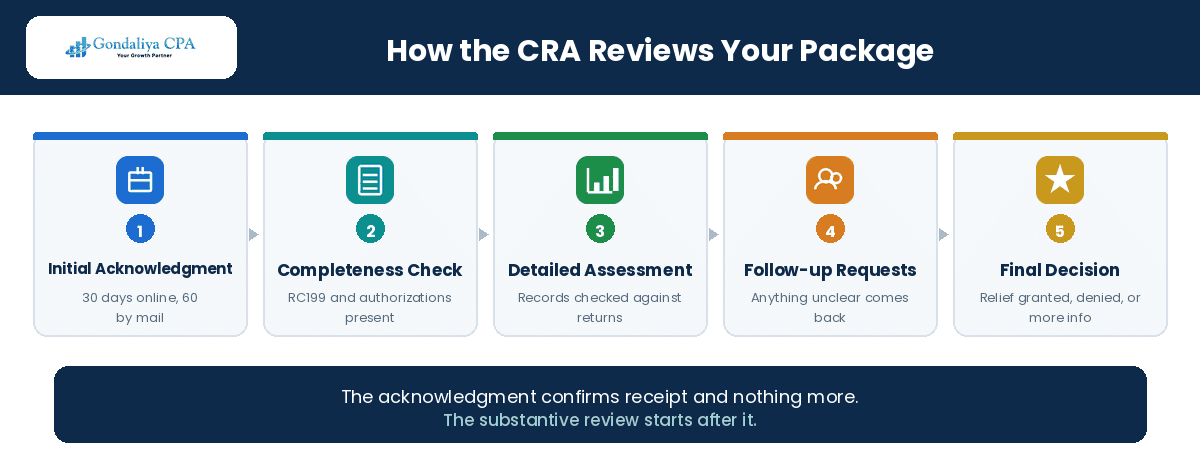
Once you submit your corporate VDP filing, the Canada Revenue Agency (CRA) starts a careful review. This process can take a few months, depending on how complex or complete your paperwork is. CRA looks at all the required documents like T2 returns for the years you disclosed, financial statements for those periods, bookkeeping records they depend on, and other tax support documents.
Here’s how CRA handles it:
- Initial Acknowledgment: They confirm they got your application.
- Completeness Check: They make sure all required forms like Form RC199 and authorization letters are there.
- Detailed Assessment: CRA checks your income records against your returns to spot any issues.
- Follow-up Requests: If something’s missing or unclear, they’ll ask for more info.
- Final Decision Preparation
You might not see progress updates online. But authorized reps can ask CRA for status reports. Knowing these steps helps companies plan their timeline around VDP application requirements.
Statutory Requirement: Full disclosure with real supporting records is needed to get relief under the Voluntary Disclosures Program.1
Possible Outcomes: Relief Granted, Denied, or Requests for Additional Information
What happens after you submit depends a lot on whether your documents meet CRA’s rules. The main outcomes are:
- Relief Granted
If you provide all required info—like complete income data and matching bookkeeping—CRA may reduce or remove penalties for late filings or mistakes. - Requests for Additional Information
Sometimes paperwork misses things like shareholder loan details or GST/HST worksheets. Then CRA asks you to send more documents before moving on. - Relief Denied
If your submission lacks proper financial statements or tries to leave out key info, CRA usually denies any penalty relief.
Companies should prepare carefully using a solid VDP filing checklist. CPA firms familiar with Canadian tax rules can help avoid delays and boost acceptance chances.
Risk Warning: Incomplete documents risk rejection and could lead to audits or enforcement actions.2
Related Resources and Helpful Links for Further Assistance
If you run an incorporated business and need help with CRA voluntary disclosure documents, these links might be useful:
- Canada Revenue Agency – Voluntary Disclosures Program Overview — Official info on who qualifies and what’s needed
- Form RC199 – Application For Taxpayer Relief — Details on this required form
- Gondaliya CPA Corporate Tax Cleanup Services — Help putting together correct disclosures
- Bookkeeping & Accounting Solutions at Gondaliya CPA
These resources explain record retention rules,3 handling electronic records,4 foreign reporting requirements,5 payroll remittance summaries,6 GST/HST return reconciliations,7 and other vital parts of preparing corporate VDP filings.
How to Provide Feedback About This Page and Access Additional Support
We welcome your feedback to improve Gondaliya CPA’s services. If you want to comment on this page’s content or need help with your corporation’s VDP application, reach out by email at info@gondaliyacpa.ca or call 647‑212‑9559. We offer support during regular hours plus evenings and weekends.
Our free consultations focus on small to medium incorporated businesses in Toronto/Ontario areas like Etobicoke, Vaughan, Mississauga—and across Canada. We guide clients through updated 2026 policies about electronic record submissions in the Voluntary Disclosures Program.8
Working with licensed pros early cuts risks from missing papers. We keep fees clear with no surprise charges—trusted by over 1300 clients who gave us five-star Google reviews. Our clients range from real estate investors to tech startups that need specialized document handling unique to their industry needs.
1 IC00‑1R6 – Voluntary Disclosures Program Conditions (Canada Revenue Agency).
2 GST/HST Memorandum 16‑5 – Documentation Requirements (Canada Revenue Agency).
3 Corporations Canada Record Retention Guidelines (Government of Canada).
4 Electronic Records Standards – ServiceOntario / Ontario Business Corporations Act Compliance Documents.
5 Foreign Reporting Obligations T1134/T1135 Guidance (Canada Revenue Agency).
6 Payroll Remittance Summaries & T4 Filing Requirements (Canada Revenue Agency).
7 GST/HST Return Filing Procedures & Input Tax Credit Documentation (Canada Revenue Agency).
8 Updated 2026 Policy Changes Regarding Electronic Submission Channels Under Corporate Voluntary Disclosure Programs (CRA Bulletin).
The most common follow-up request we see is for shareholder loan detail or a GST/HST worksheet. Both are predictable, and both can be included in the original package instead. Figures changed for privacy.
Privacy, Legal Notices, and Additional Information
Privacy, Legal Notices, and Additional Information
The Legal Notices
Privacy, Confidentiality, and Legal Notices Regarding VDP Applications
CRA voluntary disclosure documents hold private corporate tax info. The Canada Revenue Agency (CRA) keeps all Voluntary Disclosures Program (VDP) submissions very confidential. Companies filing a corporate VDP must make sure their disclosures are truthful and complete. This helps them stay eligible for any relief.
Access to these voluntary disclosure files is limited to authorized CRA staff only. Applicants should submit authorization forms so licensed CPAs or other reps can safely communicate for them. Personal and financial data sent to CRA stays protected by Canadian privacy laws and CRA rules[1].
Corporations shouldn’t send altered or incomplete records. That can lead to rejection or enforcement action. Any estimates in disclosures need clear notes on how they were made to meet CRA’s completeness rules[2]. Staying transparent in the corporate VDP filing process helps avoid legal trouble and preserves chances for relief.
Download Links and Alternate Document Formats
Corporations preparing VDP applications often need access to standard forms like:
- Form RC199 (Voluntary Disclosures Program Application)
- Authorization letters
- T2 return templates
- GST/HST schedules
- Payroll summaries
- Financial statements
You can find these documents on official sites like Canada.ca. These sources keep forms current with 2026 electronic record submission rules[3]. Some firms also offer checklists for businesses doing voluntary disclosure paperwork.
Alternate versions include fillable PDFs that work with popular accounting tools like QuickBooks or Xero. Using digital files makes it easier to organize and cross-check your documents—a key step to meet CRA’s completeness condition quickly.
Page Details and Feedback Options
This page is run by Gondaliya CPA Professional Corporation. We’re a CPA Ontario Registered Firm helping companies with corporate VDP filings across Toronto and Canada. Our info matches current CRA guidelines and offers practical tips for putting together solid voluntary disclosure packages.
Your input helps us make this content better for business owners handling tricky tax issues. Feel free to email questions or comments at info@gondaliyacpa.ca or call 647-212-9559 during business hours, including weekends if possible.
If you want help cleaning up your corporate tax records or need a full VDP package, ask us for a free consultation anytime using the contact info above.
[1]: See Canada Revenue Agency: Voluntary Disclosures Program confidentiality rules — IC00-1R6
[2]: Refer to Form RC199 instructions regarding completeness condition requirements
[3]: Updated guidance on electronic record submissions effective 2026 — Canada Revenue Agency notices
FAQs on VDP Documents and CRA Voluntary Disclosure
FAQs on VDP Documents and CRA Voluntary Disclosure
FAQ
What is CRA Form RC199 and why is it important for VDP?+
Form RC199 is the official application for voluntary disclosure. It formally requests penalty relief and requires accurate details on missed income or tax errors.
What should a disclosure letter include in a corporate VDP filing?+
A disclosure letter explains the errors corrected and reasons for late reporting. It supports Form RC199 with clear context for the CRA.
Which authorization forms are required for representatives filing on behalf of corporations?+
Form T1013 authorizes representatives to access tax information and submit documents. Written permission must accompany all filings.
Why must T2 returns be amended in a VDP application?+
Amended T2 returns reflect corrected corporate income, deductions, and schedules. They demonstrate accurate financial reporting to CRA.
How do GST/HST filings factor into the VDP submission?+
Corrected GST/HST returns reconcile sales tax errors or omissions. Proper input tax credit support must be included to validate changes.
What role do payroll remittance records play in voluntary disclosures?+
Payroll remittance summaries and T4/T4A slips confirm source deductions were accurately reported or corrected.
Why are financial statements, general ledgers, and trial balances essential?+
They prove the accuracy of income and expense figures claimed in amended returns. These records support the completeness condition.
How long should corporations keep records for VDP purposes?+
Records must be retained for six years from the end of the relevant tax year, as per CRA guidelines.
What does an indexed document package mean in a VDP context?+
An indexed package organizes all supporting documents with cross-references in a cover letter. This speeds up CRA review.
Are payment arrangements required when submitting a corporate VDP?+
If full payment is not possible, a detailed payment plan must accompany the application to show good faith under new rules.
Essential Corporate VDP Filing Components Checklist
Essential Corporate VDP Filing Components Checklist
Quick Reference
- Complete Form RC199, signed by authorized officers
- A detailed disclosure letter, explaining corrections made
- Authorization forms (Form T1013) if filing through representatives
- Amended T2 Income Tax Returns, including all schedules such as Schedule 50, 100, and 125
- Corrected GST/HST filings, with full input tax credit reconciliation
- Payroll remittance records, including T4 and T4A summaries for relevant periods
- Verified financial statements, general ledgers, trial balances, and bank statements supporting income declarations
- Documentation of shareholder loans, intercompany transfers, or merchant settlement reports if applicable
- Foreign reporting forms like T1134/T1135, where required by law
- Clear evidence of compliance with the completeness condition, including no backdated or false documents
- Retention proof following six years record retention guidelines set by CRA and Corporations Canada
- An indexed document package, with cover letters cross-referencing each attachment for quick review
- Any existing or proposed payment arrangements, fully disclosed with terms
Additional Key Points on Corporate Voluntary Disclosure Process
- Use electronic record standards to prepare digital submissions compliant with new 2026 CRA rules.
- Maintain minute book documentation and corporate resolutions to authorize disclosures properly.
- Include reasonable estimates with written methodology when exact figures are unavailable; clearly label these in submissions.
- Pre-disclosure consultation with CRA helps identify missing info before formal filing, reducing risks of delays or denial.
- Keep audit response files ready if CRA requests additional information after initial review.
- Reconciliation schedules demonstrate correction of previous accounting discrepancies in books versus filed returns.
- Comparative financial statements can highlight differences between original filings and amended disclosures.
- Third-party statements such as bank confirmations may strengthen credibility of reported figures.
- CPA review prior to submission ensures accuracy, completeness, and adherence to all VDP application requirements.
- Bookkeeping cleanup before disclosure minimizes risk of errors that could cause penalty denial.
- Adjusting entries documented transparently improve trustworthiness of revised tax positions presented to CRA.
For expert help preparing your complete VDP package with Gondaliya CPA’s trusted guidance, contact us anytime at info@gondaliyacpa.ca or 647‑212‑9559.
Bookkeeping cleanup before the disclosure is prepared, rather than alongside it, is what separates a package that reconciles from one that does not. The sequence matters more than the effort. Figures changed for privacy.
Industry Spotlights: Sectors We Represent
Industry Expertise
Every sector has one document that takes longest to assemble. Here are eleven and what usually holds the package up.
| Industry | The Document That Takes Longest |
|---|---|
| Technology startups & SaaS | Foreign reporting forms T1134 and T1135 |
| E-commerce & online retailers | Merchant settlement reports across platforms |
| Consulting firms | Amended T2 returns for several unfiled years |
| Construction, contractors & skilled trades | Payroll remittance history against T4 slips |
| Property developers & builders | Intercompany transfer documentation |
| Real estate investors & holding companies | Shareholder loan records and T1135 filings |
| Transportation, logistics & trucking | Driver payroll summaries and remittance proof |
| Restaurants & food and beverage | Bank statements reconstructing cash sales |
| Daycare, childcare & CWELCC services | Subsidy records reconciled to payroll |
| Dentists & dental practices | Schedule 50 and associate payment records |
| Medical doctors & physician corporations | Financial statements for the unfiled years |
- Technology startups & SaaS: Foreign affiliates and offshore accounts pull T1134 and T1135 into scope, and valuations have to be dated correctly.
- E-commerce & online retailers: Merchant settlement reports have to be pulled per platform and reconciled to the bank before any figure is disclosed.
- Consulting Firms: Several unfiled years means several complete T2 packages, each with its own schedules and financial statements.
- Construction, general contractors & skilled trades: Remittance history checked against issued slips is the slowest part, and the one carrying director exposure.
- Property developers & builders: Intercompany transfers between project corporations need documenting before the numbers hold together.
- Real estate investors, landlords & holding companies: Shareholder loans and foreign property reporting appear in almost every file in this sector.
- Transportation, logistics & trucking: Driver payroll summaries and the remittance proof behind them take the longest to assemble accurately.
- Restaurants & food and beverage: Cash sales are reconstructed from deposits and supplier records, which makes bank statements the central document.
- Daycare, childcare & CWELCC services: Subsidy records must reconcile to payroll before the corrected returns can be supported.
- Dentists & dental practices: Schedule 50 and associate payment records are where shareholder questions usually get settled.
- Medical doctors & physician professional corporations: Financial statements for the unfiled years have to be prepared before any T2 can be amended.
Across corporate disclosure packages in one year, the component most often missing at first submission was the payroll remittance history, followed by shareholder loan documentation. Figures changed for privacy.
Professional Guidance and Quick Reference
Guidance
Professional Guidance on VDP Documents: How Gondaliya CPA Supports Canadian Corporations
A disclosure package is judged on whether it is complete, and completeness is a documentation question rather than a legal one. Every affected year and account has to be in scope, the corrected returns have to reconcile to the books, the books have to reconcile to the bank, estimates have to be labelled with their methodology, and Form RC199 has to be signed by an officer with the authority to sign it. Gondaliya CPA assembles all of it on a fixed fee.
We handle what decides the outcome: cleaning up the bookkeeping before the returns are amended rather than alongside, pulling merchant and payroll records that reconcile to what was actually remitted, preparing the schedules the CRA will look for, drafting the disclosure letter and cross-referencing it to every attachment, and proposing a payment arrangement where the balance cannot be paid at once.
Our team works from your own records rather than a template, and will tell you plainly which documents are missing before anything is filed. Whether the scope is one year or six, you get clear advice and a fixed price before we start.
Quick Answers: Key Numbers & Concepts at a Glance
At a Glance
- Package components: Thirteen in a complete corporate filing
- Core form: RC199, signed by an authorized officer
- Representative form: T1013, plus written permission
- Corporate schedules: Schedule 50, 100 and 125 at minimum
- Foreign reporting: T1134 and T1135 where required
- Record retention: Six years from the end of the tax year
- Acknowledgment: About 30 days online, up to 60 days by mail
- Amended returns: Typically covering the past 3 to 10 years
- Estimates: Permitted if labelled with written methodology
- Software: QuickBooks Online, Xero, Adobe Acrobat Reader DC
Who This Is For / Not For
Fit Check
- For: Incorporated businesses assembling a disclosure package covering unfiled returns, unreported income, unremitted source deductions or foreign reporting gaps.
- Not For: Corporations already under audit or with an open objection on the same matter, where the program is unavailable and a different route applies.
People Also Ask
Quick Answers
Do I need original paper records or are scans acceptable?+
Scans are accepted where they are genuine and legible. What matters is that the records were not altered, and that originals exist if the CRA asks to see them.
What if exact figures cannot be reconstructed for an old year?+
Reasonable estimates are permitted, provided each one is clearly labelled as an estimate and the method used to arrive at it is set out in writing.
Does the package have to cover every tax account at once?+
Yes. A disclosure covering the T2 while leaving GST/HST or payroll out of scope fails the completeness condition.
Glossary of Key Terms
Plain-English Definitions
- Form RC199: The official application form for voluntary disclosure relief.
- Disclosure letter: The narrative explaining what is being corrected and why.
- Form T1013: The authorization allowing a representative to act on tax matters.
- Completeness condition: The requirement that every affected fact, year and account be disclosed.
- Amended T2 return: A corrected corporate income tax return for a prior year.
- Schedule 50: The T2 schedule reporting shareholder information.
- Schedule 100: The T2 schedule reporting balance sheet information.
- Schedule 125: The T2 schedule reporting income statement information.
- Trial balance: The listing of account balances used to close a period.
- General ledger: The complete record of all accounts and transactions.
- Source deductions: Payroll amounts withheld and owed to the CRA.
- T1134: The form reporting foreign affiliates of a Canadian entity.
- T1135: The form reporting specified foreign property holdings.
- Indexed package: A submission whose cover letter cross-references every attachment.
- Pre-disclosure discussion: An optional talk with the CRA about eligibility before filing.
- Payment arrangement: A proposed schedule for paying a balance that cannot be settled at once.
VDP Document Readiness Check
This quick self-check indicates how close your package is to complete. Please answer the six questions below.
VDP Document Readiness Check
Six quick questions on your records. No fee shown.
Gaps to close:
This is a general prompt, not tax or legal advice or a quote. Your position depends on your full facts. For a real review, please book a free consultation.
Want a checklist to work from? You can download our free VDP documents checklist before your consultation.
Clean the books before amending the returns, cover every year and account in one package, sign the RC199 with proper authority, label any estimate with the method behind it, index the whole package to a cover letter, and propose a payment arrangement rather than leaving the balance unaddressed.
2026 Update — what is current: Documentation standards tightened from October 1, 2025, with stronger expectations around electronic recordkeeping. Policy updates effective January 2026 expect payment arrangements to be disclosed in the first submission, and completeness verification is more rigorous. Record retention stays at six years. Please confirm the current form version and submission channels before relying on the figures in this article.
VDP documents Canada: A Complete Guide to CRA Voluntary Disclosure Documents and Corporate VDP Filing with Gondaliya CPA
A package that reconciles is a package that gets through
Gondaliya CPA cleans up the books first, prepares the amended T2 returns with their schedules, reconciles GST/HST and payroll to what was actually filed and remitted, drafts the disclosure letter, indexes every attachment, and proposes a payment arrangement where one is needed, on a fixed fee with a one-business-day response. Please book a free consultation.
Next Steps
Please book a free consultation with Gondaliya CPA and bring whatever you have, even if it is incomplete. Gaps are expected at this stage and identifying them is the point. You will get a fixed fee before any work begins. If our content helps, please add gondaliyacpa.ca as a preferred source on Google.
Published: August 13, 2026 · Last updated: August 13, 2026
Editorial policy: We research against CRA and CPA Ontario sources, fact-check the figures, and Sharad Gondaliya, CPA, reviews the content, which we update as the rules change.
Disclaimer: This article is educational information only and is not tax, legal, or financial advice. Figures marked illustrative are examples rather than quotes or guarantees. It reflects CRA rules current to 2026, including the Voluntary Disclosures Program completeness condition, documentation standards effective October 1, 2025, the six-year record retention requirement, and stated acknowledgment timelines. Forms, processing times and program conditions change and outcomes depend on your specific facts. Please consult a CPA Ontario member before acting.

Sharad Gondaliya is a CPA Canada & CPA USA with 15 Years+ experience of Accounting, Tax, Payroll of Corporate Small Businesses as Tax Accountant. He is a CPA Ontario member (61040184) and holds US CPA licences in Washington and Montana and is well known among corporate small businesses for tax planning, efficient tax solutions, and affordable CPA services. Sharad is the Principal (Director) of Gondaliya CPA – Affordable CPA Firm in Canada. Licenses: CPA Ontario: 61040184 | CPA USA (MT): PAC-CPAP-LIC-033176 | CPA USA (WA): 57629 | CPA Firm License: 61330051 View Full Author Bio