



How Catch-Up Bookkeeping Can Help Canadian Businesses Recover Missed Tax Deductions
Gondaliya CPA offers catch-up bookkeeping Canada services combined with thorough bookkeeping cleanup to help businesses recover unrecorded business expenses and improve expense reconciliation Canada. This approach supports accurate bookkeeping for corporate tax filing while maximizing bookkeeping tax savings and business deductions.
Quick Summary
Recovering a missed deduction has two halves. Finding it in the records is the first, and claiming it inside the CRA’s time limits is the second. Please note the input tax credit window and the reassessment window are not the same length, which is why waiting costs money.
| Aspect | Details |
|---|---|
| The problem | Unrecorded, miscategorised, or personally paid business expenses. |
| The timeline | Cleanup usually 10 to 30 business days by backlog age. |
| The limits | Four years for input tax credits, six years for records. |
| The route | Cleanup, then T2 or GST/HST adjustment requests. |
Reading time: 34 minutes.
Table of Contents
- Understanding Catch-Up Bookkeeping and Bookkeeping Cleanup in Canada
- Commonly Missed Deductions and What the CRA Expects You to Keep
- Common Bookkeeping Errors That Result in Missed Tax Deductions
- Key Factors Influencing the Cost of Catch-Up Bookkeeping in Canada
- Benefits of Hiring a Professional for Bookkeeping Cleanup and Tax Deduction Review
- Comparing Catch-Up Bookkeeping, Cleanup, and Reconstruction Services for Different Needs
- Frequently Asked Questions
- Essential Points on Deduction Recovery Engagement and Costs
- Industry Spotlights: Sectors We Represent
- Professional Guidance and Quick Reference
The Numbers That Matter
This article covers Canada, with Ontario and Toronto context, and reflects CRA rules current to 2026. It assumes an incorporated small or medium business with overdue or disorganised records and unclaimed expenses. Figures marked illustrative are examples, not quotes, and any masked engagement notes end with “Figures changed for privacy.” This is educational information only and not tax, legal, or financial advice. Deadlines, limits and retention rules change, so please confirm your own situation with a CPA Ontario member before acting.
Understanding Catch-Up Bookkeeping and Bookkeeping Cleanup in Canada
Understanding Catch-Up Bookkeeping and Bookkeeping Cleanup in Canada
The Basics
What Is Catch-Up Bookkeeping and How It Supports Accurate Corporate Tax Filing
Catch-up bookkeeping helps businesses fix their records when they fall behind. It makes sure every transaction is logged correctly. This leads to accurate corporate tax filing. When books are current, it’s easier to find missed tax deductions. That means businesses can save money on their taxes.
Good records help you track things like employee wages, office costs, and other expenses. This keeps your tax filings correct and lowers chances of mistakes. Mistakes could lead to CRA audits or fines. So, catch-up bookkeeping supports better tax compliance and savings for Canadian companies.
The Role of Bookkeeping Cleanup in Identifying Missed Tax Deductions
Bookkeeping cleanup means checking old records carefully. It finds errors and makes sure expenses are recorded right. Many small business owners miss deductions because their records are messy or unclear.
Cleanup helps uncover expenses that were left out. For example, if you bought office supplies with personal cash or paid in cash without a receipt, these might be missed. Cleaning up books with catch-up bookkeeping helps find these missed deductions and recover money you didn’t claim before.
Differences Between Catch-Up Bookkeeping, Cleanup, and Reconstruction Services
Here’s how catch-up bookkeeping differs from cleanup and reconstruction:
- Catch-Up Bookkeeping: Brings overdue accounts up to date.
- Bookkeeping Cleanup: Fixes mistakes in existing records but may not fill all gaps.
- Reconstruction Services: Builds complete financial records when original papers are lost.
Knowing this helps you pick the right service for your business needs.
Importance of Expense Reconciliation Canada for Recovering Unrecorded Business Expenses
Expense reconciliation checks that your transactions match bank statements and receipts. This stops valid expenses from being left out. Many small businesses miss this step because their finances get messy.
Regular reconciliation, following CRA rules, spots differences between reported numbers and real spending. This helps claim missed tax deductions on business costs during the year.
How Gondaliya CPA Approaches Bookkeeping Tax Savings Through Comprehensive Cleanup
Gondaliya CPA focuses on cleaning up books to help clients find missed tax deductions fast while following CRA rules (ITA s18(1)(a)). They review records carefully then sort them neatly for easier future reporting.
Their system aims to make sure every possible business tax deduction is claimed properly. By keeping organized records that meet CPA Ontario and CRA standards, Gondaliya CPA helps clients save more on their taxes through thorough catch-up bookkeeping cleanup.
The single largest recovery on a cleanup file is rarely one big item. It is usually a small recurring charge, a software subscription or a bank fee, that was never coded to an expense account across two or three years. Figures changed for privacy.
Key Stat: Input tax credits have their own four-year limit that runs separately from the corporate reassessment window. A deduction can still be claimable on the T2 side after the GST/HST side has closed.
Commonly Missed Deductions and What the CRA Expects You to Keep
The Categories
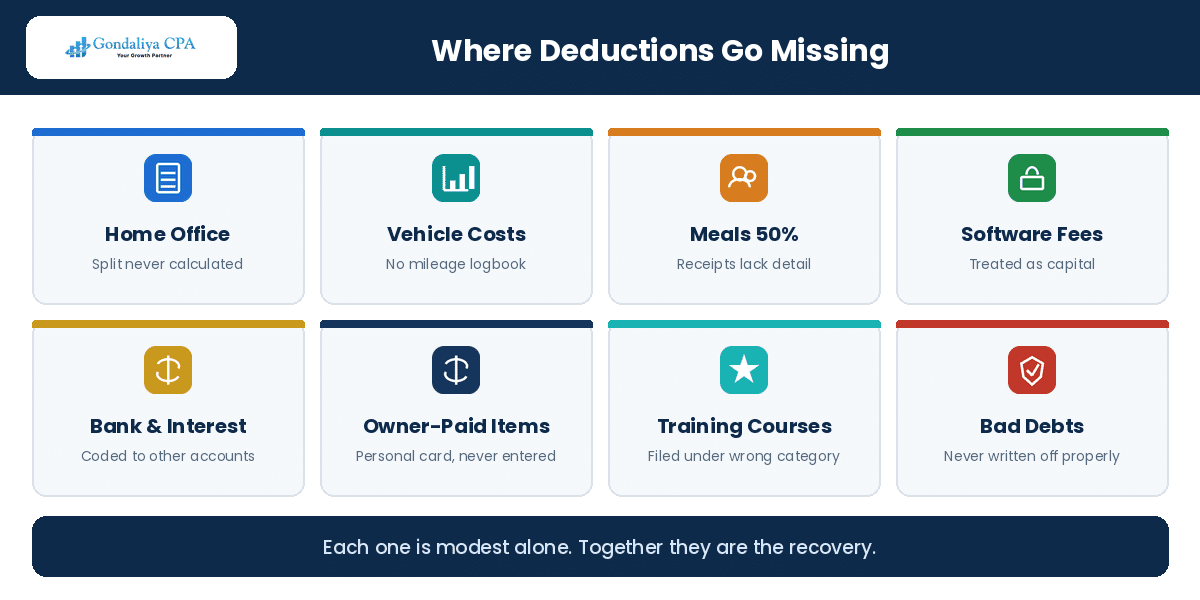
Home Office Expenses: Allocation Methods and Documentation Requirements
Many Canadian businesses miss home office expense deductions. You have to split costs between personal and business use. Use simple methods like measuring square footage or time spent working. The CRA wants clear records showing your workspace size compared to the whole home. Keep receipts for utilities, rent, property taxes, and repairs.
Documents should include utility bills, lease papers, mortgage statements if you own your home, and logs proving you use the space regularly for work. Without this proof, lots of small incorporated businesses lose out on deductions. Catch-up bookkeeping Canada services help you find and claim these missed expenses.
Vehicle Expenses: Tracking Mileage, Fuel, Maintenance, and Lease Costs
Vehicle costs can be tricky if you don’t track mileage right. You need a logbook with dates, destinations, trip reasons, and kilometers driven. The CRA demands these details to approve expenses.
Fuel receipts and maintenance bills must also be kept. If you lease a vehicle, only the business-use portion is deductible. It’s important to keep bank statements and supplier invoices handy for catch-up bookkeeping Canada work. This helps fix mistakes and get all missed tax deductions without problems from CRA rules.
Meals and Entertainment: Understanding Allowable Portions and Record Keeping
You can only claim 50% of meals and entertainment costs—unless an exception applies. Many businesses lose these deductions because they lack proper proof.
You should keep itemized receipts showing date, place, who was there, their business link, and why the meal happened. Bookkeeping cleanup helps check your past records to catch every valid deduction without going over CRA limits.
Professional Development and Training Expenses Eligible for Deduction
Courses that upgrade or maintain your business skills are deductible in Canada. This includes tuition paid to recognized schools plus materials needed for the training.
Catch-up bookkeeping can find missed education expenses hidden in your accounts or put under wrong categories. This helps you get every deduction allowed by the CRA while staying within their rules.
Technology and Software Costs: Immediate Expensing and Subscription Management
Buying computers might mean depreciation because they are capital assets. But software subscriptions usually count as immediate expenses if used just for business.
Missed deductions happen when subscriptions renew but aren’t recorded or licenses get misfiled. Catch-up bookkeeping Canada specialists check vendor contracts with bank payments to make sure all tech costs get treated right per CRA standards. Scanned receipts will be valid too starting in 2026.
Bad Debts: Criteria for Deductibility and Documentation Practices
You can deduct bad debts only after trying hard to collect them first. Your accounting records must show credit sales clearly.
Bookkeeping cleanup finds bad debts not written off properly that mess up your taxable income numbers. To claim these deductions at CRA audits, keep customer letters asking for payment and proof that the debts were counted as income before writing them off.
Marketing and Advertising: Qualifying Expenses Including Digital Campaigns
Marketing costs such as digital ads count as deductible business expenses if they promote your company’s products or services during its active period.
These must be supported by organized financial records showing campaign dates and payments made through credit cards or online platforms.
Cash payments without invoices often cause missed entries but catch-up bookkeeping fixes that by finding missing papers and matching everything up carefully following CRA rules about promotional spending.
Bank Fees, Interest, and Other Financial Charges That Can Be Claimed
Bank fees related directly to business accounts—like monthly charges—are deductible. Interest on loans used purely for earning business income also counts.
Keep documentation for six years after filing because federal rules require this record-keeping CRA. Bookkeeping cleanup spots finance charges mixed into other codes so you don’t miss claiming them. This reduces taxable profit fairly without risking penalties from audits common in Toronto/Ontario SMB sectors where CPA-level checks happen regularly.
Professional Fees for Accounting, Legal, and Consulting Services
Fees paid to professionals like accountants (CPAs), lawyers handling corporate matters, or consultants improving business efficiency qualify as deductible expenses in Canada.
Catch-up bookkeeping Canada helps find unpaid or hidden fees buried under general expenses so you can reclassify them correctly for tax purposes. Keeping proper invoices with contract notes makes audits easier while reducing risks from unclear billing often seen in startups or incorporated companies relying heavily on outside advice updated by new 2026 regulations affecting filings nationwide.
Insurance Premiums Relevant to Business Operations And Their Tax Treatment
Insurance premiums covering usual commercial risks—liability insurance, property coverage, key person insurance—are generally deductible when they protect assets used only for business.
You cannot deduct policies covering personal benefits; the Income Tax Act excludes those strictly across Canada including Ontario/Toronto areas served by firms like Gondaliya CPA.
Match premium payment schedules with fiscal periods involved using insurer confirmations to prove coverage purpose during catch-up bookkeeping tasks carefully following federal documentary standards to avoid losing rightful refunds due to past mistakes fixed now proactively.
Vehicle costs are the category owners most often abandon. Without a logbook the claim cannot be supported, so the expense sits in the accounts unclaimed even though the fuel and maintenance receipts are right there. Figures changed for privacy.
Risk Warning: Meals and entertainment and home office are the two categories where an overstated claim causes more trouble than an omitted one. The 50% limit and the personal-use split both need to hold up on paper before the deduction is worth claiming.
Common Bookkeeping Errors That Result in Missed Tax Deductions
Common Bookkeeping Errors That Result in Missed Tax Deductions
The Errors
Many Canadian businesses miss tax deductions because of simple bookkeeping errors. Mistakes like mixing up expense categories or forgetting to record cash purchases happen a lot. Sometimes, personal card payments for business stuff don’t get recorded either.
Duplicate entries and uncleared accounts can hide real expenses from the books. Owners might also put personal withdrawals as business costs by accident. These slip-ups add up if you don’t do a bookkeeping cleanup. As a result, you pay more tax than needed.
Catch-up bookkeeping Canada services look back at your old records. They spot and fix these errors by making sure all expenses are correctly logged. This helps you claim every possible deduction and stay in line with CRA rules.
How Historical Bookkeeping Review Facilitates Business Expense Cleanup
Looking over past bookkeeping records helps clean up business expenses. It means checking old financial papers to find missed or wrongly logged costs that you can deduct.
When you use catch-up bookkeeping Canada services, you match bank statements with receipts from earlier years. This process finds things like capital assets recorded as expenses or personal items mixed with business costs.
Cleaning your books this way improves your paperwork quality for CRA audits. You can even ask to adjust past tax returns within the allowed time if you find missed deductions. Overall, it keeps your records neat and helps you keep the savings that slipped through before.
Reconciling CRA Expense Records With Internal Accounting Data
Matching CRA expense records with your own accounting info is key to finding missed deductions. Expense reconciliation means checking supplier bills and bank data against what’s entered in your ledger.
Mistakes happen when invoices are lost or cash payments don’t get recorded—something common during bookkeeping cleanup efforts. Making sure every payment matches prevents losing deductible expenses by accident.
To do this well, keep clear documents that meet CRA rules: invoices must show date, amount, vendor, and a description of goods or services bought. Staying organized this way lowers risks of fines for unsupported claims and keeps your numbers solid.
| Reconciliation Step | Purpose |
|---|---|
| Extract bank/card transactions | Spot all money spent |
| Match vendor invoices | Check if expenses are real |
| Categorize by period/type | Put expenses in the right year |
| Verify input tax credits | Confirm GST/HST claims match purchases |
Practical Steps to Recover Missed Business Expenses Through Cleanup
To recover missed expenses, start with catch-up bookkeeping Canada work that cleans messy records:
- Collect all financial papers: bank statements, credit card slips (even personal cards), invoices, contracts.
- Sort documents by year to check nothing’s missing.
- Find payments not in your books.
- Classify expenses right: separate capital costs from regular ones; mark owner-paid items properly.
- Review input tax credits (ITCs) to see if they qualify under CRA rules.
- If needed, file adjustment requests using T2 forms with proof before deadlines pass.
Doing this boosts chances to reclaim money without risking trouble for wrong claims.
Impact of Bookkeeping Errors on Tax Returns and Penalty Risks
Bookkeeping mistakes change how tax returns look and can cause penalties in Ontario’s corporate filings:
- Leaving out deductible costs means paying more tax than necessary.
- Claiming too much GST/HST without receipts risks denials plus interest charges.
- Mixing capital assets with normal expenses messes up depreciation calculations later on.
- Missing receipts can lead to fines under ITA rules about proof requirements.
CRA auditors watch closely for reasonableness in claims; bad records make reassessments more likely along with penalties or interest fees.
Using catch-up bookkeeping Canada fixes these errors before filing deadlines end—helping keep clean records ready for any audit checks.
Tools and Techniques for Effective Expense Tracking and Documentation
Modern tools help tidy up bookkeeping cleanup and track expenses better:
- Cloud software like QuickBooks Online or Xero bring bank data straight into accounting systems, cutting down manual errors.
- Receipt apps like Hubdoc store digital copies that meet CRA’s electronic document rules.
- Doing monthly reconciliations stops backlog problems so mistakes show up early.
Having simple coding systems for common expense types makes reviews easier during catch-up projects—making sure classifications stay steady over time.
Using tech plus good habits builds strong records that help claim more deductions while following Canadian federal laws closely.
Owner-paid expenses are the most common single gap. Purchases made on a personal card were never entered anywhere, so on a two-year cleanup they usually account for the largest block of recovered deductions. Figures changed for privacy.
Pro Tip: Before the cleanup starts, pull the last two years of personal credit card statements as well as the business ones. Business purchases paid personally are deductible, but only once someone actually looks for them.
Key Factors Influencing the Cost of Catch-Up Bookkeeping in Canada
Key Factors Influencing the Cost of Catch-Up Bookkeeping in Canada
The Cost
The price for catch-up bookkeeping in Canada mostly depends on how many records you have and how complex they are. It also hinges on the number of mistakes and how big the backlog is. These things decide how long cleanup takes and how much it costs. Good cleanup helps you get all your business tax deductions and avoids missing any important ones.
Volume and Complexity of Records
When you have lots of transactions, it takes more time to sort them out. Businesses that use several bank accounts, credit cards, or software like QuickBooks need more careful work. If your records mix personal and business expenses or involve big purchases or many vendor bills, cleanup gets trickier.
For instance, an online seller with many payment methods might have hundreds of monthly transactions to organize. This makes the cleanup longer since every transaction needs checking.
Level of Error and Backlog
If there are many errors like duplicate entries or missing invoices, cleaning up will take more effort. Older backlogs might not have receipts or contracts, which makes things harder. When businesses delay bookkeeping updates, they risk losing input tax credits and misclassifying expenses. This can cause problems when filing corporate taxes (T2) or if CRA checks your records.
Step-by-Step Workflow for Catching Up on Late or Incomplete Records
Catch-up bookkeeping uses a clear process to fix messy books and recover all possible business tax deductions by keeping records straight.
Initial Assessment Procedures
First, we check what data you already have:
- Look over ledgers to see if anything’s missing.
- Spot gaps like unpaid cash expenses or missing bank feeds.
- See if your documents are scanned or synced electronically.
This step shows if you need simple entry work or a full cleanup. It also helps figure out how long it will take.
Bookkeeping Cleanup Steps
Cleanup usually involves:
- Collecting bank statements, credit card reports, and invoices.
- Matching your records against banks to find errors.
- Sorting each transaction into the right expense category per CRA rules.
- Separating big asset purchases from regular costs.
- Checking if owner-paid items are mixed with company expenses.
- Confirming input tax credits fit GST/HST claim rules.
- Preparing trial balances for CPA review before filing taxes.
These steps help avoid missed deductions from earlier mistakes. They also create files ready for CRA audits.1
Timeline Expectations for Bookkeeping Cleanup and Corporate Tax Filing Preparation
Knowing roughly how long cleanup takes helps you plan around filing deadlines without risking penalties or missed business tax deductions.
Estimated Timeframes
Most catch-up jobs take 10 to 30 business days depending on how old the backlog is:
| Backlog Age (Months) | Transactions/Month | Estimated Duration (Business Days) |
|---|---|---|
| 1–3 | <200 | 10 |
| 4–12 | 200–500 | 20 |
| >12 | >500 | 30+ |
If your files are messy, expect longer timelines.2
Critical Deadlines
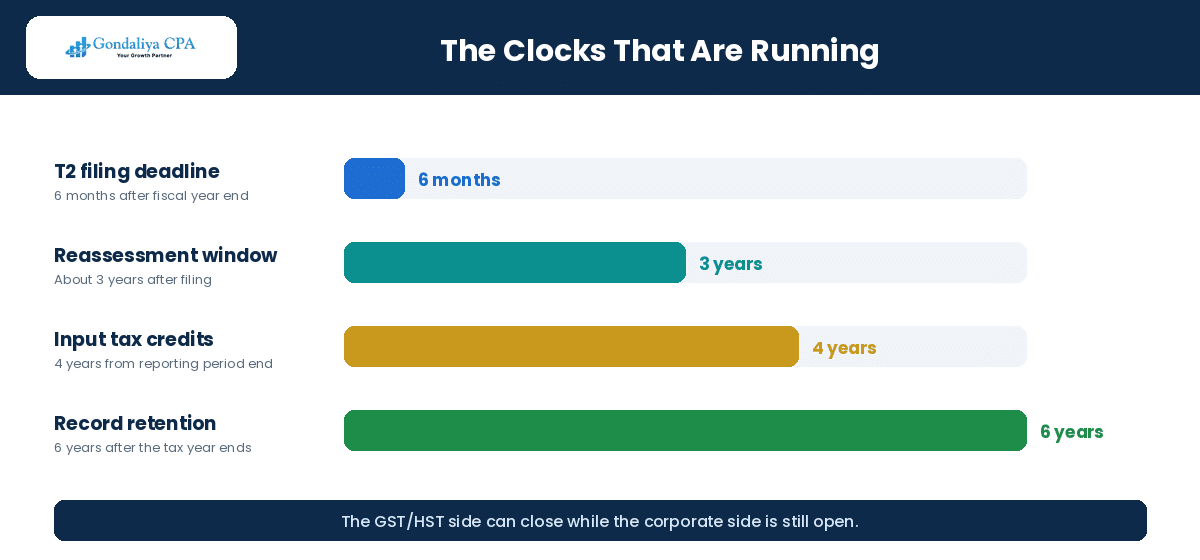
In Canada, corporations must file T2 returns within six months after their fiscal year ends.3 Late filing triggers penalties that grow over time.4 Also,
- You usually must claim Input Tax Credits within four years of the reporting period.5
- Adjustments beyond reassessment periods need special voluntary disclosure requests.6
Doing catch-up on time keeps your recovery chances high and stays compliant.7
Tax Deductibility of Catch-Up and Cleanup Service Fees
Fees paid for catch-up bookkeeping count as valid business expenses when used just to keep your accounting accurate for claiming deductions under Canadian law.8
Eligibility for Deducting Service Fees
Service fees tied directly to organizing books are deductible as admin costs under ITA s18(1)(a). This includes fixing past errors so missed business tax deductions can be claimed correctly.9
But:
- Fees only linked to new income may not fully qualify.
- Personal expense parts must be left out.10
Reporting Requirements
Keep clear invoices that show what services were done. CRA may ask for these during reviews.11 Store them along with your accounting records for at least six years after filing.12
Consequences and Hidden Costs of Delaying Bookkeeping Updates
Putting off bookkeeping updates doesn’t save money in the long run. It can lead to lost deductions and costly penalties that hurt profits despite trying to avoid costs at first.
Risk of Additional Penalties
Late filings get fines starting at $100 a day with a minimum charge depending on company size.13 On top of that,
Poor documentation invites reassessments where CRA can add interest and fines up to 50% extra taxes owed.14
Cleaning up promptly cuts down these risks by improving proof quality for claimed expenses.[CRA Business Expense Documentation Guidelines][15].
Lost Tax Savings
Missing deadlines means you may lose chances to adjust returns or claim Input Tax Credits later.16 Unclaimed expenses inflate reported profits causing higher taxes.17
How to Prepare Your Documents for a Smooth Catch-Up Process with Gondaliya CPA
Getting your papers ready makes catch-up faster and lets our experts focus on what really needs fixing without wasting time.
Document Checklist
| Document Type | Why Needed |
|---|---|
| Bank & Credit Card Statements | To verify transactions |
| Supplier Invoices & Receipts | To support expense claims |
| Payroll Reports | To record wages accurately |
| Asset Purchase Agreements | To tell capital from current costs |
| Previous T2 Returns | To compare past filings |
Try to collect digital copies if possible. Use cloud tools that work with Hubdoc or Xero since we use those integrations.[CRA Electronic Record Standards][18]. Tell us about any missing docs early so we can find other proof before delays happen.
Sharad Gondaliya, CPA, has over ten years helping Canadian small businesses fix bookkeeping errors and recover rightful missed deductions through catch-up bookkeeping services in Toronto/Ontario.
Footnotes:
- CRA Business Expense Deductibility
- Internal timing metrics based on typical SMB client engagements at Gondaliya CPA
- Corporations Canada Filing Deadline
- CRA Late-Filing Penalty Details
- GST/HST Input Tax Credit Claim Periods
- Adjustment Requests & Voluntary Disclosure Program
- See “Critical Deadlines” section above
- ITA s18(1)(a); see CRA guidance on deductible professional fees
- Ibid.; supported by case law emphasizing necessity criterion
- See CRA Reasonableness Test s67 explanations
- CRA Invoice Requirements
- Record Retention Rules – Six Years Minimum
The commonest reason a cleanup runs to the top of the range is not the number of months. It is several bank accounts and cards feeding the same business, each needing its own reconciliation before anything can be categorised. Figures changed for privacy.
Benefits of Hiring a Professional for Bookkeeping Cleanup and Tax Deduction Review
Benefits of Hiring a Professional for Bookkeeping Cleanup and Tax Deduction Review
The Benefits
Hiring a pro for catch-up bookkeeping Canada makes a big difference. They spot missed tax deductions that you might miss. A bookkeeping cleanup by experts sorts out your expenses right. This helps you get the most from business tax deductions. Plus, it keeps you on the right side of CRA rules. Many mistakes that cause missed deductions get fixed this way.
Time and Cost Savings
Many firms offer fixed fee pricing for cleanup and deduction checks. That means no surprise bills later. On average, clients get back way more in missed deductions than what they pay. It also saves you time since pros know where to look fast. You avoid digging through records yourself and delay in filing taxes.
Expertise in Complex Expense Categories
Experts understand tricky stuff like capital cost allowance classes well. They know how to claim input tax credits within the right periods too. This means better GST/HST refunds without errors. They keep capital and current expenses sorted so you don’t trigger CRA alarms.
Reduction of CRA Audit Risk
One big plus is sticking closely to CRA compliance rules during cleanup. Pros know exactly what CRA wants when checking recovered deductions: clear reasons for expenses, fair amounts per ITA s.67, and all documents ready (invoices, receipts). This lowers chances for reassessment or penalties.
When to Engage Expert Help to Avoid Missed Allowances and Penalties
If your books look messy or you think allowances got missed, call a pro soon. The normal CRA reassessment window runs about three years after filing. Trying to claim recovered deductions without proof can backfire with denied claims or penalties.
Signs Your Bookkeeping Needs Help
- Look out for unorganized books or frequent mistakes. These lead to missed deductions like uncleared items or wrong owner draw entries.
- If personal credit card purchases mix with business costs unchecked, it’s time for cleanup before filing taxes.
Timing for Professional Intervention
CRA wants records kept at least six years after the tax year ends.1 You can fix missed deductions usually within three years by adjusting T2 returns. But acting fast matters — evidence disappears, and input tax credits have their own four-year limits.
How Gondaliya CPA Supports Clients in Navigating Complex Expense Categories
Gondaliya CPA creates cleaning plans that fit each business’s needs around Toronto/Ontario.2 With over 1300 5-star Google reviews,3 they find hidden deductible expenses like software fees wrongly treated as capital or vehicle costs left unclaimed — all up-to-date with Canadian rules.
Personalized Advice on Regulatory Changes Including 2026 Update
They keep up with CRA updates like the 2026 change letting digital records count more.4 Now scanned receipts saved on cloud apps like Hubdoc or Dext qualify if authentic — making expense reconciliation Canada-wide easier and audit-ready.
Optimizing Deductions Through Effective Expense Reconciliation Canada-Wide
Expense reconciliation means matching bank statements with vendor invoices every period.5 This avoids missing valid expenses and stops double claims common in manual work — getting you all the business tax deductions allowed during the year.
| Benefit | Description |
|---|---|
| Accurate Categorization | Sorts capital versus current expenses properly |
| Timely Input Tax Credit Claims | Helps claim GST/HST credits on time |
| Complete Documentation | Keeps all source docs ready for audits |
Verdict: Pro-led expense checks catch more than do-it-yourself efforts alone.
Ensuring Compliance With CRA Guidelines During Catch-Up Bookkeeping
CRA audits want solid proof that every recovered deduction has a real business reason.6 Lack of proper invoices or receipts can kill your claim plus add interest charges. Pros keep track of supplier info and maintain clear trails from purchase to reporting stages.
Documentation Standards Required by CRA
You must keep originals or good scans of invoices, receipts showing date/place/amount/vendor name, signed contracts proving agreements, plus bank & credit card statements confirming payments.7
| Document Type | Purpose | Acceptable Format |
|---|---|---|
| Invoices | Proof of purchase or service | Paper or digital scan |
| Receipts | Confirm payment | Originals or scans |
| Contracts | Support subscriptions or recurring fees | Signed copies (paper/digital) |
| Bank/Credit Card Statements | Verify money flow | Official monthly reports |
Law says keep these at least six years after the tax year ends.
Regulatory Adherence: Record Retention Minimum Six Years
Canadian law requires holding accounting papers including these source docs for at least six calendar years after the related tax year ends.1 Keeping them safe helps if adjustments come later.
Strategies To Prevent Future Missed Deductions And Maintain Clean Records
Best practice means regular reconciliations using cloud accounting tools linked with receipt capture apps like Hubdoc or Dext.4 Use separate bank accounts/cards only for business spending. Set clear internal rules about what counts as an allowed cost.
Ongoing Record-Keeping Plans For Sustained Accuracy
Do quarterly checks where accountants match transactions against proofs regularly.5 Cloud tools automate routine parts so errors show up early — stopping backlogs many small businesses face before tax time.
Expense Tracking Systems Recommended For Year-Round Management
Accounting software such as QuickBooks or Xero works well combined with automated document requests during catch-up work.45 These make tracking expenses easy anytime and help recover missed amounts faster.
Overview Of Business Expense Categories Often Overlooked Without Professional Guidance
Here are common trouble spots:
- Personal credit card purchases mixed with company costs
- Cash payments without paper proof
- Subscription and software fees not allocated right
- Vehicle costs missing mileage logs
- Home office expenses without support
- Small tools treated as capital assets wrongly
- Shipping and delivery fees left out
- Interest charges and bank fees not fully recorded
- Personal use not properly split from business expenses
Disorganized records cause many lost deduction chances come tax time.
Sharad Gondaliya, CPA, has 10+ years helping many Canadian small businesses clean up their bookkeeping across Ontario industries.
Suggested internal links:
- Catch-Up Bookkeeping Services
- Corporate Tax Filing T2
- Bookkeeping Cleanup Solutions
- GST/HST Return Filing Assistance
- CPA Compilation Reports
Alt: Before-and-after ledger comparison showing corrected entries after catch-up bookkeeping cleanup – figures masked illustrating improved accuracy.
Caption: Example ledger transformation highlighting how professional cleaning uncovers previously missed deductible expenses.
Reading time: 8 minutes
- CRA Record Retention Guidelines
- Service areas include Toronto, Etobicoke, Vaughan
- Verified review count as per firm data
- CRA Electronic Records Guidance
- See “Bookkeeping Errors Cause Missed Deductions” section
Clients often expect the recovery to come from one dramatic item. In practice it comes from ten or twelve ordinary categories, each modest on its own, that add up once the whole period is reviewed properly. Figures changed for privacy.
Comparing Catch-Up Bookkeeping, Cleanup, and Reconstruction Services for Different Needs
Comparing Catch-Up Bookkeeping, Cleanup, and Reconstruction Services for Different Needs
The Comparison
Catch-up bookkeeping Canada services help you get your financial records current after falling behind. Bookkeeping cleanup fixes mistakes and wrong entries in your existing books. It doesn’t cover missing data. Reconstruction goes further by rebuilding lost or incomplete info from receipts, bank statements, and other sources.
Here’s a quick look at each service:
- Catch-Up Bookkeeping: Updates all missing transactions.
- Takes about 15 to 45 business days.
- Cost depends on how much backlog you have.
- Good for businesses months or years behind.
- Bookkeeping Cleanup: Fixes misclassifications and errors.
- Usually done in 10 to 30 business days.
- Price depends on error complexity.
- Best if books exist but are messy.
- Reconstruction: Builds missing data from scratch.
- Can take 30 to over 60 business days.
- Cost depends on data availability and amount.
- Needed when records are lost or during big transitions.
In short: Go with catch-up bookkeeping if you need full updates. Choose cleanup for fixing mistakes only. Reconstruction is best when lots of info is missing.
Understanding CRA Penalty Exposure and Relief Options in Backlog Situations
If you don’t keep good records, you might miss tax deductions and face CRA penalties. The CRA can charge interest or reassess taxes if claims lack proof or are wrong. But the CRA offers relief if you fix problems before they audit you through their Voluntary Disclosure Program (VDP).
Here’s what matters:
- Penalty causes: Missing documents, late filing, or overstated claims.
- Interest: Charges build up on unpaid taxes from due dates.
- Voluntary Disclosure Program: Lets you avoid penalties if you report errors early and fully.
- Record keeping: Keep your records at least six years per CRA rules.
Using catch-up bookkeeping lowers penalty risk by improving proof for expenses and deductions.
Factors to Consider When Choosing a Catch-Up Bookkeeping Specialist in Canada
Picking the right specialist matters for following CRA rules and getting back missed deductions.
Look for these things:
- Licensing: Must be a registered CPA with Ontario for Canadian clients.
- Experience: Should handle incorporated small businesses with backlogs well.
- CRA knowledge: Know deduction rules like ITA s.18(1)(a), input tax credits, and adjustment requests inside out.
- Software skills: QuickBooks Online (QBO) or Xero experience speeds up work a lot.
- Pricing transparency: Fixed fees prevent surprise bills; money-back guarantees help trust.
Gondaliya CPA is a licensed Toronto firm experienced in catch-up bookkeeping Canada with over “1300+ 5-star Google reviews.”
Transparent Pricing Models and What to Expect From Service Providers
Fixed fee pricing makes costs clearer when catching up on messy books.
For example: $1,450 including HST often covers about six months of backlog with moderate transactions.
What affects price?
| Cost Factor | Effect on Price |
|---|---|
| Number of months behind | Costs go up with more months |
| How messy the records are | More disorganization raises cost |
| Monthly transaction volume | More transactions mean more work |
| Number of bank accounts/cards | More accounts take more time |
Ask what’s included — trial balances, reconciliation reports, adjustment help.
Call Gondaliya CPA at 647‑212‑9559 for a free consult about your case.
How Thorough Bookkeeping Enhances Eligibility for Business Tax Credits and Deductions
Good bookkeeping helps you claim all eligible business tax deductions correctly.
Here’s why it matters:
- Finds expenses not claimed before like vehicle costs or fees.
- Separates capital costs from current expenses so you don’t misclassify.
- Keeps books organized for easier audits.
- Helps get credits like SR&ED that need detailed expense tracking.
Reviewing old records carefully while staying current stops missed deductions later, all within CRA rules see CRA.
Contact Information and Next Steps for Engaging Gondaliya CPA Services
Want to recover missed deductions? Need catch-up bookkeeping Canada services? Contact Gondaliya CPA now:
Phone: 647‑212‑9559
Email: info@gondaliyacpa.ca
Our licensed Toronto team responds fast — usually within one business day. We work with incorporated small businesses in Toronto, Mississauga, Vaughan, Brampton, and across Ontario.
Get a no-pressure free consultation to clean up your books while making sure your deductions follow CRA rules correctly.
Sharad Gondaliya, CPA, has over ten years helping Canadian businesses sort out their bookkeeping problems.
Owners frequently ask for reconstruction when what they need is cleanup. The records exist, they are simply coded wrongly, and that distinction changes both the price and how long the work takes. Figures changed for privacy.
Frequently Asked Questions
Frequently Asked Questions
FAQ
What is an adjustment request and how does it help with deduction recovery?+
An adjustment request lets you correct previously filed tax returns to claim missed deductions. Gondaliya CPA assists in preparing these requests to recover taxes within CRA deadlines.
How do capital cost allowance classes affect catch-up bookkeeping?+
Capital cost allowance classes group assets for depreciation purposes. Proper classification during catch-up bookkeeping ensures correct tax deductions and prevents CRA issues.
Can Gondaliya CPA provide corporate tax filing support during cleanup?+
Yes, Gondaliya CPA offers corporate tax filing support alongside bookkeeping cleanup. This ensures accurate T2 filings with all possible business tax deductions claimed.
What is the typical backlog cleanup time for catch-up bookkeeping in Canada?+
Backlog cleanup usually takes 10 to 30 business days depending on records’ age and complexity. Gondaliya CPA provides timelines after initial assessment.
How does input tax credit review aid in missed deduction recovery?+
Input tax credit reviews check GST/HST claims for accuracy. Identifying unclaimed ITCs helps maximize refunds and maintain CRA compliance.
What is the record retention period required by CRA for bookkeeping documents?+
CRA requires keeping records at least six years after the tax year ends. Gondaliya CPA advises clients to follow this rule strictly.
How do T2 adjustment requests relate to catch-up bookkeeping services?+
T2 adjustment requests amend corporate tax returns to include missed expenses found during catch-up bookkeeping, enabling deduction recovery.
What steps does Gondaliya CPA take for verification and validation of financial records?+
They verify bank statements, invoices, and receipts match entries. Validation confirms all transactions meet CRA rules before filing.
Essential Points on Deduction Recovery Engagement and Costs
Essential Points on Deduction Recovery Engagement and Costs
Quick Reference
- Deduction recovery engagement focuses on identifying unclaimed expenses through thorough record review.
- Costs depend on backlog size, error levels, and transaction volume.
- Engaging professionals like Gondaliya CPA reduces risk of missed deductions and penalties.
- Transparent pricing helps clients plan their cleanup budgets confidently.
Numeric Walkthrough of Input Tax Credit Claim Periods
- GST/HST ITC claims must be made within four years from the end of the reporting period.
- Claims outside this window are denied by CRA.
- Early cleanup increases chances of full ITC recovery before expiry.
Recovery Route for Missed Tax Deductions
- Start with detailed bookkeeping cleanup to identify missed expenses.
- Prepare T2 or GST/HST adjustment requests as needed.
- Submit corrections within CRA’s reassessment period.
- Maintain supporting documents per record retention guidelines.
The order matters more than people expect. Cleanup first, then the adjustment request. Filing the request before the records support it is what turns a routine correction into a review. Figures changed for privacy.
Industry Spotlights: Sectors We Represent
Industry Expertise
Every sector loses deductions in its own way. Here are eleven and where the money usually sits unclaimed.
| Industry | Where Deductions Usually Go Missing |
|---|---|
| Technology startups & SaaS | Software subscriptions treated as capital assets |
| E-commerce & online retailers | Platform fees and shipping costs left unrecorded |
| Consulting firms | Professional development and home office costs |
| Construction, contractors & skilled trades | Cash purchases of tools and small equipment |
| Property developers & builders | Interest and financing charges coded elsewhere |
| Real estate investors & holding companies | Vehicle mileage between properties, never logged |
| Transportation, logistics & trucking | Fuel and maintenance split across personal cards |
| Restaurants & food and beverage | Cash supplier payments without invoices |
| Daycare, childcare & CWELCC services | Supplies and training bought personally |
| Dentists & dental practices | Equipment classified into the wrong CCA class |
| Medical doctors & physician corporations | Professional fees and course costs miscoded |
- Technology startups & SaaS: Subscription renewals get treated as capital or missed entirely, and they recur monthly across several vendors.
- E-commerce & online retailers: Platform commissions and shipping costs are deducted at source, so they never appear as a payment anyone thinks to record.
- Consulting Firms: Training courses and home office costs are the two categories most often left out, because neither generates a supplier invoice by default.
- Construction, general contractors & skilled trades: Tools and small equipment bought with cash are deductible but often have no paper behind them.
- Property developers & builders: Financing charges are coded to the loan rather than to interest expense, so the deduction never appears.
- Real estate investors, landlords & holding companies: Mileage between properties is real business travel, and almost nobody keeps the logbook that makes it claimable.
- Transportation, logistics & trucking: Fuel and maintenance land on whichever card was handy, so a portion sits on personal statements unrecovered.
- Restaurants & food and beverage: Cash supplier payments are common and need reconstructing from bank withdrawals and delivery records.
- Daycare, childcare & CWELCC services: Supplies and staff training are frequently bought personally and never claimed back through the corporation.
- Dentists & dental practices: Equipment lands in the wrong capital cost allowance class, which changes the deduction available each year.
- Medical doctors & physician professional corporations: Professional fees, licensing and course costs get miscoded, and clinical hours leave no time to check.
Across deduction recovery files in one year, the two categories that came back most often were software subscriptions treated as capital and vehicle costs with no logbook behind them. Figures changed for privacy.
Professional Guidance and Quick Reference
Guidance
Professional Guidance on Recovering Missed Deductions: How Gondaliya CPA Supports Canadian Businesses
Recovering a missed deduction is a two-part job. First the expense has to be found, which means reconciling bank and card statements, including personal cards used for business, against what is actually in the ledger. Then it has to be claimed, which means an adjustment request filed inside the CRA’s time limits with documentation that holds up. Gondaliya CPA does both on a fixed fee.
We handle what decides the outcome: reviewing the backlog before quoting, separating capital purchases from current expenses so the capital cost allowance treatment is right, checking input tax credits against the four-year window before it closes, preparing the T2 or GST/HST adjustment request, and delivering a trial balance and supporting file that stands up if the claim is reviewed.
Our team works from your own records rather than a template, and tells you plainly where a deduction can be supported and where it cannot. Whether the books are six months behind or three years, you get clear advice and a fixed price before we start.
Quick Answers: Key Numbers & Concepts at a Glance
At a Glance
- Typical cleanup: 10 to 30 business days
- Catch-up bookkeeping: About 15 to 45 business days
- Reconstruction: 30 to over 60 business days
- T2 filing deadline: Six months after fiscal year end
- Reassessment window: About three years after filing
- Input tax credits: Four years from the reporting period end
- Record retention: Six years after the tax year ends
- Meals and entertainment: 50% allowable unless an exception applies
- Governing rule: ITA s18(1)(a), with reasonableness under s.67
- Software: QuickBooks Online, Xero, Hubdoc, Dext
Who This Is For / Not For
Fit Check
- For: Incorporated businesses with messy or overdue records, owners who have paid business costs personally, and companies that suspect expenses went unclaimed in filed returns.
- Not For: Businesses already reconciled monthly with documentation in place, where ongoing bookkeeping suits better than a recovery engagement.
People Also Ask
Quick Answers
Can I claim an expense I paid personally two years ago?+
Yes, where it was a genuine business expense and you can show the payment. It is brought into the books as an owner-paid item, then claimed through an adjustment request if the return is already filed.
Does recovering a deduction increase my chance of an audit?+
Filing a supported adjustment request is a normal process. What draws attention is a claim without documentation, which is why the cleanup comes before the request.
What if I have the bank statement but not the receipt?+
The statement proves the payment but not what was bought. A supplier statement, invoice copy or written explanation of the purchase is usually what closes the gap.
Glossary of Key Terms
Plain-English Definitions
- Catch-up bookkeeping: Bringing overdue accounts up to date by entering missing transactions.
- Bookkeeping cleanup: Correcting errors and misclassifications in records that already exist.
- Reconstruction: Rebuilding financial records from other sources when the originals are lost.
- Expense reconciliation: Matching ledger entries against bank statements and receipts.
- Missed deduction: A valid business expense never recorded or never claimed.
- Adjustment request: A filing that corrects a return already submitted to the CRA.
- T2 return: The Canadian corporate income tax return.
- Input tax credit: GST/HST paid on business purchases and recoverable on a return.
- Capital cost allowance: The deduction for depreciation of capital assets over time.
- CCA class: The category that sets the depreciation rate for an asset.
- Current expense: A cost consumed in the period and deductible in full that year.
- Capital expense: A cost creating a lasting benefit and deducted over several years.
- Owner-paid expense: A business cost paid personally and later brought into the books.
- Reasonableness test: The requirement under section 67 that an expense amount be reasonable.
- Reassessment period: The window in which the CRA may reassess a filed return.
- Voluntary Disclosure Program: The route for correcting errors outside the normal windows, where eligible.
Missed Deduction Recovery Check
This quick self-check indicates whether a deduction recovery review is likely to be worth running. Please answer the six questions below.
Missed Deduction Recovery Check
Six quick questions on your records. No fee shown.
Recovery signals:
This is a general prompt, not tax or legal advice or a quote. Your position depends on your full facts. For a real review, please book a free consultation.
Want a checklist to work from? You can download our free missed deductions checklist before your consultation.
2026 Update — what is current: Scanned and cloud-stored receipts are accepted where authentic, which makes reconstructing older expense records considerably easier. Record retention stays at six years, the input tax credit window stays at four years, and the reasonableness test under section 67 is unchanged. Please confirm current limits and deadlines before relying on the figures in this article.
Catch-Up Bookkeeping Canada and Bookkeeping Cleanup for Maximum Business Tax Deductions with Gondaliya CPA
Find what was missed, then claim it properly
Gondaliya CPA reviews your backlog, reconciles business and personal cards, separates capital from current expenses, checks input tax credits before the window closes, and prepares the T2 or GST/HST adjustment request, on a fixed fee including HST with a one-business-day response. Please book a free consultation.
Next Steps
Please book a free consultation with Gondaliya CPA and bring your bank and credit card statements, including any personal cards used for business, plus invoices, prior T2 returns and access to your accounting software. We will tell you what can be recovered and what cannot, with a fixed fee before any work starts. If our content helps, please add gondaliyacpa.ca as a preferred source on Google.
Published: August 13, 2026 · Last updated: August 13, 2026
Editorial policy: We research against CRA and CPA Ontario sources, fact-check the figures, and Sharad Gondaliya, CPA, reviews the content, which we update as the rules change.
Disclaimer: This article is educational information only and is not tax, legal, or financial advice. Figures marked illustrative are examples rather than quotes or guarantees. It reflects CRA rules current to 2026, including the six-year record retention requirement, the four-year input tax credit window, the reasonableness test under section 67, and deductibility under ITA s18(1)(a). Fees, limits and requirements change and outcomes depend on your specific facts. Please consult a CPA Ontario member before acting.

Sharad Gondaliya is a CPA Canada & CPA USA with 15 Years+ experience of Accounting, Tax, Payroll of Corporate Small Businesses as Tax Accountant. He is a CPA Ontario member (61040184) and holds US CPA licences in Washington and Montana and is well known among corporate small businesses for tax planning, efficient tax solutions, and affordable CPA services. Sharad is the Principal (Director) of Gondaliya CPA – Affordable CPA Firm in Canada. Licenses: CPA Ontario: 61040184 | CPA USA (MT): PAC-CPAP-LIC-033176 | CPA USA (WA): 57629 | CPA Firm License: 61330051 View Full Author Bio