



How Healthcare Professionals Can Reduce Corporate Taxes With Strategic Tax Planning in Canada
Healthcare tax planning Canada is essential for managing medical practice tax planning and corporate tax planning doctors effectively. Gondaliya CPA offers expert healthcare CPA services to help doctors optimize tax strategies and maintain compliance in the Canadian healthcare sector.
Quick Summary
Incorporation opens the door, but the savings come from what happens afterwards: the salary and dividend mix, where passive investments sit, and whether family compensation can survive a reasonableness test. Please note that documentation is what makes each of these hold up, not the structure itself.
| Aspect | Details |
|---|---|
| The passive grind | Erosion starts at $50,000 and completes at $150,000. |
| The remuneration mix | Salary builds RRSP room, dividends do not. |
| The family rules | TOSI requires real work and fair market pay. |
| The compliance | T2 within six months, records kept six years. |
Reading time: 42 minutes.
Table of Contents
- Introduction to Healthcare Tax Planning in Canada
- Understanding the Tax Environment for Canadian Medical Practices
- Professional Corporation Structure for Healthcare Providers
- Financing Strategies for Medical Practice Growth
- Income Splitting, Succession and Tax Compliance
- Passive Income, GST/HST and Advanced Strategies
- Key Tax Deductions and Eligible Expenses for Healthcare Providers
- Common Tax Planning Mistakes to Avoid in Healthcare Practices
- Frequently Asked Questions (FAQs) on Healthcare Tax Planning in Canada
- Essential Tax Considerations for Healthcare Providers: Key Points
- Industry Spotlights: Sectors We Represent
- Professional Guidance and Quick Reference
The Numbers That Matter
This article covers Canada, with Ontario and Toronto context, and reflects CRA rules current to 2026. It assumes an incorporated physician, dentist or allied health professional operating through a professional corporation. Figures marked illustrative are examples, not quotes, and any masked engagement notes end with “Figures changed for privacy.” This is educational information only and not tax, legal, or financial advice. Rates, thresholds and provincial ownership rules change, so please confirm your own situation with a CPA Ontario member before acting.
Introduction to Healthcare Tax Planning in Canada
Introduction to Healthcare Tax Planning in Canada
The Basics
Healthcare tax planning in Canada helps medical professionals keep more of what they earn. Good tax strategies cut corporate taxes and improve cash flow. They also make sure doctors follow all the rules. This guide looks at how medical practice tax planning works. It also shows why a healthcare CPA is key for doctors who want smart tax solutions.
Overview of Medical Practice Tax Planning Complexity and Importance
Medical practice tax planning can get complicated fast. Doctors must think about rules from both federal and provincial governments. They also have to handle different income types, what expenses count as deductions, and how their business is set up. Planning taxes right matters a lot because it affects take-home pay after all is said and done.
A strong plan helps doctors spot every possible deduction while staying within Canada Revenue Agency (CRA) rules. When finances are handled well, physicians spend less time on paperwork and more time with patients.
Role of a Specialized Healthcare CPA in Optimizing Tax Strategies for Doctors
Hiring a healthcare CPA makes a big difference. These accountants know the ins and outs of tax law and how healthcare works day-to-day. They find ways to save money that fit each doctor’s situation.
A healthcare CPA helps set pay packages smartly—like choosing when to use salary versus dividends. They catch all deductions allowed by law too. The goal is simple: doctors keep more money without breaking any CRA rules.
The first year of incorporation rarely produces the savings owners expect. The structure is in place, but the remuneration mix and the passive income position take a full cycle to settle. Figures changed for privacy.
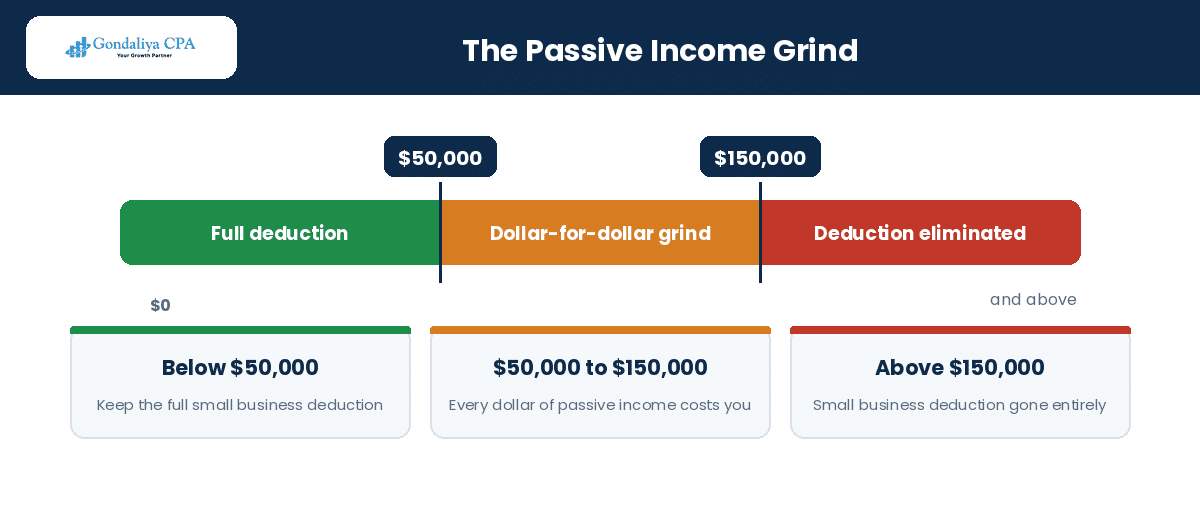
Key Stat: Passive investment income above $50,000 reduces the small business deduction dollar for dollar, and at $150,000 the deduction is eliminated entirely. That single band drives most structural decisions.
Understanding the Tax Environment for Canadian Medical Practices
Understanding the Tax Environment for Canadian Medical Practices
The Environment
Canadian taxes can be tricky for medical offices to handle properly. Knowing the details can help practices avoid mistakes and save cash where possible.
Overview of Federal and Provincial Tax Regulations Impacting Healthcare Professionals
- Income Taxes: You pay both federal and provincial rates.
- GST/HST: Some health services do not have GST/HST, but this depends on exact CRA criteria.
Doctors need clear info on these rules since they shape how profitable their practice really is.
Key Differences in Tax Treatment Among Healthcare Provider Types
| Provider Type | Incorporation Status | Key Considerations |
|---|---|---|
| Physicians | Incorporated | Can use small business deduction |
| Dentists | Unincorporated | Limited options for deferring taxes |
| Allied Health Practitioners | Mixed | Depends on individual cases |
Knowing these differences helps providers plan better with corporate tax strategies.
Impact of Healthcare Regulatory Requirements on Tax Planning
- Each province limits who can own shares in professional corporations.
- Licensing bodies set rules about what expenses you can claim.
- TOSI (Tax on Split Income) rules check if family income splitting fits real work done.
A healthcare CPA understands these rules well when helping with medical practice tax planning.
Provincial share ownership rules catch people out more often than the tax rules do. A structure that works federally can still fail a licensing body review in Ontario. Figures changed for privacy.
Professional Corporation Structure for Healthcare Providers
Professional Corporation Structure for Healthcare Providers
The Structure
Choosing to incorporate changes things like legal protection and taxes significantly. It’s not just about saving money now but setting up for growth later.
Benefits Of Incorporation For Physicians And Dentists
- Protecting personal assets from business risks
- Paying lower taxes by keeping earnings inside the corporation longer
These advantages help build stable practices that can adjust as markets change.
Choosing Between Single Corporation And Multiple Corporations For Clinic Structures
- How big the clinic is or plans to grow
- Risks involved in different parts of the business
- Extra costs from managing separate corporations
Each choice has pros and cons that need careful thought with trusted advisors.
Comparing Incorporated Versus Unincorporated Status For Healthcare Professionals
The choice between incorporated or not brings clear differences:
- Incorporation offers tax deferral chances.
- Unincorporated status means simpler setup but fewer benefits.
Doctors should pick what matches their goals best without risking legal problems.
Tax Considerations For Clinic Expansion And Multi-location Practices
Expanding clinics to multiple locations brings fresh tax issues. Local laws at each site add complexity along with existing obligations from before. Handling these details well keeps things running smoothly as practices grow bigger than a single office.
Multiple corporations sound tidier than they are. Each one adds a filing, a set of books and an associated corporations question, and the extra cost frequently outweighs the benefit for a single-site practice. Figures changed for privacy.
Pro Tip: Decide the structure with the next five years in view rather than the current tax year. Restructuring later carries its own tax cost, and a holding company added early is far cheaper than one bolted on afterwards.
Financing Strategies for Medical Practice Growth
Financing Strategies for Medical Practice Growth
The Financing
Healthcare tax planning Canada calls for smart financing moves to grow medical practices. Doctors who use solid corporate tax planning find ways to fund expansion, keep cash flowing, and increase after-tax profits. Medical practice tax planning means using retained earnings, bank loans, and real estate strategies that fit healthcare corporations well.
Key ideas to remember:
- Use profits inside your corporation instead of taking dividends right away.
- Balance keeping money inside the company with personal tax deferral.
- Choose financing options carefully for the best tax results.
Utilizing Corporate Retained Earnings for Funding Expansion
Doctors can use corporate retained earnings as a handy way to fund growth without borrowing or paying personal taxes immediately. Holding profits in the corporation helps delay personal tax bills while reinvesting in new equipment, extra staff, or new services.
But the CRA expects these retained earnings to back real business needs and follow rules on reasonable pay and shareholder benefits. A healthcare CPA can help find the right amount to keep in the company so you don’t lose liquidity but still get tax advantages.
Some points about retained earnings:
- Keeps money inside without triggering dividend taxes.
- Watch out for limits like the small business deduction threshold.
- Keep solid records proving the money is needed for business growth.
For example, we helped a Toronto specialist put 30% of net income into retained earnings over three years. This funded clinic upgrades while staying within CRA reasonableness rules. Figures changed for privacy.
Options and Tax Efficiency of Bank Financing and Interest Deductibility
Bank loans are common for expanding medical practices. But doctors must structure loans so interest payments can be deducted under ITA s.18(1)(a). Only interest on money borrowed to earn business income counts.
You should prove loan funds pay for eligible corporate assets or operating expenses. If you use loan money personally, CRA may deny interest deductions.
Tax-smart tips:
- Get loans with competitive interest rates.
- Use borrowed cash only for buying equipment or expanding practice space.
- Keep clear records linking loans directly to income-generating activities.
Working with a healthcare CPA helps separate deductible from non-deductible costs during financing talks.
Principles and Strategies for Real Estate Acquisition Within Healthcare Corporations
Buying real estate through a healthcare corporation needs careful corporate tax planning because passive investment income rules can apply here.
Here’s what doctors should know:
- Owning property inside your active professional corporation might reduce small business deduction access due to passive income rules.
- Setting up a separate holding company just for real estate keeps rental income apart from your main business.
- Lease agreements between your medical practice and holding company help optimize taxes on inter-company deals.
Timing purchases matters too, especially with upcoming Ontario corporate rate changes in 2026. A healthcare CPA firm can advise on salary and dividend plans that fit this setup.
Inter-Clinic Cost Allocation and Transfer Pricing Challenges
Multi-location clinics face tricky cost allocation issues. Clear documentation plus solid transfer pricing policies are needed to meet CRA standards.
Identifying Common Cost Categories for Allocation in Multi-location Practices
Here are typical costs that need splitting between clinics:
- Rent (split by square footage)
- Administrative staff (based on hours worked per site)
- Equipment (using usage logs or patient numbers)
- Utilities (divided by facility size)
Getting allocations right stops one clinic from unfairly helping another. It also fits ITA rules about associated corporations.
Approaches to Defensible Cost Allocation and Documentation Standards
CRA wants cost splits based on real measures — no random guesses allowed. To stay clear of trouble:
- Use consistent methods every year and keep written policies.
- Save timesheets, invoices, usage reports as proof.
- Charge fair market prices between clinics to avoid artificial profits shifting.
Healthcare CPAs help clients build clear cost-sharing systems that pass audits smoothly using Canadian transfer pricing guidelines.
Transfer Pricing Considerations To Ensure CRA Compliance
When related clinics sell goods or services among themselves, transfer pricing rules apply:
- Use arm’s length prices like unrelated parties would.
- Document how you set these prices and why.
- Check impacts on small business deductions linked to associated corporations status.
Breaking these rules risks penalties under ITA s15 around shareholder benefits if transfers look off-market. Getting professional advice cuts those risks sharply.
Employee and Independent Contractor Classification in Healthcare Settings
Proper worker classification affects payroll taxes, CPP/EI contributions, withholding taxes—and shapes medical practice tax planning outcomes a lot.
Criteria And Tax Consequences Under CRA Control Tests
| Factor | Employee Sign | Contractor Sign |
|---|---|---|
| Work hours | Fixed/scheduled | Flexible |
| Tools & materials | Employer provides | Worker owns |
| Financial risk | Low | High |
Mislabeling workers triggers payroll reassessments plus penalties plus back CPP/EI payments.
Advantages And Disadvantages Of Employee Versus Contractor Classification
Employees give more control over work quality but add employer costs. Contractors bring flexibility but risk status disputes that threaten expense claims’ validity.
Medical practices should weigh these pros/cons carefully with expert help to fit their model while staying compliant and tax-efficient.
Best Practices To Minimize Employment Status Disputes
- Writing clear contracts that match how workers actually operate
- Reviewing worker roles regularly as duties change
- Keeping records showing contractor independence where used
Gondaliya CPA suggests regular audits to spot red flags before CRA notices them first.
Income Splitting Strategies And Family Involvement Tax Rules
Income splitting looks attractive but tight TOSI rules limit how families share income in professional corporations.
Using Income Splitting In Compliance With TOSI (Tax On Split Income) Rules
TOSI restricts paying dividends or salaries beyond reasonable amounts unless family members meet special criteria set by CRA. Doctors must prove family workers actually earn what they’re paid with proper documentation.
Ignoring this leads to high retroactive taxes at top rates—definitely not what anyone wants! Tools like prescribed rate loans or equity stakes can support legal income splitting alongside good planning advice.
Applying The Reasonableness Test For Family Member Compensation
Family pay must make sense given their role’s complexity and time spent compared with industry benchmarks. Overpaying risks denied deductions and damage to reputation—especially since health regulators watch share ownership closely in Ontario’s CPSO/RCDSO/RCPSC contexts.
Good job descriptions plus timely performance reviews strengthen defenses when questioned by authorities. Gondaliya CPA tailors advice case-by-case here effectively.
Employing Prescribed Rate Loans And Equity Participation For Adult Children
Prescribed rate loans let families move wealth at low interest rates set quarterly by CRA without immediate tax hits. This helps with succession plans while protecting future gains outside dividends streams directly taxed now.
Giving adult kids minority shares works too—but doctors must respect provincial rules limiting voting rights or share types in professional corporations under Ontario Business Corporations Act regulations so nothing breaks provincial laws on PC shares ownership [25][26].
These approaches require tight legal-tax teamwork best done with healthcare CPAs skilled in managing complex rules across Canada including Toronto/Ontario markets served by Gondaliya CPA.
Cost allocation across sites is where multi-clinic files spend the most time. Square footage and timesheets are easy to defend; anything estimated after the fact is not. Figures changed for privacy.
Risk Warning: Worker misclassification carries a compounding cost. A reassessment brings back CPP and EI, employer portions and penalties, and it reaches back over the periods involved rather than starting from the assessment date.
Income Splitting Strategies and Family Involvement Tax Rules
Income Splitting, Succession and Tax Compliance
The Family Rules
Income splitting can help incorporated healthcare pros manage taxes better. But the Canada Revenue Agency (CRA) sets clear limits through Tax on Split Income (TOSI) rules. Doctors and other medical professionals need to know these rules well for good corporate tax planning doctors.
Using Income Splitting in Compliance with TOSI Rules
TOSI stops families from shifting income just to pay less tax. Most dividends or salaries paid to family from a professional corporation get extra tax unless they meet certain exceptions.
Family members can only get split income if they do real work. They must be paid fair market value for their role. The TOSI Exemption Limit allows some split income without penalty if payment matches actual work done.
If these rules are ignored, CRA taxes those payments at the highest rate. This makes old dividend sprinkling tactics risky now.
Applying the Reasonableness Test for Family Member Compensation
Salaries paid to family must pass the reasonableness test in ITA section 67(1). That means pay should fit:
- The work done
- Time spent
- Market rates for similar jobs
Paying a reasonable salary helps your corporation claim proper deductions. It also avoids CRA tagging payments as shareholder benefits.
For example, paying an admin assistant a normal local salary is safe. But high pay without proof may cause penalties or denied deductions.
Employing Prescribed Rate Loans and Equity Participation for Adult Children
You can split income by lending money at prescribed rates. Adult children then pay tax on investment income at their lower rates. This must follow TOSI and CRA interest rules closely.
Giving shares to family also spreads dividends but medical corporations limit non-professional shareholders. Any dividend payments must respect both health regulator rules and federal anti-income-splitting laws.
Strategic Succession Planning for Healthcare Practices
Succession planning fits well into corporate tax planning doctors do with help from a healthcare CPA. It protects wealth and keeps clinic ownership changes smooth in Ontario and Canada.
Comparing Internal and External Succession Options for Clinic Ownership Transition
Internal succession means passing shares among current doctor partners or associates inside the professional corporation setup approved by CPSO or RCDSO[^5]. This option keeps care steady, cuts costs, and speeds up regulatory approvals compared to selling outside.
External succession involves selling part or all of the practice outside current owners. This needs more valuation, legal checks, and regulator OKs because shares only go to licensed practitioners[^6]. Capital gains taxes may also impact proceeds here.
Choosing between internal vs external depends on:
- Successor readiness
- Financial goals
- Timing needs
- Risk exposure
- Estate freeze chances
- Control preferences
Implementing Estate Freeze Strategies To Preserve Wealth And Manage Tax Liabilities
An estate freeze locks asset values now in your holding company. Future growth goes to preferred shares owned by heirs or trusts following CRA rules[^7]. This defers capital gains taxes until later sale while obeying Ontario medical practice laws[^8].
Estate freezes plus smart salary-dividend plans boost CPP benefits and RRSP room — perks available only with incorporation[^9]. This helps balance wealth transfer goals with cutting upfront tax hits.
Integrating Succession Planning With Income And Corporate Tax Optimization
Good plans mix salaries and dividends to grow CPP pensions and RRSP space under Canadian retirement rules[^10]. Timing around fiscal year-end also lowers combined personal-corporate tax bills over time.
Corporate And Personal Tax Compliance For Healthcare Professionals
Healthcare CPAs keep doctors on track with medical practice tax planning plus strict corporate filing duties set federally by CRA.
Filing Requirements Including T2 Corporate Tax Returns And OHIP Billing Reporting
Professional corporations must file annual T2 Corporation Income Tax Returns within six months after fiscal year-end per ITA s.150(1)[^11]. Late filing triggers penalties that grow with unpaid amounts.
Clinics billing OHIP need precise revenue reporting too. Records must match GST/HST exempt status as per CRA instructions[^12].
Documentation Essentials For Inter-Corporate Transactions And Audit Preparedness
Good records cut audit risks. Focus on:
- Shareholder benefit reports
- Dividend resolutions logged properly
- Employment contracts showing fair pay
- Associated corporations details clearly stated
These prove all related party dealings follow associated corporation rules. They stop passive investments from harming small business deduction limits[^13].
Keep minute books up-to-date and keep invoices handy. These support expenses during detailed reviews expected of Ontario healthcare CPAs.
Common Tax Compliance Pitfalls And Strategies To Avoid Them
Bad or missing docs risk reassessments. Family member payments without proof often trigger shareholder benefit charges increasing taxable income unexpectedly[^14].
Avoid this by hiring healthcare CPAs who know physician corporation quirks well. Keep strong records and update them fast when laws change—like upcoming 2026 small business deduction shifts affecting many Toronto/Ontario providers.
Contact Gondaliya CPA today at 647‑212‑9559 or info@gondaliyacpa.ca for expert guidance tailored precisely toward your medical practice’s strategic corporate tax optimization needs — backed by 1300+ 5-star Google reviews.
[^1]: CRA – Split Income
[^2]: ITA Section 67 Reasonableness
[^3]: Prescribed Rate Loan Strategy – CRA
[^4]: Ontario Professional Corporation Share Ownership Restrictions
[^5]: CPSO Professional Corporations Guide
[^6]: RCDSO Regulations – Dental Practice Incorporation
[^7]: Estate Freeze Overview – CPA Canada
[^8]: Ontario Business Corporations Act – Incorporation Rules
[^9]: CPP & RRSP Integration Guidance – Canada Revenue Agency
[^10]: Salary-Dividend Mix Impact On Retirement Savings – CPA Resources
[^11]: Corporate Filing Deadlines – ITA s150(1)
[^12]: OHIP Billing & GST/HST Exemptions – CRA Guidelines
[^13]: Associated Corporations Small Business Deduction Limits – ITA s125
[^14]: Risk Warning: Paying unreasonable salaries without documentation may lead to shareholder benefit reassessment
An estate freeze done at the right moment is worth more than any single-year deduction. Done late, after values have already grown, the tax that was meant to be deferred has largely accrued. Figures changed for privacy.
Managing Passive Income and Asset Segregation in Medical Corporations
Passive Income, GST/HST and Advanced Strategies
The Thresholds
Medical corporations need to watch their passive income carefully to save on taxes under Canadian law. When a professional corporation earns passive investment income, it can lose some or all of its small business deduction. This means higher taxes. This issue matters a lot for healthcare professionals focused on healthcare tax planning Canada.
The federal Income Tax Act cuts the small business deduction if passive income goes over $50,000 per year. It reduces the deduction dollar-for-dollar until passive income hits $150,000, where it’s gone completely.1 So, doctors and other health pros who keep earnings inside their medical practice corporation and invest them passively may face bigger corporate tax bills.
One way to handle this is by separating assets. You keep active medical practice revenue in one corporation and passive investments like rental properties or stocks in another holding company. This setup helps doctors with corporate tax planning doctors because it keeps active income eligible for lower small business rates while managing investment risk separately.
CRA expects these setups to have real business reasons behind them. Documentation must prove economic substance and that transactions are at arm’s length.2 Holding companies shouldn’t just be tax shelters without legitimate purpose.
Things to keep an eye on:
- Watch your passive income yearly to stay under limits affecting the small business deduction.
- Use holding companies for passive assets like rentals or marketable securities.
- Make sure dividends between corporations qualify for Part IV tax exemption.
- Keep detailed records showing genuine asset segregation following CRA rules.
From what we’ve seen, clients who split assets properly and apply medical practice tax planning often get better cash flow timing and avoid surprise tax increases from passive income rules.
Addressing GST/HST Compliance Specific to Healthcare Practices
Healthcare providers face special GST/HST rules because many services are exempt under Canadian law. If you work with a healthcare CPA like Gondaliya CPA who knows healthcare tax planning Canada well, you avoid costly mistakes here.
Most necessary medical services by doctors, dentists, or regulated health pros are exempt from GST/HST as per Schedule V of the Excise Tax Act.3 Here’s how that works:
- Fees tied directly to diagnosis or treatment are usually exempt.
- Cosmetic procedures without medical need may have GST/HST applied.
- Charges for admin work not linked to patient care might also be taxable.
If your taxable revenues (including taxable extras) pass $30,000 over four quarters, you have to register for GST/HST.4
You can claim Input Tax Credits (ITCs) only on expenses related strictly to taxable sales. So it’s important to separate costs properly during accounting. This is something healthcare CPAs handle carefully.
Not following these rules can lead to reassessments, penalties, and interest charges. We help ensure all revenue is classified correctly and returns filed on time — especially for Ontario-based practices serving wide areas across Canada.
Advanced Tax Strategies for High-Income Healthcare Professionals
High-income doctors benefit a lot from advanced corporate tax planning doctors strategies crafted through solid medical practice tax planning by skilled healthcare CPAs.
These plans focus on maximizing take-home pay through smart salary-dividend mixes. This helps boost RRSP room while managing CPP premiums paid personally and via the corporation.5
Other useful methods include:
- Using Individual Pension Plans (IPPs) funded by the corporation. They let you save more than RRSP limits.
- Timing depreciation claims on expensive medical gear so deductions line up with your most profitable years.
- Employing family members legitimately within the practice with salaries that respect TOSI rules.6
Holding companies also play a role here. They allow you to defer taxes by keeping funds inside at lower rates before paying them out when personal tax rates make more sense — especially with Ontario’s 2026 corporate rate changes.7
These strategies require careful records and detailed modelling done each fiscal year-end. Firms like Gondaliya CPA guide clients step-by-step while making sure everything stays compliant with CRA rules.
Passive income sneaks up on practices that have been profitable for several years. Nothing changes in the practice itself, and then one year the investment portfolio inside the corporation crosses the threshold. Figures changed for privacy.
Key Stat: The GST/HST registration threshold is $30,000 of taxable revenue over four quarters. Most clinical services are exempt, so it is usually cosmetic and administrative charges that push a practice over it.
Key Tax Deductions and Eligible Expenses for Healthcare Providers
Key Tax Deductions and Eligible Expenses for Healthcare Providers
The Deductions
Healthcare tax planning in Canada means spotting expenses you can deduct to lower your taxes. Medical practice tax planning helps find costs that cut taxable income while staying within CRA rules. Common deductions include:
- Professional fees
- Office rent
- Salaries
- Medical supplies
- Admin costs tied to patient care or running the business
Corporate tax planning doctors must keep solid records—like invoices and contracts—to prove these expenses. A healthcare CPA can sort expenses properly, helping you claim the right deductions without risking an audit.
Maximizing Deductions for Professional Liability Insurance and Licensing Fees
Professional liability insurance premiums are fully deductible for incorporated healthcare pros under section 18(1)(a) of the Income Tax Act. Licensing fees charged by bodies like CPSO or RCDSO also count as necessary business costs.
Medical practice tax planning should focus on paying and documenting these on time every year. A healthcare CPA can help separate personal from corporate use—say if you do some private consulting—to meet CRA’s reasonableness rules in s.67 ITA.
Capital Cost Allowance Claims for Medical Equipment and Facilities
Capital Cost Allowance lets corporations deduct depreciation on assets like machines, dental chairs, or clinic upgrades. Here’s how it works in Canada:
- Medical gear is usually Class 8 (20% declining balance).
- Leasehold improvements get claimed over their lifespan.
- Vehicles mainly used for patients go in Class 10 or 10.1 based on cost.
Doctors using corporate tax planning gain by timing CCA claims wisely—deciding when to claim now or defer later per CRA rules. Keep detailed asset records with invoices ready for audits.
Applying Home Office, Vehicle, and Travel Expense Deductions Appropriately
Medical practice tax planning covers home office costs only for work-related space, not personal use. Deductible parts include utilities and property taxes prorated by workspace size during work hours.
Vehicle expenses need logbooks showing kms driven for patient visits or meetings, not commuting. Fuel and maintenance can be deducted proportionally.
Travel to conferences or courses tied to licensing counts too but requires receipts and proof linking the trip to professional development set by regulators like CPSO or RCDSO.
Year-End Tax Planning Best Practices for Medical Practices
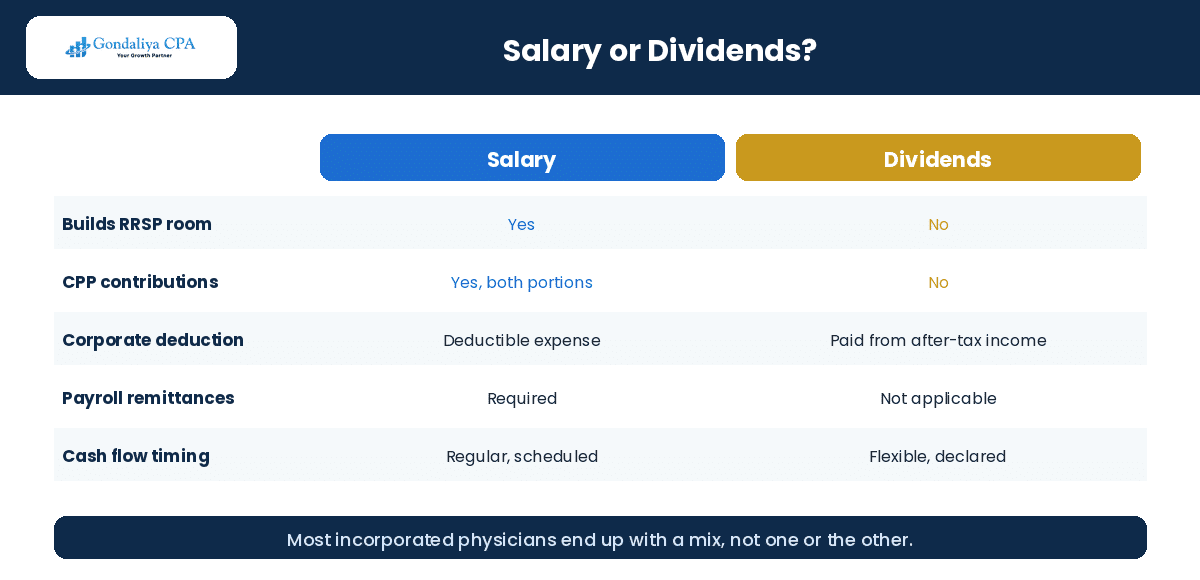
Year-end is a chance for doctors to adjust salary and dividend mixes to create RRSP room and lower CPP contributions where it fits [CRA Salary vs Dividend Integration].
Healthcare CPAs advise checking unpaid bonuses before December 31st, plus pre-paying deductible items like insurance or subscriptions to bring forward expenses legally.
This helps cash flow without triggering auditor alarms. Preparing early keeps T2 filings smooth and avoids losing small business deduction benefits linked to Ontario group practices rules.
Checklist for Closing the Fiscal Year With Optimal Tax Outcomes
| Task | Description | Client Action | CPA Role |
|---|---|---|---|
| Review Remuneration Mix | Check salary-dividend split | Provide payroll data | Advise on adjustments |
| Verify Expense Documentation | Gather receipts/invoices | Submit records | Validate eligibility |
| Assess Capital Asset Purchases | Confirm equipment investments | Supply agreements | Calculate CCA claims |
| Reconcile Receivables/Payables | Ensure book accuracy | Provide trial balances | Adjust entries; prepare reports |
| Prepay Eligible Expenses | Consider early payments | Authorize payments | Advise on timing |
| Finalize Shareholder Loans | Document loans | Disclose loan details | Review terms |
This checklist supports year-end closing while aiming at max legal deductions per Toronto/Ontario regulations, backed by healthcare CPA expertise.
Timing of Income and Expense Recognition for Tax Efficiency
Corporate tax planning doctors recognize income when earned, not just received, following accrual accounting required by CRA [T2 Guide]. This prevents income spikes or dips caused by timing mismatches in billing streams like OHIP payments or locum fees.
Expenses match obligations, not payment dates—unless cash basis applies as per ITA s.154(4). Deferring invoices near year-end can help but must avoid anti-avoidance rules. The goal: keep real economic activity clear.
Preparing for Audit Risks and Managing Legal Protections
Healthcare CPAs stress keeping all documents at least six years per CRA rules. This includes shareholder resolutions on dividends/salaries plus contracts backing family employment at fair rates under TOSI [s120.4 ITA].
Audit red flags appear if shareholder benefits don’t match services rendered or if clinics use non-arm’s-length deals hiding taxable perks [s15 ITA]. Incorporating clinics under Ontario Business Corporations Act demands clear records.
Good legal protection means hiring CPAs who know federal/provincial laws well and can represent you during reviews to reduce risks.
Healthcare Practice Accounting Fundamentals for Doctors and Dentists
Bookkeeping for medical practices blends revenue from OHIP billings plus private pay patients with separate ledger accounts. This helps apply GST/HST exemptions accurately since most medical supplies are exempt unless cosmetic without medical need (CRA GST/HST Exempt Supplies).
Expenses track typical costs: wages for nurses/receptionists paid either full- or part-time, with payroll remittances filed on time to avoid penalties. Dental offices especially must handle associates’ fee splits via clear contracts reviewed yearly.
Specific Accounting Profiles and Reporting Needs For Various Healthcare Provider Types
Different healthcare providers have unique accounting needs based on their pay models:
- Physicians run single-shareholder corporations focusing on salary-dividend balance with passive investments sometimes limited by passive income rules.
- Dentists manage larger teams including hygienists/assistants needing layered payroll systems linked to bookkeeping tools like QuickBooks or Xero common at Gondaliya CPA.
- Allied Health Pros (e.g., physiotherapists) vary due to provincial ownership restrictions impacting profit sharing compliant with regulatory body rules.
Reporting adapts accordingly with monthly financial statements highlighting profits tracked quarterly so firms act fast with corrective advice from local Toronto/Ontario CPA experts.
Reconciling Medical And Dental Billing With Tax Reporting Obligations
Medical practice tax planning requires matching billing data against reported income closely. Electronic claim submissions through OHIP/RCDSO portals must align with bank deposits in reconciliations to avoid audit flags (Canada Revenue Agency – Record Keeping).
Dental clinics face extra challenges balancing fee-for-service schedules against associates’ pay splits calculated as percentages. Transparent reconciliation helps prevent deferred revenue errors that affect final T2 filings under strict Ontario deadlines.
Utilizing Health Spending Accounts (HSAs) As Part Of Comprehensive Financial Management
Health Spending Accounts give incorporated healthcare providers a flexible way to reimburse health-related expenses outside usual benefit plans. They boost compensation packages inside physician corporations allowed provincially if done right per CRA rules (CRA HSA Guidelines).
Adding HSAs fits broader financial plans managed through specialized healthcare CPAs who integrate them into budgets carefully, keeping after-tax income healthy without risking compliance problems.
The deduction owners most often leave unclaimed is the home office, because the calculation feels fiddly. It is a fifteen-minute measurement done once, and it recurs every year afterwards. Figures changed for privacy.
Common Tax Planning Mistakes to Avoid in Healthcare Practices
Common Tax Planning Mistakes to Avoid in Healthcare Practices
The Mistakes
Healthcare tax planning Canada needs careful attention. Many doctors mess up by mixing salary and dividends the wrong way. They also miss claiming deductions they deserve. Sometimes, family members get paid without proper paperwork. These slip-ups can lead to CRA penalties.
Doctors often guess about income splitting rules without checking TOSI requirements. They might claim expenses that aren’t backed by receipts or contracts. If you use a regular accountant who doesn’t know medical practice tax planning, you might lose tax savings.
Corporate tax planning doctors should watch share ownership rules and income timing carefully. Skipping these steps risks audits and extra taxes. A healthcare CPA can spot these issues early and guide you right.
Consequences of Inadequate Passive Income Planning and Lack of Documentation
Passive investment income threshold rules matter a lot for medical corporations in Canada. If passive income goes over $50,000, your small business deduction drops dollar-for-dollar. That means higher corporate taxes.
Doctors who don’t separate investments from their corporation end up paying more tax on profits kept inside. Plus, missing documents makes things worse during audits.
Medical and dental practices often miss deductions like:
- Capital cost allowance (CCA) on equipment
- Licensing fees
- Education expenses
- Home office costs that meet CRA rules
- Vehicle logs
- Proper payroll for staff using ADP or Wagepoint
- Software subscriptions needed to run the practice
- Liability insurance premiums
Without clear records, CRA may reject these claims entirely.
Pitfalls of Improper Income Splitting Attempts and How to Implement Safe Approaches
Doctors can’t just give family members dividend cheques or salaries freely. TOSI rules say income splitting only works if family members actually work and get paid fairly.
If you ignore this, CRA can add extra taxes equal to the split amount plus penalties.
Here’s how to do it right:
- Hire family only for real jobs
- Keep detailed timesheets showing work hours
- Write formal contracts outlining duties and pay
- Check provincial laws—only licensed practitioners usually can own shares
Following these steps keeps your corporation safe while using legal income splitting methods.
Risks Associated with Neglecting GST/HST Compliance and Record Keeping
Most medical supplies are exempt from GST/HST. But cosmetic services aren’t exempt. If your taxable revenue hits $30,000 yearly, you must register for GST/HST.
Missing registration means interest charges and penalties if CRA catches you later. Bad record keeping also hurts input tax credit claims because you must separate taxable from exempt sales properly.
Good GST/HST compliance means:
- Filing returns on time (quarterly or semi-annually)
- Keeping detailed invoices stating which items are taxable or exempt
- Using accounting software like QuickBooks or Xero with receipt management
This helps avoid disputes during audits.
Integrating Tax Planning with Risk Management and Legal Protection
Corporate tax planning isn’t just following rules or pushing limits too far. It balances legal ways to reduce taxes without crossing lines.
Smart plans mix salaries and dividends to maximize RRSP room while keeping CPP costs low. Adding retirement plans like IPPs helps save more over time inside the corporation.
CRA audits look closely at shareholder perks and family salaries. They want proof that payments match real work done.
Well-kept records cut audit risks by showing clear transactions and decisions.
Professional corporations protect doctors’ personal assets from business debts. This shield matters a lot in today’s changing regulations affecting physicians, dentists, and allied health pros across Ontario and Toronto.
Mitigating Audit Risks Through Organized Tax and Financial Records
CRA checks:
- Dividend declarations approved by directors/shareholders
- Payroll matching reported salaries with remittances
- Expense ledgers proving valid business costs
- Rules around associated corporations preventing double small business deductions
Keep minutes explaining payment decisions to defend against reclassification of benefits as taxable perks.
Use cloud accounting synced regularly to avoid lost data. It speeds up answers if CRA asks for records covering six years.
Working with a healthcare CPA helps catch problems early before filing returns—saving money and headaches later.
Legal Safeguards Offered By Professional Corporation Structures
Professional corporations limit shares to licensed healthcare providers only. This keeps control with qualified people ensuring public trust stays high.
Incorporation shields personal assets from business liabilities that might happen unexpectedly.
It also supports succession plans letting doctors slowly pass equity within strict rules avoiding license risks.
Plus, professional corporations enable access to group benefit plans that boost employee retention — important in competitive Toronto job markets.
Applying Personalized Tax Strategies Aligned With Practice Goals
Combining salary and dividends wisely helps build CPP contributions that grow RRSP room too. This supports both today’s cash needs and tomorrow’s retirement savings better than relying on one method alone.
IPPs offer bigger contribution limits than RRSPs once mid-career milestones hit. Holding companies help delay distributions until tax rates are lower — lowering overall corporate taxes paid now.
These strategies need ongoing review because tax laws change often (like 2026’s new small business deduction rules). A trusted healthcare CPA who knows medical practice details will guide you safely through updates while protecting your money over time.
Contact Gondaliya CPA For Expert Healthcare Tax Planning Support
Gondaliya CPA specializes in helping incorporated doctors, dentists, and allied health pros across Toronto/Ontario manage tricky rules around incorporation, income splitting, GST/HST registrations, health spending accounts, and retirement plans — all tailored per client’s unique needs.
You can reach us by phone at 647‑212‑9559 or email info@gondaliyacpa.ca for a free consultation about how we handle medical practice tax planning within Canadian law while getting the most from your corporate structure.
How Do We Deliver Healthcare Tax Planning At Gondaliya CPA?
We start by reviewing your current revenue streams and entity setup carefully. Then we look at your salary vs dividend mixes for best cash flow and RRSP results. Next we check every possible deduction including capital asset buys plus passive investment holdings to spot any passive income grind risk triggers. Family involvement gets tested against TOSI rules too.
Finally we craft retirement funding plans with IPPs or RRSPs plus year-end calendars so filings come on time every year without surprises.
Our senior CPAs personally review your final return for accuracy backed by experience trusted across 1300+ five-star Google reviews — always with fixed pricing and support options including weekends or evenings.
What Deliverables Do You Get?
Clients receive a full package including:
| Deliverable | Description | Purpose |
|---|---|---|
| Tax Planning Memo | Detailed strategy overview | Annual reference |
| Remuneration Mix Schedule | Salary vs dividend breakdown | Cash flow & RRSP optimization |
| Dividend & Payroll Calendar | Timing guide | Compliance & liquidity |
| Deduction Schedule | Itemized list of claims | Maximize write-offs |
| Capital Asset & CCA Plan | Depreciation tracking | Asset value accuracy |
| Passive Income Review | Investment analysis | Protect Small Business Deduction |
| TOSI Assessment Note | Family income splitting check | Reduce regulatory risk |
| Retirement Funding Options | IPP/RRSP integration details | Long-term wealth building |
| Year-End Timing Calendar | Key deadlines reminder | On-time filing assurance |
Each piece blends client input with expert advice delivered digitally for easy access anytime so you stay informed every step.
Encouraging Proactive Tax Strategy Development To Enhance Financial Outcomes In Healthcare Practices
Using multiple smart strategies together inside CRA rules lifts corporate efficiency naturally in professional corporations serving medical practices well.
Planned salary-dividend mixes capture more deductions now while deferring others safely later—all staying fully compliant with CRA expectations reducing audit chances too.
The result: higher after-tax earnings kept inside your corporation build financial strength helping healthcare providers face ongoing challenges across Ontario/Toronto confidently.
The pattern behind most missed savings is not a complicated one. It is a general accountant applying general rules to a practice where the provincial ownership and TOSI questions never got asked. Figures changed for privacy.
Frequently Asked Questions (FAQs) on Healthcare Tax Planning in Canada
Frequently Asked Questions (FAQs) on Healthcare Tax Planning in Canada
FAQ
What is the Small Business Deduction Limit and how will it change in 2026?+
The Small Business Deduction Limit caps the amount of income eligible for a reduced corporate tax rate. In 2026, this limit will be adjusted, impacting incorporated medical professionals. Gondaliya CPA can guide you through these changes.
How does the Ontario General Corporate Tax Rate affect healthcare professionals in 2026?+
Ontario’s general corporate tax rate is set to increase in 2026. This affects medical practice corporations with income above the small business deduction threshold. Proper tax planning can help mitigate its impact.
What is the Passive Investment Income Threshold and why is it important?+
Passive investment income over $50,000 reduces your small business deduction dollar-for-dollar. Exceeding $150,000 eliminates it completely. Doctors must monitor passive income to avoid higher taxes.
How do Tax on Split Income (TOSI) Exemption Limits apply to family members?+
TOSI rules limit dividend or salary payments to family members unless they do real work and meet reasonableness tests. Exemptions exist but require documentation to avoid CRA penalties.
Which Capital Cost Allowance (CCA) classes apply to medical equipment?+
Medical equipment typically falls under Class 8 with a 20% declining balance rate. Leasehold improvements and vehicles have specific classes and rates that affect depreciation timing.
How does salary affect RRSP contribution room for doctors?+
RRSP room depends on earned salary, not dividends. Balancing salary and dividends optimizes retirement savings potential for incorporated physicians.
What are the maximum contributions for Individual Pension Plans (IPP)?+
IPP contributions depend on age and earnings but generally exceed RRSP limits. They offer higher retirement savings for high-income healthcare professionals.
When is the Corporate Tax Filing Deadline (T2) for professional corporations?+
T2 returns must be filed within six months after fiscal year-end. Late filing can trigger penalties affecting your corporation’s tax position.
Why are salary-dividend mixes critical in healthcare corporate tax planning?+
A proper mix helps optimize CPP contributions, RRSP room, and overall tax efficiency while complying with CRA rules.
What strategies help maximize deduction capture and deferral legally?+
Claim all eligible expenses timely and defer income or expenses when beneficial within CRA guidelines to improve cash flow and reduce taxable income.
How does CRA compliance relate to economic substance in healthcare corporations?+
Transactions must have real business purposes beyond tax benefits to avoid reassessments or penalties from CRA audits.
What differentiates tax avoidance from tax evasion under Canadian law?+
Tax avoidance uses legal means within CRA rules, while evasion involves illegal acts like hiding income or falsifying documents—risking severe penalties.
How should reasonable compensation be determined for family employees?+
Compensation must reflect fair market value based on role complexity, time spent, and industry standards to pass CRA’s reasonableness test.
What constitutes an associated corporation group under ITA s.125?+
Corporations are associated if they share ownership or control, affecting combined small business deduction limits among related entities.
How does ITA s.256 impact shareholder benefits in medical corporations?+
Section 256 requires reporting shareholder benefits like non-arm’s-length transactions as taxable income if not justified as reasonable expenses.
What guidance does CRA provide on TOSI rules?+
CRA’s TOSI guidance outlines conditions for paying dividends/salaries to family members without triggering highest marginal rates.
Where can I find detailed information in CRA Income Tax Folio S4-F16-C1 related to professional corporations?+
This folio covers policies on shareholder benefits, associated corporations, and other key corporate tax topics applicable to medical practices.
How do CRA RRSP guidelines affect incorporated doctors’ retirement planning?+
RRSP limits rely on reported earned income; thus, salary levels influence maximum contributions available each year.
What are the main points of CRA IPP guidelines for healthcare professionals?+
CRA IPP guidelines outline plan funding limits, actuarial requirements, and contribution rules suitable for medical practice incorporation structures.
Which CRA Corporation Filing Rules apply specifically to healthcare CPAs advising doctors?+
These rules cover deadlines, documentation requirements, proper reporting of inter-corporate transactions, and audit readiness tailored for health sector clients.
Essential Tax Considerations for Healthcare Providers: Key Points
Essential Tax Considerations for Healthcare Providers: Key Points
Quick Reference
- Professional Corporation Requirements: Only licensed healthcare providers may own shares per provincial medical professional corporation guidelines.
- Dental and Allied Professionals: Incorporation rules differ by profession affecting ownership restrictions and corporate structure.
- Tax Credits & Capitalization of Expenses: Eligible credits reduce taxes; capitalizing large assets spreads deductions over time.
- Small Business Deduction Threshold: Monitor closely as exceeding passive investment income limits reduces eligibility.
- Passive Investment Income Grind: Passive earnings above thresholds increase corporate tax rates; asset segregation helps manage risk.
- Prescribed Rate Loans: Use low-interest loans within families legally to enable safe wealth transfer without immediate taxation.
- Estate Freeze Strategies: Lock current asset values to defer capital gains while transferring future growth to heirs.
- Shareholder Benefits Reporting: Document all benefits accurately per ITA s.120.4 to avoid taxable reassessments.
- Family Employment Reasonable Salary: Pay family working legitimately at market rates supported by contracts and timesheets.
- CPP Costs Management: Optimize salary levels balancing CPP contributions paid personally and via corporation.
- Healthcare Regulatory Requirements Compliance: Abide by licensing body mandates regarding share ownership and expense claims.
- Retirement Savings Vehicles Integration: Combine RRSPs, IPPs, and holding companies effectively with professional advice.
- Pension Plan Documents & Actuarial Reports: Maintain updated formal pension documentation including annual actuarial valuations.
- GST/HST Exemptions & Taxable Cosmetic Services: Know which services are exempt versus taxable under Excise Tax Act schedules.
- Audit Preparedness & Documentation Standards: Keep meticulous records supporting all transactions including dividend resolutions.
Gondaliya CPA delivers expert support ensuring your medical practice stays compliant while maximizing corporate tax advantages in Canada.
The question asked most often at year end is the salary and dividend split, and there is no universal answer. It turns on RRSP room, CPP appetite and how much cash has to leave the corporation that year. Figures changed for privacy.
Industry Spotlights: Sectors We Represent
Industry Expertise
Healthcare is where this planning applies most directly, but the same structural questions arise across the sectors we serve.
| Industry | The Planning Question That Dominates |
|---|---|
| Medical doctors & physician corporations | Salary-dividend mix against passive income limits |
| Dentists & dental practices | Associate fee splits and layered payroll |
| Daycare, childcare & CWELCC services | Subsidy revenue timing and payroll structure |
| Real estate investors & holding companies | Passive income grind and asset segregation |
| Property developers & builders | Associated corporations and cost allocation |
| Construction, contractors & skilled trades | Worker classification under CRA control tests |
| Technology startups & SaaS | Capital cost allowance timing and equity planning |
| E-commerce & online retailers | GST/HST registration and input tax credits |
| Restaurants & food and beverage | Payroll remittances and family employment |
| Transportation, logistics & trucking | Vehicle CCA classes and mileage records |
| Consulting firms | Income timing and TOSI on family compensation |
- Medical doctors & physician professional corporations: The remuneration mix and the passive income position are the two levers, and they move against each other.
- Dentists & dental practices: Associate fee splits need contracts reviewed yearly, and the payroll runs deeper than a single-shareholder practice.
- Daycare, childcare & CWELCC services: Subsidy revenue recognition and payroll structure carry the same documentation burden as clinical billing.
- Real estate investors, landlords & holding companies: This is where the passive income grind bites hardest, and where segregation earns its cost.
- Property developers & builders: Several corporations means associated corporation rules and defensible cost allocation between them.
- Construction, general contractors & skilled trades: Worker classification under the CRA control tests is the single largest exposure in this sector.
- Technology startups & SaaS: Capital cost allowance timing and equity arrangements dominate the planning conversation.
- E-commerce & online retailers: GST/HST registration and input tax credit tracking replace the exemption questions clinics face.
- Restaurants & food and beverage: Payroll remittances and family employment run together, and both need the same documentation.
- Transportation, logistics & trucking: Vehicle capital cost allowance classes and mileage records decide what is actually claimable.
- Consulting Firms: Income timing across periods and TOSI on family compensation are the recurring questions.
Across incorporated professional files in one year, the two most common planning gaps were an unexamined salary and dividend split, and passive investments left inside the operating corporation. Figures changed for privacy.
Professional Guidance and Quick Reference
Guidance
Professional Guidance on Healthcare Tax Planning: How Gondaliya CPA Supports Canadian Practices
Reducing corporate tax in a medical practice comes down to a handful of decisions made in the right order. The remuneration mix has to be set against RRSP room and CPP cost. Passive investments have to sit where they do not erode the small business deduction. Family compensation has to survive a reasonableness test on paper. Capital cost allowance has to be timed against profitable years. Gondaliya CPA works through all of it on a fixed fee.
We handle what decides the outcome: modelling the salary and dividend split rather than guessing at it, reviewing passive income against the $50,000 and $150,000 thresholds before year end, testing family involvement against TOSI, documenting cost allocation across multiple sites, and preparing the T2 with the schedules and resolutions that support every position taken.
Our team knows the provincial ownership rules as well as the federal tax rules, which matters because a structure can be sound on one and fail on the other. Whether you are newly incorporated or reviewing a structure set up years ago, you get clear advice and a fixed price before we start.
Quick Answers: Key Numbers & Concepts at a Glance
At a Glance
- Passive income grind starts: $50,000 per year
- Small business deduction eliminated: $150,000 of passive income
- GST/HST registration: $30,000 of taxable revenue over four quarters
- T2 filing deadline: Six months after fiscal year end
- Record retention: At least six years
- Medical equipment: Class 8, 20% declining balance
- Vehicles: Class 10 or 10.1 depending on cost
- RRSP room: Built by salary, not by dividends
- Reasonableness test: ITA section 67 on family compensation
- Interest deductibility: ITA s.18(1)(a), business purpose required
Who This Is For / Not For
Fit Check
- For: Incorporated physicians, dentists and allied health professionals reviewing their remuneration mix, passive income position, family compensation or succession plan.
- Not For: Unincorporated practitioners still deciding whether to incorporate, where the analysis starts from a different question entirely.
People Also Ask
Quick Answers
Should I take salary or dividends this year?+
It depends on whether you want RRSP room and CPP contributions, or lower immediate cost. Most incorporated physicians end up with a mix rather than one or the other.
Can my spouse be paid through the corporation?+
Only for work actually performed, at a rate the role would command on the open market, with timesheets and a contract to support it.
Does buying a rental property through my corporation cost me the small business deduction?+
It can, once the rental income is large enough. That is why the property usually sits in a separate holding company rather than the practice corporation.
Glossary of Key Terms
Plain-English Definitions
- Professional corporation: A corporation whose shares are restricted to licensed practitioners.
- Small business deduction: The reduced corporate rate on active business income up to a limit.
- Passive investment income: Investment earnings inside a corporation rather than active business income.
- Passive income grind: The dollar-for-dollar reduction of the small business deduction above $50,000.
- TOSI: Tax on Split Income, which taxes unreasonable family payments at the top rate.
- Reasonableness test: The section 67 requirement that an expense amount be reasonable.
- Remuneration mix: The chosen balance between salary and dividends taken from the corporation.
- Capital cost allowance: The deduction for depreciation of capital assets over time.
- Class 8: The CCA class covering most medical equipment, at 20% declining balance.
- Individual Pension Plan: A corporate-funded pension allowing higher contributions than an RRSP.
- Prescribed rate loan: A family loan at the CRA rate, enabling investment income to be taxed lower.
- Estate freeze: Locking current share values so future growth accrues to heirs.
- Associated corporations: Related corporations that must share one small business deduction limit.
- Shareholder benefit: A corporate payment or perk treated as taxable income to the shareholder.
- Health Spending Account: A corporate plan reimbursing health expenses outside standard benefits.
- Transfer pricing: Setting arm’s length prices for transactions between related entities.
Healthcare Corporate Tax Position Check
This quick self-check indicates where your practice most likely has planning room. Please answer the six questions below.
Healthcare Corporate Tax Position Check
Six quick questions on your practice. No fee shown.
Areas with planning room:
This is a general prompt, not tax or legal advice or a quote. Your position depends on your full facts. For a real review, please book a free consultation.
Want a checklist to work from? You can download our free healthcare tax planning checklist before your consultation.
Model the remuneration mix rather than repeating last year’s. Keep passive investments out of the operating corporation before they cross $50,000. Document family compensation as though it will be questioned. Time capital cost allowance against profitable years. Start the succession conversation while values are still low enough for a freeze to be worth doing.
2026 Update — what is current: The small business deduction limit is being adjusted and Ontario’s general corporate rate is set to increase, both of which change the arithmetic for practices earning above the threshold. The $50,000 and $150,000 passive income thresholds, the $30,000 GST/HST registration threshold and the six-year retention rule are unchanged. Please confirm current rates and limits before relying on the figures in this article.
Healthcare Tax Planning Canada: Strategies for Medical Practice and Corporate Tax Planning for Doctors by Gondaliya CPA
Keep more of what the practice earns
Gondaliya CPA models your salary and dividend mix, reviews passive income against the thresholds before year end, tests family compensation against TOSI, documents cost allocation across sites, and prepares the T2 with the schedules and resolutions that support every position, on a fixed fee with a one-business-day response. Please book a free consultation.
Next Steps
Please book a free consultation with Gondaliya CPA and bring your last two T2 returns, your current remuneration figures, and a list of what the corporation holds beyond the practice itself. Those three things are usually enough to see where the planning room is. You will get a fixed fee before any work begins. If our content helps, please add gondaliyacpa.ca as a preferred source on Google.
Published: August 13, 2026 · Last updated: August 13, 2026
Editorial policy: We research against CRA and CPA Ontario sources, fact-check the figures, and Sharad Gondaliya, CPA, reviews the content, which we update as the rules change.
Disclaimer: This article is educational information only and is not tax, legal, or financial advice. Figures marked illustrative are examples rather than quotes or guarantees. It reflects CRA rules current to 2026, including the $50,000 and $150,000 passive investment income thresholds, the $30,000 GST/HST registration threshold, Class 8 capital cost allowance at 20%, the reasonableness test under ITA section 67, and the six-year record retention requirement. Rates, limits and provincial ownership rules change and outcomes depend on your specific facts. Please consult a CPA Ontario member before acting.

Sharad Gondaliya is a CPA Canada & CPA USA with 15 Years+ experience of Accounting, Tax, Payroll of Corporate Small Businesses as Tax Accountant. He is a CPA Ontario member (61040184) and holds US CPA licences in Washington and Montana and is well known among corporate small businesses for tax planning, efficient tax solutions, and affordable CPA services. Sharad is the Principal (Director) of Gondaliya CPA – Affordable CPA Firm in Canada. Licenses: CPA Ontario: 61040184 | CPA USA (MT): PAC-CPAP-LIC-033176 | CPA USA (WA): 57629 | CPA Firm License: 61330051 View Full Author Bio