



How Healthcare Practices Can Maximize SR&ED Tax Credits and Recover Eligible Innovation Costs
SR&ED for healthcare Canada helps incorporated healthcare practices, clinics, and medical technology companies claim valuable tax credits on eligible R&D expenses such as salaries, contractor fees, and materials. Gondaliya CPA provides expert guidance on Form T661, systematic investigation criteria, and CRA review to maximize healthcare SR&ED tax credits and medical R&D benefits.
Quick Summary
Three tests decide eligibility: technological uncertainty, systematic investigation, and technological advancement. Please note the documentation supporting all three has to be created while the work happens, because it cannot be reconstructed convincingly afterwards.
| Aspect | Details |
|---|---|
| The three tests | Uncertainty, systematic investigation, advancement. |
| The rate | Up to 35% federal enhanced refundable credit for CCPCs. |
| The deadline | Twelve months after the T2 return due date, no exceptions. |
| The proof | Daily logs, design notes, test results, timesheets. |
Reading time: 31 minutes.
Table of Contents
- Understanding SR&ED Tax Credits in Healthcare Canada
- Eligibility Criteria for Healthcare SR&ED Tax Credits
- Claim Preparation and Submission Process
- Managing CRA Review and Post-Claim Considerations
- Recent Changes to SR&ED Program Affecting Healthcare Claims in 2026
- Role of a Specialized SR&ED Accountant in Healthcare Tax Credit Claims
- FAQs on SR&ED for Healthcare Canada
- Key Points on Remaining Healthcare SR&ED Topics
- Industry Spotlights: Sectors We Represent
- Professional Guidance and Quick Reference
The Numbers That Matter
This article covers Canada, with Ontario and Toronto context, and reflects CRA rules current to 2026. It assumes an incorporated healthcare practice, clinic, laboratory or medical technology company, generally a Canadian-Controlled Private Corporation. Figures marked illustrative are examples, not quotes, and any masked engagement notes end with “Figures changed for privacy.” This is educational information only and not tax, legal, or financial advice. Rates, limits and program rules change, so please confirm your own situation with a CPA Ontario member before acting.
Understanding SR&ED Tax Credits in Healthcare Canada
Understanding SR&ED Tax Credits in Healthcare Canada
The Basics
What Are SR&ED Tax Incentives and Their Importance for Healthcare
The Scientific Research and Experimental Development (SR&ED) tax incentive program helps healthcare companies in Canada by giving tax credits. These credits support costs tied to research and development work. When a healthcare business claims SR&ED for healthcare Canada, it can get money back for projects that push technology forward. For example, medical R&D tax credits help lower the cost of making new treatments or tech.
Healthcare providers can use these credits to improve what they offer. Plus, they can fund new ideas that make patient care better. Getting healthcare SR&ED tax credits means more funds to spend on further research that benefits both the company and the public.
Key Features of the Healthcare SR&ED Program in Canada
The healthcare SR&ED program is designed mainly for Canadian-Controlled Private Corporations (CCPCs). One big benefit is the federal enhanced refundable credit rate, which gives up to 35% back on eligible R&D spending.
Here’s what matters most about this program:
- It targets CCPCs doing real scientific or tech work.
- Projects must face genuine uncertainty during development.
- Keeping detailed records is a must for proof.
This setup encourages companies to invest in new ideas by giving them solid financial help.
| Feature | Description |
|---|---|
| Enhanced Refundable Credit Rate | Up to 35% return on eligible expenses |
| Eligibility Criteria | Focused on CCPCs doing qualified R&D |
| Documentation Requirement | Detailed record-keeping required |
Types of Eligible Research and Development Activities in Healthcare
Healthcare businesses can qualify for medical R&D tax credits through different kinds of work. These include:
- Experimental Development of Medical Devices: Creating or improving devices with technical challenges.
- Software Development Projects: Making software that solves specific tech problems in healthcare.
- Process Improvements: Finding new ways to make healthcare operations better.
To claim these credits, projects must show there was real uncertainty about how technology would advance. Good documentation that explains the goals and results will help claims stand strong.
Overview of Medical R&D Tax Credits Available to Healthcare Companies
Healthcare companies in Canada can tap into several options for funding through medical R&D tax credits under programs like SR&ED. These credits don’t just cut costs now; they also encourage long-term work on health technologies and methods.
By knowing how these incentives work—like who qualifies and what benefits are offered—healthcare providers can get the most out of them. This helps improve health services across many Canadian communities.
The work that qualifies is often already happening. A clinic building its own scheduling logic or a lab refining an assay is doing experimental development, and nobody has thought to call it that. Figures changed for privacy.
Key Stat: The federal enhanced refundable rate reaches 35% for Canadian-Controlled Private Corporations. That is a refund rather than a deduction, which is what makes the program worth the documentation effort.
Eligibility Criteria for Healthcare SR&ED Tax Credits
Eligibility Criteria for Healthcare SR&ED Tax Credits
The Eligibility
Healthcare SR&ED tax credits help incorporated healthcare groups, clinics, and medical tech firms in Canada. They get support when they work on scientific research or experimental development that meets certain rules. The CRA sets these rules under the Income Tax Act. Medical R&D tax credits cover some costs linked to improving healthcare technology or methods. These efforts have to go beyond regular patient care.
Scientific and Technological Criteria Specific to Healthcare Projects
SR&ED for healthcare Canada means your project must solve real scientific or tech problems. The work should create new knowledge or make current health science methods better. This could include things like medical devices, diagnostic tools, software for managing patients, or lab techniques.
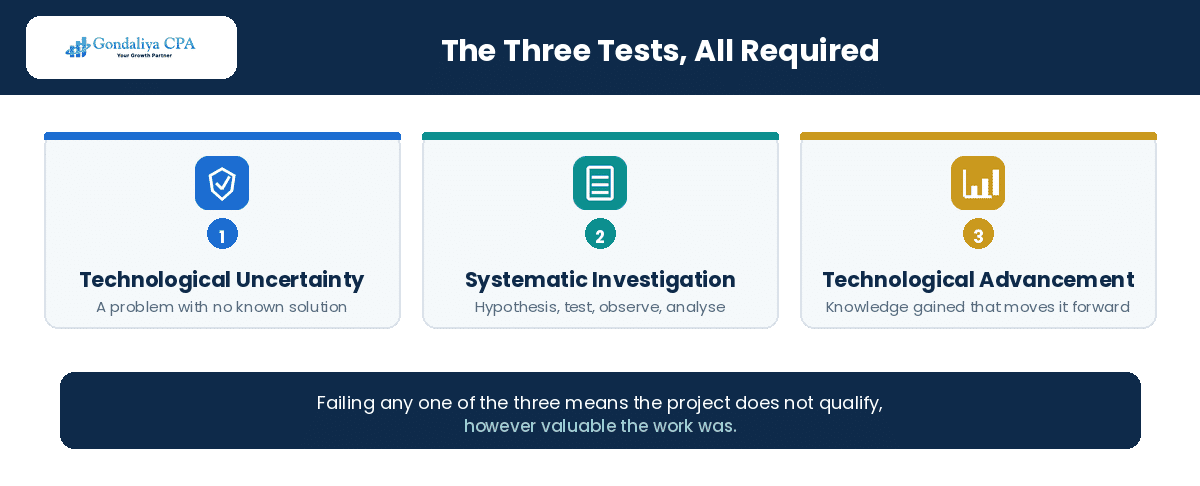
The CRA looks for three main things:
- Technological Uncertainty: You face a technical problem that isn’t easy to fix using normal methods.
- Systematic Investigation: You follow a clear plan with guesses, tests, and study of results.
- Technological Advancement: Your results must improve technology or understanding in healthcare.
Simple clinical tasks don’t count unless they involve making new devices or software with proof of testing[1].
Eligible Healthcare Entities: Incorporated Practices, Clinics, and Medical Technology Firms
Only incorporated groups can claim healthcare SR&ED tax credits. This includes corporations running doctor clinics (like OHIP-billed), dental offices using new tech or automation, labs testing new assays, and startups building medical devices or health IT solutions.
Solo practitioners without a corporation usually can’t claim directly. They might join forces with incorporated companies who do qualifying R&D[2]. Working with an SR&ED accountant Canada-wide helps set up the right entity and boosts credit chances.
Qualified Expenditures: Salaries, Contractor Payments, Materials, and Overhead Methods
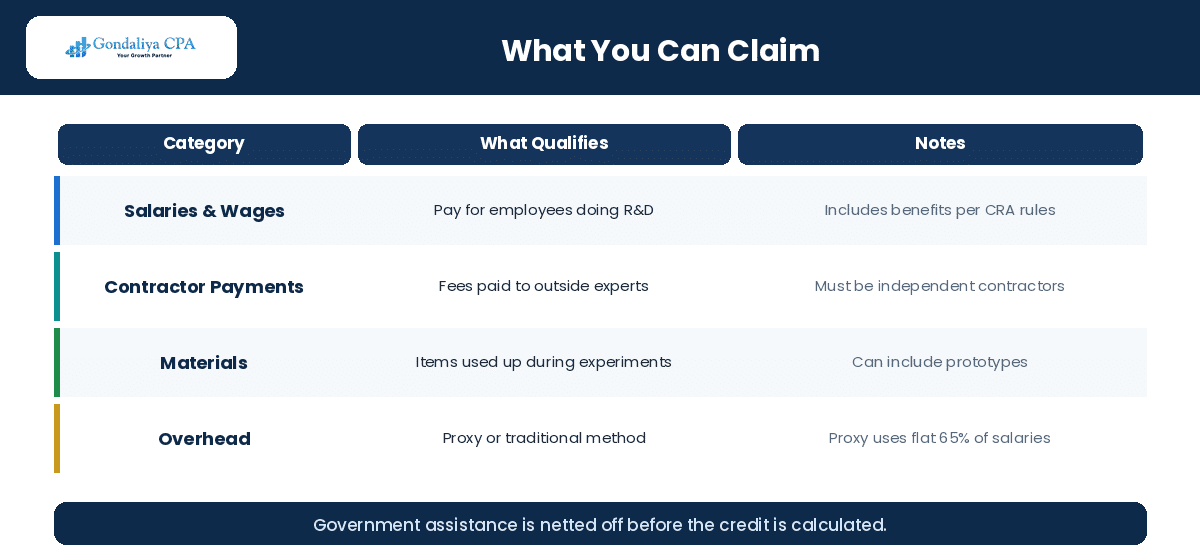
Medical R&D tax credits pay for costs tied directly to eligible SR&ED work:
| Expenditure Category | What Qualifies | Notes |
|---|---|---|
| Salaries & Wages | Pay for employees doing R&D | Includes benefits per CRA rules |
| Contractor Payments | Fees paid to outside experts on qualified tasks | Must be independent contractors |
| Materials | Items used up during experiments | Can include prototypes |
| Overhead | Indirect costs via proxy or traditional method | Proxy uses flat rate (65%) overhead |
The CRA lets you pick between two overhead ways. The proxy method uses a simple percentage of salaries. The traditional one needs exact expense records[3]. Choose what fits your setup best.
Distinctions Between Incorporated and Unincorporated Healthcare Professionals
Incorporated pros can claim federal investment tax credits through their corporation’s tax returns. They track expenses carefully for projects with help from CPAs skilled in SR&ED claims.
Unincorporated practitioners don’t have corporate status needed to file Form T661 by themselves. But they may work with incorporated firms doing research. This changes who reports expenses and claims credits[4].
An SR&ED accountant Canada-based can guide you through these differences to avoid denied claims due to wrong setups.
Provincial Healthcare Innovation Tax Credits Complementing Federal SR&ED
Ontario offers extra perks like the Ontario Innovation Tax Credit (OITC) that go alongside federal healthcare SR&ED tax credits. These target similar spending but often refund at lower levels[5]. These programs push local investment into medical tech including software made for clinics around Toronto.
You need to handle federal and provincial rules carefully since they differ on what counts as expenses and paperwork. Doing it right can increase total refunds from different government sources helping Canadian innovation.
[^1]: CRA – Scientific Research & Experimental Development Program Overview
[^2]: Corporations Canada – Incorporation Requirements
[^3]: CRA – Qualified Expenditures Under ITA Section 248(1)
[^4]: CPA Ontario Guidance on Professional Corporation Claims
[^5]: Ontario Ministry of Finance – Innovation Tax Credits
The three tests are usually met by the work itself. What is missing is the record that shows they were met, which is why the eligibility conversation happens before the year ends, not after. Figures changed for privacy.
Risk Warning: Routine clinical care does not qualify, however sophisticated it is. The distinction the CRA draws is between delivering known treatment well and resolving a technical problem that had no known solution.
Claim Preparation and Submission Process
Claim Preparation and Submission Process
The Process
Healthcare businesses in Canada can claim healthcare SR&ED tax credits by following a clear process. First, you need to find the eligible projects. Then, keep good records, fill out the right forms, calculate your costs properly, and meet all deadlines. Doing each step well helps you follow CRA rules and get the most from medical R&D tax credits.
Identifying and Grouping Qualified Healthcare R&D Projects
Finding the right healthcare R&D projects is key for SR&ED for healthcare Canada claims. Projects must tackle technological problems through careful study aimed at making scientific or tech progress.
Examples of qualifying work:
- Building or improving medical devices.
- Creating healthcare software.
- Developing new lab test methods.
- Improving diagnostic tools.
Group related tasks into projects to keep things organized. Each project should have a clear goal connected to solving tech or method problems.
For instance, a Toronto clinic making an AI patient triage system groups data gathering, training, and testing as one project in its SR&ED claim.
Grouping also helps assign costs clearly when filling Form T661 and Schedule T2SCH31[^1].
Required Documentation and Record-Keeping Best Practices for Healthcare Claims
Good records are must-have for healthcare SR&ED tax credits. The CRA wants proof that your work involved real scientific or tech challenges done methodically over time[^2].
Try these record-keeping tips:
- Keep daily logs of project work.
- Write design notes on what you tested.
- Record test procedures and results.
- Track software changes with version controls.
- Use timesheets linking staff hours to eligible work.
- Save meeting notes about decisions made.
Good documentation cuts audit risks by showing your work was valid. It also helps pick the right overhead method (proxy or traditional).
An SR&ED accountant Canada can guide you on setting up proper records suited to healthcare research[^3].
How to Complete Form T661 and Schedule T2SCH31 Accurately
Form T661 details your R&D work; Schedule T2SCH31 shows related tax credits on corporate returns.
Key tips for accuracy:
- Describe each project’s tech uncertainties clearly using simple terms matching CRA rules[^4].
- Break down salaries, materials, contractors, overhead per project in Form T661 sections 3–5.
- Adjust reported costs for any government aid per CRA rules[^5].
- Make sure totals match between Form T661 and Schedule T2SCH31 financials.
Common mistakes include vague descriptions or mismatched numbers causing delays or rejections.
Working with an SR&ED accountant Canada helps avoid errors and ensures you follow 2026 rules about capital expenses[^6].
Guidelines for Calculating Eligible Expenditures and Investment Tax Credits
Medical R&D tax credit claims follow strict rules from Income Tax Act s.248(1). Eligible expenses usually include:
| Category | What Qualifies | Notes |
|---|---|---|
| Salaries & Wages | Pay to employees doing eligible work | Includes bonuses directly tied |
| Contractor Payments | Fees for experimental services | Routine clinical fees excluded |
| Materials Consumed | Supplies used up during experiments | Capital assets usually excluded |
| Overhead | Proxy: fixed % of labor cost Traditional: actual indirect costs |
CRA offers higher refundable credit rates up to $3 million limits, mainly for Canadian-controlled private corporations (CCPCs)[^7]. Rules on associated companies affect shared research claims[^8].
Accurate cost allocation avoids overclaims that might trigger CRA penalties in healthcare SR&ED tax credits audits.
Timelines and Reporting Deadlines for Healthcare SR&ED Claims
You must file your SR&ED claim within 12 months after your corporate income tax return due date (T2). This usually means six months after fiscal year-end plus another six months allowed by law[^9]. Missed deadlines mean you lose credit chances—no exceptions.
Plan early so you don’t rush data or miss important details during CRA reviews done by experts familiar with medical R&D tax credits from places like Toronto clinics[^10].
Typical deadlines:
| Milestone | Deadline |
|---|---|
| Fiscal Year-End | Depends on company |
| Corporate Tax Return Due Date | Six months after fiscal year-end |
| Final Claim Submission | Twelve months after above date |
This deadline covers federal forms (T661 + Schedule 31) plus provincial forms like Ontario Innovation Tax Credit if needed[^11].
Missing deadlines means losing non-refundable or refundable credits—bad news for SMBs funding ongoing innovation projects.
Sharad Gondaliya, CPA, has helped many Canadian businesses get their accounting right.
Sources:
- CRA – Scientific Research & Experimental Development Program
- CRA – Record Keeping Requirements
- CPA Ontario – Professional Standards
- CRA – Completing Form T661 Guide
- CRA – Assistance Reductions
- 2026 Update – Capital Expenditure Eligibility Changes
- Income Tax Act s127(10)
- Associated Corporations Sharing Rules – CRA Guidance
- Reporting Deadlines – CRA Official Site
- Internal firm experience working with Toronto-area clients
- Ontario Innovation Tax Credit
Text CTA: For expert guidance navigating your healthcare practice’s SR&ED claim process—including precise identification of qualifying projects—contact Gondaliya CPA today at 647‑212‑9559 or info@gondaliyacpa.ca for a free consultation focused on maximizing your medical R&D tax credits without surprises.
Grouping matters more than people expect. Several small pieces of work that each look marginal become one defensible project once they are tied to a single technological objective. Figures changed for privacy.
Pro Tip: Set up the project codes in your accounting software at the start of the year, not at claim time. Hours coded as they are worked are evidence; hours allocated afterwards are an estimate, and the CRA treats them differently.
Managing CRA Review and Post-Claim Considerations
Managing CRA Review and Post-Claim Considerations
The Review
What to Expect During a CRA Review of Healthcare SR&ED Claims
The Canada Revenue Agency (CRA) checks healthcare SR&ED claims carefully. They want to see if your work really fits the rules under Canadian tax law. The CRA looks for proof of real scientific or technological challenges, tests done step-by-step, and progress in medical R&D tax credits. They review both the tech side—like building new medical devices or software—and the money side, such as wages and materials. You’ll get questions about what your project covers, how you worked on it, and any records that back up your claim. Hiring an SR&ED accountant in Canada can help you handle this review smoothly while following the latest CRA rules.
Responding to Information Requests and Audit Procedures
When CRA asks for more details during a healthcare SR&ED tax credits audit, you need to answer quickly and clearly. They usually want papers like design notes, test data, timesheets that show hours spent on eligible tasks, contracts with contractors, and bills for materials used. Giving them good info shows you followed the rules and lowers chances of cuts or denials. A skilled SR&ED accountant knows what CRA wants and helps organize everything right. Audits might also include interviews or visits to your site. Having clear talks backed by solid records makes your case stronger in these checks.
Common Mistakes to Avoid in Healthcare SR&ED Claims
Many healthcare groups mess up when they apply for medical R&D tax credits because they don’t fully understand what counts or don’t keep good records. Here are common slip-ups:
- Claiming normal patient care instead of research work.
- Not keeping daily notes that link time spent to eligible projects.
- Forgetting to subtract government help or contract payments.
- Using wrong methods to figure overhead costs without proof.
- Filing late, which causes automatic rejection.
To avoid problems, scope your projects well before filing and keep steady logs during development. Experts who know healthcare specifics can make your claim more accurate.
| Mistake | Impact | How To Avoid |
|---|---|---|
| Routine care claimed | Claim denied | Separate research from regular work |
| Poor record keeping | Higher audit risk | Keep real-time documentation |
| Ignoring assistance deductions | Expenses overstated | Track grants precisely |
| Wrong overhead method | Smaller credit amount | Use correct method per guidelines |
| Late filing | Automatic rejection | Watch deadlines closely |
Source: CRA Guidelines on SR&ED Claims
Strategies to Maximize Refunds and Reduce Claim Denials
To get the most from healthcare SR&ED tax credits, start by spotting all eligible innovation costs early in your year. This includes salaries for staff working on medical tech R&D projects. Track expenses carefully using accounting tools like QuickBooks or Xero with time tracking built-in.
Here are some tips:
- Define what technology problems you’re solving from the start.
- Keep daily logs showing tests done and results found.
- Clearly separate eligible costs from normal operations.
- Subtract government grants exactly as rules say.
- File Form T661 on time (within 12 months after T2 deadline).
- Reply fast if CRA audits you.
Hiring a CPA firm with experience in Toronto’s healthcare scene can boost your chances while avoiding filing mistakes.
Pre-Claim Consultation Benefits and Services
Meeting with an SR&ED accountant before you file gives your healthcare practice a heads-up on which projects qualify. It saves time and money later.
Here’s what you get:
- Spot qualifying projects vs normal clinical tasks early.
- Get advice on how to keep records right for medical R&D.
- Learn which expenses count, including salary limits starting 2026.
- Plan around provincial incentives that work with federal credits.
- Lower chances of costly reviews after filing.
Gondaliya CPA offers fixed-fee consultations tailored for Ontario clinics working on health tech innovations. This helps clients make smart choices based on current CRA rules.
Contact Gondaliya CPA today at 647‑212‑9559 or info@gondaliyacpa.ca for a free chat about making sure your healthcare practice gets the right Canadian innovation tax credits through proper SR&ED claims.
Key Stat: You must file your SR&ED claim no later than 12 months after your corporation’s T2 return due date (CRA source)
Risk Warning: If you don’t keep daily technical records during work, CRA may deny your claim — so log carefully!
Pro Tip: Use special time tracking codes linked directly to each qualifying research activity inside your accounting software like QuickBooks or Xero.
Suggested internal links:
Image alt text: “Healthcare professional reviewing scientific data charts – representing meticulous documentation needed for successful Canadian SR&ED claims”
Caption: Keeping good records supports better results during CRA reviews of medical R&D tax credit claims.
Reading time: 5 minutes
Sharad Gondaliya, CPA, has over 10 years helping hundreds of Canadian businesses organize their books well.
The site visit unsettles clients more than it should. Where the daily logs and design notes exist, it is a short conversation; where they do not, no amount of explanation compensates. Figures changed for privacy.
Recent Changes to SR&ED Program Affecting Healthcare Claims in 2026
Recent Changes to SR&ED Program Affecting Healthcare Claims in 2026
The 2026 Changes
The SR&ED program for healthcare in Canada has some important changes for 2026. These changes affect medical R&D tax credits. Now, certain capital costs linked to healthcare innovation can be claimed. This means you can include more than just salaries and materials.
Form T661 has also been updated. It now asks for clearer explanations about what makes your project qualify. The CRA wants better details on the technical challenges you face.
These updates show CRA is trying to support new healthcare technologies while keeping rules clear. If you run a healthcare company or medical tech firm in Toronto or Ontario, knowing these changes helps you claim the right credits.
Here’s what’s new:
- More capital assets qualify if used directly in experiments.
- Different credit rates apply depending on the kind of spending.
- Form T661 needs detailed info about technical problems faced.
- CRA offers a new pre-claim consultation service for tricky healthcare projects.
These tweaks help Canadian healthcare businesses investing in research get proper support but keep proper paperwork in check[1].
Impact of CCPC Expenditure Limit Increases and Phase-Out Thresholds on Healthcare
Canadian-Controlled Private Corporations (CCPCs) get better refundable SR&ED credit rates, but there are limits under ITA s.127(10.2). In 2026, these limits went up. That means bigger healthcare companies and startups can claim more before their credit rate shrinks.
Here’s how this affects healthcare:
| Factor | Detail | Source |
|---|---|---|
| Federal Enhanced Refundable Rate | Up to 35% refundable credit up to $4 million eligible expenses | CRA ITA s.127(10.2)[2] |
| Expenditure Limit Increase | Raised from $3 million; now higher R&D spend allowed without credit reduction | CRA Notice |
| Phase-Out Threshold | Starts at $4 million; after this, the enhanced rate fades until only non-refundable left | ITA s.127(10.2) |
Healthcare businesses doing big R&D projects—like making new diagnostic tools or software—can use this boost well if they watch their expenses carefully within these numbers.
You also have to mind associated corporation rules because related companies share the same limits[3]. Planning smart lets you claim as much as possible without surprises when spending adds up across linked firms.
Integration of SR&ED with Other Healthcare Tax Incentives (e.g., Ontario Innovation Tax Credit)
Healthcare groups can mix federal SR&ED tax credits with provincial ones like the Ontario Innovation Tax Credit (OITC). This combo can give bigger financial help for your innovation work.
The OITC refunds 8% of eligible R&D costs done in Ontario by CCPCs working on scientific research or experimental development[4]. When you combine it with federal healthcare SR&ED credits:
- Salaries and materials may count for both programs at once.
- You file provincial claims separately but with similar rules.
- You avoid claiming the same expenses twice by adjusting amounts where government aid overlaps.
This setup helps clinics that build their own health software or medical device prototypes in Toronto’s tech scene by boosting cash flow through stacked incentives[5].
Gondaliya CPA helps clients handle both filings right and follows each level’s reporting rules — which is key because deadlines and forms differ.
Examples of Successful Healthcare SR&ED Claims and Case Studies
Our experience shows that knowing how to prepare claims speeds up approvals for many Canadian healthcare innovators:
Example: Medical Device Startup Prototyping Sensor Tech
- Projects: 3
- Eligible Staff Hours: 1,200
- Contractor Spend: $150,000
- Materials Used: $50,000
- Documentation Quality: 4/5
- Prep Time: 15 business days
We found qualifying work improving sensor accuracy by using design notes and test results submitted via updated Form T661 narratives. These matched CRA rules closely[6]. We adjusted overhead costs using optimized proxy methods fit for startups partly funded through university deals, lowering net claimable expenses per assistance rules.
Example: Dental Lab Creating New Milling Process
(Data changed for privacy)
These examples show why an SR&ED accountant Canada trusts us — we help get maximum refunds while reducing audit risks with solid record checks plus clear technical stories showing real advances. This works especially well for regulated clinical areas like OHIP services or procedures certified by RCPSC[7].
Clients get full help during preparation including interviews about projects and support after filing if CRA reviews happen locally around Toronto/Ontario where we work a lot.
Emerging Trends in Healthcare Technology R&D Eligible for SR&ED
Medical research tax credits now cover many new areas driven by tech changes shaking up Canada’s health sector:
Main Areas Getting Attention:
- Healthcare Software Development: AI-powered diagnostic tools or electronic health record integration qualify if they solve tech problems rather than just maintenance[8].
- Medical Devices & Wearables: Prototypes fixing measurement accuracy meet required investigation standards[9].
- Lab Method Improvements: New test validation methods speeding up disease detection fit recognized experimental development patterns[10].
As data security rules get tighter and patient care moves toward telehealth built inside clinics or labs, there are more chances to use these credits for innovation here in Canada — especially near Toronto where medtech grows fast[11].
Keeping up with these trends helps your practice claim all eligible costs before deadlines come due.
Capital costs becoming claimable changes the arithmetic for device work in particular. A prototype build that previously fell outside the claim can now carry a meaningful part of it. Figures changed for privacy.
Role of a Specialized SR&ED Accountant in Healthcare Tax Credit Claims
Role of a Specialized SR&ED Accountant in Healthcare Tax Credit Claims
The Adviser
A specialized SR&ED accountant Canada-based plays an important role in helping healthcare providers claim tax credits. They know the rules around healthcare SR&ED tax credits and medical R&D tax credits well. These accountants spot which activities qualify and track expenses carefully. They make sure claims meet CRA rules.
Healthcare claims can get tricky because they must follow the Income Tax Act (ITA) s.248(1). A general accountant might miss some details here. A specialist can tell apart normal clinical work from experimental projects that qualify for credits. They prepare detailed technical reports using Form T661 and keep all records up to date to avoid problems during CRA audits.
Working with a healthcare-savvy expert helps clinics or medical tech firms claim the right costs while following CRA guidelines. They also find ways to get extra provincial tax credits besides federal ones.
How Gondaliya CPA Supports Healthcare Clients Through the Entire Claim Process
Gondaliya CPA helps healthcare clients every step of the way when filing SR&ED for healthcare Canada claims. They start by checking if you qualify, then guide you through filing till the end. Their team works with clinics and medical tech companies focused on healthcare innovation.
Here’s what they do:
- Identify projects that match CRA’s idea of tech advances and uncertainties in health research or software development.
- Conduct interviews to gather info for tracking time and costs like salaries, contractors, materials, overheads, grants, and contracts.
- Write clear technical narratives on Form T661 describing progress made during claim periods.
- Prepare all schedules needed including T2SCH31 forms for provincial claims when possible.
Clients get updates throughout CRA reviews. Gondaliya CPA offers representation to handle financial checks and technical audits smoothly. They charge fixed prices yearly—no surprise fees—and are available on weekends or evenings in Toronto areas like Etobicoke or Vaughan. This mix of expertise and service makes claiming easier.
Available Tools and Resources for Healthcare SR&ED Claimants
Healthcare businesses working with an SR&ED accountant Canada rely on several tools to make claim prep easier and better:
- Time Tracking Software: Apps like QuickBooks Time or Hubdoc help log hours spent on qualifying R&D tasks accurately.
- Project Coding Systems: Using software like Xero helps separate eligible costs connected to innovation projects clearly.
- Document Management: Digital folders store design notes, test results, meeting records—all needed as proof for CRA.
- Claim Prep Templates: Ready-made forms guide accountants in writing technical stories answering questions from Form T661 instructions clearly.
- CRA Pre-Claim Consultations: Getting early advice reduces chances of mistakes before submitting claims.
These tools cut down errors common for new claimants and improve chances of fast approvals without delays caused by missing info or unsupported expenses.
Contact Information and Steps for a Free Eligibility Assessment
Want to see if your practice can claim healthcare SR&ED tax credits in Canada? Gondaliya CPA offers a free check with no pressure:
Phone: 647‑212‑9559
Email: info@gondaliyacpa.ca
Here’s how it works:
- Talk about your current R&D work related to medical tech or software at your clinic or company.
- Check if you meet CRA’s rules about technology uncertainty and proper record keeping under ITA s.248(1).
- Find which expenses—like salaries directly used for experiments—you might claim back.
- Plan next steps with timelines fitting Ontario or Toronto deadlines.
This straightforward process gives clear info early so you’re ready when filing season comes around.
Additional Services: Corporate Tax Filing, Bookkeeping, CRA Representation, and Payroll Support
Gondaliya CPA does more than just help with SR&ED accounting across Canada including Toronto areas like Mississauga or Brampton:
- Corporate Tax Filing (T2): Reports your taxes right by including investment tax credits claimed, helping avoid audits while lowering taxes owed overall.
- Bookkeeping & Accounting Cleanup: Keeps clean records that separate R&D costs properly; helps decide best overhead methods based on your case.
- CRA Representation Services: Handles communications during audits making sure responses are timely and backed by proper documents so claims aren’t rejected or penalized.
- Payroll Processing Support: Runs payroll systems that track wages tied to eligible salary pools needed under current medical R&D credit laws.
Using these services together helps keep finances smooth while making sure you don’t miss out on government funds meant for healthcare innovation work.
Sharad Gondaliya, CPA, has over 10 years helping Canadian business owners organize their books well.
Suggested internal links
- SR&ED page – overview anchor text “healthcare SR&ED tax credits”
- Corporate Tax Filing – anchor “corporate tax filing”
- Bookkeeping & Accounting – anchor “bookkeeping”
- CRA Representation – anchor “CRA representation”
- Payroll – anchor “payroll”
Image alt text: “CPA reviewing documents related to healthcare industry research”
Caption: “Specialized accountants ensure accurate preparation of medical R&D tax credit claims.”
The interview stage is where most of the value is created. Technical staff describe what they tried and why it did not work first time, and that conversation becomes the narrative the CRA actually reads. Figures changed for privacy.
FAQs on SR&ED for Healthcare Canada
FAQs on SR&ED for Healthcare Canada
FAQ
What is the SR&ED technical narrative word limit for healthcare claims?+
CRA recommends keeping the technical narrative clear and concise, typically under 2,000 words. Focus on key technological uncertainties and systematic investigation steps.
When is the CRA SR&ED filing deadline for healthcare companies?+
You must file your claim within 12 months after your corporation’s T2 tax return due date to qualify for healthcare SR&ED credits.
What is the federal expenditure limit under ITA s.127(9) affecting healthcare SR&ED?+
The limit sets thresholds on refundable credit amounts, with increased limits for CCPCs to $4 million in eligible expenses before reduced rates apply.
How does the proxy overhead method rate apply to healthcare SR&ED claims?+
CRA allows a proxy overhead rate of 65% of salaries directly involved in SR&ED activities as a simplified way to calculate overhead costs.
What are the record retention requirements for healthcare SR&ED claimants?+
Records such as timesheets, project logs, test results, and contracts must be kept for six years from the end of the tax year when the claim was filed.
Does Gondaliya CPA serve Toronto and Ontario healthcare clients for SR&ED claims?+
Yes, Gondaliya CPA specializes in helping healthcare providers across Toronto and Ontario with tailored SR&ED tax credit services.
What defines technological uncertainty in healthcare R&D projects?+
It means facing a scientific or technical problem that cannot be solved easily using known methods or existing knowledge.
How is systematic investigation demonstrated in a medical R&D claim?+
By following a structured process involving hypotheses, experimentation, data collection, and analysis aimed at resolving tech uncertainties.
What qualifies as technological advancement in healthcare SR&ED?+
Developing new or improved devices, software, or processes that advance health technology beyond current capabilities.
Are routine clinical care activities eligible for SR&ED credits?+
No, routine clinical care without new technological development does not qualify under SR&ED rules.
Can market research costs be claimed under healthcare SR&ED?+
No, market research is considered business activity and is not eligible for SR&ED credits.
Is process improvement outside R&D scope eligible for claims?+
Only if it involves experimental development addressing technological challenges; simple efficiency upgrades do not qualify.
Can contract research with labs be included in medical R&D tax credits?+
Yes, fees paid to independent labs conducting qualified experimental work can be claimed if properly documented.
Key Points on Remaining Healthcare SR&ED Topics
Key Points on Remaining Healthcare SR&ED Topics
Quick Reference
- SR&ED Technical Narrative: Write clear project descriptions focusing on scientific uncertainty and experimental approach as per Form T661 instructions.
- Form T661 Instructions: Follow CRA guidance precisely; detail each project’s activities and costs while linking to technological challenges.
- Schedule T2SCH31: Accurately report investment tax credits claimed based on your qualified expenditures to ensure proper refund calculation.
- ITA s.37 (Assistance and Government Grants): Subtract government funding from your total eligible expenditures before claiming credits to avoid overclaiming.
- Non-Government Assistance: Private funding contributions do not reduce claimable amounts but require documentation to prove source.
- Capital Equipment Claim Limits: Only capital assets used directly in experimental development qualify; depreciable assets have specific caps per updated CRA rules.
- Associated Corporation Rules: Related corporations share expenditure limits; plan claims carefully across linked entities to maximize credits without overlap.
- SR&ED vs Government Grants vs Ordinary Business Deductions: Distinguish between these; only eligible R&D costs net of grants count towards SR&ED claims.
- Timesheets & Project Logs: Maintain detailed time tracking linked directly to eligible projects; essential proof during CRA audits.
- Clinical Trials & Quality Control: Routine quality control testing doesn’t qualify unless it involves resolving scientific uncertainties through experiments under systematic investigation criteria.
For precise guidance on these complex topics, contact Gondaliya CPA at 647‑212‑9559 or info@gondaliyacpa.ca to maximize your medical R&D tax credits effectively.
Failed projects are consistently under-claimed. Owners assume nothing came of the work so nothing can be claimed, when the failure itself is what demonstrates the uncertainty was real. Figures changed for privacy.
Industry Spotlights: Sectors We Represent
Industry Expertise
SR&ED is not a healthcare programme. Here are eleven sectors and the work in each that most often qualifies.
| Industry | Work That Most Often Qualifies |
|---|---|
| Medical doctors & physician corporations | Clinical software and diagnostic tool development |
| Dentists & dental practices | Milling processes and materials testing |
| Technology startups & SaaS | Algorithms solving problems with no known solution |
| E-commerce & online retailers | Custom platform engineering beyond configuration |
| Consulting firms | Proprietary tools built to deliver the service |
| Construction, contractors & skilled trades | New building methods and materials trials |
| Property developers & builders | Structural or energy systems tested on site |
| Transportation, logistics & trucking | Routing and telematics development |
| Restaurants & food and beverage | Food science, shelf life and process work |
| Daycare, childcare & CWELCC services | Custom management and reporting systems |
| Real estate investors & holding companies | Proptech and building systems development |
- Medical doctors & physician professional corporations: Clinical software and diagnostic tools built in-house qualify where the technical outcome was genuinely uncertain.
- Dentists & dental practices: Milling processes and materials testing are experimental development, and labs in this sector claim more often than clinics do.
- Technology startups & SaaS: Algorithm work qualifies where a known approach did not solve the problem, not merely because the code is new.
- E-commerce & online retailers: Custom platform engineering can qualify, though configuring an existing platform does not.
- Consulting Firms: Proprietary tools built to deliver the service are frequently overlooked as claimable work.
- Construction, general contractors & skilled trades: New methods and materials trials on site qualify where the result could not be predicted.
- Property developers & builders: Structural and energy systems tested in practice can meet all three tests.
- Transportation, logistics & trucking: Routing and telematics development qualifies where off-the-shelf systems could not do the job.
- Restaurants & food and beverage: Food science, shelf life and process work is claimable and almost never claimed in this sector.
- Daycare, childcare & CWELCC services: Custom management and reporting systems built in-house can qualify on the software side.
- Real estate investors, landlords & holding companies: Proptech and building systems development is where claims arise in this sector.
The sector that claims least relative to what it does is food and beverage. Recipe reformulation and shelf life work meets the tests routinely, and almost nobody in it files. Figures changed for privacy.
Professional Guidance and Quick Reference
Guidance
Professional Guidance on Healthcare SR&ED: How Gondaliya CPA Supports Canadian Innovators
An SR&ED claim is won on evidence rather than argument. The three tests have to be visible in records made while the work was happening: what technical problem you faced, what you tried, what happened, and what you learned. Gondaliya CPA sets that up before the year ends and prepares the claim on a fixed fee.
We handle what decides the outcome: separating experimental development from routine clinical delivery, grouping related work into defensible projects, setting up time tracking codes so hours are evidence rather than estimates, writing the Form T661 narrative in the terms the CRA reviews against, choosing between proxy and traditional overhead, netting off government assistance correctly, and representing you through any technical or financial review.
Our team works from your own project records rather than a template, and will tell you plainly which work qualifies and which does not. Whether this is a first claim or a fifth, you get clear advice and a fixed price before we start.
Quick Answers: Key Numbers & Concepts at a Glance
At a Glance
- Enhanced refundable rate: Up to 35% for CCPCs
- Expenditure limit: $4 million before the phase-out
- Proxy overhead rate: 65% of eligible salaries
- Ontario Innovation Tax Credit: Refunds 8% of eligible Ontario costs
- Filing deadline: 12 months after the T2 due date
- Record retention: Six years from the end of the tax year
- Technical narrative: Typically under 2,000 words
- Core forms: Form T661 and Schedule T2SCH31
- The three tests: Uncertainty, investigation, advancement
- Who can claim: Incorporated entities only
Who This Is For / Not For
Fit Check
- For: Incorporated clinics, laboratories and medical technology companies developing devices, software or new methods where the outcome was genuinely uncertain.
- Not For: Unincorporated practitioners, or work that is routine clinical delivery, market research or straightforward efficiency improvement.
People Also Ask
Quick Answers
Can I claim SR&ED if the project failed?+
Yes. A project that did not reach its objective still involved technological uncertainty and systematic investigation, and failed attempts are often the clearest evidence of both.
Does a grant reduce what I can claim?+
Government assistance reduces the eligible expenditure pool. Private funding is treated differently but still needs documenting to show where it came from.
How far back can a first-time claim reach?+
The filing window is twelve months past the T2 due date, so a first claim can usually cover the most recent year and sometimes the one before it.
Glossary of Key Terms
Plain-English Definitions
- SR&ED: Scientific Research and Experimental Development, the federal tax incentive programme.
- Technological uncertainty: A technical problem with no readily available solution.
- Systematic investigation: Hypothesis, experiment, observation and analysis, carried out in order.
- Technological advancement: The knowledge gained that moves the technology forward.
- Form T661: The technical and financial claim form filed with the corporate return.
- Schedule T2SCH31: The schedule reporting the investment tax credit claimed.
- Investment tax credit: The credit earned on qualified SR&ED expenditures.
- CCPC: Canadian-Controlled Private Corporation, eligible for the enhanced refundable rate.
- Expenditure limit: The spending ceiling before the enhanced rate begins phasing out.
- Proxy method: Overhead calculated as a fixed percentage of eligible salaries.
- Traditional method: Overhead calculated from actual documented indirect costs.
- Qualified expenditure: A cost eligible for the credit after assistance is netted off.
- Government assistance: Grants and funding that reduce the eligible expenditure pool.
- Technical narrative: The written account of uncertainty, investigation and advancement.
- Ontario Innovation Tax Credit: The provincial refundable credit stacking with federal SR&ED.
- Pre-claim consultation: A CRA service reviewing eligibility before a claim is filed.
SR&ED Eligibility Check
This quick self-check indicates where your practice most likely has planning room. Please answer the six questions below.
SR&ED Eligibility Check
Six quick questions on your R&D work. No fee shown.
Points to raise with us:
This is a general prompt, not tax or legal advice or a quote. Your position depends on your full facts. For a real review, please book a free consultation.
Want a checklist to work from? You can download our free healthcare SR&ED checklist before your consultation.
Set up project codes and daily logs before the work starts, because records cannot be reconstructed convincingly. Separate experimental development from routine clinical delivery. Group related work into projects tied to one technological objective. Net off government assistance exactly. Write the narrative around what failed as much as what worked, and file inside the twelve-month window.
2026 Update — what is current: Certain capital costs used directly in experimental development now qualify, Form T661 asks for clearer explanation of what makes a project eligible, the CCPC expenditure limit has risen, and the CRA has introduced a pre-claim consultation service. The 65% proxy overhead rate, the twelve-month filing window and the six-year retention rule are unchanged. Please confirm current rates and limits before relying on the figures in this article.
SR&ED for Healthcare Canada: Maximizing Healthcare SR&ED Tax Credits and Medical R&D Tax Benefits with Gondaliya CPA
Recover what the innovation actually cost
Gondaliya CPA identifies which projects qualify, sets up the time tracking and records the CRA will ask for, writes the Form T661 narrative, prepares Schedule T2SCH31 and the Ontario Innovation Tax Credit claim, and represents you through any technical or financial review, on a fixed fee with a one-business-day response. Please book a free consultation.
Next Steps
Please book a free consultation with Gondaliya CPA and bring a short description of what you built or tried to build, whatever project notes exist, and your last T2 return. That is usually enough to tell you whether a claim is worth preparing. You will get a fixed fee before any work begins. If our content helps, please add gondaliyacpa.ca as a preferred source on Google.
Published: August 13, 2026 · Last updated: August 13, 2026
Editorial policy: We research against CRA and CPA Ontario sources, fact-check the figures, and Sharad Gondaliya, CPA, reviews the content, which we update as the rules change.
Disclaimer: This article is educational information only and is not tax, legal, or financial advice. Figures marked illustrative are examples rather than quotes or guarantees. It reflects CRA rules current to 2026, including the 35% federal enhanced refundable rate, the $4 million expenditure limit, the 65% proxy overhead rate, the twelve-month filing window after the T2 due date, and the six-year record retention requirement. Rates, limits and provincial ownership rules change and outcomes depend on your specific facts. Please consult a CPA Ontario member before acting.

Sharad Gondaliya is a CPA Canada & CPA USA with 15 Years+ experience of Accounting, Tax, Payroll of Corporate Small Businesses as Tax Accountant. He is a CPA Ontario member (61040184) and holds US CPA licences in Washington and Montana and is well known among corporate small businesses for tax planning, efficient tax solutions, and affordable CPA services. Sharad is the Principal (Director) of Gondaliya CPA – Affordable CPA Firm in Canada. Licenses: CPA Ontario: 61040184 | CPA USA (MT): PAC-CPAP-LIC-033176 | CPA USA (WA): 57629 | CPA Firm License: 61330051 View Full Author Bio