



Top Tax-Saving Strategies for Restaurant Owners to Reduce Corporate Taxes in Canada
Discover effective restaurant tax saving strategies and restaurant corporate tax planning tailored for bars, cafes, and franchises in Canada. Gondaliya CPA guides you through CRA compliance, salary and dividend mix, small business deduction, capital cost allowance, and year-end timing to optimize your corporate tax filing and bookkeeping.
Quick Summary
Three areas carry most of the saving: how the owner is paid, how equipment and leaseholds are depreciated, and whether every deductible cost is actually captured. Please note the CRA looks hardest at cash sales and tip reporting in this sector, so the compliance side has to hold up before the planning side matters.
| Aspect | Details |
|---|---|
| The tax rate | 13% HST in Ontario on prepared food and alcohol. |
| The deduction | $500,000 small business limit, shared across associated corporations. |
| The depreciation | Class 8 at 20%, Class 13 variable, Class 50 at 55%. |
| The risk | Cash sales, tip reporting and worker classification. |
Reading time: 33 minutes.
Table of Contents
- Introduction to Restaurant Tax Planning in Canada
- Understanding GST/HST and Sales Tax for Restaurants
- Handling Tip Income and Labour-Related Tax Obligations
- Maximizing Tax Deductions and Capital Cost Allowance (CCA)
- Owner Compensation and Business Structure Strategies
- Year-End Tax Planning and CRA Audit Preparedness
- Frequently Asked Questions on Restaurant Tax Planning
- Key Numbers at a Glance: Restaurant Tax Planning Essentials
- Industry Spotlights: Sectors We Represent
- Professional Guidance and Quick Reference
The Numbers That Matter
This article covers Canada, with Ontario and Toronto context, and reflects CRA rules current to 2026. It assumes an incorporated restaurant, bar, cafe or franchise operation. Figures marked illustrative are examples, not quotes, and any masked engagement notes end with “Figures changed for privacy.” This is educational information only and not tax, legal, or financial advice. Rates, limits and expensing rules change, so please confirm your own situation with a CPA Ontario member before acting.
Introduction to Restaurant Tax Planning in Canada
Introduction to Restaurant Tax Planning in Canada
The Basics
Restaurant Tax Landscape and Corporate Tax Requirements
Running a restaurant in Canada means knowing the tax rules well. For incorporated restaurants, smart restaurant corporate tax planning can cut down what you owe while following Canada Revenue Agency (CRA) rules. The trick is to find good restaurant tax saving strategies that fit the law.
Restaurants can claim various restaurant tax deductions. These might include costs for food stock, employee pay, and daily expenses. These deductions lower the amount of income you pay taxes on. Working with a skilled restaurant tax accountant helps you spot these chances and stay within CRA limits.
Key Challenges in Restaurant Tax Compliance and Reporting
Restaurant owners face tough times with tax rules. One problem is reporting all income right, especially when cash or delivery sales make tracking hard. That’s why strong restaurant corporate tax planning matters so much.
Also, many miss out on valuable restaurant tax deductions because they don’t keep good records or understand what counts as expenses under Canadian law. Avoiding these mistakes means planning ahead and asking for expert help to keep your taxes straight and save money.
Importance of Professional Restaurant Tax Accounting Services
Restaurant taxes can be tricky, needing special knowledge beyond normal accounting. Hiring a restaurant tax accountant gives you experts who get the restaurant world. Firms like Gondaliya CPA know Ontario’s restaurant scene well and handle all the complex rules easily.
Using pro accounting services makes compliance smoother. It also gives owners useful info about their finances—helping them make smart choices about spending and growing their business in a tough market.
The single biggest recovery on a restaurant file is rarely food cost. It is the delivery platform commissions, which arrive netted off the deposit and so never appear as an expense anyone records. Figures changed for privacy.
Key Stat: Food cost typically runs 28% to 35% of sales and labour 30% to 35% of revenue. Between them they account for most of the cost base, which is why the smaller deductions get overlooked.
Understanding GST/HST and Sales Tax for Restaurants
Understanding GST/HST and Sales Tax for Restaurants
The Sales Tax
Restaurant corporate tax planning depends a lot on knowing how GST/HST works with food and drink sales. You also need to know the difference between zero-rated and taxable supplies. Plus, setting up your POS software right and handling delivery commissions and merchant fees well can save you money. All these parts affect your restaurant tax deductions and tax filing.
GST/HST Application on Food and Beverage Sales
GST (Goods and Services Tax) or HST (Harmonized Sales Tax) applies differently depending on what kind of food you sell. For incorporated restaurants in Ontario or Toronto, it’s key to get this right. CRA rules can be strict, so correct application means you stay legal and keep cash flow smooth.
Here’s how it breaks down:
- Prepared foods eaten right away: taxed at 13% in Ontario
- Basic groceries like raw fruits or veggies: zero-rated (no GST/HST)
If your restaurant’s taxable sales hit $400,000 or less yearly, you might use the Quick Method. It lets you pay a fixed rate on your sales instead of tracking every input tax credit. This can simplify taxes a lot. But if sales go over $400K, you must switch to the regular way.
Getting these details right helps you plan taxes better without extra work.
Distinctions Between Zero-Rated and Taxable Supplies
It matters a lot to know which items are zero-rated versus taxable if you want to claim the right restaurant tax deductions. Zero-rated means no GST/HST charged but you can still claim input credits. Taxable means you charge GST/HST.
Some examples:
- Raw ingredients like flour or fresh produce: Zero-rated
- Cooked meals served in the restaurant or for takeout: Taxable
- Alcoholic drinks: Taxable
Mixing these up can cause problems with CRA audits or miss out on deductions. Good records help keep everything clear.
Also, when planning menus or catering, knowing which supplies are zero-rated versus taxable helps avoid mistakes. Make sure to document all this as per CRA rules.
Proper POS Software Configuration for Accurate Tax Collection
Your POS system has to be set up just right to charge correct GST/HST amounts by item type. If it’s off, you might pay too much tax or undercharge customers—both cause trouble.
Make sure your system:
- Uses correct tax codes for zero-rated vs taxable products
- Separates delivery platform fees from sales income
- Tracks discounts without messing up sales numbers
Restaurant tax accountants suggest checking your POS setup regularly, especially with new CRA rules coming in 2026 that may change small business deductions or equipment write-offs.
A well-set POS lowers audit risks since CRA keeps an eye out for electronic sales suppression in hospitality businesses. Plus, it makes monthly accounting faster for your T2 tax returns.
Managing Delivery Commissions, Merchant Fees, and Related Expenses
Delivery commissions paid to third-party services count as deductible expenses if you keep good invoices linked to those sales. Merchant fees from payment processors also reduce your taxable income when tracked properly.
| Expense Type | Deductible Treatment | Needed Documents |
|---|---|---|
| Delivery Commissions | Fully deductible if invoiced | Contracts/invoices from delivery firms |
| Merchant Service Fees | Deductible based on transaction volume | Monthly statements from providers |
Gondaliya CPA recommends clear records connecting commission payments with matching sales data in your POS system. This helps during CRA checks comparing bank deposits against reported revenue.
Including these expenses properly helps with accurate restaurant corporate tax planning when preparing T2 filings while following government deduction rules.
Delivery platforms report gross sales while depositing net of commission. Where the books record only the deposit, both the revenue and the deductible commission are understated, and the CRA notices the first one. Figures changed for privacy.
Risk Warning: The CRA actively looks for electronic sales suppression in hospitality. A POS configured correctly, with discounts and platform fees separated from sales, is the cheapest audit protection available.
Handling Tip Income and Labour-Related Tax Obligations
Handling Tip Income and Labour-Related Tax Obligations
The Payroll Side
When it comes to restaurant tax saving strategies, handling tip income and labour-related taxes right is key. The CRA keeps a close eye on these things. Hiring a restaurant tax accountant can help you stay on track. They guide you through tricky parts while shaping your restaurant corporate tax planning to fit the rules.
CRA Guidelines on Tip Income Reporting and Compliance
The Canada Revenue Agency (CRA) says all tips employees get count as taxable income. This covers cash, credit card, or e-transfers. Restaurant owners should keep good records of tips shared with staff. Doing this helps support legit restaurant tax deductions tied to payroll.
Here’s what CRA wants you to know:
- Employees must report all tips as income.
- Employers might have to deduct CPP and EI from reported tips.
- Skipping tip reporting can cause audits or fines.
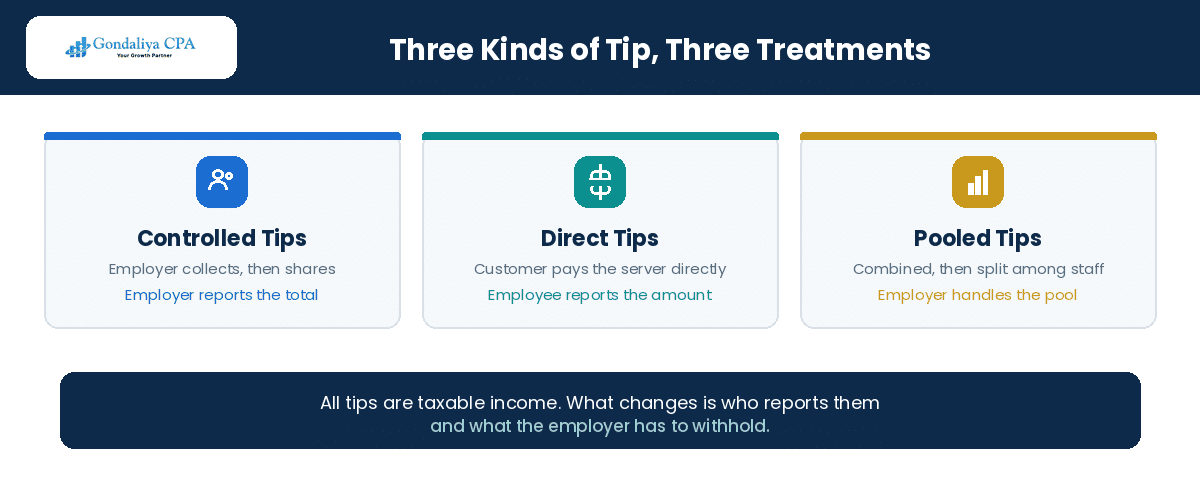
You need clear records, like logs showing controlled tips (collected by the employer), direct tips (given straight to employees), and pooled tip sharing. A skilled restaurant tax accountant makes sure your reports meet CRA rules and find all the deductions allowed.
Differences Between Controlled Tips, Direct Tips, and Pooled Tips
| Tip Type | What It Means | Tax Rules & Paperwork |
|---|---|---|
| Controlled Tips | Employer collects tips then shares with staff | Employer reports total; deducts wages including tips; detailed records needed |
| Direct Tips | Customer gives tip directly to an employee | Employee reports amount; employer tracks for CPP/EI but doesn’t report it |
| Pooled Tips | Tips combined in a pool and shared among staff | Employer handles pool; reports total in payroll |
Controlled tips help employers track money better but require strict recordkeeping. Direct tips put reporting on employees but affect payroll taxes if declared properly. Pooling means sharing is easier but must be fair and well documented.
Restaurants should talk to a restaurant CPA service when setting tip rules. That keeps everything clear under Canadian food business tax planning.
Payroll Deductions Including CPP, EI, and Employer Contributions
Payroll deductions are a big part of any solid restaurant corporate tax plan. Here’s what matters most:
- CPP: Employers take CPP from employee pay over $3,500 yearly. Both sides pay equal amounts.
- EI: Employers deduct EI premiums based on how much workers earn, up to CRA limits.
- Employer Contributions: Besides holding back employee CPP/EI, employers also pay matching amounts plus any local health levies.
Doing these right means you get valid restaurant tax deductions without late fees or penalties.
Using tools like QuickBooks or ADP helps manage this easily. Also, having a restaurant CPA review your system is smart—especially with seasonal workers common in Toronto/Ontario hospitality businesses.
Risks of Employee vs. Contractor Misclassification in Restaurants
Calling someone a contractor instead of an employee can cause trouble under Canadian law for both taxes and labour rules.
Contractors usually don’t get benefits like CPP/EI coverage from the business nor protections from labour laws.
If workers are misclassified, CRA or Ontario’s Ministry of Labour might check your books again. They could demand unpaid taxes plus fines.
Look at who controls work hours and methods, if workers use their own tools, or if they’re exclusive to your place.
For restaurants with many locations or franchises in Ontario/Canada, working with pros who know food business corporate structuring helps avoid problems. They keep your operations legal while shaping smart tax plans that fit current rules up to 2026 updates.
Tip pooling arrangements set up informally are where trouble starts. The split itself is usually fair; what is missing is anything written down showing how it was calculated. Figures changed for privacy.
Pro Tip: Write the tip policy down before the season starts, covering how controlled, direct and pooled tips are treated. It takes an afternoon and it is the document the CRA asks for first.
Maximizing Tax Deductions and Capital Cost Allowance (CCA)
Maximizing Tax Deductions and Capital Cost Allowance (CCA)
The Deductions
Maximizing restaurant tax deductions and using capital cost allowance (CCA) well matter a lot in restaurant corporate tax planning. Knowing which expenses count and keeping good records helps cut down taxable income. Using CCA smartly lets you spread out capital asset costs under CRA rules, saving taxes over time.
Common Tax Deductions: Food Cost, Cost of Goods Sold, Utilities, and Marketing
Restaurant tax deductions mainly cover direct costs from food and daily operations. The cost of goods sold (COGS) includes all ingredients, drinks (including alcohol when allowed), takeout packaging, and supplies used directly to serve customers. Keeping good track shows your real costs and lowers your taxes…[1].
Utilities like electricity, cooking gas, and water used in the restaurant are fully deductible when you prove they’re for business[2]. Marketing expenses also count if they help bring in customers. This includes ads on social media or local campaigns.
Keep invoices and bills handy. CRA wants proof when they check your books. Small expenses add up, so don’t miss those regular charges. Good bookkeeping that fits your restaurant’s spending helps catch every possible deduction.
Capital Cost Allowance Classes Relevant to Restaurant Assets
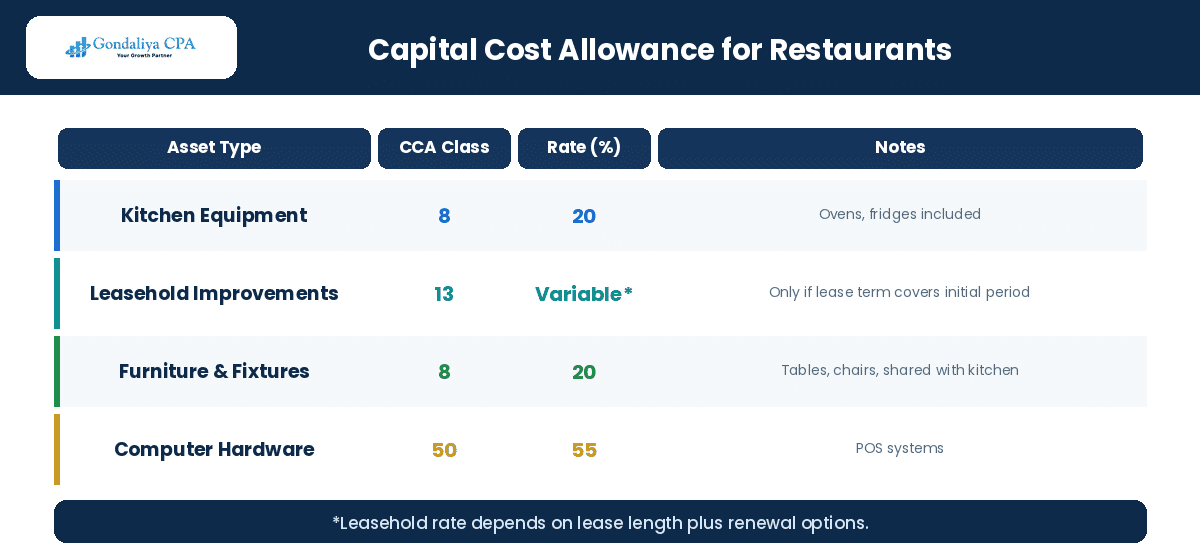
Restaurants have specific CCA classes set by CRA. These define depreciation rates for assets:
| Asset Type | CCA Class | Rate (%) | Notes |
|---|---|---|---|
| Kitchen Equipment | 8 | 20 | Ovens, fridges included |
| Leasehold Improvements | 13 | Variable* | Only if lease term covers initial period |
| Furniture & Fixtures | 8 | 20 | Tables, chairs, shared with kitchen |
| Computer Hardware | 50 | 55 | POS systems |
*Leasehold improvements’ rate depends on lease length plus renewal options[3].
You can choose to expense some things right away or depreciate over time depending on cash flow needs. For example, espresso machines fall under Class 8 at 20%, but some new rules let you expense them faster starting January 2026[4]. This helps incorporated restaurants claim more deductions now while following CRA rules.
Leasehold Improvements and Expensing Options for Incorporated Restaurants
Leasehold improvements often cost a lot when you open or upgrade a spot. This covers changes like new floors or built-in cabinets made for your rented space.
Here’s how it works under Canadian tax law:
- You must capitalize leasehold improvements.
- Depreciate them over the shorter of useful life or lease term using Class 13.
- Some immediate expensing is allowed for certain improvements starting fiscal year Jan 2026[5].
Check if your lease terms make full capitalization worth it or if partial expensing better suits your cash flow.
Also, if landlords give tenant inducements like free rent periods, you must adjust those against leasehold improvements per CRA rules[6]. Keep clear records so you stay compliant while making smart tax moves.
Deductibility of Uniforms, Repairs, Insurance, and Professional Fees
Some often missed expenses can lower taxes if properly documented:
- Uniforms: Buying staff uniforms required only for work counts as a deduction if personal use is avoided[7].
- Repairs: Fixing kitchen equipment keeps it working. These costs count as current expenses, not capital costs.
- Insurance: Premiums for property insurance covering fire or liability related to the restaurant are fully deductible.
- Professional Fees: Paying licensed accountants who understand restaurant corporate tax planning qualifies as a business expense.
Make sure invoices show these costs relate only to business activities per ITA s.18(1)(a). Keep personal spending separate to avoid issues during CRA audits—agents know the hospitality sector well[8].
References
- CRA – Inventory Valuation
- CRA – Utilities Expense Deductibility
- CRA – Capital Cost Allowance Classes
- Canada Budget Update – Immediate Expensing Changes Effective Jan 2026
- CRA – Leasehold Improvements Depreciation Rules
- CRA – Tenant Inducements Treatment
- CRA – Uniform Expenses Deduction Criteria
- ITA Section s.18(1)(a): General Business Expense Deductibility Conditions
Key Stat: Kitchen equipment fits in CCA Class 8 with a yearly depreciation rate of 20% per CRA.[3]
Pro Tip: Separate each expense type in your accounting system like QuickBooks. Save receipts that clearly show business use before claiming any deduction.[1][7]
Risk Warning: Calling repairs capital expenditures delays your deductions. Talk to a CPA early to avoid this mistake.[8]
This way of classifying expenses matches current Canadian rules well for incorporated restaurants around Toronto looking to reduce taxes without risking audit problems.
Leasehold improvements are the entry owners most often get wrong at the start. Coded as repairs they look like a big deduction, and then the reclassification arrives with interest attached. Figures changed for privacy.
Owner Compensation and Business Structure Strategies
Owner Compensation and Business Structure Strategies
The Structure
Getting owner pay and business structure right is key for good restaurant corporate tax planning. These steps help lower taxes and keep you on the right side of CRA rules. Restaurant owners should find a good balance between salary and dividends, handle small business deductions across related companies, use holding companies smartly, and watch out for shareholder benefits with TOSI rules.
Here’s what you need to focus on:
- Balancing salary vs dividends
- Sharing the small business deduction among associated corporations
- Using holding companies and managing intercompany deals
- Handling shareholder benefits and TOSI carefully
Salary and Dividend Mix for Corporate Tax Efficiency
Picking the right mix of salary and dividends saves tax in restaurants. Salary paid to owners counts as a deductible expense for the company, so it cuts corporate tax. Dividends don’t lower corporate income but come with personal dividend tax credits.
Think about these points:
- CPP Contributions: Salaries need both employer and employee CPP payments; dividends don’t.
- RRSP Room: Only salaries create RRSP contribution room.
- Cash Flow: Dividends let you choose when to take money out.
- Tax Integration: The total corporate plus personal taxes should be as low as possible by mixing pay types.
In places like Ontario or Toronto, CRA says salaries must be fair for the work done (under ITA s.67). If not, CRA can reject the deduction[1]. For seasonal restaurants, using both salary and dividends often works best since cash flow can jump around.
| Factor | Salary | Dividend | Mixed Approach |
|---|---|---|---|
| Corporate Deductible | Yes | No | Partial |
| CPP Contributions | Required | Not Required | Partial |
| RRSP Room | Yes | No | Partial |
| Admin Effort | Higher | Lower | Medium |
| Cash Flow Flexibility | Less Flexible | More Flexible | Balanced |
Bottom line: A combo of salary plus dividends helps with restaurant corporate tax planning by mixing write-offs and personal tax benefits[2].
Small Business Deduction and Business Limit Allocation Among Associated Corporations
The small business deduction (SBD) lowers federal corporate tax rates on active business income up to $500,000 per year[3]. When restaurants run through related companies — like franchises or partnerships — this $500K limit is shared.
Here’s what matters:
- Associated Corporations: If companies are linked by ownership or control, CRA treats them as associated; they share one $500K SBD limit.
- Limit Allocation Agreements: They can divide this shared limit among themselves by filing agreements on time with CRA.
- Income Timing: Planning when income is recognized helps make full use of limits without going over.
If not handled properly, your restaurants might lose access to the lower tax rates on extra income[4].
Example:
| Scenario | Number of Entities | Total Shared Limit (&$) | Allocation Needed |
|---|---|---|---|
| Single Location | 1 | 500,000 | None |
| Two Locations – Same Owner | 2 | Shared | Agreement Required |
Takeaway: Knowing who’s associated helps keep full access to restaurant business tax deductions tied to SBD[5].
Use of Holding Companies and Intercompany Transactions
Holding companies play a big role in many restaurant groups. They help protect assets like property from operational risks. They also support loans between companies, manage rent payments, track capital gains when selling assets, and help control passive investment income.
Restaurants use holding structures mainly to:
- Separate real estate or valuable assets from daily operations
- Charge rent between companies at fair market rates
- Manage taxes on sales or transfers of assets carefully
- Keep passive investment income in check per ITA s.125(5)
All deals between related companies need solid reasons documented clearly. If not, CRA may call payments shareholder benefits under s.15 if they seem unfair[6]. For example, if a holding company loans money for leasehold improvements, it’s important to track asset classes for depreciation properly.
Our experience: We helped a café group create an Ontario holding company that owns all their leaseholds separately from operations. They set rents at market rates using appraisals — which separated risks without causing TOSI problems[7]. Figures changed for privacy.
Managing Shareholder Benefits and Assessing TOSI Implications
Shareholder benefits happen when shareholders get perks beyond fair pay — like free meals or family members getting payroll without real jobs. CRA watches this closely under ss.15 & TOSI rules in ss.120.4[8][9].
Restaurants face special issues because they often provide staff meals:
- Meals eaten by employees during work shifts count as deductible staff meal expenses under certain limits (s67).
- But meals given only to shareholders or family outside work risk being taxable benefits unless well documented as job-related expenses.
TOSI stops some types of income splitting among family members unless those family members do real work matching their pay[10]. You need timesheets or job descriptions proving actual work at fair wages.
If you miss this, CRA may reassess your taxes and charge penalties plus interest for unpaid amounts[11].
Tip: Keep clear records separating real employee meal costs from shareholder meals; document family roles well before paying them[12].
Year-End Tax Planning and CRA Audit Preparedness
Year-End Tax Planning and CRA Audit Preparedness
The Year End
Year-end tax planning helps restaurant owners lower taxes and stay on CRA’s good side. Good restaurant tax saving strategies include timing expenses right, keeping inventory values accurate, and having clean records ready. A restaurant tax accountant makes this process smoother by handling tricky rules and paperwork.
Timing Strategies for Prepaying Expenses and Equipment Purchases
Prepaying bills before year-end can speed up deductions, which cuts down taxable income now. Restaurant corporate tax planning often uses capital cost allowance (CCA) rules to claim equipment costs faster.
Here are some tips:
- Pay rent or utilities early if they’re due after year-end.
- Buy kitchen gear that fits into CCA classes like Class 8 (20%) or Classes 43.1/43.2 (30%–50%).
- Use immediate expensing for up to $1.5 million of eligible property each year.
Make sure all payments have proper invoices and reflect real business transactions that CRA will accept1.
Inventory Valuation Methods and Impact on Taxable Income
Inventory counts affect your cost of goods sold (COGS), which changes your taxable income. This matters a lot since food costs make up a big chunk of restaurant expenses.
Common ways to value inventory:
- FIFO (First-In First-Out): Assumes you use older stock first; good when prices rise.
- Weighted Average Cost: Spreads out cost fluctuations; useful for fast-moving items.
Track spoilage, waste, staff meals, and theft carefully to keep inventory realistic2. If you lower ending inventory too much, COGS looks bigger but CRA may question it. If you overstate inventory, you claim fewer expenses than allowed.
Stick to one method every year for clear financials that stand up in audits focused on restaurant tax deductions.
Maintaining Accurate Bookkeeping for Audit Readiness and CRA Compliance
Good bookkeeping is the backbone of restaurant corporate tax planning and getting ready for a CRA audit. You need clear records to prove everything—payroll, tips, GST/HST, equipment purchases, leases, licenses, delivery fees, and more.
Do these:
- Reconcile daily sales data with bank deposits.
- Separate cash from electronic payments with solid proof.
- Track controlled vs direct tips according to CRA payroll source deduction rules3.
A restaurant tax accountant can help set up systems using QuickBooks or Xero plus Hubdoc for easy receipt capture. Keep all records for six years as CRA demands4.
This care lowers the chance of trouble during audits targeting missing income or questionable expenses common in food service.
Year-End Checklist Including Tip Verification, Payroll Reconciliation, and Filing Deadlines
| Task | Description | Deadline | Reference |
|---|---|---|---|
| Tip Verification | Check tip reports match payroll | Fiscal Year-End | CRA Tips & Gratuities |
| Payroll Reconciliation | Ensure T4 slips match payroll records | February 28 | CRA Payroll Source Deductions |
| Corporate Tax Return Filing | File T2 corporate return | Six months after fiscal year-end* | T2 Filing Requirements |
*Missing deadlines without reason means penalties apply5.
Following this keeps you safe from extra taxes or CPP/EI charges if CRA finds payroll or tip mistakes during hospitality sector audits.
Working with a Restaurant Tax Accountant to Optimize Corporate Tax Filing
Hiring a restaurant tax accountant helps you file your corporate taxes better by applying rules specific to restaurants. They know what deductions you can claim—for example, merchant fees from delivery apps or uniform costs under ITA s.18(1)(a).
They can help with:
- Choosing salary versus dividends to save CPP costs and keep RRSP room.
- Spreading income across multiple locations without losing small business deduction limits6.
- Finding overlooked expenses that are reasonable under s.67 ITA rules7.
Gondaliya CPA offers fixed-fee help focused on Toronto-area restaurants wanting to lower taxes legally this year.
References
- Canada Revenue Agency – Capital Cost Allowance
- Canada Revenue Agency – Inventory Valuation
- Canada Revenue Agency – Tips & Gratuities Payroll Treatment
- Canada Revenue Agency – Record Keeping Requirements
- Canada Revenue Agency – Corporate Income Tax Returns
- Canada Revenue Agency – Small Business Deduction Rules
- Income Tax Act Section 67 Reasonableness Test Overview
Prepaying suppliers before year end works only where the invoice reflects a real obligation. A payment on account with nothing behind it gets added back, and the deduction moves to the following year anyway. Figures changed for privacy.
Frequently Asked Questions on Restaurant Tax Planning
Frequently Asked Questions on Restaurant Tax Planning
FAQ
What are the top tax-saving strategies for a Canadian restaurant corporation?+
Focus on salary-dividend mix, protect small business deduction limits, track inventory accurately, maximize CCA claims on equipment, and structure payroll and tips carefully.
How should a restaurant owner set the salary and dividend mix?+
Balance salary to create RRSP room and deduct corporate tax. Use dividends for flexible cash flow without CPP contributions. Optimize tax efficiency with a mix.
How do you protect the small business deduction across multiple locations?+
Identify associated corporations and file allocation agreements. Share the $500,000 limit properly among related entities to avoid losing tax benefits.
How does accurate inventory and cost of goods sold reduce taxable income?+
Track inventory with consistent valuation methods like FIFO. Record waste and staff meals precisely to reflect true COGS and reduce taxable income legitimately.
How do you maximize deductions on kitchen equipment and leasehold improvements?+
Claim CCA in correct classes like 8 or 13. Use immediate expensing options available from 2026 to accelerate deductions on qualifying assets.
How should payroll, tips, and gratuities be structured for tax purposes?+
Report all tip income fully. Separate controlled, direct, and pooled tips properly. Deduct CPP/EI correctly on salaries and controlled tips for compliance.
How do you plan GST/HST effectively in a restaurant?+
Classify sales as zero-rated or taxable correctly. Set POS software to charge GST/HST accurately per item type to avoid overpayments or audits.
Which restaurant deductions are most often missed?+
Uniform costs, minor repairs, insurance premiums, delivery commissions, merchant fees, and professional accounting fees often go unclaimed due to poor records.
When does a holding company or second entity make sense for a restaurant group?+
Use holding companies to separate assets from operations, manage rents at market rates, control passive income, and protect against operational risks efficiently.
Key Numbers at a Glance: Restaurant Tax Planning Essentials
Key Numbers at a Glance: Restaurant Tax Planning Essentials
Quick Reference
- Average food cost percentage: 28%-35% of sales
- Average labour cost percentage: 30%-35% of total revenue
- Small Business Deduction limit: $500,000 shared by associated corporations
- GST/HST rate in Ontario: 13% on prepared foods and alcohol
- Capital Cost Allowance rates: Class 8 (20%), Class 13 (variable), Class 50 (55%)
Payroll Source Deductions Deadline Reminder
File T4 slips by February 28 annually to avoid penalties. Ensure payroll reconciles with reported tip income for CRA compliance.
Scope and Assumptions
This guidance applies to incorporated Canadian restaurants operating mainly in Ontario with annual revenues under $5 million. It assumes compliance with current CRA regulations up to fiscal year 2026.
Quick Answer: Best Approach for Restaurant Tax Savings
Use a balanced salary-dividend pay structure, keep thorough inventory records, claim all eligible deductions including leasehold improvements and equipment CCA, report tips fully, and maintain proper GST/HST handling.
Quick Comparison Table: Salary vs Dividends in Restaurant Corporations
| Aspect | Salary | Dividends | Combined Approach |
|---|---|---|---|
| Corporate Deduction | Yes | No | Partial |
| CPP Contributions | Mandatory | Not Required | Proportional |
| RRSP Room | Generated | None | Partial |
| Cash Flow Flexibility | Limited | High | Balanced |
| Administrative Load | Higher | Lower | Moderate |
Who This Is For / Not For
For incorporated restaurants seeking optimized tax savings in Canada with multiple locations or franchises. Not suitable for unincorporated sole proprietors or non-food businesses.
Tax Strategy vs Tax Compliance vs Aggressive Tax Avoidance: What Is the Difference?
Tax strategy ensures legal tax minimization through planning; compliance means following all laws; aggressive avoidance involves risky schemes that may trigger CRA penalties.
What Does CRA Review When Examining a Restaurant Corporation?
CRA focuses on income reporting accuracy (especially cash/tips), proper classification of expenses, GST/HST correctness, payroll source deductions, and supporting documentation consistency.
How Do You Sequence Strategies Across a Fiscal Year?
Plan salary/dividend mixes early; manage inventory monthly; prepay expenses before year-end; claim capital purchases timely; reconcile payroll/tips after fiscal year; file returns promptly.
Strategy Route: DIY vs General Accountant vs Restaurant CPA — Which Fits?
DIY suits simple businesses but risks missed deductions; general accountants handle basics but may lack restaurant nuances; specialized CPAs like Gondaliya CPA optimize industry-specific savings effectively.
How Do We Deliver Restaurant Tax Strategy at Gondaliya CPA?
We analyze your corporate structure, review financials thoroughly, identify unique deductions, ensure CRA compliance, optimize salary-dividend mixes, and provide clear implementation steps tailored for restaurants.
What Deliverables Do You Get?
Detailed tax-saving plan document; optimized corporate tax projections; bookkeeping checklist; customized salary-dividend recommendations; GST/HST review report; audit preparedness guide.
How Much Does Restaurant Tax Planning Cost in Canada?
Fees vary by complexity but typically range from $1,500 to $5,000 annually depending on the number of locations and services included.
What Are the Risks of Applying Strategies Without Proper Documentation?
Lack of documentation can lead to denied deductions, CRA reassessments, penalties, interest charges, delayed refunds, and costly audits.
What Should a Restaurant Owner Prepare Before a Strategy Engagement Starts?
Financial statements; payroll records including tip logs; POS reports showing GST/HST collected; invoices for major purchases; lease agreements; previous tax returns.
How Do These Strategies Apply Across 10 Industries We Serve?
While focused on restaurants primarily, similar principles apply in retail food services, catering businesses, hospitality venues, franchise operations with adjustments per industry specifics.
A Realistic Numeric Walkthrough
A Toronto café saving $20K annually by balancing owner compensation properly while claiming all allowable equipment CCA plus recording delivery fees correctly exemplifies effective planning.
How to Choose the Right CPA Firm in Toronto/Ontario for a Restaurant Business?
Look for firms with food industry experience like Gondaliya CPA; check client testimonials; confirm knowledge of local CRA rules; evaluate personalized service offerings over generic accounting.
Why Trust Gondaliya CPA? (E-E-A-T) + Editorial Policy + Disclaimers
Gondaliya CPA combines expertise in Canadian restaurant taxation with transparent advice grounded in current law. Editorials are fact-based without promotion bias. All content adheres strictly to CRA guidelines with no unauthorized advice given.
The $20,000 figure in that walkthrough is not one large item. It is owner pay restructured, equipment depreciation claimed properly, and delivery fees finally recorded, which is a typical mix. Figures changed for privacy.
Industry Spotlights: Sectors We Represent
Industry Expertise
Restaurants sit inside a wider hospitality and food economy. Here are eleven sectors and the tax question that dominates each.
| Industry | The Question That Dominates |
|---|---|
| Restaurants & food and beverage | Cash sales, tips and delivery commissions |
| Consulting firms | Salary and dividend mix on irregular income |
| E-commerce & online retailers | Platform fees and GST/HST across provinces |
| Technology startups & SaaS | Capital cost allowance timing on equipment |
| Construction, contractors & skilled trades | Worker classification and cash purchases |
| Property developers & builders | Associated corporations sharing one limit |
| Real estate investors & holding companies | Holding structures and intercompany rent |
| Transportation, logistics & trucking | Vehicle CCA classes and fuel records |
| Daycare, childcare & CWELCC services | Payroll structure and subsidy timing |
| Dentists & dental practices | Associate payments and equipment classes |
| Medical doctors & physician corporations | Remuneration mix against passive income |
- Restaurants & food and beverage: Cash sales, tip reporting and delivery commissions are where both the risk and the missed deductions concentrate.
- Consulting Firms: Income arrives unevenly, which makes the salary and dividend split a cash flow decision as much as a tax one.
- E-commerce & online retailers: Platform fees deducted at source and GST/HST varying by destination create the same reconciliation problem restaurants face with delivery apps.
- Technology startups & SaaS: Equipment and software fall into different classes, and the timing of the claim matters more than the rate.
- Construction, general contractors & skilled trades: Worker classification carries the same exposure here as it does in a kitchen, and cash purchases go unrecorded just as often.
- Property developers & builders: Several corporations under one owner share a single small business limit, exactly as multi-location restaurant groups do.
- Real estate investors, landlords & holding companies: Holding structures and intercompany rent at market rates are the same tools restaurant groups use to separate property from operations.
- Transportation, logistics & trucking: Vehicle capital cost allowance classes and fuel records decide what is actually claimable.
- Daycare, childcare & CWELCC services: Payroll structure and subsidy revenue timing carry the documentation burden in this sector.
- Dentists & dental practices: Associate payment arrangements and equipment classification are the recurring questions.
- Medical doctors & physician professional corporations: The remuneration mix has to be set against passive investment income rather than in isolation.
Restaurants and e-commerce sellers arrive with the same problem in different clothing. A platform deducts its fee before depositing, and both the revenue and the expense go unrecorded. Figures changed for privacy.
Professional Guidance and Quick Reference
Guidance
Professional Guidance on Restaurant Tax Planning: How Gondaliya CPA Supports Canadian Operators
Restaurant tax planning divides into two halves that have to be done in order. First the compliance side has to hold: sales reconciled to deposits, tips reported and documented, GST/HST charged correctly by item. Only then does the planning side matter, because a good structure on shaky records is worth nothing when the CRA looks. Gondaliya CPA handles both on a fixed fee.
We handle what decides the outcome: reconciling POS data against bank deposits, capturing delivery commissions and merchant fees that never appear as a payment, classifying leasehold improvements and equipment into the right capital cost allowance classes, setting the salary and dividend mix, allocating the small business limit across associated corporations, and documenting tip arrangements before they are questioned.
Our team works from your own POS and payroll data rather than a template. Whether you run one location or a franchise group, you get clear advice and a fixed price before we start.
Quick Answers: Key Numbers & Concepts at a Glance
At a Glance
- Ontario HST: 13% on prepared food and alcohol
- Quick Method ceiling: $400,000 of taxable sales
- Small business deduction: $500,000, shared when associated
- Class 8: 20% on kitchen equipment, furniture and fixtures
- Class 13: Variable, over the lease term
- Class 50: 55% on computer hardware and POS
- Immediate expensing: Up to $1.5 million of eligible property
- CPP threshold: Earnings above $3,500 annually
- T4 deadline: February 28 each year
- Record retention: Six years
Who This Is For / Not For
Fit Check
- For: Incorporated restaurants, bars, cafes and franchise groups looking to capture every deduction while keeping the sales and tip reporting side defensible.
- Not For: Unincorporated sole proprietors, or operators whose books are too far behind for planning to mean anything until a cleanup is done.
People Also Ask
Quick Answers
Are staff meals deductible?+
Meals provided to employees during shifts are generally deductible within limits. Meals taken by shareholders or family outside working hours are a different question entirely.
Do I charge HST on catering?+
Catered prepared food is normally taxable. The classification turns on what is supplied rather than where it is eaten, so it is worth checking menu by menu.
Should each location be its own corporation?+
Sometimes, for liability reasons. Just remember the $500,000 small business limit is shared across associated corporations, so it does not multiply with the entities.
Glossary of Key Terms
Plain-English Definitions
- Zero-rated supply: A sale with no GST/HST charged, where input credits remain claimable.
- Taxable supply: A sale on which GST/HST must be charged, such as prepared meals.
- Quick Method: A simplified GST/HST calculation available below $400,000 of taxable sales.
- Input tax credit: GST/HST paid on business purchases and recoverable on a return.
- Controlled tips: Tips collected by the employer and distributed to staff.
- Direct tips: Tips given by the customer straight to an employee.
- Pooled tips: Tips combined and shared among staff under a set arrangement.
- Capital cost allowance: The deduction for depreciation of capital assets over time.
- Class 8: The 20% class covering kitchen equipment, furniture and fixtures.
- Class 13: The class covering leasehold improvements, written off over the lease term.
- Leasehold improvement: A permanent change made to rented premises, capitalised rather than expensed.
- Tenant inducement: A landlord incentive that must be offset against leasehold improvements.
- Small business deduction: The reduced corporate rate on active business income up to $500,000.
- Associated corporations: Related corporations that must share one small business limit.
- Shareholder benefit: A corporate payment or perk treated as taxable income to the shareholder.
- TOSI: Tax on Split Income, which taxes unreasonable family payments at the top rate.
Restaurant Tax Position Check
This quick self-check indicates where your operation most likely has room. Please answer the six questions below.
Restaurant Tax Position Check
Six quick questions on your operation. No fee shown.
Points to raise with us:
This is a general prompt, not tax or legal advice or a quote. Your position depends on your full facts. For a real review, please book a free consultation.
Want a checklist to work from? You can download our free restaurant tax checklist before your consultation.
Reconcile POS sales to bank deposits every month, not at year end. Record delivery commissions and merchant fees as expenses rather than letting them vanish into net deposits. Put the tip policy in writing. Classify leasehold improvements as capital from the start. Set the salary and dividend mix deliberately, and allocate the small business limit before the returns are filed.
2026 Update — what is current: Immediate expensing options broaden from January 2026 for certain equipment and improvements, which changes the timing decision on kitchen purchases. The 13% Ontario HST rate, the $400,000 Quick Method ceiling, the $500,000 small business limit and the six-year retention rule are unchanged. Please confirm current rates and expensing rules before relying on the figures in this article.
Restaurant Tax Saving Strategies and Corporate Tax Planning for Bars, Cafes, and Franchises | Gondaliya CPA
Stop leaving deductions in the deposit
Gondaliya CPA reconciles your POS data to bank deposits, captures the delivery commissions and merchant fees your books are missing, classifies equipment and leaseholds into the right capital cost allowance classes, sets the salary and dividend mix, and prepares the T2 with the documentation behind every claim, on a fixed fee with a one-business-day response. Please book a free consultation.
Next Steps
Please book a free consultation with Gondaliya CPA and bring your last T2 return, a recent POS sales summary, and your delivery platform statements. Those three usually show within minutes where the deductions are going missing. You will get a fixed fee before any work begins. If our content helps, please add gondaliyacpa.ca as a preferred source on Google.
Published: August 14, 2026 · Last updated: August 14, 2026
Editorial policy: We research against CRA and CPA Ontario sources, fact-check the figures, and Sharad Gondaliya, CPA, reviews the content, which we update as the rules change.
Disclaimer: This article is educational information only and is not tax, legal, or financial advice. Figures marked illustrative are examples rather than quotes or guarantees. It reflects CRA rules current to 2026, including the 13% Ontario HST rate, the $400,000 Quick Method ceiling, the $500,000 small business deduction limit, Class 8 capital cost allowance at 20%, and the six-year record retention requirement. Rates, limits and expensing rules change and outcomes depend on your specific facts. Please consult a CPA Ontario member before acting.

Sharad Gondaliya is a CPA Canada & CPA USA with 15 Years+ experience of Accounting, Tax, Payroll of Corporate Small Businesses as Tax Accountant. He is a CPA Ontario member (61040184) and holds US CPA licences in Washington and Montana and is well known among corporate small businesses for tax planning, efficient tax solutions, and affordable CPA services. Sharad is the Principal (Director) of Gondaliya CPA – Affordable CPA Firm in Canada. Licenses: CPA Ontario: 61040184 | CPA USA (MT): PAC-CPAP-LIC-033176 | CPA USA (WA): 57629 | CPA Firm License: 61330051 View Full Author Bio