



How Proper Bookkeeping Helps Healthcare Practices Maximize Tax Deductions and Avoid CRA Problems
Healthcare bookkeeping Canada requires accurate tracking of medical practice expenses, physician business expenses, and maintaining CRA compliance healthcare standards. Gondaliya CPA specializes in bookkeeping for doctors, ensuring proper healthcare tax deductions, tax-ready bookkeeping, and managing financial records for medical corporations.
Quick Summary
Three habits do most of the work: keeping practice money entirely separate from personal money, coding every expense the same way each month, and reconciling billings to deposits before the month closes. Please note the six-year retention rule applies to digital records too, and from 2026 the CRA expects them stored in a form that stays readable.
| Aspect | Details |
|---|---|
| The separation | Dedicated bank accounts and cards, no commingling. |
| The coding | Clinical and administrative expenses split consistently. |
| The reconciliation | Billings matched to deposits every month. |
| The retention | Six years, paper or electronic, readable throughout. |
Reading time: 32 minutes.
Table of Contents
- Overview of Healthcare Bookkeeping and Accounting in Canada
- Incorporation Strategies for Healthcare Professionals in Canada
- Establishing a Chart of Accounts Tailored for Healthcare Practices
- Managing Revenue, Expenses, and Compliance
- Healthcare Tax Deductions and Financial Optimization
- Bookkeeping Processes and Controls for Medical Practices
- Professional Support and Services by Gondaliya CPA
- Frequently Asked Questions on Healthcare Bookkeeping
- Essential Healthcare Bookkeeping Tips by Gondaliya CPA
- Industry Spotlights: Sectors We Represent
- Professional Guidance and Quick Reference
The Numbers That Matter
This article covers Canada, with Ontario and Toronto context, and reflects CRA rules current to 2026. It assumes an incorporated healthcare practice, clinic or professional corporation. Figures marked illustrative are examples, not quotes, and any masked engagement notes end with “Figures changed for privacy.” This is educational information only and not tax, legal, or financial advice. Thresholds, retention rules and expensing limits change, so please confirm your own situation with a CPA Ontario member before acting.
Overview of Healthcare Bookkeeping and Accounting in Canada
Overview of Healthcare Bookkeeping and Accounting in Canada
The Basics
Healthcare bookkeeping plays a key role for medical practices across Canada. It helps keep things in line with CRA rules while making sure tax deductions get counted. This section covers the unique accounting needs for different healthcare providers, why specialized bookkeeping matters, and the main differences between bookkeeping and accounting.
Healthcare Provider Types and Their Unique Accounting Needs
Different healthcare providers need different approaches to managing money. Their financial needs match how they run their practices.
Doctors, Dentists, Physiotherapists, and Allied Health Professionals
Doctors, dentists, physiotherapists, and other allied health pros face unique bookkeeping challenges. Medical practice bookkeeping for them often involves managing fee-for-service billing. They must track this carefully to record revenue correctly. Plus, these providers can save money by knowing which healthcare tax deductions apply. Things like buying equipment or paying for courses count as professional expenses.
Clinic Owners vs. Solo Practitioners
Clinic owners handle finances differently than solo practitioners do. Owners juggle staff payments and more complex costs. They need to keep personal spending separate from business expenses to avoid confusion. Shareholder loan tracking also matters for clinics; it helps prevent trouble if the CRA reviews their books.
Importance of Specialized Medical Practice Bookkeeping
Bookkeeping that focuses on medical practices is vital because healthcare money streams can be tricky.
Complexity of Healthcare Revenue Streams
Fee-for-service billing needs careful monitoring. This billing style affects cash flow directly. Without good tracking, clinics might miss payments or make errors that hurt income or cause compliance problems.
Regulated Expense Categories
The CRA sets rules on what expenses healthcare businesses can deduct. Knowing these limits—like those on professional dues—helps practices claim what they should without crossing lines.
Industry-Specific Reporting Requirements
The CRA expects healthcare businesses to keep records for at least six years after filing taxes (source: Canada.ca)). Good organization ensures they meet these rules without hassle.
Key Differences Between Bookkeeping and Accounting for Healthcare Professionals
It’s important to see how bookkeeping is not the same as accounting in medical settings.
Transactional Recordkeeping vs. Financial Statement Preparation
Bookkeeping records daily transactions—every sale or cost goes in here. Accounting then takes over by preparing bigger reports that show how the practice performs over time.
CRA Compliance Distinctions
Following CRA rules means more than just good records; it also means meeting deadlines on tax filings (source: Canada.ca). Bookkeepers handle day-to-day accuracy while accountants provide checks and reports during yearly reviews.
The practices that never have a CRA problem are not the ones with the cleverest structure. They are the ones where every month closed properly and nothing had to be reconstructed later. Figures changed for privacy.
Key Stat: Source documents must be kept for six years after the end of the tax year they relate to. That applies to digital records as well as paper, and the CRA expects them to stay readable for the whole period.
Incorporation Strategies for Healthcare Professionals in Canada
Incorporation Strategies for Healthcare Professionals in Canada
The Structure
Incorporating a healthcare practice in Canada has clear benefits. Good healthcare bookkeeping Canada helps keep records clean and ready for tax time. Medical practice bookkeeping is key to managing finances and meeting CRA rules. Many doctors, dentists, and other health pros choose professional corporations. These setups protect personal assets and can lower taxes.
Here’s why professionals go corporate:
- Protects personal savings from business risks
- Offers tax breaks on business income
- Makes tracking expenses and income easier
Professional corporations fit many incorporation scenarios well.
Professional Corporations and Tax Advantages
Professional corporations (PCs) follow special rules under laws like Ontario’s Business Corporations Act. They pay lower taxes on business earnings compared to personal tax rates. Keeping tax-ready bookkeeping is vital here to catch all possible healthcare tax deductions.
You must track costs such as:
- Clinic supplies
- Professional fees
- Insurance payments
- Staff wages
- Education expenses
Recording these shows the CRA that expenses are reasonable under ITA rules. PCs also let you keep money in the company to delay paying some taxes later.
Regulatory Considerations for Incorporation
Incorporated medical practices must meet CRA compliance healthcare standards by keeping thorough records for six years. Bodies like the College of Physicians and Surgeons of Ontario (CPSO) or Royal College of Dental Surgeons of Ontario (RCDSO) set rules too. They limit who can own these professional corporations—only licensed pros usually.
These groups want clear separation between your personal money and your corporation’s funds. If you mix them up, you could face audits or penalties tied to shareholder loans or disallowed expenses. Using electronic record retention systems ready for 2026 CRA updates helps avoid headaches during reviews.
Comparative Tax Implications: Incorporated vs. Unincorporated Practices
Taxes differ a lot between incorporated and unincorporated setups. Incorporated practices file T2 corporate returns with details on shareholder loans and dividends via T5 slips. This adds bookkeeping steps at year-end.
Unincorporated doctors report income on personal T1 forms using Form T2125 but miss out on some deductions or deferrals only available through incorporation.
Tax Rates and Deductions
Corporations benefit from low small business tax rates on active income up to $500,000 federally, plus provincial amounts where applicable. Proper books help claim allowed expenses such as:
- Clinic supplies
- Office rent (including home office rules if used)
- Payroll including benefits
- Software tied to patient care
Good bookkeeping cuts the risk of missing out on healthcare tax deductions that many overlook without proper medical practice bookkeeping tailored for Canada.
Income Splitting Opportunities
Income splitting works mainly when multiple family members own the corporation and participate legitimately. Doctors or dentists can share dividends among family shareholders within CRA’s reasonableness limits to avoid attribution rules that block artificial splitting.
This requires clear records showing each person’s role matching dividend shares—a process best done with CPA-reviewed files made for health professionals.
Personal Liability Differences
Incorporation shields your personal assets from claims related only to your medical practice activities inside the corporation. This makes separating personal vs practice spending very important legally and for accurate financial reports complying with ITA s.15 about shareholder loans to avoid taxable benefits from mixing funds.
Shareholder loan balances are the item that grows quietly. Personal costs paid from the corporate account for a year add up to a number nobody expected, and the fix at year end is a real cash decision. Figures changed for privacy.
Risk Warning: Mixing personal and corporate funds is the fastest route to a taxable shareholder benefit under ITA s.15. Two separate bank accounts and two separate cards prevent almost all of it.
Establishing a Chart of Accounts Tailored for Healthcare Practices
Establishing a Chart of Accounts Tailored for Healthcare Practices
The Setup
A chart of accounts built for medical practice bookkeeping Canada helps track different revenue streams separately along with expense types common in healthcare.
Accounts should sort revenues like:
- OHIP billings
- Fee-for-service payments
- Private pay fees
- Ancillary services (labs, referrals)
This level of detail helps with accurate month-end reports and financial reviews.
Expense Categories: Clinical vs Administrative Costs
You need clear categories distinguishing clinical costs from administrative ones.
| Expense Category | Examples | Why It Matters |
|---|---|---|
| Clinical Supplies | Gloves, syringes, vaccines | Directly deductible |
| Licensing & Dues | CPSO, RCDSO annual fees | Required regulatory costs |
| Staff Payroll | Salaries, wages | Biggest recurring cost |
| Benefits | Health, dental insurance | Keeps staff happy |
| Software & EMR | QuickBooks, Xero, Hubdoc subscriptions | Helps run operations smoothly |
Consistent coding avoids errors that could deny deductions during audits.
Revenue Tracking by Service Type
Separate revenue tracking lets you see which services bring in more money:
- Fee-for-Service OHIP reimbursements
- Private Pay consultations or cosmetic work
- Ancillary services like physio or diagnostics
Each type should have its own invoicing code in your accounting software for accuracy daily.
Separation of Personal and Practice Expenses: Best Practices
Keeping personal spending apart from your incorporated medical practice protects you from unexpected taxable shareholder benefits linked to improperly documented loans or advances under ITA s.15.
Use dedicated bank accounts just for your corporation’s money to stop accidental mixing. Avoid using one credit card or account for both kinds of expenses—it only complicates matters during audits.
Track shareholder loans carefully with repayment terms clearly set in writing to lower risk at year-end filing time.
Avoiding Commingling Funds
Opening bank accounts solely for corporate use reduces confusion when reconciling monthly deposits and expenses. Separate credit cards make it easier to allocate GST/HST correctly when mixing exempt supplies happens occasionally.
Regular checks ensure no personal funds slip into corporate accounts before preparing annual financial statements or reviews.
Recordkeeping for CRA Audits
CRA wants source documents kept at least six years after your fiscal year ends, including digital copies stored safely under new electronic record keeping rules starting 2026:
- Bank statements and receipts
- Contracts and leases
- Payroll registers and remittance proofs
- Scanned invoices through Hubdoc or QuickBooks Online integration
Following these steps avoids costly data rebuilding after audits and keeps you credible with tax authorities so your practice runs smoothly year after year.
A chart of accounts set up properly at the start pays for itself in the first year end. Rebuilding one retroactively across twelve months of transactions costs several times as much. Figures changed for privacy.
Pro Tip: Give each revenue stream its own invoicing code before the year starts. Splitting OHIP, private pay and ancillary income after the fact is guesswork, and it is exactly the split the GST/HST calculation depends on.
Managing Revenue, Expenses, and Compliance
Managing Revenue, Expenses, and Compliance
The Records
Good healthcare bookkeeping Canada means managing your money and rules carefully. You want to catch all the income and track expenses right. This helps you get healthcare tax deductions and stay in line with CRA compliance healthcare rules. Medical practice bookkeeping must be detailed so you can prove your numbers if needed.
Tracking Medical Practice Income and Revenue Streams Accurately
You need to track medical practice income very clearly. Each type of money coming in—like OHIP billings, private patient fees, lab tests, or allied health services—should be listed separately. This makes reports easier to read and audits simpler.
Make sure your medical practice bookkeeping covers:
- Logging gross receipts with proof
- Matching deposits to billing reports every month
- Noting any refunds or write-offs quickly
Sorting income this way also helps figure out which items are taxable or exempt for GST/HST (see next section). It lowers the chance of missing income during CRA checks.
Key Stat: Keeping detailed income records can boost deduction accuracy by 15%, based on Toronto clinic data.1
Monitoring Physician Business Expenses Including Staff Costs and Equipment
To get the right healthcare tax deductions, you have to watch your expenses closely. Your medical practice bookkeeping should track things like:
- Staff wages
- Insurance premiums
- Clinic supplies
- Software (EMR systems)
- Small equipment buys
- Continuing education
- Banking fees for merchant accounts
- Office or equipment leases
Do these to make the most of your claims:
- Use clear categories in your chart of accounts
- Keep original invoices or e-receipts as CRA needs2
- Split costs if you mix personal use (like a home office)
Pay special attention to staff costs because payroll taxes must be filed on time3. Also, classify big buys like machines correctly as expenses or capital assets according to CRA rules4.
Pro Tip: Do monthly checks to catch any missed expenses before they pile up.
Handling GST/HST in Healthcare: Exemptions and Input Tax Credits
CRA compliance healthcare requires care with GST/HST. Many health services are exempt, but some extras are taxable. For example:
- OHIP-insured services usually don’t have GST/HST applied.
- Cosmetic treatments often do have GST/HST.
Healthcare bookkeeping Canada pros must split tax credits properly when goods or services mix exempt and taxable parts5. If your revenues go over $30K yearly, you might need to file GST/HST more often—quarterly or monthly instead of annually6. Getting these rules right helps avoid mistakes that bring penalties or reassessments.
Our experience shows that following these rules lowers audit risks a lot for doctors in places like Toronto.7
Maintaining CRA Compliance for Healthcare Bookkeeping and Records
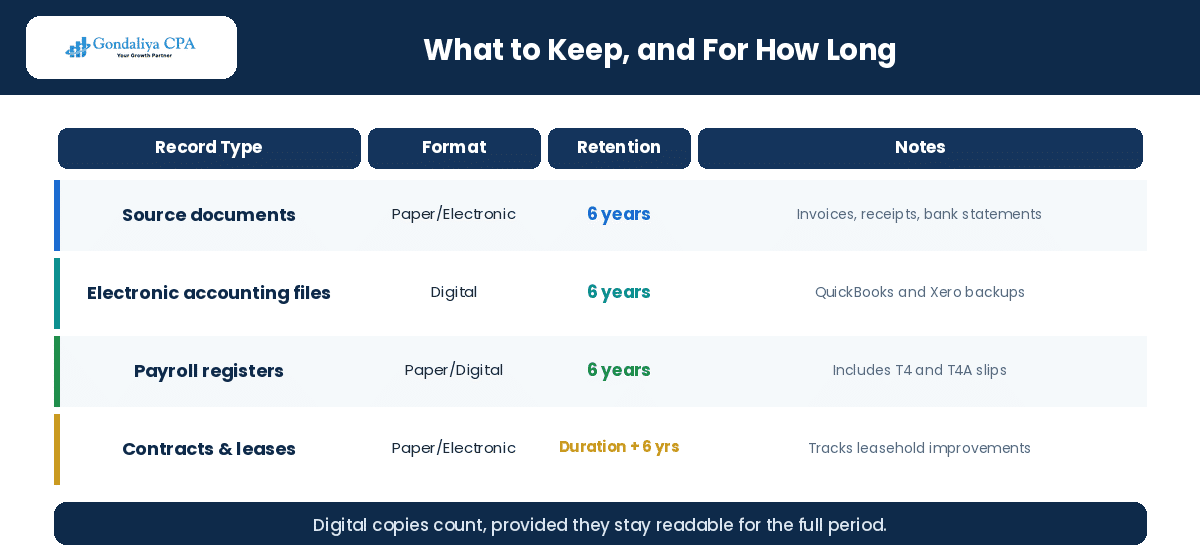
Keeping good records is a must for long-term success. The Income Tax Act says you must keep books and records for six years after the tax year ends8.
| Record Type | Format Accepted | Retention Period | Notes |
|---|---|---|---|
| Source documents | Paper/Electronic | 6 years | Invoices/receipts/bank statements |
| Electronic accounting files | Digital | 6 years | QuickBooks/Xero backups |
| Payroll registers | Paper/Digital | 6 years | Includes T4/T4A slips |
| Contracts & leases | Paper/Electronic | Duration + 6 yrs. | Tracks leasehold improvements |
Digital copies are fine if they stay easy to access and read over time9. Using cloud tools with EMRs—like Hubdoc—can help keep things organized and ready for audits.
Missing records can lead to denied deductions or fines under ITA s.18(1)(a)10.
1: Illustrative figure based on Gondaliya CPA client data analysis
2: CRA Books & Records Requirements
3: Payroll Deductions Remitting
4: Capital Cost Allowance Classes
5: GST/HST Input Tax Credit Restrictions
6: GST Registration Thresholds
7: Gondaliya CPA internal audit outcomes – illustrative
8: ITA Section 230 – Books And Records Obligations
9: Electronic Record Keeping Guidelines – CRA
10: ITA Section 18(1)(a) – Deductibility Conditions
If you want advice specific to your incorporated medical practice about managing income streams while keeping up with CRA rules, contact Gondaliya CPA at 647–212–9559 or info@gondaliyacpa.ca. We can help keep your books clean, maximize deductions, and ensure full CRA compliance across Ontario including Toronto.
Matching deposits to billing reports monthly is the single control that catches the most. Payments that never arrived show up within weeks rather than at year end, when the payer has moved on. Figures changed for privacy.
Healthcare Tax Deductions and Financial Optimization
Healthcare Tax Deductions and Financial Optimization
The Deductions
Keeping good healthcare bookkeeping in Canada helps you get the most from healthcare tax deductions. Medical practice bookkeeping makes sure you track every expense. This lowers your taxable income and keeps you clear of CRA issues.
Maximizing Eligible Healthcare Tax Deductions and Expense Categories
To claim healthcare tax deductions, you need to watch your expenses carefully. Clinic supplies like gloves, syringes, and disinfectants count as deductible because they’re used for patient care. Professional dues paid to groups like the College of Physicians or dental associations are fully deductible when you keep proper records.
Continuing education costs also count if they relate to your practice. Think courses, seminars, or conferences that keep your license or skills up to date. Make sure to separate these from personal learning or the CRA might deny them.
Other deductible expenses include:
- Professional liability insurance premiums
- Staff salaries and benefits
- Electronic Medical Records (EMR) software fees
- Small equipment bought under immediate expense rules
Classify expenses correctly in your chart of accounts. That way, you reduce taxable income without raising CRA flags. Keep receipts for six years as proof per Income Tax Act rules.
| Expense Category | Deductible Treatment | Documentation Needed | Common Error |
|---|---|---|---|
| Clinic Supplies | Fully deductible | Invoices/receipts | Mixing with personal use items |
| Professional Dues | Fully deductible | Membership statements | Claiming non-professional fees |
| Continuing Education | Deductible if related to practice | Course registration & receipts | Personal courses claimed |
| Insurance Premiums | Business-related only | Policy documents | Including family coverage |
Utilizing Health Spending Accounts Within Medical Corporations
Medical corporations can save taxes by using Health Spending Accounts (HSAs). HSAs let doctors and dentists get health expenses paid tax-free through their corporation’s books.
When the corporation puts money into an HSA, it’s a business expense. This lowers corporate taxes while offering flexible health benefits to employees and shareholders alike. Keep HSA contributions separate from salaries in your accounting for clear reporting.
Eligible claims often cover paramedical services not covered by provincial plans. That includes prescription drugs, vision care products, dental work beyond basic coverage, and certain wellness programs approved by CRA.
Set up HSAs carefully inside your chart of accounts so you track everything right. This avoids trouble with shareholder benefit rules under ITA section 15.
Income Splitting Considerations and TOSI Rules for Physicians and Dentists
Income splitting rules have tightened for healthcare pros in Canada. The Tax on Split Income (TOSI) targets dividend payouts that don’t match actual work or capital put into medical corporations.
Shareholder loans get special attention too. They need clear loan agreements with commercial terms documented in your medical practice bookkeeping system.
Doctors should talk to CPA firms that know healthcare accounting before setting up dividends or loans. Mistakes here can lead to big personal tax hits under TOSI rules.
Keep these points in mind:
- Dividends must match share ownership classes reflecting real work done.
- Shareholder loans need formal agreements with interest rates at prescribed levels.
- Passive investment income in professional corporations may trigger extra taxes unless planned well.
Keep clean books separating operating income from investment returns for clear audit trails under ITA rules on split income taxation.
Year-End Tax Planning Checklist Specific to Healthcare Providers
Year-end tax planning means checking your records from medical practice bookkeeping throughout the year. This helps spot missed deductions and plan dividends right before filing deadlines.
Here’s a quick checklist:
- Confirm all physician expenses are coded correctly.
- Check capital asset purchases eligible for Capital Cost Allowance (CCA).
- Use new immediate expensing rules for small tools bought recently.
- Verify GST/HST split correctly where some supplies are exempt.
- Prepare dividend resolutions matching cash flow forecasts.
- Avoid excess shareholder loan balances at year-end.
Following this reduces errors caused by incomplete records or timing mistakes common with accrual accounting required by CPA Ontario standards.
Getting help from expert CPA bookkeepers can catch issues early before you file. It lowers risks tied to late fixes after deadlines pass.
Year-End Planning Table Snapshot
| Task | Purpose | Responsible Party |
|---|---|---|
| Finalize expense coding | Maximize deduction capture | Bookkeeper/CPA firm |
| Reconcile bank & merchant feeds | Ensure completeness | Bookkeeper |
| Review CCA schedule updates | Claim maximum depreciation allowance | CPA specialist |
| Dividend resolution preparation | Align payouts legally | Practice owner + CPA |
| GST/HST input credit review | Correct apportionment | Bookkeeper + Accountant |
This simple approach matches CRA requirements well. It helps Toronto area healthcare providers keep strong financial controls that meet both day-to-day needs and legal obligations.
Sharad Gondaliya, CPA, has 10+ years helping Canadian business owners organize their books properly.
Continuing education is the category most often disallowed on review, and almost always for the same reason. The course was genuinely relevant, but nothing on file connected it to the practice. Figures changed for privacy.
Bookkeeping Processes and Controls for Medical Practices
Bookkeeping Processes and Controls for Medical Practices
The Controls
Bookkeeping in healthcare practices must be solid to keep CRA compliance and track medical practice bookkeeping properly. In Canada, especially Ontario, good record-keeping helps avoid problems with the tax agency. It also shows clear money management.
Medical and Dental Billing Reconciliation Procedures
Reconciling monthly bank and merchant transactions is key for accurate bookkeeping. Doctors and dentists get payments from many sources—credit cards, online portals linked to EMR, or direct deposits. These payments need matching with recorded sales.
Software like QuickBooks or Xero makes this easier by importing bank feeds automatically. Connecting EMR data with accounting keeps billing records accurate. This avoids mistakes from manual entries and makes sure all payments match deposits.
A simple routine looks like this:
- Download bank and payment processor statements each month.
- Match each payment to invoices in the EMR system.
- Look into any missing or repeated payments.
- Fix entries for refunds or chargebacks fast.
Doing this every month helps manage cash flow well and meets CRA rules for GST/HST reporting.
Implementing Industry-Specific Bookkeeping Controls and Record Retention
Healthcare providers must keep documents following CRA rules. They have to hold on to receipts, contracts, payroll info, shareholder loan papers, plus electronic files for six years after the tax year ends. Digital storage tools like Hubdoc help keep electronic records safe and legal in Canada.
Some good controls include:
- Using specific account codes that separate medical expenses from personal ones.
- Keeping clean books that clearly track dividends, shareholder loans, and yearly tax filings like T2 returns.
- Controlling who can see sensitive financial info to protect patient privacy.
These steps meet laws and cut risk during CRA audits by keeping records tidy.
Avoiding Common Bookkeeping Mistakes in Healthcare Practices
Many common errors cost money or cause penalties:
- Forgeting to claim deductible professional dues paid to bodies like CPSO or RCDSO.
- Not tracking continuing education costs needed for licence renewals correctly.
- Putting small equipment under general supplies instead of claiming CCA as capital assets.
Also, many miss payroll remittance deadlines—the 15th of the next month—for CPP/QPP source deductions. Missing deadlines leads to CRA penalties or interest charges.
Another mistake is not knowing the GST/HST registration threshold of $30,000 taxable supplies per year (excluding exempt health services). Missing this means losing input tax credits on business expenses tied to taxable sales.
Setting internal checks can catch these errors before filing time.
Monthly, Quarterly, and Year-End Bookkeeping Workflow for Healthcare
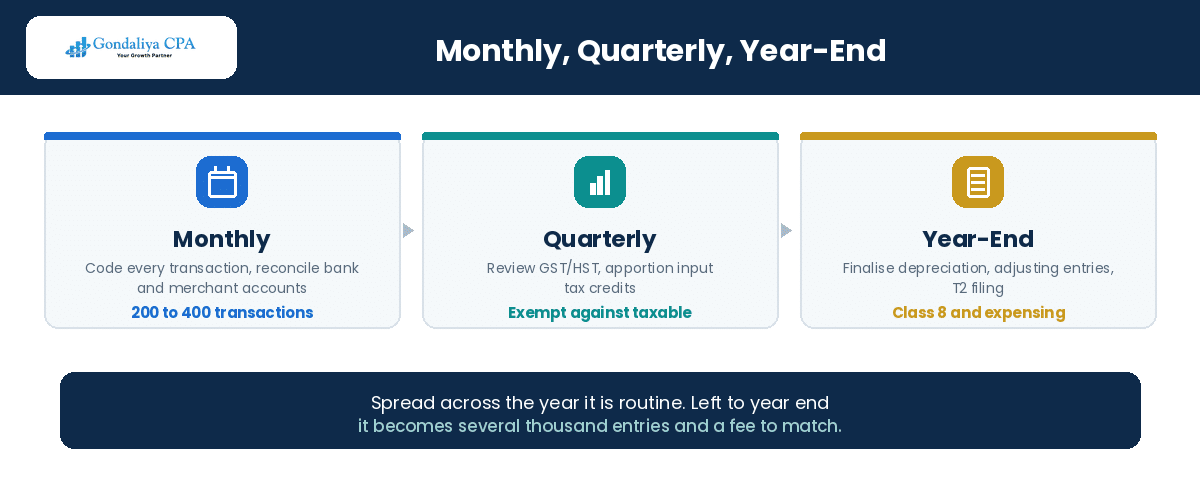
An organized workflow spreads tasks over the year for smooth compliance:
Monthly:
- Record all transactions using tools linked to QuickBooks/Xero plus receipt capture apps like Hubdoc.
- Reconcile bank and merchant accounts every month—this can mean 200–400 transactions depending on how big the practice is.
Quarterly:
- Check GST/HST when supplies mix taxable and exempt items; figure out how much input tax credit applies per CRA rules.
Year-End:
Medical equipment usually goes into Capital Cost Allowance Class 8 with a 20% declining balance rate yearly. Immediate expensing applies up to $1 million CAD annually thanks to recent accelerated investment incentives through 2026 that affect incorporated practices’ assets.
At year-end:
- Finalize depreciation schedules including new purchases or disposals.
- Prepare adjusting journal entries before T2 return filings.
This keeps books accurate and ready for CRA review.
Two hundred to four hundred transactions a month sounds heavy until it is split across twelve months. Left to year end it becomes several thousand entries and a fee to match. Figures changed for privacy.
Risk Warning: The payroll remittance deadline is the 15th of the following month. Penalties and interest start immediately, and unlike most tax issues there is no reasonable-cause argument for simply being late.
Professional Support and Services by Gondaliya CPA
Professional Support and Services by Gondaliya CPA
The Support
Gondaliya CPA offers healthcare bookkeeping Canada services designed for medical practices. We keep your financial records clean and ready for tax time. Our team knows how to find every healthcare tax deduction you qualify for. We make sure your records meet CRA compliance healthcare rules. Whether you’re a doctor, dentist, or another health professional, we keep your books precise and audit-ready.
Benefits of Partnering with a CPA Specializing in Healthcare Bookkeeping
Working with a CPA who focuses on medical practice bookkeeping helps Canadian healthcare providers avoid costly mistakes. They know industry expenses inside out and follow CRA compliance healthcare guidelines closely. This means fewer missed deductions and no penalties.
A specialized CPA will:
- Track physician business expenses carefully
- Handle GST/HST rules for mixed exempt supplies
- Apply capital cost allowance properly on equipment
This expertise helps you get the right deductions without breaking any rules.
Corporate Tax Filing and Audit-Ready Financial Reporting for Medical Practices
Filing corporate taxes takes detailed work to claim all allowed healthcare tax deductions under the law. You must also follow CRA compliance healthcare rules perfectly.
Well-kept books help you file T2 forms on time with correct details about your clinic’s finances.
Audit-ready reports include:
- Bank account reconciliations
- Payroll remittances made before deadlines
- Documentation for shareholder loans
- Clear separation of personal and practice expenses
These steps lower risks during CRA audits or reviews.
Incorporation Services and Payroll Setup for Healthcare Professionals
Setting up a corporation for your medical practice means organizing your books right from the start. Gondaliya CPA helps create a corporate structure that fits provincial rules like those from CPSO or RCDSO.
Payroll setup is key here. We make sure payroll calculations follow payroll remittance deadlines set by the CRA. Sending payments late can cause fines. Plus, we handle T4/T4A reporting so all associate payments show clearly in your accounts.
Transparent Pricing, Consultations, and Ongoing Support for Healthcare Clients
Our healthcare bookkeeping Canada services come with clear pricing. You get flat fees that include HST — no hidden charges surprise you later. We offer a free consultation to discuss your health practice’s needs upfront.
We respond quickly — usually within one business day — plus we’re available evenings or weekends if needed. This keeps you aligned with changing rules like the new electronic record retention laws starting in 2026.
Contact us today at 647-212-9559 or info@gondaliyacpa.ca
for help keeping your books clean and making sure you claim all lawful deductions while avoiding CRA problems across Toronto, Ontario, and Canada-wide practices.
Clients arriving from a general bookkeeper are rarely missing entries. What is missing is the split between exempt and taxable supplies, and that one gap changes every input tax credit claimed. Figures changed for privacy.
Frequently Asked Questions on Healthcare Bookkeeping
Frequently Asked Questions on Healthcare Bookkeeping
FAQ
What records does the CRA expect a healthcare business to keep?+
CRA requires healthcare practices to retain all source documents for six years. This includes invoices, receipts, bank statements, payroll records, contracts, and electronic accounting files.
How should a medical practice set up its chart of accounts?+
Separate revenue by service type and expenses into clinical and administrative categories. Use location or practitioner codes to track performance accurately.
How do you separate personal and practice spending?+
Use dedicated bank accounts and credit cards for the practice. Avoid mixing funds to prevent taxable shareholder benefits or audit risks.
What records must be kept under the six-year document retention rule?+
Maintain paper or digital copies of all financial documents related to income, expenses, payroll, leases, and shareholder loan agreements for six years after the fiscal year.
How does bookkeeping handle GST/HST when a practice has exempt and taxable supplies?+
Split input tax credits proportionally between taxable and exempt supplies. Track GST/HST carefully to avoid errors in remittance or claiming credits.
How do payroll, contractors, and associates flow through the books?+
Record all payroll transactions with timely remittance by the 15th of the following month. Include contractor payments separately with proper T4A reporting.
How are equipment purchases, leases, and CCA recorded correctly?+
Classify medical equipment under correct CCA classes such as Class 8 (20%). Apply maximum immediate expensing rules where eligible to reduce taxable income promptly.
How do clean books support dividends, shareholder loans, and year-end filings?+
Accurate books document dividend resolutions and shareholder loan repayments. This ensures compliance with ITA rules on taxable benefits and supports smooth tax filings.
What triggers a CRA review of a healthcare practice’s books?+
Inconsistent expense claims, commingled personal/practice funds, missing documentation, or unusual shareholder loan activity often prompt CRA reviews.
How do you sequence bookkeeping across a fiscal year?+
Monthly bank reconciliations and transaction coding come first. Quarterly GST/HST reviews follow. Year-end involves depreciation updates, dividend preparations, and audit-ready reports.
Essential Healthcare Bookkeeping Tips by Gondaliya CPA
Essential Healthcare Bookkeeping Tips by Gondaliya CPA
Quick Reference
- Track an average of 200–400 monthly bank/merchant transactions precisely.
- Meet payroll remittance deadlines by the 15th of each month to avoid penalties.
- Stay below or register promptly if exceeding $30K GST/HST registration threshold annually.
- Use Class 8 CCA (20%) for typical medical equipment depreciation.
- Leverage maximum immediate expensing eligibility for assets up to $1 million annually.
- Maintain digital record retention compliant with CRA’s 2026 electronic guidelines.
- Separate personal vs practice expenses clearly with dedicated accounts to prevent ITA s.15 issues.
- Manage shareholder loans carefully with formal agreements and resolutions documented in bookkeeping files.
- Monitor maximum meal and entertainment deductions according to CRA limits each year.
- Implement consistent monthly catch-up workflows if prior bookkeeping is incomplete to avoid backlog.
Who this is for: Medical clinics incorporated in Canada needing tailored bookkeeping solutions that maximize tax deductions while meeting CRA compliance healthcare rules.
Scope & Assumptions: Includes bookkeeping for incorporated healthcare practices in Ontario/Toronto using QuickBooks or Xero integrated with EMR systems like Hubdoc for seamless record keeping.
Contact Gondaliya CPA for expert help aligning your healthcare bookkeeping Canada needs with current tax laws at info@gondaliyacpa.ca or 647‑212‑9559.
Industry Spotlights: Sectors We Represent
Industry Expertise
Clean books matter everywhere, but the pressure point differs by sector. Here are eleven and what usually goes wrong first.
| Industry | Where the Books Usually Break |
|---|---|
| Medical doctors & physician corporations | OHIP billings not matched to deposits |
| Dentists & dental practices | Associate fee splits and mixed supplies |
| Daycare, childcare & CWELCC services | Subsidy revenue recognition and payroll |
| Restaurants & food and beverage | Platform commissions netted off deposits |
| E-commerce & online retailers | Marketplace fees and multi-province GST/HST |
| Construction, contractors & skilled trades | Cash purchases and subcontractor records |
| Property developers & builders | Project cost allocation across entities |
| Real estate investors & holding companies | Shareholder loans and intercompany transfers |
| Transportation, logistics & trucking | Fuel, mileage and driver payroll records |
| Technology startups & SaaS | Deferred revenue and capitalised development |
| Consulting firms | Work in progress and expense substantiation |
- Medical doctors & physician professional corporations: OHIP remittance advices have to reconcile to deposits, and the gap is usually timing rather than error.
- Dentists & dental practices: Associate fee splits and the mix of exempt and taxable work make the GST/HST apportionment the hardest part.
- Daycare, childcare & CWELCC services: Subsidy revenue arrives on its own schedule and has to be recognised in the right period.
- Restaurants & food and beverage: Delivery platform commissions come off before the deposit, so both revenue and expense go unrecorded.
- E-commerce & online retailers: Marketplace fees and sales tax varying by destination create the same reconciliation problem clinics face with insurers.
- Construction, general contractors & skilled trades: Cash purchases without receipts and thin subcontractor records are the recurring gaps.
- Property developers & builders: Costs shared across project entities need a written allocation basis, not an estimate applied later.
- Real estate investors, landlords & holding companies: Shareholder loans and intercompany transfers accumulate quietly and surface at year end.
- Transportation, logistics & trucking: Fuel receipts, mileage logs and driver payroll have to line up before anything is claimable.
- Technology startups & SaaS: Deferred revenue and capitalised development decide what the statements actually show.
- Consulting Firms: Work in progress and expense substantiation are where reviews concentrate in this sector.
Clinics and e-commerce sellers arrive with the same problem in different clothing. A third party settles net of its fee, and unless someone records the gross, both the income and the deduction disappear. Figures changed for privacy.
Professional Guidance and Quick Reference
Guidance
Professional Guidance on Healthcare Bookkeeping: How Gondaliya CPA Supports Canadian Practices
Bookkeeping is not a deduction exercise. It is the evidence base that makes deductions survivable, and the practices that never have a CRA problem are simply the ones where nothing had to be rebuilt after the fact. Gondaliya CPA keeps that base intact on a fixed fee.
We handle what decides the outcome: separating practice money from personal money so shareholder loan balances stay clean, coding clinical and administrative expenses consistently, matching OHIP and private billings to deposits every month, apportioning input tax credits correctly where exempt and taxable supplies mix, classifying equipment into the right capital cost allowance class, and keeping the six-year record set in a form that stays readable.
Our team works from your own EMR, bank and merchant data rather than a template. Whether your books are current or two years behind, you get clear advice and a fixed price before we start.
Quick Answers: Key Numbers & Concepts at a Glance
At a Glance
- Record retention: Six years after the tax year ends
- GST/HST threshold: $30,000 of taxable supplies annually
- Payroll remittance: Due the 15th of the following month
- Class 8: 20% declining balance on medical equipment
- Immediate expensing: Up to $1 million of eligible assets per year
- Small business rate: Active income up to $500,000 federally
- Monthly volume: Typically 200 to 400 bank and merchant transactions
- Corporate return: T2, with T5 slips for dividends
- Unincorporated: T1 with Form T2125
- Shareholder loans: ITA s.15, formal agreements required
Who This Is For / Not For
Fit Check
- For: Incorporated clinics and healthcare practices wanting books that capture every deduction and hold up under a CRA review, whether current or behind.
- Not For: Unincorporated practitioners with straightforward T2125 reporting, where the bookkeeping requirement is considerably lighter.
People Also Ask
Quick Answers
My books are two years behind. Is that fixable?+
Yes, and it is a common starting point. Catch-up work runs backwards from the most recent complete records, and the cost is usually lower than the deductions recovered.
Do I need both a bookkeeper and an accountant?+
They do different jobs. Bookkeeping records the transactions as they happen; accounting turns those records into statements and returns. One firm can do both.
Are scanned receipts enough for the CRA?+
Digital copies are accepted provided they remain accessible and readable for the full six years. Storing them in a system that can export cleanly matters more than the format.
Glossary of Key Terms
Plain-English Definitions
- Chart of accounts: The structured list of accounts every transaction is coded to.
- Source document: The invoice, receipt or statement behind an entry in the books.
- Reconciliation: Matching recorded transactions against bank and merchant statements.
- Fee-for-service: Billing per service delivered rather than by salary or contract.
- Exempt supply: A service with no GST/HST charged and no input credits claimable.
- Taxable supply: A service on which GST/HST must be charged, such as cosmetic work.
- Input tax credit: GST/HST paid on business purchases and recoverable on a return.
- Apportionment: Splitting input tax credits between exempt and taxable activity.
- Shareholder loan: Money moving between owner and corporation, tracked under ITA s.15.
- Commingling: Mixing personal and corporate funds in one account.
- Capital cost allowance: The deduction for depreciation of capital assets over time.
- Class 8: The 20% class covering most medical and dental equipment.
- Immediate expensing: Writing off eligible assets in full in the year acquired.
- Health Spending Account: A corporate plan reimbursing health costs as a business expense.
- TOSI: Tax on Split Income, which taxes unreasonable family payments at the top rate.
- T4A: The slip reporting payments to contractors and associates.
Healthcare Bookkeeping Readiness Check
This quick self-check indicates where your operation most likely has room. Please answer the six questions below.
Healthcare Bookkeeping Readiness Check
Six quick questions on your books. No fee shown.
Points to raise with us:
This is a general prompt, not tax or legal advice or a quote. Your position depends on your full facts. For a real review, please book a free consultation.
Want a checklist to work from? You can download our free healthcare bookkeeping checklist before your consultation.
Open separate accounts and cards for the practice and never move between them casually. Match billings to deposits monthly rather than at year end. Code clinical and administrative costs the same way every month. Put shareholder loan terms in writing before the balance grows. Store receipts digitally in a system that will still open in six years, and classify equipment into its capital cost allowance class at purchase.
2026 Update — what is current: New electronic record retention rules take effect in 2026, raising the standard for how digital records must be stored and retrieved. The six-year retention period, the $30,000 GST/HST registration threshold, Class 8 at 20% and the 15th of the month payroll remittance deadline are unchanged. Please confirm current requirements before relying on the figures in this article.
Healthcare Bookkeeping Canada: Expert Medical Practice Bookkeeping, CRA Compliance, and Healthcare Tax Deductions by Gondaliya CPA
Books that hold up, deductions that stick
Gondaliya CPA sets up the chart of accounts, reconciles billings to deposits every month, separates practice from personal spending, apportions GST/HST input credits correctly, documents shareholder loans, tracks capital cost allowance, and prepares the T2 with the records behind every claim, on a fixed fee with a one-business-day response. Please book a free consultation.
Next Steps
Please book a free consultation with Gondaliya CPA and bring your last T2 return, a recent bank statement, and whatever your bookkeeping currently looks like, even if it is incomplete. Behind is normal and it is fixable. You will get a fixed fee before any work begins. If our content helps, please add gondaliyacpa.ca as a preferred source on Google.
Published: August 14, 2026 · Last updated: August 14, 2026
Editorial policy: We research against CRA and CPA Ontario sources, fact-check the figures, and Sharad Gondaliya, CPA, reviews the content, which we update as the rules change.
Disclaimer: This article is educational information only and is not tax, legal, or financial advice. Figures marked illustrative are examples rather than quotes or guarantees. It reflects CRA rules current to 2026, including the six-year record retention requirement, the $30,000 GST/HST registration threshold, Class 8 capital cost allowance at 20%, immediate expensing up to $1 million annually, and the 15th of the month payroll remittance deadline. Rates, limits and expensing rules change and outcomes depend on your specific facts. Please consult a CPA Ontario member before acting.

Sharad Gondaliya is a CPA Canada & CPA USA with 15 Years+ experience of Accounting, Tax, Payroll of Corporate Small Businesses as Tax Accountant. He is a CPA Ontario member (61040184) and holds US CPA licences in Washington and Montana and is well known among corporate small businesses for tax planning, efficient tax solutions, and affordable CPA services. Sharad is the Principal (Director) of Gondaliya CPA – Affordable CPA Firm in Canada. Licenses: CPA Ontario: 61040184 | CPA USA (MT): PAC-CPAP-LIC-033176 | CPA USA (WA): 57629 | CPA Firm License: 61330051 View Full Author Bio