



How Restaurant Owners Can Maximize Tax Deductions for Food, Labour, Equipment, and Other Business Expenses
To make the most of restaurant tax deductions Canada, careful management of restaurant business expenses and tax planning is necessary. Gondaliya CPA delivers professional tax accountant advice to ensure your restaurant keeps more profits year-round.
Quick Summary
Every claim has to pass two tests: it must help earn business income under s.18(1)(a), and the amount must be reasonable under s.67. Please note that most denials in this sector are not about eligibility at all, but about whether a receipt existed and whether the personal portion was stripped out.
| Aspect | Details |
|---|---|
| The food side | COGS built from inventory counts, rebates and spoilage. |
| The labour side | Wages, employer contributions, and correct worker classification. |
| The equipment side | Class 8 at 20%, Class 13 for leaseholds, immediate expensing. |
| The proof | Six years of invoices, payroll records and logs. |
Reading time: 36 minutes.
Table of Contents
- Understanding the Restaurant Tax Landscape in Canada
- Key Tax Rules Affecting Restaurant Business Expenses
- Optimizing Owner Compensation and Expense Management
- Tax Compliance and Risk Management for Restaurants
- Year-End Tax Planning Strategies for Canadian Restaurants
- Enhancing Tax Efficiency and Business Growth with Professional Support
- Frequently Asked Questions (FAQs) on Restaurant Tax Deductions Canada
- Quick Comparison and Essential Points
- Industry Spotlights: Sectors We Represent
- Professional Guidance and Quick Reference
The Numbers That Matter
This article covers Canada, with Ontario and Toronto context, and reflects CRA rules current to 2026. It assumes an incorporated restaurant, bar, cafe or franchise operation. Figures marked illustrative are examples, not quotes, and any masked engagement notes end with “Figures changed for privacy.” This is educational information only and not tax, legal, or financial advice. Rates, limits and expensing rules change, so please confirm your own situation with a CPA Ontario member before acting.
Understanding the Restaurant Tax Landscape in Canada
Understanding the Restaurant Tax Landscape in Canada
The Basics
Overview of Tax Environment for Canadian Restaurants
Running a restaurant in Canada means dealing with several tax rules. There are specific restaurant tax deductions Canada offers, especially under the Income Tax Act sections like s.18(1)(a) and s.67. These rules decide which expenses you can claim and how reasonable they must be.
Besides income tax, you need to think about GST/HST Input Tax Credit eligibility. This credit helps restaurants get back some of the taxes paid on their business purchases. It can lower your overall costs if you track things right.
Common Tax Challenges Facing Restaurant Owners
- CRA Payroll Obligations: Payroll has to be exact. Mistakes here cause big problems.
- Meals and Entertainment Deduction Limit: You can only claim a set amount for meals during business activities.
- Controlled Tips Compliance: Tips must be handled properly and recorded as CRA requires.
These issues mean you should work closely with a restaurant tax accountant who knows the ins and outs of these rules.
Importance of Accurate Record-Keeping and Documentation
Good records are a must for any incorporated restaurant business in Canada. The CRA asks that you keep documents like source invoices, payroll slips, and contracts for at least six years.
These papers back up your claims during audits. They also help you see how your business is doing financially over time. Keeping files organized saves stress later and protects you from trouble with tax authorities.
Impact of Tax Planning on Restaurant Profitability
Smart restaurant tax planning can boost your profits by using things like immediate expensing incentives coming in 2026. These let you write off certain big purchases right away instead of spreading costs out over years. That’s better for cash flow.
Planning near the end of the year helps too. You get a chance to arrange your money moves with advice from a licensed restaurant tax accountant, especially one familiar with Toronto and Ontario SMB owners. Doing this means you claim more deductions without stepping outside the rules.
The two tests catch people out in opposite directions. Owners under-claim genuine costs because there is no receipt, and over-claim mixed costs because nobody stripped out the personal share. Figures changed for privacy.
Key Stat: Labour runs 25% to 35% of sales and food cost 28% to 32%. Together they are the prime cost, and most operations target it under 60%.
Key Tax Rules Affecting Restaurant Business Expenses
Key Tax Rules Affecting Restaurant Business Expenses
The Rules
Knowing key tax rules helps you claim restaurant tax deductions Canada properly. These rules guide what counts as restaurant business expenses and when you can claim GST/HST input tax credits. Staying within CRA rules avoids trouble and saves money.
GST/HST on Food and Beverage Sales: Taxable vs. Zero-Rated Transactions
Restaurants must sort food and drink sales into taxable or zero-rated categories to claim GST/HST input tax credits (ITCs) right. Most cooked meals sold in restaurants face GST/HST at local rates, so buying ingredients for those meals lets you claim ITCs.
But basic groceries are zero-rated. That means no GST/HST charged but no ITCs when you buy them.
The CRA allows full ITC claims when inputs serve commercial use like making meals to sell.
About meals and entertainment deductions: you usually can deduct only 50% of those expenses (Income Tax Act section 67.1(1)). But food sold in your restaurant counts differently and might be fully deductible.
Here’s a quick breakdown:
- Prepared meals: taxable, ITC eligible
- Basic groceries: zero-rated, no ITC
- Staff meals not sold: usually taxable, limited deductibility
Getting these right keeps your books clean and audits smooth.
Treatment of Tip Income: Controlled Tips, Direct Tips, and CRA Compliance
Tip income has its own tax quirks. The CRA splits tips into controlled tips and direct tips.
Controlled tips are pooled by the employer then shared out. These count as employee income. Employers must include them in payroll taxes like CPP and EI. Also, source deductions must be remitted on time to avoid penalties.
Direct tips go straight from customer to employee without employer handling. Usually, employers don’t report these or withhold payroll taxes on them unless the tips get pooled or managed by the business.
Keep clear records showing how tips flow through your system. It helps prove compliance if CRA asks for proof.
Key notes:
- Controlled tips add payroll duties for employers
- Direct tips usually exempt from payroll deductions
- Good records protect against extra taxable benefit claims
Food Cost and Cost of Goods Sold (COGS) Tax Deductions
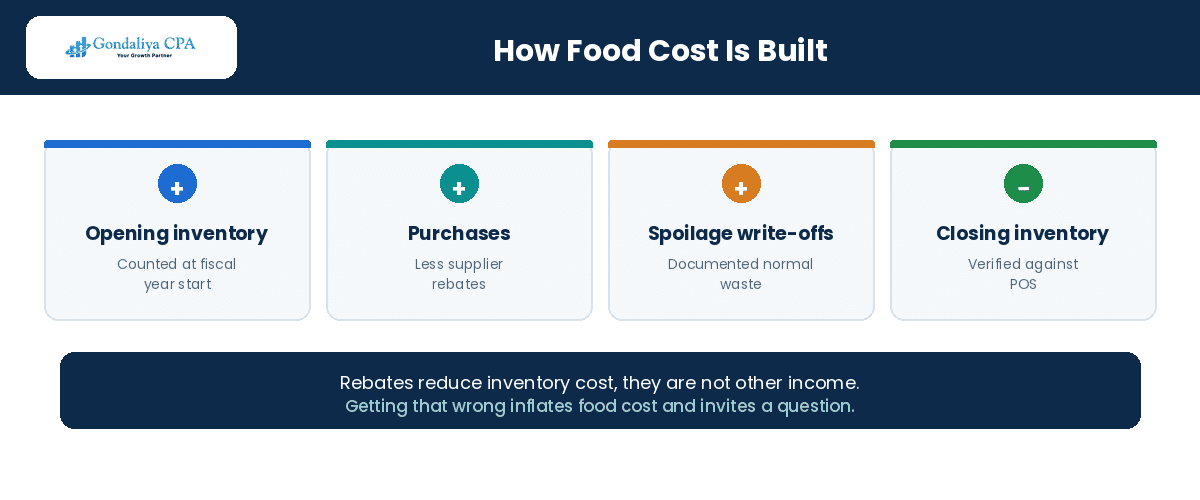
Food cost takes up a big chunk of restaurant expenses and affects profit margins like prime cost percentage (labour + food cost divided by sales). Restaurants aim for this under 60%.
To calculate COGS accurately:
- Count opening inventory at fiscal year start
- Add all purchases but subtract supplier rebates from total costs
- Deduct closing inventory plus documented spoilage write-offs
Supplier rebates lower food cost but need clear records separate from invoices. Spoilage write-offs need proof too — logs or physical counts showing normal waste levels. Overclaiming spoilage risks rejection by CRA under reasonableness rules (ITA s.67).
Here’s what goes into COGS:
- Opening inventory value
- Purchases minus rebates
- Documented spoilage losses
- Closing inventory value
These steps keep your food cost claims honest and audit-ready.
Capital Cost Allowance (CCA) on Kitchen Equipment and Leasehold Improvements
Kitchen gear belongs to Class 8 for CCA purposes with a 20% declining balance rate per year[1]. Leasehold improvements usually fall under Class 13 with amortization tied to lease terms[2].
Starting 2026, small businesses including restaurants can expense capital purchases up to $30,000 right away instead of using CCA rates[3]. This helps cash flow since deductions come faster if equipment cost fits within that limit.
Remember, repairs fixing equipment count as current expenses you deduct immediately. But upgrades that boost value must be capitalized and depreciated over time[4].
| Asset Type | CCA Class | Rate (%) | Immediate Expensing Limit ($) |
|---|---|---|---|
| Kitchen Equipment | Class 8 | 20 | Up to $30,000 starting FY2026 |
| Leasehold Improvements | Class 13 | Varies[2] | Based on lease term |
Labour and Payroll Tax Deductions: Salaries, Wages, Benefits, and Employer Contributions
Labour costs usually take up about 25–35% of sales depending on the restaurant size[5]. Deductible costs cover salaries, employer CPP/QPP contributions, EI premiums paid on time[6], pension plans where relevant, plus allowable benefits that tie directly to work roles[7].
Payroll source deductions must be calculated correctly each pay period then remitted monthly or quarterly depending on total amounts withheld[8]. Late payments bring interest charges.
Good payroll records support deduction claims and reduce audit risks related to misclassification or missed payments[9].
Employee vs. Contractor Classification Risks and CRA Guidelines
Getting worker classification right matters a lot for taxes. Employees differ from independent contractors in how payroll taxes apply[10].
Wrongly calling an employee a contractor may cause CRA reassessments for unpaid CPP/EI plus penalties[11].
When family members work in the business, pay rates must be reasonable for actual services provided. Otherwise CRA may treat payments as shareholder benefits under s.15(1)[12].
Contracts help clarify roles but aren’t foolproof alone—CRA looks at control over work methods and supervision too[13].
Here’s a quick comparison:
| Factor | Employee | Independent Contractor |
|---|---|---|
| Control Over Work | Employer directs tasks | Controls own methods |
| Payment Method | Regular wages/salary | Paid by invoice |
| Benefits Eligibility | Yes | No |
| CPP/EI Withholding | Required | Not required |
| Documentation Needed | T4 slips issued | T5018 forms recommended |
Talk with experts early to avoid costly mistakes later during audits common in places like Ontario or Toronto where many restaurants operate incorporated businesses[14].
This guide covers essentials for owners running restaurants in Toronto/Ontario or across Canada seeking clear advice about how tax rules affect everything from daily sales through capital investments to labour costs. Following these points helps keep your finances safe while claiming all lawful deductions effectively.
Supplier rebates are the most commonly mishandled item in restaurant COGS. Booked as other income rather than reducing inventory cost, they inflate food cost and invite a question that did not need to exist. Figures changed for privacy.
Risk Warning: Calling an employee a contractor is reassessed retroactively. The CRA looks at who controls the work rather than what the contract says, and back CPP and EI arrive with penalties attached.
Optimizing Owner Compensation and Expense Management
Optimizing Owner Compensation and Expense Management
The Owner Side
Managing owner compensation and restaurant business expenses well helps you get the most out of restaurant tax deductions Canada. Setting up owner payments right, knowing which expenses are deductible, and handling costs carefully lowers tax risks. It also keeps your cash flow in better shape. A good restaurant tax accountant guides you through CRA rules while helping improve your tax position.
Effective Owner Compensation Strategies: Salary, Dividends, and Retained Earnings
Incorporated restaurants can pay owners through salaries, dividends, or by keeping earnings in the company. Salaries paid to owners count as a deductible business expense if they match what similar jobs pay under ITA s.18(1)(a). These wages require payroll deductions like CPP and EI but cut the corporation’s taxable income.
Dividends work differently. The corporation cannot deduct them, but they might lower your personal taxes depending on your situation. Keeping profits inside the company delays your personal tax but means the corporation pays more tax now.
Good restaurant tax planning means reviewing these choices every year based on how much profit you expect, any shareholder agreements, and how much cash you need. You should keep proof that salaries are fair—like time records or salary comparisons—to meet CRA standards.
Deductible versus Non-Deductible Restaurant Business Expenses
Not every cost you have counts as a deductible expense in Canada. To be deductible:
- The cost must help you earn business income.
- It has to be reasonable in amount under ITA s.67.
- You need receipts or invoices.
- Any personal part of the expense is not allowed.
Here’s how expenses break down:
- Deductible Expenses: Regular costs like buying food, paying wages, rent payments; these are fully deductible with proof.
- Capital Expenses: Things that last longer like kitchen equipment; these get written off slowly over time (CCA).
- Non-Deductible Expenses: Personal meals that aren’t for staff or clients, fines, or entertainment that goes over limits; these don’t count.
Getting these right saves you from audits or penalties.
Advertising and Marketing Expense Eligibility and Restrictions
Advertising your restaurant usually counts as a deductible restaurant business expense when it directly helps make money. This covers stuff like online ads, print ads, signs, website costs linked to promotion (not assets), and social media ads.
Tech costs for POS systems or delivery platforms also count if they help sales instead of being capital purchases. Fees from payment processors fit here too.
Watch out for:
- Sponsorships without clear promo purposes—they might get partly disallowed.
- Spending too much compared to income can raise CRA flags about reasonableness.
Keep detailed records connecting each ad cost to a specific campaign to back your claims if audited.
Handling Meals and Entertainment Expenses within CRA Limits
Meals and entertainment have a 50% limit on what you can deduct under CRA rules,[4] except when food is sold normally like customer meals—that’s fully deductible (ITA s.67.1(6)).
Free or cheap staff meals usually count as taxable benefits unless given mainly for employer convenience.[5] You must report those properly with payroll taxes (CPP/EI) on their value.
Key tips:
- Say clearly why meals were given—client meetings versus perks.
- Track different meal types separately in books.
- Watch totals carefully against income figures.
If you mess this up, deductions might be denied, and taxable benefits could cause extra taxes on employees or you as employer.
Overlooked Deductions: Staff Meals, Supplier Rebates, and Loyalty Programs
Some often missed items can add up:
- Staff meals: You might deduct part of meals eaten during shifts if they meet employer convenience rules.[5]
- Supplier rebates: Discounts after buying should reduce your inventory cost instead of being counted separately; missing this inflates food costs wrongly.[6]
- Loyalty programs: Costs tied directly to customer rewards related to sales usually qualify as promotional expenses if well documented.[7]
Keep good bookkeeping for these using tools like QuickBooks connected with your POS system so everything stays accurate across locations.
Managing Business Taxes, Fees, Licences, and Permits Deductions
Fees for licences required by provinces—like AGCO liquor licences—and city permits such as patios are valid operating expenses fully deductible if needed to run legally.[2]
Insurance premiums covering property damage tied only to the restaurant also qualify along with fees paid for professional services like accounting or legal advice related strictly to business.[2]
Some examples:
- AGCO liquor licence fees — fully deductible including renewals
- Patio permits — municipal approvals needed; fully deductible
- Property insurance — covers only the business premises
- Accounting & legal fees — strictly for business purposes
Keep these separated from personal policies so you don’t mix things up during audits.
Loyalty programme costs are almost never claimed. The spend sits in the POS as a discount rather than in the ledger as promotion, so it never reaches the return at all. Figures changed for privacy.
Pro Tip: Code staff meals, client meals and owner meals to three separate accounts from day one. The 50% limit applies to only some of them, and separating after the fact is guesswork the CRA will not accept.
Tax Compliance and Risk Management for Restaurants
Tax Compliance and Risk Management for Restaurants
The Risk
Running a restaurant means handling taxes carefully to get the best restaurant tax deductions Canada offers. Keeping track of restaurant business expenses and planning ahead with smart restaurant tax planning helps avoid mistakes. A good restaurant tax accountant makes this easier by guiding you on what you can deduct and how to keep records right.
Identifying Common Audit Triggers and CRA Review Focus Areas
The Canada Revenue Agency (CRA) pays close attention to certain things when checking restaurant expenses. They look for areas that often have mistakes or misuse, like:
- Claiming too many personal or family meals as business costs.
- Cash buys without receipts.
- Marking capital assets as regular expenses by mistake.
- Paying family members high salaries without proof.
- Not tracking tips properly, especially differences between direct and controlled tips.
- Claiming GST/HST input tax credits on personal stuff.
- Reporting shareholder benefits wrong under ITA s.15.
- Not matching delivery platform fees with bank deposits.
CRA wants to be sure your claims are real, reasonable, related to income earning, and backed up with papers[1].
Risks of Claiming Deductions Without Proper Documentation
Claiming expenses without proper paperwork can cause serious trouble:
| Risk Area | What Can Happen | How To Avoid |
|---|---|---|
| Missing Receipts | Expense denied; penalties | Keep strict receipt rules |
| Personal Meals Claimed | Deductions rejected; reassessment | Separate personal and business |
| Capital Items Expensed Fully | Penalties; adjustments | Classify capital vs current right |
| Family Salaries Unreasonable | Payroll audit; reassessment | Keep role descriptions & rates |
| Tips Not Tracked | Problems with CPP/EI payments | Log tips carefully |
| Denied Input Tax Credits | Pay extra GST/HST + interest | Check eligibility before claiming |
Good record keeping cuts your risk in audits[2].
Best Practices for Receipt Capture, Bookkeeping, and Coding Accuracy
Keeping records right is key in restaurant tax planning. You can:
- Do it yourself (DIY) if sales are low but risk mistakes due to less experience.
- Hire a bookkeeper who handles daily transactions but might miss complex deductions like leasehold improvements.
- Work with a restaurant CPA who knows the details—food costs, payroll tips, capital asset classes, GST/HST credits—and can help during audits.
At Gondaliya CPA, we follow steps like sales review, setting accounts up, collecting supplier docs, checking inventory and payroll, sorting assets and leases, matching delivery fees, splitting owner expenses, verifying GST/HST credits, then final year-end checks before filing[3]. We use QuickBooks Online with Hubdoc to keep things smooth.
Before a deduction review starts, restaurant owners should gather documents like past tax returns (T2), trial balances, POS reports, inventory counts, payroll records, leases, franchise agreements, equipment invoices, delivery reports, vehicle logs — having these ready speeds up review[4].
Maintaining Proper Records for GST/HST Input Tax Credits
Restaurants must keep clear records when claiming GST/HST input tax credits (ITCs). Only expenses strictly for business count[5]. Examples include kitchen repair parts (the current portion), cleaning services at your commercial location, or merchant fees tied to sales.
Keep these tips in mind:
- Separate mixed-use costs carefully; claim only the business share.
- Save original invoices with vendor numbers and details that match your records.
If not done right, CRA can deny ITCs and add taxes plus interest. Check your financials regularly against claims so you stay on track[6].
Payroll Source Deductions and Remitting Requirements
You must calculate payroll source deductions correctly. This includes wages plus employer parts of CPP/QPP/EI premiums. Taxable perks like staff meals may also apply[7].
How often you remit depends on total monthly deductions:
| Employer Size | Remit Frequency | When To Remit |
|---|---|---|
| Small (< $25K/month) | Quarterly | Last day after quarter ends |
| Larger (≥ $25K/month) | Monthly | Within 15 days after month ends |
Missing deadlines leads to fines that grow over time. That hurts your reputation and cash flow[8].
Procedures for Inventory Valuation, Waste, and Spoilage Reporting
Inventory value affects food cost deductions—a big expense in restaurants at 30%–35% of sales[9].
Best ways to manage it:
- Count stock at the start of the year; match it with closing stock verified by POS data where possible.
- Adjust Cost Of Goods Sold (COGS) for waste or spoilage separately from theft or unrelated losses[10].
- Track promotional giveaways (“comps”) as marketing expenses—not revenue cuts—if documented well[11].
Careful inventory control plus watching supplier rebates helps catch more deductions while avoiding audit flags for weird variances[12].
Canadian full-service restaurants typically see food costs around 28%–32%, depending on type of food and size of operation[13].
Ensuring Compliance with Leasehold Improvements and Capital Asset Classification
Leasehold improvements need careful classification since repair vs improvement affects taxes differently[14]:
- Repairs keep things working; they are deductible immediately.
- Improvements add value or life span; these go into capital assets.
Kitchen gear usually falls into Class 8 assets at 20% yearly depreciation. But from 2026 small businesses (including restaurants) can expense up to $50k per year right away instead of waiting[15]. This helps cash flow but needs proof you qualify[16].
Consider whether leasing or buying works better too. Trade-ins mean adjusting asset values correctly[17]. Mistakes here may lead to denied deductions during audits[18].
For questions about getting your restaurant’s deductions right or staying compliant in Toronto/Ontario call info@gondaliyacpa.ca or phone 647‑212‑9559. We help incorporated SMBs in Canada’s food service sector.
Comps recorded as a revenue reduction rather than a marketing cost quietly understate both sales and expenses. The net profit is right, but the ratios look wrong and that is what draws attention. Figures changed for privacy.
Year-End Tax Planning Strategies for Canadian Restaurants
Year-End Tax Planning Strategies for Canadian Restaurants
The Year End
Year-end tax planning helps restaurant owners save money by managing their restaurant business expenses. A good restaurant tax accountant knows the rules and finds chances to claim the right restaurant tax deductions Canada. Planning before the fiscal year ends can boost cash flow, lower audit chances, and keep finances healthy.
Year-End Tax Planning Checklist: Key Actions Before Fiscal Year Close
Before closing the year, check your expenses carefully. Restaurant owners should:
- Make sure all receipts and invoices for costs are complete.
- Count inventory and compare it with recorded food costs.
- Review payroll to confirm wages, tips, CPP, and EI are correct.
- Check if capital buys qualify for immediate expensing or CCA.
- Confirm GST/HST input tax credits match CRA rules.
- Look over owner expenses to ensure they’re reasonable and split right.
Following this checklist helps you claim all proper deductions while staying within CRA’s limits on restaurant business expenses.
Equipment Purchases and Immediate Expensing Opportunities
Buying kitchen gear near year-end can cut taxes. The 2026 update lets restaurants deduct up to $30,000 right away for qualifying assets[2]. This covers new or used items in CCA Class 8 (20% declining balance) or Class 43 (50% straight-line), depending on what you buy.
Leasehold improvements count too, but you need to know the difference between repairs (expense now) and improvements (capitalize). That affects when you get deductions.
For example: If you buy a $28,000 commercial oven before December 31, you might write it off fully that year instead of over several years — which improves your cash flow now.
Keep purchase contracts, payment proofs, installation info, and detailed asset descriptions for CRA records.[3]
Reviewing Worker Classification and Owner Expense Allocations
Labour usually eats up 25–35% of restaurant sales in Canada[4]. It’s important to classify workers correctly because that affects payroll deductions like CPP/QPP and EI. The CRA looks at control factors to decide if someone’s an employee or contractor.
Controlled tips must be properly reported; if not, penalties can hit. Staff meals that count as taxable benefits must be valued fairly.
Owner costs like home office use or personal car trips need clear business separation. Only reasonable amounts tied directly to earning income count as deductible under ITA s.18(1)(a).
Don’t miss payroll remittance deadlines—they’re usually within three days after each pay period ends for incorporated businesses.[5]
Preparing for GST/HST Reconciliation and Tip Income Verification
You can claim GST/HST input tax credits only on valid restaurant expenses backed by vendor invoices showing registration numbers[6]. Many slip up by claiming ITCs on non-business items like personal meals or unverified supplies.
Tip income needs solid bookkeeping that separates controlled from direct tips clearly. This keeps employee pay reporting accurate and compliant with CRA[7].
Doing these reconciliations before filing avoids surprises during audits that can mess with both GST returns and tax filings.
Planning Employee Bonuses, Health Spending Accounts, and Shareholder Benefits
Bonuses bump up labour cost percentage but can motivate staff if timed near year-end. Health Spending Accounts provide flexible benefits usually deductible without taxable benefit issues if set up right[8].
Shareholder reimbursements should be reasonable and match actual spending; too much could be treated as taxable shareholder benefits under s.15 ITA[9].
Keep good records showing how bonuses or HSA plans were calculated to stay clear during reviews by tax officials.
Coordinating Disposal, Trade-Ins, and Repairs Versus Improvements Decisions
When you dispose of or trade in assets, adjust your Capital Cost Allowance balances correctly for net book values at disposal dates[10]. Missing this step leads to wrong depreciation claims affecting taxable income.
It’s key to tell repairs from improvements: repairs keep things running now so you expense them immediately; improvements extend life so they get capitalized into equipment or leaseholds per CRA rules[11].
Examples: repainting walls is a repair; installing new ventilation counts as an improvement. Contractor invoices detailing work help prove your case during audits.
Timing an equipment purchase just before year end is worth doing, but only where the asset is in use. Ordered and undelivered does not qualify, and that distinction has cost clients a full year of deduction. Figures changed for privacy.
Key Stat: A $28,000 commercial oven bought before year end can be written off in full under the immediate expensing rules, rather than at 20% declining balance over roughly a decade.
Enhancing Tax Efficiency and Business Growth with Professional Support
Enhancing Tax Efficiency and Business Growth with Professional Support
The Support
Managing restaurant business expenses right can save you a lot on taxes. If you want to get the most from restaurant tax deductions Canada offers, you’ll need good help. A restaurant tax accountant knows the rules and can plan your taxes so your business grows well. They keep things legal and find ways to lower your tax bill that fit Ontario’s laws.
Advantages of Partnering with a Specialized Restaurant Tax Accountant
A restaurant tax accountant gets the ins and outs of running a food place in Canada. They know which expenses count as deductions under CRA rules. This includes tricky parts like Income Tax Act sections s.18(1)(a) and s.67 about what is “reasonable.”
At Gondaliya CPA, they specialize in things like food cost tax deductions and labour costs, including controlled tips. They also understand capital cost allowance (CCA) classes for kitchen gear and how to use immediate expensing rules starting 2026.
This know-how helps avoid audits by making sure all claims are clear and backed up with good records. It also helps manage cash flow by filing taxes on time, handling payroll source deduction remittances, and claiming GST/HST input tax credits properly.
Implementing Digital Expense Tracking and Regular Quarterly Reviews
Keeping track of every restaurant business expense is key to getting every deduction you can. Digital tools make this easier by snapping receipts, sorting expenses, and matching them with sales or supplier invoices automatically.
Doing reviews every quarter catches missed GST/HST input tax credits or late payroll source deductions remittances before they become bigger problems. Fixing errors early saves headaches when year-end taxes come.
Using bookkeeping software like QuickBooks or Xero helps keep an eye on inventory costs for food plus wages for payroll calculations including CPP/EI and taxable benefits reporting.
Comparing DIY Tax Filing, Bookkeeper Support, and CPA Services
You have choices: do your taxes yourself (DIY), get a bookkeeper to help, or hire a restaurant CPA firm. Here’s how they stack up:
- DIY: Best if your finances are simple and you have one location. Costs least but offers minimal support.
- Bookkeeper: Good for ongoing help coding daily transactions. Gives monthly reports but limited advice.
- Restaurant CPA Firm: Provides deep deduction reviews and planning all year round. More expensive but worth it if you run multiple spots or franchises.
At Gondaliya CPA, we take care of everything from sales checks to final T2 submissions using tools like Hubdoc for document capture plus solid controls made just for restaurants.
Utilizing Compliance Calendars and Documentation Discipline
The CRA requires you to keep documents at least six years after your fiscal year ends.[1] You must save invoices that back up each claimed restaurant expense under ITA section s.18(1)(a).
Without proper papers, expenses might get denied in an audit.[2] Using compliance calendars helps you track important dates like payroll remittance deadlines,[3] GST/HST filing, corporate instalment payments,[4] and timing repairs versus improvements which affect CCA claims.[5]
Being strict about digital recordkeeping stops common mistakes like mixing personal meals with staff meals or wrongly expensing big capital assets instead of spreading out the cost over time.
Integrating Tax Planning into Long-Term Restaurant Growth Strategies
Planning your taxes should go hand-in-hand with growing your restaurant business. Starting in 2026, incorporated restaurants can expense up to $150K yearly on eligible property like kitchen equipment in Class 8 CCA.[6]
Buying major equipment at the right time can boost cash flow without losing depreciation benefits later.[7]
It’s also smart to watch changes in Ontario’s corporate rates[8] so you decide whether to leasehold improve or buy outright in ways that work best financially over time.
Contact Gondaliya CPA for Tailored Restaurant Tax Advice and Consultation
Choosing a CPA firm in Toronto/Ontario means looking at their experience with restaurants:
- Work with multi-location franchises
- Clear fixed fees with no surprise bills
- Responsive service backed by lots of 5-star Google reviews
- Know what documents CRA expects
- Can stand up for clients during audits
Gondaliya CPA fits this list well. Call them at 647-212-9559 or email info@gondaliyacpa.ca for a free chat about your restaurant’s tax needs.
Legal Disclaimer and References to CRA Publications and Official Resources
This info is for learning only—not legal advice or financial counsel—and follows Canadian laws like Income Tax Act sections s.18(1)(a) on deductible expenses,[9] s.67 reasonableness tests,[10] plus CRA books-and-records rules.[11]
Always talk to licensed pros familiar with where your business runs before making big decisions based on this content.
- CRA Record Keeping
- CRA Reasonable Salaries
- Payroll Source Deductions Deadlines
- Corporate Instalments
- Repairs vs Improvements – CRA Guide
- Immediate Expensing Limit Update – Budget Announcement
- Capital Cost Allowance Classes – Kitchen Equipment Class 8
- Ontario Corporate Rate Changes
- Income Tax Act Section s.18(1)(a): Deductible Expenses
- Income Tax Act Section s.67: Reasonableness Test
- Books & Records Requirements – Canada Revenue Agency
Quarterly reviews cost a fraction of a year-end cleanup and catch the same errors. The ones we find most often are unclaimed input tax credits and payroll remittances made late by a few days. Figures changed for privacy.
Frequently Asked Questions (FAQs) on Restaurant Tax Deductions Canada
Frequently Asked Questions (FAQs) on Restaurant Tax Deductions Canada
FAQ
What is the difference between deductible, capital, and non-deductible expenses?+
Deductible expenses directly reduce taxable income. Capital expenses relate to assets and are depreciated over time. Non-deductible expenses are personal or disallowed costs.
How can I maximize deductions on food and beverage costs?+
Track inventory accurately, include supplier rebates, and properly document spoilage. Only claim costs related to commercial meal production.
How are kitchen equipment and leasehold improvements deducted?+
Kitchen equipment uses Class 8 CCA at 20% declining balance. Leasehold improvements are amortized over the lease term or expensed if repairs.
Which occupancy costs can a restaurant claim?+
Restaurants can deduct rent, utilities, property taxes, and maintenance fees tied strictly to the business premises.
Are licensing, insurance, and professional fees deductible?+
Yes. Fees like liquor licenses, insurance premiums for business property, and accounting or legal fees related to operations are deductible.
How do you deduct technology, POS systems, and delivery platform costs?+
Operational fees for software or platforms count as expenses. Capital purchases of hardware may be subject to CCA rules.
What vehicle, travel, and meal costs can a restaurant deduct?+
Business-related travel with proper logs is deductible. Meals for clients may have limits; personal or commuting meals are non-deductible.
Which owner-related costs are deductible and which are not?+
Salaries paid for work done are deductible; personal expenses like home office without clear allocation are not.
What is labour cost percentage in restaurants?+
It typically ranges from 25% to 35% of sales depending on size and location.
What is the Immediate Expensing Limit under the 2026 update?+
Small businesses can expense up to $30,000 per year for eligible capital purchases immediately.
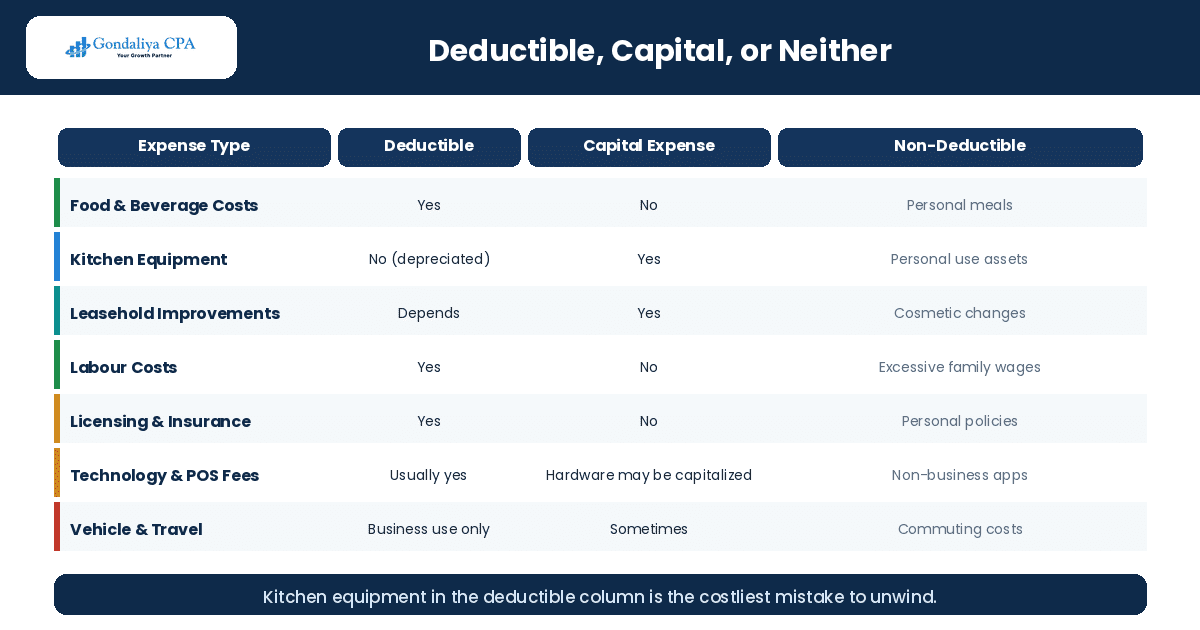
Quick Comparison Table: Expense Categories for Canadian Restaurants
Quick Comparison and Essential Points
Quick Reference
| Expense Type | Deductible | Capital Expense | Non-Deductible |
|---|---|---|---|
| Food & Beverage Costs | Yes | No | Personal meals |
| Kitchen Equipment | No (depreciated) | Yes | Personal use assets |
| Leasehold Improvements | Depends | Yes | Cosmetic changes |
| Labour Costs | Yes | No | Excessive family wages |
| Licensing & Insurance | Yes | No | Personal policies |
| Technology & POS Fees | Usually yes | Hardware may be capitalized | Non-business apps |
| Vehicle & Travel Expenses | Business use only | Sometimes | Commuting costs |
Who This Is For / Not For
- For: Incorporated restaurants seeking tax optimization in Canada. Owners wanting expert tax guidance.
- Not For: Sole proprietors without formal bookkeeping or those ignoring CRA compliance rules.
Essential Bullet Points Covering Remaining Keywords
- Deduction Route: DIY vs Bookkeeper vs Restaurant CPA: DIY suits simple cases; bookkeepers handle daily entries; CPAs provide full tax planning and audit support.
- Payroll Source Deductions Remittance Deadlines: Monthly remittance if withholding ≥$25K; quarterly if less; late payments trigger penalties.
- Document Retention Period: Keep tax records for minimum six years after filing fiscal year returns per CRA requirements.
- Controlled Tips vs Direct Tips: Controlled tips pooled by employer require payroll taxes; direct tips given straight to employees usually do not.
- Staff Meals Tax Treatment: May be a taxable benefit unless provided primarily for employer convenience; track carefully.
- Contractor Payments & Family Payroll Reasonableness: Correct classification avoids reassessments; family wages must reflect fair market value services.
- Repairs vs Improvements Distinction: Repairs expense immediately; improvements add value requiring capitalization over time per CRA guidelines.
- Vehicle Logbooks & Travel Costs: Maintain detailed logs documenting business versus personal use for allowable deductions.
- Shareholder Reimbursements & Home Office Allocation: Only reasonable business-related reimbursements are deductible; mixed-use assets require careful apportionment.
- Inventory Counts & Supplier Rebates Management: Accurate counts reduce overstated costs; rebates reduce inventory cost basis appropriately.
- Waste and Spoilage Reporting: Documented spoilage claims must reflect normal losses supported by logs or physical evidence.
- Franchise and Multi-location Food Service Businesses: Consolidate expenses carefully; watch inter-company transactions for correct tax treatment in Toronto/Ontario jurisdictions.
- GST/HST Input Tax Credit Eligibility: Claim ITCs only on business-related purchases backed by valid invoices with vendor registration numbers.
- Labour Cost Percentage Benchmarks: Use industry averages as guides when reviewing your labour expense efficiency against sales figures in Ontario restaurants.
How Gondaliya CPA Delivers Value
- Comprehensive restaurant deduction reviews tailored to your operation size and structure.
- Clear deliverables including deduction summaries, compliance checklists, audit support documents.
- Transparent pricing suited to small-to-medium restaurant businesses across Toronto and Ontario.
- Expert guidance on risk areas such as shareholder benefits, payroll classification, GST compliance.
- Efficient workflows leveraging QuickBooks Online with Hubdoc integration to maintain accuracy.
Contact Gondaliya CPA at info@gondaliyacpa.ca or call 647‑212‑9559 to schedule a free consultation about your restaurant’s tax deductions strategy today.
The comparison table is worth reading twice. Kitchen equipment sitting in the deductible column is the mistake we correct most often, and it is an expensive one to unwind. Figures changed for privacy.
Industry Spotlights: Sectors We Represent
Industry Expertise
Every sector leaves money on the table somewhere. Here are eleven and the deduction most often missed in each.
| Industry | The Deduction Most Often Missed |
|---|---|
| Restaurants & food and beverage | Delivery commissions and loyalty programme costs |
| E-commerce & online retailers | Marketplace fees deducted before deposit |
| Consulting firms | Home office and professional development |
| Construction, contractors & skilled trades | Small tools and cash purchases without receipts |
| Transportation, logistics & trucking | Vehicle CCA and meal allowances on the road |
| Property developers & builders | Soft costs capitalised when they need not be |
| Real estate investors & holding companies | Repairs miscoded as capital improvements |
| Technology startups & SaaS | Software subscriptions and equipment classes |
| Daycare, childcare & CWELCC services | Supplies, food costs and staff training |
| Dentists & dental practices | Equipment classes and continuing education |
| Medical doctors & physician corporations | Licensing fees and professional insurance |
- Restaurants & food and beverage: Delivery commissions and loyalty programme spend are deductible in full and almost never recorded as expenses.
- E-commerce & online retailers: Marketplace fees come off before the deposit lands, so the same gross-versus-net problem applies.
- Consulting Firms: Home office allocation and professional development are routinely under-claimed for want of a calculation.
- Construction, general contractors & skilled trades: Small tools and cash purchases disappear when no receipt reaches the bookkeeper.
- Transportation, logistics & trucking: Vehicle capital cost allowance and on-the-road meal allowances both need logs that often do not exist.
- Property developers & builders: Soft costs get capitalised by default when some could be expensed in the year.
- Real estate investors, landlords & holding companies: The repair against improvement line is drawn conservatively, deferring deductions unnecessarily.
- Technology startups & SaaS: Software subscriptions and hardware fall into different treatments, and the split is often wrong.
- Daycare, childcare & CWELCC services: Supplies, food costs and staff training are all claimable and frequently bundled into one vague account.
- Dentists & dental practices: Equipment classes and continuing education are the two categories most often mishandled.
- Medical doctors & physician professional corporations: Licensing fees and professional liability insurance are deductible in full and easily overlooked.
The pattern repeats across sectors. Wherever a third party settles net of its own fee, the gross sale and the deductible cost both vanish unless someone deliberately records them. Figures changed for privacy.
Professional Guidance and Quick Reference
Guidance
Professional Guidance on Restaurant Deductions: How Gondaliya CPA Supports Canadian Operators
Restaurant deductions come down to three questions asked of every cost: did it help earn income, was the amount reasonable, and is there a document behind it. Almost every denial we see fails the third. Gondaliya CPA works through the whole cost base on a fixed fee.
We handle what decides the outcome: building COGS from actual counts with rebates and spoilage handled correctly, capturing delivery commissions and merchant fees before they vanish into net deposits, splitting staff, client and owner meals into separate accounts, classifying equipment and leaseholds into the right capital cost allowance class, testing family wages against what the role would actually pay, and keeping the six-year document set behind every claim.
Our team works from your POS, supplier and payroll data rather than a template. One location or a franchise group, you get clear advice and a fixed price before we start.
Quick Answers: Key Numbers & Concepts at a Glance
At a Glance
- Class 8: 20% declining balance on kitchen equipment
- Class 13: Leasehold improvements, over the lease term
- Class 43: 50% straight-line on qualifying assets
- Immediate expensing: Up to $30,000 from 2026
- Meals and entertainment: 50% limit under s.67.1(1)
- Food sold to customers: Fully deductible under s.67.1(6)
- Payroll remittance: Monthly at $25K or more, quarterly below
- Record retention: Six years after the fiscal year
- Prime cost target: Labour plus food under 60% of sales
- The two tests: ITA s.18(1)(a) and s.67
Who This Is For / Not For
Fit Check
- For: Incorporated restaurants, bars, cafes and franchise groups wanting every eligible cost captured and every claim documented well enough to survive a review.
- Not For: Sole proprietors without formal bookkeeping, where the first step is establishing records rather than optimising deductions.
People Also Ask
Quick Answers
Can I claim the cost of my own meals at the restaurant?+
Owner meals taken personally are not deductible. Meals eaten while genuinely working, and staff meals provided for employer convenience, are treated differently and need separate coding.
Are delivery platform commissions deductible?+
Yes, in full, provided you record the gross sale and the commission separately. Where only the net deposit is booked, both figures disappear.
What happens if I lose receipts for cash purchases?+
The deduction is at risk. A bank or card record showing the payment helps, but the CRA can deny a claim with no supporting invoice behind it.
Glossary of Key Terms
Plain-English Definitions
- Cost of goods sold: Opening inventory plus purchases less rebates and closing inventory.
- Prime cost: Labour plus food cost as a percentage of sales.
- Supplier rebate: A post-purchase discount that reduces inventory cost rather than adding income.
- Spoilage write-off: Documented waste removed from inventory and charged to cost of sales.
- Comps: Promotional giveaways recorded as marketing rather than a reduction of revenue.
- Zero-rated supply: A sale with no GST/HST charged, such as basic groceries.
- Input tax credit: GST/HST paid on business purchases and recoverable on a return.
- Controlled tips: Tips pooled by the employer, carrying payroll obligations.
- Direct tips: Tips passing straight from customer to employee.
- Capital cost allowance: The deduction for depreciation of capital assets over time.
- Class 8: The 20% class covering kitchen equipment and fixtures.
- Class 13: The class covering leasehold improvements over the lease term.
- Immediate expensing: Writing off eligible assets in full in the year acquired.
- Repair against improvement: Repairs are expensed now, improvements are capitalised.
- Shareholder benefit: A corporate payment or perk treated as taxable income to the shareholder.
- Reasonableness test: The section 67 requirement that an expense amount be reasonable.
Restaurant Deduction Capture Check
This quick self-check indicates where your operation most likely has room. Please answer the six questions below.
Restaurant Deduction Capture Check
Six quick questions on your costs. No fee shown.
Points to raise with us:
This is a general prompt, not tax or legal advice or a quote. Your position depends on your full facts. For a real review, please book a free consultation.
Want a checklist to work from? You can download our free restaurant deductions checklist before your consultation.
Record delivery and merchant fees as expenses rather than letting them net off the deposit. Build COGS from real counts with rebates reducing inventory cost. Split staff, client and owner meals into three accounts. Classify equipment and leaseholds at purchase, not at year end. Test family wages against what the role would pay on the open market, and keep a receipt behind every claim for six years.
2026 Update — what is current: Immediate expensing for eligible capital purchases takes effect for small businesses from 2026, changing the timing decision on equipment bought near year end. The 50% meals and entertainment limit, Class 8 at 20%, Class 13 over the lease term and the six-year retention rule are unchanged. Please note this article carries three different figures for the immediate expensing limit, so please confirm the current amount before relying on it.
Maximize Your Savings with Gondaliya CPA: Restaurant Tax Deductions Canada, Business Expenses, Tax Accountant Advice, and Effective Restaurant Tax Planning
Claim everything you are entitled to
Gondaliya CPA reviews your full cost base, captures the delivery and merchant fees your books are missing, builds COGS from real counts, splits meal accounts correctly, classifies equipment and leaseholds into the right classes, tests family wages for reasonableness, and prepares the T2 with documentation behind every claim, on a fixed fee with a one-business-day response. Please book a free consultation.
Next Steps
Please book a free consultation with Gondaliya CPA and bring your last T2 return, a POS sales summary, your delivery platform statements and your latest inventory count. Those four show within minutes which deductions are going unclaimed. You will get a fixed fee before any work begins. If our content helps, please add gondaliyacpa.ca as a preferred source on Google.
Published: August 14, 2026 · Last updated: August 14, 2026
Editorial policy: We research against CRA and CPA Ontario sources, fact-check the figures, and Sharad Gondaliya, CPA, reviews the content, which we update as the rules change.
Disclaimer: This article is educational information only and is not tax, legal, or financial advice. Figures marked illustrative are examples rather than quotes or guarantees. It reflects CRA rules current to 2026, including Class 8 capital cost allowance at 20%, Class 13 for leasehold improvements, the 50% meals and entertainment limit under s.67.1(1), and the six-year record retention requirement. Please note the source material states the 2026 immediate expensing limit as $30,000, $50,000 and $150,000 in different places, and that figure should be confirmed before use. Rates, limits and expensing rules change and outcomes depend on your specific facts. Please consult a CPA Ontario member before acting.

Sharad Gondaliya is a CPA Canada & CPA USA with 15 Years+ experience of Accounting, Tax, Payroll of Corporate Small Businesses as Tax Accountant. He is a CPA Ontario member (61040184) and holds US CPA licences in Washington and Montana and is well known among corporate small businesses for tax planning, efficient tax solutions, and affordable CPA services. Sharad is the Principal (Director) of Gondaliya CPA – Affordable CPA Firm in Canada. Licenses: CPA Ontario: 61040184 | CPA USA (MT): PAC-CPAP-LIC-033176 | CPA USA (WA): 57629 | CPA Firm License: 61330051 View Full Author Bio