



Common Restaurant Accounting Mistakes That Can Cost Canadian Business Owners Thousands in Taxes
TLDR: Many Canadian restaurants face common bookkeeping and tax filing errors such as incorrect GST/HST reporting, cash reconciliation gaps, and payroll source deduction mistakes. Gondaliya CPA specializes in restaurant accountant services, providing guidance on electronic sales records, QuickBooks setup, and corporate tax filing to avoid costly tax reassessments.
Quick Summary
The expensive mistakes cluster in four places: sales not reconciled to deposits, payroll remitted late, personal spending inside the business, and inventory left uncounted. Please note none of these require intent to become costly, and all four are visible within a month if anyone is looking.
| Aspect | Details |
|---|---|
| The sales side | POS, cash and deposits reconciled daily. |
| The payroll side | Remittances on time, tips and classification correct. |
| The separation | No personal spending inside the corporation. |
| The fix | T2 adjustments, or the Voluntary Disclosures Program. |
Reading time: 34 minutes.
Table of Contents
- Introduction to Restaurant Accounting Challenges in Canada
- Key Restaurant Bookkeeping Mistakes to Avoid
- Common Tax Filing Errors and GST/HST Compliance Issues
- Establishing Daily, Weekly, and Monthly Bookkeeping Routines
- Choosing the Right Restaurant Accountant and Bookkeeping Solutions in Canada
- Financial Reporting, Tax Strategies, and Next Steps
- Frequently Asked Questions (FAQ)
- Cleanup Routes, Deliverables and Glossary
- Industry Spotlights: Sectors We Represent
- Professional Guidance and Quick Reference
The Numbers That Matter
This article covers Canada, with Ontario and Toronto context, and reflects CRA rules current to 2026. It assumes an incorporated restaurant, bar, cafe or franchise operation. Figures marked illustrative are examples, not quotes, and any masked engagement notes end with “Figures changed for privacy.” This is educational information only and not tax, legal, or financial advice. Penalty rates, thresholds and filing rules change, so please confirm your own situation with a CPA Ontario member before acting.
Introduction to Restaurant Accounting Challenges in Canada
Introduction to Restaurant Accounting Challenges in Canada
The Basics
Unique Factors Affecting Canadian Restaurant Accounting
Restaurant accounting in Canada comes with its own set of challenges. Owners need to keep detailed records and report accurately to meet Canada Revenue Agency (CRA) rules. For incorporated food service businesses, the tax side can get tricky. They must handle things like Capital Cost Allowance (CCA), which covers equipment depreciation. Also, they must choose the right GST/HST filing frequency.
Missing these details can cause problems. For example, if expenses are recorded wrong or sales are misreported, restaurants risk fines and extra CRA checks. Understanding these factors helps restaurant owners avoid costly mistakes and keep their finances on track.
The Impact of Accounting and Tax Errors on Restaurant Profitability
Mistakes in accounting hit a restaurant’s bottom line hard. They can lead to paying more taxes than needed or missing out on deductions that lower tax bills.
Common errors include:
- Wrong Expense Reporting: Mixing personal costs with business expenses can bring CRA reassessments.
- Not Tracking Deductions: Skipping eligible deductions means paying more tax than necessary.
Penalties from bookkeeping slip-ups add up fast, sometimes costing thousands each year. Catching these mistakes early protects profits and keeps everything compliant with the law.
Overview of Common Bookkeeping and Tax Filing Issues in the Canadian Foodservice Industry
Restaurants often face certain bookkeeping problems because things move fast:
- GST/HST Misreporting: Claiming zero-rated status wrongly leads to large debts.
- Payroll Source Deduction Issues: Not paying employee source deductions properly triggers fines and interest.
- Inventory Management Mistakes: Poor inventory tracking distorts cost calculations and profits.
Spotting these issues soon lets restaurant owners fix them before CRA audits cause trouble. Having a good restaurant accountant in Canada can make all the difference when it comes to dealing with these specific industry challenges.
None of the costly files we clean up involved anything deliberate. They involved a busy season, a missed remittance, and nobody checking until the assessment arrived. Figures changed for privacy.
Key Stat: Payroll penalties start at 3% for a single day late and climb to 20% with repeated delays, plus interest. No other restaurant tax error escalates that quickly.
Key Restaurant Bookkeeping Mistakes to Avoid
Key Restaurant Bookkeeping Mistakes to Avoid
The Mistakes
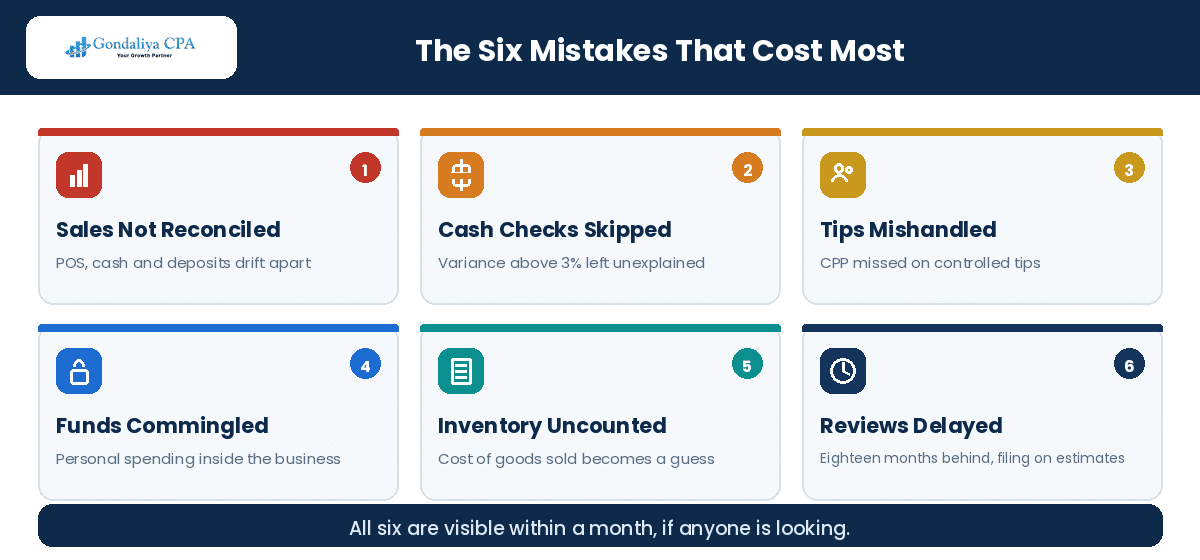
Inaccurate Daily Sales Recording and POS Data Management
Recording daily sales wrong causes many restaurant accounting mistakes. A lot of places see differences between their POS sales, cash in hand, and bank deposits. These mismatches come from delays in deposits, missing voids or comps, and mistakes in delivery platform payouts.
Delivery platforms often confuse books when restaurants record gross sales minus fees without adjusting the numbers. Electronic sales records must be full and checked every day. This includes cash, card payments, tips, and online orders.
The Canada Revenue Agency (CRA) wants all sales transactions recorded properly and documents kept for six years[1]. If records are incomplete, reassessment penalties may follow.
Here’s a real case: A Toronto cafe’s POS showed $12,000 in daily sales but only $10,800 was deposited after delivery fees. They didn’t adjust bookkeeping right for the fees. Fixing this made tax reporting much clearer. Figures changed for privacy.
Neglecting Regular Cash Reconciliation Practices
Skipping daily cash checks leads to common restaurant bookkeeping mistakes. Cash variances are the gap between expected cash from sales and actual counted cash.
Usually, daily cash variance stays between 0% to 3%. Higher gaps suggest theft, counting errors, or bad record-keeping. These need fixing fast.
If you ignore reconciliation, small errors pile up. That makes audits harder and raises CRA risk due to untracked income or missing receipts[2].
Good cash variance analysis means:
- Tracking float amounts separate from takings
- Documenting voids
- Reconciling tip payouts
- Checking till counts against bank deposits
A multi-location bar once saw monthly negative variances over 5%. They added strict end-of-shift reconciliations with digital audit trails via their POS and QuickBooks. The problem cleared up quickly. Figures changed for privacy.
Mismanagement of Tip Income and Payroll Source Deductions
Mistakes happen when tip income is handled wrong in payroll. This can affect CPP/EI contributions and payroll remittances.
Tips paid through payroll require employer deductions for CPP/QPP but not always EI premiums[3]. Tips given directly by customers usually don’t need source deductions but still need tracking. Otherwise taxable benefits can appear if staff meals or tips are mixed wrongly[4].
Late payroll remittances bring penalties fast—starting at 3% if one day late up to 20% plus interest after repeats[5]. Misclassifying contractors as employees triggers back taxes and fines too.
We helped a Vaughan catering business hit with a $15,000 penalty for missed CPP on controlled tips because they filed payroll late during busy season. Figures changed for privacy.
Mixing Personal and Business Finances
Mixing personal with business spending causes trouble. CRA treats this as shareholder benefit inclusion under ITA s.15(1). This raises taxable income unexpectedly and can deny expenses during reviews[6].
Typical problems include:
- Owner draws recorded as expenses instead of distributions
- Family meal costs charged directly without rules
- Personal credit cards used randomly causing poor documentation
- Shareholder-paid bills with no formal agreement
Keeping bank accounts separate and having clear policies avoids these costly errors. It also helps create clear financial statements needed by lenders or franchisors[7].
For example: A Scarborough franchisee once expensed home internet bills of $2,400 yearly before we set up a plan splitting reimbursable business use from personal costs. Tax filings became cleaner after that. Figures changed for privacy.
Failing to Monitor Inventory Changes Effectively
Ignoring inventory changes messes up cost of goods sold (COGS) numbers—a common cause of restaurant accounting mistakes affecting profits and taxes[8].
CPA Ontario suggests monthly physical inventory counts at least[9]. You should adjust purchases rather than just expensing them. If opening/closing stock stays unchanged wrongly, COGS inflates falsely[10].
Waste or spoilage not tracked also distorts food costs. Staff meals hidden inside inventory raise expenses wrongly unless treated as taxable benefits where needed[11].
A quick-service place in Ottawa didn’t count liquor stock at month-end and overstated COGS by about $18K yearly until they started monthly cycle counts matching purchase orders. Their profit margins got clearer after cleanup. Figures changed for privacy.
Infrequent or Inadequate Financial Reviews and Reporting
Delaying bookkeeping causes many risks like lost deduction chances due to missing receipts[12], unreconciled accounts that block audits[13], rushed year-end estimates prone to mistakes[14], late returns penalties[15], plus weak proof in CRA exams that hurts credibility[16].
Quarterly financial reviews made for restaurants catch odd spikes or margin drops early so fixes come before year-end filings[17].
Regular reports help decisions like labor scheduling tied tightly to prime cost control—a key metric in successful Canadian hospitality firms[18].
One Mississauga cafe chain lagged eighteen months behind on bookkeeping before quarterly reviews fixed things along with cleanup work cutting compliance risks big time. Figures changed for privacy.
Risk Warning: A daily cash variance above 3% is not a rounding issue. Sustained negative variance points to theft, counting errors or missing records, and every one of those becomes a CRA problem if left alone.
Common Tax Filing Errors and GST/HST Compliance Issues
Common Tax Filing Errors and GST/HST Compliance Issues
The Filing Errors
Restaurant tax mistakes happen often. Many owners get tripped up by GST/HST rules, payroll mix-ups, and missed deductions. Across Canada, especially in Toronto, restaurant bookkeeping mistakes lead to penalties or lost savings. Knowing your GST/HST filing frequency options, how to apply Capital Cost Allowance (CCA) classes for kitchen equipment, and sending payroll on time helps keep things smooth with the CRA.
Incorrect Calculation and Remittance of GST/HST Based on Gross Sales
Lots of restaurants mess up calculating GST/HST because they confuse taxable sales with exempt items. For example, zero-rated basic groceries differ from taxable prepared foods under the Excise Tax Act[1]. Using wrong rates means you owe too little or too much tax.
Your GST/HST filing frequency depends on yearly sales — monthly, quarterly, or annually[2]. Picking the wrong schedule can hurt cash flow or cause late-filing fines. Here’s a quick breakdown:
- Monthly filers send payments within one month after period end.
- Quarterly filers pay within a month after the quarter finishes.
- Annual filers file three months after their fiscal year ends — but only if they qualify.
If your restaurant uses a POS system, include all revenue like cash and card sales in gross sales. Don’t count delivery platform commissions as income. Claim input tax credits only with proper documents[3].
Our Experience: A Toronto café we worked with counted net delivery deposits as gross sales. That cut their GST owed by $12,000 — which wasn’t right (just an example). Fixing this meant amending returns with clear reconciliations. Figures changed for privacy.
Overlooking Eligible Tax Deductions and Capital Cost Allowance (CCA) Claims
Missing tax deductions is a common restaurant accounting mistake. Owners often don’t claim CCA properly on kitchen equipment[4]. Most kitchen gear fits into CCA Class 8 with a 20% declining balance rate unless immediate expensing applies under recent 2026 rules[5].
Typical slip-ups include:
- Calling big repairs expenses instead of capital costs.
- Forgeting leasehold improvements have different depreciation rules.
- Skipping small tools or furniture that count as current expenses.
Getting classification right impacts taxes and financial statements. Keeping asset costs tracked separately helps claim max deductions without risking CRA reassessment over unreasonable claims[6].
Our Experience: An Ottawa bar owner treated $45,000 spent on ovens as repairs instead of capital costs. We fixed it to allow proper CCA claims that lowered future taxable income projections (just an example). Figures changed for privacy.
Errors in Payroll Tax Filings and Source Deduction Remittances
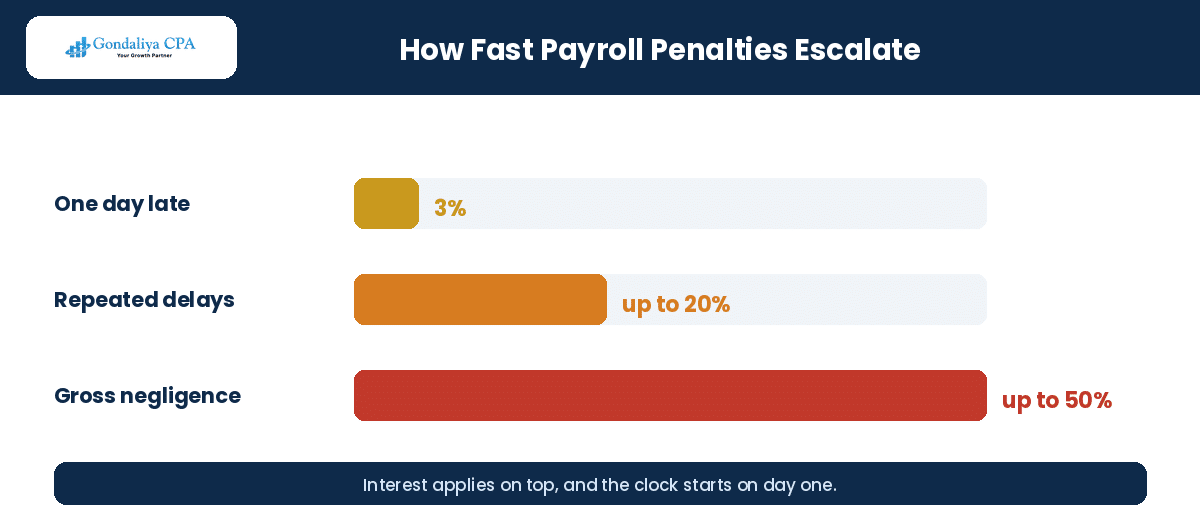
Payroll tax errors happen when businesses send source deductions late. CRA penalties can hit hard under Income Tax Act rules[7]. Employers must deduct CPP (including controlled tips), EI premiums correctly each pay period.
Common problems are:
- Mistaking contractors for employees, missing source deduction remittance.
- Late payroll filings triggering penalties starting at 3% plus daily interest.
- Forgetting staff meals given free or cheap count as taxable benefits needing T4 reporting[8].
Sending payroll info on time avoids piling penalties and keeps you compliant with Ontario employment laws for incorporated restaurants in Toronto[9].
Our Experience: We helped a Mississauga franchise fix tip payouts that missed CPP/EI calculations. That saved them $18,500 in potential penalties through voluntary disclosure before any audit (example). Figures changed for privacy.
Risks of Tax Penalties and Reassessments Due to Non-Compliance
Skipping careful bookkeeping invites more taxes plus reassessments during the normal reassessment period — usually three years after filing corporate returns under ITA s.152(4). Penalties grow if filings are late or errors look deliberate under s.163(2).
| Risk Area | Consequence | CRA Reference |
|---|---|---|
| Late Payroll Remittance | Penalty + Interest | ITA ss.227 & Regs |
| Underreported Revenue | Reassessment + Gross Negligence Penalty | ITA ss.163(2), s230 |
| Improper Input Tax Credits | Denial + Repayment Demand | ETA Part IX |
| Unsubstantiated Expense Claims | Disallowance + Potential Shareholder Benefit | ITA ss.18(1)(a), s15 |
Penalties add up fast; checking books often can help avoid surprises during audits[12].
Handling Tax Amendments and Responding to CRA Audits
Fixing filed returns needs formal amendments through T2 adjustment requests backed by detailed notes on changes — like fixing revenue or CCA claims based on asset reclassification[13]. The Voluntary Disclosures Program lets you correct errors without penalty if no audit is underway[14].
CRA audits focus on risky areas like cash sale reporting gaps,[15] shareholder benefit issues,[16] input tax credit proofs,[17] payroll source deduction accuracy,[18] sales suppression software,[19] delivery platform records,[20] especially for incorporated restaurants across Ontario including Toronto.
Working with an experienced restaurant accountant Canada-wide helps handle amendments faster and lowers risk through proactive support suited for complex hospitality tax rules today.[21]
The Voluntary Disclosures Program only works before the CRA arrives. Once a review has started the door closes, which is why the timing of a decision to come forward matters more than the size of the error. Figures changed for privacy.
Pro Tip: Record delivery platform sales gross and the commission as a separate expense. Booking only the net deposit understates revenue, which is precisely the pattern a CRA reviewer looks for.
Establishing Daily, Weekly, and Monthly Bookkeeping Routines
Establishing Daily, Weekly, and Monthly Bookkeeping Routines
The Routine
Keeping a steady bookkeeping routine helps avoid restaurant bookkeeping mistakes. When you track transactions daily, weekly, and monthly, errors get caught early. For example:
- Every day, match cash sales to your POS reports. This spots any mismatches fast.
- Each week, check supplier invoices and compare bank statements.
- Once a month, review payroll totals, do inventory counts, and prepare financial statements.
If you skip these steps, you risk losing receipts or leaving accounts unchecked. That often leads to costly CRA audits. A steady schedule makes tax filing easier and stops small problems from growing bigger.
Using Integrated Accounting Software and POS Systems for Accuracy
Using accounting software that works with your POS system cuts down on restaurant accounting mistakes. These systems link sales data directly to your books so you don’t have to type everything by hand. That means fewer errors.
You need complete electronic sales records that the CRA can trust. The law says you must keep proper books under ITA s.230[1]. With the right setup, your software tracks all sales—from cash to card payments—and logs tips and discounts too.
Software that connects with QuickBooks or Xero adds an audit trail you can use during CRA checks. It also stops issues with electronic sales suppression software compliance[2], which can bring heavy fines if mishandled.
Implementing Proper Tip Recording and Payroll Classification
Recording tips correctly helps you avoid restaurant tax mistakes. If tips get pooled and shared (controlled tips), both employer and employee pay CPP/EI contributions[3]. Tips given straight to staff don’t count the same way.
Also, putting workers in the wrong category can cost you a payroll late remittance penalty[4]. Treating employees like contractors triggers fees if source deductions come in late—starting at 3% per month.
Keep detailed tip records tied to payroll so taxable benefits like staff meals get counted right[5]. Good records help you dodge CRA penalties from wrong or missing payroll info.
Separating Personal and Business Finances for Clearer Records
Mixing personal spending with business expenses creates messy bookkeeping errors. A restaurant accountant Canada trusts will tell you this confuses profit numbers and triggers problems during audits.
When owners take money out but mark it as business costs, profits look smaller than they really are. Also, if shareholders pay expenses without clear rules, CRA might call those shareholder benefits under ITA s.15[6].
Keep business and personal accounts separate. It simplifies record-keeping and supports accurate corporate tax filings (T2). It also cuts audit risks tied to personal costs claimed as business deductions.
Conducting Regular Financial Reviews to Track Prime Cost and Food Cost Percentages
Doing financial reviews often lets restaurants track prime cost—the total of labour plus food expenses—which usually falls between 55% and 65%, depending on service type[^7].
Counting inventory weekly or every two weeks keeps food cost numbers on target per ITA s.10 rules[^8]. Watching labour costs against revenue uncovers staffing inefficiencies that hurt profits.
Skipping these checks lets mistakes build up unnoticed. That can cause lost tax deductions when documents don’t back up claims at year-end.
Regular financial check-ins give owners clear info to control operations better while keeping records compliant under Canadian tax law.
Maintaining Accurate Electronic Sales Records for CRA Compliance
The CRA forbids electronic sales suppression software that hides income—penalties can reach 50% for gross negligence under ITA s.163(2)[^9]. Restaurants must keep true daily sales reports showing all transactions: cash tips, voids, comps, refunds, third-party commissions—and reconcile these regularly with bank deposits[^10].
Good electronic records make GST/HST filings easier by separating zero-rated groceries from taxable prepared foods as rules change in 2026[^11]. Messy records risk lost input tax credits and trigger reassessments that raise taxes owed.
References
[1]: CRA – Books & Records Requirements
[2]: CRA – Electronic Sales Suppression Software Penalties
[3]: CRA – Tips & Gratuities Payroll Treatment
[4]: CRA – Payroll Source Deductions Remitting Deadlines & Penalties
[5]: CRA – Taxable Benefits Staff Meals
[6]: ITA Section 15 – Shareholder Benefits Rules
[7]: Restaurant Benchmark Data: Labour + Food Cost Percentage Norms (Industry Reports).
[8]: ITA Section 10 – Inventory Valuation Methods
[9]: ITA Section 163(2): Gross Negligence Penalty Details
[10]: Canada Revenue Agency – Record Retention Requirements Six Years Minimum
[11]: GST/HST Food & Beverage Rules Update Effective 2026 (Canada Gazette Notice).
Daily reconciliation feels like overhead until the first time it catches a deposit that never arrived. After that nobody argues about the ten minutes it takes. Figures changed for privacy.
Risk Warning: Electronic sales suppression carries gross negligence penalties reaching 50% under ITA s.163(2). This is one area where the CRA treats the software itself as evidence of intent.
Choosing the Right Restaurant Accountant and Bookkeeping Solutions in Canada
Choosing the Right Restaurant Accountant and Bookkeeping Solutions in Canada
The Choice
Picking a restaurant accountant in Canada who knows the business well can save you a lot of trouble. Mistakes in restaurant accounting, bookkeeping, or taxes often cost more than expected. When your records stay clean, you get the deductions you deserve and keep the CRA happy. This is true whether you run one spot or many across Ontario and beyond.
Evaluating In-House vs. Outsourced Bookkeeping Options
Many restaurant bookkeeping mistakes happen because staff don’t have the right training or get overloaded. You’ll want to think about your restaurant size, how much business you do, and what resources you have before choosing.
- In-House Bookkeeping means you control every step. But it needs someone who understands hospitality rules—like reconciling POS sales, tracking stock, or managing payroll with tips and CPP/EI rules.
- Outsourced Services bring experts who know common restaurant accounting mistakes across Canada. They scale up when things get busy without the cost of full-time workers.
Outsourcing cuts risks like missing tax breaks or messing up GST/HST filings. Smaller restaurants might mix both—using software themselves but getting a pro to check things now and then.
Key Qualities to Look for in a Canadian Restaurant Accountant
Finding the right restaurant accountant Canada-wide means checking for more than just CPA papers:
- Hospitality Know-How: They should get costs like food and labor (prime cost) and how delivery fees change your sales numbers.
- CRA Rules Expertise: They need to spot tax mistakes restaurants make all the time—like shareholder benefits—and know about 2026 changes on immediate write-offs or GST/HST on ready-to-eat food.
- Tax Savings Focus: Good accountants find missed deductions by reviewing expenses carefully, not just fixing problems after filing.
- Clear Pricing & Fast Replies: No surprise bills, clear fees, and quick answers matter, especially during audits.
Also, experience with multi-location setups helps if your business grows beyond one café or bar.
How a CPA Specializing in Restaurant Accounting Can Improve Profitability
A CPA who knows restaurants well can stop costly errors that eat profits:
- Fixing common restaurant bookkeeping mistakes like wrong cash counts keeps revenue accurate and avoids CRA penalties.
- Using new rules for kitchen equipment write-offs helps free up cash sooner through faster depreciation claims.
- Keeping personal costs out of business books stops taxable income from rising unexpectedly due to shareholder benefit issues.
When financial reports match real daily sales and expenses—like tying POS data directly into accounting—you get better insights on pricing menus or planning shifts.
Tools and Software Recommendations: QuickBooks, Xero, Wagepoint, Hubdoc
The right tools can cut down restaurant bookkeeping mistakes by handling routine tasks automatically:
| Tool | Purpose | Benefit |
|---|---|---|
| QuickBooks | Full accounting software | Makes invoicing & bank links easy |
| Xero | Cloud bookkeeping | Lets teams work together in real time |
| Wagepoint | Payroll processing | Ensures correct CPP/EI payments |
| Hubdoc | Document capture & storage | Prevents lost receipts |
These apps help match daily sales with bank deposits—a tricky spot where many restaurants slip up and trigger CRA questions.
Using systems built for hospitality cuts manual errors that cause lost input credits or payroll filing problems.
Importance of Ongoing Accounting Support and Bookkeeping Cleanup Services
Regular help stops small restaurant accounting mistakes from turning into big problems:
- Monthly checks make sure all sales—even from delivery apps—show up correctly after subtracting commissions as CRA expects. Cleanup work clears old unpaid bills or misfiled costs that hide true profit margins.
- Quick fixes keep GST/HST refunds safe and meet CRA’s book rules under ITA s.230. This way, you avoid penalties tied to late payroll filings starting in 2026.
Getting expert accountants involved early lets restaurant owners across Toronto, Ontario, and Canada focus on running their business—not chasing paperwork mistakes common in busy kitchens.
Sharad Gondaliya, CPA, has over 10 years helping Canadian businesses fix their books. For tailored advice on avoiding costly restaurant accounting mistakes call 647‑212‑9559 or email info@gondaliyacpa.ca for a free consult based on your needs.
The choice is rarely in-house against outsourced. Most operations settle on a hybrid, with someone on site coding daily and a firm reviewing quarterly, which costs less than either done properly alone. Figures changed for privacy.
Financial Reporting, Tax Strategies, and Next Steps
Financial Reporting, Tax Strategies, and Next Steps
The Reporting
Essential Monthly Financial Reports for Restaurants
Monthly financial reports help spot restaurant bookkeeping mistakes early on. One important report is the daily cash variance. It shows the difference between recorded sales and actual cash. Usually, this variance should stay under 1% of total sales. If it’s higher, that might mean errors or theft.
Labour cost percentage is another key figure. In Canada, restaurants often see labour costs between 25% and 35% of their gross revenue. Watching this helps catch payroll mistakes like wrong source deductions or unreported hours.
Other reports to check every month include:
- Profit and Loss Statement: Shows your income vs expenses.
- Inventory Valuation Report: Keeps track of your cost of goods sold (COGS).
- Bank Reconciliation Statements: Makes sure deposits match sales, including from third-party apps.
Going over these reports regularly keeps your records solid and reduces risks from restaurant accounting mistakes. Plus, it helps with CRA rules under ITA s.230.
Year-End Tax Planning and Strategic Use of Immediate Expensing
At year-end, tax planning can save incorporated restaurants money and keep them within the rules. Kitchen equipment usually fits in Capital Cost Allowance (CCA) Class 8 with a 20% rate. But new rules let you expense some assets immediately if bought after December 31st, instead of spreading out the deduction.
You also need to pick the right GST/HST filing frequency. CRA says it depends on your yearly sales volume—some must file monthly, others quarterly. Picking correctly avoids late penalties many food businesses face.
Using immediate expensing smartly alongside timely GST/HST filings can lower your tax bill and help manage cash before year-end.
Managing Multi-Location and Franchise Restaurant Accounting Complexities
Running restaurants across Canada with multiple locations or franchises brings unique challenges that can lead to restaurant tax mistakes. Different bookkeeping methods at each spot may cause messy consolidated financials or missed intercompany entries.
Franchise owners often slip up with tracking royalty payments or mixing up franchise fees as expenses when they should be capitalized. Shared costs like marketing or admin fees also get wrongly split sometimes. These errors can trigger CRA reassessments if documents don’t back them up.
For multi-location bookkeeping:
- Use centralized systems that pull POS data from all sites into one ledger.
- Separate expenses per location for clear reporting under ITA rules.
Standard procedures and cloud tools help keep things consistent across all branches and catch mistakes before you file taxes.
Practical Tips to Minimize Tax Liability and Avoid Costly Mistakes
Avoiding expensive restaurant accounting mistakes means following CRA compliance tips made for Canadian restaurants:
- Keep business and personal spending apart; don’t code owner draws as expenses.
- Fix payroll source deduction errors quickly by checking T4 slips against payroll summaries every month.
- Use good inventory tracking by doing regular counts and comparing to purchase invoices; track waste separately from COGS per CRA rules.
- Record staff meals carefully—know what’s a taxable benefit versus allowed entertainment claims.
Doing internal audits on these points often helps spot issues early and lowers risk of denied input tax credits or shareholder benefit problems because of missing documents.
Invitation to Contact Gondaliya CPA for Tailored Restaurant Accounting Assistance
Toronto restaurants wanting help to avoid restaurant accounting mistakes can reach out to Gondaliya CPA. Our team knows Canadian tax law well, including immediate expensing updates starting in 2026.
Call us at 647‑212‑9559 or email info@gondaliyacpa.ca for a free chat with an expert Canadian restaurant accountant who understands how good bookkeeping leads to better tax results without surprises.
Franchise royalty and marketing fund charges are the entries most often miscoded in multi-location groups. Split wrongly between sites, the individual location profit figures stop meaning anything. Figures changed for privacy.
Key Stat: Labour typically runs 25% to 35% of gross revenue. A figure drifting outside that band is usually a payroll coding problem rather than a staffing one.
Frequently Asked Questions (FAQ)
Frequently Asked Questions (FAQ)
FAQ
What are common restaurant accounting mistakes that can cost Canadian owners thousands in taxes?+
Mistakes include misreporting GST/HST, mixing personal and business expenses, incorrect payroll deductions, and poor inventory tracking. These errors often trigger reassessments and penalties.
How often should restaurants perform inventory counts?+
Canadian restaurants should count inventory monthly at minimum. Frequent counts prevent cost of goods sold (COGS) errors and improve tax accuracy.
What is the normal reassessment period for CRA audits?+
The CRA normally reassesses corporate tax returns within three years after filing. Keeping accurate records beyond this helps during audits.
How long must restaurants keep records according to CRA?+
The CRA requires businesses to retain records for six years after the end of the last tax year they relate to.
What is the payroll late remittance penalty in Canada?+
Penalties start at 3% if source deductions are one day late and increase up to 20% with repeated delays plus interest charges.
How do you fix restaurant accounting mistakes already filed?+
Submit formal amendments through T2 adjustment requests or use the Voluntary Disclosures Program to avoid penalties if no audit exists.
What does CRA review when examining a restaurant corporation?+
CRA examines sales recording, payroll deductions, input tax credits, shareholder benefits, and electronic sales suppression compliance.
What is the difference between bookkeeping errors, filing mistakes, and non-compliance?+
Bookkeeping errors happen during record-keeping; filing mistakes occur in tax return submission; non-compliance means deliberate or repeated violations of CRA rules.
Who is this guide for and who is it not for?+
It targets Canadian restaurant owners and managers seeking accounting clarity. It’s not for unincorporated or non-food service businesses.
How do you prevent restaurant accounting mistakes throughout the fiscal year?+
Implement daily reconciliations, regular financial reviews, timely payroll filings, and consistent inventory controls.
Cleanup Route Options: DIY vs Bookkeeper vs Restaurant CPA — Which Fits?
Cleanup Routes, Deliverables and Glossary
Quick Reference
- DIY Approach: Suitable for very small operations but risky due to limited expertise on GST/HST rules and payroll laws.
- Bookkeeper: Good for day-to-day data entry but may miss complex tax issues unique to restaurants.
- Restaurant CPA (Gondaliya CPA): Best choice for complete cleanup including amendments, audit defense, and strategic tax planning.
How Gondaliya CPA Delivers Restaurant Accounting Cleanup
- Comprehensive review of books and records.
- Correction of misclassified expenses and revenue.
- Payroll source deduction reconciliation.
- GST/HST filing adjustments.
- Preparing amendment requests with CRA-compliant documentation.
Deliverables You Get from Gondaliya CPA
- Accurate financial statements tailored for restaurants.
- Detailed reconciliation reports with variance analyses.
- Tax filing amendment packages ready for submission.
- Ongoing bookkeeping best practice guidelines.
- Clear communication on compliance status and risk areas.
People Also Ask
Can mixing personal expenses lead to CRA penalties?+
Yes, CRA can reclassify these as shareholder benefits increasing taxable income unexpectedly.
Are electronic sales suppression software violations common?+
They are increasingly scrutinized; non-compliance risks heavy fines and audits under ITA s.163(2).
Glossary Highlights
- CCA (Capital Cost Allowance): Tax depreciation on assets like kitchen equipment categorized in Class 8 with 20% rate.
- Payroll Source Deductions: Mandatory employee/employer contributions for CPP/QPP and EI deducted from wages.
- Input Tax Credits (ITCs): GST/HST paid on business expenses recoverable through filings when properly documented.
Next Steps
For tailored support avoiding costly restaurant accounting mistakes, contact Gondaliya CPA today at 647‑212‑9559 or info@gondaliyacpa.ca. Protect your Canadian restaurant’s profitability with expert guidance from dedicated specialists who understand hospitality tax nuances across Toronto, Ontario, and beyond.
Owners underestimate how much a cleanup recovers. Two years of unclaimed input tax credits and missed deductions routinely cover the cost of the work several times over. Figures changed for privacy.
Industry Spotlights: Sectors We Represent
Industry Expertise
The error that costs most differs by sector. Here are eleven and where the money usually goes.
| Industry | The Costliest Recurring Error |
|---|---|
| Restaurants & food and beverage | Sales not reconciled to deposits |
| E-commerce & online retailers | Marketplace settlements booked net |
| Construction, contractors & skilled trades | Late payroll remittances |
| Transportation, logistics & trucking | Mileage and fuel records incomplete |
| Consulting firms | Personal spending inside the corporation |
| Real estate investors & holding companies | Shareholder loans left undocumented |
| Property developers & builders | Costs allocated across entities without basis |
| Technology startups & SaaS | Deferred revenue recognised too early |
| Daycare, childcare & CWELCC services | Subsidy income recorded in the wrong period |
| Dentists & dental practices | Input tax credits claimed on exempt supplies |
| Medical doctors & physician corporations | Billings not matched to remittance advices |
- Restaurants & food and beverage: POS totals, cash and deposits drifting apart is where nearly every other problem originates.
- E-commerce & online retailers: Marketplace settlements arrive net of fees, so revenue is understated exactly as it is with delivery apps.
- Construction, general contractors & skilled trades: Payroll remittances slip during busy periods, and the 3% penalty applies from day one.
- Transportation, logistics & trucking: Mileage and fuel records left incomplete turn claimable costs into disallowed ones.
- Consulting Firms: Personal spending running through the corporate card is the shareholder benefit question waiting to happen.
- Real estate investors, landlords & holding companies: Shareholder loan balances accumulate without written terms and surface at year end.
- Property developers & builders: Costs shared between project entities need a documented allocation basis, not a later estimate.
- Technology startups & SaaS: Deferred revenue recognised on receipt rather than delivery distorts every statement that follows.
- Daycare, childcare & CWELCC services: Subsidy payments land on their own schedule and end up in the wrong period.
- Dentists & dental practices: Input tax credits claimed against exempt clinical work are denied on review.
- Medical doctors & physician professional corporations: Billings not matched to remittance advices leave revenue unexplained.
One theme runs through all of these. Nothing was hidden deliberately; a routine step was skipped during a busy period and nobody went back to check it. Figures changed for privacy.
Professional Guidance and Quick Reference
Guidance
Professional Guidance on Restaurant Accounting: How Gondaliya CPA Supports Canadian Operators
Restaurant accounting problems are almost never sophisticated. They are routine steps missed during busy periods, compounding quietly until a return is filed on estimates or an assessment arrives. Gondaliya CPA fixes what is behind and builds the routine that stops it recurring, on a fixed fee.
We handle what decides the outcome: reconciling POS totals, cash and deposits so revenue is complete, recording delivery platform sales gross with commissions expensed separately, bringing payroll remittances and tip treatment back onside, separating personal spending out of the corporation, correcting inventory and cost of goods sold, and preparing T2 adjustments or a voluntary disclosure where past filings need fixing.
Our team works from your POS, payroll and bank data rather than a template, and will tell you plainly what a review would find. Whether the books are current or eighteen months behind, you get clear advice and a fixed price before we start.
Quick Answers: Key Numbers & Concepts at a Glance
At a Glance
- Record retention: Six years after the last tax year
- Payroll penalty: 3% at one day late, rising to 20%
- Gross negligence: Up to 50% under ITA s.163(2)
- Reassessment period: Normally three years under s.152(4)
- Class 8: 20% declining balance on kitchen equipment
- Daily cash variance: Normally 0% to 3%
- Prime cost: Typically 55% to 65% of sales
- Labour cost: Typically 25% to 35% of gross revenue
- Inventory counts: Monthly at minimum
- Books and records: Required under ITA s.230
Who This Is For / Not For
Fit Check
- For: Incorporated restaurants, bars, cafes and franchise groups whose books are behind, whose filings may need correcting, or who want to know what a CRA review would find.
- Not For: Unincorporated or non-food service businesses, where the compliance picture and the risk areas are different.
People Also Ask
Quick Answers
How far back can the CRA reassess my restaurant?+
Normally three years from the notice of assessment. That window does not apply where a return is misrepresented, in which case there is no time limit at all.
Is it worth catching up two years of books?+
Almost always. The recovered deductions and avoided penalties typically exceed the cleanup fee, and the alternative is filing on estimates.
Do I need to tell the CRA about a past error?+
Not necessarily, but correcting it voluntarily before any review begins is what preserves relief under the disclosure programme.
Glossary of Key Terms
Plain-English Definitions
- Cash variance: The gap between expected cash from sales and cash actually counted.
- Reconciliation: Matching recorded transactions against bank and merchant statements.
- Electronic sales records: The complete daily transaction record the CRA expects to see.
- Sales suppression software: Prohibited tools that hide transactions, carrying severe penalties.
- Cost of goods sold: Opening inventory plus purchases less closing inventory.
- Prime cost: Labour plus food cost as a percentage of sales.
- Controlled tips: Tips pooled by the employer, carrying payroll obligations.
- Source deductions: CPP, QPP and EI amounts withheld and remitted to the CRA.
- Late remittance penalty: The charge applied from the first day a payroll payment is late.
- Shareholder benefit: A corporate payment or perk treated as taxable income to the shareholder.
- Input tax credit: GST/HST paid on business purchases and recoverable on a return.
- Capital cost allowance: The deduction for depreciation of capital assets over time.
- Class 8: The 20% class covering kitchen equipment and fixtures.
- Reassessment period: The window in which the CRA may normally revisit a filed return.
- T2 adjustment request: The formal route to amend a corporate return already filed.
- Voluntary Disclosures Program: The route to correct errors before a review begins.
Restaurant Accounting Risk Check
This quick self-check indicates where your operation most likely has room. Please answer the six questions below.
Restaurant Accounting Risk Check
Six quick questions on your records. No fee shown.
Points to raise with us:
This is a general prompt, not tax or legal advice or a quote. Your position depends on your full facts. For a real review, please book a free consultation.
Want a checklist to work from? You can download our free restaurant cleanup checklist before your consultation.
Reconcile POS totals, cash and deposits every month without exception. Never let a payroll remittance slip, because the penalty starts at day one. Keep personal spending entirely out of the corporation. Count inventory monthly and track waste separately. Record delivery sales gross with commissions expensed. If past filings are wrong, correct them before a review starts rather than after.
2026 Update — what is current: GST/HST food and beverage rules are updated for 2026, and immediate expensing applies to eligible equipment purchases. The six-year retention rule, the 3% to 20% payroll penalty scale, gross negligence penalties under ITA s.163(2) and the three-year reassessment period are unchanged. Please confirm current rules before relying on the figures in this article.
Top Restaurant Bookkeeping Mistakes, Tax Filing Errors, and GST/HST Compliance Tips for Canadian Restaurants by Gondaliya CPA
Fix it before the CRA finds it
Gondaliya CPA reviews your books and records, corrects misclassified revenue and expenses, reconciles payroll source deductions, adjusts GST/HST filings, and prepares amendment requests with CRA-compliant documentation, on a fixed fee with a one-business-day response. Please book a free consultation.
Next Steps
Please book a free consultation with Gondaliya CPA and bring your last T2 return, a recent POS sales summary and a bank statement, plus whatever bookkeeping exists. Behind is normal and it is fixable, usually for less than the penalties it avoids. You will get a fixed fee before any work begins. If our content helps, please add gondaliyacpa.ca as a preferred source on Google.
Published: August 15, 2026 · Last updated: August 15, 2026
Editorial policy: We research against CRA and CPA Ontario sources, fact-check the figures, and Sharad Gondaliya, CPA, reviews the content, which we update as the rules change.
Disclaimer: This article is educational information only and is not tax, legal, or financial advice. Figures marked illustrative are examples rather than quotes or guarantees. It reflects CRA rules current to 2026, including the six-year record retention requirement, the 3% to 20% payroll late remittance penalty scale, gross negligence penalties up to 50% under ITA s.163(2), the three-year normal reassessment period, and Class 8 capital cost allowance at 20%. Rates, limits and expensing rules change and outcomes depend on your specific facts. Please consult a CPA Ontario member before acting.

Sharad Gondaliya is a CPA Canada & CPA USA with 15 Years+ experience of Accounting, Tax, Payroll of Corporate Small Businesses as Tax Accountant. He is a CPA Ontario member (61040184) and holds US CPA licences in Washington and Montana and is well known among corporate small businesses for tax planning, efficient tax solutions, and affordable CPA services. Sharad is the Principal (Director) of Gondaliya CPA – Affordable CPA Firm in Canada. Licenses: CPA Ontario: 61040184 | CPA USA (MT): PAC-CPAP-LIC-033176 | CPA USA (WA): 57629 | CPA Firm License: 61330051 View Full Author Bio