



How Proper Restaurant Bookkeeping Can Help Identify Missed Tax Deductions and Improve Cash Flow
Restaurant bookkeeping Canada requires careful handling of financial records, payroll remittance, GST/HST, and expense management to maximize tax deductions and control costs. Gondaliya CPA offers specialized bookkeeping services, tax preparation, and cash flow management tailored to restaurants, ensuring accurate corporate tax filing and compliance with CRA regulations.
Quick Summary
The deductions restaurants miss are rarely obscure. Delivery commissions, merchant fees, uniforms, small wares and staff training are all claimable and all buried in transaction volume. Please note that finding them is a bookkeeping problem rather than a tax one, which is why the frequency of the review matters more than the cleverness of the return.
| Aspect | Details |
|---|---|
| The weekly number | Prime cost, food plus labour against sales. |
| The daily habit | Sales summaries reconciled to bank deposits. |
| The missed costs | Commissions, merchant fees, uniforms, small wares. |
| The timing | Immediate expensing against capital cost allowance. |
Reading time: 35 minutes.
Table of Contents
- Introduction and Overview of Restaurant Accounting in Canada
- Five CPA Tips for Restaurant Bookkeeping
- Financial Reporting, Tax Planning, and Compliance Essentials
- Restaurant Tax Deductions and Expense Management
- Accounting Services and Support Offered by Gondaliya CPA
- Regional Expertise, Team Credentials, and Client Engagement
- Frequently Asked Questions (FAQs)
- Key Insights, Expense Categories and Best Practices
- Industry Spotlights: Sectors We Represent
- Professional Guidance and Quick Reference
The Numbers That Matter
This article covers Canada, with Ontario and Toronto context, and reflects CRA rules current to 2026. It assumes an incorporated restaurant, bar, cafe, ghost kitchen or franchise operation. Figures marked illustrative are examples, not quotes, and any masked engagement notes end with “Figures changed for privacy.” This is educational information only and not tax, legal, or financial advice. Rates, thresholds and expensing rules change, so please confirm your own situation with a CPA Ontario member before acting.
Introduction and Overview of Restaurant Accounting in Canada
Introduction and Overview of Restaurant Accounting in Canada
The Basics
Keeping good restaurant bookkeeping in Canada helps foodservice businesses stay on track. A restaurant accountant knows the ins and outs of managing money for these businesses. They make sure every expense makes sense and helps the business grow. Managing cash flow well supports day-to-day work and keeps the business stable over time.
Restaurant Accounting Challenges Unique to Canadian Foodservice Businesses
Canadian restaurants face some specific problems with accounting. One big issue is figuring out which restaurant tax deductions apply. These can be tricky because CRA rules are complex. For example, costs for inventory, staff meals, or buying equipment might count as deductions—but only if you keep good records.
Also, cash flow management can get tough when sales go up and down a lot. Off-peak times can strain money if not planned for properly. Filing taxes that meet CRA standards adds another layer of difficulty. Not following rules exactly can cause fines or missed chances to save money.
- Understanding complex tax rules
- Tracking expenses carefully
- Managing uneven sales periods
- Filing accurate, CRA-compliant returns
Importance of Specialized Bookkeeping and Tax Services for Restaurants
Working with a specialized restaurant CPA like Gondaliya CPA can really help food service owners. These experts know details like cost control and how GST/HST affects food sales.
Good bookkeeping services made just for restaurants provide clear financial reports and smart advice on cash flow planning. This kind of support catches problems early and keeps everything in line with CRA rules.
- Deep knowledge of restaurant accounting
- Help with cost control and taxes
- Accurate reporting tailored to foodservice
- Advice that fits restaurant needs
In short, hiring professional restaurant bookkeeping services is a smart move for staying legal and improving business health in Canada’s food scene.
Owners rarely arrive asking about deductions. They arrive because cash feels tight, and the deductions turn up while working out where the money actually goes. Figures changed for privacy.
Key Stat: Prime cost sits between 55% and 65% of sales in most operations. A weekly reading of that single number catches more problems than a monthly full report ever will.
Five CPA Tips for Restaurant Bookkeeping
The Tips
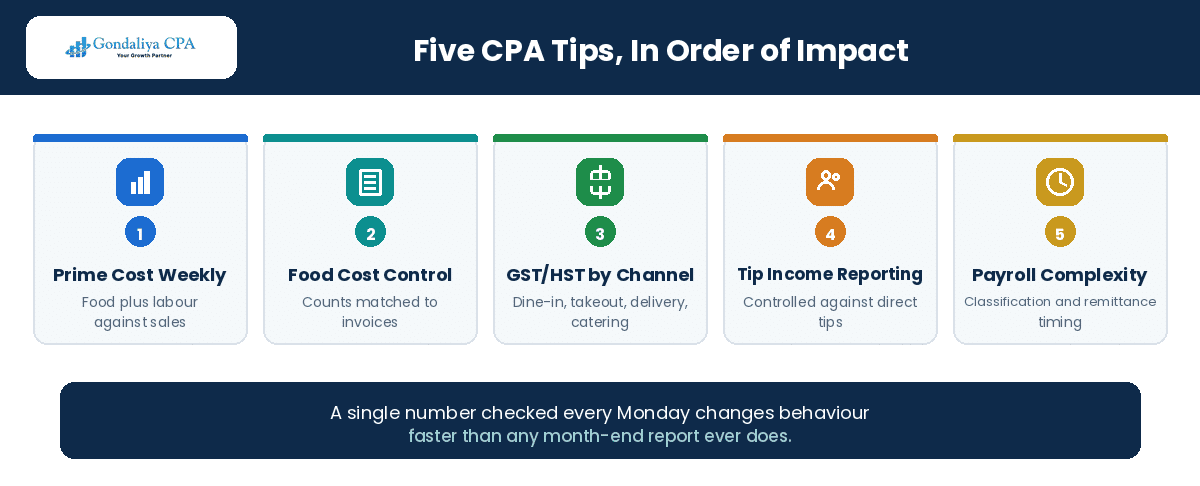
CPA Tip 1 — Weekly Tracking of Prime Costs for Timely Decision-Making
Tracking prime costs every week helps keep restaurant bookkeeping Canada on point and supports good restaurant cash flow management. Prime costs mix food and labour expenses, often making up 55% to 65% of total sales. Checking these numbers weekly lets owners and their restaurant accountant spot trends early. They can then adjust orders or staffing quickly to avoid money problems.
Reviewing prime costs weekly means catching budget differences before they get worse. For example, if labour costs jump due to overtime, you can fix that right away instead of waiting for month-end reports. This helps plan cash flow better by matching when money goes out with when it comes in.
Using integrated POS systems and bank reconciliations gives exact prime cost numbers each week. Your accountant can use this info to suggest tax strategies linked to deductible business expenses that boost efficiency.
Key takeaway: Checking prime costs every week gives clear insights that help improve profits and follow CRA rules on reasonable business expenses[1].
[1]: CRA ITA s.18(1)(a), Reasonableness test s.67
CPA Tip 2 — Managing Food Cost Percentage Effectively
Keeping food cost percentage in check is vital for restaurant bookkeeping Canada. It impacts profits and the restaurant tax deductions you can claim. Food cost percentage compares ingredient costs against sales revenue.
To track this well, you need detailed inventory counts at opening and closing times. Match those with purchase invoices so you value inventory right under CRA’s rules (ITA s.10). If food costs are off, your profit numbers will be wrong, and you might miss deductions because purchases weren’t properly recorded.
Good food cost management means:
- Regularly comparing physical stock counts with purchase records
- Tracking waste, spoilage, or theft separately from actual COGS
- Separating staff meals (which are partly non-deductible) from normal menu items
- Using past data to plan future buying
This helps restaurant cash flow management by avoiding too much money tied up in inventory and making sure deduction claims have proper proof.
Example: A cafe in Toronto improved its monthly tax deductions by doing stock counts twice a month and checking supplier invoices carefully—something we suggest during accounting cleanups.[2] Figures changed for privacy.
[2]: CRA Inventory Valuation Guidelines; ITA s.10
CPA Tip 3 — Ensuring GST/HST Compliance Across Sales Channels
GST/HST compliance matters a lot for restaurants in Canada, especially when sales come from various places like dine-in, takeout, delivery apps, or catering.
Restaurant bookkeeping Canada must separate zero-rated groceries from taxable prepared foods based on CRA definitions[3]. Different sales channels have different GST/HST rules:
- Dine-in meals usually charge full HST (like Ontario’s 13%)
- Takeout may have different tax treatment depending on how food is prepared
- Alcohol has its own special tax rules needing separate tracking
Keep solid records with supplier registration numbers on invoices to claim input tax credits without audit trouble[4]. Check delivery app statements carefully since commissions reduce deposits but count as deductible fees affecting taxes[5].
Ignoring these rules can lead to penalties that hurt your daily cash flow.
Pro tip: Use tools like QuickBooks with Hubdoc to automate GST/HST tracking across all sales channels before filing.[6]
[3]: CRA GST/HST Food & Beverage Rules; Canada.ca
[4]: Input Tax Credit Documentary Requirements – CRA Guide RC4022
[5]: Merchant Fee Deductibility – ITA s18(1)(a) Reasonableness Test
[6]: Gondaliya CPA Tools Stack
CPA Tip 4 — Accurate Reporting and Handling of Tip Income
Handling tip income correctly affects both your restaurant tax deductions and payroll duties done by your restaurant accountant.
The CRA treats controlled tips (collected by employer then given out) differently than direct tips received only by employees[7]. This matters when calculating CPP/EI contributions[8]. You need good records showing tip declarations with payroll info so source deductions get paid right and no fines pop up later[9].
Not reporting tips properly can cause reassessments that threaten wage-related deductions or trigger shareholder benefit issues (ITA s15).
Best steps include:
- Logging all tip income daily by type
- Comparing declared tips with POS reports when possible
- Teaching staff about tip reporting rules
Clients who follow strict tip-tracking face fewer audit problems about payroll taxes. They also get clearer views of taxable benefits like staff meal allowances under Canadian law[10].
[7]: Controlled vs Direct Tips – CRA Payroll Guide PD7R
[8]: Employer CPP/EI Obligations – ITA ss147–153
[9]: Penalties on Late Remittance – Section 221(1), ETA
[10]: Staff Meals Taxable Benefits Guidance
CPA Tip 5 — Addressing Restaurant Payroll Complexities
Payroll in restaurants is tricky and needs careful handling in any good restaurant bookkeeping Canada system. It takes an accountant who knows hospitality details well.
Common issues are:
- Paying family members correctly according to labour laws[11]
- Knowing when someone is a contractor versus employee based on work done[12]
- Calculating employer contributions properly when controlled tips affect insurable earnings[13]
- Meeting federal/provincial remittance deadlines to avoid penalties that hurt cash flow management[14]
You might also want payroll software like Wagepoint or ADP linked smoothly into your accounting system. This cuts manual mistakes and keeps clear records for year-end T4 filings following ServiceCanada standards[15].
Skipping these details risks denied expense claims or employment standard violations that can impact provincial licences including Ontario’s AGCO permits[16].
Hiring an expert helps avoid these troubles so you focus on running your business while staying compliant and claiming all possible employee-related tax breaks[17].
[11] Family Payroll Documentation – Employment Standards Act Ontario
[12] Worker Classification Criteria – CRA Employer Compliance Tool
[13] Insurable Earnings Calculation Including Tips – EI/CPP Guides
[14] Federal/Provincial Remittance Deadlines & Penalties – Canada.ca
[15] Software Integration Best Practices – Gondaliya CPA Experience
[16] AGCO Licensing Conditions Related To Employment Records
[17] Strategic Payroll Tax Planning Insights
Weekly prime cost is the habit clients keep. Monthly reports get read once; a single number checked every Monday changes ordering and scheduling behaviour within a few weeks. Figures changed for privacy.
Financial Reporting, Tax Planning, and Compliance Essentials
Financial Reporting, Tax Planning, and Compliance Essentials
The Reporting
Running a restaurant in Canada means you need solid bookkeeping and smart tax planning. A good restaurant accountant helps you keep up with CRA rules and makes sure your cash flow stays steady. Tracking your finances well lets you spot chances to save money on taxes and keep your business growing.
Essential Monthly Financial Reports for Restaurants
You should get monthly financial reports to check how your restaurant is doing. These reports show where money comes in and where it goes. Here are the key ones:
- Profit and Loss Statement: Shows your sales, expenses, and profit for the month. It helps spot if costs are too high or sales are dropping.
- Cash Flow Statement: Lists cash coming in and going out. It points out any timing issues between paying bills and getting paid.
- Balance Sheet: Summarizes what your restaurant owns and owes at month-end.
- Inventory Valuation Report: Tracks starting stock, purchases, waste, and ending stock. This helps calculate food costs correctly.
- Payroll Summary: Details wages paid, including tips that affect CPP/EI payments.
These reports help with restaurant cash flow management by warning you before money gets tight. They also ensure you claim all possible deductions under CRA rules[1].
Did you know? Doing monthly closes can cut down year-end fixing by nearly 40%, which means less stress when filing taxes.
Optimizing Capital Cost Allowance (CCA) and Immediate Expensing
Restaurants spend a lot on kitchen gear or upgrades. Knowing what counts as an expense now versus what needs to be spread over years is key.
- Repairs or small fixes count as current expenses. You can deduct these fully right away if they’re reasonable[2].
- Big buys like ovens or major renovations fall into CCA classes (for example, Class 8 covers kitchen appliances). These get deducted bit by bit over time[3].
Starting in 2026, some purchases under $30,000 per item can be deducted immediately instead of waiting years[4]. This can improve your tax deductions timing and help with cash flow.
Your restaurant accountant makes sure expenses go into the right bucket so you don’t lose deductions or trigger audits.
| Expense Type | Deduction Timing | Relevant CCA Class | Notes |
|---|---|---|---|
| Small Equipment Repair | Current Year | N/A | Fully deductible |
| Kitchen Appliances | Over Several Years | Class 8 | Depreciation applies |
| Leasehold Improvements | Over Useful Life | Class 13/14 | Amortized accordingly |
| New POS System | Immediate Expensing* | Varies | Subject to 2026 threshold |
*Applies from fiscal years starting in 2026 onwards.
Year-End Tax Strategies Tailored for Restaurant Operators
Year-end is a good time to find extra tax savings before filing returns:
- Check for missed deductions like delivery fees or staff training costs. These often get overlooked during busy days.
- Count inventory carefully; adjust waste records properly since this changes your cost of goods sold and taxable income[5].
- Review payroll tips closely. Make sure controlled tips (subject to employer contributions) are separated from tips employees keep directly.
A restaurant accountant knows CRA rules on meal limits (§67.1), reasonableness tests (§18(1)(a)), plus recent Ontario tax rate updates[6][7]. They help lower risks of reassessment while improving after-tax profits—a must when margins are tight.
Maintaining Audit-Ready Books and Risk Mitigation Practices
Keeping audit-ready books protects you from fines due to missing papers or wrong claims. Follow these tips:
- Save supplier invoices showing GST/HST numbers as required by ITA s.230; keep records for at least six years according to Corporations Canada[8].
- Track all sales channels including cash carefully; reconcile daily totals with bank deposits without fail.
Avoid mixing personal expenses with business costs. Document family members’ pay clearly. Separate delivery fees from total revenue. These steps lower risks during CRA checks.
Working regularly with an Ontario CPA firm familiar with hospitality accounting keeps you on the right side of the rules across Toronto-area businesses where scrutiny grows each year.
Sharad Gondaliya, CPA, has helped hundreds of Canadian business owners keep their books accurate.
[1] CRA – Books & Records Requirements
[2] CRA – Repairs vs Improvements
[3] CRA – Capital Cost Allowance Classes
[4] Canada Budget Update – Immediate Expensing Changes Effective 2026
[5] CRA – Inventory Valuation Methods
[6] ITA Section 67(1) Meals & Entertainment Limits
[7] Ontario Corporate Income Tax Rates Update
[8] Corporations Canada – Record Keeping Requirements
A monthly close that actually closes is worth more than any single deduction. Year-end work shrinks to a review rather than a reconstruction, and the fee follows the effort. Figures changed for privacy.
Restaurant Tax Deductions and Expense Management
Restaurant Tax Deductions and Expense Management
The Deductions
Keeping good records is key for restaurant bookkeeping Canada. It helps catch all the tax deductions you qualify for and keeps your expenses clear. Whether you run a café, bar, franchise, or a multi-location spot, staying organized means you won’t miss out on any deductible costs. Accurate tracking also makes it easier to follow CRA rules and can improve your cash flow visibility.
Identifying Common and Specific Tax-Deductible Expenses for Restaurants
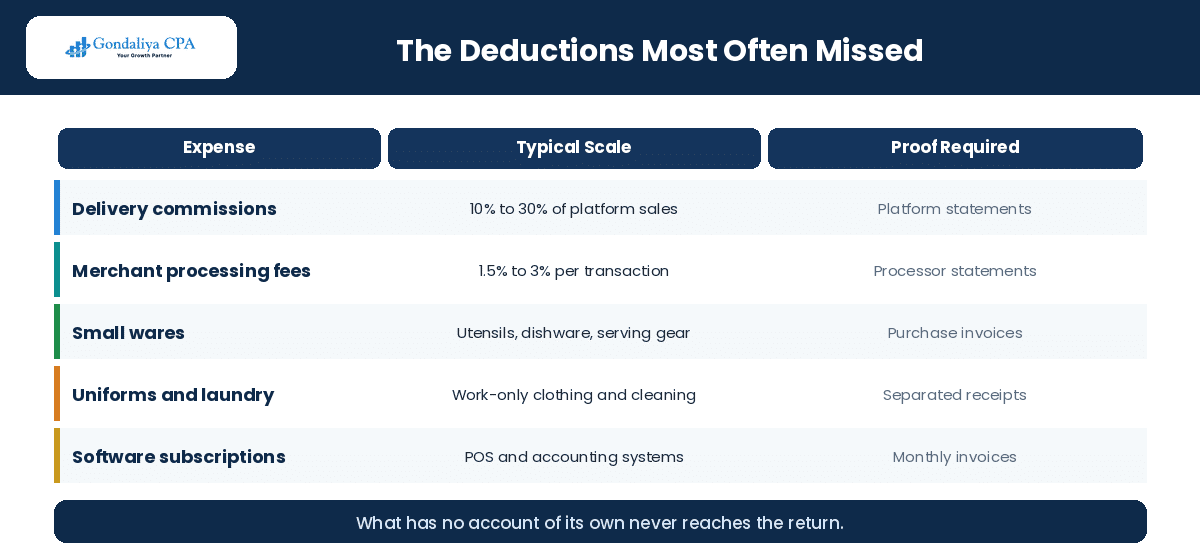
Restaurants often miss some deductible costs because of lots of transactions or unclear tracking. Here are common ones to watch:
- Delivery Commission Rates: You pay delivery platforms between 10% and 30% of sales. These fees count as business expenses if you keep platform statements.
- Merchant Processing Fees: Banks or payment processors charge about 1.5% to 3% per transaction in Canada. These fees reduce your revenue but can be deducted if tracked separately.
- Staff Meals: Meals given to employees during shifts can be partly deducted if they meet CRA rules (see ITA s.18(1)(a) and s.67(2)). Keep good records to separate these from free meals to customers.
- Uniforms and Laundry Costs: Buying or cleaning uniforms used only at work counts as a current expense[^2]. Make sure receipts separate uniform laundry from personal clothes.
- Software Subscriptions: Fees for POS systems or inventory software like QuickBooks are deductible operating costs when used directly in your restaurant.
Sorting these properly within restaurant bookkeeping services helps catch deductions right and keeps you ready for audits.
Managing Payroll and Employment Benefit Deductions
Payroll impacts both taxes and your cash flow in big ways:
- Payroll Remittance Timing: You must send CPP contributions, EI premiums, and income tax withholdings on time. Late payments cause penalties that hit working capital[^3]. Sync payroll cycles with deadlines to avoid surprises.
- Employer CPP Contributions & EI Obligations: Employers match contributions, which raises labor costs but these remain fully deductible once recorded correctly.
- Taxable Benefits – Staff Meals: If you give free meals beyond regular shift food, those might be taxable benefits on T4 slips[^4]. Classify them right to avoid tax surprises later.
Also, how you report tips matters. CRA rules distinguish controlled tips from direct tips affecting CPP/EI calculations[^5]. This influences your total employment deductions recognized by your restaurant accountant team.
Handling Leasehold Improvements and Asset Depreciation
Knowing what counts as a current expense vs capital is important for depreciation:
- Current vs Capital Expense Test: Fixing equipment normally counts as current expenses you deduct right away. Big renovations that extend asset life must be capitalized following ITA rules[^6].
- Kitchen Equipment CCA Classes (8, 43 & 44): Most kitchen gear falls under Class 8 (20% declining balance). Leasehold improvements go into Class 43 (30%) or Class 44 (50%) if bought after certain dates in Ontario[^7].
Starting in 2026, you can immediately expense some assets below set amounts instead of depreciating over years[^8]. This helps cash flow if used well in bookkeeping routines.
Don’t forget to record asset disposals fast so you don’t claim wrong depreciation when filing taxes with your restaurant CPA bookkeeping experts.
Expense Management Techniques for Cost Control
Keeping costs tight means turning daily numbers into clear insights:
- Canadian restaurants aim for food cost percentages around 28% to 35%, based on cuisine type[^9]. Watching this monthly helps spot waste or pricing problems early.
- Match daily sales summaries with bank deposits every day to catch any revenue mismatches — including cash[^10]. This step is crucial for solid restaurant cash flow management.
Doing regular reconciliations plus quick inventory updates boosts margin checks seen in monthly profit-and-loss reports prepared by accountants who know the hospitality field well[^11].
References
- CRA – Merchant Service Charges
- CRA – Uniforms
- CRA – Payroll Remittances
- CRA – Taxable Benefits Staff Meals
- CRA – Tips Reporting Rules
- Canada Revenue Agency – Current vs Capital Expenses
- CCA Classes Guide – Kitchen Equipment & Leaseholds
- 2026 Immediate Expensing Update – CRA Notice (illustrative)
- National Restaurant Association Canada Benchmark Report (illustrative)
- CRA Books & Records Requirements Section (§230 ITA)
- Gondaliya CPA Internal Hospitality Accounting Standards Manual
For help with Toronto-area incorporated restaurants wanting clear restaurant bookkeeping Canada solutions that catch every restaurant tax deductions while helping with restaurant cash flow management, reach out at info@gondaliyacpa.ca or call 647‑212‑9559 today.
Small wares are the category nobody thinks about. Utensils, dishware and serving equipment replaced through the year add up to a meaningful deduction that usually sits uncoded in a general supplies account. Figures changed for privacy.
Risk Warning: Uniform laundry claimed alongside personal clothing is a straightforward denial. Keep the receipts separate at the point of purchase, because splitting them afterwards is not credible.
Accounting Services and Support Offered by Gondaliya CPA
Accounting Services and Support Offered by Gondaliya CPA
The Services
Gondaliya CPA focuses on restaurant bookkeeping Canada. We serve incorporated restaurants, bars, cafes, franchises, and multi-location food businesses. Our specialized restaurant accountant helps owners keep a close eye on cash flow. This way, they can spot opportunities to save on taxes and manage their money better.
Comprehensive Restaurant Bookkeeping and Financial Reporting Services
Good restaurant bookkeeping Canada captures all expenses clearly. We offer bookkeeping built just for restaurants. Our team tracks daily sales and checks merchant deposits, including delivery platform statements. We watch inventory changes that affect cost of goods sold (COGS). Payroll is managed carefully with tip reporting following CRA rules.
Our restaurant accountant creates monthly reports with profit and loss by location or revenue source. This helps with restaurant cash flow management by showing when money comes in versus when it’s earned. We keep records that match CRA standards under ITA sections 18(1)(a) and 230. This prevents missing tax deductions on things like small wares, staff meals benefits, license fees, or software subscriptions.
- Track daily sales summaries
- Reconcile merchant deposits & delivery platform statements
- Monitor inventory adjustments affecting COGS
- Manage payroll with tip reporting compliant with CRA
- Provide monthly financial reports by location or revenue stream
Corporate Tax Preparation and Filing for Canadian Restaurants
Many restaurants miss out on tax deductions because paperwork is messy or expenses are wrongly classified. Gondaliya CPA handles corporate tax prep to find every deduction for Canadian restaurants. We check if expenses count as current or capital costs—like repairs vs leasehold improvements—and apply new rules from 2026 about immediate expensing.
Our restaurant accountant files T2 returns reflecting real income minus allowed costs such as delivery fees paid to third parties or merchant processing charges backed by documents. We also understand rules around AGCO licensing for hospitality businesses. This lowers audit risks and helps plan instalments based on expected taxable income to improve cash flow.
- Identify all allowable restaurant tax deductions
- Separate current vs capital expenses correctly
- Apply immediate expensing provisions where possible
- Prepare accurate T2 filings with proper documentation
- Support AGCO licensing compliance
Specialized Services: Catch-Up Bookkeeping and CRA Audit Resolution
Restaurants behind on their books struggle come tax time or audits. Gondaliya CPA offers catch-up bookkeeping that reconstructs past records using bank feeds from QuickBooks or Xero. We collect supplier invoices through Hubdoc tools and reconcile POS data including voids or comps—a must to spot missed deductions.
If the CRA questions payroll remittances like CPP/EI on tips or GST/HST credits for mixed-use expenses such as home office use during COVID, our CPAs step in. We represent clients before the agency to resolve issues fairly, aiming to avoid penalties using voluntary disclosure options when possible.
- Rebuild financial records with bank feeds integration
- Capture supplier invoices using Hubdoc
- Reconcile POS transactions including voids/comps
- Represent clients during CRA audits or inquiries
- Assist in resolving payroll remittance & GST/HST claims
Cloud-Based Accounting Integration and Technology Solutions
Restaurant bookkeeping Canada works best with cloud tech for instant financial info needed to manage cash flow well. Gondaliya CPA connects platforms like QuickBooks Online with Wagepoint payroll and Stripe payments to automate transaction recording across sites.
This tech stack cuts down errors common in paper systems and improves traceability required by ITA s.230 for keeping documents six years minimum [CRA]. Automated workflows speed up monthly closes and produce reports lenders want—not just at year-end but quarterly too—helping predict cash needs during seasonal ups and downs common in Toronto eateries.
- Use QuickBooks Online paired with Wagepoint payroll automation
- Integrate Stripe payment gateways for multi-location recording
- Reduce manual errors compared to paper-based systems
- Keep source documents per ITA s.230 retention rules (6 years)
- Generate lender-ready reports quarterly for better forecasting
Transparent Pricing and Engagement Process
Restaurateurs need clear pricing to plan budgets without surprises that hurt cash flow. Our transparent pricing uses fixed annual rates covering full-service restaurant bookkeeping Canada packages based on client size—like number of locations or transactions yearly.
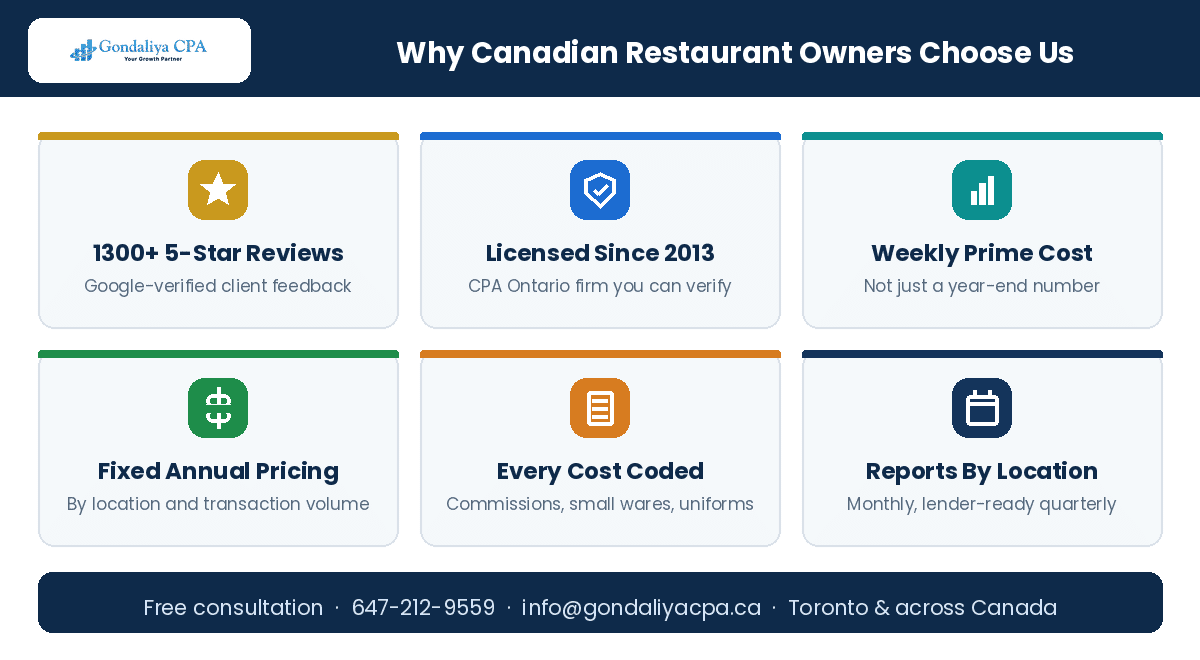
Clients get detailed engagement outlines listing what we deliver—from bank reconciliations to deduction memos to T2 filing support. Our communication promises replies within one business day plus weekend availability if needed. We back this up with “1300+ 5-star Google reviews.” Interested businesses can reach us at 647-212-9559 or info@gondaliyacpa.ca for a free chat about their needs.
- Fixed annual pricing covering full bookkeeping packages
- Pricing based on locations handled or transaction volume
- Clear engagement letters outlining deliverables
- Fast response times within one business day plus weekends
- Contact info: 647‑212‑9559 / info@gondaliyacpa.ca
Catch-up work is less painful than owners expect. Bank feeds plus supplier invoices rebuild most of a year quickly; what takes time is the POS data with its voids and comps. Figures changed for privacy.
Regional Expertise, Team Credentials, and Client Engagement
Regional Expertise, Team Credentials, and Client Engagement
The Team
Understanding Local Tax Laws and Market Trends Across Canadian Regions
Handling restaurant tax deductions means knowing local tax rules well. Each province in Canada has its own ways to treat expenses, payroll, and taxes on food services. For instance, Ontario will change corporate tax rates in 2026. That change affects how restaurants manage their cash flow.
CRA-compliant tax filings need clear and accurate records. The Income Tax Act (ITA) sets rules on what costs you can deduct and how to check if they’re reasonable. The CRA’s new immediate expensing rules from 2026 let restaurants write off some costs faster. That helps with both saving taxes and keeping enough working capital.
Also, restaurant bookkeeping Canada must consider how customers behave in each region. Big cities like Toronto see many sales every day. Smaller towns like Guelph or Windsor don’t have that volume. So, bookkeeping must adjust to catch all deductions and give a good picture of cash flow.
Meet the Restaurant Accounting Team
The team at Gondaliya CPA knows restaurant accounting inside out. Sharad Gondaliya, CPA (Sharad) Gondaliya leads the group as a CPA Ontario member. We work mainly with incorporated small and medium businesses in food service—from bars and cafes to ghost kitchens and franchises.
Our restaurant accountants find tax deductions that others might miss. Vandana Goel is one specialist who keeps records neat and CRA-ready. She also helps clients manage cash flow by providing timely reports and forecasts.
We use cloud-based tools like QuickBooks and Xero with POS systems for smooth data entry. This system fits busy Canadian restaurants that handle lots of sales daily without slowing down their business.
Case Studies Demonstrating Results for Canadian Restaurants
Here are real stories showing how focused restaurant bookkeeping Canada improves deductions and cash flow:
- A café in Toronto boosted its staff training expense claims by $12K yearly after tracking supplier invoices carefully and keeping laundry logs.
- A bar chain with several locations saved over $25K per year by matching delivery fees each month correctly instead of netting out commissions.
- An Ottawa catering business improved profit margins by adding weekly inventory counts to bookkeeping steps, which cut waste effectively.
Figures changed for privacy.
These examples show how checking daily sales closely plus sorting expenses well uncovers missed deductions. It also gives better insight into cash flow cycles needed for steady growth while following CRA rules.
Client Support and Ongoing Education Resources
Gondaliya CPA offers ongoing help paired with learning resources. We focus on legal restaurant tax deductions under CRA rules while helping improve cash flow management.
Clients get updates about changes affecting the foodservice world—like new depreciation classes or payroll deadlines coming in 2026+. We share checklists explaining what source documents they need, such as supplier invoices with registration numbers, to claim GST/HST credits properly.
We hold workshops that explain tricky points like the difference between repairs versus improvements. This stops costly mistakes from wrong expense claims under ITA reasonableness tests.
Our goal is to help restaurateurs from places like Scarborough to Vaughan handle books confidently. They meet filing requirements without surprises at year-end.
Multiple Contact Options and Calls to Action
Want advice made for your incorporated food business? Contact Gondaliya CPA anytime by phone at 647-212-9559 or email info@gondaliyacpa.ca.
We’re licensed in Ontario but serve clients all over Canada—from single cafés to big franchises across Toronto neighborhoods like Etobicoke, Mississauga, Brampton, plus Hamilton up north near Ottawa.
Reach out early so you don’t miss any CRA-approved deductions while watching your cash position closely through the year — key steps toward strong finances using restaurant bookkeeping Canada expertise focused on smart restaurant cash flow management by a trusted restaurant accountant team.
Sharad Gondaliya, CPA, has more than 10 years helping hundreds of Canadian businesses get their finances straight.
Pro Tip: The $25K recovered by that bar chain came from one change: recording delivery sales gross with the commission expensed, rather than booking the net deposit. It is the highest-value single correction in this sector.
Frequently Asked Questions (FAQs)
Frequently Asked Questions (FAQs)
FAQ
What records does CRA expect behind a restaurant deduction?+
CRA requires invoices with GST/HST registration numbers, receipts for expenses, payroll records, and inventory logs. Proper documentation ensures deductions are accepted during audits.
How do you recover deductions from years already filed?+
You can file an adjustment request using CRA’s T2 amendment process. Supporting documents must back up the claim for missed deductions.
What should a restaurant owner prepare before bookkeeping starts?+
Gather bank statements, sales reports, invoices, payroll data, inventory counts, and previous tax returns to ensure accurate bookkeeping setup.
What are the risks of weak restaurant bookkeeping?+
Poor bookkeeping can lead to missed tax deductions, cash flow issues, audit penalties, and inaccurate financial statements that harm decision-making.
How do you build a cash flow plan across a fiscal year?+
Analyze past revenue patterns, track expenses monthly, forecast seasonal fluctuations, and plan working capital needs to maintain smooth operations.
What is the difference between bookkeeping vs accounting vs cleanup vs tax filing?+
Bookkeeping records daily transactions. Accounting interprets financial data. Cleanup corrects past errors. Tax filing reports income and deductions to CRA.
How to choose the right CPA firm in Toronto/Ontario for a restaurant business?+
Look for hospitality experience, transparent pricing, good client reviews, proactive communication, and familiarity with CRA restaurant rules.
Why trust Gondaliya CPA?+
Gondaliya CPA specializes in Canadian restaurant accounting with proven expertise in maximizing deductions and managing cash flow effectively.
Key Insights on Restaurant Bookkeeping Records & Cash Flow
Key Insights, Expense Categories and Best Practices
Quick Reference
- Track daily sales summary discipline to reconcile with bank deposits every day.
- Use a cash-flow-management dashboard for a Canadian restaurant to monitor real-time money movement.
- Monitor daily cash variance closely to spot discrepancies early.
- Maintain an average monthly close turnaround time under 10 business days for timely reports.
- Calculate days of cash on hand regularly to assess liquidity and operational stability.
Essential Expense Categories & Deductions Overview
- Delivery commission rate fees are deductible if documented properly through platform statements.
- Merchant processing fees reduce net revenue but qualify as valid business expenses.
- Small wares purchases such as utensils or dishware count as deductible supplies.
- Uniforms and laundry costs must be separately tracked from personal expenses for valid claims.
- Software subscriptions related to POS or accounting systems are fully deductible operating costs.
Managing Payroll & Employee Costs Efficiently
- Document family payroll with duties clearly outlined to comply with employment standards.
- Classify contractor versus employee status carefully according to CRA criteria.
- Track staff meals as taxable benefits only when meals exceed regular shift allowances.
- Record tip income accurately distinguishing controlled versus direct tips for correct CPP/EI contributions.
Best Practices for Record Keeping & Compliance
- Follow CRA document retention period rules: keep business records at least six years after the tax year end.
- Track accrued costs and prepaid expenses monthly for accurate matching of expenses to periods served.
- Separate promotions, refunds, and chargebacks distinctly in accounting records to avoid revenue overstatements.
Monthly Close & Reporting Routine Tips
- Perform monthly close routines consistently including reconciliations of bank accounts and sales channels.
- Prepare profit vs cash analyses showing the difference between earned income and actual cash received each month.
Additional Operational Insights
- Monitor waste and spoilage records closely to control food costs effectively under CRA guidelines.
- Use vehicle mileage logs if delivering food or supplies for valid travel expense claims.
- Plan staff training expenses carefully; keep invoices ready for deduction support.
- Manage licences and permits payments ensuring all related costs are captured correctly in books.
- Understand home office deductions eligibility if applicable during COVID or remote management phases.
For expert guidance on these topics or tailored services from Gondaliya CPA’s specialized team, contact us today at info@gondaliyacpa.ca or call 647‑212‑9559.
Days of cash on hand is the number owners find most useful once they start tracking it. Profit is a monthly abstraction; days of cash tells you what happens if next week is quiet. Figures changed for privacy.
Industry Spotlights: Sectors We Represent
Industry Expertise
The deduction most often left behind differs by sector. Here are eleven and what usually goes unclaimed.
| Industry | Most Commonly Missed Deduction |
|---|---|
| Restaurants & food and beverage | Delivery commissions and small wares |
| E-commerce & online retailers | Marketplace and payment processing fees |
| Consulting firms | Home office and software subscriptions |
| Construction, contractors & skilled trades | Small tools and protective clothing |
| Transportation, logistics & trucking | Mileage logs and on-road meal allowances |
| Property developers & builders | Soft costs eligible for current deduction |
| Real estate investors & holding companies | Repairs coded as capital improvements |
| Technology startups & SaaS | Equipment classes and immediate expensing |
| Daycare, childcare & CWELCC services | Supplies, food costs and staff training |
| Dentists & dental practices | Continuing education and licensing fees |
| Medical doctors & physician corporations | Professional insurance and dues |
- Restaurants & food and beverage: Delivery commissions netted off deposits, plus small wares buried in a general supplies account.
- E-commerce & online retailers: Marketplace and processing fees deducted at source, so neither the revenue nor the cost is recorded.
- Consulting Firms: Home office allocation and recurring software subscriptions go unclaimed for want of a calculation.
- Construction, general contractors & skilled trades: Small tools and protective clothing bought on the job and never reaching the ledger.
- Transportation, logistics & trucking: Mileage and on-road meal allowances both require logs that frequently do not exist.
- Property developers & builders: Soft costs capitalised by default when some could be deducted in the year.
- Real estate investors, landlords & holding companies: The repair against improvement line drawn conservatively, deferring deductions unnecessarily.
- Technology startups & SaaS: Equipment classes and immediate expensing eligibility left unexamined at purchase.
- Daycare, childcare & CWELCC services: Supplies, food and staff training bundled into one vague account and under-claimed.
- Dentists & dental practices: Continuing education and licensing fees claimable in full and routinely overlooked.
- Medical doctors & physician professional corporations: Professional liability insurance and college dues, fully deductible and easily forgotten.
The common thread is transaction volume. Nothing is hidden; the cost simply never gets its own account, and what has no account never reaches the return. Figures changed for privacy.
Professional Guidance and Quick Reference
Guidance
Professional Guidance on Restaurant Bookkeeping: How Gondaliya CPA Supports Canadian Operators
Bookkeeping done properly is not a compliance chore, it is where missed deductions surface and where cash flow becomes predictable. The costs restaurants fail to claim are ordinary ones lost in transaction volume, and finding them is a matter of how often someone looks. Gondaliya CPA does that work on a fixed fee.
We handle what decides the outcome: tracking daily sales summaries and reconciling them to merchant and delivery deposits, monitoring inventory movements that drive cost of goods sold, managing payroll with tip reporting that satisfies the CRA, coding delivery commissions, merchant fees, small wares and uniforms into their own accounts, timing capital purchases against immediate expensing, and producing monthly reports by location so cash needs are visible before they bite.
Our team works from your POS, supplier and payroll data rather than a template. One café or a franchise group, you get clear advice and a fixed price before we start.
Quick Answers: Key Numbers & Concepts at a Glance
At a Glance
- Prime cost: 55% to 65% of total sales
- Food cost: 28% to 35%, depending on cuisine
- Delivery commission: 10% to 30% of platform sales
- Merchant fees: 1.5% to 3% per transaction
- Class 8: 20% declining balance on kitchen equipment
- Immediate expensing: Under $30,000 per item from 2026
- Ontario HST on dine-in: 13%
- Record retention: Six years after the tax year end
- Monthly close target: Under 10 business days
- Books and records: Required under ITA s.230
Who This Is For / Not For
Fit Check
- For: Incorporated restaurants, bars, cafes, ghost kitchens and franchise groups wanting bookkeeping that surfaces deductions and makes cash flow predictable.
- Not For: Unincorporated operators or non-food businesses, where the expense categories and compliance picture are different.
People Also Ask
Quick Answers
How long does a catch-up cleanup take?+
For a single location roughly two to four weeks once the bank feeds and supplier invoices are in. Multi-location groups take longer, mostly because of POS data.
Can I claim deductions I missed two years ago?+
Usually yes, through a T2 adjustment request, provided the supporting documents still exist. That is why the six-year retention rule matters.
What is the single most useful weekly number?+
Prime cost. Food plus labour against sales, checked every Monday, tells you more about the week ahead than any month-end report tells you about the month behind.
Glossary of Key Terms
Plain-English Definitions
- Prime cost: Food plus labour expressed as a percentage of sales.
- Food cost percentage: Ingredient cost measured against sales revenue.
- Cost of goods sold: Opening inventory plus purchases less closing inventory.
- Daily sales summary: The complete record of a day’s takings across every channel.
- Cash variance: The gap between expected cash from sales and cash actually counted.
- Days of cash on hand: How long the business can operate on current cash reserves.
- Delivery commission: The platform fee deducted before the deposit reaches you.
- Merchant processing fee: The per-transaction charge from a payment processor.
- Small wares: Utensils, dishware and serving equipment replaced through the year.
- Controlled tips: Tips pooled by the employer, carrying payroll obligations.
- Direct tips: Tips passing straight from customer to employee.
- Capital cost allowance: The deduction for depreciation of capital assets over time.
- Class 8: The 20% class covering most kitchen equipment.
- Immediate expensing: Writing off eligible assets in full in the year acquired.
- Monthly close: The routine that finalises a month’s books before the next begins.
- T2 adjustment request: The formal route to amend a corporate return already filed.
Restaurant Bookkeeping Health Check
This quick self-check indicates where your operation most likely has room. Please answer the six questions below.
Restaurant Bookkeeping Health Check
Six quick questions on your routine. No fee shown.
Points to raise with us:
This is a general prompt, not tax or legal advice or a quote. Your position depends on your full facts. For a real review, please book a free consultation.
Want a checklist to work from? You can download our free restaurant bookkeeping checklist before your consultation.
Reconcile sales to deposits daily and read prime cost weekly. Give delivery commissions, merchant fees, small wares and uniforms their own accounts, because what has no account never reaches the return. Count inventory and track waste separately. Close each month inside ten business days. Decide immediate expensing against capital cost allowance at purchase, not at year end.
2026 Update — what is current: Immediate expensing applies to eligible purchases under $30,000 per item from fiscal years starting in 2026, and Ontario corporate rates change in the same year. The six-year retention rule, Class 8 at 20% and the 13% Ontario HST on dine-in meals are unchanged. Please note this article cites Class 13/14 in one place and Class 43/44 in another for leasehold improvements, so please confirm the correct class before relying on it.
Restaurant Bookkeeping Canada: Expert Tips on Tax Deductions, Cash Flow Management, and Accounting Services by Gondaliya CPA
Find what your books are hiding
Gondaliya CPA tracks daily sales, reconciles merchant and delivery deposits, monitors inventory against cost of goods sold, manages payroll with compliant tip reporting, codes every deductible cost to its own account, and delivers monthly reports by location, on a fixed annual fee with a one-business-day response. Please book a free consultation.
Next Steps
Please book a free consultation with Gondaliya CPA and bring your last T2 return, a POS sales summary, your delivery platform statements and a recent inventory count. Those four usually show within minutes which deductions are going unclaimed and where cash is getting stuck. You will get a fixed fee before any work begins. If our content helps, please add gondaliyacpa.ca as a preferred source on Google.
Published: August 17, 2026 · Last updated: August 17, 2026
Editorial policy: We research against CRA and CPA Ontario sources, fact-check the figures, and Sharad Gondaliya, CPA, reviews the content, which we update as the rules change.
Disclaimer: This article is educational information only and is not tax, legal, or financial advice. Figures marked illustrative are examples rather than quotes or guarantees. It reflects CRA rules current to 2026, including the six-year record retention requirement, Class 8 capital cost allowance at 20%, immediate expensing under $30,000 per item from 2026, and the 13% Ontario HST on dine-in meals. Rates, limits and expensing rules change and outcomes depend on your specific facts. Please consult a CPA Ontario member before acting.

Sharad Gondaliya is a CPA Canada & CPA USA with 15 Years+ experience of Accounting, Tax, Payroll of Corporate Small Businesses as Tax Accountant. He is a CPA Ontario member (61040184) and holds US CPA licences in Washington and Montana and is well known among corporate small businesses for tax planning, efficient tax solutions, and affordable CPA services. Sharad is the Principal (Director) of Gondaliya CPA – Affordable CPA Firm in Canada. Licenses: CPA Ontario: 61040184 | CPA USA (MT): PAC-CPAP-LIC-033176 | CPA USA (WA): 57629 | CPA Firm License: 61330051 View Full Author Bio