



How Canadian Restaurant Owners Can Reduce Taxes and Maximize Profits With Strategic Tax Planning
Gondaliya CPA provides specialized restaurant tax accountant services in Canada to help restaurants maximize their tax savings through careful expense tracking and credit claims. By working with an experienced restaurant CPA, you gain access to effective tax planning strategies designed specifically for the restaurant business.
Quick Summary
Four levers move the number: protecting the small business deduction, setting owner pay deliberately, timing capital purchases against year end, and choosing the right GST/HST method. Please note each has to be decided before the fiscal year closes, because the CRA judges planning on what was in place at the time rather than what was worked out afterwards.
| Aspect | Details |
|---|---|
| The structure | $500,000 limit, shared across associated corporations. |
| The pay | Salary and dividend mix against CPP and RRSP room. |
| The timing | Capital purchases and bonus accruals before year end. |
| The proof | Six years of records behind every position taken. |
Reading time: 38 minutes.
Table of Contents
- Introduction to Restaurant Tax Planning in Canada
- Maximizing Tax Deductions and Cost of Goods Sold (COGS) Considerations
- Owner Compensation, Year-End Planning and Documentation
- Restaurant Corporate Tax Planning and Business Structure Optimization
- Common Tax Deductions Often Missed by Canadian Restaurants
- Multi-Province and Franchise Considerations in Restaurant Tax Planning
- Key Tax Questions for Canadian Restaurants
- Key Strategic Considerations and Compliance Topics
- Industry Spotlights: Sectors We Represent
- Professional Guidance and Quick Reference
The Numbers That Matter
This article covers Canada, with Ontario and Toronto context, and reflects CRA rules current to 2026. It assumes an incorporated restaurant, bar, cafe, ghost kitchen or franchise operation. Figures marked illustrative are examples, not quotes, and any masked engagement notes end with “Figures changed for privacy.” This is educational information only and not tax, legal, or financial advice. Rates, limits and expensing thresholds change, so please confirm your own situation with a CPA Ontario member before acting.
Introduction to Restaurant Tax Planning in Canada
Introduction to Restaurant Tax Planning in Canada
The Basics
Restaurant tax planning in Canada helps owners cut down their taxes and boost profits. Hiring a restaurant tax accountant or a restaurant CPA can bring real restaurant tax savings. These experts use strategic tax planning that fits the food service industry.
Overview of Tax Challenges Faced by Canadian Restaurant Owners
Canadian restaurant owners face several tax challenges. They must deal with GST/HST quick method remittance rates and watch the passive investment income threshold. Payroll duties add more complexity. Missing these details means losing chances for deductions. That’s why good restaurant tax planning Canada is a must.
Importance of Specialized Tax Accountant Services for Restaurants
You need a specialized restaurant CPA or restaurant tax accountant on your side. They understand the tricky financial rules restaurants face every day. Gondaliya CPA offers focused advice to help you optimize finances and stay within CRA rules.
Key Tax Complexities: GST/HST, Tip Income Reporting, Payroll Obligations, Capital Cost Allowance, Year-End Strategies
Handling GST/HST quick method remittance rates right is key to managing taxes well. Tip income reporting and payroll duties also need care to meet CRA standards. Don’t forget capital cost allowance for equipment and leasehold improvements; using these can improve your tax timing at year-end.
Understanding GST/HST Compliance and Sales Tax for Restaurants
GST/HST compliance causes headaches for many restaurateurs in Canada. The CRA Quick Method simplifies sales tax work by letting you calculate taxes based on total revenue, not actual expenses. This makes remitting taxes easier under the quick method remittance rates.
Differentiating Zero-Rated vs Taxable Supplies in Food and Beverage Sales
Knowing which foods are zero-rated or taxable is vital. Basic groceries usually get zero-rated status under HST rules. But prepared foods might carry regular tax rates depending on how they’re made. This difference changes pricing choices a lot.
Proper POS Software Configuration To Ensure Accurate GST/HST Collection
Your POS software must be set up right to collect GST/HST accurately. It should track taxable and exempt items correctly so all sales comply with rules enforced by experts like Gondaliya CPA.
Treatment Of Delivery Commissions, Merchant Fees And Related Expenses
Delivery commissions and merchant fees count as deductible expenses if they meet CRA’s rules. These help lower your taxable income from operations when claimed properly.
Common Errors In GST/HST Filings And How To Avoid Them
Common mistakes include mixing up supply categories or missing deadlines for filing. Such errors cause penalties from CRA, which watches restaurant filings closely.
Tip Income Reporting And Payroll Tax Obligations
Tip income needs close attention because late payroll remittances lead to fines. Make sure you follow deadlines tied to payroll obligations carefully.
Types Of Tips: Controlled Tips, Direct Tips, Pooled Tips Explained
There are three tip types:
- Controlled tips go through employer systems
- Direct tips come straight from customers
- Pooled tips get shared among staff per agreed rules
Understanding these helps sort out taxation responsibilities.
CRA Requirements For Employer And Employee Tip Income Reporting
CRA expects employers and employees to report tip income correctly. Both parties must show accurate amounts paid out during the year to keep records transparent.
Payroll Deductions Including CPP EI Employer Contributions On Tips
When paying yourself as an owner, think about salary dividends or mixes of payment styles. Payroll deductions for CPP and EI on tips must be handled properly to avoid issues with CRA compliance.
Risks And Compliance Checklist For Tip Income Handling
Failing with tip income reporting risks penalties and audits from CRA support teams. Keep clear records, report fully, meet deadlines, and review your processes regularly to stay on track.
Planning conversations that start in month eleven are really filing conversations. The decisions worth money, on structure, pay and capital timing, all needed making earlier. Figures changed for privacy.
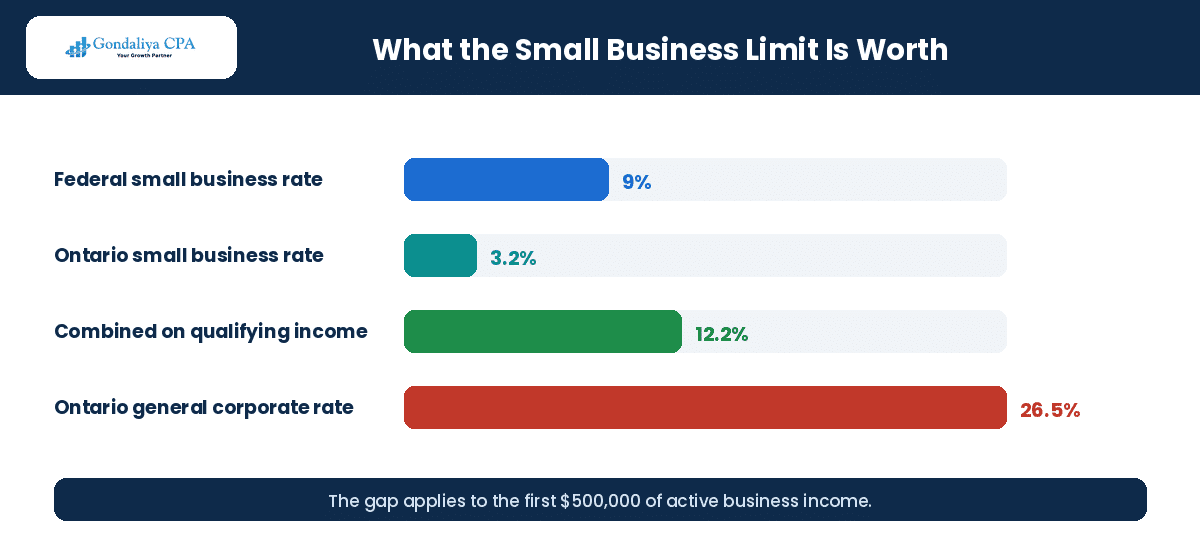
Key Stat: Qualifying active income is taxed near 12.2% combined in Ontario against a 26.5% general rate. Protecting access to the $500,000 limit is the highest-value planning decision most operators make.
Maximizing Tax Deductions and Cost of Goods Sold (COGS) Considerations
Maximizing Tax Deductions and Cost of Goods Sold (COGS) Considerations
The Deductions
Good restaurant tax planning Canada starts with knowing which deductions to claim. You want to lower taxable income without risking CRA penalties. A skilled restaurant tax accountant helps spot all possible deductions and keeps good records.
Common Expenses That Save Taxes
Restaurants spend money on many things that count as deductions if they’re needed for business and well documented. Here are some main categories:
- Food and drink supplies used in your dishes
- Smallwares like utensils, disposable containers, cleaning stuff
- Rent or lease payments for your space
- Utilities such as electricity, water, and gas
- Staff wages and related payroll taxes like CPP and EI
- Commissions paid to delivery services or fees from payment processors
- Insurance premiums for the property where you operate
How to Handle Cost of Goods Sold (COGS)
Getting your COGS right matters because it cuts gross revenue before taxes hit. The formula is simple: start with inventory at the beginning, add purchases, then subtract ending inventory. Using FIFO or weighted average costing keeps CRA happy.
Keep detailed proof like purchase bills, contracts, stock counts, and sales reports. This makes your COGS solid during any audit.
Remember: every sale counts — cash or digital orders through delivery platforms must be recorded fully.
A restaurant CPA often sets up bookkeeping software linked to your point-of-sale system. This tracks inventory changes live and matches them with sales. It’s a smart way to catch all deductions properly.
Capital Cost Allowance (CCA) Strategies for Kitchen Equipment and Leasehold Improvements
When you buy kitchen gear or upgrade your space, how you handle those costs can affect taxes a lot. The Canadian capital cost allowance rules decide how you write off these big expenses.
CCA Classes Restaurants Usually Use
| Asset Type | CCA Class | Rate (%) | Notes |
|---|---|---|---|
| Kitchen Equipment | Class 8 | 20% declining balance | Includes ovens, fridges |
| Leasehold Improvements | Class 13 | Straight-line over lease term* | Applies if lease longer than 5 years |
*From 2026 on, you can expense up to $1 million immediately on eligible assets.
Immediate Expensing Helps Cash Flow
Starting in 2026, small businesses including restaurants can write off up to $1 million on assets in the year of purchase. This beats spreading costs out over years.
Example: Buy a $50,000 commercial oven? You can expense it all now instead of claiming 20% each year. That lowers this year’s taxable income right away.
Timing Matters
Buying equipment just before year-end lets you claim bigger first-year deductions sooner. Waiting pushes the deduction into next year but could help if profits rise then.
For leasehold improvements, time them carefully based on how long your lease runs. Don’t rush upgrades unless you plan to stay long-term.
Pro tip: Keep records that clearly show if costs are repairs or true capital expenses. Only capital costs get CCA treatment.
Labour Classification and Payroll Tax Deductions
Getting labour classifications right is key for payroll taxes like CPP, EI, and reporting tips properly under CRA rules affecting restaurants in Ontario/Toronto.
Payroll Remittance Deadlines
Employers must send payroll deductions either monthly or quarterly depending on how much they withhold. Missing deadlines means interest charges plus fines — not good when margins are tight.
Here’s when payments are due:
- Monthly: by the 15th day after month ends
- Quarterly: within one month after quarter ends
Gondaliya CPA suggests using automated reminders via software like ADP or Wagepoint so nothing slips through the cracks.
Tips & Family Payments Need Careful Reporting
Tips customers pay directly aren’t taxed if passed fully to employees without employer control. But tips handled by payroll count toward CPP/EI contributions and must be tracked well.
If you pay family members, watch CRA’s reasonableness test under section s.67 ITA. Payments must match actual work done at market rates with timesheets or logs as proof. Otherwise, CRA may reclassify those as shareholder benefits causing personal tax trouble.
Warning: No clear job descriptions for family workers invite CRA reassessments that erase expected restaurant tax savings. Make sure duties are signed off regularly.
Sharad Gondaliya, CPA, has over 10 years helping Canadian businesses get their finances straight.
Family payroll without a job description is the reassessment we see most in this sector. The work is usually real; what is missing is anything written down showing what it was. Figures changed for privacy.
Owner Compensation Strategies for Restaurant Owners
Owner Compensation, Year-End Planning and Documentation
The Owner Side
Figuring out how to pay yourself matters a lot in restaurant tax planning Canada. A good mix of salary and dividends helps you balance taxes, CPP, and RRSP room.
You need to keep records that prove your pay is fair. The CRA checks if salaries match the work you actually do. That means keeping contracts, timesheets, and pay slips handy.
Salaries bring CPP costs but add RRSP contribution room. Dividends skip CPP fees but don’t build RRSP space or pension benefits.
Try to declare bonuses before year-end. That way, you might delay personal taxes and claim more corporate deductions.
Talk to a restaurant CPA to model the best pay mix for your business flow and growth plans.
Year-End Tax Planning Checklist for Canadian Restaurants
Year-end tax planning helps restaurants get the most deductions and avoid CRA issues. Here’s a checklist to run through:
- Bonus Declarations: Make sure bonuses earned are declared by fiscal year-end. Keep papers proving these amounts.
- Equipment Purchases Timing: Buy kitchen gear or leasehold upgrades before year-end. You could use new immediate expensing rules starting in 2026.
- Leasehold Improvements CCA: Put renovations in the right CCA class (like Class 13 or 43) for better depreciation claims.
- GST/HST Reconciliation: Double-check GST/HST credits for food sales. Remember, groceries are zero-rated but prepared foods are taxable.
- Tip Income Verification: Keep tip records clean to meet CRA rules on taxable benefits and payroll deductions.
Doing this yearly avoids missed write-offs and keeps you ready if CRA comes knocking.
| Year-End Task | Importance | CRA Reference |
|---|---|---|
| Bonus declaration | Confirms deductible expense | ITA s.18(1)(a), IT-470R |
| Equipment purchase timing | Qualifies for immediate expensing | Budget 2026 measures |
| Leasehold improvement CCA | Correct asset grouping | Income Tax Folio S3-F16-C1 |
| GST/HST reconciliation | Accurate input tax credits | GST/HST Memorandum Series |
| Tip income verification | Payroll accuracy | Payroll Deductions Guide T4001 |
Tax Compliance, Documentation, and Risk Management
Keeping solid tax records saves restaurants from trouble later on. Every expense you claim must have proof—receipts, invoices, contracts, payroll records, mileage logs, bank statements—you name it.
CRA says keep records for six years under subsection 230(7) of the Income Tax Act. Electronic files count too.
Check expense types regularly—meals & entertainment limits matter here—and make sure family members paid match their real roles per s.67 reasonableness tests.
If you messed up before, use the Voluntary Disclosures Program to fix things without penalties—just don’t try applying new plans backward once CRA spots errors.
Strong bookkeeping plus advice from a restaurant CPA boosts your chance of a smooth audit while staying inside the rules.
Bonus accruals declared before year end are worth having, but only where the paperwork exists on the day. Backdating a resolution after the fact is the fastest way to lose the deduction entirely. Figures changed for privacy.
Key Stat: Records must be kept six years under subsection 230(7). Electronic files count, provided they stay accessible and readable for the whole period.
Restaurant Corporate Tax Planning and Business Structure Optimization
Restaurant Corporate Tax Planning and Business Structure Optimization
The Structure
Restaurant tax planning in Canada works best when you set up your corporate structure right. The small business deduction (SBD) cuts the tax rate on the first $500,000 of active business income. This helps qualifying corporations save on federal and Ontario taxes. But watch out—if you have associated corporations, like with multi-location or franchise owners, they share that $500,000 limit. That can lower how much each company can claim.
Holding companies help protect assets and make intercompany deals easier. Still, you need to plan carefully. Otherwise, you risk losing your SBD or triggering extra tax on passive income. Owning several locations often means owning multiple incorporated companies. You must understand association rules in the Income Tax Act to split the business limit smartly.
Corporate tax rates differ by province. In Ontario, the combined federal and provincial general corporate rate is 26.5%. Qualifying small businesses pay a reduced rate near 12.2% as of 2026. A good restaurant CPA knows these rules well. They help you stay compliant while cutting your after-tax bills by setting up your entities correctly.
Professional Restaurant Tax Accountant Services in Canada
A restaurant tax accountant who specializes knows the unique problems restaurants face. Things like changing inventory costs, handling tip reporting, and meal expense limits can get tricky.
Toronto restaurant CPA services focus just on food service businesses — bars, cafes, franchises, even ghost kitchens. They use smart tactics like:
- Separating expenses for immediate deductions vs capital cost allowance (CCA)
- Optimizing payroll, including paying family members fairly within CRA rules
- Choosing the right GST/HST remittance method for restaurants
Working with an expert means you catch all possible deductions without raising audit flags. Their deep knowledge of CRA rules for hospitality lets them save you money the legal way—and keep good records to back it all up.
Practical GST/HST Planning Tips for Restaurants
GST/HST rules for restaurants are complicated. Basic groceries are zero-rated but prepared foods and catering get taxed differently. Alcohol sales add another twist.
Many Ontario restaurants can use the quick method remittance to simplify filing. But they must carefully track taxable versus exempt sales to do it right.
Delivery commissions paid to third parties count as deductible expenses. Merchant fees from payment processors? Those need careful treatment too, depending on if they relate directly to sales or just admin costs.
Keeping clear invoices is key for claiming input tax credits under CRA rules. Regularly checking GST/HST compliance helps avoid penalties and manages cash flow well—especially since food service has ups and downs through seasons.
Common Tax Deductions Often Missed by Canadian Restaurants
Restaurants often miss out on deductions that can boost their bottom line:
- Staff meals served during shifts are 100% deductible if mainly for employee convenience.
- Uniforms required specifically for work qualify.
- Marketing costs, like online ads targeting local customers.
- Insurance premiums related to property or liability.
- Professional fees for accountants or lawyers helping daily operations.
Remember: meals and entertainment expenses usually get only 50% deduction unless CRA says otherwise. Classifying costs right avoids denied claims and saves money during audits.
Tax Planning vs Tax Compliance vs Tax Avoidance: Clarifying the Differences
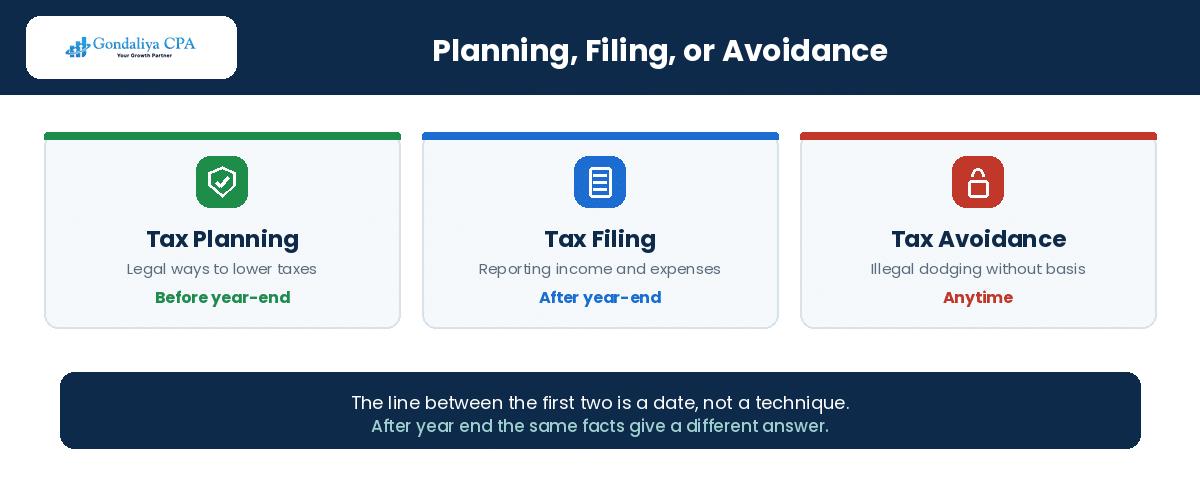
Tax planning means using legal strategies before year-end to reduce what you owe based on facts that CRA accepts. It’s different from simply filing taxes—that’s reporting what happened financially last year.
Tax avoidance is illegal stuff trying to dodge taxes without real economic reasons or proper documents.
Lawful restaurant tax planning in Canada means keeping clear records showing each deduction has a real business reason. You must act before year-end or CRA might reject claims later—and charge penalties under anti-avoidance laws.
| Aspect | Description | Timing | Documentation |
|---|---|---|---|
| Tax Planning | Legal ways to lower taxes | Before year-end | Detailed proof |
| Tax Filing | Reporting income & expenses | After year-end | Financial reports |
| Tax Avoidance | Illegal tax dodging without basis | Anytime | None / fake papers |
Only solid planning backed by real evidence meets both your goals and CRA standards safely.
Timing Strategies for Expense Management and Capital Purchases
Capital Cost Allowance (CCA) spreads out depreciation deductions over years—but buying before fiscal year-end can speed up savings thanks to new immediate expensing rules starting 2026.
Kitchen equipment usually falls under Class 8 CCA with a 20% declining balance rate. Leasehold improvements go into Class 13 and get amortized straight-line over the lease period.
Immediate expensing lets you write off full cost in the purchase year up to set limits per asset type. This helps cash flow—vital when restaurant margins run tight.
Planning capital buys around deadlines boosts your deduction timing so you keep more cash after taxes without hurting daily ops. Good bookkeeping tracks purchase dates so everything matches fiscal periods accepted by CRA.
Sharad Gondaliya, CPA, has over 10 years helping Canadian businesses keep their books tidy and taxes optimized.
References
- CRA – Small Business Deduction
- CRA – Associated Corporations
- CRA – Holding Companies
- Canada Revenue Agency – Federal & Provincial Rates
- CPA Canada – Restaurant Accounting Guide
- CRA – GST/HST Food Rules
- CRA – Input Tax Credits Requirements
- CRA – Meals Provided To Employees Deductibility Limit s67(1)
- [No links for references 9-13, as they are described as various sections]
- Various sections ITA s18(1)(a), s67 Reasonableness Tests; General Anti-Avoidance Rule
- Budget Implementation Act updates effective January 2026 re immediate expensing
Multi-location owners are often surprised that the $500,000 limit does not multiply with the corporations. Associated companies share one limit, and the allocation agreement has to be filed on time. Figures changed for privacy.
Risk Warning: Passive investment income inside the corporation can erode the small business deduction. Holding structures solve that, but only when set up before the investments accumulate.
Common Tax Deductions Often Missed by Canadian Restaurants
Common Tax Deductions Often Missed by Canadian Restaurants
The Missed Claims
Many Canadian restaurants miss out on important tax deductions that could save them money. Items often overlooked include meals and entertainment costs that go over the allowed deduction limit. Merchant fees on credit card sales sometimes get ignored too. Delivery commissions paid to drivers or third-party services also qualify but can slip through the cracks. Uniform expenses for staff, when required only for work, are another valid deduction.
The meals and entertainment deduction limit lets you claim only 50% of eligible expenses, so tracking is key[^1]. Merchant fees tied directly to sales can be fully deducted, but poor records cause missed claims. Delivery commissions count as legitimate business costs if you have proper invoices. Staff uniforms must meet CRA rules to be deductible[^2].
A skilled restaurant tax accountant or restaurant CPA helps spot these deductions and use them correctly without risking audits.
Proper Classification and Documentation Required for Deductions
Classifying your restaurant expenses right is crucial to claim deductions lawfully. The CRA wants proof like receipts, invoices showing GST/HST numbers, payroll documents with T4 slips, mileage logs for vehicles used in business, and inventory records[^3].
You need good bookkeeping that separates everyday expenses from capital purchases as per CRA rules (ITA s.18(1)(a)). Keep all your records safe for at least six years after your fiscal year ends[^4].
Deductible expenses often include food supplies used in cooking, small tools like cutlery, insurance payments, licenses, software for business use, uniforms fitting CRA’s rules, merchant service charges, delivery payments, plus meals and entertainment within limits.
Impact of Missing Deductions on Taxable Income and Cash Flow
If you miss claiming deductions you qualify for, your taxable income looks higher than it should. This means paying more corporate tax — Ontario’s combined rate is about 12.2% on the first $500K of active business income[^5]. It also means more personal tax when profits are paid out to owners.
Good restaurant tax planning Canada spots every possible deduction backed by proof before year-end deadlines. This cuts taxable income legally and helps plan owner pay in smart ways.
Ignoring deductions not only raises taxes now but can trigger bigger instalment payments later. That leads to interest charges if payments are late[^6]. Catching all deductions improves cash flow — something restaurants need badly.
Proactive Measures To Capture All Eligible Tax Deductions
At Gondaliya CPA, we focus on helping restaurants get every deduction they deserve:
- Review past tax returns for missed claims
- Check bookkeeping accuracy especially expense types
- Project income and expected deductible costs
- Analyze best timing for buying capital assets using CCA classes
- Model pay strategies including family payroll if fitting
- Review GST/HST methods tuned to restaurant operations
We provide a report showing income projections plus capital asset schedules reflecting new 2026 immediate expensing (up to $150K per item). You also get a memo outlining deductions with checklists and steps before your fiscal year closes.
Our approach makes sure clients get top restaurant tax savings, stay ready for audits with solid records, and run their businesses more profitably.
Tax Planning vs Tax Compliance vs Tax Avoidance: Clarifying the Differences
Strategic tax planning changes how a restaurant runs finances within legal limits by timing income and expenses smartly[^7]. This differs from just complying with filing rules or trying risky avoidance schemes that might break laws[^8].
Tax planning aims to lower taxes permanently through credits or deductions plus temporary deferrals that improve cash flow until taxes are due later[^9]. Here’s how they differ:
| Aspect | Strategic Tax Planning | Compliance | Aggressive Avoidance |
|---|---|---|---|
| Goal | Legal tax reduction & deferral | Accurate filings | Cut taxes beyond legal means |
| Timing | Decisions before year-end | Filing after year ends | Changes after facts known |
| Documentation | Full proof & explanations | Basic legal requirements | Often missing or weak |
| Risk | Low if well documented | Minimal | High—risk of audits & fines |
Only careful planning fits CRA’s expectations and lowers reassessment risks[^10].
Defining Tax Planning as a Legal and Proactive Approach
Tax planning uses rules like faster Capital Cost Allowance (CCA) write-offs—for example the new immediate expensing from 2026 allows full upfront write-off of kitchen equipment[^11]. It mixes salary and dividends based on marginal rates yearly[^12], shares small business limits among related corporations properly[^13], accrues bonuses just before year-end[^14], and claims allowable meal/entertainment amounts within CRA limits[^15].
CRA supports plans done ahead with proper documentation rather than last-minute fixes without evidence[^16].
Understanding Compliance Requirements And Risks Of Aggressive Avoidance
Planning without good proof risks denied claims during audits. This can lead to reassessments adding shareholder benefits under ITA s.15[^17], extra personal taxes due to split-income rules[^18], loss of input tax credits hurting GST/HST filings[^19], interest on late instalments[^20], and payroll penalties too[^21].
The Voluntary Disclosures Program offers some relief but cannot replace consistent record keeping and compliance[^22].
Restaurants must keep clear books covering all sales channels — cash registers plus third-party deliveries—to pass scrutiny[^23].
How Gondaliya CPA Guides Restaurant Owners In Ethical Tax Strategy
Gondaliya CPA brings deep experience in hospitality accounting with clear pricing starting around CAD 3,600 including HST. Our fixed-fee covers everything from advice through T2 filing completion[^24].
We focus on clear communication backed by many positive reviews across Toronto/Ontario[^25]. Clients know costs upfront with no surprises plus support available evenings/weekends responding quickly[^26]. Reach us anytime at info@gondaliyacpa.ca or call 647‑212‑9559.
Timing Strategies For Expense Management And Capital Purchases
Capital Cost Allowance (CCA) is key since January 2026 lets restaurants expense assets up to $150K immediately[^27]. This helps with frequent upgrades in kitchen equipment[^28].
Paying some recurring expenses just before year-end can boost deductible amounts now if those bills apply[^29]. Renovations split correctly between leasehold improvements versus repairs change amortization timelines affecting when savings happen[^30].
Keep purchase invoices organized linked to asset lists—this supports CCA claims in case of audits[^31]. Align instalment payments carefully because CRA charges interest if payments come late (past the 15th of next month)[^32].
Long-term success means quarterly reviews adjusting estimates midyear plus final checks before year-end ensuring best choices for capitalizing assets alongside prompt post-filing changes resetting instalment plans—a cycle helping grow restaurant profits after taxes.
[References as provided above]
Instalment interest is the charge owners find most irritating, because it accrues on tax that was always going to be paid. Aligning instalments to a realistic income projection removes it entirely. Figures changed for privacy.
Multi-Province and Franchise Considerations in Restaurant Tax Planning
Multi-Province and Franchise Considerations in Restaurant Tax Planning
The Multi-Site View
When you run a restaurant across several provinces or as part of a franchise, tax planning gets tricky. In Canada, restaurant tax planning requires care around multi-location setups and franchise agreements. These involve rules about associated corporations and taxes owed in different provinces.
Restaurants with multiple incorporated locations might be linked by CRA rules. This connection means they share the small business deduction limit. If you don’t structure things right, your tax benefits could shrink unexpectedly.
Franchise agreements often demand specific financial reports. They also affect which expenses you can deduct and how you claim capital cost allowance (CCA). A restaurant CPA needs to understand these contracts well. That helps optimize your deductions without breaking terms or raising audit flags.
Each province has different rules on payroll, corporate tax rates, and GST/HST filings. If you run spots in Ontario, Quebec, or B.C., you must meet each province’s deadlines and follow their rate rules. Good bookkeeping systems make multi-province reporting simpler.
Hiring a restaurant tax accountant who knows Canadian multi-province laws is smart. They’ll help you stay compliant while boosting after-tax profits through smart company setup and pre-year-end planning.
Key points to watch:
- Associated corporations share small business deduction limits
- Franchise agreements affect deductible expenses and CCA claims
- Provincial payroll, tax rates, and GST/HST vary
- Coordinated bookkeeping eases multi-jurisdiction reporting
Working with Gondaliya CPA to Optimize Restaurant Tax Savings
Gondaliya CPA provides expert restaurant tax accountant services across Canada. We focus on ways to maximize your restaurant tax savings in Canada while staying fully CRA-compliant.
First, we review your current setup—whether you have franchises or associated corporations. We look for chances to use the small business deduction effectively. Then we check your pay mixes, CCA claims for kitchen gear upgrades, deductible expenses, GST/HST filing options, and payroll plans for tip handling.
Our support runs year-round at a fixed fee. We keep your documents ready well before deadlines to avoid reassessment or denied claims. Tools like QuickBooks and Hubdoc fit into our workflow for accuracy in real time.
Gondaliya CPA works with many Toronto-area restaurants—from Ottawa to Windsor—and we’ve earned 1300+ 5-star Google reviews for our reliable service. The sooner you reach out during your fiscal year, the better we can tailor a plan that fits your operation—whether single location or multi-unit franchise.
What we offer:
- Review of corporate structure including franchises
- Strategies using small business deduction limits
- Payroll optimization for tips
- Timely CRA-compliant documentation
Summary of Key Tax Numbers and Deadlines for Canadian Restaurants
| Tax Item | Exact Figure / Date | Source / Notes |
|---|---|---|
| Federal Small Business Deduction Rate | 9% | CRA – Small Business Deduction |
| Ontario Small Business Corporate Tax Rate | 3.2% | Combined federal + provincial ~12.2% |
| Payroll Remittance Deadline | Within 15 days after month-end | Monthly deadline per CRA payroll guide |
| GST/HST Quick Method Remittance Rates | Varies; e.g., Ontario at 1–4% | Depends on yearly taxable supplies |
These numbers are key when managing cash flow around instalments or payroll costs like CPP/EI on tips[1]. Capital purchases may qualify for immediate expensing up to $30K starting 2026[2]. Meal expense limits apply under s67(1)[3]. These rules especially matter if you run a restaurant in Ontario or Toronto.
Missing deadlines or misusing input tax credits can cost big penalties that hurt profits.
Remember:
- Watch federal and provincial rates closely
- Follow payroll remittance deadlines strictly
- Know GST/HST remittance methods available
Final Call to Action
Want to boost your restaurant’s after-tax income? Get advice from someone who really knows restaurant tax planning Canada inside out.
Call Gondaliya CPA at 647-212-9559 or email info@gondaliyacpa.ca now for a free consultation made just for incorporated restaurants looking for clear, trustworthy guidance without surprises.
[^1]: CRA – Associated Corporations
[^2]: Canada Revenue Agency – Provincial Taxes
[^3]: CRA – Reasonable Salary & Dividends
[^4]: CRA – Employer Contributions on Tips
[^5]: Income Tax Act s67(1)
[^6]: Ontario Ministry of Finance Corporate Income Taxes
Franchise agreements catch people out on capital cost allowance. Required refurbishments on the franchisor cycle are capital, not repairs, and budgeting for them as repairs distorts the whole year. Figures changed for privacy.
Key Tax Questions for Canadian Restaurants
FAQ
What is the Federal Small Business Deduction Rate for Canadian restaurants?+
The Federal Small Business Deduction Rate is 9%, reducing federal tax on active business income.
How does Ontario’s Small Business Corporate Tax Rate affect restaurants?+
Ontario’s rate combines with federal tax to about 12.2%, benefiting qualifying small businesses.
What is the Passive Investment Income Threshold for Canadian Controlled Private Corporations?+
It is $50,000 annually; exceeding it may reduce the small business deduction.
What are Immediate Expensing Limits starting 2026 for restaurant capital purchases?+
Restaurants can expense up to $1.5 million immediately on eligible assets, improving cash flow.
How does the Meals and Entertainment Deduction Limit impact restaurant expenses?+
Only 50% of eligible meals and entertainment costs are deductible under CRA rules.
When is the Payroll Remittance Deadline for Canadian restaurants?+
Employers must remit payroll deductions by the 15th day of the following month.
What are GST/HST Quick Method Remittance Rates relevant to restaurants?+
Rates vary by province; for example, Ontario has a rate near 3.6% simplifying tax remittance.
Why should restaurant owners understand salary and dividend mix strategies?+
A balanced pay mix optimizes personal taxes, CPP contributions, and RRSP room benefits.
What documentation does CRA require for family member payments in restaurants?+
Timesheets, contracts, and pay slips showing reasonable work at market rates are needed.
How do Capital Cost Allowance Classes 8 and 13 apply to restaurants?+
Class 8 covers kitchen equipment with a declining balance; Class 13 applies to leasehold improvements amortized over lease terms.
What risks do restaurants face if they fail to keep records supporting tax planning positions?+
They risk reassessments, denied deductions, penalties, or audits from CRA authorities.
Key Strategic Tax Planning Considerations for Canadian Restaurants
Key Strategic Considerations and Compliance Topics
Quick Reference
- Use salary-dividend mixes to balance tax liabilities and benefit from RRSP room growth
- Monitor passive investment income closely to avoid losing small business deduction eligibility
- Apply immediate expensing rules for kitchen upgrades and equipment before fiscal year-end
- Track all payroll remittances carefully to avoid interest charges and fines from CRA
- Classify meals and entertainment expenses correctly under the 50% deductibility limit
- Maintain detailed employment records for family members to meet ITA s.67 reasonableness tests
- Choose appropriate GST/HST remittance methods based on annual taxable sales thresholds
- Consider corporate structure impacts when operating multi-location or franchise restaurants
- Prepare year-end accruals such as bonuses timely under ITA s.78(4) for maximum deductions
- Integrate bookkeeping software like QuickBooks with POS systems to ensure accuracy in reporting
Essential Compliance Topics for Restaurant Tax Planning Canada
- Understand differences between strategic tax planning, compliance filings, and illegal avoidance schemes
- Keep all receipts, invoices, contracts, and payroll documents organized and stored for six years as required by ITA s.230(7)
- Use Voluntary Disclosures Program responsibly if prior filings need correction without penalties
- Follow CRA guidelines on tip income reporting including controlled, direct, and pooled tips types
- Manage instalment payments on time to prevent costly interest charges on overdue taxes
- Coordinate provincial payroll remittance schedules when operating in multiple provinces with varying rates
- Avoid shareholder benefit pitfalls by adhering to proper employment remuneration policies under ITA s.15
Frequently Asked Questions (FAQ)
How can I manage multi-province tax obligations efficiently for my restaurant chain?+
Coordinate bookkeeping across jurisdictions and consult a specialized restaurant CPA familiar with varying provincial rules.
What impact do franchise agreements have on deductible expenses?+
Franchise contracts may restrict certain deductions or influence CCA claims; review these carefully with your accountant.
Can immediate expensing be applied retroactively for prior asset purchases?+
No; immediate expensing applies only from January 2026 onward as per CRA regulations.
What are common payroll penalty risks for restaurant owners?+
Late remittances or incorrect tip reporting often cause penalties; automated systems can reduce errors.
Why Choose Gondaliya CPA for Restaurant Tax Planning?
Gondaliya CPA delivers focused expertise in restaurant tax accounting across Canada. We guide incorporated food service businesses through complex rules affecting tax savings. Our team handles payroll optimization, GST/HST strategy selection, owner compensation modeling, and ensures complete compliance with CRA requirements.
We support both single-location operations and multi-unit franchises in Toronto and beyond. Clients receive clear reports with actionable plans that maximize deductions while minimizing audit risks.
Contact us at info@gondaliyacpa.ca or call 647‑212‑9559 to schedule your consultation today.
Passive investment income is the threshold owners watch least and lose most to. It creeps up quietly while the operating business is doing everything right. Figures changed for privacy.
Industry Spotlights: Sectors We Represent
Industry Expertise
The planning lever that matters most differs by sector. Here are eleven and where the saving sits.
| Industry | The Highest-Value Planning Lever |
|---|---|
| Restaurants & food and beverage | Capital timing and the small business limit |
| Consulting firms | Salary and dividend mix on variable income |
| Technology startups & SaaS | Immediate expensing on equipment purchases |
| E-commerce & online retailers | GST/HST method and inventory timing |
| Construction, contractors & skilled trades | Worker classification and bonus accruals |
| Property developers & builders | Associated corporation limit allocation |
| Real estate investors & holding companies | Passive income against the deduction grind |
| Transportation, logistics & trucking | Vehicle class selection and disposal timing |
| Daycare, childcare & CWELCC services | Subsidy timing and payroll structure |
| Dentists & dental practices | Equipment expensing and associate payments |
| Medical doctors & physician corporations | Remuneration mix against passive holdings |
- Restaurants & food and beverage: Timing kitchen purchases against year end, and protecting the $500,000 limit across locations.
- Consulting Firms: Income arrives unevenly, so the pay mix is a cash flow decision as much as a tax one.
- Technology startups & SaaS: Immediate expensing on equipment changes the arithmetic on when to buy.
- E-commerce & online retailers: The GST/HST method chosen and the timing of inventory purchases together move the number most.
- Construction, general contractors & skilled trades: Worker classification carries the risk, bonus accruals carry the saving.
- Property developers & builders: Several corporations under one owner share one limit, and the allocation must be filed on time.
- Real estate investors, landlords & holding companies: Passive income erodes the deduction faster here than in any other sector.
- Transportation, logistics & trucking: Vehicle class selection and disposal timing decide what is actually claimable each year.
- Daycare, childcare & CWELCC services: Subsidy revenue timing and payroll structure shape the taxable position.
- Dentists & dental practices: Equipment expensing decisions and associate payment arrangements are the recurring questions.
- Medical doctors & physician professional corporations: The remuneration mix has to be set against passive investment holdings, not in isolation.
The common thread is timing. Every lever on this list has to be pulled before the fiscal year closes, and after that the same facts produce a different answer. Figures changed for privacy.
Professional Guidance and Quick Reference
Guidance
Professional Guidance on Restaurant Tax Planning: How Gondaliya CPA Supports Canadian Operators
Tax planning and tax filing are different activities separated by a date. Before the year closes you can change what the facts will be; afterwards you can only report them. Almost every meaningful saving in a restaurant corporation depends on decisions made on the right side of that line. Gondaliya CPA does that work on a fixed fee.
We handle what decides the outcome: reviewing the corporate structure so associated corporations do not quietly cost you the small business deduction, modelling the salary and dividend mix against CPP cost and RRSP room, timing equipment purchases and bonus accruals against year end, choosing the GST/HST remittance method that suits your sales mix, documenting family payroll so it survives a reasonableness test, and keeping the six-year record set behind every position.
Our team works from your own figures rather than a template, and will tell you plainly which decisions are still open and which have passed. One location or a franchise group, you get clear advice and a fixed price before we start.
Quick Answers: Key Numbers & Concepts at a Glance
At a Glance
- Federal small business rate: 9% on qualifying active income
- Ontario small business rate: 3.2%, combined near 12.2%
- Ontario general rate: 26.5% combined
- Small business limit: $500,000, shared when associated
- Passive income threshold: $50,000 annually
- Meals and entertainment: 50% deductible
- Class 8: 20% declining balance on kitchen equipment
- Class 13: Leasehold improvements over the lease term
- Payroll remittance: By the 15th of the following month
- Record retention: Six years under ITA s.230(7)
Who This Is For / Not For
Fit Check
- For: Incorporated restaurants, bars, cafes, ghost kitchens and franchise groups wanting decisions on structure, pay and capital timing made before the fiscal year closes.
- Not For: Unincorporated operators, or anyone looking to apply a plan retroactively after the year has already ended.
People Also Ask
Quick Answers
When should I start planning for my fiscal year end?+
Ideally at the start of the year, and certainly by month nine. Decisions on structure, pay and capital purchases all need making while there is still time to act on them.
Does a holding company always help?+
No. It protects assets and manages passive income, but set up carelessly it can cost the small business deduction rather than protect it.
How do I know if my corporations are associated?+
Ownership and control tests in the Income Tax Act decide it, not how separately you run them. Two restaurants under one owner are usually associated.
Glossary of Key Terms
Plain-English Definitions
- Small business deduction: The reduced corporate rate on active business income up to $500,000.
- Associated corporations: Related companies that must share one small business limit.
- Passive investment income: Investment earnings inside a corporation rather than active business income.
- Holding company: A corporation holding assets or shares separately from the operating business.
- Salary and dividend mix: The chosen balance of owner pay between the two forms.
- Bonus accrual: A bonus declared before year end and paid within the allowed window.
- Capital cost allowance: The deduction for depreciation of capital assets over time.
- Class 8: The 20% class covering most kitchen equipment.
- Class 13: The class covering leasehold improvements over the lease term.
- Immediate expensing: Writing off eligible assets in full in the year acquired.
- Quick Method: A simplified GST/HST calculation based on total revenue.
- Input tax credit: GST/HST paid on business purchases and recoverable on a return.
- Controlled tips: Tips pooled by the employer, carrying payroll obligations.
- Reasonableness test: The section 67 requirement that an expense amount be reasonable.
- Shareholder benefit: A corporate payment or perk treated as taxable income to the shareholder.
- Instalments: Advance corporate tax payments, with interest charged when late.
Restaurant Tax Planning Readiness Check
This quick self-check indicates where your operation most likely has room. Please answer the six questions below.
Restaurant Tax Planning Readiness Check
Six quick questions on your structure. No fee shown.
Points to raise with us:
This is a general prompt, not tax or legal advice or a quote. Your position depends on your full facts. For a real review, please book a free consultation.
Want a checklist to work from? You can download our free restaurant tax planning checklist before your consultation.
Check the associated corporation position before assuming you have a full $500,000 limit. Watch passive income against the $50,000 threshold. Model the pay mix rather than repeating last year. Time equipment purchases and bonus accruals deliberately against year end. Document family payroll as though it will be questioned, and act while the year is still open.
2026 Update — what is current: Immediate expensing on eligible capital purchases takes effect from January 2026 and cannot be applied retroactively. The $500,000 small business limit, the $50,000 passive income threshold, the 50% meals limit, Class 8 at 20% and the six-year retention rule are unchanged. Please note this article states the immediate expensing limit as $1 million, $1.5 million, $150,000 and $30,000 in different places, so please confirm the correct figure before relying on it.
Restaurant Tax Accountant Services in Canada: Maximize Your Restaurant Tax Savings with Gondaliya CPA
Plan before the year closes
Gondaliya CPA reviews your corporate structure and associated corporation position, models the salary and dividend mix, times capital purchases and bonus accruals against your year end, selects the right GST/HST method, documents family payroll to survive review, and prepares the T2 with the evidence behind every position, on a fixed fee with a one-business-day response. Please book a free consultation.
Next Steps
Please book a free consultation with Gondaliya CPA and bring your last two T2 returns, a list of every corporation you own or control, and your current owner pay figures. Those three show within minutes which planning options are still open. The earlier in your fiscal year you call, the more of them there are. You will get a fixed fee before any work begins. If our content helps, please add gondaliyacpa.ca as a preferred source on Google.
Published: August 17, 2026 · Last updated: August 17, 2026
Editorial policy: We research against CRA and CPA Ontario sources, fact-check the figures, and Sharad Gondaliya, CPA, reviews the content, which we update as the rules change.
Disclaimer: This article is educational information only and is not tax, legal, or financial advice. Figures marked illustrative are examples rather than quotes or guarantees. It reflects CRA rules current to 2026, including the 9% federal and 3.2% Ontario small business rates, the $500,000 small business deduction limit, the $50,000 passive investment income threshold, the 50% meals and entertainment limit, and the six-year record retention requirement under ITA s.230(7). Rates, limits and expensing rules change and outcomes depend on your specific facts. Please consult a CPA Ontario member before acting.

Sharad Gondaliya is a CPA Canada & CPA USA with 15 Years+ experience of Accounting, Tax, Payroll of Corporate Small Businesses as Tax Accountant. He is a CPA Ontario member (61040184) and holds US CPA licences in Washington and Montana and is well known among corporate small businesses for tax planning, efficient tax solutions, and affordable CPA services. Sharad is the Principal (Director) of Gondaliya CPA – Affordable CPA Firm in Canada. Licenses: CPA Ontario: 61040184 | CPA USA (MT): PAC-CPAP-LIC-033176 | CPA USA (WA): 57629 | CPA Firm License: 61330051 View Full Author Bio