



How to Choose the Best CPA for Your Medical Practice or Healthcare Business in Canada
Gondaliya CPA offers specialized healthcare CPA Canada services focusing on medical practice accounting, including OHIP billing, clinic billing, professional corporation rules, and GST/HST exemptions. We assist doctors and professional corporations with compliance on medical professional corporation rules, remuneration planning, and timely corporate tax filings to ensure smooth financial management.
Quick Summary
The right firm has to hold four things at once: the college rules on who may own shares, the CRA rules on what may be deducted, the split between exempt and taxable supplies, and a defensible remuneration mix. Please note that a general accountant will usually handle the second of those well and the other three by guesswork.
| Aspect | Details |
|---|---|
| The regulator | Certificate of authorization, renewed annually. |
| The tax side | Small business deduction against passive income limits. |
| The billing | OHIP exempt, cosmetic and third-party work taxable. |
| The pay | Salary and dividend mix, reasonable and documented. |
Reading time: 39 minutes.
Table of Contents
- Understanding Healthcare Accounting Needs for Canadian Doctors and Dentists
- Professional Corporation Setup and Medical Professional Corporation Rules
- Tax Planning Strategies for Healthcare Professionals
- Handling GST/HST for Physicians, Dentists, and Mixed Practices
- Essential Deductions and Practice Expenses for Canadian Medical Professionals
- Succession, Retirement, and Estate Planning for Healthcare Providers
- Frequently Asked Questions (FAQ)
- Selection Criteria and Switching Firms
- Industry Spotlights: Sectors We Represent
- Professional Guidance and Quick Reference
The Numbers That Matter
This article covers Canada, with Ontario and Toronto context, and reflects CRA rules current to 2026. It assumes an incorporated medical, dental or allied health practice regulated by a provincial college. Figures marked illustrative are examples, not quotes, and any masked engagement notes end with “Figures changed for privacy.” This is educational information only and not tax, legal, or financial advice. Rates, thresholds and college requirements change, so please confirm your own situation with a CPA Ontario member before acting.
Understanding Healthcare Accounting Needs for Canadian Doctors and Dentists
Understanding Healthcare Accounting Needs for Canadian Doctors and Dentists
The Basics
Role of a Medical Practice Accountant in Managing Clinic and OHIP Billing
A medical practice accountant helps keep clinics in Canada financially healthy. They know the unique challenges doctors and dentists face, especially with OHIP billing and following the rules.
Key Responsibilities:
- Billing Management: The accountant makes sure all clinic services get billed correctly to OHIP. This helps avoid mistakes that can slow down payments or trigger audits.
- Financial Reporting: They create clear financial reports designed for healthcare settings. These reports help doctors understand their money flow better.
- Tax Compliance: These accountants know healthcare tax laws well. They guide medical practices to follow tax rules while reducing what they owe.
- Expense Tracking: Keeping track of patient care costs is important to stay profitable. A good accountant spots deductible expenses that might be missed.
- Regulatory Guidance: They understand the rules for professional corporations in each province. This helps doctors keep their ownership and operations legal.
- Cash Flow Management: By studying cash flow, accountants advise on ways to improve money availability, which matters when patient visits go up or down.
- Audit Support: If the CRA checks OHIP claims or taxes, having a CPA experienced in healthcare accounting means expert help with paperwork and representation.
- Strategic Planning: These professionals don’t just handle daily tasks. They also offer advice for long-term money plans, helping practices grow or adjust as the market changes.
In short, hiring a medical practice accountant means getting more than just number crunching. You gain a partner who knows your field well and lets you focus on patient care while they handle your finances carefully.
The question worth asking a prospective firm is who else in healthcare they act for. A practice is not a small business with a stethoscope; the college rules alone change what is possible. Figures changed for privacy.
Key Stat: Qualifying active income is taxed near 12.2% combined in Ontario, against personal marginal rates reaching over 53%. That gap is why the structure matters more than any single deduction.
Professional Corporation Setup and Medical Professional Corporation Rules
Professional Corporation Setup and Medical Professional Corporation Rules
The Structure
Starting a professional corporation for your medical practice isn’t simple. You need to know Canadian healthcare rules, tax laws, and compliance standards. A healthcare CPA Canada or a medical practice accountant Canada can help you meet these rules and save on taxes. Picking the right CPA for doctors or a healthcare tax accountant helps you handle the tricky professional corporation rules.
Professional Corporation Setup Process
The setup process has many important steps. These steps fit the legal and financial needs of healthcare pros in Ontario and across Canada. If you work with a medical practice accountant Canada early, you avoid missing any rules from health colleges or CRA.
Here’s what usually happens:
- Check Eligibility: Make sure you qualify under your college (like CPSO for doctors).
- Apply for Certificate of Authorization: This must come from your regulator before starting.
- Get Name Approval: Your corporation name must follow provincial and health regulator rules.
- File Incorporation: Prepare Articles that show professional status, who owns shares, and your goals.
- Register With CRA: Sign up for corporate tax (T2), GST/HST if needed, payroll accounts, and other remittances.
A healthcare CPA Canada helps you through these steps. They also keep you updated on yearly renewals like certificates of authorization.
Legal Structure and Incorporation Steps
When you incorporate a medical practice, you create a legal entity separate from yourself. But there are strict rules because of the profession’s nature. Usually, this means setting up a Professional Corporation under Ontario’s Business Corporations Act.
Important steps include:
- Check Rules: Look at your college’s rules about who can own shares, share classes, voting rights, and limits on ownership.
- Draft Documents: Write Articles that include rules specific to professional corporations—like no non-professional owners.
- File with ServiceOntario: Send forms with fees to get your Certificate of Incorporation.
- Apply for Certificate of Authorization: Get official permission to operate as an MPC.
- Keep Governance Records: Keep minute books with resolutions about share issuance following regulator policies.
A skilled medical practice accountant Canada makes these steps smoother so nothing is missed or causes problems later.
Medical Professional Corporation (MPC) Rules
MPCs follow tight regulations set by bodies like the CPSO (College of Physicians & Surgeons Ontario). These rules decide who owns shares (usually licensed pros only), how profits are shared, how doctors get paid, and certificate renewals every year.
| Rule | Description | Source |
|---|---|---|
| Shareholder Restrictions | Only licensed members can hold shares; limited family member holdings | CPSO Regulations |
| Certificate Of Authorization | Must renew yearly to confirm eligibility | CPSO / RCDSO |
| Naming Conventions | Name must clearly show profession without misleading terms | Ontario BCA |
| Dividend Distribution Limits | Dividends go only to eligible shareholders based on share ownership | CRA ITA s89(11) |
Breaking these rules risks losing your authorization or facing tough CRA audits on deductions claimed through MPCs.
Benefits of Incorporation for Doctors and Dentists
Doctors and dentists gain many perks when they incorporate properly with help from a healthcare tax accountant familiar with Canadian law:
- Tax Deferral: Money kept in the corporation pays less tax than personal income at high rates [CRA Small Business Deduction].
- Income Splitting: Dividends can go to family shareholders if it fits legal tests [CRA Tax on Split Income].
- Limited Liability: Your personal assets stay separate from business debts; malpractice insurance stays vital [CPSO Guidance].
- Expense Deductions: You can deduct office rent, salaries, and other costs allowed against business income [CRA s18(1)(a)].
Working with Gondaliya CPA keeps your incorporation plan solid while fitting new 2026 changes about passive income limits affecting doctor-owned corporations.
Sharad Gondaliya, CPA, has over 10 years helping Canadian businesses manage their books well.
The certificate of authorization renewal is the item most often missed. It is annual, it is separate from the corporate filing, and letting it lapse is a college matter rather than a tax one. Figures changed for privacy.
Risk Warning: Share ownership outside what your college permits can invalidate the corporation itself. Please have any proposed share structure reviewed against college rules before it is issued, not afterwards.
Tax Planning Strategies for Healthcare Professionals
Tax Planning Strategies for Healthcare Professionals
The Planning
Tax planning matters a lot for healthcare pros in Canada. It helps you keep more of what you earn and follow the rules. A healthcare CPA Canada knows the specifics of medical professional corporations. They offer advice that fits CRA rules and local laws.
Tax Rate Comparison: Incorporated vs. Unincorporated Practices
Choosing to incorporate your medical practice changes your tax picture. Operating as an unincorporated sole proprietor or partnership has different tax effects than incorporation. Knowing these differences helps doctors decide what suits them best.
Understanding Federal and Provincial Tax Rates
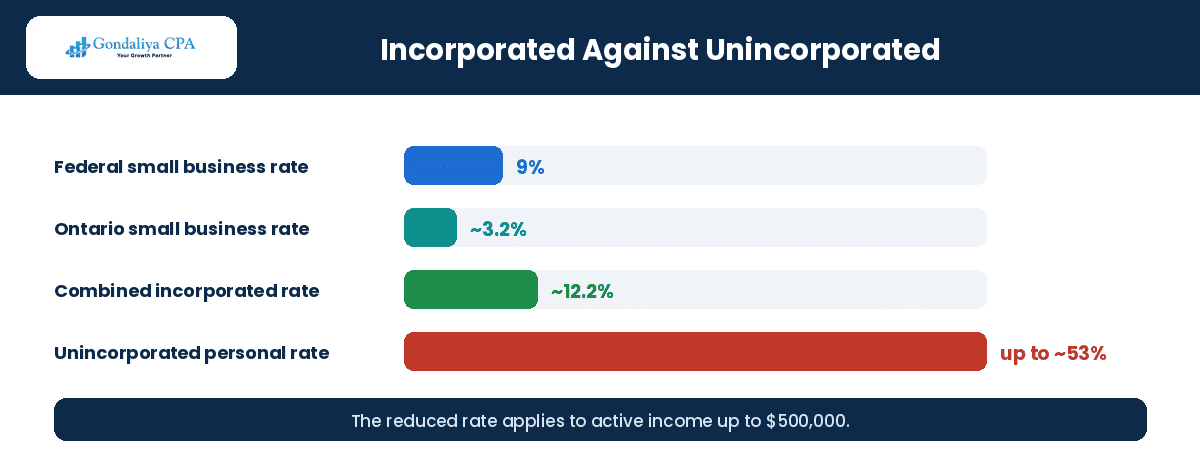
In Ontario, incorporated practices pay less tax thanks to the small business deduction (SBD). The federal corporate tax rate drops to 9% on active income up to $500,000. Ontario adds about 3.2% provincially. Unincorporated doctors pay personal marginal rates that can jump from around 20% up to over 53%, depending on income.
Keep in mind: If passive investment income inside the corporation passes $50,000 a year, the SBD phases out. That raises tax rates sharply. So, managing passive investments inside your corporation is key.
Here’s a quick look:
- Incorporated Practice: 9% federal + ~3.2% Ontario = ~12.2% combined
- Unincorporated: Personal marginal rates up to ~53%
This shows why many consider incorporating.
Impact on Take-Home Income and Long-Term Planning
Lower corporate taxes let you keep more money in the company. You can hold onto earnings for reinvestment or take them later as dividends or salary.
A healthcare CPA Canada guides clients on how to balance salary and dividends carefully. They also help with CPP contribution limits and RRSP room effects. Incorporation makes passing ownership easier too — like transferring shares when retiring — following college rules.
For example, we helped a Toronto family doctor switch from sole proprietorship to incorporation. By tweaking their pay mix, they improved after-tax cash flow without crossing passive investment limits.
Salary and Dividend Decisions in Remuneration Planning
Figuring out how much to take as salary versus dividends takes thought. You have to consider taxes, CPP payments, compliance, and retirement savings options.
Balancing Salary, Dividends, and CPP Contributions
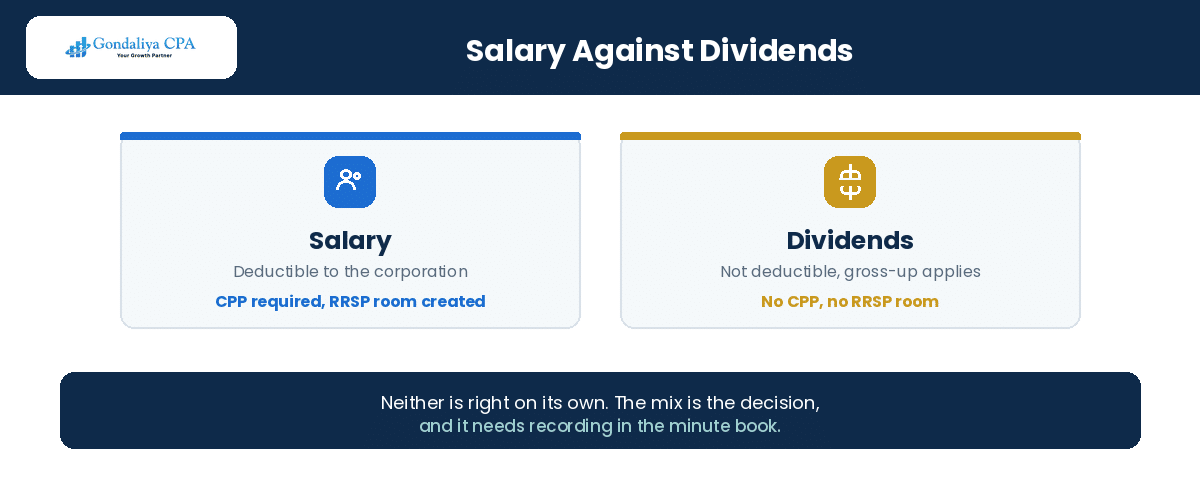
| Compensation Type | Tax Treatment | CPP Contribution | Retirement Savings Benefit |
|---|---|---|---|
| Salary | Deductible expense; taxed at marginal rate | Required up to max | Creates RRSP contribution room |
| Dividends | Not deductible; taxed at gross-up rate | No | No RRSP room created |
Advantages and Disadvantages of Each Approach
- Salary Advantages:
- Builds pensionable earnings under CPP
- Provides steady income
- Allows deductible employer benefits
- Salary Disadvantages:
- Payroll taxes apply (EI may be exempted)
- More admin work
- Dividend Advantages:
- Lower personal taxes if planned right (due to gross-up credits)
- No payroll remittance hassle
- Dividend Disadvantages:
- No RRSP room or CPP benefits gained
- Could get audited if CRA thinks pay is unreasonable under ITA s.67
A good healthcare tax accountant helps keep everything documented properly so CRA doesn’t challenge your payments under s.15 ITA rules.
Compliance with CRA Guidelines
CRA wants compensation to be reasonable for services done. This should be clear in board minutes or resolutions showing market rates in your specialty. If not followed, CRA might reassess your returns with penalties or treat dividends as taxable benefits, causing issues on both personal and corporate taxes.
At Gondaliya CPA, we stress clear engagement letters that set expectations about remuneration advice based on current laws — including changes coming in 2026 affecting capital asset expensing common in medical practices.
Need specific advice for your medical practice?
Contact Gondaliya CPA at 647‑212‑9559 or info@gondaliyacpa.ca for a free chat about improving your financial situation while staying within Canadian rules.
Pro Tip: Record the remuneration decision in the minute book in the year it is made, with a note on comparable market rates for the specialty. That document is what answers a reasonableness question years later.
Handling GST/HST for Physicians, Dentists, and Mixed Practices
Handling GST/HST for Physicians, Dentists, and Mixed Practices
The Sales Tax
Exempt and Taxable Supplies, Cosmetic Procedures, and Third-Party Billing
Physicians and dentists need to tell apart exempt supplies from taxable ones under Canadian GST/HST rules. Most medically needed services are exempt under the Excise Tax Act. But some services, like cosmetic treatments or reports billed to third parties, are taxable. Knowing these details helps with correct tax filing and following the rules.
Identifying Taxable Healthcare Services
Taxable healthcare services usually cover elective cosmetic work that isn’t medically necessary per provincial plans like OHIP. Things like Botox for looks or teeth whitening at dental clinics fall here. Also, medical exams done for insurance claims often have GST/HST because they’re not exempt professional services.
Doctors’ corporations should check their services carefully to mark each supply right. Getting this wrong can mean wrong tax filings or lost input tax credits (ITCs). Talking with a medical practice accountant Canada-wide helps make sure taxable and exempt supplies match CRA rules [CRA: GST/HST Info Sheet GI-131].
GST/HST Treatment for Cosmetic Procedures
Cosmetic work that isn’t seen as therapeutic by bodies like CPSO or RCDSO must include GST/HST—currently 13% in Ontario. Clinics offering both exempt health care and taxable cosmetic services should keep clear records showing income from each.
Invoices should show these charges separately. This cuts audit risks tied to limited ITC claims on expenses partly used in taxable work [CRA: Guide RC4022]. Not charging GST/HST on cosmetic procedures can bring penalties if the CRA checks your books.
Billing to Insurance Companies and Other Third Parties
Billing private insurers or other third parties adds complexity to how GST/HST applies. When fees reimburse insured health services, exemption usually applies.
But extra charges like report prep fees billed apart from care may have HST unless otherwise exempt [CRA: Interpretation Bulletin IT-496R3]. Doctor corporations must keep billing clear to meet CRA rules and professional standards.
GST/HST Registration and Input Tax Credits
Handling registration needs and claiming input tax credits can get tricky for incorporated healthcare practices in places like Toronto.
Who Must Register for GST/HST?
A physician’s corporation must sign up for a GST/HST account if its total worldwide taxable sales top $30,000 over four calendar quarters. This includes any non-exempt goods or services sold beyond patient care [CRA: Small Supplier Threshold].
Even if most money comes from exempt OHIP billings, revenue from taxable things like cosmetic work means registration is mandatory when the limit’s hit. You can also register voluntarily below that amount but must file returns regularly anyway.
Registering lets you claim input tax credits but brings ongoing duties like timely payments—a key factor when picking a healthcare-savvy CPA.
Maximizing Input Tax Credits
Input tax credits let registered practices get back GST/HST paid on business costs linked partly to commercial activity. This might be rent split between clinical use and admin tasks connected to taxable services [CRA: Guide RC4022].
Getting this split right avoids denied ITCs common when mixed-use assets exist in clinics that blend physician offices with taxed providers (like med spa retail).
Working with a medical practice accountant Canada-based helps set up proper records covering eligible expenses—from capital gear under correct CCA classes to everyday costs—boosting cash flow without triggering audit troubles per Income Tax Act s230 document rules requiring six years retention [Canada.ca].
Reporting and Filing Processes
Registered entities file regular electronic returns listing collected GST/HST minus claimed ITCs through CRA’s My Business Account portal or approved EFILE software like QuickBooks or Xero. Top firms such as Gondaliya CPA handle many Toronto clients this way.
Filing late risks penalties of 1% monthly up to 12 months plus interest; keeping an eye on deadlines lowers risk during year-end reconciliations before submitting corporate T2 returns with full health & sales tax info reviewed carefully as per Canadian federal-provincial laws current through 2026 updates affecting small business deductions [CRA Circulars & Notices].
Key Stat: Hitting $30,000 in taxable revenues triggers required GST/HST registration—even if only some income comes from taxable supplies (Source)
Statutory Requirement: Keep financial records supporting exemptions/registrations for six years under Income Tax Act s230 (Source)
Pro Tip: Separate invoices by exempt vs taxable items right when billing—they make audits simpler
Risk Warning: Treating cosmetic revenues as exempt wrongly can cost money in reassessments plus penalties
Our Take: Choosing a CPA familiar with healthcare accounting keeps your practice’s finances sound
For tailored help with your clinic’s mix of billings under Canada’s complex health & sales tax rules call Gondaliya CPA at 647‑212‑9559 | info@gondaliyacpa.ca – free consults across Toronto/Ontario.
Apportionment is where mixed practices lose money quietly. Rent and utilities partly supporting taxable work carry recoverable tax, and clinics that treat everything as exempt simply never claim it. Figures changed for privacy.
Essential Deductions and Practice Expenses for Canadian Medical Professionals
Essential Deductions and Practice Expenses for Canadian Medical Professionals
The Deductions
Medical professionals in Canada face some tricky accounting rules. Incorporation, billing, and regulations all mix up finances. A healthcare CPA Canada or medical practice accountant Canada knows these rules well. They help you get the right tax deductions without problems. Keeping track of deductible expenses keeps your practice’s money healthy.
Practice Overhead, Equipment, Continuing Education, and Home Office Costs
A healthcare tax accountant knows overhead costs hit incorporated doctors hard. These include rent, utilities, office supplies, medical gear leases or buys, mandatory continuing education fees, and home office costs if you work from home.
Each type has CRA rules about what you can deduct:
- Overhead: Rent for your clinic counts if it’s only for business.
- Equipment: Big assets like diagnostic machines go under specific CCA classes with set depreciation.
- Continuing Education: Fees that keep your license valid or improve skills are deductible.
- Home Office: Only counts if you use it regularly and just for admin work. You must be fair in how you split expenses.
A medical practice accountant Canada makes sure these claims follow CRA rules and avoid audits.
Deductible Expenses: What Counts?
Not every cost is deductible. Healthcare tax accountants tell clients to focus on “reasonable” expenses under ITA s.67 that relate to making income.
Typical deductible items are:
- Professional dues (like CPSO fees)
- Malpractice insurance
- Staff salaries including associates
- Clinic supplies used during patient care
- Leasehold improvements needed for running the office
- Vehicle costs based on business use with proper logs
Personal expenses dressed as business ones can cause penalties. A CPA for doctors helps avoid costly mistakes by knowing these fine lines.
Managing Practice Overhead and Equipment Purchases
Keeping overhead in check means careful tracking of monthly costs using bookkeeping software like QuickBooks or Xero with Hubdoc receipt capture.
Starting 2026, small businesses including many physician corporations can fully expense certain capital purchases in the year bought instead of spreading depreciation over years (per CRA).
This helps practices investing in new tech but needs careful classification between capital and regular expenses. A healthcare CPA Canada familiar with CRA’s immediate expensing rules and CCA classes like Class 8 (20% declining balance) guides this process well.
Continuing Education and Professional Fees
Doctors must keep up certification by taking courses paid personally or via their corporation budget. Medical practice accountants Canada verify which courses count as business expenses per CRA.
Generally, courses required by licensing bodies like CPSO’s mandatory CME credits qualify fully. Optional seminars not linked to clinical duties might not count.
Professional fees include yearly registration renewals necessary to practice legally within Ontario’s colleges like CPSO or RCDSO. Proper records ensure deductions match the correct fiscal year on T2 returns.
Optimizing Home Office Deduction
If you work from home sometimes, you can claim a home office deduction but only if the space is clearly set aside for admin tasks related to your incorporated practice (CRA rule).
You may deduct utilities proportional to the workspace size versus whole house plus internet bills tied to business use.
Healthcare tax accountants suggest keeping good records: floor plans showing work area size and saving utility bills for at least six years per ITA s.230 — useful if CRA asks for proof later.
Billing Reconciliation, Revenue Management, and Overhead Splits
Billing reconciliation is key for keeping revenue accurate in any medical practice. Physicians often juggle OHIP fee-for-service payments plus private billings like cosmetic services subject to GST/HST taxes. Healthcare CPA Canada teams know how to handle mixed supply rules so you stay compliant with CRA exempt vs taxable services laws.
Best Practices for Billing Reconciliation
Reconciliation means matching OHIP payments received against bills logged using accrual accounting suited for physician corporations tracking locums’ billings separately from associates’ shares.
Steps include:
- Logging daily patient visits crosschecked against electronic billing submissions.
- Quickly following up on overdue receivables beyond usual terms.
- Separating government-funded exempt services from taxable third-party billings and adjusting input tax credits accordingly.
Using automated systems linked with Wagepoint payroll simplifies associate pay calculations tied to overall revenue split monitored by a trusted medical practice accountant Canada.
Revenue Tracking and Allocation
Medical practices get money from many places—monthly OHIP payouts plus client invoices right after services need detailed tracking set up around charts-of-account designed by healthcare CPAs experienced with Canadian doctor offices.
Correct allocation avoids mistakes that affect taxable income levels tied to small business deductions federally combined with Ontario provincial rates changing in 2026 that impact corporate taxes due.
Overhead Splits Among Partners and Associates
In clinics where several providers share space but run separate corporations—or have associates—the way overhead gets split should match market values documented well in shareholder agreements updated regularly.
CPA for doctors help create fair splits covering rent shares per doctor numbers plus shared staff salaries while avoiding accidental shareholder benefits caught by ITA s15 rules.
Health Spending Accounts and Employee Benefits in Medical Practices
Health spending accounts (HSAs) give incorporated doctors flexible ways to pay health expenses outside traditional group plans. Employers contribute money that lowers taxable income when done right — an approach known well by healthcare tax accountants watching changing laws on employee benefits tailored to medical offices’ needs.
Keep all receipts supporting expense claims at least six years after filing per ITA s230; missing this risks reassessment even after usual timeframes end.
For advice on structuring your incorporation expenses call Gondaliya CPA at 647‑212‑9559 or info@gondaliyacpa.ca. We offer free consultations backed by 1300+ five-star Google reviews helping Toronto area physicians across Ontario and beyond.
Overhead splits between associates are the arrangement most often undocumented and most often questioned. Where the shareholder agreement says nothing, the CRA is free to characterise the difference as a benefit. Figures changed for privacy.
Succession, Retirement, and Estate Planning for Healthcare Providers
Succession, Retirement, and Estate Planning for Healthcare Providers
The Long View
Succession, retirement, and estate planning matter a lot for healthcare professionals in Canada. They help secure your financial future. Working with a healthcare CPA Canada or a medical practice accountant Canada helps you follow professional corporation rules. Plus, it makes your taxes more efficient. A CPA for doctors knows the special rules for incorporated practices in Ontario and across the country.
Individual Pension Plan (IPP) and Lifetime Capital Gains Exemption (LCGE)
Healthcare providers gain from tools like the Individual Pension Plan (IPP) and Lifetime Capital Gains Exemption (LCGE). These need knowledge from a healthcare tax accountant or healthcare CPA Canada who understands physician corporations’ needs well.
How IPPs Work and Their Tax Benefits
An IPP is a defined-benefit pension plan made for business owners like incorporated doctors. It lets you contribute more than RRSPs after age 40. This gives steady retirement income. Contributions from the corporation reduce taxable income since they are deductible expenses. The plan also protects assets from creditors, which personal savings do not offer.
Tax benefits include:
- Deductible corporate contributions.
- Growth inside the pension fund without tax now.
- Possibly lower taxes when taking money out at retirement compared to salary or dividends.
A CPA for doctors can set up an IPP based on your age, income, and goals to get the best results.
Lifetime Capital Gains Exemption for Medical Professionals
The LCGE lets shareholders in small business corporations exempt up to $971,190* of capital gains on shares sold during succession events (check CRA for exact numbers). Medical pros with incorporated practices following provincial rules—like CPSO certificates—can use this exemption if share ownership fits college rules.
A medical practice accountant Canada helps arrange shares before selling or transferring them. This way, clients qualify fully without bad tax surprises from passive investments or breaking professional corporation rules.
Succession and Estate Planning Strategies
Good succession planning gets your practice ready to pass on smoothly with little fuss. Some strategies are:
- Making buy-sell agreements that match shareholder eligibility under regulator rules.
- Using trusts when allowed by Ontario Business Corporations Act.
- Changing corporate setup well before retirement.
Estate planning fits in by making sure assets go where you want them. It also uses lifetime exemptions smartly. A healthcare CPA Canada helps align plans with laws for professional corporations in Toronto and Ontario.
Accounting Technology Used: Software Integration and Process Efficiency
New accounting tech improves accuracy and speed when handling medical billing’s complexity. A medical practice accountant Canada makes sure software fits health sector needs including OHIP billing quirks.
Recommended Accounting Software for Medical Practices
Popular software accountants suggest includes QuickBooks Online, Xero, Hubdoc plus payroll tools like Wagepoint or ADP suited for doctor payrolls with locums or associate splits. These systems help:
- Auto bank feed matching
- Expense tracking live
- Custom reports meeting CRA filing rules
Choosing software all teams can use cuts mistakes common when mixing exempt services with taxable ones—a problem clinics see when offering cosmetic alongside insured care.
Streamlining Workflow with Cloud Solutions
Cloud accounting lets CPAs check cash flow anytime without disturbing busy clinics. This works well for CPAs handling many locations across Toronto/Ontario who must file on time while using secure shared digital spaces following Canadian privacy laws.
Automation for Payroll and Expense Management
Automation eases repeat jobs like payroll remittances including CPP/EI calculations plus sorting expenses right. This is key when paying associates properly under ITA s67 reasonableness rules that CRA audits often check in physician corporations nationwide handled by skilled healthcare tax accountants.
CRA Representation, Compliance Support, and Audit Response
A good healthcare tax accountant helps get ready early for audits by making sure records meet CRA’s strict storage rules (§230 ITA), usually six years after year-end filing.
Audit Preparation and CRA Representation
Preparation means checking T2 returns are full and correct with active business income claims after small business deduction changes coming post-2026 federal updates that affect incorporated SMBs including physician offices in Ontario’s area.
Maintaining Compliance With Regulatory Bodies
Healthcare CPAs keep you following not just federal taxes but also college mandates on shareholder makeup yearly renewed through CPSO/RCDSO certificates to avoid big fines from accidental breaches.
Ongoing Support And Advisory Services
CPAs advise all year on pay mixes balancing salary/dividends avoiding split-income risks after incorporation plus quick advice as laws change impacting clinic incomes from OHIP billings or GST/HST on cosmetic care.
Service Structure, Fee Models, And Annual Engagement With Gondaliya CPA
Gondaliya CPA offers clear service plans just for health pros needing deep expertise beyond general firms focusing on fixed fees so no surprise bills pop up later.
Overview Of Engagement Models
Clients pick full yearly packages covering bookkeeping fixes to T2 filings backed by compilation engagements done only by licensed public accountants registered at CPA Ontario—this keeps things clean through the work period.
Fixed vs Value-Based Fee Structures
Fixed fees give budgeting peace of mind liked by busy docs while value-based fees match charges to case complexity like multiple corporations juggling locums/associate costs needing detailed models done regularly at Gondaliya CPA made to fit client needs clearly outlined upfront per CSRS 4200 compilation standards.
Annual Review And Strategic Planning Sessions
Each year’s review updates forecasts factoring new immediate expensing starting 2026 that boosts capital cost allowance on new equipment often needed to keep clinics modern plus one-on-one talks spotting issues early cutting risk of costly re-checks later.
Year-End Tax Review And Strategic Planning For Medical Professionals
Year-end checks done by skilled medical practice accountants canada zoom in on maxing out deductions such as education costs fully allowed under s18(1)(a). They also make sure receivables tie up correctly using billed-basis accounting rules unique to regulated professions so no hidden debts linger before final electronic filing done securely on time across Toronto/Ontario areas served widely.
Contact Gondaliya CPA today at 647‑212‑9559 or info@gondaliyacpa.ca — for a free consult focused on securing your finances with expert healthcare accounting help trusted across Canada.
*Figures marked illustrative unless stated otherwise.*
Share structure decided at incorporation is what makes an exemption available a decade later. Reorganising close to a sale is possible but slower, costlier and constrained by the college rules. Figures changed for privacy.
Key Stat: An IPP allows higher contributions than an RRSP after age 40, and those contributions are deductible to the corporation while the fund grows without immediate tax.
Frequently Asked Questions (FAQ)
Frequently Asked Questions (FAQ)
FAQ
What is input tax credit apportionment for healthcare professionals?+
Input tax credit apportionment divides GST/HST paid on shared expenses between taxable and exempt supplies. It ensures correct ITC claims compliant with CRA rules.
How does the Tax on Split Income (TOSI) affect incorporated medical practices?+
TOSI restricts dividend income splitting with family members unless specific conditions are met. A healthcare CPA helps structure income to minimize TOSI impact.
Will Gondaliya CPA represent my practice if CRA audits my corporation?+
Yes. Gondaliya CPA offers full CRA representation, handling audit documentation, communication, and compliance issues for medical professional corporations.
Is Gondaliya CPA’s fee structure clear and fixed?+
Gondaliya CPA provides transparent, fixed fees outlined in writing. Clients know costs upfront, avoiding surprises while receiving tailored healthcare accounting services.
What is the difference between a bookkeeper, accountant, and licensed CPA firm for medical practices?+
Bookkeepers handle data entry and transactions. Accountants provide financial reports and basic tax filing. Licensed CPA firms offer strategic tax planning, audits, and regulatory compliance expertise.
What should a medical practice ask before signing an engagement letter with a healthcare CPA?+
Ask about service scope, fees, deliverables, compliance support, audit assistance, and how they handle updates in healthcare regulations.
How does Gondaliya CPA onboard a new medical practice client?+
We assess current finances, set up tailored accounting software, clarify regulatory needs, and define communication channels to ensure smooth integration.
What deliverables can a doctor expect from a healthcare CPA?+
Monthly bookkeeping summaries, tax filings (T2), remuneration advice, billing reconciliations, GST/HST returns, audit support, and annual financial reviews.
How much does hiring a CPA cost for a Canadian medical practice?+
Costs vary by service complexity but typically range from fixed annual packages covering bookkeeping to full tax filings tailored for doctors’ corporations.
What are warning signs of choosing the wrong accountant for my clinic?+
Lack of healthcare sector knowledge, unclear fees, poor communication on regulatory changes, or no audit support may indicate an unsuitable accountant.
Selection Criteria: Choosing the Right Healthcare CPA for Your Practice
Selection Criteria and Switching Firms
Quick Reference
- Expertise in medical professional corporation rules across Canadian provinces.
- Experience with OHIP billing reconciliations and mixed taxable/exempt supplies.
- Knowledge of GST/HST input tax credit apportionment specific to clinics.
- Ability to provide clear remuneration planning aligned with TOSI rules.
- Proven track record in CRA representation during audits or reviews.
- Transparent fee structure clearly stated before engagement.
- Strong integration skills with common medical accounting software like QuickBooks or Xero.
- Dedicated annual reviews and strategic financial planning sessions.
Quick Comparison Table: Bookkeeper vs Accountant vs Licensed Healthcare CPA
| Role | Main Focus | Healthcare Expertise | Tax Planning Ability | CRA Audit Support |
|---|---|---|---|---|
| Bookkeeper | Data entry & transaction tracking | Low | None | None |
| Accountant | Financial reporting & basic filings | Moderate | Limited | Limited |
| Licensed Healthcare CPA | Compliance & strategic advisory | High | Comprehensive | Full representation |
What Should You Prepare Before Your First Consultation?
- Latest financial statements and corporate tax returns (T2).
- Clinic billing reports including OHIP payments and private billings.
- Shareholder agreements if incorporated under professional corporation rules.
- Details on salary vs dividend payments made previously.
- List of significant expenses including capital asset purchases.
- Current GST/HST filings and registration status documentation.
How Do You Switch Accountants Without Disrupting Filings?
- Notify current accountant formally about transition date.
- Gather all bookkeeping files and past tax filings.
- Ensure new healthcare CPA has access to bank feeds and billing systems.
- Confirm deadlines for upcoming GST/HST or T2 returns.
- Schedule onboarding session with new firm to align expectations.
- Monitor filing progress closely during first few months.
Why Trust Gondaliya CPA?
Sharad Gondaliya holds dual Canadian & US CPA licenses with 10+ years helping doctors across Canada optimize taxes legally. Our team stays current on health sector changes such as 2026 passive income rules impacting physician corporations while providing personalized attention in Toronto/Ontario region.
The comparison table is worth taking seriously. Most practices that arrive unhappy were not badly served; they were served by someone doing a different job from the one they needed. Figures changed for privacy.
Industry Spotlights: Sectors We Represent
Industry Expertise
What a specialist accountant actually adds differs by sector. Here are eleven and where the expertise shows.
| Industry | Where Sector Knowledge Matters Most |
|---|---|
| Medical doctors & physician corporations | College rules, OHIP reconciliation, remuneration mix |
| Dentists & dental practices | Mixed exempt and taxable supplies, associate splits |
| Daycare, childcare & CWELCC services | Subsidy timing and payroll structure |
| Consulting firms | Pay mix on variable income, home office claims |
| Restaurants & food and beverage | Cash reconciliation and platform commissions |
| E-commerce & online retailers | Marketplace fees and multi-province sales tax |
| Construction, contractors & skilled trades | Worker classification and source deductions |
| Property developers & builders | Cost allocation across entities |
| Real estate investors & holding companies | Passive income and shareholder loan tracking |
| Technology startups & SaaS | Deferred revenue and equipment expensing |
| Transportation, logistics & trucking | Vehicle classes and mileage substantiation |
- Medical doctors & physician professional corporations: College share rules, OHIP reconciliation and a defensible remuneration mix all have to work together.
- Dentists & dental practices: The blend of exempt clinical and taxable cosmetic work makes apportionment the hardest part.
- Daycare, childcare & CWELCC services: Subsidy revenue timing and payroll structure carry the documentation burden.
- Consulting Firms: Uneven income makes the salary and dividend decision a cash flow question as much as a tax one.
- Restaurants & food and beverage: Cash reconciliation and platform commissions netted off deposits are the recurring gaps.
- E-commerce & online retailers: Marketplace fees and sales tax varying by destination mirror the mixed-supply problem clinics face.
- Construction, general contractors & skilled trades: Worker classification and source deduction accuracy carry the exposure.
- Property developers & builders: Costs shared across entities need a documented allocation basis.
- Real estate investors, landlords & holding companies: Passive income and shareholder loans both erode the position quietly.
- Technology startups & SaaS: Deferred revenue and equipment expensing decide what the statements actually show.
- Transportation, logistics & trucking: Vehicle capital cost allowance classes and mileage substantiation govern what is claimable.
The common thread is regulation. Every sector on this list answers to someone beyond the CRA, and the accountant who knows only the tax half will eventually get the other half wrong. Figures changed for privacy.
Professional Guidance and Quick Reference
Guidance
Professional Guidance on Healthcare Accounting: How Gondaliya CPA Supports Canadian Medical Practices
Choosing a firm for a medical practice is not the same as choosing one for any other business. The corporation answers to a college as well as to the CRA, most of its revenue is exempt while some of it is not, and the owner’s pay has to satisfy a reasonableness test. Gondaliya CPA works with all four of those at once, on a fixed fee.
We handle what decides the outcome: keeping the certificate of authorization and share structure inside college rules, reconciling OHIP and private billings against what was actually received, apportioning input tax credits between exempt and taxable supplies, setting the salary and dividend mix with the reasoning recorded in the minute book, classifying equipment and leasehold spend correctly, documenting overhead splits between associates, and preparing the T2 with the evidence behind every position.
Our team works from your own billing, payroll and clinical data rather than a template. Single practitioner or multi-provider clinic, you get clear advice and a fixed price before we start.
Quick Answers: Key Numbers & Concepts at a Glance
At a Glance
- Federal small business rate: 9% on active income to $500,000
- Ontario small business rate: About 3.2%, combined near 12.2%
- Unincorporated: Personal marginal rates up to about 53%
- Passive income threshold: $50,000 before the SBD phases out
- GST/HST registration: $30,000 of taxable supplies over four quarters
- Ontario HST on cosmetic work: 13%
- Class 8: 20% declining balance on equipment
- Lifetime capital gains exemption: Up to $971,190
- GST/HST late filing: 1% monthly, up to 12 months, plus interest
- Record retention: Six years under ITA s.230
Who This Is For / Not For
Fit Check
- For: Incorporated medical, dental and allied health practices wanting a firm that understands college rules, mixed supplies and remuneration planning together.
- Not For: Unincorporated practitioners with straightforward personal filings, where the compliance picture is considerably lighter.
People Also Ask
Quick Answers
Can my spouse hold shares in my professional corporation?+
It depends on your college. Some permit limited family holdings and some do not, and TOSI then governs whether dividends to them are taxed at the top rate.
Do I need to register for GST/HST if I only bill OHIP?+
Not on OHIP work alone, since it is exempt. Once cosmetic, third-party or other taxable revenue crosses $30,000 over four quarters, registration becomes mandatory.
How long does switching accountants actually take?+
Usually a few weeks. The constraint is access to bank feeds and billing systems, not the handover of files, so start before a filing deadline rather than after.
Glossary of Key Terms
Plain-English Definitions
- Professional corporation: A corporation a regulated professional may practise through.
- Certificate of authorization: The college permission to operate as a professional corporation, renewed annually.
- Small business deduction: The reduced corporate rate on active income up to $500,000.
- Passive investment income: Investment earnings inside the corporation that can erode the deduction.
- Exempt supply: A service with no GST/HST charged and no input credits claimable.
- Taxable supply: A service on which GST/HST must be charged, such as cosmetic work.
- Input tax credit: GST/HST paid on business purchases and recoverable on a return.
- Apportionment: Splitting input tax credits between exempt and taxable activity.
- Billing reconciliation: Matching OHIP and private billings to amounts actually received.
- Salary and dividend mix: The chosen balance of owner pay between the two forms.
- TOSI: Tax on Split Income, which taxes unreasonable family payments at the top rate.
- Reasonableness test: The section 67 requirement that an expense amount be reasonable.
- Individual Pension Plan: A defined-benefit plan allowing higher contributions than an RRSP after age 40.
- Lifetime capital gains exemption: The exemption available on qualifying small business shares.
- Overhead split: How shared clinic costs are divided between providers or corporations.
- Health spending account: A corporate plan reimbursing health costs as a business expense.
Healthcare CPA Fit Check
This quick self-check indicates where your operation most likely has room. Please answer the six questions below.
Healthcare CPA Fit Check
Six quick questions on your practice. No fee shown.
Points to raise with us:
This is a general prompt, not tax or legal advice or a quote. Your position depends on your full facts. For a real review, please book a free consultation.
Want a checklist to work from? You can download our free healthcare CPA selection checklist before your consultation.
Ask any prospective firm which colleges they deal with and how many healthcare clients they act for. Confirm they can apportion input tax credits across mixed supplies. Have the share structure checked against college rules before shares are issued. Review the pay mix annually rather than repeating it. Watch passive income against the $50,000 threshold. Get the fee in writing before work starts.
2026 Update — what is current: Immediate expensing on certain capital purchases applies from 2026, and passive income rules affecting physician corporations change in the same year. The $500,000 small business limit, the $50,000 passive income threshold, the $30,000 GST/HST registration threshold, Class 8 at 20% and the six-year retention rule are unchanged. Please confirm the current lifetime capital gains exemption figure with the CRA before relying on it.
Healthcare CPA Canada: Expert Medical Practice Accountant Services for Doctors and Professional Corporations by Gondaliya CPA
A firm that knows both regulators
Gondaliya CPA keeps your share structure and certificate inside college rules, reconciles OHIP and private billings, apportions input tax credits correctly, sets and documents the remuneration mix, classifies equipment and leasehold spend, and prepares the T2 with the evidence behind every position, on a fixed fee with a one-business-day response. Please book a free consultation.
Next Steps
Please book a free consultation with Gondaliya CPA and bring your last T2, a recent billing report covering both OHIP and private work, and your shareholder agreement if one exists. Those three show within minutes where a healthcare-specific firm would do things differently. You will get a fixed fee before any work begins. If our content helps, please add gondaliyacpa.ca as a preferred source on Google.
Published: August 17, 2026 · Last updated: August 17, 2026
Editorial policy: We research against CRA and CPA Ontario sources, fact-check the figures, and Sharad Gondaliya, CPA, reviews the content, which we update as the rules change.
Disclaimer: This article is educational information only and is not tax, legal, or financial advice. Figures marked illustrative are examples rather than quotes or guarantees. It reflects CRA rules current to 2026, including the 9% federal and approximately 3.2% Ontario small business rates, the $50,000 passive investment income threshold, the $30,000 GST/HST registration threshold, and the six-year record retention requirement under ITA s.230. Rates, limits and expensing rules change and outcomes depend on your specific facts. Please consult a CPA Ontario member before acting.

Sharad Gondaliya is a CPA Canada & CPA USA with 15 Years+ experience of Accounting, Tax, Payroll of Corporate Small Businesses as Tax Accountant. He is a CPA Ontario member (61040184) and holds US CPA licences in Washington and Montana and is well known among corporate small businesses for tax planning, efficient tax solutions, and affordable CPA services. Sharad is the Principal (Director) of Gondaliya CPA – Affordable CPA Firm in Canada. Licenses: CPA Ontario: 61040184 | CPA USA (MT): PAC-CPAP-LIC-033176 | CPA USA (WA): 57629 | CPA Firm License: 61330051 View Full Author Bio